Case—Optimizing Food Donation Delivery for Nonprofit Company Logica&Co
Abstract
The case addresses a real-world challenge encountered by the nonprofit organization Logica&Co. It revolves around optimizing the logistics involved in collecting food donations from local businesses and delivering them to soup kitchens, utilizing a fleet of bike riders. The focus is identifying efficient strategies to minimize transportation and warehouse costs while maximizing the impact of the donations and private sponsor monetary contributions. The study includes tasks such as determining optimal bike and e-bike warehouse locations and managing the allocation of resources among riders and soup kitchen volunteers.
1. Appeal on Social Media
“Welcome to our page.
We are the , an Italian nonprofit company founded in 2023 in Rome thanks to a crowdfunding initiative involving more than 50 donors, which started one year ago.
Our primary mission is to minimize food and beverage industry waste by implementing a centralized collection and distribution system while promoting the economic sustainability of soup kitchens1 and homeless shelters. We aspire to aid community groups by gathering surplus food from local markets, bakers, and greengrocers and distributing them to the public and/or socially valuable organizations as supplies. Currently, our operations have received approval in four districts in the northern area of the city, thanks to the collaboration of 50 local businesses and a group of environmentalist volunteers. We are profoundly grateful for their support! Follow us on social media to stay updated on our needs and how you can assist us.
How does our business work?
Each soup kitchen requires specific (known) quantities of food and beverages to prepare meals twice a day, with volunteers handling the cooking processes. Our plan involves daily collection of goods from local businesses and their delivery to soup kitchens, utilizing cargo bikes and e-bikes operated by paid riders. The types of vehicles differ in terms of the volume they can carry and operational costs. Daily product availability varies and cannot be predicted in advance; however, with the assistance of our partners, we have reasonably estimated the average daily supply from each local business. In outline, key decisions for our business concern (i) determining the size of our fleet (number and type of bikes to be acquired), (ii) the composition of our employee group (number of riders to be hired), (iii) identifying warehouses’ location, and (iv) establishing the most efficient delivery routes.
How can you support us?
Our founders lack the skills to professionally approach this wide range of decisions involving numerous and complex tradeoffs. Therefore, we invite our followers, who may possess the necessary competencies, to lend their support. We need your assistance in formulating a decision-support model for managing the pick-up and delivery operations in the upcoming semester. The model must identify the optimal allocation and assignments for each resource. Our solution simulator (SoS) can assess and evaluate any proposed solutions, and we recommend using it as an assessment tool to enhance your model.
Time is short, but we are confident that some of our followers are able to develop the most effective solution. Let us give assistance to those most in need and reduce food waste in Rome!”
2. System Characteristics
In the following, we provide a thorough overview of Logica&Co’s internal organizational structure and the key features of the local community network.
Logica&Co is required to define an effective strategy for collecting and delivering food and beverage donations over a semester, considering a total of 22 working days per month. The objective is to maximize the company’s profits, which are defined as the sum of soup kitchens’ savings (interpreted as profits) and investors’ donations, minus the incurred logistics costs. Part of the duties entails identifying optimal warehouse locations, coordinating the activities of riders and volunteers, and determining the optimal size of the vehicle fleet (see Sections 2.1.2, 2.3, and 2.4).
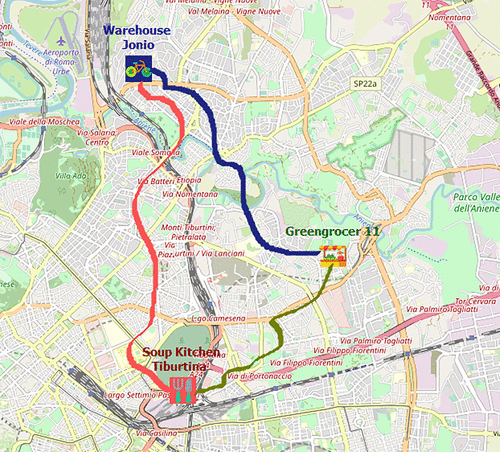
Figure 1 illustrates a potential logistic flow for the Logica&Co service, where a rider departs from a warehouse, collects daily goods donations from a single local business, and transports the goods to a designated soup kitchen. After completing the delivery, the rider returns to the initial warehouse. Notice that a logistic flow is viable only when it conforms to the constraints associated with the type of bike used (refer to Section 2.3).
2.1. Soup Kitchens
The Logica&Co supplies three soup kitchens: Sant’Alessandro, Santa Colomba, and Tiburtina. Each of them requires specific minimum (known) quantities (expressed in kilograms) of bread, fruits and vegetables, and general goods to be ready to serve meals twice a day. Soup kitchens can absorb food products in addition to the minimum requests, according to system constraints and cost-effectiveness.
2.1.1. Potential Savings.
The soup kitchens receive from Logica&Co, as a donation, part of their daily need in food and beverages, with a corresponding savings in supplies. In particular, each delivered product allows for differentiated monetary savings for bread, fruits and vegetables, and general goods (measured in euros per kilogram). Clearly, the higher the weight of products delivered, the higher the gain for the soup kitchens’ economic sustainability. However, the products’ collection and delivery are always associated with costs for transport (e.g., vehicle acquisition, energy, riders’ salary) and the cost of warehouse management.
2.1.2. Person-hours.
Any delivered products must be taken into charge and checked for quality (e.g., freshness). These operations are carried out by (unpaid) volunteers, who can individually process and arrange a maximum of 18 kilograms of products daily. Considering that the overall number of volunteers at Logica&Co is 110, the organization needs to determine the allocation of volunteers to each soup kitchen daily.
2.2. Local Businesses
At the current state, Logica&Co is affiliating three types of food and beverages shops: bakers, greengrocers, and supermarkets. Many local businesses joined the project for each category, making the groups numerically heterogeneous: 10 bakeries, 20 greengrocers, and 20 supermarkets. Given that Logica&Co fixed a minimum daily need for each product type, a minimum number of pick-ups covering all three categories must occur daily.
Each local business can be visited for pick-ups at most once a day. Thanks to the local business management expertise and experience, it was possible to estimate the average supply available at each bakery, greengrocer, and supermarket with reasonable approximation. Clearly, the higher the number of local businesses joining the project, the higher the potential economic savings for the charities. On the other hand, having many local businesses is also associated with higher complexity and increments in transport and operator costs (see logistic flow).
2.3. Vehicles
For the transport operations, Logica&Co chooses to exclusively use bikes and e-bikes (i.e., motorized bicycles with an integrated electric motor used to assist propulsion). The two kinds of vehicles differ in technical characteristics. In particular, because of the impact on the riders’ physical health and security, the maximum range (in kilometers) and maximum load capacity (in kilograms) present lower thresholds for the bikes than the e-bikes. As a result, some delivery duties, particularly loading or far from warehouses’ locations, can be carried out using only e-bikes.
2.3.1. Vehicle Fleet Acquisition.
The purchasing costs vary depending on the type of vehicle and are detailed in the data file (in euros). Each bike or e-bike composing the fleet is purchased on a one-off basis, and it is considered available and productive for the entire planning time horizon (six months).
Logica&Co strategically chooses to finance the fleet acquisition exclusively through funds provided by external sponsors (refer to Section 2.5). Sponsors can invest in bikes, e-bikes, or both. Consequently, the investments made by sponsors must collectively cover the overall expenses associated with the fleet.
2.3.2. Advertising Spaces as a Reward.
In optimizing the fundraising activities, Logica&Co offers advertising spaces as a reward for each monetary donation from sponsors. For this purpose, patches (permanent or temporary) are placed on vehicles’ bodies or loading areas. Notice that the loading area of e-bikes allows for bigger spaces.
2.4. Warehouses
The nonprofit company has identified five warehouse locations as adequate for the fleet’s nighttime parking: Jonio, Labia, Settebagni, Settecamini, and Talenti. Each warehouse can accommodate either bikes or e-bikes; any mixed storage is avoided as only some of the warehouses are equipped with electric charging infrastructures (namely, Settebagni, Settecamini, and Talenti). The data file reports all warehouses’ specific capacities (number of vehicles that can be stored) and allowed vehicle types (bikes or e-bikes).
2.4.1. Energy Costs (e-Bike Warehouses Only).
The e-bikes need to be recharged during nighttime parking, and this process requires a specific amount of energy (kilowatt-hours). Logica&Co purchases the energy on a one-off basis, separately for each warehouse, at a rate denoted as T (in euros per kilowatt-hour). This rate follows a stepwise pricing structure where the cost per kilowatt-hour changes based on reaching a certain threshold, denoted by . Figure 2 illustrates the tariff system. For each warehouse, energy consumption below the threshold is charged at a lower tariff rate, denoted as Tlow, whereas consumption exceeding this threshold is subject to a higher tariff rate, denoted as Thigh.
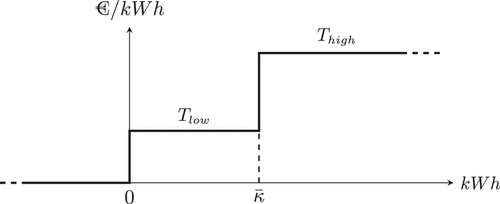
For instance, consider the scenario where deliveries originate from both Talenti and Settecamini warehouses. If the energy consumption exceeds the threshold only for the Talenti warehouse, Logica&Co would pay as follows:
The lower tariff Tlow for all kilowatt-hours consumed in Settecamini, as the threshold is not reached;
The lower tariff for the kilowatt-hours consumed up to the threshold in Talenti;
The higher tariff Thigh for any additional kilowatt-hours consumed beyond the threshold in Talenti.
2.4.2. Human Resources Costs: Riders Expressed in Person-Hour Need.
Employed riders operate the collection and redistribution of donated goods. Each rider is responsible for an assigned vehicle and therefore appointed to a warehouse. Their daily activities include departing from their warehouse of reference, reaching one and only one local business for the collection of the goods and one and only one soup kitchen for the goods delivery, and going back to the warehouse base (Figure 1). The data file reports any possible origin-destination path length (in kilometers).
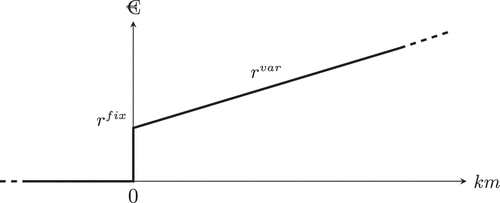
The riders’ daily salary comprises a minimum fixed amount and a variable quota based on the distance traveled, with the salary structure (fixed and variable components) varying according to the type of vehicle used. Figure 3 illustrates the rider tariff system. For example, consider the path outlined in Figure 1. If a rider from warehouse Jonio collects a donation from Greengrocer 11 and delivers it to the soup kitchen Tiburtina, their total distance traveled would be km. Given that the rider departs from a warehouse that accommodates only bikes, their daily salary would be composed of the fixed remuneration of euros and the variable remuneration of euros per kilometer traveled, resulting in a total of euros. Considering all the data and constraints, Logica&Co must determine the number of riders operating in each warehouse.
2.4.3. Fixed Costs.
Logica&Co considers a warehouse operational if it hosts at least one bike/e-bike for nighttime parking throughout the semester. Because of variations in location and capacity, each warehouse incurs a different fixed rental fee (in euros).
2.5. Sponsors’ Investments
External investments from various sponsors finance the fleet acquisition. To encourage substantial donations, Logica&Co offers a symbolic reward in advertising space. As anticipated, advertising patches representing the sponsors’ logos are applied on the vehicles’ bodies and loading areas: the number and dimension of the patches are calibrated on the donation amount. The company received interest from 10 potential sponsors. However, because of limited advertising space, constrained by the fleet size, Logica&Co decided to accept donations from a maximum of 5 sponsors out of 10 applications.
Each sponsor has the option to invest exclusively in bikes, exclusively in e-bikes, or in both markets simultaneously. Additionally, each sponsor has a maximum willingness to pay, denoted as , representing the upper limit of capital sponsor i is willing to allocate to a specific market (where b represents bikes and e represents e-bikes). The investment of each sponsor i in each market c is limited by the function . Should exceed the threshold, the sponsor’s investment in that market will be zero. For instance, suppose the first sponsor’s maximum willingness to pay in the bike market is . The sponsor can contribute with an amount equal to or less than only if . Otherwise, the investment will be zero.
For each sponsor and bike market is a nonlinear function calculated as follows:
The function is influenced by the number of bikes nb and e-bikes ne that will compose the fleet of Logica&Co. As the fleet dimension increases, the sponsors are more inclined to invest, although the impact depends on the type of vehicle (see definition of parameters λ, β, and ξ). Sponsors account for the overall investments of the other sponsors as an element of their decision. This amount presents a negative influence on the actual benefit of each sponsor (according to the advertising externality coefficient γ).
For each sponsor, Logica&Co has to establish the amount of their monetary donations for the two types of bikes (in euros).
3. Solution Proposal
The solutions must include all required values in nine .txt files, formatted according to the following guidelines:
Rider delivery routes: five different files, each named deliveries-w.txt, where w is replaced by the name of the warehouse. Each file contains a 3 × 50 matrix where coefficients are set to one if there is a delivery for soup kitchen s, starting from warehouse w and collecting donated products from local business l, and zero otherwise.
Number of riders/vehicles: a file named num-riders.txt containing a five-row column vector, with coefficient representing the number of riders/vehicles departing from warehouse w.
Number of volunteers: a file named num-volunteers.txt containing a three-row column vector, with coefficient representing the number of volunteers working at soup kitchen s.
Sponsors’ investments: two files named qnt-investments-bike.txt and qnt-investments-e-bike.txt, each containing a 10 × 2 matrix, where each coefficient represents the amount of money invested by sponsor i in market c.
4. Supplied Materials and Solution Simulator
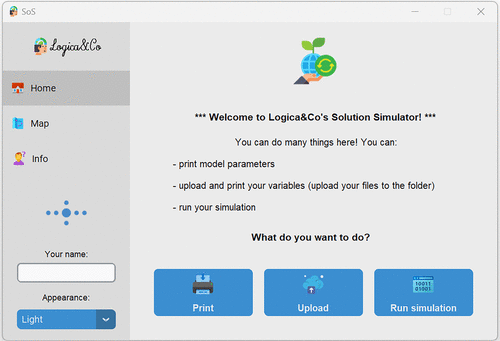
It is possible to evaluate different solutions and explore viable alternatives using the offline application SoS.2 Figure 4 shows the Home frame that appears upon launching the application. The application is compatible with both Windows and macOS platforms. The application needs three folders to be run: data, input, and output.
4.1. Data
The data folder contains an Excel file named Data.xlsx with all the data required to model the Logica&Co problem. It includes the following:
A list of all soup kitchens’ parameters (sheet Soup Kitchens)
A list of all local businesses’ daily supply (sheet Donations)
A list of all warehouses’ parameters (sheet Warehouses)
A list of all sponsors’ parameters (sheet Investments)
An origin-destination matrix of the distances from every warehouse to every local business (sheet Distances W-LB)
An origin-destination matrix of the distances from every local business to every soup kitchen (sheet Distances LB-S)
An origin-destination matrix of the distances from every soup kitchen to every warehouse (sheet Distances S-W)
A list of supplementary parameters and coefficients (sheet Additional Parameters)
A file named Data.txt, summarizing all data reported in Data.xlsx in a text file, can also be generated using the SoS command Print.
4.2. Input
The input folder contains solution-alike .txt files. To evaluate the quality of a proposed solution, this folder must be populated with the solution data by the users.
4.3. Output
The output folder is the target folder for the simulation reports. After a simulation, the output folder is automatically populated with a variable summary file and a report (see the next section).
4.4. How to Use SoS
The SoS allows users to gain insights into a solution and inspect the framework data. A Map frame provides a navigable map of all soup kitchens, local businesses, and warehouses, and an Info frame summarizes the step-by-step procedure for running a simulation. Within the Home frame, there are three command buttons:
Print: Print the model parameters in a file named Data.txt in the data folder. This file summarizes all model dimensions and parameters.
Upload: Upload, check, and print the solution files inserted by the user in the input folder (see Section 3). If no errors are detected, a summary file Variables.txt is created and saved in the output folder; otherwise, a popup window with an error report appears.
Run simulation: Run a simulation using the uploaded input values. If the inputs produce a feasible solution, all revenues and costs are calculated in detail by day, month, and semester (total) and stored in a file named Report.txt in the output folder. If the inputs lead to an infeasible solution, a popup window with an error report appears; details on the violated constraints can be found in the Report.txt file.
We thank all the students of Sapienza University of Rome who participated in the project courses with great passion and enthusiasm.
1 The term soup kitchen indicates any place (public or private) where free food is offered to homeless and extremely low-income people.
2 The SoS application files can be downloaded at https://annaliviacroella.site.uniroma1.it/publications/sos.