Case Article—Potty Parity: Stadium Restroom Design
Abstract
In view of the long wait times for women and the lack of accessibility for LGBTQ+ individuals when they use restrooms, this case provides a set of analytical tools to evaluate wait time disparity among users for different restroom configurations. A stadium manager who faces complaints about excessive restroom wait times aims to retrofit the restroom layout to improve both efficiency, measured in terms of wait time, and fairness, measured in terms of totalitarian and Rawlsian scores. Given that customers have diverse preferences over the use of restroom types, in three modules, students learn to (i) evaluate queuing parameters for a mix of heterogeneous populations, (ii) evaluate queuing metrics for various restroom layouts and discuss their wait time disparities, and (iii) evaluate and discuss the fairness of access to restroom facilities from a diversity, equity, and inclusion (DEI) perspective. By completing this case, students gain an understanding of service systems, learn about process flexibility concepts, and become familiar with DEI concepts and measures. The primary objectives of the case for students are to understand the trade-offs between efficiency and fairness, develop an understanding of multiobjective problems, and improve their skills in employing queuing concepts and tools.
History: This paper has been accepted for the INFORMS Transactions on Education Special Issue on Diversity, Equity and Inclusion in OR/MS Classrooms.
Supplemental Material: The Teaching Note and Excel files are available at https://www.informs.org/Publications/Subscribe/Access-Restricted-Materials.
1. Introduction
This case provides students with an opportunity to learn about and increase their awareness of diversity, equity, and inclusion (DEI) concepts and considerations when proposing designs and policies for real-world issues. Specifically, this case focuses on the prevalent problem of “potty disparity,” which exists in many existing buildings in which Insider has reported women wait up to 32 times longer in restroom queues than men1 and LGBTQ+ individuals often lack inclusive and safe restroom access.2 Such disparities primarily stem from poor initial allocations of restrooms to different genders, influenced by unanticipated demographic changes and deficiency of international plumbing codes for solving the problem.
To date, various venues, such as stadiums, theaters, and universities, have made headlines in newspapers and garnered attention because of user dissatisfaction with current restroom allocations as well as complaints about long wait times and unsafe facilities.3 Given that adding more restrooms is often impractical in existing buildings, this case focuses on creative solutions to retrofit the current restroom layout with the objective of alleviating potty disparity. In this case, students will note the fact that customers are heterogeneous in terms of their preferences as well as their service requirement characteristics, such as service rates. The case develops discussions around the disparity of access to restrooms for this heterogeneous population by first directing students to calculate queuing metrics for different restroom layouts and discuss wait time disparities for different restroom types accessed by different genders. It then expands the discussion by evaluating fairness scores, specifically totalitarian and Rawlsian scores, to assess the inclusivity of access with a stronger focus on individuals’ preferences for the restroom type they wish to use. When students discuss the latter, they will learn how to develop the discussion toward fairness issues and improve their understanding of the trade-off between efficiency and fairness.
Students are exposed to various design options for which they need to calculate operational queuing metrics and fairness scores. For instance, assuming an equal total number of toilet stalls, one design option is the all-gender restroom design, which achieves a lower average wait time than another design option involving only a few unisex toilets, resulting in higher wait times for a group of visitors. Whereas it is evident that the all-gender restroom design is more desirable from an operational perspective, students are required to conduct analyses with respect to fairness and inclusivity scores for visitors of various genders using these restrooms. This conflicting situation and its objectives will arouse students’ curiosity and galvanize them into delving deeper into the fairness aspects of restroom design, transcending beyond the traditional focus on operational efficiency. Although we have designated the quantitative analysis of fairness as an optional module in our teaching note, the qualitative discussion on fairness associated with various restroom designs can be easily conducted during the case debrief session without requiring resources for the quantitative aspects of fairness.
More specifically, the case is divided into three modules. In the first module, students, based on parameters sourced from real data sets cited in Huh et al. (2019) and Farajollahzadeh and Hu (2021), analyze and synthesize queueing input parameters for mixed population, including service time, service rate, and coefficient of variation, for gender-segregated restrooms in the status quo. In the second module, students gain experience and expertise in calculating wait times for various restroom design options with multiple classes of users and analyzing the factors contributing to them. The module includes questions for which students are expected to use quantitative techniques to determine operational metrics and provide qualitative discussions on fairness issues based on their intuition. In the third module, which is optional, students will (i) explore fairness measurement using quantitative techniques such as totalitarian and Rawlsian scores, which assess average and minimum gains/preferences of individuals upon using the service for various restroom design options, aligned with current discussions on the topic, and (ii) learn to interpret these fairness scores to determine the optimal restroom design option.
2. Literature Review
Utilizing queueing models to estimate delays is a critical application of operations management. Educational materials in this area aim to equip students with the skills to use queueing formulas and calculate performance metrics in various contexts. Studies by Weiss and Tucker (2018) and Colley and Davis (1993) introduce students to strategies for managing customer wait times by either reducing these times or managing customer expectations. Lau and Fernandez (2014) delve into restaurant operations, exploring how monetary incentives can shift peak time arrivals to less busy periods. Kraft and Dorronsoro (2017) present a case in which a restaurant manager seeks to optimize the burrito-making process to reduce wait times. Landel and Boes (2018) use simulation methods to evaluate queueing performance in a restaurant setting. Other research and cases, such as those by Savva and Tezcan (2019), Ang et al. (2020), and Siegrist (2020), focus on minimizing emergency room wait times. Fagan and Perez (2020) examine optimal screening line and staffing configurations at airports, whereas Lariviere (2022) investigates how a call center can manage wait times by offering fast-track lines. The case study addresses the incorporation of fairness considerations into managerial decision making and develops an optimization-based task allocation model to improve employee satisfaction and morale in a call center, also enhancing students’ ability to integrate quantitative optimization with qualitative workplace fairness concepts. Cachon and Terwiesch (2017, chapter 16) examines the potty disparity of access between men and women in a mini-case. Our work extends the discussion to not only include men and women, but also LGBTQ+ individuals. This inclusive approach invites students to consider queuing from the perspectives of both efficiency and fairness metrics, thereby encouraging them to contemplate queue inclusivity and utilize queuing tools in order to design inclusive processes beyond merely improving system efficiency.
Another significant area of literature encompasses the concepts of DEI in business settings. These concepts are discussed in various contexts, such as leadership and management, in which Vijay et al. (2022) examine common discrimination and aggression in the work environment. In the realm of marketing strategies, Bigio et al. (2021) raise awareness about the importance of considering minorities when developing communication strategies. Human resources research, exemplified by Romansky et al. (2021), focuses on measuring diversity and inclusion within companies. In the field of information systems, Chilazi and Bohnet (2020) explore ways to present and leverage data to empower the right people and shift social norms in alignment with DEI goals. In the context of operations management, Wu et al. (2025) design a case study and address the incorporation of fairness considerations into managerial decision making and develop an optimization-based task allocation model to improve employee satisfaction and morale in a call center, also enhancing students’ ability to integrate quantitative optimization with qualitative workplace fairness concepts. Finally, in the context of strategy, Yatsko and Koh (2022) discusses approaches for implementing DEI goals at an institutional level. These works not only increase awareness, but also focus on teaching how to develop leadership skills and implement change within an institution. Our case study introduces students to methods for revising processes to incorporate DEI at the operational level and discusses the trade-off between efficiency and fairness when designing policies.
Our case serves as a bridge between these two areas in the literature, encouraging students to address both wait time and access disparities simultaneously. Moreover, it provides operations research/management science students with an opportunity to familiarize themselves with the terminologies used to discuss DEI issues, enabling them to communicate more effectively with peers and in professional settings.
3. Learning Objectives
This case study introduces students to queueing theory principles and guides them in proposing innovative and equitable restroom designs for diverse genders, including men, women, and nonbinary individuals. It fosters a critical, analytical approach to problem solving, emphasizing equity and inclusivity alongside efficiency. Students develop a comprehensive understanding of the operational and social factors crucial for designing inclusive restroom solutions. Upon completion, they acquire skills to make informed decisions and engage in evidence-based discussions about restroom design, balancing efficiency with inclusivity considerations, and they should be able to:
Explain how heterogeneous random service times from various customer groups can be consolidated into a unified stream of customers for a single resource.
Identify the appropriate queuing model for each problem, such as M/M/1, M/M/s, M/G/1, or M/G/s.
Analyze and quantify the average wait time for different types of restrooms, including gender-segregated and unisex options.
Understand how to evaluate the service time coefficient of variation when multiple streams of customers with heterogeneous average processing times and variances utilize a specific restroom.
Apply the concept of process flexibility to evaluate various restroom designs and redesigns, assess the impact of each design on the average customer wait time, and explore the probability of long wait times for each design/redesign option.
Calculate and interpret totalitarian and Rawlsian scores and interpret these efficiency and fairness scores.
Recognize the effects of each service system design on efficiency and fairness scores, considering both wait time and user experience.
4. Required Background
This case can be used in introductory operations management courses in the commerce, MBA, and E-MBA programs. The accompanying teaching note and Excel files provide instructors with comprehensive instructions on the required knowledge for students. This case assumes students have a basic understanding of calculating performance metrics for single-server and multiserver queuing systems, including average wait and system times for customers. Students should also be comfortable with software tools such as Excel and QMacros, specialized software for solving queuing problems that can be incorporated into Excel as an add-in (Groenevelt 2021). In addition, the accompanying documents guide instructors on how the case and its assignment questions can be adjusted based on students’ backgrounds and their quantitative maturity. More specifically, the case requires students to possess the following body of knowledge:
Basic queueing knowledge: Students should have a solid foundation in queuing theory and be familiar with common formulas for calculating wait times for M/M/s and M/G/s queues, especially when users from multiple classes requiring different service times and arrival rates utilize the same service unit. In addition to providing all formulas required to analyze the questions in the case study, we provide citations to related textbooks and our teaching notes, which can aid in preparing both students and instructors to address all aspects of this case study effectively.
DEI concepts: Students should understand mainstream discussions on fairness, specifically totalitarian and Rawlsian fairness concepts. Totalitarian fairness principles recognize a policy as fair when the total gains of all individuals increase. Rawlsian fairness principles recognize a policy as fair when the welfare of the individual with the minimum gain in the system increases. The former considers a solution fair when the total pie is larger, whereas the latter focuses on the gain of the individual who receives the smallest slice to ensure this person is not neglected for the greater good. Besides fairness concepts, students need to become familiar with inclusive language related to gender and individual preferences for the discussions.
5. Teaching Plan
The first two modules of this case study lend themselves well to an 80- to 90-minute academic session. We have outlined a structured approach in our teaching notes for debriefing this case within the confines of an 85-minute class session, allocating specific time slots to each assignment question and learning objective. We suggest that instructors employ a blend of whiteboard and slides to debrief the case effectively. Utilizing the whiteboard allows for active student engagement, particularly in areas in which divergent answers may arise, encouraging discussion and exploration of differing perspectives. Alternatively, for sections involving calculations or complex concepts, slides can streamline the discussion and facilitate smooth transitions between topics.
There are two ways to approach the debrief of this case:
Hands-on approach. The instructor may opt for a hands-on approach, wherein students are tasked with utilizing Excel to compute performance metrics to scrutinize the assignment questions in the case. The formulas required for these calculations are provided to instructors at the end of the case and in the teaching note. The objective of this method is to foster technical proficiency in students, allowing them to utilize Excel to develop a decision support system for determining the optimal design of restrooms.
Managerial approach. This approach entails the utilization of the QMacros Excel add-in as a tool for students to identify the pertinent parameters for their decision-making process. Upon determining these parameters, students insert them into the add-in, thereby enabling the automatic computation of all relevant performance metrics. This pedagogical strategy is particularly beneficial when teaching MBA and executive MBA courses as it enables a focus on the managerial implications inherent in each restroom design option.
If the instructor is using this case for a nontechnical audience such as E-MBA students, the outputs of the first module—assignment questions 1 and 2 (included in the teaching note)—can be presented to students as input exhibits. This approach allows students to focus solely on using QMacros to derive queueing performance measures.
The instructor must consider the potential requirement of a 10- to 15-minute increment to the established 85-minute debriefing duration in the event that a hands-on approach is chosen for the case study evaluation. Conversely, the adoption of QMacros offers the possibility of an optimized utilization of time and obviates the necessity of such an increment.
6. Classroom Experience
We assigned this case study to second year commerce students enrolled in the RSM 270 course, that is, operations management, at the Rotman School of Management, the University of Toronto. Before analyzing this case study, students had been instructed in the following topics:
The link between operations and strategy.
Process analysis.
Inventory buildup and Little’s law.
Single-server queuing systems of types D/D/1, M/M/1, and G/G/1, involving both manual calculations and the utilization of QMacros software.
Multiserver queuing systems: D/D/s, M/M/s, G/G/s, accommodating both homogeneous and heterogeneous customer populations, and M/M/s/K with finite system space and customer blocking.
We note that, for students to comprehend the case and its educational objectives fully, the instructor needs to cover the content from lectures 2–5. Additionally, we remark that the formulas used in both single-server and multiserver queueing systems are based on the Pollaczek–Khinchine (PK) formula, which is a versatile approximating formula that estimates the performance of various queueing systems. Under certain circumstances, the PK formula can provide exact values for a queueing system’s performance metrics (see Cachon and Terwiesch 2019, chapter 9). Instructors have the option to utilize other formulas available for these queueing systems, and the choice of formula will not impact the final pedagogical objectives of the case study. To ensure the individual competency of each student in these subjects, three biweekly individual assignments are provided: (i) the first assignment encompasses material from lectures 1 and 2, (ii) the second assignment focuses on content from lectures 3 and 4, and (iii) the third assignment is dedicated solely to topics covered in lecture 5. To ensure that students have acquired proficiency in using the QMacros software, we assigned a two-point quiz (see the details at the end of the accompanying teaching note) after lecture 4 with a due date set a couple of weeks before the case study deadline.
There are two approaches students can use to address this case study: (i) manually calculate all performance metrics or (ii) utilize QMacros software. Students have clearly communicated to us that this software serves as a potent and versatile tool, enabling them to analyze various aspects of the case swiftly. Furthermore, it stands as an effective teaching aid for instructors to elucidate various queueing systems, underscore their distinctions, and even streamline the debriefing session, all without compromising any pedagogical points already contemplated for the debrief session. Our teaching note encompasses all queueing formulas should the instructor opt for approach (i). Suppose the instructor opts for approach (ii), utilizing QMacros. In that case, we recommend they share a subset of multiple-choice questions (MCQs) and/or the numerical question included at the end of the teaching note with students. During lecture 4, the instructor can also utilize the QMacros software to estimate the performance metrics of a couple of queueing systems. This serves to familiarize students with the features and capabilities of the software, enhancing their understanding and proficiency in its use.
This case study was assigned to 136 students across two sections of RSM 270 in fall 2023 under the instruction of a semiexperienced instructor, 168 students across three sections with a junior instructor (with participation rates ranging from 92.2% to 94.6% for different questions, noting that not all participants responded to every question in the survey), and 238 students across three sections with an experienced instructor in winter 2024 (with participation rates ranging from 90.0% to 95.0% for different questions, again with some questions left unanswered by certain participants). Following the assignment of this case study in fall 2023, the semiexperienced instructor received verbal feedback indicating that some students had not effectively engaged with the technical aspects requiring the use of QMacros software. In response, the instructor developed MCQs to assess students’ understanding of the software. These MCQs were subsequently shared with new instructors to administer to students after lecture 4 with two points awarded for participation. The primary aim of the quiz was to ensure that students familiarized themselves with the QMacros manual, thereby acquiring the necessary skills to collaborate effectively on the case study questions.
A survey was posted after students submitted their reports for this case to evaluate the perception of students concerning this case. The survey consisted of the following questions:
Q1: Articulate the primary goals of this case study, providing insights from both theoretical and practical perspectives.
Q2: Explain the theoretical techniques employed in the analysis of this case study.
Q3: Detail how the use of QMacros software facilitated the analysis process. Support your explanation with a specific example.
Q4: Which question(s) from this case study did you find to be the most challenging?
Q5: Rate, on a scale from 1 to 10, the usefulness of applying queueing theory to address a critical DEI issue.
Note that question 5 is quantitative, whereas questions 1–4 provide a qualitative assessment of students’ perceptions.
6.1. Quantitative Analysis
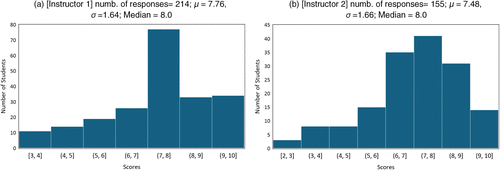
The students’ scores assigned to Q5 for each instructor are illustrated in Figure 1. This figure demonstrates that students in both classes find the queueing theory techniques useful for achieving equitable and efficient restroom design as indicated by the average scores (7.76 versus 7.48), standard deviation (1.64 versus 1.66), and median scores (8.0 versus 8.0). Based on students’ comments for question 5, the slight score differences reflect variations in instructors’ teaching styles and experiences and the emphasis placed on QMacros during the lecture. These factors influence instructors’ ability to effectively communicate the relevance and applicability of queueing theory techniques.
6.2. Qualitative Analysis
We next analyze students’ qualitative assessments in their responses to questions 1–4. Based on students’ responses to Q1, one can summarize that the primary goal of the case study is to optimize stadium washroom facilities for efficiency, inclusivity, and social responsibility. Students assert that this case encourages practical problem solving and highlights the intersection of academic theory with real-world challenges in service management. Here are the meaningfully representative sample responses4 of two students to Q1, which we quote as follows:
“This case study focuses on using queue theory and operations management principles to improve customer experience through the redesign of stadium washrooms. It challenges students to apply theoretical models to practical problems, optimizing infrastructure for efficiency and inclusivity. By considering the needs of diverse user groups, the study underscores the importance of accessibility and societal benefits in public service design. The goals blend academic learning with real-world application, encouraging innovative solutions to enhance the game-day experience for all fans while also highlighting the operational, financial, and societal implications of service management decisions in public venues.”
“This case study aims to deepen our understanding of how queueing theory applies to the everyday operation of services, focusing on making the stadium’s washroom facilities more efficient. It involves looking at the current layout of the washrooms, understanding how it affects waiting times, and paying special attention to meeting the needs of different genders and ensuring everyone has fair access. The study encourages using [queueing] theory to tackle real-life challenges, promoting practical problem solving that considers operational effectiveness, cost-effectiveness, and social responsibility.”
Based on students’ responses to Q2, one can conclude that the primary technique to solve this case study has been to utilize queuing theory for heterogeneous flows of customers to a resource to minimize wait times for stadium washrooms by systematically addressing access inequality and proposing practical solutions to enhance customer experience and promote inclusivity. Here are the representative sample responses of two students to Q2, which we quote as follows:
“The analysis of this case study primarily employs theoretical techniques from queue theory and operations management, focusing on calculating average service times, the coefficient of variation of service times, and selecting appropriate queueing models for different washroom scenarios. These techniques are applied to systematically address and solve the issues of long wait times and access inequality in stadium washrooms. The study leverages these mathematical and theoretical frameworks to propose practical solutions that enhance customer experience, optimize infrastructure usage, and promote inclusivity in a public facility setting.”
“We use queuing theory to determine how to minimize wait times for people in line for their respective bathrooms. By utilizing this method, we get a flexible understanding (since we can tweak parameters like number of servers) to ultimately accurately model the different situations, and then once we’ve gone through different iterations of possible bathroom layout, we have a bigger picture to make an informed decision about which layout truly optimizes for what we look for, in this case, lower wait times for men and (mostly) women.”
Based on students’ responses to Q3, one can conclude the use of QMacros software has facilitated students’ analysis process, allowing them to easily apply queuing models within a spreadsheet environment and quickly simulate different scenarios, such as altering washroom configurations, to observe their impact on wait times and service efficiency. Here are the representative sample responses of two students to Q3, which we quote as follows:
“The utilization of QMacros undoubtedly facilitated the analysis process by offering a practical tool to apply theoretical queuing models directly within a familiar spreadsheet environment. QMacros allowed for the efficient simulation and testing of various queuing scenarios, enabling us to input parameters like arrival rates, service times, and user preferences to instantly see the impact of different washroom configurations on wait times and service efficiency. For instance, we could use QMacros to model the effect of converting a men’s urinal stall into a unisex toilet, examining how such a change alters queue dynamics and wait times for all users.”
“The utilization of QMacros software helped incredibly in the analysis process. The software allows us to choose the queueing model system and adjust the parameters according to our needs. It makes the analysis quicker as we can compare the numbers with different parameters. For example, we can adjust the parameters to six or seven servers, see the results, and compare them to see which one is better.”
According to students’ feedback on Q4, the most challenging aspect of this case study appears to be determining the standard deviation of heterogeneous customers, which includes varying average processing times and standard deviations and understanding how to utilize this information to identify the optimal configuration for restroom designs. Here are the representative sample responses of two students to Q4, which we quote as follows:
“Question 2 [of the case] poses a significant challenge by requiring the analysis of converting a men’s urinal stall into a unisex toilet; assessing the queue models; and evaluating the operational, financial, and societal impacts. This question demands not only complex calculations to find suitable queueing models, but also a deep understanding of the broader implications, including the balance between enhancing service efficiency and promoting inclusivity in a public venue, making it a multifaceted and intricate problem to solve.”
“Coming up with the most optimal option for the given challenge in the case is the most challenging. There was a dilemma between two of the options we have come up with. It was difficult to choose the better one because choosing one would mean sacrificing the benefit of the other.”
“Personally, [assignment] question 5, which involves converting all existing washrooms into unisex toilets and assuming everyone lines up in one pooled queue, seemed to present a significant challenge. This question required a comprehensive understanding of operational, financial, and societal impacts, making it complex. The analysis had to account for operational efficiencies, such as wait times and service rates, while also considering the societal implications of fully unisex washrooms, including public acceptance and inclusivity. Balancing these aspects while ensuring the practicality of the solution adds layers of complexity to the analysis.”
7. Concluding Remarks
Inspired by a real-world challenge faced by a stadium, this case study offers students a unique opportunity to apply well-established theories in process flexibility and queuing systems. They will analyze various aspects of service system design and calculate fairness scores associated with restroom designs. In this case study, students are presented with a challenge in which some women and LGBTQ+ individuals incur excessive wait times when using restroom facilities. In response, students analyze the optimal configuration of restroom design as a retrofitting plan for the current restroom designs. This analysis offers an exploration of queuing theories, spanning from fundamental concepts to advanced topics. It includes identifying queuing systems for different customer classes based on their coefficient of variations and the number of servers and integrating heterogeneous customer flows in a unisex toilet as a demonstration of process flexibility. Unlike conventional queuing case studies, this case significantly diverges by incorporating considerations of DEI. It challenges students to contemplate multiple objective functions for service system design, extending beyond the operational considerations of queuing performance metrics typically addressed in operations management courses. To facilitate analysis and promote the application of queueing theories, we have provided students with the QMacros software, enabling rapid analysis of various queueing systems.
This case guides students in applying appropriate queuing formulas and interpreting results through the lens of DEI concepts, notably by evaluating efficiency and fairness scores. Furthermore, it familiarizes students with LGBTQ+ terminology and offers insights into the considerations of policymakers and businesses when designing inclusive spaces. This fosters critical thinking as students devise optimal solutions to address and resolve the issue. In addition to the insights gleaned from analyzing the assigned case questions, the age-old adage of “a little flexibility goes a long way” holds true for this case study, particularly when considering DEI aspects. After teaching this case study in the operations management course at the Rotman School of Management across six sections taught by both junior and senior faculty members, we conducted surveys to gather students’ opinions. The feedback was positive with students expressing appreciation for the novelty and practical applicability of the case study.
We express our gratitude to the associate editor for the excellent summary of the reviewers’ comments and the prompt handling of our manuscript. We extend our appreciation to each member of the review team, the AE and two anonymous referees, for their thoughtful and detailed feedback, which has significantly enhanced the quality of our paper. We also extend our sincere appreciation to Professors Adam Saunders and Hansheng Jiang from the Rotman School of Management for incorporating this case into their operations management course curriculum and for conducting a survey to gauge students’ perceptions of this case and its pedagogical merits. We also extend our gratitude to Mr. Hamed Roshanaei for his contribution to drawing the restroom layouts in AutoCAD, which are included in the teaching note. Lastly, we thank the committee chaired by Professor Matthew J. Drake for selecting this case to be the winner of the 2024 INFORMS Case Competition.
1 See https://www.insider.com/why-women-always-wait-longer-bathroom-public-restroom-2019-9.
2 See https://99percentinvisible.org/episode/where-do-we-go-from-here/.
3 See https://www.nytimes.com/2017/02/07/theater/broadways-bathroom-problem-have-to-go-hurry-up-or-hold-it.html; https://www.dailydot.com/news/taylor-swift-fans-ejected-from-concert/.
4 We opt to include answers that are more detailed and informative, addressing various aspects of the questions rather than shorter, incomplete ones.
References
- (2020) Too Long for Comfort: Tackling Consultation Wait Time at a Hospital Emergency Department (Singapore Management University, Singapore).Google Scholar
- (2021) Dr. Bonnie Henry: Contending with COVID-19 in Visible Minority Communities (WDI Publishing at the University of Michigan, Ann Arbor, MI).Google Scholar
- (2017) Operations Management, 4th ed. (McGraw Hill, New York).Google Scholar
- (2019) Matching Supply with Demand: An Introduction to Operations Management, 4th ed. (McGraw Hill, New York).Google Scholar
- (2020) How to best use data to meet your DE&I goals. Harvard Bus. Rev. (Brighton, MA).Google Scholar
- (1993) Megacard Corporation (Darden School of Business, Charlottesville, VA).Google Scholar
- (2020) Queuing Theory to the Rescue: Managing Security Screening Lines at Logan Airport (Harvard T.H. Chan School of Public Health, Boston).Google Scholar
- (2021) Potty parity: Process flexibility via unisex restroom. McGill University Working Paper No. 3914880, Montreal.Google Scholar
- (2021) Qmacros 18.0 user guide. Available via email: [email protected].Google Scholar
- (2019) The potty parity problem: Towards gender equality at restrooms in business facilities. Socio-Econom. Planning Sci. 68:100666.Crossref, Google Scholar
- (2017) Pancho’s Burritos (Darden School of Business, Charlottesville, VA).Google Scholar
- (2018) A Late Night at the Virginian Restaurant (Darden School of Business, Charlottesville, VA).Google Scholar
- (2022) BAT Case: Putting Tech Support on the Fast Track (Kellogg School of Management, Evanston, IL).Google Scholar
- (2014) Fat Angelo’s Italian Restaurants: Managing the Customer Waiting Experience (The Hong Kong University of Science and Technology, Hong Kong).Google Scholar
- (2021) How to measure inclusion in the workplace. Harvard Bus. Rev. (Brighton, MA).Google Scholar
- (2019) To reduce emergency room wait times, tie them to payments. Harvard Bus. Rev. (Brighton, MA).Google Scholar
- (2020) Sweetbriar Hospital (A) (Harvard T.H. Chan School of Public Health, Boston).Google Scholar
- (2022) Breaking the Silence: Engaging Challenges Faced by the LGBTQ+ Community (Ivey Publishing, Ontario).Google Scholar
- (2018) Queue management: Elimination, expectation, and enhancement. Bus. Horizons 61(5):671–678.Crossref, Google Scholar
- (2025) Case article—Three mountain communications: Fairness considerations for workplace task allocation. INFORMS Trans. Ed., ePub ahead of print July 24, https://doi.org/10.1287/ited.2023.0044ca.Google Scholar
- (2022) Dr. Joan Reede and the Embedding of Diversity, Equity, and Inclusion at Harvard Medical School (Harvard T.H. Chan School of Public Health, Boston).Google Scholar