Case—Humanitarian Supply Chains and Inventory Management: Planning Medical Supply at the International Committee of the Red Cross
Abstract
Funding: The ETH project with the ICRC was supported by a Humanitarian Action Challenges (HAC) grant within the joint “Engineering Humanitarian Aid” (EHA) program.
Introduction
Hannah Seydou, global supply chain coordinator in the Geneva Headquarters of the International Committee of the Red Cross (ICRC), studied the numbers on the dashboard carefully. The financial crisis at the ICRC caused by a deficit of CHF700M in 2023 was exerting pressure on her already tight budget. A reduction in health programs was expected in the coming financial year, and costs would need to be cut across existing programs as well. As Hannah prepared for the meeting with her team, she put together a list of potential cost saving measures. One of the topics on her list was how to improve the process for planning medical inventory. Hannah’s challenge was to reduce costs while maintaining low stockouts of vital medical supplies.
Background
After witnessing the suffering on the battlefield of Solferino, Henri Dunant founded the International Committee of the Red Cross in 1863 to aid victims of armed conflict. The ICRC’s charter includes a health mission that “ensures that people affected by conflict can get basic health care that meets universally recognized standards. This may involve assisting existing health services or temporarily replacing them” (ICRC 2024). The ICRC’s mission is close to Hannah’s heart because she herself grew up in a war-torn country. Hannah started working for the ICRC in 2014 in Niger during the cholera outbreak. She has since served in multiple deployments as a medical logistician, responsible for order management, planning, and warehousing of medical supplies. She has seen her share of suffering in deployments like Afghanistan and the Democratic Republic of Congo. Hannah knows that, in contrast to commercial companies, the objective of humanitarian organizations is not to maximize profit or minimize costs, but to relieve suffering.
International funding of humanitarian organizations has increased steadily over the years, and yet the money given for humanitarian response has not been keeping up with the growing need, resulting in the so-called humanitarian funding gap. Because logistics consumes up to 80% of the budgets of humanitarian organizations (Van Wassenhove 2006), there is enormous potential to make better use of limited investments by improving operations. The ICRC has recognized the potential of its supply chain as an enabler of mission performance. Over time, Hannah earned three MS degrees in quality assurance in the food industry, quality assurance for hospitals, and humanitarian logistics. Her professional and educational credentials are typical for the ICRC’s highly qualified headquarters (HQ) staff. Hannah and her logistics team know that they can benefit from the knowledge and technical tools generated by their commercial counterparts. But commercial practices need to be translated and adapted to the humanitarian context.
Managing Operations at the ICRC
As global supply chain coordinator, Hannah is responsible for planning inventory in the ICRC’s central warehouse in Geneva, the Nairobi regional logistics center, and the national warehouses in South Sudan and the Democratic Republic of Congo (DRC) (Figure 1).
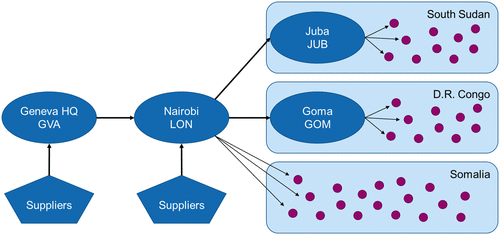
To support healthcare in the war zones of South Sudan, DRC, and Somalia, the ICRC’s health programs provide medical supplies to facilities like field clinics (Figure 2), hospitals, schools, and detention centers. The ICRC does not manage or staff these facilities, but the ICRC national delegations work closely with the local health authorities and ministries to negotiate supply service level agreements with local health providers (ICRC 2018). There is currently a list of 177 medical stock keeping units (SKUs) regularly supplied by the ICRC. They include everything from painkillers like ibuprofen to instruments used in operating rooms to weapon-wounded and rape kits. Depending on the health facility site, demand can be highly volatile. The ICRC national delegations employ health coordinators who determine the material requirements of local health services and enter orders for medical supplies through the ICRC’s enterprise resource planning (ERP) system. The national warehouses organize last-mile transport to the health facilities.
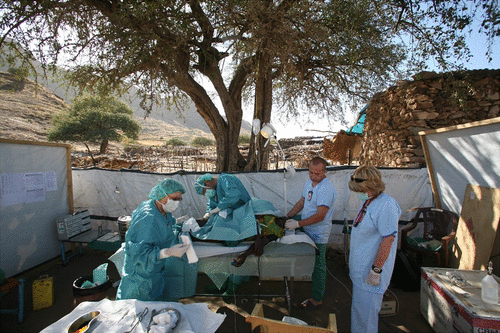
Notes. Copyright © ICRC, Boris Heger. Included with permission from the copyright owner.
Within each national delegation, the health coordinator and supply chain coordinator belong to two separately managed departments. The health coordinator is part of the Operations department, whereas the supply chain coordinator is in the Support department. Figure 3 contains an overview of the organizational and reporting structures of a national delegation. In this organizational setup, a degree of cross-functional coordination is necessary to ensure that requested goods are in the right place at the right time, with reasonable cost and effort (Wagner and Thakur-Weigold 2018). Although managed separately, the ICRC’s logistics teams effectively deliver on promises made by the ICRC’s health programs. At present, a service level of 98% for all stocked items has been officially promised, although not always achieved. Hannah needs to work with her health colleagues to set realistic expectations about the stock that is available to fulfill orders or even renegotiate service levels. Once a year, Hannah’s team reviews the standard list of stocked medical items together with the ICRC’s local health teams, deciding whether to add, remove, or replace individual entries from the list. It is not easy to make everybody happy. Hannah recalls the objections made by her health colleagues at a recent meeting: “Supply chain should not decide which items to fund based on their math models.”
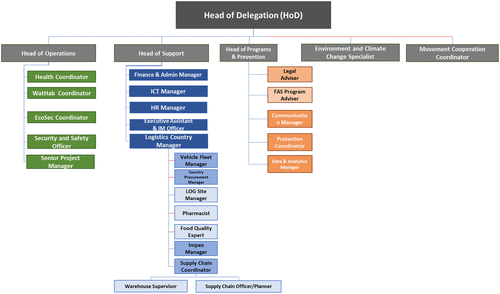
Notes. The health coordinator reports to the head of operations. The supply chain coordinator, however, reports to the head of support.
Planning Challenge
The work of a humanitarian organization supply chain planner is a tricky balancing act. Hannah and her team must decide how much stock to keep at which location in order to assure timely fulfillment of orders at the promised service level while minimizing excess inventory. Both stockouts and overstock hurt the performance of the ICRC’s health programs. Stockouts obviously can harm patients who need the medical items for treatment. However, overstocks are easily as damaging to the ICRC. Acute humanitarian emergencies usually see a spike in funding directly after the early media coverage, but the funding tapers off over time as donor attention moves on to newer disasters. Funding for protracted crises is limited. Despite their hard work under difficult conditions like war zones, humanitarian organizations struggle with a reputation for wasteful or corrupt practices. Donations are often earmarked for particular programs. The finances of the supply chain department are regularly audited, with detailed accounts of spending reported to donors. When medical supplies expire, or must be disposed of, relationships with donors and host governments can suffer, which can reduce funding in the future. Under these pressures, Hannah and her colleagues are naturally averse to prepositioning stock if they cannot be sure of using it to fulfill future orders. Reverse logistics out of locations like Juba or Mogadishu are exorbitantly costly and onerous.
The ICRC’s ERP system supports order management and inventory planning. Because actual consumption of the medical items occurs at facilities outside the ICRC, the ICRC does not have the visibility of the stock on hand at these facilities. Nor do they have the equivalent of real-time “point-of-sale” data. Demand is only visible as incoming order quantities periodically entered by the ICRC’s health coordinators. To forecast monthly demand for each item, the ERP system computes a moving average, averaging order quantities over the previous 12 months. Based on this rolling forecast, safety stock levels are set at three months of average demand. Every month, the ICRC planners are prompted by the ERP system to review the stock targets and the purchase orders recommended by the system and correct them as they see fit. Manual interventions based on personal judgement are known to trigger the bullwhip effect in supply chains (Wagner and Thakur-Weigold 2018) and are therefore a source of potential error in the planning process. The mix of automation and manual checks also generates a high workload for the planning staff. The cumulative effect of these factors shows that there is room for improvement in how the system is set up and executed.
Measuring and Managing Uncertainty in ICRC’s Supply Chain
Hannah knows that, in a multiechelon distribution network like hers, it often makes sense to pool risk, prepositioning inventory upstream and occasionally expediting deliveries downstream. This option is, however, not feasible for her organization. Switzerland has the highest cost structures in the world, which led the ICRC to institute a hiring freeze and a moratorium on increasing capacity in the Geneva warehouse. The warehouse was already too small to store the volume of material required to supply all downstream national delegations. Also, the farther away goods are stored, the higher the risk of delays at border crossings due to import paperwork. In 2022, the chronic bottleneck in picking and packing in Geneva propagated through the system to aggravate stockouts in national warehouses. ICRC recently authorized a redistribution of item handling to Nairobi’s larger facility, which also has a bigger team of qualified staff.
To find opportunities for improving the efficiency and effectiveness of their processes, Hannah’s boss initiated an improvement project with a university. Before the project was launched, Hannah and her colleagues knew that demand patterns for their medical items were volatile, but did not measure or manage this volatility in a systematic way. Nor did they measure supply uncertainty, which also looms large in war zones. When delivering to the critical last mile, safety issues and poor or nonexistent infrastructure can obstruct transport and cause delays.
Reflecting on the many complexities of the ICRC’s current state, Hannah worried that the heightened pressure to cut costs will result in uncoordinated changes that misallocate resources further. To mitigate the risks and reduce waste, Hannah wants to redesign the decision-making process and support it with data analytics. She knows that one of the reasons the current planning process produces erratic order fulfilment rates is that the target safety stock level is a one-size-fits-all; that is, it does not take into account the real variability of the incoming demand patterns (Fuller et al. 1993). Although it may feel as though humanitarian managers are at the mercy of unpredictable events like disasters and war, certain patterns of variability can be measured. For example, the demand uncertainty can be captured as the standard deviation of the demand history. The ICRC ERP system also keeps track of delivery lead times and can be used to calculate their averages and standard deviations. From her degree in logistics, Hannah knows that safety stock can (and should) be calculated using these parameters. Hannah would also like to find a way to group stocked items in a logical manner to avoid determining target service levels for each individual SKU on her list.
Finally, Hannah wants to create a more collaborative order fulfilment process at the ICRC, one that lives up to commitments made to the health programs. She tells her team, “The key to high service levels is predictability of incoming orders. We need to incentivize our requesters to improve their planning, which can help to reduce variability in order frequency and amounts; hence improve overall service levels.”
Although this case is based on a project with the International Committee of the Red Cross, facts and data are modified for teaching purposes.
References
- (1993) Tailored logistics: The next advantage. Harvard Bus. Rev. 71(3):87–98.Google Scholar
ICRC (2018) Logistics manual. Accessed June 13, 2023, https://shop.icrc.org/icrc/pdf/view/id/2836.Google Scholar- ICRC (2024) Health: Providing care at the front line. Accessed October 25, 2024, https://www.icrc.org/en/what-we-do/health.Google Scholar
- (2006) Humanitarian aid logistics: Supply chain management in high gear. J. Oper. Res. Soc. 57(5):475–489.Crossref, Google Scholar
- (2018) Supporting collaboration in humanitarian supply chains: Insights from a design science project. Production Planning Controls 29(14):1130–1144.Crossref, Google Scholar