Martin Boundary of a Degenerate Reflected Brownian Motion in a Wedge
Abstract
We consider an outward degenerate drifted Brownian motion in the quarter plane with oblique reflections on the boundaries. In this article, we explicitly compute the Laplace transforms of the Green’s functions associated with the process. These Laplace transforms are expressed as an infinite sum of products by iterating a functional equation, which is deeply linked to the compensation method. We also derive the asymptotics of the Green’s functions along all possible paths and determine the (minimal) Martin boundary. Finally, we provide explicit formulae for all the corresponding positive harmonic functions.
Funding: This project received funding from ENS Rennes (PhD funding) and from the ANR RESYST [ANR-22-CE40-0002].
1. Introduction and Main Results
1.1. Context
The semimartingale reflecting Brownian motion (SRBM) in two-dimensional convex cones is a classical topic in probability theory. Problems such as existence and uniqueness (Harrison and Reiman 1981, Taylor and Williams 1993), recurrence and transience conditions (Williams 1985, Hobson and Rogers 1993), the study of stationary distribution properties (Harrison and Williams 1987b, Dieker and Moriarty 2009, Dai and Miyazawa 2011, Franceschi and Kourkova 2017), and many others have been studied extensively in the literature, mostly under the assumption of a nondegenerate covariance matrix.
An important problem in transient SRBM is the analysis of Green’s functions, which can be divided into two parts:
Obtaining the Laplace transforms of the Green’s functions;
Computing the asymptotics of the Green’s functions along all trajectories of the SRBM.
Solutions to in the half-plane can be expressed directly in terms of a rational function of two variables, , where is a branch of a certain two-valued algebraic function, as detailed in Ernst and Franceschi (2021). However, solving in a general cone presents a significantly greater challenge. Specifically, for nondegenerate SRBM in the quarter plane with three domains, the Laplace transforms are obtained as singular integral representations via boundary value problems, as shown in Franceschi and Raschel (2019) and Franceschi (2020). Although these expressions are explicit, they are not particularly amenable to in-depth analysis. Fortunately, they are not required to resolve the second issue . In fact, only the locations of the dominant singularities of unknown Laplace transforms are necessary to compute the asymptotics of the Green’s functions. Problem for nondegenerate SRBM has been solved in the half-plane in Ernst and Franceschi (2021) and in an arbitrary wedge in Franceschi et al. (2024b). The approach followed in these articles has been developed in Malyshev (1973), Kurkova and Malyshev (1998), Dai and Miyazawa (2011), Franceschi and Kourkova (2017), Kurkova and Raschel (2011), and Fayolle et al. (2017) and can be considered as a version of the so-called kernel method. For more information, see the survey by Zhao (2022). The kernel of the SRBM is given by one half of the quadratic form of the covariance matrix plus the linear form of the drift inside the cone. The interplay between the branches of algebraic functions and , defined by the kernel equation , allows us to analytically continue unknown Laplace transforms and to determine their singularities. The inverse Laplace transforms, combined with the saddle point method, then yield asymptotic expansions for the Green’s functions. This procedure provides asymptotic developments of Green’s functions with arbitrarily many terms, but with unknown multiplicative constants. These constants may be derived—albeit somewhat indirectly—from the solutions to
The degenerate SRBM in two-dimensional cones, that is, with a covariance matrix of rank one, has been studied far less extensively. In Ichiba and Karatzas (2022) and Franceschi et al. (2024a), it arises as the gap process between three particles moving and colliding in . The construction of this three-particle process relies on the Skorokhod reflection approach, as developed in Harrison and Reiman (1981), to define pathwise reflected Brownian motion.
In the present article, we consider a class of degenerate transient SRBMs in the quadrant, defined by conditions (1.1)–(1.3), and solve both problems and . The Laplace transforms of the Green’s functions are expressed in terms of infinite series in product form. This result follows from the compensation method, initially introduced in Adan et al. (1993) to obtain the stationary measure for certain degenerate random walks in a quadrant. This approach has since been successfully applied to queueing systems (Adan et al. 1991, Adan 1994). It has also been used to derive generating functions for random walks with small steps Adan et al. (2013) and, more recently, to determine the harmonic functions of singular walks in the quadrant (Hoang et al. 2023). In Franceschi et al. (2024a), for instance, it was used to derive the explicit form of the stationary distribution and in Franceschi (2024) to determine the Martin boundary of killed degenerate Brownian motion in a two-dimensional cone.
In this article, we compute the asymptotics of the Green’s functions along all trajectories. To achieve this, we adapt the approach described earlier and developed in Kurkova and Malyshev (1998), Dai and Miyazawa (2011), Fayolle et al. (2017), Franceschi and Kourkova (2017), Ernst and Franceschi (2021), and Franceschi et al. (2024b) to this class of degenerate SRBMs. A key difference is that, unlike the nondegenerate case—in which the kernel equation for the process defines an ellipse—the kernel equation for the degenerate case defines a parabola in . The multiplicative constants in the asymptotic expressions of the Green’s functions, derived from the solution to , are made explicit in terms of infinite series in product form. The significance of these constants—viewed as functions of the starting point of the process—extends beyond asymptotic precision; they also yield all positive harmonic functions for the DRBM via the Martin boundary theory.
Initiated by Martin (1941) and further developed by Hunt (1957), Doob (1959), and Kunita and Watanabe (1965), this theory is summarized in Doob (1984) and Chung and Walsh (2005). Its aim is to describe the asymptotic behavior of the process and to characterize all nonnegative superharmonic and harmonic functions. The limits of the Martin kernel along the trajectories of the process, when they exist, compactify the state space and form the so-called Martin boundary. This procedure allows every nonnegative harmonic function to be expressed as an integral representation over the Martin boundary. In Ney and Spitzer (1966), Ignatiouk-Robert (2009, 2010), Ignatiouk-Robert and Loree (2010), and Duraj et al. (2022), the Martin boundary is identified via large deviation principles. It has also been obtained from the asymptotics of Green’s functions in Kurkova and Malyshev (1998), Kurkova and Raschel (2011), Ernst and Franceschi (2021), and Franceschi et al. (2024b). In this article, using the solutions to problems and described above, we determine the Martin boundary, the minimal one, and provide explicit expressions for all positive harmonic functions.
1.2. Main Results
The Degenerate Reflected Brownian Motion, Assumptions.
We consider a degenerate Brownian motion in a quadrant, with oblique reflection at the boundaries. By degenerate, we mean that the covariance matrix is of rank 1. This obliquely reflected process was studied in Ichiba and Karatzas (2022), and its rigorous definition is provided in Section 2. The parameters of the degenerate reflected Brownian motion are given by
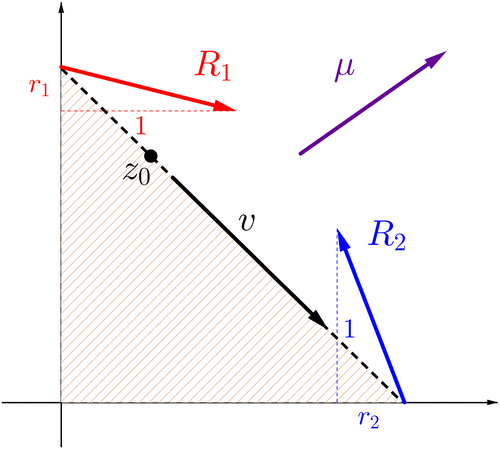
Note. The process starting from never reaches the hatched region.
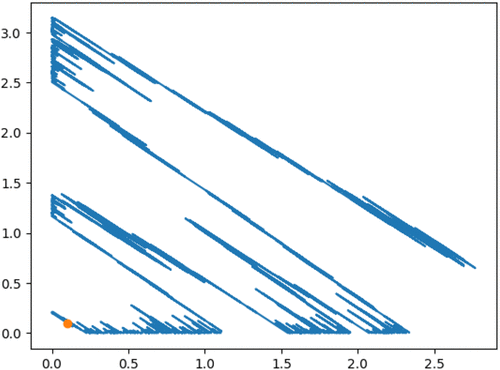
Note. The initial point is marked in orange.
Assumption (1.2) ensures that the process is transient, whereas (1.3) specifies that the reflection vectors (on ) and (on ) point outward from the direction v of the Brownian motion (see Figure 1).
In Sections 1–8, we state and prove our results under the additional assumption
Results for the general case, that is, without Assumption (1.4), are stated and proved in Section 9. In fact, they are easily deduced from the results under (1.4) by means of a simple space-time transformation.
Green’s Functions.
We show that for any starting point , there exists a density of the Green’s measure on the quadrant defined as
Functions are called the Green’s functions. We also define the Green’s measures on the sides of the wedge
It can be viewed as a balance equation for Green’s measures between the interior and the edges of the quadrant. Let us define
The functional Equation (3.1) is similar to that in Franceschi et al. (2024b); however, an important difference is that is now a parabola rather than an ellipse. This distinction is what allows the compensation method to be effective, leading to explicit expressions for the Laplace transforms and positive harmonic functions.
Explicit Expressions for Laplace Transforms.
The first results of the article provide explicit expressions for Laplace transforms and in terms of infinite series of product forms, given by formulae (4.24) and (4.23), which we do not specify here. Function is derived from and via the functional Equation (1.7).
Asymptotics of Green’s Functions.
We now focus on the asymptotics of as and . For any direction , we denote by a corresponding point on the parabola given by
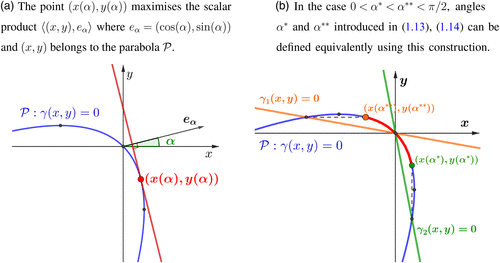
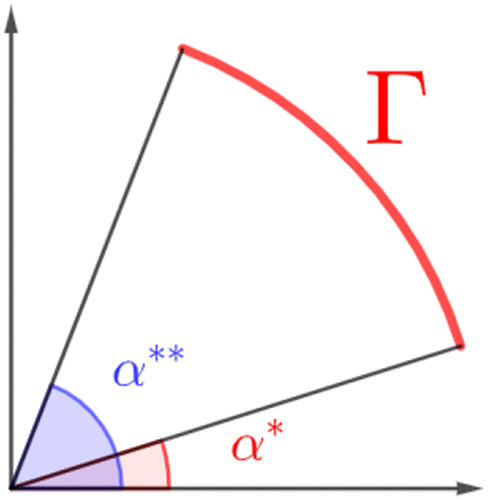
Let us define two particular directions
In the following theorem, we summarize the asymptotics of Green’s functions for directions . The ones for are given later in Theorems 6, 7, and 8.
(
If , then
(1.15)If , then
(1.16)If , then
(1.17)
where , and are positive explicit constants depending only on the parameters of the degenerate reflected Brownian motion (see (6.1)), and are harmonic functions given in Theorem 2. Furthermore, are nonzero.
Explicit Expressions for Positive Harmonic Functions with the Compensation Method.
Let us recall the following definition: a function is harmonic if and only if for all and ,
All functions are harmonic. These functions are explicitly stated in Theorem 2 below and will be derived in this article using the compensation method. The essence of this method is to construct functions that satisfy the partial differential equation along with boundary conditions:
For and we set
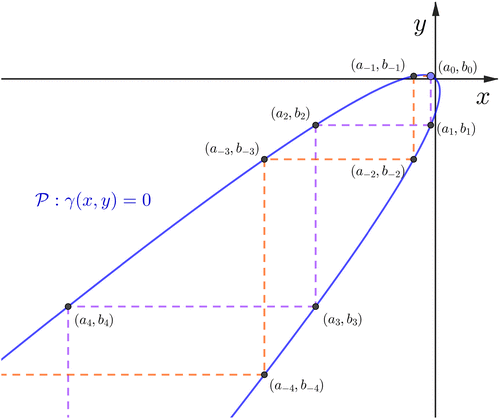
As illustrated in Figure 4, points are constructed by following the “downstairs” path on the parabola, applying successively automorphisms that leave invariant the first or the second coordinate, respectively.
(
For , taking , we have
(1.22)where and
(1.23)(with the convention ).
For ,
– If , then and .
– If , then and taking ,
(1.24)where– If , then and taking ,
(1.25)whereFor , symmetrical formulae hold replacing by , by , and 0 by .
Note that if or , expression (1.22) may define a harmonic function that is not necessarily nonnegative everywhere.
The Martin boundary and its minimality are derived from Theorems 1 and 2, together with the further technical results in Theorems 6, 7, and 8 concerning the asymptotics of Green functions along the directions and .
(
Furthermore, the Martin boundary is minimal.
(
- Regarding assumption (1.2), similar results could be established under the more general condition . This condition is equivalent to the orientation of the parabola toward and . It is also necessary for the convergence of the expressions defining —specifically, equation (1.22). Namely, if , then the Laplace transform would have a pole at zero. Because of the technical nature of this paper, we have chosen to restrict our analysis to Assumption (1.2). Investigating how the Martin boundary is affected by the presence of such a pole could be an interesting direction for future work.
- If (1.3) is not satisfied, then the arguments that yield the explicit expressions of the harmonic functions fail. In particular, attempts to construct the functions without this assumption often lead to signed functions that, although possibly harmonic, are not necessarily nonnegative. For interested readers, the only step in our argument that fails for general reflection vectors is equation (4.18), which may offer a direction for future investigation.
1.3. Plan of the Article
In Section 2, we define the degenerate reflected Brownian motion. We then derive the functional Equation (1.7) in Section 3 and meromorphically extend Laplace transforms on the edges up to their singularities. In Section 4, we obtain the explicit form of the Laplace transforms iterating the functional Equation (1.7). Next, in Section 5, we carry out preparatory work to derive the asymptotics of Green’s functions. These asymptotics are computed in all directions in Sections 6 and 7 by the saddle point method. This enables us to prove Theorems 1 and 2 by employing the explicit expressions from Section 4. In Section 8, we establish the asymptotics of the Martin kernel and identify all the harmonic functions. We also prove the minimality of the Martin boundary and conclude the proof of Theorem 3. Finally, in Section 9, we treat the general case of the model without Assumption (1.4) via a linear transformation of space and time.
2. Definition of the Process
Throughout the following, the filtered space we consider is always the space of continuous functions with the standard field and the usual filtration. The following background definition is taken from Taylor and Williams (1993), where the nondegenerate reflected Brownian motion is studied.
(
is an adapted degenerate Brownian motion (with zero drift) of covariance starting from under .
L is an adapted two-dimensional process starting from 0 such that almost surely, and its components are continuous and nondecreasing with ; that is, increases only when .
Note that under , Z can be written as , where is a one-dimensional Brownian motion and ( under (1.4)) is the unique eigenvector (up to a scalar multiplication) associated with the positive eigenvalue of the covariance matrix.
(
Define the matrix , whose spectral radius is . By theorem 1 in Harrison and Reiman (1981), for any continuous path , there exists a unique solution of the Skorokod problem
As in the nondegenerate case, there may be existence and uniqueness in law if R is a general -matrix Taylor and Williams (1993) (without assuming ) but not path-wise uniqueness (Bass and Burdzy 2024). To avoid excessive technicality, we work under assumption
(
Consider , which is orthogonal to the direction of the Brownian motion. It suffices to note that is almost surely strictly increasing and tends to because by (1.3). □
We recall the definition of Green’s measure and from (1.5) and (1.6). Assumption (1.2) on the drift is crucial for the following proposition.
(
Let A be a compact set of at a positive distance of the edges. Define the stopping times:
Considering the back-and-forth trajectories between A and (see Harrison and Williams 1987a and Lemma 9 in Section 7), we can reduce the proof to showing that
Then, by the Strong Markov property, it suffices to prove the result for a nonreflected degenerate Brownian motion. By Assumption (1.2), rotating the plane so that the x-axis aligns with the drift direction reduces the problem to one-dimensional Brownian motion. The proposition then follows from elementary properties of the latter. □
(
For brevity, we omit the dependence on the starting point in the notation for the Laplace transforms. However, when relevant, we will denote this dependence explicitly as and .
3. Functional Equation, Kernel, and Analytic Continuation
From now on, we assume (1.2) to (1.4). As mentioned in the introduction, Laplace transforms are linked by a functional equation.
(
We apply Itô’s formula to the semimartingale and the function . Then,
Considering as a polynomial in x (resp. y) with coefficients depending on y (resp. x), we obtain two complex branches , (resp. , ) satisfying :
We have one branching point (resp. for (resp. ). The square roots are chosen to be defined as holomorphic functions on and take nonnegative values on the nonnegative reals.
Let such that . Then, we have
If satisfy , then
Let . Then, for all x such that . Similarly, for all y such that .
Equations (3.4) and (3.5) follow directly from the expression (1.8) of . The last statements come from the inequalities and . □
(
This follows directly from Lemma 1 and the functional Equation (3.1). □
From now on, and will be considered over their extended domains. Let us define
If equation (resp. ) has a solution in the complex plane, then it is unique and is given by (resp. ). We also define
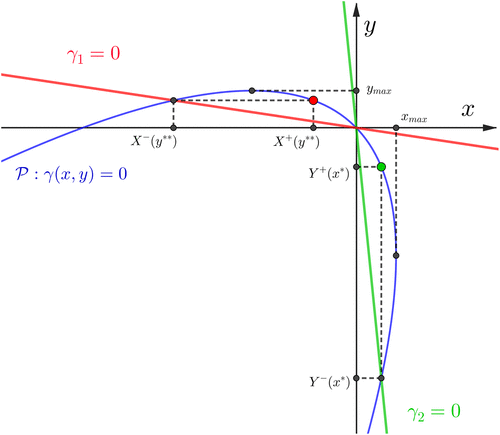
(
(i) (resp. ) is not a pole of (resp. ).
(ii) If x (resp. y) is a pole of (resp. , then (resp. ) and (resp. ). Furthermore, is a pole of (resp. is a pole of ) if and only if
The first point follows from the continuation Equation (3.7) because .
For (ii), if x is a pole of , then it follows from (3.7) that , which implies that Moreover, the Laplace transform is holomorphic in . Thus , being a pole of , must be positive. Note that equation has a positive solution if and only if . This last condition is equivalent to .
Let us assume that . Then, . Because , it follows from (3.7) that is a pole of if the numerator of the right-hand side of (3.6) does not vanish at . The last fact holds true and is actually equivalent to the nonnullity of the function defined in (3.24); this equivalence and the non-nullity are postponed till the end of Section 6.2. □
The following proposition provides some estimates for the Laplace transforms. These estimates will be useful in Section 5.
(
The expressions and grow linearly with respect to v as v tends to Furthermore, expression (3.4) provides inequality for some constants and
We also give some further estimates for Laplace transforms that will be useful in Section 4.3.
(
The symmetric result holds for .
By (1.3), note that the support of the measure is . Then,
4. The Compensation Method and the Explicit Expressions of the Laplace Transforms
4.1. Heuristic of the Compensation Method
Let h be a smooth function satisfying the following partial differential equation with boundary conditions,
The principle of the compensation method is to find functions of the form such that each exponential term satisfies condition : (i.e., , see Figure 4) and to “compensate” the constants so as to ensure that conditions and are satisfied. We require that
Given that conditions are linear, it follows that h is a harmonic function. By a direct computation, we find that conditions on the right-hand side of (4.2) are satisfied if and only if and for any integer k. Similarly, conditions in the right-hand side of (4.2) are satisfied if and only if and for any integer n.
We will see in Section 6.1 that the harmonic functions we obtain can be written as
The explicit expressions of and in Section 4.3 then provide the exact Equation (4.2) suggested by the compensation method. Moreover, the approach of Section 6.1 justifies why the harmonic functions given by (4.2) are nonnegative when is well chosen.
4.2. Parabola and Automorphisms
Let us recall that is the parabola defined by (see (1.10)). Before defining the sequence motivated by Section 4.1 (see Figure 4), we first give a parametrization of .
(
This means that .
The relation is easily verified by substituting into the expression (1.8) of . Furthermore, the parameterization is injective. To show this, assume that
Subtracting the second equation from the first gives , which implies . Similarly, surjectivity can be verified by elementary considerations. □
To define the “downstairs” as in Figure 4, we introduce two transformations on the parabola that leave the first (resp. second) coordinate invariant. This is the aim of the following proposition (which also serves as a definition). This proposition is illustrated by Figure 7.
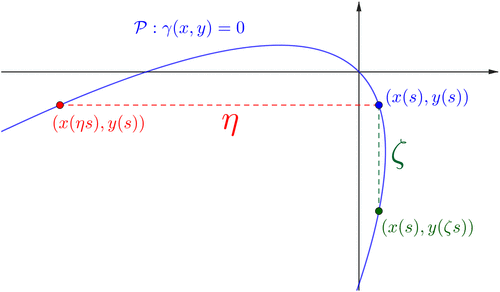
(
Then, and for all . Therefore, and in their respective domains of definition. Furthermore, for all and , we have
The formulae and are easily verified. The expression of is a consequence of expressions of and of the equation (see Assumption (1.4)). □
Note that , By the parameterization (4.3), and can be regarded as reflections (see (4.4)) and their composition as a translation (see (4.5)).
(
(see Figure 4). Then, for any , the following expressions hold:
The invariance of the first and the second coordinate of and , respectively, implies equalities and . The explicit expressions of and are obtained from the explicit expression (4.5). □
For , we define
With these notations,
Note that the curve is the portion of the parabola from to going counterclockwise (see Figure 6). Furthermore, and with definition (3.8). We can now provide explicit expressions for the Laplace transforms and
4.3. Explicit Expression of Laplace Transforms via the Compensation Approach
(
Similarly, for all
Before proving Theorem 5, we establish a technical lemma.
For all and , we have and . Furthermore, are also nonzero.
We define two portions of the parabola and given by
By Assumption (1.3), the line (resp. ) cannot pass through (resp. ). Additionally, note that and . Because, belongs to for all . Thus, for any . By similar reasoning, for any . The last statement comes from the fact that □
The main idea of the proof is to get a recursive formula for Laplace transforms. To do this, we rewrite the functional Equation (3.1) in and , which holds because and are negative:
By the invariance of (resp. ) under (resp. ), we have and . Then, by eliminating from the equations (which is possible by Lemma 4), we obtain
Similarly, we get
Substituting this into (4.15), we get
Then, by induction on N, we obtain the following equality for all :
The proof is then reduced to proving the following limit:
To justify this, note using Equation (4.12) and Lemma 3 that
By elementary considerations, the following asymptotic behavior holds:
The exponent given by (4.20) is exactly the parameter introduced in Dreyfus et al. (2025), which determines the algebraic nature of the Laplace transforms for the same degenerate particle model in the recurrent case. Furthermore, the constants in (1.22) satisfy
In (4.11) (resp. (4.13)), (resp. ) is not given as a function of x (resp. y) but of s. Therefore, we establish the following corollary.
The following expressions hold in the domains and , respectively:
By Lemma 3 and equalities for , Equations (4.23) and (4.24) hold on the curve . By Corollary 1, Laplace transforms and are meromorphic on and , respectively. Consequently, the explicit expressions (4.23) and (4.24) remain valid in these domains. □
5. Laplace Inverse and Saddle Point Method
To avoid certain technical complications, we first derive the asymptotic behavior of the Green functions for and later address the case with additional arguments.
5.1. Inverse Laplace Theorem and Saddle Point
Let be a starting point of the process. The inverse Laplace transform formula (see (Doetsch 1974 (theorems 24.3 and 24.4) and Brychkov 1992) yields the following representation for : for sufficiently small,
(
By the functional Equation (3.1), can be decomposed as
Substituting this expression into the double integral (5.1), is written as the sum of three double integrals. Let us consider the first term, given by
Let be the closed oriented contour defined by
By applying the residue theorem along the contour and considering the asymptotics as (see Franceschi et al. 2024b (lemma 4.1) for more details), we obtain the identity
To find the asymptotics of these integrals as , we use the saddle point method. For any , let be defined as
Note that , using notation (4.3). By studying the variations of the function , we prove that
Using the definitions of , and given by (1.13), (1.14), and (3.8), if (resp. ) is a pole of (resp. ), then (resp. ). Because (see Notation 1), then the monotonicity of (5.6) implies that , where is the angle of the drift. We follow the notation of Franceschi et al. (2024b) and define
By construction, the equations and hold. Then, by differentiating Equation (5.7) and , we get for any :
Therefore,
Similarly,
5.2. Contour of Steepest Descent
Let . The key idea of the saddle point method is to use the parameterized Morse lemma. Because , lemma A.1 from Franceschi et al. (2024b) yields some and a family of smooth paths such that
For further details on the construction, please refer to appendix A in Franceschi et al. 2024b. Define
In particular,
Furthermore, and (see Figure 8 and construction in Franceschi et al. 2024b). The same construction holds for for G and . These paths satisfy
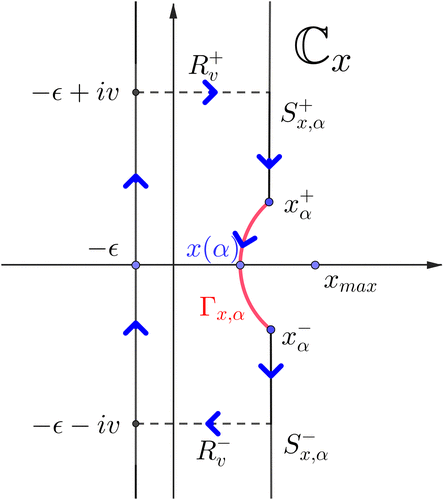
Note. Here, .
The arrows above and below the paths indicate reversed orientations; this notation is taken from (Fayolle et al. 2017, chapter 5.3).
5.3. Shift of the Integration Contours and Contribution of the Poles
We now apply the saddle point method. To do this, we shift the integration contours of , , and to contours passing through the saddle point and following the steepest descent contours and . We define and for , where
(
Let and be the initial condition of the process. Then, for any ,
The shift of the path is illustrated in Figure 8 and is the same as in (Franceschi et al. 2024b, lemma 6.1). The proof of (5.14) is a direct consequence of the residue theorem, provided that the integrals over the horizontal contours and tend to 0 as v tends to Then, it remains to be proven that for any sufficiently small ,
By the functional Equation (3.1) and continuation Equation (3.7), the term inside the supremum is equal to
By (3.3), grows like uniformly in as . Furthermore, grows linearly in v uniformly in as by Assumption (1.3). The same asymptotics hold for . Moreover, , so this expression grows with rate , uniformly in . Considering the exponential decay of (see Lemma 2) we get the conclusion for . Formulae for and are obtained similarly. □
5.4. Negligibility of Some Integrals
For any pair let be the angle in such that and . We now aim to evaluate the asymptotics of the integrals over and in Lemma 6 as and for some In the next lemma, we establish exponential bounds for the integrals over the vertical contours , . These bounds imply that the main contribution to the above asymptotics comes from the integrals over the steepest descent contours , , whereas those over and turn out to be negligible.
(
If , then
If , then
We start by showing (5.18). Using notations (5.7) and (5.12), this inequality can be rewritten as
Suppose first that . Let and . Because , this expression does not vanish and grows at rate as , uniformly in , with Similarly, grows with speed |v| as , uniformly in , . Then, we have, for all
Now suppose that . We no longer use estimate (5.23) because it would produce terms of order , and here b may be close to zero. Let . We write continuation Equation (3.7) for , which splits into two terms,
Note that if , then the quotient in the integrand is of order ) as . Moreover, it suffices to bound the integral over for some because the integrand is uniformly bounded with respect to and . By integration by parts, the integral over equals
Furthermore, and for all with large enough and . With some calculations, the integrand of (5.27) is of order as . Hence, the integral in (5.27) is bounded by a positive constant independent of and of . This establishes the bound in (5.18). Inequalities (5.19), (5.20), and (5.21) are obtained similarly. □
6. Proof of Theorem 1
In Section 6.1, we establish the asymptotics stated in Theorem 1. In Section 6.2, we show that all the constants appearing in the asymptotics of Theorem 1 are nonzero, which completes the proof of the theorem.
6.1. Asymptotics in Theorem 1
We now have the tools to derive the asymptotics stated in Theorem 1, where is given by (1..22), by (1..24) (with the symmetric formula for ), and
We use the identity , using the expressions provided in Lemma 6. By the classical saddle point method (see details in (Franceschi et al. 2024b, lemma 8.1), the sum of the integrals of Lemma 6 along and has the following asymptotic expansion:
Lemma 7 shows that, when , integrals over are negligible compared with those over paths of steepest descent. Finally, Theorem 5 gives the explicit form of residues of Lemma 6 providing , . □
For the case , we establish two preliminary lemmas. The first one is a consequence of the general Martin boundary theory.
For , is harmonic on .
For , we may consider the process evolving in . Because is the limit of the quotient of Green’s kernels, Kunita and Watanabe (1965) implies its harmonicity over all these domains and thus over . □
Let be the contour defined by and the stopping time at . Then, for all satisfying ,
Suppose first that . The process is a martingale; indeed, for ,
Now suppose , and consider a sequence in the quarter plane converging to such that . By continuity of , converges to as n goes to . Because Equation (6.6) holds for all nonzero initial conditions, it suffices to show that
By continuity and boundedness of on ), it is enough to show that weakly, where denotes the law of with initial condition . This follows from Assumption (1.2), combined with Harrison and Reiman (1981, theorem 1), which ensures the continuity of the mapping from the nonreflected to the reflected path under the topology of uniform convergence on compacts. □
We can now prove Theorem 1 in the case of .
By continuity of the process and by the Strong Markov property, if lies at a distance from , then
Because the constant C from the saddle point method (Franceschi et al. 2024b, lemma 8.1) depends continuously on , and because the constants in Lemma 7 are locally uniform in , then for any compact set K in the quadrant with , we have
By this expansion,the asymptotics of (6.7) yield
6.2. Positivity of
To make our asymptotics consistent, we prove here the positivity of the constants .
Let . Then, for every , there exists such that and . If (resp. , then the same result holds for (resp. ).
By the explicit Equation (1.22) for , Equation (1.24) for , and its equivalent for , the following asymptotics hold as for , and for (resp. ), if (resp. ), then
The conclusion follows with for r large enough. □
The following Lemma is inspired by (Franceschi et al. 2024b, lemma 8.3) and establishes the positivity of constants in the framework of Theorem 1.
(
Let , and let such that both coordinates are larger than those of z and such that ; see Lemma 10. Let V be a compact neighborhood of , and denote by the hitting time of V. By the hypothesis on z, . By the strong Markov property,
Furthermore, by continuity of , the set V can be chosen to satisfy . On the other hand, we also have
This is the end of the proof of Proposition 4.
The remaining part of the proof is equivalent to showing that ; indeed, is equal to up to a nonnull multiplicative constant (see (1.24) and (4.11)). The positivity is established in the previous lemma. □
7. Asymptotics of Green’s Kernel in the Particular Directions , and
In Section 7.1, we study the asymptotics of Green’s functions in the direction under the assumption that . In Section 7.2, we provide these asymptotics in the direction if Then, in Section 7.3, we analyze the limiting case where and . The analysis of the directions , if and is symmetrical. We then derive the proof of Theorem 2 in Section 7.4.
7.1. Case If
Before deriving the asymptotics, let us relate Green’s densities to .
(
By the functional Equation (3.1), if , then
Furthermore, by elementary properties of Laplace transforms,
Then, letting in (7.1), we get . The injectivity of the Laplace transform concludes the proof. The case of is symmetrical. □
(
Note that by (3.3). Then, using the continuation Equation (3.7), is continuous at and
It then remains to be shown that . From Equation (5.6), we have
We can now establish the asymptotics of Green’s functions as . We use the notation and for the constants in the first and second terms, respectively, in the asymptotic expansion of Green’s functions (cf. (6.8)).
(
Moreover,
If (i.e. has no pole), then
If (i.e. has a pole), then
where and are given by (1.24) and (6.1), respectively.
Moreover, the constants and are nonzero in the corresponding asymptotics.
First, (7.2) follows from the regularity of in and from the convergence as (see (1.22)). Now we analyze the asymptotics of the sum of the three integrals in (2) along the saddle point curves as . The integrands in the second and third terms are holomorphic in a neighborhood of the saddle point . The integrand of the first term, namely , has a branching point at . For this reason, we perform the change of variables :
Additionally, from (3.7),
Note that is holomorphic in a neighborhood of . The crucial point is that is also holomorphic there. Indeed, it can be expressed as
To see this, note that and are the two roots of . Then, by Vieta’s equations and because , (7.6) follows immediately. Because , it follows from (7.5) that is holomorphic at , so the saddle point method applies to the right-hand side of (7.4). Then, asymptotics of Green’s functions become
By Proposition 8, . Finally, Lemma 12 applies and completes the asymptotic analysis. The nonvanishing of is analogous to the case ; see Section 6.2. The nonvanishing of if is already proved in Lemma 11. □
7.2. Case When
(
If , then
(7.9)where is given by (1.24).If for some constant K, then for (resp. ),
(7.10)where constants , are independent of initial condition .If , then
If , then
(7.11)If , then
(7.12)
where C is a positive constant independent of initial condition .
Furthermore, . Constants , and C are made explicit in Franceschi et al. (2024b, section 10).
The proof is analogous to Franceschi et al. (2024b, section 10), which compares the asymptotic contribution of the pole term and the saddle point term in the expressions of Lemma 6 for . The nonvanishing of was already proved in Lemma 11.
7.3. Last Particular Case
Suppose (so ). Then,
The proof follows the same approach as that of Theorem 6, but here . Thus, we consider only the first term in (6.2) with the representation (7.4) for . First, note from (3.6) that . Then, by (7.6),
Hence, . Furthermore, by similar calculations.
Using the same arguments as in the proof of Theorem 6, the function
This implies (1.25). The proof of the nonvanishing of is analogous to Lemma 11. □
7.4. Proof of Theorem 2
This is a direct consequence of Theorems 1, 6, 7, and 8.
8. Harmonic Functions and Martin Boundary
In this section, we prove Theorem 3. In particular, we show in Section 8.1 that the Martin boundary is homeomorphic to and in Section 8.2 that the Martin boundary is minimal.
8.1. Context of Martin the Boundary
In this section, we consider the construction of the Martin boundary as presented in (Pinsky 1995, section 7.1) for elliptic processes, and we adapt this approach to reflected degenerate processes. This method allows us to consistently link the harmonic functions found in Theorem 2 and the Martin boundary. Note that another general construction of the Martin compactification is presented in Kunita and Watanabe (1965).
(
By usual considerations (see Pinsky 1995), is a metric equivalent to the Euclidean one on . A sequence of is called a Martin sequence if converges pointwise. Two Martin sequences are said to be equivalent if their limit functions are equal. We then define M as the quotient of the set of all Martin sequences by this equivalence relation. Each is then naturally associated with function denoted by . The metric extends naturally to M with the same formula so that the map
Let be defined in Theorem 2. Then, the map
Before proving this lemma, we recall some properties of the family .
Note that for :
By Theorems 1, 2, 6, 7, and 8, is surjective. To prove the continuity of , note that a sequence converges to some if converges pointwise toward almost everywhere. Therefore, the proof of the continuity of is reduced to showing that, for any , the map is continuous. Let .
By (1.22), the map is continuous on .
If and , then we have
so is continuous at .If , then can be written as
where are defined by (1.20) and (1.21), with , and is given by (1.23). Because (see Notation 1 and Proposition 4), the expected continuity in follows from standard continuity theorems on series.The remaining case and is analogous.
The proof of the continuity of at is symmetric.
Next, let us show that is injective. By the explicit expressions in Theorem 2, the following asymptotics hold as . For and , we have
If , then for any ,
If and , then
The corresponding symmetric asymptotic behavior holds for . If are distinct, then by (5.4) and the preceding formulae,
Hence, for any constant C, and is injective.
Because is continuous, and because is compact, is closed in for any closed subset F of . Therefore, is a homeomorphism. □
The following properties hold:
(i) If satisfies , then .
(ii) The metric space is compact.
(iii) is dense in M with respect to .
(iv) If a sequence converges to with respect to , then converges pointwise to .
Properties (i), (iii), and (iv) follow directly from our construction. We now prove (ii). Let be a sequence in M. Then:
Either has infinitely many points in , in which case it has a convergent subsequence because is compact (see Lemma 13);
or has a bounded subsequence, in which case the conclusion follows because is equivalent to the Euclidean metric;
or has a subsequence that tends to infinity. Because is compact, has a subsequence to infinity in some direction . By Theorems 1, 6, 7, and 8, this subsequence converges (with respect to the metric ) to . □
By Corollary 2, M is the Martin compactification in the sense of Kunita and Watanabe (1965) and Pinsky (1995), and the Martin boundary is homeomorphic to .
In particular, by Kunita and Watanabe (1965, theorem 4), the following representation theorem holds.
(
Furthermore, every function defined by (8.7) is harmonic.
8.2. Minimality of Functions and Martin Boundary
In this section, we prove that the Martin boundary is minimal.
(
(
To prove this, we state the following lemma.
Let and . Then, there exist constants and such that
This follows from Theorem 2, where explicit formulae of are given. □
Let . We aim to prove that if for some Radon measure , then is the Dirac measure at . This directly implies the minimality of using Definition 4 and Theorem 9. It suffices to show that the support of is exactly . Suppose first that . Let us prove that . Let . First, by (5.4), we can choose such that
Second, by Lemma 14, such that
Considering and in (5.4), we obtain, for large enough,
By (8.9), the asymptotics of the previous inequality as yield . Therefore, can be written as for some nonnegative constants A, B, and C, that is, . Now, considering the asymptotics (8.4), (8.5), and (8.6), we immediately get and . Hence, is the Dirac measure at , and is minimal. The cases and are treated similarly. □
This is a direct consequence of Lemma 13, Remark 4, and Proposition 9. □
9. From Assumption (1.4) to the General Case
We stated and proved Theorems 1, 2, and 3 under Assumption (1.4). In this section, we generalize these theorems without assuming (1.4). To achieve this, we apply transformations to the axis, axis, and time t in order to reduce the problem to a process that satisfies (1.4).
(
Then, the process
This is a direct consequence of Definition 1 applying the corresponding transformation to (2.1). □
(
Furthermore, the Martin boundary remains homeomorphic to and is minimal.
Let be the map defined by . We denote by (resp. ) the Green’s measure associated with (resp. with ) and (resp. the corresponding Green’s functions, where . Note that
Furthermore,
Therefore, the following holds for all :
Then,
The author thanks Sandro Franceschi and Irina Kourkova for their invaluable insights and discussions about this article. First and foremost, the author sincerely thanks Sandro Franceschi for introducing the author to the compensation method and for the many fruitful discussions they have had. Sandro Franceschi’s guidance has been crucial in shaping this research, and the conversations between him and the author have greatly deepened the author’s understanding of the subject. The author is also deeply grateful to Irina Kourkova for her numerous valuable suggestions regarding the writing of this article as well as for their exchanges on a specific case related to asymptotic analysis.
References
- (1994) A compensation approach for queueing problems. CWI Tract - Centrum voor Wiskunde en Informatica, Centrum voor Wiskunde en Informatica, Amsterdam.Google Scholar
- (2013) The compensation approach for walks with small steps in the quarter plane. Combin. Probab. Comput. 22(2):161–183.Google Scholar
- (1991) Analysis of the asymmetric shortest queue problem. Queueing Systems 8(1):1–58.Google Scholar
- (1993) A compensation approach for two-dimensional Markov processes. Adv. Appl. Probab. 25(4):783–817.Google Scholar
- (2024) Pathwise non-uniqueness for Brownian motion in a quadrant with oblique reflection. https://arxiv.org/abs/2405.06144.Google Scholar
- (1992) Multidimensional Integral Transformations (Gordon and Breach Science Publishers, Philadelphia).Google Scholar
- (2005) Markov Processes, Brownian Motion, and Time Symmetry (Springer, New York).Google Scholar
- (2011) Reflecting Brownian motion in two dimensions: Exact asymptotics for the stationary distribution. Stoch. Systems 1(1):146–208.Link, Google Scholar
- (2009) Reflected Brownian motion in a wedge: Sum-of-exponential stationary densities. Electron. Commun. Probab. 14:1–16.Google Scholar
- (1974) Introduction to the Theory and Application of the Laplace Transformation (Springer, Berlin Heidelberg).Google Scholar
- (1959) Discrete potential theory and boundaries. Indiana Univ. Math. J. 8(3):433–458.Google Scholar
- (1984) Classical Potential Theory and Its Probabilistic Counterpart (Springer, New York).Google Scholar
- (2025) Degenerate systems of three Brownian particles with asymmetric collisions: Invariant measure of gaps. Working paper or preprint.Google Scholar
- (2022) Martin boundary of random walks in convex cones. Annales Henri Lebesgue 5:559–609.Google Scholar
- (2021) Asymptotic behavior of the occupancy density for obliquely reflected Brownian motion in a half-plane and martin boundary. Ann. Appl. Probab. 31(6):2991–3016.Google Scholar
- (2017) Random Walks in the Quarter Plane: Algebraic Methods, Boundary Value Problems, Applications to Queueing Systems and Analytic Combinatorics (Springer International Publishing, Berlin, Heidelberg).Google Scholar
- (2020) Green’s functions with oblique Neumann boundary conditions in the quadrant. J. Theoret. Probab. 34(4):1775–1810.Google Scholar
- (2024) Martin boundary of a space-time Brownian motion with drift killed at the boundary of a moving cone. Potential Anal. (Oxford) 63(2):531–555.Google Scholar
- (2017) Asymptotic expansion of stationary distribution for reflected Brownian motion in the quarter plane via analytic approach. Stoch. Systems 7(1):32–94.Link, Google Scholar
- (2019) Integral expression for the stationary distribution of reflected Brownian motion in a wedge. Bernoulli 25(4B):3673–3713. Google Scholar
- (2024b) Asymptotics for the Green’s functions of a transient reflected Brownian motion in a wedge. Queueing Systems 108(3–4):321–382.Google Scholar
- (2024a) Invariant measure of gaps in degenerate competing three-particle systems. Preprint, Submitted January 19, https://arxiv.org/abs/2401.10734.Google Scholar
- (1981) Reflected Brownian motion on an orthant. Ann. Probab. 9(2):302–308. Google Scholar
- (1987a) Brownian models of open queueing networks with homogeneous customer populations. Stochastics 22(2):77–115.Google Scholar
- (1987b) Multidimensional reflected Brownian motions having exponential stationary distributions. Ann. Probab. 15(1):115–137. Google Scholar
- (2023) Harmonic functions for singular quadrant walks. Indagationes Mathematicae 34(5):936–972. Google Scholar
- (1993) Recurrence and transience of reflecting Brownian motion in the quadrant. Math. Proc. Cambridge Philos. Soc. 113(2):387–399.Google Scholar
- (1957) Markoff processes and potentials. I, II, III. Illinois J. Math. 1(1):44–93. Google Scholar
- (2022) Degenerate competing three-particle systems. Bernoulli 28(3):2067–2094. Google Scholar
- (2009) Martin boundary of a reflected random walk on a half-space. Probab. Theory Related Fields 148(1–2):197–245.Google Scholar
- (2010) t-martin boundary of reflected random walks on a half-space. Electron. Comm. Probab. 15:149–161. Google Scholar
- (2010) Martin boundary of a killed random walk on a quadrant. Ann. Probab. 38(3):1106–1142. Google Scholar
- (1965) Markov processes and martin boundaries part I. Illinois J. Math. 9(3):485–526.Google Scholar
- (1998) Martin boundary and elliptic curves. Markov Processes Related Fields 4(2):203–272.Google Scholar
- (2011) Random walks in with non-zero drift absorbed at the axes. Bull. de la Société Mathématique de France 139(3):341–387.Google Scholar
- (1973) Asymptotic behavior of the stationary probabilities for two-dimensional positive random walks. Sib. Math. J. 14(1):109–118.Google Scholar
- (1941) Minimal positive harmonic functions. Trans. Amer. Math. Soc. 49(1):137–172.Google Scholar
- (1966) The Martin boundary for random walk. Trans. Amer. Math. Soc. 121(1):116–132. Google Scholar
- (1995) Positive Harmonic Functions and Diffusion (Cambridge University Press, Cambridge, UK).Google Scholar
- (1993) Existence and uniqueness of semimartingale reflecting Brownian motions in an orthant. Probab. Theory Related Fields 96(3):283–317.Google Scholar
- (1985) Recurrence classification and invariant measure for reflected Brownian motion in a wedge. Ann. Probab. 13(3):758–778.Google Scholar
- (2022) The kernel method tail asymptotics analytic approach for stationary probabilities of two-dimensional queueing systems. Queueing Systems 100(1–2):95–131.Google Scholar