Long Time Limits of Fluid Models for Many-Server Queues with Abandonment via Nonlinear Volterra Equations
Abstract
In this paper, we study the fluid limit of many-server queues with abandonment (with traffic intensity ) via a class of nonlinear Volterra equations. For a broad class of service time distributions, we establish the asymptotic behavior of the solutions to the class of nonlinear Volterra equations, which in turn implies the large time behavior of the fluid limit of the many-server queues with abandonment.
1. Introduction
In recent years, there has been tremendous attention given to the study of many-server queueing systems with customer abandonment due to its applications for telephone contact centers or (generally) customer contact centers (Garnett et al. 2002, Gans et al. 2003, Brown et al. 2005), patient flows in hospitals (Brown et al. 2005, Green 2006, Armony et al. 2015, Shi et al. 2015), and enzymatic processing networks in biology, where reneging seeks to model the phenomenon of dilution (Mather et al. 2010). A basic model, also known as the queue, describes a service system with N parallel identical servers, and customers (jobs) arrive with a (possibly) time-dependent arrival rate, require independent and identically distributed (i.i.d.) service times drawn from a general distribution, and have i.i.d. patience times drawn from another general distribution. Arriving customers enter service immediately if there is an idle server available, else they join the back of the queue. A customer at the head of the queue starts service once a server becomes available. Once a customer completes service, it departs the system. Customers are assumed to abandon from the system if their time spent waiting in queue reaches their patience times. The arrival process, service, and patience times are assumed to be mutually independent. The service discipline is first-come-first-serve (FCFS) and nonidling; that is, no server will idle whenever there is a customer in queue. Important system performance measures of interest include the stationary waiting time and queue distributions. When the customers’ arrivals follow Poisson and the service times follow exponential distribution, but the patience times follow a general distribution, explicit formulas for the scaled steady-state distributions were obtained in Baccelli and Hebuterne (1981), and their asymptotics as N, the number of servers, goes to infinity, were studied in Zeltyn and Mandelbaum (2005). However, statistical analysis of real call centers has shown that both service times and patience times are typically not exponentially distributed (Brown et al. 2005, Zeltyn and Mandelbaum 2005), and the exact analysis of the scaled steady-state distributions is typically not feasible. Instead, an asymptotic analysis, as the number of servers goes to infinity, is desired.
In Kang and Ramanan (2010), the state descriptor of the system with N identical servers includes a pair of measure-valued processes, the “potential queue measure” process, , the “age measure” process, , and the total count process, . Here, keeps track of the waiting times of customers in the “potential” queue that includes, not only those customers in queue, but also those customers who may have already entered service (and possibly departed the system), but for whom the time since entry into the system has not yet exceeded its patience time; keeps track of the amounts of time that customers currently receiving service have been in service; and represents the total number of customers in the system (including those in service and those in queue). Under suitable conditions on the service and patience distributions, it was shown in Kang and Ramanan (2010) that when the average arrival rate or traffc intensity converges to , the rescaled state descriptor converges to a deterministic limit that is the unique solution to the (measure-valued) fluid model equations in Definition 1.
In AKKR (Atar et al. 2023), the long time behavior of , parameterized by the constant arrival density , is studied under the assumption that the fluid model equations admit a unique invariant state (equivalently, fixed point). When (subcritical regime), the convergence of , as , is established under the assumption that the patience time distribution has finite mean and the service time distribution has finite mean as well. On the other hand, when (critical regime) and (supercritical regime), only the convergence of is established under additional assumption that the hazard rate function of the service time distribution is either decreasing or bounded away from zero and infinity. The proof techniques are different under the two sets of assumptions on the service time distribution . When the hazard rate function is decreasing, a reformulation of the dynamics in terms of a certain renewal equation is used, in conjunction with recursive asymptotic estimates. When the hazard rate function is bounded away from zero and infinity, the proof uses an extended relative entropy functional as a Lyapunov function. Note that, in AKKR, the convergence of for is not obtained, and the convergence results there do not cover distributions like lognormal, Weibull, or gamma distributions because the hazard rate functions of these distributions are neither decreasing in general nor bounded either away from zero or from infinity. It was discussed in Brown et al. (2005) that the service duration of customers at a small call center for one of Israel’s banks actually follows a lognormal distribution. This observation is also confirmed in Cogdill and Monticino (2007) for service times of customers in retail banks. Therefore, it is imperative to establish the convergence of for a more broad class of distributions than those in AKKR in the critical or supercritical regime . This is the main goal of this paper.
The main tool used here is different from the ones used in AKKR. We study the process directly as the solution to a nonlinear Volterra equation (see Lemma 1). This enables us to use certain integrability and comparison results on solutions to a certain class of nonlinear Volterra equations in Engler (1986), a sensitive analysis on solutions to a certain class of nonlinear Volterra equations in Miller (1971), and another comparison result on solutions to a certain class of nonlinear Volterra equations in Sato (1953). We establish the convergence of and hence the convergence of in Theorem 1 for under Assumption 2 on the service time distribution , the initial state , and the patience time distribution . Note that Assumption 2, (a)–(d), is very mild, and Assumption 2, (1)–(3), on the service time distribution only comes in when the arrival rate for some that depends only on (see (30)). For lognormal, Weibull, or gamma distributions, the value is typically small as discussed in Remark 5. Therefore, when the system is slightly overloaded (), the convergence of holds just under Assumption 2, (a)–(d). Even when , Assumption 2, (1)–(3), is more general than the ones in AKKR (see Remark 3). Also, the assumption used in AKKR that the fluid equations admit a unique invariant state is only needed here for the critical region (). For a future investigation, it would be interesting to see if the convergence of can be established just under Assumption 2, (a)–(d), for all .
1.1. Notation and Terminology
The following notation will be used throughout the paper. is the set of strictly positive integers, is set of real numbers, and is the set of nonnegative real numbers. For , denotes the maximum of a and b, the minimum of a and b, and the shorthand is used for . Given a set B, denotes the indicator function of the set B (that is, if and otherwise). The constant function will be represented by the symbol . Given a nondecreasing, right continuous function f having left limits on , denotes the inverse function of f in the sense that
The space of Radon measures on a Polish space E, endowed with the Borel -algebra, is denoted by , whereas is the subspace of finite nonnegative measures in . Here is equipped with the usual weak topology; that is, a sequence in is said to converge weakly to if and only if for every bounded and continuous function on E,
The symbol will be used to denote the measure with unit mass at the point x. When E is an interval, say , for notational conciseness, we will often write instead of . For any Borel measurable function that is integrable with respect to , we often use the short-hand notation
Let be the set of nondecreasing, right continuous functions f having left limits on with . Let be the set of continuous functions on , be the subset of of functions that are bounded, and be the set of continuous functions on [a, b]. For two functions f and g defined on , let denote the convolution of f and g, that is, for each ,
2. Fluid Model Equations and Nonlinear Volterra Equations
2.1. Fluid Model Equations and Invariant States
We now state the fluid model equations considered in Kang and Ramanan (2010) as a fluid analog of the queues and the associated invariant states.
For a cumulative distribution function G on with density g, the right end of the support H of g is defined as and then the hazard rate function h on is defined as , where . Note that when if , . In this case, is interpreted as zero.
In this paper, we always impose the following mild density assumption on the patience and service time distribution functions and and first moment assumption on the service time distribution function . Without loss of generality, we can normalize the service time distribution so that its mean equals one. This is the reason why we call the critical regime because, in this regime, the arrival rate equals to the mean rate of service completion.
The patience time distribution function has density on , where is the right end of the support of . The service time distribution function has density on , where is the right end of the support of and
Define the following space of feasible input data for the fluid model equations stated in Definition 1:
For any , represents the arrival process for the amount of mass (limiting fraction of customers) arriving to the system since time 0, represents the initial amount of mass in the system including those in service and those waiting in queue at time 0, represents the amount of mass in service at time 0 whose elapsed service time (time spent in service) lies in the range at time 0, and represents the amount of mass in the system by time 0 whose elapsed patience time lies in the range at time 0. The first restriction that simply reflects the nonidling condition. Note that represents the total mass that have arrived to the system by time 0 and whose patient times have not been reached by time 0. This mass not only includes those waiting in queue at time 0, which is , but also includes those who have entered service by time 0. This naturally leads to the second restriction that .
(
From the definition of the fluid model equations, we obtain the following two additional balance equations: From (7) and (10),
Note that (4) and (6) are required to be satisfied only for bounded continuous functions in Definition 1. But by using a standard approximation argument, namely representing indicators of finite open intervals in as monotone limits of continuous functions with compact support and appealing to the monotone class theorem, it follows that both equations in fact hold for any bounded measurable or nonnegative measurable f and , respectively. In particular, these equations hold with in (4) and in (6). The latter fact is used several times in this paper.
We now give an informal, intuitive explanation for the form of the fluid equations. Recall that represents the cumulative arrival of the amount of mass (limiting fraction of customers) arriving to the system in the time interval [0, t]. Note that represents the amount of mass in service at time u whose elapsed service time lies in the range , and represents the fraction of mass with elapsed service time x that would complete service while having elapsed service time in . Hence, in (3), represents the departure rate of mass from the system due to service completion at time u, and its integral, , is the cumulative departure due to service completion in the interval [0, t]. On the other hand, represents the amount of mass at time u whose elapsed patience time (time elapsed since arrival before its patience exhausted) lies in the range , and represents the fraction of mass with elapsed patience time x that would exhaust patience while having elapsed patience time in . Hence, in (3), represents the departure rate of mass from the system due to patience exhaustion at time u, and its integral, , is the cumulative departure due to patience exhaustion in the interval [0, t]. Because of the FCFS nature of the system, the fluid queue at time w contains all the mass in that is to the left of and all the mass to the right of has entered service before time w. Roughly speaking, given any , there is a mass of dy customers in the queue whose elapsed patience time at w is and the mean abandonment rate of customers with this elapsed patience time is . Thus, the total actual abandonment that has occurred in the interval [0, t], denoted by , is represented by the integral, as specified in (8). Next, represents the total mass in queue (awaiting service) at time t, represents the total mass in the system at time t including both those in service and those in queue, and represents the cumulative mass of entry into service. Then, Equations (5), (7), and (9) are simply mass conservation equations, and (10) represents a nonidling condition that ensures that no server can idle when there is work in the queue. Finally, Equations (4) and (6) govern the evolution of and , respectively. In particular, if , the mass is coming from initial mass conditioning its service has not completed by time t with the fraction , and if , the mass is coming from the fraction of arrived mass with service time exceeding for all . These lead to the two terms on the right-hand side of (4). Equation (6) is exactly analogous, but with and the cumulative arrivals into the system in place of and K, respectively.
Let be a Borel probability measure on and be a Borel finite nonnegative measure defined on as follows:
Note that and are well defined due to Assumption 1. For , define the set as follows:
By (14), the map is continuous and strictly increasing on , and therefore is continuous and strictly increasing on its domain for each . Because is also continuous, we have is nonempty for each . For , let be the invariant manifold for the fluid model equations, defined by
Each element in is called an invariant state for the fluid model equations.
For each , let be a solution to the fluid model equations associated with . Note that, by theorem 4.6 of Kang and Ramanan (2010), the solutions to the fluid model equations associated with are unique, and it is easy to check that the constant function is a solution to the fluid model equations associated with . It follows that . This is the reason why we call each element in an invariant state and the invariant manifold. Note that, for each , each invariant state depends only on the arrival rate , the service time distribution function , and the patience time distribution function , and the invariant manifold has infinitely many invariant states if . But if the equation has a unique solution, then and hence has a single invariant state.
2.2. Nonlinear Volterra Integral Equation
In this section, we show that the function in a solution to the fluid model equations associated with initial data satisfies a nonlinear Volterra integral equation.
Let be a solution to the fluid model equations associated with an initial data . Then the nonnegative function satisfies the following nonlinear Volterra equation:
Fix and a solution to the fluid model equations associated with . By (4), Remark 1, an application of changing the order of integration and an application of integration by parts, and (12), for each ,
From the above display and (9), we can see that for each ,
By (8) and an application of integration by parts on the left-hand side of the display below, it follows that for each ,
Then (20), (1), (21), (11), and (18) together imply that, for each ,
Note that for each ,
For each , define
It follows from the above three displays that, for each ,
Recall that denotes the renewal density associated with and satisfies that, for each ,
By applying theorem 5.2.4 of Asmussen (2003) to (23), for each ,
This, (22), (24), and (25) together imply that, for each ,
3. Assumptions and Main Result
We now state the main result of the paper under the following assumption on the initial data and the service time distribution and patience time distribution .
The following conditions are assumed to hold:
(a) The arrival process is absolutely continuous with the constant derivative .
(b) The service time distribution has finite second moment, that is,
(c) The initial data satisfies that
(28)(d) The density of is such that its renewal density is differentiable and
(29)
In addition, if , where
(1) The renewal density satisfies
(31)(2) The renewal density is nondecreasing and if , .
(3) The quantities and if .
Lastly, if , the patience time distribution satisfies that the equation has a unique solution .
The finite second moment assumption in Assumption 2(b) is to ensure that certain properties involving the renewal density hold, which are stated in Lemma 2. The two conditions in (28) are assumed for technical reasons to ensure the convergence of certain quantities involving . The two conditions in (28) and Assumption 2(b) actually hold automatically under Assumption 2(3). In fact, if , then
On the other hand, if , then
The two conditions in (28) also hold under Assumption 2(b) if is supported on [0, M] for some . This is because, under Assumption 2(b), as (see the proof of (1) of Lemma 2). Because for each and as , it follows that as . Hence, the second condition in (28) follows from a simple application of the dominated convergence theorem. The first condition in (28) holds trivially when is supported on [0, M] for some .
When the hazard rate function is decreasing on , then by theorem 3 of Brown (1980) and Alexandrov’s theorem (Niculescu and Persson 2005, p. 172), the renewal density is nonincreasing on and then for all . Then
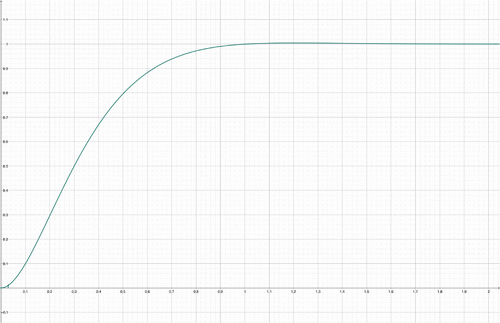
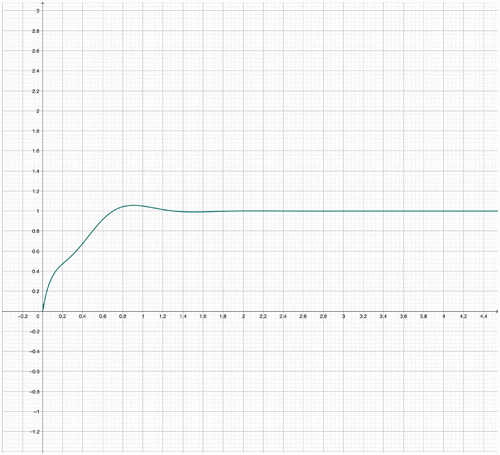
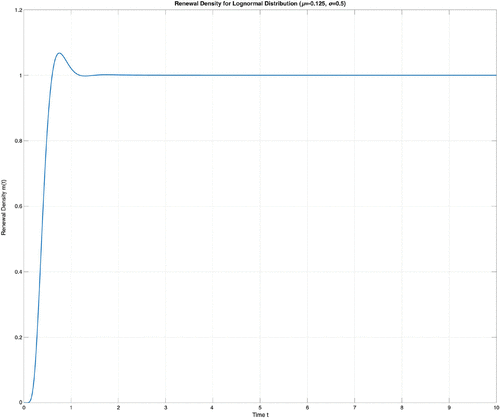
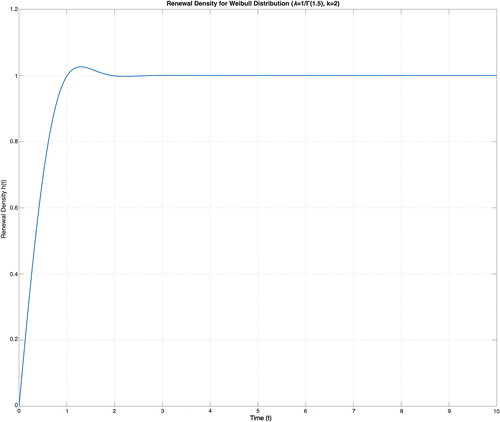
For certain distributions, the constant in (30) is actually very small. In this case, as long as the system is reasonably overloaded (that is, ), we only need Assumption 2, (a)–(d), for the main results to hold. For example, when the renewal density is nondecreasing, then . For a gamma distribution with shape 3 and rate 3, its renewal density is and . For a gamma distribution with shape 6 and rate 6, its renewal density (see the discussion after theorem 3.2.7 of Barlow and Proschan (1965)) is , as illustrated in Figure 2, and . For distributions with no explicit expressions of their renewal density functions, such as log-normal distribution and Weibull distribution, numerical approximation of is needed. For example, the renewal density function of the log-normal distribution with parameters and is numerically computed and graphed in Figure 3 with , and the renewal density function of the Weibull distribution with parameters and is numerically computed and graphed in Figure 4 with .
When , the assumption on the patience time distribution in Assumption 2 implies that the fluid model equations admit a unique invariant state.
Now we state the main theorem of this paper.
Suppose that Assumption 2 holds. For any , the solution converges to an invariant state as .
4. Proof of Theorem 1
The proof of Theorem 1 is divided into the two mutually exclusive cases and . The first case is established in Section 4.2, and the second case is established in Section 4.3. We shall focus on the convergence of , as , because the convergence of to , as , is established in lemma 4.1 of AKKR and is included here for completeness.
Fix and, given any , let be the solution to (6). Then as .
Fix . In view of (6), the boundedness of , the finiteness of the measure , the dominated convergence theorem, and the fact that for every , as , together imply that the first term on the right-hand side of (6) vanishes. On the other hand, because the mean patience time is finite by Assumption 1, the dominated convergence theorem shows that the last term on the right-hand side of (6) converges to . This concludes the proof that as . □
4.1. Some Crucial Estimates
We first discuss some crucial consequences of Assumption 2 in Lemmas 2–5.
Suppose that Conditions (a)–(d) of Assumption 2 hold. Then the following hold.
as ;
Condition (1) and Condition (2) follow directly from (1) and the discussions in Stone (1966) under the finite second moment assumption on in Assumption 2(b). For Condition (3), note that
Suppose that Conditions (a)–(d) of Assumption 2 hold. Recall from (1). For each , let
Then is differentiable on and its derivative satisfies that
It follows from (1) that is differentiable and, for each ,
Then the differentiability of follows from the differentiability of and, for each ,
By the representation of in (33), we have that, for each ,
Note that by exchanging the order of integration, we have that, for all ,
By applying a change of variables and then the integration by parts, we have that, for each and ,
Combining the above two displays, we have that, for all ,
Combining the above displays with (33), we have that, for all ,
Note that
It follows that as . □
Suppose that Conditions (a)–(c) of Assumption 2 hold and let . Recall in (18). Define a function on as
Then
Fix . For the function defined in (38), it is clear that is differentiable on with derivative
Recall that from (18). We define a function on as
It follows from an application of change of variables, (6), and Remark 1 that, for all ,
Note that, by Proposition 1, as . It follows that as . Then the above display implies that, for all t sufficiently large,
Because , we have that, for all t sufficiently large,
This, in particular, implies that, for all t sufficiently large,
It follows from Lemma 2(1) and the fact that that as . □
Suppose that Conditions (a)–(d) of Assumption 2 hold. Then the functions and stated in Lemma 3 and Lemma 4, respectively, satisfy that
Note that by (37) and (40), for each ,
Note that
By Assumption 2(c), the initial data satisfies (28), then
It follows that
By Lemma 2(2),
Also, by Lemma 2(3),
Lastly, because satisfies
Then it follows that (44) holds. □
4.2. Long Time Limit of When
In this section, we consider the case when .
Suppose that Assumption 2 holds. If , then
If and the density of satisfies Assumption 2(2) or Assumption 2(3), then Assertion (46) also holds.
Recall that satisfies the following nonlinear Volterra equation:
Now define the function such that for each . Then it follows that for each , and
For each and , define
Then satisfies the following modified nonlinear Volterra equation: For each ,
For each , consider , the time-shifted by T, as
Then, it is readily checked that is a solution to the following nonlinear Volterra equation:
Note that
We first consider the case that . Because the function is nonnegative, then for each . Recall in (30). For all ,
Because , there exists such that . By Lemma 2(1) and Lemma 3, there exists such that for all and all . We may assume that there exists such that , because, otherwise, for all , , and then , by (11) and by (8) and by (10). It follows from (12) that, for all , , which implies that for all . But this together with (4) implies that as , which contradicts that for all . Now fix a such that . For all and , let
Then and . It follows that for every bounded, measurable, nonnegative function w and for each with , , and then
By corollary 5.2 of Engler (1986), we have that for all , that is, for all .
We next consider the case that . In this case, the density of is assumed to satisfy Assumption 2(2) or Assumption 2(3). If satisfies Assumption 2(3), then the conclusion holds by theorem 3.2(2) of AKKR (see (3.1) therein). Now, let us assume that satisfies Assumption 2(2). Because the renewal density is assumed to be nondecreasing on under Assumption 2(2), then for each and hence for all ,
Then we also have that there exists such that for all and all . Thus, corollary 5.2 of Engler (1986) can still be applied to show that for all , that is, for all . □
We next establish a supporting lemma. For that satisfies Assumption 2, let such that . Consider
Then satisfies the following nonlinear Volterra equation:
Note that
For each and , define
For the kernel that satisfies (51) and the function defined in (52), let be two solutions to the following equation:
Because satisfies (51), then there exists such that
It follows that for all and for a.e. ,
On the other hand, for all and for a.e. ,
Combining the above two displays with (55), we have that, for all and for a.e. ,
Then (54) follows from theorem 4.1 of Engler (1986) with . □
Now we prove the main result of this section.
Suppose that Assumption 2 holds and . The solution to the nonlinear Volterra Equation (50) satisfies
Fix . Let , , be the constant function on . It is clear that the function satisfies (53) with
By (50), also satisfies (53) with
Note that for each ,
Then for each ,
Note that by Lemma 6, if or if and the density of satisfies Assumption 2(2) or Assumption 2(3),
If and the density of satisfies Assumption 2(1), then , and then by (44),
Suppose that Assumption 2 holds and . Let be a solution to the fluid model equations associated with . Then, as , , and .
Because is a solution to the nonlinear Volterra Equation (50), then by Theorem 2,
It follows that there exists such that as . Then
Because for each ,
We next show that as . Note that by differentiating both sides of (27), for each ,
Because as , then as . By using a similar argument that yields (42), we can also show that for all t sufficiently large,
Then it follows that
By taking the limits on both sides of (33) and using (28), we see that as . Note that due to Lemma 2(1). Moreover, by letting in (35) and using (36),
Because as , this and the fact that together imply that
Note that
Combining all the convergence results derived above, we see that as .
At last, we show that as . It follows from (9), (8), (11), and (18) that, for each ,
By taking the limits on both sides of the above display, we have that, as ,
It follows from theorem 2.6 of AKKR that the auxiliary process in (4) has a derivative such that for a.e. ,
Because and , there exists such that and then for all . It follows that as . Then for each , as ,
Then by (4), for each , as ,
4.3. Long Time Limit of When
In this section, we consider the case when ; hence, we fix . Note that, by Assumption 2, when , , Assumption 2(a)–(d), and Assumption 2(1)–(2) hold.
Let R be a solution to the following equation:
Then we have that as .
We prove this lemma by contradiction. Suppose that does not converge to zero as . Then either or .
We first consider the case that . Let be such that . We claim that there exists a sequence such that , and as . If the claim does not hold, then there exists a such that for all , either or . If there exists such that , then for all , because otherwise, there exists such that , let . Then for all , and then . It follows that , which is a contradiction. But for all implies that ; this is again a contradiction. Therefore, there does not exist such that ; that is, for all , , and then . This implies that R is decreasing on , exists, and . Therefore, . By (62), for all ,
From this, the fact that , Lemma 3, and Lemma 4, we see that
This implies that and then , which contradicts the fact that . This shows that the claim in fact holds.
It follows from the claim and (62) that
From Lemma 3 and Lemma 4, we see that as . On the other hand, because is nondecreasing in x, then
It follows that
By (43), for all large enough,
It follows that and then , which contradicts the fact that .
We next consider the case that . Let be such that . We claim that there exists a sequence such that , and as . If the claim does not hold, then there exists a such that, for all , either or . If there exists such that , then for all because otherwise, there exists such that , let . Then for all , , and then . It follows that , which is a contradiction. But for all implies that ; this is again a contradiction. Therefore, there does not exist such that ; that is, for all , and then . This implies that R is increasing on , exists, and . Therefore, . By (62), for all ,
From Lemma 3 and Lemma 4, we have that
From the above two displays and the fact that , we see that , which contradicts that . Then the claim that there exists a sequence such that , and as holds. Then . By (62), for all ,
Note that
Because both cases lead to contradictions, this proves that as . □
Suppose that and the density of satisfies Assumption 2(2), then .
By (17), is a solution to the following equation:
Consider the function on defined by , . Let , , be the constant function on . Then satisfies (64) with replaced by in (38) with . For each and , let
It follows from (64) that
For each , and , let
Note that, because is nondescreasing and bounded below by by Assumption 2(2), for , , and ,
For each , let be a solution to the following equation:
By applying theorem 4 of Sato (1953), we have that for all and . By theorem 4.2 in chapter 2 of Miller (1971), we have that there exists a sequence such that and uniformly on compact sets as , where R is a solution to the Equation (62). It follows that for all , and then by Lemma 8, we have that . □
Suppose that , and the density of satisfies Assumption 2(1) or Assumption 2(2); then, , and , as .
When the density of satisfies Assumption 2(1) and in (49), then by the same argument as in Theorem 2, . By the same argument as in Corollary 1, there exists such that as and . It follows that . When of satisfies Assumption 2(2), by Lemma 9, to show that , we just need to show that
We prove this inequality by contradiction. Suppose not, there exists an such that . We claim that there exists a sequence , such that , , and as . If the claim does not hold, then there exists a such that, for all , either or . If there exists such that , then for all because otherwise, there exists such that , let . Then for all , , and then . It follows that , which is a contradiction. But for all implies that ; this is again a contradiction to . Therefore, there does not exist such that ; that is, for all , , and then . This implies that is decreasing on , exists, and . Therefore, . By (64), for all and ,
By Property (1) of Lemma 2 and Lemma 3, we have that as . Note that for all and . Because is nonnegative, then for all . We see that
Then, by Assumption 2(d), we have that
It follows that
This implies that and then , which contradicts the fact that . This shows that the claim in fact holds. Note that along the sequence , we have by (64) that, for all ,
Note that as by Lemma 3 and Property (1) of Lemma 2. Because , we have that
Because , then as . This and the fact that by Assumption 2(d) together imply that
Note that, because for all , then for all . Note that as . It follows that
The author thanks Kavita Ramanan for encouragement and advice during the course of this work.
References
- (2015) Patient flow in hospitals: A data-based queueing-science perspective. Stochastic Systems 5(1):146–194.Link, Google Scholar
- (2003) Applied Probability and Queues, 2nd ed. (Springer, Berlin).Google Scholar
- (2023) Large-time limit of nonlinearly coupled measure-valued equations that model many-server queues with reneging. SIAM J. Math. Anal. (Oxford) 55(6):7189–7239.Google Scholar
- (1981)
On queues with impatient customers . Gelenbe E, ed. Performance ‘81 (North-Holland Publishing Company, Amsterdam), 159–179.Google Scholar - (1965) Mathematical Theory of Reliability (Wiley, New York).Google Scholar
- (1980) Bounds, inequalities, and monotonicity properties for some specialized renewal processes. Ann. Probability 8(2):227–240.Google Scholar
- (2005) Statistical analysis of a telephone call center: A queueing-science perspective. J. Amer. Statist. Assoc. 100(469):36–50.Google Scholar
- (2007) Analysis of teller service times in retail banks. Case Studies in Business, Industry, and Government Statistics, 15–25.Google Scholar
- (1986) A note on scalar Volterra integral equations, II. J. Math. Anal. Appl. 115(2):363–395.Google Scholar
- (2003) Telephone call centers: Tutorial, review and research prospects. Manufacturing Service Oper. Management 5(2):79–141.Link, Google Scholar
- (2002) Designing a call center with impatient customers. Manufacturing Service Oper. Management 4(3):208–227.Link, Google Scholar
- (2006)
Queueing analysis in healthcare . Hall R, ed. Patient Flow: Reducing Delay in Healthcare Delivery, International Series in Operations Research & Management Science, vol. 91 (Springer, Boston).Google Scholar - (2010) Fluid limits of many-server queues with reneging. Ann. Appl. Probability 20(6):2204–2260.Google Scholar
- (2010) Correlation resonance generated by coupled enzymatic processing. Biophys. J. 99(10):3172–3181.Google Scholar
- (1971) Nonlinear Volterra Integral Equations (W. A. Benjamin, Menlo Park, CA).Google Scholar
- (2005) Convex Functions and Their Applications: A Contemporary Approach (Springer, Berlin).Google Scholar
- (1953) Sur Véquation intégrale non linéaire de Volterra. Composite Math. 11:271–290.Google Scholar
- (2015) Models and insights for hospital inpatient operations: Time-dependent ED boarding time. Management Sci. 62(1):1–28.Google Scholar
- (1966) On absolutely continuous components and renewal theory. Ann. Math. Statist. 37(1):271–275.Google Scholar
- (2005) Call centers with impatient customers: Many-server asymptotics of the M/M/n+G queue. Queueing Systems 51(3):361–402.Google Scholar