


Case Article—Using Moneyball to Introduce Students to Data Analytics: Illustrating the Data Analytics Life Cycle
Abstract
In this data-dependent world, competency in data analytics is quickly becoming critical for success in business. In a quantitative-intensive course that introduces data analytics concepts, engaging students quickly and exposing them to more nuanced parts of the data analytics lifecycle is critical. This exercise uses the movie Moneyball as a framing tool to achieve these goals. Leveraging an appealing movie can help increase student engagement in the subject by presenting concepts in a less foreboding way. This exercise highlights scenes in the movie which embody the various stages of the data analytics lifecycle and allows faculty to present concepts via an engaging story adapted from a real-world example. This exercise provides faculty with different options of how to incorporate this movie into classes to introduce and develop a better understanding of the various steps of the data analytics lifecycle for students.
Supplemental Material: The Teaching Note and supplemental material are available at https://www.informs.org/Publications/Subscribe/Access-Restricted-Materials.
According to the McKinsey Global Institute (Manyika et al. 2011), businesses in the United States need 1.5 million more data-savvy managers to take full advantage of big data. PriceWaterhouseCooper (PwC) also recognizes this need, with its $320 million initiative to address an anticipated skills gap for data science and analytics skills in high schools (Corporate Philanthropy Report 2017). Facts such as these, along with press coverage focusing on the benefits for companies embracing analytics (Berman 2012), have increased universities’ and students’ interests in data analysis classes.
In a recent article on the popular online job posting website Monster.com, Bortz (2019) lists data analytics as one of the seven job skills that increase marketability of all job seekers to employers. This is another reminder that employers are searching for job candidates who can understand and utilize data. The aim of building these skills in the classroom is to equip future business leaders with the ability to use data to understand their business and make better decisions—a crucial skill for business.
Despite this increased interest by stakeholders, students may still enter their first data analysis class with some trepidation. The quantitative nature of material in these types of classes can be a barrier to some students, who may reflect on previous bad experiences in quantitative courses and their resulting math anxiety. In addition, many of the concepts, such as databases and data mining, may be unfamiliar to students. Textbooks in this field are powerful pedagogical sources for explaining concepts such as the structure of a data warehouse, identifying the steps in various analytic models, or discussing different types of models. However, the more complicated process of implementing data analysis initiatives within organizations is difficult to express in a textbook and for a novice to the field to grasp. This case describes the use of the movie Moneyball to introduce students to data analysis and provides a frame of reference for the data analytics life cycle.
Theoretical Foundation
The challenge of many business courses is transitioning students from the conceptual understanding of a field of study to applying the concepts to real problems while recognizing the nuances inherent in all socially applied concepts. Sometimes this transition is difficult to make in introductory courses. Moreover, instructors face challenges to create pedagogical approaches that appeal to technologically savvy students using online technologies. In fact, Clemens and Hamakawa (2010) state that today’s students may respond more favorably to streaming media use in the classroom because they do not know life without electronic media. Therefore, using movies to appeal to students may bridge this transition between concept introduction and application early in a data analytics course.
Many disciplines already embrace movies as one form of media to reinforce course content (see Hutton and Mak (2014)) for the rich, visually intense imagery that movies provide. Some of the benefits of using movies include engaging students with events in an organization on the screen without the student being part of any particular organization (Golden-Biddle 1993), the emotional appeal of movies drawing students into appreciating concepts and their nuances, and the ability of movies to present concepts in entertaining, and thus more memorable, ways (Champoux 2001). Perhaps Huczynski and Buchanan (2004, p. 708) state it best:
Film can be regarded as entertaining fictions, as reflections of reality, or as cultural artifacts that shape and constitute our understanding of social and organizational life.
Moneyball is perfectly scripted to illustrate many concepts in introductory data analytics courses. A benefit of using Moneyball is that the movie reflects reality: it stems from a change within the Oakland Athletics (or A’s) baseball team. It appeals to students with recognizable stars, reflects the reality of a business organization, involves a favorite American sport, and illustrates concepts of data analytics.
The appropriateness of Moneyball for introductory data analytics classes centers on how the movie highlights numerous stages of the data analytics process. There are a variety of implementation processes in textbooks. One such process is the data analytics life cycle as developed by EMC Education Services (2015) (see Figure 1 in the case), which we follow in this case to guide students through the content of the movie and highlight the different life cycle stages. Stages of the life cycle are provided parenthetically in the Classroom Learning Objectives section. This model also adheres to the domain areas of the Certified Analytics Professional exam offered by INFORMS (Gorman and Klimberg 2014).
In data analytics classes, substantial amounts of time and effort can be spent on learning software tools. When this occurs, students spend most of their time in the Model Building stage. Students can become so focused on the software tools that they fail to develop usable solutions to legitimate problems or pay attention to the other stages in the life cycle. As such, Wider and Ozgur (2015) define the appropriate skill level and breadth of knowledge necessary for business school graduates in analytics. They also offer the following guidelines for a successful program:
Use a variety of specific examples instead of generalizations
Focus on problem solving, teamwork, and communication skills
Confront the “I’m never going to use this stuff” syndrome with real-world examples
Delving into Moneyball with students allows us to address these points with a real example of leveraging analytics in an organization and illustrates the importance of problem solving and communication. Beginning a course with this movie creates an inviting introduction to the subject matter and provides a vivid and engaging story of the more nuanced aspects in the data analytics life cycle.
Classroom Learning Objectives
The specific objectives of this case include the following:
Reduce student anxiety and increase the comfort level of students with weaker quantitative backgrounds to the topic of data analytics
Become familiar with all the stages in the data analytics life cycle, including
understanding the importance of correctly framing the problem (“Discovery”), and
understanding the importance of a subject matter expert and being able to communicate to all stakeholders (“Communication of Results”)
Appreciate the impact of data: if analytics can help “America’s pastime,” it can help businesses
The use of Moneyball in a classroom helps with the need to frame the problem (“Discovery”): in this case, how to the Oakland A’s could compete with teams that have budgets that far exceeded that of the A’s. In the movie, general manager Billy Beane approaches this dilemma by abandoning the traditional approach of seeking talent using talent scouts and turning to data and statistical analysis. This approach allows him to create a team that costs less but remains competitive by focusing on outcomes that correlate with wins.
Because decades of historical baseball statistics are available, this data warehouse is a perfect example of historical data uses in data analytical processes. The specific data about each player are especially important for the approach that Beane is attempting to exploit (“Data Preparation”). Focusing on traditional metrics of stolen bases and batting average, however, did not produce wins in the prior system that relied on human judgment of players. Understanding the full set of data available allows Beane and Peter Brand, his statistician, to consider different metrics for success. Using more statistically robust individual player metrics that correlate with team wins reveals that on-base percentage and slugging percentage are more closely associated with wins (“Modeling Planning”). Therefore, the type of players the A’s begin to consider changes dramatically. Also, the traditional system’s faults become more noticeable.
Finally, in what is perhaps the most intriguing part of the story, the change to player selection is announced to the larger A’s organization (“Communication of Results”). A change in the approach of selecting players of this magnitude for a sport played for over 100 years is a major shift. Even with data in hand to support the new approach, the skeptics are fierce and numerous. In the movie, Beane provides many examples of how not to sell a new method to a resistant audience before he learns to communicate the benefits of the new approach in understandable terms. Ultimately, the final metric is the number of games won using the new system.
This movie also highlights some of the human issues organizations face when adopting a new system into an organization with 100 years of organizational inertia (“Operationalization”). The announcement of using player data into the operations of the A’s baseball team illustrates how resistance to change may appear in different organizations. The initial resistance in the A’s organization is understandable, considering the long-standing prior approach, but consistent implementation and communication is critical for the ultimate organizational success.
The opposition to the data analytic approach in the movie is not idiosyncratic to the A’s organization and exists in many organizations—left unaddressed, this opposition can sabotage a project. Research provides support for the importance of communication of results. Woodside (2011) includes communication as one of the factors in his business implementation success model. The importance of communicating the model and results receives further support by Hobek et al. (2009), who identify employee buy-in as one of five key nontechnical factors for successful business intelligence implementations.
Classroom Experience
We use this case in graduate and undergraduate business intelligence classes. For the last five years (approximately twice a year) at a major public university, we introduce data analytics to these students with this case. Most sections are taught at the graduate level. Results are similar for both undergraduate and graduate classes, but graduate students tend to dwell on the communication approaches and organizational change while also discussing the use of analytics in sports and business. Most of the graduate students are MBAs, but other majors included MS in mathematics, biology, and accountancy students. Our student population is diverse in concentration areas (finance, human resources, marketing, etc.) and ethnicity at both levels. Therefore, we provide information to students about the basics of baseball (sources provided in the teaching note). A lack of familiarity with the sport may make some students more hesitant to discuss the case. All students submit answers to case questions before the class discussion. The quality of their answers did not appear to be dependent on their knowledge of baseball. On the other hand, there are always a few students who are less likely to participate in a more business-related discussion whose participation increases during this discussion because of familiarity with baseball or sports in general.
Because the case introduces students to analytics, it is important that they watch the movie at the beginning of the semester, with the assignment due at the beginning of the second week of class (classes meet once a week). An email is sent the week prior to the initial class containing information about the assignment and due date to allow for time to access the movie. Over the period of using the case, media formats have gone from DVDs to streaming video. More recently, the movie was readily available on various streaming services. Therefore, accessing the movie is not a problem.
The discussion about the movie and analytics is always lively, and the participation rate is high. Our initial fear of students being too familiar with the movie and the term “Moneyball” to generate an interesting discussion did not materialize. We surprisingly find that very few students have even heard of the movie.
As the semester progresses, student often make comparisons to the movie. In addition, the final group project requires students to analyze their own data. Often, these student projects involve other sports and attempts to “moneyball” them.
At the end of the semester, we ask students to describe what they learned from the Moneyball assignment. The questions are intentionally very broad because we want to see whether they respond with answers that reflect achieving our learning objectives. We present a sampling of open-ended comments given in three recent semesters (n = 57; a majority of students completed the survey) in the appendix.
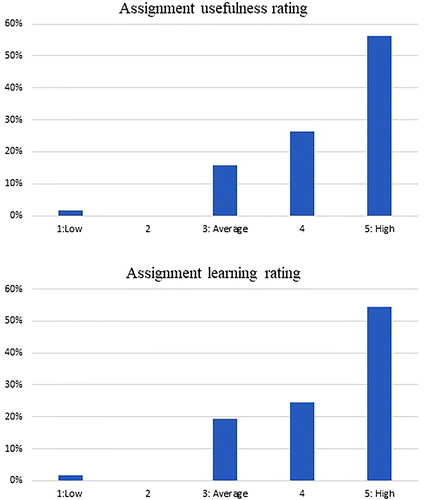
In addition to the qualitative comments, we also gauge students’ perceptions of the Moneyball case and its impact on learning using a five-point Likert scale (low, below average, average, above average, and high) (Likert 1932). We assess student ratings of the assignment’s impact on its usefulness in demonstrating the concepts of the data analytics life cycle and on its impact on learning these concepts. From our sample of students (n = 57), the average score on usefulness is 4.35, and the average score on learning is 4.30. The overwhelming majority of students find this case study very useful in demonstrating how these concepts apply in “real-world” organizations and that it helps them with their learning of the concepts in a fun and engaging manner. Although our measures are not direct measures of our first objective of easing anxiety for less quantitative students, we find that our results provide support of our second and third objectives of the assignment: introducing the data life cycle stages and appreciating the impact of data analytics on decision making. We also note that some may interpret the lively discussions from all students as anecdotal evidence that the case helps ease anxiety about data analytics for less quantitative students.
Conclusion
The introduction of data analytics to students with a wide variation of knowledge is a difficult road. A lack of familiarity with the subject matter and concern about math requirements results in students experiencing anxiety, which creates an obstacle for some students. The choice of the movie Moneyball as an introduction to data analytics is appropriate for several reasons that research in using rich media supports: it eases students into new concepts, applies concepts to a reality-based story, and increases relatability with known stars. For data analytics courses, the main story line illustrates nuanced aspects in the data analytics life cycle. Recent research reports that building data analytical skills is essential for all business professionals in the future, and this case helps students to appreciate data analytical projects more fully within businesses in a more comfortable initial introduction.
Appendix. Qualitative Comments from Students About the Use of Moneyball to Introduce Data Analytics Tied to the Specific Objectives of the Case
We present comments illustrating the three specific objectives of the case because they provided more depth into the student’s experiences. The following are a sampling of student responses to the question “Please list what you learned from the Moneyball assignment.” This was part of a one-page survey given out on the last day of class to a graduate class. It contained seven questions, three of which were about Moneyball. The other two Moneyball questions were quantitative ratings on the effectiveness of the exercise (see Figure A,1). The comments were overwhelmingly positive and reflected recall of the key points of the assignment. The majority of the 57 students answered the question, and only one had a very low opinion of the assignment. Each bullet point represents one student comment.
Reduce student anxiety and increase the comfort level of students with weaker quantitative backgrounds to the topic of data analytics
• “Data Analytics can be used for predicting various scenarios and can be useful in several industries.”
• “Prior to the class, I never saw the movie Moneyball. It was a great intro (in)to the topic of data analysis, business intelligence and predictive analysis. I learned a lot of new topics that are very relevant for the current job market.”
• “I love the movie and it made me research more about data analytics and I was able to get “help” from my husband who LOVES sports. Great co-ed project.”
Become familiar with all the stages in the data analytics life cycle, including
understanding the importance of correctly framing the problem (“Discovery”), and
understanding the importance of a subject matter expert and being able to communicate to all stakeholders (“Communication of Results”)
• “Analytics in sports is cool and could create values to a team but only when implemented with the support from the management side.”
• “Data can be powerful if it is used by someone that understands it and has support from the organization. Making BI changes requires buy-in at all levels to be successful.”
• “The Moneyball assignment was a very good way of understanding how business intelligence can be applied in real life situations. I got a more clear picture of the positive aspects but also the issues that can be encountered using BI tools.”
Appreciate the impact of data: if analytics can help “America’s pastime,” it can help businesses.
• “Data-driven decision is better than guts. It has no bias.”
• “It made me realize how important data can be and why is such a big part of everything.”
References
- (2012) So, what's your algorithm? Wall Street Journal (January 4), https://www.wsj.com/articles/SB10001424052970203462304577138961342097348.Google Scholar
- (2019) The top data skills you need to get hired. Clueless about big data? You can easily learn data skills—and become even more marketable to employers. Accessed January 20, 2021, https://www.monster.com/career-advice/article/top-data-skills-0617.Google Scholar
- (2001) Animated movies as a teaching resource. J. Management Ed. 25(1):79–100.Google Scholar
- (2010) Classroom as cinema: Using movie to teach sustainability. Acad. Management Learn. Ed. 9(3):561–563.Google Scholar
- Corporate Philanthropy Report (2017) PwC initiative takes aim at education, tech skills gap. 32(6):1–12.Google Scholar
EMC Education Services (2015) Data Science and Big Data Analytics (John Wiley & Sons, Indianapolis).Crossref, Google Scholar- (1993) Organizational dramas and dramatic stagings about them. J. Management Ed. 17(1):39–49.Google Scholar
- (2014) Benchmarking academic programs in business analytics. Interfaces 44(3):329–341.Link, Google Scholar
- (2009) The importance of soft skills in business intelligence implementations. Bus. Intelligence J. 14(1):28–36.Google Scholar
- (2004) Theory from fiction: A narrative process perspective on the pedagogical use of feature film. J. Management Ed.. 28(6):707–726.Google Scholar
- (2014) Is a picture worth a thousand words? Using movies and televisions shows to teach public relations. Public Relations Rev. 40(3):585–594.Crossref, Google Scholar
- (1932) A technique for the measurement of attitudes. Arch. Psych. 22(140):5–55.Google Scholar
- (2011) Big data: The next frontier for innovation, competition, and productivity. Report, McKinsey Global Institute, Chicago.Google Scholar
- (2015) Business analytics curriculum for undergraduate majors. INFORMS Trans. Ed. 15(2):180–187.Google Scholar
- (2011) Business intelligence: Best practices for success. Grant K, ed. Ryerson University, Toronto, Canada Internat. Conf. Inform. Management Evaluation (Ryerson University, Toronto, Canada), 556–562.Google Scholar

