Case—Prescriptive Analytics for Entrepreneurial Growth: Data-Driven Strategic Decision Making at iParty Bangkok Co., Ltd.
Introduction
Mint Sirich, owner of iParty Bangkok Balloons and Party Supplies, Inc. (iPB), went over the revenues from the day one more time. Demand for iPB’s unique balloon arrangements had been going up. iPB was able to keep up with demand, and customers were generally happy with the quality and level of service. Having just finished her analytics degree, however, Mint knew that she could do even better. Specifically, she focused her attention on a source of additional cash flows: delivery revenue. Every balloon arrangement was prepared in iPB’s headquarters and shipped out to customers using third-party providers. Mint’s business already owned a van, and she believed that at least some of the revenue currently going to third-party providers could be reclaimed by utilizing the van.
Background
A balloons art and venue décor business can be started with minimum capital, the skills required to create balloon arrangements can be learned, and many entrepreneurs with a creative streak find the work fulfilling. Making a balloon arrangements business successful, however, is difficult. Exactly because barriers to entry are low, there is a lot of competition. Although many entrepreneurs start the business from their homes, growing the business requires commitment to good operations management—managing staffing levels and scheduling; dealing with fixed costs, such as office rent; and improving planning and delivery processes to maintain a high level of customer satisfaction.
Rather than starting a new business, Mint decided to purchase iPB in 2018. Based in Bangkok, Thailand, the business had one administrative employee and three employees on the production side at the time. There are advantages and disadvantages to buying a business. On the one hand, iPB had clients and an office lease already secured. On the other hand, businesses are often sold because they are not as successful as hoped. Looking over iPB’s records, Mint realized, for example, that more than 50% of the time deliveries were late and that customer satisfaction was middling. There were frequent mistakes in the orders, and the orders often ended up delivered to the wrong customer. Mint felt that there were many aspects of the business where better performance and higher margins could be ensured through changes in operations.
Mint set out to differentiate iPB through improved processes. She designed a careful process for planning next-day order completion, achieving on-time completion for 95%–97% of orders. The delays for the remaining 3%–5% of orders were only because of traffic. iPB began purchasing high-quality balloons from the United States and engaged in cocreation with customers to design unique arrangements that matched the customers’ preferences and occasion (Figure 1). Because tardiness, quality of arrangements, and customization options improved, iPB grew its customer base substantially. It expanded to three branches in Bangkok. The original branch (now headquarters) had 14 employees working full time, and 4 additional employees could be summoned from the other two branches if demand was high at the central branch. For all practical purposes, employees were available to work around the clock (0–24 hours) to fulfill orders. One full-time manager coordinated the orders and staffing at branches, and two administrators took calls from customers and responded to emails and instant messages on Instagram or messaging apps.
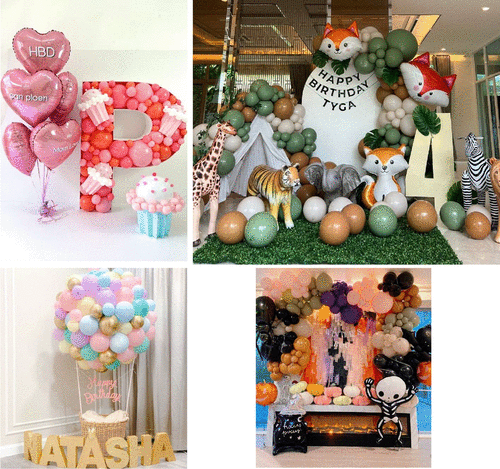
Source. https://www.instagram.com/iparty_bkk/.
Note. These images are included with permission from the copyright owner.
Mint’s next target was delivery processes. Currently, iPB sends all of its orders to customers through third-party providers. There were some advantages to this strategy when iPB was small as iPB did not have to commit to operating its own transportation early on. However, in 2020, Mint made the decision to purchase a van for marketing purposes. iPB even hired a designer to design a sticker for the van. It seemed logical that the next step would be to use the van for at least some of iPB’s deliveries. In addition to believing that some optimization can be achieved with regard to delivery costs, Mint thought that iPB would be able to control the quality of delivery better. Sending the balloon arrangements through third-party providers had an additional cost as balloons would pop during transport, and there would be nothing that iPB could do once the balloon arrangements were sent out for delivery. If the damage during transportation was large, iPB would sometimes need to provide full reimbursement or partial compensation to the customer. Delivering with iPB’s van could ensure more careful handling and potentially, resources for fixing arrangements if they got damaged during transport.
Utilizing iPB’s Own Transportation
Using iPB’s van would require hiring a driver, who would cost about 218,000 Thai baht (U.S. $6,269.04) per year. With the number of orders growing, Mint believed that there was now sufficient volume so that hiring a driver would make sense. She realized, for example, that deliveries with a van could be routed more efficiently; instead of delivering each order from headquarters, iPB could use the van to make several deliveries in one trip. However, Mint was cautious. She wanted to come up with a reliable estimate of the savings compared with third-party providers before committing to hiring a driver.
Table 1 shows a list of customer orders, (example) coordinates of order destinations,1 delivery costs as charged by third-party providers, and orders’ characteristics for a typical day. Mint decided to analyze how a van could be used in a typical day to get a sense of the feasibility of the idea. The data in Table 1 are also available from 1. InputData.xlsx.
|

Table 1. An Example of a Possible Day Schedule for Balloon Arrangement Orders from iPB’s Main Headquarters (i.e., the Hub)
| Order identification | Customer identification | Address/coordinates | Time to be delivered | Time needed to complete | Time needed to start | Price, $ | Delivery cost, $ | Need installation? (1 = yes) | Preordered? (1 = yes) | Volume of arrangement, cubic feet | Van capacity, % | Life span |
|---|---|---|---|---|---|---|---|---|---|---|---|---|
| O-2206-11884 | 1 | 13.720657905114582, 100.58810261350393 | 7:00 a.m. | 6:00 a.m. | 5:00 a.m. | 20.00 | 6.29 | 0 | 1 | 4.18 | 10 | 6–8 hours |
| O-2206-11880 | 2 | 13.738638240355872, 100.54335677886789 | 4:00 p.m. | 3:00 p.m. | 2:00 p.m. | 159.29 | 12.86 | 0 | 1 | 33.38 | 150 | 6–8 hours |
| O-2206-11859 | 3 | 13.80886257687304, 100.62221422139507 | 11:00 a.m. | 10:00 a.m. | 9:00 a.m. | 83.29 | 14.86 | 0 | 1 | 27 | 100 | 6–8 hours |
| O-2206-11887 | 4 | 13.757005653679453, 100.56725839655996 | 10:30 a.m. | 9:30 a.m. | 8:00 a.m. | 29.71 | 6.29 | 0 | 1 | 2.21 | 5 | 2 days |
| O-2206-11867 | 5 | 13.743034280613264, 100.61680149655967 | 10:00 a.m. | 9:00 a.m. | 8:00 a.m. | 80.00 | 6.57 | 0 | 1 | 19.36 | 30 | 6–8 hours |
| O-2206-11891 | 6 | 13.732972332190943, 100.58190025237974 | 4:00 p.m. | 2:00 p.m. | Previous day | 680.00 | 51.43 | 1 | 1 | 176 + 2m × 2m backdrop | 200 | 1–2 days |
| O-2206-13802 | 7 | 13.82507551300698, 100.56682155238103 | 11:00 a.m. | 10:00 a.m. | 9:00 a.m. | 63.14 | 8.00 | 0 | 1 | 17 | 30 | 6–8 hours |
| O-2206-11889 | 8 | 13.726576550743152, 100.5738401542314 | 3:00 p.m. | 2:00 p.m. | 1:00 p.m. | 78.86 | 5.14 | 0 | 0 | 7 | 30 | 1–2 days |
| Hub | — | 13.721006388924163, 100.5961192390889 |
Notes. Actual data are available from file 1. InputData.xlsx. Columns Order identification, Customer identification, and Address/coordinates describe the destination of the order/assignment to a customer and of the hub. Time to be delivered indicates the time by which the order needs to be delivered to the customer. Time needed to complete (usually an hour before the time to be delivered) marks an internal deadline for iPB workers to complete the order and prepare for sending. Time needed to start marks the internal deadline for iPB workers to start preparing the order and is related to the complexity of the balloon arrangement. Price and Delivery price (in U.S. dollars) are the prices the customer pays for the arrangement and the delivery, respectively. Need installation denotes whether the arrangement needs additional time for installation after delivery to the customer. Preordered indicates whether the order was known before or whether the customer called on the day under consideration. Volume of arrangement and Van capacity show how large the balloon arrangement is in absolute terms (cubic feet) and as a percentage of the van, respectively. Life span shows the amount of time the balloon arrangement in that order lasts.
One of the challenges for using a single van would be competing orders. For example, Customer 2 requested that the balloon arrangement be delivered to the location by 4 p.m. Customer 6 requested the same delivery time. However, Mint knew that she had some flexibility; the delivery window could typically be easily negotiated to be up to 45 minutes before the requested time. So, a van could in theory be used for both orders as long as it could deliver both within the promised time window.
Service time also had to be taken into consideration when scheduling deliveries. Mint estimated that, typically, it would take about 30 minutes for an arrangement to be dropped off at location, which could be shortened if necessary. However, orders that require installation could take between 90 and 120 minutes.
In addition, balloon arrangements differed by volume. For example, order 1 was small (it took up 10% of the van’s capacity), whereas order 3 was large (it took up 100% of the van’s capacity).
There were some other considerations as well. Balloon arrangements last for only a certain number of hours. (Their lifetimes are provided in the column Life span in Table 1.) Thus, one had to be careful about scheduling trips with the van that had deliveries too many hours apart in the day.
Mint considered the purchase of the van a sunk cost; however, there would be ongoing costs if the van was used for deliveries, such as the costs of fuel, maintenance, and insurance. Maintenance was $42 per year, and insurance was $125 per year. The van’s mileage was 16 miles per gallon, and given increasing gas prices in recent months, Mint wanted to use a conservative estimate of $5 per gallon for the price of gas.
The Dilemma
How could Mint organize the information systematically to help her make a decision on whether to use the company van for deliveries? What kinds of techniques, models, and calculations would be useful in this context? Note that there are both financial and operational considerations to take into account.
Mint was also committed to growing the business and generating generalizable insights. What recommendations would you make to Mint about extending these approaches as the business grows?
1 These coordinates were created for illustrative purposes for this case and do not correspond to actual customer addresses.