Serious-Play Cards for Teaching AI Applications in Manufacturing
Abstract
This paper introduces a serious-play card deck designed to teach artificial intelligence (AI) use case applications in manufacturing. The deck comprises 42 cards, each presenting a real-world problem paired with a corresponding AI use case. Instructors can use these cards to facilitate structured and engaging group discussions. The paper describes the design of the cards and their implementations across four executive education classes in both classroom and metaverse settings. For the most recent intervention, we conducted a structured evaluation using an anonymous, theory-anchored survey instrument. The results indicate that the cards are perceived as engaging and valuable, particularly for supporting application-oriented learning and peer-based discussion while contributing less strongly to perceived knowledge acquisition. These findings suggest that serious-play cards are most effective as a complement to conventional teaching methods, enabling learners to translate abstract AI concepts into context-specific managerial reasoning. The paper provides full instructions and card details that support reuse by instructors.
Introduction
As the development of artificial intelligence (AI) advances, manufacturers are seeking useful applications of AI, and teachers are seeking effective ways to teach it. A particular challenge is that this topic requires foundational knowledge across at least three disciplines: computer science, engineering, and business. Proficiently learning this material requires exposure to a variety of teaching experiences, including both coursework and real-world applications. In such contexts, teachers and learners benefit from access to learning tools that bridge real-world applications with theory. The objective of this paper is to present the design of a serious-play card deck for teaching AI applications in manufacturing and to provide a structured empirical evaluation of its pedagogical value in executive education settings.
Teachers can bridge the gap between theory and practice in many ways. For example, they can bring case examples during their lectures, assign project assignments or case studies with tutorials, invite industry speakers to give guest lectures, organize field trips, or utilize advanced learning factories. All these approaches have their strengths and weaknesses, and learning can benefit from exposure to a variety of them, known as multimodal learning (Bouchey et al. 2021). In this context, one relevant approach is serious play (Connolly et al. 2012, Larson 2020), which encompasses a range of interactive and experiential learning formats, including but not limited to role-playing and games (for examples used in operations research (OR) and analytics, see DePuy and Taylor (2007), Griffin (2007), and Kong (2019)).
However, not all serious-play formats rely on competition or game mechanics. Teachers can also use serious-play methods to structure interaction and discussion rather than relying on gameplay or competition. This is particularly relevant for complex and context-dependent topics such as AI applications, where learners benefit from opportunities to interpret, contextualize, and exchange perspectives with peers. In such settings, structured serious-play formats can complement traditional teaching by facilitating peer-to-peer and application-oriented learning.
This paper presents the design and implementation of a serious-play card deck for teaching AI applications in manufacturing and reports on its use across multiple executive education settings. In addition to describing the cards and their pedagogical design, we provide a structured empirical evaluation based on a theory-anchored survey instrument. The findings offer insights into how serious-play formats can support application-oriented learning and peer-based sensemaking in complex technological domains. By providing full access to the card deck and implementation guidelines, the paper also contributes a practical teaching resource for instructors.
The remainder of the paper is structured as follows. The Card Design section describes the development of the serious-play card deck and its underlying pedagogical objectives. The Serious-Play Implementation section outlines how the cards are integrated into executive education settings. The Evaluation Approach section presents the data collection instrument and the analysis. The Evaluation Results section reports the empirical findings. The Discussion section interprets the results and discusses implications for teaching AI applications. Finally, the sections Limitations and Conclusions summarize constraints and outline directions for future research. Appendix A includes instructions and details of the serious-play cards.
Card Design
The card deck was designed with two primary pedagogical objectives: (1) to provide learners with structured exposure to a broad set of AI use cases in manufacturing within a limited time frame and (2) to enable application-oriented discussion by allowing participants to select and contextualize use cases relevant to their own organizational settings. It is most useful for students with a basic knowledge of both AI technologies1 and manufacturing management and those who seek to apply this knowledge in industrial practice. The card development was motivated by the challenge of teaching executives about the potential of AI applications in manufacturing. Because the application space for AI is broad and varied, teaching single use cases risks being narrow-minded or irrelevant to many students.
The content for the cards is based on the first author’s work with manufacturing firms and insights from the Global Lighthouse Network (GLN), an initiative by the World Economic Forum highlighting leading examples of digital transformation (Betti et al. 2023). Rather than starting from AI technologies, the cards are anchored in recurring business problems observed in practice, each paired with a representative and realistic AI use case. These problems were grouped into 11 application categories. The resulting deck consists of 42 problem-solution cards spanning a broad set of manufacturing domains. The card deck is not intended to be exhaustive nor to provide definitive solutions. Instead, it offers a curated and representative set of use cases designed to stimulate discussion and exploration. It provides a broad introduction, across different application areas, to the most commonly observed use cases in GLN award-winning companies (World Economic Forum 2025) and beyond (Lee 2020).
Table 1 shows one example of pairs of problems and AI use cases for each of the 11 categories. Appendix A provides the details of all cards.
|

Table 1. Examples of Card Content Across the 11 Categories (See Appendix A for All Cards)
| Card category (no. of cards) | Problem (example) | AI use case (example) |
|---|---|---|
| Administration (2) | Time-consuming compliance reporting | Automated compliance reporting |
| Customer Service (4) | Handle customer queries | AI-powered virtual assistant |
| Human Resource Management (HRM) (3) | Close skill gaps in the workforce | AI-based personalized training programs |
| Health, Safety, and Environment (HSE) (5) | Identify safety hazards | Real-time hazard detection |
| Kaizen (1) | Improve problem-solving | Copilot for problem-solving |
| Logistics (2) | Optimize internal logistics | AI-driven route planning |
| Maintenance (2) | Identify machine maintenance actions | Prescriptive maintenance |
| Process (13) | Recover from schedule disruptions | Dynamic production rescheduling |
| Product Development (4) | Reduce product development times | Smart design suggestions in CAD |
| Quality (3) | Detect product quality errors | Visual quality inspection |
| Supply Chain (3) | Manage supplier risks | Risk prediction and supplier evaluation |
The card descriptions are intentionally brief to enable learners to interpret the challenges and match them to the use cases in their specific manufacturing context. They are, however, sufficiently detailed to facilitate a discussion on the AI implementation required for each use case. Accordingly, the cards are not designed as self-contained teaching materials, but as a structured facilitation tool embedded within a broader instructional setting. The cards are intended to function as a discussion scaffold in breakout groups, enabling participants to share experiences, compare interpretations, and jointly explore implementation challenges.
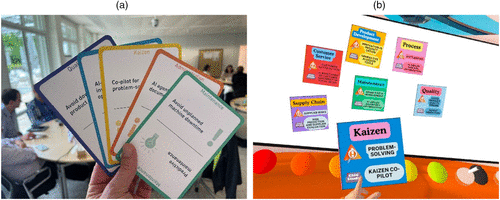
For the physical version of the card game, a graphic designer assisted in designing the playing cards, as shown in Figure 1(a), which displays 5 of the 42 cards. The cards were printed in A6 size for good visibility during group work and on thick, glossy paper that provides a haptic experience when used. The categories were visually separated by using different colors for easier sorting. For the virtual version of the cards, a software designer implemented the design shown in Figure 1(b). The virtual cards were implemented in Gemba’s virtual 360-degree environment used for corporate and executive teaching.2 Both the physical and virtual cards have a uniform back and all text on the front, allowing the deck to be used in a “choice” mode (face up) or a “surprise” mode (face down).
Serious-Play Implementation
The simplicity of the serious-play cards enables flexible implementation across different teaching formats. Importantly, the cards are not intended to replace lectures but to complement them by enabling structured discussion and application of the material. In our courses, the cards are typically used for 15%–20% of class time in breakout sessions between lecture segments. Although the cards can be used in various ways, we developed the structured approach described next. In our courses, the cards were used in multiple rounds, each lasting 45–60 minutes.
In the first round, the class is divided into groups of four to eight participants, and each group receives a stack of cards. Each participant reviews all cards and selects one with a use case they are either interested in or are already implementing in their company.3 Participants then take turns in the groups to share their use cases and why they selected them, allowing other students to comment on the selected use cases. After that, the groups vote for their favorite card(s) and selected group speakers take turns presenting the winning use case(s) in plenary.
In a follow-up class, the winning cards are split on tables and participants from all groups self-select into cards of interest for an in-depth discussion of (1) the use case’s business case, (2) technical AI implementation, (3) need for data and infrastructure, and (4) roadblocks for implementation. Further game rounds can allow students to explore more cards. Although we used the cards as a red thread in our classes by integrating them across teaching days, teachers can also use them as a one-off class toward the end of a course.
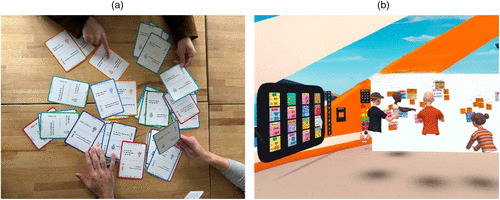
At the time this paper was written, we had used the serious-play cards across four courses: two onsite, three-day Executive Master in Business Administration (EMBA) courses with 26 participants in May 2025 and 36 new participants in February 2026, and two online, three-day masterclasses in the metaverse with 20 participants in February 2025 and 16 new participants in November 2025. The senior executives in the onsite EMBA courses came from various industries, whereas the online participants were all senior executives in the manufacturing sector. In the metaverse classes, participants met from dispersed locations in a 360° virtual reality environment using Meta Quest 3 virtual reality headsets. The integration of the cards in the class was independent of whether the class was online or on-site. Figure 2 illustrates the use of the cards in both the physical EMBA setting (a) and the virtual metaverse environment (b).
Evaluation Approach
Our evaluation objective is to provide systematic evidence on participants’ perceptions of the serious-play card intervention, rather than to establish causal effects on learning outcomes. This approach is consistent with prior research in executive education contexts, where practical constraints often limit the use of experimental designs.
Although qualitative feedback and instructor observations were collected across all four classes, the most recent EMBA cohort was used to conduct a structured and systematic evaluation of the cards’ pedagogical value. We developed a short, theory-anchored measurement instrument capturing four key dimensions of learning and instructional value: (1) cognitive engagement, (2) perceived learning gain, (3) collaborative learning, and (4) instructional value. Items were adapted from established constructs in the educational and information systems literature, with wording tailored to the specific instructional context.
Cognitive Engagement reflects the extent to which learners actively process and apply information. This construct is grounded in the Interactive, Constructive, Active, Passive (ICAP) framework, which distinguishes passive from active, constructive, and interactive learning modes and posits that deeper learning occurs through higher-order engagement (Chi and Wylie 2014). Three items captured active thinking, critical reflection, and application of concepts.
Perceived Learning Gain captures participants’ subjective assessment of their learning outcomes and has been widely used in management education and instructional evaluation research (Kraiger et al. 1993). Three items assessed improvements in understanding AI use cases, development of new insights, and depth of understanding beyond lectures.
Collaborative Learning Quality reflects the extent to which peer interaction contributes to knowledge construction. This construct is rooted in social constructivist learning theory, which emphasizes the role of social interaction in cognitive development (Vygotsky 1978). Two items measured the perceived value of peer discussions and the exchange of perspectives.
Instructional Value captures participants’ evaluation of the usefulness and effectiveness of the teaching format. This construct is conceptually related to perceived usefulness in the Technology Acceptance Model, which links perceived value to adoption and continued use (Davis 1989). Three items assessed whether the activity added value relative to traditional instruction, whether the time investment was worthwhile, and whether participants would recommend the format for future cohorts.
In addition to the four constructs, a single item capturing overall course satisfaction was included for contextual purposes. The instrument was intentionally kept concise to reduce respondent burden in an executive education setting. All items were measured on a five-point Likert scale ranging from one (strongly disagree) to five (strongly agree). Invalid or empty entries were treated as missing values. To ensure anonymity, the survey was managed entirely by the EMBA class administration. Of the 36 participants, 21 completed the survey, which is an acceptable response rate (58.3%) for executive education settings.
To assess potential nonresponse bias, we compared early and late respondents following the procedure suggested by Armstrong and Overton (1977). Early respondents were defined as those completing the survey on the day of administration (n = 9), whereas late respondents completed the survey on later days (n = 12). Independent samples t-tests revealed no significant differences across the four constructs (all p > 0.38), and mean differences were small and nonsystematic, indicating that nonresponse bias is unlikely to be a major concern.
Data analysis focused on descriptive statistics and internal consistency reliability. Given the small sample size, we report item-level means and standard deviations, construct-level aggregates, and reliability measures (Cronbach’s alpha and Spearman-Brown coefficient). Consistent with recommendations for small-sample educational research, we do not conduct confirmatory factor analysis and instead interpret results at the construct level with appropriate caution.
Evaluation Results
Participants reported high overall satisfaction with the course (mean (M) = 4.43, standard deviation (SD) = 0.49), indicating a consistently positive evaluation. Against this backdrop, Table 2 reports descriptive statistics for the serious-play card activity. Among the constructs, instructional value received the highest mean rating (M = 4.06, SD = 0.97), followed closely by collaborative learning quality (M = 4.05, SD = 0.76) and cognitive engagement (M = 3.94, SD = 0.88). Perceived learning gain received comparatively lower, although still favorable, ratings (M = 3.62, SD = 0.90). Overall, the pattern of results suggests that the cards are particularly effective in supporting application and peer interaction, whereas perceived learning gains are comparatively more moderate.
|
Table 2. Descriptive Statistics for Survey Items and Construct-Level Aggregates
| Construct (mean, standard deviation) | Item | Mean | Standard deviation | N |
|---|---|---|---|---|
| Cognitive engagement (3.94, 0.88) | The card-based activity required active thinking rather than passive listening. | 4.15 | 1.04 | 20 |
| The format stimulated critical reflection on AI applications. | 3.70 | 1.03 | 20 | |
| I had to apply course concepts to concrete AI scenarios during the discussions. | 4.05 | 0.86 | 21 | |
| Perceived learning gain (3.62, 0.90) | The activity improved my understanding of AI use cases. | 3.43 | 1.21 | 21 |
| I developed new insights about practical AI applications. | 3.55 | 0.94 | 20 | |
| The discussions deepened my understanding beyond what lectures alone provide. | 3.81 | 0.93 | 21 | |
| Collaborative learning quality (4.05, 0.76) | Peer discussions enhanced my learning. | 4.05 | 0.86 | 21 |
| The card format facilitated meaningful exchange of perspectives. | 4.05 | 0.94 | 20 | |
| Instructional value (4.06, 0.97) | The card format adds value as a supplement to traditional instruction. | 4.25 | 0.85 | 20 |
| The time invested in this activity was worthwhile. | 4.00 | 1.05 | 21 | |
| I would recommend this teaching format for future MBA cohorts. | 3.95 | 1.12 | 21 |
At the item level, all scores are above the neutral midpoint (three), and the pattern is consistent across all items. We report selected items to illustrate the main findings. The highest-rated aspects of the activity relate to application and peer interaction, including applying course concepts to concrete AI scenarios (M = 4.05, SD = 0.86) and the perceived value of peer discussions (M = 4.05, SD = 0.86). Participants also strongly agreed that the format adds value as a supplement to traditional instruction (M = 4.25, SD = 0.85) and that the time invested was worthwhile (M = 4.00, SD = 1.05). In contrast, items capturing perceived learning gains, such as improved understanding of AI use cases (M = 3.43, SD = 1.21) and development of new insights (M = 3.55, SD = 0.94), received comparatively lower ratings, although still above the neutral midpoint.
Table 3 reports internal consistency reliability for the four constructs. Cognitive engagement (α = 0.88), perceived learning gain (α = 0.80), and instructional value (α = 0.96) demonstrate good internal consistency (Nunnally and Bernstein 1994). For collaborative learning quality, measured with two items, the Spearman-Brown coefficient is 0.61, indicating acceptable reliability for a short scale. Given the small sample size and the exploratory nature of the study, results are interpreted at both the construct and item levels. In addition, the relatively high correlations observed across constructs suggest that participants’ evaluations likely reflect a broadly positive assessment of the intervention rather than sharply differentiated perceptions across the four constructs.
|
Table 3. Internal Consistency Reliability of Constructs
| Construct | Items | Reliability |
|---|---|---|
| Cognitive engagement | 3 | α = 0.88 |
| Perceived learning gain | 3 | α = 0.80 |
| Collaborative learning quality | 2 | Spearman-Brown = 0.61 |
| Instructional value | 3 | α = 0.96 |
Note. Reliability is reported as Cronbach’s alpha (α) for multi-item constructs and the Spearman-Brown coefficient for the two-item construct.
Discussion
This study examined the use of serious-play cards as a pedagogical tool for teaching AI applications in an executive MBA setting. The results indicate that the intervention is perceived as valuable and engaging, with its primary strength lying in supporting application-oriented learning and peer-based sensemaking, while contributing less strongly to perceived knowledge acquisition.
The first central insight is that the card-based activity appears to effectively support application-driven engagement. Participants anonymously reported that the format required them to actively process and apply course concepts to concrete AI scenarios. This pattern is consistent with the ICAP framework, which suggests that deeper learning is associated with constructive and interactive forms of engagement (Chi and Wylie 2014). In open feedback, one EMBA student reported, “It was instructive and fun,” and another noted, “It helped start a discussion.” In this context, the cards function less as a vehicle for content delivery and more as a mechanism for structured problem framing, prompting participants to translate abstract concepts into context-specific managerial reasoning.
The second key insight concerns the role of peer interaction as a mechanism for sensemaking. Judging from the survey data, participants reported that group discussions enhanced their learning and enabled meaningful exchanges of perspectives. This aligns with social constructivist perspectives, which emphasize that knowledge is developed through interaction and dialogue (Vygotsky 1978). Also here, qualitative feedback supports the quantitative evidence. For example, one EMBA student reported, “It brings the opportunity to explore new ideas and concepts and based on that try to think outside the box,” In executive education settings, where participants bring heterogeneous experiences, the card format appears to structure and focus discussion in ways that support collective interpretation of complex and ambiguous phenomena, such as AI use cases.
At the same time, perceived learning gains were less pronounced than ratings of engagement and instructional value. This finding is aligned with the intention of the game: It complements rather than replaces classic input lectures. Participants were more reserved in reporting improvements in understanding or the development of new insights. This suggests that the primary contribution of the intervention lies less in introducing new knowledge and more in activating and contextualizing existing knowledge. The empirical evaluation confirms that the cards are most effective when used to deepen and operationalize prior input, rather than as a standalone instructional format.
Importantly, the relatively small differences between constructs, together with their high intercorrelations (all r > 0.64), indicate that participants did not strongly differentiate between engagement, learning, and instructional value. Rather, responses reflect a more holistic evaluation of the learning experience. This implies that the constructs in this study should be interpreted as analytical lenses capturing different aspects of a broadly positive experience rather than as empirically independent dimensions.
From a pedagogical perspective, these findings suggest that serious-play cards are particularly well suited as a complementary tool for structuring application and discussion in AI education. Their value lies in enabling participants to work through concrete scenarios, compare interpretations, and articulate implications, thereby bridging the gap between conceptual input and managerial application. This finding was exemplified by the following quote from a senior executive attending one of the metaverse courses: “The cards were very helpful as they structured the discussion around concrete use cases. From there, we could go vertical or horizontal in our discussions.” For instructors, this implies that such tools are most effective when integrated with lectures or other forms of content delivery that provide foundational knowledge.
On the critical side, students who expected a traditional game that could be played competitively criticized the simplicity of the serious-play cards, noting that the cards are not “played” but discussed. Some EMBA students in the first cohort were disappointed that their play performance could not be quantified or assessed. The lecturers learned from this early feedback and made sure not to raise false expectations when introducing the cards across subsequent classes (including the one in which we collected structured, rigorous survey feedback). From our qualitative observations, we learned that some students wanted more case details on the cards, whereas others preferred fewer details. Overall, our takeaway is that the serious-play cards are not self-sufficient and teachers must thoughtfully integrate them into a class that alternates between classroom content and serious-play breakout sessions. One EMBA student summarized this realization as follows: “I liked the dynamic used to play the game, and it was helpful as a break to go from lecture to a more engaging topic [the cards].”
Overall, this study contributes to the literature on interactive teaching in operations management and information systems education in two ways. First, by providing evidence that structured serious-play interventions can support application, sensemaking, and peer-based learning. The findings highlight the importance of designing pedagogical formats that explicitly facilitate the translation of abstract technological concepts into contextually grounded discussion and sensemaking. Second, by providing full insights into the involved teaching materials and design, including suggested instructions and card details in Appendix A.
Limitations
This study has several limitations. First, for the quantitative analysis, the sample is small (n = 21) and drawn from a single executive MBA course, limiting generalizability and precluding more advanced measurement validation. Second, the analysis relies on self-reported, cross-sectional data, capturing perceived rather than objective learning outcomes, which raises the possibility of common-method bias. Third, the absence of a control group prevents causal inference regarding the effectiveness of the intervention relative to alternative teaching formats. Finally, although the instrument is theory anchored, the high intercorrelations among constructs and the lower reliability of the two-item collaboration measure suggest that results should be interpreted at both the construct and item levels. Accordingly, the findings are best understood as exploratory evidence of the perceived pedagogical value of the serious-play cards. We note that it was not the intention of this paper to present “the best” cards, but to present one useful and proven pedagogical tool that lecturers can use to vary their teaching formats.
Conclusions
This paper presented a serious-play card deck designed to support the teaching of AI applications in manufacturing through structured discussion and application. It focuses on problems and AI use cases across several business domains of manufacturing companies. The cards are designed as a conversation starter and guide for in-depth group or classroom discussions on AI in manufacturing, a topic of increasing relevance in industrial practice and in engineering and management curricula. The cards are intended as a complement to traditional teaching formats, enabling instructors to facilitate application-oriented discussion and peer-based learning in complex and context-dependent domains. Our experiences have been good, and we keep on using these cards across new classes. We hope other teachers take inspiration from the described serious-play card decks to either use them or develop their own when teaching AI in manufacturing.
We thank the students of the 2025 and 2026 EMBA-X cohorts at ETH Zurich and the University of St. Gallen for valuable feedback on the card deck and class intervention; Jihan Mohamud at Gemba for early feedback and encouragement during the game’s development; Katalin Tesch for the visual design of the physical cards; and Gemba for implementing the virtual cards on their metaverse teaching platform. During the preparation of this work, the author(s) used Grammarly and ChatGPT to assist in the development of the manuscript and to improve the language and grammar. The authors take responsibility for the content of the publication.
Appendix A. The Serious-Play Cards
A.1. Instructions
The card deck is designed to support the teaching of AI applications in manufacturing. It can be used within a standard class session (e.g., 45 minutes) or adapted in duration as needed. It can also be used across several classes.
The cards function as a structured discussion scaffold rather than a competitive game. Their purpose is to help learners apply AI concepts to concrete scenarios, exchange perspectives, and explore implementation challenges. The cards are most effective when learners have some familiarity with manufacturing contexts or when used alongside a case company.
There are several ways to use the serious-play cards. You can invent a way that works for you or follow one of the suggestions below. Learners are typically divided into breakout groups of four to eight participants, with each group receiving a full stack of cards. Each card has a uniform back and descriptive content on the front, allowing the deck to be used in choice mode (face up) or surprise mode (face down).
Round 1: Breakouts (≈20 Minutes)
Variant A: Choice Mode
All cards are mixed and placed face-up on a table or wall.
Each participant reads all the cards and selects one (for example, a use case they are already implementing or would like to implement).
Participants take turns presenting their selected use case cards to the group.
For each card, the group discusses the use case, its business relevance, and potential technical implementation, including data requirements and AI approaches.
Participants vote on their preferred use case(s) and select a spokesperson to present the group’s choice in the plenary session.
Variant B: Surprise Mode
All cards are placed face down on a table or wall.
Each participant draws one random card.
Participants take turns presenting their drawn use case cards to the group.
For each card, the group discusses the use case, its business relevance, and potential technical implementation, including data requirements and AI approaches.
Participants vote on their preferred use case(s) and select a spokesperson to present the group’s choice in the plenary session.
Round 2: Plenary Discussion (≈20 Minutes)
Each group presents its selected use case in plenary, including the business context and potential implementation approach. The class may discuss selected cases in more depth. Participants with relevant experience or interest can be identified for follow-up discussions or further exploration.
Continuation
Subsequent sessions can build on selected use cases that generated strong interest, allowing for deeper analysis and extended discussion.
A.2. Content
One instruction sheet and 42 use case cards across 11 manufacturing task categories: Administration (2), Customer Service (4), Human Resource Management (HRM) (3), Health, Safety and Environment (HSE) (5), Kaizen (1), Logistics (2), Maintenance (2), Process (13), Product Development (4), Quality (3), and Supply Chain (3).
Table A.1 lists all 42 cards. The complete card deck is available as printable cut-out templates for download at https://pom.ethz.ch/education/ai-use-case-cards.html.
|
Table A.1. Forty-Two Serious-Play Cards for Teaching AI Applications in Manufacturing
| Category | Problem | AI use case |
|---|---|---|
| HSE | Avoid injuries to humans | Safety incident prediction |
| HSE | Reduce energy consumption | Smart energy management |
| HSE | Identify safety hazards | Real-time hazard detection |
| HSE | Reduce carbon footprint | Carbon footprint optimization |
| HSE | Reduce material waste | Material usage optimization |
| Process | Reduce assembly errors | Real-time assembly verification |
| Process | Improve machine efficiency | Automated parameter setting |
| Process | Recover from schedule disruptions | Dynamic production rescheduling |
| Process | Monitor process capability | AI-enhanced statistical process control |
| Process | Automate assembly | AI-controlled robotic arms for assembly |
| Process | Predict production lead times | Predict finish time for production orders |
| Process | Manage spare part inventory | AI-driven inventory optimization |
| Process | Reduce machine processing times | Machine ramp-up curve modeling |
| Process | Troubleshoot machine problems | Troubleshooting chatbot |
| Process | Optimize job-shop scheduling | AI-generated schedule suggestions |
| Process | Automate real-time production control | Run-to-run control with automatic parameter adjustments |
| Process | Quick machine programming | Copilot for CAM programming |
| Process | Accelerate ramp-up of a new machine | Transfer learning from an old machine |
| Quality | Detect product quality errors | Visual quality inspection |
| Quality | Find and eliminate process quality errors | Root-cause analysis |
| Quality | Avoid downstream product quality errors | Defect prediction |
| Maintenance | Avoid unplanned machine downtime | Predictive maintenance |
| Maintenance | Identify machine maintenance actions | Prescriptive maintenance |
| Product development | Reduce product development times | Smart design suggestions in CAD |
| Product development | Innovate new product designs | Generative AI design tools |
| Product development | Validate product designs | Simulation-based design validation |
| Product development | Accelerate code writing for software-integrated products | Copilot for software engineering |
| Supply chain | Improve market forecasts | AI-driven demand forecasting |
| Supply chain | Manage supplier risks | Risk prediction and supplier evaluation |
| Supply chain | Optimize external logistics | AI-powered route and load planning |
| Administration | Assist documentation processes | AI agent for documentation |
| Administration | Time-consuming compliance reporting | Automated compliance reporting |
| Kaizen | Improve problem-solving | Copilot for problem-solving |
| Customer service | Handle customer queries | AI-powered virtual assistant |
| Customer service | Manage product customization requirements | AI-driven product customization suggestions |
| Customer service | Ensure customer satisfaction | AI monitoring of customer sentiment on social media |
| Customer service | Offer personalized product marketing | AI-driven order suggestions |
| HRM | Close skill gaps in the workforce | AI-based personalized training programs |
| HRM | Capture and share knowledge | AI-powered knowledge management systems |
| HRM | Effective onboarding of foreign workforce | Real-time two-way translation |
| Logistics | Automate internal logistics | AI-controlled automated guided vehicles (AGVs) |
| Logistics | Optimize internal logistics | AI-driven route planning |
1 See, for example, the two course designs for teaching AI for industrial engineers presented in Boutilier and Chan (2023).
2 See information about Gemba at https://thegemba.com/masterclasses/.
3 An alternative to play is to let students draw a random card from the stack of cards; see Instructions in Appendix A.
References
- (1977) Estimating nonresponse bias in mail surveys. J. Marketing Res. 14(3):396–402.Crossref, Google Scholar
- (2023) Global Lighthouse Network: Shaping the Next Chapter of the Fourth Industrial Revolution (World Economic Forum, Geneva).Google Scholar
- (2021)
Multimodal learning . Innovative Learning Environments in STEM Higher Education: Opportunities, Challenges, and Looking Forward, 35–54.Crossref, Google Scholar - (2023) Introducing and integrating machine learning in an operations research curriculum: An application-driven course. INFORMS Trans. Ed. 23(2):64–83.Link, Google Scholar
- (2014) The ICAP framework: Linking cognitive engagement to active learning outcomes. Ed. Psych. 49(4):219–243.Crossref, Google Scholar
- (2012) A systematic literature review of empirical evidence on computer games and serious games. Comput. Ed. 59(2):661–686.Crossref, Google Scholar
- (1989) Perceived usefulness, perceived ease of use, and user acceptance of information technology. MIS Quart. 13(3):319–340.Crossref, Google Scholar
- (2007) Using board puzzles to teach operations research. INFORMS Trans. Ed. 7(2):160–171.Link, Google Scholar
- (2007) The use of classroom games in management science and operations research. INFORMS Trans. Ed. 8(1):1–2.Link, Google Scholar
- (2019) Active game‐based learning of dynamics modeling and simulation in biomedical systems engineering. INFORMS Trans. Ed. 20(1):16–25.Link, Google Scholar
- (1993) Application of cognitive, skill-based, and affective theories of learning outcomes to new methods of training evaluation. J. Appl. Psych. 78(2):311–328.Crossref, Google Scholar
- (2020) Serious games and gamification in the corporate training environment: A literature review. TechTrends 64(2):319–328.Crossref, Google Scholar
- (2020) Industrial AI: Applications with Sustainable Performance (Springer, Berlin).Crossref, Google Scholar
- (1994) Psychometric Theory (McGraw-Hill, New York).Google Scholar
- (1978) Mind in Society: The Development of Higher Psychological Processes (Harvard University Press, Boston).Google Scholar
World Economic Forum (2025) Global Lighthouse Network: The Mindset Shifts Driving Impact and Scale in Digital Transformation (World Economic Forum, Geneva).Google Scholar