


Asset Pricing in a World of Imperfect Foresight
Abstract
A key assumption of dynamic asset pricing theory is that agents have perfect foresight: for all future contingencies, they correctly foresee the corresponding equilibrium prices. Is it possible for prices to still reflect perfect foresight even if agents have imperfect foresight? We answer affirmatively, provided agents exhibit a mild form of narrow framing, which we refer to as dynamic narrow framing: while accounting for future endowments, agents ignore retrading opportunities. This behavior vastly simplifies computation of optimal choices because it obviates the need to form beliefs about future prices. Obviously, choices will generally be different, and hence, suboptimal, compared with those that obtain if agents were to optimize dynamically using perfect foresight about future prices. With a controlled experiment, we verify that our behavioral assumption explains both prices and choices. Our findings allow us to reinterpret the successes (when evaluating prices only) and failures (when evaluating prices against choices) of traditional tests of asset pricing theory on historical data from the field.
This paper was accepted by Lukas Schmid, finance.
Funding: P. Bossaerts acknowledges funding from the Australian Research Council [Grant DP180102284], from a R@MAP Chair at the University of Melbourne, and from The Leverhulme Trust.
Supplemental Material: The online appendix and data files are available at https://doi.org/10.1287/mnsc.2025.03690.
1. Introduction
The canonical model for dynamic asset pricing is one where agents are allowed to retrade a limited set of securities for a number of periods, after which these securities expire and agents consume their liquidation values. Because of the possibility to retrade, agents can attain significantly better final allocations (allocations that entail higher utility) than if they had only been allowed to trade once. Effectively, with the right securities, agents can generically trade to final allocations that are as good as if they had been able to trade all securities simultaneously.
In technical terms, retrade in a few crucial securities makes the market dynamically complete, meaning that it allows agents to reach the Pareto optimal allocations of the Walrasian equilibrium of a complete market (Kreps 1982, Duffie and Huang 1985). As such, allocations in an inherently incomplete market can become Pareto optimal under the right retrading conditions. The principles behind retrade are well understood: they underlie many key results in dynamic asset pricing that are widely used in practice, for instance in option pricing (Black and Scholes 1973, Merton 1973b) and term structure modeling (Ho and Lee 1986, Heath et al. 1992).
The power of dynamic completeness comes with an important caveat, though. Nothing less than perfect foresight is required to reach the Pareto optimality of the Walrasian equilibrium through continuous retrading of a limited set of securities. Perfect foresight is the ability to correctly foresee the right (equilibrium) prices for every possible future contingency. The resulting equilibrium is referred to as Perfect Foresight Equilibrium (PF Equilibrium) or the Radner Equilibrium (named after the author of the first formal analysis of PF Equilibrium, see Radner (1972)). The more commonly used notion of the Rational Expectations Equilibrium builds on the premise of perfect foresight. However, we will refrain from using the term here since it generally imposes restrictions not only on forecasts of future prices, but also on beliefs about future states, see Lucas (1978).
The requirement that price foresight be perfect is not innocuous: it is hard to imagine how, without substantial repetition in a stationary environment, agents can acquire perfect foresight.1 Knowledge of economic constraints generally does not limit expected prices enough to deduce (“educe”) the right prices (Guesnerie 1992). It is therefore important to investigate what happens before agents acquire perfect foresight (if ever) and how potential deviations therefrom impact prices and allocations in equilibrium.
The term “perfect foresight” is easily misinterpreted. It does not mean that agents are fully prescient, that is, that they can predict the future. It “only” means that agents know prevailing equilibrium prices conditional on the realized (future) state of nature. They do not have to agree on the chances of states, but they do have to agree on prices in each state.2 The notion of “perfect foresight” is standard terminology in general equilibrium theory,3 where—as in reality—the necessary inference required for perfect foresight increases in the number of exchangeable goods.
Acknowledging the inherent difficulty of achieving perfect foresight in the real world, the literature has proposed alternative concepts. For instance, it has been suggested that Temporary Equilibrium may explain prices and allocations in the interim (Radner 1974, Grandmont 1977). The idea is that agents posit provisional (future) prices, optimize with these prices in mind, and adjust expectations (of future prices) as experience grows. Specific ways in which agents build expectations upon repetition include “online” regression (Marcet and Sargent 1988) and Bayesian updating (Jordan and Radner 1982). The problem with the Temporary Equilibrium is that it is silent about which future prices or price ranges agents could reasonably hypothesize. At best, agents somehow happen to guess the true future equilibrium prices, in which case the Temporary Equilibrium and the Perfect Foresight Equilibrium coincide. It is unclear what the worst-case scenario would look like.
Here, we introduce and provide evidence for an alternative theory that offers clean and refutable predictions. In what we shall refer to as the Dynamic Narrow Framing Equilibrium, agents only optimize over one period at a time. They ignore future possibilities of retrading, thereby avoiding having to form concrete predictions about prices of currently nontraded assets. Importantly, agents do take into account future endowments. That is, they are aware of their personal economic situations today and in future states, but they assume that they can only trade today to improve current and expected utility.
We interpret dynamic narrow framing (DNF) not as a typical bias, but rather as a manifestation of bounded rationality. Indeed, it is a mild form of narrow framing (Barberis et al. 2006), a well-documented heuristic that humans adopt when facing the complexity of decision-making under uncertainty (Tversky and Kahneman 1974). Intuitively, the agent ignores future trading opportunities because it is too difficult to guess what prices she could trade at. Under its most common interpretation, narrow framing is more extreme: the agent ignores even present holdings that she currently cannot trade when making decisions about today’s trades. In contrast, under dynamic narrow framing, the agent does take into account quantities of goods she currently holds or will hold in the future but cannot trade today. Such limited awareness of future trading opportunities is consistent with a growing literature in behavioral economics showing that people often fail to internalize their future actions in dynamic decision-making tasks (Symmonds et al. 2010, Chakraborty and Kendall 2022, Liang 2023). Dynamic narrow framing can also be viewed as a temporal version of mental accounting. Temporal accounting was suggested as an explanation for why humans show deficiencies when choosing between substitutes that are consumed over time (e.g., work versus leisure, see, e.g., Karlsson et al. (1997), Rajagopal and Rha (2009), Puaschunder (2019)).
In our theoretical analysis, we build on quadratic utility. This is equivalent to assuming normally distributed portfolio returns, in the sense that both are consistent with mean-variance optimization.4 We show that under this assumption, pricing under dynamic narrow framing is identical to the corresponding PF Equilibrium. Put differently, even if agents ignore future (re)trading opportunities, equilibrium prices are as if agents had perfect foresight. However, as we shall see, equilibrium allocations can be vastly different. This obviously has important welfare implications. Intuitively, accounting for endowment contingencies allows prices to reflect the relative abundance (scarcity) of temporarily nontraded endowments, but—at the same time—prompts agents to overtrade in currently tradeable securities. The latter generically causes suboptimal risk sharing. Although unsolvable in closed form, we show numerically that the above result also extends qualitatively to power utility, for example, CRRA preferences. Simulations yield much larger differences between equilibrium allocations relative to deviations in equilibrium prices. Furthermore, the associated risk sharing inefficiencies materialize in a substantial increase in average payoff risk under dynamic narrow framing.
To keep the exposition close to the necessary requirements of a clean experimental test (see below), we illustrate our main theoretical result within a simple three-state market economy without any interim uncertainty resolution. The extension to more than three states is straightforward. As to uncertainty resolution, it is true that perfect foresight is generally invoked in settings where, in-between trading, there is partial revelation about the likely final outcome. In the binomial option pricing model (see Online Appendix B), for instance, in-between each trading period, one final state is eliminated. Yet, perfect foresight is even needed when no information is revealed between trading periods. We thus omit interim uncertainty resolution from our theoretical development in the main text. However, Online Appendix A provides the proof for the case with intermediate information revelation.
We test our theory with an experiment. Some readers may wonder about the benefits of running experiments on foundations of dynamic asset pricing theory, such as perfect foresight, given that the theory often fails to fit field data anyway. Experiments are needed precisely because the empirical evidence is mixed. Laboratory experiments that verify the theory are essential for identifying confounding factors in the field. They are needed, for instance, when one observes in the field that, contrary to Newton’s laws of motion, different objects generally fall at different speeds. There could be many causes why dynamic asset pricing theory has failed to consistently fit field data. Our focus is on one of them: perfect foresight. Other reasons could include false beliefs about future states, nonexpected utility preferences, market incompleteness, nonstationarities that preclude econometric inference altogether, etc. We focus on perfect foresight as it constitutes the one assumption that permeates all of dynamic asset pricing, in its original form (Lucas 1978), or when altered to accommodate, for example, false beliefs about the occurrence of future states (Cecchetti et al. 2000), nonexpected utility preferences (Epstein and Zin 1991), or outcome nonstationarities (Bossaerts 2004).
We investigate perfect foresight in a constructive way: we delineate the conditions when imperfect foresight has no impact on prices, and document, with a controlled experiment, that these conditions are not merely a theoretical possibility—presumably because they reflect a reasonable degree of bounded rationality. This then allows us to discuss the circumstances when we expect dynamic asset pricing to explain field data and when we expect to see clear violations. We obtain qualified predictions, consistent with the mixed evidence from the field.
To test the DNF Equilibrium, we leverage an experimental design that induces participants’ preferences across states to account for potential confounding effects. In particular, we need to eliminate extrinsic uncertainty, since we would have to assume, on top of everything else, that participants are expected-utility maximizers. Moreover, this also would have required the estimation of participants’ utility parameters. The resulting estimation error would decrease the power of testing our theory.5 We therefore incentivize participants so that choices are merely as if governed by the rules of expected utility. Specifically, we induce preferences that are isomorphic with expected utility: equilibrium prices and allocations will be as if there was extrinsic uncertainty and agents indeed maximized expectations of induced utility.
In the experiment, there are two treatments. In the first treatment, all assets are traded simultaneously. In the second treatment, assets are traded sequentially. While the notion of complete versus incomplete markets has traditionally been associated with situations of extrinsic uncertainty, it translates to situations where there is no extrinsic uncertainty, but where different goods are traded over time. Pareto optimality obtains when all goods are traded simultaneously. When some markets are closed or open at different points in time, Pareto optimality may not obtain—unless agents have perfect foresight. We thus use the terms “complete-markets” (“incomplete markets”) and “simultaneous trading” (“sequential trading”) alternately.
In both treatments, we deliberately did not induce quadratic utility, but instead induced power utility with constant relative risk aversion. This means that prices in the PF and DNF equilibria are (measurably) different. Refraining from quadratic utility, we can test for dynamic narrow framing against perfect foresight not only by investigating allocations (which would be different across the PF and DNF equilibria even if we had induced quadratic utility), but also by studying prices (which, under quadratic utility, would be identical across equilibria). Testing power is significantly improved since we can verify theoretical predictions across two dimensions: allocations and prices. This is of particular empirical relevance, as holdings in market experiments are more noisy and converge less reliably than prices (Bossaerts et al. 2007, Asparouhova et al. 2020). This pattern replicates in our experiment.
We find strong support in favor of the DNF Equilibrium: when market participants have to trade assets sequentially, prices and allocations are better explained by the DNF Equilibrium than the PF Equilibrium. When participants can trade all assets simultaneously, prices and allocations are better explained by the traditional Walrasian Equilibrium. Note that the PF Equilibrium is identical, in terms of prices and allocations, to the Walrasian Equilibrium when trade is simultaneous. Hence, we will refer to the two equilibria interchangeably.
The literature regularly debates the external validity of markets experiments of the likes reported on here. The question one asks is whether the results would still obtain if we were to scale incentives to the level of field markets and use a mix of retail and professional traders. Our study does not shed light on this. Instead, it investigates to what extent it is possible at all that prices could be right despite bounded rationality among market participants. If this is generally believed to be true in field markets, it should also be true at smaller scales, and certainly in a better controlled environment. If the theory fails in our experiment, what could make it work in the field, where perfect foresight is even harder to obtain?6
We proceed as follows. In Section 2, we introduce our theory by means of an example that will set the stage for the experiment. At that point, we also provide intuition and discuss robustness to deviations from the case of quadratic utility. In Section 3, we formally define the notions of equilibrium we entertain, including our proposed DNF Equilibrium, and we state the main theoretical result. In Section 4, we describe our experiment to test the theory. Section 5 presents the experimental evidence. In Section 6, we discuss (i) the implications of our findings for the empirical evidence on dynamic asset pricing theories, and (ii) the identification of possible domains where dynamic narrow framing is unlikely to obtain. Finally, Section 7 concludes.
2. Motivating Example
We introduce concepts with a formal example. Next, we discuss the intuition behind the main result: under quadratic utility, prices under dynamic narrow framing will be as if everyone had perfect foresight, even if choices are generically different. We then change the assumption on utility, from quadratic to power, to gauge the robustness of the main result.
2.1. Formal Example
Imagine a three-state economy with two state (Arrow-Debreu) securities and a third security, referred to as cash, that pays an equal amount ($1) in all states. Cash is used to trade and its price equals unity.7
We compare two cases. In the first case, the markets for the two state securities are open simultaneously. In the second case, agents first trade one state security, and subsequently trade the other state security. In the first case, markets are complete, and the traditional Walrasian Equilibrium applies: everyone optimizes utility subject to a budget constraint taking as given prices that clear markets. In the second case, markets are incomplete. For dynamic completeness, the rational equilibrium imposes perfect foresight: agents decide at once how much to trade in both trading periods as they foresee all equilibrium prices. There could be various Perfect Foresight (PF) Equilibria. We focus on the one that implements the Walrasian Equilibrium from the complete-markets case. This equilibrium always exists (Duffie and Huang 1985). Note, here we abstract from any revelation of information between trading stages, unlike in, for example, the binomial option pricing model (see Online Appendix B). Partial uncertainty resolution in-between trading merely complicates the mathematical exposition. We address partial uncertainty resolution in Section 3.
We envisage another equilibrium for the second case, namely, a “Dynamic Narrow Framing” (DNF) Equilibrium, defined as follows. Agents optimize trade in the first period given equilibrium prices for the first state security, while keeping holdings of the second state security fixed at endowment levels. Similarly, they then optimize trade in the second period given equilibrium prices for the second state security, keeping holdings of the first state security fixed at the levels obtained in the first trading period.
More formally, we assume three terminal states, that is, . The numeraire asset indexed (C for “cash”) has unit price and pays$1 in all states. The two state securities pay in state (asset ) and (asset ), respectively. Agent i, , starts with an endowment of asset k equal to and trades toward holdings , . All agents have state-independent and state-separable preferences over final consumption. We will first work with homogeneous quadratic utility. The main theoretical result also applies under heterogeneous quadratic utility. In the numerical analysis below, we additionally consider power utility. Initial endowments are heterogeneous. For both homogeneous and heterogeneous preferences, demand can be aggregated to that of a representative agent with the same type of utility (Rubinstein 1974).
Let denote the representative agent’s utility as a function of final consumption , where:
Consumption is generated by the representative agent’s final holdings of securities , . Across states, utility is separable, so outcomes are evaluated based on expected utility:
2.1.1. Simultaneous Case.
In the first case, where markets are complete, there is only one budget constraint:
Notice the second equation, where the Lagrange multiplier is to equal the expected marginal utility across all states.
Implicit in these first-order conditions is the requirement that optima obtain for interior solutions. While this is often implied by the assumed preferences, we will impose as an explicit assumption that an equilibrium obtains whereby everyone chooses an interior solution. We let , (where ) denote the resulting Walrasian Equilibrium prices, satisfying the budget constraint (1) and first-order conditions (2).
2.1.2. Sequential Case.
In the second case, where markets are incomplete, we have two separate budget constraints, one for each trading period. In period 1, the budget constraint is:
We now compare the optimality conditions for the incomplete-markets case under perfect foresight versus dynamic narrow framing. First, let us assume perfect foresight. Under perfect foresight, the optimality conditions again constitute a set of simultaneous equations, covering trade in period 1:
The equations can be solved simultaneously because of perfect foresight: since there is no uncertainty as to prices in the second trading period, final holdings of asset 3 and cash set marginal utilities already in the first trading period. This is possible because in period 1, the agent already foresees that she will trade to and in period 2, as she already knows period-2 prices.
For the second period-1 first-order condition in (5) and the first period-2 condition in (6) to hold jointly, the Lagrange multipliers must coincide, that is, . Duffie and Huang (1985) prove that this is possible if one takes as prices the equilibrium prices from the complete-markets case. Specifically, if we set , , then there exists a solution such that , where is given by (2). This is the PF Equilibrium that implements the complete-markets Walrasian Equilibrium, in terms of prices and holdings.
Second, let us investigate the incomplete-markets case assuming dynamic narrow framing. There, the optimality conditions in period 1 become:
Notice the restriction that the holdings of asset 3 must equal the endowment. This embodies our assumption of dynamic narrow framing: the agent optimizes knowing that she has an endowment of asset 3, but ignoring that she will be able to trade it in the second period. In period 2, the optimality conditions take the holdings resulting from period-1 trading as endowments:
Formally, (6) and (8) coincide, yet optimal choices likely differ. The DNF Equilibrium defines a set of prices , , such that markets clear in both trading periods, and choices satisfy the first-order conditions in (7)–(8) as well as the budget constraints in (3)–(4).
The question is whether the PF Equilibrium prices possibly can also clear markets under dynamic narrow framing:
As we show below, for quadratic utility, the answer is affirmative. In this case, the same prices that provide the Walrasian Equilibrium, and hence, the PF Equilibrium, also support the DNF Equilibrium. Prices are as if agents had perfect foresight, when, in fact, they do not!
Notice, however, that the holdings in the DNF Equilibrium will generally be different from those in the PF Equilibrium. This becomes clear from comparing the first-order conditions. In the period-1 first-order conditions under dynamic narrow framing, (7), the marginal utility in state 3, , is generically different from the corresponding marginal utility featured in the perfect foresight first-order conditions, (5), that is, . Differences obtain not only because , but also because of potentially different cash holdings, that is, .
The generic statement and proof of this result follow in Section 3. Next, we discuss its intuition.
2.2. Intuition
Our price-equivalence result may be surprising, but the intuition as to why prices can be right even if agents frame narrowly is simple. Dynamic narrow framing does not mean that agents are ignoring contingent endowments that they currently cannot trade away from. They do take these endowments into account, only, they assume that these remain nontradeable. For instance, an agent with a high contingent, but currently nontraded endowment assumes that she cannot ever sell it, which she will signal indirectly through orders that reveal that she is interested in portfolios that pay in other contingencies (she wants to smooth consumption across states). If everyone has a high endowment in the same nontraded contingency, then prices of currently traded contingencies will reflect this. This is not specific to quadratic utility, but with quadratic utility, prices will be exactly as if all contingencies are traded at once. Prices are “right,” that is, they reflect perfect foresight.
Therefore, through demand for currently traded assets, market prices under DNF indirectly reflect knowledge of the scarcity or abundance of currently nontraded endowments, and prices thus behave as if the latter had been available for trade. However, DNF agents cannot plan to the extent perfect foresight agents can. If they anticipate future endowments of low personal value, they will ignore upcoming opportunities to sell them and using the proceeds to pay back a loan they may take out today to buy the assets they value more. As a result, allocations in the DNF Equilibrium may differ markedly from those in the PF Equilibrium. Allocations may be “wrong,” that is, they deviate from perfect foresight.
Online Appendix C illustrates this result with a numerical example. The example showcases how, for identical equilibrium prices, suboptimal risk sharing under dynamic narrow framing substantially increases the payoff variance implied by agents’ final holdings.
Crucially, with quadratic utility, demand functions are linear in endowments. The demand function of one asset is linear in the endowment of that asset and that of all other assets, even nontraded ones. As a result, aggregate demand depends linearly on the aggregate endowment of even the nontraded assets, allowing the same prices to clear the market as if all goods were simultaneously tradeable. To the degree that quadratic utility provides a good approximation of other utility functions (Judd and Guu 2001), approximate price equivalence also obtains under such preferences. In the last part of this section, we study the approximation quality under power utility.
2.3. Robustness: The Case of Power Utility
To the extent quadratic utility approximates actual preferences, our main results can in principle be applied to other utility functions (Judd and Guu 2001). Here, we numerically solve for equilibrium prices and allocations under power utility, that is, CRRA (Constant Relative Risk Aversion) utility. We consider an economy with two types of agents, present in equal relative mass. As above and in the example in Online Appendix C, we again assume three equally probable states, , and common beliefs. Specifically, agents trade two state securities, assets 1 and 3, which pay in states 1 and 3, respectively, as well as cash. Type-1 agents are endowed with one unit of asset 1 and one unit of cash, while type-2 agents start with one unit of asset 3 and one unit of cash. Therefore, the per-capita supplies of state securities 1 and 3 are balanced. Choices of both agent types reveal CRRA preferences with common risk aversion parameter . That is, utility of type i, , in state s equals As above, trade first takes place in asset 1 and then in asset 3.
Figure D.2 in Online Appendix D displays equilibrium prices and holdings as a function of risk aversion. In the first round of trading, type-1 agents, who did not start out with asset 3, over-sell asset 1 relative to the optimum in the PF Equilibrium, especially at low levels of risk aversion. In the second round of trading, the same agents under-buy asset 3. Therefore, type-1 (type-2) agents end up with lower (higher) than optimal asset holdings. As a result, risk sharing is suboptimal, compared with holdings in the PF Equilibrium. Strikingly, the pricing implications of such suboptimal risk sharing are relatively modest. The higher risk borne by each agent implies slightly lower prices. However, price deviations across the two equilibria are small, implying that price equivalence remains approximately valid for power utility and over a wide range of risk aversion levels (i.e., , see Figure D.2).
As already pointed out for quadratic utility (Online Appendix C), suboptimal risk sharing under dynamic narrow framing materializes in a substantial increase in agents’ payoff variance. Based on the numerical results in Figure D.2, we compute the associated increase in average payoff variance relative to perfect foresight for different levels of risk aversion. Figure D.3 in Online Appendix D shows that, for relatively low levels of risk aversion, the payoff variance across agents rises considerably and to a similar magnitude compared with the quadratic utility example discussed in Online Appendix C.
3. Theory
We here present the theory in its generality. Proofs can be found in Online Appendix A.
3.1. Setting
There are I investors, indexed , who trade with each other to maximize their expected utility of final wealth across S states. There is a risk free security, indexed C, which pays$1 in all states. We take it to be the numeraire, and hence its price equals unity. There are state securities. We arrange states so that the security corresponding to state is omitted, where . Agent i starts with an endowment of state security k equal to , , and an endowment of the risk free security. The agent chooses (trades toward) holdings and . Agents have state-independent and state-separable utility of terminal wealth w and maximize expected utility across states:
As in Section 2, we distinguish two cases: in the first case, all assets trade simultaneously, whereas in the second case, agents first trade one subset of state securities, followed by a sequential trading period, during which they trade the remaining state securities.
Simultaneous Case. In the simultaneous case, all available () state securities are traded simultaneously against cash C. Let denote the price of asset k, . The price of cash, , is set equal to 1.
Sequential Case. In the sequential case, trading happens sequentially over two periods. In period 1, cash and the first L state securities are traded, paying in the states . In period 2, along with cash the remaining state securities are traded, paying in states . To disambiguate prices, let denote the incomplete-markets price of asset k, . As with simultaneous trading, cash is always priced at unity, that is, . We denote by agent i’s temporary cash holdings at the end of the first trading period and by her final cash holdings after the second trading period.
Note that, in the sequential case, we could have allowed for any number of trading periods T up to the number of state securities, that is, , as long as eventually all state securities are traded. However, as the logic of the proof does not depend on how often one trades, but only on whether all tradeable state securities span all states, we can as well set . Similarly, besides state securities and cash, any set of securities is permissible as long as they span the state space.8
Lastly, for the time being, we abstract from the revelation of information in-between trading rounds, unlike in traditional treatments of incomplete markets such as the Black-Scholes or binomial option pricing model (see Online Appendix B). We elaborate later on how intermediate (partial) resolution of uncertainty can be dealt with.9
3.2. Equilibrium Definitions
We first provide definitions for the traditional equilibria: (i) the complete-markets Arrow-Debreu equilibrium, which we refer to as the Walrasian Equilibrium, applicable to the simultaneous trading case, and (ii) the incomplete-markets Perfect-Foresight Equilibrium, applicable to the sequential trading case. The notation implicitly assumes that, if there are multiple Perfect Foresight Equilibria, we pick the one that implements the Walrasian Equilibrium. Duffie and Huang (1985) prove that such an equilibrium always exists (for the right securities, see below).
(
(
Under sequential trading, there are two interdependent budget constraints, namely:
These two budget constraints can be merged as in (11) since agents perfectly foresee all prices beforehand. They do not have to wait till period 2 to observe prices , . Optimal period-1 cash holdings can readily be derived from the budget constraint in period 1:
Merging the budget constraints makes the conditions for the existence of the PF Equilibrium in the sequential case, that is, (11)–(12), identical to those for the Walrasian Equilibrium in the simultaneous case, (9)–(10). Hence, the same prices can support both equilibria. For our setting, this then provides a simple proof that a complete-markets Walrasian Equilibrium can be implemented by sequential trading via the dynamically-complete-markets PF Equilibrium (Duffie and Huang 1985).
Finally, we define the Dynamic Narrow Framing Equilibrium, applicable to the sequential trading case.
(
Furthermore, in period 2, keeping , , fixed, every agent i, , optimizes her expected utility with respect to , , and subject to her period-2 budget constraint:
3.3. The Main Result
In the sequential case, under quadratic utility with potentially heterogeneous risk aversion and endowments but common beliefs, provided the equilibria exist with interior solutions, a DNF Equilibrium, defined by (13)–(16), obtains with the same prices as in the PF Equilibrium, (11)–(12).
We remind the reader that the PF Equilibrium implements the Walrasian Equilibrium of the simultaneous case, (9)–(10). Thus, the main result could also be stated in terms of Walrasian Equilibrium: the DNF Equilibrium obtains with the same prices as the Walrasian Equilibrium.
The proof is provided in Online Appendix A. □
We refer to this prediction as “prices are right,” meaning that they are consistent with perfect foresight. Choices (allocations), however, may generically be different, as illustrated by the example in Online Appendix C. We refer to this as “allocations are wrong,” that is, they are inconsistent with perfect foresight.
The Proposition requires that both the DNF and PF Equilibrium exist with interior solutions. This is to ensure that we can use standard first-order conditions. Either or both equilibria may not exist if feasibility constraints are violated. For instance, in the numerical example in Online Appendix C, one can construct examples, for example, by imposing some restrictions on short selling, where either or both equilibria are infeasible.10 In that case, only a “quasi DNF (PF) Equilibrium” may exist. We leave the exploration of the scope of applicability under feasibility constraints to further theoretical study. In the case of the experiment we present next, we made sure that existence issues do not arise.
Online Appendix A proves the Proposition. Our assumption of quadratic utility affords the existence of a representative agent whose demand summarizes the average demand of potentially heterogeneous agents. Thus, agents need not share the same level of risk aversion or initial endowments. This was originally proven in Rubinstein (1974). For clarity, our proof constructs the representative agent without invoking Rubinstein’s result.11 Importantly, our representative agent “represents” demands of all individuals in the sense of Gorman (Gorman 1953): the first-order conditions of this representative agent generate aggregate demands regardless of whether prices are at equilibrium. This contrasts with the representative agent more commonly used in macro-finance, namely one that aggregates demands in equilibrium assuming Pareto optimality. Aggregation in this sense, also referred to as Negishi aggregation (Negishi 1960), solely holds in equilibrium.12
As indicated above, our results can be extended to the case of partial uncertainty resolution in-between trading periods. Online Appendix A also proves the proposition for the case with intermediate information revelation. However, some obvious restrictions on information revelation apply, as dynamic completeness is required for the PF Equilibrium to implement the complete-markets Walrasian Equilibrium (Duffie and Huang 1985). As discussed in Kreps (1982), this calls for the right set of securities for a given information revelation structure, or the appropriate information revelation structure if the securities are chosen beforehand, as we do here (we assume state securities). With state securities, intermediate information release must not exclude any state from occurring.13 This “No Early Exclusion Hypothesis” (NEEH) is satisfied in, among others, the Black-Scholes model, but violated in the traditional binomial option pricing model.
To see why NEEH is needed, imagine that, for three states, , asset (state security) 3 is not traded until the second period. If in-between trading periods it is revealed that state 3 will not occur, then the price of asset 3 should be zero. Agents with endowments in asset 3 will not have had the opportunity to exchange part of their endowment for promises of consumption in other states. As a result, there is no way that Pareto optimal allocations can be achieved. Hence, the complete-markets Walrasian Equilibrium cannot be implemented through dynamic trading of state securities.
Our main result will continue to apply with an information revelation structure that satisfies the NEEH, provided the chosen securities ensure dynamic completeness, and hence, that Duffie and Huang (1985) applies. We discussed above how our results do not rely on our specific choosing of state securities. Without intermediate information revelation, any set of securities that spans all states will do. With intermediate information revelation, a dynamically complete set of securities is needed.
4. Experiment
4.1. Design
It is ultimately an empirical question which of the two theories—perfect foresight, or dynamic narrow framing—better explains actual market outcomes. We therefore design an experiment that allows us to clearly distinguish between theories. The design closely follows our theoretical analysis. To reduce complexity as much as possible, we focus on two trading periods, three states, and two agent types.
In the experiment, we eliminated extrinsic uncertainty and instead induced expected utility by paying participants for the expected utility under a specific utility function based on their holdings after trade. As discussed before, the alternative would have been to realize one of the states, with probability , and to pay participants for the payoffs in that state only. To test the theory, we would have had to assume that participants choose as if they were expected utility maximizers. Even with that assumption, we would still need to infer the utility function reflected in their choices. Any mistake in this estimation would have made it more difficult to compare prices across complete and incomplete-markets treatments. A test of the theoretical restrictions on prices and choices would have amounted to a test of the joint hypothesis that DNF Equilibrium holds and that participants have expected-utility preferences of the type assumed in the inference.14
Consequently, we chose to induce expected utility by paying participants the weighted average of nonlinear transformations of their payoffs on their asset holdings. To induce incentives to trade, participants started from heterogeneous endowments. In the incomplete-markets case, that is, the “sequential markets” treatment, participants encountered a two-period trading setting. In a first period, they traded the first state-dependent asset (called “steel”) and the numeraire asset (a cash equivalent called “plastic”), followed by a second period, when they traded the second state-dependent asset (called “wood”) against the numeraire. This is illustrated in Figure 1 (bottom).
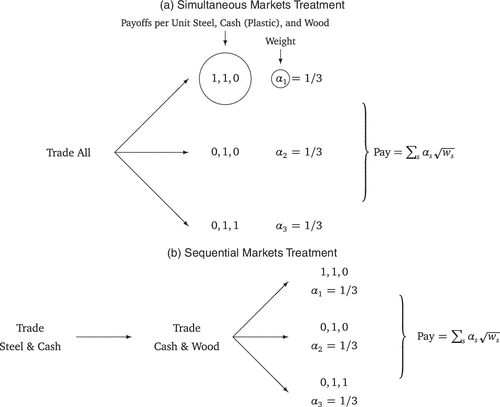
Notes. The top (bottom) panel illustrates the simultaneous (sequential) markets treatment. Payoff (wealth) in state s is computed as , where denotes number of steel (S), cash/plastic (C), or wood (W) held, and payoff per unit k in state s. One can interpret both settings in terms of risky production with square-root production functions. There are three equally probable states distinguished by which perfectly substitutable inputs are lost in production (cash (plastic) is never lost, steel is lost in the middle and lower state, wood is lost in the upper and middle state). Participants are paid for expected production. In the simultaneous markets treatment, all three inputs are traded at once. In the sequential markets treatment, steel is traded first (for cash), followed by wood. By design, there is no intermediate resolution of uncertainty.
As our naming of the securities suggests, one can recast our setting as one of production. It is “as if” there were three states with equal probabilities, and three perfectly substitutable inputs. States are distinguished by which inputs are lost in production (i.e., plastic is never lost, steel is lost in the middle and lower states, wood is lost in the upper and middle states). The production function is of the square-root form (see below for details) to ensure decreasing but positive returns to scale, that is, in analogy to risk aversion. Participants are paid for expected production.
We compare outcomes in the above sequential trading setting against a single-period trading setting, where all three assets (including the numeraire) are traded simultaneously, after which participants are paid depending on their final holdings. This is illustrated in Figure 1 (top). We refer to the single-period setting as the “simultaneous markets” treatment. This treatment features complete markets: all securities are traded at the same time.
4.2. Benchmark Equilibria
The appropriate notion of equilibrium that applies to the simultaneous markets treatment is the Walrasian Equilibrium, where demands equal supplies given equilibrium prices. The standard notion of equilibrium for the sequential markets treatment is the Perfect Foresight Equilibrium (PF Equilibrium), where, in period 1, agents optimize dynamically to determine current choices given correct (perfect) foresight of the (Walrasian) equilibrium prices that prevail in period 2.
Given the dynamic completeness of our sequential markets treatment, its corresponding PF Equilibrium coincides with the Walrasian Equilibrium of the simultaneous treatment. Crucially, if participants’ dynamic narrow framing prohibits perfect foresight, final holdings in the sequential treatment will not equilibrate at PF Equilibrium allocations (and hence will also differ from Walrasian Equilibrium allocations of the simultaneous treatment).
4.3. Parameterization
In our experiment, as already indicated in Figure 1, we induced power, that is, square-root instead of quadratic utility functions.15 This deliberate deviation from the theory (price equivalence) is motivated by three reasons. The first one is technical: contrary to quadratic utility, square-root utility avoids issues of decreasing utility beyond a certain level of securities holdings. Second, square-root utility implies a constant relative risk aversion of 0.5, matching the average level of risk aversion commonly observed in experimental asset markets (see, e.g., Biais et al. (2017)). The third reason is more fundamental. Under square-root utility, strict price equivalence no longer holds: the DNF Equilibrium prices are no longer identical to the Walrasian Equilibrium prices of the corresponding simultaneous markets, and hence, to those of the PF Equilibrium.
Let us elaborate. By using nonquadratic preferences, the result is that, if DNF Equilibrium is a better description of actual outcomes than PF Equilibrium, we will recognize such discrepancies in both allocations and prices. In contrast, had we used quadratic utility, we could only rely on allocations to test for different equilibria. Therefore, experiments with induced square-root utility provide a stronger test of DNF. Furthermore, final holdings in multigood/asset experiments are known to be noisy (Bossaerts et al. 2007) and convergence of holdings is generally much slower than convergence of prices.16 It is thus crucial to be able to verify the nature of the equilibrium markets are converging to with prices in addition to allocations. Moreover, rather than merely testing for empirical price equivalence between the DNF and PF Equilibrium under quadratic utility, we instead test whether the DNF Equilibrium is the right way to model prices and allocations in sequential markets. This augments the external validity of our experiment: we validate a type of equilibrium, namely the DNF Equilibrium, and not “only” a theoretical result that relies on specific preferences.
In total, we ran eight experiments. When choosing parameters (endowments, payoff function weights), we made sure that the two equilibria under investigation could be attained with an interior solution, yet provided sufficient deviation between predicted prices and allocations.
By the end of the fifth experiment, we noticed that participants stopped trading even if there were still gains from trade. We attribute this to lack of incentives: the extra trades had only a marginal effect on the payoff function, and hence earnings. In the remaining three experiments, we therefore decided to convert payoffs into dollar earnings using a sigmoid function that ensures sustained incentives to trade close to PF Equilibrium payoffs. As we shall see when discussing the results, this did have the intended effect on final holdings. Online Appendix F explains how the sigmoid function was determined.
In Experiments 1 to 7, we ran several replications of the sequential-markets treatment with identical endowments. This obviously affects expectations: upon repetition, participants could use knowledge of the previous instance to guess which wood prices would prevail after the steel market closed. In the last (eighth) experiment, we instead changed endowments every time a new sequential treatment was initiated. We shall document to what extent continuously changing endowments, and hence, continuously changing equilibria, favored emergence of the DNF Equilibrium.
Online Appendix E provides all design details of the eight experimental sessions.17 Table E.2 lists the equilibrium predictions, on prices, as well as on net (steel) trades that participants of type 2 would have to accomplish (at equilibrium prices) to reach equilibrium holdings. In the results section, we focus on analyzing the choices of type-2 participants, since the remaining choices are complementary, adding no evidence as to which equilibrium allocations markets are evolving to. We chose to investigate holdings of steel, since predictions across the two equilibria differed much more than for wood. This is consistent with our results in Section 3, that is, deviations in equilibrium holdings are substantially larger for earlier traded assets.
|

Table 2. Final Holdings Regressions
| Dependent variable: | (1) | (2) |
|---|---|---|
| : [intercept] | 0.04 | 0.16 |
| (0.15) | (0.67) | |
| : | −1.52 | −0.63 |
| (−1.78) | (−0.74) | |
| : | 1.03 | −0.02 |
| (1.96) | (−0.04) | |
| : | 0.74** | |
| (3.04) | ||
| : | 0.73 | |
| (1.83) | ||
| AIC | 1,356 | 1,368 |
| BIC | 1,374 | 1,390 |
| Participant random effects | Yes | No |
| Number of observations | 298 | 298 |
Notes. Reported are estimates from general linear maximum likelihood modeling with deviation of individual final holdings of asset 1 (steel) from PF Equilibrium prediction as dependent variable. Only type-2 participants are included. Column (1) reports estimates of Equation (21) and column (2) reports estimates from Equation (22) (t-statistics in parentheses). No random effects are allowed in the latter as individuals are assigned to experiments that have either constant or changing endowments, while a dummy for changing endowments is included as interaction in one of the regressors.
**, , and denote significance at , , and , respectively.
To alleviate computational burden, participants had access to an online spreadsheet with which they (i) could compute production as a function of all traded input goods, and (ii) simulate all implied payoff impacts of potential trades.18 The original instructions for the experiment can be found in Online Appendix E, which also includes snapshots of the online spreadsheet and trading interface. Trading was implemented via continuous two-sided open books using the Flex-E-markets software,19 replicating the dominating trading protocol in modern financial exchanges (see Online Appendix E for details).
5. Experimental Evidence
5.1. Descriptive Results
In total, 117 participants took part across the eight experimental sessions. Participants were undergraduate and postgraduate students from the University of Melbourne.20 During an extended practice period, participants were given ample opportunity to train themselves in both trading and the use of the online spreadsheet. At the end of each session, participants were paid the payoffs (in AUD) from one randomly selected replication. Payoffs ranged from $40 to $57, with a mean of $50.74. Sessions lasted a little under two and a half hours. Given the deliberate exclusion of any exogenous uncertainty, the low variation in payoffs (standard deviation of $3.65) reflects a high degree of competitiveness, and hence, adequate incentivization.
We first provide illustrative, graphical evidence of prices and allocations. To this end, we focus on the three final experiments, that is, those with increased trading incentives. Figure 2 depicts average prices of steel (asset 1) in Experiments 6 and 7 (black solid line, in trading time, across pooled transactions). These experiments constitute the two sessions with fixed endowments and, thus, constant equilibria.21 Despite the relatively small difference between the PF Equilibrium (PF Eq) and the DNF Equilibrium (DNF Eq) price, we see clear separation between treatments: with simultaneous trading (right panel), prices converge to the PF-equivalent Walrasian Equilibrium (WAL Eq), while for sequential trading (left panel), prices converge to the DNF Equilibrium by market close.
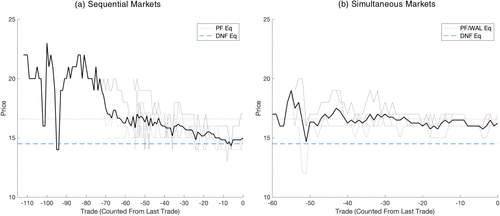
Notes. Shown are trade prices for all rounds of the two treatments. Left panel: sequential markets, right panel: simultaneous markets. Each line represents a steel (asset 1) price time series (in cents) in one of the rounds. The solid line shows the average price (in trading time). The horizontal dotted (dashed) line indicates the PF/Walrasian (DNF) Equilibrium price level. Time is measured in number of transactions prior to the last transaction. Minimum calendar time equals five minutes but was extended up to seven minutes if trade had not subsided by the preannounced minimum time.
Figure D.4 in Online Appendix D shows the evolution of trade prices for each replication (“market”) for Experiment 8, where equilibrium predictions varied across replications because endowments varied. As in Figure 2, we observe that prices in the sequential treatment are very close to the DNF Equilibrium, whereas, in the simultaneous treatment, they are economically indistinguishable from the Walrasian Equilibrium. DNF Equilibrium prices are generally very similar to their Walrasian counterparts. Because of power (square-root) utility, equilibrium price predictions for steel (asset 1) do deviate measurably between markets, however. Overall, observed transactions suggest that the DNF Equilibrium, not the PF Equilibrium (or Walrasian Equilibrium) predicts prices under sequential trading, while the Walrasian Equilibrium predicts prices under simultaneous trading. Notably, Figure D.4 reaffirms that the Walrasian Equilibrium actually works for multiple simultaneous markets, which, considering the required cognitive efforts, is not self-evident.22
In sequential markets, allocations predicted by the DNF Equilibrium versus the PF/Walrasian Equilibrium are always distinctly different for the early traded asset (steel), whereas discretization generally renders them indistinguishable for the late traded asset (wood). Across sequential markets treatments with sustained trading incentives (Experiments 6 to 8), the left panel of Figure 3 shows histograms of the absolute differences in final steel holdings relative to the DNF and relative to the PF Equilibrium predictions. The right panel of Figure 3 shows the respective histograms for the simultaneous markets treatments (relative to the Walrasian Equilibrium predictions). Vertical lines indicate median differences.
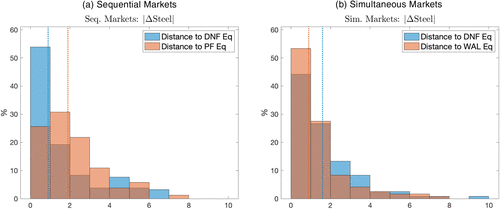
Notes. Shown are histograms of absolute deviations of actual final holdings in steel (asset 1) from predictions (blue: DNF Equilibrium, orange: PF/Walrasian Equilibrium). Left: sequential-markets treatment, right: simultaneous-markets equilibrium (here, DNF Equilibrium predictions are taken from sequential-markets treatment). Dotted vertical lines indicate medians.
Unsurprisingly, final allocations exhibit considerable variation. Nevertheless, as conjectured under sufficient incentives, the right panel of Figure 3 shows that final allocations in the simultaneous-markets treatment are closest to the (Pareto optimal) Walrasian Equilibrium (orange deviations). The median deviation relative to the Walrasian Equilibrium (0.9) is significantly smaller (, Wilcoxon rank-sum test) than the median deviation relative to the DNF Equilibrium (1.6). More importantly, the left panel of Figure 3 shows that holdings in the sequential-markets treatment are much closer to the DNF Equilibrium allocations (blue deviations, median of 0.9) than to the PF Equilibrium allocations (orange deviations, median of 1.9). As before, this difference is highly statistically significant (, Wilcoxon rank sum test).
Overall, these illustrative results suggest that, in (appropriately incentivized) sequential markets, the DNF Equilibrium predicts both final prices and allocations more accurately than the PF Equilibrium, while the Walrasian Equilibrium best predicts outcomes in simultaneous markets. Next, we confirm this formally, combining data from all sessions and adding relevant controls for potentially confounding factors.
5.2. Formal Evidence
Leveraging the entire price time series (rather than only final prices),23 we now provide formal evidence for convergence of prices to the DNF Equilibrium in the sequential-markets treatment, and to the Walrasian Equilibrium in the simultaneous-markets treatment. We also provide formal evidence that final holdings in the sequential-markets treatment are better explained by the DNF Equilibrium. Because they yield identical predictions, we will use the terms Walrasian Equilibrium and PF Equilibrium interchangeably. Due to the discrete nature of experimental parameters (tick size and units), we focus on the early traded asset (steel).
5.2.1. Prices: Sequential-Markets Treatment.
Inspection of the price evolution in the sequential-markets treatment rounds in Figure 2 and Figure D.4 suggests that prices converge. We will model this convergence generically as an AR(1) process of the difference between the trade price and a benchmark price. To ensure we do not use a test that is favoring the DNF model, we first use the PF Equilibrium price as benchmark. Hence, for each round, we estimate the following AR(1) process:
We are interested in this long-term mean. If it is zero, because is zero, then prices can be expected to converge to the PF Equilibrium. We use this as the null. Under the alternative that prices instead converge to the DNF Equilibrium, however, will be nonzero. Instead it will be proportional to the difference between the DNF and PF Equilibrium price levels for the round, with positive constant of proportionality. To capture this alternative possibility, we allow to depend on the difference between the DNF and the PF Equilibrium, and specify the autoregression as follows:
Our focus thus lies on the estimates of . If we cannot reject that equals zero, we conclude that trade prices converge to the PF Equilibrium and the DNF Equilibrium is rejected. If instead, across rounds, the estimates of are reliably different from zero, the intercepts of our autoregressions are nonzero, and hence, prices do not converge to the PF Equilibrium. In this case, we are interested in the sign of the coefficients: if , then prices drift toward the DNF Equilibrium instead of the PF Equilibrium, that is, the DNF Equilibrium “pulls” prices. If instead , then DNF prices go in the opposite direction, and neither the PF Equilibrium nor the DNF Equilibrium explain the evolution of prices. We will refer to as the “pull” by the DNF Equilibrium in round r. For completeness, we also estimate the corresponding autoregression with the DNF Equilibrium price as benchmark:
Table 1 reports aggregate statistics of the estimates of the autoregression coefficients () and the DNF (PF) “pull” coefficients (). Shown under (1a) and (1c) in the top panel are averages across all rounds of the sequential-markets treatment. We also provide estimates based on general linear model maximum likelihood estimation with random effects at the round level. These are provided under (1b) and (1d), respectively. In principle, this procedure should generate similar results, but it is more efficient (smaller standard errors) if it can be assumed that the distribution of coefficients across rounds is Gaussian. Absent theories of equilibration, we cannot provide arguments for the assumption of Gaussianity, however. Random-effects maximum likelihood modeling does allow us to investigate to what extent model specification is appropriate, in particular whether () and () have to be modeled as random slope coefficients as opposed to fixed coefficients. Table 1 reports differences in Akaike (AIC) and Bayesian Information Criteria (BIC) from including random effects.24 Both criteria decisively show that random effects are needed.
|
Table 1. Price Convergence Regressions
| Time series | Sequential treatment | Simultaneous treatment | ||||
|---|---|---|---|---|---|---|
| (1a) | (1b) | (1c) | (1d) | (2a) | (2b) | |
| (autoregression) | 0.53*** | 0.59*** | 0.53*** | 0.59*** | 0.45*** | 0.53*** |
| [7.75] | (14.09) | [7.75] | (14.28) | [4.03] | (7.53) | |
| (intercept) | −1.53*** | −1.26*** | −0.42 | −0.45 | ||
| [−6.51] | (−4.51) | [−1.81] | (−2.32) | |||
| (DNF “pull”) | 0.76*** | 0.64*** | ||||
| [6.51] | (4.28) | |||||
| corr(,) | −0.52 | −0.54 | ||||
| AIC/BIC | −240/−225 | −240/−224 | −81/−68 | |||
| (autoregression) | 0.53*** | 0.59*** | 0.53*** | 0.59*** | ||
| [7.75] | (14.19) | [7.75] | (14.28) | |||
| (intercept) | −0.59 | −0.44 | ||||
| [−0.50] | (−1.70) | |||||
| (PF “pull”) | −0.30 | −0.23 | ||||
| [−0.50] | (−1.77) | |||||
| corr(,) | 0.35 | 0.30 | ||||
| AIC/BIC | −241/−225 | −240/−224 | ||||
| 0.30 | 0.06 | −0.55*** | −0.47*** | |||
| [0.50] | (0.58) | [−8.87] | (−6.55) | |||
| −0.76*** | −0.47*** | |||||
| [−6.51] | (−4.04) | |||||
| AIC/BIC | −238/−207 | −81/−68 | ||||
| Round random effects | No | Yes | No | Yes | No | Yes |
| Mean number (std) of obs./round | 50 (23) | 44 (19) | ||||
| Number of rounds | 29 | 12 | ||||
| Total number of observations | 1,455 | 529 | ||||
Notes. Reported are estimates of the autoregression coefficients and the DNF (FRE) “pull” coefficients in Equation (17) to (19) (top two panels), and coefficient estimates for the price deviation adjustments as specified in Equation (20) (bottom panel). Results are reported for asset 1 (steel). Price differences (changes) are measured in cents. Each observation corresponds to one trade. Columns (1a) to (1d) ((2a) to (2b)) refer to the sequential-markets (simultaneous-markets) treatment. (1a), (1c), and (2a) report averages based on least-squares estimations for each round separately (ratio of average t-statistic divided by its standard error in square brackets). (1b) and (2b) report estimates of general linear model maximum likelihood estimation with random effects at the round level (t-statistics in parentheses). The linear correlation between estimates of () and () across rounds is shown. AIC/BIC reports the differences in the Akaike (AIC) and the Bayesian Information Criterion (BIC) from including random effects.
***, , and denote significance at , , and , respectively.
The autoregression coefficient across (1a) to (1d) is varying between 0.53 and 0.59, implying that the difference between the trade price and the PF Equilibrium price is converging (“autoregressing”). But is it converging toward zero, which would mean that prices converge to the PF Equilibrium? Our results provide strong support for the alternative hypothesis that it is not. First, both intercept coefficients in (1a) and (1b) are sizeable () and highly significant. The estimates of the long-term mean in Equation (17) amount to and , respectively. Second, the mean DNF “pull” () coefficient in Equation (18) is strictly positive, between 0.64 (1d) and 0.76 (1c), implying that the steady-state difference between trade price and PF Equilibrium price is determined by the deviation of the DNF relative to the PF Equilibrium price. When evaluated under the best model fit (1d), the mean steady-state difference between trade and PF Equilibrium price is:
In contrast, turning to Equation (19) in the middle panel of Table 1, for the difference between trade price and DNF Equilibrium price, the raw intercept (correspondingly denoted by ) is much smaller and insignificant at . Moreover, if anything, the mean PF “pull” () coefficient in Equation (19) is negative. When evaluated under the best model fit (1d), the mean steady-state difference between trade and DNF Equilibrium price is:
Notice that, as a function of r, estimates of () and () exhibit negative (positive) correlation. This means that, if the autoregressive coefficient is larger, the “pull” toward (away from) the DNF (PF) Equilibrium decreases. Conversely, when DNF has more “pull,” prices appear to drift more randomly relative to the PF Equilibrium. This suggests that PF and DNF Equilibria are empirical substitutes: when there is less evidence for one, the other provides better forecasting power.
Finally, focusing on the time series of (simple) price changes, we run the following horse race between the PF and the DNF Equilibrium:
Overall, we conclude that the experiment provides strong support for the DNF Equilibrium, rejecting convincingly that prices converge to the PF Equilibrium in the sequential-markets treatment.
5.2.2. Prices: Simultaneous-Markets Treatment.
Columns (2a) and (2b) in the top panel of Table 1 display the price autoregression estimates of Equation (17) for the simultaneous-markets treatment. For that treatment, we do not have a compelling alternative, so we test whether the steady state of the autoregression in the deviation of trade prices from the PF Equilibrium equals zero.25 That is, we again start from the regression in Equation (17), modelling as single parameter that, under the null, should be zero, and under the (unspecified) alternative, should be nonzero. Column (2a) in the top panel shows the pooled results from estimating the parameters and separately for each round. Column (2b) reports general linear maximum likelihood estimation across rounds with random effects at the round level.
The inferences from (2a) and (2b) are almost identical. There is significant autoregression: the estimates of the mean range from 0.45 (2a) to 0.53 (2b), implying that the gap between the trade price and the PF Equilibrium price narrows over time. The estimates of the mean are much smaller (in absolute terms) compared with columns (1a) and (1b) and only marginally significant. Under the best model fit (2b), the mean steady-state difference between trade and PF Equilibrium price is:
Recall that prices are measured in cents. On our trading platform, the tick size was one cent. So, economically, the long-term expected gap is within the tick size. We conclude that, in the simultaneous-markets treatment, the price gap converges to below tick-size levels, or equivalently, that trade prices converge to the PF Equilibrium.26 Finally, focusing again on the time series of price changes as specified in Equation (20), the bottom panel of Table 1 corroborates this conclusion: deviations with respect to PF Equilibrium prices are corrected for by subsequent price movements.
5.2.3. Final Holdings.
As elaborated before, experimentally testing equilibrium theory on final holdings is challenging because holdings in multiasset experiments are generically noisy (Bossaerts et al. 2007) and converge slower than market-clearing prices—consistent with theory (Asparouhova et al. 2020).
Table 2 reports the results from regressing final holdings of asset 1 (steel) of type-2 participants onto the DNF predictions, allowing for interactions with treatment and experiment parameterization. To avoid spurious effects from differences in equilibrium holdings levels across experiments, we subtract the PF predictions from both the regressand and regressor. We only include type-2 participants as all other participants are of type 1: the latter are the counterparties in trade with type-2 participants, and hence, collectively do not add any information.
Let denote the set of rounds in which participant i participated. Let be the count of all rounds across all experiments.27 Let denote participant i’s final holdings of steel in round . We only retain observations in . We thus obtain a panel of 58 time series (one per participant of type 2), each of length five (for participants in Experiments 1 through 7) or six (in Experiment 8).
We first run the following regression:
Our hypothesis was that, for observations of the simultaneous-markets treatment, final holdings should be equal to those in the PF Equilibrium. This means that the average intercept in the equation, that is, the mean of the , would equal zero. In the sequential-markets treatment, the part in parentheses kicks in: a different intercept is allowed for (). We hypothesized that final holdings would be better explained by the DNF Equilibrium, implying that the coefficient should equal unity.
Column (1) of Table 2 displays the results from general linear maximum likelihood modeling with Gaussian errors terms. We find that the intercept is insignificant, implying that final holdings in the simultaneous-markets treatment are well explained by the PF Equilibrium (or equivalently, the Walrasian Equilibrium). For observations in the sequential-markets treatment, we find that the slope coefficient to the difference between the DNF and PF Equilibria is significantly positive. This means that the difference between the final holdings and the PF Equilibrium predictions can be explained by the DNF Equilibrium predictions. At 1.03, this slope is close to, and insignificantly different from, unity, as hypothesized.
Across experimental sessions, we changed two aspects of the design: (i) from Experiment 6 onward, participants’ earnings were a sigmoid transformation of the expected production based on their final holdings; (ii) in Experiment 8, we varied the endowments across pairs of rounds (one for each treatment). Both design changes were introduced to enhance participants’ trade incentives. We therefore study whether these design changes had the intended effect by running the following regression:
Column (2) of Table 2 displays the results of estimating Equation (22). The intercept remains insignificant, as before. However, the slope to the difference between the DNF and PF Equilibria now loses all significance (), and is even negative. In contrast, the effect of the regressor becomes highly significant () once interacted with the dummy capturing enhanced incentives, and weakly significant when interacted with the dummy for varying endowments. This showcases that the design amendments had the intended effect.
Altogether, we conclude that the DNF Equilibrium provides unbiased predictions of final holdings in the sequential-markets treatment, while the PF Equilibrium (equivalently, the Walrasian Equilibrium) correctly predicts final holdings in the simultaneous-markets treatment. The final holdings regressions demonstrate that dynamic narrow framing drives trade when participants cannot simultaneously observe prices in all markets.
6. Implications
6.1. On the Empirical Record of Asset Pricing Theory
It has long been observed that there is a discrepancy in empirical support (in historical data from the field) for asset pricing theory depending on whether it explains prices in terms of benchmark portfolio values or whether the theory explains prices in terms of covariation with choices such as consumption (Campbell and Cochrane 2000).
Generally, benchmark portfolio models (multifactor models) generate far more support. Such models solely require “right” prices. This is usually tested by verifying that expected returns net of a risk premium, that is, alphas, are zero. Under the conditions of the DNF Equilibrium, perfect foresight obtains. All one still needs is that agents have “correct” beliefs about the occurrence of states: beliefs that can be verified ex post in historical data. Then alphas will indeed be zero.29
In contrast, models that tie prices to choices require choices to be “right” too, which, in addition, necessitates perfect foresight: agents do not only have to hold correct beliefs about the occurrence of future states, but also about conditional prices that would obtain in those states. In principle, it should be easier to build correct expectations about the occurrence of states, which are exogenous to the economy, as opposed to expectations about prices within states, which are endogenous. Indeed, it may be relatively easy to predict the chance of frost in, say, Florida, but far more difficult to assess the effect on orange juice prices if such frost were to occur (Roll 1984).
Our theory shows that prices can be right, while choices are wrong, because they reflect dynamic narrow framing. Therefore, our theory may explain why benchmark portfolio models fit the historical record better than consumption-based models.
Mehra and Prescott (1985) hypothesize that the combination of consumer heterogeneity and incomplete consumption insurance may resolve the seminal equity premium puzzle, that is, the excessiveness in (excess) stock return when contrasted with the historically low levels of aggregate consumption risk. Constantinides and Duffie (1996) demonstrate that the puzzle can be solved under homogeneous preferences (time- and state-separable power utility) but heterogeneous income processes that lead to persistent and heteroscedastic income shocks across consumers. Our proposition of dynamic narrow framing is different than the mechanism proposed by Constantinides and Duffie (1996), as we assume bounded rationality and abstract from multiple income streams. However, agents who exhibit dynamic narrow framing still fail to achieve the risk-sharing levels feasible in a PF Equilibrium (see above). Therefore, in a DNF Equilibrium, the level of risk borne across agent types is greater than imposed by aggregate fluctuations in consumption, which in turn could materialize in a higher equity premium.
There are other puzzles that our theory sheds light on. For instance, a number of studies document that option prices were of similar (informational) quality before and after the publication of the Black-Scholes-Merton model (Moore and Juh 2006, Chambers and Saleuddin 2019). The historical evidence indicates an “intuitive” understanding of derivative pricing long before the development of formal theories. Our findings suggest an alternative explanation, which is that prices can be accurate even in the absence of the right model to predict future prices. This requires that traders engaged in competitive exchange to cover their risks without accounting for retrading in the future, that is, assuming that they had to hold the options till maturity.
6.2. When Prices May Be Wrong
Our main theoretical result relies on dynamic narrow framing, which the experiment substantiates as a reasonable working hypothesis. We do not expect dynamic narrow framing to obtain in all circumstances, however. Indeed, there are situations in which agents are forced to predict future prices. That is, agents have to speculate. For instance, intermediate dividend payments may require agents to think about future prices, if only because “home-made dividends” (synthetic dividends constructed purely from buying and selling securities) may be taxed less heavily than actual dividends. In the face of such market frictions, agents have to consider whether price changes upon future dividend payments are such that collecting dividends is not beneficial. Speculation about ex-dividend prices may lead to mispricing, which could be exploited. Therefore, mispricing may emerge in areas such as high-dividend-yield stocks.
Two recent experiments demonstrate how forced speculation leads to wrong prices. In the first experiment, participants were forced to think about future dividend endowments because their utility depended on how much cash flows today’s investments would generate in the future (Asparouhova et al. 2016). In a second experiment, participants were paid only if they assured the right amount of cash flows from future dividends (Asparouhova et al. 2016). In both experiments, participants had to speculate about future prices, and significant mispricing emerged because of lack of perfect foresight.
Likewise, prices may be wrong when agents want to speculate. The desire to speculate, and the negative impact on price quality, has been documented in a number of circumstances, such as technology stocks (Brunnermeier and Nagel 2004), or high-beta stocks (Hong and Sraer 2016).
When prices are right, there is no benefit from active portfolio management: strategic asset allocation in the form of passive investments in a number of indices will eventually outperform actively managed portfolios. However, in situations where investors are forced to think about future resale prices of their investments, mispricing may emerge. The same may occur when investors voluntarily engage in speculation. Active portfolio management may become beneficial. As such, our findings suggest domains where active portfolio management should concentrate.
7. Conclusion
In this paper, we study traders’ ability to attain perfect foresight. This is a key assumption in dynamic asset pricing theory that in our opinion is not made sufficiently explicit in the literature. We first show theoretically that, under quadratic preferences, Dynamic Narrow Framing (DNF) Equilibrium prices generically are as if agents had perfect foresight, even if equilibrium allocations are different. Under dynamic narrow framing, agents take into account future endowments, but ignore that they may be able to trade them, obviating the need to form expectations about the prices at which they could trade those in the future. Second, leveraging the control of markets experiments, we find strong empirical evidence for dynamic narrow framing in both observed prices and choices.
Our findings have important implications for financial economics. We provide a foundation for asset pricing that does not require agents to exhibit the level of rationality and foresight inherent in the traditional premise of market efficiency. Moreover, our results could explain why asset pricing models that relate prices of risky securities to each other (e.g., multifactor models) generally fit historical data from field markets better than models that relate prices to choices (e.g., consumption-based models). Finally, our theory provides a framework to re-evaluate the empirical record of the Efficient Markets Hypothesis (EMH): we expect prices to be right, that is, EMH obtains, when agents can afford dynamic narrow framing. If instead, they are forced to speculate about future prices, for example, when asked to produce “home-made dividends,” EMH may likely fail.
The paper benefited from presentations at conferences (Society for Experimental Finance, Econometric Society, FIRN Annual Meeting, Behavioral Finance and Capital Markets Conference, FIRN Virtual Seminar, Asia Experimental and Behavioral Economics Seminar Series, AEA Annual Meeting, SGF Conference, 10th Helsinki Finance Summit on Investor Behavior, 12th Miami Behavioral Finance Conference, FIRS Conference) and universities (Hebrew University, Hong Kong UST, Monash University, University of Geneva, University of Louvain, University of Melbourne, University of St. Gallen, Tinbergen Institute, University of Zurich). The authors are grateful for valuable comments by Daniel Hauser, Nicholas Hirschey, Chad Kendall, Chen Wang, Matthias Weber, and Rüdiger Weber. Preliminary results on the experiments reported here were first reported in the Honours Thesis of Frans van den Bogaerde at the University of Melbourne, entitled “Dynamic Asset Pricing with Imperfect Foresight.”
1 The assumption of perfect foresight is often not made explicit. Even advanced textbooks discuss perfect foresight only in end-of-chapter notes, see Duffie (1988), Chapter 16; Magill and Quinzii (2002), Chapter 2; or LeRoy and Werner (2014), Chapter 21. In Online Appendix B, we illustrate how seminal results, that is, the Cox et al. (1979) binomial option pricing model or Modigliani and Miller’s (1958) capital structure irrelevance, require perfect foresight. To our knowledge, perfect foresight was first introduced explicitly by Arrow (1964).
2 See Anderson and Bossaerts (2019) for conditions under which agents may disagree on the chances that states obtain.
3 Perfect foresight is analogous to subgame perfection in game theory, where players know how to continue in every node and continuation is restricted to Nash play (Fudenberg and Levine 1983).
4 Linear asset pricing models such as the CAPM or multi-factor models (Fama and French 2004) directly assume mean-variance preferences. Intertemporal models such as Merton’s ICAPM with constant investment opportunities (Merton 1973a) or the Black-Scholes-Merton model (Black and Scholes 1973, Merton 1973b) are consistent with quadratic utility as they adhere to the linear relationship between an asset’s expected return and its correlation with the market.
5 Extrinsic uncertainty is uncertainty generated by nature: randomness that the agents have no control over, whether individually or collectively. In contrast, intrinsic uncertainty refers to endogenous outcomes such as prices. Because of the assumption of competition, agents have no control over it individually. However, they do collectively. That is, agents collectively determine prices in future trading periods if trading is sequential, but do not know those in earlier periods. In the traditional perfect-foresight equilibrium, uncertainty about future equilibrium prices is assumed away, that is, there is no intrinsic uncertainty as everyone knows which prices will obtain in each feasible state. Because of DNF, intrinsic uncertainty, while present, does not matter for agents. Given they ignore future trading opportunities, they do not have to form expectations about future prices.
6 Asparouhova et al. (2022) discusses these issues in the context of competitive markets under adverse selection.
7 Instead, agents could also trade a risk free bond paying an exogenous interest rate, but this merely complicates notation.
8 We analyze the impact of dynamic narrow framing in sequential trading using state securities. We could have started from generic securities that pay arbitrary amounts across states. We would then let agents trade these securities sequentially. As long as one can re-express the payoffs of these securities as payoffs on portfolios of state securities, there is no loss of generality in focusing on state securities. A proof of the impact of dynamic framing on pricing in the presence of generic securities would have started by re-expressing the problem in terms of state securities anyway. To prove our results without making this conversion would obfuscate matters.
9 Suffice it to state here that in binomial pricing models, one single security is traded repeatedly over time, along with cash, rather than different securities as we propose. Trading the same security over time raises issues when information is revealed in-between trading rounds. The choice of security becomes crucial to avoid that revealed information implies that this single security has zero value going forward. For instance, in binomial pricing models, this rules out state securities, which underscores the importance of security choice to ensure dynamic completeness under intermediate resolution of uncertainty, as discussed in Kreps (1982). We elaborate at the end of this section.
10 Consider the type-3 agent in Table C.1. In the PF Equilibrium, the agent would have to trade to 1.9877 + 0.1975 = 2.1852 units of asset (state security) 1 in the first period. This trade ensures a payoff of 2.1852 from asset 1, from which she subtracts 0.1975 to repay the cash loan she takes out, which generates a net payoff of 1.9877 (−0.1975) in state 1 (2). At a price of 0.2895 per unit, this would cost her 2.1852 0.2895 = 0.6326 in cash. In the DNF Equilibrium, the agent buys 2.8177 units of asset 1 at a cost of 2.8177 0.2895 = 0.8147. Analogously, this trade yields a net payoff of 2.3285 (−0.4892) in state 1 (2). Thus, in the PF Equilibrium, she will be short 0.6326 units of cash in period 1, and, in the DNF Equilibrium, she will be short 0.8147. If the agent was allowed to short cash only to, say, 0.75 units, then only the PF Equilibrium would be feasible.
11 For ease of reference, the proof provides a translation of our notation into that of Rubinstein (1974).
12 A celebrated result, due to Constantinides, is that, in a dynamically complete market with expected-utility agents, the Negishi-type representative agent also has expected utility preferences (Constantinides 1982).
13 NEEH has been appealed to before, to formulate valid statistical tests of dynamic asset pricing that do not require agents’ prior beliefs to be correct (i.e., to be confirmed in historical data), unlike what has generically been assumed in such tests. See Bossaerts (2004) for details.
14 Moreover, previous experiments involving financial markets have shown that participants’ choices often reflect beliefs () that differ from the probabilities the experimenter uses to draw states, even if the experimenter announces those probabilities. This further complicates experimental tests of asset pricing theory. See Bossaerts and Plott (2004) for discussion.
15 For the experiment, we prefer the equivalent interpretation in terms of uncertain production.
16 See Asparouhova et al. (2020) for an explanation as to why convergence is slower.
17 Note, participants were never informed about securities’ aggregate supply. While this introduces price uncertainty (as intended), recall that asset pricing theory does not require knowledge of aggregate supplies (Bossaerts and Plott 2004).
18 In Experiments 6 to 8, we provided participants directly with the sigmoid transformation of the expected square root payoff function.
19 Flex-E-markets is a SaaS platform where users can flexibly design marketplaces with multiple simultaneous public and private markets using the continuous open-book mechanism, and invite participants to trade directly through an online user interface. Developed by Quantahm, Salt Lake City, UT (USA). See quantahm.com.
20 The study was approved by the University of Melbourne Human Research Ethics Committee (Ethics ID: 1749620.1) and was conducted in accordance with the World Medical Association Declaration of Helsinki. All participants provided written informed consent.
21 All trading occurred for a minimum of five (sequential treatment) or ten (simultaneous treatment) minutes, but market(s) remained open longer if trade had not subsided by the pre-announced minimum time. This happened mostly in the sequential treatment, where the steel market at times remained open for more than seven minutes. Due to varying trading activity, some time series are longer than others.
22 Indeed, in the experimental economics literature, there exist very few examples of designs with more than one simultaneously traded good/asset. In seminal experiments such as Smith (1965) or Smith et al. (1988), only one good/asset is traded. For further discussion, see Asparouhova et al. (2022).
23 Given that price differences between equilibria are generally small, analyzing final prices only lacks statistical power.
24 Fixed-effects general linear modeling would produce results that are identical to those reported under (1a), (1c), and (2a), provided fixed effects are applied to all slopes at the level of rounds.
25 Recall that the PF and Walrasian Equilibria are equivalent and referred to interchangeably.
26 Still, this does not necessarily imply that the true for all rounds was economically insignificant. This is also indicated by our model selection: both AIC and BIC call for the inclusion of random effects for (and ) as the respective statistics are substantially larger without these effects (AIC: 1554 instead of 1473, BIC: 1567 instead of 1499). We can also test this directly, as follows. Under the null that equals zero for all r, the distribution of the corresponding t-statistics is . However, the distribution of these t-statistics across rounds deviates significantly from the standard Gaussian distribution. Specifically, the Kolmogorov-Smirnov statistic testing for equality of the two distributions equals 0.68 (). Further inspection of the empirical distribution function shows that it is leptokurtic relative to the standard Gaussian distribution: more t-statistics are either close to or far away from zero than under .
27 Thus, for Experiment 1, , and for Experiment 2, , etc.
28 With only five or six observations per time series, using fixed-effects modeling would be ill-advised.
29 For a detailed discussion, see Bossaerts (2005), Chapter 2.
References
- (2019) Modelling asset prices under heterogeneous beliefs. Preprint, submitted June 7, https://ssrn.com/abstract=3465423.Google Scholar
- (1964) The role of securities in the optimal allocation of risk-bearing. Rev. Econom. Stud. 31(2):91–96.Crossref, Google Scholar
- (2016) Payout policy, investor rationality, and market efficiency: Evidence from laboratory experiments. Working Paper, University of Utah, Salt Lake City.Google Scholar
- (2022)
Pairing multi-market theory with experiments . Füllbrunn S, Haruvy E, eds. Handbook of Experimental Finance (Edward Elgar Publishing, Cheltenham, GL), 172–193.Crossref, Google Scholar - (2020) Price formation in multiple, simultaneous continuous double auctions, with implications for asset pricing. Preprint, submitted July 26, https://ssrn.com/abstract=2774301.Google Scholar
- (2016) “Lucas” in the Laboratory. J. Finance 71(6):2727–2780.Crossref, Google Scholar
- (2006) Individual preferences, monetary gambles, and stock market participation: A case for narrow framing. Amer. Econom. Rev. 96(4):1069–1090.Crossref, Google Scholar
- (2017) Asset pricing and risk sharing in a complete market: An experimental investigation. TSE Working Paper No. 17-798, Toulouse School of Economics, Toulouse, France.Google Scholar
- (1973) The pricing of options and corporate liabilities. J. Political Econom. 81(3):637–654.Crossref, Google Scholar
- (2004) Filtering returns for unspecified biases in priors when testing asset pricing theory. Rev. Econom. Stud. 71(1):63–86.Crossref, Google Scholar
- (2005) The Paradox of Asset Pricing (Princeton University Press, Princeton, NJ).Google Scholar
- (2004) Basic principles of asset pricing theory: Evidence from large-scale experimental financial markets. Rev. Finance 8(2):135–169.Crossref, Google Scholar
- (2007) Prices and portfolio choices in financial markets: Theory, econometrics, experiments. Econometrica 75(4):993–1038.Crossref, Google Scholar
- (2004) Hedge funds and the technology bubble. J. Finance 59(5):2013–2040.Crossref, Google Scholar
- (2000) Explaining the poor performance of consumption-based asset pricing models. J. Finance 55(6):2863–2878.Crossref, Google Scholar
- (2000) Asset pricing with distorted beliefs: Are equity returns too good to be true? Amer. Econom. Rev. 90(4):787–805.Crossref, Google Scholar
- (2022) Noisy foresight. NBER Working Paper No. 30333, National Bureau of Economic Research, Cambridge, MA.Google Scholar
- (2019) Commodity option pricing efficiency before Black, Scholes, and Merton. Econom. Hist. Rev. 73(2):540–564.Crossref, Google Scholar
- (1982) Intertemporal asset pricing with heterogeneous consumers and without demand aggregation. J. Bus. 55(2):253–267.Crossref, Google Scholar
- (1996) Asset pricing with heterogeneous consumers. J. Political Econom. 104(2):219–240.Crossref, Google Scholar
- (1979) Option pricing: A simplified approach. J. Financial Econom. 7(3):229–263.Crossref, Google Scholar
- (1988) Security Markets: Stochastic Models (Academic Press, New York).Google Scholar
- (1985) Implementing Arrow-Debreu equilibria by continuous trading of few long-lived securities. Econometrica 53(6):1337–1356.Crossref, Google Scholar
- (1991) Substitution, risk aversion, and the temporal behavior of consumption and asset returns: An empirical analysis. J. Political Econom. 99(2):263–286.Crossref, Google Scholar
- (2004) The capital asset pricing model: Theory and evidence. J. Econom. Perspect. 18(3):25–46.Google Scholar
- (1983) Subgame-perfect equilibria of finite-and infinite-horizon games. J. Econom. Theory 31(2):251–268.Crossref, Google Scholar
- (1953) Community preference fields. Econometrica 21(1):63–80.Crossref, Google Scholar
- (1977) Temporary general equilibrium theory. Econometrica 45(3):535–572.Crossref, Google Scholar
- (1992) An exploration of the eductive justifications of the rational expectations hypothesis. Amer. Econom. Rev. 82(5):1254–1278.Google Scholar
- (1992) Bond pricing and the term structure of interest rates: A new methodology for contingent claims valuation. Econometrica 60(1):77–105.Crossref, Google Scholar
- (1986) Term structure movements and pricing interest rate contingent claims. J. Finance 41(5):1011–1029.Crossref, Google Scholar
- (2016) Speculative betas. J. Finance 71(5):2095–2144.Crossref, Google Scholar
- (1982) Rational expectations in microeconomic models: An overview. J. Econom. Theory 26(2):201–223.Crossref, Google Scholar
- (2001) Asymptotic methods for asset market equilibrium analysis. Econom. Theory 18:127–157.Crossref, Google Scholar
- (1997) Effects of mental accounting on intertemporal choice. Göteborg Psych. Res. 27(5):1–27.Google Scholar
- (1982)
Multiperiod securities and the efficient allocation of risk: A comment on the Black-Scholes option pricing model . McCall J, ed. The Economics of Uncertainty and Information (University of Chicago Press, Chicago), 203–232.Google Scholar - (2014) Principles of Financial Economics (Cambridge University Press, Cambridge, UK).Crossref, Google Scholar
- (2023) Boundedly rational information demand. Working paper, Carnegie Mellon University, Pittsburgh, PA.Google Scholar
- (1978) Asset prices in an exchange economy. Econometrica 46(6):1429–1445.Crossref, Google Scholar
- (2002) Theory of Incomplete Markets, vol. 1 (MIT Press, Cambridge, MA).Google Scholar
- (1988) The fate of systems with “adaptive” expectations. Amer. Econom. Rev. 78(2):168–172.Google Scholar
- (1985) The equity premium: A puzzle. J. Monet. Econom. 15(2):145–161.Crossref, Google Scholar
- (1973a) An intertemporal capital asset pricing model. Econometrica 41(5):867–887.Crossref, Google Scholar
- (1973b) Theory of rational option pricing. Bell J. Econom. Management Sci. 4(1):141–183.Crossref, Google Scholar
- (1958) The cost of capital, corporation finance and the theory of investment. Amer. Econom. Rev. 48(3):261–297.Google Scholar
- (2006) Derivative pricing 60 years before Black–Scholes: Evidence from the Johannesburg Stock Exchange. J. Finance 61(6):3069–3098.Crossref, Google Scholar
- (1960) Welfare economics and existence of an equilibrium for a competitive economy. Metroeconomica 12(2–3):92–97.Crossref, Google Scholar
- (2019) Mental temporal accounting. Proc. Internat. RAIS Conf. Social Sci. Humanities Organized Research Association Interdisciplinary Studies (RAIS), 114–124.Google Scholar
- (1972) Existence of equilibrium of plans, prices, and price expectations in a sequence of markets. Econometrica 40(2):289–303.Crossref, Google Scholar
- (1974) Frontiers Quant. Econom. Intriligator MD, Kendrick DA, eds. vol. II (North-Holland Publishing, Amsterdam, Netherland).Google Scholar
- (2009) The mental accounting of time. J. Econom. Psych. 30(5):772–781.Crossref, Google Scholar
- (1984) Orange juice and weather. Amer. Econom. Rev. 74(5):861–880.Google Scholar
- (1974) An aggregation theorem for securities markets. J. Financial Econom. 1(3):225–244.Crossref, Google Scholar
- (1965) Experimental auction markets and the Walrasian hypothesis. J. Political Econom. 73(4):387–393.Crossref, Google Scholar
- (1988) Bubbles, crashes, and endogenous expectations in experimental spot asset markets. Econometrica 56(5):1119–1151.Crossref, Google Scholar
- (2010) A behavioral and neural evaluation of prospective decision-making under risk. J. Neuroscience 30(43):14380–14389.Crossref, Google Scholar
- (1974) Judgment under uncertainty: Heuristics and biases. Science 185(4157):1124–1131.Crossref, Google Scholar

