

Request Username
Can't sign in? Forgot your username?
Enter your email address below and we will send you your username

The INFORMS Transactions on Education journal is pleased to announce a new, annual award: the Best Paper Award. Articles published in the journal each calendar year are evaluated by the editorial board and a plaque presented to authors.
Kai Wendt, Daniel Hellwig, Volodymyr Babich, Arnd Huchzermeier
Game—DISASTER: Blockchain-Enabled Token Trading Game for Supply Chain Management
Vol. 24, No. 2, January 2024
This paper describes the blockchain-enabled token trading game for supply chain management, a web-based supply chain simulation. The game uses blockchain technology’s concepts to create virtual markets for supplier capacity trading among retailers, in which participants take on the role of a retailer, have different valuations for products, and submit an order before knowing their demand; after demand realization, participants trade tokens (claims on the supplier’s capacity) among themselves using virtual markets to maximize their profits. The game provides participants with firsthand experience with how blockchain technology can be used in practice, thus serving as an interactive pedagogical tool. More generally, the game is intended to help supply chain management and blockchain technology students and executives understand the challenges of serving uncertain customer demand and the role of virtual markets in providing an effective remedy for reconciling supply and demand, thus improving supply chain performance.
Catherine Cleophas, Christoph Hönnige, Frank Meisel, Philipp Meyer
Who’s Cheating? Mining Patterns of Collusion from Text and Events in Online Exams
Vol. 23, No. 2, January 2023
As the COVID-19 pandemic motivated a shift to virtual teaching, exams have increasingly moved online too. Detecting cheating through collusion is not easy when tech-savvy students take online exams at home and on their own devices. Such online at-home exams may tempt students to collude and share materials and answers. However, online exams’ digital output also enables computer-aided detection of collusion patterns. This paper presents two simple data-driven techniques to analyze exam event logs and essay-form answers. Based on examples from exams in social sciences, we show that such analyses can reveal patterns of student collusion. We suggest using these patterns to quantify the degree of collusion. Finally, we summarize a set of lessons learned about designing and analyzing online exams.
Dessislava Pachamanova, Vera Tilson, and Keely Dwyer-Matzky
Machine Learning, Ethics, and Change Management: A Data-Driven Approach to Improving Hospital Observation Unit Operations
Vol. 22, No. 3, May 2022
This case discusses a process improvement project aimed at maximizing the use of hospital capacity as the flu season looms. Dr. Erin Kelly heads the observation unit and turns to predictive models to improve the assignment of patients to her unit. The case covers three major themes: (1) data analytics life cycle and interface of predictive and prescriptive analytics in the context of process improvement, (2) design and ethical application of machine learning models, and (3) effecting organizational change to operationalize the findings of the analysis. Realistic data, R code, and Excel models are provided. The rich context of the case allows for discussing change management in a healthcare organization, analytics problem framing and model mapping, service process capacity analysis and Little’s law, data summaries and visualizations, interpretable machine learning algorithms, evaluations of predictive model performance, algorithmic bias, and dealing with dirty data. The case is appropriate for use in courses in machine learning, business analytics, operations management, and operations research, both at the advanced undergraduate level and at the master’s/MBA level.
Note: This case was winner of the 2020 INFORMS Case Competition. Video of the authors’ presentation can be accessed at https://youtu.be/3UACmNJZo2A.
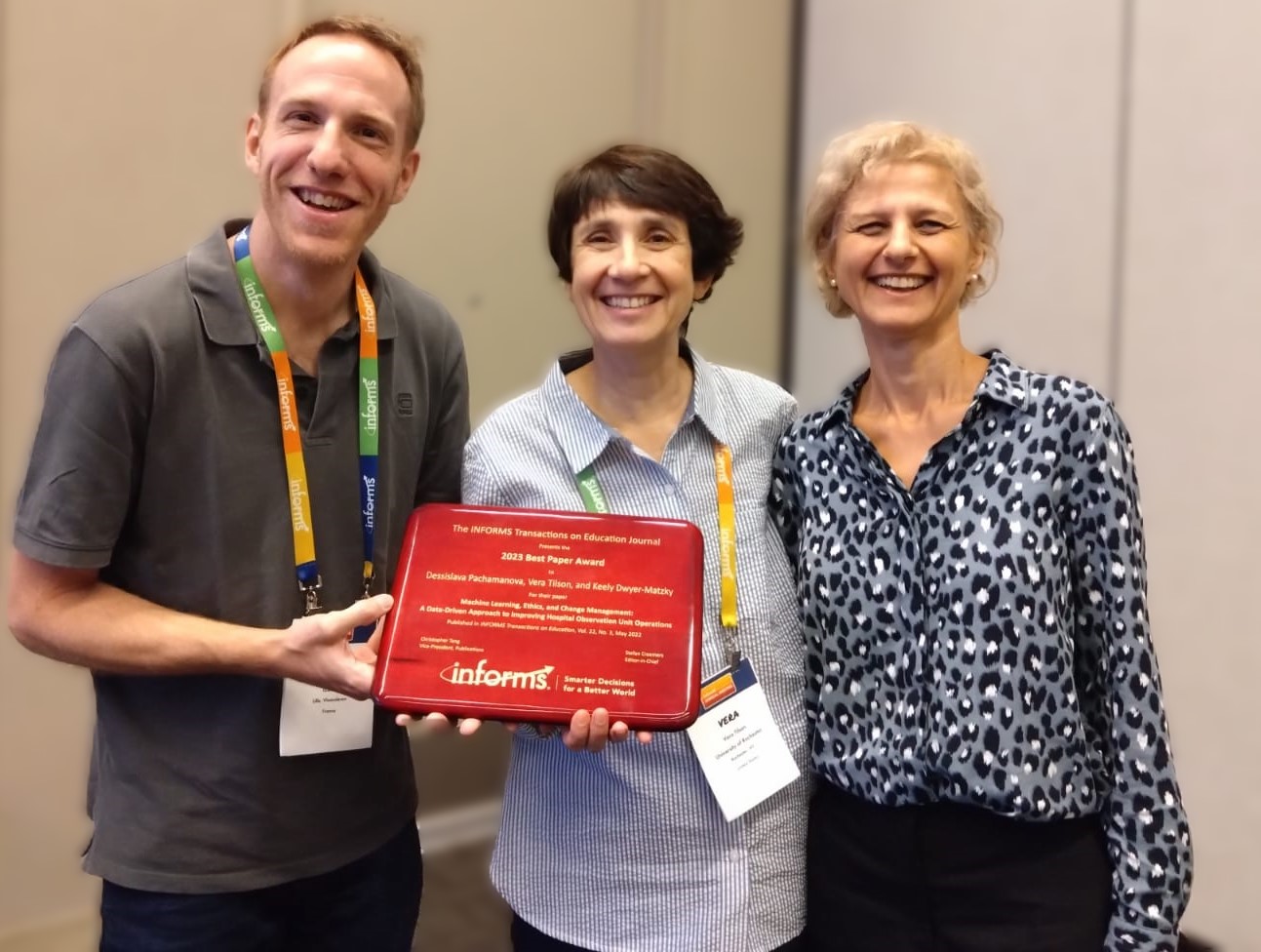
Stefan Creemers, EIC of ITE, presents the journal's first Best Paper Award to Vera Tilson, Dessislava Pachamanova, and Keely Dwyer-Matzky (not pictured).