Evolution Cum Agency: Toward a Model of Strategic Foresight
Abstract
This study examines the origin of the strategic innovation that changed the face of financial services—Charles Merrill’s financial supermarket business model—through three well-known and largely juxtaposed conceptual models of strategic foresight. Our study, whose purpose, business historical focus, and structure mirrors Graham Allison’s famous “Conceptual Models of the Cuban Missile Crisis,” allows us to make three contributions. First, it sharpens our understanding of the models we used in the study. Second, it provides the foundations of an integrated view and model of strategic foresight that suggests disciplined strategic foresight is possible, understandable, and replicable within some precise boundaries. Finally, it suggests directions for future behavioral strategy work.
“Today when we conjure up the names of the great American financiers, we tend to think of people like J. P. Morgan and Warren Buffett and even Michael Milken. But none of them had the effect on American life that Charles Merrill had. In fact, they’re not even close.” Joseph Nocera, Time Magazine, 1998
1. Introduction
The concept of strategic foresight—that is, the ability of a strategist to identify a superior course of action, especially one that is markedly different from the status quo, and foresee its consequences—is the focal point of a polarized debate in business strategy. Some argue that strategic foresight is simply impossible or, at best, heavily constrained; yet others assert that it is not only possible but also the learnable skill that defines the role of the strategist. It is, therefore, natural to ask if these opposing viewpoints can be reconciled, or if the clash is unavoidable. In this article we propose an answer to this question. We do so by sketching the foundations of a view and a model of strategic foresight that has general applicability within some clearly defined boundaries. The position we take synthesizes the pessimistic and optimistic viewpoints on foresight, and perhaps more generally on strategy. It synthesizes evolution and agency. This position has implications for future strategy research of a behavioral bent.
Our conception of this study is almost completely indebted to Graham Allison’s (1969) “Conceptual Models and the Cuban Missile Crisis”. While Allison focused on the Cuban Missile Crisis, we instead focus on one of the most important strategic innovations in the history of the financial services industry: Charles Merrill’s “financial supermarket” business model. Conceived in the late 1930s, this strategy not only gave impetus to what then became a Wall Street icon, Merrill Lynch, but also opened up the then elitist Wall Street to middle-class America. Just as Allison looked at the Cuban Missile Crisis through three different models of decision making, we look at the genesis of Merrill Lynch’s strategy through three different models of strategic foresight.
Polarized debates often focus on demonstrating the superiority of a particular worldview over others rather than on progressing understanding. Allison’s approach rejected such antagonistic logic. Allison focused on the fact that any conceptual model is a partial representation of a phenomenon, centering on certain things and ignoring others. Therefore, any conceptual model (at least those he employed in his study) has something valuable to offer, provided that it is understood in ways that respect its original character and intent. Multiple lenses, used at once, can produce a fuller understanding of a complex phenomenon. It is in this vein that we can understand Allison’s aspirations. First, Allison greatly valued clarifying what different models truly can and cannot explain, especially in relation to other relevant models. This was his main goal, and he pursued it first through an in-depth appreciation of the conceptual architecture of three models of decision making and then through what this architecture means in practice, i.e., in the explanation of the Cuban Missile Crisis. Second, Allison greatly valued exploring relationships among different conceptual models and the possibility of a theoretical integration that goes beyond current explanations. Allison pursued this second goal as well.
Allison’s aspirations define the aspirations and structure of our study. Like Allison, we first dissect three well-known conceptual models of strategic foresight. For each model, we lay out its core postulates and explanatory mechanisms. We then put the models, as Allison would say, to work. That is, we view the focal events through three different points of view. More precisely, for each model, we ask the following question: given the discovery of the strategy that changed the face of financial services, what evidence do we find in the available historical records that is consistent with the model’s explanatory engine? The end result should be the unambiguous characterization of each models’ practical meaning as well as a richer representation of the focal phenomenon since each model illuminates different aspects of it. Finally, we pursue an integrated conceptualization of strategic foresight that can somewhat resolve current divisions in the field and offer a richer yet behaviorally realistic understanding of strategic foresight.
We first consider a viewpoint that is rooted in the Carnegie School, specifically “A Behavioral Theory of the Firm” (Cyert and March 1963), and found a more developed expression in evolutionary economics thinking applied to strategy (Nelson and Winter 1982, 2002; Levinthal 1997; Denrell et al. 2003; Winter 2012). Here, reliably attaining distant strategic foresight is viewed as impossible, or at least very unlikely. Given their bounded rationality and the irreducible complexity and instability of competitive situations, agents cannot anticipate the consequences of distant courses of action. They are inherently myopic (Levinthal and March 1993). If the management of a firm discovers a seemingly distant strategic opportunity, it is not because it has a superior insight or a superior representation of the environment; rather, this is because the firm is preadapted (Cattani 2006). Indeed, in the pursuit of something other than the opportunity it eventually discovered, the firm moved to a position that made the discovery of the opportunity a relatively easy task. The discovery of the opportunity is thus serendipitous (Denrell et al. 2003). In caricature you have to be lucky enough to stumble upon a well-hidden $10 bill, alert enough to realize that you stumbled on it, and flexible enough so that you can bend and pick it up. We call this set of perspectives the “evolutionary view,” and focus on “preadaptation” as a specific model of strategic foresight within this view.
The second viewpoint we consider, also rooted in the Carnegie School, falls within Simon’s pragmatist lineage of the school (Simon 1947, Cohen 2007). Here, agents cope with their inherent myopia by approaching the strategic problem at hand on the basis of simplified mental representations of the problem (Gavetti and Levinthal 2000). While in most competitive settings, strategic leaders share similar mental representations, deviations from a dominant representation can lead one to see courses of action that are outside of her peers’ field of vision (Gavetti 2012). According to this model, attaining intelligence in the choice of a new mental representation is possible, for instance, through the skilled use of analogy (Gavetti et al. 2005). This is the sense in which this viewpoint differs from the evolutionary view, leading us to call it the “cognitive view.” Within this view, we focus on “analogy” as a specific model of strategic foresight.
The third viewpoint is that of the positioning school of strategy (for representative examples: Porter 1980, 1985; Ghemawat 1991; Brandenburger and Stuart 1996). In contrast to the other two models, this model is not concerned with the rationality with which agents strategize. Instead, it assumes that: (a) agents reason and conduct analyses by means of economic principles, and (b) they are good at doing so once they possess manageable principles. Rationality per se is therefore not problematic. What is problematic or relevant is the sophistication of the principles through which the strategist approaches the strategic problem. Much of the action in this research tradition therefore lies in sharpening the economic principles for thinking about strategy. Here, the imagery connected to the opportunity discovery process (and the conception of the strategist) is that of an agent who seeks strategic insight via economic principles. We call this perspective the “economic view,” and focus on “positioning” as a specific model of strategic foresight within this view.
We then put the models to work. In other words, we use each of the models to interpret in-depth historical evidence about how Charles Merrill arrived at his decision. We gathered this evidence via an exhaustive analysis of the available historical sources including company documents, Charles Merrill’s personal notes, articles, books, a biography of Charles Merrill, and more. The integral transcript of the 1940 off-site meeting that spearheaded Merrill & Lynch’s financial supermarket era played an especially central role in our historical reconstruction of events.1 Notably, one of the reasons that makes this historical case particularly interesting is that it is a case of strategic foresight ante litteram: it anteceded scholarly attempts specifically directed at explaining and informing the discovery of strategic opportunities. If there are typical, systematic factors that underpin strategic foresight, we expect some combination of them to be more likely represented in a case of this sort (as opposed to a situation that has been “polluted” by recipes focusing the strategist’s attention on some mechanisms over others).
In Section 5 we bring the three narrative together and use them to sketch the foundations of an integrated model of disciplined strategic foresight, one that suggests disciplined strategic foresight is possible, understandable, and replicable within some precise boundaries. The model is profoundly evolutionary in its emphasis on the constraining role of history, especially the role of strategists’ idiosyncratic experiences in a given set of relevant domains; it is profoundly cognitive in its emphasis on cognitive representation and analogical reasoning; and it is profoundly economic in its emphasis on the role of economic first principles.
2. Conceptual Models of Strategic Foresight
We introduce each model by first briefly discussing their general premises and the intellectual milieu in which they were conceived—the respective “viewpoint.” Within each viewpoint, we then describe a focal model of strategic foresight. Finally, we articulate the central postulates (explicit and implicit assumptions) that each model hinges upon. This last step aims to capture in a parsimonious way the differences among the models. As Allison pointed out, articulating and simplifying “… a largely implicit framework is of necessity to caricature. But caricature can be instructive” (Allison 1969, p. 693). We strive for caricatures that are both accurate and instructive.
2.1. Definitions
Before proceeding to the models, we define a few concepts that will be used in all of them.
Strategic Opportunity: By strategic opportunity we mean a course of action that supports positive NPV. By course of action we mean a combination of many components such as commodities, resources, or activities, which can be more or less interdependent.
Complexity: Given a mapping between all conceivable courses of action and payoff, by complexity we mean the measure of interdependence among the course of action’s components. In turn, assuming that each component of a given course of action contributes to the course of action’s performance, interdependence among components means that the contribution of a given component to overall performance hinges on the specific nature of the other components.2
Bounded Rationality: Following Simon (1947 and 1969), by bounded rationality we mean limitations in knowledge of the alternatives that are open to choice, and/or limitations in knowledge of the consequences that follow on each of the alternatives. In turn, these limitations can be a function of lack of information and/or limited computational abilities.
Cognitive Representation: By cognitive representation of a given reality we mean a simplified understanding (or mental image) of said reality. In our context, a cognitive representation of the strategic problem means a simplified mental mapping between all conceivable courses of action and their payoffs. “Simplified” means that an agent holding a cognitive representation of the strategic problem “views” only a tiny fraction of all possible courses of action, and views them in coarse terms (i.e., the key defining traits of said courses of action).
2.2. The Evolutionary View
Background. Half a century ago, Cyert and March wrote a book “about the business firm and the way it makes decisions” (Cyert and March 1963, p. 1) that viewed its theoretical premises as “A set of more frontal attacks on the assumptions [of the standard economic theory of the firm]” (Cyert and March 1963, p. 8). The path-breaking nature of this book found one of its most subversive manifestations in the assumption that managers
“avoid the requirement that they correctly anticipate events in the distant future by using decision rules emphasizing short-run reactions to short-run feedback rather than anticipation of long-run uncertain events. They solve pressing problems rather than develop long-run strategies … In short they achieve a reasonably manageable decision situation by avoiding planning where plans depend on predictions of uncertain future events …” (Cyert and March 1963, p. 167).
Three decades ago, this skepticism about the possibility of intelligent anticipation found new interpreters in Nelson and Winter. For Nelson and Winter (1982, p. 134), “As a first approximation, therefore, firms can be expected to behave in the future according to the routines they employed in the past,” because “learning guided by short-term feedback can be remarkably powerful, even in addressing complex challenges. But that sort of learning does little to enable sophisticated foresight, logically structured deliberation and/or the improvisation of novel action patterns—and situations that demand these are rarely handled well” (Nelson and Winter 2002, p. 29).
Stated differently: (a) The anticipation of future events in uncertain worlds outstrips the bounds of managers’ rationality; (b) Managers deal with this challenge by avoiding anticipation altogether; (c) Managers resort to reliable coping mechanisms like short-term reaction to short-term feedback, routines, and the establishment of aspiration levels that trigger search when performance falls below such levels. The image is that of cognitively bounded agents who can see only a short distance from their current position, who are mostly coasting along on their existing routines, and where change happens in response to unsatisfactory outcomes through local modifications of the status quo, with the environment then selecting performance-improving adaptations. Path dependence in capabilities development is a fundamental consequence of individual and organizational myopia.
The evolutionary sensibility of these pioneering contributions has had great influence on work on organizations and strategy, from work on organizational learning (Levitt and March 1988, Levinthal and March 1993, Cohen and Sproull 1996, March et al. 1991, Argote 1999), to work on organizational knowledge (Kogut and Zander 1992), to the so-called “capabilities” paradigm of strategy research (Teece et al. 1997, Dosi et al. 2000), which came to be a dominant voice in the current strategy debate (for a review, see Gavetti and Levinthal 2004).
Model of Foresight: Preadaptation and Local Search. It should not come as a surprise that this perspective, which assumes sharp constraints to anticipation, does not pay much attention to foresight. Work in this tradition has taken the aforementioned assumptions for granted and mostly ignored the foresight problem while celebrating substitute sources of organizational intelligence. But there are exceptions, most notably the line of work of Sidney Winter and colleagues on strategy and strategic opportunities (cfr. especially Winter and Teece 1987, Nelson and Winter 2002, Denrell et al. 2003 (DFW from now on); Winter 2012). Because this stream of work is almost unique in this tradition in its direct tackling of foresight, it is on its basis, especially DFW, and Cattani’s related work on preadaptation (Cattani 2006), that we lay out the focal model for the evolutionary view. DFW is particularly revealing of the school’s position on foresight, or lack thereof, because it focuses squarely on our focal question: given that a firm has discovered a strategic opportunity, what process is likely to have led to it?
Here is the gist of their answer:
“We argue that … [the discovery of a strategic opportunity] is likely to have been serendipitous … . The firm that did spot the opportunity must, for some reason, already have been in possession of several of the necessary components. The reason is the same as emphasized by Simon in his discussion of the evolution of complexity (Simon 1962, 1969). A complex system is unlikely to emerge if it requires that numerous elements are simultaneously combined. It is much more likely to emerge if it can be assembled via existing subsystems. In this case, the evolution of the system does not hinge upon the chance event that all necessary components emerged simultaneously in the right combination. Applied to the context of opportunity recognition, Simon’s argument suggests that it is much more likely that an opportunity that requires a complex combination of commodities would be discovered if it could be assembled using subsystems that were already available since they were considered valuable by themselves” (DFW: 986).
Further, “it is more likely in proportion as more of those subsystems are known to a single firm” (DFW: 986), because if several firms had this knowledge, the strategic opportunity could be quickly contested.
Foresight then, especially distant foresight (i.e., the ability to anticipate courses of action that are distant from the status quo and whose consequences depend on distant environments) does not play a primary role in the evolutionary story. Much of the action lies in the unintentional acquisition (for the purposes of the opportunity discovery) or development of most of the subsystems that are required to seize the opportunity: to recognize the opportunity, the firm must be almost there, meaning, almost on the verge of discovering the opportunity. Therefore, the idiosyncratic history of the focal firm is critical to this account; the history of the focal firm allows its management team to see what other firms’ management teams cannot see. To the extent that foresight enters the equation, it does so once the opportunity has been identified, and it involves the recognition of the incremental additional steps (i.e., missing subsystems) that need to be taken to pursue the opportunity. In metaphor, the process of opportunity recognition is
“analogous to an individual facing a jigsaw puzzle with only a few lacking pieces. Even if the individual did not have any idea of the final picture, and thus initially could not be guided by any picture of the final outcome, when most pieces were assembled he or she would nevertheless be able to guess the final picture and thus the color and pattern of the final pieces. In a similar way, when a firm has assembled many of the necessary components, it may be able to see that these resources could be valuable if complemented with some others. As a result, the search for the last components will be intentional rather than serendipitous” (DFW: 987).
Stated differently, the firm must be preadapted (Cattani 2006), like what happens in nature when “by chance, an organ that works well in one function turns out to work well in another function after relatively little adjustment” (Ridley 1999, p. 347). For instance, in the context of technological evolution, Cattani (2006) shows that Corning pioneered fiber optics (Corning’s core business for many years) not because it had superior foresight of this technology’s potential. Rather, when the market hinted at possible telecommunications applications of fiber optics, Corning happened to possess a series of fiber optics technologies that it had developed for other purposes that made it easy for Corning to see the opportunity, i.e., the revolutionary telecommunication potential of fiber optics. Corning had the right technological subsystems in place at the right time: it was in the proximity of an opportunity when the all the conditions were in place for the opportunity to materialize.
Postulates. The evolutionary model hinges on the following distinctive (implicit or explicit) assumptions:
P0PR.3 Agents are boundedly rational and therefore sharply limited in their ability to foresee complex strategic opportunities.
P1PR. Agents cannot reliably develop cognitive representations that can serve as a basis for distant foresight.
P2PR. Generic representations that capture fundamental truths about the world (like those stemming from the application of economic principles to real-life situations) are broadly available, but unlikely to offer truly superior insight.
P3PR. Agents might be able to spot an arbitrage opportunity, but only if it involves an incremental change in the way certain elements are used.
P4PR. In the hypothetical event that an agent attains distant foresight,4 the future behavior of the organization would be strongly conditioned by its past experience, as recorded or reflected in its learned routines and capabilities, and also in its assets (resources), culture, and reputations with diverse audiences.5
A brief elaboration is necessary. Relative to P1PR, P2PR, and P3PR, the claim that generic representations exist that are designed to help agents make sense of their strategic problems is uncontroversial (see the positioning model later). Uncontroversial is also the claim that agents routinely use cognitive representations, whether generic or idiosyncratic, to help them understand, manage, and solve strategic problems. However, central to this model is the proposition that an opportunity can be spotted only if the firm has most of the subsystems in place, when it is “almost there.” This proposition therefore rejects the notion that superior insight can be had via generic representations; the reason being that something generic, and therefore held by most managers, can lead at best to spotting short-lived opportunities. It also rejects the possibility that agents can reliably acquire or develop idiosyncratic superior representations of their strategic problems. Reliably here indicates the possibility that something like a method can be devised that helps agents use their idiosyncratic experience or information toward the accurate representation of the focal situation (i.e., one that captures, for instance, the causal structure that underlies observed outcomes). The negation of reliability in the acquisition of accurate representations of the strategic problem is equivalent to negating the possibility of intelligent anticipation or foresight, especially if distant. It is largely because of this overall skepticism toward the role of representations that “There may be little to learn from examining the strategy process of successful firms” (DFW: 987).
P4PR is a variation of what Nelson and Winter (2002) call “the behavioral continuity” assumption. As Winter (private communication) put it:
“Predictions about future behavior should privilege information about a firm’s heritage over relatively abstract impressions of objectives, declaratory ‘strategies’ and instrumentalities that are available in principle but perhaps not in practice (such as ‘simply’ purchasing a needed capability or reputation).”
This proposition offers a second, related rationale for the preadaptation model. Even if P1PR, P2PR, and P3PR were violated, and a firm foresaw a superior course of action that involves substantial change and depend on a remote environment, the journey to success should be expected to be hard and ultimately unlikely to reach the hoped-for destination.
Corollary: Heterogeneity: Since agents cannot reliably generate or choose cognitively distant representations that lead to strategic foresight, any heterogeneity that is observed among agents in their ability to seize a strategic opportunity has to be traced back to luck that caused them to become “preadapted” for a certain opportunity, alertness that allows them to see the opportunity when it is close enough (i.e., they could have still used a cognitive representation to evaluate the course of action, but since it was “close enough” to the status quo, the status quo representation was sufficient to allow the agent to evaluate the potential performance implication of the action with small, incremental changes), and flexibility that allows them to seize the opportunity.
2.3. The Cognitive View
Background. Cyert and March (1963) drew on “Administrative Behavior” in their emphasis on behavioral realism, but their goals could not be more different from Simon’s. Simon was a pragmatist at heart (Cohen 2007). Where Cyert and March were interested in sheer realistic “representation” of the way decisions happen in “the modern representative firm” (Cyert and March 1963, p. 1), Simon was interested in realism insofar as its pursuit could help augment the intelligence of decisions in organizations. This position goes back to his dissertation (then Administrative Behavior) days: “It is the thesis of this study that the construction of a satisfactory administrative theory waits upon the solution to this final question (What administrative arrangements are conducive to “correct” choices?)” (Simon 1943, p. 2).6 This distinction is of central importance here because Simon’s pragmatic sensibility led to a view of foresight that differs substantially from the evolutionary view. In the latter, the avoidance of anticipation must be the view’s pillar insofar as that is how the representative firm normally copes with its rationality bounds. It is a central tendency in how organizations approach decisions. Indeed, for Cyert and March (1963, p. 121) “Rather than looking for ways of dealing with uncertainty through certainty equivalents, the firm looks for procedures that minimize the need for predicting uncertain future events. One method uses short-run feedback as a trigger to action, another accepts (and enforces) standardized decision rules.” Simon’s point of departure is radically different: it is not how economic agents normally cope with the bounds of rationality, but how to augment rationality; it is not how to substitute the hard-to-attain anticipatory logic, but pushing our limits in attaining it. Thus, even if anticipation of “the consequences that will follow on each choice” (Simon 1947, p. 81) is sharply limited, and “In actual behavior only a very few of these possible alternatives ever come to mind” (Simon 1947, p. 81), agents can still somewhat anticipate choice alternatives and their consequences by forming mental images of future situations and their relative merits—cognitive representations. Indeed, “Since these consequences lie in the future, imagination must supply the lack of experienced feeling in attaching value to them” (Simon 1947, p. 81), where imagination stands for mental representation. From this standpoint, therefore, the natural starting point of a model of foresight is the construct of cognitive representation, especially the question of whether and how the acquisition of appropriate cognitive representations of complex problems can occur. This position draws a profound dividing line between this cognitive perspective and the evolutionary view.7
Since the 1950s, the concept of cognitive representation has been the leitmotiv of the “cognitive revolution,” of which Simon was a main figure (Thagard 2014). Indeed, the focal question of the intelligent acquisition of representations has been on cognitive scientists’ radar screen for a long time (cfr. Simon 1969). However, because of its difficulty, progress on it has proceeded slowly (Kaplan and Simon 1990). A notable exception is the study of analogy and related associative forms of reasoning (Gentner 1983, Holyoak and Thagard 1995, Hofstadter 2001). According to analogy scholars, analogy is not only an ubiquitous source of representation or interpretation (Gentner 1983), but also something that can be disciplined to a substantive degree.8 The potential power and ubiquity of this kind of reasoning is such that it has recently become the focus of theories of decisions that emphasize behaviorally realistic accounts of decision making in complex and uncertain worlds, whether in administrative disciplines (March 2006, Gavetti et al. 2005, Loewenstein et al. 2003), decision theory (Gilboa and Schmeidler 2001), economics (Mullainathan et al. 2008), or political science (Neustadt and May 1986). Because this body of work offers a simple characterization of a (potentially) powerful and common source of representation, an understanding of what distinguishes good from bad analogizing, and anecdotal evidence that strategists often reason analogically, we take analogy as the focal model of the cognitive view. This is not to say, of course, that the intelligent acquisition of cognitive representations cannot be arrived at through different mechanisms, which can be more or less associative in nature (Edelman 1987, Holyoak and Cheng 2011). For instance, recent work demonstrates the possibility of acquiring and refining representations of strategic problems through a process that is more reminiscent of local hill search over the space of representations than it is of analogy (Csaszar and Levinthal 2015). There can thus be other legitimate interpretations of the cognitive model that future work can explore to expand our analogy-based interpretation of the cognitive model.
Model of Foresight: Analogy. Although our model seeks to capture the substance and spirit of the aforementioned work on analogy more generally, its language and emphasis is more aligned with work that has focused on analogy specifically in decision making and strategy settings, especially Gilboa and Schmeidler (2001) and Gavetti et al. (2005).
In its simplest form, the structure of analogy can be defined along the following coordinates.
(A) Agents face a problem, so-called “target” problem TP.
(B) Agents have a finite memory M comprising direct and vicarious experiences, and organized in terms of “cases”—episodes, or classes of episodes (i.e., categories), C1⋯ CN.
(C) Formally, a case Ci is a triplet (P, A, O), where P is a problem (also called “source” problem), A is an action (the solution to the problem), and O is an outcome. That is, agents hold memories of problems they directly or indirectly experienced, solutions to these problems, and outcomes associated to these solutions.
(D) Analogical reasoning occurs when the solution A’ to TP is found via perceived similarity between TP and a problem P encountered in the past. More precisely, A’ is an adaptation of A, the solution that led to a satisfactory outcome O to problem P.
If these four coordinates provide the essential anatomy of analogical reasoning, the actual process can vary along at least three dimensions.
First, there is the question of how broadly individuals search their memory when facing a problem. Here we do not refer to the micro neurocognitive mechanisms of search (although this is an active area of research, see Anderson and Bower 1980, Kandel et al. 2000) but how extensively individuals search cases in their memory when facing a problem. At one extreme, there is an exhaustive search over all possible memories. Although this process is cognitively implausible, analogy-based decision-theoretic models have moved in this direction (Gilboa and Schmeidler 2001). At the other extreme, one can imagine the absence of search. That is, in a particular problem domain, the focal agent might have one particularly salient memory through which she tends to analogize when problems arise in that domain.
Second, there is the question of the extent to which the solution A gets adapted to reflect the peculiarities of the target problem. Here, at one extreme there is the complete replica of A, and at the other extreme solutions that are used just as a coarse starting point for a process of adaptation to the idiosyncratic circumstances of the target problem.
Third, and perhaps most importantly, there is the question of how deep the focal agent draws similarities between the source problem and the target problem TP. This is thought to be the critical driver of the quality of analogical reasoning. For instance, Gentner (1983) draws a sharp distinction between similarity premised on superficial features of the source problem (i.e., features that characterize the source problem but are not part of what makes a particular solution work), and similarity premised on the deep structure of the source problem (i.e., the reasons why a given solution worked well or badly in the source). More specifically, deep analogy requires an accurate causal understanding of the source: why solution A works well in problem P. This requirement in turn requires isolating the central elements of A, how they relate to each other, and what contextual conditions of P (i.e., deep features of the problem) need to be met for that particular solution to work well in P. According to Gentner, it is the latter type of analogy, also called deep or structural analogy, which is particularly likely to provide valuable solutions to the problem at hand. Gavetti et al. (2005) proposed a business strategy interpretation of this principle. They note that any business or industry can be characterized in terms of a variety of “observable characteristics”—features that managers can observe and assess. Many of these characteristics are superficial in the sense that their presence or absence does not affect the mapping between possible courses of action and economic performance. Conversely, some of these characteristics are consequential vis-a-vis economic performance: for instance, if economies of scale are present or absent in a given business typically has implications for what course of action is eventually successful. Obviously, for analogy to be a useful guide to choice, the assessment of similarity should proceed on the basis of deep features of the industry. For the purposes of the current study it suffices to know that there can be great variation among specific individuals and instances of analogical reasoning in terms of the extensiveness of search, the degree of adaptation of the solution, and the depth of similarity mapping.
Postulates. The analogical model of the cognitive view hinges on the following distinctive (implicit or explicit) assumptions:
P0A. Agents are boundedly rational and therefore sharply limited in their ability to foresee complex strategic opportunities.
P1A. Agents can reliably develop cognitive representations that can serve as a basis for distant foresight.
P2A. A possible mechanism for reliably developing such representations is analogy.
P2.1A: In familiar contexts or competitive settings, the causal structure of the relationship between a given strategic course of action and its payoff (i.e., what conditions of context P need to be satisfied so that course of action A leads to outcome O) can be discerned in its fundamental elements.
Def.: Deeply similar cases are those that share a similar causal structure (e.g., the conditions that need to be met for A to lead to O).
P2.2A: In deeply similar problems, similar courses of action lead to similar outcomes.9 (Hume 1748, Section IV).
Corollary: Heterogeneity: The logical implication of the prior postulates, especially P2A, P2.1A, and P2.2A, is that heterogeneity among agents in their ability to achieve strategic foresight via analogy is a function of three variables: (a) The existence in agents’ memory of direct and indirect experiences of a case that is structurally similar to the problem at hand; (b) Agents’ ability to search, retrieve, and adapt such a case; (c) Agents’ ability to assess similarity in the problems’ deep features.
2.4. The Economic View
Background. The evolutionary and cognitive views are different expressions of a scholarly tradition that originated, as Cyert and March (1963, p. 8) put it, as a “a set of more frontal assaults on the assumptions [of standard economic theory of the firm].” This same economic theory is the ground in which the economic view, as we conceive of it here, originated. The story is well known (Ghemawat 2002). In a nutshell, by the early 1970s, clear evidence had accumulated in industrial organization economics that the structure of many industries might permit incumbents to gain superior returns for long periods of time. Hundreds of empirical studies had been published that explored, in different industries, the specific industry characteristics leading to superior profitability. From a public policy perspective, the objective was the minimization of excessive profits. It was in this intellectual milieu that in 1975 Michael Porter wrote a “Note on the Structural Analysis of Industries,” which reversed this logic by focusing on the business policy objective of profit maximization. This note marked the beginning of a school of thought (also called “positioning school”) that greatly influenced both the practice (e.g., Porter 1980 and 1996), and the theory of strategy (e.g., Ghemawat 1991, Brandenburger and Stuart 1996).
What interests us is the model of strategic foresight underlying the conception of the “strategist” that this line of work puts forth. If the starting point of the evolutionary and cognitive views are constraints that, as Simon (1972) would put it, are internal to the individual, here the key constraints, the problematic areas, are external to the individual. If the evolutionary and cognitive views use a magnifying lens to see how the individual processes information and how she can get better at that, the economic view uses a magnifying lens to explore the regularities of the working of competitive processes. Therefore, scholarly progress here largely accrues as a result of a better understanding of the competitive game (Brandenburger and Stuart 1996 and 2007). What does this all mean for the question at hand? The first thing to consider is that in the positioning perspective the agents that populate the theory have traditionally been viewed as unproblematic rational profit maximizers. As a result, the strategist does not enter the theoretical picture. She is left in the background, behind the scenes. But if this is true relative to the protagonists of the theoretical fiction, it is also true that the positioning paradigm, with its prescriptive emphasis, rests on the implicit assumption that an individual exists that can apply the right principles to good effect, and the question of strategic opportunity discovery needs to be understood in terms of the implicit assumptions that are made on this user of the theory. We will elaborate on these assumptions as postulates later. To preview, it is important to keep in mind that the proposition: “In essence, the job of the strategist is to understand and cope with competition” (Porter 2008, p. 25) hides a series of implicit assumptions about the strategist that are more aligned with the “bounded rationality” movement than has typically been recognized. If the basic idea is that a strategist that fulfills her role can bring her firm to enjoy sustained superior returns, and her job is to “understand and cope” with competitive forces, then it must be true that an agent’s baseline ability to “understand and cope” with competition is far from the full rationality ideal, or “superior” would turn into “normal.” Stated differently, the economic theories that are the foundation of this work act as first principles (or meta-representations) to help boundedly rational actors form powerful representations of their competitive landscape. Viewed in this light, the economic and cognitive views are similar despite their differing roots (Levinthal 2011).
Model of Foresight: Positioning. The economic view is straightforward in its characterization of foresight. The acquisition of proper economic principles is a “foundation for the formulation of business strategies” (Brandenburger and Stuart 1996, p. 5). That is, such principles give strategists the possibility of forming meaningful representations of the competitive landscape—simplified mental pictures of some select broad courses of actions and their relative payoffs. The job of the strategist is to then find the best “position” on this competitive landscape. Stated differently, strategic foresight is premised on learnable first economic principles.
Core Postulates. The key traits of the positioning model of foresight correspond to largely unstated assumptions that can be inferred from the general logic of the positioning argument. We think these assumptions hold more or less true across a wide spectrum of contributions in this school, both positive and normative.
P0PO. Agents are boundedly rational and therefore sharply limited in their ability to foresee complex strategic opportunities.
P1PO. Agents can reliably develop cognitive representations that can serve as a basis for distant foresight.
P2PO. A possible mechanism for developing such representations is the application of economic principles (or frameworks embodying such principles) to the strategic situation at hand.
P2.1PO. The power of these principles derives from their being drawn from solid empirical regularities.
P2.2PO. The quality of the strategy formulation process (i.e., the quality of foresight) is a function of the agent’s familiarity with the relevant principles and her ability in applying them to the strategic problem.
Corollary: Heterogeneity: Heterogeneity in the ability of agents to achieve strategic foresight is due to the heterogeneity in the agents’ familiarity with the relevant economic principles and her ability in applying them to the strategic problem.
3. Data and Methodological Considerations
Before we proceed to the narratives, we would like to provide some detail regarding the historical material relating to the Charles Merrill episode.
We sought to be as exhaustive as possible in identifying useful historical material on Charles Merrill and Merrill Lynch. In addition to a very informative biography of Charles Merrill (Perkins 1999) as well as a highly detailed history of Merrill Lynch (Smith 2013),10 we reviewed firm documents such as the detailed transcript of the 1940 “strategy off-site” meeting that kicked off the new strategy at the Waldorf Astoria Hotel in Manhattan, New York, annual reports, and other internal communications that we were able to gather. We also reviewed newspaper or magazine articles that focused on Charles Merrill’s activities, Merrill Lynch, Safeway, and Pierce & Co. during the 1920–1940 period. Finally, we reviewed historical studies on Wall Street and the financial sector more generally, as well as contemporary newspaper or magazine articles focused on the industry. We reviewed and interpreted all of this material independently of each other before sharing and discussing our interpretations.
The complete transcript of the 1940 meeting was especially relevant to our reconstruction of the events. It is an extraordinary document because in the context of that meeting, Merrill laid out his strategic ideas and how he arrived at them in excruciating detail. The meeting unfolded over a two-day period, and brought together Merrill Lynch’s executive partner Charles Merrill, other top executives (most notably Winthrop H. Smith, the man who more than anyone else was instrumental to Merrill’s return to Wall Street, and Edward A. Pierce, former managing partner of Pierce & Co.), and around 70 brokers. A special guest was Ted Braun of Braun & Co., an independent Los Angeles-based consulting firm. Merrill had met Ted Braun in the context of some work Braun did for Safeway, and the two men had become friends. Before accepting Pierce & Co.’s offer, Merrill commissioned Ted Braun (who, as Perkins remarks, was a pioneer in the use of modern polling techniques) to undertake a thorough survey of a sample of Pierce & Co.’s 3,000 customers and a sample of potential customers, and an in-depth analysis of the operations of the Pierce branch in Los Angeles. As will become clear later in the narratives, Braun’s study played an important part in Merrill’s decision to accept the challenge and re-enter the financial world, as well as in Merrill’s conceptualization of Merrill Lynch’s strategy, and Braun was given ample room at the meeting to present the results of his study.
At this point, we note that these documents are all historical artifacts, and that they cannot be taken at face value. There is a “data generating process” that produced them, and a sequence of events that caused the object to survive and come to our attention. Furthermore, there are also questions concerning the “nature” of the object, particularly the transcript of the 1940 meeting, which may be colored by Merrill’s need to persuade a group of potentially skeptical, resistant employees to believe in the new vision. As will become evident later, there are good reasons to believe the document is a fundamentally faithful representation of Merrill’s thinking. But it is important to at least flag this potential issue. Thus, much care needs to be taken when using such evidence. But at the same time, given its uniquely valuable nature, it should not be ignored either. Thus, we have attempted to triangulate around the facts with the larger set of documents mentioned earlier.11
4. Narratives
4.1. Background
On April 3, 1940, at the Starlight Ballroom of the Waldorf-Astoria Hotel in New York City, Charles E. Merrill of Merrill Lynch, E.A. Pierce and Cassatt (Merrill Lynch from now on)12 unveiled the strategic innovation that changed the face of Wall Street.
In 1940, Charles E. Merrill was a semi-retired 54-year-old businessman. Born in Florida from a middle-class family, and educated at Amherst College and the University of Michigan, he found his way to the then elitist Wall Street, where he made himself wealthy thanks to Merrill, Lynch & Co., the underwriting/merchant banking house he founded in 1914.13 By the end of the 1920s, Merrill, Lynch & Co. was a healthy company, known in Wall Street especially for its merchant banking successes. Merrill was one of the few bankers to anticipate the big crash of 1929. In fact, Merrill, Lynch & Co. liquidated most of its assets in early 1929, and remained largely unscathed by the crash. In the 1930s Charles Merrill left Wall Street. Merrill, Lynch & Co. sold its brokerage operations to the brokerage house E.A. Pierce & Co., and became a mostly dormant concern, active only in infrequent underwriting deals. At the same time, Merrill focused his attention on Safeway Stores, a grocery chain based in California, where he had kept a controlling stake from the merchant banking days of the previous decade. In addition, he retained a minority interest in E.A. Pierce & Co. Merrill spent much of his time playing golf and tennis in his Southampton mansion, but also made frequent trips to California to oversee the operations of Safeway.
It was in this context that at the end of 1939, E.A. Pierce & Co. offered Merrill the opportunity to go back to financial services. Like many other Wall Street firms hit by the deep crisis of 1938–1943, the brokerage house was in trouble, and Merrill was thought of as a white knight who could rescue it. The idea was to merge what remained of Merrill, Lynch & Co. (the investment banking arm of the old firm, which retained a skeleton staff) with E.A. Pierce & Co., and simultaneously merge with Cassatt & Co., a Philadelphia-based investment banking and brokerage house with which Pierce & Co. had been partnering since 1935. Merrill would assume the title of Merrill Lynch’s14 “directing partner” with complete decision powers. Despite some initial hesitation, Merrill accepted the job. Just a few months later, on April 3, 1940, he unveiled a strategy for the new company that radically departed from anything ever seen before on Wall Street or the financial sector more generally. Merrill envisioned a “financial supermarket” that, in the elitist Wall Street of that era, would open the financial world to the middle class. At that time, it was common belief on Wall Street that middle-class investors were “little fellows who had no right to be buying chips” (Fortune 1941, p. 103).
Merrill’s strategic innovation led to one of the most spectacular successes in the history of Wall Street, which also marked a dividing line between the old and modern Wall Street (Sobel 2000). It was evident to his contemporaries that Merrill’s strategic concept was path-breaking. For instance, a skeptical 1941 it Fortune article concluded that:
“… [I]f he succeeds in making a profit, it will constitute the greatest possible incentive for other firms to follow similar or better methods. Thus, although the firm’s motives are completely narrow and selfish, it does not alter the fact that a success would stimulate the financial business as a whole … with a consequent stimulation of the entire machinery for a free capital market.” (Fortune 1941, p. 120)
We now use our three models of strategic foresight as three interpretive platforms for how Charles Merrill, the directing partner and chief strategist of Merrill Lynch, came to his strategic insight in 1940. We move sequentially from one model to the next. In each case we look for historical evidence that corroborates the model.
4.2. Evolutionary View: Preadaptation
We put the preadaptation model to work with two overarching questions. The first question is: what are the precise components (i.e., activities, resources, subsystems, capabilities) of the strategy Charles Merrill had in mind when he articulated the strategic future of Merrill Lynch in 1940, and which of these components were already in place at that time? This question captures what we view as the necessary condition of an evolutionary narrative: the existence at time T, when a given strategic opportunity is conceptualized in the mind of the strategist, of most of the subsystems or activities said strategic opportunity is to be comprised of at time T + 1. Indeed, as we saw, the situation should be “analogous to an individual facing a jigsaw puzzle with only a few lacking pieces” (DFW: 986). It is only when a few lacking pieces are missing that the strategist “would … be able to guess the final picture and thus the color and pattern of the final pieces. In a similar way, when a firm has assembled many of the necessary components, it may be able to see that these resources could be valuable if complemented with some others” (DFW: 986). The second question is: how did these pre-existing components help spark the insight that led to the new strategic conceptualization?
A practical way to answer the first question is to do something in the spirit of Siggelkow’s (2002) study of Vanguard, or Gavetti and Rivkin’s (2005) study of Lycos. These studies documented, respectively, Vanguard’s and Lycos’ strategic histories. To aid the analysis, they created maps of the most salient elements of the companies’ strategy at select points in time. Similarly, we create a map of the most salient elements of Merrill Lynch’s strategy as Merrill envisioned them in 1940. We then contrast this map with a map of the actual strategy in place at that time. According to the behavioral narrative, there should be significant overlap between the two maps. We inferred the map of Charles Merrill’s strategic idea from the transcript of the 1940 Waldorf Astoria meeting. More specifically, the map is comprised of policy choices that were explicitly articulated in the Waldorf Astoria meeting transcript (WAMT from now on), and that we encoded as being particularly salient to Merrill’s narrative. We triangulated this evidence with other archival sources.
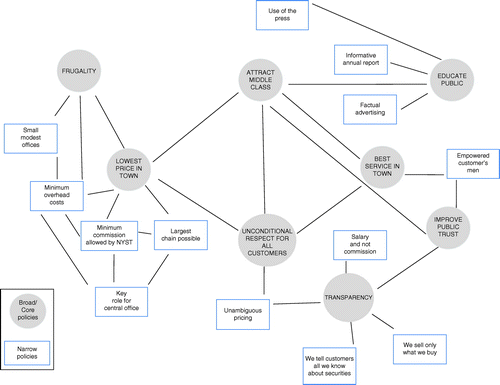
Merrill’s idea in 1940.Figure 1 represents Merrill’s initial strategic conceptualization of Merrill Lynch’s strategy, organized in terms of broad/core policies (the round gray nodes) and narrowly defined ones (the square white notes), connected through lines representing logical interdependencies among them as we could infer them from WAMT. Merrill’s strategic design was straightforward. Its heart is what Merrill referred to as his “theory of merchandising,” which Merrill described in terms of six overarching policies: (a) attracting the middle class; (b) commitment to the chain store format; (c) delivering the best product in town; (d) doing so at the lowest possible price in town (in the class of products and services delivered); (e) a culture of unconditional respect and commitment toward all customers, small and large, no matter their importance; and (f) a culture of parsimony and frugality. In Merrill’s words,
“I hope you will bear with me on this thing, because I consider it absolutely basic if you are going to understand my theory of merchandising. When a customer comes into the Safeway Store, to be specific, she is entitled to buy the best merchandise in the market that she can find any place in that city, and she is entitled to buy with confidence that she is getting full value at the lowest possible price that can be found in any store in that town. And the difference between what she pays, item by item, and our cost, by George, is our gross profit, and not some per cent. Most merchants say that they are competitive, that their prices are fair, provided they think they are striking an arithmetical average. That hasn’t got a damned thing to do with our theory of merchandising” (WAMT: 7–8).
Further,
“Now, in our business and in every business that deals with the public, there are two types of customers: the smart customer who knows his or her way around, and the rank and file of customers who think that you are just absolutely all right and leaves it to you to charge a fair fee for your services. Now, I contend that, win, lose, or draw, we must treat all customers the same[…] When we open our doors to all class of customers, we have simply got to nail the policy to the mast that anybody that comes in this shop is going to receive the squarest and best treatment on the lowest competitive terms” (WAMT: 9).
All in all, the theory was that the rising middle class was where the opportunity existed, and that low-price but high-quality service to all types of customers—small and large, poor and rich—was the path to pursue this opportunity.
The initial articulation of Merrill’s theory of merchandising in the context of financial services took the form of three main groups of “policies and practices” (see Figure 1 for a detailed map). In Section 4.3, we will elaborate on Braun’s contribution to the formulation of these policies. For the time being, it suffices to say that Braun provided much of the factual evidence that was needed to make these choices.
The first group revolves around cost. For Merrill the key policy was scale in the form of a very large network of branches. Indeed, such a network affords “the same advantage that a big manufacturer has. If Henry Ford’s company made only ten thousand cars a year, the cost of those cars would be so great that Henry couldn’t sell one of those ten thousand cars” (WAMT: 83). The implication is that a larger network of offices that relies completely on the support of a central office affords a stronger central office at a lower price per transaction. In addition, Merrill realized that “If R.H. Macy had the same approach toward important expenses, business-getting expenses, that all members of the New York Stock Exchange have, I assure you R.H. Macy and Company would be out of business by next April first, and it wouldn’t be April Fool’s Day either.” The point was that frugality was antithetical to Wall Street’s culture and Pierce & Co. was no exception; and a company aspiring to deliver the best service in town at the lowest price, in addition to having large scale, needed to be frugal. Therefore, a mindset of frugality was very important to Merrill’s strategic design, together with a series of related low-cost policies such as: relocating to small and modest offices (versus the large and posh offices in which Pierce & Co.’s brokerage network had expanded); slashing office overhead costs via, for instance, reduction of staff and support personnel, and employing cheaper telecommunications.
The second group of policies gave precise meaning to the concept of “customer focus”—if the Merrill Lynch strategy is built around the customer, what specific customer needs should it serve? Merrill thought the customers he targeted cared about price, an assumption that drove the first group of policies. As we saw, he also believed in the importance of equality, which, to him, meant a culture of unconditional respect for all customers had to be pivotal to Merrill Lynch. In addition, Braun confirmed that customers did not have confidence in Wall Street in general, and Pierce & Co. in particular. Further, they were grossly ignorant about the world of financial services. These two deficits resulted in a series of policy choices, among which a select few stood out. First, everything in the sales domain had to be done according to a principle of full transparency. For instance, customers needed to have the same information about the securities for sale as did the broker. Further, Merrill Lynch would only sell securities it owned. Also, the pricing scheme should be totally transparent so that even unsophisticated customers could understand it. Finally, it was decided that the company should charge the minimum commission allowed by the New York Stock Exchange (a move consistent with the overall low-cost low-price strategy but also designed to signal that Merrill Lynch did not take advantage of customers). The second policy was that brokers would be paid a fixed monthly salary as opposed to a commission, a major deviation from industry practice. This was perhaps the most controversial of all policies—it represented a radical change for the broker—but also one that Merrill and Braun considered crucial to signal the company’s uniqueness in its commitment to honesty. Merrill initially resisted this policy. Braun had to work hard to persuade him of the policy’s merits, and looking back in his later years, Merrill conceded that this particular policy was the single most important one of the new Merrill Lynch (Smith 2013, p. 143). The third policy (or set of policies) involved the “creation” of a customers’ man that would fit the company’s new strategy. Merrill thought that pursuing the kind of customer focus he had in mind required employees who fully identified with the company. Therefore, he tried to create an empowered broker, someone “industrious and honest” who did not need much supervision (a cost-saving move too) but genuinely acted in the best interest of the company. Indeed,
“remember now, men work for money, they work for appreciation, they work for affection, they work for the joy of going somewhere. Some men, and I am one of them, like to work because it is dangerous or challenging, or impossible. They are the type of fellows we want, and if we have a customers’ man or anybody else in this organization, who is not willing to enlist under that banner, then, gentlemen, the sooner we get rid of him, the better” (WAMT: 74).
Third, in addition to informing some key HR policies, the goals of improving public trust and investor education also informed the company’s approach to marketing. As Braun put it,
“Merely adopting policies and practices that are sound and that are right … won’t be enough. You must keep in mind the long background of public suspicion. You have got a terrific job of producing conviction, of getting people to believe you; and that means that in creating the right package you also have the further problem of putting new twists on every aspect of it, dramatizing every aspect of it, making it so dramatic, so shocking that you get conviction; you must seem to be right in addition to being right” (WAMT: 46).
This imperative led to some unusual choices. For instance: Merrill wanted to publish an annual report, a very informative one, which was an unusual policy back then. He wanted to advertise broadly, which was unusual in the industry, and to do so in a factual, informative way, which was even more unusual. Finally, he wanted to use the press more extensively than other firms did:
“On a number of occasions we will sit down with fellows we know that work for newspapers, and we will tell them what we are trying to do, and we will give them the facts, and how they interpret those facts and how they write the story is their business, and nobody in this firm has the authority to go to one reporter and complain as to how he interprets the facts we have given him” (WAMT: 90).
In general, there is an attempt to reach the customer in a straightforward, matter-of-fact way, using her language. As the 1941 Fortune article put it: “In short, the customers wrote the advertisements” (Fortune 1941, p. 116).
Merrill’s idea vs. Pierce & Co. in 1940. We did not find detailed descriptions of the strategy of Pierce & Co. in 1940, but we could infer its main elements from WAMT,15 the biography of Merrill by Perkins (1999), the history of Merrill Lynch by Smith (2013), as well as the other contemporary sources that we used for triangulation purposes. Figure 2 maps the key elements of Pierce & Co.’s strategy. Pierce & Co. was a traditional Wall Street brokerage firm that targeted the standard elitist market, adopted standard HR practices (e.g., compensation, incentives, typology of employees), related to the customers in a standard way (e.g., the customer was a source of revenue, not someone to serve in the best possible way), had standard operations (e.g., an emphasis on high churn and in-depth advice), and organized in ways that were standard at that time (e.g., many of the advice functions were carried out in local branches as opposed to the central office, and some research functions too). There were two notable departures of Pierce & Co. from the norm. First, compared to the competition, Pierce & Co. had an especially widespread presence in the territory. In fact, it had the largest network of branches (even without accounting its close partnership with Cassatt & Co., which de facto deepened the network in the Northeast of the United States). Additionally, Pierce & Co. also had a commodities business, and the accompanying access to big industrialists. Second, Edward Pierce was at the forefront of a crusade to fight the proliferation of ruthless speculators that, according to some, were the real cause of Wall Street’s crisis. Since compensation was commission-based, high churn was the norm, but the company preferred to trade solid companies that could provide long-term returns than high-risk securities with less-than-solid economic foundations. In today’s parlance, Pierce & Co. had a value-orientation.
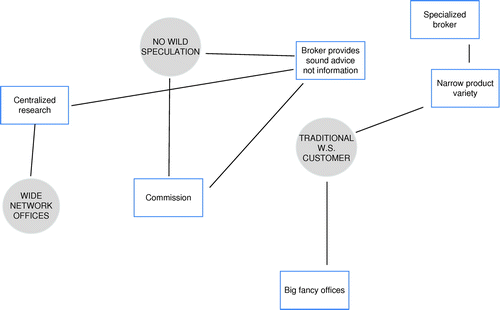
We could paint a more nuanced image of Pierce & Co.’s strategy, but we believe this summary description is sufficient to answer our first question. Contrasting Figures 1 and 2 offers a striking demonstration of the discontinuous nature of Merrill’s strategic conception relative to Pierce & Co. Of the many subsystems of Figure 1, there is little trace in Figure 2. But there are two important exceptions—the extensiveness of Pierce & Co.’s network of offices, and the value-oriented culture of Pierce and the company. These elements are hard-to-build resources that played an important role in Merrill’s envisioned strategy. However, and this answers our second question, we did not find any evidence of these elements playing any direct role to spark Merrill’s idea. In sum, in 1940 when Merrill saw the final picture of the puzzle, very few, albeit “heavy,” pieces of the puzzle existed, and they did not appear to help him see the picture. We thus interpret this case as being somewhat anomalous relative to the preadaptation model, especially P3PR and P4PR.
4.3. Cognitive View: Analogical Narrative
We have shown that by the time Merrill took the helm of Merrill Lynch, he had a clear representation of the strategy he wanted the company to pursue. To put the analogical model to work, we need evidence of the extent to which this representation was the product of analogical reasoning, and, if so, how the analogy was drawn. In particular, we direct our inquiry in two directions, which correspond to two questions. To start, and most obviously, is there evidence that Merrill’s basic strategic idea was a (more or less direct) product of a “case” contained in Merrill’s memory? If the answer to this question is in the positive, then a second question is in order: is there evidence of Merrill assessing the similarity between the chosen analogue and the situation at hand, and, if so, how did he do so? The reason for this question is that similarity assessment is not only a defining feature of analogical reasoning, but also the place where the potential of analogy as a reliable source of foresight lies. So, the question of whether Merrill tested the similarity between source and target problem, and how deeply he did so, is a crucial one. In simple words, it would be important to establish whether Merrill was just the lucky carrier of a winning analogy, or if there is something in the process he followed that can be learned from and generalized.
Based on WAMT, the answer to the first question is unambiguous: the conceptual anchor around which Merrill developed the new strategy for Merrill Lynch is his theory of merchandising, as we explained in Section 4.2. Let us examine, for instance, how Merrill explains the origin of his idea at the beginning of the New York meeting. Merrill begins with an identity statement: “Although I am supposed to be an investment banker, I think I am truly a grocery man at heart. I have been in the chain store business, you know, ever since 1912” (WAMT: 6). He immediately follows this statement with the description of “my theory of merchandising,” which in the next paragraph becomes “our theory of merchandising” (WAMT: 8), because “in our business and in every business that deals with the public, there are two types of customers ….” The conclusion is that, as a result, Merrill Lynch must adopt the policies of his theory of merchandising. To paraphrase: (1) I know the grocery “case” well, especially the chain store format; (2) based on my business experience, I formed a high-level understanding of grocery/merchandising16; (3) this theory is generalizable to financial services because there is no fundamental difference between what the public wants in this business and what it wants in grocery/merchandising; (4) given this similarity, the basic strategy we are going to adopt is based on my theory of merchandising. It is thus Merrill’s experience with the chain store format in grocery, a very salient “case” in his memory (of which Merrill held a coarse representation), which led to his initial strategic insight.
If the centrality of this case is apparent, it is much less apparent the extent to which Merrill searched for and then rejected other potential sources of analogy. As mentioned earlier, Merrill’s experience was broad. He had direct managerial experiences in a variety of businesses, including the auto business, movie distribution, and publishing. Some of these experiences were deep, but not as salient as his experience at Safeway. In the documents we analyzed there is no evidence of any search process involving any of these experiences.17 We think the saliency of the “supermarket” memory was such that this is the only case he took into consideration; or that other less salient memories received only cursory attention.
Moving to similarity, it might be worth asking what, in this case, the deep assessment of similarity would entail. According to the analogical model, the key challenge for Merrill would require meeting at least two conditions. First, Merrill would need to form an appreciation of the causal structure of the “grocery/Safeway” case or memory: What features of Safeway were essential to its success and why? And what structural characteristics of the grocery business were especially conducive to the success of a company like Safeway? Second, Merrill would need to assess the similarity between grocery and financial services through the lenses of this causal structural interpretation of grocery.
Merrill met both conditions. He met the first by relying on his theory of merchandising, and the second via the assignment he gave to Mr. Braun, as well as the extensive fact finding and analysis he did with Winthrop Smith. Let us consider in more detail how he met each condition.
Merrill’s theory of merchandising was effectively a theory of performance in grocery, a causal theory: a reduced form representation of what key features of Safeway led to success in grocery and why. Merrill was vocal about what these features were, and we outlined them in Section 4.2. He was less vocal about the structural conditions of the grocery business under which this theory holds true, but it is clear from the records that he thought a few conditions needed to be met. In no particular order: there had to be substantial economies of scale, or having a size advantage would not allow offering both superior quality and best price; customers had to be sensitive to both the substantive attributes of the service and its price, and much less so about the shopping environment, including shop-floor service; relatedly, customers had to be sensitive to “egalitarian” treatment. At the time he was strategizing for Merrill Lynch, Merrill thought these conditions were met in the supermarket business, and were essential to Safeway’s success. In this sense, Merrill passed the first test for an in-depth assessment of similarity: he was looking at the source problem via a theory of performance, which channeled his attention to structural conditions (or, more precisely, conditions he perceived as being structurally relevant).
The next question is whether Merrill assessed rigorously the existence of these conditions in financial services, or, alternatively, he did not go beyond the hunch that led him to consider grocery in the first place. To start answering this question, we need to realize that Merrill believed hunches are often misleading. Consider what he said on his early experiences with Safeway:
“And I give you my word that, notwithstanding every effort on my part to learn something about the chain store business—and there was a time when I thought I knew almost all there was to know about it—I awoke with an awful thud in 1931, with the very irritating and humiliating discovery that I didn’t know a damned thing about it. Well, that is a pretty place to start from. The reason why I didn’t know anything about it was because nobody in the grocery business knew anything about it. I had been fed reams and reams and reams of misinformation … The people that gave me the information spoke from memory, from hunch, intuition, tradition, the general feel of the business. But they had nothing, I assure you, to support their conclusions” (WAMT: 5).
It is for this reason—that he did not completely trust his hunch that the business of selling canola oil and yogurt and the business of selling financial services were similar—that Merrill hired Braun. In his words:
“I just put myself in the corner and asked, “Well, listen here, young fellow, how much do you really know and how much of it is what is left in the sleeve of memory after all the years you have been in Wall Street? And then we decided […] that, by George, we would start out and try to find some facts, not what we thought or what we hoped or what we said we thought; we decided we would go right out to where this thing starts, then we would go and talk to the customer, or, in grocery terms, to the consumer. […] So, we enlisted an organization known as Braun and Company to make a factual survey of the situation in Los Angeles” (WAMT: 10).
Indeed, much of the factual evidence that Merrill asked Braun to assemble went precisely in the direction of “testing” the “structural conditions” discussed earlier. First, Merrill was concerned that the typical customer shopping for grocery in a supermarket might be interested in different dimensions of service compared to the typical customer shopping for securities in a brokerage firm, which might result in the limited applicability of his theory of merchandising to financial services. One of Merrill’s biggest concerns had to do with customers’ confidence in brokerage houses, a very diffused concern back then. Indeed, in the late 1930s, when Wall Street was at the peak of one of its worst crises, the Security Exchange commissioned a survey to Elmo Roper (one of the very first pollsters in the country) to find out about customer sentiment. The results showed an alarming lack of confidence toward Wall Street, and deep ignorance regarding its most basic functions (Sobel 2000). Most Wall Street bankers dismissed the surveys, but Merrill was concerned, as was Edward Pierce. Therefore, Merrill asked Braun to do something akin to the Roper surveys, but geared toward the company’s customers, and with one crucial addition: an emphasis not only on customers’ confidence, but also on what customers wanted Merrill Lynch to do more broadly—what kind of service and at what price. For instance, he wanted to know the relative importance of features such as price, the perception of being treated equally no matter their socioeconomic status, the elegance of the shopping environment, the perceived reliability of the broker, the type of securities of interest, and several others.
The second question for Braun was about the company’s operations. Merrill was well aware of his ignorance of what was going on at the shop floor level. Relatedly, he was ignorant of the real extent of the economies of scale in financial services, and, more broadly, the extent of the potential cost savings were Merrill Lynch to adopt a Safeway-like strategy including Safeway’s strong emphasis on frugality. Therefore, he asked Braun to paint a detailed picture of a typical branch’s activities—what brokers did in detail, how they used staff resources, what motivated them, how they were compensated, how they dealt with the public, what their relationship with the central office was, and anything that could help understand actual operations—and the associated cost structure.
Braun responded to Merrill’s requests with a data-driven and detailed analysis. On the customer front, he profiled both current and potential customers (the ascending middle-upper class). On the operations front, he performed an in-depth analysis of the current cost structure of a typical branch, but he did not stop there. In addition, to assess the similarity between grocery and financial services, Braun and Merrill articulated in detail the central elements of a strategy for Merrill Lynch that would be consistent with Merrill’s theory of merchandising, and assessed its viability through a detailed estimation of cost and potential revenues (size of the current and potential market, and customer’s willingness to pay). In fact, this survey was so central to the new strategy that Winthrop H. Smith, Merrill’s soon-to-be second in command, a fellow Amherst alum, former employee and partner at the old Merrill, Lynch & Co., would go on to say that “This survey will be ever memorable in the annals of the firm; from it we based our policies and to it we are largely indebted for whatever success we may have achieved” (Smith 2013, p. 141).18
In addition to Braun’s survey and analyses, Merrill also conducted extensive analyses with Winthrop Smith, then a partner at Pierce & Co. In fact, it was Smith who approached Merrill with the idea of returning to Wall Street. In the fall of 1939, Merrill met Smith in Chicago while on his way to the West Coast for one his routine visits to oversee the operations of Safeway. Smith tried to convince Merrill that “fresh capital and an aggressive reduction of overhead could turn the combined firm into a moneymaker” (Smith 2013, p. 139). Merrill was intrigued and they went over the numbers repeatedly that weekend. Three weeks later, Merrill returned and Smith had more detailed financial projections for him. Still unconvinced, Merrill invited Smith to New York between Thanksgiving and Christmas, and again starting the New Year to keep working on the numbers. According to Smith, “We worked late into the nights for the whole month and never seemed able to get the right combination of figures that satisfied Merrill. I went back to Chicago for Christmas and came to New York the first of the year and resumed work. We never seemed to be able to come up with the right answers, and it began to look very much as though Merrill was going to throw over the whole idea of a merger” (Smith 2013, p. 140). Merrill even sent out a survey to his longtime associates, asking them “What would Eddie Lynch have done?” In end, Merrill did decide to go ahead with the merger, and the rest is history.
4.4. Economic View: Positioning Narrative
The cognitive account we just put forth suggests that Merrill’s cognitive representation of financial services and the associated strategic choices had analogical roots. To put the positioning model to work, we need to assess what role reasoning from first economic principles played in Merrill’s strategic innovation. What we find is that although this type of reasoning was on the surface less prominent than analogy, it complemented and supplemented analogy in at least two important ways: in the way Merrill developed his theory of merchandising, and in the way he adapted it to the idiosyncrasies of the financial services business. We now discuss them in turn.
The emphasis of the analogical narrative was on Merrill’s theory of merchandising, which led him to ground his assessment of the similarity between the Safeway/grocery and Merrill Lynch/financial services cases on causally relevant characteristics as opposed to superficial ones. The logic was that Merrill’s theory was really a theory of performance, an extrapolation of factors that he believed to be causally relevant to performance. But what if the theory is flawed? A flawed theory would lead to the assessment of similarity based on features that, while perceived to play a causal role, might in fact be irrelevant to performance. Thus, a flawed theory does not filter out flawed analogies, which begs the question of how a robust theory of performance can be had.
The positioning model would answer that applying appropriate economic principles to the competitive situation at hand should return an accurate theory of performance of said situation—a theory that, depending on the situation at hand, helps formulate a new strategic solution, or explain why an existing strategy works well or poorly. We suggest that Merrill’s theory of merchandising reflects the application of what can be construed as economic principles, which, if our interpretation is correct, contributed to make it a robust basis for Merrill’s analogizing. This suggestion is grounded on a set of clues we observed in the historical records. Specifically, we detected some patterns in how Merrill described his theory of merchandising and in Merrill’s strategic decisions in grocery, banking, and elsewhere19 that are strikingly aligned with the precepts of the modern positioning school. We interpret these patterns as the equivalent of a revealed preference in the domain of reasoning, with Merrill’s decisions revealing a particular way of thinking: a revealed mindset he consciously or unconsciously employed in thinking about strategic problems or competitive situations that was recurrent and therefore predictable in its key traits. According to this interpretation, Merrill can be viewed as a modern strategist ante litteram: his strategic thinking appears to have followed economic principles long before such principles had been made available to practitioner strategists.20 The reader should know that this conjecture cannot be proved conclusively given the available historical records. The fact that we observed patterns that are suggestive of beliefs and principles that are (consciously or unconsciously) deployed to think about a problem does not guarantee that Merrill did indeed have such principles. A particular set of decisions can be consistent with a particular general belief, but they can also reflect considerations other than the general belief. The historical records contain public statements by Merrill or Merrill’s contemporaries that strongly corroborate our interpretation. But again, ours is an informed conjecture.
The first pattern we detected is what we consider the most defining element of Merrill’s mindset. It both permeates Merrill’s description of his theory of merchandising and characterizes the essence of his past decision making. In a nutshell, no matter the competitive setting he was in, Merrill would not face competition frontally. He would compete via drastic deviations from the status quo. Merrill consistently tried to create companies that were “different” from the competition in ways that he thought were economically meaningful. And this is also how his contemporaries understood him (Smith 2013). For Fortune magazine (Fortune 1941, p. 104): “Short when competitors had been unwisely long, out when they were in, Merrill had made a fortune by strokes that had been cried down as pipe dreams, just as his new policy has been scorned.” Reading his description of his theory of merchandising suggests that, to him, Safeway (or any other successful merchandising company) was not a success because it was one of several companies delivering a good product or service, or because it adopted the chain store format. Its superior performance was rooted in it being uniquely, and favorably, different. What made Safeway successful was that it was unique, and superior, in its interpretation of the chain store format. Indeed, during his tenure at the helm of Safeway, Merrill dictated a series of moves that at once deepened the company’s uniqueness in ways that allowed it to serve its customers better or reduce costs. To cite but one example, in 1932 Merrill convinced Life magazine’s managing editor Harry Evans to co-found Family Circle (which Merrill founded out of his own pocket because Safeway’s CEO M.B. Skaggs did not want to make it a division of Safeway), a magazine targeting women that would be distributed free of charge in Safeway stores and other supermarket chains to drive traffic. Family Circle was the first store-distributed magazine in the United States.
Second, despite his reputation for being a bold original thinker, Merrill was profoundly aware that unorthodoxy is a source of trouble when not coupled with strong analytics (Perkins 1999, Smith 2013). And that was the essence of the Charlie and Edmund couple: Merrill’s creative leaps found in Lynch the austere and severe analytical interpreter. Merrill valued his analytical counterpart to the point that he went on record several times saying that his success was largely due to Lynch’s discipline.21 And when the two partners grew distant, Merrill handpicked highly skilled replacements such as Mr. Braun. In this sense, it should not be surprising that when talking about Safeway, what he described as “a vital part, one of the vital segments of Safeway’s operation” (WAMT: 10) was a “public relations and research unit,” to study customers, keep them happy, and monitor Safeway’s costs, because that is where “this thing starts” (WAMT: 10). This is the key: for Merrill the “thing” starts with what value is delivered to customers and what it cost to deliver it—these are Merrill’s central categories of thought when he thought about Safeway, Merrill Lynch, or more generally a company’s strategy and success.
To illustrate, using some of the quotes from earlier:
“Most merchants say that they are competitive, that their prices are fair, provided they think they are striking an arithmetical average. That hasn’t got a damned thing to do with our theory of merchandising”… “When a customer comes to the Safeway Store, to be specific, she is entitled to buy the best merchandise in the market that she can find any place in that city, and she is entitled to buy with confidence that she is getting full value at the lowest possible price that can be found in any one store in that town.” (WMAT: 8)
And Safeway’s profits come from “what there was left in our pockets after meeting the lowest competitive prices in town, and from that subtracting the cost of our merchandise, which we tried to buy in the lowest possible market” (WAMT: 7). The bottom line is that a pattern that is clearly visible in Merrill’s descriptions of Safeway, his theory of merchandising, and the strategy he devised for Merrill Lynch is that key to a company’s strategy is the economic meaningfulness of its uniqueness, which has to be assessed in terms of the value delivered to customers and the cost incurred to create such value.
The third pattern is something that, while certainly present in WMAT, we did not find in other historical records. It is a theme throughout WMAT that every single choice needed to be consistent with each other, and with Safeway’s overarching identity, cultural traits, and brand. For instance,
“when a woman comes into a store, she is entitled to buy her coffee at the lowest price, and her bread, her butter, and every item in that store. And then she is entitled to do something else, to get something else; she is entitled to buy items that are not frequently sold, slow turnover merchandise, at the lowest possible competitive price, because infrequently purchased items stick in the mind of the customer, and if the customer pays five cents too much per bottle of vanilla extract, and she runs into some friend and she finds out that the friend has bought an unimportant item at five cents cheaper than she had paid for it at Safeway, then, by George, her confidence in the whole operation is shocked” (WAMT: 8–9).
Here the point is that the temptation of charging higher prices for certain items needs to be resisted because it is not consistent with Safeway’s overall image in the eyes of the consumers, and could affect their interest in purchasing groceries from Safeway. For a similar reason, and because a key policy of Safeway was to accept all customers no matter their wallet or social status, Merrill thought it was fundamental to treat all customers the same way, as we have previously seen. In general, WAMT contains extensive references that can be readily interpreted as suggestive of “systemic thinking.”
In sum, Merrill did not think Safeway was successful solely because it used the chain store format, a model other firms employed with varying degrees of success. Merrill had a love affair with the chain store format, but he thought a superior interpretation of the format such as Safeway’s derived from: (a) Safeway’s distinctiveness; (b) a distinctiveness that meant being unique along measurable dimensions of service that customers cared about and a superior and measurable cost structure; (c) a distinctiveness that was supported by a system of policies that were deeply consistent with each other. These three points well describe some of the most fundamental principles of the positioning approach to strategy (Porter 1996, Brandenburger and Stuart 1996).
First, as Ghemawat and Rivkin (1998, p. 7) put it, “The notion of added value highlights the fact that competitive advantage derives fundamentally from scarcity. A firm establishes added value by making sure it is unique in some valuable way.” Similarly, Brandenburger and Stuart (1996) note that “[Under conditions of unrestricted bargaining], the key to a firm’s achieving a positive added value was seen to be the existence of a favorable asymmetry between the firm and its competitors” (Brandenburger and Stuart 1996, p. 23), and “Possession of a positive added value is the key to value appropriation” (Brandenburger and Stuart 1996, p. 6). These propositions capture well Merrill’s focus on uniqueness relative to the competition. Second, the concepts of competitive advantage and added value are premised on the categories of customers’ willingness to pay, and firm’s costs. Take the above quotes. There, the concept of valuable in being “unique in some valuable way,” or favorable in “favorable asymmetry,” both refer to a firm’s uniqueness in its ability to command a wider wedge between the willingness-to-pay of its customers and its costs relative to its competitors. This is precisely the way Merrill conceived of Safeway’s uniqueness. Finally, the notion of alignment or fit has been one of the leitmotivs of this school of strategic thought. The simple idea is that “different choices interact with one another: production decisions affect marketing choices, distribution choices need to fit with operations decisions, compensation choices influence a whole range of activities, and so forth. Each interaction implies that a choice made on one dimension affects the cost and willingness-to-pay impact of another choice” (Ghemawat and Rivkin 1998, p. 18). Because of the existence of these interactions, critical to the success of a firm’s strategy is that its activities be aligned. Indeed, “A firm whose choices are internally inconsistent is unlikely to succeed” (Ghemawat and Rivkin 1998, p. 18). Once again, this looks like a line taken from Merrill’s description of Safeway.
We believe there is a second way in which first principles entered the equation. We have seen that to assess the similarity between grocery and financial services, Merrill and Braun pushed far the translation of Merrill’s theory of merchandising into a coherent and detailed set of policies for Merrill Lynch. A translation such as this is a one-to-many mapping: there are many ways in which a coarse representation, what Gavetti and Levinthal (2000) call a template, can take practical form in a system of activities. For instance, “best” in the policy “sell the best product in town” can take on many different meanings, and the same can be said for all of the other elements of Merrill’s theory of merchandising, such as exploiting economies of scale, becoming a frugal organization, treating all customers equal, etc. Gavetti and Levinthal (2000, p. 117) note that “Conceptually, there seem to be two basic mechanisms that flesh out such a template. One is the existing set of routines and behaviors of the organization. These actions may serve as defaults for choices that are not specified by the template. Alternatively, the template, and possibly past practices, may serve as a starting point for a process of experiential learning.” Somewhat surprisingly, in the case under scrutiny neither of these mechanisms played a primary role. As our evolutionary narrative suggests, Merrill’s rendition of the new strategy largely rejected past practices of Pierce & Co. Further, Merrill did not use his coarse theory of merchandising as a starting point for a process of experiential learning, i.e., a process of online local search. Merrill used this template as a starting point for a process of off-line distant search. Interestingly, the new policies identified early on underwent very little adjustment as time went on. As Perkins (1999, p. 161) noted, “Confessing at the outset that the new concepts were experimental and might need to be adjusted or even abandoned altogether, Charlie was nonetheless optimistic about the practicality of the reforms. In retrospect, one of the remarkable aspects of the implementation of the new policies was how little of the original plan required modification as the months and years passed.” Based on the available records, we identified two main steps through which Merrill designed a strategy for Merrill Lynch—a thorough economic analysis of the market/industry, followed by careful choices of policies as informed by certain economic first principles.
First, we already commented on the extensive market analysis and financial projections that Merrill and colleagues undertook prior to embarking on the new journey. This analysis gave Merrill some direct answers about the similarity between the supermarket business and financial services (e.g., that customers were not especially interested in stylish offices; that there was significant untapped demand for financial services in the middle-upper class; or that the cost structure was such that economies of scale would be substantial), and also offered precious suggestions about what kind of specific policies Merrill Lynch could adopt to fit Merrill’s theory of merchandising to the peculiarities of financial services. As Braun put it: “Since we have a measurement, a pretty accurate measurement, of what they [customers] want, it hasn’t been any difficult trick to build some specifications in terms of policies and practices that would meet these consumers want” (WAMT: 45).
Second, in addition to the answers directly provided by the survey, we believe that some of Merrill’s judgment calls were helped by some of the same economic first principles that underlay his theory of merchandising. While the evidence for the application of such abstract principles in his thinking is less direct at this stage, there are hints.
For instance, Merrill’s narrative contains many indications that the principles of uniqueness and fit were very relevant to his policy making. Merrill wanted a company that was both radically different (and better in serving the middle-to-upper class) and premised on a set of interdependent choices so that existing competitors would be outclassed, and potential entrants would find it too difficult to enter, because Merrill Lynch should be too good and too difficult to imitate. In Merrill’s words:
“We will use every legitimate competitive and aggressive method to bring customers to us. We will compete with anybody in a fair and square fight, but we must have different little displays in our windows, different signs on billboards, a little bit different from those of the other fellow” (WAMT: 80).
Further,
“Now I want to make a statement of policy which I think is really and truly important. You take a city like Spokane, for instance; we have got that market and nobody is in it today but ourselves. The way to keep that situation intact is to have the lowest rates of interest, the finest service, the best advertising, the finest personnel in Spokane that we have got anywhere in the whole system. Let’s don’t wait for two or three or four million shares a day and have a dozen houses want to go into Spokane. Let’s keep those customers so fine, so well, that nobody would dare come into that town” (WAMT: 181–182).
Further, consider the switch in the compensation of the broker from commission to salary. One rationale for this change was Merrill’s preoccupation that:
“When we give that man a report on a certain company, he may not tell us, but in the back of his head is a lot of curiosity and a lot of suspicion. He is just wondering all the time, with one-half of his brain, “How much of this can I rely on? What is behind it? Why should this customer’s man show me these facts and figures regarding a company that I never heard before? What is his motive?” (WAMT: 65–66).
The move away from the commission system, if properly advertised, would attenuate this skepticism. But this was an extreme measure, one that represented a major shift from standard practice in the Wall Street of the era and Merrill was aware of its risk. Merrill also knew that he could have pursued a more conservative approach, for instance prohibiting the sale of certain classes of risky securities or similar measures. So, why did he take the risk? We think his reasoning was that the more extreme choices he made, the better Merrill Lynch could serve its customers, and the more difficult it would be to imitate. Indeed, for him moving to the salary system of compensation was also an instrument to implement another extreme choice: getting rid of normal, standard brokers. Merrill was aware that the new Merrill Lynch strategy was an “impossible” bet. Therefore, he thought he needed people who are motivated by “impossible” dreams. He wanted ambitious idealists. As we have seen, he wanted men who “like to work because it is dangerous or challenging or impossible” (WAMT: 74). Merrill believed the move to the salary system would help him get rid of the type of greedy, competitive, ruthless broker that was most diffused at that time. Only that way, “we can construct an organization with that spirit, and it will be so obvious that all of our competitors will say, ‘Well, by George, there is one firm that I would like to work for and be associated with.’ ”22
Thus, Merrill, along with his associates, was able to design an integrated set of policy choices that allowed the firm to carve out a unique position in the competitive landscape, one that generated a high willingness-to-pay on the part of the customers while driving massive economies of scale to lower costs. Although evidence is not watertight that Merrill was actively aware of these abstract principles, and that the rigorous application of these principles is what led to the exact policy choices he introduced, there seem to be strong indicators that he was indeed applying these ideas.
5. Discussion and Conclusion
Our opening statement was that the question of strategic foresight is central to strategy and yet a divisive one. Our closing statement is that a better path to foresight is one of integration rather than division; and that we now have a better understanding of what such path (at least a path) entails. In this last section, we uncover this path by first articulating a fourth narrative that integrates the salient elements of the three narratives we described earlier, and then encapsulating its meaning into a model of foresight that combines evolution with agency.
5.1. An Integrated Narrative of Strategic Foresight: Evidence in Outline
There may well be facets of the Merrill Lynch story that the theory-informed narratives we constructed fail to capture, but the ones they capture emerged with force. Taken together, they configure a fourth narrative that gravitates around Merrill’s theory of merchandising, and hinges on the processes of abstraction (how Merrill abstracted it from the complex reality of merchandising), and articulation (how Merrill articulated it to fit the reality of financial service so that he could evaluate the theory’s viability in the new domain). This is the story of a journey from reality to theory, and then back, in a different domain. In outline:
Element 1: Merrill’s theory of merchandising. It is around his theory of merchandising, a theory of performance, that Merrill gives new meaning to financial services. This cognitive representation is “coarse” in the sense that it captures cause and effect at a high level of abstraction.
Element 2: Abstraction. Merrill attained a robust theory of merchandising on the basis of (at least) two documentable influences:
His experience with the chain model of business, especially but not only in grocery.
Some select economic principles that appear to have guided the interpretation of such experiences, whether Merrill was self-aware of them.
Element 3: Articulation. Merrill carefully assessed if the key causal mechanisms of his theory of merchandising held true in financial services. To do so, he and Braun articulated his theory via the identification of a system of detailed policies for Merrill Lynch. This process of articulation was rooted in (at least) two documentable processes:
Comprehensive data gathering and analysis focused on Pierce & Co. and its current and potential customers, guided by Merrill’s theory of merchandising.
The use of first principles to aid the identification of new policies for Merrill Lynch.
We think these three pivotal categories, together, capture the essence of the focal events. But there is something that, while still part of the narrative, is not properly emphasized when one considers its importance to the outcomes of interest: the depth of Merrill’s experiences (especially with Safeway), and its breadth (his involvement in a variety of similar merchandising enterprises). We think this lack of emphasis has to do with the theoretical idiosyncrasies of the models we used, which is something that needs to be corrected as we explain later. For now, we just add it to the integrated narrative as a fact not sufficiently emphasized.
Element 4: A de-emphasized element: The depth and breadth of Charles’ experience. It is fact that Merrill knew Safeway very well, and he had an unusually large set of experiences in other grocery firms and other merchandising businesses. It is also true that our narrative recognizes the role of this knowledge. Trivially, even the smartest agent would not know how to abstract a sensible theory of a given reality if she did not know or had poor exposure to the reality in question. What our narrative does not sufficiently recognize is the importance of Merrill’s history of direct, hands on, committed involvement with Safeway and related businesses. Relative to most of his Wall Street peers, Merrill had a deep experience with one specific grocery company, but his experience was broad given his involvement with other supermarkets, and other merchandising companies outside of grocery. And as we have shown, he identified deeply with these ventures, Safeway in particular. This meant, among other things, that Merrill had a proactive attitude toward learning about the business even in its most detailed aspects. We think this aspect has two consequences that are germane to our narrative. First, to the extent that critical to a process of abstraction is the application of the right first principles to one’s domain-specific knowledge, the deeper and broader the knowledge, the more accurate, sophisticated, and nuanced the abstraction is likely to be. For example, we have seen that Merrill had an almost religious belief in treating all customers the same, and that this was a significant part of his theory of merchandising. Where did this belief come from? We cannot offer a conclusive answer, but a plausible one is that, sometime in the past, Merrill or his strict Safeway collaborators had witnessed episodes in which unequal treatment of customers led to setbacks relative to situations in which they were treated equal. These experiences then likely resulted in equality becoming part of the “Safeway way.” As a result of these events, the experiential basis on which Merrill could abstract a theory of performance for Safeway or merchandising more broadly included this idiosyncratic experience, which is something that, had Merrill not been deeply involved with Safeway, might have not occurred. Stated differently, had Merrill been just an investor or an external consultant, his knowledge of operations would probably not have been sufficiently granular to even make him aware of the equality issue and that equality was an important policy. Further, the fact that Merrill knew well other supermarkets and the chain-store format outside of grocery, presumably gave him more than an opportunity to observe variation in this policy and associated outcomes. To the extent that his recurring questions were: “What makes Safeway meaningfully unique and therefore superior? And is there a successful ‘merchandising’ model?” his answers would naturally include the equality aspect. If he had a shallower experience such as that of other bankers or even merchandisers of this time, he would have no doubt obtained a shallower answer. Second, we argued that Merrill articulated his coarse theory of merchandising largely through what we called an off-line process of distant search, driven by Braun’s insightful survey and economic reasoning. It is clear that these processes played a central role. However, there is some evidence that Merrill also used his experience in supermarkets to inform some specific policy choices. That is, the wisdom from his past grocery life did not exclusively inform a relatively abstract set of strategic principles. It also informed some narrow policy choices, such as those of publishing an annual report, pursuing a rigorously fact-based approach to communication, monitoring competitors’ billboards and windows to ensure that Merrill Lynch’s were different. These are all examples of individual policies transferred from Safeway to Merrill Lynch with little adaptation. In sum:
Implications for abstraction. The accuracy and nuance of Merrill’s theory of merchandising was helped by the depth and breadth of his experience in grocery and merchandising businesses.
Implications for articulation. The articulation of Merrill’s theory of merchandising into a detailed set of policy choices for Merrill Lynch was helped by his depth of experiences with Safeway.
5.2. Toward a Model
5.2.1. Limitations and Spirit of the ExerciseThis integrated narrative is, almost by design, richer than each individual narrative. It offers a fuller characterization of the focal events. But our ultimate goal was not to provide a richer characterization of this particular event. We also had the more ambitious goal of developing a general understanding of disciplined strategic foresight that leverages the strengths of the models we employed and overcomes their limitations–in other words, a more potent model of strategic foresight. Can we interpret this narrative as being suggestive of such a model?
We think the answer is in the positive, but it is important to flag the limitations of our exercise. The overarching problem is one of learning from a single case, which makes interpretation of cause and effect hard (to what extent was Merrill’s success attributable to the process he followed, and what parts of the process were especially relevant?), in addition to presenting issues of generalizability (what conditions have to hold true so that the replication of Merrill’s process or parts of it can lead to similar outcomes?). For instance, skeptics might say that had it not been for the anomalous post-WWII excess liquidity that benefited the American middle class in that era, Merrill would not be material for studies such as ours. These skeptics might also say that all Merrill did back in 1940 was a theatrical production aimed to persuade skeptics. Thus, if the goal is to advance our understanding of strategic foresight, little of what we wrote in this article would be relevant. We think these objections are legitimate. Having lived in close connection with the historical material for a long time, we believe they are ultimately unfounded, but we cannot rule them out conclusively.
To some degree, however, the way we use the narrative here is resistant to some of these limitations. Our theory-building exercise is anchored to the models through which we interpreted the Merrill story. We use a combination of the evidence we collected and logic to evaluate the models’ limitations and how these limitations can be overcome. It is more an exercise in syncretism than it is of new theory-generation, although the synthesis that emerges has novel implications. Our questions are as follows: Can we discern a logical structure in the way Merrill operated that ties the models together? Are there apparent ways in which the conjunction of these models makes each of them more potent vis-a-vis the problem of disciplining foresight? And does this evidence suggest new interpretations of such models? Even if we cannot conclusively determine the extent to which the specific outcomes we observed were determined by Merrill’s process relative to other lucky contingencies, we can evaluate, through logic, if the process Merrill employed makes logical sense and in what ways it can suggest a more potent model of foresight. Based on this exercise of logical deduction inspired by Merrill’s behavior we will argue that the facts leading to Merrill’s strategic innovation correspond to an interpretation of each model that transcends common interpretations, in addition to (crucially) bringing them together by giving each of them a precise role or function, in what appears to be a natural synthesis. It is as if Merrill had known the models and intuited a way to combine them that ultimately overcomes some of their limitations. In this sense, we can say that the narrative is not a collection of lucky steps, but an archetypal figure that foreshadows a path to disciplined foresight that is learnable and generalizable within some bounds, which we define next. We use the term archetype of disciplined strategic foresight in the Platonic sense of the term archetype—a pure form that embodies fundamental properties of the “thing.” There is no reason to believe this is the only possible archetype. There can be other archetypal forms of disciplined foresight. But there are good reasons to believe this is an archetype of disciplined foresight.
5.2.2. Interpretation of the Integrated NarrativeSo far, we progressed from overarching “views” to “models” to “narratives.” We now reverse the approach, and first interpret the specifics of the integrated narrative to derive what specific model of foresight they seem to configure. We then draw broader implications, namely what “view” of foresight this all suggests.
Commentary on Element 1. Although analogy work often takes the “case,” or the “memory” as the critical unit of analysis (cfr. Gilboa and Schmeidler 2001, and Gavetti et al. 2005), here the unit of analysis is an abstraction of it. The cornerstone of Merrill’s thinking is not the case, but rather a causal theory of performance of it, a cognitive representation of the causal mechanisms that make a given outcome possible in a given setting. The idea is certainly not new in analogy work (see for instance, Gentner 1983 and Gavetti and Rivkin 2005), but its prominence in the Merrill story is a useful reminder of what can effectively be considered a general necessary condition for the attainment of reliability in analogy. This point reflects P2.1A.
Commentary on Element 2. The narrative also traces a clear path to the development of a robust theory of performance. In this case, the importance of reasoning from first principles is self-evident. The evidence is consistent with P2PO, P2.1PO, and P2.2PO, which state that properly applying the proper economic principles to the situation at hand should return a solid causal economic theory of the situation at hand. In general, we can assume that the acquisition of relevant first principles is not problematic for a committed decision maker, although it is quite possible that even committed decision makers can differ in their level of sophistication in the knowledge of relevant first principles. Similarly self-evident in this case is the importance of one’s knowledge of the situation at hand, which is also implicit in P2PO.
Commentary on Element 3. Postulates P2.1A and P2.2A posit that in similar problems, similar actions lead to similar outcomes. Further, it posits that in familiar source environments it is possible to grasp fundamental cause and effect relationships. The implication is that to ascertain the level of real similarity, a given “theory of performance” in the source needs to be evaluated in the target domain. Consider a continuum of evaluation mechanisms that goes from maximum superficiality (i.e., no evaluation) to maximum depth or rigor. What Merrill did appears to sit squarely on the extreme right of this continuum. Merrill approached financial services with a theory of what it took to be successful in merchandising, and then questioned whether these conditions could be met in financial services. To do so, he articulated his theory as far as possible into a system of integrated policies for Merrill Lynch, and that is where his rigor in gathering data and properly using first principles allowed him to make educated guesses that, for the most part, turned out to be right in the long run. We should note that the preadapted elements of Merrill Lynch probably helped this evaluative process: as we have seen, Pierce & Co. was already a large network, which was an advantage not only in the subsequent phases of execution, but also in this phase of evaluation of the analogy; for instance, it is easier to make educated guesses on the cost advantages of a chain of offices if the chain already exists to a large degree than if it is to be built from scratch. This aspect of Merrill’s articulation/evaluation step therefore aligns with the spirit of the preadaptation model, particularly P3PR, which emphasizes the advantages of evaluating changes that are proximate to the status quo. All in all, work on analogy is typically silent on how somebody with a good understanding of the familiar source environment can assess its similarity to the problem at hand. This case offers a powerful example of how similarity can be drawn at a deep level.
Commentary on Element 4. Based on our understanding of the focal story, Merrill’s depth (Safeway) and breadth (the broad merchandising space and beyond, including Merrill’s initial banking experience) of experience played a primary role. Yet, the depth and breadth of the strategist’s experience does not appear to be the focal feature of any of the models we used, although it does not conflict with any of them. For the positioning model, the important thing is that the strategist “knows” the situation at hand before she can apply the right economic principles. In staying with the intellectual roots of the model, how this knowledge is attained is unproblematic, and direct, first-hand, deep experience is not a necessary condition. For the analogy model, the important thing is that the strategist knows the causal structure of the “source” before she can assess its similarity with the situation at hand. How that knowledge is attained is typically not theorized about, and certainly depth and breadth of experience is not a central variable (but see Gavetti et al. 2005 for an exception). The role of the strategist’s first-hand experience in domains other than the focal one is not a central element of the preadaptation model either, where the action is all in the existence of capabilities, subsystems, or policies broadly defined that bring the firm so close to the new opportunity that it is hard for the alert strategist not to “see” it. Yet this role of experience is profoundly aligned with the broader evolutionary sensibility. The firm Merrill inherited in 1940 was very distant from the final puzzle he envisioned; yet what Merrill envisioned was relatively proximate to his prior personal experiences, provided he could acquire relevant domain-specific knowledge to assess the viability of the idea in financial services and make the translation. In 1940 Merrill Lynch was not preadapted. Charles Merrill was. He was cognitively preadapted, in the sense that he had knowledge of past situations that would allow him to see superior solutions that others could not see. And that knowledge had little to do with Merrill Lynch. Charles was cognitively preadapted because a case in his repertoire of cases happened to be structurally similar to the situation at hand, and it suggested a superior solution that no one else could see at that time. This observation, if considered together with what the other elements of the narrative imply, has important implications for our understanding of strategic foresight. Next we pursue these implications.
What brings all these elements together is that they all express what we view as “general truths.” Indeed, the logical conditions that need to be met to support this assertion can be readily articulated. Specifically, it has to be true that: (a) Any competitive situation is governed by predictable and discernable forces that appropriate economic principles single out at least to some degree; (b) The outcomes of any given competitive strategy or behavior cannot escape these economic forces. That is to say that strategy X cannot sustain superior returns if it is in violation of economic forces that would predict otherwise; (c) Any given competitive situation and associated distribution of profits among competing firm in accordance to general economic forces is the expression of complex behaviors (i.e., what firms actually do, and how what they do contributes to outcomes) that are only partially accessible to decision makers. For instance, the strategist of company X can understand her company’s superior returns are rooted in its uniqueness, but she may have a hard time ascertaining what ultimately determines the economic meaningfulness of this uniqueness; (d) Ceteris paribus, an increase in one’s depth of experience in a given focal domain and breadth of experience in related domains (so that meaningful comparisons can be made) increases her ability to interpret this complexity; (e) Similarly, ceteris paribus, an increase in one’s ability to obtain relevant information about relevant aspects of the competitive environment increases her ability to interpret this complexity.
5.2.3. Evolution cum Agency: A Path to Disciplined Strategic ForesightWhat does this all mean for strategic foresight?
In its most general form, the first implication is the proposition that relevant historical knowledge and discipline together, can give humans remarkable power of anticipation. Here, the emphasis is on “relevant knowledge” and “discipline.” Their meaning and the extent of the challenge they pose to foresight is likely to differ in different domains of human activity. In the strategy domain, the general proposition is that foreseeing innovative strategies that depart significantly from the status quo and their likely outcomes is possible and disciplinable within bounds that can be defined with some precision. This implication is valuable for two reasons. First, it can help us interpret, or reinterpret, accomplishments such as Merrill’s that had been either too quickly dismissed as the result of dumb luck, or too quickly celebrated as the achievements of superior intellect. The reality is somewhere in between, and we can offer at least one possible interpretation of it. Second and more importantly, given the generalizability of the elements of the integrated narrative, as anticipated above, we think the narrative represents an (and not the exclusive) archetype of disciplined strategic foresight. This means its central traits can be taken as the building blocks of a model of strategic foresight.
The second implication is represented by the precise form this model can take and what it says regarding the sources of heterogeneity among agents in their ability to achieve foresight. Developing a full-fledged model of strategic foresight is beyond the scope of this article, and we leave it for future work. But we can briefly define what its basic elements would be if it were to be built to reflect our interpretation of the Merrill case. As evidenced by the prior discussion, we view the model as a synthesis of the three models initially articulated, with a crucial requalification of the preadaptation model from preadaptation tout court to cognitive preadaptation. In essence, disciplined strategic foresight requires that the strategist or group of strategists facing a strategic problem:
a. Rely upon a reservoir of experiences or “cases” containing a case that is structurally similar to the situation at hand. This first point expresses a boundary condition to the possibility of intelligent foresight.
b. Have deep experience with such case and possibly with related cases that can help its interpretation. This second point expresses a second, more stringent boundary condition. It is this point in particular that expresses the evolutionary sensibility of the model.
c. Have or abstract an accurate theory of performance of the case or cases that can act as relevant source of insight for the problem at hand, via a combination of first economic principles and in-depth knowledge of the cases in question. If properly taken, this step should return a set of conditions (both contextual, i.e., external to the firm, and organizational) that need to be met for the strategy to be viable.
d. Evaluate the viability of such theory in the situation at hand. As we have seen, properly taking this step might require the off-line, “pen and yellow-pad,” detailed articulation of the “source strategy” in the new domain, which in turn is greatly aided by a combination of detailed information about the focal firm and the environment it is in, the use of economic first principles, and knowledge of some idiosyncratic practices that played an important role in the source strategy.
The logical consequence is that heterogeneity in achieving foresight can arise at different junctures in the process and as a result of different processes, e.g., how first principles are used to abstract a theory of performance in familiar domains; how first principles are used to articulate it; how relevant information is gathered to assess the viability of the theory of performance in the new domain; etc. Although all of these sources of heterogeneity conceivably play a key role, what is perhaps the most important source of heterogeneity lies in the focal agents’ idiosyncratic baggage of experiences—their level of cognitive preadaptation, and the level of breadth and depth of experience in the cases that can be a source of preadaptation. This means, we think, that an important question for future scholarship is about whether cognitive preadaptation can be viewed as a variable subject to manipulation, or a constraint; and if it is not only a constraint, what type of manipulation can best shape it. For instance, if the unit of analysis is strategic decision making, and the level of analysis is the strategist or the group of strategists, it would be natural to ask if there are ways to adapt the boundaries and nature of the group of these individuals to the situation at hand. But the issue is broader and perhaps more fundamental. What constitutes a “deep experience?” Can business education help form it? And in all this, what is a role for business consulting?
Let us move to the final implication. In staying with the structure of the article, it might be worth asking what overarching “viewpoint” this model reflects. We think the answer is that it really is the synthesis of the three views and associated sensibilities we considered throughout. Indeed, the model can be seen as a model of analogy with the addition of tight boundary conditions on what cases or experiences are likely to generate truly superior insight, and an explication of how discipline can be attained in the different phases of the analogy process. From this perspective, this is a model that addresses some of the issues normally associated with analogy and some of the limitations of current work on analogy. It can also be seen as a model of positioning, with the addition of a theoretical apparatus that injects disciplined creativity (where “discipline” denotes, among other things, tight boundary conditions on the possible sources of disciplined creativity) in a framework that lacks a proper treatment of the creative aspects of strategy, as some of the school’s proponents lament (Ghemawat and Rivkin 1998). Finally, it can be seen as a model of cognitive preadaptation, with a shift in the locus of preadaptation from the firm to the individual decision maker or teams of decision makers, and the injection of a theoretical apparatus that addresses the question of how a preadapted decision maker can take her favorable position to fruition. So, we view this model as a syncretic artifact that takes advantage of the various sensibilities it stems from—the emphasis of representations of the cognitive model, the emphasis on first principles of the positioning model, and the emphasis on history of the evolutionary model—and, in doing so, overcomes some of their individual limitations. It therefore expresses a view that is at once evolutionary, cognitive, and economic. It is a model of evolution cum agency (see Figure 3).
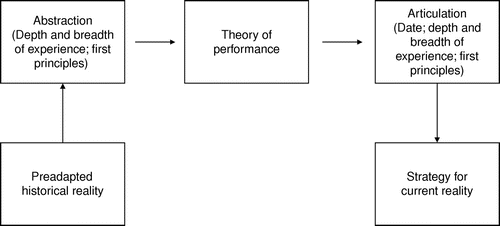
The story we just presented is an anomaly. Merrill Lynch is a rare violation of the precept of behavioral continuity: it took a long jump that required a major shift in capabilities, routines, or subsystems, and it did not fall. In the parlance of our postulates, it is a violation of P4PR. Further, Charles Merrill had an unusual ability to anticipate the detailed components of a course of action that deviated significantly from the status quo. We already summarized what we view as the key insights and generalizations that we can draw from this “anomaly.” Let us add a broader reflection.
We think this anomaly suggests that the concept of behavioral continuity may have more layers than is typically recognized. There is the layer of routines, but there is also the layer of cognitive representations. If routines are rightly viewed as the genetic material of organizations in many cases, cognitive representations may well play a functionally equivalent role in other cases. If preadaptation at the level of firms’ capabilities or routines is how we can explain what appear to be significant yet successful departures from the status quo such as Corning’s move to fiber optics, cognitive preadaptation can explain equally well other significant yet successful departures from the status quo such as Merrill Lynch’s strategic innovation.
Consequently, the story we just presented is really not an anomaly … provided that we give behavioral continuity the broader meaning we suggest. But accepting this expansion necessarily translates into a more expansive evolutionary perspective on strategy, one that maintains its original stance on capabilities, inertia, and associated understanding of the sources of heterogeneity across firms, while also pursuing strategic foresight, choice, innovation, albeit within precise limits. It is a perspective that gives strategic agency more play but interprets it through the lenses of its commitment to behavioral realism and the power of history. This perspective thus holds the promise of defining a “behavioral center” for the strategy field that in the past has had the tendency to both Balkanize around extreme characterizations of economic and behavioral perspectives (Gavetti and Levinthal 2004, Mintzberg and Waters 1985) and to be relatively a-historic. To conclude, the behavioral ferment that characterizes the recent history of the strategy field and goes under the headings of behavioral strategy (Powell et al. 2011, Gavetti 2012), microfoundations (Felin and Foss 2005), and attention (Ocasio 1997) is quite rich in behavioral realism at all levels of analysis, but perhaps not as rich in its historical sensibility. For this reason, we think it may be well served if it found a common center in this expanded evolutionary sensibility.
For helpful comments, the authors thank Gino Cattani, Dan Levinthal, Dan Raff, Sidney Winter, the participants in the EOI Workshop at the Wharton School, University of Pennsylvania, the participants in the 2015 Behavioral Strategy conference at the NYU Stern School of Business, and two anonymous referees. A special thank you goes to Edwin Perkins for his generous comments and for granting access to precious historical documents. Errors remain the authors’ own.
1 We thank Edwin Perkins for sharing with us this document, which is currently not publicly available.
2 For instance, if in TV advertising, the nature of the product or service produced and the target market are interdependent, it means that the marginal contribution of TV advertising to overall performance hinges upon what specific product or service is produced, and what specific market is being targeted.
3 The suffix PR stands for “preadaptation.” Similarly, we use the suffix A to denote “analogy” postulates, and PO to denote “positioning” postulates.
4 In the form, for instance, of a representation allowing the identification of the broad traits of a superior course of action.
5 P4PR did not exist in the first version of the paper. We thank Sidney Winter for highlighting the need for it.
6 Because his ultimate goal was not to characterize the representative firm, Simon did not build his theoretical engine around it. Cyert and March wanted to “Link models of the firm as closely as possible to empirical observations of both the decision output and the process structure of actual business organizations” (Cyert and March, 1963, p. 2). In contrast, presumably due to his pragmatic preoccupation that attending to too many layers of organizational complexity makes it too hard to attain practical relevance, for Simon “… The scantiness of my experiences with organizations posed no particular limit to my development of an alternative approach to decision making. Applying the ideas of bounded rationality to organizations could then be easily achieved with only a bookish knowledge of organizations. It was simply necessary to ask what the implications of bounded rationality were for the division of labor, for authority, for organizational identification, for coordination, and so on. Inference rather than empirical observation could, and did, guide this analysis” Simon (1991, p. 87). Simon’s starting point for Administrative Behavior was the idea of bounded rationality and the evidence supporting it, not evidence of decision making in the representative firm.
7 The irony in all this is that Simon’s early work was heavily influenced by behaviorism, the then dominant school of thought in psychology. Interestingly though, Simon’s main influence was not mainstream behaviorist work, but Edward C. Tolman, one of behaviorism’s most unorthodox voices. Tolman was the first to introduce the concept of mental map, precursor to cognitive representation, in his article “Cognitive Maps in Rats and Men” (Tolman, 1948).
8 The fact that analogy is a very important form of thinking is not a new insight. For instance, Hume (1748) concluded: “From causes which appear similar we expect similar effects. This is the sum of all our experimental conclusions.”
9 This postulate finds a deep analogue in Hume’s famous “An enquiry concerning human understanding.” In particular: “In reality, all arguments from experience are founded on the similarity which we discover among natural objects, and by which we are induced to expect effects similar to those which we have found to follow from such objects. And though none but a fool or madman will ever pretend to dispute the authority of experience, or to reject that great guide of human life, it may surely be allowed a philosopher to have so much curiosity at least as to examine the principle of human nature, which gives this mighty authority to experience, and makes us draw advantage from that similarity which nature has placed among different objects. From causes which appear similar we expect similar effects. This is the sum of all our experimental conclusions.”
10 Interestingly, this book was written by Winthrop H. Smith Jr., the son of Winthrop H. Smith who played a very important role in Merrill’s return to Wall Street, as we will see in Section 4.3. This personal connection allowed the author access to many private documents and letters as well as personal quotes, and this significantly enriched our understanding of the story. We thank Sidney Winter for pointing us to this source, which (according to him) he discovered “serendipitously.”
11 We thank Daniel Raff for emphasizing these methodological issues.
12 Merrill Lynch, E.A. Pierce and Cassatt was renamed Merrill Lynch, Pierce, Fenner and Beane in 1941 after the acquisition of Fenner and Beane, and finally Merrill Lynch Co. in 1952.
13 Charles E. Merrill & Co. was founded on January 6, 1914. It was renamed Merrill, Lynch & Co. on October 15, 1915 bringing Edmund C. Lynch on board.
14 Despite the death of his long-time partner and friend Edmund C. Lynch in 1938, Charles insisted on keeping “Lynch” in the title of the new company.
15 Indeed, Braun and Merrill described the new company they had in mind largely against the background of what Merrill inherited and the broader Wall Street.
16 Based on Merrill’s description of his theory of merchandising in WAMT, contemporary articles on Merrill Lynch, and interviews with Merrill, it is clear that what he has in mind when he speaks of merchandising is Safeway and the grocery business. Most likely, the fact that he calls it “my theory of merchandising” reflects his belief that it can be generalized to several other merchandising settings.
17 WAMT contains several references to other businesses or companies Merrill had been involved in, directly or indirectly. Yet, they are typically used as examples of minor assertions and do not seem to have played a role to the overall strategic direction of the company. The only exception might be his experience in the publishing industry, helping create and run Family Circle, a magazine that was distributed free of charge in Safeway Stores. Some of this experience was drawn upon when Merrill used informational booklets on financial analysis and investing as a means of educating the “masses” and to attract them into buying financial instruments.
18 We should also acknowledge the possibility that Braun and his analysis was also used by Merrill as an instrument of persuasion. At the Waldorf-Astoria meeting in 1940, Merrill was trying to convince a group of very experienced brokers to take on policies that were very different from things they were used to. This was a significant persuasion challenge, and one has to think that bombarding them with the sort of detailed numbers-driven market analysis performed by Braun should have helped the cause. But the historical evidence above should indicate that Braun and his data also played a major role in the strategy formulation.
19 Even in his personal life. For instance, the way Merrill, the (relatively) poor Southern outsider competed (for reputation, prestige, women) with the rich New Englanders that populated Amherst College and later in New York at the turn of the century is deeply similar to his way of strategizing in business settings.
20 A perceptive reviewer suggested that this evidence should not be at all surprising. In the reviewer’s words: “The principles of the positioning school were developed in large part by observing cases such as Merrill Lynch. Porter (1985) and Ghemawat and Rivkin (1998) even mention Merrill Lynch by name.”
21 Indeed, when Charlie took the helm of Pierce & Co. and changed its name to Merrill Lynch, E. A. Pierce, and Cassatt, he had to fight hard to add “and” and then keep “Lynch” in the name of the company.
22 It should be noted that the evidence here is more that the chosen policies were consistent with the economic first principles, and less directly for their explicit application, perhaps with the exception of the quote about differentiation.
References
- (1969) Conceptual models and the cuban missile crisis. Amer. Political Sci. Rev. 63(3):689–718.Crossref, Google Scholar
- (1980) Human Associative Memory (Lawrence Erlbaum Associates, Hillsdale, NJ).Google Scholar
- (1999) Organizational Learning Creating, Retaining and Transferring Knowledge (Kluwer Academic Publishers, Norwell, MA).Google Scholar
- (2007) Biform games. Management Sci. 53(4):537–549.Link, Google Scholar
- (1996) Value-based business strategy. J. Econom. Management Strategy 5(1):5–24.Crossref, Google Scholar
- (2006) Technological pre-adaptation, speciation, and emergence of new technologies: How Corning invented and developed fiber optics. Indust. Corporate Change 15(2):285–318.Crossref, Google Scholar
- (2007) Reading Dewey: Reflections on the study of routine. Organ. Stud. 28(5):773–786.Crossref, Google Scholar
- Cohen MD, Sproull LS, eds. (1996) Organizational Learning (Sage Publications, Thousand Oaks, CA).Google Scholar
- (2015) Mental representation and the discovery of new strategies. Strategic Management J., ePub ahead of print November 17, http://dx.doi.org/10.1002/smj.2440.Crossref, Google Scholar
- (1963) A Behavioral Theory of the Firm (Prentice-Hall, Englewood Cliffs, NJ).Google Scholar
- (2003) The economics of strategic opportunity. Strategic Management J. 24(10):977–990.Crossref, Google Scholar
- (2000) The Nature and Dynamics of Organizational Capabilities (Oxford University Press, New York).Google Scholar
- (1987) Neural Darwinism: The Theory of Neuronal Group Selection (Basic Books, New York).Google Scholar
- (2005) Strategic organization: A field in search of micro-foundations. Strategic Organ. 3(4):441–455.Crossref, Google Scholar
Fortune (1941) Merchandisers of securities: Merrill Lynch, E.A. Pierce & Cassatt. (June) 100–104, 116, 118, 120.Google Scholar- (2012) PERSPECTIVE—Toward a behavioral theory of strategy. Organ. Sci. 23(1):267–285.Link, Google Scholar
- (2015) Representing is not the same thing as changing organizations: Cyert and March vs. Simon. J. Management Inquiry 24(3):327–328.Crossref, Google Scholar
- (2000) Looking forward and looking backward: Cognitive and experiential search. Admin. Sci. Quart. 45(1):113–137.Crossref, Google Scholar
- (2004) The strategy field from the perspective of Management Science: Divergent strands and possible integration. Management Sci. 50(10):1309–1318.Link, Google Scholar
- (2005) How strategists really think: Tapping the power of analogy. Harvard Bus. Rev. 83(April):54–63.Google Scholar
- (2005) Strategy making in novel and complex worlds: The power of analogy. Strategic Management J. 26(8):691–712.Crossref, Google Scholar
- (1983) Structure-mapping: A theoretical framework for analogy. Cognitive Sci. 7(7):155–170.Crossref, Google Scholar
- (1991) Commitment: The Dynamic of Strategy (Free Press, New York).Google Scholar
- (2002) Competition and business strategy in historical perspective. Bus. History Rev. 76(1):37–74.Crossref, Google Scholar
- (1998) Creating competitive advantage. Harvard Business School Background Note 798-062, Boston. Revised February 2006.Google Scholar
- (2001) A Theory of Case-Based Decisions (Cambridge University Press, Cambridge, UK).Crossref, Google Scholar
- (2001) Analogy as the core cognition. Gentner D, Holyoak KJ, Kokinov BN, eds. The Analogical Mind: Perspectives from Cognitive Science (MIT Press, Cambridge, MA), 499–538.Crossref, Google Scholar
- (2011) Causal learning and inference as a rational process: The new synthesis. Annual Rev. Psych. 62:135–163.Crossref, Google Scholar
- (1995) Mental Leaps: Analogy in Creative Thought (MIT Press, Cambridge, MA).Google Scholar
- (1748) An Enquiry Concerning Human Understanding (Alex Catalogue, Raleigh, NC).Crossref, Google Scholar
- (2000) Principles of Neural Science, 4th ed. (McGraw-Hill, New York).Google Scholar
- (1990) In search of insight. Cognitive Psych. 22(3):374–419.Crossref, Google Scholar
- (1992) Knowledge of the firm, combinative capabilities, and the replication of technology. Organ. Sci. 3(3):383–397.Link, Google Scholar
- (1996) What firms do? Coordination, identity, and learning. Organ. Sci. 7(5):502–518.Link, Google Scholar
- (1988) Organizational learning. Annual Rev. Sociol. 14:319–338.Crossref, Google Scholar
- (1997) Adaptation on rugged landscapes. Management Sci. 43(7):934–950.Link, Google Scholar
- (2011) A behavioral approach to strategy—What’s the alternative? Strategic Management J. 32(13):1517–1523.Crossref, Google Scholar
- (1993) The myopia of learning. Strategic Management J. 14(Special Issue):95–112.Crossref, Google Scholar
- (2003) Analogical learning in negotiation teams: Comparing cases promotes learning and transfer. Acad. Management Learn. Ed. 2(2):119–127.Crossref, Google Scholar
- (2006) Rationality, foolishness, and adaptive intelligence. Strategic Management J. 27(3):201–214.Crossref, Google Scholar
- (1991) Learning from samples of one or fewer. Organ. Sci. 2(1):1–13.Link, Google Scholar
- (1985) Of strategies, deliberte and emergent. Strategic Management J. 6(3):257–272.Crossref, Google Scholar
- (2008) Coarse thinking and persuasion. Quart. J. Econom. 123(2):577–619.Crossref, Google Scholar
- (1982) An Evolutionary Theory of Economic Change (Belknap Press of Harvard University Press, Cambridge, MA).Google Scholar
- (2002) Evolutionary theorizing in economics. J. Econom. Perspectives 16(2):23–46.Crossref, Google Scholar
- (1986) Thinking in Time: The Uses of History for Decision-Makers (Free Press, New York).Google Scholar
- (1998) Charles Merrill: Main Street broker. Time (December 7), http://content.time.com/time/magazine/article/0,9171,989774,00.html.Google Scholar
- (1997) Toward an attention-based view of the firm. Strategic Management J. 18(S1):187–206.Crossref, Google Scholar
- (1999) Wall Street to Main Street: Charles Merrill and Middle-Class Investors (Cambridge University Press, New York).Google Scholar
- (1975) Note on the structural analysis of industries. Harvard Business School Case Services, Boston.Google Scholar
- (1980) Competitive Strategy: Techniques for Analyzing Industries and Competitors (Free Press, New York).Google Scholar
- (1985) Competitive Advantage: Creating and Sustaining Superior Performance (Free Press, New York).Google Scholar
- (1996) What is strategy? Harvard Bus. Rev. 74(November–December):61–78.Google Scholar
- (2008) The five competitive forces that shape strategy. Harvard Bus. Rev. 86(1):78–93, 137.Google Scholar
- (2011) Behavioral strategy. Strategic Management J. 32(13):1369–1386.Crossref, Google Scholar
- (1999) Evolution (Blackwell Science, Cambridge, MA).Google Scholar
- (2002) Evolution toward fit. Admin. Sci. Quart. 47(1):125–159.Crossref, Google Scholar
- (1943) Fiscal Aspects of Metropolitan Consolidation (Bureau of Public Administration, University of California, Berkeley, CA).Google Scholar
- (1947) Administrative Behavior (Free Press, New York).Google Scholar
- (1962) The Architecture of Complexity. Proc. Amer. Philos. Soc. 106(6):467–482.Google Scholar
- (1969) The Sciences of the Artificial (MIT Press, Cambridge, MA).Google Scholar
- (1972) Theories of Bounded Rationality (North-Holland Publishing Company, Amsterdam).Google Scholar
- (1991) Models of My Life (Basic Books, New York).Google Scholar
- (2013) Catching Lightning in a Bottle: How Merrill Lynch Revolutionized the Financial World (John Wiley & Sons, Hoboken, NJ).Google Scholar
- (2000) Dangerous Dreamers: The Financial Innovators from Charles Merrill to Michael Milken (Beard Books, Washington, DC).Google Scholar
- (1997) Dynamic capabilities and strategic managment. Strategic Management J. 18(7):509–533.Crossref, Google Scholar
- (2014) Cognitive science. Zalta EN, ed. The Stanford Encyclopedia of Philosophy. Accessed August 26, 2016, http://plato.stanford.edu/entries/cognitivescience.Google Scholar
- (1948) Cognitive maps in rats and men. Psych. Rev. 55(4):189–208.Crossref, Google Scholar
WAMT (1940) Transcript of Branch Managers’ Conference. Merrill Lynch Corporate Archives, New York.Google Scholar- (2012) Purpose and progress in the theory of strategy: Comments on Gavetti. Organ. Sci. 23(1):288–297.Link, Google Scholar
- (1987) The competitive challenge: Strategies for industrial innovation and renewal. Knowledge and Competence As Strategic Assets (Ballinger, Cambridge, MA), 159–183.Google Scholar
Giovanni Gavetti is an associate professor of strategy at the Tuck School of Business at Dartmouth. He teaches the core course “Competitive and Corporate Strategy.” His research explores the cognitive foundations of strategy.
Anoop Menon is an assistant professor of management at the Wharton School, University of Pennsylvania, where he teaches courses on competitive strategy. His research explores the role of cognition in strategy.
This article appears in INFORMS Analytics Collections Vol. 15: 25 Years of INFORMS.
Visit this collection for free access to more articles showcasing the evolution of INFORMS over the past 25 years.