Game—How to Share the Gains of Collaboration?
Abstract
Supply chain collaborations may generate substantial cost savings. Many such initiatives cease to exist, however, due to not reaching an agreement on how to share the gains. We describe an exercise to understand the challenges in collaborative gain sharing.
Funding: This project has received funding from the European Union’s Seventh Programme for research, technological development and demonstration (FP7 Transport) [Grant Agreement 284926].
Introduction
Supply chain collaboration has been around for decades. In a vertical collaboration, companies within one and the same supply chain collaborate with each other to, for instance, improve their forecast accuracy or inventory management. Well-known examples in retail supply chains are collaborative planning, forecasting, and replenishment and vendor-managed inventory, where buyers (retailers) share their sales and inventory data with their suppliers (vendors) with the purpose to reduce stockouts and excess inventories. Horizontal collaboration is a more recent phenomenon where companies at the same level of the supply chain (i.e., between suppliers or between buyers) establish partnerships. Collaborative shipping and collaborative warehousing are such partnership examples, where shippers bundle their volumes in the same vehicle or warehouse to increase fill rates. This more holistic view across individual supply chains may bring additional cost reductions as a result of the increased utilization of assets (Beliën et al. 2017).
Supply chain collaborations may also have a positive environmental impact. Collaborative shipping, for instance, increases vehicle loads by consolidating less-than-full truckloads or reduces the number of empty trips by effective backhauling of full truckloads. Moreover, consolidating freight loads of multiple parties encourages a modal shift toward sustainable transport modes, such as rail transport or inland waterways, through the scale economies that renders the collaboration more cost effective.
Collaboration is also the cornerstone of the Physical Internet, introduced by Montreuil (2011), to tackle inefficiencies in transportation and logistics. In a Physical Internet, goods will move in the same way as its digital namesake moves data (Mervis 2014). The Physical Internet promotes collaboration by pooling assets, such as trucks and warehouses, that are often now locked into proprietary networks owned by individual companies.1
Despite its financial and sustainability benefits, creating and supporting strategic alliances is, however, not simple. Many logistics collaboration initiatives have ended because of mistrust about the fairness of applied gain share rules. Indeed, given that the benefits generated within a collaborative network are not necessarily divided equally, a clear and fair rule to reallocate the benefits is a prerequisite to ensure long-term collaboration. To that extent, the allocation rule should ensure that each member company receives its fair share. If a certain member of the network is not allocated its financial fair share of the benefits realised, the network stability is threatened. Such a member will likely pull out, disrupting the collaboration opportunities for the network as a whole.
There is a plethora of gain sharing rules that have been proposed in the literature and in practice, each with its own advantages and disadvantages. In this article we describe an exercise that we have used in the classroom to introduce gain sharing and discuss some well-known allocation methods. We refer to Guajardo and Rönnqvist (2016) for a more elaborate survey on cost allocation methods found in the literature on collaborative transportation and to Boute et al. (2017) for a comprehensive teaching case on supply chain collaboration. The exercise described in this article complements their work because of its simplicity in introducing gain sharing to a diverse audience.
The Going to the Beach Exercise
The “Going to the Beach” exercise describes different groups of people travelling in separate cars to the same destination. To increase efficiency and reduce costs, they consider carpooling. The objective is to find an alliance with another party and a solution to share the costs/gains that is the most convenient for each party.
The similarity with current freight transportation is readily made. Half-empty driving trucks can increase their efficiency through collaboration by sharing the capacity of the truck. The different groups of people in each car in the Going to the Beach exercise correspond to different freight loads of the collaborating companies. The analogy also holds for collaborative warehousing, where the people in the car correspond to the square meters used by each company.
The instructions of the exercise (provided in the appendix) are distributed to each participant in different sheet colors: red, blue, green, yellow, and white. The sheet color indicates the color of the car and the number of people it carries: a red sheet indicates a red car carrying five people; a blue sheet, four people in a blue car; a green sheet, three people in a green car; a yellow sheet, two people in a yellow car; and a white sheet, one person in a white car. Each car is identical in size, can carry up to five people, and incurs a cost of €100 per trip. Note that the red cars are fully occupied from the beginning and, in principle, do not need to find alliance partners. They may consider splitting up, however, and join other parties to obtain further cost reductions.
In case each color is used once, there are in total 15 people travelling in five separate cars at a total cost of €500. Table 1 indicates the cost per person for each of the cars, prior to collaboration. Under the optimal cost-minimizing solution, where people collaborate to fill up empty spaces, we need three cars to carry 15 people. The total cost for three cars is then only €300. If this cost is equally divided among the 15 people, the average cost per person is €300/15 = €20. This information can be given by the instructor to the participants as a benchmark solution. The instructor can draw the attention to the fact that, under this solution, the party in the red car does not benefit from collaborating, whereas the one person in the white car gains 80%. However, if one party is not satisfied with its allocated share, or has the feeling that it is not allocated a fair portion of the benefits, it may opt out, and the collaboration may not materialize.
|

Table 1. Cost per Person (pp) for Each of the Cars Before and After Collaboration
| Car (no. of people) | Cost (€) pp before collaboration | Cost (€) pp after collaboration |
|---|---|---|
| Red (5) | 20 | 20 (−0%) |
| Blue (4) | 25 | 20 (−20%) |
| Green (3) | 33.3 | 20 (−40%) |
| Yellow (2) | 50 | 20 (−60%) |
| White (1) | 100 | 20 (−80%) |
Notes. In case each color is used exactly once, we need a minimum of three cars to carry the 15 people at a total cost of €300. An equal cost allocation implies each person pays €300/15 = €20.
Table 1 can be written on the blackboard when the exercise starts. Participants are then given 15 minutes to find a collaboration partner(s) and a way to share the gains of the collaboration. Afterward, the following information is collected:
The costs per person after collaboration
The total costs of the community
The perception of the solution quality and its “fairness”
Tables 2–4 provide a few possible collaborations that we have observed in class. For those parties that did not manage to find an alliance, the instructor may ask why they did not succeed in doing so.
|
Table 2. A Possible Solution Observed in Class: Green Car and Yellow Car
| Car (no. of people) | Cost (€) pp before collaboration | Cost (€) pp after collaboration |
|---|---|---|
| Green (3) | 33.3 | 13.3 (−60%) |
| Yellow (2) | 50 | 30 (−40%) |
Notes. In this table, a green car (cost per person (pp) of €100/3) collaborates with a yellow car (cost pp of €100/2). Together, they need one car to carry five people. The €100 cost of that car is split as follows: the three people in the green car each pay €40/3, and the two people in the yellow car pay €60/2.
|
Table 3. A Possible Solution Observed in Class: Blue Car and White Car
| Car (no. of people) | Cost (€) pp before collaboration | Cost (€) pp after collaboration |
|---|---|---|
| Blue (4) | 25 | 10 (−60%) |
| White (1) | 100 | 60 (−40%) |
Notes. Here, a blue car (cost per person (pp) of €100/4) collaborates with a white car (cost pp of €100/1). Collaboration results in one car carrying five people. The €100 cost of the joint car is split as follows: the four people in the blue car each pay €40/4, and the person in the white car pays €60.
|
Table 4. An Alternative Possible Solution Observed in Class: Blue Car and White Car
| Car (no. of people) | Cost (€) pp before collaboration | Cost (€) pp after collaboration |
|---|---|---|
| Blue (4) | 25 | 6.25 (−75%) |
| White (1) | 100 | 75 (−25%) |
Notes. Here, a blue car (cost per person (pp) €100/4) collaborates with a white car (cost pp €100/1). The €100 cost of the joint car is split as follows: the four people in the blue car each pay €25/4, and the person in the white car pays €75.
To stimulate (more) collaborative partnerships, a second round of the exercise can be organized, in which the government gives incentives to favor collaboration. A €5 penalty is charged per unfilled seat in a car that drives half full, whereas a full car of five receives a €20 bonus. Completely empty cars are not charged any fee, nor any penalty, as they do not make the trip. Participants have 10 minutes to make a new alliance, after which the same information is collected as in the first round.
One solution from an undergrad student after the second round is worth mentioning, where a blue car of four teams up with a white car of one. He proposed that the blue car rides for free and gets the €20 bonus; the white car pays the full €100 but saves €20 penalties by avoiding four empty seats. The four people thus have some pocket money to buy a nice ice cream for everyone upon their arrival at the beach!
There is an infinite number of possible ways to share the gains. There is no “right” or “best” allocation method, so it will always remain subject to discussion. The process is generally influenced by negotiation skills and power games. In the next section, we discuss some well-known allocation methods along with their main characteristics.
Discussion of the Gain Sharing Methods
In general, there is no definite answer as to whether one method is better than another method. The findings in the literature are usually the result of intensive numerical experimentation, and despite the fact that some traditional methods appear repeatedly in the literature, there is no broad consensus on their acceptance. As we will show next, some easy to implement allocation methods do not necessarily lead to a fair distribution of the gains or to a cost allocation where each company improves its individual cost performance when compared with its precollaboration performance.
Suppose a green car (three people) teams up with a white car (one person) to jointly fill a car with four people. In such a case, two cars are reduced to one, and the collaboration gain is €100. If these were four friends, they would divide the cost of the car equally so that each person pays €25. Under this cost allocation, each person of the green car gains (€33.3 − €25) = €8.3, whereas the person originally in the white car gains (€100 − €25) = €75. The difference in gains may not be perceived as a fair allocation scheme, as the green car was originally the most efficient one, and its occupants’ gains are only marginal. Between friends, this may not matter as, in the long run, it may cancel out. In business, however, there is no guarantee for a long-term relationship, and the deal has to be appropriately closed right away.
The described allocation rule is known as the volume-based allocation rule: the allocated cost is proportional to the volume shipped. Despite its simplicity and intuition, volume-based allocation is not always considered to be fair because of its disregard for prior efficiencies. Moreover, as we will show in the next section, the volume-based allocation rule may not always lead to individual gains for each party in the alliance.
One method to share the gains in a “fair” way, is the Shapley value. Introduced by the Nobel Prize winner Lloyd Shapley, this method allocates gains to each company proportional to the marginal contribution of each company to the partnership. That means that if substantial cost savings can be obtained as a result of the inclusion of company A to the alliance, company A should receive a substantial part of the gains. On the contrary, if the addition of company B does not contribute to any cost reduction, company B should not receive any of the cost savings.
When only two companies collaborate, the Shapley value is simple: it allocates half of the gains to each company. Indeed, as none of the cost savings can be obtained without involving the other company, both companies contribute to the same extent. In our exercise, each car should get €50 of the savings, no matter how the cars were initially filled. Tables 5–7 illustrate the Shapley value solution under different collaborations.
|
Table 5. Collaboration Between a Green Car and a White Car
| Car (no. of people) | Cost (€) pp before collaboration | Cost (€) pp after collaboration |
|---|---|---|
| Green (3) | 33.3 | 16.67 (−50%) |
| White (1) | 100 | 50 (−50%) |
Notes. When a green car collaborates with a white car, one car can be reduced. The Shapley value splits the resulting savings of €100 evenly to both cars. The three people from the green car thus each pay (€100 − €50)/3. The person in the white car pays (€100 − €50)/1. pp, per person.
|
Table 6. Collaboration Between a Green Car and a Yellow Car
| Car (no. of people) | Cost (€) pp before collaboration | Cost (€) pp after collaboration |
|---|---|---|
| Green (3) | 33.3 | 16.67 (−50%) |
| Yellow (2) | 50 | 25 (−50%) |
Notes. When a green car collaborates with a yellow car, the Shapley value splits the resulting savings of €100 evenly to both cars. The three people from the green car each pay (€100 − €50)/3, and the two persons in the yellow car each pay (€100 − €50)/2. pp, per person.
|
Table 7. Collaboration Between a Blue Car and a White Car
| Car (no. of people) | Cost (€) pp before collaboration | Cost (€) pp after collaboration |
|---|---|---|
| Blue (4) | 25 | 12.5 (−50%) |
| White (1) | 100 | 50 (−50%) |
Notes. When a blue car collaborates with a white car, under the Shapley value, the four people from the blue car each pay (€100 − €50)/4, and the person in the white car pays (€100 − €50)/1. pp, per person.
The Shapley value is praised because it is considered to lead to a “fair” distribution. Moreover, notice that for green cars, for instance, each person pays €16.67 after collaboration, which is equivalent to what they would pay if they would travel in a car of six (which is physically impossible).
When the consumer packaged goods companies Tupperware and Procter & Gamble set up a logistics alliance to bundle their freight shipments between Belgium and Greece, it led to more than 15% cost savings overall. One company, however, saved €200K in yearly logistics costs,2 whereas the other company incurred €40K additional manipulation costs. In order to ensure sustained collaboration, the €160K net gain was shared fifty-fifty between both companies, and the former company paid €120K each year to the latter.
Extension to More Than Two Collaborating Parties
The Shapley method rewards companies more if they contribute more to the collaboration gains. Despite its desirable fairness properties, it may be difficult to implement as soon as more than two companies collaborate.
In our Going to the Beach example, the calculations still remain relatively straightforward. Suppose that two yellow cars (carrying two people each) collaborate with a white car (one person) to fill up one car together. The reduced transportation costs from €300 to €100 result in a gain of €200. Under a volume-based allocation, each person pays €100/5 = €20 of the cost of the joint car. The person in the white car thus reduces his cost by (€100 − €20)/€100 = 80%, whereas each person in the yellow cars only reduces the cost by (€50 − €20)/€50 = 60% (see Table 8). The latter may not be happy with this solution, as they initially had a higher efficiency in their car with fewer empty seats.
|
Table 8. Collaboration Between Two Yellow Cars and One White Car
| Car (no. of people) | Cost (€) pp before collaboration | Cost (€) pp after collaboration: Volume-based allocation | Cost (€) pp after collaboration: Shapley value |
|---|---|---|---|
| Yellow (2) | 50 | 20 (−60%) | 16.6 (−66.6%) |
| Yellow (2) | 50 | 20 (−60%) | 16.6 (−66.6%) |
| White (1) | 100 | 20 (−80%) | 33.3 (−66.6%) |
Notes. The Shapley value rewards each person with the same relative benefit. This does not hold under the volume-based allocation rule. pp, per person.
The Shapley value, on the other hand, rewards each company according to its average contribution as the collaboration network gradually builds up. For car A, for instance, it measures the average reduction of the collaborative transport costs when car A collaborates with car B, when A collaborates with car C, or when it enters an existing collaboration consisting of cars B and C.3 In this simple example, it is easy to see that each additional party in the collaboration reduces total transport costs with the same €100. Given their equal contribution, they should each be allocated an equal portion of the gains (i.e., 33% of €200, or €66.6). The yellow car thus pays €100 − €66.6 = €33.3, or €16.6 per person in the yellow car. The person in the white car pays €100 − €66.6 = €33.3. As a result, each person gains the same 66.6%. In Table 9 we illustrate the same calculations when a yellow car collaborates with two white cars.
|
Table 9. Collaboration Between One Yellow Car and Two White Cars
| Car (no. of people) | Cost (€) pp before collaboration | Cost (€) pp after collaboration: Volume-based allocation | Cost (€) pp after collaboration: Shapley value |
|---|---|---|---|
| Yellow (2) | 50 | 25 (−50%) | 16.6 (−66.6%) |
| White (1) | 100 | 25 (−75%) | 33.3 (−66.6%) |
| White (1) | 100 | 25 (−75%) | 33.3 (−66.6%) |
Notes. When a yellow car collaborates with two white cars, each person pays an equal amount under a volume-based allocation (€100/4). The Shapley value rewards each car 33.3% of the $200 gains. pp, person.
To calculate the Shapley value, we need to know the cost performance of all possible hypothetical combinations of alliances—for instance, when only companies A and B would join forces or when only companies B and C collaborate. In the above-mentioned Going to the Beach example, each subcoalition leads to the same cost reduction, and the contribution of each party is exactly the same. In real-life settings, however, this may no longer be the case. The cost impact of each company may be different, depending on which partners they collaborate with. When their contributions are not equal, one can no longer simply divide the gains equally among all partners. Instead, one needs to quantify the cost benefit of each hypothetical partnership. A separate tender is required to quantify the transport costs for each possible combination of (sub)alliance, which is typically not possible in practice. Therefore, unless we know the costs under each collaborative combination, we cannot apply Shapley when more than two companies are involved in the alliance.
To cope with this limitation, a linear allocation method that allocates the costs based on a ratio of each company’s precollaboration performance compared with the network performance can alternatively be used. In our examples of Tables 8 and 9, that means that each person in the yellow car pays €50/€300 = 16.6% of the costs under collaboration, or 0.166 × €100 = €16.6. The person in the white car pays €100/€300 = 33% of the costs under collaboration, or 0.33 × €100 = €33.3. Notice that, for this simple example, the resulting allocation is identical to the Shapley value, yet it does not require the quantification of the costs for each possible combination of (sub)alliance.
Consider now another example, taken from Boute and Van Steendam (2018), to illustrate the linear allocation rule. Three companies set up a tender for collaborative transport. Companies B and C are equal in size, and each ship 20% of the total aggregated volume, whereas company A is three times bigger and ships 60% of the total. Their transportation costs, however, are different. Compared with A and B, company C has lower transportation costs prior to the collaboration, for instance, because of its efforts to improve logistics efficiency or because of a better transport negotiation agreement. Suppose transportation costs are distributed according to Figure 1.
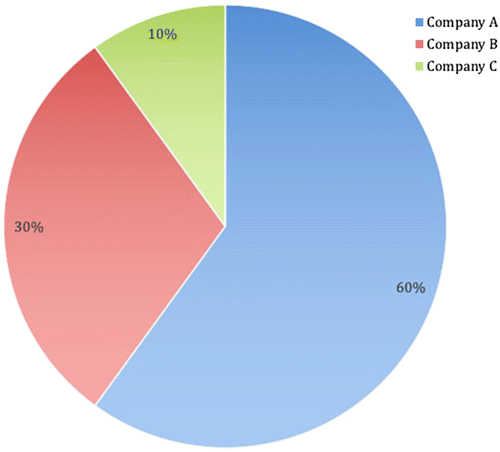
Suppose the collaborative tendering process results in a 10% reduction compared with current transport costs—say, a reduction from €100 to €90. These savings stem from improved utilization of transport capacity, thereby reducing the number of transport trips. The question now remains how the €90 will be allocated to the three companies. Implementation of the Shapley value requires a separate tender to quantify the transport costs for each possible hypothetical combination of alliances—for instance, when only companies A and B would join forces, or when only companies A and C or companies B and C collaborate. As this is not available, we have to rely on alternative allocation rules.
Under a linear allocation method, the costs under collaboration would be divided according to the distribution in Figure 1. That means that company A pays 0.60 × €90 = €54, company B pays 0.30 × €90 = €27, and company C pays 0.10 × €90 = €9. As a result of this rule, each company gains 10% under collaboration (see Table 10). Notice that the linear rule takes into account previous efficiencies (the better the cost performance prior to collaboration, the lower its allocated costs after collaboration), as well as volumes (lower volumes and precollaboration costs generate lower allocated costs after collaboration). A pure volume-based allocation method is not desirable for all the companies in this example. A volume-based allocation rule would allocate 20% of the costs to each of the companies B and C (i.e., 0.20 × €90 = €18 per company), and company A pays 60% (i.e., 0.60 × €90 = €54) (see Table 10). It once more shows how the volume-based allocation method does not take prior efficiencies into account. Moreover, under such a volume-based collaborative shipping agreement, company C will even pay more than before the collaboration. As a result, the collaboration and its savings will likely never materialize.
|
Table 10. Impact of Different Allocation Methods by Company
| Company | Precollaboration costs (€) | Linear rule (€) | Volume-based (€) |
|---|---|---|---|
| A | 60 | 54 (−10%) | 54 (−10%) |
| B | 30 | 27 (−10%) | 18 (−40%) |
| C | 10 | 9 (−10%) | 18 (+80%) |
| Total | 100 | 90 (−10%) | 90 (−10%) |
Notes. When the costs under collaboration are allocated using the linear rule, each company gains 10%. When costs are allocated based on their respective volumes, company C does not gain from the collaboration.
We have handed out the Boute and Van Steendam (2018) article to our participants as a debriefing to the Going to the Beach exercise. It complements the exercise with a discussion and illustration of the aforementioned cost allocation rules.
Classroom Experience
We have used the exercise with large groups of about 150 undergraduate students and in executive education programs with about 20 participants in a 60- to 90-minute lecture. The following has worked well. First, we provide a motivation why collaboration will gain traction in the future by highlighting the current low utilization rate of trucks. Currently, trucks transporting goods drive about 40% empty, on average. In fact, various studies show that 25% of all trucks are entirely empty. Collaboration is therefore a desirable option to increase the fill rate of trucks. Additionally, improving the load factor reduces the number of vehicles on the road. Fewer vehicles means lower emissions of harmful greenhouse gasses, less congestion, and fewer chances of vehicle accidents. Depending on time and interest, the instructor can also discuss the Physical Internet, which is usually accompanied with a rich discussion on its feasibility. This introduction is important, as it provides a strong motivation and urge for collaboration. Participants usually get the message that collaboration is important, if not necessary, in order to cope with today’s climate change concerns.
We next introduce the Going to the Beach exercise. One could just hand out the exercise in the appendix, yet it usually helps to quickly describe the context and illustrate the cost calculation prior to collaboration, as well as the theoretical optimal solution.
After the participants have played the exercise and shared their solutions, a discussion can be triggered about how they came to this solution and how it feels to each party. The instructor can ask questions such as “Do you feel this is a fair solution to you?” and “Would you be happy to sustain this partnership?” to trigger discussion.
Finally, one can illustrate how some well-known allocation rules work. We usually start with the volume-based rule. It is not only intuitive; participants also rapidly see that it is unfair. Then we introduce the rationale behind the Shapley value. We usually do not go into the details of the mathematics, as it requires a long introduction on game theory. Instead, we only show how it can be applied to the examples described in this article and how it could be applied in collaborations with more than two companies. This typically suffices for an understanding of its application. Finally, we introduce the linear allocation rule as a pragmatic yet fair mechanism to allocate the gains.
In our classes, the participants enjoyed the engagement and interaction of the exercise and found it an easy introduction into gain sharing and cost allocation matters. They also appreciated the debriefing of the exercise without delving into complex mathematics. After the session, the students understand the challenges and opportunities of gain sharing, where it could go wrong, and possible methods to make it work.
Conclusions
Despite the cost saving potential of supply chain collaboration, creating and supporting alliances is not easy. Many horizontal logistics collaborations have ended due to mistrust about the fairness of applied gain share rules. In this paper we have described a simple exercise that can be used to introduce (fair) gain sharing and discuss a number of allocation methods that have been used in practice.
The “Going to the Beach” exercise was developed under the CO3 project, which received funding from the European Union’s Seventh Framework program (http://co3-project.eu).
1 For an excellent introduction to the Physical Internet in the classroom, we recommend the following three-minute video: https://youtu.be/PJyzFaKOXnY (accessed November 2019).
2 This is an order-of-magnitude estimate. Real data are disguised for confidentiality reasons.
3 We refer to https://en.wikipedia.org/wiki/Shapley_value (accessed November 2019) for the mathematical definition of the Shapley value, which finds its origin in game theory.
Appendix. Going to the Beach Exercise
Problem Definition
Each of you represents a group of people travelling in different cars. You have found out that you are all going to the coast this weekend. You were all planning to go in several cars with parties of different sizes. You now decide instead that it would be wiser to carpool, in order to increase efficiency and reduce costs.
1. The cost of the trip is €100 per car, independent of the number of people it carries.
2. Each car is identical in size and can carry a maximum of five people. If a car is not used, the community saves €100.
3. The colour of your sheet represents the colour of the car. A red car indicates a party of five people going to the beach; a blue car indicates it carries a party of four (and has one empty seat); a green car has three people; yellow, two; and white, one.
Objective
You need to find a collaboration with another party and a solution to share the costs/gains that is the most convenient for each of you individually and collectively. Negotiate an agreement with other parties in order to decrease your own party costs.
4. You negotiate on behalf of everyone at your original car party. The final costs will be split evenly among the original party participants.
5. At the start of the game each party is in its own car and splits the cost evenly across occupants. The costs per person at the start of the game were thus €100 for a person travelling alone (white car); €50 for parties of two (yellow), €33.3 for parties of three (green), €25 for parties of four (blue), and €20 for parties of five (red).
Guidelines
Calculate your cost before and after the agreements you make and calculate cost savings. You can split your party in more groups as long as you manage to decrease your overall costs. Remember whatever your final costs are, you divide them equally across each person of your party. In general, your party must act as a rational economic being; that is, you cannot accept an offer that will lead your party to pay more than your initial or present condition.
References
- (2017) Collaborative shipping: Logistics in the sharing economy. OR/MS Today 44(2):20–23.Google Scholar
- (2018) A better way to share the gains of collaborative shipping. Supply Chain Management Rev. 22(6):37–41.Google Scholar
- (2017)
B-Kay Tech: Horizontal collaboration in logistics . Ivey Case 9B17D017, Ivey Publishing, Western University, London, ON, Canada.Google Scholar - (2016) A review on cost allocation methods in collaborative transportation. Internat. Trans. Oper. Res. 23(3):371–392.Crossref, Google Scholar
- (2014) The information highway gets physical. Science 344(6188):1104–1107.Crossref, Google Scholar
- (2011) Toward a Physical Internet: Meeting the global logistics sustainability grand challenge. Logist. Res. 3(2–3):71–87.Crossref, Google Scholar