Consumer-Driven Class Pricing
Abstract
Class pricing describes a widespread practice of assigning a few price points to a large set of differentiated products. Although previous literature proposes firms’ costly price setting activities as a friction-based explanation, I offer a consumer-driven rationale rooted in reference-dependent and loss-averse consumer behaviors. I develop a model incorporating a monopolistic firm selling multiple products to a continuum of consumers with heterogeneous tastes and employ the expectations-based prospect theory proposed by Kőszegi and Rabin to depict customers’ reference points as endogenously determined via aligning their optimal choices to their rational expectations about consumption outcomes. I find that although product cost variations motivate unequal prices to stimulate demand for lower-cost products, loss aversion constrains this practice; the resulting demand shift asymmetrically diminishes consumers’ willingness to pay (WTP) for lower-cost products more significantly than it can elevate WTP for higher-cost alternatives. This asymmetry reduces the firm’s total profit from multiple products and drives the adoption of class pricing. My research contributes to a better understanding of class pricing for both academic and managerial practice, and it provides insights on when more prices are not necessarily advantageous in an era of information and emerging artificial intelligence technologies.
History: Olivier Toubia served as the senior editor.
Funding: Z. Xiao acknowledges financial support from the 2016 University of Minnesota Graduate School Doctoral Dissertation Award and the 2017 INFORMS Marketing Science Doctoral Dissertation Award.
Supplemental Material: The online appendix is available at https://doi.org/10.1287/mksc.2023.0133.
1. Introduction
Advancements in information technologies and artificial intelligence (AI)-based pricing algorithms enable firms to set prices that closely reflect product costs or values. Yet, the prices of individual products do not often align with these factors. One prominent example is class pricing, a practice in which a number of differentiated products are priced with only a few price points. Wernerfelt (2008) describes this practice as dividing “a large set of goods or services into [a smaller number of] classes, and assign[ing] a single price to any element of a class” (Wernerfelt 2008, p. 755). Table 1 illustrates class pricing at a bar where the eight beers on tap carry only three prices, despite the self-evident differences in their costs or values.
|

Table 1. Class Pricing of Draft Beer
| Draft beer (16 ounces) | Price, $ |
|---|---|
| Angry Orchard Hard Cider | 5.50 |
| Blue Moon Belgian White | 5.50 |
| Brewer’s Dirty Wookie (Local) | 5.50 |
| Budweiser | 4.00 |
| Great Basin Icky Pale Ale (Local) | 5.50 |
| Guinness Stout | 6.50 |
| Miller Light | 4.00 |
| Pabst Blue Ribbon | 4.00 |
This pattern of strikingly fewer assigned prices than the assortment size is frequently observed across various product categories. Table 2 shows class-pricing patterns in supermarket assortments of fast-moving consumer packaged goods. Additional examples cited by Wernerfelt (2008) include books, pizzas, dollar stores, auto rentals, college tuition, and all-inclusive resorts.
|
Table 2. Class Pricing (from Zhang and Krishna 2007)
| Category | No. of stock-keeping units | No. of prices |
|---|---|---|
| Liquid detergent | 74 | 14 |
| Margarine | 55 | 12 |
| Spaghetti sauce | 127 | 17 |
Despite its prevalence, class pricing has been studied rigorously in the extant literature in just a single paper. Wernerfelt (2008) proposes the costly process of setting prices (i.e., gathering information about cost and demand, analyzing the data, bargaining costs, posting prices, etc.) as a firm-side explanation. The pricing costs induce firms to pass up some opportunities for assigning fine-grained prices.
This research aims to add to Wernerfelt (2008) by providing a different rationale for class pricing based on the consumer perspective. Drawing from prospect theory (Kahneman and Tversky 1979), I assume that consumers exhibit reference dependency and loss aversion in their preferences. Specifically, consumers not only evaluate their economic payoffs from consuming a product, but also, they compare their outcomes relative to some reference point and experience reference gains or losses from these comparisons. As is well known, their sense of loss looms larger than the equivalent-sized gain, a phenomenon referred to as “loss aversion.” I develop an analytical model showing that class pricing emerges as an optimal strategy for firms to engage reference-dependent and loss-averse consumers.
I build on the seminal expectations-based prospect theory developed by Kőszegi and Rabin (2006), which posits that consumers’ reference points are their rational expectations about future consumption outcomes. This framework enables endogenous determination of reference points by aligning their optimal behaviors conditional on their rational expectations. Despite the elegance and significance of Kőszegi and Rabin (2006), its application to marketing strategies has been quite modest because the challenges of applying Kőszegi and Rabin (2006) stem from the self-fulfilling nature of consumers’ expectations to identify consumers’ optimal behaviors. Consequently, much of the existing economic literature (Heidhues and Kőszegi 2008, 2014; Karle and Peitz 2014) has focused solely on single-product firms.
My research overcomes these obstacles and advances Kőszegi and Rabin (2006) to a multiproduct context. I establish a model wherein a representative firm sets prices for its differentiated products and sells to a continuum of consumers with heterogeneous tastes. Consumers are ex ante uncertain about their ideal tastes and hold prior beliefs regarding these tastes. This uncertainty is resolved just prior to purchase, at which point each consumer privately observes the realization.
Central to my analysis of consumers’ optimal behaviors is the concept of state-contingent consumption plans, which outline consumers’ planned product choices for every possible realization of their ideal tastes. These plans generate distributions of future possible consumption outcomes along both price dimension and taste dimensions. In accordance with Kőszegi and Rabin (2006), these distributions function as consumers’ reference distributions. Upon taste realization, consumers compare consumption outcomes from each product choice against the reference distributions to determine reference gain/loss utilities, and they select ex post optimal product(s) to maximize their total utilities. My solution employs credible consumption plans, ensuring that consumers’ ex post optimal product choices after taste realization align with their ex ante consumption plans. I characterize the structure and uniqueness of credible consumption plans and identify conditions for class pricing to be optimal. I further characterize how the optimal numbers of classes, grouping patterns, and class sizes can be determined and how loss aversion can affect class size in a more general model.
My findings reveal a core driver of class pricing centering around demand-side effects rooted in consumers’ loss aversion. At its core, although cost differences motivate unequal prices to expand demand for a low-cost product, consumers asymmetrically evaluate the induced price difference as weighted reference price gain for the low-cost (cheaper) product but weighted reference price loss for its high-cost (expensive) alternative. Because of loss aversion in prices, this price difference reduces consumers’ utility for the expensive product more than it can increase consumers’ utility for the cheaper one. Therefore, when a monopolist fully extracts indifferent consumers’ value, the demand expansion for the low-cost product reduces its own willingness to pay (WTP) more significantly than it can elevate the WTP for the high-cost alternative. In case of very strong loss aversion, WTP for both products may decline. Therefore, this asymmetry induced by loss aversion in prices can reduce total profit from selling multiple products, incentivizing the monopolist to adopt class pricing.
More specifically, an increase in a cheaper product’s demand dilutes its alignment with indifferent consumers’ taste and decreases its product fit, generating increased reference loss in the taste dimension. To make this product attractive to the outside option, the increased loss in the taste dimension needs to be counterbalanced by an increased reference gain in the price dimension (namely, a reduced WTP for the cheaper product). Conversely, this demand shift simultaneously enhances the fit of its expensive alternative and thereby, reduces reference loss for buying the expensive alternative in the taste dimension. As the fit of the outside option is unchanged, this demand shift increases the expensive product’s marginal taste advantage over the cheaper one up to twice as much as it decreases the cheaper product’s marginal taste advantage over the outside option.
However, loss aversion in the price dimension constrains the monopolist’s ability to fully capitalize on the expensive product’s increased taste advantage. The price difference between products is asymmetrically weighted as a partial reference gain for the cheaper product but a partial reference loss for the expensive one. Consequently, choosing the expensive product yields both a realized partial loss and a foregone partial gain for the cheaper one. This dual cost results in a price disadvantage for the expensive product scaled by a composite weight that captures both the incurred partial loss and the foregone partial gain. Because of loss aversion, this weight exceeds the complete gain associated with the cheaper product’s price disadvantage over the outside option. Therefore, under full value extraction, this asymmetry caps the permissible marginal increase in the price difference to be less than twice the magnitude of the marginal reduction in the cheaper product’s WTP. It follows that even if the expensive product’s WTP rises when loss aversion is not too strong, this increase is insufficient to offset the larger price reduction of the cheaper product. Under severe loss aversion, the price difference becomes even less responsive than the price reduction of the cheaper product, and the WTP for both products declines. In both scenarios, this demand shift results in a net decrease in total revenue.
The core mechanism, which is built on asymmetric consumer responses to price expectations driven by loss aversion, is both theoretically consistent and well supported by extensive empirical evidence. Asymmetric reference price effects have been robustly documented across many frequent purchase categories in supermarket and retailing settings, including coffee (Kalwani et al. 1990, Krishnamurthi et al. 1992), yogurt (Mayhew and Winer 1992), eggs (Putler 1992), refrigerated orange juice (Hardie et al. 1993), and sweetened and unsweetened drinks (Kalyanaram and Little 1994) as well as ketchup, peanut butter, and tuna (Erdem et al. 2001). Moreover, loss aversion in pricing has been observed in diverse contexts, such as tourism (Nicolau 2008), restaurants (Morgan 2008), telecommunications (Bidwell et al. 1995), and energy use (Adeyemi and Hunt 2007, Ryan and Plourde 2007). It is noteworthy that many of these product categories and contexts are precisely those where class pricing is commonly employed. This consonance lends suggestive support to the underlying mechanism proposed in my model.
My research contributes to the literature in several ways. First, this research supplements the Wernerfelt (2008) friction cost explanation for class pricing with my consumer-driven explanation based on reference dependency and loss aversion. Second, I extend Kőszegi and Rabin (2006) to multiproduct settings, enriching the current economic literature that applies Kőszegi and Rabin (2006) in consumer purchase contexts (Heidhues and Kőszegi 2008, 2014; Karle and Peitz 2014). Lastly, my work contributes to the growing marketing literature that explores marketing strategies with loss aversion (Ho and Zhang 2008, Orhun 2009, Kuksov and Wang 2014, Amaldoss and He 2018, Zhang and Li 2021). Although much existing work employs fixed and context-specific reference points, by drawing on Kőszegi and Rabin (2006), my work employs stochastic and endogenous reference points to sidestep context-specific references, and thus, it adds to the limited formal modeling of applying Kőszegi and Rabin (2006) to marketing strategies.
From a managerial perspective, my findings provide valuable insights into the necessity and desirability of class pricing. My results suggest that firms can benefit from implementing class pricing across various product categories when consumers exhibit strong loss aversion in pricing. Of immediate practical utility are my results about the number, the size, and the grouping patterns of pricing classes in implementing class pricing and about profit and consumer surplus implications with class pricing. Furthermore, I argue that although big data and emerging technologies enable firms to assign different prices to different products and the implementation of high-frequency AI pricing algorithms can exacerbate the magnitude of price differentials among products, doing so may not necessarily be more profitable. The central role of consumers with loss aversion motivates firms to adopt fewer rather than more prices.
The remainder of the paper is organized as follows. Section 2 reviews related literature. Section 3 sets up the model and introduces the firm’s problem. Section 4 characterizes the existence and properties of consumers’ personal equilibria (PE), and it analyzes marginal consumers’ behavior and the firm’s optimal strategies in a two-product analysis. I identify conditions on the optimality of class prices. In Section 5, I generalize my model results in an N-product case on how number of pricing classes and class sizes are determined. Section 6 concludes with a discussion of academic contributions and managerial implications of the results as well as directions for future work.
2. Related Literature
Despite the literature on class pricing per se being limited to Wernerfelt (2008), there is a stream of work on a uniform price for all products. Softened producer competition is identified as the primary motivation, with competing firms averting a prisoner’s dilemma through a credible commitment to uniform pricing (Holmes 1989, Corts 1998, Chen and Cui 2013). Additional explanations encompass firm-side friction costs and regulatory constraints on segmented prices as reviewed by Einav and Orbach (2007). As uniform pricing can be considered a restrictive form of class pricing, my rationale for class pricing can also be applied to uniform pricing. Consequently, this paper supplements existing explanations for uniform pricing by offering an alternative explanation that is applicable in monopolistic scenarios, driven by customer behaviors, and valid in the absence of regulatory constraints.
My work builds upon the expectations-based prospect theory developed by Kőszegi and Rabin (2006), which posits that consumers’ reference points are their rational expectations about future consumption outcomes. Extensive empirical evidence from both laboratories and the field has demonstrated the predictive value of Kőszegi and Rabin (2006). List (2003) shows that the endowment effect vanishes among experienced traders who expect to trade. Crawford and Meng (2011) find that drivers with expectations about wage and working hours stop working upon reaching anticipated target hours. Ericson and Fuster (2011) validate a laboratory experiment in which individuals anticipating a higher probability of trading engage in more trading. Abeler et al. (2011) reveal consistent correlation between expectations and individuals’ effort behaviors.
In the context of pricing that adopts the framework of Kőszegi and Rabin (2006), Heidhues and Kőszegi (2008) examines how single-product firms with varying costs compete for loss-averse consumers using an identical price. Their intuition is that consumer-determined reference points lead to a kink in the demand curve; therefore, increasing a price above consumers’ expected price results in a substantial loss of demand to competitors, and decreasing a price below cannot attract sufficient demand from competitors. The issue of kinked demand in my paper does not exist because the endogeneity in a firm’s determination of reference points smooths out the demand responsiveness. Moreover, my focus on a monopolistic setting with complete market coverage eliminates demand stealing effects induced by competition.1 Instead, my mechanism centers on the asymmetric effects of loss aversion on consumers’ WTP for different products—effects that are absent from Heidhues and Kőszegi (2008). Karle and Peitz (2014) also examines firms’ competition with loss-averse consumers similar to Heidhues and Kőszegi (2008) but in the context where firms can determine reference prices. Interestingly, in contrast to the focal pricing discovered in Heidhues and Kőszegi (2008), they find that loss aversion exacerbates price differences between competing firms. Heidhues and Kőszegi (2014) study a monopolist’s high-low pricing strategies with a loss-averse consumer in a single-product context. Whereas both papers emphasize how loss aversion contributes to price disparities or variations in a setting where firms can determine reference prices, my paper shows the formation of class pricing by a multiproduct monopolist in such a setting.
My research contributes to the literature examining firm strategies for loss-averse consumers/agents, which has addressed channel contracting (Ho and Zhang 2008), produce line design (Orhun 2009), dynamic price competition (Kuksov and Wang 2014), differentiated price competition (Amaldoss and He 2018), and quality disclosure (Zhang and Li 2021). This paper contributes to this stream of literature both on the methodology side and with managerial insights. On the methodology side, as the canonical prospect theory by Kahneman and Tversky (1979) provides limited guidance on determining reference points, many of these studies employ context-specific reference points. By employing Kőszegi and Rabin (2006), a theory with demonstrated portability across different contexts, this paper contributes to this body of literature by sidestepping context-specific reference points and expanding the applications of Kőszegi and Rabin (2006) into marketing strategies. On the managerial insight front, although loss aversion typically presents a negative externality to consumers’ utility functions, its impacts can vary across different contexts.2 For example, Orhun (2009) shows that loss aversion can lead to a compressed product line, offering consumers similar products. In contrast, Amaldoss and He (2018) demonstrate that loss aversion may enhance product variety depending on consumer valuations. This research contributes to this body of literature by studying optimal pricing strategies with multiple products in monopolistic environment and identifying conditions for class pricing despite cost variances.
3. The Model
In this section, I set up a model to study a representative firm’s pricing decisions that incorporate consumers’ endogenous reference-dependent and loss-averse preferences. Consider a firm selling an assortment of () products in a product category. These horizontally differentiated products3 are located on a Hotelling line from zero to with an equal distance from each other, and denotes the equidistance between two neighboring products (Hotelling 1929). Thus, the location of product is , . I consider the case where these products differ in their marginal costs with so that the firm has incentive to charge different prices for different products.4
3.1. Consumer Behavior
A mass of consumers have tastes for their ideal product denoted as , uniformly distributed on the same Hotelling line. Each consumer buys at most one product and evaluates their consumption (economic) outcomes along two dimensions: taste dimension and price dimension defined as . Therefore, and are denoted as consumption outcomes in the taste and price dimension, respectively, for consumers located in the th interval of the Hotelling line (or correspondingly, for ) when purchasing product . In the taste dimension, a consumer incurs linear transportation costs to buy product for traveling from to , and , where is consumers’ intrinsic value for all of the products and is the same for all of the consumers, is the mismatch taste cost (transportation cost) between their ideal product and the actual product , and measures the unit transportation cost. In the price dimension, consumers pay for product , so .
Therefore, the total consumption payoff is . To best investigate consumers’ switch between products, I focus on the case when is sufficiently high so that all of the consumers find it better to buy one product than buy nothing.
3.1.1. Ex Ante Taste Variability.
The literature has long demonstrated that consumers’ tastes may vary across by different settings and contexts, which is evident by their variety-seeking and brand-switching behaviors (McAlister and Pessemier 1982, Givon 1984). I incorporate this idea of taste variability and assume that ex ante consumers located in () hold a prior that their ideal tastes are uniformly distributed over this region (equivalently ).5 With ranging from to , consumers located in different intervals have different priors; thus, this setup incorporates heterogeneity in consumers’ priors.
Just prior to the purchase decision, every consumer privately observes his realized taste , and such uncertainty in taste is resolved.
3.2. Credible Plans/Personal Equilibria (PE)
Consumers evaluate not only their consumption outcomes, but also, they compare their consumption outcomes with reference points. Per Kőszegi and Rabin (2006), consumers’ rational expectations held ex ante about outcomes serve as references. In the context of multiple products, I incorporate consumers’ rational expectations as generated by consumers’ credible state-contingent consumption plans, which are defined as planned product choices that every consumer forms ex ante for every possible state in their prior belief distribution. A state-contingent plan is credible when a consumer’s ex post optimal product choice (after uncertainty is resolved) aligns with their ex ante planned choice for every possible state. If such a credible plan exists, we say a personal equilibrium (PE) exists. Figure 1 illustrates a closed-loop process of determining credible plans (PE).
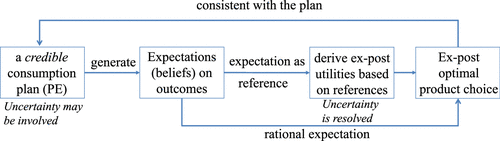
Specifically, a consumer with a prior belief about the taste , where , forms a taste-contingent consumption plan , which outlines their planned product choice(s) from the available products for every possible taste (equivalently, for every ). This plan generates two probability distributions of anticipated future consumption outcomes in the price dimension and the taste dimension denoted as and , respectively, which will serve as reference distributions.
When the uncertainty in their taste is resolved, the consumer privately observes a realized , and the consumer’s ex post consumption outcomes from buying product are in the price dimension and in the taste dimension.
To formally model reference-dependent and loss-averse preferences, in demension , for a consumption outcome and a reference point in its distribution , a weighted gain-loss utility is given by
Here, is the weight given to the gain-loss utility as compared with consumption utility, and the loss aversion coefficient is the additional weight attached to reference losses relative to reference gains. The reference gains are associated with a slope for , whereas reference losses are associated with a slope of . Loss aversion is captured with such that losses loom larger than the same-sized gains.
Notably, the ex post consumption outcome () is deterministic, whereas the reference distribution is stochastic. Per Kőszegi and Rabin (2006), when the consumer exhibits a reference-dependent preference, they compare with every possible reference point within , with each comparison weighted by the occurrence probability of that reference point. Thus, is a weighted gain-loss utility based on the probability density of the reference distribution.
I consider that both consumption outcomes and reference gain-loss utilities are additive across dimensions, so the ex post total utility for a consumer with to buy product is
Accordingly, with the realized , the consumer’s optimal product choice is determined by , the products that give them the highest ex post total utility among the available products.
I also establish the consumer’s participation constraint, which ensures that they find it better to buy something than to buy nothing. If the consumer chooses to buy nothing, then they get their initial endowment normalized to zero in both dimensions (equivalently, ). Thus, the ex post total utility of not buying, , is given by
Consumers can form any consumption plan as desired, but only credible plans are rationally expected to survive at the purchase stage. The key step in determining PE is to eliminate implausible plans and retain only credible plans in which consumers’ planned product choice generates higher ex post total utility than all other alternatives, including the option of not buying.
Formally, is a PE for a consumer with a prior belief if for every (), we have the following.
i. Optimality and internal consistency. , where and are distributions of anticipated outcomes in price and taste dimensions, respectively, generated by .
ii. Participation constraints. .
3.3. Firm’s Problem
The firm is a standard profit-maximizing monopolist that knows the distribution of consumers’ stochastic tastes but does not observe their realizations. The firm chooses prices, (these prices can be the same or different from each other), to maximize its expected profit. I assume that prices weakly increase in costs; that is, a price assigned to a higher-cost product is no lower than a price assigned to a lower-cost product (equivalently, for products with costs ).6
3.3.1. Consumer Demand.
With credible plans, every consumer follows through their plan. The consumer demand of product can be generalized and written as , where if and zero if otherwise. Here, is demand of product from consumers located in . Given that there are different intervals, the total demand of product can be aggregated from the demand from all of the intervals.
Therefore, the firm’s optimization problem is given by
subject to , and the constraints derived from PE conditions.
The timing of events is given as follows.
Stage 1. The firm announces (or makes commitment on) prices for all products.
Stage 2. For any , consumers located in form an ex ante taste-contingent consumption plan for all , based on which they derive expectations of future possible consumption outcomes, and that serve as their reference distributions.7
Stage 3. Consumers privately observe their realized tastes (i.e., uncertainty is resolved for all of the consumers).
Stage 4. Consumers decide which product to buy (PE conditions guarantee that their choices are consistent with their ex ante state-contingent consumption plans).
4. Two-Product Analysis
To best understand the insights of class pricing, I start with a scenario involving two products (equivalently, ). Consequently, there is only one interval between products with and , so we have . Ex ante consumers form a state-contingent consumption plan for all , which generates reference distributions and .
4.1. Characterization of PE
To characterize the structure of a credible plan , for a realized taste , I denote as the set of ex post realized tastes with which consumers find it optimal to buy product over other alternatives. I first explore several properties about consumers’ ex post total utilities from buying products 1 and 2 ( and , resepctively, as defined by Equation (1)) and the sets and . These properties hold true for any and .
For any arbitrary and , given ,
decreases in ;
increases in ;
both sets and are convex sets (that is, there are no holes); and
if there exists an interior cutoff point at which , then is unique, , and if and only if.
As and are independent of realized tastes, a larger value of shifts consumers’ ideal taste farther away from (or closer to) product 1 (or product 2), inducing a worse (or better) fit from buying product 1 (or product 2) in the taste dimension. By comparing the realized outcome with , it also generates a lower (or higher) reference gain-loss utility in the taste dimension. In contrast, a draw of has no impact on consumption outcomes or reference gain-loss utilities in the price dimension. Therefore, based on these monotonicity patterns in the taste dimension, Lemma 1(iii) shows that if there exists a range of realized tastes where consumers ex post choose product 1 (or product 2) over other alternatives, then in any adjacent region to the left (or right) of that range, consumers will also prefer product 1 (or product 2).
Because buying the more affordable product 1 generates both higher consumption outcome and reference gain-loss utility than buying the more expensive product 2 in the price dimension, if there exists an interior cutoff point where consumers are indifferent between products 1 and 2, the indifferent consumer must attain a better fit and reference gain-loss utility in the taste dimension by locating more closely to product 2.
When there is no difference between prices (), comparison between prices generates no reference gain or loss in the price dimension. Anticipating equal total utilities between buying products 1 and 2 in the price dimension, the indifferent consumer must also obtain equal total utilities in the taste dimension. This can be achieved when they position themselves precisely at , the midpoint of the Hotelling line, ensuring an equal distance from either product.
Building on Lemma 1, I formally characterize the structure and uniqueness of an interior PE as follows.
(
Proposition 1 establishes a subgame equilibrium on the consumer side. Intuitively, this PE partitions into two intervals, with as an interior cutoff point. Based on the reference distributions generated by this plan, consumers find it better to buy product 1 (or product 2) over other alternatives when the realized taste falls in (or ). Therefore, these preplanned product choices are indeed ex post optimal. By Lemma 1(iv), , so the indifferent consumer is located more closely to product 2.
Proposition 1 also identifies conditions for the existence and uniqueness of this PE. First, I focus on interior PE, where every product has positive demand (equivalently, ). This happens when the price difference between the two products is not too large (condition (i) in Proposition 1); otherwise, consumers always plan to buy product 1 over product 2. Condition (ii) in Proposition 1 is a participation constraint to ensure that every consumer finds it better to buy something than buy nothing.
4.2. Indifferent Consumer’s Behavior
Before I proceed to the firm’s optimal pricing strategies, I explore the key driver of class pricing—the behavior of the consumer who is indifferent between buying product 1 and product 2. The credible plan (PE) characterized in Proposition 1 specifies that the indifferent consumer is located at .
The credible plan generates distributions of anticipated future consumption outcomes in the price and taste dimensions, which serve as reference distributions and , respectively. In the price dimension, this plan generates a discrete distribution with two possible future outcomes: with the probability that falls in , which is , or with the probability that falls in , which is . Thus, . In the taste dimension, this plan generates a dense distribution with outcomes . Given , the probability density of is for and zero otherwise.
Therefore, by applying Equation (1), the indifferent consumer’s total utility from buying product 1, , is given by
The first term is the indifferent consumer’s economic consumption outcome from buying product 1. The subsequent two terms reflect the reference gain/loss in the price dimension weighted by the probability of the corresponding reference point’s occurrence. Like other consumers, because stands as the lowest price available in the market, the indifferent consumer experiences exclusive reference gain and zero reference loss in the price dimension when buying product 1, weighted by the probability of planning to buy product 2 ex ante.
The last two terms reflect the weighted reference gain/loss in the taste dimension. In contrast, the indifferent consumer experiences zero gain but exclusive reference loss in the taste dimension as they locate farthest from product 1 than any other consumers from their intended product choices, resulting in the worst fit.
Also, by applying Equation (1), the indifferent consumer’s total utility from buying product 2, , is given by
In the price dimension, with as the highest price in the market, the indifferent consumer experiences no reference gain but exclusive reference loss from buying product 2, weighted by the probability of planning to buy product 1 ex ante.
In the taste dimension, the indifferent consumer experiences a mixture of reference gain and loss. Reference loss prevails except within the region . For tastes falling in this interval, consumers anticipate being located farther away from their intended product 1 compared with the distance between the indifferent consumer and product 2, so choosing product 2 generates better fit than from the intended product 1, generating reference gain. Note that only when , this specific region vanishes, and the indifferent consumer experiences exclusive reference loss from buying product 2, mirroring the exclusive reference loss from buying product 1 in the taste dimension.
A unique feature of my setup is that the firm can use prices to manage consumers’ expectations and that consumers can rationally anticipate the indifferent consumer’s location based on prices. Given that the indifferent consumer attains equal total utilities between buying products 1 and 2 (equivalently, ), we have
In the price dimension, product 2 suffers a relative price disadvantage over product 1 quantified as the negative price difference amplified by a combination of partial recognized loss and partial foregone gain, . Conversely, product 2 gains a relative taste advantage over product 1 quantified as the positive taste outcome difference amplified by a reduced loss offset by partial gain, .
I denote as the price difference between product 2 and product 1, and derive the responsiveness of to , , based on Equation (5):
The derivative of is determined by two opposing effects. First, an increase in widens the normalized relative taste advantage of product 2 over product 1 (as captured by the first term in Equation (6)), which necessitates a larger price difference. Second, it also increases the reference price weight , which reduces the required price difference. Substituting Equation (5) into Equation (6) yields the expression of listed on the second line in Equation (6). Note that when is small (i.e., ), the second term is negligible, so is mainly determined by the taste-to-price reference weight ratio.
When the indifferent consumer chooses not to buy (applying Equation (2), like all other consumers), their total utility of not buying, , is given by
Choosing not to buy saves possible paid prices, thereby generating exclusive reference gain in the price dimension. Conversely, no buying foregoes possible intrinsic benefits from owning a product, leading to exclusive reference loss in the taste dimension.
Following participation constraints, all consumers prefer to make a purchase rather than abstain. This is ensured when even the indifferent consumer is willing to make a purchase. Equivalently, we have .
4.3. The Optimality of Class Pricing
Because every consumer ex post follows through their credible ex ante plans, consumer demand is determined by the PE. Accordingly, the consumer demand for product 1 is , and the consumer demand for product 2 is . Solving Equation (5) yields an explicit expression of endogenously determined :
Note that can be elegantly represented as a function of . To ensure an interior , I can further establish a constraint regarding the upper bound of , which gives that .
Accordingly, the firm’s optimization problem is defined as Problem 1 below .
subject to:
1. ;
2. (indifference condition based on PE) as defined in Equation (8);
3. (participation constraint) ; and
4. (interior equilibrium condition) .
An important aspect of a monopolistic environment is the monopolist’s unique ability to extract consumer surplus by leveraging multiple prices collectively. The following lemma establishes how the monopolist extracts consumer value in this optimization problem.
(
Intuitively, given that the consumer demand is a function of the price difference (Equation (8)), if the monopolist sets for product 1 and for product 2, it follows that the monopolist could achieve a strictly higher profit by simultaneously raising the price for product 1 from to and the price for product 2 from to . In this way, both prices increase without changing their products’ demands as the price difference remains at .8
With a full value extraction, the monopolist sets prices at consumers’ maximum willingness to pay. Consumers’ WTP for product 1, denoted as , can be derived based on . Accordingly, we have
In the price dimension, buying nothing saves all of the money, a higher economic outcome than buying product 1, generating a relative price advantage and thereby, a full gain for all of the possible states denoted as . In contrast, in the taste dimension, not getting a product at all yields a lower economic outcome than buying product 1, generating a relative taste disadvantage and thereby, a full loss for the whole span of possible tastes denoted as .
Consequently, WTP for product 1 is derived as
This readily yields an expression of , the responsiveness of product 1’s WTP to its own demand :
Note that both reference weights and are constants independent of and that always stays negative. The negative relationship between and occurs because the relative taste disadvantage of not buying compared with buying product 1 must be offset by its relative price advantage.
Similarly, I can also derive WTP for product 2, , based on . Because of the complexities arising from a mix of reference gain and loss in both the price and taste dimensions between and , the expression of is tedious. This posess a challenge in understanding the cross-price response to demand, that is, how product 2’s WTP responds to the demand of its alternative product , captured by . Rather than a direct derivation, given under full value extraction, I find: . Therefore, alternatively, a more elegant way to elucidate the characteristics of is to compare the relative effects between and . The proposition below summarizes how loss aversion constrains the responsiveness of the weakly more expensive product 2’s WTP to .
(
The responsiveness of the weakly more expensive product’s WTP to the cheaper product’s demand decreases in the degree of loss aversion. Mathematically, decreases in .
The responsiveness of the weakly more expensive product’s WTP to the cheaper product’s demand is positive under weak loss aversion and negative under strong loss aversion. Mathematically, when and when .
Because , the suppressive effect of loss aversion on the WTP for the weakly more expensive product can be decomposed into its effect on (1) the cheaper product’s price responsiveness, , and (2) the price difference responsiveness, . The impact on is direct. When comparing the outside option with product 1, higher amplifies the full-loss weight in the taste dimension but leaves the full-gain weight unchanged in the price dimension. Therefore, decreases linearly in .
Although the responsiveness of to exhibits a more complicated nonmonotone pattern,9 it is always dominated by the responsiveness of , resulting in a net decrease of in . When is large, both and decrease in . When is small, as discussed about Equation (6), both and are primarily determined by their respective taste-to-price reference weight ratios, and their responsiveness to reflects the net elasticity difference between the associated taste and price weights regarding . Structurally, is less sensitive to than , and its loss component constitutes a smaller fraction of the total weight. This results in a lower elasticity for than . More importantly, ’s elasticity exceeds half that of . This occurs because the partial loss portion in is no smaller than its partial gain portion, causing the loss component to be weighted more heavily than half of the full loss in . In contrast, exhibits zero elasticity as its full gain component is independent of . These effects collectively imply that the net elasticity governing in is less than half of that governing , leading to a weaker responsiveness of to than .
To illustrate, Figure 2 compares how , , , and change with when . Although increases with for small , its rate of increase is always smaller in magnitude than the rate of decrease in , inducing a negative responsiveness of to .
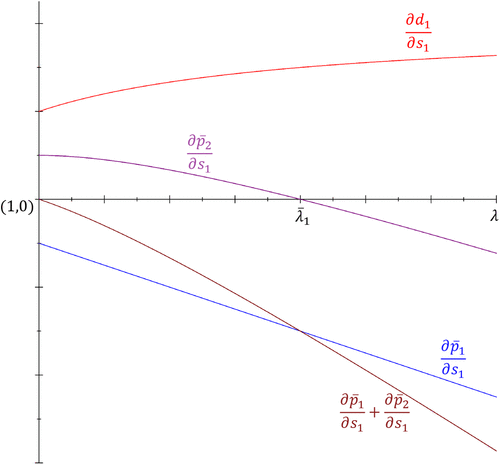
Despite its decrease in , does not exhibit a consistent sign. Unlike , which remains negative, the value of depends on the degree of loss aversion, being positive for small and negative for large as illustrated in Figure 2. When , the reference taste weight is the same as the reference price weight. This parallels the classic model without loss aversion, where and are equally responsive to the change in but in opposite directions. Specifically, , and .10 When , is bounded above, whereas is unboundedly negative, resulting in a negative value of .
Building on Proposition 2 and by solving Problem 1, I characterize the conditions under which class pricing emerges as an optimal strategy as summarized in the proposition below.
(
Proposition 3 highlights the optimality of class pricing despite variances in the products’ marginal costs.11 I show that the core driver of class pricing centers around the demand-side effect driven by consumers’ loss aversion. In the absence of loss aversion (), class pricing does not exist for , and the monopolist will find it optimal to use different prices for different products.
Motivated by variations in costs, the firm has an incentive to deviate from class pricing and increase demand for the low-cost product, , to leverage its higher profit margin relative to its high-cost counterpart if priced equally. However, this strategy invariably leads to a decrease in total revenue from selling both products. The impact of loss aversion diminishes consumers’ WTP for the low-cost product more significantly than it can elevate the WTP for the high-cost alternative. As illustrated in Figure 2, and if and only if . In the Appendix, I formally prove that holds for any .
Specifically, for the low-cost product, an expansion in demand dilutes its alignment with the taste of the indifferent consumer and diminishes its product fit. This decreased fit increases reference loss in the taste dimension. To make the product attractive to the outside option, the firm must induce a compensating complete reference gain in the price dimension to offset the increased complete loss in the taste dimension. This necessitates a substantially lower price, creating a significant reduction in the WTP for the low-cost product.
For its high-cost counterpart, a marginal increase in affects its WTP through the net effect of the marginal reduction in the low-cost product’s WTP and the marginal adjustment in the price difference. The former is a constant independent of : namely, the ratio of a full taste loss to a full price gain (Equation (11)). The latter, in contrast, is contingent on as established in Equation (6).
When the firm deviates marginally from an equal price by increasing just above , the demand shift alters consumer valuation in both dimensions. In the taste dimension, it enhances the fit of the high-cost product, and thus, it simultaneously increases the reference loss for buying the low-cost (cheaper) product while reducing the reference loss for buying the high-cost (expensive) alternative. Because the fit of the outside option remains unchanged, this shift increases the expensive product’s taste advantage over the cheaper one twice as fast as it decreases the cheaper product’s taste advantage over the outside option.
In the price dimension, the price difference is asymmetrically weighted as a partial reference gain for the cheaper product but a partial reference loss for the expensive one. Therefore, choosing the expensive product imposes both a realized partial loss and a foregone partial gain for missing the cheaper one (see Equation (5)). The dual cost creates a price disadvantage for the expensive product scaled by a composite weight that captures both the incurred partial loss and the missed partial gain. A larger necessitates a smaller price difference to prevent overwhelming consumer resistance to this compounded disadvantage.
When the firm fully extracts the indifferent consumer’s value, any marginal improvement in relative taste advantage between options will be precisely offset by a marginal worsening of relative price disadvantage via pricing. Although the firm widens the price difference to leverage the expensive product’s increased taste advantage, loss aversion in the price dimension introduces a critical asymmetry. Because of loss aversion, the composite weight , which reflects both the incurred partial loss and the missed partial gain, is larger than the full gain assigned to the cheaper product’s price disadvantage over the outside option. This asymmetry caps the permissible marginal increase in the price difference to be less than twice the magnitude of the marginal reduction in the cheaper product’s WTP.
As shown in Proposition 2 and illustrated in the left panel of Figure 3, when loss aversion is not too strong, an increase in can raise the WTP for the expensive product. However, because of the critical cap on the price difference, this increase is entirely offset by the larger reduction in the low-cost product’s WTP, resulting in a net decrease in total revenue from both products. When loss aversion is extremely strong, as illustrated in the right panel of Figure 3, the marginal increase in the price difference is itself insufficient to counterbalance the marginal reduction in the low-cost product’s WTP. Consequently, the WTP for both products declines, also leading to a reduced total revenue.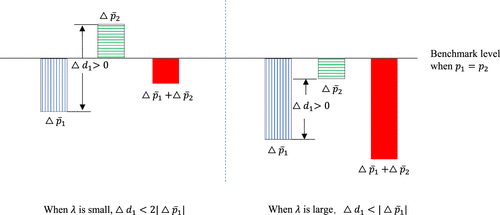
As increases beyond , in the taste dimension, any further increase in reduces merely a partial reference loss for buying the high-cost product unlike the reduction of a complete loss with . This partial loss results from an offsetting reference gain accrued over the range . Because a larger means that a greater portion of the loss is counteracted by this gain, it leads to a smaller net reduction in reference loss for buying the high-cost product, diminishing its marginal taste advantage over the low-cost product. In the price dimension, a larger shifts purchase probability toward the cheaper product; thus, choosing the expensive product entails a larger realized loss and a smaller foregone gain from the low-cost product, thereby worsening the expensive product’s marginal price disadvantage. Additionally, a larger requires a smaller price difference to counterbalance any marginal change in taste advantage. All of these combined effects suggest that the marginal change in the price difference decreases in .12 This resulting concavity of the price difference in relation to establishes that class pricing (resulting in ) is not just locally but globally optimal.
It is noteworthy that the firm’s optimal price within class pricing increases in loss aversion. Here, the utility of not buying depending on loss aversion plays a key role. When consumers plan to buy something ex ante, not getting a product is evaluated as a reference loss, and saving money is evaluated as a reference gain. As loss aversion intensifies, to offset the increased reference loss in the taste dimension, consumers are willing to raise their willingness to pay in the price dimension. Therefore, this result mirrors the endowment effect using expectations-based prospect theory.13
My theoretical analysis can provide valuable managerial insights in optimizing firms’ profit and in understanding consumer surplus implications with class pricing. Within class pricing, the firm’s optimal profit is derived as
The consumer surplus is derived as follows:
The proposition below summarizes how loss aversion can influence the firm’s optimal profit and consumer surplus.
(
the firm’s optimal profit with class pricing increases in the degree of loss aversion; and
consumer surplus with class pricing decreases in the degree of loss aversion.
Building on my previous discussions in Proposition 3, it is evident that consumers’ willingness to pay increases in loss aversion because of the endowment effect. Leveraging this endowment effect, the monopolist exploits consumers by charging at their WTP. Consequently, as loss aversion intensifies, the firm experiences an increase in its optimal profit. However, this comes at the expense of consumer surplus as consumers find themselves paying higher prices because of their increased aversion to losses. My result underscores the trade-off between consumer welfare and firm profitability in the context of monopolistic pricing strategies.
5. A Generalized Model
In this section, I extend class-pricing strategies to a generalized N-product case. When , several new challenges and distinctions from the two-product analysis emerge.
5.1. Challenge 1: Uniqueness of PE
Consider an arbitrary interval (); one may ask if a consumer could have other possible plans (i.e., ex ante, they plan to buy other product () or ( for a certain region on ). Multiple PEs are likely, making it challenging to derive consumer demand. In a two-product analysis, the uniqueness of an interior PE is automatically satisfied based on Proposition 1 because there are only two product choices for the interval . Below, I identify a condition to eliminate alternative plans and ensure the uniqueness of the PE.
(
Lemma 3 rules out the scenarios in which consumers find it credible to buy products other than the two located most closely to their ideal taste. This is reasonable because a monopolist has little incentive to cannibalize its neighboring products so much that one product has very little demand. With the imposed up bound to the price difference, the result holds true for any arbitrary consumption plans.
Intuitively and obviously, any planned choice of buying a product located to the right of product will be dominated by product ex post, so it will not be ex post optimal. Compared with , any product () is no cheaper and located farther; thus, it always yields lower utilities on both the price and taste dimensions than product does.
Compare the ex post utilities of buying () and buying . For any arbitrary reference point, the difference in the reference utilities from buying and is always bounded above by . When the price difference is not too large, the maximum benefits of buying the cheaper product relative to buying in the price dimension cannot offset the least negative difference between the two in the taste dimension; thus, buying always yields a lower ex post utility.
Accordingly, Proposition A1 in the Appendix formally characterizes the structure of PE in the generalized N-product case. The PE structure is similar with the two-product PE as characterized in Proposition 1: for a consumer with a prior , , they plan to buy product if , plan to buy product if , and are indifferent between product and when , where . Intuitively, this PE partitions into two intervals with as an interior cutoff point, and on each interval, there is a planned choice that is also ex post optimal among the available products.
5.2. Challenge 2: Emergence of Middle Products
In the two-product analysis, each product has only one neighboring product; thus, the demand of one product solely influences the demand for the other. Now, consider a simple case. In this case, unlike the demands for product 1 or product 3, which are located at the ends of the Hotelling line, the demand for product 2, situated between products 1 and 3, affects the demands for both of its two neighboring products on the left and on the right (i.e., products 1 and 3, respectively). These products located in between are hence referred to as “middle products.” Generally, the demand for the middle product is given by
Note that for product , its total demand is composed of its demand between products and and its demand between products and .
Therefore, the firm’s optimization problem for the generalized N-product case is summarized as Problem 2 below, subject to a set of constraints.
subject to:
;
2. (indifference conditions based on PE)
3. (participation constraints): , ; and
4. (uniqueness and interior equilibrium conditions): , .
The demand for middle products presents technical challenges to the firm’s optimization problem. This is because the profit function is not well behaved in prices given the interdependency of demands for middle products.
5.3. Challenge 3: The Growing Number of Interdependent Constraints
Another source of complexity comes from the multitude of constraints; specifically, there are participation constraints that establish the upper bounds for all prices. Notably, the intricacy emerges from the interdependence of these constraints. The upper bound for derived as , where is a function of both and as indicated in (2) in Problem 2, is intertwined with both upper bounds for and , adding significant technical complexity in solving the optimization problem.
To address both challenges 2 and 3, I instead focus on a transformed problem, define below as Problem 3. In Problem 3, I define and transform the objective function with respect to prices in Problem 2 into an objective function with respect to and ().
subject to:
1. (indifference conditions based on PE):
2. (participation constraint): ; and
3. (uniqueness and interior equilibrium conditions): , .
Consider that all of the cutoff points () can be expressed as a function of as the price difference between two adjacent products and that all of the prices can also be expressed as the sum of and a series of ’s (i.e., ); so, I transform the optimization of Problem 2 over prices into a problem maximizing over and all of the ’s. Furthermore, I identify the tightest participation constraint listed as Constraint 2 in Problem 3. I show in the proof that when this participation constraint is satisfied, all other participation constraints are spontaneously satisfied. This reduces the number of participation constraints from to just one participation constraint in Problem 3. In the subsequent analysis, I focus on the case when .14 By solving Problem 3, I determine the circumstances in which class prices are optimal strategies and present the findings in the following proposition.
(
Proposition 5 establishes the robustness of class pricing in the generalized N-product case and identifies the conditions under which class pricing is optimal. Similar to Proposition 3, the optimality of class pricing is mainly driven by consumer loss aversion. A larger pricing class emerges when the impact of loss aversion outweighs the cost differences across a greater number of adjacent product pairs. The intuition is similar. Briefly, although employing unequal prices favors higher consumer demand for lower-priced products, loss aversion constrains the cap of the price difference between products, limiting the firm’s ability to capitalize on the expensive alternative’s increased taste advantage. Therefore, the possible increase in WTP for expensive products is entirely offset by the decrease in the WTP for cheaper alternatives, leading to a net decline in the total revenue.
Based on this more generalized model, I can generate several new insights that are absent from the two-product analysis.
5.4. New Insight 1: Formation of the Optimal Number of Classes, Class Sizes, and Product Grouping Patterns
In the two-product scenario, only single-class pricing can emerge, limiting the exploration of more complicated pricing structures involving at least two pricing classes and their class sizes as well as how to group the products into different pricing classes. Consider pricing classes for products; there are ways to divide products into classes. Proposition 5 establishes the conditions for each grouping method, yet detailing all possible groupings is challenging. Therefore, I focus on an case and a numerical example with for illustration purposes.
(
(One-class pricing/uniform pricing) When and both hold, it is optimal for the firm to group all three products into one pricing class; thus, the optimal number of classes , and this class has a size of three products.
(Two-class pricing)
2.1. When and , it is optimal for the firm to group products 1 and 2 as a pricing class (with a class size of two products) and leave product 3 as a separate class; thus, .
2.2. When and , it is optimal for the firm to leave product 1 as one class and group products 2 and 3 as a separate pricing class (with a class size of two products); thus, .
(Individual prices) When and , it is optimal for the firm to use different prices for different products; thus, .
(
5.5. New Insight 2: Class Size and Loss Aversion
In the two-product analysis, because there is a single pricing class, its class includes both products. With a generalized N-product model, different pricing classes with multiple products are not necessarily of equal size. The size of a pricing class is determined by the interplay between cost differentials and the strength of the effect from loss aversion, and these relative interplays are not necessarily uniform. Corollary 1 summarizes how class size can be impacted by consumers’ loss aversion.
(
A larger indicates stronger effects stemming from the loss aversion, which acts as the primary driver of class pricing. As increases, the conditions pertaining to the cost differentials between products become generally more relaxed, inducing the firm to group a weakly larger number of products into each pricing class. Consequently, this results in the formation of larger-sized pricing classes. One limitation is that products’ demands can be highly responsive to large values of , which can lead to a not-well-behaved profit function. Therefore, this monotonic pattern about class sizes concerning is bounded above by in scenarios involving a large number of products.
6. Discussion and Conclusions
Class pricing is a widely observed yet understudied phenomenon. Theoretically, this research adds to the limited existing understanding of class pricing, which has been primarily attributed to firm-side frictions, such as the costs of setting prices (Wernerfelt 2008). I show that although cost variations motivate unequal prices to stimulate consumer demand for lower-cost products, the influence of loss aversion constrains this practice and diminishes consumers’ WTP for cheaper products more significantly than it can elevate WTP for higher-priced alternatives. This asymmetry decreases a firm’s total profit and leads to class pricing.
Methodologically, I advance the growing body of literature that applies the Kőszegi and Rabin (2006) concept of endogenous expectations-based loss aversion. Most existing research focuses on single-product firms because of the challenges of solving personal equilibria in generalized contexts with endogenous reference points. I overcome these challenges and extend the Kőszegi and Rabin (2006) model to a monopolistic multiproduct environment with consumer heterogeneity in their beliefs. My research emphasizes the importance of identifying credible consumption plans and determining personal equilibria in complex settings.
Managerially, my paper sheds light on the following implications and insights.
6.1. When Should We Use Class Prices?
My findings suggest that class pricing is superior to individual pricing when loss-averse consumers shop primarily on prices. This strategy can be applied to various product categories, such as fast-moving consumer packaged goods, grocery items, fast-food and quick-service restaurants, toys, discount stores, convenience stores, and budget airlines among others. Conversely, class pricing is less prevalent in product categories where price is a less salient attribute, such as antiques or artwork.
When assessing the optimality of class pricing, managers can consider specific questions, such as “is price the dominant factor in the purchase decision?,” “do consumers frequently compare prices within our category?,” “how can we frame gain or loss in pricing strategies?,” etc. Moreover, managers can measure the strength of loss aversion through a combination of various methods, including survey design asking customers to rate their perceived “loss” in the taste and “gain” in purchase scenarios, controlled experiments that offer identical products at different prices to measure how framing of gain or loss affects consumer choices, and observational data analysis to analyze historical sales data and market responses to infer consumers’ sensitivity to losses.
6.2. Class Size and Profit with Class Pricing
This research provides valuable insights for marketing professionals to better comprehend the necessity and desirability of class pricing, pricing class formation, and its profit and consumer surplus implications. When implementing class pricing, managers should carefully evaluate the appropriate number and size of pricing classes based on consumer sensitivity to price differentials and loss aversion tendencies and consider the asymmetry in consumers’ willingness to pay for products at different price points. My results suggest that products with strong consumer loss aversion in pricing should be grouped into a large pricing class to prevent revenue reductions. I also show that firms’ profits increase with loss aversion at the expense of consumer surplus, which highlights the challenges and intricacies involved in effectively managing class-pricing strategies while considering their broader impacts on consumer welfare.
6.3. Reassessment of Individual Prices Based on Big Data and AI
Conventional economic intuition holds that setting prices that are not fully responsive to costs or values is inefficient and can be generally improved. With new technologies, firms can now use big data to exploit consumer values from consumer purchase history, geolocations, social-economic status, etc.; assign different prices to different products; and implement high-frequency AI-based pricing algorithms to exacerbate price differentials among products. My work suggests that these may not necessarily enhance firms’ profitability. Instead, firms could benefit from incorporating psychological factors that influence consumer purchase decisions and use fewer and not more price points to improve profit performance.
My analytical model makes several simplification assumptions, which open avenues for future research. First, all of class decisions are made by a monopolist, and my model does not account for seller competition. Although I believe that my main results might hold in competitive settings, further insights may emerge for firms in strategic multiproduct contexts. Second, I assume that the locations of an assortment of horizontally differentiable products with varying costs are exogenous in the multiproduct context. Endogenizing location decisions could yield fruitful insights. Third, my model does not consider impulse purchases from street vendors, which are entirely unplanned. At the other extreme, my model does not address purchase settings involving long, complex journeys with ongoing updating of consumption plans, such as buying a house. A promising direction for future research is to incorporate dynamic consumption plans that can be updated by consumers based on prior outcomes.
The author is grateful to her PhD advisor, George John, for his invaluable support and guidance, without which this paper would not have been possible. The author is indebted to her other dissertation committee members, Mark Bergen, Yi Zhu, and David Rahman, for their insightful feedback. The author thanks the senior editor, the associate editor, and two anonymous reviewers for their constructive comments that greatly strengthened this work. The author also thanks seminar participants at the Chinese University of Hong Kong (Shenzhen), Iowa State University, the University of Wisconsin–Milwaukee, and the University of Illinois Urbana-Champaign as well as conference participants at the 2017 American Marketing Association-Sheth Doctoral Consortium, the 2017 American Marketing Association summer conference, and the 2018 INFORMS Marketing Science Conference. The author thanks the marketing faculty group at the Carlson School of Management, University of Minnesota for their support. This paper is based on the first essay of the author’s doctoral dissertation at the University of Minnesota Twin Cities. The author certifies that she has no affiliations with or involvement in any organization or entity with any financial interest or nonfinancial interest in the subject matter or materials discussed in this manuscript.
1 I acknowledge the associate editor’s extremely valuable input and summary regarding these differentiations.
2 I thank the anonymous reviewer for their valuable input in motivating me to compare various effects of loss aversion driven by analogous externality impacts.
3 My model results are robust in the setting of vertical differentiation. Detailed results are available upon request.
4 This setup about products is similar to that Wernerfelt (2008), which also assumes horizontal differentiated products with variations in marginal costs. When all of the products have the same value and cost, class pricing (specifically, one-class/uniform pricing in this case) would naturally emerge. Therefore, both Wernerfelt (2008) and this paper focus on new rationales for class pricing despite cost variations. I appreciate the anonymous referee for the valuable insights on the similarities between these two papers. To justify the existence of cost variations between horizontally differentiated products, consider clothes with various colors as an example. In the manufacturing process, producing darker colors in clothing requires more or stronger dyes and more extensive color fastness testing compared with lighter colors. As a result, dark garments incur higher production costs than light ones.
5 To justify the assumption of uncertain fit over a subset of all available products as reasonable, the literature on variety seeking and brand switching (McAlister and Pessemier 1982, Givon 1984) has consistently offered theoretical and empirical support. For example, a consumer who prefers sweet-tasting yogurt over sour-tasting yogurt may narrow down their choices to options such as honey and pineapple flavors while excluding alternatives, like lemon or key lime. Similarly, a consumer who favors dark-colored clothes may limit their consideration to options like navy blue or black while disregarding choices such as white or beige.
6 This assumption is supported by extensive empirical evidence on retailers’ pass-through of their costs, such as wholesale prices to shelf prices, which has been observed across a wide spectrum of product categories (Besanko et al. 2005, Nakamura 2008). Analytically, characterizing the full set of asymmetric optimal prices for products with asymmetric costs seems very challenging. There are ways to divide products into classes. Furthermore, the firm needs to compare cases to determine the globally optimal number of classes . I am not aware of general characterizations even for the classic model without reference-dependent preferences. This assumption helps reduce some complexity of the already-complex firm-side optimization problem.
7 This setup is an important departure from Heidhues and Kőszegi (2008). Heidhues and Kőszegi (2008) assumes that consumers do not know firm prices and form their expectations before observing firm prices. As a result, firms cannot influence consumers’ expectations and are not obligated to comply with consumers’ expectations. In contrast, this paper examines cases where firms first make commitment of prices, enabling consumers to know firm prices when forming their expectations. My paper is well suited to understanding long-run behaviors of firms and consumers when firms can make credible price commitments.
8 This result reveals two crucial distinctions between my paper and Heidhues and Kőszegi (2008). First, this full value extraction effect is absent from Heidhues and Kőszegi (2008), and the utility of not buying is not considered in their model. In contrast to monopolistic settings, their competitive setting benefits rather than exploits indifferent consumers, resulting in positive surplus for them. Second, the two papers rely on distinct consumer utilities. The firm-determined reference points facilitate price comparisons between products, resulting in product-specific reference utilities that derive consumer demand as a function of price difference between products. When all of the prices are the same, there is no reference gains or loss in the price dimension. Conversely, Heidhues and Kőszegi (2008) features consumer-generated reference points that are independent of firm prices; therefore, their utility of buying product is unaffected by , and their consumer demand is not a function of price difference. When all of the firm prices are the same, there might still exist reference gains or losses by comparing prices with consumer-formed references. I thank the anonymous reviewer for engaging insightful feedback that has enriched my understanding on these fundamental distinctions between these two papers. This scrutiny has also significantly enhanced the contribution of my work.
9 In the Appendix, I establish that increases in for small but decreases in for large .
10 This result demonstrates how my multiproduct monopolistic setting contrasts with competitive settings. In competitive settings, reducing the price of one product incentivizes its neighboring competitors to lower their prices as well. In contrast, in my model, unless under very strong loss aversion, reducing the price for one product incentivizes the monopolist to increase the price of its neighboring product.
11 The class-pricing model results do not rely on the assumption of variations in marginal costs. When cost variations are absent, the condition for class pricing listed in Proposition 3 is always met for . In this case, the monopolist lacks cost-based incentive to use different prices for different products, which adds to the demand-side justification for adopting class pricing and enhances the robustness of my model results.
12 Formally, I prove that in the Appendix.
13 Interestingly, loss aversion also leads to higher prices in Heidhues and Kőszegi (2008) but is based on a different rationale of reduced price competition. In contrast, my results are grounded in the monopolist’s ability to leverage the endowment effect. I acknowledge the associate editor’s valuable input on this differentiation between this paper and Heidhues and Kőszegi (2008).
14 Although my main model with two products has showcased the robustness of class pricing with exceptionally high loss aversion, the N-product optimization problem focuses on when is not excessively high. For , this upper bound for ranges from . Empirical estimates of range from 1.3 to 2.6 (see Ho and Zhang 2008 for a summary), and the value of ranges from 0.299 to 1.886 (Crawford and Meng 2011). Therefore, the assumed range of in this lemma sufficiently encompasses these reported estimates. Additionally, because my model’s intuition depends only on the behaviors of indifferent consumers, it should remain robust for certain variations in across individuals. I thank the anonymous referee for bringing up this issue, and I appreciate the associate editor’s valuable input regarding this matter.
15 is a function of and . The expression of is tedious, and it is provided in the proof of this proposition in the Appendix.
References
- (2011) Reference points and effort provision. Amer. Econom. Rev. 101(2):470–492.Crossref, Google Scholar
- (2007) Modelling OECD industrial energy demand: Asymmetric price responses and energy-saving technical change. Energy Econom. 29(4):693–709.Crossref, Google Scholar
- (2018) Reference-dependent utility, product variety, and price competition. Management Sci. 64(9):4302–4316.Link, Google Scholar
- (2005) Own-brand and cross-brand retail pass-through. Marketing Sci. 24(1):123–137.Link, Google Scholar
- (1995) An analysis of asymmetric demand response to price changes: The case of local telephone calls. J. Regulatory Econom. 8(3):285–298. Crossref, Google Scholar
- (2013) The benefit of uniform price for branded variants. Marketing Sci. 32(1):36–50.Link, Google Scholar
- (1998) Third-degree price discrimination in oligopoly: All-out competition and strategic commitment. RAND J. Econom. 29(2):306–323.Crossref, Google Scholar
- (2011) New York City cab drivers’ labor supply revisited: Reference-dependent preferences with rational expectations targets for hours and income. Amer. Econom. Rev. 101(5):1912–1932.Crossref, Google Scholar
- (2007) Uniform prices for differentiated goods: The case of the movie-theater industry. Internat. Rev. Law Econom. 27(2):129–153.Crossref, Google Scholar
- (2001) Understanding reference-price shoppers: A within-and cross-category analysis. J. Marketing Res. 38(4):445–457.Crossref, Google Scholar
- (2011) Expectations as endowments: Evidence on reference-dependent preferences from exchange and valuation experiments. Quart. J. Econom. 126(4):1879–1907. Crossref, Google Scholar
- (1984) Variety seeking through brand switching. Marketing Sci. 3(1):1–22.Link, Google Scholar
- (1993) Modeling loss aversion and reference dependence effects on brand choice. Marketing Sci. 12(4):378–394.Link, Google Scholar
- (2008) Competition and price variation when consumers are loss averse. Amer. Econom. Rev. 98(4):1245–1268.Crossref, Google Scholar
- (2014) Regular prices and sales. Theoret. Econom. 9(1):217–251.Crossref, Google Scholar
- (2008) Designing pricing contracts for boundedly rational customers: Does the framing of the fixed fee matter? Management Sci. 54(4):686–700.Link, Google Scholar
- (1989) The effect of third-degree price discrimination in oligopoly. Amer. Econom. Rev. 79(1):244–250.Google Scholar
- (1929) Stability in competition. Econom. J. 39(153):41–57.Google Scholar
- (1979) Prospect theory: An analysis of decision under risk. Econometrica 47(2):363–391. Crossref, Google Scholar
- (1990) A price expectations model of customer brand choice. J. Marketing Res. 27(3):251–262.Crossref, Google Scholar
- (1994) An empirical analysis of latitude of price acceptance in consumer package goods. J. Consumer Res. 21(3):408–418.Crossref, Google Scholar
- (2014) Competition under consumer loss aversion. RAND J. Econom. 45(1):1–31.Crossref, Google Scholar
- (2006) A model of reference-dependent preferences. Quart. J. Econom. 121(4):1133–1165.Crossref, Google Scholar
- (1992) Asymmetric response to price in consumer brand choice and purchase quantity decisions. J. Consumer Res. 19(3):387–400.Crossref, Google Scholar
- (2014) The bright side of loss aversion in dynamic and competitive markets. Marketing Sci. 33(5):693–711.Link, Google Scholar
- (2003) Does market experience eliminate market anomalies? Quart. J. Econom. 118(1):41–71.Crossref, Google Scholar
- (1992) An empirical analysis of internal and external reference prices using scanner data. J. Consumer Res. 19(1):62–70.Crossref, Google Scholar
- (1982) Variety seeking behavior: An interdisciplinary review. J. Consumer Res. 9(3):311–322.Crossref, Google Scholar
- (2008) Loss aversion and a kinked demand curve: Evidence from contingent behaviour analysis of seafood consumers. Appl. Econom. Lett. 15(8):625–628.Crossref, Google Scholar
- (2008) Pass-through in retail and wholesale. Amer. Econom. Rev. 98(2):430–437.Crossref, Google Scholar
- (2008) Testing reference dependence, loss aversion and diminishing sensitivity in Spanish tourism. Investigaciones Económicas 32(2):231–255.Google Scholar
- (2009) Optimal product line design when consumers exhibit choice set-dependent preferences. Marketing Sci. 28(5):868–886.Link, Google Scholar
- (1992) Incorporating reference price effects into a theory of consumer choice. Marketing Sci. 11(3):287–309.Link, Google Scholar
- (2007) A systems approach to modelling asymmetric demand responses to energy price changes. Barnett WA, Serletis A, eds. Functional Structure Inference, vol. 18 (Emerald Group Publishing Limited, Bingley, UK), 183–224.Google Scholar
- (2008) Class pricing. Marketing Sci. 27(5):755–763.Link, Google Scholar
- (2007) Brand-level effects of stockkeeping unit reductions. J. Marketing Res. 44(4):545–559.Crossref, Google Scholar
- (2021) Quality disclosure under consumer loss aversion. Management Sci. 67(8):5052–5069.Link, Google Scholar