Editorial—Report of the Marketing Science Editorial Review Committee
Abstract
This is an abridged version of an evaluation report for Marketing Science, which was commissioned by the INFORMS Publications Committee as part of its periodic review of every INFORMS journal. The coauthors listed here comprised the task force that conducted the research project and strategic analysis described below.
Introduction
The evolution of “marketing science” as a discipline has been dramatic. From a small niche group of faculty—drawn largely from elite American universities—in the late 1970s, it has grown into a large global network of scholars, vendors, and client practitioners that proudly associate themselves with this label. The collective impact of their academic and applied efforts is undeniable, and the future outlook for this field is quite promising.
In parallel, the field’s flagship journal, Marketing Science, has seen similar growth in the breadth of contributors, readers, and topics covered. The raw “dashboard metrics” for the journal are strong, but it is the qualitative aspects that are most impressive. The diversity of topics covered in the journal would have been inconceivable for the journal’s founders 30 years ago, and the quality of the work published is higher than ever. As a whole, the breadth and depth of the journal’s intellectual richness are unquestioned.
When the journal is viewed purely by these conventional metrics, it is in great shape. We conducted a survey (more details about it to follow) that clearly confirms this assessment and leaves little reason to question the journal’s overall health and mission. As such, we will not dwell extensively on these traditional facts and figures in this report; we do not want to merely “pat ourselves on the back” but would rather focus our efforts on addressing an important issue with a major impact on the journal’s future.
Despite the generally rosy state of affairs for the journal, it has been facing some tough questions in recent years. In particular, many members of the marketing science community have questioned the viability of the current editorial structure, i.e., a single editor-in-chief (EIC) supported by a group of roughly 25 associate editors (AEs), who rely on an editorial board of roughly 100 members (and a number of ad hoc outsiders) to evaluate several hundred papers that are submitted every year. Although this model has worked well for three decades, and we have been blessed by having an unbroken succession of superb EICs, many colleagues in the field are worried about our ability to maintain this state of affairs.
Specifically, there has been an emerging consensus (confirmed by our survey) that the EIC’s job has become so demanding that many top scholars will refuse to consider taking it on. Indeed, we are aware of many strong would-be candidates who have withdrawn themselves from being nominated for the role, and it has been very challenging to get our most recent EICs to stay on the job for more than one three-year term.
The large number of submitted papers is one obvious factor that contributes to this problem, but that’s just the tip of the iceberg: as noted earlier, the breadth of papers and their technical complexity have been increasing in recent years, and we expect both of these factors to become even more challenging in the years ahead. In some respects, this is a good trend since it reflects the fact that marketing science is attracting more attention from other related technical fields such as economics, statistics, computer science, and various areas of engineering. But the additional pressures that it places on the EIC are substantial.
Ideally, we want an EIC who is deeply involved in the review process for every paper (e.g., does not delegate too much of the evaluation to a specialized AEs), but this is becoming more difficult for both of the reasons stated above. Our current and former EICs have done a remarkable job coping with these challenges and finding ways to continually improving the journal in spite of them, but there are increasing doubts about the sustainability of this progress.
In recent years, there have been a number of informal conversations about the need for changing the editorial structure as well as endless speculations about possible alternatives to the status quo. But none of these discussions had any official “blessing” of INFORMS, nor did they reflect a broad investigation of the perceptions across the full population of journal constituents. In the committee’s opinion, this year’s periodic evaluation of the journal offered a perfect opportunity to explore these issues.
With this background in mind, our committee set out to understand these critical questions with suitable depth and clarity to help INFORMS make a thoughtful decision about the journal’s future, with special emphasis on the editorial structure. The specific recommendations are covered in an accompanying piece by the journal’s new editorial team; here, we go over the detailed process that led to them.
The Survey
Our survey asked a number of general questions about overall perceptions of the journal, as well as a few more specific ones about the editorial structure. In September 2013, we sent the survey to nearly 5,000 target respondents, representing the direct constituents of Marketing Science (i.e., submitters, reviewers, subscribers, editorial board members), as well as others from the INFORMS Society for Marketing Science (ISMS) and INFORMS with no ties to the journal. We received 528 usable responses, implying a reasonable response rate of 11%. Furthermore, many respondents offered detailed unstructured comments about the focal issue, which proved to be quite insightful and helpful as we sought to make specific decisions based on the survey results—and to anticipate how these decisions would likely be received by the marketing science community. These numerous and detailed qualitative responses were also an indication of just how passionate the community members are about this issue and their desire to see the journal move ahead in the most effective manner.
General Results: Health of the Journal
As noted above, the journal appears to be in fine shape; we didn’t detect any areas of special concern or meaningful subgroups with any substantial apprehensions. Over 67% of the respondents gave the journal a top score (on a seven-point scale) for being “a highly prestigious journal,” with a top-two-box score over 87%. Similar numbers were seen for other reputational questions.
There was an undercurrent of sentiment that the journal is seen as too elitist, favors rigor over relevance, and does not have strong applicability to practice; however, these are not new concerns. For instance, the current EIC, Preyas Desai, instituted a new initiative called “Science-to-Practice” to encourage authors to create and submit a PowerPoint deck based on their published paper that could then be used for instruction in an MBA classroom. So the journal has been making meaningful strides to address this issue, and thus we do not see it as cause for any alarm.
The journal’s impact seems to be strong within our field. For example, the question “Relative to other leading quantitative marketing journals, a paper will carry more weight in a hiring/promotion case if published in Marketing Science” received a top-box score of 40% (with top-two-box score of 63%). And this strength of impact seems to be stable (if not growing): when asked to respond to the statement “The journal’s scholarly impact is growing,” only 11% disagreed. To be fair, 25% chose the middle of the scale, but it is encouraging that 54% agreed with this statement, especially during a time that many new journals with a focus on quantitative aspects of marketing have been emerging.
But whereas the journal seems to be doing very well among its core audience, it appears to have some room for improvement among two tangential audiences: nonquantitative researchers within marketing and quantitative researchers in other fields. Questions about perceptions of the journal’s impact on these two audiences received top-box scores of around 9% and top-two-box scores between 20% and 25%. This is an area worth further examination in the future.
Turning to the review process, it seems to be perceived reasonably well. For most of the questions covering different aspects of the review process (e.g., timeliness, fairness, constructiveness), the modal score was a six (out of seven), and the top-two-box scores mostly ranged from 35% to 40%. Given the “negative halo” often associated with the review process in general, this is probably about as good as it gets. We have no basis for comparison with past surveys or other journals, but our assessment is that the journal is doing fine as a whole in this regard.
And if we drill down into the questions about the EIC specifically, the responses are very strong. The two most relevant questions, “The Editor-in-Chief (EIC) makes fair, balanced decisions” and “The EIC provides clear guidance on deliverables” received strong top-box scores of 33% and 27%, respectively, and top-two-box scores of 60% and 50%, respectively. Again, given that the EIC can’t be everybody’s friend, we see this as very impressive—a strong vote of confidence for Preyas Desai (and his predecessors).
These are the principal highlights of the main part of the survey. We believe that they paint a consistent picture of a journal that is in good shape. Of course, it’s not a perfect picture by any means—there are some areas for improvement—but these concerns seem to be relatively minor, and the EIC has been taking proactive strides to address them. Thus, we focus the remainder of this report on the one issue that could drive the future success of the journal more than any other: the editorial structure.
Focal Results: Editorial Structure
In our final structured question, we got right to the point and asked, “We are contemplating a move to a new editorial structure, i.e., with a set of senior editors (having complete accept/reject authority), coordinated by a single EIC. Do you generally agree or disagree that this would be a good idea?” The top two boxes received the modal responses with 20% and 22% in each, respectively. Many respondents were relatively neutral, but only 18% chose any of the “disagree” options. So it’s not a universal mandate by any means, but there is evidence of a consensus in favor of this option, and there are no obvious “pockets of resistance” to it. Furthermore, many of the qualitative comments seemed to suggest that a number of the “disagreers” chose that option not necessarily out of principal but because of implementation concerns.
That single structured question offered support for such a proposal, but the unstructured question that followed it on the survey offered a lot of useful details that explained the logic behind respondents’ answers and (more importantly) lots of specific advice and words of caution about how to implement it. Remarkably, more than 40% of the respondents who answered the structured question also answered the unstructured one—reflecting just how important this issue is to the Marketing Science community.
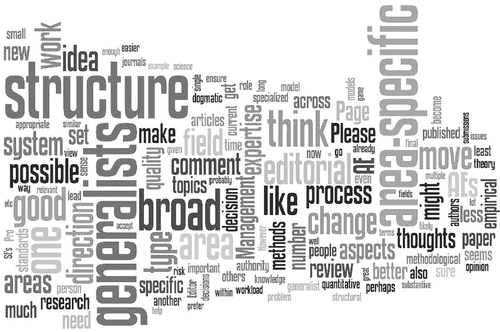
As but one way to summarize these open-ended comments in a concise manner, we present a “Wordle” in Figure 1.1 Besides its aesthetic appeal, the Wordle offers a useful summary of some of the key issues that arose in the comments, most importantly the trade-off between using “generalists” or “area specialists” as senior editors (SEs). Although the comments were generally positive about making a move toward the use of SEs, the respondents were quite divided—almost equally—on the issue of what kinds of skills SEs need.
The committee discussed this issue and many others arising from the survey results at great length. As our discussions (both via conference call and countless emails) continued, it became clear that there was strong support for a new editorial structure incorporating SEs, and we reached a solid agreement on the parameters of a proposal that seemed feasible and well positioned to address the concerns identified in the survey results (and mentioned earlier in this report).
Communicating the Proposal
We proceeded to consult with Preyas Desai and several key people involved with the INFORMS Publications Committee, and then we started to roll out our ideas to ISMS and the Marketing Science community. We began with an email to the ISMS community in October 2013. Over the two weeks that followed, there was a spirited flurry of emails from many recipients to several members of the committee. Many were simple congratulatory messages, some were questions seeking clarification about the plans we had in mind, and others expressed some concerns that were not addressed in the brief email above (but had been discussed by the committee). The most resonant concern was that the “administrative costs” of the new structure (e.g., added bureaucracy, potential lack of coordination among SEs) could outweigh its benefits. But overall this was a very useful exchange that helped fine-tune the subsequent email that laid out many more details about the proposal. As a committee, we felt it was best for this critical email to come from Preyas himself to convey his support for the proposal and his personal plans to implement it. In that email (sent in November 2013), he laid out the initial vision for the formal proposal (which is described in more detail in the accompanying editorial). In parallel, the INFORMS Publications Committee has given its formal blessing and support as well.
Conclusion
The evaluation process described here has been a relatively unusual one for the INFORMS Publications Committee, but it aptly reflects the unusual circumstances currently facing Marketing Science. It is fortuitous that it was time for INFORMS to review the journal, since that provided a perfect opportunity to undertake the study described here. We hope that the research conducted by our committee, and the recommendations and communication efforts that have emerged from it, will be useful to INFORMS as it helps guide the journal into the future.
There is no guarantee of success here, and we expect that, even in the best case, there will be a number of mid-course corrections as this new editorial structure is implemented in the months and years ahead. But we feel that our data-driven approach should make this transition easier and help anticipate (and mitigate) some of the possible risks.
We look forward to the next era for Marketing Science and expect that, with continued excellent oversight from INFORMS, the next 30 years will be as fruitful as the journal’s first 30 years.
1 A Wordle is a “word cloud” that captures the essence of a piece of text (or a set of unstructured comments), giving greater prominence to words that appear more frequently in the source text—see http://www.wordle.net/ for more information about this visualization technique.