Invited Commentary—“How Support for Black Lives Matter Impacts Consumer Responses on Social Media”
Abstract
In this commentary, we focus on the racial justice movement popularly known as BlackLivesMatter (BLM). We begin our comments by briefly noting the history that led to the formation of the BLM organization and movement. This sets the stage for our comments on “How Support for Black Lives Matter Impacts Consumer Responses on Social Media”—an issue important for marketers who must evolve with an increasingly socially inspired economy. As BLM is a polarizing issue that is often misunderstood, we first note a potential internal validity issue with research on this topic. We then discuss issues specific to Blackout Tuesday, the intervention of interest in the paper. These include the comparability of the treatment and control platforms; the need for a clear baseline during this turbulent period; the possibility that the followers in the control condition were also treated; the parallel trends assumption; and the analysis and interpretation of the authors’ headline finding that firms supporting Blackout Tuesday faced a backlash in terms of a reduction in follower growth. Throughout this comment, we offer suggestions for future research that tackles the response to social-political issues like BLM.
History: K. Sudir served as the senior editor for this article.
“How Support for Black Lives Matter Impacts Consumer Responses on Social Media” (Wang et al. 2022) is one of the first papers in the marketing science domain that attempts to examine how social media consumers respond to brand activism that supports racial justice. The authors’ key conclusion is that brand support of BlackLivesMatter (BLM or sometimes referred to as #BLM on social media) leads to a negative social media consumer response. As brands operate within the economic, social, and cultural contexts of their consumers, employees, and other stakeholders, understanding the consequences of their actions beyond just those in the product-market space, has become a clear necessity (see also Ho 2020). The paper therefore takes an important first step in enhancing our understanding of BLM-brand interactions.1
The purpose of this commentary is to offer a perspective and additional social context around this topic and the paper’s findings while providing a discussion of the main elements of the paper. We begin by briefly reviewing the historical context that set the foundation for BLM and properly define BLM as an organization and a movement. Next, we discuss how the intent and vision of BLM is misunderstood and argue that this has implications for internal validity of any analysis that focuses specifically on BLM. As such, it is important to interpret and draw inferences about consumers’ responses to BLM within the appropriate historical context. Next, we dive deeper into the “natural experiment” and the Blackout Tuesday “intervention,” which form the cornerstone of the analysis and of the basis for the paper’s conclusions. We discuss the Instagram versus Twitter comparison, which is the basis for the natural experiment; then we focus on the specific difference-in-differences analysis results that are based on data from the natural experiment. We conclude by positing that a comprehensive understanding of BLM and interpretation of the social media data around Blackout Tuesday is important for interpreting responses to antiracist brand activism and has corporate social responsibility implications.
Historical Background for Black Lives Matter
The year 2022 marks the first time in American history in which Juneteenth is recognized as a national holiday. Despite the emancipation from slavery over 150 years ago, countless accounts still exist detailing black Americans who have been subjugated to harassment or acts of excessive violence, too often resulting in death. But what distinguishes many of these accounts from the American slave period is the aggressive interactions often involve a member of law enforcement. Many have raised the question of whether the excessively violent law-enforcement interactions would have been the same if the presumed perpetrator was not black or a person of color. Race, being a common thread that unites many of the alleged victims, has logically been identified as a moderating factor that influences a person’s interaction with law enforcement thereby giving rise to social movements that have drawn attention to racial, specifically antiblack, inequalities and systemic bias. For example, #SayTheirNames (#SayTheirNames) is an organized platform that chronicles blacks who have been killed by U.S. law enforcement over the last decade and beyond. One of these such murders was that of Trayvon Martin, an unarmed 17-year-old African American male who was shot and killed by a neighborhood watch patrolman while walking home from a convenience store in his neighborhood.
In response to the acquittal of Trayvon’s killer in 2013, a series of social media posts, intended to express love to the black community, inspired the name Black Lives Matter (Chase 2018) and led to the formation of the group BlackLivesMatter. BLM started as a decentralized grassroots movement by black community organizers who galvanized others and collectively became identified as a coalition of liberators. Their mission is to “eradicate white supremacy and build local power to intervene in violence inflicted on Black communities by the state and vigilantes.” (Black Lives Matter) As the murder of other unarmed blacks by law enforcement became more broadly known, BLM grew. Fueled by public protests and justice events comprised of activists across racial lines, today BLM is a globalized nonprofit chapter-based organization affiliated with the Black Lives Matter Global Network Foundation (Encyclopedia Britannica).
In sum, BLM represents, and aspires to be, an organized group of activists from all racial backgrounds2 whose focus is on drawing attention to and eliminating the laws, institutional practices, and policies that unfairly affect black people (Black Lives Matter).3
Misunderstanding BLM
The direct reference and focus on black people has fueled seemingly negative reactions to BLM and triggered slogans such as “All Lives Matter.” They reflect a counter point and misinterpretation of BLM to mean only black lives are important or that black lives are more important than others. In a joint interview with a BLM cofounder and Alicia Garza, an organizer with the National Domestic Workers Alliance, Garza points out, “When we start to say, ‘all lives matter,’ we start to represent this post-racial narrative,” that is at odds with the countless acts of antiblack racism. Garza adds, “of course all lives matter” (Smith 2014). According to Garza, language is malleable, but “what’s embedded in our culture is a real fear of black folks and black lives. And a real disdain for black lives” (Smith 2014). For clarity, the BLM movement is about recognizing the value and contributions of black people, being no less or more important than the value and contributions of others. Other narratives that may surface around the meaning of BLM are misunderstandings and deviations from its leadership’s vision and intent.
Given this context of the data, the findings of “How Support for Black Lives Matter Impacts Consumer Responses on Social Media,” must carefully be interpreted because some of the responses reflected on social media may likely reflect these misconceptions. Specifically, a negative sentiment may well be against the mission of BLM or rather simply an expression of advocacy for a broader population that spans across racial lines. Although this distinction is not acknowledged in the paper, it is nevertheless critical for a brand to understand as it will help in deciding on subsequent courses of action.
Another factor that arises from the varied interpretations of BLM is concern about the internal validity of any study that focuses on BLM advocacy as a causal factor of consumer response. If we assume that the meaning of BLM has a clear and consistent understanding, then the natural experiment in Wang et al. (2022) is a logical approach for making a causal argument and there should be minimal concerns about internal validity. But as we have outlined in this commentary, there is significant misunderstanding or varied interpretations of BLM in the relevant study population. Therefore, if the goal is to assess the impact of support for BLM, then it is imperative that one first identify what BLM means to the respondents and attempt to establish a common meaning of the BLM construct. This approach will strengthen the internal validity of the study.
As social justice research builds on this paper, an important issue that the paper’s results also raise is whether the negative reaction to support for BLM translates into negative reaction to support for racial justice in general. It is our recommendation that in order to tackle the issue of consumer response to brand support for racial justice, one should (1) examine multiple instances of support and not a single event like Blackout Tuesday, (2) examine activism for justice across a variety of race-related issues, and (3) fully understand the context and history of the racial issues so that biases and misinterpretations can be accounted for and a baseline for comparison can be made that has internal and external validity.
Natural Experiment
The “Intervention”—Blackout Tuesday
On Monday June 1, 2020, music executives Brianna Agyemang and Jamila Thomas at Atlantic Records announced the launch of a global initiative starting with an appeal to businesses in the music industry to abstain from releasing new music and engaging in other business operations on June 2, 2020. The idea was to protest perceived racism and police brutality in response to the murders of George Floyd, Ahmaud Arbery, and Breonna Taylor. As a sign of allyship, users on social media such as Instagram participated primarily, by posting a single photo of a black square alongside the hashtag #blackouttuesday. Businesses also got involved. For example, Figure 1(a) shows the post from Apple Music on Instagram. Because the initiative was primarily on Instagram, the paper takes that social media site as the “treatment” condition where businesses posted their Blackout Tuesday support. And as data were also available on another social media site—Twitter—on which businesses were less involved in terms of Blackout Tuesday–related posts, the paper uses that site as the “control” condition.
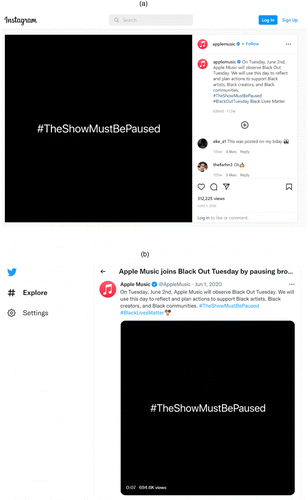
Note. (a) Instagram; (b) Twitter.
Given its association with factors that motivated the Black Lives Matter movement, some users (including businesses such as Apple Music) posted the black square image using the hashtag #blacklivesmatter or #BLM. A consequence of this is that it led some who were searching for or tracking those hashtags to the solid black images of Blackout Tuesday rather than to information on Black Lives Matter. This needs to be considered when interpreting the results that the authors provide.
Instagram and Twitter
The natural experiment (i.e., Blackout Tuesday, which occurred primarily on Instagram on Tuesday June 2, 2020) is based on a comparison between Instagram—the primary platform for the black-square/tile posts—and Twitter. The metric of interest is the number of followers, and the outcome of interest is a (weakly) monotonically increasing transformation of follower growth in levels (more on this later) on the two platforms around the time of the event. A comparison between these two platforms before and after the intervention is central to the analysis and conclusions of “How Support for Black Lives Matter Impacts Consumer Responses on Social Media.”
Platform Positioning and Capability.
In the domain of social media platforms, each platform tries to position itself differently and offer unique benefits and experiences to its potential users. Twitter and Instagram are no different. Instagram is a picture and video focused media platform, whereas Twitter is more text focused, has limits as to the amount of text allowed in a post, and is often sought as a primary source for news updates (see Robarts 2018 for a more detailed comparison). Thus, Twitter is used by brands for succinct messaging and for short pieces of information and to provide links to other potential sources of information. Instagram, on the other hand, is used by brands to create a community, share different types of media and content, and to leverage influences who can promote engagement with the brand.
The authors’ offer the disclaimer, “Twitter is not a perfect control platform due to different characteristics in followers on Instagram relative to Twitter (despite the confirmed parallel pre-trend),” (p. 11). Rightly so, followers in these two platforms may reflect different characteristics, but it is more complex than follower characteristics. Differences in the platforms themselves offer unique benefits for social media engagement. The visual nature of posting a static black square, as was done on Blackout Tuesday, is more suited to a platform such as Instagram than Twitter. This basic platform difference calls into question the paper’s natural experiment, that is, comparing Instagram to Twitter follower growth after some brands posted a black square on Instagram. A key question to ask is if followers on Twitter would behave the same way as those on Instagram if they received the same intervention? Based on the above differences, it seems unlikely. Importantly, the paper’s results might provide some clues to this. Figure 1(b) shows the same post from Apple Music as that in Figure 1(a) except that this is the post on Twitter. If given the same intervention, followers of Apple Music on Twitter behaved differently from those on Instagram; this could suggest that followers on the two platforms behave differently. Although information on this specific case is not available, we offer some reasons for differences in behaviors next.
One complicating factor in a platform-based comparison is the fact that social media users are aware that their post and responses can be visible to their followers and thereby provide information about them to their network. Thus, in this specific context of BLM, allyship, advocacy, or lack of advocacy reflects on both the user and the brand. Wang et al. touch on this phenomenon when they raise the issue of the bandwagon effect versus a lone-wolf supporter. In general, this awareness can result in strategic posts and responses (i.e., follows and likes), particularly if the topic or visual media is sensitive. The extent to which this “self-awareness” impacts the follow or like decision differentially across platforms is unknown and an opportunity for future research.
Unique aspects of the platforms (e.g., text dominant versus picture and video dominant) can also influence how a user constructs their social networks in each platform, which in turn could influence the strategic actions above. The result can be that a user’s social network may differ across platforms. So for example, a user might establish a network on Instagram comprised of people with whom one might share vivid personal moments which are more easily communicated via pictures and videos. In contrast, the user’s Twitter networks might be more “professional” or include those with whom a person would not share those same moments or forms of media. In sum, these factors lead to user preferences for specific social media platforms and bias for specific platforms for specific posts and responses. Thus, awareness of the network might influence the way in which a person engages or responds to posts (see Lim et al. 2015).
Was the Control Condition Also “Treated”?
While the Apple Music example was an illustration that the platforms may not be “comparable” (more on the parallel trends in the data later), it also highlights another potential issue that suggests the need to exercise caution when interpreting the results, that is, that followers in the control condition might have also been exposed to the treatment. Following up on the Apple Music example above, Figure 2(a) provides the scaled number of Tweets for Apple Music (obtained from the freely accessible API) around the time of Blackout Tuesday. One can see the sharp increase in the number of Tweets that day. Figure 2(b) provides some example tweets from the data that suggest that the twitterati had a variety of reactions to Apple’s actions. Although the authors do not provide a brand-level analysis, it will be instructive to know whether Apple Music had different outcomes across the platforms. An affirmative answer to this would support the differences in how followers react across the two platforms.
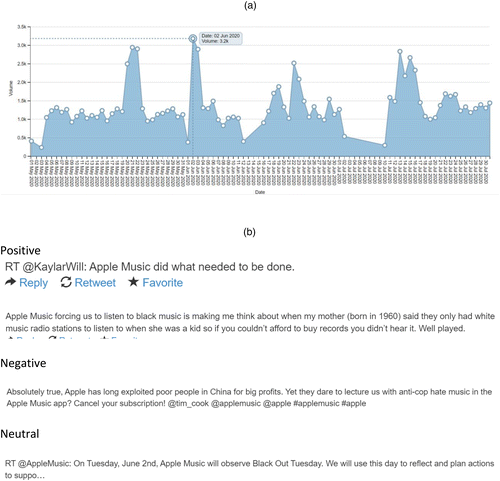
Note. (a) Scaled volume of tweets; (b) example tweets—positive, negative, and neutral.
Another concern regarding the control condition followers being shielded from the treatment is the followers themselves. According to Fusion Media (https://fusionmediaagency.com/blog/social-media-overlap/, accessed September 12, 2022), 85.7% of Twitter users use Instagram and 60.7% of Instagram users use Twitter (see also Lim et al. 2015 for similar numbers). Given the overlap in the actual people (i.e., followers) across the platforms, is it a reasonable assumption to say that the control condition followers were not subject to the treatment even though they may choose to behave differently on the two platforms as described above? Clarity on this issue and understanding the consequences of this overlap will help readers better interpret the results.
What is the Baseline?
Blackout Tuesday is not a straightforward natural experiment. One reason is because the social-political environment in America was racially charged by June of 2020; prosocial posts were rampant on multiple social media platforms (including Twitter) before, during, and after Blackout Tuesday. A comparison between Instagram and Twitter does not offer a reasonable test-control comparison in this data context. For example, Ahmaud Aubry was killed in February 2020 and shortly after Breonna Taylor was killed in March 2020. Both murders evoked public actions and heightened social media activism. Disentangling these events from Blackout Tuesday and then trying to make a broader statement about support for BLM therefore requires that these events impacted the platforms in a “similar” manner in such a way as to preserve the relative comparison. The parallel trends do provide some assurance on this. At the same time, given the timing of the event being that it was while there was unrest in the country requires a careful interpretation of the estimated effect of Blackout Tuesday and its implications for the BLM movement. Isolating the Blackout Tuesday effect in the data also requires the establishment of a clear baseline. Given all the activity surrounding the BLM on both platforms in this time period, it is unclear what that baseline might be. This challenge is analogous to establishing a baseline to measure promotional effects in a category that is heavily promoted. The paper’s supplementary analysis that looks at the degree to which a brand is prosocial speaks to this issue but does not directly address the challenge of providing an appropriate comparison for isolating Blackout Tuesday effects.
Data, Parallel Trends, and Follower Growth
Loosely interpreted, the data pattern presented in figure 2 of (Wang et al. 2022) suggests that, on average, prior to the intervention, the number of followers on Instagram were increasing in an approximately linear fashion each day, whereas those for Twitter were decreasing in a similar manner over time. Prima facie, this provides some support for the point made earlier that the two platforms are not necessarily comparable, as the follower graph would not be parallel but would show a diverging or converging pattern over time depending on their relative levels.
The way that the authors address this issue is via a (weakly) monotonic transformation of the growth in the number of followers and then using logarithms (and signed absolute values to deal with negative growth numbers). Differencing linear trending series addresses the issue of converging or diverging patterns by converting them to a roughly horizontal pattern, albeit at different levels (one positive for Instagram and one negative for Twitter) with the logarithm serving its usual function. A question that arises here is whether such a transformation is in the spirit of a standard difference-in-differences analysis with a parallel trends assumption.
A further challenge with this transformation is that it renders the results difficult to interpret. Therefore, the authors (and readers) need to do postprocessing to uncover the estimated effects of the Blackout Tuesday intervention. Figure 2 in Wang et al. (2022) is also not directly useful for the purpose as the confidence interval provided is the confidence interval of the mean of the logarithm of the follower growth. Additionally, to interpret the magnitudes of the results readers should also know the sizes of the brand’s follower base. For example, a change of 10,000 followers might be large for brand with a 100,000 followers but less so for another with 10 million followers.
Analysis, Results, and Interpretation
The main specification used in the model to obtain the effects of Blackout Tuesday is shown in equation (2) and the results are shown in table 4. Importantly, the analysis controls for very granular fixed effects to account for unobservables in the analysis. The headline finding is that the intervention caused a 65.5% reduction in follower growth. To see this, note from figure 2 in Wang et al. (2022) that the average follower growth on Instagram is around 7.4 (=exp(2)). With an effect of −1.065 in table 4, that would drop to 2.55 (=exp(2 − 1.065)), so the change would represent a 65.5% reduction.4 One issue here is that the regression also controls for the actual messaging. Clearly, the intervention corresponds to a change in messaging so it would be informative to see the results without those controls as a first column. As mentioned earlier, it would also be useful to see these numbers as percentages of the total number of followers. The authors also conduct some robustness checks around their choice of dependent variable and the choice of control group. The model in column (3)—the best fitting model—shows a strong growing trend in the number of followers (as suggested by the significant large positive constant, 7.013) even in the presence of a dip in followers observed after Blackout Tuesday (coefficient is −1.129). This indicates that the number of brand followers on the platform is growing, although at a lower rate around the intervention period. Overall, the authors interpret their findings as reflecting a backlash to the BLM movement.
A question that arises is, why the negative effect? One explanation is that offered by the authors that potential followers were unhappy with the brand’s involvement with this initiative; and as the authors’ heterogeneity results suggest, especially so for brands that did not previously engage in prosocial comments. Indeed, the comments on Apple Music mentioned earlier in Figure 2 support this conjecture.
Two other, somewhat related, explanations are worth noting. The first has to do with what the Blackout Tuesday event was supposed to accomplish—that is, social media silence (beyond posting the black tile). It is possible that it is not the presence of the black tile but the absence of any social media activity by brands that resulted in the reduction in followers. Indeed, interpreted in that light, the authors’ results seem to show that Blackout Tuesday actually worked and not that there was a backlash against the companies.
Second, the posting of the Blackout Tuesday hashtag was also often accompanied by the Black Lives Matter hashtag. So anyone searching for information about BLM encountered a barrage of black tiles. BLM activists felt that this “crowded out” that important information, which could also have had some effect (https://ftw.usatoday.com/2020/06/blackout-tuesday-social-media-origin-critics, https://www.the-standard.org/news/blackouttuesday-takes-over-social-media/article_4bf6109c-a5bb-11ea-8957-13963cffa178.html, https://www.theguardian.com/us-news/2020/jun/02/blackout-tuesday-dominates-social-media-millions-show-solidarity-george-floyd, https://www.fastcompany.com/90642264/why-blackouttuesday-became-a-symbol-of-empty-brand-gestures, accessed September 12, 2022). We hope that future research delves into these motivations in greater depth. Again, this reflects a point made earlier in this discussion that results dealing with BLM need to be interpreted with some caution and in context.
Persistence of Negative Reaction
Following the authors’ conclusions, the relevant question turns to how permanent is the setback in follower growth due to a Blackout Tuesday post? Figure 2 (titled “Model Free Evidence”) in Wang et al. (2022) also raises this inquiry because within two periods after Blackout Tuesday, there appears to be a rebound in Instagram follower growth. The question of permanency cannot be addressed from any of the models in table 4. But from the preliminary models in table 3, one can infer that the effects of a BLM post seem to only be impactful in the period in which the post is made with some trailing impact from a BLM post in the prior (t − 1) period. But it is critical to note that these effects are only significant and become managerially measurable if a large number of brands also make BLM posts in those periods (see interaction effects in table 3 of the paper). Looking forward, it will be interesting to see if there are lingering effects of Blackout Tuesday as it appears that the effects were largely short lived, often like such phenomena on social media (see also Figure 2(a) in this discussion). A continuing challenge as noted earlier, however, is that brands continue posting even after that day so it becomes difficult to isolate these effects. Thus, the overall effect of BLM on brands, we believe, continues to be an open question.
Conclusion
“How Support for Black Lives Matter Impacts Consumer Responses on Social Media” is important research because it attempts to tackle a difficult social-political issue that can be polarizing and, as we point out, often misunderstood. Through this paper, several challenges become clear about research on racial justice and social-political activism. These challenges are often qualitative in nature but impact quantitative analyses. As such, the fundamental principles of internal and external validity must be considered as research evolves in this area. We posit that a comprehensive understanding of BLM and interpretation of the social media data around Blackout Tuesday is important for interpreting these results and any responses to antiracist brand activism. Notably, the impact of this research extends beyond understanding response to single event; it logically may shape perceptions of how companies should responsibly engage in social issues. To that end, we encourage future research on racial justice and other similar social issues to consider the full context of the data when modeling data and arriving at conclusions.
“How Support for Black Lives Matter Impacts Consumer Responses on Social Media” also represents important research to marketers who must evolve with a growing socially inspired economy. Social media is a part of that economy; its forms are evolving, and its impact and influence will likely continue to grow. As researchers who investigate brand and consumer engagement in this context, this research reminds us that it will be important to acknowledge and account for differences in social platforms. Hence, the issues and challenges that this research brings to the forefront make it an important step in marketing science research.
1 See https://www.chicagobooth.edu/review/corporate-responses-black-lives-matter-commitment-speaks-volumes?sc_lang=en for a more casual analysis of BLM.
2 BLM recognizes that in order to achieve its objective, it must “move beyond the narrow nationalism” that characterizes many black communities and instead inclusively embrace all who seek to end the systematic marginalization and oppression of black people (Black Lives Matter).
3 BLM co-founder Opal Tometi expresses that BLM is more than a civil rights movement; it is also a battle about human rights whereby “the full breadth of our humanity be acknowledged and embraced. This means queer, trans, migrant, formerly incarcerated, disabled, and all of us who find ourselves unapologetic about our complexity,” (Tometi and Lenoir 2015).
4 Note that this simple calculation is very approximate because of the nonlinearity in the model and would have to be computed across the various brands and then summarized.
References
Black Lives Matter . About. Accessed September 12, 2022, https://blacklivesmatter.com/about/.Google ScholarEncyclopedia Britannica . Black Lives Matter. Accessed February 27, 2022, https://www.britannica.com/topic/Black-Lives-Matter.Google Scholar- (2018) The early history of the Black Lives Matter movement, and the implications thereof. Nevada Law J. 18(3):1091–1112.Google Scholar
- Ho S (2020) A social media ‘blackout’ enthralled Instagram. But did it do anything? Accessed July 29, 2022, https://www.nbcnews.com/tech/social-media/social-media-blackout-enthralledQ:10 instagram-did-it-do-anything-n1230181.Google Scholar
- (2015)
#mytweet via Instagram: Exploring user behaviour across multiple social networks . Pei J, Silvestri F, Tang J, eds. IEEE/ACM Internat. Conf. Adv. Soc. Networks Anal. Mining (ACM, New York), 113–120.Crossref, Google Scholar - (2018) Differences between Instagram and Twitter. Accessed September 1, 2022, http://www.differencebetween.net/technology/differences-between-instagram-and-twitter.Google Scholar
#Say Their Names . Accessed July 17, 2022, https://sayevery.name/#2022.Google Scholar- (2014) Meet the BART-stopping woman behind “Black Lives Matter.” Grist Magazine (December 4), https://perma.cc/BCK8-RW7M.Google Scholar
- (2015) Black Lives Matter is not a civil rights movement. Time (December 10), http://time.com/4144655/international-human-rights-day-black-lives-matter.Google Scholar
- (2022) Frontiers: How support for Black Lives Matter impacts consumer responses on social media. Marketing Sci., ePub ahead of print, August 4, https://doi.org/10.1287/mksc2022.1372.Google Scholar