Frontiers: Content Quality Provision and Welfare Implications of Digital Platform Commission Fees
Abstract
Several digital content developers, including Epic Games and Spotify, have voiced concerns that the commission fees charged by platforms (e.g., Apple’s App Store, Sony PlayStation) are too high and stifle innovation. Therefore, they advocate for a reduction in the commission rates. This paper employs a game-theoretic model to analyze a platform ecosystem comprising two competing platforms, hardware devices compatible with these platforms, and a representative content developer to examine whether reducing commission rates improves content quality provision and consumer surplus. Our findings reveal that reducing the commission rate may not always enhance content quality. Moreover, even when a lower commission rate reduces content quality, the developer may still be better off. We also find that consumer surplus may decrease as the commission rate declines. These results are primarily driven by platforms raising device prices when commissions decrease, thereby contracting the developer’s effective market.
History: Catherine Tucker served as the senior editor. This paper was accepted through the Marketing Science: Frontiers review process.
Supplemental Material: The online appendix is available at https://doi.org/10.1287/mksc.2024.1084.
1. Introduction
Over the past few years, a major conflict has emerged between platforms such as Apple’s App Store and Google Play Store and the developers of leading digital services. Prominent firms such as Spotify and Epic Games argue that the high commission on in-app revenues stifles innovation (Allyn 2020, Hoppe 2020, Geradin 2021).1 This dispute has attracted growing scrutiny from regulators in the United States, European Union, and Asia, who question whether prevailing fee structures promote or hinder technological progress (Warren 2021, Jimenez 2024). The issue has also entered the public spotlight with media coverage such as John Oliver’s HBO segment claiming that high commissions suppress developer innovation (Kelly 2022).
At first glance, it seems intuitive that lower commission fees should spur innovation: reduced commissions raise developers’ marginal returns, encouraging investment in higher quality content (a direct effect). However, platforms also benefit from high-quality content as it boosts engagement and usage, thereby increasing their own revenues. To enhance content quality, platforms can expand the demand for content, thus increasing the marginal returns of developers to investing in quality. Understanding how platforms shape this demand is therefore crucial.
A defining feature of many platforms is that they are hardware-gated ecosystems: consumers must purchase a proprietary device to access content, for instance, smartphones for mobile apps, video game consoles (Sony PlayStation, Microsoft Xbox), e-readers (Amazon Kindle, Barnes & Noble Nook), or smart-home systems (Amazon Alexa, Google Home).2 Because the demand for content depends on the installed base of compatible devices, platforms often price devices aggressively to expand both hardware adoption and content consumption. A reduction in commission rates weakens this incentive by lowering the platforms’ revenue from content, leading to higher device prices and a smaller installed base. This contraction reduces the developer’s effective market size and, in turn, the incentive to invest in quality (an indirect effect). The direct and indirect effects, thus, operate in opposite directions, making the overall impact of commission changes on content quality fundamentally ambiguous.
This mechanism reflects real-world practice. Revenues from digital content distribution now make up a substantial share of the earnings of many platforms. For example, Apple’s services segment—including the App Store—generated nearly $96 billion in 2024, contributing significantly to the company’s gross profits.3 Such figures create strong incentives for Apple to factor service-side revenues into device pricing. Cross-subsidization across markets is also well-established, for instance, Google’s Fiber initiative was not aimed at direct profits but at accelerating adoption in complementary markets such as smart homes and video streaming (Levin and Downes 2018). These cases highlight the plausibility of platforms strategically subsidizing hardware to expand demand for complementary service-side revenue streams.
These observations lead to our main research questions. We seek to investigate how the commission fees charged by hardware-gated platforms may impact digital content quality innovation as well as the profitability of developers. Additionally, we aim to assess how the commission rate influences consumer welfare. By exploring these aspects, we provide a comprehensive understanding of the economic implications of the commission rates charged by platforms for different stakeholders in the ecosystem.
We develop a stylized model of a market with two competing platforms and a digital content developer who invests in content quality and distributes it on both platforms. Each platform sells a proprietary device that consumers must purchase to access the content and also collects commissions on the developer’s revenue. Differences in design and user experience cause consumers to engage more on one platform, creating an asymmetry in which that platform yields higher content revenue for the developer.
A reduction in the commission rate lowers the importance of commission revenues in platform profits and leads platforms to raise device prices. Because the platform with higher consumer engagement depends more on commissions, it has a stronger incentive to raise prices, and this reduces its market share. This shift dampens developer revenues and weakens quality incentives. When the indirect loss in incentives outweighs the direct benefits of lower commissions, the developer invests less in quality. The developer may still earn more overall because of the lower commission burden, but consumers face higher device prices and possibly lower content quality. Thus, a commission cut can reduce quality provision or consumer welfare, improving the developer’s payoff, showing that developer incentives may diverge from consumer interests.
Our work relates to research on platform strategies that shape innovation by third-party suppliers. Previous studies show how platform actions can influence developer incentives; for example, the launch of Google’s first-party apps reduces the innovation of existing third-party apps on Google Play (Foerderer et al. 2018, Wen and Zhu 2019); up-front fixed access fees make failed innovation more costly, encouraging sellers to exert more effort (Lin et al. 2011); and rating systems affect incentives for high-quality apps on the Apple App Store (Leyden 2021). Angelini et al. (2025) further demonstrate how demand-enhancing platform actions can asymmetrically affect sellers. Based on this stream, our article shows how the commission of a platform interacts with the pricing of devices in a hardware-gated ecosystem to influence developers’ innovation incentives. Unlike much of the prior literature, which examines a single platform with many sellers, our setting features two competing platforms and a single developer, highlighting how cross-platform competition and device cross-subsidization shape quality investment incentives.
Our paper also contributes to the literature on pricing in platforms (Rochet and Tirole 2003, Parker and Van Alstyne 2005). Although much of this work emphasizes direct subsidies to one side of the market (typically consumers) to stimulate growth, we study an indirect subsidy: device pricing. Because consumers must purchase the platform’s device to access content, device subsidies directly affect demand for content and, therefore, alter developers’ incentives to invest in quality. Finally, our work connects to the literature on vertical relationships, which examines how upstream–downstream arrangements shape innovation. Wang and Shin (2015) show how contract form and downstream competition influence upstream innovation, whereas Guo (2020) analyze how upstream suppliers may exploit downstream firms through contractual terms. In contrast, we study hardware-gated ecosystems in which the interaction of commission rates and device pricing may serve as the upstream lever shaping a developer’s innovation incentives.
In the next section, we present our model, and we present our findings in Section 3. We discuss our concluding thoughts in Section 4. All proofs are presented in the appendix, and all model extensions are contained in the Online Appendix.
2. Model
We consider a setting with two competing digital platforms, labeled a and b. Each platform owns and sells a proprietary hardware device—denoted A and B—that provides users access to its respective digital ecosystem. A representative third-party developer D creates digital content (e.g., an app, game, or service) that can be accessed on either platform, and users must purchase one of the hardware devices to do so. We focus on a setting in which the developer possesses market power, with monopoly as the extreme case, in order to isolate how platform commissions and device pricing shape the developer’s incentives to invest in quality.4
2.1. Developer and Platforms
The developer, D, develops content of quality q by investing , where .5 We assume that a consumer spends q on content purchases if the consumer uses the content version from platform a and if the consumer uses the content version from platform b, where q is the quality of the content and . Without loss of generality, the setup captures the fact that higher content quality results in higher content purchases on both platforms. Note that implies that a consumer on both platforms generates an equal amount of revenue per unit quality for the developer, whereas implies asymmetric returns to quality for the developer from the two platforms.
In practice, developers often earn different average revenues per user across platforms. For instance, Howarth (2025) reports that, in the mobile app ecosystem (iOS versus Android), users not only spend different amounts of time engaging with apps but also differ systematically in income levels. These differences in engagement and user demographics together help explain why app developers may experience heterogeneous per-user earnings across platforms. The difference in engagement could be due to a better user experience (a supply-side factor) on one of the platforms. In the mobile app market, the open nature of Google’s ecosystem—in which numerous manufacturers deploy customized versions of Android—results in significant fragmentation in both hardware and operating system (OS) versions. In contrast, iOS operates in a more controlled environment with a limited number of device models and much greater consistency in OS adoption. As a result, iOS apps need to be optimized for a narrower range of hardware and software configurations, enabling a more streamlined and consistent user experience (Brovkin 2017, DDI Development 2018). As also reported by Gyorödi et al. (2017), iOS outperforms Android in two of the three core performance tests, specifically asynchronous JavaScript object notation parsing and user interface rendering speed, both of which are critical for the smooth functioning of modern apps.6 Consequently, we model a setting in which one of the platforms provides a better user experience. To do this and without loss of generality, we assume that , which implies that the content earnings per user from platform b are higher compared with platform a. In one of the model extensions, we also consider the alternative scenario in which the two platforms are asymmetric in the utility they provide, and the reason for the differential per-user revenue across platforms is the demand-side factor of heterogeneity in consumers’ willingness to pay for quality. See Section 3.1 for more details.
We assume that both platforms charge a commission rate of r on the developer’s revenue from content purchases.7 This assumption is motivated by the following observations. First, competing platforms across industries consistently charge similar commission fees, typically around 30% (Perez 2020, Borck et al. 2021), despite having vastly different business models. For example, both Apple’s App Store and the Google Play Store charge 30% on in-app purchases and subscription revenue.8 Likewise, Xbox and PlayStation maintain 30% commission rates despite offering different subscription and cloud gaming models (LeBlanc 2022, Wolfe 2025). Second, this 30% rate has remained remarkably stable over time; even as the app ecosystem has expanded from hundreds to millions of apps, smartphone adoption in the United States has grown from 35% in 2011 to more than 90% in 2024 (Pew Research Center 2024), and monetization has shifted from paid downloads to subscriptions and in-app purchases.9 The substantial variation across market structures, platform monetization models, business strategies, and time periods makes it unlikely that the commission rates arise from a competitive, Bertrand-style equilibrium. Relatedly, Apple has also said that it followed the prevalent industry standard to choose its commission rates (Miller 2021).
2.2. Consumers
We capture the device market through a Hotelling line of unit length, allowing for a differentiated market because of a variation in consumers’ brand preferences for different devices. We assume A is located at the left end of the line (at zero), and B is located at the right end (at one).10 The prices of the devices are set at and , respectively. A unit mass of consumers are uniformly distributed over the line and estimate their utility from device A to be and from device B to be , respectively. We assume here that the utility the consumers get from devices is independent of the content quality.11 A consumer located at distance x from device A gets a net surplus of from buying A and from buying B. We assume that and are large enough so that the market is covered.
A consumer who is indifferent between devices A and B is denoted by . Based on the location of the marginal consumer, we can derive the demand function for each device. Let denote the demand for device . We have and . Then, the profit functions of a, b, and D are given by the following expressions: , , and , respectively.
3. Analysis
In this section, we present the results of our analysis under a subset of parameter conditions described in the model, and this allows us analytical tractability, preserving insights. In particular, we assume that .12 The timeline of the game is as follows. Based on the commission rate r, the content developer D first decides the level of quality (innovation) because the core development of the content is a more long-term decision than setting device prices.13 Then, the two platforms set their respective device prices.
Using the timeline, we use backward induction to solve the game. First, we obtain optimal prices of the devices as functions of the content quality by solving the first order conditions for the profit functions of A and B. These prices are
Accordingly, we represent the market shares of the devices and the profits of the developer as a function of quality by for and , respectively. From the price expressions, one can see that, as , , which, in turn, implies that the market share of B increases with r as that of A decreases ().
Using the above price expressions, we examine the impact of content quality on prices. We present this relationship in the following lemma.
Both device prices decrease with content quality.
The first observation from the above lemma is that the prices of both devices decrease with the content’s quality. This price reduction happens because a higher content quality increases consumers’ spending on the content. Consequently, the revenues per consumer through commission fees from the content purchases for the two platforms also increase. Therefore, both of these platforms have an incentive to reduce the price of their devices to gain market share to capitalize on the increased revenue per consumer from commissions.
The second observation from Lemma 1 is that the rate of reduction in the price of B is higher than that of A. The reason is that a unit increase in the content’s quality improves the revenue per consumer for platform b more than that for platform a (because ). Hence, platform b has a stronger incentive than a to reduce the price of its device to gain market share.
An implication of Lemma 1 is that .
Device prices decrease with content quality at a higher rate when the commission rate increases.
Lemma 2 says that the rate of price reduction of the devices with content quality increases with the commission rate, r. Further, this rate of reduction is higher for B. The reason for these observations is that, as r increases, the marginal value of increasing the market size increases for both A and B because of higher earnings from commission revenue. Further, because B earns higher revenues than A per consumer (because ), this incentive of B is greater than that of A.
Continuing our analysis, we substitute the first stage prices and into the profit function of developer D and obtain the equilibrium content quality by solving the first order condition with respect to quality.14 We then substitute the equilibrium quality expression into the first stage prices to get the equilibrium prices. We present the expressions of equilibrium content quality and phone prices below:15
Content quality () decreases as r decreases when .
Proposition 1 provides the insight that a decrease in the commission rate may create incentives for the content developer to decrease quality.16 The intuition behind this result can be explained by two opposing forces created by the reduction in commission rate on the content developer. To explain these two forces, we write the marginal value of quality,
Next, we turn to the effect of the commission rate on the profits of the content developer.
The content developer’s profit () decreases as r decreases when .
Intuitively, a decrease in the commission rate r should increase the content developer’s profits because it retains a larger share of the content revenues.17 On the contrary, Lemma 3 says that the content developer’s profits decrease with a reduction in r when r is relatively small. The reason becomes clear from applying the envelope theorem to the content developer’s profit function with respect to r. We find that the direct effect of a decrease of r on the developers’ profits is indeed positive because
Combining the results from Proposition 1 and Lemma 3, we have the following.
When , a decrease in r decreases the content quality but increases the content developer’s profits, and when , a decrease in r decreases both the content quality and the content developer’s profits.
The above finding reveals a scenario in which the incentives of the content developer are not aligned with an improvement in quality provision.18 We note that, as the commission rate reduces, the content quality also reduces (for ). However, the reduction of the commission rate on the content developer’s profits can be both positive and negative. This result is because of two opposing effects of a decrease in commission rate on the content developer’s profits. On the one hand, a reduction in commission rate improves the profits of the content developer as it keeps a larger fraction of the content revenue. On the other hand, however, as the commission rate decreases, both platforms’ revenue from the content decreases, and it creates an incentive to increase their device prices. As B’s price increase is greater (when ), the relative decrease in B’s market share hurts the content developer’s marginal value of quality (because ). Therefore, the content developer creates a lower quality that increases its profits because of a reduction in convex quality creation costs. We find that the positive effect of a decrease in the commission rate on the developer’s profits dominates when . Hence, it is possible that content developers complain about the commission rate being too high even when a reduction in the commission rate leads to a lower content quality. When , the negative effect of a decrease in the commission rate dominates, and a reduction in r reduces the content developer’s profits. This implies that, in this parameter range, lowering the commission rate may not only hurt content quality but also the content developer’s profits.
Last, we look at the impact of decreasing the commission rate on consumer welfare.
As r decreases, the content quality increases, but consumer surplus reduces when .
In our model, a reduction in the commission rate affects consumer surplus through its influence on device prices.19 When content quality increases with a reduction in r (when ), the platforms’ content revenue can decrease because it retains a smaller fraction of content revenues. This feature may, therefore, lead the platforms to increase their device prices (when ), thus hurting consumer welfare. The implication of this result is that consumer welfare does not move in lockstep with the content quality and may even decrease when the content quality increases.
Beyond consumer surplus, we examine the broader implications for social welfare by incorporating the platforms’ and the developer’s profits. Our analysis reveals that, in certain parameter ranges (e.g., at , , and ), a reduction in the commission rate leads to a decline in both consumer surplus and overall social welfare. This occurs when the lower commission weakens the incentives of platform b more to lower its device price, shrinking its market, and reducing content quality. We find that, whereas the developer’s profits may rise because of improved margins, the sum of the profits of the two platforms declines. The decline in consumer surplus and platforms’ profits may dominate the increase in the developer’s profits, resulting in lower social welfare. These results underscore that lower commission rates, despite potentially benefiting developers individually, can be welfare-reducing when the indirect effects on quality are considered.
3.1. Robustness Checks
In Online Section 1.1, we analyze a model in which platforms are vertically differentiated and consumers differ in their willingness to pay for device and content quality. In this setting, a reduction in commission rates leads platforms to raise device prices, and this can contract overall market coverage and indirectly reduce the developer’s incentive to invest in quality. However, if the lower bound of willingness to pay is sufficiently high so that full coverage is maintained even after device prices increase, this extensive margin channel disappears, and the main findings can no longer hold. The unifying theme across both models is that the developer’s quality incentives weaken when the effective market shrinks through intensive margin reallocations in the main model, in which users shift toward the lower revenue platform, or through extensive margin contractions in the vertical differentiation model, in which higher device prices reduce market coverage.
Beyond the vertical differentiation case, we also analyze several other extensions to assess the robustness of our main insights (see details in the Online Appendix). These include allowing the developer to offer asymmetric quality across platforms, linking device utility directly to content quality, relaxing the assumption of identical commission rates, and comparing open versus closed platform systems. Across these variations, the qualitative mechanism remains consistent: reductions in commission rates can raise device prices and indirectly dampen developers’ incentives to invest in quality by contracting their effective market size. Taken together, these analyses demonstrate that our central finding—that lower commissions need not always increase innovation or consumer welfare—holds under a broad range of modeling assumptions and continues to capture the key dynamics of hardware-gated platform ecosystems.
4. Discussion
In this section, we discuss the role of various parameters in obtaining our results. We note that the parameter influences the thresholds presented in Propositions 1 and 2 ( and ). We capture the interplay between r and through a visual summary of our main results in Figure 1 (for ). We observe that, in the leftmost region, a decrease in r leads to higher quality content, and the content developer’s profits also increase. However, for a given commission rate, as increases, the relationship between content quality (or developer profits) and the commission rate changes. Specifically, (i) both the content quality and the developer’s profits decrease with a reduction in r in the rightmost region, and (ii) the content quality decreases but the content developer’s profits increase with a reduction in r in the middle region. The consumer surplus always decreases with a reduction in r throughout the presented region.20
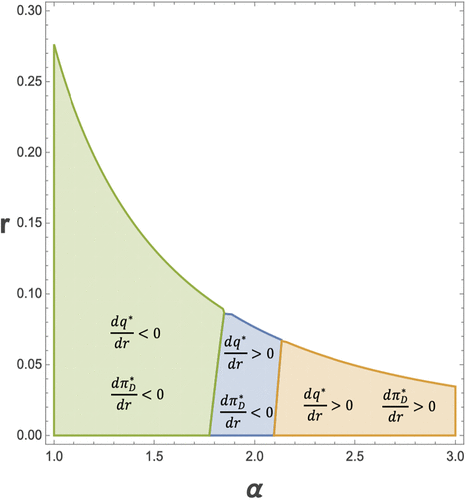
Regulators around the world are actively debating whether high commission rates harm innovation and consumer welfare. For example, the European Union recently required Apple to allow consumers to bypass the App Store’s payment system and avoid commission fees (Hancock 2024). Our findings caution against assuming that lower commissions necessarily foster innovation or benefit consumers. As Proposition 3 shows, even when reduced commissions lead to higher content quality, consumer welfare can decline if device prices rise in response. This occurs when commission rates are relatively low because the platforms then rely more heavily on device revenues. By contrast, when commission rates are high, a reduction can intensify device price competition and improve welfare. These results suggest that the welfare effects of commission cuts depend on the prevailing level of commissions and that regulators should carefully consider how commissions interact with device markets when assessing interventions.
A promising avenue for future work is to analyze settings in which commission rates are determined endogenously by competing platforms, which would provide a richer view of how setting commission itself interacts with device pricing and innovation incentives. Another direction is to consider competition among multiple developers or study market entry, and this could further shape how commissions and device pricing affect quality incentives and welfare.
All authors certify that they have no affiliations with or involvement in any organization or entity with any financial interest or nonfinancial interest in the subject matter or materials discussed in this manuscript. The authors have no funding to report.
Appendix
A.1. Proofs of Lemmas 1 and 2
We have and . Therefore, we have and .
Further, as , we have .
A.2. Equilibrium Conditions
We first check the second order conditions for equilibrium stability at the second (price) stage. Let
The eigenvalues of are and . It is negative definite as all the eigenvalues are negative. The second order condition for the content developer holds when . We further require for , , and for . We assume throughout the main text of the paper. We only consider the interior solutions because we are interested in equilibria in which both devices have a positive market share.
A.3. Proof of Proposition 1
We have when . Now, this inequality can also be rewritten as . But only when . Therefore, can only be positive when .
A.4. Comparative Statics of Equilibrium Prices with Respect to r
We have and .
A.5. Proof of Lemma 3
We have when . Now, this inequality can also be rewritten as . But only when . Therefore, can only be positive when .
A.6. Proof of Proposition 2
We have when and when . Therefore, for both and to hold simultaneously, we require . Now, when . And, for both and to hold simultaneously, we require .
A.7. Proof of Proposition 3
We have when . And we have when .
We have .
1 Both Apple and Google charge a commission rate of in-app revenue of above $1 million at 30% (Campbell and Alexander 2021).
2 Similar concerns arise in video games. In a 2025 interview, Epic Games CEO Tim Sweeney said consoles would be a better place if they allowed competing stores, pointing to PlayStation, Xbox, and Nintendo’s closed ecosystems (Totilo 2025). In Epic Games v. Apple, he also noted that none of the major console makers permit developers to distribute content outside their proprietary stores, underscoring how this restricts developer options (Fitzgerald 2023).
3 See https://bullfincher.io/companies/apple/revenue-by-segment.
4 This abstraction avoids conflating the mechanism with strategic interactions among multiple developers within a platform.
5 In one of the model extensions, we also show the robustness of our main results with a model in which the content developer, instead of deciding only one quality q, decides two qualities, and , for the two platforms (see Online Section 1.2).
6 Prior human–computer interaction research shows that even modest reductions in latency are perceptible and can significantly improve user experience (Deber et al. 2015).
7 We relax this assumption in one of the model extensions in which we consider that the two platforms charge different commission rates (see Online Section 1.4).
8 The cut for subscription revenue drops to 15% after 12 months though Google only recently reduced it to 15% for the first 12 months as well; see https://www.gamedeveloper.com/business/google-play-is-lowering-service-fees-on-app-subscriptions-to-15-percent.
10 In Online Section 1.5, we explicitly model an open platform scenario in which there also exists a third-party firm C in the hardware device market that uses platform a.
11 In Online Section 1.3, we also numerically analyze a model in which the utility from a device increases with content quality and find that our results remain robust.
12 In Online Section 1.3, we show that all our main results hold even when .
13 This is consistent with the fact that, for instance, in the smartphone industry, the core quality development (not updates) of the highest grossing mobile games today (e.g., Clash of Clans) happened many years ago, whereas phone prices are set every year.
14 Equilibrium conditions require . For details, see Appendix A.2.
15 Note that is lower because we assume in our stylized model. However, this feature does not drive our results. In the model extension presented in Online Section 1.3, we show that, when , we can get to be higher, along with our results.
16 We check that in Appendix A.3.
17 We check that in Appendix A.5.
18 We check the conditions under which in Appendix A.6.
19 The content quality does not influence consumer surplus directly because the consumer utility from a device is independent of content quality. However, in Online Section 1.3, we consider a model in which the content quality increases device utility and find consistent results.
20 Equilibrium conditions do not hold in the whitespace region.
References
- (2020) Epic games founder on the lawsuit against tech giants. Technical report. Accessed October 9, 2020, https://www.npr.org/2020/09/10/911592340/epic-games-founder-on-the-lawsuit-against-tech-giants.Google Scholar
- (2025) Platform investment and seller competition in two-sided markets. J. Econom. 144(1):1–29.Google Scholar
- (2021) Apple’s app store and other digital marketplaces: A comparison of commission rates. Accessed February 3, 2024, https://www.apple.com/newsroom/pdfs/apple-app-store-study-2020.pdf.Google Scholar
- (2017) Why having both iOS and android app versions is so important. Medium Online. Accessed August 13, 2023, https://medium.com/swlh/why-having-both-ios-and-android-app-versions-is-so-important-8a74115b979d.Google Scholar
- (2021) A guide to platform fees. The Verge Online. Accessed May 22, 2023, https://www.theverge.com/21445923/platform-fees-apps-games-business-marketplace-apple-google.Google Scholar
DDI Development (2018) 10 major differences between Android and iOS app development. Technical report. Accessed April 25, 2025, https://ddi-dev.com/blog/programming/10-differences-between-android-and-ios-app-development/.Google Scholar- (2015) How much faster is fast enough? User perception of latency & latency improvements in direct and indirect touch. Begole B, Kim J, Inkpen K, Woo W, eds. Proc. 33rd Annual ACM Conf. Human Factors Comput. Systems (ACM Press, New York), 1827–1836.Google Scholar
- (2023) Epic games CEO claims android OS is a ‘fake open platform.’ Channel News (November 22), https://www.channelnews.com.au/epic-games-exec-android-os-is-a-fake-openplatform.Google Scholar
- (2018) Does platform owner’s entry crowd out innovation? Evidence from Google photos. Inform. Systems Res. 29(2):444–460.Link, Google Scholar
- (2021) How Apple’s app store practices are stifling innovation. Technical report. Accessed July 24, 2023, https://appfairness.org/wp-content/uploads/2021/05/caf-stifling-innovation.pdf.Google Scholar
- (2020) Upstream exploitation and strategic disclosure. Marketing Sci. 39(5):923–938.Link, Google Scholar
- (2017) A comparative study between applications developed for Android and iOS. Internat. J. Adv. Comput. Sci. Appl. 8(11):176–182.Google Scholar
- (2024) EU accuses Apple of breaching landmark digital law. Politico Online. Accessed June 24, 2024, https://www.politico.eu/article/apple-gets-eu-warning-over-app-store-rules/.Google Scholar
- (2020) Epic games v. Apple: How the case evolved and where it is heading. Technical report. Accessed May 24, 2023, https://gammalaw.com/epic-games-v-apple-how-the-case-evolved-and-where-it-is-heading/.Google Scholar
- (2025) iPhone vs Android user stats (2025 data). Exploding Topics Online. Accessed July 15, 2025, https://explodingtopics.com/blog/iphone-android-users?Google Scholar
- (2024) Tech regulation digest: Antitrust scrutiny and apple’s evolving regulatory strategies. Technical report. Accessed September 2, 2024, https://milkeninstitute.org/article/tech-regulation-digest-antitrust-scrutiny-apple.Google Scholar
- (2022) John Oliver exposes how Google and Amazon stifle competition. The Verge Online. Accessed May 22, 2023, https://www.theverge.com/2022/6/13/23165955/john-oliver-last-week-tonight-amazon-apple-facebook-google-antitrust.Google Scholar
- (2022) Playstation CEO says first-party games will not launch day one on revamped PS plus. GameInformer Online. Accessed March 29, 2022, https://www.gameinformer.com/2022/03/29/playstation-ceo-says-first-party-games-will-not-launch-day-one-on-revamped-ps-plus.Google Scholar
- (2018) Why Google fiber is high-speed internet’s most successful failure. Harvard Bus. Rev. (September 7), https://hbr.org/2018/09/why-google-fiber-is-high-speed-internets-most-successful-failure.Google Scholar
- (2021) Platform design and innovation incentives: Evidence from the product ratings system on apple’s app store. Preprint, submitted June 11, http://dx.doi.org/10.2139/ssrn.3863816.Google Scholar
- (2011) Innovation and price competition in a two-sided market. J. Management Inform. Systems 28(2):171–202.Crossref, Google Scholar
- (2021) Apple and Epic go head-to-head in fiery opening remarks of highly-anticipated trial. Technical report. Accessed May 22, 2023, https://9to5mac.com/2021/05/03/apple-epic-openings-remarks-trial/.Google Scholar
- (2005) Two-sided network effects: A theory of information product design. Management Sci. 51(10):1494–1504.Link, Google Scholar
- (2020) Apple digs in heels over its app store commission structure with release of new study. Tech Crunch Online. Accessed July 22, 2020, https://techcrunch.com/2020/07/22/apple-digs-in-heels-over-its-app-store-commission-structure-with-release-of-new-study/.Google Scholar
Pew Research Center (2024) Mobile fact sheet. Technical report. Accessed April 23, 2025, https://www.pewresearch.org/internet/fact-sheet/mobile/.Google Scholar- (2003) Platform competition in two-sided markets. J. Eur. Econom. Assoc. 1(4):990–1029.Crossref, Google Scholar
- Totilo S (2025) Tim Sweeney wants the Epic Games Store on consoles, but isn’t going to sue over it. Game File (May 3), https://www.gamefile.news/p/tim-sweeney-epic-games-store-xbox-playstation-switch.Google Scholar
- (2015) The impact of contracts and competition on upstream innovation in a supply chain. Production Oper. Management 24(1):134–146.Crossref, Google Scholar
- (2021) EU accuses Apple of app store antitrust violations after Spotify complaint. Technical report. Accessed May 22, 2023, https://www.theverge.com/2021/4/30/22407376/apple-european-union-antitrust-charges-app-store-music-competition-commission-margrethe-vestager.Google Scholar
- (2019) Threat of platform-owner entry and complementor responses: Evidence from the mobile app market. Strategic Management J. 40(9):1336–1367.Crossref, Google Scholar
- (2025) PlayStation Plus vs. Xbox Game Pass: Which is best? Stuff.tv. Accessed April 5, 2025, https://www.stuff.tv/features/gaming-subscription-services-battle/.Google Scholar