

Request Username
Can't sign in? Forgot your username?
Enter your email address below and we will send you your username

 INTRODUCTION
Lingxiu Dong
Olin Business School,
Washington University in St. Louis
Email: [email protected]
Colin Kessinger
End-to-End Analytics, Part of Accenture
Palo Alto, CA
Email: [email protected]
Danko Turcic
A. Gary Anderson Graduate School of Management,
University of California at Riverside
Email: [email protected]
Risk and supply chain disruption received renewed attention when many essential products became unavailable during the COVID-19 pandemic, and prolonged material shortages hampered many industries’ recovery and growth. The objective of this special issue is to present some of the latest research articles on the topic. Below we list strategies that the selected literature suggests to firms as protection against disruption risk. Figure 1 illustrates graphically when such strategies are most appropriate to use according to the disruption’s likelihood and consequences on a firm’s operations.1
Buffering: Direct buffering (hereafter buffering) includes investments in safety stock and production and supply chain redundancies, including multi-sourcing.
Financial hedging: Financial hedging2 includes financial buffers. Whereas traditional buffering requires investment in tangible assets (e.g., inventory), financial hedges are investments in financial contracts.
Contingency planning: Contingency planning is indirect (virtual) buffering. Whereas direct buffering requires firms to continuously hold redundant capacity, contingency planning is about securing access to backup capacity only in the event of a disruption. It can come from firms' own mothballed capacity or from backup suppliers.
Crisis management and insurance: Crisis management and insurance are the last line of defense that a firm employs to avoid a large default or total collapse. Insurance contracts typically cannot prevent a failure from happening, but they can financially compensate firms if one occurs.
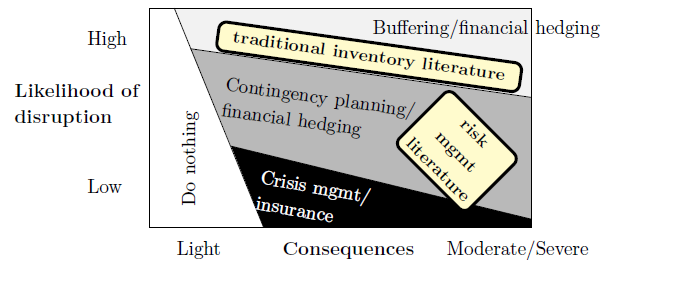
Figure 1: Matching risk management strategies to types of supply chain risk. Source: W.J. Hopp. Supply Chain Science. McGraw-Hill Irwin, New York, NY 10020-1095, 2008.
The effectiveness and cost of these strategies make them appropriate for different situations. Direct buffering and financial hedging often tie up a firm’s financial resources. Both techniques, however, endow firms with capacity – operational or financial – that can be tapped whenever needed. Thus, they are the most effective against frequent but less severe disruptions (e.g., ordinary demand fluctuations and routine supply glitches). Contingency planning trades smaller backup capacity costs for lower capacity availability. (Accessing capacity through an indirect buffer is slower than through a direct one.) As such, contingency planning works well against less frequent disruptions whose mitigation would require extensive (i.e., costly) buffers and hedges. Finally, insurance is a financial instrument that compensates for financial losses associated with a disruption without necessarily fixing the disruption itself. Insurance, however, is an essential source of liquidity that might allow firms to remain operational after the failure.
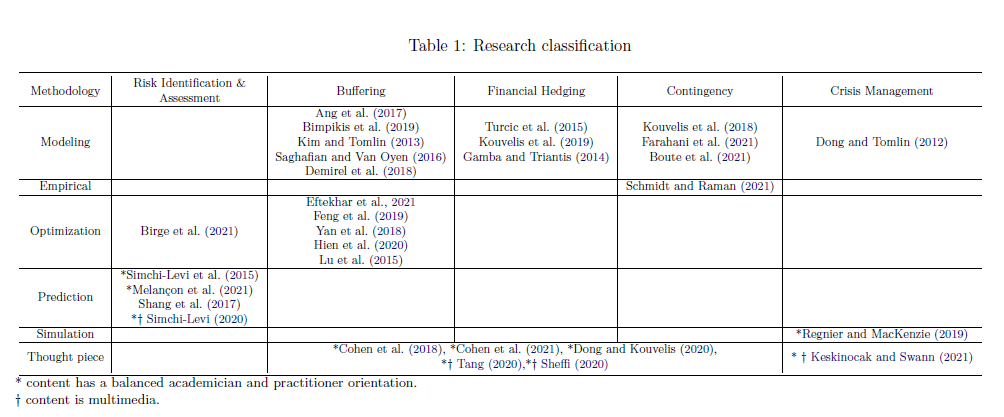
In selecting the articles on the topic of risk management analytics, we consciously shied away from articles about the COVID-19 pandemic because we thought that the literature still needed time to develop. (However, the COVID-19 pandemic heavily inspired our following multimedia content selection, which points to the pandemic while highlighting the need for more research in the areas of supply chain disruption and risk management in general: Tang (2020) and Sheffi (2020).) We tried to look for papers with models and insights that managers might find helpful, empirical papers that describe the current practice, and methodology papers that advise academics and practitioners on developing new tools for future practice. This search left us with a set of twenty-three articles and two multimedia pieces. Table 1 classifies the contents according to methodology and the topic on which they focus.
Table 1 reveals that most of the selected contents are about optimal design of buffers and risk mitigation; there are three pieces on crisis management, five pieces on risk identification, and, finally, there are seven papers on hedging and contingency planning.
In terms of methodology, there are twelve modeling papers, one empirical paper. The rest of the articles have some methodological contribution that assists current and future risk management tools.
The “sweet spot.” Based on the papers that we collected, the best-researched area appears to be the optimal design of direct buffers, where researchers propose smart capacity investments (Saghafian & Van Oyen, 2016), multi-sourcing (Boute et al., 2021; Feng et al., 2019), or resilient supply network design (Bimpikis et al., 2019; Yan et al., 2018). Some papers couple these buffers with smart supply contracts that further alleviate the risk of disruption by aligning incentives at different levels of the supply chain (Demirel et al., 2018; Farahani et al., 2021; Kouvelis et al., 2018). We refer to these papers as the “sweet spot” because there is a rich OM/OR literature on direct buffers and the methods proposed in these papers appear to be widely utilized in the industrial practice. Regarding methodology, modeling approaches that utilize traditional OR optimization techniques dominate the recent literature, despite the community-wide effort for more data-driven research. In terms of application, the techniques covered in these papers work best against mild and moderate disruptions. They are not as effective against extreme disruptions such as those many firms experienced during the COVID-19 pandemic.
Future research opportunities. Having concluded our article search, we also wish to point out some research areas with potential for future research – domains where practice might be ahead of research and domains where additional research could enhance current practice.
Risk-management horizon. Many of the existing risk-management models are static, and as such, they give little or no guidance on how long the optimal buffers should protect them. We routinely use dynamic models to determine the amount of safety stock to carry when facing stochastic demand. Nevertheless, the literature still has room to extend these ideas to other sources of risk (e.g., supply glitches) and strategies that go beyond inventory buffers. Cohen et al. (2018) and Dong and Kouvelis (2020) are thought pieces that give industry perspectives on risk management planning horizons and highlight additional open research questions in the context of global operations and trade policies.
Financial hedging. Hedging does more than financially compensate firms for losses. If it is combined with intelligent supply contracts, it can ensure supply and maintain an optimal output level under adversity. The finance literature more or less stopped short of identifying hedging’s operational implications. The OM/OR literature should fill in the missing pieces. Further exploration of the synergy between operational and financial hedging will likely offer innovative risk management tools.
Cost/risk trade-off. Ultimately supply chain risk management requires an integrated approach that embeds the performance elements associated with risk into the core sourcing process. On its own, most supply chain risk management is akin to buying insurance, which runs counter to the highly cost-sensitive operations mindset. Did suppliers fail to risk-proof their supply chains during the COVID-19 pandemic, or did consumers see shortages because such risk-proofing would not be cost-effective – or even feasible? As it stands today, companies engage in multi-sourcing but remain largely sole-sourced in surprising areas for essentially economic reasons. There is an acknowledgment of the risk mitigation benefits of multi-sourcing. However, these benefits are often trumped by the benefits of leveraging the spend with one or two suppliers. Similarly, companies that have to strike a balance between leadtimes and cost usually heavily skew the balance towards lower cost without fully incorporating the risk implications of longer leadtimes into their sourcing decisions. Finally, companies have made varied investments into supplier integration and rapid planning capabilities to enable shorter recovery times. However, relatively little progress has been made over the last twenty-five years because the cost and complexity have outweighed the day-to-day operational benefits. The question is whether or not any of these efforts would be bolstered by combining the benefits of both improved daily operations and improved risk management. Given the level of investment in each of these activities, many companies are nearing the tipping point to reconsider these as core capabilities, and the proper cost/risk framework may make these decisions much clearer. For further reading, see Cohen et al. (2021).
Contents referenced in the Introduction are listed below:
We categorize the articles and media selected for the special issue as follows.
1. Risk Identification and Assessment
2. Buffering
3. Financial Hedging
4. Contingency
5. Crisis Management and Insurance
1 The initial sketch of the classification diagram appeared in Hopp (2008) Supply Chain Science. McGraw-Hill Irwin, New York, NY 10020-1095. We added the more recent risk management tools, such as financial hedging and insurance, which were not prevalent when the initial diagram appeared in the press.
2 Definition. Here, to “financially hedge” means to buy or sell a financial contract (options and futures) as a protection against loss or failure due to price fluctuation. For details, see Van Mieghem (2003, p. 296). The literature has also coined the term “operational hedging,” which is essentially another expression for buffering.
Ang, E., Iancu, D. A., & Swinney, R. (2017). Disruption Risk and Optimal Sourcing in Multitier Supply Networks. Management Science, 63 (8), 2397–2419.
Bimpikis, K., Candogan, O., & Ehsani, S. (2019). Supply Disruptions and Optimal Network Structures. Management Science, 65 (12), 5504–5517.
Birge, J. R., Khabazian, A., & Peng, J. (2021). Optimization Modeling and Techniques for Systemic Risk Assessment and Control in Financial Networks. Recent advances in optimization and modeling of contemporary problems (pp. 64–84).
Boute, R. N., Disney, S. M., Gijsbrechts, J., & Van Mieghem, J. A. (2021). Dual Sourcing and Smoothing Under Nonstationary Demand Time Series: Reshoring with SpeedFactories. Management Science, 0 (0), null.
Cohen, M. A., Cui, S., Doetsch, S., Ernst, R., Huchzermeier, A., Kouvelis, P., Lee, H. L., Matsuo, H., & Tsay, A. (2021). Putting Supply Chain Resilience Theory into Practise. Management and Business Review, Forthcoming.
Cohen, M. A., Cui, S., Ernst, R., Huchzermeier, A., Kouvelis, P., Lee, H. L., Matsuo, H., Steuber, M., & Tsay, A. A. (2018). OM Forum—Benchmarking Global Production Sourcing Decisions: Where and Why Firms Offshore and Reshore. Manufacturing & Service Operations Management, 20 (3), 389–402.
Demirel, S., Kapuscinski, R., & Yu, M. (2018). Strategic Behavior of Suppliers in the Face of Production Disruptions. Management Science, 64 (2), 533–551.
Dong, L., & Kouvelis, P. (2020). Impact of Tariffs on Global Supply Chain Network Configuration: Models, Predictions, and Future Research. Manufacturing & Service Operations Management, 22 (1), 25–35.
Dong, L., & Tomlin, B. (2012). Managing Disruption Risk: The Interplay Between Operations and Insurance. Management Science, 58 (10), 1898–1915.
Eftekhar, M., Jeannette Song, J.-S., & Webster, S. (2021). Prepositioning and Local Purchasing for Emergency Operations Under Budget, Demand, and Supply Uncertainty. Manufacturing & Service Operations Management, 0 (0), null.
Farahani, M. H., Dawande, M., Gurnani, H., & Janakiraman, G. (2021). Better to Bend than to Break: Sharing Supply Risk Using the Supply-Flexibility Contract. Manufacturing & Service Operations Management, 0 (0), null.
Feng, Q., Jia, J., & Shanthikumar, J. G. (2019). Dynamic Multisourcing with Dependent Supplies. Management Science, 65 (6), 2770–2786.
Gamba, A., & Triantis, A. J. (2014). Corporate Risk Management: Integrating Liquidity, Hedging, and Operating Policies. Management Science, 60 (1), 246–264.
Hien, L. T. K., Sim, M., & Xu, H. (2020). Mitigating Interdiction Risk with Fortification. Operations Research, 68 (2), 348–362.
Hopp, W. J. (2008). Supply Chain Science. McGraw-Hill/Irwin.
Keskinocak, P., & Swann, J. (2021). O.R. & Analytics in Hurricane Preparedness.
Kim, S.-H., & Tomlin, B. (2013). Guilt by Association: Strategic Failure Prevention and Recovery Capacity Investments. Management Science, 59 (7), 1631–1649.
Kouvelis, P., Turcic, D., & Zhao, W. (2018). Supply Chain Contracting in Environments with Volatile Input Prices and Frictions. Manufacturing & Service Operations Management, 20 (1), 130–146.
Kouvelis, P., Wu, X., & Xiao, Y. (2019). Cash Hedging in a Supply Chain. Management Science, 65 (8), 3928–3947.
Lu, M., Ran, L., & Shen, Z.-J. M. (2015). Reliable Facility Location Design Under Uncertain Correlated Disruptions. Manufacturing & Service Operations Management, 17 (4), 445–455.
Melançon, G. G., Grangier, P., Prescott-Gagnon, E., Sabourin, E., & Rousseau, L.-M. (2021). A Machine Learning-Based System for Predicting Service-Level Failures in Supply Chains. INFORMS Journal on Applied Analytics, 51 (3), 200–212.
Regnier, E. D., & MacKenzie, C. A. (2019). The Hurricane Decision Simulator: A Tool for Marine Forces in New Orleans to Practice Operations Management in Advance of a Hurricane. Manufacturing & Service Operations Management, 21 (1), 103–120.
Saghafian, S., & Van Oyen, M. P. (2016). Compensating for Dynamic Supply Disruptions: Backup Flexibility Design. Operations Research, 64 (2), 390–405.
Schmidt, W., & Raman, A. (2021). Operational Disruptions, Firm Risk, and Control Systems. Manufacturing & Service Operations Management, 0 (0), null.
Shang, Y., Dunson, D., & Song, J.-S. (2017). Exploiting Big Data in Logistics Risk Assessment via Bayesian Nonparametrics. Operations Research, 65 (6), 1574–1588.
Sheffi, Y. (2020). Reshaping Business and Supply Chain Strategy Beyond Covid-19.
Simchi-Levi, D. (2020). From Pandemic Disruption to Global Supply Chain Recovery.
Simchi-Levi, D., Schmidt, W., Wei, Y., Zhang, P. Y., Combs, K., Ge, Y., Gusikhin, O., Sanders, M., & Zhang, D. (2015). Identifying Risks and Mitigating Disruptions in the Automotive Supply Chain. INFORMS Journal on Applied Analytics, 45 (5), 375–390.
Tang, C. S. (2020). Rethinking the Global Supply Chain in the Midst of the COVID-19 Pandemic.
Turcic, D., Kouvelis, P., & Bolandifar, E. (2015). Hedging Commodity Procurement in a Bilateral Supply Chain. Manufacturing & Service Operations Management, 17 (2), 221–235.
Van Mieghem, J. A. (2003). Commissioned Paper: Capacity Management, Investment, and Hedging: Review and Recent Developments. Manufacturing & Service Operations Management, 5 (4), 269.
Yan, Z., Gao, S. Y., & Teo, C. P. (2018). On the Design of Sparse but Efficient Structures in Operations. Management Science, 64 (7), 3421–3445.
Morris A. Cohen, Shiliang Cui, Sebastian Doetsch, Ricardo Ernst, Arnd Huchzermeier, Panos Kouvelis, Hau L. Lee, Hirofumi Matsuo, Andy Tsay

UCLAAnderson
Published Online: May 15, 2020
MIT Center for Transportation & Logistics
Published Online: Oct 20, 2020