Managing the Transition to a Dual Business Model: Tradeoff, Paradox, and Routinized Practices
Abstract
Building on an in-depth study of a manufacturing company’s shift from a product to a product-service business model, we explore how single-focus companies transition to a dual orientation. Although companies generally use highly sophisticated practices to manage a dual orientation, those that transition to one successfully start with less sophisticated practices. Early on, the use of simple tradeoff practices, which maintain the product and service logics, helps single-focus companies explore the emergent tensions that their transition to a dual orientation causes. Conversely, adopting more sophisticated practices at this early stage overwhelms them. At a later stage, these companies’ growing understanding of the tensions allows them to experiment with more comprehensive paradox practices that transcend the product and service logics. Conversely, maintaining simple practices at this stage prevents them from gaining the solution experience required to complete the transition. The evolutionary process culminates in sophisticated routinized practices that institutionalize recurrent tensions’ solution, while allowing for further experimentation to deal with new tensions. The different practices’ appropriate sequence and pacing during the evolutionary process facilitate companies’ transition to a dual orientation.
Introduction
Companies increasingly respond to contradictory demands by transitioning from a single to a dual business model (Markides 2013). For example, stakeholders’ changing expectations motivate companies to combine their commercial businesses with social businesses (Grove and Berg 2014). Globalization prompts Western companies to complement their premium business models with low-cost business models for emerging markets (Winterhalter et al. 2016). Digitalization enables manufacturing companies to add advanced service business models to their product business models (Kohtamäki et al. 2019). Nevertheless, studies show that managing the transition to a dual business model is challenging. Markides and Oyon (2010) followed 65 companies that attempted to adopt a dual business model. Two-thirds of these companies failed to transition successfully. A global study of 421 manufacturing companies found that while 82% explored a product-service business model, fewer than 5% completed the transition (Nebuloni et al. 2019). This evidence is consistent with research describing persistent tensions emerging when companies add a new business model whose goals and practices are incompatible with those of their traditional business model (Markides and Charitou 2004, Sjödin et al. 2020).
Extensive scholarly research explores how companies manage tensions that arise from a dual orientation (e.g., Raisch and Birkinshaw 2008, Pache and Santos 2010, and Schad et al. 2016). This research focuses on companies with a dual orientation as a part of their mission, such as ambidextrous firms that combine exploratory and exploitative businesses (O’Reilly and Tushman 2008) or social enterprises with joint commercial and social activities (Battilana and Lee 2014). Given this focus, scholars regard tensions as a given and analyze companies’ practices to manage them. Prior work has identified a wide range of tensions arising from conflicting goals and practices, such as those between cost and quality, stability and change, and differentiation and integration (Lewis 2000). To manage these tensions, scholars describe tradeoff practices (either/or), which choose one side of the tension, and paradox practices (both/and), which transcend the two sides to enable synergies (Cameron and Quinn 1988, Smith 2014). Scholars also acknowledge tensions’ recurrent nature and, therefore, provide a process view of managing tensions (Smith and Lewis 2011, Hargrave and Van de Ven 2017). Overall, prior research offers rich insight into the processes and practices that companies with a dual orientation use to manage tensions, but does not explore how those with a single-focus transition successfully to a dual orientation.
Companies with a single focus may have difficulties reproducing the processes and practices that companies with a dual orientation use. Process theory suggests that knowledge of the processes that successful organizations apply reveals little about how to transition to these (Pettigrew 1992, Langley et al. 2013). Making this knowledge actionable requires additional insight into the sequence of moves required to arrive at the proposed process (Langley 2007). Such an evolutionary perspective needs to describe the process’s emergence, trace its subsequent development, and identify how to successfully conclude this process (Van de Ven 1992). The transition to a dual orientation is unlikely to be smooth because it is in established businesses’ interest to defend the status quo against possible power and resource shifts to new businesses, which creates persistent tensions between the dual businesses (Ashforth et al. 2014, Raisch and Tushman 2016). In line with this reasoning, our study focuses on exploring the processes and practices that facilitate companies’ transition to a dual orientation.
We address this research objective through an in-depth longitudinal study of a manufacturing company’s transition from a product to a product-service business model. This company experienced emergent tensions caused by the two businesses’ conflicting goals and practices. Service businesses strive to extend their products’ lifecycle, whereas product businesses aim for faster product-replacement cycles (Visnjic Kastalli and Van Looy 2013). Moreover, service businesses require a customer-centric approach, which interferes with the product-engineering mindset (Kohtamäki et al. 2020). These contradictions create tensions, but there are also interdependencies between these businesses, because products (i.e., industrial equipment) are the basis of services (i.e., data analytics), and providing services strengthens the customer relationship and facilitates product sales (Cusumano et al. 2015). In many industries, the ability to bundle products and services for integrated customer solutions is a competitive advantage (Kowalkowski et al. 2015). Consequently, companies transitioning to a product-service business model have to manage tensions that arise from the two businesses’ conflicting, yet interdependent, goals (Visnjic Kastalli et al. 2013).
We traced the activities aimed at managing the transition at four of the manufacturing company’s subsidiaries. Although two subsidiaries transitioned successfully to a dual orientation, the remaining two did not. By comparing these cases, we found that the successful subsidiaries underwent an evolutionary process, during which they used increasingly sophisticated practices. Early on, these subsidiaries used simple tradeoff practices, which maintain the product and service logics, in order to explore the tensions that the dual orientation creates. Although these practices caused conflict, working through this conflict increased the managers’ understanding of the tensions, allowing them to experiment with more comprehensive paradox solutions that transcend the product and service logics. Ultimately, this solution experience enabled the successful subsidiaries to evolve to sophisticated routinized practices that institutionalize recurrent tensions’ solution, while allowing for further experimentation to deal with new tensions. In contrast, those subsidiaries that did not transition either moved to more sophisticated practices prematurely, which overwhelmed them, thus limiting their understanding of the tension, or maintained simple practices for too long, preventing them from gaining the solution experience required to complete the transition.
Building on these insights, we contribute to the organizational literature by conceptualizing the evolutionary process that allows single-focus companies to transition to a dual orientation. Although companies generally use highly sophisticated practices to manage a dual orientation (Jay 2013, Smith and Besharov 2019), those that transition to one benefit initially from less sophisticated practices and only gradually evolve to using more sophisticated practices. This extension of the literature has theoretical implications: First, extant research tends to denote simple tradeoff practices as an inferior alternative to paradox practices when companies manage a dual orientation (Lewis 2000, Farjoun 2010). In contrast, we find that tradeoff practices are valuable during the transition process, because their simplicity facilitates understanding. We clarify the conditions under which the use of tradeoff practices promotes understanding, instead of giving rise to the inertial forces that prior research describes (Sundaramurthy and Lewis 2003). Second, we discuss the importance of different practices’ appropriate temporal sequence and pacing during the transition process. Although simple tradeoff practices are valuable in the transition’s early stages, their continued use in the later stages prevents the comprehensive solution experience required to complete the transition. More sophisticated paradox (Smith and Lewis 2011) and routinized (Salvato and Rerup 2018) practices facilitate such a solution experience, but only do so when applied in the right sequence and with appropriate pacing during the transition process to a dual orientation.
Conceptual Development
Environmental conditions change rapidly, driving companies to complement their established business model with another one in order to hedge against discontinuities (Christensen and Raynor 2003) and/or to generate new streams of revenues (Markides 2013). The resulting dual business models often have contradictory strategic goals and organizational demands, which cause tensions between the two businesses (Markides and Charitou 2004). However, organizations often strive for spillovers and synergies between the dual businesses, which requires them to collaborate and integrate their activities across these businesses (Van Looy et al. 2005). Consequently, organizations adopting a dual orientation need to manage the tensions that arise from conflicting, yet interdependent, goals and demands (Smith et al. 2010).
Managing a Dual Orientation
Organizational theorists have a long-standing interest in how companies respond to tensions arising from a dual orientation. One research stream draws on institutional theory to depict competing demands and highlight their contradictory and oppositional nature (Greenwood et al. 2011, Pache and Santos 2013). This work conceptualizes tensions as dilemmas or tradeoffs, in which the opposing elements are incompatible and mutually exclusive (Farjoun 2010, Smith and Tracey 2016). Organizations resolve these tradeoffs by selecting one or the other element (Smith 2014), by searching for a compromise (Oliver 1991), or by separating the two elements (Pratt and Foreman 2000). In the context of dual business models, scholars have proposed differentiation practices, which allow for separating and managing the two businesses as distinct units (Christensen and Raynor 2003). Such structural separation could reduce the inherent conflicts, internal competition for resources, and cannibalization effects (Markides and Charitou 2004). However, scholars have also criticized structural separation by pointing out that it ignores the interrelations between dual business models (Visnjic Kastalli et al. 2013, Cusumano et al. 2015).
A second research stream adopts a paradox-theory perspective that conceptualizes tensions as not only contradictory, but also interdependent, with elements that persist over time (Cameron and Quinn 1988, Schad et al. 2016, Sharma and Bansal 2017). Given these interdependencies, and the tensions’ persistence over time, scholars suggest that it is impossible to simply resolve tensions through tradeoff (either/or) solutions and that organizations need to apply more comprehensive paradox (both/and) approaches (Poole and Van de Ven 1989, Lewis 2000). Scholars specifically describe differentiation and integration practices’ joint critical role in managing tensions that arise from dual business models (Andriopoulos and Lewis 2009, Markides 2013, Smith 2014). For example, the ambidextrous organization allows firms to have structurally differentiated, but loosely integrated, business units (O’Reilly and Tushman 2008, Raisch and Tushman 2016). Scholars have also described mechanisms to integrate across the dual businesses. For example, Besharov (2014, p. 1503) highlights the need for “pluralist managers” positioned at the different orientations’ intersection, who can facilitate the integration. Others describe organizational “spaces of negotiation” (Battilana et al. 2015, p. 1660) and formalized collaboration procedures (Ramus et al. 2017), enabling the members to work together and create integrative solutions across differentiated units.
Although the bulk of prior work has focused on organizational practices, some scholars have developed a process perspective of managing tensions (Putnam et al. 2016). Most of these studies focus on the pioneering dynamic equilibrium model for managing tensions. With this model, Smith and Lewis (2011) suggest that organizations’ cyclical or iterative responses to tensions enable sustainability. Organizations enable virtuous cycles by embracing or “working through” tensions and confronting them by iterating between differentiation and integration practices. Subsequent empirical studies have built on this conceptual model, providing further insight into its elements (Tsoukas and Cunha 2017). Jay (2013), for example, finds that sensemaking about paradoxical outcomes enables hybrid organizations’ actors to embrace tensions. Smets et al. (2015) show that ambidextrous organizations confront tensions by shifting dynamically between differentiation and integration practices. In addition, scholars have found that hybrid enterprises dispose of their governing boards (Ebrahim et al. 2014), as well as their paradoxical leadership frames and organizational guardrails (Smith and Besharov 2019), to avoid “mission drift” toward either commercial or social goals, all of which help them maintain their dual orientation over time.
Finally, scholars recently moved beyond such cyclical models for a longitudinal perspective of managing tensions (Hargrave and Van de Ven 2017, Raisch et al. 2018). By integrating insights from dialectics theory (Langley and Sloan 2012), these models suggest that organizations with a dual orientation experience subsequent divergence and convergence stages. During divergence, organizations use trial-and-error learning to experiment with new practices and reach a higher understanding of tensions and their management. During convergence, they agree on and refine their current understanding and practices by means of a circular process. Although these longitudinal models provided the first insight into how activities to manage tensions evolve over time, they apply to companies that already have a dual orientation, and not to those intending to transition from a single focus to a dual orientation.
Transitioning to a Dual Orientation
Process research in organization theory suggests that firms cannot simply reproduce processes that work in other companies. Langley and Tsoukas (2010) point out that knowing that a certain organizational process is generally effective reveals almost nothing about how to move to this process. However, this is arguably the most pressing issue for those managers seeking guidance on how to realize this process in their companies (Langley 2007). Understanding the transition requires additional insight into the sequence of events that unfold over time (Langley et al. 2013). Such an evolutionary perspective explains how and why a process emerges, unfolds, and concludes over time (Van de Ven 1992). Specifically, process theory points us to three gaps in our understanding of the transition to a dual orientation, which inform a set of analytical questions that guides our empirical investigation:
First, we need to learn more about the process’s emergence (Van de Ven 1992, Langley 2007). Extant research suggests that organizations with a dual orientation embrace tensions purposefully (Smith and Lewis 2011, Sharma and Bansal 2017). However, when organizations transition from a single focus to a dual orientation, they have little understanding of the emergent tensions. Identifying, analyzing, and making sense of tensions are complex tasks (Schad et al. 2016), and organizational actors’ immediate grasp of this complexity is limited (Orlikowski 1996, Tsoukas and Chia 2002). Under these conditions, organizational actors’ typical reaction is to respond defensively, to repress the tensions, and to ultimately choose one alternative rather than embracing both sides of the tension (Vince and Broussine 1996, Smith 2014, Child 2020). Our first analytical question is therefore: How do organizations starting a transition to a dual orientation acquire the necessary understanding to embrace emergent tensions?
Second, we need to trace emergent processes’ subsequent evolution in the face of opposing forces (Van de Ven 1992, Langley 2007). Although extant research describes solutions for managing tensions (Schad et al. 2016), it may not be easy for organizations transitioning to a dual orientation to develop and implement these solutions. These organizations are likely to face inertial pressures in which their structures, processes, and competences support the existing practices and workflows rather than novel ones (Tripsas and Gavetti 2000, Gilbert 2005). The organizations may therefore experience power and resource struggles between the competing factions representing the currently dominant logic and the emergent one (Ashforth et al. 2014, Raisch and Tushman 2016). Under these conditions, the transition process is unlikely to be smooth and linear (Van de Ven 1992). Our second analytical question is therefore: How do organizations that transition to a dual orientation develop their solution for managing tensions?
Third, we need to identify the development’s “functional end point” (Van de Ven 1992, p. 180), which produces recursive cycles or routines of stability and change (Langley 2009). Prior conceptual work with an evolutionary perspective portrays the managing of tensions in organizations with a dual orientation as a learning process with subsequent divergence and convergence stages (Hargrave and Van de Ven 2017, Raisch et al. 2018). Others describe the cyclical or iterative (Smith and Lewis 2011, Smith and Besharov 2019), as well as the highly routinized (Salvato and Rerup 2018) processes that organizations with a dual orientation use. Given these prior perspectives of the development’s possible “functional end point,” we pose a third and final analytical question for our empirical investigation: How, and under which conditions, do organizations complete their transition to a dual orientation?
Research Design
We conducted an inductive study, using four in-depth longitudinal cases of an incumbent manufacturer implementing a dual business model in its subsidiaries. Inductive studies with a grounded theory-building approach (Glaser and Strauss 1967) are particularly useful for analyzing complex processes that evolve over time (Langley 1999). Longitudinal data are required to observe how these processes unfold across the sequences and transitions (Langley et al. 2013). The multiple case studies generated rich, field-based insights into the processes that companies use to transition to a dual orientation.
Research Setting
We deliberately chose the research company that we call Dual. The Group to which Dual belongs was founded in the second half of the 19th century with the mission to manufacture and sell railway equipment. In the 1950s, the Group refocused on industrial, construction, and air-compression equipment. Within the Group, Dual became a standalone company and began its ascent to global market leadership in air-compression equipment. A compressor is a machine that converts power into energy by increasingly forcing air into a storage tank, thereby increasing the pressure. It is an indispensable piece of equipment in most manufacturing operations, from textile to plastic bottle production. Compressors’ sizes and types may vary, but most of them are complex, with an expected lifetime of more than five years. Moreover, they are essential for the functioning of the many applications for which they are used. Owing to their intrinsic product characteristics, and the critical role they play, compressors need ongoing servicing.
Although the compressors that Dual develops and sells have always had the potential to provide services such as maintenance, repair, and optimization, these services have, for most of the company’s history, merely been a support function of the actual product business. However, shortly after the appointment of a new CEO in 2007, Dual started considering offering advanced services as a business. The senior management team began exploring the possibilities of creating a separate service business to generate new revenue streams, eventually developing and implementing a dual product-service business model. Dual’s service and product objectives were, for the first time, treated as equally important. The company started offering advanced digital services, such as remote monitoring and outcome-based contracts. This transition to a dual business model created persistent tensions on all levels of the organization, from the headquarters to the customer-facing teams in the country subsidiaries.
Case Selection
As a multinational company, Dual operates through a network of country subsidiaries representing the company in local markets and fully responsible for delivering its products and services. Following a top management decision in 2007, a new product-service business model was rolled out across all of Dual’s subsidiaries. By starting our observation at that time, we had the unique opportunity to observe the transition to a dual business model right from the start and track its subsequent evolution. An evolutionary process perspective, which we use in this study, requires this real-time data collection in order to place researchers in “the manager’s temporal and contextual frames of reference” (Van de Ven 1992, p. 181).
We chose the subsidiaries as the primary unit of analysis, because the product-service tension is most pronounced at that level (Kindström 2010). This choice had the added benefit of providing us with multiple comparable cases. All the subsidiaries adopted the same dual business model, product-service offerings, and structures. However, their general managers had full autonomy in respect to their managerial practices. This setting gave us the opportunity to compare the different subsidiaries’ practices associated with their transition to a dual orientation. Dual’s senior management mentioned 11 country subsidiaries that they considered representative. We initially monitored all of these subsidiaries, noticing that they experienced highly similar tensions between their product and service businesses. As soon as the differences in the subsidiaries’ tension-management approaches became apparent, we narrowed our scope.
Consistent with inductive studies’ theoretical sampling strategy (Eisenhardt 1989), we focused on four subsidiaries (Beta, Gamma, Delta, and Epsilon) that were polar cases regarding their transition to a dual orientation. At the time, Gamma and Epsilon were struggling with their tension management, whereas Beta and Delta showed early signs of progress. Ultimately, the latter two subsidiaries transitioned successfully to a dual orientation, whereas the former two did not. Furthermore, this sample provided us with polar case pairs for developed-country (Delta and Epsilon) and developing-country (Beta and Gamma) markets. Dual’s senior management had recommended this choice, because their experience had taught them that service businesses are generally easier to scale in developed-country markets than in developing ones. Through additional data collection from our headquarters informants, we ensured that other contextual factors, such as the country markets’ size, the subsidiaries’ age and profitability, and the service businesses’ size, did not affect our findings materially (see Table 1).
|

Table 1. Sample and Data Collection
| Subsidiary | Beta | Gamma | Delta | Epsilon |
|---|---|---|---|---|
| Region | Latin America | Asia Pacific | Europe | Europe |
| Country size | Large | Large | Midsized | Midsized |
| Country development | Developing | Developing | Developed | Developed |
| Year of subsidiary establishment | 1969 | 1998 | 1969 | 1931 |
| Revenues in EUR millions (2007) | 113 | 166 | 135 | 72 |
| % of service revenues (2007) | 31 | 26 | 31 | 34 |
| Gross profit margin (2007) (%) | 45 | 40 | 44 | 52 |
| Interviews with subsidiary leaders* | 6 | 7 | 9 | 8 |
| Interviews with subsidiary staff** | 5 | 5 | 7 | 7 |
| Direct observation at the subsidiary (hours) | 40 | 40 | 24 | 40 |
| Archival data (total number of documents)*** | 18 | 17 | 14 | 17 |
| Interviews with Dual top management**** | 40 | |||
| Number of days spent at Dual | Approximately 200 (or one third of the working days over 3 years) | |||
*General Manager, Service Line Manager, and Product Line Manager.
**Service Marketing Manager, Service Operations Manager, Service Sales Manager, Service technical support staff, Service Planner, Service Technician, Service Sales Specialist, Service Marketing Specialist, Product Marketing Manager, Product Sales Specialist, Rental Specialist, and Logistics Manager.
***Including detailed subsidiary financial and operational data from Dual’s Enterprise Resource Planning (ERP) system, quarterly subsidiary review presentations, presentations on product or service line initiatives, and specific meeting documents and minutes.
****President, Vice President Services, Director Service Marketing, Director Service Operations, Director Service R&D, Service managers, Vice President Small Equipment, Vice President Large Equipment, Vice President Portable Equipment, Product managers, Chief Business Controller, Human Resources Manager, and Supply Chain Manager.
Data Collection
Between January 2007 and December 2010, the first author spent a third of her working hours at Dual. She had comprehensive access to the company sites, and the corporate and subsidiary leadership supported her study (Eisenhardt 1989). Evolutionary process studies require researchers’ prolonged involvement, which allows them to build interactional expertise and provides them with easy access to events and processes (Langley et al. 2013). The first author collected data through three primary data sources (Yin 2009): (1) cross-sectional interviews, (2) direct observation of the subsidiaries’ day-to-day operations during site visits, and (3) archival data from internal documents. Her interviews began with the corporate management, continued with the general management, and, finally, progressed to lower-level subsidiary actors. The subsidiary informants included, among others, the general managers, product line managers, service line managers, product sales managers, and service sales managers. We collected data from at least 11 subsidiary informants per case. Although most of the interviews were held during the observation period (2007–2010), we continued to conduct interviews after this period to track subsequent developments. We concluded the data collection on reaching theoretical saturation (Glaser and Strauss 1967). Table 1 provides an overview of our informants and data sources.
The interviews were generally conducted during site visits and lasted between 60 and 90 minutes. We used a semistructured interview guide, which we had developed by using insights from our initial exploratory visits (Fontana and Frey 1998). We started the interviews with questions related to the informant’s role, the adoption of the product-service business model, and the tensions experienced. We then moved on to our specific analytical questions (Kvale 1996), with an emphasis on the processes and practices that subsidiary leaders use to manage the transition to a dual orientation. The intense use of real-time data helped us mitigate informants’ retrospective bias, while combining these data with retrospective data provided us with more observations and a better grounding (Miller et al. 1997). We recorded and transcribed the interviews and, in the few cases when the informants did not wish to have their interviews recorded, wrote detailed notes immediately after the interview (Yin 2009). The use of informants from multiple organizational levels and functions helped mitigate the subject bias (Eisenhardt and Graebner 2007) and provided a broad range of perspectives (Eisenhardt and Bourgeois 1988).
In addition, we collected archival data, including minutes of meetings, press releases, and quarterly review reports. Archival data were used to prepare for interviews and often served as a conversation starter. We also used these data to challenge our interviewees and/or corroborate their statements. Time-stamped information was particularly useful to verify our interviewees’ timeline and sequence of events. Finally, observation at the subsidiaries comprised attending meetings and informal conversations, which served a dual purpose (Rowley 2002): First, the direct involvement helped us gain trust, identify interviewees, and facilitate interviews. Second, the observations allowed for triangulating the archival and interview data with additional insights gained during these observations and cross-check these data for accuracy.
Data Analysis
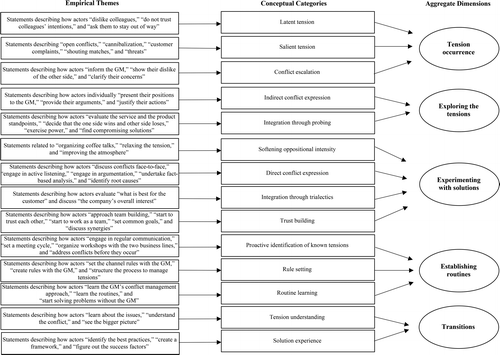
The data analysis started with developing longitudinal case histories for content analysis (Yin 2009). Building on these case histories, the first author coded a list of empirical themes, which served as the basis for an extensive deductive reasoning phase, during which she grouped the empirical themes into conceptual categories. Although the themes were still grounded in the case contexts, the categories comprised multiple empirical themes and reflected the theoretical constructs (Strauss and Corbin 2015). For example, she grouped informant statements about “disliking colleagues” and “staying out of way” under the theoretical category “latent tension” (Smith and Lewis 2011). The first author then undertook a cross-case analysis (Eisenhardt 1989) to identify similar empirical themes and theoretical categories across the cases (Miles and Huberman 1994), which she clustered into aggregate dimensions (Gioia et al. 2013).
More specifically, she aggregated the categories “latent tension,” “salient tension,” and “conflict escalation” in the dimension tension occurrence. She subsequently grouped the evolving practices for managing the transition to a dual orientation into three dimensions, which reflect our analytical questions: Exploring the tensions refers to our first analytical question about how the subsidiaries acquired the necessary understanding to embrace emergent tensions and contains the categories “indirect conflict expression” and “integration through probing,” which occurred in the initial stage. Experimenting with solutions refers to our second analytical question about the subsidiaries’ evolving activities to develop solutions for managing tensions and contains the categories “softening oppositional intensity,” “direct conflict expression,” “integration through trialectics,” and “trust building,” which emerged in the intermediate stage. Establishing routines relates to our third analytical question about the transition’s conclusion and comprises the categories “proactive identification of known tensions,” “rule setting,” and “routine learning,” which occurred during the advanced stage. The final dimension comprises the categories “tension understanding” and “solution experience,” which describe the transitions between the stages.
At this point, the second author, who had not previously been involved in the data analysis, recoded the data independently. There was strong interrater agreement, and the remaining disagreements were resolved through discussion and mutual coding. Thereafter, we explored the less successful cases based on a similar analysis process and compared their findings with those of the successful cases. The variation between the two groups allowed us to use theoretical replication logic (Yin 2009). We also verified our conceptual categories’ temporal sequencing across the cases. Although these processes were not entirely linear (Van de Ven 2007), we could develop an evolutionary process model that closely matched the order in which the categories emerged. Finally, we presented our findings and conclusions to our key informants to ensure our theoretical explanations’ plausibility (Miles and Huberman 1994). Figure 1 provides an overview of the key processes and practices in the transition to a dual orientation.
Findings
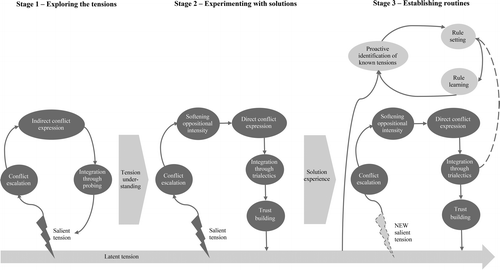
In the following, we present the subsidiaries’ evolving activities aimed at managing their transition to a dual orientation in three stages. The first stage recounts the initial developments following the adoption of a dual product-service business model in 2007; the second stage, the dual business model’s subsequent implementation; and the final stage, the postrollout in 2010 and thereafter. Although all four subsidiaries attempted to transition to a dual orientation, only two (Beta and Delta) completed this transition during our observation period, whereas the other two either remained stuck in their initial activities (Gamma) or in moderately advanced ones (Epsilon). We present the successful Beta case in detail, comparing it to the developments at Gamma in the initial stage and those at Epsilon in the intermediate stage. Table 2 presents an overview of the four cases, and Table 3 provides additional evidence not reported in the text regarding Delta and Epsilon, while Figure 2 presents the conceptual model that emerged from our data.
|
Table 2. Overview of the Cases
| Subsidiary | Beta | Gamma | Delta | Epsilon |
|---|---|---|---|---|
| Evidence at the beginning of the study period | ||||
| Salient tension | Yes | Yes | Yes | Yes |
| Evidence of the evolving process* | ||||
| Stage 1 | Yes (15) | Yes (24) | Yes (18) | Yes (22) |
| Transition 1 | Yes (5) | No | Yes (6) | Yes (4) |
| Stage 2 | Yes (18) | No | Yes (14) | Yes (6) |
| Transition 2 | Yes (7) | No | Yes (6) | No |
| Stage 3 | Yes (21) | No | Yes (16) | No |
| Evidence of the performance at the end of the study period | ||||
| Revenue synergies achieved (i.e. cross-selling)** | High | Negative (cannibalization) | High | Low |
*The numbers in parentheses indicate the number of directly applicable interview quotes.
**As reported by the general managers and reflected in the internal financial reports and data.
|
Table 3. Additional Representative Quotes
| Stage | Delta | Epsilon |
|---|---|---|
| Stage 1: Exploring the tensions | Latent tension: Our [product] salespeople receive a commission on the sales of equipment through distributors. Of course, everything the distributors sell in the region is lost for services, because [the service line] can no longer sell a service contract or anything else to those customers. Hence, there is a deep conflict and people in services therefore do not like distributors. —Service Line Manager Salient tension: One of our service technicians heard that a customer need[ed] a simple equipment installation. He handed the lead to [product] sales. The product salesman then thought that our services would be too expensive, and they might not be capable of doing the installation, which led him to give the lead to his distributor. The whole story came to the Service Line Manager’s attention, who said, ‘Hey, my guy acquired this machine, he generated the lead, he worked proactively to support sales…and now he can’t service this machine, because the contract has been handed over to the distributor. We will never get our investment back.’ —General Manager Conflict escalation: The Service Line Manager told me about his conversation with the Product Line Manager: ‘Hey, why didn’t you sell it directly, then we could have done the service ourselves, because we always need work for our technicians.’ —General Manager Indirect conflict expression: I had worked on both the product and the service side, and they know me well. This experience helped me understand their individual perspectives. I got to know what was going on by talking to representatives from each business line in confidence. —General Manager Integration through probing [Prioritizing]: The problem is that the relationship between the product sales representatives and the distributor has grown for many, many years. Sometimes, I even ask myself if the sales representatives sell for Dual, or for the distributor. Whenever there is a lead generated by someone in the organization, the sales representatives hand it to the distributor. The distributor takes the deal, and even if we did do the service for this customer in the past, it has now gone to the distributor, which is very frustrating for the service line. That is why I decided to no longer allow that. —General Manager [Rebalancing]: Once a customer called us, but it was a customer who was already taken care of by the distributor. The customer had googled, trying to get the best deal, which is how he ended up with our Service Planner, who then dispatched a service technician to do the installation. The technician went there, and the customer asked, ‘Do you also close service contracts?’ and the technician answered, ‘Of course!’ He sold a service contract and received a commission. Afterward, the distributor called and complained. This was escalated to the General Manager, who said that he had to protect the distributor and ordered us to return the customer to the distributor. —Service Line Manager [Compromising]: Sometimes it is important to look at both sides for a solution. The service people always say that the product sales representatives give a service away for free. It is not really like that; it is just that the market works like that. With equipment, we often give up to 55 or 60% discount, because it is a buyer’s market, and it is not only us doing it, but also our competitors. However, we give almost no discount for a service, and since the service division’s establishment, service prices have increased by three to five per cent a year. I therefore had to find a compromise, because if the product’s market prices don’t increase, but the service prices increase every year, overhauling is more expensive than the machine after five years. —General Manager | Latent tension: When the service business line was set up, we appointed dedicated service sales representatives. Our customers now have two salespersons—one for products, one for services. This setup causes persistent frictions. The product salespersons continue to speak of ‘their customers,’ and I constantly explain, ‘no, they are not your customers, they are our company’s customers.’ —General Manager Salient tension: To close a deal, one of our product sales representatives had overpromised on the machine’s performance and suggested a very low rate for servicing the machine. When the service sales representative showed up at the customer site, he got all the blame for the machine’s deficiencies compared with what had been promised. …Clearly a terrible start if you want to build a lasting relationship for delivering advanced services. That was when the product and the service guys came into conflict. —General Manager Conflict escalation: [The Service Line Manager] came to me complaining about the promises that the product sales representatives had made. He also told me about the reaction of the customer, who had basically told them that they had to be out of their minds to increase the service rate by 200% compared with what had been initially promised [by the product salesman]. —General Manager Indirect conflict expression: I first called [the Product Line Manager] who stressed the importance of replacing the customer’s old machine for security and energy-efficiency reasons. He also told me how difficult it was to convince the customer of the deal. Offering the service agreement had sealed it. Afterward, I called [the Service Line Manager], who argued that if the product line could use services as a bargaining chip, there was no sense in having a separate service line. —General Manager Integration through probing [Prioritizing]: Since the promises made to the customer could not be undone, I asked the service business line to provide services at the negotiated low fee. We simply had to bear this cost to prevent further conflict with the customer, who sees us as one company and does not distinguish between our divisions. —General Manager I had another discussion with the General Manager, because I did not want to accept what he had asked me to do. I think his decision was wrong. At the very least, I want to have it in writing. If something happens, I can say, ‘it was his decision and I had to accept it because he is my boss.’ —Service Line Manager The General Manager has always been far more interested in the product side. He spent most of his career selling large equipment deals and our products are his first love, places two and three are empty, then the spare parts follow, and only long after those, services appear. —Service Marketing Manager [Rebalancing]: There were situations like the one when a distributor was offering a customer services for which our service line was responsible. In this situation, the General Manager decided to tell the Product Line Manager to ask the distributor to let us continue with the service contract. On other occasions, he would prioritize the product line’s objectives instead. —Service Line Manager [Compromising]: The General Manager also helped us reach a compromise on some occasions, but I think it would have been better to make these decisions together with us, not having him impose the decision on us. …It’s difficult when you don’t have a framework of common goals. —Product Line Manager |
| Transition 1 – Tension understanding: I grew to hate the fact that whenever I took a decision to help either (the product or service) side, not everybody was convinced, and then spoke to the outside world with different voices and this hurt us. I then tried out a different approach to reach agreement with both business line managers. I realized they needed to come to an agreement before we implemented anything. —General Manager It´s a learning curve for the General Manager as well. He has never experienced these conflicts before. He learned by observing the two groups of people acting in their own interest, still pursuing targets set in the past, following the legacy, and reaching for low-hanging fruits, which resulted in an unwillingness to change. Over time, he realized that small changes lead nowhere; there is a need to address these conflicts more deeply by really changing our approach. —Service Line Manager (During today’s leadership meeting), the General Manager drew a diagram that places him between the product and service line managers. Referring to the lines between products and services, he explained that his main role from now on would be to ensure that the ‘whole is greater than the sum of its parts.’ —First author, Observation diary | Transition 1 – Tension understanding: What I have learned as a General Manager is that I need to understand much better how this [product and service] relationship works in order for all of us to avoid repeating daily conflicts and managing them on a case-by-case basis. Besides the loss of efficiency, there is also the impact this has on the customer, because at the end of the day, the customer needs to have the best experience with our company overall, not with product and services individually. —General Manager The General Manager reported on a situation in the northern region where there was no coordination between the product and service salesmen, and they sometimes targeted the same customer at the same time. Thereafter, he presented an employee survey showing the lack of customer orientation as a key improvement area. …He announced a workshop to discuss how to overcome the daily conflicts and compromises with the business lines and to move to a solution that truly satisfies customers. —First author, Observation diary At [Epsilon], they have finally understood that they need to think about the customer from an overall company perspective and not from a product or a service perspective. —Service Marketing Director, Dual Headquarters | |
| Stage 2: Experimenting with solutions | Conflict escalation: I received emails from the product line manager complaining that he had lost a product deal because the service line was asking too high a price. Then he and the service line manager would send aggressive emails back and forth, with me in copy. I told them it felt like being at kindergarten. I got really upset with them about all the energy they wasted fighting each other. —General Manager Softening oppositional intensity: [Following this], we simply sat together, had some coffee and snacks, talked to each other like normal people for two hours. —General Manager We started by sometimes meeting outside the company. The change of scenery really helped us relax more about what was happening. —Product Line Manager Direct conflict expression: There are always personal interests involved, and some people simply do not get along that well, but when they are confronted with one another and have to provide clear arguments, they tend to do it in a professional manner. It was therefore essential to confront them, especially because as soon as they started talking to one another, they recognized that things are not that black and white. —General Manager Integration through trialectics: Breaking down the barriers between the business lines is a continuous process. These barriers do not simply go away in half a year. It is absolutely crucial to get the business lines together to agree on common goals. …At our joint meetings, I did not provide a solution; I just asked questions to help them produce the solution themselves. …I can’t solve everything for everybody, but when there is serious conflict, I listen to them and help them solve their problems. It is not that I do it for them, I just take the initiative. …I always encourage them not to forget that we all work for Dual and our primary duty is working together to find the best solution for the customer. …I ask them to not only look through their divisional glasses, but to analyze the situation from the customer’s perspective. What would you expect if you were the customer? I do not give them the solution, I just ask questions, which allows them to come up with the solution themselves. —General Manager Trust building: [Referring to the product and service line]: Sometimes, you have to get your hands dirty with operational problems. I let them lay all their troubles on me from time to time, and I accept this, and then I solve some of their problems—not all of them of course, but some—and that helps me gain their trust. They get the feeling that we are all in this together. —General Manager | |
| Transition 2 – Solution experience: My mission was, first of all, to open the eyes of the product and service managers to the fact that they’re destroying their market and that, in the end, this was not good for Dual. Then, I shifted their attention to what the best option for the customer was, or to what makes Dual the most competitive company on the market as a whole, and across the product and the service perspectives. We have instructed our people, as well as equipment service salespeople, that they need, first of all, to ask the right questions, such as: ‘What does the customer really want?’ They now have a clear guideline of what the questions are that they need to ask in order to proceed. —General Manager. At some point, we were ready to formulate guidelines for the whole organization. Together with [the business line managers], I designed a policy on what is best for the customer. Unlike before, when we had first started the cultural change and were gaining awareness of the problem—the problem of separate goals and the need for a common goal—our learning focus is now on how to best implement a solution. …Then, as with everything else, what gets measured, gets done. You have to set up KPIs [Key Performance Indicators] and connect these KPIs to the organization’s overall goals. Connect the [business] line-specific KPIs, like the service share or the market share, to the customer satisfaction metrics, like the net promoter score, and these subsequently to the overall financial metrics, like profitability. —General Manager (During today’s leadership meeting), the Service Line Manager presented the lessons learned from a workshop with the product and the service line managers. His presentation was structured into two parts. The initial slides defined the ‘Key success factors for a successful product-service relationship,’ which were ‘Customer management and intimacy,’ ‘Short and speedy communication,’ and ‘Solution selling.’ The following slides covered ‘Critical deficiency factors threatening the product-service relationship,’ which were ‘Brick walling,’ ‘Process drift,’ and ‘Direct allocation.’ The presentation was followed by extensive discussion. —First author, Observation diary; Meeting presentation | ||
| Stage 3: Establishing outlines | Proactive identification of known tensions: [At these meetings], we have product and service people from the same region working jointly through their greatest challenges. They analyze the customer feedback—what they did well and what not—and discuss new leads and opportunities. —Service Line Manager We have 40 or 50 distributors, and we regularly see around 30 of them during our distributors’ meetings. At these meetings, I am joined by the product salespeople, the service salespeople, and the operations people, when we discuss different cases and decisions that were made and future situations that might emerge. —General Manager Rule setting: We defined a few ‘golden rules’ to manage product-service tensions. For example, we now have a rule that a general overhaul can only be priced up to a given percentage of the price of the equipment being serviced. …Yet another rule is that if a unit is ready for a first overhaul, the service salesperson quotes for just the overhaul. However, if the same unit is ready for a second overhaul, the product and service lines jointly develop options and prices for an overhaul and for a new machine, which they jointly present to the customer. —General Manager The General Manager brought us to the table, and we jointly agreed on the main rule for distributors, which is: whoever acquired the customer [i.e., sold the equipment], has the right to offer services. If it’s a new customer who our people acquired and we incurred the marketing cost, then we should also receive payback during the service contract’s duration; if the distributor acquires the customer, then we hand him over to the distributor, because he incurred the marketing cost. It is no longer acceptable for salesmen to just hand over leads to distributors because they want to please them. —Service Line Manager Rule learning: I told them: ‘I want all of you to leave my office and find a solution together, because I know if you sit down together for half an hour, the issue will be solved, and you will identify the perfect solution.’ —General Manager We told five or six people from one region to focus on a specific case and talk it through. They looked at the metrics, the customer comments, and then used their experiences. That was really powerful, and our people were extremely happy that they were directly involved in resolving the challenges together. —Service Line Manager We instructed the product and service salespeople that they, first of all, needed to ask the right questions. They now have clear guidelines specifying the questions they need to ask in order to develop the right solutions. For example, the first question is: ‘What does the customer really want?’ —General Manager (New) salient tension: Obviously, not every conflict is black and white. Especially if new types of conflicts arise, we have to manage the process very closely again by identifying the issue, discussing the different perspectives, and finding a common solution. If that happens, we present the outcome and communicate it to the entire organization. —General Manager Normally I try to do everything to keep customers, but this customer was very angry and disappointed with our service, and I had to transfer him to our distributor, despite the rules stipulating that he is our customer. I would have done anything to keep the customer … but in this case it was good for the organization that the customer went with the distributor, he would otherwise have gone to the competition. This is something we did not do in the past, but it was the best solution for the customer. …We learned from this experience that if we have an emergency, we should engage the distributors. We need this new rule, which I will now have to discuss with the different parties. I have already talked to the distributor, and he said, ‘I know why [the service line] is afraid to give the job to me; they are afraid of losing the customer … it is a matter of trust.’ Indeed, the service line does not trust our distributors enough. We are working on a process to improve this. —General Manager We have this customer who wanted to pay for machine time and capacity rather than buy the machine and signing a service contract. Here, we have a common interest [between the products and service lines], which is to jointly develop a service plan that allows the customer to only pay what he consumes. We worked together to develop the best solution, first, from a customer perspective and then for the two business lines. The customer’s payment is now based on the running hours of the product and the service, and we then split the revenues internally so that 60% goes to products and 40% to the services in the first five years. After that, everything goes to the services until the machine is replaced. That is a good deal for all of us. …For the first time, we designed a solution where there are no boundaries between the product and the service. This fully synergistic solution extends our range of possible scenarios and solutions substantially. —Product Line Manager Performance: On the synergy side, we see so many good examples now, where [the product and service lines] really collaborate and where they generate more value for the entire organization. They’re communicating, they’re sharing information, not only on a daily basis, but on an hourly basis, with one side throwing the ball to the other, complementing one another, and it is a true pleasure to see this. —General Manager We now have joint campaigns to use [governmental] energy efficiency subsidies to promote our new products and services to our customers. Depending on different parameters, such as whether it is our customer or that of a competitor, we first approach the customer with either a service or a product offering. Once we have a foot in the door, we suggest our new outcome-based contract solution in which products and services are part of the deal. —Product Manager [A two-digit percentage] of Delta’s revenues come from the most advanced services, followed by Beta [with a high, one-digit percentage]. Gamma and Epsilon have a negligible share of advanced services —Archival Records, Enterprise Resource Planning System |
Stage 1: Exploring the Tensions
Beta.
When the separate service division was created in late 2007, the latent product-service tension at Beta became salient. The Service Marketing Manager provided an example of this: “We had a customer with an extremely old machine, but no capital for purchasing a new one. We were in favor of the customer’s demand for continued service, even though the unit was up for replacement, but the product salesman insisted on pushing through the sale of the new machine.” Discouraged by the product salesman, the service technician adopted a less proactive customer-service approach, which the product line perceived as a lack of responsiveness. The product line employees started complaining that the service technicians refused to take their customers’ calls. The conflict was escalated to the product and service line managers, and eventually to the General Manager, who explained:
Conflicts between the product and service sales representatives surfaced regularly. A specific conflict would then be escalated to the line managers, who escalate it to me. Mostly it was [the Service Line Manager] who came to me, because he was not ready to accept being wronged.
The General Manager would then consult both sides. In this specific situation, he first contacted the Service Line Manager to investigate why the service line had not responded to the customer’s calls. He subsequently talked to the Product Line Manager and the responsible product sales representative to better understand their perspectives of the conflict. After consulting both sides, the General Manager usually made a decision. In this case, he allowed the product line to push the sale of a new machine. The Service Marketing Manager felt that the General Manager, more often than not, prioritized the product line:
[The General Manager] initially continued to follow the old principle that service is not a business in its own right and allowed the product guys to push customers to purchase new machines. We sometimes even lost customers when they pushed machine sales too much.
Over time, the General Manager became aware that prioritizing the product division created deep frustration and real challenges for the service side, which could hurt the overall business. He started looking for opportunities to strengthen the service line. When another conflict about competence development emerged, he decided in favor of the service line. A service line employee explained:
[The General Manager] tried to be fair and keep our Service Line Manager happy. Our initiative to upgrade the service line competence was approved, and we were given priority in competence development. He supported us by rebalancing the initial decisions in favor of the product line, which helped increase our competence levels and service quality.
However, the General Manager realized that rebalancing across conflicts did not ease the tension: “The frictions became even stronger because the equipment people now started to think they were being left behind.” Over time, these experiences taught the General Manager that ruling in favor of one side inevitably created problems for the other side. The internal conflicts often affected customers negatively. The Service Line Manager stated, “We started to see so many situations where customers were not happy because [products and services] did not talk to one other, and we realized we had to do something about it.”
At this point, the General Manager started searching for compromise solutions for conflicts that would, to a certain extent, fulfill both parties’ needs. The Service Marketing Manager recounted:
Dealing with the issues between products and services took so much organizational energy that it was easier for [the General Manager] to compromise or find other ways to avoid them, especially regarding smaller conflicts. But that didńt mean anyone was really satisfied with the solution. …The tensions between the business line managers remained extremely high.
The General Manager then started discussing the issue with the business line managers. The Service Marketing Manager told us that they realized that compromising could provide a temporary solution, but would ultimately fail to address the underlying tension: “The lack of an effective resolution of smaller conflicts made the resolution of bigger conflicts difficult, and the fundamental lack of trust persisted.” The General Manager’s core insight was that addressing the tension would require an entirely different, more comprehensive approach:
I learned that it is important not only to treat a specific case, but also to address its root cause. …My interpretation is that there are two types of conflict. One is about technical problems. Those conflicts are important, but the main problem is that there is also a fundamental conflict when people from both sides do not understand the other’s approaches.
The Service Line Manager added his perspective of the learning process that had occurred:
The General Manager, who had a broader vision, started to see a pattern emerging from the conflicts, which started reappearing. He felt that he was wasting his time solving endless conflicts and realized that there was something more fundamentally wrong with how he had addressed them. He understood that he would have to solve these conflicts from a structural perspective, rather than continuing to fight fires. This was our wake-up call.
Gamma.
Whereas the Delta and Epsilon subsidiaries’ early stage experiences were fairly similar to those at Beta (see Table 3 for illustrative quotes), the Gamma subsidiary’s experience was initially similar, but quickly deviated substantially. Early on, this subsidiary also experienced a salient tension between the new service line and the established product line. The Service Line Manager recounted:
Tensions started to emerge when we introduced specific key performance indicators for the product and service lines. …When customers buy new machines, they tend to say, ‘Your products are good, but your service prices are a bit steep.’ The product salesman then asks me, ‘Can you reduce the service price, so that we can sell the machine? If we do not sell the machine, there won’t be a service contract.’ What can I do? If I reduce the price, we fail to achieve our key performance indicators.
Initially, the Service Line Manager gave in several times to help the product line close deals. However, he felt increasing pressure to meet his own business targets. When a product salesman approached him, he argued, “[This customer] can afford a higher price, which allows us to provide higher-quality service, increase customer satisfaction, and, in turn, help [the product line] sell new equipment.” However, he did not convince the product salesman, who argued: “The service unit does not support us much, and I am not sure that customers interested in our products really care that much about service.” This time, the Service Line Manager decided not to give in, but escalated the conflict to the General Manager.
The General Manager asked both sides to provide their arguments separately. He explained this approach in line with the company’s structure: “The divisional organization needs to be implemented all the way through. I look at the two business lines’ arguments and then support either one or the other position.” In this case, both sides’ arguments were based on their respective key performance indicators, which they found difficult to realize without the other side’s concessions. Eventually, the General Manager made a decision, which was to reduce the service price to allow the product line to close the deal. The Service Line Manager commented:
The General Manager strengthens either the product or the service line to make at least one division head happy. If one of them is happy, that is much better for him than if both are unhappy. The smart thing for him to do is to align himself with one division’s strategy.
The Product Line Manager did not conceal his satisfaction with the decision: “In a booming market, prioritizing the product objectives makes a lot of sense.” In contrast, the Service Line Manager was upset:
It’s not that I do not want to help products, but if we always reduce the service price, how can we ever be successful? …The product salesmen should demonstrate the unique customer value we create, for example, by showing that our equipment efficiency is higher than that of our competitors. We have the arguments needed to change the customer’s mind, but that requires more sophisticated communication than simply discussing the price.
Contrary to the Beta case, the General Manager at Gamma continued to rule in favor of the product line in subsequent conflicts. His strong focus on the divisions and his prioritization of the product line’s interests contributed to a culture of increasing rivalry between the business lines. During a subsidiary visit, the first author observed that the product and service line managers avoided meeting physically and instead opted for calling in separately during meetings. In a follow-up conversation, the General Manager told her that he had decided to take a back seat and let the line managers handle future conflicts directly:
I think it is very important that the General Manager allows these guys to try and solve the problems themselves. As always, you believe that they see themselves as equals, but if you know that one business line manager is more dominant than the other one, and tends to manipulate the other one, then you have to be sure that the other guy, first of all, learns how to stand on his own two feet and, secondly, that he has his division’s best interests at heart.
Dual’s top management eventually transferred the General Manager to another position. The succeeding General Manager attempted to change the culture of rivalry by striving for compromise solutions. One example was his handling of a conflict about spare part prices. Although the product line was pushing the service line to cut its spare part prices, the Service Line Manager worried about the negative impact on the service line’s performance. The General Manager explained his compromise solution:
I created a new service plan in which the spare parts are bundled and sold through a long-term contract…. The service plan is better, because the customer receives a better service, product salesmen can sell equipment more easily, and the service line gets the service contract.
The service plan concept was implemented, but the product and the service line managers did not receive it positively and continued pushing exceptions that met their business line’s interests better in subsequent conflicts. Over time, the General Manager proposed other compromise solutions, which sometimes appeased the conflicts momentarily, but did not change the culture of distrust between the business lines.
The General Manager concluded that the clashes between the product and service businesses were inevitable. He eventually decided to delegate the task of finding compromises to the line managers:
I took this position two years ago and I tried out some things, but there are still huge problems between the divisions, a lot of complaining, and much blaming of one another. I believe this is because each division has its own business model, and they don’t understand each other’s business models. I therefore asked [the business lines] to organize monthly meetings where the business lines’ managers could come together to discuss the problems they have with one another. Only if they cannot solve the problem on their level, do they direct it to me.
During these meetings, the tension between the two business lines remained high. Gamma continued to suffer escalating conflicts and, as the quarterly subsidiary reports show, sales cannibalization between the business lines, where the loss of service clients led to the loss of product clients and vice versa.
Model Development.
Exploring these cases provides insight for our first analytical question: How do organizations starting a transition to a dual orientation acquire the necessary understanding to embrace emergent tensions? In all four cases, there was a latent tension (Smith and Lewis 2011) emerging from the product and service business lines’ contradictory, yet interdependent, objectives (Markides and Charitou 2004). A contextual change, in this case, Dual’s shift from a product to a product-service business model, turned the latent tension into a salient tension (Smith 2014) at the subsidiary level. This created conflict, which was escalated to the senior managers. Such conflict escalation, or the communication of opposition in the presence of the leader (Weingart et al. 2015), is important, as it allows leaders to perceive and address the tension (Smith and Tushman 2005). In our cases, the leaders did so by asking the conflicting parties to present their interests separately—a management practice that could be described as differentiation through indirect conflict expression. Differentiation denotes managerial practices that clarify how the two sides differ from one another by advocating each domain separately (Smith 2014). Indirect conflict expression means that each side articulates its concerns separately, which allows the leader to gain insight into the conflict’s causes from two perspectives (Weingart et al. 2015). However, the two sides are unaware of the other side’s perspective and maintain their respective worldviews.
Subsequently, the senior managers used a form of integration, which refers to managerial practices that identify communalities and connections between the two sides (Smith 2014). Integration through probing relied on tradeoff (either/or) rather than paradox (both/and) practices to address newly emerging tensions: First, the leaders relied on prioritizing. After evaluating the two sides’ arguments, they ruled in favor of one or the other side in a given conflict. Second, the leaders used rebalancing, which describes their attempts to counterbalance prior decisions by deciding in favor of the previously neglected side when subsequent conflicts occurred, allowing them to treat both sides equally over time. Third, leaders used compromising to find solutions for conflicts that would at least partially satisfy both sides’ interests.
These management practices may appear to be incomplete and somewhat clumsy attempts at integration. For example, prioritizing and rebalancing always triggered opposition from the unfavored side, whereas compromising led to both sides protesting. However, our case studies also revealed that these probing practices allowed the leaders in the three cases that subsequently progressed to stage 2 (Beta, Delta, and Epsilon) to work through these conflicts and gain deeper insight into the tension. Leaders facing emerging tensions fail to immediately grasp tensions’ full complexity (Tsoukas and Chia 2002). Prioritizing and rebalancing allowed the leaders to explore the tension’s poles and experience the escalating dynamics that such one-sided approaches trigger (Lewis 2000). This experience provided the insight that tradeoff solutions ignore the interdependence between the two sides, which has negative internal (for the neglected side) and/or external (for the customer) consequences. Furthermore, the leaders learned that compromising fails to resolve the tension, which persists and reemerges when conditions change.
In the successful cases, the leaders’ comprehensive probing experience helped them understand the tension’s interdependent, dynamic, and persistent nature. This growing tension understanding motivated them to subsequently change their approach and use more comprehensive paradoxical practices, which embrace the tensions’ interdependence, dynamism, and persistence. In contrast, Gamma’s senior managers failed to reach a comprehensive understanding of the tension. Each general manager used just one of the probing practices, which enabled only partial understanding. Insufficient probing experience left the senior managers with the firm belief that the products and service businesses are in direct conflict and that only one side could win, which made the tension seem an insurmountable tradeoff (Putnam et al. 2016) or dualism (Farjoun 2010). Consequently, Gamma did not transition to developing paradoxical solutions, but retained its tradeoff practices. Moreover, the general managers’ early attempts to establish routinized practices by delegating the tension resolution to the product and service line managers failed due to these managers’ limited understanding of the tensions and lacking experience in managing them.
Stage 2: Experimenting with Solutions
Beta.
Although the tensions remained, and the conflicts continued to escalate, the General Manager at Beta used his learnings from the prior probing experience to adapt his subsidiary’s approach to managing tensions. He used the new tension-management process when a conflict about commissions made the product-service tension salient again. The Service Line Manager described this conflict:
The product sales representatives have their commission, and our [service] sales representatives have theirs. If my sales representatives maximize their commission by selling an expensive service plan, they jeopardize future equipment sales. Not surprisingly, this creates tension between us and the products. …As usual, this conflict emerged at the operational level, but was then escalated.
The General Manager decided to use this conflict to address the tension more profoundly. He initiated a series of meetings with the two parties to “improve the atmosphere.” Both the product and service line managers spoke highly of the General Manager’s efforts to ensure a constructive debate, which helped mitigate the tension. The Service Line Manager explained:
When the conflict was escalated, [the General Manager] addressed it very calmly. His demeanor showed us that we should discourage further fighting with our product line colleagues. He described us as gentlemen who can reach an agreement rather than lesser spirits who start fighting.
In one of the joint meetings, the General Manager asked the two parties to present their views of the conflict. He suggested that the conflict was partly rooted in each side’s lack of understanding of the other party’s perspective. Having both sides elaborate their respective perspectives, which included a clarification of their challenges and needs, helped them achieve a mutual understanding, while also allowing the group to jointly identify the conflict’s root causes. The General Manager provided an example:
I encouraged the Service Line Manager to explain to his product counterpart why there was a backlog in service provision for [a specific customer]. He argued that his team follows the general policy of prioritizing service plan customers, defended this practice, and explained why they could not simply change the planning in this situation. …The Product Line Manager started understanding the larger context and now has the right arguments to explain the situation to his customers and propose a solution, which is to suggest a service plan granting the customer priority service.
The General Manager did not make a decision to resolve the conflict, but asked the two sides to jointly develop a solution. He insisted that this solution should not be a compromise between the two sides, but the best possible solution from the customer’s perspective, regardless of the product and service line goals: “I no longer asked about their problems, I asked them what solution would satisfy the customer most.” The Service Line Manager told us that they used the same approach in subsequent conflicts:
We now always think about the best solution for the customer. …If a customer has old equipment and there is huge potential for energy savings, buying new equipment will serve him better. My guys will then help the product guys sell new equipment, even if we have to lower our service prices to make the sale. However, if a customer tells us he cannot replace the equipment, he only has a budget to refurbish it, it is the other way around. Then, the product guys must help us sell the overhaul.
After each conflict’s resolution, the General Manager organized follow-up meetings. His philosophy was, “a conflict resolved is a positive force.” He used the exchange to cultivate a common team spirit and foster trust between the parties. The Service Line Manager described the measures taken:
[The General Manager] now organizes regular meetings to bring people from both sides together. He asks us to give presentations. Our people increasingly feel a part of the same team, get along better, and rely on one another more. It is not easy to create this spirit, because it requires us to daily address and solve frictions between products and services. This demands a great deal of communication, especially in terms of repeating the same message endlessly.
By experimenting with the new process across different conflict situations, the leaders started defining an effective solution process’s characteristics. The General Manager worked on identifying the conditions and principles that needed to be considered when applying the new management process to different types of tension occurrences. He eventually formalized his combined learnings in an overarching framework for addressing tensions. The Service Line Manager recounted:
The examples of good case solutions started to accumulate, and a pattern started emerging regarding a good product-service relationship’s characteristics. Drawing on this experience, [the General Manager] created this framework, which he, at the time, called ‘the dimensions of customer satisfaction.’ In this framework, he clarified what was important from a customer perspective when we address a conflict. …He isolated the values that were important for us to cultivate, like accessibility, honesty, and other things that would help us deliver the best overall customer experience. If you take, for instance, honesty as a value, the moment a service salesman goes to a customer and wants to say, ‘Hey, this is an overhaul, the price is good for you, let’s move on,’ he should instead change his story and say: ‘You know, Mr. Customer, we could do an overhaul, but let me be honest with you, this is not the best alternative for you at this point in time. I think you should consider acquiring new equipment because of this and that.’ [The General Manager] now highlights these customer-centricity concepts at our subsidiary’s quarterly meetings.
The General Manager emphasized that it took an iterative process to develop the solution and make it part of his country organization by applying it to different types of tensions:
We then consistently focused on the overall business perspective to improve customer satisfaction …We called it ‘the synergy perspective’; although the name was changed later, the target remained the same: To develop a common view of how [Dual] operates and convince teams that this is the right way for everyone. The challenge was to apply this view to all the conflicts that emerged about equipment, sales, services, and customers. At the end, we created a common view of the responses regarding time, warranties, spare parts, utilization, and so on. …We had to repeat the process quite a lot to clarify what we want…. We also had to communicate this strategy quite often, because a single booklet, a single email, a single kick-off meeting is simply not sufficient for a comprehensive understanding of the synergistic way in which we want to operate and collaborate.
Epsilon.
Although the Delta subsidiary’s development process was similar to that of Beta (see Table 3 for illustrative quotes), Epsilon, too, faced recurrent conflicts, but quickly started diverging from Beta and Delta’s experiences throughout stage 2. The General Manager provided an example of a conflict:
One of the product salesmen sold a machine with a very long delivery time. When the machine arrived, this person called the service planner and said: ‘You absolutely have to send your technician to this customer right away to commission the machine.’ The service planner responded: ‘I will send the technician in two weeks.’ The product salesman was furious, the Product Line Manager called the Service Line Manager, and they escalated it to me.
Like his counterparts at the Beta and Delta subsidiaries, the General Manager at Epsilon invited both parties to present their problems in each other’s presence. He explained:
I got everyone together to present their sides of the story, which clarified the service planner’s massive workload to the product side. The people from the product side weren’t aware of this problem. When they first saw the list of priorities that the service planner had to deal with … they understood his response much better.
At this point, the tension-management process at Epsilon started deviating in two ways. First, there was no evidence of team building or other socializing activities prior to the conflict resolution. Second, whereas Beta and Delta’s general managers elevated the discussion to an overall customer perspective, allowing the business line managers to jointly find more encompassing solutions, Epsilon’s General Manager remained focused on clarifying the product and the service lines’ interests to subsequently make the decision himself:
What I did was to clarify the service planner’s priorities for the product side. Now they know that if they are going to receive a machine, they should not wait until the last moment to call the service planner. They should call him two weeks in advance to make sure the machine is ready on time and to ensure that the customer has everything prepared in advance for the technician’s visit.
The General Manager argued that the exchange was sufficient to make the product team change its mind and resolve the customer’s problem. He subsequently focused on trust-building activities. Although these activities had some similarities to those at Beta and Delta, they remained more general. The General Manager explained that his focus was on creating a culture in which conflicts could be expressed openly:
Currently, I am trying to develop our employees’ and managers’ understanding that they can raise a ‘red flag’ if they are suffering. Communication is essential here. …You have to create a level of trust in the organization that allows everybody to voice their opinion freely. For example, I asked one of the service managers how we could make things better for him. He said: ‘I have only one wish, which is a professional training room for our distributors.’ …I said: ‘OK, prepare a business case, show us the return on investment, and present this at the management meeting.’ He did that, and everybody voted in favor. I told him: ‘Now you have your training room.’ …I think by handling things this way, people start to trust you.
The General Manager continued addressing conflicts by inviting the two parties to present their views. However, his approach did not develop further, and the Epsilon subsidiary did not progress to a routinized approach in phase 3. Although his ad hoc process temporarily handled specific conflicts, it did not address the more fundamental issues underlying the product-service tension. In consequence, Epsilon achieved modest success with realizing synergies, such as occasional cross-selling achievements, but remained behind the Beta and Delta subsidiaries’ extensive synergies (see Table 2).
Model Development.
Our continued comparative case analysis provides insight into our second analytical question: How do organizations that transition to a dual orientation develop their solution to managing tensions? In stage 2, Beta’s and Delta’s general managers altered their tension-management process by organizing joint meetings with the two parties rather than talking to them independently. They first engaged in socializing and relationship-building activities to reduce the anxiety and negative feelings, described in prior work as softening oppositional intensity (Weingart et al. 2015). Experiments have shown that high oppositional intensity causes people to expect losses and threats (Lee and Aaker 2004), which makes them rigid and unwilling to share information (Bendersky and Hays 2012). Softening the oppositional intensity allows the conflicting parties to “monitor the merits of others’ actions or viewpoints and integrate them into their own response” (Weingart et al. 2015, p. 241). The senior managers then encouraged both parties to share their perspectives and explore them jointly, a process we describe as differentiation through direct conflict expression. In this process, the sender clarifies his or her position to the receiver, enabling the latter to express disagreement, which helps the participants work toward a common understanding of the conflict’s root causes (Tinsley and Weldon 2003). Collectively, these measures created an organizational space for collaboration (Battilana et al. 2015).
The greatest change after stage 1, however, concerned the integration approach. At Beta and Delta, the senior managers shifted the opposing parties’ attention from their divisional objectives toward common, superordinate goals, such as customer satisfaction and the subsidiary performance. The inclusion of this third-party perspective allowed for more comprehensive sensemaking (Bartunek and Bowe 1988, Weick 1995) and motivated a transcendence discourse (Putnam et al. 2016, Sharma and Bansal 2017). We refer to these activities as integration through trialectics (Bartunek 1988, Janssens and Steyaert 1999), during which situating the two elements within an overarching whole helped integrate the products and services. This approach allowed the participants to reframe the tension from a tradeoff to a paradox perspective. Further, the senior managers used each conflict-resolution episode as an opportunity to foster trust building (Adler et al. 1999) between the parties, which further solidified the joint sensemaking (Weick 1995).
Moreover, the Beta and Delta subsidiaries developed their paradoxical solution process for coping with tensions over time. The senior managers’ initial focus was on applying the trialectics approach to different forms of tension expression (i.e., specific conflicts about service quality, price, contracts, and distribution channels) in order to define solutions for each type of tension. During this effort, they consistently relied on the customer as the third actor offering a more comprehensive perspective. Ultimately, the senior managers integrated the specific solutions into a customer-oriented framework that served as organizational schemata for trialectics (Bartunek 1988), which could be applied widely across tensions. This experimentation with paradoxical solutions for managing tensions helped them gain solution experience. When the general managers felt that their solution had become sufficiently stable and encompassing to deal with the most recurring tensions, they formalized it and communicated it to their product and service teams, therefore marking the start of the transition to the final stage.
In contrast, the process at Epsilon did not evolve to the same extent. Although the increasing tension understanding also led to the reexamination of its conflict-resolution approach, the subsidiary’s subsequent activities differed in two ways. First, we did not observe any softening of the oppositional intensity activities prior to the conflict resolution. Second, although the conflict-resolution process also started with differentiation through direct conflict expression, the integration approach differed substantially. Rather than experimenting with more comprehensive paradoxical solutions through trialectics, Epsilon’s General Manager continued to provide tradeoff solutions focused on managing specific conflicts when they occurred. The Epsilon subsidiary did not progress to the routinized approach in stage 3.
Stage 3: Establishing Routines
Beta.
Building on their paradoxical solution, Beta’s and Delta’s general managers started designing and implementing a process to institutionalize tension management throughout their country organizations (for Delta, see Table 3). At Beta, the General Manager felt that his management team had gained sufficient solution experience to address tensions proactively before they escalated:
We no longer allow problems to escalate. If there are any rumors or speculations, we handle them very early on. We use two new monitoring instruments: customer satisfaction surveys, which give us the net promoter scores and specific customer comments on what works and what does not, as well as employee insight surveys, which provide employee satisfaction scores and detailed comments on how the product line feels about the service line and vice versa. By using these surveys, we can identify imminent issues or conflicts at any given point in time.
The Service Line Manager added his perspective:
The net promoter score is a first source of input to identify customer complaints. We now have a database on which we register all the customer complaints made to any person in our organization. Everybody has access to this database and can create an incident report on a problem and its cause. That claim is then forwarded to the responsible area, but the line managers are always involved. Even if there is a specific service problem, which a lower-level employee addresses, we are still on copy and are responsible for ensuring that the problem is solved. This is a more proactive way of identifying issues and searching for synergies. We are well aware of the typical conflicts that can arise, and address them before they escalate. …I organize workshops where I ask the service and product technicians to assume one another’s roles. From that perspective, they have to identify problems that they had caused for the other side. …This role play allows us to not only solve the specific conflict, but also to work through the conflict more generally, and find rules and solutions.
The senior managers then established concrete procedures and rules to deal with previously experienced conflicts. For example, they created rules clarifying the conditions under which either the product or the service side would assume the lead in the sales process. The Service Line Manager recounted:
One rule is that the service line takes the lead to suggest an overhaul when a machine is between five and 10 years old. The product unit takes over after 10 years, because it becomes increasingly hard to find parts to repair such old equipment. However, even though we set limits for running hours and equipment age…, we give borderline cases some leeway when we can either offer an overhaul or new equipment, and allow the customer to decide.
Once a set of procedures and rules had been established, the General Manager invested much time in teaching the line managers to identify conflicts and apply solutions themselves. He explained: “In the beginning, this felt strange, because people were still very defensive, trying to push their own interests, even with these rules in place. However, little by little, they started tackling problems from a customer perspective and learned to solve conflicts themselves.” The Service Line Manager added his perspective:
I would say that, initially, [the learning] started at our yearly strategy meeting. This approach soon became the management team’s standard behavior, and we started to teach the lower levels in the organization. We initiated monthly business line manager meetings to discuss how we could create synergies between the service and the product lines. At that stage, the General Manager stopped handling daily conflicts. It is a sign of maturity that the line managers are now able to solve these conflicts on their level without having to escalate them.
The product and service line managers contributed to this learning process by subsequently providing their subordinates with similar training. The Service Line Manager elaborated:
Our people started learning how to solve conflicts. In the beginning, the line managers’ involvement was normal, but today, I am far less involved. Our people learned that if they come to us, we simply tell them to take a customer perspective and consider the rules we agreed on. Consequently, they think: ‘Let’s not waste our time; let’s solve the issue ourselves.’
Although the rules and trainings helped the lower-level actors tackle many day-to-day conflicts, new types of conflicts emerged occasionally from the product-service tension. In these situations, the lower-level managers did not feel confident enough to address the problems themselves. They then escalated these conflicts to the higher levels, who solved them through a process resembling the trial-and-error learning process that was used to address specific stage 2 conflicts. The Product Line Manager explained:
We drew up rules and developed a standard process, but, nevertheless, sometimes encounter situations that are not so easy to resolve. In certain situations, the line managers still have to become involved, and sometimes even the General Manager.
The Service Line Manager recounted an example of such a situation:
Our largest customer blacklisted us due to a conflict we had with them in the service area. The issue was so important that we involved the General Manager in the decision, which was to designate one person in the service unit to handle all our relations with this customer. Two years later, the customer started asking this service person questions related to new equipment. That experience helped us discover that we could use the same approach with other very large customers. It is now common practice for key account customers to first call our service people, even if they want to buy equipment.
Beta repeatedly added similar new rules to the existing set of rules, sometimes using these learnings to modify its tension-management practices and adapt its manager and employee training accordingly.
Over time, Beta mastered this dual tension-management process increasingly, which contributed to an increase in the revenue synergies between the product and service business lines. During a visit to the Beta subsidiary, the first author had the opportunity to join the product and services sales representatives on their joint customer visit and observe their interaction. In her observation diary, she noted that the sales representatives had an amicable relationship and followed the customer-centric sales approach that Betás leadership team had taught closely. Their customer was highly responsive to their proactive attempts to identify his company’s needs and propose solutions for future productivity improvements in terms of both the equipment and the services. Consistent with this observation, Dual’s internal financial data provide evidence of Beta’s (and Delta’s) strong performance in terms of generating revenue synergies across the product and service business lines (for information on Delta, see Tables 2 and 3).
Model Development.
By contrasting and comparing the cases that transitioned with those that did not, we gained insight into our final analytical question: How, and under which conditions, do organizations complete their transition to a dual orientation? At Beta and Delta, the senior managers developed a sophisticated routinized process for managing recurrent tensions. This process started with the senior managers putting mechanisms in place that allowed lower-level actors to engage in the proactive identification of known tensions. Senior managers used a range of tools, such as joint problem-solving workshops, internal and external surveys, and roleplays, to identify tensions before they escalated. Senior managers subsequently formalized the decision-making parameters by developing standard rules and procedures. Rule setting for managing tensions should be understood as establishing an ostensive routine, or a codified standard operating procedure (Feldman and Pentland 2003), which allows lower-level actors to address recurrent tensions without senior management’s intervention. The senior managers supported this process by means of rule learning, which refers to their activities regarding teaching lower-level organizational members how to address recurrent tensions by using the established rules. Prior studies have recognized the importance of equipping line managers and staff with the procedures, tools, and skills to manage tensions themselves (Smith 2014, Battilana et al. 2015, Ramus et al. 2017). These combined efforts helped the subsidiaries institutionalize tension management throughout their organizations.
Although the routinized practices usually worked well, not all latent tensions could be identified and solved before they escalated. Specifically, new forms of tension expression, for which the existing routines failed to offer clear guidelines, still caused salient tensions. In these situations, the senior leaders would step in and address the new salient tension by returning to the trial-and-error learning approach observed in stage 2. In many cases, they used the experience from this continued experimentation with solutions to modify their routines by, for example, changing certain rules, procedures, and training contents to accommodate the new type of tension expression. Although scholars have historically described routines for fostering stability through standardization (Cyert and March 1963), they now also describe the dynamics when performative routines enable change by recreating and modifying ostensive routines (Feldman and Pentland 2003). In our study, we observe a similar interplay in the successful subsidiaries’ use of routines, which combines an institutionalized process of addressing recurrent, previously experienced tensions with continued experimentation to accommodate new, previously unexperienced tensions.
Discussion
Dual business models allow companies to manage inconsistent demands, survive disruptions, and generate new revenue streams (Markides 2013). However, companies find transitioning from a single focus to a dual orientation challenging due to the emergent tensions that this transition creates (Sjödin et al. 2020). We took an evolutionary perspective (Langley et al. 2013) to induce a process framework of how organizations transition successfully from a single focus to a dual orientation by developing increasingly sophisticated practices to manage the emergent tensions over time.
Although firms with a dual orientation, such as ambidextrous firms (O’Reilly and Tushman 2008) and social enterprises (Battilana and Lee 2014), have the expertise to manage tensions, single-focus companies that transition to a dual orientation initially have difficulties grasping the tensions’ inherent complexity. In the early stage, the successful subsidiaries we observed used multiple tradeoff practices, which maintain the product and service logics, in order to explore the tensions. Each of these practices reduced the tensions’ complexity, thereby allowing for unique insights into their interdependent, dynamic, and persistent nature. These practices’ complementary use provided the subsidiary leaders with sufficient understanding of the tensions to overcome their natural tendency to respond defensively (Vince and Broussine 1996) and to allow them to embrace the tensions purposefully (Smith 2014). Conversely, the Gamma subsidiary, which did not transition, only made partial use of these tradeoff practices. Its leaders therefore never overcame their defensive response to the tensions. Their tentative efforts to move to more sophisticated practices prematurely failed due to their limited understanding of these tensions.
In the successful subsidiaries, the different tradeoff practices’ complementary use facilitated a growing understanding of the tensions, eventually allowing the leaders to start experimenting with more comprehensive paradox practices. These practices transcend the product and service logics and, therefore, helped resolve the power and resource struggles between the two businesses’ actors (Ashforth et al. 2014). Specifically, practices to build mutual trust (Adler et al. 1999) and adopt a third-party perspective (Janssens and Steyaert 1999) contributed to the creation of a space for collaboration (Battilana et al. 2015). Over time, these subsidiaries’ leaders gained extensive experience with managing recurrent tensions. Ultimately, they used this experience to develop sophisticated routinized practices that institutionalized recurrent tensions’ solution, while allowing for further experimentation to deal with newly emerging tensions. Conversely, the Epsilon subsidiary retained its simple tradeoff practices, therefore preventing its leaders from gaining the solution experience required to complete the transition.
Theoretical Implications
How organizations manage a dual orientation has received substantial research attention (Poole and Van de Ven 1989, Raisch and Birkinshaw 2008, Pache and Santos 2010, Smith and Lewis 2011, Schad et al. 2016). We contribute to this literature by conceptualizing the evolutionary process of transitioning from a single focus to a dual orientation. Although prior research describes highly sophisticated practices that companies use to manage a dual orientation (Jay 2013, Smith and Besharov 2019), we propose that single-focus companies that transition to a dual orientation initially benefit more from less sophisticated practices and only gradually evolve to more sophisticated ones over time. Our evolutionary perspective of the transition to a dual orientation has several theoretical implications:
First, prior research generally describes paradox practices as a superior choice, warning companies against using inferior tradeoff practices (Lewis 2000, Smith and Lewis 2011, Schad et al. 2016). Although paradox practices offer a more comprehensive solution for managing a dual orientation, tradeoff practices are valuable during the transition process from a single focus to a dual orientation because their simplicity facilitates understanding. Tradeoff practices reduce the complexity that can otherwise overwhelm leaders who experience newly emerging tensions (Tsoukas and Chia 2002). These partial practices cause conflict and escalating tensions (Smith and Besharov 2019), which can lead to organizational paralysis (Sundaramurthy and Lewis 2003), inertia (Battilana and Dorado 2010), and mission drift (Ebrahim et al. 2014) in companies with a dual orientation, but enable further rounds of sensemaking (Orlikowski 1996) in companies that transition to a dual orientation. Such sensemaking increases the transitioning companies’ understanding of tensions, eventually allowing them to evolve to more comprehensive paradox practices. Consequently, unlike Farjoun (2010) and Smith and Lewis (2011), who discuss tradeoff and paradox as alternative solutions for managing a dual orientation, we propose a complementary view of tradeoff and paradox as sequential and interrelated practices for managing the transition to a dual orientation.
Second, our findings show the importance of different practices’ appropriate temporal sequence and pacing during the transition process. Although simple tradeoff practices are valuable in the transition’s early stage, their continued use in the later stages prevents leaders from gaining the solution experience required to complete the transition. Conversely, the use of more sophisticated paradox (Smith and Lewis 2011) and routinized (Salvato and Rerup 2018) practices provides such a solution experience, but only does so in the later stages of the transition process. If single-focus companies move to routinized practices prematurely, these sophisticated practices overwhelm them, hindering their transition to a dual orientation. Our findings further show that single-focus companies can allocate both too much and not enough time to tradeoff practices in the transition’s early stage. Enough time is required because all tradeoff practices are reductionist (Lewis 2000), but not in the same way. The subsequent experience of different tradeoff practice provides complementary insights into complex tensions’ interdependence, dynamics, and persistence. Moving on too quickly to more sophisticated practices cuts this sensemaking process short, which can lead to a partial understanding of the tensions. However, maintaining tradeoff practices for too long traps leaders in their tradeoff perspective. Similarly, sufficient solution experience is needed at a later stage before routinized practices can be established. Consequently, unlike Smith and Lewis (2011) and Tsoukas and Cunha (2017), who accentuate circular or iterative processes’ role in managing a dual orientation, we describe transitioning to a dual orientation as an evolutionary process whose outcomes are contingent on different practices’ sequence and pacing (Van de Ven 1992, Langley et al. 2013).
Finally, our findings have wider implications for the debate on managing a dual orientation. In extant process studies, the dual needs to experiment with new solutions and apply existing ones have been well documented (Smith 2014, Raisch et al. 2018). In organizations with a dual orientation, these needs are addressed through a process with sequential divergence and convergence stages (Hargrave and Van de Ven 2017). During convergence, routinized practices replace the initial experimentation with solutions. In contrast, organizations that transition to a dual orientation continue to experiment with new solutions while using routinized practices. They do so, because they have developed solutions for recurrent tensions, but still experience new tensions that require further experimentation. Rather than sequentially addressing the dual needs for stability and change across time (Hargrave and Van de Ven 2017, Raisch et al. 2018), the transitioning organizations address them simultaneously across levels. While lower-level actors manage the recurrent tensions through a routinized process, senior leaders embrace new tensions. These insights resonate with Burgelman’s (1991) evolutionary view of strategy, which suggests that organizations first use a sequential approach of divergence and convergence to respond to a contextual change (i.e., the adoption of a dual business model), but then simultaneously combine induced (or top-down) and autonomous (or bottom-up) processes to retain their adaptability over a longer time horizon.
Limitations
To give our theoretical development focus and depth, we have restricted our assumptions and limited our propositions. Reconsidering these boundaries goes beyond our study’s scope, but could inform future research. A significant limitation of our research is that we only have four cases, all embedded in the same organization and all focused on managing the same type of transition from a product to a product-service business model. We have, however, suggested that our sample’s uniqueness provided us with the opportunity to take an evolutionary perspective of the transition to a dual orientation. Further research is needed to determine whether the practices we identified are found in other contexts, such as organizations adopting an ambidextrous orientation (O’Reilly and Tushman 2008) or companies combining their commercial ventures with social ones (Smith et al. 2013). Such studies could also use a quantitative approach to formally test the transition processes’ outcomes.
Practical Implications
Managers are increasingly faced with the need to adopt dual business models to respond to contradictory demands. Despite the proliferation of best practices for managing a dual orientation, organizations continue to struggle with their transition from a single focus to a dual orientation (Nebuloni et al. 2019). Our evolutionary perspective identified the evolving practices used to manage this transition and clarified their sequence and pacing over time. Different practices are required for the transition’s successive stages, with simple tradeoff practices preceding more sophisticated paradox and routinized practices, with the initial focus on understanding the tension making way for the subsequent experience of solutions, and with routinization needing to be complemented with continued experimentation to complete the transition successfully. Our findings suggest that managers should consider these processes and practices when looking for ways to transition to a dual business model.
Conclusion
At the outset of our research, our objective was to explore the evolving processes that facilitate companies’ transition to a dual orientation. By examining four organizations’ responses to tensions emerging throughout the transition process, we identified three subsequent practices that these organizations used to manage their transition and clarified the drivers and conditions that allowed some of these organizations to complete their transition to a dual orientation successfully. These evolving practices have implications for the literature on managing a dual orientation, because they extend the scope of the practices that need to be considered from paradox solutions to tradeoff solutions, show the importance of these practices’ appropriate sequence and pacing in the transition process, and describe a simultaneous approach allowing organizations to combine routinized practices with continued experimentation.
The authors thank senior editor Ann Majchrzak and three anonymous reviewers for their guidance on developing the paper. Furthermore, the authors are grateful to Jonathan Schad, Wendy Smith, and the participants of research seminars at Copenhagen Business School, ESADE Business School, and London Business School for their valuable comments on earlier versions of the paper.
References
- (1999) Flexibility vs. efficiency? A case study of model changeovers in the Toyota Production System. Organ. Sci. 10(1):43–68.Link, Google Scholar
- (2009) Exploitation-exploration tensions and organizational ambidexterity: Managing paradoxes of innovation. Organ. Sci. 20(4):696–717.Link, Google Scholar
- (2014) Ambivalence in organizations: A multilevel approach. Organ. Sci. 25(5):1453–1478.Link, Google Scholar
- (1988)
The dynamics of personal and organizational reframing . Quinn RE, Cameron KS, eds. Paradox and Transformation: Toward a Theory of Change in Organization and Management (Bullinger, Cambridge, MA), 137–162.Google Scholar - (1988) The transformational management of conflict: A perspective from the early Christian church. Employee Responsibilities Rights J. 1(2):151–162.Crossref, Google Scholar
- (2010) Building sustainable hybrid organizations: The case of commercial microfinance institutions. Acad. Management J. 53(6):1419–1440.Crossref, Google Scholar
- (2014) Advancing research on hybrid organizing—Insights from the study of social enterprises. Acad. Management Ann. 8(1):397–441.Crossref, Google Scholar
- (2015) Harnessing productive tensions in hybrid organizations: The case of work integration social enterprises. Acad. Management J. 58(6):1658–1685.Crossref, Google Scholar
- (2012) Status conflict in groups. Organ. Sci. 23(2):323–340.Link, Google Scholar
- (2014) The relational ecology of identification: How organizational identification emerges when individuals hold divergent values. Acad. Management J. 57(5):1485–1512.Crossref, Google Scholar
- (1991) Intraorganizational ecology of strategy making and organizational adaptation: Theory and field research. Organ. Sci. 2(3):239–262.Link, Google Scholar
- (1988)
Organizational paradox and transformation . Quinn RE, Cameron KS, eds. Paradox and Transformation: Toward a Theory of Change in Organization and Management (Bullinger, Cambridge, MA), 1–18.Google Scholar - (2020) Whence paradox? Framing away the potential challenges of doing well by doing good in social enterprise organizations. Organ. Stud. 41(8):1147–1167.Crossref, Google Scholar
- (2003) The Innovator’s Solution (Harvard Business School Press, Boston).Google Scholar
- (2015) Services, industry evolution, and the competitive strategies of product firms. Strategic Management J. 36(4):559–575.Crossref, Google Scholar
- (1963) A Behavioral Theory of the Firm (Prentice Hall, Englewood Cliffs, NJ).Google Scholar
- (2014) The governance of social enterprises: Mission drift and accountability challenges in hybrid organizations. Res. Organ. Behav. 34:81–100.Crossref, Google Scholar
- (1989) Building theories from case study research. Acad. Management Rev. 14(4):532–550.Crossref, Google Scholar
- (1988) Politics of strategic decision making in high-velocity environments: Toward a midrange theory. Acad. Management J. 31(4):737–770.Crossref, Google Scholar
- (2007) Theory building from cases: Opportunities and challenges. Acad. Management J. 50(1):25–32.Crossref, Google Scholar
- (2010) Beyond dualism: Stability and change as a duality. Acad. Management Rev. 35(2):202–225.Crossref, Google Scholar
- (2003) Reconceptualizing organizational routines as a source of flexibility and change. Admin. Sci. Quart. 48(1):94–118.Crossref, Google Scholar
- (1998)
Interviewing: The art of science . Denzin NK, Lincoln YS, eds. Collecting and Interpreting Qualitative Materials (Sage, Thousand Oaks, CA), 47–78.Google Scholar - (2005) Unbundling the structure of inertia: Resource vs. routine rigidity. Acad. Management J. 48(5):741–763.Crossref, Google Scholar
- (2013) Seeking qualitative rigor in inductive research: Notes on the Gioia methodology. Organ. Res. Methods 16(1):15–31.Crossref, Google Scholar
- (1967) The Discovery of Grounded Theory: Strategies for Qualitative Research (Aldine Publishing Co., Chicago).Google Scholar
- (2011) Institutional complexity and organizational responses. Acad. Management Ann. 5(1):317–371.Crossref, Google Scholar
- (2014) Social Business: Theory, Practice, and Critical Perspectives (Springer Science & Business Media, Heidelberg, Germany).Crossref, Google Scholar
- (2017) Integrating dialectical and paradox perspectives on managing contradictions in organizations. Organ. Stud. 38(3-4):319–339.Crossref, Google Scholar
- (1999) The world in two and a third way out? The concept of duality in organization theory and practice. Scand. J. Management 15(2):121–139.Crossref, Google Scholar
- (2013) Navigating paradox as a mechanism of change and innovation in hybrid organizations. Acad. Management J. 56(1):137–159.Crossref, Google Scholar
- (2010) Toward a service-based business model—Key aspects for future competitive advantage. Eur. Management J. 28(6):479–490.Crossref, Google Scholar
- (2020) Exploring servitization through the paradox lens: Coping practices in servitization. Internat. J. Prod. Econom. 226:107619.Crossref, Google Scholar
- (2019) Digital servitization business models in ecosystems: A theory of the firm. J. Bus. Res. 104:380–392.Crossref, Google Scholar
- (2015) What service transition? Rethinking established assumptions about manufacturers’ service-led growth strategies. Indust. Marketing Management 45(1):59–69.Crossref, Google Scholar
- (1996) InterViews: An Introduction to Qualitative Research Interviewing (Sage Publications Ltd., London).Google Scholar
- (1999) Strategies for theorizing from process data. Acad. Management Rev. 24(4):691–710.Crossref, Google Scholar
- (2007) Process thinking in strategic organization. Stratetic Organ. 5(3):271–282.Crossref, Google Scholar
- (2012)
Organizational change and dialectical processes . Boje DD, Burnes B, Hassard J, eds. The Routledge Companion to Organizational Change (Routledge, London), 261–275.Google Scholar - (2010)
Introducing perspectives on process organization studies . Hernes T, Maitlis S, eds. Process, Sensemaking, and Organizing (Oxford University Press, Oxford, UK), 1–24.Crossref, Google Scholar - (2013) Process studies of change in organization and management: Unveiling temporality, activity, and flow. Acad. Management J. 56(1):1–13.Crossref, Google Scholar
- (2004) Bringing the frame into focus: The influence of regulatory fit on processing fluency and persuasion. J. Personality Soc. Psych. 86(2):205–218.Crossref, Google Scholar
- (2000) Exploring paradox: Toward a more comprehensive guide. Acad. Management Rev. 25(4):760–776.Crossref, Google Scholar
- (2013) Business model innovation: What can the ambidexterity literature teach us? Acad. Management Perspect. 27(4):313–323.Crossref, Google Scholar
- (2004) Competing with dual business models: A contingency approach. Acad. Management Executive 18(3):22–36.Google Scholar
- (2010) What to do against disruptive business models (when and how to play two games at once). MIT Sloan Management Rev. 51(4):25–32.Google Scholar
- (1994) Qualitative Data Analysis: An Expanded Sourcebook, 2nd ed. (SAGE Publications, Thousand Oaks, CA).Google Scholar
- (1997) Retrospective reports in organizational research: A reexamination of recent evidence. Acad. Management J. 40(1):189–204.Crossref, Google Scholar
- (2019) IDC Servitization Barometer: Charting Your Path to New Revenue Streams (IDC, London).Google Scholar
- (1991) Strategic responses to institutional processes. Acad. Management Rev. 16(1):145–179.Crossref, Google Scholar
- (2008) Ambidexterity as a dynamic capability: Resolving the innovator’s dilemma. Res. Organ. Behav. 28(1):185–206.Crossref, Google Scholar
- (1996) Improvising organizational transformation over time: A situated change perspective. Inform. Systems Res. 7(1):63–92.Link, Google Scholar
- (2010) When worlds collide: The internal dynamics of organizational responses to conflicting institutional demands. Acad. Management Rev. 35(3):455–476.Crossref, Google Scholar
- (2013) Inside the hybrid organization: Selective coupling as a response to competing institutional logics. Acad. Management J. 56(4):972–1001.Crossref, Google Scholar
- (1992) The character and significance of strategy process research. Strategic Management J. 13(S2):5–16.Crossref, Google Scholar
- (1989) Using paradox to build management and organization theories. Acad. Management Rev. 14(4):562–578.Crossref, Google Scholar
- (2000) Classifying managerial responses to multiple organizational identities. Acad. Management Rev. 25(1):18–42.Crossref, Google Scholar
- (2016) Contradictions, dialectics, and paradoxes in organizations: A constitutive approach. Acad. Management Ann. 10(1):65–171.Crossref, Google Scholar
- (2008) Organizational ambidexterity: Antecedents, outcomes, and moderators. J. Management 34(3):375–409.Crossref, Google Scholar
- (2016) Growing new corporate businesses: From initiation to graduation. Organ. Sci. 27(5):1237–1257.Link, Google Scholar
- (2018) The learning spiral: A process perspective on paradox. J. Management Stud. 55(8):1507–1526.Crossref, Google Scholar
- (2017) Institutional complexity in turbulent times: Formalization, collaboration, and the emergence of blended logics. Acad. Management J. 60(4):1253–1284.Crossref, Google Scholar
- (2002) Using case studies in research. Management Res. News 25(1):16–27.Crossref, Google Scholar
- (2018) Routine regulation: Balancing conflicting goals in organizational routines. Admin. Sci. Quart. 63(1):170–209.Crossref, Google Scholar
- (2016) Paradox research in management science: Looking back to move forward. Acad. Management Ann. 10(1):5–64.Crossref, Google Scholar
- (2017) Partners for good: How business and NGOs engage the commercial–social paradox. Organ. Stud. 38(3-4):341–364.Crossref, Google Scholar
- (2020) Value creation and value capture alignment in business model innovation: A process view on outcome-based business models. J. Product Innovation Management. 37(2):158–183.Crossref, Google Scholar
- (2015) Reinsurance trading in Lloyd’s of London: Balancing conflicting-yet-complementary logics in practice. Acad. Management J. 58(3):932–970.Crossref, Google Scholar
- (2014) Dynamic decision making: A model of senior leaders managing strategic paradoxes. Acad. Management J. 57(6):1592–1623.Crossref, Google Scholar
- (2019) Bowing before dual Gods: How structured flexibility sustains organizational hybridity. Admin. Sci. Quart. 64(1):1–44.Crossref, Google Scholar
- (2011) Toward a theory of paradox: A dynamic equilibrium model of organizing. Acad. Management Rev. 36(2):381–403.Crossref, Google Scholar
- (2016) Institutional complexity and paradox theory: Complementarities of competing demands. Strategic Organ. 14(4):455–466.Crossref, Google Scholar
- (2005) Managing strategic contradictions: A top management model for managing innovation streams. Organ. Sci. 16(5):522–536.Link, Google Scholar
- (2010) Complex business models: Managing strategic paradoxes simultaneously. Long Range Planning 43(2–3):448–461.Crossref, Google Scholar
- (2013) Managing social-business tensions: A review and research agenda for social enterprise. Bus. Ethics Quart. 23(3):407–442.Crossref, Google Scholar
- (2015) Basics of Qualitative Research (Sage, Thousand Oaks, CA).Google Scholar
- (2003) Control and collaboration: Paradoxes of governance. Acad. Management Rev. 28(3):397–415.Crossref, Google Scholar
- (2003) Responses to a normative conflict among American and Chinese managers. Internat. J. Cross Cultural Management 3(2):183–194.Crossref, Google Scholar
- (2000) Capabilities, cognition, and inertia: Evidence from digital imaging. Strategic Management J. 21(10-11):1147–1161.Crossref, Google Scholar
- (2002) On organizational becoming: Rethinking organizational change. Organ. Sci. 13(5):567–582.Link, Google Scholar
- (2017)
On organizational circularity: Vicious and virtuous circles in organizing . Smith WK, Lewis MW, Jarzabkowski P, Langley A, eds. Oxford Handbook of Organizational Paradox (Oxford University Press, Oxford, UK), 393–412.Google Scholar - (1992) Suggestions for studying strategy process: A research note. Strategic Management J. 13(S1):169–188.Crossref, Google Scholar
- (2007) Engaged Scholarship A Guide for Organizational and Social Research (Oxford University Press, New York).Google Scholar
- (2005) Organizing for continuous innovation: On the sustainability of ambidextrous organizations. Creativity Innovation Management 14(3):208–221.Crossref, Google Scholar
- (1996) Paradox, defense and attachment: Accessing and working with emotions and relations underlying organizational change. Organ. Stud. 17(1):1–21.Crossref, Google Scholar
- (2013) Servitization: Disentangling the impact of service business model innovation on manufacturing firm performance. J. Oper. Management 31(4):169–180.Crossref, Google Scholar
- (2013) Steering manufacturing firms toward service business model innovation. Calif. Management Rev. 56(1):100–123.Crossref, Google Scholar
- (1995) Sensemaking in Organizations (Sage Publications, Thousand Oaks, CA).Google Scholar
- (2015) The directness and oppositional intensity of conflict expression. Acad. Management Rev. 40(2):235–262.Crossref, Google Scholar
- (2016) Managing dual business models in emerging markets: An ambidexterity perspective. R & D Management 46(3):464–479.Crossref, Google Scholar
- (2009) Case Study Research: Design and Methods (Sage Publications, Thousand Oaks, CA).Google Scholar
Ivanka Visnjic is associate professor of innovation and director of the Institute for Innovation and Knowledge Management at ESADE Business School, Ramon Llull University. She received her PhD from KU Leuven. Her work examines how established companies develop novel technologies and bring them to market, shift from product to service business models, and deliver customer solutions and outcomes.
Marin Jovanovic is assistant professor at the Copenhagen Business School. He received a PhD from the KTH Royal Institute of Technology and a PhD Cum Laude from the Universidad Politécnica de Madrid. His research interests include digital transformation of manufacturing and maritime industries, platform ecosystems in the business-to-business context, and artificial intelligence.
Sebastian Raisch is professor of strategy at the Geneva School of Economics and Management, University of Geneva, Switzerland. He received his PhD from the University of Geneva and his habilitation from the University of St. Gallen. His research interests include artificial intelligence, organizational ambidexterity, and organizational paradox.