Rejoinder: Spilling More Beans on Political Consumerism: It’s More of the Same Tune
Abstract
Lelkes (2022) and Bronnenberg and Dubé (2022) provide thoughtful comments on Liaukonytė et al. (2022) and give additional context for how our work relates to the broader literature on political consumerism, polarization, and corporate political engagement. The comments also highlight important areas for future research especially as they relate to the generalizability of our findings, identification challenges, and consumer motivation to engage in political consumerism. In this rejoinder, we expand on each of these three points. In revisiting the generalizability angle, we also document the aftermath of another high-profile social media boycott campaign: widely publicized calls to boycott Spotify did not harm Spotify’s subscriber numbers or revenue, which grew at a similar rate as before the controversy. We discuss this and other similarities between the Spotify and Goya boycotts.
History: Olivier Toubia served as the senior editor for this article.
Supplemental Material: The data files and online appendix are available at https://doi.org/10.1287/mksc.2022.1411.
1. Introduction
Lelkes (2022) and Bronnenberg and Dubé (2022) provide thoughtful commentaries on our paper (Liaukonytė et al. 2022) that give additional context for how our work relates to the broader literature and that highlight many opportunities for future work in the area of political consumerism and corporate political engagement. Within their comments, we identified three overarching themes that we wished to expand on in this rejoinder: the generalizability of our findings, identification challenges, and the consumer motivation to engage in political consumerism. In discussing the generalizability angle, this rejoinder also documents the net effect of a January 2022 boycott of Spotify and how its aftermath was similar to Goya’s boycott. We hope that this open discussion leads to more research in the rapidly evolving and important domain of political consumerism.
2. Generalizability
Bronnenberg and Dubé (2022) highlight the importance of uncovering whether Goya’s experience would generalize to other brands. We wholeheartedly agree that this is an important endeavor for future work in the domain of political consumerism, although our ability as researchers to do so is, as usual, dependent on the accessibility of relevant data.
Fortunately, after our paper was accepted, we were able to obtain data on Spotify subscription rates and revenue that allowed us to evaluate the net effect of a January 2022 boycott of Spotify on the company’s subscriber numbers and revenue. In this section, we strive to ascertain whether this other political consumerism campaign—calls to boycott Spotify due to their relationship with controversial conservative podcast host Joe Rogan—yielded similar patterns in consumer behavior to those documented in Liaukonytė et al. (2022)’s investigation of Goya Foods. First, we briefly describe the context of the controversy, the data, and our findings. We then provide a brief discussion of the similarities and differences between the Goya and Spotify case studies.
2.1. Spotify Boycott
On January 25, 2022, Neil Young demanded that his music be removed from Spotify because he disapproved of Spotify’s refusal to restrict the COVID-19 misinformation that Joe Rogan publicized on his highly popular conservative podcast exclusively hosted by Spotify (Cain 2022). This move triggered many other musicians and podcasters to remove their content from Spotify and generated an angry wave of calls from liberals to boycott Spotify on social media starting on January 27, 2022. At approximately the same time, Spotify’s stock price fell by 12%, and the media largely attributed the cause of this more than $2 billion loss in Spotify’s market value to the controversy (Spangler 2022, Vaziri 2022).1 The hashtags #DeleteSpotify, #CancelSpotify, #SpotifyExodus, and #BoycottSpotify quickly gained traction on social media, and many websites offered step-by-step instructions on how to delete or unsubscribe from Spotify.
We began our analysis by collecting data on Spotify-boycott related keywords and hashtags using Twitter’s academic application programming interface. Figure 1(a) plots the number of daily tweets that use Spotify boycott-related hashtags and documents the magnitude and duration of the boycott related chatter.2 Unlike the case of Goya, there was no significant or detectable call to “buycott” on Twitter, although many conservatives did see the boycott campaign as an instance of liberals trying to quash free speech. Figure 1(b) compares the normalized proportion of Spotify’s boycott-specific Twitter daily chatter with that of Goya and shows that, in both cases, the conversations completely died off within two weeks.
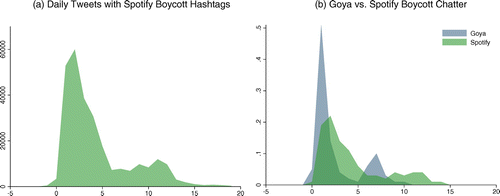
Notes. (a) Number of daily tweets that use Spotify boycott-related hashtags. Day 0 is January 27, 2022. (b) Normalized proportion of all boycott-related tweets for Spotify and Goya. We overlay the two curves with Day 0 denoting the scandal date (January 27, 2022 for Spotify and July 9, 2020 for Goya).
Next, we obtained data on Spotify premium weekly subscribers and revenue from Earnest Research, a leading data analytics company that collects de-identified credit and debit card transaction data. Earnest Research’s representative panel tracks purchases of 1.56 million panelists in the United States (around 3% of all credit and debit transactions in the United States). Kim and McCarthy (2022) compared Earnest Research data with publicly listed company sales data for 36 companies and found that there is a 99% median correlation between the numbers reported in Earnest Research data and numbers reported in publicly traded firms’ quarterly financial disclosures. We use this data set to construct a weekly time series index of Spotify subscribers, where the number of subscribers is normalized to one for the first week in January 2019. Figure 2(a) plots the weekly Spotify subscriber index from January 1, 2019, to March 30, 2022. We conduct the same analysis using Spotify revenue, the results of which mirror the subscriber analysis findings.
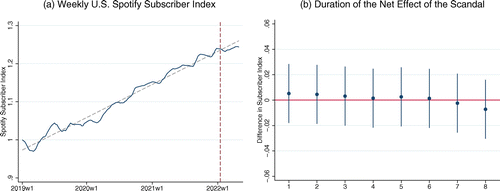
Notes. (a) Weekly U.S. Spotify subscriber index from January 2019 through the first quarter of 2022. The number of subscribers is normalized to one for the first week in January 2019. The vertical dashed line indicates the week of the scandal (1/26/2022 to 2/2/2022). (b) Coefficient estimates and 95% CIs of a regression where the detrended weekly subscriber index is regressed on a set of weekly dummy variables corresponding to each of the eight weeks after the boycott event and week-of-year fixed effects. In (b), the x axis is weeks after scandal.
To investigate the effect of the Spotify boycott on Spotify’s subscribers (revenue), we first detrend the time series with the prescandal linear trend. Then we regress the detrended subscriber (sales) index on a treatment dummy variable that takes on a value of one in the eight weeks after the scandal. The regression includes week-of-year fixed effects to control for seasonality. We find a null treatment effect when analyzing both the subscriber and revenue indices (p = 0.790).3 Next, we analyze the postperiod at a more granular level, replacing the eight-week treatment dummy with a set of weekly dummy variables corresponding to each of the eight weeks after the scandal. We plot the estimated coefficients in Figure 2(b) and find a null result across the board. These results show that the number of Spotify subscribers did not decrease as a result of the boycott, and in fact, subscriber counts grew at the same rate as before the scandal.
Our null results are consistent with the quarterly paid subscriber numbers that were later reported in Spotify’s earnings report and that showed continued subscriber growth despite the controversy (Spotify 2022). One limitation of this analysis, however, is that we only observe the behavior of paying subscribers and the corresponding revenue and not the total hours listened on the platform, which can be more sensitive to calls for boycotts among listeners who use Spotify’s free service. Nevertheless, these fears—that the boycott might have affected advertising revenue—were not reported in Spotify’s quarterly reports, and we believe that the null result among premium subscribers is informative in assessing the effects of the boycott.
2.2. Similarities Between Spotify and Goya Boycotts
Overall, we find that, for both the Spotify and Goya boycotts, the conversation on social media exhibited similar patterns and was short lived, lasting only one news cycle. In the case of Spotify, we find no significant impact on subscribers and revenue even in the short run, whereas for Goya, we see that the counter movement (“buycott”) generated a short-lived boost in sales. The short-lived nature of political consumerism has also been documented in a couple of very recent papers studying other settings of political consumerism. Hou and Poliquin (2022) and Painter (2021) study what happened when chief executive officers (CEOs) of major corporations made statements supporting gun control. Similar to Goya’s boycott, they find asymmetric effects in liberal versus conservative counties and the effects they document fully dissipate within 8–10 weeks. The accumulating evidence seems to suggest that short-lived effects are likely fairly generalizable across different contexts.
Unfortunately, our analysis of both Spotify and Goya boycotts also shows that Twitter chatter (and media coverage in the case of Goya) is not a great proxy for the sales impact of political consumerism because the sales patterns we document do not align with the skew in the conversation in the media. Thus, the disconnect between Twitter chatter and sales outcomes may be somewhat generalizable, highlighting that what people say is not necessarily what people do. This finding underscores the additional value of our revealed preferences analysis (sales outcomes) over experimental or survey-based studies that show strong boycotting effects. We thank Lelkes (2022) for recognizing this benefit of our setting and noting that “the affective polarization literature is often criticized for using self-reported survey measures.”
Finally, when analyzing purchase metrics for both Spotify and Goya, we found limited evidence of boycotting. In Liaukonytė et al. (2022), we presented evidence that switching costs and loyalty may have created inertia that limited the sales response among Latino consumers. In the case of Spotify, the subscription business model and features like personalized playlists can create large switching costs, so in this case, inertia may have played an even larger role in limiting boycotting among existing subscribers.
3. Identification
Bronnenberg and Dubé (2022) also discuss potential factors other than purely political activity that could plausibly have led to an increase in brand sales. In particular, they point out that the attention that political figures gave to the brand could have served as a form of advertising, shifting out demand either by informing consumers about the existence of the brand or persuading consumers that Goya products are of high quality. This could have generated an increase in sales that is not driven by consumers “voting with their wallets.” We agree with this possibility and acknowledge a related point in our discussion of limitations, where we discuss the fact that social media activity may have increased brand awareness or salience, which could lead to an increase in sales. We concur that an important avenue for future research would be to seek to separately identify political consumerism effects from an advertising or salience effect that is created by media attention. Bronnenberg and Dubé (2022) suggest that researchers could disentangle the advertising effect from the political motivation effect by comparing outcomes to other instances of corporate activism that did not stimulate a high-profile media response. One conceptual concern that might arise in this context is that there might need to be sufficient awareness about corporate political engagement to trigger a political consumerism campaign. In a sense, some media coverage is a required precondition, which will further complicate the disentangling of the two effects.
For this reason, we focus on the focal high-profile scandal and emphasize that we think that some of the key patterns in our existing analysis are more consistent with political consumerism than a pure advertising effect. In particular, Liaukonytė et al. (2022) documents a larger increase in sales in heavily Republican areas compared with heavily Democratic areas and reports a placebo analysis that confirms that the differential consumption changes in Republican versus Democratic markets were unique to the focal weeks relative to other weeks in the panel. This heterogeneity as a function of political preference is broadly consistent with political consumerism. However, we certainly cannot rule out the important role of media because it likely contributed to the amplification of this effect. Furthermore, we acknowledge that if Republican consumers are less likely to be familiar with the brand, then informative advertising effects could be larger in Republican areas, which could potentially generate a similar pattern of sales increases as observed in the data. Finally, we also hypothesize that a pure informative advertising awareness effect would likely generate a more long-lasting increase in sales than what we find, whereas political consumerism motivations may be more consistent with a short-lived “signal my support for the cause” type of purchase behavior that seems more consistent with our data.
Although we hope future work can make more progress on separating these two effects, we think that from the firm’s perspective, managers want to know how high profile political scandals will affect sales. Ultimately, the combined net effect of boycotts, buycotts, and advertising/awareness/salience is the effect of interest for managers who worry about becoming embroiled in a high-profile event, and we believe our estimates capture exactly that.
4. Consumer Motivation to Participate
Finally, we close our rejoinder with a discussion of the factors that might drive consumers to participate in political consumerism campaigns, which we think is a ripe area for future research. Our paper focuses on documenting the sales impact of a political consumerism campaign and explores two potential frictions to participation: switching costs and brand loyalty. Both the commentary by Lelkes (2022) and Bronnenberg and Dubé (2022) discuss other factors that may affect a consumer’s decision to participate. We agree that an important objective for future work should be to better understand the factors that motivate heterogeneous consumers to purchase different products at baseline and to change their purchase behavior as part of political consumerism campaigns.
For example, Lelkes (2022) discusses work that shows that liberals are more likely to drive a Prius, whereas conservatives are much more likely to drive a pick-up truck. These consumption choices could reflect heterogeneous use-cases, but they may also be a means of signaling one’s identity and values. Indeed, as Lelkes (2022) writes and as we show in our study “partisanship divides us far beyond the ballot box—even to the kitchen pantry.” The example of Lelkes (2022) highlights an important dimension that future research should also investigate: whether the observability of consumption might affect the motivation to engage in political consumerism. What car you drive is highly visible and thus can easily be used to signal one’s identity to others. What brand of canned beans you buy and what music streaming service you use is, in contrast, much more private.
Bronnenberg and Dubé (2022) also discuss signaling (both inward and outward) and the potential to separate an identity signaling story from genuine social preferences for a cause by using price as an instrument for the strength of the signal. We agree that more work may be necessary to determine whether participation is driven by beliefs in the underlying political cause or identity signaling. It’s possible that text mining Twitter data could be helpful in this regard. One could analyze whether Twitter posts were more likely to mention political parties or leaders (more of an identity association) or specific causes like immigration.
Bronnenberg and Dubé (2022) also puts forth another potential motivation for participation in the call to boycott—to pressure Goya into censuring or dismissing their CEO. The authors suggest that sales may not be the appropriate measure for the strength of such a pressure campaign. While the consequences to leadership are certainly interesting to consider, we believe that understanding the sales impact is still of the utmost relevance to managers. Companies may worry a lot less about the potential consequences of taking political stances if the consequences largely fall on individuals rather than shareholders.
Overall, both Bronnenberg and Dubé (2022) and Lelkes (2022) bring up important dimensions of consumer motivations to participate in political consumerism that should be explored in future research.
5. Concluding Remarks
We thank Bronnenberg and Dubé (2022) and Lelkes (2022) for their detailed and thoughtful commentaries on our paper (Liaukonytė et al. 2022). We also thank the editor, Olivier Toubia, for the opportunity to write this reply in which we further clarify our perspective on the generalizability of our findings, the identification of political consumerism effects on sales, and the factors that drive consumers to shop with politics in mind. We hope that our paper and the discourse around it will help stimulate further work in these areas.
The authors thank Yphtach Lelkes, Bart Bronnenberg, and Jean-Pierre Dubé for thoughtful commentaries on our paper, as well as the editor, Olivier Toubia, for inviting us to write this rejoinder. The authors also thank Daniel McCarthy and Earnest Research for facilitating access to the Spotify subscriber data. The author names are listed in alphabetical order.
1 Some financial analysts instead argue that the fall occurred because the company had failed to meet investor targets.
2 The complete list of keywords and hashtags includes the following: Boycott Spotify, #CancelSpotify, #SpotifyDeleted, #ByeSpotify, #DeleteSpotify, #CancelJoeRogan, #BoycottSpotify, #SpotifyBoycott, #SpotifyExodus, #DitchSpotify, #BoycottJoeRogan.
3 This null treatment result is robust to different variations of the specification, including regressing the raw index on week-of-year fixed effects, a treatment dummy, trend, trend-squared, trend interacted with treatment, and trend-squared interacted with treatment.
References
- (2022) Frontiers: Comment on “Spilling the beans on political consumerism: Do social media boycotts and buycotts translate to real sales impact?” Marketing Sci. Forthcoming.Link, Google Scholar
- (2022) Neil Young demands Spotify remove his music over Joe Rogan vaccine misinformation. The Guardian, https://www.theguardian.com/music/2022/jan/25/neil-young-demands-spotify-remove-his-music-over-joe-rogan-vaccine-misinformation.Google Scholar
- (2022) The effects of CEO activism: Partisan consumer behavior and its duration. Strategic Management J. https://onlinelibrary.wiley.com/doi/full/10.1002/smj.3451.Crossref, Google Scholar
- (2022) Wheels to meals: Measuring the impact of micromobility on restaurant demand. Preprint, submitted June 13, https://dx.doi.org/10.2139/ssrn.3802082.Google Scholar
- (2022) Frontiers: Commentary on “Spilling the beans on political consumerism: Do social media boycotts and buycotts translate to real sales impact?” Marketing Sci. Forthcoming.Link, Google Scholar
- (2022) Frontiers: Spilling the beans on political consumerism: Do social media boycotts and buycotts translate to real sales impact? Marketing Sci. Forthcoming.Link, Google Scholar
- (2021) Firm statements Consumer political beliefs, and the limits of stakeholder capitalism. Preprint, submitted August 18, https://dx.doi.org/10.2139/ssrn.3557961.Google Scholar
- (2022) Neil Young-Joe Rogan dispute: Spotify market cap drops by $2 billion+. Variety, https://variety.com/2022/digital/news/spotify-2-billion-market-cap-neil-young-joe-rogan-1235166798.Google Scholar
Spotify (2022) Spotify Technology S.A. announces financial results for first quarter 2022. Accessed September 5, 2022, https://investors.spotify.com/financials/press-release-details/2022/Spotify-Technology-S.A.-Announces-Financial-Results-for-First-Quarter-2022/default.aspx.Google Scholar- (2022) Spotify loses $4 billion in market value after Neil Young controversy. Datebook|San Francisco Arts & Entertainment Guide, https://datebook.sfchronicle.com/music/spotify-loses-4-billion-in-market-value-following-neil-young-controversy.Google Scholar