


Competitive Threats, Constraint, and Contagion in the Multiunit Firm
Abstract
Do unexpected events experienced by one line of business adversely affect other lines of business in diversified firms? We use fine-grained data on the film industry in the United States to show that such contagion frequently occurs when a distributor opens a film in theaters and concurrently releases an older title to home video: Being exposed to a competitive threat—a period of unexpected volatility—in the theatrical market at the time of a film opening leads the distributor to suffer a loss in sales on the concurrent home video release. Further analysis revealed that managers responded to these competitive threats by intensifying the advertising and promotion of their films in theaters, suggesting that they diverted resources and attention away from home video. Our results therefore suggest that the effects of unexpected events do spread across lines of businesses within firms and consequently that resource constraints may limit the ability of firms to engage effectively in multiple markets.
Introduction
A recent stream of literature in macroeconomics has suggested that the uncertainty generated by unexpected events—such as 9/11 or the eruption of Eyjafjallajökull—can ripple through the economy (Bloom 2009). Managers, suddenly uncertain of future sales, hold off on investing in expanding capacity and inventories. That decision to delay investments and slow production, in turn, reduces the demand for the firms that supply them, causing those suppliers to delay their own investments and slow their own production (e.g., Alexopoulos and Cohen 2009, Bloom et al. 2012). As these adjustments diffuse from one firm to the next, an unexpected event in one part of the world or one segment of the economy can spread to other seemingly unaffected sectors and regions, potentially leading to large-scale economic downturns (Bloom 2009).
We explore whether a similar dynamic might occur within firms. Of course, the mechanism underlying this macroeconomic research suggests that one would expect contagion to occur within vertically integrated firms, as those organizations serve as their own suppliers. But we see reason to expect that one would even see contagion in the effects of unexpected events across the units of horizontally diversified organizations. When firms span multiple lines of business, they typically share resources across those businesses—at a minimum, in terms of managerial capacity and access to financial capital. To the extent that addressing problems in one line of business requires the organization to allocate a larger share of resources, at least temporarily, to the business experiencing the unexpected event, it diverts resources away from these other lines of business, potentially to their detriment (e.g., March and Simon 1958, Levinthal and Wu 2010).
Although these theoretical accounts seem compelling, it has nevertheless been difficult to demonstrate empirically that unexpected events can indeed precipitate such contagion in performance. At the macroeconomic level, it often remains nearly impossible to determine whether uncertainty led to an economic slowdown because managers postponed investments or whether firms slowed expansion in response to a recession (Bachmann et al. 2013). At the firm level, a similar issue arises: If two lines of business experience downturns at the same point in time, does that represent contagion or simply the fact that both businesses have been commonly affected by some change in the external environment or in the internal operations of the firm?
To demonstrate that the effects of unexpected events can diffuse across the units of diversified firms, even to lines of businesses not directly affected by those events, and to explore the micromechanisms underlying this transmission, we focused on a setting with unusually high-quality and fine-grained data: the sales of movies both in theaters and in recorded formats (primarily DVD) for home viewing, from 2000 to 2009. These data allowed us to isolate unexpected events that occurred external to the firm and in only one of the businesses in which the firms operated. They also allowed us to estimate the effects of these events on the performance of the business segments that did not experience them.
We estimated a differences-in-differences model, examining how the revenues associated with movies released for sale in recorded formats for home viewing by a distributor concurrently exposed to a competitive threat, an unexpected and rapid rise in volatility in the theatrical market—usually because of the opening of a movie with unusual and extraordinarily broad appeal—compared to those associated with movies released for sale in the same week but by a distributor not exposed to this volatility in the theatrical market. We found that exposure to volatility in the theatrical market dramatically reduced the revenues associated with the titles being released concurrently for sale in recorded formats. To the extent that these periods of uncertainty arose exogenously, moreover, our estimates have a causal interpretation.
Those results, of course, do not explain why this transmission occurred. We therefore turned to detailed data on the behavior of distributors in the theatrical market to explore how managers allocated resources in response to these periods of high volatility. Distributors create copies of films and deliver them to theaters and retailers but they also bear responsibility for promoting these films. Examining these promotion efforts, we found that exposure to a rapid rise in volatility—to a period of competitive threat—had strong positive effects on both the amount of advertising spent by distributors and on the levels of soft promotion allocated to the films affected by these competitive threats.1 To the extent that these distributors had finite resources—in terms of dollars, connections, and managerial attention—these responses to volatility in the theatrical market would have siphoned resources away from the promotion of home video releases.
Our research has at least two potential implications. First and foremost, to the extent that the effects of unexpected events can diffuse horizontally, within firms, in addition to vertically from buyers to suppliers, even seemingly isolated events might have the potential to ripple through the economy to create widespread waves of volatility and economic slowdown. Economies may then vary in their fragility as a function of the connections across industries created by the firms that operate in them. Second, the fact that adverse events in one line of business negatively affect other businesses within the same firm points to a potential downside to broad scope: an impaired ability to cope with crises and unexpected environmental conditions (March and Simon 1958).
Contagion
One of the primary reasons for organizations to span products, industries, and regions has been that doing so allows them to share certain costs across these operations. Savings generally arise for one of two reasons. On the one hand, factors of production may have indivisibilities (Penrose 1959). An organization, for example, might need to purchase an entire machine even if it cannot use its full capacity. Or, a firm might need to hire someone full time, even if it could not keep that person busy. On the other hand, the need for some resources occurs only intermittently or intertemporally (Eppen 1979). A fast food restaurant focused on burgers might use its kitchen and dining space primarily for lunch and dinner. Or, a marketing team required to handle product launches might have little to do between these events. Although conceptually distinct, as one moves to coarser-grained time scales, these two sources of inefficiency look increasingly similar. When firms can deploy these under-utilized assets to another line of business, they can often operate more profitably than more focused rivals (Panzar and Willig 1981).
But with the efficient usage of these resources comes a reduction in slack—spare resources available for redeployment.2 That’s often true not just on a percentage basis but also in absolute terms. Compare, for example, a manager who spends half of her time overseeing one line of business to one who spends half of his time managing a similar business but also another quarter of it overseeing a second one. The first manager has twice as much unused capacity (and potentially several times the amount of spare time relative to the scale of the operations being managed). Much of the literature on organizational and financial slack has emphasized the importance of these spare resources to the promotion of innovation and risk taking (e.g., Nohria and Gulati 1996, Greve 2003, Natividad 2013b). But slack also plays an important role in the day-to-day operations of the firm, allowing it to absorb and respond to periods of intensified competition, heightened uncertainty, and environmental change (Thompson 1967, Hannan and Freeman 1977, Freeman and Hannan 1983). Businesses with broader scope therefore likely have a diminished ability to respond to these intermittent and unexpected events.
But diversified firms need not maintain less slack than their more focused rivals for contagion to occur, the process requires simply that these firms operate relatively efficiently. Particularly in the short run, firms face tight resource constraints. Hiring, building interorganizational relationships, and raising financial capital require time and effort. Because multiunit businesses have limited slack—particularly within any given business unit—responding to intermittent events typically requires those organizations to siphon human, social, and financial capital away from other lines of business. That might mean reassigning personnel for a period of time or shifting a budget temporally to the unit under duress. Unless these resources had been uselessly deployed, however, their reallocation will have negative consequences for the lines of business from which they have been pulled, leading to contagion in the crisis from the unit originally experiencing the adverse event to other parts of the organization.
Although others have alluded to this idea (e.g., March and Simon 1958), empirical research on this potential diadvantage of scope has been elusive. Perhaps the primary limitation has been the availability of data. Testing this possibility of within-firm contagion as a response to unexpected, intermittent events requires fine-grained data on at least two lines of business for a large number of organizations, longitudinally, over some meaningful stretch of time. That requirement alone poses a high hurdle. But one would also ideally want a setting in which only some organizations encounter these unexpected external events. One can then compare the firms exposed to the unexpected events to those not exposed to disentagle contagion from factors affecting all firms active in the second line of business. Film distribution offers just such a setting.
Film Distribution
Film distributors engage in a range of activities from the financing of films, to the copying and delivery of film reels and the promotion of films being shown in theaters, to the production and marketing of recorded media for home viewing (Vogel 2011). In terms of organizational structure, many of the larger distributors maintain separate departments for theatrical exhibition and home video—to negotiate contracts and to produce and distribute film reels and DVD’s—but nearly all maintain a single integrated marketing department that promotes products in both categories.
This setting has the unusual, but useful, feature that distributors do not engage the theatrical market on a continuous basis. Their participation in it rather focuses on the periods following a small number of product introductions, film openings. As a result, even within a given year and even among the largest firms, distributors vary in the market conditions they experience depending on when they happen to have films in theaters.
DataWe assembled data from a variety of sources and used the longest period available for each analysis. Our information on the theatrical sales of films, covering 1985 to 2009, came from the weekly sales reported in Variety, the leading industry newspaper. We purchased data on the weekly sales of home video products, for 2000 to 2009, from Nielsen’s VideoScan, the leading source for information on video sales.3 Our information on monthly advertising expenditures, covering 1995 to 2007, came from TNS, and we extracted weekly data on soft promotion activities from IMDb, for the period 1985 to 2009. Table 1 provides summary statistics for the main variables used in the analyses at the weekly, video-week, distributor-week, and distributor-month levels.
|

Table 1: Descriptive Statistics
| Mean | Std. dev. | Min | Max | Obs. | |
|---|---|---|---|---|---|
| At the weekly level: | |||||
| SD of box office revenue | 5.29 | 2.84 | 0.39 | 23.56 | 1,304 |
| Number of opening films | 7.33 | 3.59 | 0.00 | 23.00 | 1,304 |
| Number of large production budget openings | 0.60 | 0.88 | 0.00 | 5.00 | 1,304 |
| Holiday | 0.22 | na | 0.00 | 1.00 | 1,304 |
| SD of production budget of opening films | 20.10 | 17.15 | 0.00 | 117.56 | 1,304 |
| SD of screen count of opening films | 859.35 | 432.29 | 0.00 | 2,136.88 | 1,304 |
| At the video-week level: | |||||
| Video units sold (logged) | 4.96 | 3.05 | 0.00 | 15.12 | 151,680 |
| At the distributor-month level: | |||||
| Network TV advertising | 1.29 | 3.82 | 0.00 | 34.74 | 8,702 |
| Spot TV advertising | 0.51 | 1.55 | 0.00 | 24.91 | 8,702 |
| All TV and cable advertising | 2.49 | 7.11 | 0.00 | 64.21 | 8,702 |
| At the distributor-week level: | |||||
| Printed media cover pages | 0.10 | 0.49 | 0.00 | 18.00 | 61,565 |
| Press interviews | 0.12 | 0.55 | 0.00 | 17.00 | 61,565 |
| Live show appearances | 1.18 | 3.63 | 0.00 | 181.00 | 61,565 |
Notes. Standard deviations of box office revenue and of the production budgets for opening films, and all of the advertising variables represent millions of 2009 dollars. Number of opening films counts the number of films in their first week in theaters. Number of large production budget openings counts the number of films with production budgets above the 90th percentile. Holiday equals one for the weeks closest to the eight most important holidays in the United States. The soft promotion variables on printed media cover pages, press interviews, and live show appearances all represent simple counts.
What might constitute an unexpected event in this setting? Note that the success of any given film has always been viewed as uncertain (De Vany and Walls 2004); poor sales therefore constitute a common outcome. Firm-specific (or film-specific) levels of sales may also reflect issues with the internal operations of the distributor rather than exposure to unanticipated environmental conditions. A decline in the level of sales therefore does not represent a plausibly exogenous event.
The overall distribution of sales across films—in terms of overall ticket sales and the relative shares of those sales captured by the most popular films each week—by contrast, has been much more stable over time. Moreover, as a property of the entire industry rather than of a single firm, this volatility also appears arguably exogenous to any given distributor. We therefore focused on the effects of unexpected, rapid increases in the volatility of theatrical movie sales—the variance in theatrical ticket sales across films in a given week. These periods represent a departure from the normal course of business and therefore one might expect managers in the industry to notice and respond to them.
These increases in variation or volatility—what some might call second-moment shocks—have some similarity to those examined in the macroeconomics literature (e.g., Bloom 2009). But they differ in at least one important respect: Whereas the macroeconomics literature has in mind exogenous factors that generate uncertainty about future demand at the level of the economy or at the level of the industry as a whole, the rapid increases in volatility identified here arise from within the industry, in the sense that they emerge from shifting preferences and product-level competition. We therefore refer to these spells as “periods of competitive threat” because they upset the usual competitive balance in the industry.
We first validated that these periods of competitive threat constituted unusual events, rather than simply being part of the normal distribution of volatility over time. Using box office sales data for all films shown in theaters between 1985 and 2009, Figure 1 plots the cross-sectional standard deviations of film-level box office revenues over time in constant millions of 2009 dollars (i.e., for each week, we calculated the standard deviation of revenues across films for that week). The chart appears to reveal many large spikes, periods of unusually high volatility, occuring at irregular intervals. To evaluate more systematically whether these periods of competitive threat represented deviations from the underlying distribution, we calculated Barndorff-Nielsen and Shephard’s (2006) statistical tests for jumps: the jump-linear test and the adjusted jump-ratio test. In essence, these tests assess the odds that one would have observed spikes of this order and frequency if the data represented draws from a normal distribution. The data reject the null of no jumps at the 5.1% and 5.9% significance levels, respectively.
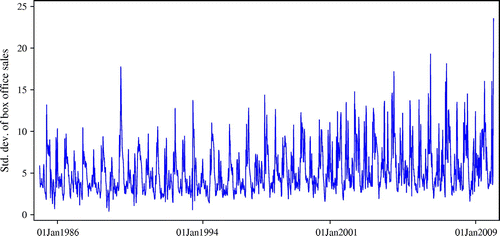
We defined periods of competitive threat as weeks in which the standard deviation of box office revenue exceeded twice the median standard deviation of the times series.4 To assess the extent to which distributors might have been able to anticipate these periods of competitive threat (jumps) and therefore to prepare for them, Table 2 reports descriptive regression estimates of the correlates of the standard deviation of box office sales. Weeks with a holiday and with smaller numbers of opening films and larger numbers of big budget films had higher variance. Variation in sales also increased with the standard deviation of the production budgets of opening films, though distribution companies probably do not have a good sense of this variation in production budgets ex ante. Overall, however, these factors only explained about one-third of the overall variation. We therefore suspect that many of these periods of competitive threat came as suprises to the managers of distribution companies.
|
Table 2: Linear Regression Estimates of Standard Deviation in Film-Level Sales
| Model 2.1 | Model 2.2 | |
|---|---|---|
| Number of opening films | −0.220∗ (−8.96) | −0.200∗ (−8.33) |
| Number of large production budget openings | 1.091∗ (10.89) | 0.374∗ (2.89) |
| Holiday | 1.936∗ (10.25) | 2.059∗ (11.03) |
| SD of production budget of opening films | 0.060∗ (7.66) | |
| SD of screen count of opening films | 0.000 (0.20) | |
| Year fixed effects | Yes | Yes |
| R2 | 0.32 | 0.39 |
| N (weeks) | 1,304 | 1,304 |
Note. t-Statistics in parentheses.
∗Significant at the 1% level.
Empirical Strategy
We wished to estimate the effects of exposure to a period of competitive threat in the theatrical market on performance in the home video market. Releases to home video therefore represented the focal market in this analysis and the (home video) title-week served as the unit of observation. We identified 3,288 feature films newly released to home video between January 1, 2000, and December 31, 2009, carried by 347 different distribution companies, and we focused on the sales of these videos for the first 40 weeks following their release.5 Overall, our sample includes 151,680 video-week observations.
To estimate the effects, we used a differences-in-differences (diff-in-diff) empirical strategy. We defined treatment at the film level. Being exposed to the treatment here meant that the release of the film to home video occurred concurrent to its distributor opening a different feature film in theaters during a period of competitive threat in the theatrical market. We essentially used two sets of home videos to identify this effect: (i) those released during the same week but by distributors not concurrently opening a feature film in the theatrical market, and (ii) those released during noncompetitive threat weeks, both by distributors simultaneously active in the theatrical market and by those only releasing to home video. We therefore examined the difference in performance between simultaneous releases and being active only in the home video market, and how those differences in turn differed according to whether the theatrical market had been experiencing a period of unusual volatility.
Our primary analysis built on the specification proposed by Hendricks and Sorensen (2009), which allows the investigator to estimate both the treatment effect and its persistence over time. Consider each video, i, released to home video by distributor, d, in each of its life-cycle weeks, r, in the home video market, where r runs from 1 to 40. We defined an indictor variable, , denoting treatment, to have a value of one when d experienced a period of competitive threat in the same week that it released a title to the home video market (i.e., r = 0). Our baseline model therefore estimates:
Two features of this specification allow us to rule out a large number of competing interpretations of the results. First, the models include distributor fixed effects (αd). Our results therefore effectively account for any time-invariant differences across distributors. Second, the models incorporate two different kinds of fixed effects related to time: Year-week fixed effects (𝜃t) account for any common factors influencing supply or demand during a particular week in a particular year, such as a school holiday or unseasonable weather. Week-since-release indicator variables (λr) meanwhile flexibly capture the typical time path of home video sales as a function of how long the video has been available for purchase.
Note that this estimation approach effectively eliminates the possibility that some common factor accounts for both the increased volatility in the theatrical market and any decline in home video sales. Because our results are effectively within a particular week, both the treated and untreated home video releases should have been exposed to the same conditions in the home video market (and therefore the year-week fixed effects should absorb these factors).
Bertrand et al. (2004) have noted the need for caution when multiple observations stem from the same treatment in a diff-in-diff estimation. They therefore recommend clustering observations sharing a common treatment. We adopted an even more conservative approach: Not only do sales of the same video probably have correlated errors across weeks but also sales of different videos by the same distributor may also have correlated residuals. We therefore estimated (1) using standard errors clustered at the level of the distribution company.
Results
Our estimation generates 40 coefficients that jointly describe the effect of being treated—being released by a distributor concurrently exposed to a period of competitive threat (high volatility) in the film market. Given this large number of coefficients, we find it useful to display the results graphically. Figure 2 plots the weekly coefficients along with the 95% confidence interval implied by their standard errors. Films released to home video by distributors exposed to these unexpected conditions in the theatrical market clearly suffered from lower sales, though this effect dissipates over time—falling to zero after three to five weeks.
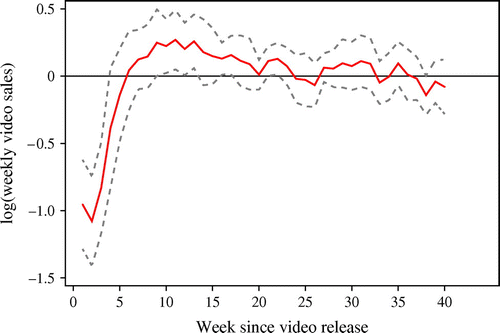
Table 3 reports and extends these results in table format. Model 3.1 reports the coefficient estimates displayed in Figure 2. Note that, to hold the tables to a manageable length, we do not report the point estimates for the effects of treatment for weeks 6 through 40. From the point estimates, one can see that being released to home video by a distributor exposed to a period of competitive threat has a large, and statistically significant, negative effect on sales. In the first three weeks following the release to home video, films carried by treated distributors experienced sales more than 75% lower than their untreated counterparts releasing home videos at the same time.
|
Table 3: Differences-in-Differences Estimates of Effect of Theatrical Market Volatility on Home Video Sales
| Volatility indicator | Continuous variable | ||
|---|---|---|---|
| Model 3.1 | Model 3.2 | Model 3.3 | |
| Volatility treatment | −0.075 (−0.70) | −0.080 (−0.78) | 0.031∗ (3.50) |
| Volatility treatment × (Video week = 1) | −0.873∗ (−4.15) | −0.874∗ (−4.09) | −0.211∗ (−6.83) |
| Volatility treatment × (Video week = 2) | −0.996∗ (−5.05) | −0.998∗ (−4.95) | −0.211∗ (−6.63) |
| Volatility treatment × (Video week = 3) | −0.753∗ (−3.69) | −0.752∗ (−3.62) | −0.123∗ (−4.33) |
| Volatility treatment × (Video week = 4) | −0.307 (−1.33) | −0.307 (−1.32) | −0.093∗ (−4.02) |
| Volatility treatment × (Video week = 5) | −0.068 (−0.33) | −0.060 (−0.29) | −0.077∗ (−4.27) |
| Interactions through (Video week = 40) | Yes | Yes | Yes |
| Simultaneous release week dummy | Yes | Yes | Yes |
| Distributor fixed effects | Yes | Yes | Yes |
| Size quartile dummies | No | Yes | Yes |
| Genre variety quartile dummies | No | Yes | Yes |
| Video-week fixed effects | Yes | Yes | Yes |
| Year-week fixed effects | Yes | Yes | Yes |
| R2 | 0.56 | 0.56 | 0.57 |
| N (Video weeks) | 151,680 | 151,680 | 151,680 |
| Number of clusters (distributors) | 347 | 347 | 347 |
Notes. t-Statistics based on standard errors clustered by distribution company reported in parentheses. This table reports estimates of Equation (1). Only interaction coefficients for the first five weeks have been reported for brevity. A graphical display of the full set of coefficient estimates appears in Figure 2.
∗Significant at the 1% level.
Although the models include distributor-level fixed effects, one might nonetheless worry that the results reflect some aspect of distributor product strategy. Model 3.2, however, demonstrates that the negative effect of treatment on sales persists even after adjusting for two time-varying features of distributors: size and genre variety. Specifically, for each distributor, for each month, the models included indicator variables for each quartile of the distributor size and genre variety distributions. The inclusion of these controls, however, had no meaningful effect on the observed relationship between performance and being released by a distributor concurrently exposed to a competitive threat in the theatrical market.
Finally, Model 3.3 examines the robustness of the results to the use of a continuous variable for periods of competitive threat. In other words, instead of defining these periods in terms of binary (1/0) jumps that exceed two standard deviations in the distribution of theatrical box office volatility, these models use a continuous treatment variable: the standard deviation of theatrical box office sales for distributors concurrently promoting films in theaters. The results appear robust and similar in magnitude in this alternative specification.
Although these models demonstrate that treated films—those distributed by firms concurrently releasing films to the theatrical market during a period of competitive threat—experienced a temporary decline in sales performance, one cannot say for certain from this analysis whether this decline represented “lost” sales. Note that the point estimates for the effect of being exposed become positive—though generally insignificant—in weeks 6 through 40. These results might therefore simply reflect time-shifting in when the video sales occur.
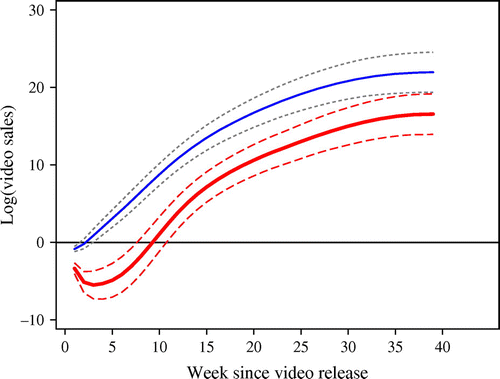
To determine the long-run effect of treatment, Figure 3 integrates the week-to-week coefficients over time, illustrating the cumulative effect of treatment at the end of each week. One can clearly see the dip in sales that occurs during the first three weeks following home video release. Although the gap between these two lines begins to narrow from the fourth week of the release into home video, the two lines do not converge, suggesting that distributors never recover these lost sales. Overall, home videos released at the same time that the distributor faces a competitive threat in the theatrical market sell about 30% less during their first forty weeks.
Although our primary specification controls quite well for the conditions in the home video market, it relies on the combination of two events to form the treatment: simultaneous participation in the theatrical market and a jump in volatility in that market. One might therefore worry that the negative effects on home video releases stem simply from simultaneous participation in the theatrical market rather than as a response to a competitive threat in that market. Recall that the diff-in-diff specification includes a separate intercept for simultaneous release and therefore captures the main effect of being active in both markets, but one might worry that simultaneous release interacts with one or more of the other controls.
We explored this possibility by creating an alternative counterfactual. Instead of including home videos released in the same week of the same year to help establish the baseline, we focused only on distributors simultaneously releasing a film in the theatrical market. We therefore compare those distributors that simultaneously released the two during a “normal” period to those that do so during a period of competitive threat. Because this approach restricts us to instances of simultaneous release, we lose a substantial amount of statistical power, retaining only 1,395 cases (less than 50% of those in our primary analysis). Also, because the alternative counterfactual requires us to draw the treated and untreated films from different weeks, the models cannot include fixed effects for the year-week (because the treatment variable does not vary across distributors within a week). The combination of having fewer cases and no adjustments for seasonality also limits our ability to trace the persistence of the effect. Instead, we simply estimated a model for the average effect of being exposed to a period of competitive threat.
The results of these models using the alternative counterfactual appear in Table 4. Although these models suggest somewhat smaller effect sizes, with home videos released simultaneously by distributors during periods of competitive threat selling roughly 20% less than those released simultaneously by distributors during normal conditions, the models using this alternative specification—controlling more precisely for simultanous participation in both markets but less precisely for seasonality and conditions in the home video market—also point to a contagion in the effects of volatility in the theatrical market to performance in the home video market.
|
Table 4: Linear Regression Estimates of Effect of Theatrical Market Volatility on Home Video Sales (for Subsample of Distributors Simultaneously Active in Both Markets)
| Model 4.1 | Model 4.2 | Model 4.3 | |
|---|---|---|---|
| Volatility treatment | −0.225∗∗ (−2.22) | −0.212∗∗ (−2.10) | −0.212∗ (−1.68) |
| Size quartile dummies | No | Yes | Yes |
| Genre variety quartile dummies | No | Yes | Yes |
| R2 | 0.00 | 0.03 | 0.03 |
| Sample size | 1,396 | 1,396 | 1,396 |
| Number of clusters (year-week) | 461 | ||
Note. t-Statistics based on robust standard errors (clustered by year-week in Model 4.3) reported in parentheses.
∗∗ and ∗ significant at the 5% and 10% levels, respectively.
Responding to Volatility
Although our results demonstrate that the performance of films in home video depends on whether the distributors carrying those films must simultaneously contend with releasing other films in theaters during a period of competitive threat, the analysis above provides limited insight into the mechanisms underlying this result. To explore these issues further, we therefore analyzed additional microdata on the behavior of these firms in the theatrical market.
How would one expect managers to respond to sudden increases in the volatility of their environments? One stream of literature suggests that uncertainty should lead to inaction. When managers do not know whether the market will expand or contract, waiting until the future seems more foreseeable frequently has an option value (e.g., McDonald and Siegel 1986, Dixit 1989). Another stream of literature, meanwhile, suggests that uncertainty spurs action (March and Simon 1958). Worried about how changes in the environment might threaten the profitability of the firm or one’s position within it, managers rally to respond to the perceived crisis.
Arguments for inaction generally rely on a notion of rational action. In the presence of adjustment costs, managers increase the expected profitability of their firms by postponing capital investments during periods of uncertainty. By waiting until the environment becomes more orderly, they avoid investing in assets that might have little long-run value (McDonald and Siegel 1986, Dixit 1989, Bloom 2009). Even in the absence of these adjustment costs, volatility implies noise. Responding to this noise as if it represented a signal has the similar disadvantage of engaging in actions and developing routines that fail to fit the future environment (Levitt and March 1988, March 1991). Consistent with these ideas, firms that adapt more slowly perform better during times of turbulence (Sorenson 2003).
Arguments for action meanwhile focus on agency issues—managers worrying more about their own jobs than the profitability of their firms—or on emotional susceptibility or on risk aversion on the part of managers. Thompson (1967), for example, argued that managers actively structure their organizations to reduce uncertainty. Pfeffer and Salancik (1978) similarly portrayed managers as changing the boundary of the firm primarily to bring uncertainty under their control, thereby reducing it. Rapid change and its concomitant uncertainty, moreover, has often been seen to spur organizations into action rather than resulting in increased inertia (e.g., Miles and Snow 1978, Smart and Vertinsky 1984).
Evidence exists for both responses. We would nonetheless note that, empirically, the effects found appear to depend on at least one crucial aspect of the nature of the uncertainty. Evidence for managers favoring inaction has generally come from situations in which the uncertainty concerns the overall level of demand in the economy (e.g., Bloom 2009, Bloom et al. 2012). By contrast, many of the studies suggesting that it promotes action stem from uncertainty concerning the relative position of a firm in the industry (e.g., Koberg 1987, Sawyerr 1993).
It would therefore appear that a crucial element distinguishing between these two responses may be the extent to which the uncertainty engenders status anxiety on the part of managers. Whereas a general downturn affects everyone and therefore no one need worry about being singled out, uncertainty about the strength of particular positions within the industry leads managers to worry about their relative ranking among rivals and probably also their jobs. Given that our measure of periods of competitive threat (uncertainty) captures within-industry variation in demand, these prior findings would lead us to expect that managers in this setting would respond to volatility with action.
Note that either action or inaction could lead to contagion. Regardless of how managers respond, these periods of competitive threat absorb managerial attention, distracting personnel away from other lines of business (March and Simon 1958, Penrose 1959). To the extent that managers respond by allocating resources as well as attention to the crisis, then one would expect their actions to produce even stronger contagion as they pull both managerial attention and human, social, and financial capital away from other parts of the firm (Levinthal and Wu 2010).
Promoting Films
In addition to producing and delivering copies of films to theaters and retailers, distributors also bear primary responsibility for the promotion of the films that they carry. Interestingly, these promotion activities represent one of the few dimensions on which distributors could respond to a changing competitive landscape. Distributors can buy additional advertising time and space on short notice or reallocate purchased slots across films. They can also exploit outlets—such as television news, magazines, and newspapers—with daily and weekly production cycles. By contrast, budgets for movies already in production remain fixed, and release dates for these films get set months ahead. Although distributors might shift their selection of films in the future, the lag between these other actions and any effect that it would have on performance stretches to eighteen months or more given the production cycle for a feature film.
Much of the promotion in the film industry occurs through traditional advertising channels—billboards, posters, television commercials, print ads in magazines and newspapers, and (increasingly) online. But distributors also put a great deal of effort into securing other forms of promotion (Hirsch 1972): They pitch producers to place the director or stars of their movies on talk shows; they lobby the editors and staffs of magazines to run stories about the film or its actors; and they encourage critics to write (positive) reviews. We refer to these nonadvertising marketing activities as soft promotion.
The literature on the production of culture has long noted the importance of these soft promotion activities across a variety of entertainment industries (e.g., Hirsch 1972, Peterson and Berger 1975). In books, for example, publishers try to influence critics to review particular titles so that readers become aware of them. Perhaps the most extensive research has been done in music, where encouraging disc jockeys to play songs helps to stimulate demand for records (Peterson and Berger 1975, Rossman 2013). Soft promotion also plays an impotant role in the film industry, though it has received less academic attention in that context.
Empirical Strategy
To analyze the effects of exposure to periods of competitive threat in the theatrical market on the marketing activities of distributors during these periods, we built two additional panel data sets describing the behavior of distributors in the theatrical market.
AdvertisingOur data on advertising cover films released from 1995 to 2007, and we use the distributor-month as the unit of observation.7 We considered three different types of advertising expenditures: advertising on network television (ABC, CBS, NBC, Fox, UPN, and WB), spot television advertising, and total television advertising (the sum of spot advertising, advertising on network television, cable, and advertising through syndication). In all cases, these variables represent millions of dollars. To focus the analysis, we only included distributor-months four months prior to the release of a film and two months after the release. Thus, for example, a distributor that only released one film on the theatrical market in a given year would have six monthly records associated with it. The larger and more active distributors nevertheless appear almost continuously throughout the observation period.
For each distributor, we sorted all films released into two mutually exclusive and exhaustive categories: films exposed to a period of competitive threat (which we called “treated” films) and films not exposed to such a period (labeled “nontreated” films). For each distributor-month observation, we summed the advertising expenditures for that month separately across all treated and all nontreated films.
To control for a variety of firm-specific and time-varying variables, our models included fixed effects for distributors, distributor-month size quartiles, distributor-month genre variety quartiles, and year-month periods. Volatility treatment, an indicator variable equal to one for films exposed to a period of competitive threat, represented the primary coefficient of interest. Note that this variable only switched on after the film had been exposed to a jump in volatility. In other words, this variable retained a value of zero even for films eventually exposed to a period of competitive threat up to the week in which that jump in volatility actually occurred. We therefore estimated the contemporaneous effect of a period of competitive threat on the actions pursued by distributors on the projects directly affected by this period (treated films).
Soft PromotionWe also built an analogous data set for soft promotion but with the distributor-week (rather than the distributor-month) as the unit of observation. Because IMDb has recorded this information over a longer period, this analysis covers films released between 1985 and 2009. We analyzed three types of soft promotion: the count of covers related to the movie in printed media (e.g., magazines), the number of interviews of cast and crew in printed media, and the count of their live television show appearances. Again, to focus the analysis, we only included distributor-weeks for 16 weeks prior to the release of a film and for eight weeks after the release.
The other steps of constructing and analyzing these data followed that for advertising expenditures. We again sorted films into treated and nontreated and summed the counts across these two categories for distributors for each week. Our models included an analogous set of fixed effects and defined the variable of interest in the same way.
Results
Table 5 reports the results of our analysis of the monthly advertising data. The estimates in the first column indicate that exposure to a period of competitive threat led distribution companies to increase their investments in network television advertising, relative to the level that they had been investing immediately prior to this threat. In total, distributors exposed to the competitive threat raised their ad spending by nearly $1 million on average.
|
Table 5: Linear Regression Estimates of Effect of Theatrical Market Volatility on Advertising Expenditures
| Network TV advertising | Spot TV advertising | All TV and cable advertising | |||||||
|---|---|---|---|---|---|---|---|---|---|
| All films Model 5.1 | Treated Model 5.2 | Untreated Model 5.3 | All films Model 5.4 | Treated Model 5.5 | Untreated Model 5.6 | All films Model 5.7 | Treated Model 5.8 | Untreated Model 5.9 | |
| Volatility treatment | 0.905∗ (3.85) | 1.587∗ (4.16) | −0.682∗ (−3.30) | 0.278∗ (3.89) | 0.606∗ (4.11) | −0.328∗ (−2.86) | 1.709∗ (4.11) | 3.084∗ (4.20) | −1.375∗ (−3.16) |
| Size quartile dummies | Yes | Yes | Yes | Yes | Yes | Yes | Yes | Yes | Yes |
| Genre variety quartile dummies | Yes | Yes | Yes | Yes | Yes | Yes | Yes | Yes | Yes |
| Distributor fixed effects | Yes | Yes | Yes | Yes | Yes | Yes | Yes | Yes | Yes |
| Year-month fixed effects | Yes | Yes | Yes | Yes | Yes | Yes | Yes | Yes | Yes |
| R2 | 0.09 | 0.16 | 0.08 | 0.07 | 0.18 | 0.09 | 0.09 | 0.18 | 0.09 |
| N (Distributor months) | 8,702 | 8,702 | 8,702 | 8,702 | 8,702 | 8,702 | 8,702 | 8,702 | 8,702 |
| Number of clusters (distributors) | 582 | 582 | 582 | 582 | 582 | 582 | 582 | 582 | 582 |
Notes. t-Statistics based on standard errors clustered by distribution company reported in parentheses. For each type of advertising, the columns either estimate advertising across (i) all films, (ii) only those films exposed to an unexpected rise in volatility during their week of release (treated), and (iii) only those films not exposed to an unexpected rise in volatility during their week of release (untreated).
∗Significant at the 1% level.
The next two models split the analysis according to whether the films being advertised experienced the period of competitive threat. One can see that the increase in investment occurs entirely on the films exposed to the period of competitive threat, by nearly $1.6 million on average. By contrast, distributors appeared to reduce their advertising expenditures on the films not affected by the volatility (by nearly $600,000). Since these films generally have not yet been released, it appears that distributors responded to periods of competitive threat by shifting advertising dollars from future releases to those currently in theaters. Contagion therefore may not just spill poor performance over into the home video market but also into future releases in the theatrical market.
Note, however, that network advertising represents just one component of the overall advertising of films. Models 5.4–5.9 demonstrate that similar effects occurred across all other categories of advertising. In terms of overall expenditures on television advertising, Models 5.8 and 5.9 suggest that distributors raised their ad spending on films exposed to periods of competitive threat by more than $3 million, apparently pulling some of those resources (about $1.4 million) from future releases and some of this money from elsewhere. To put these numbers in perspective, the median film in our sample would have had an advertising budget of around $20 million (Vogel 2011)—across print, billboards, television, trailers and all other forms of promotion. Perhaps as much as 90% of this budget, moreover, gets spent prior to the release of a film (Elberse and Anand 2007), meaning that the typical film might have a post-release advertising budget of less than $2 million. Distributors therefore appear to react quite dramatically, increasing their post-release advertising by more than 100%, in response to a period of competitive threat.
Our analyses of soft promotion, reported in Table 6, tell a similar story. The first column reports the effects of exposure on the number of magazine covers. Although the overall number of covers does not vary with exposure to a period of competitive threat, Models 6.2 and 6.3 again suggest a shifting, with more covers being allocated to the films experiencing the competitive threat and fewer being devoted to future films. Again, the effects appear large. To put these values in context, the average film in our sample appeared on only 0.1 magazine covers, thus exposure to a competitive threat increased soft promotion in this category by more than 50%.
|
Table 6: Linear Regression Estimates of Effect of Theatrical Market Volatility on Soft Promotion
| Printed media cover pages | Press Interviews | Live show appearances | |||||||
|---|---|---|---|---|---|---|---|---|---|
| All films Model 6.1 | Treated Model 6.2 | Untreated Model 6.3 | All films Model 6.4 | Treated Model 6.5 | Untreated Model 6.6 | All films Model 6.7 | Treated Model 6.8 | Untreated Model 6.9 | |
| Volatility treatment | 0.027 (1.59) | 0.056∗ (3.11) | −0.029∗ (−2.84) | 0.053∗ (3.10) | 0.089∗ (4.68) | −0.035∗ (−3.99) | 0.722∗ (5.78) | 1.024∗ (5.97) | −0.302∗ (−2.92) |
| Size quartile dummies | Yes | Yes | Yes | Yes | Yes | Yes | Yes | Yes | Yes |
| Genre variety quartile dummies | Yes | Yes | Yes | Yes | Yes | Yes | Yes | Yes | Yes |
| Distributor fixed effect | Yes | Yes | Yes | Yes | Yes | Yes | Yes | Yes | Yes |
| Year-week fixed effect | Yes | Yes | Yes | Yes | Yes | Yes | Yes | Yes | Yes |
| R2 | 0.10 | 0.06 | 0.08 | 0.13 | 0.08 | 0.12 | 0.16 | 0.11 | 0.12 |
| N (Distributor weeks) | 61,565 | 61,565 | 61,565 | 61,565 | 61,565 | 61,565 | 61,565 | 61,565 | 61,565 |
| Number of clusters (distributors) | 748 | 748 | 748 | 748 | 748 | 748 | 748 | 748 | 748 |
Notes. t-Statistics based on standard errors clustered by distribution company reported in parentheses. For each type of advertising, the columns either estimate advertising across (i) all films, (ii) only those films exposed to an unexpected rise in volatility during their week of release (treated), and (iii) only those films not exposed to an unexpected rise in volatility during their week of release (untreated).
∗Significant at the 1% level.
We observed similar patterns for the other forms of soft promotion. Consider first the number of press interviews. Overall, the number of interviews increased in response to periods of competitive threat, perhaps because distributors begin pushing these interviews more aggressively during these periods. Models 6.5 and 6.6, moreover, again point to a reallocation of resources, with interviews being shifted to the films exposed to the periods of competitive threat at the expense of future releases. Appearances by stars on television talk shows, such as the Late Show with David Letterman, followed the same pattern.
Across all of these variables we would note that the magnitudes of the positive effects—increased effort and expenditure—associated with the treated films exceeded those of the negative effects associated with the untreated ones. To the extent that distributors have finite financial and organizational resources, therefore, these resources must come from somewhere. Our contagion results suggest that distributors not only cannibalize future films but also resources that otherwise would have gone to the promotion of concurrent releases in the home video market.
Discussion
We examined the extent to which firms transmit crises from one line of business to another. The use of highly granular data on film distribution companies and the population of feature films released in the theatrical and home video markets between 2000 and 2009 allowed us to examine the extent to which unexpected competitive conditions in the theatrical market affected the performance of films released by the same distributors in the home video market. We found strong evidence of contagion: Films being released in home video by distributors concurrently exposed to a period of competitive threat on the theatrical market—a time of unexpected volatility in sales—experienced much lower sales than films being released to home video at the same time but by distributors not exposed to the threat.
Further investigation of the behavior of the distributors active in the theatrical market pointed to a reallocation of limited resources as the source of this contagion. In response to being exposed to an unusual level of volatility in the theatrical market, distributors allocated large levels of additional resources, both financial and nonfinancial, to shoring up the promotion of the affected films. Although some of this increased allocation appeared to come from the cannibalization of resources that might otherwise have been used to promote future films, this shifting of resources within the theatrical distribution business did not fully offset the additional resources devoted to responding to the competitive threat. At least some of these financial and nonfinancial resources, therefore, appear to have been pulled away from other lines of business, such as home video.
Our results have at least three important implications. Most directly, they suggest that distributors in the film industry might benefit from coordinating their theatrical and recorded home video releases—so that they do not try to do both concurrently. But that strategy has limits. As distributors release more and more films, they eventually reach the point where they are always involved in some release.
In this respect, our results also have implications for the relationship between organizational scope and performance, suggesting that finite managerial attention, human resources, and social capital may place fundamental limits on the ability of firms to expand. To some extent, such a suggestion might seem surprising. After all, as organizations expand, they also build resources and capacity and they develop routines and an infrastructure for coordinating activities across the firm (Helfat and Peteraf 2003). However, although the development of routines can allow organizations with broad scope to operate effectively on a day-to-day basis, those routines cannot guide the firm through poorly understood periods.
Much of the advantage of combining multiple lines of business within a single firm stems from the sharing of assets and resources (Penrose 1959, Teece 1982, Natividad 2013a). Such sharing improves efficiency by eliminating excess capacity and organizational slack (Penrose 1959, Panzar and Willig 1981), but that very efficiency also leaves firms vulnerable (e.g., Hannan and Freeman 1977, Freeman and Hannan 1983). When unexpected conditions arise, managers must allocate attention and organizational resources to dealing with those surprises. In multiunit firms, that attention and those resources come at the expense of other units, thereby potentially transmitting the crisis from one business unit to others.
Although others have alluded to this potential disadvantage of broad scope (e.g., March and Simon 1958, Penrose 1959, Levinthal and Wu 2010), little empirical evidence has been offered for its existence and our understanding of the micromechanisms through which it might occur remains limited. Our analyses therefore provide some of the first systematic empirical evidence for this supply-side source of diseconomies of scope.
Finally, our results may also have interesting implications for the dynamics of industries and economies as a whole. Bloom (2009) has demonstrated that managers—by responding to crises through a “wait-and-see” response, through inaction—may exacerbate the effects of destabilizing events on the economy as a whole. By postponing changes in personnel, managers slow productivity growth by not reallocating people to positions where they could produce more value. And, by postponing capital investments, managers effectively transmit uncertainty regarding demand in their own industry to the firms that would have been suppliers for those investments. Those suppliers then, in turn, may forgo hiring and their own capital investments. Contagion therefore can lead to temporary increases in uncertainty to produce economy-wide downturns.
Interestingly, managerial action, in this case in response to within-industry rather than economy-wide events, may also lead to the deleterious diffusion of volatility through the economy. In diversified firms, periods of competitive threat in one part of the organization may lead those firms to divert scarce resources and managerial attention away from other divisions, thereby potentially disrupting the dynamics of those industries as well. Contagion therefore could again spread across sectors of the economy. However, whereas Bloom (2009) suggests that these disruptions would travel vertically through buyers and suppliers, resource reallocation would point to disruptions diffusing horizontally across the industries that diversified firms span.
The authors thank Lisa George, Greta Hsu, two anonymous reviewers, and seminar participants at Georgetown University and New York University, as well as conference participants at the 2013 Atlanta Competitive Advantage Conference, the 2012 ICT Ludwig Maximillian University of Munich Conference, and the 2012 International Society for New Institutional Economics Annual Conference for comments on earlier versions of this paper. The authors thank the NET Institute (http://www.NETinst.org) and the Rotman School of Management for financial support.
1 Distributors engage in a range of activities to promote a film. They may, for example, encourage magazines to carry stories about a movie or pitch directors and stars as potential guests for talk shows (Hirsch 1972). We refer to these activities as “soft promotion” to distinguish them from money spent on advertising.
2 Those familiar with the ecological literature on specialism and generalism might feel that this claim runs counter to the arguments made there (Hannan and Freeman 1977, Freeman and Hannan 1983). But having more slack resources in that literature definitionally implies that an organization has pursued a generalist strategy. Slack does not come from having a broader range of operations. According to that line of reasoning, then, one would classify firms that span lines of business and exploit economies of scope across those businesses as specialists. Consistent with the implications of that theory, specialists (in our case, firms exploiting economies of scope) with lower levels of slack find themselves more vulnerable to environmental change.
3 VideoScan assembles sales data by surveying a large sample of retail outlets, such as Target and Tower Records, on a weekly basis. It does not include the sales of recorded video to firms that then rent those tapes or discs to consumers. In total, the VideoScan data detail unit sales for each of 166,037 video titles—including feature films, television series, and made-for-television films—on a weekly basis from January 1, 2000, to December 31, 2009.
4 We also estimated all of our main models using a continuous measure of volatility—the standard deviation of box office revenues across films within a given week (see Table 3).
5 The home video market has changed even across this decade. For example, in 2000, the average home video release occurred roughly 40 weeks after the film’s theatrical opening but by 2009 this lag had shrunk to 18 weeks. To determine whether any of these changes influenced our results, we split the sample into two halves and estimated the models within each half. Although the effects appeared slightly smaller in the more recent period, none of the differences in the coefficients reached a p ≤ 0.05 significance level.
6 The addition of this constant has little effect as the median title sold 119 copies in each of its first 40 weeks. Only 7% of observed title-weeks had sales of zero.
7 TNS only records advertising expenditures at a monthly level. We therefore could not analyze variation in advertising from week to week.
References
- (2009) Uncertain times, uncertain measures. Working paper, University of Toronto.Google Scholar
- (2013) Uncertainty and economic activity: Evidence from business survey data. Amer. Econom. J.: Macroeconomics 5(2):217–249.Crossref, Google Scholar
- (2006) Econometrics of testing for jumps in financial economics using bipower variation. J. Financial Econometrics 4(1):1–30.Crossref, Google Scholar
- (2004) How much should we trust differences-in-differences estimates? Quart. J. Econom. 119(1):249–275.Crossref, Google Scholar
- (2009) The impact of uncertainty shocks. Econometrica 77(3):623–685.Crossref, Google Scholar
- (2012) Really uncertain business cycles. NBER Working Paper 18245, National Bureau of Economic Research, Cambridge, MA.Crossref, Google Scholar
- (2004) Motion picture profit, the stable Paretian hypothesis, and the curse of the superstar. J. Econom. Dynam. Control 28(6):1035–1057.Crossref, Google Scholar
- (1989) Entry and exit decisions under uncertainty. J. Political Econom. 97(3):620–638.Crossref, Google Scholar
- (2007) The effectiveness of pre-release advertising for motion pictures: An empirical investigation using a simulated market. Inform. Econom. Policy 19(3–4):319–343.Crossref, Google Scholar
- (1979) Effects of centralization on expected costs in a multi-location newsboy problem. Management Sci. 25(5):498–501.Link, Google Scholar
- (1983) Niche width and the dynamics of organizational populations. Amer. J. Sociol. 88(6):1116–1145.Crossref, Google Scholar
- (2003) A behavioral theory of R&D expenditures and innovations: Evidence from shipbuilding. Acad. Management J. 46(6):685–702.Crossref, Google Scholar
- (1977) The population ecology of organizations. Amer. J. Sociol. 82(5):929–964.Crossref, Google Scholar
- (2003) The dynamic resource-based view: Capability lifecycles. Strategic Management J. 24(10):997–1010.Crossref, Google Scholar
- (2009) Information and the skewness of music sales. J. Political Econom. 117(2):324–369.Crossref, Google Scholar
- (1972) Processing fads and fashions: An organization-set analysis of cultural industry systems. Amer. J. Sociol. 77(4):639–659.Crossref, Google Scholar
- (1987) Resource scarcity, environmental uncertainty, and adaptive organizational behavior. Acad. Management J. 30(4): 798–807.Crossref, Google Scholar
- (2010) Opportunity costs and non-scale free capabilities: Profit maximization, corporate scope and profit margins. Strategic Management J. 31(7):780–801.Crossref, Google Scholar
- (1988) Organizational learning. Annual Rev. Sociol. 16:319–340.Crossref, Google Scholar
- (1991) Exploration and exploitation in organizational learning. Organ. Sci. 2(1):71–87.Link, Google Scholar
- (1958) Organizations (Wiley, New York).Google Scholar
- (1986) The value of waiting to invest. Quart. J. Econom. 101(4):707–727.Crossref, Google Scholar
- (1978) Organization Strategy, Structure and Process (McGraw-Hill, New York).Google Scholar
- (2013a) Financial capacity and discontinuous investment: Evidence from emerging market multibusiness firms. Rev. Financial Stud. 26(9):2375–2410.Crossref, Google Scholar
- (2013b) Financial slack, strategy, and competition in movie distribution. Organ. Sci. 24(3):846–864.Link, Google Scholar
- (1996) Is slack good or bad for innovation? Acad. Management J. 39(5):1245–1264.Crossref, Google Scholar
- (1981) Economies of scope. Amer. Econom. Rev. 71(2):268–272.Google Scholar
- (1959) The Theory of the Growth of the Firm (Basil Blackwell, Oxford, UK).Google Scholar
- (1975) Cycles in symbol production: The case of popular music. Amer. Sociol. Rev. 40(2):158–173.Crossref, Google Scholar
- (1978) The External Control of Organizations (Harper & Row, New York).Google Scholar
- (2013) Climbing the Charts: What Radio Airplay Tells Us about the Diffusion of Innovation (Princeton University Press, Princeton, NJ).Google Scholar
- (1993) Environmental uncertainty and environmental scanning activities of Nigerian manufacturing executives: A comparative analysis. Strategic Management J. 14(4):287–299.Crossref, Google Scholar
- (1984) Strategy and the environment: A study of corporate responses to crises. Strategic Management J. 5(3):199–213.Crossref, Google Scholar
- (2003) Interdependence and adaptability: Organizational learning and the long-term effect of integration. Management Sci. 49(4):446–463.Link, Google Scholar
- (1982) Towards an economic theory of the multiproduct firm. J. Econom. Behav. Organ. 3(1):39–63.Crossref, Google Scholar
- (1967) Organizations in Action: Social Science Bases of Administrative Theory (McGraw-Hill, New York).Google Scholar
- (2011) Entertainment Industy Economics, Eighth ed. (Cambridge University Press, Cambridge, UK).Google Scholar
Gabriel Natividad is a professor of economics at Universidad de Piura in Miraflores, Lima, Peru. He received his Ph.D. from the University of California, Los Angeles Anderson School of Management. His strategy-related research has appeared or is forthcoming in the RAND Journal of Economics, Management Science, Organization Science, the Journal of Economics and Management Strategy, and the Journal of Industrial Economics. He also conducts research in finance.
Olav Sorenson is the Frederick Frank ’54 and Mary C. Tanner Professor of Management at the Yale School or Management and a professor at Yale University’s Department of Sociology (by courtesy). He received his Ph.D. from Stanford University. He studies a broad range of topics including corporate strategy, entrepreneurship, economic geography, innovation, and the evolution of organizations and industries.

