Unsettling Settled Knowing: Reconciling Differences in Expert Practice
Abstract
Occupational subgroups with similar training often develop differing work practices within their local settings. These differences may create inconsistencies when organizational change brings subgroups together to work alongside each other. Based on a two-year qualitative study of a hospital merger combining two neonatal intensive care units, we consider how differing expert practices may be challenged, preserved, or reconciled when subgroups are brought together. We find that reconciliation processes are unexpectedly triggered by novice newcomers who struggle to socialize into a consistent way of working. Comparing five expert practices over time, we also find that when groups are able to converge around the type of knowledge that should apply to expert practices (abstract versus experiential knowledge), a form of reconciliation is possible, but when there is divergence around the type of knowledge that is relevant to the situation, reconciliation fails. Converging on experiential knowledge implies a simplified process of reconciliation that preserves expert autonomy while masking residual differences. Converging on abstract knowledge involves a complex, multilayered process in which expert subgroups need to revert in part to mechanisms resembling those that underpinned their initial socialization into the discipline. These mechanisms include mobilizing evidence to update abstract knowledge, situated mentoring with respected experts, and authoritative reinforcing via interventions from high-status professionals. Our study highlights the challenges of changing expert practices that are rooted in ingrained experiential knowledge. It reveals that abstract knowledge alone is insufficient and that reconciliation invariably involves settlements and agreements on what form of knowledge matters.
Funding: This work was supported by the Social Sciences and Humanities Research Council of Canada.
“You want to teach me what I already know?! Seriously?”—Experienced NICU Nurse
Introduction
Formal professional training is designed to offer some assurance that individuals with the same occupational credentials will have acquired a common foundation of skills and expertise (Freidson 1970, Abbott 1988). However, the occupations literature suggests that groups with similar professional training but working in different settings may perform expert practices differently due to distinct historical trajectories; differing physical workplace arrangements and objects; dissimilar organizational structures; and the particular types of clients, collaborators, or problems encountered (Van Maanen and Barley 1984, Orlikowski 2002, Bechky and Chung 2018, Waisberg and Nelson 2018, Anteby and Holm 2021, Beane and Anthony 2023, Pakarinen and Huising 2023). Novices entering specific settings learn from working alongside local incumbents (Lave and Wenger 1991, Hutchins 1995, Brown and Duguid 2001), gradually acquiring both the abstract knowledge and applied know-how locally recognized as expertise (Abbott 1988, Sandefur 2015, Anteby and Holm 2021, Pakarinen and Huising 2023). This process is likely to lead to the reproduction and consolidation of localized expert practices over time, with distinctive ways of working becoming ingrained among group members.
But what happens when groups from the same occupation that have previously evolved separately are brought together and asked to work alongside one another to undertake similar tasks? Organizations often merge, restructure, or relocate groups of experts in search of efficiencies or synergies (Smets et al. 2012, Monin et al. 2013, Graebner et al. 2017). Practice differences between these subgroups may become problematic. In cases where individuals work independently, the pressure for harmonization may be minimal; however, differences can prompt concerns about outcome quality, consistency, or fairness, leading to pressures to reconcile practices and develop common ways of working.
Reconciling expert practice differences is likely to pose a challenge because it may disrupt existing knowledge bases in which occupational subgroups are invested (Compagni et al. 2023). Experts accustomed to performing their work in a certain manner are likely to resist practice changes that appear to threaten their subgroup’s expertise, autonomy, and status (Carlile 2002). Although we understand that ways of working differ between occupational subgroups and why reconciling differences is challenging, we know less about how these differences influence subsequent practices and how they might be reconciled (or not) into shared work practices. Therefore, we ask the following research question: How might expert practices that have evolved separately in different settings be challenged, preserved, or reconciled when groups from the same occupation are brought together?
To address this question, we undertook a 24-month qualitative study of two merging neonatal intensive care units (NICUs) from major Canadian teaching hospitals. A NICU specializes in caring for fragile, preterm, and critically ill newborns. Through careful shadowing, observation, and interviews, we traced the practices of NICU staff in each of the hospitals for 7 months before the merger and followed the same practices (and differences in their practices) for 17 months after the merger. We examined how and why some practice differences—and not others—were reconciled.
We found that, although practice differences were initially tolerated and preserved through mutual agreement between the subgroups, these differences could not be sustained. Novice nurses found themselves unable to socialize into a consistent way of working and sought clarity from persons with professional authority on the “correct” approach. In response and to reconcile practice differences, three mechanisms were enacted in succession, each putting progressively more social pressure on the subgroups. First, updated abstract knowledge in the form of scientific evidence was introduced, when possible, as an “objective,” “impartial” basis for a new shared practice (we refer to this mechanism as mobilizing evidence). Second, subgroups were made to apprentice via situated mentoring with respected seniors. Third, high-status professionals monitored and enforced evidence-based practices via authoritative reinforcing. This reconciliation process was contentious and complex with the application of abstract knowledge alone insufficient to achieve reconciliation. Moreover, we found that even when all three mechanisms were in place, subgroups could still reject proposed changes when divergence occurred among central actors on the type of knowledge (abstract versus experiential) believed to be important for the practice. Central actors are respected members of an occupational subgroup that play a key part in orchestrating reconciliation efforts. Finally, when abstract knowledge could not be found to adjudicate between different ways of working, experiential knowledge was promoted to determine how to treat specific cases and was combined with situated mentoring to address the learning needs of novices. This approach was adopted unproblematically by subgroups as their autonomy and status were preserved. Although practices remained distinct, there was agreement on how to proceed with the work.
Our study contributes to our understanding of a common, yet underexplored form of expert practice change that occurs when expert practices that have evolved separately in different settings are brought together. First and surprisingly, we show that novices, although usually seen as peripheral learners (Lave and Wenger 1991, Collins and Evans 2007), can play a critical agential role in initiating practice reconciliation. That is, their rudimentary knowledge and peripheral position leave them puzzled and challenged by practice differences, inciting them to seek guidance from central actors responsible for clarifying the proper way to perform practices. Second, we show that, although the mobilization of abstract knowledge based on scientific evidence may play a role in practice reconciliation as the existing literature would tend to suggest (Freidson 1970, Abbott 1988, Barends and Rousseau 2018, Subbiah 2023), it is not enough on its own. To enact a new shared practice, experts may need to revert in part to mechanisms resembling those that underpinned their initial socialization into the discipline. Third, we contribute by showing how forms of reconciliation depend on whether there is convergence among central actors about the type of knowledge that should apply to a practice. Converging on experiential knowledge implies a simplified process of reconciliation that preserves expert autonomy. Converging on abstract knowledge involves a complex multilayered process including the mobilization of evidence and social pressure from authoritative actors, potentially undermining expert autonomy. When there is divergence in the type of knowledge relevant to the situation, reconciliation is likely to fail. Thus, our study shows how practice reconciliation depends on settlements about what type of knowledge matters.
Reconciling Differences in Expert Practice
Few studies have directly addressed how expert practices emerging in different settings for the same tasks might be challenged, preserved, or reconciled when they are brought together. However, abundant research exists on other forms of expert practice change that might potentially inform this puzzle. For example, scholars have considered practice change in response to technological innovation (Nelson and Irwin 2014, Kaplan et al. 2017, Kellogg et al. 2020, Pachidi et al. 2020, Sergeeva et al. 2020, Anthony 2021, Beane and Anthony 2023), new regulations or reforms (Kellogg 2009, Battilana 2011, Huising 2014, Evans and Silbey 2022), new managerial models or practice improvement initiatives (Timmermans and Berg 1997, 2003; Broom et al. 2009; Langley et al. 2012; Raman and Bharadwaj 2012; Bucher and Langley 2016; Nigam et al. 2016; Kellogg 2019; Canales et al. 2024), evolving institutional and organizational values and norms (Goodrick and Reay 2011, Smets et al. 2012, Howard-Grenville et al. 2017, Wright et al. 2017, Evans 2021), and crisis-generated knowledge disruptions (Majchrzak et al. 2007, Compagni et al. 2023).
A common observation across these studies is that changing expert practice is challenging due to the nature of expertise. Expertise, based on both abstract knowledge and tacit know-how, can be difficult to capture and evaluate even for close colleagues (Gorman and Sandefur 2011, Lebovitz et al. 2021). Although abstract knowledge provides the foundation for practical know-how, experts often rely on experiential knowledge to perform their practices, especially in complex cases (Abbott 1988). Rather than depending on abstract principles and rules, they draw on their accumulated experience to respond intuitively to each situation (Freidson 1970, Dreyfus and Dreyfus 2005). This tacit and ineffable dimension of expertise grants experts considerable autonomy.
Accustomed to performing their work in specific ways, experts often resist changes that require unexpected role or task restructuring (Kellogg 2019). Further, initiatives demanding practice change can threaten the credibility of the expert’s position (Nigam et al. 2016, Beane and Anthony 2023), encroach on work autonomy (Huising 2014), and challenge strongly held values and interests (Battilana 2011, Bechky 2019). A distinct challenge for practice reconciliation across groups that have evolved in different settings lies in the complexities of navigating and potentially adjudicating rival claims to expertise that are deeply embedded in practice, strongly held, and may present themselves, at least initially, as equally plausible.
Because there is limited work on expert practice reconciliation per se, we develop our literature review by considering possible mechanisms for navigating practice differences, building in part on insights from adjacent literatures on other forms of expert practice change. In doing so, we focus on three mechanisms that seem a priori particularly relevant to negotiating and bridging rival claims to expertise and thus offering potential pathways toward reconciliation: (1) authoritative imposition, where managers or authoritative actors engage in direct efforts to reconcile differing expert practices; (2) relational accommodation, where expert groups negotiate differences among themselves, with audiences, and with stakeholders in everyday work; and (3) knowledge updating, where actors invoke and mobilize scientific evidence and “best practice” to guide the performance of a new practice.
Authoritative Imposition
Research has shown that the use of authority to alter expert practice may succeed if experts regard such authority as legitimate in their domain of work, agree with its commands, and comply with its directives (Huising 2015, Pakarinen and Huising 2023). However, these conditions constitute a rather tall order, particularly when taken together. Eliciting compliance with authority is a hard-won accomplishment with experts as they possess unique abstract knowledge and practical techniques that enable them to define and control problems and tasks, and work without interference (Abbott 1988). If authority is perceived as encroaching on expert autonomy, they may ignore directives (Kellogg 2019, DiBenigno 2020), engage in selective compliance or adaptation tactics (Huising 2014, Chown 2021, Evans and Silbey 2022), or simply invoke their unique expertise and practical experience that may be difficult for outsiders or even close colleagues to evaluate to justify their practices (Collins and Evans 2007). Thus, although hierarchical authority might play a role, it is not entirely clear how it might be legitimately mobilized to impose a common practice when two groups of experts disagree on how work should be accomplished.
Nevertheless, the study of Huising (2014) of how managers at a university enhanced their control over safety laboratory specialists suggests possible pathways to achieving practice change through hierarchical authority. Specifically, Huising (2014) shows how managers worked to standardize variable expert practices across dispersed labs, laboratory specialists, and situations for an entire organization in response to demands from an outside actor: the U.S. Environmental Protection Agency (EPA). Working with newly hired nonspecialist coordinators and researchers, managers repeatedly highlighted how expert practices violated goals of compliance with the EPA. Accused in “censure episodes” of offering overly customized, overly prudent, and ambiguous advice that did not allow coordinators and researchers to fulfill their responsibilities, laboratory specialists found themselves developing standard operating procedures to comply with managerial demands, gradually devaluing their own expertise.
This study reveals some of the demanding conditions that might be needed for authoritative imposition to become a mechanism for practice reconciliation. First, we note the importance of strong external pressure in triggering and reinforcing efforts to impose standardized practices. Second, we see in this case how the authority of managers was significantly bolstered by alliances with other experts (researchers) and with nonspecialist coordinators dedicated to the task of compliance. Third, we note that, although hierarchical authority was effective in establishing control over laboratory specialists, the practices implemented were not, in fact, managerially defined. Rather, censure episodes essentially shamed the specialists into (reluctantly) codifying their own expertise in ways that eliminated variety, ambiguity, and the situated judgments that had made their expertise valuable.
In summary, even if authoritative imposition were seen as legitimate, which is doubtful given the commitment of experts to autonomy (Freidson 1970, Abbott 1988), the conditions revealed in the study of Huising (2014) make us skeptical that authoritative imposition would be sufficient alone to enable practice reconciliation, especially absent strong external pressure and alliances with other experts. Yet, the way the laboratory specialists in the study of Huising (2014) ultimately worked together to codify their own practice raises another possibility that we label “relational accommodation,” where different groups negotiate practices among themselves to reconcile their differences.
Relational Accommodation
Relational accommodation entails informal patterns of social interaction that are central to how actors learn, enact, and negotiate expert practice (Eyal 2013). For example, novices in an occupation learn a practice through repeated social interaction and joint performance with peers and senior coworkers (Lave and Wenger 1991). Meanwhile, experts enact and adapt practices together by informally sharing experiences, collectively questioning outcomes, and jointly responding to problems arising in everyday work (Brown and Duguid 1991, 2001; Barley and Kunda 2001; Bechky 2003). The seminal study of Orr (1996) of copier technicians showed how relational accommodation in the form of exchanging stories enabled them to teach and challenge one another, differentiate between client issues, and deepen their understanding of problem diagnosis. This study demonstrated that knowledge is rooted in social context and is constituted by, as well as transmitted through, relational means.
In other words, relational accommodation among expert groups might, theoretically, offer another potential pathway toward practice reconciliation where differences are negotiated through daily interactions. This pathway is illustrated empirically in the longitudinal study of Smets et al. (2012) of a merger between two law firms from Germany and the United Kingdom, which offers one of the very few examples of empirical research that addresses a research question similar to ours. Smets et al. (2012) recount how, immediately following the merger, different ways of working between the lawyer groups on the same practices initially collided, giving rise to considerable tension and “small crises.” When lawyers on both sides realized that these crises “did not inspire confidence among clients who showed little tolerance for disagreements among lawyers from the same firm” (Smets et al. 2012, p. 887), they began engaging with and accommodating one another to arrive at shared ways of working. Over time, these accommodations led to hybrid practices that incorporated elements from both sides. These practices, initially improvised to solve everyday problems, eventually scaled up across work groups and were formalized as best-practice guidelines. The study shows that conflict and influential audiences who challenge differences (e.g., clients) appear to be crucial to enabling reconciliation through relational accommodation between occupational subgroups.
The achievement of practice reconciliation through relational accommodation observed in this case must, however, be nuanced by evidence from other research, which tends to suggest that, absent problematization by influential audiences, relational accommodation alone may not lead to adjustment when experts are highly invested in their ways of working. For example, the study of Langley et al. (2012) of a merged critical care unit in a general hospital describes how attempts to establish common practices for bathing patients through a consultative task force involving two groups of nurses resulted in an agreement to disagree, leaving nurses to make decisions according to their own preferences.
Another impediment to relational accommodation in a context where two groups of experts are brought together might occur when these experts work on the same tasks in parallel rather than interdependently. It is notable that in the study of Smets et al. (2012), protests from clients arose precisely because of interdependence as clients were exposed to conflicting practices from members of the same firm. Given their tendency to avoid practice change, expert subgroups might find that a parallel task structure helps to evade the negotiation and relational accommodation that would be necessary when proceeding with interdependent work. Because experts are likely to regard their own practices as legitimate and satisfactory, it becomes even more unlikely that occupational subgroups will be inclined to negotiate among themselves and converge on a new shared practice in this work arrangement. This is where recourse to abstract knowledge—our third mechanism—might play a role.
Knowledge Updating
A third mechanism relevant to practice reconciliation that seems to offer the potential to bridge rival claims to expertise involves the identification of “best practices” based on updating the abstract knowledge underlying a practice. Abstract knowledge refers to the theories, principles, and models that underpin how an occupation or profession performs its work (Goode 1960, Freidson 1970, Abbott 1988). It takes the form of a dynamic system of interconnected components that is esoteric and complex, precluding nonmembers from understanding or evaluating its production and application (Freidson 1970, p. 45). By linking work practice to updated knowledge (Barends and Rousseau 2018, Subbiah 2023) that is “thought to be ‘scientific,’ which is to say more reliable, ‘objective,’ and less variable than other forms of knowledge or belief” (Freidson 1970, p. 209), the practice becomes more credible.
Updating expert practice on the basis of new abstract knowledge may first require the search for advances in scientific research pertaining to the practice, followed by the development of rules to translate the abstract knowledge into standard operating procedures that direct the work. In clinical settings, evidence-based science is part of the abstract knowledge corpus of the medical profession. Research evidence is used as a scientifically validated form of abstract knowledge if it meets the gold standard for medical research, based on randomized control trials (Bowker and Star 1999, Brunsson and Jacobsson 2000, Timmermans and Berg 2003). Yet, even then, attempts to align situated practices to an evidence-based guideline can stall because the abstract and universal nature of evidence may not be perceived as capturing the needs of complex cases or may challenge the status and autonomy of occupational subgroups (Bowker and Star 1999, Timmermans and Berg 2003, Carr 2010). In such situations, actors may defend the experiential knowledge underlying their ways of working to preserve them. Alternatively, actors may attach themselves to evidence not for its epistemological value but to legitimize their practices or negotiate positions (Timmermans and Angell 2001, Carr and Obertino 2022). For example, a study by Raman and Bharadwaj (2012) examined six attempts at evidence-based practice transfer in a healthcare setting and found that these initiatives failed when the work-role interests of the more powerful actors involved in the practice conflicted with organizational goals. All this implies that efforts at practice reconciliation based on abstract knowledge may encounter difficulties even if such knowledge carries an aura of scientific validity (Nigam et al. 2016).
Thus far, our review has considered three potential mechanisms for practice reconciliation, drawing on relevant insights from the literature on related or different forms of expert practice change. Although the mechanisms discussed—authoritative imposition, relational accommodation, and knowledge updating—may potentially shed light on our research question, as we saw, they all appear insufficient on their own to explain how the practices of expert groups that have evolved separately might be reconciled when they are brought together. Authoritative imposition is likely to encroach on expert autonomy and be met with resistance tactics or justifications that invoke expertise based on abstract knowledge or experience. Relational accommodation between subgroups is likely to be avoided altogether as experts prefer to preserve their ways of working so long as they can credibly defend them, especially if work takes place in parallel. Finally, agreement on updated abstract knowledge may not be enough to reconcile differences as experts may question the necessity of applying what they consider to be generic principles to complex cases, instead preferring their own experience-based judgment.
It is conceivable that all three mechanisms could be effective at reconciling practice differences among junior members of an occupation who are eager to acquire knowledge, motivated to advance in their occupations, and primarily rely on formal abstract knowledge to guide their work. However, for experts who possess deep experiential knowledge, are invested in their practices, can credibly justify their ways of working, and are established in the occupation, reconciliation via each of the three mechanisms alone will likely be met with resistance. Further, it is unclear if and how these mechanisms might coexist or intertwine during the process of practice reconciliation. Therefore, our study examines how expert practices are challenged, preserved, or reconciled when different groups from the same occupation or profession are brought together.
Methods
Research Setting
Our research site is a leading children’s hospital (KIDS) merged with a prominent tertiary care hospital for adults (GEN) in Canada. KIDS and GEN hospitals belonged to one of the largest university health networks in Canada. At the time of our study, the local government had approved the merger of the two hospitals as part of a province-wide health consolidation and improvement strategy. Our fieldwork took place over a 24-month period—7 months before and 17 months after the merger—and focused on the NICU.
The NICU is a specialized unit that cares for newborns needing critical care. These babies are generally categorized as extremely premature (“preemies”) or requiring surgical intervention (“surgical babies”). Preemies, born as early as 23 weeks rather than the full term of 40 weeks, require life support, warmth, skin care, continuous ventilation, and surgically inserted lines for nutrient and medication delivery. Surgical babies, on the other hand, are often born to term but suffer from serious conditions such as congenital malformations, neurological defects, life-threatening infections, or organ malformation or failure. These conditions can cause sudden deterioration, requiring the NICU team’s continuous monitoring, immediate intervention, and the coordination of appropriate expertise.
Prior to the GEN-KIDS merger, the NICU function was split between the 517-bed GEN hospital and the 144-bed KIDS hospital. GEN’s 22-bed NICU, embedded in an adult hospital that held a birthing center, cared for extreme preemies; KIDS’s 30-bed NICU, in a children’s hospital, catered mostly to surgical babies. A medical team of 13 neonatologists, 2 fellows, 12–15 residents and medical students, and 9 neonatal nurse practitioners (NNPs) worked across both sites. Meanwhile, 145 nurses and 37 allied health staff were split between the two NICUs because union rules prevented them from working at multiple sites. Six months before the merger, the nurses engaged in some cross-training, but overall, they had little experience at the other hospital.
The NICU nursing staff at both GEN and KIDS had similar professional education and training, reflecting national standards. Like other nursing professionals, NICU nurses obtained credentials through a three-year associate degree or a four-year bachelor of science in nursing. These credentials prepared them to care for both preemies and surgical neonates. Further formal educational subspecialization by illness was not common in the province. Once a novice was hired, practical training in the NICU supplemented formal theoretical knowledge. This two-month training involved shadowing a preceptor (an experienced bedside nurse from either GEN or KIDS) for the first two weeks of each month to observe how care was actually performed, ask questions, and gradually participate in care practices. Next, still under the supervision of the preceptor, the novice would take primary responsibility for a baby’s care. This pattern repeated with more complex cases in the second month. Thus, practical training took the form of apprenticing and knowledge socialization within an experienced professional community of NICU nurses.
Although all NICU nurses at KIDS and GEN started with the same theoretical, formal knowledge, their practical knowledge was shaped by the babies they cared for. GEN nurses focused on ensuring that extreme preemies stayed on their growth trajectory by regulating temperature, maintaining ventilatory support, performing routine interventions, and protecting them from excessive stimulation. KIDS nurses, on the other hand, focused on rapid airway manipulation for immediate respiratory support and stabilization in case of sudden deterioration. Only when extreme preemies experienced multiple complications and needed to be transferred to the KIDS NICU were the KIDS nurses exposed to them.
In each unit, some senior nurses engaged in additional training for specialized roles. The resuscitation nurse (or resus nurse) at the GEN NICU is trained to respond to critical situations such as reviving deteriorating newborns, overseeing their transfer to the NICU from the birthing center, and ensuring that they are stabilized in an incubator. These nurses are also part of the code pink emergency response team that is activated to revive a “crashing baby.” Another role is that of the nurse educator, a highly trained neonatal nurse, who develops educational programs, organizes clinical training, and ensures that all nurses have up-to-date nursing skills. Finally, the nurse manager monitors staffing levels, organizes training, tracks patient progress, and maintains a safe environment on the floor.
Before the merger, both units had turnover rates less than 10% (below the 17% North American average (Thomas et al. 2022), with more than three-quarters of nurses having been on their respective units since the start of their careers. Because of a provincial NICU nurse shortage, hires were usually fresh graduates who were socialized into a cohesive culture focused on the care of the local baby population.
After the merger, the new NICU had 52 incubators and was staffed by the same medical team (13 attending neonatologists, 2 fellows, 12–15 residents and medical students, and 9 NNPs), the merged complement of 145 nurses (in addition to the GEN nurse manager, the KIDS nurse educator, and the KIDS lactation consultant), and 37 allied health staff. Four months after the merger, because of nursing attrition occasioned by the move to the new site, the NICU began rapidly recruiting and onboarding new nurses. By the end of our study, the unit had onboarded and trained 52 new nurses (5% with prior NICU experience) and lost 24 experienced nurses. The total number of nurses increased from 145 to 173, with novices making up 30% of the pool, up from 3% before the merger.
Immediately following the merger, the unit sought to integrate the two nursing groups by having them take on one another’s babies and assist each other. KIDS nurses felt comfortable caring for extreme preemies because they had been intermittently exposed to transferred cases of extreme preemies with multiple comorbidities. In addition, the KIDS nurses often regarded extreme preemies as a simpler patient population to care for than surgical babies, because they did not consider them to be sick, just “not ready to be born.” GEN nurses, on the other hand, were initially reluctant to care for surgical babies without additional training. Training was made available to them toward the end of our research. Thus, our study focuses on extreme preemie care after the merger when clear practice differences became visible.
Data Collection
We began our qualitative field study with a broad focus on understanding inductively the processes of integrating work practices across the two NICUs. As our observations progressed, we began to notice that clinical practice differences between the nurses in the two units were emerging as a critical concern, and we therefore began to focus our study on these—and how, when, and why they evolved over time. We aimed to capture the granularity of each practice trajectory and cross-compared trajectories to glean insights from variation (Huising 2014, Jackson and Kellogg 2023).
Our data collection relied on observations, shadowing, interviews, informal conversations, and internal archives, including training manuals, clinical protocols, and hospital policies. Altogether, these data sources helped elucidate work practices and whether they evolved into a shared way of working or not following the merger. We observed interactions at the GEN and KIDS NICUs for seven months before the merger, with the first author spending two to three days a week at each hospital, shadowing staff and socializing with actors in various roles. Because informants in specific roles moved around and interacted extensively with others throughout a shift, each shadowing opportunity offered a window into the work of the entire unit. Extensive field notes were taken and typed daily. The first author also joined the staff for breaks and participated in informal discussions about evolving situations related to the work of the unit.
After four months of fieldwork, the research team took a month off to analyze the differences between the two NICUs, brainstorm promising themes, and orient the next data collection phase. Based on our data, we identified that the biggest differences in the ways of working were rooted in the types of babies cared for in each unit. Although doctors worked across both units and adapted their work unproblematically, the nurses had developed different care approaches. Upon returning to the field, two months prior to the move, we focused on how the two units prepared for the merger and their expectations of each other’s work.
After the merger, the first author spent 4 days per week at the merged site for 6 months, took a month off for data analysis, and then resumed a 2-day weekly schedule for the last 10 months. The third author joined in conducting some observations and semistructured interviews. In the merged unit, we observed care practice differences between KIDS and GEN nurses for extreme preemies. For example, GEN nurses suctioned secretions from a baby’s throat every three or four hours when maintaining bubble continuous positive airway pressure (bCPAP), whereas KIDS nurses did so every four to six hours. We traced these differences in real time to observe whether and how they might evolve into a shared way of working. Our detailed field notes and memos guided subsequent observations and interviews (Emerson et al. 1995). While shadowing and when the situation allowed, we conducted informal interviews to seek clarification on actions that were not well understood and not directly observed (Spradley 1979). During formal semistructured interviews, we initially aimed to understand why care practice differences persisted and later focused on how and why some evolved into a shared way of working, whereas others did not. When new nurses were onboarded, we aimed to understand how they experienced differences in practices and how they responded to those differences. Throughout our fieldwork, we conducted 64 formal interviews, averaging 56 minutes, and 92 informal conversations. We also analyzed a large archive of photographs and internal documents, including the NICU-training Intranet, which included manuals, protocols, operating procedures, and weekly updates.
Data Analysis
When we first entered the field, our focus was on understanding the work practices surrounding the care of babies in each of the NICUs. Informant quotes and interaction episodes were coded, compared, and grouped together into broader care activities that comprised the work of each NICU. Codes developed to describe “the same” practices at KIDS and GEN often differed. For example, KIDS codes for the bathing practice included the following: “baby is lifted from incubator by one nurse while the other holds baby’s probes and lines,” “nurse ensures minimal water near trach and where line penetrates skin,” and “chlorhexidine wipe used where line penetrates skin.” For GEN, the codes for the bathing practice included “baby remains in closed temperature regulated incubator,” “two nurses bathe baby through portholes,” and “nurses use sterile water and soft cloth to wipe baby’s body.” As we continued coding, we found common and nonoverlapping practices between the two NICUs. Some practices, like bathing or regular care, occurred at both NICUs but were performed differently. Others, like temperature regulation or cooling (a practice that brings down body temperature to preserve brain activity), were specific to one NICU (and one type of baby). We continued coding in this manner to develop a baseline account of care practices at each hospital.
After the merger, as KIDS nurses began to care for GEN babies, we coded differences in how critical nursing practices were performed on extreme preemies. For example, differences in “working through the portholes versus raising domes” and “inserting temperature probe versus vitals check” corresponded to the practice of temperature regulation. Differences in “suctioning frequency” and “mask and tube positioning during suction” were grouped into the bCPAP practice—and so on. We found that five critical care practices were performed differently: temperature regulation, bathing, bCPAP, regular care, and umbilical arterial blood draw. These practices form the bulk of critical nursing care and triangulate well with the foundational protocols and basic skills in the merged unit’s 2017 NICU nursing preceptor handbook.
In the field, we noted that some practice differences evolved into a single way of working and others did not. This guided our data analysis, leading to the construction of detailed narratives for each practice, focusing on the actors, their interests, tools used, actions, and consequences (Langley 1999). At this point, the second author joined the team to provide an outsider’s perspective on interpreting the data and theorizing. Together, we compared codes and narratives across practices over time to unearth interaction patterns that contributed to or impeded reconciliation. We paid close attention to how and why these patterns formed and persisted in some cases and not in others. We shared these preliminary findings with the merged NICU medical team in November 2015, at the citywide NICU grand rounds in October 2016, and at the overseeing medical school in April 2017 (Patton 2002). Informants concurred with our presentation of events and work practice differences and their evolutions.
To understand how practice differences played out over time, we compared and contrasted the narratives and codes for practices that were fully reconciled with those that were not. Using a typical grounded theory approach (Glaser and Strauss 1967), we comparatively analyzed the cases to identify differences in process and outcomes. We tabulated the different actions occurring in each reconciliation effort and identified similarities and differences that enabled us to conceptualize a number of mechanisms that repeated across cases. The differences we identified foregrounded the role of abstract and experiential knowledge, situated mentoring, and authoritative reinforcing. These mechanisms undergirded the process of reconciliation across the cases but played out in different ways and resulted in different outcomes.
The first mechanism involved soliciting and mobilizing evidence from the clinical literature—the abstract knowledge of the nursing profession—as an “objective” way to mediate between the nursing subgroups’ differing ways of experiential knowing. When evidence could not be found to support one way of working over another, critical thinking and judgement (i.e., experiential knowledge) were emphasized as a basis for a reconciliation approach. The second mechanism encompassed efforts to involve respected experts (e.g., resus nurses, selected KIDS and GEN nurses, or the GEN manager/KIDS nurse educator) to train and mentor nursing subgroups on evidence-based practices or experiential knowledge. The third mechanism involved authoritative actors, such as neonatologists working with the KIDS nurse educator and the GEN nurse manager, applying pressure to reinforce the adoption of a new evidence-based way of working. The mechanisms are described in detail in the findings. Further supporting data are provided in Tables 1–3.
|

Table 1. Full Reconciliation: Converging on Abstract Knowledge
| Surfacing practice differences | Mobilizing evidence | Situated mentoring | Authoritative reinforcing | |
|---|---|---|---|---|
| Temperature regulation practice | “I don’t get why some people aren’t so particular about maintaining temperature and others insist on keeping the dome down and shut. I asked my other new friends and nobody seemed to know, even after looking at the protocol so we went to KIDS nurse educator to ask. – (Novice) I follow Nina [novice nurse], precepting with a senior GEN nurse. We go into room 23 and Gia (GEN preceptor) is moving the little baby around through holes on the side of the isolette. The mother is watching and she asks the GEN nurse, ‘Why like that?’ Gia responds, “Like how?” The mother says, “Keeping the isolette closed. Your friend from the last shift kept it up when she was repositioning Julie (baby’s name).” (Field notes, October 30, 2015) | “So we dug up the temperature regulation and skin care protocol and checked it was up to date. It was a bit embarrassing that we couldn’t find it in the usual places as first. The educator didn’t even think it existed! But we made sure to email it to everyone.” – (GEN Nurse Manager) “So pulling out the protocol and saying look guys, there is scientific evidence for this, especially from someone like resus nurse B. who’s been on resus a long time—is pretty powerful. The new nurses internalized it and were convinced but the GEN and KIDS nurses had a lot of pride, like they’re being schooled and not liking it.” – (GEN Nurse Manager) | “I’ve been told keep the domes down, put the probes on, etc. etc. so many times by the resus nurses on admission it’s like muscle memory now. I just do it.” – (KIDS Nurse) Resus nurse: “OK so put the probe on.” KIDS nurse: “I’m doing vitals … .” Resus nurse: “Yes, but the probe is more important. We need to get her inside the isolette now.” KIDS nurse: “OK I’m just finishing … .” Resus nurse: “Now. We can’t wait. It’s protocol. It’s dangerous for them. I have it in the binder there” [looks at the chair with a binder]. KIDS nurse: [sighs] “Okay, okay.” (Field notes, May 2, 2016) | Not needed. |
| Bathing practice | “I had to ask my educator what to do because it wasn’t clear in the bath protocol. Some GEN nurses tell me to use sterile water on the micro preemie and some KIDS nurses are like just use the wipe; it’s faster and better for infections.” – (Novice) “Many new nurses found the bath protocol confusing so they approached us about it. They sort of referred back to it to see what was evidence-based. So we had to update it to make sure they were consulting a clear, credible source. That also helps all the nurses understand what is evidence-based and why.” – (KIDS Nurse Educator) | “I’m helping the educator do a lit search to make the bath algorithm more specific—by finding support for approaches for different types of conditions and weights and ages. I’m looking at the evidence-based guidance and I guess she’ll look at it, amend then get input and approval from the nursing and medical leadership. If they approve, it’ll take time to get it through the hospital committees, but in the meantime, we’ll release it as a guideline on the floor.” – (GEN Nurse on maternity leave, assisting KIDS Nurse Educator) “The GEN nurse managers are always after us about the infection risk of not using chlorhexidine wipes. They always stress the literature.” – (KIDS Nurse) | “There’s this table that they [the mentors] explain and we first determine what category our assigned baby falls into, then we discuss how to give a bath, and what to use, as is indicated in the [protocol] table. It feels a bit too complicated for the task … it’s a bath for heaven sakes!” – (KIDS Nurse) “Before, we (KIDS), wouldn’t even worry about it; it would just be like, if the baby’s dirty, bathe the baby. Now they [the mentors] tell us … this baby is this age, this weight, has a central line, there’s a whole protocol for it. You have to kind of look down and see where your baby fits in the scale … .” – (KIDS Nurse) | “We tried to be collaborative with training [with the mentors] using the protocols, but when that didn’t work, you bring out the big guns, starting with Dr. X.” – (GEN Nurse Manager) “This revised bath protocol is always being pulled out during rounds [by the neonatologists]. I think it’s important the leadership presents the algorithm and the associated evidence in the neonatal literature. OK, I [now] use the wipe. But I’ve been around long enough to know the guidance changes with new research. The old guidance also worked! But also, the protocol doesn’t always apply to every situation. Can you tell I’m [resentful about] feeling like an infant at school?” – (Senior GEN Nurse) |
|
Table 2. Symbolic Reconciliation: Converging on Experiential Knowledge
| Surfacing practice differences | Mobilizing experiential knowledge | Situated mentoring | |
|---|---|---|---|
| Regular care practice | “I couldn’t find the regular care protocol. I looked and asked a few nurses. They shrugged their shoulders and said, ‘Isn’t it in the binders?’ Well no it wasn’t; that’s the point. When I asked the educator, they say there isn’t one! So I’m thinking, how do I know when to do a care and what to do for each care? I saw so many different ways.” – (Novice) “They kept asking where the care protocol was and I knew we didn’t have one because when to do a care and what to include is less clear.” – (KIDS Nurse Educator) | “The philosophy we’ve chosen to go with, it’s really, you should be looking at what your baby needs in that moment and as much as you may not want to disturb your fresh 26-weeker, it doesn’t necessarily mean that you’re going to disturb the baby or stress the baby by changing the diaper. Like, there’s ways to approach things without necessarily doing a full hands-on, opening-of-the-isolette kind of check.” – (KIDS Nurse Educator) “So for example, just how often to take vital signs on a baby? For us, we really base it on the baby’s current condition. There’s not a protocol. It’s not protocoled. We look at the baby’s current condition and does the baby need to be assessed more frequently or less frequently? Um, whereas in other units, it may be more protocoled, and they’re used to looking at the protocol, and they don’t know how to make that jump, from being protocoled to kind of critical thinking.” – (KIDS Nurse Educator) | “When we can, we visit them at their alcoves and talk about how to think through when, like at what intervals, to perform a regular care and what activities to include because that may vary by preemie condition. The idea is to develop a sense or intuitive judgment and critical thinking based on the baby and the situation. To work on their own and become confident in their skill.” – (KIDS Nurse Educator) “It was helpful to have the GEN nurse manager show us how to assess when to go into the incubator of a preemie and what tasks to perform, especially since there’s not protocol.” – (Novice) “I was asked for my opinion by GEN nurse manager on how I do a care—like—frequency and what I base it on. As if they wanted to share that with others.” – (GEN Nurse) |
| Umbilical arterial blood draw practice | “All I could find is a dated nursing manual that ignored the issue [blood reinfusion] completely. So I had to ask the GEN nurse educator about what to do because it wasn’t being done consistently.” – (Novice) “We didn’t have a protocol or official policy. Some nurses were refusing and others weren’t. So we have to be clear on how everyone should work.” – (GEN Nurse Manager) | “Whether to push the heparinized blood back in depends on a variety of things. You definitely want to do it if you can on a little one because they are so small and so is their blood volume but you really have to be careful because they are so fragile and can have a high mortality rate. So it all depends how the little ones are progressing on a variety of indicators.” – (GEN Nurse Manager) “We now have written guidance in the nurse manual on how to do it but the ‘if’ and the ‘when’ and the ‘how much’ is discussed and decided at rounds as a group.” – (GEN Nurse) | “On rounds, we encourage the nurse to propose whether a baby with an umbilical catheter could withstand a return of blood after a draw. They are the closest to the baby and know best how its condition has been changing since birth. We are here as a safety net and to teach when we can.” – (Neonatologist) “In the beginning it’s hard to speak up in front of the entire round, especially that you’re giving a recommendation. Clinicians are so smart. But they have made me feel at ease, and now I intervene if I think blood should be discarded.” – (Novice) |
|
Table 3. No Reconciliation: Diverging Between Abstract and Experiential Knowledge
| Surfacing practice differences | One-sided mobilizing of evidence | Situated mentoring results in partial appropriation | Authoritative reinforcing results in ceremonial appropriation | |
|---|---|---|---|---|
| bCPAP practice | “Many of us new nurses wanted to refer to the CPAP protocol since we were still learning, and we saw different suctioning frequencies. I really wanted to know how often I should suction since the seniors seemed to have different styles. But I just didn’t find the protocol so I asked the KIDS nurse educator.” – (Novice) “The bCPAP protocol needed work because the new hires couldn’t find clear answers around suctioning, for example. I had to do something about it, even though I was on my own for this one.” – (GEN Nurse Manager) | “In the bCPAP committee, we amended the protocol to better guide suctioning frequency, positioning, and how to suction while ensuring flow to the patient. The guideline is now with everyone and in the binders.” – (Respiratory Therapist) “I was on my own with the committee because KIDS nurse educator was busy training. I think they weren’t very keen because of their experience in the KIDS NICU.” – (GEN Nurse Manager) | “The other day my friend [from KIDS], J.—she really knows her stuff. Anyway, she popped into my [patient] room and she said, ‘Look I’ve been asked to be a CPAP champion.’ I kinda rolled my eyes at her and smiled. She said, ‘OK, OK’ but she asked me to hear her out. So she shows mthe protocol on our Intranet and she explains why preemies struggle between breaths and what can happen if they don’t get continuous pressure. It was decent refresher.” – (KIDS Nurse) “Some of us KIDS are asked to be champions by GEN manager and we’re doing it but it’s hard because the rest of the nurses aren’t really taking it too seriously. I think it’s our experience in the old place and the fact that our educator isn’t very strict about the protocol.” – (KIDS nurse) | “I always ask to see the chart when I do my check on the preemie. I check suction frequency in the chart and I talk to the nurse about whether she suctions one nostril at a time to ensure airflow. I also follow up with a lot of teaching about this stuff on rounds.” – (Neonatologist) “Now [a year and half after the merger] there are still variabilities because for example Dr. X would come up to me and say, ‘I have an extreme preemie, what nurse do you have that can look after him and do bCPAP right?’ There was also the issue, stop giving extreme preemies to less experienced nurses. Because there still was this attitude that “he’s only a preemie,” and that influence came from education.” – (GEN Nurse Manager) |
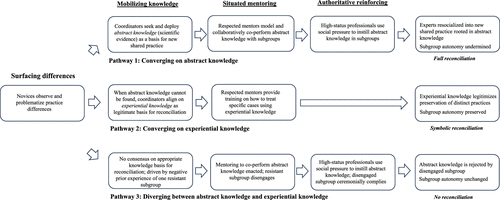
Our analysis allowed us to gain a deeper understanding of how and why abstract knowledge or experiential knowledge might be taken up differently by experts across the practices and with what consequences. We noted that the type of knowledge (abstract or experiential) that was mobilized to reconcile practice differences had an important impact on the trajectory toward reconciliation. More specifically, we noted three distinct patterns of reconciliation related to the tension between the different ways of knowing among the subgroups. These are elaborated in our conceptual model in Figure 1.
Surfacing and Reconciling Differences in Expert Practice
When the two NICU nursing subgroups, GEN and KIDS, came together for the first time, they initially attempted to preserve their distinct ways of treating extreme preemies. Their differences persisted until they were surfaced and problematized by novice newcomers who were puzzled about which practices to adopt. In response, both the GEN nurse manager and the KIDS nurse educator, whom we call expert coordinators, attempted to reconcile discrepant practices by legitimating different forms of knowledge, abstract or experiential, as a basis for a common way of working.
We found that updated abstract knowledge in the form of scientific evidence often provided a foundation for new ways of working but was insufficient on its own to change subgroup practices. Subgroups were invested in their experiential knowledge and resisted applying evidence-based guidelines that appeared to discredit their expertise. To overcome this resistance, respected actors from within and around the profession worked together to collaboratively model and authoritatively reinforce evidence-based practices. Although subgroups ultimately converged on shared ways of working, the process was multilayered, contentious, and contingent, involving more than merely applying abstract knowledge to adjudicate between different ways of knowing. Even then, subgroups tended to reject evidence-based practices when respected actors diverged on the importance of abstract knowledge over experiential knowledge in guiding practice, resulting in no reconciliation.
When abstract knowledge could not be identified to guide shared ways of working, experiential knowledge was mobilized and reinforced by respected actors to legitimate reconciliation efforts. This was done to respond to the novices’ need to learn but had the effect of preserving some form of autonomy for the expert subgroups. Here, subgroups continued performing practices differently but with agreement on how to proceed in the practice.
We elaborate these findings and provide representative quotes from the data in Tables 1–3. For each finding’s section, we present a synthesis of the analysis in advance to help the reader follow the theoretical significance of the empirical findings, which were inductively developed (Berends and Deken 2019).
Preserving Practice Differences
When GEN and KIDS nurses first began working with one another, they encountered practice differences when they assisted one another in the care of an extreme preemie or assumed responsibility for another’s assigned preemie during breaks or when one nurse needed to step away (e.g., to retrieve supplies or consult medical staff). However, because their distinct ways of working had sedimented over the years and each subgroup was invested in its own practices, both eventually agreed, implicitly, to preserve their own ways of working—even when they viewed the others’ practices as inferior. In the following sections, we first examine the differences observed for all five care practices and then show that implicit agreements emerged to enable the nurses to continue working differently. Refer to Table 4 for additional data supporting differences in practice.
|
Table 4. Differences in Care Practices
| Care practice | GEN nurses | KIDS nurses | Differences in performance |
|---|---|---|---|
| Temperature regulation | Keep incubator top closed/locked and work through portholes Temperature probe upon birth | Work with incubator top open Measurements upon birth | “GEN nurses insist on locking incubators so that the babies don’t roll out. Well, we never do that because we need to be able to access the babies fast in case of an emergency. C’mon, a 24-weeker rolling out, really?” – (Senior KIDS Nurse) “So like, incubators open for a little twenty-five weeker? You can’t do that. He’ll lose half his weight … he’d be frozen stiff.” – (GEN Nurse Manager) |
| Bathing | In evening, once every 3 days; less frequent Limited use of disinfectant wipes | Anytime, once every 2 days at most Use disinfectant wipe on babies with lines | “We use sterile water and wait as long as possible for their fragile skin.” – (GEN Nurse) “The Vernix gets really gross so I wash the baby as soon as I can with water.” – (KIDS Nurse) “For me, the wipe, I’ll use it but it doesn’t really count as a bath—the kid doesn’t get as thorough a clean.” – (KIDS Nurse) |
| Regular care | Cluster routine care and perform every 3 to 4 hours to avoid disturbing infants | Perform different care elements as the baby needs them; allow babies to rest; care every 4 to 6 hours | “The other day, there were twins and I had one and a nurse from the KIDS had the other. One baby received care every six hours and the other received care every four. It was not coherent for the parents, it was not logical for them … .” – (GEN Nurse) “For small babies we always did their [regular] care every six hours and I know at the GEN, when we first moved here there was a feeling that that was too long. Maximum it should be at four hours. For me, it really depends on the baby. If they react really poorly to you when you touch them and their heart rate is dropping and it’s really traumatic for them I’m not going to do it every four hours just to be able to write it [emphasizes ‘write’] in the chart. Some babies, if you leave them too long, they get too many secretions, they get worked up and they really need to be suctioned more frequently so I base it off the baby’s secretions.” – (KIDS Nurse) |
| Umbilical arterial blood draw | Return heparinized blood to the baby umbilicus through the closed loop system | Discard heparinized blood after blood draw | “I’m not sure about pushing the blood back in … I usually don’t do it because these guys are so infection prone.” – (KIDS Nurse) “0.5 cc can be a big amount of blood for these tiny 23-weekers so I try whenever I can to push the blood back in, unless the baby is sick or something. Then I’ll know on rounds or from the Attending.” – (GEN Nurse) “Unless something is really wrong, I reinfuse the blood because the 0.5 cc is a lot [of blood] for preemies.” – (GEN Nurse) |
| bCPAP | Suction every 3 or 4 hours Do not remove prongs/hat for care | Suction every 4, 5, or 6 hours depending on the baby Remove prongs/hat for care | “I go Q3 so secretions don’t accumulate. That way, the preemies don’t struggle to breathe.” – (GEN Nurse) “I was told the protocol was to suction Q3 but I’m not sure—I haven’t seen it; I see others suctioning three, four, or sometimes five without any issue. For me it depends on the baby’s capacity to go without struggling. I like to let them rest.” – (KIDS Nurse) |
Temperature Regulation.
When KIDS nurses assumed the care of extreme preemies, they paid less attention to temperature regulation than the preemie nurses. With the lid closed, GEN nurses worked through the incubator’s portholes to change a diaper, reposition the baby, take a temperature, and perform regular care tasks. In contrast, the KIDS nurses worked with the incubator lid open to perform care tasks. Each group had a justification for their practices, rooted in their accumulated experiential knowledge.
“Working with preemies, well, we’re used to having the top up most of the time to access the baby quickly, in case something goes wrong.” (KIDS Nurse)
“So the way to do it is not to open the incubator [top]; it’s not that hard. You can perform suctioning and the full regular care through the portholes for that matter. It may require a bit more dexterity but it is easily done.” (GEN Nurse)
Further, GEN nurses were very concerned with the lack of attention to temperature control when babies from the birthing center arrived and were subsequently examined and prepped.
“When admitting preemies, they measure the baby, they do BP [blood pressure], four limbs…they do that. It’s like, come on! And I was looking at them exasperated saying, ‘Can you put the temperature probe on your baby, please?’” (Senior GEN Resus Nurse)
Bathing.
Following the merger, differences in bathing frequency emerged between the GEN and KIDS nurses. One KIDS nurse explained their approach.
“We would do our baths every second day, and they would do it every third day. So when we would write out our care plan for the day we would write ‘bath every second day,’ and then I would give the report to a GEN nurse and they would erase it and write every third day.”
Additionally, unlike KIDS nurses, GEN nurses avoided using chlorhexidine wipes on extreme preemies.
“We try not to use chlorho wipes. It can be rough on their delicate skin. We use sterile water. But if there is a threat of infection, we use them. Still, I don’t like to use them.” (GEN Nurse)
Regular Care.
To ensure preemies were appropriately monitored, nurses needed to perform regular care tasks every few hours. These could include recording vital signs, taking temperatures and blood pressures, feeding if necessary,1 changing diapers, repositioning the baby, listening to lungs and bowels, checking airways, and drawing blood. Following the merger, GEN and KIDS nurses discovered that they performed regular care at different frequencies. KIDS nurses tried to maximize the rest period for a preemie, performing regular care every six hours. GEN nurses felt that extreme preemies needed diaper changes and repositioning every four hours to protect their skin.
“They [KIDS nurse educator] were like, you need to let them rest. Yes, you need to let them rest but a preemie lying on one side with fragile skin for six sometimes eight hours—that’s not good for their skin. There were kids that slept for eight hours with the same urine-soaked diaper. They were like you don’t want to disturb them, yeah but you don’t want to neglect them. So four to six hours for me would be the maximum.” (GEN Nurse Manager)
Umbilical Arterial Blood Draw.
When an extreme preemie is born, they are fitted with an umbilical artery catheter that allows blood to be taken from the umbilicus without repeated needle pricks. The nurses differed in whether they returned unused, heparinized blood back into the umbilicus.
“… What we do is we draw out the [heparinized] point five cc blood before we draw out the actual blood samples to send. I usually put that blood back in because you know these guys are so small so point five cc can be a lot of blood loss.” (GEN Nurse)
“When I was here, a few months later, and I was doing the arterial blood draw, this other nurse had seen me do it, and she was like, “Oh, aren’t you going to push that back in?” I was like, “Oh.” I wanted to be careful about contaminants.” (KIDS Nurse)
bCPAP.
Many preemies require artificial ventilation to ensure adequate airflow to their still-forming lungs. Air is delivered through a pair of prongs attached to the baby’s nostrils and connected to tubes attached to a fitted cloth hat. Performing bCPAP requires regularly suctioning secretions that accumulate in the back of the throat, repositioning the baby, and adjusting the apparatus, all while ensuring continuous airflow. KIDS and GEN nurses suctioned preemies at different intervals.
“For bCPAP, you suction every three hours. That’s based on a protocol that I read.” (GEN Nurse)
“For bubble CPAP I was told to suction every four hours. That’s what I think Dr. S, who is the bubble CPAP king told us when he was giving us some education. So that’s what I’ve always done.” (KIDS Nurse)
Furthermore, the KIDS nurses removed the hat and prongs completely to perform a care task, whereas the GEN nurses kept them in place.
“When I suction for bCPAP, I only partially remove the device so that the child has a continuous flow of air to the lungs. So I remove the prong from one nostril, lift up the device partly, do my care then put it back and do the same thing on the other nostril. At any one time, the device is connected to the baby and she receives oxygen through one nostril.” (GEN Nurse)
Both expert coordinators, the GEN nurse manager and the KIDS nurse educator, knew that differences existed among the nurses, but they, too, disagreed on some practices. In addition, the unit had not appointed a head nurse with the authority to decide on a common approach. Absent a unified perspective, the expert coordinators felt they could not move forward without creating more tension.
“We’re still integrating the two groups and have to present a unified front so we’re sort of overlooking some of that stuff [differences] because senior nurses use critical thinking and may do things differently depending on the baby.” (KIDS Nurse Educator)
Meanwhile, the neonatologists delegated such matters to nursing leadership. One neonatologist explained, “We have very experienced nurse managers from KIDS and GEN, and we rely heavily on them to train and develop nurses and to oversee their work.”
Preserving Differences via Implicit Agreement.
Across all five expert practices, GEN and KIDS nurses came face to face with practice differences and initially agreed to respect, albeit grudgingly, each other’s ways of working. Four months into the merger, differences persisted in a tense but civil understanding that respected the other group’s autonomy. One GEN nurse shared,
“So I work with the dome down for the little ones. They [KIDS] don’t do that. Yesterday, for example, me and a girl from KIDS were buddied, and I had a preemie. So when I left for break, I told her jokingly, ‘Shut the dome on MY baby, OK?’ She smiled back and was OK with my comment. But am I pissed that they are not closing the domes? Yeah, I’m pissed!”
The nurses settled on an implicit working arrangement: The helping nurse accommodated the primary nurse even though they still believed the procedure was “inappropriate,” as this exchange illustrates.
I approach two nurses wiping a tiny bright-red preemie through the portholes. KIDS nurse says they are giving the little one a bath. When I ask how they did it, this exchange took place: GEN nurse says: ‘We gently rub down the baby with sterile water using a soft cloth.’ KIDS nurse reacts: ‘If it were my baby, it’s so small, I would just use one chlorho wipe—get the crevices, the line, and we’re done.’ GEN nurse chuckles: ‘I’m schooling her on how to look after delicate ones.’ KIDS nurse rolls her eyes and chuckles back: ‘You’re just creating work for yourself plus, chlorhos are antiseptic!’ GEN nurse responds: ‘And harsh, and drying, cracking, and infection! …’ KIDS nurse says, laughing: ‘Fine, have it your way!’ and leaves the room. GEN nurse whispers to me: ‘Geez, they’re so arrogant …’ (Field notes, June 2, 2015)
One nurse explained how they did not encroach on another nurse’s suctioning frequency for bCPAP.
“Some were leaving it longer like Q6 [six-hour suctioning interval]. I was more conservative, so I did Q3 or Q4. When I’m buddied, I just go with the other’s approach on their babies—like when I watch my buddy’s baby. I’m not going to step on their toes….” (GEN Nurse)
Thus, the two nursing subgroups negotiated an informal arrangement to maintain their own ways of working, and this aligned their interests across the five NICU practices.
Surfacing Practice Differences
The discrepant practices persisted until they created urgent concerns for novice newcomers. In our setting, newly recruited novice nurses found it difficult to learn and train at bedside. Driven by their need to socialize into a specific way of working and their inability to do so when practices varied, novices surfaced and problematized practice differences to their expert coordinators.
Observing Differences.
After a week of theoretical education, novice nurses shadowed senior GEN and KIDS preceptors (i.e., senior nurses training novices by showing them how to perform procedures at bedside). While at bedside, the novices began observing inconsistencies in all five practices between the two subgroups. They also noted that parents sometimes questioned temperature regulation, bathing, and regular care practices, because these differences were visible and intelligible to them. We observed an episode that a novice called “confusing for me and really weird for the parents.”
A novice nurse, Nicola, was assigned one fresh extreme preemie twin. She asked Gina, her bedside training preceptor (GEN senior nurse) whether she should bathe the infant. Gina said to wait until tomorrow because of the fragility of the baby’s skin. Nicola then asked Katie, an experienced KIDS nurse assigned to her preemie’s twin, what she will do so they can update the parents. Katie says: ‘I’ve already bathed the baby with the mother. Used chlorhexidine wipes.’ Nicola worries about the inconsistent care plans for the twins and how they will be seen by the parents. The protocol did not clarify what was recommended. Nicola brings it up to the educator at the end of her shift, referring to the protocol. (Field notes, March 9, 2016)
In the old NICUs, novices apprenticed unproblematically with senior nurses working in a similar way. In the new NICU, they could not attach to a single practice and form associations with senior nurses because they observed differences and did not know who to follow. They worried that the wrong choice could have grave consequences. According to one novice nurse, “It’s confusing being new because [senior] nurses have different styles. Yesterday I worked with a GEN nurse, and she was telling me to suction every three hours. But on another shift my preceptor was from KIDS, and they let the baby go an hour longer. It’s a bit scary because one way or another can impact the baby; they are so fragile.”
Problematizing Differences.
The immediate response of the novices was to seek the relevant evidence-based protocol to confirm the proper way to perform the procedure. One novice called it “doing our homework before asking anyone else.” An evidence-based protocol is a medical guideline that reflects up-to-date abstract knowledge in the profession. It integrates evidence across research studies with existing theoretical knowledge to develop guidelines that inform clinical practice and support learning. Searching on the Intranet and in the cart holding protocol binders, the novices could not find the temperature regulation, regular care, and umbilical arterial blood draw protocols. They found the bathing and bCPAP protocols, but those were unclear on the observed areas of discrepancy. Absent a clear protocol, the novices consulted with the coordinators as they were responsible for formal training, although generally they avoided seeking clarification from their preceptors.
“I was reluctant to ask my GEN preceptor why she did a care in a more difficult way through the holes. My other KIDS preceptor just raised the dome and worked on the baby directly. You can really feel the tension between the KIDS and GEN nurses, and I didn’t want to stir up some sensitive issue about who is right and who is wrong. That’ll backfire on me. I don’t want to be on the wrong side of senior nurses.” (Novice)
One novice nurse explained why they felt it was appropriate to bypass the senior KIDS and GEN nurses and approach the GEN nurse manager or the KIDS nurse educator.
“The little ones are so fragile and getting it wrong might mean they catch an infection or develop a heart condition or some neuro complication and…like…even die. Well…not on my watch. It’s our responsibility to make sure we do things right. It’s also the educator’s. We just did our training with them. So we go to them. The GEN nurse manager is also there and responsible for us. So we check with whoever is available, and we’re careful not to antagonize anyone. When it comes down to it—it’s about the learning and the baby, not about the GEN way or the KIDS way.”
Their desire to learn how to perform a practice well to ensure they “do no harm” was salient.
Two new nurses are talking quietly in an alcove. Nora: ‘GEN preceptor tells me I should keep the incubator locked when I need to do any procedure. But yesterday, I was confirming it with KIDS preceptor and she said to do what is more convenient relative to how sick the baby is. Not sure what that means….’ Naomi: ‘What some of us have been doing for other things is just seeing what the protocol says. So I look for it and if I don’t understand what I’m supposed to do, talk to the GEN nurse manager or KIDS nurse educator, whomever is there—that’s their job…. What’s funny though is I tried to find the temperature regulation protocol but it wasn’t there. So I told the educator and they seemed alarmed. (Field notes, July 16, 2015)
Novices consulted either the GEN nurse manager or the KIDS nurse educator depending on who was available at that moment (their offices were side by side). Often, however, novices sensed that one was more passionate about certain practices than the other. In the words of another novice,
“Like we all sort of knew the KIDS nurse educator wasn’t really fussed about bCPAP but the GEN nurse manager cared a lot…. But the KIDS nurse educator did care about temperature regulation and everything else like bathing, for example.”
When seeking advice from either the GEN nurse manager or the KIDS nurse educator, novices explained that they had witnessed different ways of working and could not find clear guidance in the available protocols. They asked pointed questions on how to perform temperature regulation, bathing, bCPAP, regular care, and umbilical arterial blood draws.
“So, when do I use chlorho wipes? I’ve been told, ‘no, not on the prems’ but then I’m also told, ‘you need to use them on every baby with a line.’ So which is it? …The bathing protocol didn’t clearly specify what to use and how often to give a bath so I just asked the question to my educator.” (Novice)
“I’ve heard and seen Q3, Q4, and even Q6 [hours] for bCPAP suctioning. I wanted to know what the real answer was. That protocol wasn’t actually in our protocol binder so I went and asked my head nurse for it and explained why I needed it.” (Novice)
This persistent consulting and questioning pressured the GEN nurse manager and the KIDS nurse educator to address discrepancies and make clear, up-to-date protocols available.
“The novices are asking us about protocols and it doesn’t look good that they’re not up to date. But we have to give them a well-researched answer, it’s our responsibility. We have to update them [the protocols]. And we have to reassure the parents that our nurses know what they are doing.” (GEN Nurse Manager)
In this manner, novices created pressure for practice reconciliation despite their peripheral position. Rather than confronting experienced preceptors from either professional subgroup, they approached the GEN nurse manager or the KIDS nurse educator—both responsible for baby health and safety, parental support, and nurse training, all areas of consequence for practice performance. They appealed to the interests of the expert coordinators by problematizing differences in ways that were culturally and socially appropriate but also exposed shortcomings in their areas of responsibility (e.g., incomplete or missing protocols). Ultimately, they came across as acceptable incompetents (Lofland and Lofland 1971) and thus avoided social sanctions for “questioning power.” Instead, they succeeded at shifting accountability for appropriate practice from themselves to both coordinators, prompting the latter to take action.
The actions of novices triggered reconciliation efforts in the combined NICU. Below, we describe three distinct reconciliation patterns, each characterized by different processes and outcomes: (a) full reconciliation, which involves converging on abstract knowledge; (b) symbolic reconciliation, marked by converging on experiential knowledge; and (c) no reconciliation, where there is divergence on the type of knowledge—abstract or experiential—that should apply in a practice.
Full Reconciliation: Converging on Abstract Knowledge
Once novices had surfaced practice differences, the GEN nurse manager and the KIDS nurse educator often worked together or supported one another to update and mobilize scientific evidence in the form of revised protocols (or guidelines) to reconcile differences. Although evidence—as a form of abstract knowledge—provided a rationale and scientific justification for a new, shared way of working, both nursing subgroups resisted immediate adoption of the revised protocols. To alter their actions, respected mentors, such as resus nurses, were recruited to engage in situated mentoring, modeling, and coperforming the protocols collaboratively with the subgroups. If differences continued to persist even after the intervention of the respected mentors, high-status professionals (i.e., neonatologists) were enlisted to engage in authoritative reinforcing of the evidence-based protocols. Here, the neonatologists applied additional, more coercive pressure to encourage the subgroups to enact the protocols and internalize the underlying abstract knowledge. Of the five practices we traced, temperature regulation and bathing underwent a full reconciliation and converged on new shared ways of working through these means. Below, we examine how differences were reconciled for temperature regulation and bathing.
Mobilizing Evidence.
For the temperature regulation and bathing practices, the expert coordinators worked together to consult the medical literature, update the evidence-based protocols, and heavily promote them to the nursing subgroups. In both cases, the evidence provided a scientific basis for shared ways of working and thus diffused tensions between the coordinators and their different philosophies on these practices.
Temperature Regulation.
In temperature regulation, the protocol was missing from the electronic protocol repository on the NICU intranet and the physical protocol binders, prompting the GEN nurse manager to conduct a search.
“A new nurse asked me for the temperature regulation protocol. It was not in the binders by the transport entrance so I dug it up from the Intranet. I just assumed it was there and was used during training. Later, the educator told me they didn’t think a protocol existed and was surprised about that. I emphasized how important it was for preemie care. So now, they’re circulating it with guidance on closing lids to all the NICU by email.” (GEN Nurse Manager)
Finding and publicizing the temperature regulation protocol addressed the concerns of the novices by providing clear, externally validated guidance on how to perform the work. This shared protocol also served the expert coordinators’ objective of providing scientifically backed guidance to the novices for safety and, in turn, to signal consistency to parents.
For the GEN and KIDS nurses, meanwhile, the temperature regulation protocol created problems, and its diffusion was insufficient to reconcile practice differences on its own. The protocol limited the use of professional judgment at bedside and required a change in practice for KIDS nurses. A KIDS nurse expressed his frustration.
“If you have a preemie that’s growing like you expect, successfully extubates, gets off TPN, no infections, not many desats, things like that, fine, I get the protocol. But, I have enough experience to tell you that if my preemie is unstable, has fluctuating vitals, BPs and desats a lot, when I touch her, she may become irritated and deteriorate fast so I need to be able to fully access [her] to resuscitate. I can’t do that through the portholes. So, you have to prioritize issues, use your critical thinking in the moment. The protocol isn’t always the holy grail.”
Even GEN nurses, whose practices were more in line with the temperature regulation protocol, were dismissive of being “handed a protocol” and told to work to it. One nurse explained this attitude.
“I know how and when to fit a temperature probe. I’ve been doing it for years. So when I receive an email with this protocol, I’m like, yeah OK. I’ll glance at it for a minute just in case there’s some new research or something. Then it gets lost in my inbox.” (GEN Nurse)
To sell the protocol to GEN and KIDS nurses, the GEN nurse manager repeatedly spoke for the evidence embedded in it, adopting a scientific narrative that framed the protocol as objective.
“It’s in the literature, there’s evidence and I keep repeating it. Maintaining temperature is crucial. Imagine yourself in a 38-degree environment and you’re all wet and humid and a gust of wind of 20 degrees hits you. And you’re not even as fragile as these little preemies. It freezes you. The temperature drops dramatically when you open the dome.”
The KIDS nurse educator, although focused on surgical babies in the past, also framed temperature regulation as an established evidence-based activity.
“We know that opening the dome exposes the babies to more light and more noise, to cold air, to all kinds of stressors. It’s not a nebulous activity like how often you go into the incubator to do a care. There’s like randomized control trials on it…if you don’t maintain humidity and for the prems, it can be dangerous.”
This narrative was mobilized to “speak for” the scientific evidence. The GEN nurse manager and the KIDS nurse educator were united in emphasizing the scientific basis of the protocol and the dangerous consequences of not abiding by it. They told us they kept repeating to all the nurses that a sudden change in environmental temperature is associated with stress, intraventricular bleeds, and neurological disorders—hence the need to keep incubators closed and work through the portholes to preserve safe temperature and humidity levels.
GEN nurses, whose ways of working corresponded to the protocol, began using the GEN nurse manager’s scientific narrative to validate their approach as legitimate vis-a-vis that of KIDS nurses. We observed a GEN nurse assisting a KIDS nurse on a preemie and saying, “Did you see the temp regulation protocol? Now I really know why I’ve been working with the dome shut. Before I just kind of did it. But skin infection and weight loss from temperature changes can actually kill the baby. Scary.”
Novices, GEN nurses, and the expert coordinators were now aligned with the protocol; however, KIDS nurses continued to work differently. The KIDS nurse educator explained, “The KIDS nurses are still not closing the domes even though everyone else around them is. The way they work is instinctive and intuitive, so it’s hard to let that go. Plus, by letting that go, you sort of concede to practicing the ‘wrong way’ and that hurts your pride.”
Bathing.
For the bathing practice, the protocol that novices consulted was outdated and unclear on key areas of difference such as bathing frequency and whether to use chlorhexidine wipes. Thus, a search in the literature was conducted, and the protocol was updated.
“The bath protocol, what we realized as we were using it, was that it was causing a lot of confusion…so, when to use chlorhexidine wipes and when not to use chlorhexidine wipes. It was not clear…so we added a table to the bath protocol to clarify the confusion and made sure everyone knew it was there and to follow it.” (KIDS Nurse Educator)
As with the temperature regulation practice, the protocol provided guidance for novices but did not immediately catch on with the GEN and KIDS nurses. A GEN nurse commented, “I’ve been doing [preemie] baths for God knows how many years now, and you email me instructions on how to bathe my baby? Like, come on, you’ve got to be kidding me.”
To enroll the GEN and KIDS nurses, the KIDS nurse educator and the GEN nurse manager again developed and used a narrative that promoted the protocol as scientific and thus objective.
“We are stressing that the evidence shows that chlorhexidine wipes don’t affect the fragile skin but rather reduce infection. We keep repeating this to the nurses. Like listen guys—the wipe WILL NOT hurt their skin and here’s why.” (KIDS Nurse Educator)
The KIDS nurse educator emphasized to us that bathing extreme preemies is a delicate operation because of the potential for skin damage or infection through still-forming skin. Accordingly, bathing needs to be done in the incubator, usually through the portholes, using chlorhexidine wipes. As with temperature regulation, the coordinators were aligned on the protocol. The KIDS nurse educator took responsibility for updating the protocol and told us that the literature search (done by a few nurses on maternity leave) confirmed that the use of chlorhexidine baths reduces central line–associated bloodstream infections in neonates. The GEN nurse manager confirmed this: “We use the wipe. If it’s in the literature, that’s what I go with. Not I think this or I think that.” KIDS nurses had already been using chlorhexidine wipes, so they immediately appropriated the protocol to validate their knowledge of preemie care. One KIDS nurse confided,
“It seems like all the GEN nurses are scared to use the wipe because it’s rough on the skin. Well it’s not. Even their GEN nurse manager says it won’t hurt them and they did a big evidence search. We’ve been paying attention to infection all along with extreme preemies.”
Meanwhile, GEN nurses continued to push back and defend their own experiential knowledge, rejecting the protocol. One GEN nurse explained,
“So now I have to use the wipes on preemies with lines. I get the infection risk with the immature immune systems. So OK, fine. But I used to bathe them with sterile water and I never had any infections. So, evidence changes.”
Thus, like temperature regulation, the nursing subgroups whose practices were already aligned with the proposed practices adopted the protocol, although opposing subgroups remained reluctant to change their ways of working. For the novices, however, the protocols, the updated scientific evidence underlying them, and the narratives used to promote them were influential in guiding and shaping their practices.
Situated Mentoring.
Because mobilizing evidence was unsuccessful on its own at reconciling the temperature regulation and bathing practices, the expert coordinators enlisted respected mentors in senior professional roles to persuade the subgroups to enact the scientific evidence. These actors developed relationships with the nurses and modeled collaboratively how the evidence in the updated protocols was to be applied in practice.
Temperature Regulation.
For temperature regulation, the GEN nurse manager, supported by the KIDS nurse educator and the neonatologists, decided to enlist highly respected nurses as mentors to show how the protocol might be used in practice. Resus nurses, already embedded in the admissions workflow, intercepted every case and modeled the temperature regulation protocol with the bedside nurse on every incoming baby. They showed how the protocol worked in practice, engaged in a narrative to justify the science, and effectively attempted to socialize all nurses into a new way of working. For every extreme preemie admitted from the birthing center, the mentors demonstrated how to set and warm the incubator and how to place the temperature probe on the new preemie. They also reinforced the importance of creating a temperature- and humidity-controlled environment. An attending neonatologist described this approach.
“So [the manager and educator] had our support and they said: OK, you guys [resus nurses] are experts on extreme preemies and we want to use your expertise to help spread that information to everyone. So when you have a preemie, you are there and you can assist anyone doing the admitting and reinforce knowledge on the golden hour; emphasize the probe and keeping the domes closed after golden hour procedures.”
For resus nurses, the activity was something they cared deeply about, and the on-the-job training was an occasion to showcase their role. The bedside nurses, meanwhile, found the resus nurses to be highly credible. According to the GEN nurse manager, “They [KIDS] were like ‘Oh, ok.’ So you had this sense of, oh, she is a resus nurse talking to me; she has separate expertise.” With daily, work-based reinforcement, KIDS nurses started changing their approach to align with the protocol. One KIDS nurse reflected on their previous practice.
“I don’t want to say we were less careful. But we’re maybe less considerate of like the baby’s developmental [care], what he needs in the first few hours [of life], which is temperature control. They need to be touched and left alone really fast, without like panicking them too much…. We’re now careful to keep the isolette (incubator) closed and locked when we work.”
The KIDS nurse educator noted, in describing the success of this effort, “The experienced nurses [referring to KIDS nurses] start to work to the protocol as well when everyone else is using it.” Thus, with the highly respected resus nurse centrally positioned in every nurse’s workflow and intercepting every preemie case, the repeated coperforming eventually aligned the opposed subgroup to the protocol.
Bathing.
For bathing, however, respected mentors were not as successful at reconciling practices as they were not centrally positioned in the nursing workflow. For the bathing practice, skilled “champions” were recruited from both the KIDS and GEN subgroups to perform door-to-door mentoring on selected shifts. They would visit all the nurses during a shift and show them how the updated protocol might be enacted and explain the importance of the disinfectant wipe. GEN nurses continued to resist, however. A frustrated older GEN nurse told us,
“Look I’ve been at GEN for over 15 years and now you hand me a table [in the protocol] and have a younger nurse train me on how to give a bath to my preemie? Seriously? I can do this stuff with my eyes closed.”
Unlike in temperature regulation, the mentors chosen for this role were not always seen as quite so credible by the more senior nurses. Moreover, they were not centrally positioned in the nursing workflow and could not intercept every case. Co-performance of the practice was not habitual and sustained. Thus, the door-to-door interaction between the mentors and the subgroups did not provide sufficient work-based reinforcement to change the practices of the resistant nursing subgroup (GEN). Thus, the subgroups did not align with the protocol.
Authoritative Reinforcing
Bathing.
In a further effort to reconcile practice differences for bathing in line with updated scientific evidence, the GEN nurse manager requested the help of neonatologists to monitor compliance to the protocol and reinforce knowledge of it. All bedside nurses participated in rounds and respected the expertise and education provided by the neonatologists. When checking on a baby in rounds, the neonatologists would perform accountability rituals, such as questioning nurses about aspects of bathing and correcting deviations from the protocol. They pressed the nurses to ensure mastery of the principles and underlying theory. The exchange often occurred in the company of other, sometimes novice, nurses and medical personnel participating in rounds. A senior GEN nurse confided that she learned the protocol so she wouldn’t “look like an idiot” in front of others and added, “If this [the protocol] is a priority for the doctors, it must be important.” The doctors would also examine the baby’s chart to ascertain how many times the preemie was bathed and whether the wipe was used.
“The doctors, the educator, and me, we also checked that nurses were following the protocol by looking at the [baby’s] chart. You look at the chart and you see, OK, this baby had a bath yesterday and yeah, they indicate if they use a chlorhexidine bath—so if they use it, perfect. If not, why didn’t you use it? So it was doctors, me, and education conducting a lot of the spot checks. And a month after the protocol was out, a lot were complying.” (GEN Nurse Manager)
Thus, the neonatologists performed rituals and enrolled metrics to make conformity visible, ensure knowledgeability, create performance pressure, and induce protocol use. This directive approach toward the nurses by a respected professional group succeeded in changing the practice.
In sum, our analysis thus far suggests that for the expert subgroups to reconcile practice differences, they may need to renew their knowledge of the “same” practice, a challenging undertaking given that they already possess deep experiential knowledge and enjoy significant autonomy. For this to happen, the mechanisms discussed above may need to be layered in succession and with increasing social pressure to instill the new knowledge. First, although abstract knowledge may be promoted as a scientific basis for expert practice, it may face resistance, particularly when it devalues established experiential practices or proves insufficient for complex situations. Second, involving respected mentors to collaboratively model and promote the evidence can be effective, but only if this situated mentoring is embedded within actual work episodes. The third mechanism entails adding a layer of reinforcement involving high-status professionals with authority over what is regarded as legitimate knowledge. Their involvement in reinforcing the evidence exerts even more social pressure in favor of updated abstract knowledge. Eventually, the subgroups become receptive to this professional authority as resistance may result in losing face and status. Thus, converging on abstract knowledge involves a complex multilayered process that includes increasing social pressure from authoritative actors; the latter needed to change the practices of those “who already know what they are doing.” Table 5 provides the full reconciliation mechanisms and corresponding forms of social pressure.
|
Table 5. Full Reconciliation Mechanisms and Forms of Social Pressure
| Mechanisms | Social pressure applied | Authoritative actors involved | How it worked |
|---|---|---|---|
| Mobilizing evidence | Mobilizing scientific rhetoric: Appeal to science as objective and impartial to legitimize protocol | By expert coordinators
|
|
| Situated mentoring | Influencing via collaboration: Pressure to replicate and learn from mentor performance | By respected mentors Organized by expert coordinators:
|
|
| Authoritative reinforcing | Influencing via coercion: Pressure to learn, articulate, and enact updated abstract knowledge or compromise status | By high-status professionals Organized by expert coordinators:
|
|
Symbolic Reconciliation: Converging on Experiential Knowledge
When updated abstract knowledge in the form of scientific evidence was not found or appeared insufficient to develop well-defined evidence-based protocols, the expert coordinators addressed the surfacing of differences by jointly mobilizing experiential knowledge. They promoted the use of critical thinking and professional judgment, based on experiential knowledge, in determining how to treat specific cases. To respond to the learning needs of novices, mobilizing experiential knowledge was also combined with situated mentoring. This process ended up preserving the autonomy of the subgroups; thus, practices were only reconciled symbolically. That is, any practice differences that persisted following situated mentoring could be legitimized by an appeal to judgment grounded in experiential knowledge. Two practices, regular care and umbilical arterial blood draw, incurred symbolic reconciliation, as shown below.
Mobilizing Experiential Knowledge
Regular Care.
For the practice of regular care, a protocol was not developed because no precise guidelines were identified in the literature on what tasks were required and how often to perform them. According to the KIDS nurse educator, too many contingencies surrounding the baby’s condition existed to standardize regular care.
“I had a new nurse ask me about the different ways she was seeing regular care performed. So for example, temperature regulation is a more evidence-based activity. Whereas doing like a care, when you do a check and what you do, well, it’s a bit nebulous. Some recommend every four hours, but he’s on CPAP, he needs suctioning every three, or he might need feeding every three, so you’re going into the isolette anyways. Do you change the diaper, not change the diaper? Do you suction? It’s very detailed, based on your judgment and depends on the baby’s condition; there’s no protocol for it.”
At the same time, the KIDS nurse educator’s discussions with novice nurses still triggered the need to communicate a common philosophy for performing the practice. The KIDS nurse educator and the GEN nurse manager chose to promote the prioritization of critical thinking skills and experience-based judgment to determine what the baby needed in the moment.
Umbilical Arterial Blood Draw.
For the umbilical arterial blood draw practice, a protocol could not be developed either. The decision about whether to reinfuse heparinized blood was determined on a case-by-case basis by the medical team, with input from the baby’s nurses. The GEN nurse manager explained that for extreme preemies, the risks of reinfusing heparinized blood into the umbilicus included introducing bacteria or excess heparin into the circulatory system, which might trigger a life-threatening infection or allergy. Once more, the expert coordinators encouraged nurses to prioritize critical thinking skills and judgement-based experiential knowledge in performing the practice.
Situated Mentoring
Regular Care.
For the regular care practice, the expert coordinators began initiating ad hoc door-to-door training and mentoring. During their interactions with nurses, they enacted a narrative that promoted judgement and experiential knowledge to determine what each baby needed in the practice. Although preferred frequency intervals for various care tasks (e.g., when to change a diaper, whether every three (Q3) or every four (Q4) hours) were discussed, final determinations regarding regular care frequency and tasks were left to the discretion of the nurses.
“During training we were told Q4 or Q6 depending on the baby. So, if the baby has a lot of secretions, then we do them Q4. But if there’s someone that does not have a lot of secretions, they’re doing really well, they’re satting well, their heart rate is fine and they’re not fussy, then you can let them rest, Q6 is fine. But sometimes, you know, you want to be safe and do it Q4. So it really depends, from baby to baby.” (Novice)
Such mentoring scaffolded the work for the novices but allowed the nursing subgroups to maintain their autonomy over their practice. One senior nurse described her training session with the educator: “They just asked how I do things normally. I showed them and they just kind of nodded, said something like, ‘Yeah, that’s what I would do.’ So it’s like we’re doing what we know how to do already.”
Umbilical Arterial Blood Draw.
For the umbilical arterial blood draw practice, the GEN nurse manager and the KIDS nurse educator performed ad hoc training and additional education with all nurses about what baby conditions and indicators would suit or prevent the reinfusion of heparinized blood during umbilical blood draws, as well as how to follow medical team advice during rounds or on treatment plans. On rounds, we witnessed the following exchange.
Neonatologist: “So what are we doing here? Baby Jimmy’s on TPN but I don’t like the creatinine levels. Surfactant levels aren’t great either. We need more bloods. How fast can we …?”
Resident: “We don’t reinfuse when we do bloods, right?”
Nurse: “Not sure we should. He’s been fussy overnight.”
Neonatologist: “Yeah, we don’t want any more problems. Just watch her weight will you, Annie?”
(Field notes, May 2, 2016)
Thus, final determination regarding how to perform an umbilical arterial blood draw varied from preemie to preemie and was made by the medical team and the nurse together.
In sum, for the regular care and umbilical arterial blood draw practices, a different form of reconciliation emerged. Although ways of working remained inconsistent, actors converged on the use of experiential knowledge and reached consensus on what needed to be done to proceed in the practice. Experiential knowledge and situated mentoring were accepted and adopted by the subgroups unproblematically as their autonomy and status was preserved. Interestingly, expert subgroups could use experiential knowledge symbolically as a justification for not changing their ways of working and expert coordinators could overlook the fact that experiential knowledge masked the issue of differences.
No Reconciliation: Diverging Between Abstract and Experiential Knowledge
Practice differences could not be reconciled when one subgroup found that the scientific evidence being marshalled strongly contradicted their own experiential knowledge. Here, experiential knowledge was not merely misaligned with abstract knowledge but forcefully opposed to it based on prior experience of failure in attempting to apply an evidence-based approach to the focal practice. This issue was reflected in the subgroup coordinator’s decision to disengage from and subtly withhold support for reconciliation efforts. Therefore, we found that although the three mechanisms of mobilizing evidence, situated mentoring, and authoritative reinforcing could be enacted, the resistance of one subgroup culminated in partial and ceremonial adoption of the evidence. The subgroup decoupled its knowledge of and verbal support for the scientific evidence from their actual practice. This occurred in the bCPAP practice, where a protocol was developed but did not result in the reconciliation of differences.
One-Sided Mobilizing of Evidence
bCPAP.
The bCPAP practice was introduced at both the GEN and KIDS NICUs two years prior to the merger. A bCPAP committee—composed of a lead neonatologist, the GEN nurse manager, and a respiratory therapist—was formed to monitor progress on implementation across both units. The bCPAP initiative succeeded at GEN, but it was not well received at KIDS because of the older baby population. Larger babies would move around, making it difficult for the bCPAP apparatus to stay on the face and nose, which risked compromising airflow. The KIDS nurse educator mentioned that KIDS nurses felt “jittery” and “stressed out” when using the hat-and-prongs device because babies could easily dislodge it. A KIDS nurse explained, “In the old place, my babies were sick but active and alert so some would push out the [nasal] prongs and tubes. That worried me because they were not getting the continuous airflow.” The KIDS unit, therefore, decided to go back to the full-face mask they had been using before. At that point, the bCPAP committee became less active.
When the novices saw differences in bCPAP performance and questioned the GEN nurse manager or the KIDS nurse educator, the GEN nurse manager began to update the protocol. The KIDS nurse educator, however, disengaged from bCPAP-related matters, referring queries to the GEN nurse manager. The KIDS nurse educator noted, “The bCPAP didn’t work for us. The hat and prongs kept coming off our babies. So I refer questions to the GEN nurse manager because it worked for them.” The KIDS nurse educator withdrew from the process of promoting the updated bCPAP protocol because of the negative experience with the bCPAP device in the old KIDS unit and its unfavorable reception among the KIDS subgroup.
The GEN nurse manager first reactivated the bCPAP committee by approaching the head neonatologist. The respiratory therapist and the GEN nurse manager, working with part-time nurses, conducted a search in the neonatal literature on bCPAP devices and presented the findings to the head neonatologist. These were then communicated to the leadership team and released as a guideline attached to the existing protocol. The updated protocol applied to all eligible babies2 in the NICU and specified suctioning every three hours, one nostril at a time (not removing the hat and prongs) and repositioning the apparatus and the baby at every suctioning interval.
“Dr. X who headed up the bCPAP committee was very supportive in getting the [protocol] revisions done quickly and communicating with other doctors about the need to make sure they are followed by both nursing groups.” (GEN Nurse Manager)
As with the temperature regulation and bathing practices, the GEN nurse manager repeatedly spoke for the bCPAP protocol by appealing to the objectivity of the science.
“I’m not saying you have to suction every baby every three hours but when it comes to preemies, there is scientific evidence why you should do that. It’s not because one has an opinion that not suctioning may hurt them, it is that we have clear scientific studies and evidence that’s been done.”
The GEN nurse manager continued, “Science is our fig leaf. Nobody can tell you you are wrong if you go by it. It’s not about GEN thinks this or KIDS thinks that. It doesn’t take sides.” They explained to us that optimal suctioning frequency strikes a balance between removing accumulated secretions in the back of the throat and disturbing the baby. The objective is to reduce the chance of apnea (period of breathing cessation), bradycardia (a slowing heartbeat below normal levels), and low blood oxygen.
Despite repeatedly invoking the narrative of scientific objectivity, the GEN nurse manager could not generate support for the protocol from the two subgroups. First, not enough KIDS nurses were performing in line with the protocol to create a critical mass of support. According to a senior GEN nurse, “Some of us suction Q4, some Q3, some even Q2. But we’re on the higher frequency side compared with the KIDS. And for many of us the baby reposition is a bit new.” The nurse also explained that they preferred to rely on their judgment because they know their baby well and what they need in the moment. Second, the disengagement of the KIDS nurse educator affected the degree to which KIDS nurses rallied around the protocol. They did not believe that the bCPAP protocol was the most appropriate for the practice given their prior experience with it in the old KIDS unit. The GEN nurse manager expressed their concern: “If we each push our own way, it sends even more mixed messages to the nurses and it opens up the floor to: ‘Who do you want to follow?’ It becomes more political and less about getting the care right.” Furthermore, KIDS nurses felt that a bCPAP protocol should not be imposed as it might be inadequate for complex cases.
“I heard that the new nurses refer to protocols to do bCPAP. Good for them. That’s what they should be doing since they have zero experience. I’ve been caring for sick children, complex cases for a while now, yeah? I respect the guidelines, sure, but I give care based on my baby, my experience, my critical thinking—that’s my value, right? So if you tell me, ‘here’s a protocol, use it to the letter,’ and don’t think about unique cases or prioritizing different issues, I will have a problem with that.” (KIDS Nurse)
Situated Mentoring Results in Partial Appropriation
bCPAP.
To enroll GEN and KIDS nurses absent the KIDS nurse educator’s involvement, the GEN nurse manager along with the bCPAP committee created a formal mentoring program. The GEN nurse manager admitted, “It’s no secret that the senior nurses are not following the protocol no matter how much we talk about it. With their experience, they feel they don’t need it so they don’t read it until they run into an issue.” To help win the nurses over, the committee selected respected mentors from both KIDS and GEN. to perform door-to-door training sessions with their own groups to reinforce key aspects of the protocol:
“We have 8–10 champions. They are mixed with GEN and KIDS nurses. The KIDS nurses were initially skeptical but had enough belief to help and got exposed to some of the data as reinforcement and became converts. I use them as ambassadors with other KIDS nurses. The KIDS nurses would not have reacted well to GEN nurses coming to show them how—it would have become political.” (GEN Nurse Manager)
The mentors were amicable and succeeded at partially shifting the practices of GEN nurses; however, random examinations of patient charts by the bCPAP committee revealed that KIDS nurses continued to perform the practice in variable ways and not in line with the protocol. KIDS nurses bemoaned the prescriptive nature of the protocol, claiming it narrowed discretion or did not account for complex patient scenarios. One KIDS nurse told us, “KIDS nurse educator is a bit more relaxed about suctioning frequencies, so I just use my critical skills like she always emphasizes.” Another mentioned, “We were always told by our educator to pay attention to the secretions at the back of the baby’s throat. You can tell by the way they’re breathing…so only when they accumulate, do you disturb the baby. It’s a judgment call.” It became clear that the lack of consensus between the coordinators originating from the different subgroups’ previous experience had an important influence on the mentor’s ability to reconcile practices. The KIDS nurse educator’s lack of alignment with the protocol dampened the KIDS nurses’ urgency to change their way of working. One KIDS nurse explained, “Look, they’re [GEN] doing them and we’re doing us. Our educator seems cool with that and no babies have been hurt.”
Authoritative Reinforcing Results in Ceremonial Appropriation
bCPAP.
To reach KIDS nurses, the GEN nurse manager enlisted neonatologists to reinforce knowledge and monitor performance. During rounds and when checking on a baby, the neonatologists would question nurses about various aspects of the bCPAP practice and point out deviations from the protocol to ensure compliance. One KIDS nurse described her exchange with a doctor on rounds.
“Dr. L was the Attending on my corridor and I was looking after a really small feeder-and-grower. When the round got to me, I did my report, system by system but when I got to airways, Dr. L grilled me on CPAP maintenance—like suctioning frequency, handling, mask positioning. I was like woah. They’re getting very serious about harmonizing these things. It’s a good thing I had my shit together.”
In the presence of the neonatologists in the rounding workflow, the bedside nurses were keen to signal their knowledgeability. According to the GEN nurse manager, “People start to come in line when they hear [from the doctors] how important continuous airflow during a bCPAP care is. And when they [the neonatologists] question you, you don’t want to look stupid—it’s embarrassing.” However, bCPAP charting checks continued to reveal disappointing results. Publicly displayed metrics such as “percent of staff compliant” to specific indicators were below benchmarks. Many KIDS nurses had been learning the protocol enough to field questions during rounds but continued to work their own way. When we left the field, bCPAP practices remained variable and adherence to the protocol was still inconsistent. In the words of the lead neonatologist on the bCPAP committee, “We’re winning small fights but we have yet to win the bCPAP battle.”
In sum, when one subgroup could not embrace the importance of the scientific evidence for the practice given their own negative prior experience, reconciliation was not possible. This issue was reflected in their coordinator’s decision to subtly withdraw from the reconciliation efforts. Although the other coordinator, the respected mentors, and the neonatologists together advocated for the bCPAP protocol, the subgroups did not converge on a shared way of working. We found that the coordinators wielded a foundational form of expert authority with the subgroups, sometimes even overshadowing the neonatologists in adopting new abstract knowledge. Without the coordinators’ engagement, evidence-based protocols did not attract sufficient adherents, and mentors struggled to enlist members of their subgroup. Even the neonatologists’ effectiveness was limited as the disengaged subgroup complied ceremonially with their reinforcement efforts to save face but continued practicing in their own way. Novices, on the other hand, navigated the inconsistencies between the coordinators and the subgroups by adhering to the official evidence-based protocol endorsed by the unit’s bCPAP committee, and advocated by the mentors and neonatologists. For them, formal guidance grounded in abstract knowledge was essential to their learning and the execution of appropriate practice.
Discussion
Organizational change sometimes brings together occupational subgroups whose similar work practices are performed differently. When these subgroups work alongside one another, they may face pressures to reconcile their distinct ways of working. This paper considers the difficulties associated with changing expert practices that are rooted in deeply ingrained experiential knowledge. Our conceptual model, represented in Figure 1, depicts the processes and mechanisms that illustrate how distinct expert practices come to be challenged, preserved, or reconciled.
Our model suggests that practice differences need to be surfaced as problematic before they can be reconciled; otherwise, they are likely to persist. We show that novices, surprisingly, can challenge coexisting practices when they are not able to socialize into a consistent way of working but need to acquire knowledge to perform their work. By raising questions about differences to those in charge of their training—and who are motivated to resolve these issues—novices create pressure for change.
We suggest that reconciliation efforts are tense and conflictual, involving struggles over what and whose knowledge comes to matter. Our model shows that expert practice reconciliation can proceed along three distinct pathways depending on whether there is consensus among central actors about the type of knowledge—abstract or experiential—that is suitable to support the practice. The first pathway mobilizes abstract knowledge in the form of scientific evidence as a basis for a new shared practice; however, evidence is insufficient on its own to induce convergence in a consistent way of working as it challenges the established experiential knowledge of subgroups and often proves inadequate for complex situations. In turn, involving respected experts to collaboratively model and co-perform the scientific evidence with the subgroups proves effective when this situated mentoring is embedded within actual work episodes. Finally, enlisting high-status professionals to reinforce the evidence can exert additional social pressure on subgroups, ultimately leading to the adoption of the new evidence-based practices. Although the subgroups ultimately converge on a shared way of working, the layering of the above three mechanisms is complex and contingent, involving increasing forms of social pressure to change expert practice.
The second pathway mobilizes experiential knowledge when abstract knowledge cannot be found to support one way of working over another. Experiential knowledge is mobilized and combined with training and co-performance opportunities to legitimize reconciliation efforts and respond to the learning needs of novices. Indeed, emphasizing experiential knowledge helps preserve the autonomy of subgroups because such knowledge underpins how they perform their practices. Thus, practices remain variable but parties come to an agreement on how to proceed with the work. The reconciliation is in some sense symbolic as practice differences can be legitimized by appealing to “critical thinking” and “judgement” based in experiential knowledge.
In the third pathway, actors orchestrating reconciliation efforts diverge on the appropriateness and relevance of abstract knowledge to a practice. This divergence can be shaped by the prior experiences of specific subgroups with a particular evidence-based practice. Thus, when there is divergence around the type of knowledge that should apply to the practice (abstract or experiential), the complex multilayered process carried out in the first pathway may be enacted but is likely to be ineffective, resulting in the persistence of practice differences.
Contributions
In illuminating processes of practice reconciliation, this paper contributes to multiple scholarly streams related to expert practice change. First, our study indicates that although expert practices are rooted in abstract knowledge, merely updating this knowledge may not be enough to change these practices. Research shows that abstract knowledge is foundational to work practice and enables experts to make claims to classes of complex problems (Freidson 1970, Abbott 1988). This is reflected in organizational attempts to update work practices by implementing agreed-upon “best-practice” guidelines backed by scientific evidence, a form of abstract knowledge (Timmermans and Berg 1997; Bowker and Star 1999; Timmermans and Epstein 2010, p. 71). However, we find that the importance of abstract knowledge to an occupation’s autonomy and legitimacy does not automatically guarantee its adoption and enactment in situated practice. According to Freidson (1970, p. 351), “In order to apply purely technical knowledge to practical affairs, one must engage in social as well as merely technical activity. The technical activity itself becomes social in that it has social meaning, is embodied in social relationships, and has social consequences for the members of that relationship.” In line with this thinking, our study contributes by offering a deeper understanding of the social dynamics that shape how abstract knowledge may be appropriated (or not) to reconcile practice differences.
Our study suggests that abstract knowledge is critical in providing a foundation for how a new, shared practice might be enacted. A new practice, however, still may be met with initial resistance from members of occupational subgroups who accord greater legitimacy to their own experiential knowledge and question the necessity of applying what they consider to be generic approaches to complex cases. Experts are invested in the experiential knowledge underlying their practices as it is hard-won, requiring time and effort to develop (Carlile 2002). Dropping this knowledge and picking up new knowledge is costly in terms of effort and status. Finally, the commitment to experiential knowledge might be intensified by negative prior experiences with attempting to apply abstract knowledge to a practice, as was the case in our third empirical pathway. For these reasons, it is unlikely for experts to change their ways of working based on updates to abstract knowledge alone.
In assessing boundary conditions for this insight, one might ask whether alternative mechanisms to abstract knowledge might be available to arrive at agreed-upon guidelines for new shared practices. For example, might negotiated arrangements obtained through egalitarian consultative processes among members of two subgroups replace abstract knowledge in legitimating new guidelines? The literature tends to suggest the limitations of this approach (Langley et al. 2012, Monin et al. 2013), which seems likely to generate conflict or result in agreements to disagree, similar to what occurred initially in our case. The study of Smets et al. (2012) suggests that subgroup members might improvise new hybrid practices in informal ways when faced with pressure from clients; meanwhile, this study also suggests that for improvised changes to become fully solidified, normative frames that formalize and standardize these improvised practices ultimately become necessary. In the context of healthcare, evidence constitutes in many ways the ultimate normative frame (Timmermans and Berg 1997, 2003).
Research has revealed the many challenges of implementing abstract knowledge in the form of evidence-based guidelines, such as how actors may attach themselves to evidence not for its epistemological value but to legitimize or negotiate their practices, showing more broadly how power and organizational politics becomes intertwined with enactment efforts (Bowker and Star 1999, Timmermans and Angell 2001, Timmermans and Berg 2003, Carr 2010, Raman and Bharadwaj 2012, Nigam et al. 2016, Carr and Obertino 2022). Here, we show how updated abstract knowledge can ultimately be injected into expert practice. Other mechanisms that uphold and defend abstract knowledge, such as situated mentoring and authoritative reinforcing, are needed to achieve change. With these mechanisms, abstract knowledge influences subgroups and shapes subgroup practices indirectly through respected and authoritative actors within and across related occupations or professions. More specifically, respected mentors can be enlisted to help subgroups appropriate abstract knowledge by modeling and co-performing evidence-based guidelines in practice. If this is unsuccessful, social pressure might be applied by more authoritative actors, such as high-status professionals, to reinforce the application of abstract knowledge to practice. In sum, abstract knowledge can ultimately shape practice reconciliation but needs to be supported by a variety of other mechanisms that apply increasing social pressure to enlist expert subgroups in new ways of working.
Second, our findings show how full practice reconciliation resembles an arduous process of unsettling and resettling expert knowing. We trace how expert subgroups might renew their knowledge and come to perform the “same” practice afresh in the process of converging on a new way of working. The three successive mechanisms that enable reconciliation partially resemble those that the experts underwent when they were first socialized into the discipline. As novices, they would first acquire abstract knowledge through formal education and then they would work alongside peers and respected seniors, gradually progressing to the center of their occupational community (Abbott 1988, Lave and Wenger 1991, Anteby et al. 2016). As newcomers to the occupation, they were likely to be open, enthusiastic, and willing participants in this process of legitimate peripheral participation that enabled them to acquire expert knowledge (Lave and Wenger 1991). As experts, however, they “already know what they are doing” and are less receptive to changing their proven, established ways of working. For this reason, the mechanisms that apply to novices may need to be adapted to gain the support of more obstinate experts.
We suggest that the full practice reconciliation pathway may require a progressively intensifying pattern of social pressure to compel experts to adopt a new way of working. This begins with the persistent use of scientific rhetoric to promote updated abstract knowledge as objective and neutral. When evidence is unsuccessful at changing expert practice, more pressure is applied via situated mentoring: mandated, yet collaborative co-performance of the abstract knowledge with respected mentors. Finally, if situated mentoring is unsuccessful, authoritative reinforcing involving high-status professionals and more coercive reinforcement approaches is likely to change expert practice. Our study suggests that immediately “forcing” experts to change their practices is unlikely to succeed. Instead, full reconciliation entails a deliberate, carefully orchestrated process that progressively applies increasing social pressure but allows for the early opportunity to engage voluntarily and collaboratively with reconciliation efforts.
The literature on occupational communities suggests that experts update and adapt their practices through the informal exchange of experiences, collective scrutiny of outcomes, and mutual challenging of and joint responses to everyday work situations (Brown and Duguid 1991, 2001; Orr 1996; Bechky 2003). Our study suggests that fully reconciling practice differences between two occupational subgroups of equal status may require more than repeated social and relational co-performance. The introduction of abstract knowledge is needed to establish an “objective” and “impartial” knowledge basis for a shared practice. Thus, for experts to update their practices, they may need to reacquire updated abstract knowledge alongside the social and relational dynamics that shape experiential knowledge.
Third, full practice reconciliation may entail the orchestration of social pressure not only from within the occupation but also from across interdependent occupations to induce convergence on a shared way of working. Recent research has suggested that the exercise of hierarchical authority within an occupation may have mixed consequences for updating expertise (Freidson 1970; Van Maanen and Barley 1984; Huising 2014, 2015). For junior members of an occupation, expert questioning about choices and assumptions might improve how they perform their practices for their clients (Anthony 2021). Experts, on the other hand, are likely to perceive such knowledge reinforcement efforts as undermining their established experiential knowledge, and they may choose not to engage (Bowker and Star 1999, Timmermans and Angell 2001, Timmermans and Berg 2003, Carr 2010, Raman and Bharadwaj 2012, Nigam et al. 2016, Carr and Obertino 2022). Our study suggests that social pressure exerted by respected actors within the occupation can establish the significance of abstract knowledge as these senior occupational members have authority over what counts as a legitimate practice. However, this may not translate into the adoption of new practices based on updated abstract knowledge. To facilitate practice change, higher-status professionals who engage in interdependent work with the occupational subgroups can be effective at applying additional social pressure during their interactions. Thus, full reconciliation may necessitate layered interventions that apply intensifying pressure not only from within the occupation but from across occupations to change the work practices within.
Because experts are often resistant to social pressure from respected members within their own occupation, it may be necessary to engage higher-status professionals with overlapping knowledge and interdependent work. Future research might consider how alternate sources and forms of social pressure might reinforce abstract knowledge and change ways of working should a high-status interdependent profession not be available. That is, for occupations or professions that do not interact with higher-status professions familiar with their abstract and experiential knowledge, a key area for future research is identifying alternative forms of authority that could reinforce abstract knowledge or facilitate changes in practice.
Fourth, even when a high-status profession is enlisted to reinforce new knowledge and change ways of working, subgroups may reject changing the way they work. If central actors from within the focal occupation diverge on the importance of the type of knowledge that should apply to a practice, reconciliation is unlikely. This can occur when a subgroup’s previous attempts to implement abstract knowledge have been unsuccessful and negatively received. Efforts at situated mentoring become severely impeded as subgroups receive conflicting messages from different sources of authority regarding the importance of applying new abstract knowledge. Authoritative reinforcing is likely to result in ceremonial compliance as subgroups decouple what they say from what they do. Subgroup members communicate convincingly about abstract knowledge with high-status professionals during work episodes to preserve their status but continue to rely on their own experiential knowledge in performing the practice.
Fifth, our findings show that novices, despite (and even in part, because of) their limited expertise and peripheral position, can engage with those who consider themselves responsible for “appropriate practice,” thereby initiating efforts toward reconciliation. Research suggests that practice reconciliation is generally resisted, at least initially, when two groups with different ways of performing similar tasks are brought together (Langley et al. 2012, Smets et al. 2012). To stimulate deliberate initiatives to reconcile practice differences, external observers (to the subgroups) might be needed to problematize these differences. For example, Huising (2014) notes the role of external regulators, and Smets et al. (2012) suggest the important role clients play in pushing lawyers to improvise new practices that would reconcile their differing approaches. In our study, clients in the form of parents played a relatively peripheral role; instead, it was novices who problematized differences to senior members with authority over what constitutes “best practice” in the profession.
The literature on expertise and occupations tends to regard novices as the least agentic actors in an occupational community (Brown and Duguid 1991, Lave and Wenger 1991, Hutchins 1995, Anteby et al. 2016). They have few resources and become socialized into ways of working via processes of legitimate peripheral participation (Lave and Wenger 1991). By apprenticing with seniors and emulating their actions, they slowly acquire know-how and practical understanding. In contrast, our paper reveals that novices can, quite unexpectedly, become key players in triggering practice reconciliation through their interactions with seniors. This occurs precisely because practice differences hinder their socialization into established ways of working, as might happen under normal circumstances. In the face of ambiguity about how to proceed, novices surface differences and expose them to central actors in their communities, who feel motivated to reconcile them.
Prior research has shown that novices can potentially play a role in practice change but for very different reasons than the ones we identified in this study. For example, several studies have illustrated how more junior members of an occupation may possess stronger technological capabilities because of their more recent formal education. Armed with advanced knowledge and abilities, they may be seen as challenging the hierarchical position of seniors (Barley 1986, Beane and Anthony 2023). Alternatively, such competencies may enable them to play a crucial bridging role with other experts who are inaccessible to the seniors (Kaplan et al. 2017). Howard-Grenville et al. (2017) consider a different source of influence and agency and show how novices can be more motivated than seniors by moral and ethical concerns, which they then work to promote among their peers.
In our case, the motivation is different. Indeed, it is precisely because of their weakness in terms of experiential knowledge (and not because they possess additional competences or different values) that they become influential in triggering efforts aimed at practice reconciliation. Future research should consider what other circumstances might place apparently weaker members of an occupation in a position where they could influence practice. In attempting to make this observation transferable, it is important to consider potential boundary conditions for this effect. In the unit we studied, the stress of the merger led to significant attrition, followed by a large influx of novices who were able to place significant collective pressure on coordinators, something that might not have occurred with a smaller number of new arrivals distributed over a longer period of time. Furthermore, the high-stakes nature of the work (where errors can have grave consequences) may have further legitimized the actions of novices by serving the interests of seniors and opening up an opportunity to create alignment rather than challenging the status quo. Nevertheless, we believe that the potential role of novices in problematizing expert practices has been under-recognized in the occupation literature more generally. According to prior research, novices are expected to smoothly integrate into their occupational communities’ ways of working, yet they may also disrupt practices in various ways, such as those discussed in our study and in the above research. Nonetheless, we suggest that status hierarchies in professional settings are likely to inhibit novices from directly challenging seniors (Anthony 2021, Beane and Anthony 2023), leaving them to find alternative pathways to air their concerns (e.g., between novices or, in our case, with coordinators responsible for their training).
Sixth, processes of reconciliation may result in arrangements that center and decenter experiential knowledge, with consequences for expert work. Scholars who examine expert practice change (Smets et al. 2012, Huising 2014, Compagni et al. 2023) often conceptualize outcomes of such efforts as binary—either practices change or they do not. Our study suggests that practice reconciliation may involve more nuanced outcomes that reflect settlements or agreements between the parties involved. If we understand reconciliation as an arrangement on how to proceed in a practice, then we offer two forms of reconciliation that vary in process and outcome. In the first, subgroups converge on abstract knowledge and a shared way of working. In the second, subgroups converge on experiential knowledge and continue to work differently, with each subgroup able to justify its distinct practices by mobilizing legitimized experiential knowledge. In the third pathway, reconciliation is not possible because no agreement is reached among central actors on the type of knowledge that should apply in the practice.
These different reconciliation arrangements can decenter experiential knowledge for some practices and recenter it for others. When scientific evidence is available, efforts to legitimize, uphold, and reinforce abstract knowledge through a complex, layered process can progressively decenter the experiential knowledge possessed by those regarded as experts. The decentering of tacit experiential knowledge has mixed consequences for occupational subgroups. On the one hand, the effort to reconcile practice differences brings to bear updated abstract knowledge that in theory should enable improvement in practice once fully integrated into everyday work (Timmermans and Berg 1997). On the other hand, a complete centering of abstract knowledge might unintentionally undermine the tacit know-how of experts, which can be degrading and disempowering (Timmermans and Berg 2003, Timmermans and Kolker 2004, Gorman and Sandefur 2011). This unintended outcome is likely to occur even absent managerial control intentions. Our study, however, would also suggest that, as evidence-based guidelines become appropriated and embedded in the new practice, they are likely to recede into the background as the subgroups enact a shared stabilized practice, again based on tacit know-how.
Reconciliation efforts might center experiential knowledge when scientific evidence favoring one way of working over others cannot be produced. Here the legitimacy of experiential knowledge can be used to justify practice differences. In the midst of efforts that appear to devalue expert know-how, the centering of experiential knowledge for certain practices can have the effect of preserving subgroup autonomy and status. The centering of experiential knowledge may also imply that the complete standardization of expert practice may not be desirable for the treatment of critically ill babies who require highly situated, complex care.
Taken as a whole, our findings offer insight into how expert practices are reconciled or not when groups from the same profession or occupation are brought together. The question arises as to the extent to which our findings can travel to different settings and under what conditions. In addition to our discussion of boundary conditions above, we suggest that analytical transferability is strong in settings where practice reconciliation involves occupational subgroups of equal status that enjoy autonomy because of their experiential knowledge. In the case of less autonomous professional or occupational subgroups, their expertise may be more accessible and easier to reshape. We would therefore expect that their work may be more susceptible to regulation or standardization and thus more receptive to practice reconciliation efforts. Another contextual factor that may affect whether and how practices are reconciled is their criticality (e.g., in our case, to a baby’s life). For example, in a NICU, one might expect that for practices where variation poses greater mortality risk to a neonate, reconciliation based on abstract knowledge may be more likely. Although we did not find evidence of a relationship in our data and analysis, future research might evaluate if and how practice criticality might influence reconciliation outcomes. Finally, our study might raise a question as to whether the preservation of fairness among subgroups could influence the processes of reconciliation. In our setting, reconciliation was not one sided; subgroups that changed their ways of working for one practice witnessed their counterparts changing their practices for another. However, it is unclear whether this equity might induce reconciliation on critical practices in exchange for greater autonomy on less critical ones. Future research might examine how political concerns to maintain fairness might affect practice reconciliation outcomes among subgroups.
Conclusion
Experts are generally reluctant to alter their established ways of working when they are not prepared to do so. However, when faced with the pressure to reconcile their practices with those of members from a different occupational subgroup, they may need to adapt. Our study examines the challenges of reconciling differences in expert practice to establish shared ways of working, as well as the moments when deeply ingrained experiential knowledge can block various efforts at enacting change.
Reconciling practices differences involves a conflictual and contingent process over what and whose knowledge comes to matter. To adjudicate between multiple ways of performing the same practice, abstract knowledge in the form of scientific evidence can be mobilized as an “objective” and “impartial” basis for a new shared practice. However, this form of knowledge might be perceived as undermining established experiential practices, or it could prove inadequate in complex situations. For these reasons, multiple mechanisms that apply increasing forms of social pressure to “undo” the experiential knowledge of experts might be needed for experts to converge on a shared way of working based on updated abstract knowledge. We find that these mechanisms resemble those used in an expert’s initial socialization into the discipline. However, unlike novices who are eager participants, experts often resist reacquiring the “same” practices as this undermines their established experiential knowledge. Therefore, fully reconciling expert practices may require the orchestration and layering of multiple mechanisms that involve progressively greater forms of social pressure.
When abstract knowledge cannot be found, experiential knowledge might be endorsed and mobilized as the preferred approach to performing a practice. This symbolic reconciliation preserves expert autonomy and enables subgroups to justify their own ways of working by invoking experiential knowledge. When groups cannot agree on what type of knowledge should underpin a practice, however, reconciliation fails. Our study reveals that reconciliation outcomes are not just about whether subgroup practices converge; rather, they reflect different settlements or agreements associated with how to proceed with the work.
The authors are indebted to the medical professionals at the two participating neonatal intensive care units for allowing us to observe and understand their world while they cared tirelessly for sick babies. The authors thank Senior Editor Ruthanne Huising and three anonymous reviewers for their developmental feedback and guidance. The authors are also grateful to Jennifer Howard-Grenville, Michael Barrett, Paul Tracey, Mark de Rond, Lisa Cohen, Saku Mantere, Gil Eyal, and participants in the Organization Theory Research Group (OTREG) for their constructive feedback on earlier versions of the manuscript. K. Sayegh wishes to acknowledge the support of her snails writing group. A previous version of this paper received the HCM Best Paper Award, Best Dissertation Award and was the finalist for the William Newman Award from the Academy of Management.
1 Extreme preemies receive nutrition in the form of total parenteral nutrition (TPN), a mixture of fluids that includes vitamins, electrolytes, minerals, and amino acids. TPN is administered continuously via drip through the umbilicus because the preemie gastrointestinal (GI) tract is underdeveloped and cannot digest breast milk. In addition, extreme preemies have very little suction reflex and cannot be fed by bottle. TPN tubing is replaced every 24 hours to prevent catheter-related infection and is normally changed during a regular care episode.
2 bCPAP was administered to extreme preemies (less than 28 weeks gestational ages), moderately preterm babies (32–37 weeks), and infants with congenital deformities and comorbidities. bCPAP was used mainly to address acute respiratory distress syndrome, apnea, underdeveloped lungs, chronic lung disease, or compromised lung function.
References
- (1988) The System of the Professions: An Essay on the Division of Expert Labor (University of Chicago Press, Chicago).Crossref, Google Scholar
- (2021) Translating expertise across work contexts: U.S. puppeteers move from stage to screen. Amer. Sociol. Rev. 86(2):310–340.Crossref, Google Scholar
- (2016) Three lenses on occupations and professions in organizations: Becoming, doing, and relating. Acad. Management Ann. 10(1):183–244.Crossref, Google Scholar
- (2021) When knowledge work and analytical technologies collide: The practices and consequences of black boxing algorithmic technologies. Admin. Sci. Quart. 66(4):1173–1212.Crossref, Google Scholar
- (2018) Evidence-Based Management: How To Use Evidence To Make Better Organizational Decisions (Kogan Page, New York).Google Scholar
- (1986) Technology as an occasion for structuring: Evidence from observations of CT scanners and the social order of radiology departments. Admin. Sci. Quart. 31(1):78–108.Crossref, Google Scholar
- (2001) Bringing work back in. Organ. Sci. 12(1):76–95.Link, Google Scholar
- (2011) The enabling role of social position in diverging from the institutional status quo: Evidence from the UK National Health Service. Organ. Sci. 22(4):817–834.Link, Google Scholar
- (2023) Inverted apprenticeship: How senior occupational members develop practical expertise and preserve their position when new technologies arrive. Organ. Sci. 35(2):405–431.Link, Google Scholar
- (2003) Sharing meaning across occupational communities: The transformation of understanding on a production floor. Organ. Sci. 14(3):312–330.Link, Google Scholar
- (2019) Evaluative spillovers from technological change: The effects of “DNA envy” on occupational practices in forensic science. Admin. Sci. Quart. 65(3):606–643.Crossref, Google Scholar
- (2018) Latitude or latent control? How occupational embeddedness and control shape emergent coordination. Admin. Sci. Quart. 63(3):607–636.Crossref, Google Scholar
- (2019) Composing qualitative process research. Strategic Organ. 19(1):134–146.Crossref, Google Scholar
- (1999) Sorting Things Out: Classification and Its Consequences (MIT Press, Boston).Crossref, Google Scholar
- (2009) Evidence-based healthcare in practice: A study of clinician resistance, professional de-skilling, and inter-specialty differentiation in oncology. Soc. Sci. Medicine 68(1):192–200.Crossref, Google Scholar
- (1991) Organizational learning and communities-of-practice: Toward a unified view of working, learning, and innovation. Organ. Sci. 2(1):40–57.Link, Google Scholar
- (2001) Knowledge and organization: A social-practice perspective. Organ. Sci. 12(2):198–213.Link, Google Scholar
- (2000) A World of Standards (Oxford University Press, Oxford, UK).Google Scholar
- (2016) The interplay of reflective and experimental spaces in interrupting and reorienting routine dynamics. Organ. Sci. 27(3):594–613.Link, Google Scholar
- (2024) Evidence in practice: How structural and programmatic scaffolds enable knowledge transfer in international development. Admin. Sci. Quart. 69(3):655–710.Crossref, Google Scholar
- (2002) A pragmatic view of knowledge and boundaries: Boundary objects in new product development. Organ. Sci. 13(4):442–455.Link, Google Scholar
- (2010) Enactments of expertise. Annual Rev. Anthropology 39:17–32.Crossref, Google Scholar
- (2022) Legitimizing evidence: The trans-institutional life of evidence-based practice. Soc. Sci. Medicine 310:115130.Crossref, Google Scholar
- (2021) The unfolding of control mechanisms inside organizations: Pathways of customization and transmutation. Admin. Sci. Quart. 66(3):711–752.Crossref, Google Scholar
- (2007) Rethinking Expertise (University of Chicago Press, Chicago).Crossref, Google Scholar
- (2023) Responding to professional knowledge disruptions of unmitigable uncertainty: The role of emotions, practices, and moral duty among COVID-19 physicians. Acad. Management J. 67(3):829–861.Crossref, Google Scholar
- (2020) Rapid relationality: How peripheral experts build a foundation for influence with line managers. Admin. Sci. Quart. 65(1):20–60.Crossref, Google Scholar
- (2005) Peripheral vision: Expertise in real world contexts. Organ. Stud. 26(5):779–792.Crossref, Google Scholar
- (1995) Writing Ethnographic Fieldnotes (University of Chicago Press, Chicago).Crossref, Google Scholar
- (2021) How professionals construct moral authority: Expanding boundaries of expert authority in stem cell science. Admin. Sci. Quart. 66(4):989–1036.Crossref, Google Scholar
- (2022) Co-opting regulation: Professional control through discretionary mobilization of legal prescriptions and expert knowledge. Organ. Sci. 33(5):2041–2064.Link, Google Scholar
- (2013) For a sociology of expertise: The social origins of the autism epidemic. Amer. J. Sociol. 118(4):863–907.Crossref, Google Scholar
- (1970) Profession of Medicine: A Study of the Sociology of Applied Knowledge (University of Chicago Press, Chicago).Google Scholar
- (1967) The Discovery of Grounded Theory (Aldine De Gruyter, Berlin).Google Scholar
- (1960) The profession: Reports and opinion. Amer. Sociol. Rev. 25(6):902–965.Google Scholar
- (2011) Constellations of institutional logics: Changes in the professional work of pharmacists. Work Occupation 38(3):372–416.Crossref, Google Scholar
- (2011) “Golden age,” quiescence, and revival: How the sociology of professions became the study of knowledge-based work. Work Occupation 38(3):275–302.Crossref, Google Scholar
- (2017) The process of post-merger integration: A review and agenda for future research. Acad. Management Ann. 11(1):1–32.Crossref, Google Scholar
- (2017) “If chemists don’t do it, who is going to?” Peer-driven occupational change and the emergence of green chemistry. Admin. Sci. Quart. 62(3):524–560.Crossref, Google Scholar
- (2014) The erosion of expert control through censure episodes. Organ. Sci. 25(6):1633–1661.Link, Google Scholar
- (2015) To hive or to hold? Producing professional authority through scut work. Admin. Sci. Quart. 60(2):263–299.Crossref, Google Scholar
- (1995) Cognition in the Wild (MIT Press, Boston).Crossref, Google Scholar
- (2023) Triadic advocacy work. Organ. Sci. 34(1):456–483.Link, Google Scholar
- (2017) Symbiont practices in boundary spanning: Bridging the cognitive and political divides in interdisciplinary research. Acad. Management J. 60(4):1387–1414.Crossref, Google Scholar
- (2009) Operating room: Relational spaces and microinstitutional change in surgery. Amer. J. Sociol. 115(3):657–711.Crossref, Google Scholar
- (2019) Subordinate activation tactics: Semi-professionals and micro-level institutional change in professional organizations. Admin. Sci. Quart. 64(4):928–975.Crossref, Google Scholar
- (2020) Algorithms at work: The new contested terrain of control. Acad. Management Ann. 14(1):366–410.Crossref, Google Scholar
- (1999) Strategies for theorizing from process data. Acad. Management Rev. 24(4):691–710.Crossref, Google Scholar
- (2012) Identity struggles in merging organizations: Renegotiating the sameness–Difference dialectic. J. Appl. Behav. Sci. 48(2):135–167.Crossref, Google Scholar
- (1991) Situated Learning: Legitimate Peripheral Participation (Cambridge University Press, Cambridge, UK).Crossref, Google Scholar
- (2021) Is AI ground truth really true? The dangers of training and evaluating AI tools based on experts’ know-what. MIS Quart. 45(3):1501–1525.Crossref, Google Scholar
- (1971) Analyzing Social Settings: A Guide to Qualitative Observation and Analysis (Wadsworth, Belmont, CA).Google Scholar
- (2007) Coordinating expertise among emergent groups responding to disasters. Organ. Sci. 18(1):147–161.Link, Google Scholar
- (2013) Giving sense to and making sense of justice in postmerger integration. Acad. Management J. 56(1):256–284.Crossref, Google Scholar
- (2014) “Defining what we do—All over again”: Occupational identity, technological change, and the librarian internet-search relationship. Acad. Management J. 57(3):892–928.Crossref, Google Scholar
- (2016) Explaining the selection of routines for change during organizational search. Admin. Sci. Quart. 61(4):551–583.Crossref, Google Scholar
- Orlikowski WJ (2002) Knowing in practice: Enacting a collective capability in distributed organizing. Organ. Sci. 13(3):249–273.Link, Google Scholar
- (1996) Talking About Machines: An Ethnography of a Modern Job (ILR Press, Cornell, NY).Google Scholar
- (2020) Make way for the algorithms: Symbolic actions and change in a Regime of Knowing. Organ. Sci. 32(1):18–41.Link, Google Scholar
- (2023) Relational expertise: What machines can’t know. J. Management Stud. 62(5):2053–2082.Google Scholar
- (2002) Qualitative Research and Evaluation Methods (Sage Publications, Thousand Oaks, CA).Google Scholar
- (2012) Power differentials and performative deviation paths in practice transfer: The case of evidence-based medicine. Organ. Sci. 23(6):1593–1621.Link, Google Scholar
- (2015) Elements of professional expertise: Understanding relational and substantive expertise through lawyers’ impact. Amer. Sociol. Rev. 80(5):909–933.Crossref, Google Scholar
- (2020) Losing touch: An embodiment perspective on coordination in robotic surgery. Organ. Sci. 31(5):1248–1271.Link, Google Scholar
- (2012) From practice to field: A multilevel model of practice-driven institutional change. Acad. Management J. 55(4):877–904.Crossref, Google Scholar
- (1979) The Ethnographic Interview (Wadsworth Group, Belmont, CA).Google Scholar
- (2023) The next generation of evidence-based medicine. Nature Medicine 29(1):49–58.Crossref, Google Scholar
- (2022) Burnout and turnover among NICU nurses. MCN Amer. J. Maternal Child Nursing 47(1):33–39.Crossref, Google Scholar
- (2001) Evidence-based medicine, clinical uncertainty, and learning to doctor. J. Health Soc. Behav. 42(4):342–359.Crossref, Google Scholar
- (1997) Standardization in action: Achieving local universality through medical protocols. Soc. Stud. Sci. 27(2):273–305.Crossref, Google Scholar
- (2003) The Gold Standard: The Challenge of Evidence-Based Medicine and Standardization in Health Care (Temple University Press, Philadelphia).Google Scholar
- (2010) A world of standards but not a standard world: Toward a sociology of standards and standardization. Ann. Rev. Sociol. 36:69–89.Crossref, Google Scholar
- (2004) Evidence-based medicine and the reconfiguration of medical knowledge. J. Health Soc. Behav. 45:177–193.Google Scholar
- (1984) Occupational communities: Culture and control in organizations. Res. Organ. Behav. 6:287–365.Google Scholar
- (2018) When the general meets the particular: The practices and challenges of interorganizational knowledge reuse. Organ. Sci. 29(3):432–448.Link, Google Scholar
- (2017) Maintaining the values of a profession: Institutional work and moral emotions in the emergency department. Acad. Management J. 60(1):200–237.Crossref, Google Scholar
Karla Sayegh is an assistant professor of organizational theory and information systems at the Cambridge Judge Business School. She uses ethnographic methods to examine how emerging technologies, organizational restructurings, and other forms of discontinuous change are reshaping knowledge work and collaboration.
Ann Langley is an emerita professor of management at HEC Montréal and a distinguished research environment professor at the University of Warwick. Her research deals with strategy processes and practices in complex organizations with an emphasis on qualitative research methods. She served as the deputy editor for qualitative research at Academy of Management Journal (2022–2025) and coeditor of the book series Perspectives on Process Organization Studies published by Oxford University Press.
Samer Faraj is the Canada research chair in technology, innovation and organizing at McGill University’s Desautels Faculty of Management and an associate member of the McGill Department of the Social Studies of Medicine. He directs the research group on complex collaboration. His current research focuses on complex collaboration in healthcare and on how emergent technologies are transforming coordination and organizing. He is the director of the McGill Institute for Transforming Healthcare.