


Positioning in Digital Markets: A Demand-Side View
Abstract
This paper proposes that firms’ positioning in digital markets involves offering combinations of core and peripheral product functions that add value to customers. When new entrants face demand uncertainty and seek positions that match customer needs and preferences, they draw on external market feedback, specifically customer evaluations of other products, as an input to their positioning decisions. Using data on Photo & Video mobile applications in the Apple App Store, we theorize and show that two dimensions of external market feedback—overall customer dissatisfaction and customer evaluation heterogeneity—convey distinct information about the demand environment. These cues shape whether entrants position as generalists combining multiple functions or as specialists that concentrate on a core function, as well as the extent to which they differentiate from existing competitive products. Our results show that higher customer dissatisfaction is associated with greater focus on the core function and stronger differentiation in the peripheral functions. On the other hand, higher customer evaluation heterogeneity is associated with reduced focus on the core function and greater imitation in peripheral functions. This study contributes to the emerging literature on firm strategies in digital markets by identifying external market feedback as a key driver of product variety and positioning. It also advances a demand-side view of market entry by demonstrating how entrants use broad market signals to manage demand uncertainty when choosing their initial positions.
Funding: This work was supported by the INSEAD [Research & Development Funds] and the Strategic Management Society [SRF Dissertation Research Grant 2018].
Supplemental Material: The online appendices are available at https://doi.org/10.1287/orsc.2022.17112.
Introduction
The advent of digital technologies has sharply reduced the costs of producing, distributing, and promoting products. As a result, positions with moderate or niche appeal have become economically viable and attractive in digital markets (Waldfogel 2017). These lower costs have contributed not only to exponential growth in the number of product offerings (Aguiar and Waldfogel 2018) but also to unprecedented variety and a proliferation of heterogeneous market positions (Boudreau 2012, Benner 2025). For example, in the film industry, digitization coincided with a clearer separation in positioning: Major movie studios increasingly concentrated on costly blockbusters aimed at theatrical release, whereas younger, newcomer producers targeted both “long tail” low-budget, low-commercial-intent films and “middle tail” films with moderate budgets and commercial intent released directly through digital streaming (Benner and Waldfogel 2023). In music, digitization similarly enabled divergent positioning strategies: Major labels leaned into reproducing previously successful artists and genres, whereas independent labels discovered new artists and released music aimed at smaller lower-revenue audiences (Benner and Waldfogel 2016). Across digital markets, firms not only introduce new products but also choose among a wide range of feasible market positions, deciding where to differentiate and where to imitate across multiple dimensions.
This proliferation of heterogeneous market positions creates an interesting dynamic in digital markets: As entry barriers fall, positioning choices become significantly more complex. Digital products often compete in fine-grained, multidimensional product spaces with many feasible positions, which allow them to address heterogeneous customer needs and compete in distinct ways even when serving the same customer base. Although these positions can be characterized by different dimensions such as technical features, price, or target customer demographics, a more fundamental lens is what users experience and evaluate: product functions, or what the product enables users to do (van Osselaer and Janiszewski 2012, Christensen et al. 2016). Unlike physical products, where form and function are more tightly coupled, digital products can combine multiple functions within a shared digital infrastructure (Yoo et al. 2010, Boudreau 2012). We therefore conceptualize positioning in digital markets as positioning in a functional space, where a product is defined by the set of functions it performs for customers. Firms position themselves by choosing (i) how strongly to focus on a core function relative to peripheral functions and (ii) which peripheral functions to combine with the core (Baldwin 2024). In digital markets, different products, as combinations of core and peripheral functions, serve overlapping yet distinct customer needs. This creates a key challenge for new entrants: In an expansive functional space with many viable combinations, how do firms choose an initial position?
In principle, entrants would choose functional combinations that closely align with the target customers’ needs and preferences. In practice, they often face substantial demand uncertainty about the functional attributes customers are likely to value in products (Adner 2002). Ex ante, firms have only partial knowledge of customers’ explicit and latent preferences (Moeen et al. 2020), even when they can tailor products to meet customers’ needs (Danneels 2008, Gaba and Meyer 2020, Schmidt et al. 2024). Demand uncertainty is typically addressed through firms’ own experience and customer interactions, but digital markets pose a harder challenge given the multitude of viable positions and largely unknown frontier of possibilities (Aguiar and Waldfogel 2018). Under these conditions, firm-specific knowledge may be insufficient to map the demand landscape. Hence, we propose that entrants in digital markets learn about the demand environment by observing customers’ evaluations of other products and use this external market feedback to inform their initial market positions. Customer evaluations provide information about the attributes and quality of existing products and, importantly, they reveal information about underlying customer needs and preferences (Sun 2012, Reimers and Waldfogel 2021). Thus, using external market feedback to map the demand environment requires firms to infer how different functional combinations are received in the market to identify potential opportunities in the functional space.
Our theory links external market feedback to entrants’ initial positioning decisions in digital markets. We characterize a product’s position by its focus on the core function and the extent to which its peripheral functions overlap with those of existing successful products. We argue that different dimensions of external market feedback provide distinct cues about the demand environment, and these cues shape whether entrants pursue more novel versus more imitative positions. Specifically, we distinguish between overall customer dissatisfaction and heterogeneity in customer evaluations and examine how they shape positioning choices. High dissatisfaction indicates that existing products fall short of customer expectations, suggesting unmet demand and opportunities for improvement. We therefore expect firms to increase their focus on the core function to meet minimum performance requirements and enable discovery among core users while differentiating in peripheral functions relative to successful products to explore novel positions. High evaluation heterogeneity, in contrast, signals differentiated preferences and a fragmented demand landscape: Existing products satisfy some users but not others. In such environments, entrants infer that demand is not concentrated solely around the core function and may be motivated to offer more versatile products, attracting not only core customers but also those drawn to peripheral functions. Yet the same heterogeneity in preferences also increases uncertainty about which novel combinations will pay off, making entrants more cautious. We therefore expect entrants to reduce focus on the core function and to imitate successful products in their choice of peripheral functions.
We test these arguments using data from the photo and video mobile applications (apps) in the U.S. Apple App Store. Within the broad “Photo & Video” category, the functional space is expansive, allowing entrants to emphasize different combinations of core and peripheral functions. For example, Meitu is primarily a photo-editing app that offers filters to beautify images, whereas GIF Maker focuses on creating animated images. These distinct functions address different customer needs. At the same time, an app focused on creating moving images, such as GIF Maker, can also incorporate peripheral functions such as filters, text overlays, and social sharing. An app’s market position thus reflects the specific combination of core and peripheral functions it offers. Because app developers use product descriptions to communicate intended uses, we identify functions by applying a latent Dirichlet allocation (LDA) topic model to all the app descriptions in the photo and video category from 2008 to 2018, and we use the resulting output to assign each app a core function and a set of peripheral functions based on its description. We then examine how external market feedback shapes entrants’ initial positions in this digital market space from 2014 to 2018.
We find that higher overall customer dissatisfaction is associated with greater focus on the core function and lower overlap in peripheral functions with successful products, a pattern consistent with more novel positioning aimed at addressing unmet demand. On the other hand, higher evaluation heterogeneity is associated with reduced focus on the core function and greater overlap in peripheral functions with successful products, a more imitative and risk-averse positioning. Our additional analyses comparing initial and subsequent positions show that these relationships are strongest at entry, suggesting that external market feedback is particularly influential when firms lack firsthand experience and internal knowledge.
Our paper makes two contributions. First, we contribute to the emerging research on positioning strategies in digital markets (Brynjolfsson et al. 2003, Miller and Wang 2024, Benner 2025) by theorizing and testing antecedents of heterogeneous positions. In doing so, our study challenges an implicit premise that lower entry barriers mechanically translate into greater product variety. Although prior work often assumes that entrants in digital markets expand product variety by targeting heterogeneous customer preferences (Boudreau 2012, Waldfogel 2017), we show that novelty in positioning varies systematically with external market feedback. High customer dissatisfaction leads to differentiated positions, whereas high evaluation heterogeneity encourages more imitative positioning.
In addition, our characterization of market positions as combinations of core and peripheral functions more faithfully captures the vast range of positioning possibilities and the complexity of positioning in digital markets. By framing positions as combinations of core and peripheral functions, we provide a language that complements work on product concepts, functional uses, and product features (Benner and Tripsas 2012, Anthony et al. 2016) and is well suited to digital contexts where products routinely span multiple uses. Empirically, our natural language processing (NLP) approach offers a scalable toolkit for quantifying positioning in multifunctional space.
Second, we contribute to the demand-side view of market entry (Eggers and Moeen 2018, Shermon and Moeen 2022) by identifying external market feedback as a source of pre-entry learning that helps entrants navigate demand uncertainty when firm-specific knowledge is limited. Building on the conceptual work on how information about customer needs and preferences shapes product and market decisions (Adner and Levinthal 2001, Adner and Snow 2010, Moeen et al. 2020), we show empirically that different dimensions of external market feedback provide distinct informational cues and lead to systematically different positioning outcomes.
Theoretical Development
Positioning in Digital Markets
The growth of digital markets such as app stores, video game distribution platforms, and self-publishing book platforms has expanded the set of options available to consumers and content creators (Rietveld 2018, Caminade and von Wartburg 2022). Because digitized products can be created, recombined, and distributed at very low marginal cost, market positions with moderate appeal that would be difficult to sustain in traditional markets can become viable and attractive in digital markets (Waldfogel 2017). Lower entry barriers also invite mass entry by firms with diverse identities and capabilities, many of which seek positions that fit with their existing capabilities (Benner and Waldfogel 2016). At the same time, entrants must contend with demand-side considerations: They need to align with customer needs and preferences and differentiate along dimensions that customers value (Porter 1980, 1996). Because products can be tailored for a broader range of customer needs, the relevant market space becomes increasingly multidimensional, increasing the complexity of positioning decisions (Boudreau 2012, Benner 2025). With more dimensions available for differentiation, the scope for heterogeneous positions expands (Adner et al. 2014). In short, digital markets enable hyper-differentiation: entry into a large, recombinable product space in which firms can pursue many distinct configurations (Boudreau 2012, p. 1412).
Digitization also shifts the basis of positioning. Because physical attributes such as packaging or distribution become less salient differentiators, content and functionality become central to how firms create value and distinguish their positions in digital markets. For example, e-book publishers can no longer rely on paper quality or binding to enhance the reading experience; instead, they differentiate by expanding content volumes and investing in content development (Miller and Wang 2024). More generally, digital technologies allow functional logic to be separated from the physical embodiment (Yoo et al. 2010): Firms can introduce new functions or modify existing ones without changing physical components. Consider the bokeh effect in photography. The aesthetic blurring of backgrounds once required specific camera lenses with wide apertures or long focal lengths can now be achieved purely through digital inputs and algorithms. As a result, digital products have fluid boundaries that allow firms to assemble functions with far fewer physical constraints (Yoo et al. 2010, 2012). This flexibility makes it possible to compete even within a single product category by combining a core function with different sets of complementary peripheral functions.
Market Positions as Combinations of Core and Peripheral Functions
Prior research on strategic positioning has long emphasized product functions, understood as the uses or purposes a product serves for customers, as an important basis for differentiation (Santos and Eisenhardt 2009, Levinthal 2016). Anthony et al. (2016), for example, show that firms’ functional conceptualizations of a music synthesizer, whether as an instrument capable of making novel creative sounds, an acoustic emulator recreating traditional instrument sounds, or a hybrid of both, shaped positioning strategies in the emerging music synthesizer market. Similarly, in commercial drones, functional uses range from photography and videography to short-distance inspection, long-distance surveying, precision agriculture, and aerial supply chain applications. These uses encompass a set of tasks and technical features, and firms strategically choose the breadth of such functional uses in their product portfolios as part of their market entry strategy (Shermon and Moeen 2022).
In digital markets, implementing functions is comparatively easier due to standardized programming interfaces, toolkits, and shared architecture. Firms can combine multiple functions within a single product and adjust both the mix and relative focus across functions at low cost and short cycle times (Caves 2000, Zittrain 2006, Boudreau 2012). To target specific customer needs and preferences, firms typically select a core function that anchors the product’s primary intended use and add peripheral functions to complement it (Baldwin 2024). Conceptualizing market positions as combinations of core and peripheral functions, therefore, captures the combinatorial logic of digital products more accurately and provides a more fine-grained lens on competition and demand in digital markets.
To illustrate, Figure 1 maps photo and video mobile apps into a functional space. We identify this space by applying LDA topic models to the descriptions of all photo and video apps that entered the Apple App Store between 2008 and 2018. Each app’s position reflects a particular combination of core and peripheral functions inferred from its description. This approach leverages the fact that firms describe intended uses in product descriptions, which connect products to customer goals (Cattani et al. 2017, Barlow et al. 2019). Figure 1 provides a simplified visual representation of the multidimensional space1 where the colored clusters correspond to distinct core functions. That is, each dot in the figure represents an app, and the color indicates its core function. Whether a function is “core” or “peripheral” reflects relative emphasis and can change through future updates. Apps with a greater focus on their core function appear closer to the center of the relevant cluster and are more likely to be perceived as serving customers who primarily seek that core function. As an app shifts emphasis toward peripheral functions, it moves toward the edges of the color clusters and may also appeal to customers whose primary needs lie in the adjacent functions. For instance, Meitu, a photo-editing app, appears as a peach dot in the figure, and depending on how strongly it emphasizes its core photo-editing function relative to its peripheral photo-sharing function, it may fall near the center of the photo-editing cluster or closer to its boundary with the blue photo-sharing cluster. In this sense, focus on the core function captures the extent to which the app is oriented toward a single functional need or multiple needs. Meanwhile, apps that share a core function (apps with the same color) are direct competitors (competing for largely overlapping target customers), even when they differ in peripheral functions and the emphasis placed on each function.
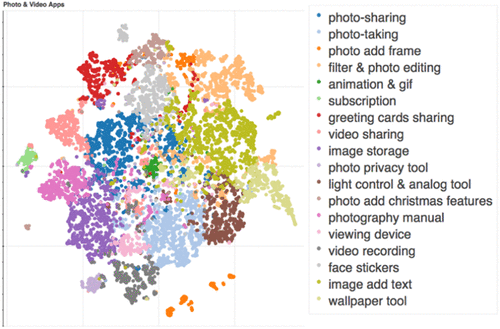
Figure 1 also underscores the two challenges firms face in positioning in digital markets. First, entrants must attain recognition and legitimacy among target customers in an environment characterized by high volume and continual influx of new products (Zuckerman 1999, 2017). Product functions map onto customer goals or a “job to be done,” and customers perceive and evaluate products through this functional lens (van Osselaer and Janiszewski 2012, Christensen et al. 2016). Because initial recognition is often anchored in the core function, firms may select a core function based on their beliefs about target customers, shaped by prior industry affiliations and cognitive frames (Gavetti and Levinthal 2000, Benner and Tripsas 2012). At the same time, resource constraints force tradeoffs in attention and investments across core and peripheral functions. Greater focus on the core function can increase recognition among core users whose primary need is that function but may limit appeal among users who value other functions. Investing more in peripheral functions can broaden appeal across multiple functional needs but may weaken clarity and perceived strength in the core function. This tension parallels a specialist versus generalist tradeoff, with functional demands mapping onto market segments.
Second, the presence of many competitors and the threat of new entrants in digital markets make differentiation crucial for competitive advantage (Deephouse 1999, Lieberman and Asaba 2006). Because products sharing the same core function compete for similar customers, the core function often defines the competition. Peripheral functions then become a primary pathway for differentiation, enabling firms to create distinctive market positions that can be strategically advantageous (Barroso et al. 2016, Zhao et al. 2018). Yet, in digital markets, the proliferation of long tail low-demand products (Brynjolfsson et al. 2003) makes it impractical, and often uninformative, to track every competitor’s functional configuration. Therefore, entrants are likely to orient toward a smaller set of salient reference points, especially successful products that have achieved relatively stronger performance within a core function. Such products represent functional combinations that have proven attractive and of sufficiently robust quality, and they can serve as benchmarks under conditions of information overload.
Building on these challenges, we theorize how firms choose combinations of core and peripheral functions at entry. Although digital markets allow many functional combinations, entrants’ initial choices are neither random nor unconstrained. First, entrants must position their products so they can be discovered by target customers. Product discovery is particularly challenging for customers in digital markets due to the constant influx of new products (Sorensen 2017, Aguiar et al. 2024). Firms, therefore, foreground the intended functions in product descriptions as customers rely on discovery mechanisms such as search, ranking, ratings, and reviews (Lanzolla et al. 2020). Second, new entrants must search for viable positions along a largely unknown frontier of possibilities (Boudreau 2012, Aguiar and Waldfogel 2018). This search requires information not only about customer needs and preferences but also about how competitors are currently positioned and which functional configurations appear promising.
We posit that firms engage in pre-entry learning by accessing and interpreting external market feedback, defined here as customer evaluations of other existing products in the market. Digital markets make such feedback salient and widely available. Customers can experiment with many offerings and provide evaluations, and these signals are visible in the marketplace through ratings and reviews (Dellarocas 2003, Lu and Rui 2018, Greenberg et al. 2024). Entrants can use this external knowledge rather easily and cost-efficiently to inform initial positioning (Boudreau 2012, Riedl and Seidel 2018).
Next, we develop hypotheses about how different dimensions of external market feedback shape two key aspects of positioning: (1) the focus on the core function relative to peripheral functions and (2) overlap in peripheral functions with successful products. We further distinguish between overall customer dissatisfaction and customer evaluation heterogeneity as two conceptually distinct dimensions of external market feedback.
Hypotheses
To offer functional combinations that customers value, firms need to address demand uncertainty arising from incomplete knowledge of customers’ explicit and latent preferences (Rosenberg 1982, Moeen et al. 2020). Prior studies show that firms often navigate demand uncertainty through their own experiences and direct interactions with customers (Zander and Zander 2005, Roy et al. 2018, Denoo et al. 2022). Prior experiences and interactions shape beliefs about customer needs and preferences in a new market and guide decisions about product functions and features (Benner and Tripsas 2012, Shermon and Moeen 2022). As firms experiment and iterate, ongoing customer interactions enable belief updating and strategic adaptation (Cozzolino and Verona 2022). Through such firsthand experience, firms learn about customer needs and preferences (Adner 2002, Danneels 2008, Gaba and Meyer 2020), which influences their strategic decisions, such as technology trajectories and product positions (Adner and Levinthal 2001; Adner et al. 2014, 2016; Schmidt et al. 2024). Prior research also highlights that users differ in their ability to provide valuable demand insights. Lead users, for example, who are at the forefront of market trends, can anticipate customer preferences more accurately and provide valuable input for firms’ product strategies (von Hippel 1986, Urban and von Hippel 1988). Customers who have sampled diverse offerings can similarly provide informationally rich feedback that enables firms to improve market fit (Hsu et al. 2019).
New entrants, however, typically lack sufficient firm-specific knowledge to reduce demand uncertainty, and this limitation is amplified in digital markets with expansive functional space and positioning possibilities. The range of possible functional combinations and the pace of change mean that even entrants with prior beliefs need to map a much broader landscape of customer needs and competitive positions to minimize the risk of not getting discovered by customers and not standing out amid intense competition. Therefore, reducing demand uncertainty prior to entry becomes particularly important. In traditional settings, gathering valuable demand insights without direct customer interactions has received relatively little scholarly attention because customers cannot reveal their preferences without engaging with any offerings (Christensen and Bower 1996). Digital markets, however, enable extensive customer experimentation with many different products and make customer evaluations visible to all market participants. This visibility creates a stock of external knowledge that becomes useful to manage demand uncertainty when direct experience is limited (Boudreau 2012, Riedl and Seidel 2018). In addition, entrants in digital markets have more flexibility to adapt later through updates.
We propose that customer evaluations of other products, which we call external market feedback, provide information about how customers value different product attributes and can reveal underlying customer needs and preferences (Peukert and Reimers 2022). Although demand uncertainty is never fully resolved, this external knowledge helps firms manage the risks in selecting positions. Importantly, different dimensions of customer evaluations carry different informational content. Average ratings convey perceived quality, whereas variance in ratings is often associated with niche appeal that serves smaller customer groups (Sun 2012). Moreover, low ratings (one star) can have stronger effects on outcomes such as sales than a high rating (five stars), underscoring the salience of dissatisfaction (Chevalier and Mayzlin 2006).
Building on these insights, we focus on two dimensions of external market feedback: overall customer dissatisfaction and customer evaluation heterogeneity. Because external market feedback stems from existing combinations of core and peripheral functions in the market, it reveals information about both the demand for the core function and the value-generating potential of positions with different peripheral functions. New entrants, therefore, make two related assessments. First, they infer how critical it is to prioritize the core function, which shapes relative focus on core versus peripheral functions. Second, they assess the value-generating potential of exploring novel positions versus imitating the existing ones that have already proven successful, which influences overlap in peripheral functions with the successful products.
Overall Customer Dissatisfaction and Market Positioning
Overall customer dissatisfaction reflects the extent to which other existing products fall short of customer expectations. Higher dissatisfaction signals that current products do not adequately address customers’ needs and preferences, indicating unmet market demand. In our framework, the core function represents the product’s primary intended use for the customers. In the mobile app context, for example, customers who seek photo-editing tools will discover apps positioned around that core function and expect the app to meet their basic needs for photo editing, adding filters and effects. In other words, products must fulfill core customers’ minimal functional requirements to be useful (Adner and Levinthal 2001, Tripsas 2008). When overall customer dissatisfaction is high, firms infer that demand for the core function is not being met, either because existing products fail to meet minimum performance thresholds or because their functional configurations are misaligned with customer needs. To address unmet demand and overcome discovery challenges in digital markets (Sorensen 2017, Aguiar et al. 2024), firms are motivated to offer products that better satisfy customers’ functional requirements and are recognized as credible options by customers who prioritize that core function. We therefore expect firms to increase their relative focus on the core function in their initial positions.
Overall dissatisfaction also provides information about the value-generating potential of existing functional combinations. When overall dissatisfaction is high, firms infer that current configurations are, on average, not compelling, including among the more successful products. Given substantial recombination opportunities, even the functional combinations of successful products may represent local optima in a largely unexplored digital landscape. This inference likely encourages firms to search beyond established configurations or templates (Gavetti and Levinthal 2000), particularly when choosing peripheral functions. Rather than replicating peripheral configurations of existing successful products, firms are motivated to explore novel combinations of peripheral functions that may better tap latent demand.
Taken together, we expect that high overall dissatisfaction will lead entrants to increase focus on the core function while simultaneously encouraging differentiation in peripheral functions relative to successful products.
The more customers are dissatisfied with other existing products, the more firms focus on the core function in their initial positioning.
The more customers are dissatisfied with other existing products, the less firms overlap with peripheral functions of successful products in their initial positioning.
Customer Evaluation Heterogeneity and Market Positioning
Customer evaluation heterogeneity captures the extent to which customers agree or disagree about the value of other existing products. High heterogeneity suggests that existing products only satisfy a subset of the market and fail to appeal broadly (Sun 2012). Heterogeneity in evaluations, therefore, signals differentiated customer preferences and a fragmented demand landscape in which multiple viable but relatively narrow positions coexist (Adner et al. 2014). This fragmented landscape complicates firms’ assessment of the broader appeal of the core function. When customers vary widely in how they evaluate existing products that share a core function, firms cannot rely solely on that core function to attract a broad customer base. Instead, they recognize that customers may place substantial value on various peripheral functions or particular combinations of core and peripheral functions. As a result, firms are motivated to offer more versatile products that address multiple functional needs (Tucker and Zhang 2011), attracting customers interested not only in the core function but also in other peripheral functions. We therefore expect that higher evaluation heterogeneity will lead firms to reduce their relative focus on the core function at entry.
Evaluation heterogeneity also shapes how firms assess the value-generating potential of novel positions. Although a fragmented demand landscape creates opportunities for distinct positions to address diverse customer preferences, it also makes viable positions harder to identify. Even in less fragmented digital markets, the appeal of novel positions is already difficult to assess ex ante (Aguiar and Waldfogel 2018). When customers value functional combinations in different ways, novel viable positions are likely to be dispersed in the product space (Adner et al. 2014), so entrants face greater uncertainty about where to search and which direction to explore. Under these conditions, firms are more likely to adopt risk-reducing strategies that rely on imitation rather than exploration (Ofek and Turut 2008, Ordanini et al. 2008). Among the set of existing positions, the functional combinations associated with successful products become particularly attractive as templates (Posen et al. 2023), because they signal demonstrated market acceptance for specific niches. By aligning their peripheral configurations with those of successful incumbents, entrants can position themselves near proven niches and increase the likelihood of attracting customers who already value those configurations (Barlow et al. 2019). Peripheral overlap thus becomes a way to manage risk in a fragmented demand environment while preserving the option to adapt after entry as firms learn from their own customers.
In sum, we expect high evaluation heterogeneity to lead entrants to reduce focus on the core function while increasing overlap of peripheral functions with successful products.
The greater the heterogeneity in customer evaluations of other existing products, the less firms focus on the core function in their initial positioning.
The greater the heterogeneity in customer evaluations of other existing products, the more firms overlap with peripheral functions of successful products in their initial positioning.
Methods
Research Setting
We use Apple’s mobile application platform as the empirical context to test our theory. This digital marketspace attracts third-party complementor firms (app developers) to launch products for customers (app users) who own smart devices running on Apple’s platform (Kapoor and Agarwal 2017). Typical of a digital market, the mobile application platform offers a vast array of development possibilities, with many product offerings combining diverse functions to address varied customer preferences (Boudreau 2012). It also allows access to abundant information. Each app’s profile page includes information on the launch date, size, price, category, description, update details, and more. User ratings, reviews, and rankings based on user downloads and revenue are also available for the apps. All app users, app developers, industry analysts, and researchers have access to this information. The mobile application platform is an ideal setting for studying how external market feedback guides firms’ strategic positioning in digital markets.
Sample and Data
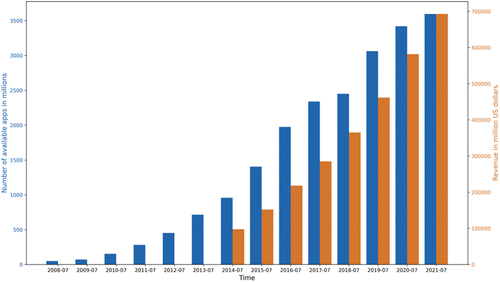
Since 2008, Apple has created and maintained different product categories on its mobile application platform, the Apple App Store, including Games, Entertainment, Photo & Video, and Social Networking. Third-party developers who make apps for Apple devices (iPhones and iPads) submit them to these Apple-designed categories for approval. Once approved, the apps are then distributed through the App Store. In 2018, the App Store housed more than 2 million third-party software apps for iPhone, iPad, and iPod touch users in 155 countries worldwide. Veteran developers have commented that the App Store has developed over its 10 years into “the richest, most diverse, and most accessible software ecosystem the world has ever seen.”2 U.S. consumers spend, on average, 2.5–3 hours on mobile devices, with more than 85%–90% of this time on apps, creating tremendous demand and significant incentives for app developers (Wang et al. 2018). Figure 2 illustrates the number of available apps in the App Store from 2008 to 2018 and the worldwide mobile app revenue from 2014 to 2018.3
We obtained data on mobile apps and developers from Apptopia (www.apptopia.com), a data analytics firm specializing in mobile applications. To identify the different functional focuses of apps, we restricted the sample to all apps in the U.S. store’s photo and video category with English product descriptions, ensuring comparability (including developers based outside the United States who launched products in the U.S. store). We apply a machine learning algorithm to identify the language for all descriptions, dropping non-English and overly short descriptions. Our final sample includes 12,459 apps launched between 2008 and 2018, whose descriptions we used to identify functions within the photo and video category. For analysis, we tracked new products launched from September 2014 to July 2018 as user feedback information became systematically available since June 2014 in the data set. The procedure yielded 6,864 total apps launched by 4,111 developers, of which 3,780 developers initially launched 4,957 apps upon entering the market.
Identifying Functions via LDA Topic Modeling
Firms use app descriptions to communicate the underlying functions to their customers. Since the product functional space would more accurately map onto the underlying demand landscape as more products became available (Adner and Snow 2010), we used the descriptions of all 12,459 photo and video apps launched between 2008 and 2018 in our final sample to build the corpus for textual analysis. We treated each app description as a “bag of words,” disregarding word order and assuming that topics of texts can be identified through the co-occurrences of individual words (Corritore et al. 2020). The text corpus is filtered to consist of words across app descriptions that are sufficiently distinct, as opposed to category-level labels such as “photo” or “video,” which appear in nearly all apps (see Online Appendix A1 for more technical details).
We used an LDA topic model on this corpus to identify functions. LDA is based on a generative Bayesian probabilistic model of a corpus, where documents are represented as random mixtures over latent topics, and each topic is characterized by a distribution over words (Blei et al. 2003). The LDA method enables us to uncover latent topics with minimal human intervention by observing words that frequently co-occur within documents. The method has been employed in management research as a large-scale quantitative approach to determine clusters through cognitive and cultural sources rather than through technological or financial considerations (Guo et al. 2017, Haans 2019). The input for the model is a document-word matrix, where the rows are the description documents, and each description is represented by word counts for all the words in the corpus. The output for the model is a document-topic matrix, in which each app description is assigned to a probability distribution and given weights across all topics that the model estimates. One of the most important researcher-imposed parameters in the LDA topic model is the number of topics. We selected the number of topics to ensure that the topics are clear, well bounded, and interpretable (Hannigan et al. 2019). Therefore, we first selected topics based on local optimal coherence scores (high coherence suggests clear and well-bounded topics) and then based on the interpretability of the functions to the everyday app user, resulting in 18 functions.4 Using top keywords that characterize each topic, we gave topic labels to each of the functions identified (such as photo taking or photo editing) and present these function labels in Table 1 with top keywords characterizing them.
|

Table 1. Function Labels and Corresponding Keywords
| Function label | Top keywords |
|---|---|
| Photo-sharing | “like,” “share,” “get,” “u,” “friend,” “pictur,” “nt,” “see,” “want,” “new” |
| Photo-taking | “camera,” “take,” “use,” “pictur,” “time,” “set,” “button,” “mode,” “iphon,” “save” |
| Photo add frame | “frame,” “use,” “pictur,” “galleri,” “make,” “beauti,” “effect,” “select,” “share,” “imag” |
| Filter and photo editing | “effect,” “filter,” “collag,” “sticker,” “make,” “pictur,” “editor,” “share,” “pic,” “edit” |
| Animation and gif | “anim,” “gif,” “eye,” “face,” “make,” “live,” “skin,” “look,” “bodi,” “share” |
| Subscription | “subscript,” “purchas,” “period,” “account,” “http,” “current,” “charg,” “renew,” “end,” “may” |
| Greeting cards sharing | “love,” “card,” “day,” “friend,” “famili,” “share,” “send,” “greet,” “birthday,” “babi” |
| Video sharing | “video,” “music,” “add,” “share,” “creat,” “stori,” “instagram,” “edit,” “slideshow,” “clip” |
| Image storage | “view,” “imag,” “share,” “upload,” “use,” “album,” “locat,” “user,” “event,” “allow” |
| Photo privacy tool | “privat,” “album,” “lock,” “secur,” “protect,” “secret,” “hide,” “password,” “delet,” “safe” |
| Light control and analog tool | “imag,” “light,” “color,” “use,” “exposur,” “film,” “effect,” “white,” “len,” “filter” |
| Photo add christmas features | “christma,” “suit,” “montag,” “look,” “editor,” “new,” “free,” “santa,” “best,” “hair” |
| Photography manual | “photograph,” “photographi,” “work,” “world,” “book,” “profession,” “design,” “art,” “artist,” “new” |
| Viewing device | “iphon,” “ipad,” “devic,” “live,” “tv,” “io,” “support,” “ipod,” “screen,” “connect” |
| Video recording | “video,” “record,” “support,” “file,” “play,” “download,” “camera,” “movi,” “audio,” “devic” |
| Face stickers | “face,” “sticker,” “print,” “friend,” “fun,” “choos,” “make,” “pictur,” “funni,” “use” |
| Image add text | “imag,” “text,” “color,” “share,” “add,” “save,” “use,” “facebook,” “creat,” “twitter” |
| Wallpaper tool | “effect,” “wallpap,” “adjust,” “filter,” “edit,” “tool,” “crop,” “blur,” “imag,” “add” |
The model assigned each photo and video app in our sample a probability vector of 18 dimensions, and the weights in these 18 functional dimensions add up to one. This probability vector defines the app’s unique position in the multidimensional functional space. The highest-weight topic for each app represented its core function, defining its main demand and competitive environment. All apps with the same highest-weight topic formed a cluster around that focal function, competing for users with the same primary functional use (Figure 1).
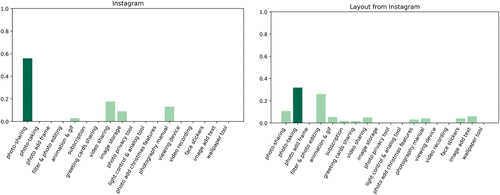
Figure 3 further illustrates the apps’ probability vectors of different functions. The left graph in Figure 3 shows the probability vector of a particular photo and video app, Instagram, whose core function is photo-sharing. Instagram’s photo-sharing function has the highest weight, at around 0.559. The weights for other noncore functions are all positive, even though some numbers are too small to be visible. The weights in all functions add up to one. The right graph of Figure 3 shows the probability vector of another app, Layout, launched by the same developer. The core function for Layout is photo-taking, which has the highest weight at around 0.319. The graphs show that each app has a core function with a different weight and is usually a combination of different core and peripheral functions.
To better understand our raw data, we provide a visual overview for the distribution of apps’ core function weight, that is, the highest weight in their probability vectors, and the distribution of customer ratings for apps sharing a core function. In Figure 4(a), we pooled the data across time periods and categorized apps by their core function, presenting the distributions of core function weight. The average and median core function weights are 0.491 and 0.449, respectively, across the 18 core functions. In Figure 4(b), we pooled the data across time periods and categorized them by 18 core functions, presenting the distribution of customer ratings on apps with each core function. In both graphs, we observe heterogeneity within and across different core functions. In Online Appendix B, we present 18 subplots by the core function, and for each subplot we present the distribution of apps’ core function weight (Figure B1) and distribution of customer ratings (Figure B2) by time period to show variation over time. We also present the functional combination of a representative app (median core function weight) for each core function to better illustrate what a product positioning looks like in Figure B3.
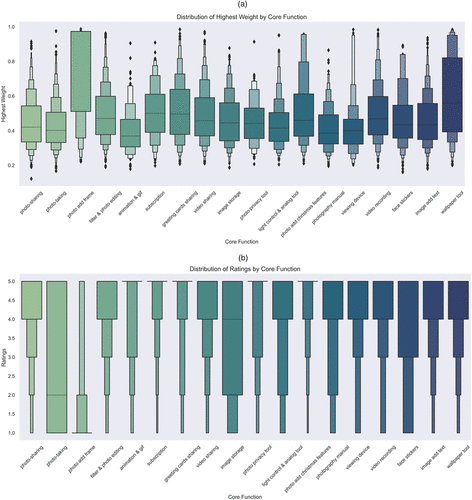
Notes. (a) Distribution of core function weight (highest weight). (b) Distribution of customer ratings by core function.
Measures
Dependent Variables.
Our first dependent variable is focus on core function, which captures the extent to which a firm’s new app focuses on its core function relative to peripheral functions. We calculated the measure by the highest weight in the function probability vector generated by the LDA model (Srivastava et al. 2018, Corritore et al. 2020). Because weights in the probability vector adds up to one, the more weight allocated to the core function, the less they are allocated to peripheral functions. This measure is highly correlated (0.955) with alternative operationalizations, such as the Herfindahl index.
Our second dependent variable is peripheral function overlap, which captures the extent to which a firm’s new app differentiates from or imitates existing successful apps sharing the same core function. Peripheral functions are defined as meaningful noncore functions in an app. By design of the LDA model, all functions have a positive weight, but not every noncore function is equally important. As weights add up to one, and there are 18 functions in total, we consider weights more than 1/18 as meaningful and count a particular function as peripheral function when its weight is less than the core function weight and more than 1/18. To identify successful apps, we utilize the grossing ranking lists in the photo and video category to measure performance. In the Apple App Store, data on revenues earned by apps are not publicly available, but Apple discloses daily top-ranking lists by download and by gross revenue, within and across categories. Apps that rank higher on the lists offer clear evidence of performance superiority (Tidhar and Eisenhardt 2020, Agarwal and Kapoor 2023). Following prior research, we calculate the reciprocal of the daily rank in the photo video grossing list for each app as a proxy for daily revenue and calculate the monthly revenue proxy by aggregating these reciprocals over a particular month (Kapoor and Agarwal 2017). We define successful apps as those above the 75th percentile in the monthly revenue proxy within the core function, in the time period three months prior to the focal app entry. Peripheral function overlap is calculated as the average pairwise Jaccard similarity between the focal app and all successful apps. For both the focal app and a successful app, we find the sets of peripheral functions they incorporate in support of the core function. Jaccard similarity is calculated by the intersection of the two sets of peripheral functions divided by the union of the two sets of peripheral functions (, where J is the Jaccard similarity index, A and B are sets). The intersection of the two sets reflects the overlap of peripheral functions between the apps, and the union of the two sets captures the total number of peripheral functions incorporated by both apps.5
Explanatory Variables.
Our main explanatory variables are external market feedback that firms observe before market entry. The most important market feedback in Apple Store is customer rating, which ranges from one to five stars, with five being the most satisfactory. At each point in time, the platform shows the distribution of individual ratings for each app, based on all past customer evaluations. Given its availability and saliency to the observers, we take all this historical information when considering market feedback at a given time. In particular, we look at two aggregate dimensions, customers’ overall dissatisfaction and customer evaluation heterogeneity.
Overall Dissatisfaction.
Because our explanatory variables are at the core function level, we first pooled all individual ratings for all the existing apps sharing a core function and calculated the average rating.6 Because we work with individual ratings, this calculation automatically gives more weight to apps with a greater number of customer ratings. To calculate customers’ overall dissatisfaction, we reverse scored this average rating by subtracting it from six. This reverse scored variable ranges from one to five—a higher level of overall dissatisfaction means a lower average rating, indicating a higher level of customer dissatisfaction with existing apps.
Evaluation Heterogeneity.
We calculated evaluation heterogeneity, that is, the heterogeneity of customer evaluations across apps that share the same core function, using an entropy measure. First, we pooled all individual ratings of existing apps and calculated the proportion of user evaluations at one star, two stars, three stars, four stars, and five stars (Pi); second, we used these five percentages to calculate the entropy measure E at the core function level, defined as . A high value of evaluation heterogeneity indicates that customers have diverse preferences for existing apps with this particular core function; that is, customer evaluations are not concentrated around any star rating in this core function. The correlation between our entropy measure and the Blau index (Herfindahl index subtracted from one, ) is very high (0.99), but we use the entropy measure because it has better features in aggregation and decomposition (Jacquemin and Berry 1979).
Control Variables.
To isolate the impact of our theorized variables on firms’ positioning, we controlled for several other factors at both market and firm levels when estimating our models.
Although an app’s main competitive and demand environment is defined by its core function, characteristics of the broader environment can still affect firms’ positioning because a new app can incorporate all functions in the demand landscape. We control for evaluation heterogeneity in other functions to account for market characteristics in other core functions. We measured evaluation heterogeneity in other functions by first calculating customer evaluation heterogeneity (the entropy measure ) in all the other functions that are not core to a focal app and then calculating the average weighted by the number of downloads for apps targeting that core function.
We control for competitors’ focus on core function, as the extent to which competing apps focus on the core function could affect the focal app’s positioning. We calculated this measure by identifying all apps that share this core function and averaging their weight on this core. We also control for the number of apps sharing the same core function. Additionally, we control for the demand growth potential in this core function by calculating the monthly growth rate of user downloads for all existing apps sharing this core function. A higher growth rate reflects greater potential demand for this core function, which can affect the focal app’s positioning.
We also included a set of controls at the firm level, as different firm characteristics can affect how they position their new apps. We control for the firm type, a binary variable that equals one if an app developer registers a company headquarter. Because of low entry barriers and ease of experimentation, the mobile application market comprises a mix of independent developers and more established developers, and different types of developers may employ varying positioning strategies. We also control for firm simultaneous launches, a binary variable that equals one if the firm launched multiple apps in the same month as the focal app. Firms that launch multiple apps simultaneously may have specific positioning strategies for their product portfolio. Table 2 reports the descriptive statistics and correlations for all variables.
|
Table 2. Descriptive Statistics
| Variables | Mean | Standard deviation | (1) | (2) | (3) | (4) | (5) | (6) | (7) | (8) | (9) | (10) | |
|---|---|---|---|---|---|---|---|---|---|---|---|---|---|
| (1) | Focus on core function | 0.492 | 0.191 | 1.000 | |||||||||
| (2) | Peripheral function overlap | 0.173 | 0.103 | −0.453 | 1.000 | ||||||||
| (3) | Overall dissatisfaction | 2.048 | 0.844 | 0.293 | −0.223 | 1.000 | |||||||
| (4) | Evaluation heterogeneity | 0.637 | 0.149 | −0.328 | 0.241 | 0.168 | 1.000 | ||||||
| (5) | Evaluation heterogeneity in other functions | 0.616 | 0.034 | 0.041 | −0.048 | 0.046 | 0.031 | 1.000 | |||||
| (6) | Competitors’ focus on core function | 0.453 | 0.042 | 0.170 | −0.129 | 0.057 | −0.124 | −0.149 | 1.000 | ||||
| (7) | Number of apps | 127.046 | 66.610 | −0.260 | 0.035 | −0.108 | 0.507 | 0.121 | −0.155 | 1.000 | |||
| (8) | Demand growth potential | 0.053 | 0.440 | −0.044 | 0.047 | −0.043 | 0.012 | 0.002 | 0.045 | −0.032 | 1.000 | ||
| (9) | Firm type | 0.299 | 0.458 | −0.109 | 0.112 | −0.042 | 0.073 | −0.003 | −0.044 | 0.016 | 0.010 | 1.000 | |
| (10) | Firm simultaneous launches | 0.228 | 0.420 | 0.351 | −0.242 | 0.201 | −0.348 | 0.047 | 0.092 | −0.240 | −0.046 | −0.097 | 1.000 |
Model Specification
We estimated our models using ordinary least squares (OLS) panel regression models with year fixed effects and robust standard errors clustered at the core function level. The unit of observation is app level, the independent and control variables are lagged by three months from the app’s entry month.
Results
We present our results for the dependent variable focus on core function in Table 3. Model 1 includes only the control variables, Model 2 includes only the independent variables, overall dissatisfaction and evaluation heterogeneity, and Model 3 presents the full model.
|
Table 3. Focus on Core Function
| Model 1: Controls only | Model 2: Explanatory variables | Model 3: Full model | |
|---|---|---|---|
| Overall dissatisfaction (H1a) | 0.0780*** | 0.0642*** | |
| (0.0103) | (0.00759) | ||
| Evaluation heterogeneity (H2a) | −0.470*** | −0.334*** | |
| (0.0589) | (0.0415) | ||
| Evaluation heterogeneity in other functions | 0.503* | 0.390# | |
| (0.209) | (0.196) | ||
| Competitors’ focus on core function | 0.671*** | 0.559*** | |
| (0.166) | (0.147) | ||
| Number of apps | −0.000539# | −0.000148# | |
| (0.000258) | (0.0000834) | ||
| Demand growth potential | −0.0163 | −0.0107 | |
| (0.00987) | (0.00695) | ||
| Firm type | −0.0282** | −0.0221** | |
| (0.00854) | (0.00737) | ||
| Firm simultaneous launches | 0.112* | 0.0692*** | |
| (0.0403) | (0.0158) | ||
| Constant | −0.142 | 0.615*** | 0.0391 |
| (0.180) | (0.0646) | (0.193) | |
| Year fixed effects | Included | Included | Included |
| Observations | 4,957 | 4,957 | 4,957 |
Notes. Dependent variable: Focus on core function. Standard errors in parentheses, clustered by core function.
#p < 0.1; *p < 0.05; **p < 0.01; ***p < 0.001.
In Model 1, the baseline model, we find that the effect of evaluation heterogeneity in other functions is positive and significant (p = 0.028). It implies that when the evaluation heterogeneity is high in other functions, firms are more likely to increase their focus on the core function in their positioning. We further find that competitors’ focus on core function, that is, the extent to which existing competitor apps prioritize the core function, has a positive and significant effect on the focal app’s positioning focus (p = 0.001). The effect of the number of apps is negative and marginally significant (p = 0.052). These results suggest there are both elements of imitative learning and competitive crowding when deciding on the relative focus of core versus peripheral functions.
Firm characteristics also affect their initial positioning. The effect of firm simultaneous launches is positive and significant (p = 0.013), suggesting that firms’ product portfolio strategies play a role in the positioning of each app. If firms launch multiple apps in the same month, each app is more likely to increase focus on the core function. The effect of firm type is negative and significant (p = 0.004), indicating that established developers are more likely to reduce the focus on core function in initial positioning.
Model 2 shows the effects of our independent variables without controls. The effect of overall dissatisfaction is positive and significant (p < 0.001), suggesting that the more users are dissatisfied with other existing apps, the greater firms focus on the core function. The effect of evaluation heterogeneity on the focus on core function is negative and significant (p < 0.001), indicating that greater the disagreement among users in their evaluations of other existing apps, the less firms focus on the core function in their positioning.
In the full model, Model 3, the main effects of our independent variables are similar. Overall dissatisfaction has a positive and significant effect with a coefficient of 0.0642 (p < 0.001), supporting Hypothesis 1a; evaluation heterogeneity has a negative and significant effect with a coefficient of −0.334 (p < 0.001), supporting Hypothesis 2a.
Table 4 presents our results for the dependent variable, peripheral function overlap, with successful apps sharing the same core function. Model 1 includes only the control variables, Model 2 includes only the independent variables overall dissatisfaction and evaluation heterogeneity, and Model 3 presents the full model.
|
Table 4. Peripheral Function Overlap Relative to Successful Apps
| Model 1: Controls only | Model 2: Explanatory variables | Model 3: Full model | |
|---|---|---|---|
| Overall dissatisfaction (H1b) | −0.0320*** | −0.0328*** | |
| (0.00479) | (0.00464) | ||
| Evaluation heterogeneity (H2b) | 0.190*** | 0.221*** | |
| (0.0286) | (0.0327) | ||
| Evaluation heterogeneity in other functions | −0.366* | −0.255 | |
| (0.142) | (0.151) | ||
| Competitors’ focus on core function | −0.296# | −0.232* | |
| (0.144) | (0.0973) | ||
| Number of apps | −0.0000533 | −0.000302** | |
| (0.000161) | (0.0000898) | ||
| Demand growth potential | 0.00749# | 0.00457 | |
| (0.00402) | (0.00297) | ||
| Firm type | 0.0176*** | 0.0140** | |
| (0.00443) | (0.00427) | ||
| Firm simultaneous launches | −0.0509* | −0.0259*** | |
| (0.0189) | (0.00623) | ||
| Constant | 0.597*** | 0.129*** | 0.432** |
| (0.123) | (0.0360) | (0.115) | |
| Year fixed effects | Included | Included | Included |
| Observations | 4,957 | 4,957 | 4,957 |
Notes. Dependent variable: Peripheral function overlap. Standard errors in parentheses, clustered by core function.
#p < 0.1; *p < 0.05; **p < 0.01; ***p < 0.001.
In Model 1, the baseline model, we find that the effect of evaluation heterogeneity in other functions is negative and statistically significant (p = 0.019). It suggests that when the evaluation heterogeneity is high in other functions, firms are less likely to imitate the peripheral functions of successful apps. We further find that competitors’ focus on core function, that is, the extent to which existing competitor apps focus on the core function, has a negative and marginally significant effect on the peripheral function overlap of the focal entry (p = 0.056). The effect of demand growth potential is positive and marginally significant (p = 0.08).
Firm characteristics also affect a new app’s positioning. The effect of firm simultaneous launches is negative and significant (p = 0.016), suggesting that firms’ product portfolio strategies play a role in the competitive positioning of each app. If firms launch multiple apps in the same month, each app is more likely to differentiate from existing apps. The effect of firm type is positive and significant (p = 0.001), indicating that established developers are more likely to imitate existing apps in initial positioning.
In Model 2, we find that the main effect of overall dissatisfaction on peripheral function overlap is negative and significant (p < 0.001), suggesting that firms are less likely to choose peripheral functions already explored in successful apps when customers are dissatisfied with existing apps. The main effect of evaluation heterogeneity on peripheral function overlap is positive and significant (p < 0.001), indicating that firms are more likely to choose peripheral functions already explored in successful apps when evaluation heterogeneity is high.
In the full model, Model 3, the effects of the independent variables are similar in significance and magnitude. Overall dissatisfaction has a negative and significant effect with a coefficient of −0.0328 (p < 0.001); evaluation heterogeneity has a positive and significant effect with a coefficient of 0.221 (p < 0.001). These results in Table 4 fully support Hypothesis 1b and Hypothesis 2b, suggesting that firms are more likely to differentiate from successful apps in the choices of peripheral functions when overall dissatisfaction is high, and more likely to imitate successful apps when evaluation heterogeneity is high.
Additional Analyses
We performed several additional analyses to validate our findings and to identify the boundary conditions of our theory. First, we compare firms’ initial and subsequent positioning decisions to assess when external market feedback is most consequential for navigating demand uncertainty. Second, we investigate the interactive effects between customers’ overall dissatisfaction and evaluation heterogeneity on positioning to clarify the distinctive informational content of each signal and any complementarity between them. Third, we introduce an alternative positioning measure that captures how firms select peripheral functions relative to the core, to further understand how external market feedback shapes the discovery-differentiation tension in positioning.
Initial vs. Subsequent Positioning
Our theory argues that external market feedback helps firms assess viable market positions by providing broad information about customer needs and preferences, especially when firms have not yet interacted directly with the customers. This suggests that such external feedback may be most valuable at the initial positioning, when firms must map demand and competition with limited firsthand information. Accordingly, we compare firms’ initial and subsequent positioning decisions and expect the hypothesized effects of overall dissatisfaction and evaluation heterogeneity to be stronger for initial than subsequent positioning.
For subsequent positioning, we also add controls for different dimensions of firm experience. We control for firm’s investment in apps, measured by the total number of updates to the focal firm’s prior apps. More updates indicate greater investment in prior apps and more sustained customer engagement. We control for firm’s function experience, measured as the percentage of the focal firm’s prior apps that share the same core function as the focal app, capturing familiarity with the focal core function. Because network effects can influence platform complementors’ behaviors, we also control for experience with high network-effects apps by counting the focal firm’s prior apps whose core function involves sharing (for example, photo sharing, greeting card sharing, and video sharing). Apps with stronger network effects tend to have more locked-in customers, which may give firms greater flexibility in subsequent positioning because they can more easily retain and redirect an existing customer base as they expand the portfolio. Finally, we control for experience with business model features by including the number of paid apps and apps with in-app purchase.
The first three columns in Table 5 present results for the focus on core function as the dependent variable. Model 1 reproduces the initial positioning results from the main analyses, Model 2 presents the results for the subsequent positioning, and Model 3 presents full sample analysis with interaction effects to compare the magnitude and significance of coefficients between initial and subsequent positioning. In the main analyses, overall dissatisfaction (p < 0.001) is positive and significant, and evaluation heterogeneity (p < 0.001) is negative and significant. These patterns do not hold for subsequent positioning. Instead, in Model 2, overall dissatisfaction has a negative and significant effect (p = 0.002) and evaluation heterogeneity has a positive and significant effect (p = 0.02). The magnitudes are notably smaller, roughly one-half to one-third of those for initial positioning. In Model 3, the interaction effect between subsequent positioning (indicator variable) and overall dissatisfaction is negative and significant, suggesting that the positive effect of overall dissatisfaction on core function focus is significantly attenuated in subsequent positioning. The positive and significant interaction effect between subsequent positioning and evaluation heterogeneity suggests that the negative effect of evaluation heterogeneity on core function focus is also significantly attenuated for subsequent positioning. As expected, these results indicate that external market feedback is more impactful for the initial positioning.
|
Table 5. Initial and Subsequent Product Positioning
| Focus on core function | Peripheral function overlap | |||||
|---|---|---|---|---|---|---|
| Model 1: Initial positioning | Model 2: Subsequent positioning | Model 3: All | Model 4: Initial positioning | Model 5: Subsequent positioning | Model 6: All | |
| Overall dissatisfaction | 0.0642*** | −0.0299** | 0.0675*** | −0.0328*** | −0.01845 | −0.0332*** |
| (0.00759) | (0.00813) | (0.0191) | (0.00464) | (0.0171) | (0.00467) | |
| Evaluation heterogeneity | −0.334*** | 0.0995* | −0.357*** | 0.221*** | 0.0186 | 0.227*** |
| (0.0415) | (0.0387) | (0.0435) | (0.0327) | (0.0663) | (0.0327) | |
| Subsequent positioning | −0.156*** | 0.115* | ||||
| (0.0413) | (0.0532) | |||||
| Subsequent positioning × overall dissatisfaction | −0.0990*** | 0.0138 | ||||
| (0.00320) | (0.0132) | |||||
| Subsequent positioning × evaluation heterogeneity | 0.462*** | −0.207* | ||||
| (0.0546) | (0.0748) | |||||
| Evaluation heterogeneity in other functions | 0.390# | 0.231 | 0.378* | −0.255 | 0.162 | −0.146 |
| (0.196) | (0.159) | (0.147) | (0.151) | (0.274) | (0.145) | |
| Competitors’ focus on core function | 0.559*** | 0.757*** | 0.632*** | −0.232* | −0.310*** | −0.262** |
| (0.147) | (0.121) | (0.131) | (0.0973) | (0.0647) | (0.0817) | |
| Number of apps | −0.000148# | −0.000195* | −0.000150# | −0.000302** | −0.000224# | −0.000283** |
| (0.0000834) | (0.0000883) | (0.0000816) | (0.0000898) | (0.000117) | (0.0000866) | |
| Demand growth potential | −0.0107 | 0.0102 | −0.00581 | 0.00457 | 0.000824 | 0.00401 |
| (0.00695) | (0.0147) | (0.00549) | (0.00297) | (0.00510) | (0.00259) | |
| Firm type | −0.0221** | −0.0139 | −0.0195*** | 0.0140** | 0.0192# | 0.0154*** |
| (0.00737) | (0.00987) | (0.00504) | (0.00427) | (0.00922) | (0.00407) | |
| Firm simultaneous launches | 0.0692*** | 0.00867 | 0.0459*** | −0.0259*** | −0.0000199 | −0.0167*** |
| (0.0158) | (0.00845) | (0.0104) | (0.00623) | (0.00907) | (0.00409) | |
| Firm’s investment in apps | 0.000318 | 0.000366 | −0.000324 | −0.000306 | ||
| (0.000564) | (0.000542) | (0.000354) | (0.000365) | |||
| Firm’s function experience | 0.0986*** | 0.0999*** | −0.0158# | −0.0176# | ||
| (0.0195) | (0.0197) | (0.00840) | (0.00919) | |||
| Firm experience with high network-effects apps | −0.0135# | −0.0175* | −0.00987# | −0.00957* | ||
| (0.00696) | (0.00781) | (0.00514) | (0.00454) | |||
| Firm experience with paid apps | 0.0113* | 0.0118* | −0.00131 | −0.00207 | ||
| (0.00499) | (0.00496) | (0.00154) | (0.00167) | |||
| Firm experience with in-app purchase | −0.000291 | −0.00000391 | 0.000984 | 0.00160 | ||
| (0.00301) | (0.00305) | (0.00142) | (0.00137) | |||
| Constant | 0.0391 | −0.0968 | 0.0180 | 0.432** | 0.269 | 0.362** |
| (0.193) | (0.150) | (0.147) | (0.115) | (0.164) | (0.0996) | |
| Year fixed effects | Included | Included | Included | Included | Included | Included |
| Observations | 4,957 | 1,907 | 6,864 | 4,957 | 1,907 | 6,864 |
Note. Standard errors in parentheses, clustered by core function.
#p < 0.1; *p < 0.05; **p < 0.01; ***p < 0.001.
The sign reversal between initial and subsequent positioning may also suggest a shift in how firms translate the same external market signals into actions, once they have accumulated internal knowledge from interacting with their own customers. For initial positions, firms primarily seek customer acquisition. External market feedback is one of the few available sources of demand information prior to entry, so it is likely to shape positioning toward discovery and meeting minimum performance expectations. In subsequent positioning, firms can draw on internal knowledge from their own customer reviews, usage patterns, and development experience, and their objectives may shift toward customer retention and monetization in addition to acquisition. In that context, a high dissatisfaction signal about unmet demand may be interpreted as an opportunity to differentiate through novel bundling, reducing the focus on a core function. On the other hand, high evaluation heterogeneity, which signals fragmented demand, may prompt more precise positioning once a firm has learned which users it can attract and retain, increasing focus on the core for those users.
The last three columns of Table 5 report results for peripheral function overlap (positioning relative to successful apps). Model 4 reproduces the main results for initial positioning, Model 5 presents the results for subsequent positioning, and Model 6 shows the results of full sample analyses with interaction effects. In Model 5, the effects of overall dissatisfaction and evaluation heterogeneity on peripheral function overlap are no longer significant. For subsequent positioning, firms no longer systematically differentiate from or imitate successful competitors in response to external market feedback.
Taken together, the comparison of initial and subsequent positioning suggests that external market feedback strongly guides firms’ initial positions, but its influence diminishes as firms accumulate firsthand experience. This pre-entry learning pattern, in which firms draw on externally produced knowledge when internal knowledge is limited, also echoes evidence from Benner and Tripsas (2012) in the nascent digital camera market, where entrants rely on external cues early but less so as they gain experience. The sign reversal for core function focus additionally suggests that experience may lead firms to use external market feedback differently, not merely less.7
Joint Effects of Overall Dissatisfaction and Evaluation Heterogeneity
Our theory treats overall customer dissatisfaction and customer evaluation heterogeneity as distinct signals that convey different information about customer needs and preferences. Although our main analyses focus on their independent effects, the two signals may have complementary informational value. We therefore examine the joint effects.
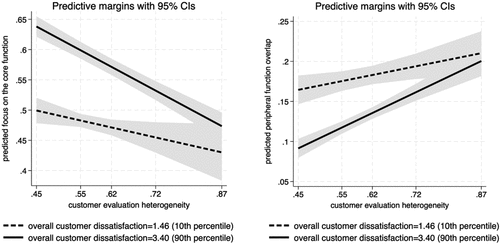
Models 1 and 2 of Table 6 report results for focus on core function as the dependent variable. In Model 1, we reproduced the full model from Table 3. Model 2 adds the interaction between overall dissatisfaction and evaluation heterogeneity. The interaction is negative and significant (p = 0.005), whereas the main effect of evaluation heterogeneity is no longer significant. Models 3 and 4 of Table 6 report using peripheral function overlap as the dependent variable. Model 3 reproduces the full model from Table 4. Model 4 adds the interaction terms. The interaction is positive and significant (p = 0.008), and the main effect of evaluation heterogeneity is no longer significant. Together, these results suggest that firms adjust both core focus and peripheral overlap in response to customer evaluation heterogeneity primarily when dissatisfaction is high.
|
Table 6. Interactive Effects Between Overall Dissatisfaction and Evaluation Heterogeneity
| Focus on core function | Peripheral function overlap | |||
|---|---|---|---|---|
| Model 1: Main model | Model 2: Interaction | Model 3: Main model | Model 4: Interaction | |
| Overall dissatisfaction | 0.0642*** | 0.124*** | −0.0328*** | −0.0725*** |
| (0.00759) | (0.0208) | (0.00464) | (0.0151) | |
| Evaluation heterogeneity | −0.334*** | 0.00639 | 0.221*** | −0.00425 |
| (0.0415) | (0.122) | (0.0327) | (0.0775) | |
| Overall dissatisfaction × evaluation heterogeneity | −0.117** | 0.0776** | ||
| (0.0366) | (0.0260) | |||
| Evaluation heterogeneity in other functions | 0.390# | 0.352# | −0.255 | −0.230 |
| (0.196) | (0.182) | (0.151) | (0.136) | |
| Competitors’ focus on core function | 0.559*** | 0.514** | −0.232* | −0.202* |
| (0.147) | (0.142) | (0.0973) | (0.0911) | |
| Number of apps | −0.000148# | −0.000131 | −0.000302** | −0.000314** |
| (0.0000834) | (0.0000791) | (0.0000898) | (0.0000894) | |
| Demand growth potential | −0.0107 | −0.0102 | 0.00457 | 0.00426 |
| (0.00695) | (0.00728) | (0.00297) | (0.00332) | |
| Firm type | −0.0221** | −0.0209* | 0.0140** | 0.0133** |
| (0.00737) | (0.00759) | (0.00427) | (0.00442) | |
| Firm simultaneous launches | 0.0692*** | 0.067*** | −0.0259*** | −0.0245** |
| (0.0158) | (0.0164) | (0.00623) | (0.00700) | |
| Constant | 0.0391 | −0.106 | 0.432** | 0.528*** |
| (0.193) | (0.149) | (0.115) | (0.0984) | |
| Year fixed effects | Included | Included | Included | Included |
| Observations | 4,957 | 4,957 | 4,957 | 4,957 |
Note. Standard errors in parentheses, clustered by core function.
#p < 0.1; *p < 0.05; **p < 0.01; ***p < 0.001.
These findings are consistent with the view that the two dimensions of external market feedback convey distinct information, and firms may interpret them jointly. Customer evaluation heterogeneity captures the dispersion of demand and the distributions of viable positions in the market space. This information appears most actionable when overall dissatisfaction signals latent opportunities to address unmet demand.
Figure 5 plots the predicted relationship between evaluation heterogeneity and the two dependent variables—focus on core function (left) and peripheral function overlap (right)—at high (90th percentile, solid line) and low (10th percentile, dashed line) levels of overall dissatisfaction. When customer dissatisfaction is high, firms focus more on the core function on average but reduce this focus more rapidly as evaluation heterogeneity increases. In parallel, firms exhibit lower peripheral overlap on average but increase overlap more rapidly as evaluation heterogeneity increases. When customer dissatisfaction is low, these responses to evaluation heterogeneity are substantially flatter.
Alternative Measure of Market Positioning
Our study conceptualized firms’ positioning in digital markets as focus on core relative to peripheral functions and overlap in peripheral functions with successful competitors. Another relevant aspect of positioning is how firms select peripheral functions relative to the core. For example, an app with photo editing as a core function may pair it with closely related peripheral functions (e.g., adding frames or texts) or with more distant peripherals (e.g., privacy tools or video sharing). Such choices plausibly matter for how firms pursue opportunities informed by external market feedback.
To examine this, we introduce an alternative dependent variable, peripheral distance to the core, which captures how far an app’s peripheral functions are from its core function in the semantic space. Larger distance indicates less overlap in their intended uses for customers. Because each function identified via LDA model has a probability vector for all the keywords in the dictionary, we first compute pairwise Jensen-Shannon distance8 for all functions. We then rescale the weights of peripheral functions within each app to sum to one and calculate the weighted distance between all peripheral functions and the core function using the new weights.
Table 7 reproduces the main analyses, focus on core function in Model 1 and peripheral function overlap in Model 2, respectively. Model 3 reports results for the new dependent variable9 peripheral distance to the core. Overall dissatisfaction has a positive and significant effect (p < 0.001) on peripheral distance to the core, whereas the effect of evaluation heterogeneity is insignificant. This suggests that, when dissatisfaction is high, firms tend to select peripheral functions that are more distant from the core, allowing them to pursue unmet demand for the core while also incorporating more distant peripheral functions—consistent with a novelty-seeking positioning. This provides additional evidence that dissatisfaction is associated with novelty seeking not only through differentiation from successful competitors but also through the selection of peripheral functions that are less tightly coupled to the core.
|
Table 7. Alternative Specification of Positioning: Peripheral Distance to the Core
| Model 1: Focus on core function | Model 2: Peripheral function overlap | Model 3: Peripheral distance to the core | |
|---|---|---|---|
| Overall dissatisfaction | 0.0642*** | −0.0328*** | 0.01002*** |
| (0.00759) | (0.00464) | (0.00206) | |
| Evaluation heterogeneity | −0.334*** | 0.221*** | −0.0109 |
| (0.0415) | (0.0327) | (0.0186) | |
| Evaluation heterogeneity in other functions | 0.390# | −0.255 | 0.123# |
| (0.196) | (0.151) | (0.0695) | |
| Competitors’ focus on core function | 0.559*** | −0.232* | −0.0867 |
| (0.147) | (0.0973) | (0.0548) | |
| Number of apps | −0.000148# | −0.000302** | −0.000283*** |
| (0.0000834) | (0.0000898) | (0.0000511) | |
| Demand growth potential | −0.0107 | 0.00457 | 0.00247* |
| (0.00695) | (0.00297) | (0.000964) | |
| Firm type | −0.0221** | 0.0140** | −0.00180 |
| (0.00737) | (0.00427) | (0.00200) | |
| Firm simultaneous launches | 0.0692*** | −0.0259*** | −0.0112** |
| (0.0158) | (0.00623) | (0.00328) | |
| Constant | 0.0391 | 0.432** | 0.642*** |
| (0.193) | (0.115) | (0.0635) | |
| Year fixed effects | Included | Included | Included |
| Observations | 4,957 | 4,957 | 4,957 |
Note. Standard errors in parentheses, clustered by core function.
#p < 0.1; *p < 0.05; **p < 0.01; ***p < 0.001.
Discussion and Conclusion
In this study, we develop a theory of how external market feedback shapes firms’ positioning in digital markets. We conceptualized positions as combinations of core and peripheral functions, where functions reflect firms’ understanding of the intended use of a product and how it creates value for customers. We argued that different dimensions of external market feedback—in particular, customers’ overall dissatisfaction and evaluation heterogeneity—convey distinct informational cues about the demand environment. These cues, in turn, influence how firms manage the discovery–differentiation tension in positioning by shaping both focus on the core function and the selection of peripheral functions relative to successful competitors.
Our results showed that high overall customer dissatisfaction signals that existing products fail to meet customers’ expectations and that there are latent opportunities to address unmet demand. In such markets, entrants increase their focus on the core function to meet minimum performance expectations and to be discovered by the target audience. At the same time, they reduce overlap in peripheral functions with successful products to differentiate and explore novel, potentially superior combinations. High customer evaluation heterogeneity, in contrast, indicates dispersed and differentiated preferences and a market space populated by positions with narrow appeal. In such situations, entrants place less focus on the core function and instead seek to position themselves to appeal to customers who prefer not only the core function but also other peripheral functions. Yet, because fragmented demand also increases uncertainty about which combinations will be valued, firms become more cautious in their peripheral choices, increasing overlap with the peripheral functions of successful products. Our additional analyses indicate that these effects are more pronounced for initial than subsequent positioning, consistent with the view that external market feedback is especially consequential when firms face demand uncertainty without firsthand experience.
Our findings contribute to the emerging literature on firm strategies in digital markets (Brynjolfsson et al. 2003, Miller and Wang 2024). Prior studies document how digitization expands product variety and heterogeneous positioning in settings such as film and music (Benner and Waldfogel 2016, 2023) but have paid less attention to how entrants decide which positions to occupy. We complement this work by identifying external market feedback as a key driver of positioning decisions. Although it is well established that online customer ratings influence subsequent customer choices (Chevalier and Mayzlin 2006, Sun 2012), our results show that the same feedback also informs firms’ strategic choices at entry. Entrants use external market feedback not only to gauge perceived product quality, but also to infer the structure of demand and to identify where, and how, to position within an expansive product space. Our findings also qualify a common assumption that new entrants in digital markets typically increase product variety by targeting heterogeneous customer preferences (Boudreau 2012, Waldfogel 2017). The extent to which new entrants introduce novelty in the digital markets depends on customer evaluations of existing products: When dissatisfaction is high, entrants tend to differentiate by searching for improved and potentially superior positions, whereas when evaluations are heterogeneous, entrants tend to imitate by positioning near successful products in fragmented and uncertain demand environments. This distinction matters because it points to demand-side signals as a key factor that channels search toward either differentiation or imitation.
We also contribute to the demand-side perspective on market entry decisions (Eggers and Moeen 2018, Shermon and Moeen 2022). Building on prior research on product concepts, expected functional uses, and product features (Benner and Tripsas 2012, Anthony et al. 2016), we conceptualize positioning in content-focused digital markets as the selection and combination of core and peripheral functions. This functional lens provides a useful vocabulary for linking firm cognition—how firms intend their products to add value to customers—to customer use and revealed preferences. Empirically, we provide a toolkit to quantify demand-oriented product choices at scale using NLP methods. Rather than inferring positioning only from broad categories, we extract functional themes from firms’ own product descriptions, which are central to communication and discovery in many digital contexts. This approach can support more systematic empirical work on demand-side market entry and positioning and can be extended to other digital contexts where product descriptions are salient signals. Our conceptualization of the demand-side perspective on market positions also alludes to a coevolutionary dynamics between producers and customers in the digital market space, where shifts in customer evaluations and preferences can redirect firms’ functional combinations, and new functional combinations can reshape customer expectations; this merits further investigation.
More broadly, our results point to a pre-entry learning mechanism in which entrants draw on customer evaluations of other products to address demand uncertainty (Adner and Levinthal 2001, Adner and Snow 2010, Moeen et al. 2020). External market feedback is particularly valuable as a pre-entry input because it allows entrants to infer demand conditions without direct customer interactions. At the same time, our additional analyses suggest that the relationship between external feedback and positioning may evolve with internal knowledge accumulation. As firms gain firsthand experience, they may combine external signals with internal customer feedback and portfolio considerations, potentially leading to different mappings from the same external signals to positioning choices. Unpacking this interplay over time, including how it shapes experimentation, portfolio choices, and performance, is an important direction for future research.
Our study has implications for research on industry evolution and knowledge creation. Prior work has examined how firm-level knowledge aggregates and becomes codified as industry-level knowledge over time (Moeen et al. 2020). Our results suggest that, when industry knowledge is abundant, the type of external feedback can channel entrants’ search behavior and thereby influence which knowledge is generated and reinforced. This perspective also treats market segmentation as partially endogenous to a firm’s positioning choices. Rather than assuming segmentation as an outcome of exogenous change (Dobrev and Kim 2006, Klepper and Thompson 2006), our framework highlights how different market segments can be formed and reshaped as firms enter with different functional combinations and adjust their positions in response to market feedback. This underscores the value of more nuanced research on how firms enter and exit nascent markets (Eggers and Moeen 2018) and how the differentiation and imitation strategies can potentially shape industry structure over time (Makadok and Ross 2013). Such studies can contribute to a more balanced view of market evolution that explicitly incorporates interaction between firms and customers (Gaba and Meyer 2020).
Our theory is likely to generalize to settings in which experimentation and recombination across functions are feasible and relatively low cost and where external knowledge is accessible and informative. These conditions often coincide with digitization, even in otherwise physical markets. For example, in the automotive industry, digital technology and infrastructure increasingly allow manufacturers to introduce and recombine functions that were once constrained by physical components, creating a richer functional landscape for positioning. At the same time, the theory may be less applicable in settings where combining multiple functions is infeasible or undesirable or where external knowledge is inaccessible or weakly informative. In many nondigital contexts, entry decisions are more irreversible, and external feedback may be less comparable across offerings, which can shift firms to rely more heavily on internal experience, targeted market research, or direct customer relationships than on broad external evaluations.
Our paper has limitations that also suggest avenues for future research. First, we focus on behavioral feedback, namely, ratings and their distributions. In the absence of direct customer input, such behavioral indicators are valuable signals of preferences. However, there are other, more articulated forms of user feedback, such as textual reviews, comments, and user forums. Future research could compare behavioral versus articulated feedback, examine their interaction, and identify when firms weigh one more heavily than the other. For instance, do detailed reviews amplify or attenuate the effects of dissatisfaction and heterogeneity captured in ratings, and under what conditions firms treat ratings as coarse measures and rely on text to infer demand environments?
Second, our analysis centers on positioning choices rather than their performance consequences. Debates persist over what constitutes successful functional configurations in digital markets, or a “killer app,” including whether narrowly focused apps outperform super apps that bundle many functions. Examining the performance consequences of different functional configurations, and how demand characteristics and competition moderate the returns to different types of positions, would clarify the trade-offs that firms face when choosing between focus, breadth, differentiation, and imitation. Relatedly, more work is needed to understand the subsequent positioning decisions in which shifts in customer evaluations redirect firms’ functional combinations, and new combinations reshape customer expectations. Tracing these dynamics over time remains an important opportunity for future research.
Despite these limitations, our study provides evidence that external market feedback plays a central role in shaping firms’ positioning in digital markets. Overall, customer dissatisfaction signals unmet demand and encourages entrants to strengthen their focus on the core function while exploring novel peripheral combinations. Customer evaluation heterogeneity, as a signal of fragmented demand, motivates entrants to reduce emphasis on the core function while increasing overlap in peripheral functions associated with successful offerings. By linking these patterns to a functional view of positioning, we show how organizations interpret demand-side signals and act on them in their positioning choices.
The authors thank Senior Editor Mahka Moeen and the anonymous reviewers for their feedback during the review process. For helpful comments on earlier drafts, they thank Oliver Alexy, Henrich Greve, Leena Kinger Hans, Tianyu He, Jax Kirtley, Ying Li, Mary Tripsas, as well as seminar participants at the University of Wisconsin Madison, University of California Irvine, University College London, Tsinghua University, Renmin University, HKUST, the 2024 SKEMA Crossing Bridges Behavioral Strategy Workshop, the 2024 Academy of Management Annual Meeting, the 2023 INSEAD Doriot Entrepreneurship Conference, the 2023 Consortium on Research in Strategy, and the 2021 Industrial Studies Association Annual Conference. The authors acknowledge funding from the INSEAD R&D and the SRF Dissertation Research Grant awarded to the first author.
1 Figure 1 is plotted using the dimensionality reduction data visualization technique t-SNE (van der Maaten and Hinton 2008) on a higher-dimensional functional space.
2 See https://www.apple.com/sg/newsroom/2018/07/app-store-turns-10/.
3 The data are sourced from Statista, and revenue information is only available from 2014 onward.
4 More detailed procedures for deciding the number of topics are presented in Online Appendix A2.
5 This variable is also highly correlated with the intersection of the two sets of peripheral functions divided by the focal app’s number of peripheral functions (0.8674).
6 We also calculated the median rating for all the existing apps sharing a core function, and the correlation between median and average rating is 0.942.
7 To investigate this further, we interacted external market feedback with several dimensions of firm experience. We found that, for subsequent positioning, the negative association between overall dissatisfaction and core focus is stronger among firms with greater prior investment in app development and more paid-app experience. Responses to evaluation heterogeneity are less uniform when interactions are introduced. Overall, it appears that some types of internal knowledge, particularly those tied to active customer engagement and monetization experience, are associated with a different mapping of external market feedback into positioning choices. These dynamics warrant a more systematic examination in future research.
8 Pairwise Jensen-Shannon distance is widely used to calculate the distance between two probability vectors generated by the LDA model (Srivastava et al. 2018, Corritore et al. 2020). Given two probability vectors, p and q, the Jensen-Shannon distance is defined as , where m is the pointwise mean of p and q, and D is the expectation of the logarithmic differences between probabilities p and m (the Kullback-Leibler divergence). Jensen-Shannon divergence () makes these useful adjustments over Kullback-Leibler divergence, so it is symmetric and bounded between zero and one. The square root of the Jensen-Shannon divergence is commonly seen as a true metric for distance.
9 A simpler, alternative operationalization to this weighted distance variable is to calculate the distance between the highest weighted peripheral function to the core function. The two variables have a correlation of 0.8403 and the results are qualitative similar.
References
- (2002) When are technologies disruptive? A demand-based view of the emergence of competition. Strategic Management J. 23(8):667–688.Crossref, Google Scholar
- (2001) Demand heterogeneity and technology evolution: Implications for product and process innovation. Management Sci. 47(5):611–628.Link, Google Scholar
- (2010) Old technology responses to new technology threats: Demand heterogeneity and technology retreats. Industrial Corporate Change 19(5):1655–1675.Crossref, Google Scholar
- (2014) Positioning on a multiattribute landscape. Management Sci. 60(11):2794–2815.Link, Google Scholar
- (2016) Specialist versus generalist positioning: Demand heterogeneity, technology scalability and endogenous market segmentation. Strategy Sci. 1(3):184–206.Link, Google Scholar
- (2023) Value creation tradeoff in business ecosystems: Leveraging complementarities while managing interdependencies. Organ. Sci. 34(3):1216–1242.Link, Google Scholar
- (2018) Quality predictability and the welfare benefits from new products: Evidence from the digitization of recorded music. J. Political Econom. 126(2):492–524.Crossref, Google Scholar
- (2024) Platforms and the transformation of the content industries. J. Econom. Management Strategy 33(2):317–326.Crossref, Google Scholar
- (2016) “Who are you?…I really wanna know”: Product meaning and competitive positioning in the nascent synthesizer industry. Strategy Sci. 1(3):163–183.Link, Google Scholar
- (2024) Design Rules Volume 2: How Technology Shapes Organizations (MIT Press, Cambridge, MA).Crossref, Google Scholar
- (2019) Optimal distinctiveness, strategic categorization, and product market entry on the Google Play app platform. Strategic Management J. 40(8):1219–1242.Crossref, Google Scholar
- (2016) Crowding, satiation, and saturation: The days of television series’ lives. Strategic. Management J. 37(3):565–585.Crossref, Google Scholar
- (2025) What are digital strategies? Retrieved July 5, https://oxfordre.com/business/view/10.1093/acrefore/9780190224851.001.0001/acrefore-9780190224851-e-459.Google Scholar
- (2012) The influence of prior industry affiliation on framing in nascent industries: The evolution of digital cameras. Strategic Management J. 33(3):277–302.Crossref, Google Scholar
- (2016) The song remains the same? Technological change and positioning in the recorded music industry. Strategy Sci. 1(3):129–147.Link, Google Scholar
- (2023) Changing the channel: Digitization and the rise of “middle tail” strategies. Strategic Management J. 44(1):264–287.Crossref, Google Scholar
- (2003) Latent Dirichlet allocation. J. Machine Learn. Res. 3(January):993–1022.Google Scholar
- (2012) Let a thousand flowers bloom? An early look at large numbers of software app developers and patterns of innovation. Organ. Sci. 23(5):1409–1427.Link, Google Scholar
- (2003) Consumer surplus in the digital economy: Estimating the value of increased product variety at online booksellers. Management Sci. 49(11):1580–1596.Link, Google Scholar
- (2022) The success of third-party apps on the App Store. Retrieved June 4, https://www.apple.com/newsroom/pdfs/the-success-of-third-party-apps-on-the-app-store.pdf.Google Scholar
- (2017) Categories and competition. Strategic Management J. 38(1):64–92.Crossref, Google Scholar
- (2000) Creative Industries: Contracts between Art and Commerce (Harvard University Press, Cambridge, MA).Google Scholar
- (2006) The effect of word of mouth on sales: Online book reviews. J. Marketing Res. 43(3):345–354.Crossref, Google Scholar
- (1996) Customer power, strategic investment, and the failure of leading firms. Strategic Management J. 17(3):197–218.Crossref, Google Scholar
- (2016) Know your customers’ “jobs to be done”. Harvard Bus. Rev. 94(9):54–62.Google Scholar
- (2020) Duality in diversity: How intrapersonal and interpersonal cultural heterogeneity relate to firm performance. Admin. Sci. Quart. 65(2):359–394.Crossref, Google Scholar
- (2022) Responding to complementary-asset discontinuities: A multilevel adaptation framework of resources, demand, and ecosystems. Organ. Sci. 33(5):1990–2017.Link, Google Scholar
- (2008) Organizational antecedents of second-order competences. Strategic Management J. 29(5):519–543.Crossref, Google Scholar
- (1999) To be different, or to be the same? It’s a question (and theory) of strategic balance. Strategic Management J. 20(2):147–166.Crossref, Google Scholar
- (2003) The digitization of word of mouth: Promise and challenges of online feedback mechanisms. Management Sci. 49(10):1407–1424.Link, Google Scholar
- (2022) The impact of customer ties and industry segment maturity on business model adaptation in an emerging industry. Strategic Entrepreneurship J. 16(3):602–632.Crossref, Google Scholar
- (2006) Positioning among organizations in a population: Moves between market segments and the evolution of industry structure. Admin. Sci. Quart. 51(2):230–261.Crossref, Google Scholar
- (2018) Entry strategy for nascent industries: Introduction to a virtual special issue. Strategic Management J. 42(2):1–15.Google Scholar
- (2020)
Discontinous change in organizations and fields . Poole MS, Van de Ven AH, eds. Oxford Handbook of Organization Change and Innovation, 2nd ed. (Oxford University Press, Oxford, UK), 364–396.Google Scholar - (2000) Looking forward and looking backward: Cognitive and experiential search. Admin. Sci. Quart. 45(1):113–137.Crossref, Google Scholar
- (2024) Rating systems and increased heterogeneity in firm performance: Evidence from the New York City Restaurant Industry, 1994–2013. Strategic Management J. 45(1):36–65.Crossref, Google Scholar
- (2017) Automated competitor analysis using big data analytics: Evidence from the fitness mobile app business. Bus. Process Management J. 23(3):735–762.Crossref, Google Scholar
- (2019) What’s the value of being different when everyone is? The effects of distinctiveness on performance in homogeneous versus heterogeneous categories. Strategic Management J. 2019(1):3–27.Crossref, Google Scholar
- (2019) Topic models in management research: Rendering new theory from big textual data. Acad. Management Ann. 13(2):586–632.Crossref, Google Scholar
- (2019) Experientially diverse customers and organizational adaptation in changing demand landscapes: A study of US cannabis markets, 2014–2016. Strategic Management J. 40(13):2214–2241.Crossref, Google Scholar
- (1979) Entropy measure of diversification and corporate growth. J. Industry Econom. 27(4):359.Crossref, Google Scholar
- (2017) Sustaining superior performance in business ecosystems: Evidence from application software developers in the iOS and android smartphone ecosystems. Organ. Sci. 28(3):531–551.Link, Google Scholar
- (2006) Submarkets and the evolution of market structure. RAND J. Econom. 37(4):861–886.Crossref, Google Scholar
- (2020) Digital transformation: What is new if anything? Emerging patterns and management research. Acad. Management Discoveries 6(3):341–350.Google Scholar
- (2016) Editorial: Special issue on competitive positioning. Strategy Sci. 1(3):3–4.Link, Google Scholar
- (2006) Why do firms imitate each other? Acad. Management Rev. 31(2):366–385.Crossref, Google Scholar
- (2018) Can we trust online physician ratings? Evidence from cardiac surgeons in Florida. Management Sci. 64(6):2557–2573.Link, Google Scholar
- (2013) Taking industry structuring seriously: A strategic perspective on product differentiation. Strategic Management J. 34(5):509–532.Crossref, Google Scholar
- (2024) Product digitization and differentiation strategy change: Evidence from the book publishing industry. Strategic Management J. 45(7):1241–1272.Crossref, Google Scholar
- (2020) Building industries by building knowledge: Uncertainty reduction over industry milestones. Strategy Sci. 5(3):218–244.Link, Google Scholar
- (2008) To innovate or imitate? Entry strategy and the role of market research. J. Marketing Res. 45(5):575–592.Crossref, Google Scholar
- (2008) The many moods of inter‐organizational imitation: A critical review. Internat. J. Management Rev. 10(4):375–398.Crossref, Google Scholar
- (2022) Digitization, prediction, and market efficiency: Evidence from book publishing deals. Management Sci. 68(9):6907–6924.Link, Google Scholar
- (1980) Competitive Strategy: Techniques for Analyzing Industries and Competitors (Free Press, New York).Google Scholar
- (1996) What is strategy? Harvard Bus. Rev. 74(6):61–78.Google Scholar
- (2023) Reconceptualizing imitation: Implications for dynamic capabilities, innovation, and competitive advantage. Acad. Management Ann. 17(1):74–112.Crossref, Google Scholar
- (2021) Digitization and pre-purchase information: The causal and welfare impacts of reviews and crowd ratings. Amer. Econom. Rev. 111(6):1944–1971.Crossref, Google Scholar
- (2018) Learning from mixed signals in online innovation communities. Organ. Sci. 29(6):1010–1032.Link, Google Scholar
- (2018) Creating and capturing value from freemium business models: A demand-side perspective. Strategic Entrepreneurship J. 12(2):171–193.Crossref, Google Scholar
- (1982) Inside the Black Box: Technology and Economics (Cambridge University Press, Cambridge, UK).Google Scholar
- (2018) When dinosaurs fly: The role of firm capabilities in the ‘avianization’ of incumbents during disruptive technological change. Strategic Entrepreneurship J. 12(2):261–284.Crossref, Google Scholar
- (2009) Constructing markets and shaping boundaries: Entrepreneurial power in nascent fields. Acad. Management J. 52(4):643–671.Crossref, Google Scholar
- (2024) Customers, markets, and five archetypical value creation logics: A review of demand-side research in strategic management. J. Management. 50(6):2309–2342.Crossref, Google Scholar
- (2022) Zooming in or zooming out: Entrants’ product portfolios in the nascent drone industry. Strategic Management J. 43(11):2217–2252.Crossref, Google Scholar
- (2017) Bestseller lists and the economics of product discovery. Ann. Rev. Econom. 9(1):87–101.Crossref, Google Scholar
- (2018) Enculturation trajectories: Language, cultural adaptation, and individual outcomes in organizations. Management Sci. 64(3):1348–1364.Link, Google Scholar
- (2012) How does the variance of product ratings matter? Management Sci. 58(4):696–707.Link, Google Scholar
- (2020) Get rich or die trying…finding revenue model fit using machine learning and multiple cases. Strategic Management J. 41(7):1245–1273.Crossref, Google Scholar
- (2011) How does popularity information affect choices? A field experiment. Management Sci. 57(5):828–842.Link, Google Scholar
- (2008) Customer preference discontinuities: A trigger for radical technological change. Managerial Decision Econom. 29(2–3):79–97.Crossref, Google Scholar
- (1988) Lead user analyses for the development of new industrial products. Management Sci. 34(5):569–582.Link, Google Scholar
- (2008) Visualizing data using t-SNE. J. Machine Learn. Res. 9(86):2579–2605.Google Scholar
- (2012) A goal-based model of product evaluation and choice. J. Consumer Res. 39(2):260–292.Crossref, Google Scholar
- (1986) Lead users: A source of novel product concepts. Management Sci. 32(7):791–805.Link, Google Scholar
- (2017) How digitization has created a golden age of music, movies, books, and television. J. Econom. Perspective 31(3):195–214.Crossref, Google Scholar
- (2018) Copycats vs. original mobile apps: A machine learning copycat-detection method and empirical analysis. Inform. Systems Res. 29(2):273–291.Link, Google Scholar
- (2010) The new organizing logic of digital innovation: An agenda for information systems research. Inform. Systems Res. 21(4):724–735.Link, Google Scholar
- (2012) Organizing for innovation in the digitized world. Organ. Sci. 23(5):1398–1408.Link, Google Scholar
- (2005) The inside track: On the important (but neglected) role of customers in the resource-based view of strategy and firm growth. J. Management Stud. 42(8):1519–1548.Crossref, Google Scholar
- (2018) Optimal distinctiveness in the console video game industry: An exemplar-based model of proto-category evolution. Organ. Sci. 29(4):588–611.Link, Google Scholar
- (2006) The generative internet. Harvard Law Rev. 119(7):1974–2040.Google Scholar
- (1999) The categorical imperative: Securities analysts and the illegitimacy discount. Amer. J. Sociol. 104(5):1398–1438.Crossref, Google Scholar
- (2017)
The categorical imperative revisited: Implications of categorization as a theoretical tool . Durand R, Granqvist N, Tyllström A, eds. From Categories to Categorization: Studies in Sociology, Organizations and Strategy at the Crossroads, Research in the Sociology of Organizations, vol. 51 (Emerald Publishing Limited, Leeds, UK), 31–68.Crossref, Google Scholar
Amy Zhao-Ding is an assistant professor of strategy and entrepreneurship at the Paul Merage School of Business at the University of California, Irvine. She received her PhD in entrepreneurship from INSEAD. Her research explores questions related to strategic decision making, learning, and adaptation in innovation and entrepreneurship settings.
Vibha Gaba is the Berghmans Lhoist chair in entrepreneurial leadership professor at INSEAD. She received her PhD from Lundquist College of Business at the University of Oregon. Her current research examines the adoption and integration of digital and artificial intelligence technologies within organizations. Her work also examines the decision-making implications of multiple goals and aspirations, the role of structure in decision making, and organizational adaptation to disruptive environments.

