Request Username
Can't sign in? Forgot your username?
Enter your email address below and we will send you your username

 INTRODUCTION
Guangwen Kong
Fox School of Business
Temple University
Email: [email protected]
Ming Hu
Rotman School of Management
University of Toronto
Email: [email protected]
Garrett van Ryzin
Supply Chain Optimization Technologies (SCOT)
Amazon
Email: [email protected]
An online marketplace may refer to an online platform that enables individuals or small entities as buyers and sellers to “transact” effectively and efficiently or a market model that allows sharing of access to goods and services. Examples of online marketplaces include e-commerce retailers such as Amazon as well as the emerging gig-economy platforms such as Uber, Lyft, and Instacart. An important role played by such a platform is to facilitate the matching between demand and supply on both sides of the market. The intermediary role of a platform brings many research opportunities and novel business practices. In this collection, we curate recent works in this area from the following perspectives.
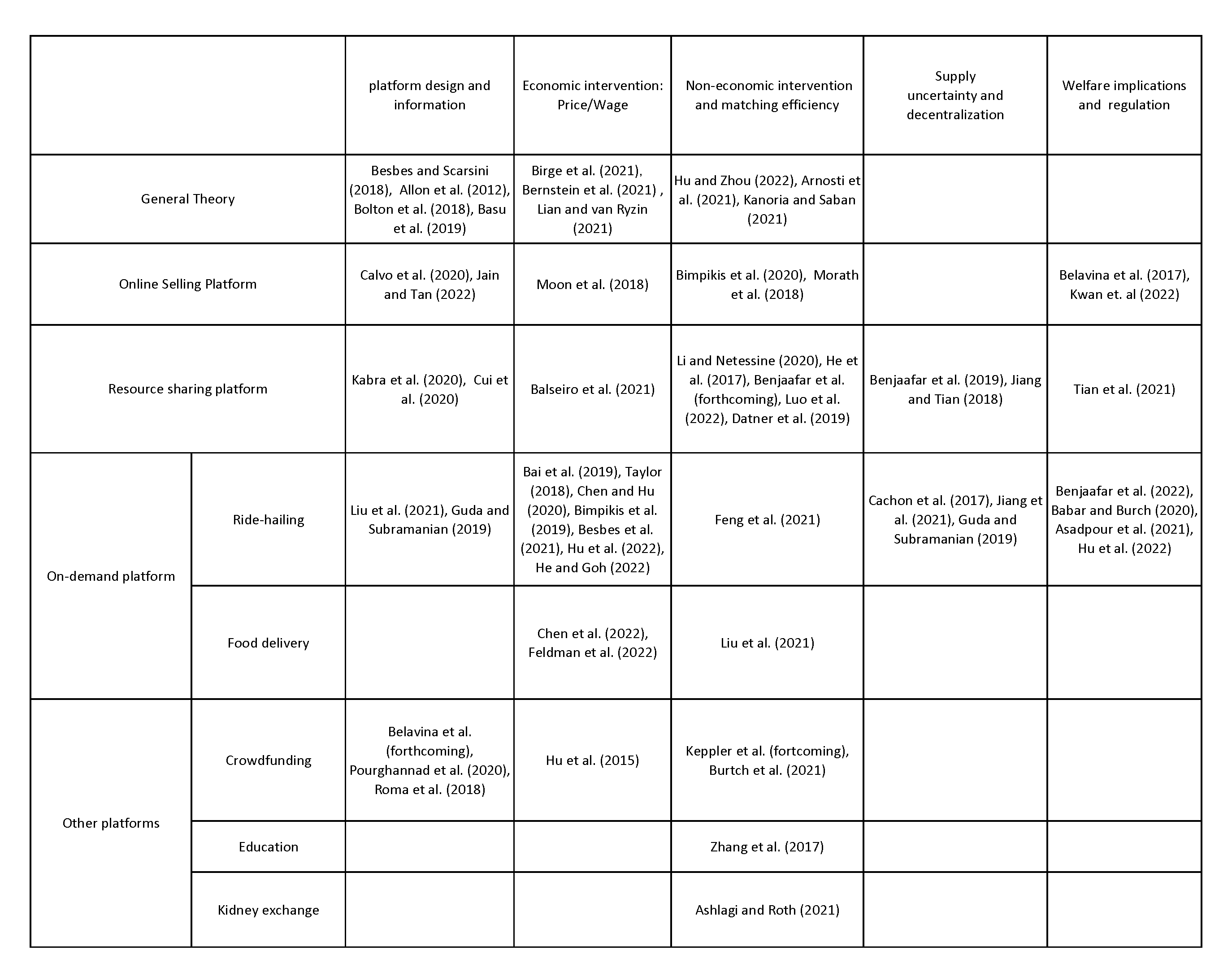
As an online marketplace usually deals with multiple sides of user bases, market design of online marketplaces involves designing the “rules of the game” so that the multi-interactions among the users are sustainable. A well-functioning marketplace needs to provide market thickness and meanwhile overcome the congestion brought by the thickness. In addition, the mechanism that enables users to reveal their information (e.g., ratings, certification, and recommendation) plays a critical role in establishing the effectiveness of an online marketplace.
Research in this stream considers the pricing decisions on both the supply and demand sides. The platforms may charge consumers prices and pay individual service providers wages, conditional on market conditions. As a special form, a contingent pricing policy that requires wages to be a fixed commission rate of dynamic prices has been studied and is shown to generally achieve nearly the optimal profit. Research in this stream has considered time scales such as minutes, hours, and weeks, which cover pricing decisions from operational up to strategic levels.
Unlike traditional markets in which pricing is the single most critical way to match demand and supply, non-monetary matching mechanisms play a crucial role in meeting demand with supply. Research in this stream examines the role of matching mechanisms in improving matching efficiency, which includes but is not limited to reducing customer waiting time, increasing the total volume or value of matching. Research in this stream also explores the distinctive features of various platforms. For example, a ride-hailing platform is different from a traditional queueing system in that the spatial features such as pick-up distance (time), which could dynamically change with the state of the system, play an important role in matching efficiency.
The online marketplace has fundamentally changed the workforce structure. Unlike a traditional firm that can centrally determine its capacity and schedule workers to shifts, workers on a platform are independent agents. They can decide when, where, and how much to work. While flexible working arrangements have offered more employment opportunities, it has brought platforms new operational challenges that have not been faced by a traditional firm. The self-scheduling behavior of individual contractors on top of classical operational models has brought many interesting research opportunities.
The growth of online marketplaces has also brought unprecedented challenges for regulation. We point to the websites of the Organization for Economic Co-operation and Development (OECD) for providing a toolkit of regulations and European Agency for Safety and Health at Work for an overview of regulatory and policy developments policies protecting workers in online marketplaces. Research in this area has examined the classifications of on-demand workers and full-time workers, the impact of online marketplaces to labor welfare and minimum wage regulation, the impact of online markets to environment and sustainability, and ways to facilitate dispute resolution and tackle discrimination as well.
For this INFORMS Analytics Collection, we are bringing together a variety of interesting resources for those who want to learn more about online marketplaces. We provide research articles on the above five perspectives in four major categories, including general theory, online selling platforms, resource sharing platforms, and on-demand platforms, and one less-explored category of other platforms. We provide a table summarizing the academic progress made in each category as follows.