


Moving Violations: Pairing an Illegitimate Learning Hierarchy with Trainee Status Mobility for Acquiring New Skills When Traditional Expertise Erodes
Abstract
We explore how members of a community of practice learn new tools and techniques when environmental shifts undermine existing expertise. In our 20-month comparative field study of medical assistants and patient-service representatives learning to use new digital technology in five primary care sites, we find that the traditional master-apprentice training model worked well when established practices were being conferred to trainees. When environmental change required introducing new tools and techniques with which the experienced members had no expertise, third-party managers selected newer members as trainers because managers judged them to be agile learners who were less committed to traditional hierarchies and more willing to deviate from traditional norms. This challenged community members’ existing status, which was based on the historical distinctions of long tenure and expertise in traditional tasks. In three sites, the introduction of this illegitimate learning hierarchy sparked status competition among trainees and trainers, and trainees collectively resisted learning new tools and techniques. In the other two sites, managers paired the new, illegitimate learning hierarchy with the opportunity for trainee status mobility by rotating the trainer role; here, trainees embraced learning in order to exit the lower-status trainee group and join the higher-status trainer group. Drawing on ideas of status group legitimacy and mobility, we suggest that managers’ pairing of an illegitimate learning hierarchy with the opportunity for trainee status mobility is a mechanism for enabling the situated learning of new techniques when traditional expertise erodes.
As the world of work changes, workers must find innovative ways of acting skillfully in the midst of a new and shifting set of problems in order to deliver value (e.g., Christin 2017, Pine and Mazmanian 2017, Beane 2019, and Myers and Kellogg 2020). Digital technologies, increased competition, and advances in tools and techniques create pressures for workers to learn different skills to stay relevant, and learning on the job in everyday work has been shown to be an effective means of skill development (e.g., Liu and Batt 2007, Bailey and Barley 2011, and Ranganathan 2018). This raises the question: When the external environment shifts in a way that either undermines the core work practices that need to be taught or dramatically changes the technological environment in which work happens, how and when can workers learn to use new tools and techniques in everyday work?
Scholars of work and occupations and scholars of work and employment have each explored how workers learn new tools and techniques in everday work. Work and occupations theory focuses on how a “teaching-learning ecology” populated with independent but interacting specialists allows individuals to learn new skills amid rapid change (Bailey and Barley 2011). Here, specialists keep updated on changes in techniques and technologies in their specialized areas, and they share information and help one another, regardless of rank (e.g., Perlow and Weeks 2002, Hargadon and Bechky 2006, Bailey et al. 2012, and Grodal et al. 2015). Individual learning of new tools and techniques in everyday work is facilitated by frames, norms, scripts, and routines that support help seeking and help giving (e.g., Edmondson et al. 2001, Fisher et al. 2018, and Brooks et al. 2020). Work and employment theory draws attention to how continuous improvement processes can allow workers to learn new skills amid rapid change. Here, special teams carry out improvement projects to develop new work practices in response to changing external conditions, and experienced members designated as trainers train peers on the new processes (e.g., Hodson et al. 1992; Adler et al. 1997, 1999; and Ranganathan and Shivaram 2018). Individual learning in everyday work is facilitated by skilled trainers, adequate resources, and training materials and routines tailored to the setting (e.g., Liu and Batt 2007; Litwin 2011, 2015; and Canales 2018, 2019).
The work and occupations and work and employment literatures have been critical in explaining how workers can learn to use new tools and techniques in everyday work by learning from experienced specialists or trainers. However, workers and organizations face a dilemma when the external environment shifts in a way that either undermines the core work practices that need to be taught or dramatically changes the technological environment in which work happens. Such situations demand introducing new tools or techniques with which experienced members have no expertise.
Given the vast transformation taking place in the world of work, situations in which experienced members do not have the expertise required to train newer members are increasingly common (e.g., Barley 2015, Bechky 2019, Anteby and Chan 2018, and Lifshitz-Assaf 2018). In such situations, experienced members may need to learn from newer members, rather than vice versa. Senior medical trainees may need to learn robotic surgery techniques from more junior trainees (Beane 2019). Senior marketing managers may need to learn digital marketing skills from more junior marketers (Kessinger and Kellogg 2020). And senior lawyers may need to learn to use artificial intelligence legal services technologies from more junior lawyers (Pachidi and Tschan 2019).
In this article, we demonstrate that in order to understand how the learning of new tools and techniques is accomplished in such situations, we must take into account not only the community norms, frames, and routines that support help seeking and help giving, and the the trainers, training materials, and resources available for learning, but also the legitimacy of the learning hierarchy and opportunities for trainee status mobility.
Current Understanding of Situated Learning of New Tools and Techniques When Traditional Expertise Erodes
Work and occupations theory and work and employment theory have both examined how and when workers can learn new tools and techniques in everyday work.
Work and Occupations Theory
Work and occupations studies on helping (e.g., Perlow and Weeks 2002, Hargadon and Bechky 2006, and Grodal et al. 2015), information seeking (e.g., Perlow 1997 and Borgatti and Cross 2003), and knowledge sharing (e.g., Carlile 2002, 2004; Bechky 2003; Leonardi and Bailey 2008; Deken et al. 2016; Treem and Leonardi 2017; Leonardi 2018; and Lee et al. 2020) show that the situated learning of new tools and techniques in a rapidly changing environment can be extremely difficult. Knowledge sharing requires time and effort from organization members, and it may lower productivity (e.g., Perlow and Weeks 2002, Hargadon and Bechky 2006, Grodal et al. 2015, and DiBenigno 2020).
Yet, despite these challenges, both individual and collective learning (Hargadon and Bechky 2006, Bailey and Barley 2011) occur through help seeking and help giving at multiple levels of the organization (e.g., Bamberger 2009 and Grodal et al. 2015). Organization members seek and give help to assist with problem solving (Bamberger 2009), task execution (Barley and Kunda 2006), task integration (Bendersky and Hays 2012, Brooks et al. 2020), and goal attainment (Perlow and Weeks 2002). For example, Bailey and colleagues (Bailey et al. 2010, Bailey and Barley 2011) show how structural engineers in a fast-changing environment first attempted to solve complex design issues on their own, but they then sought help from other engineers who specialized in particular technologies who could provide different viewpoints on the problems. Similarly, Hargadon and Bechky (2006) demonstrate that creative professionals facing complex problems used helping practices to incorporate diverse perspectives for the production of creative outcomes.
Particular frames, norms, routines, scripts, and structures support help seeking and help giving (e.g., Feldman and Pentland 2003, Flynn 2003, Bechky 2006, Grant and Patil 2012, Toegel et al. 2013, and Brooks et al. 2020). Perlow and Weeks (2002) demonstrate that Indian engineers engaged in more helping behaviors than did U.S. engineers because, in India, helping was framed as a desirable opportunity for skill development rather than as an unwanted interruption. Brennecke (2020) describes how engineers at an aerospace manufacturer used norms of problem solving to seek help from colleagues who were otherwise difficult to work with. And Grodal et al. (2015) show how helping routines allowed engineers to cognitively and emotionally engage others to jointly solve problems, develop new knowledge, and promote an environment for future helping interactions. Situated learning can be facilitated not only by frames, norms, and routines that support help seeking and help giving but also by scripts that downplay a threat to hierarchy (Brooks et al. 2020, Truelove 2020), positive interpersonal relationships (Friedman et al. 2018), moderate status distance (Doyle et al. 2016), and an environment that fosters psychological safety (Edmondson et al. 2001, Hofmann et al. 2009, Anthony 2018).
Work and Employment Theory
Work and employment theorists add to this picture by highlighting that situated learning is challenging not only because it requires workers to exchange help but also because it requires them to attain and process new information (e.g., Osterman 1995 and Liu and Batt 2007) in an environment where there is often a historic lack of trust between managers and workers (e.g., Kochan and Rubinstein 2000; Gittell et al. 2004; and Kochan et al. 2008, 2013).
Regarding how situated learning occurs, these scholars suggest that it can be accomplished successfully through employee involvement during the development and implementation of new tools and techniques (e.g., MacDuffie and Krafcik 1992, Litwin 2011, and Kochan 2015). Special teams of workers can carry out improvement projects and train peers on the new processes (e.g., Piore 1968; Hodson et al. 1992; and Adler et al. 1997, 1999). For example, Litwin (2011, 2015) shows how workers at Kaiser Permanente learned to use a new scheduling system within Kaiser’s electronic medical record (EMR) system by participating in the development and implementation of new tools and techniques both at the workplace level and at the functional level. Liu and Batt (2007) demonstrate how call center workers helped their peers gain both explicit knowledge related to operating a new database system and tacit knowledge related to customer satisfaction.
Regarding when such situated learning occurs, it is facilitated by skilled trainers, well-designed training materials and routines, and adequate resources. For example, Ranganathan (2018) explains how experienced supervisors trained new frontline workers by teaching them the “work-readiness” needed to be successful at work. Adler and colleagues (Adler 1995; Adler et al. 1997, 1999) detail how, at NUMMI, an automobile manufacturing plant run as a joint venture between Toyota and General Motors, frontline managers with high levels of skill acted as informal trainers on topics such as problem solving and process improvement (see also Hodson et al. (1992) and Saganski (1995)). And Litwin (2011) demonstrates how “super-users” who were able to communicate between frontline workers and top management during implementation, training, and follow-up were critical to the situated learning of new tools and techniques at Kaiser Permanente. Situated learning can be facilitated not only by skilled trainers but also by well-developed training routines (Liu and Batt 2007); training materials that include language, challenges, and examples from trainees’ own experience (Canales 2018, 2019); and standards that support learning across boundaries (Huising 2014, Valentine 2017).
The work and occupations and work and employment literatures have provided important explanations for how and when situated learning of new tools and techniques in everyday work occurs, but we must add to them to explain the outcomes we observed in our 20-month comparative field study of medical assistants (MAs, clinical support staff) and patient-service representatives (PSRs, administrative support staff) learning to use new digital technology in five primary care practices.
As we will elaborate in further detail, the five medical sites had similar frames, norms, and routines around help seeking and help giving. The sites also had the same training materials and similar trainers and resources. However, MAs and PSRs engaged in situated learning at a greater rate at two of the sites than they did at the other three. To explain this difference in outcomes, we need to bring an understanding of learning hierarchies and status mobility into our explanations of the situated learning of new tools and techniques in everyday work.
Learning Hierarchies and Situated Learning Between Masters and Apprentices
In communities of practice exposed to rapidly changing environments, the learning of new technologies and techniques is relatively unproblematic; these communities often contain independent but interacting specialists who share specialized, factual knowledge with one another, regardless of rank (e.g., Perlow and Weeks 2002, Hargadon and Bechky 2006, Bailey et al. 2012, and Grodal et al. 2015). However, in communities of practice where the rate of knowledge change has historically been slower, teaching and learning often occurs through master-apprentice interactions, and this can pose a problem for the learning of novel tools and techniques when environmental shifts undermine existing expertise.
In learning ecologies populated by masters and apprentices (Bailey and Barley 2011), experienced members who have significant knowledge about practicing an occupation (masters) teach inexperienced newcomers (apprentices) to engage in the community and develop skills through a process of “legitimate peripheral participation” (Lave and Wenger 1991; see also Brown and Duguid (1991) and Hutchins and Lintern (1995)). As newcomers observe more experienced organization members in their daily work, they develop an understanding of the context and of the various activities and the processes central to becoming a full, sustained participant in the community of practice (Becker et al. 1961, Van Maanen 1975). In this view, access to a community does not happen through formal instruction or teaching but through specific and contextualized discussions (Lave 1988, Lave and Wenger 1991) and stories told during practice within the community (Orr 1996). The context only comes to life in all its specificity when newcomers experience others conducting meaningful tasks (e.g., using the tools of the trade, bringing about coordination, negotiating disagreements, or addressing uncertainties; Van Maanen and Barley 1982, Suchman 1987, Wenger 1998, Bernstein 2012).
According to Van Maanen and Schein (1979), newcomers to a community need to learn three dimensions of their new role: the functional dimension (the various tasks performed by members of the role), the political dimension (the hierarchical rank of the role in comparison with other organizational roles), and the social dimension (the social rules, norms, and values through which a role member’s worthiness to the community is judged by members of that community). Trainers within a master-apprentice community of practice are positioned higher in the learning hierarchy than are trainees along each of these dimensions. From a functional standpoint, trainers are experienced hands who know how to perform the tasks required by members in the role better than trainees do (e.g., Harper 1987, Hutchins and Lintern 1995, and Marchand 2008). From a political standpoint, trainers have higher rank or longer tenure than do trainees (e.g., Bosk 1979 and Michel 2011). From a social standpoint, trainers understand the social rules, norms, and values through which a person’s worthiness to the group is judged by members of that group better than trainees do (e.g., Bailyn 1993, Ibarra 1999, Pratt et al. 2006, and Bailey et al. 2010).
In these apprenticeship systems, trainers are motivated to train trainees, in part, in order to maintain their high position in the learning hierarchy. From a functional standpoint, trainers depend on trainees to help do the work, and the more skilled trainees are, the more trainees can be helpful to the trainers (Glance et al. 1997, Bailey and Barley 2011). From a political standpoint, trainers often have incentives tied to training new recruits, such as promotion paths that depend on members serving in a training role (Hackman and Wageman 1995, Ranganathan and Shivaram 2018). From a social standpoint, trainers are often accorded status because they are perceived to be the members who contribute the most to the group (e.g., Blau 1964).
Trainees are motivated to engage in training, in part, because their low position in the learning hierarchy puts them in an anxiety-producing situation (e.g., Becker et al. 1961 and Van Maanen 1973); they are motivated to reduce this anxiety by learning the functional, political, and social requirements of their new role as quickly as possible (Van Maanen 1975, Bosk 1979). Trainees look to the seasoned trainers to help them master the key tasks of the job, to help them understand informal relationships and networks, and to help them interpret the events they experience so that they can take appropriate action in order to gain social rewards in the form of belonging and avoid social punishments in the form of embarrassment and rejection (e.g., Orr 1996, Ibarra 1999, and Bailey and Barley 2011).
Yet in such master-apprentice communities, the learning of new technologies and techniques when environmental shifts undermine existing expertise is particularly difficult. Here, allowing old hands to teach the traditional tricks of the trade to new recruits risks failing to use the highest-quality or most cost-efficient new practices. Thus, when the external environment shifts in a way that either undermines the core work practices that need to be taught or dramatically changes the technological environment in which work happens, traditional forms of expertise erode, and new structures of training may be needed. A handful of scholars have demonstrated that individuals within master-apprentice communities of practice may learn new tools and techniques under such conditions through processes of subterfuge that preserve the existing learning hierarchy, as when technicians engaged in clandestine teaching with radiologists around computed tomography scanner technology (Barley 1986) or when surgical trainees engaged in shadow learning apart from senior surgeons around robotic surgery technology (Beane 2019). New skills can also be brought into master-apprentice communities through collective action by community members. For example, Leonardi’s (2007) junior information technology technicians’ solving of client problems caused social pressure to build. This led to discrepant events, which required community members to collectively learn how to use the technology in a new way, even though doing so upended the initial learning hierarchy. Kellogg’s (2009, 2011) junior surgical trainees mobilized with other community members in relational spaces and then collectively challenged defenders of the status quo to engage in the surgical technique of hand-offs in a new way, transforming the learning hierarchy in the process.
We find that members within master-apprentice communities of practice may learn new tools and techniques in everyday work not only when the existing learning hierarchy is furtively protected or collectively contested by community members but also when it is redefined by powerful third parties such as managers. Our investigation leads us to suggest that managers can enable situated learning within master-apprentice communities of practice by pairing the introduction of a new, illegitimate learning hierarchy with opportunities for trainee status mobility up this new hierarchy. After developing our grounded findings, we join them with insights from studies of status group legitimacy, mobility, and competition (e.g., Tajfel and Turner 1979, 1986; and Ellemers et al. 1993) to propose a status-based perspective for understanding the situated learning of new tools and techniques when traditional expertise erodes.
Methods
Research Setting and Data Collection
We conducted a 20-month field study of trainee participation in situated learning from May 2013 to December 2014 within Community Practice (CP, a pseudonym). CP is a large, community-based medical group in the Northeast that had three strategic priorities at the time of the study. First, CP’s sites were pursuing national recognition as “patient-centered medical homes” (PCMHs). The PCMH designation recognizes a new model of care (emphasizing access to care, population management of chronically ill patients, care management, care coordination and tracking, and quality improvement) that has been shown to improve quality, patient experience, and staff satisfaction while lowering costs. Second, the U.S. government, through the Centers for Medicare and Medicaid Services Meaningful Use program, was providing financial incentives to encourage investment in EMRs, as well as standard processes and expectations for using EMRs (e.g., for electronic prescribing of medications). PCMH and meaningful use requirements overlapped substantially. Third, CP was seeking to improve patient safety for in-office procedures (e.g., medication and vaccine administration). In an effort to achieve PCMH recognition, meaningful use, and patient safety, CP managers introduced a continuous improvement process in which special teams carried out specific improvement projects to develop and standardize particular processes. As will be described, members designated as trainers then trained peers on these new processes.
In our study, we conducted observations of and interviews with headquarters managers, site managers, doctors, MAs, and PSRs to understand MA and PSR participation in situated learning around 11 new processes that required new tools and techniques. MAs are nonlicensed, clinical support staff, and PSRs are administrative support staff. MAs at CP had traditionally performed clinical tasks such as taking vital signs and administering vaccines and point-of-care laboratory tests, as well as tasks that supported doctors such as assisting with the completion of paper-based medical forms and the calling in of medication refills to the pharmacy. PSRs at CP had traditionally provided administrative support with tasks such as handling phone calls, appointment scheduling, check-in and check-out processes, and paper-based referrals and insurance authorizations. The 11 new processes entailed moving from paper-based to electronic practices, requiring MAs and PSRs to learn additional computer skills, expert thinking skills, and communication skills (see Table 1).
|

Table 1. New Processes and New Tools and Techniques Required
| Rollout date | Historical process | New process | Target | New process incorporating the use of digital technology |
|---|---|---|---|---|
| 9/23/2013 | Rooming variable, depending on doctor preferences. Documented limited information in the EMR. | Standard rooming | MA | MA: Develop facility with navigating and populating a range of population health management screens in the EMR according to a standard flowchart. |
| 11/20/2013 | Refills (mostly paper or called in to pharmacy) processed based on patient request. | Medication refill protocol | MA | MA: Review relevant clinical information in the EMR, guided by standard medication refill protocols (e.g., last blood pressure, laboratory values) and submit refill requests to pharmacy in the EMR. |
| 12/31/2013 | No standard clinical guidelines for telephone screening, some used paper-based reference books, others transferred all calls to triage nurse voicemail. | Same-day visit screening | MA/PSR | MA: Use standard EMR templates to review clinical information with patient, screen calls for urgency, and document. |
| PSR: Follow guidelines in standard EMR templates for “red, yellow or green” calls to determine routing and turnaround time. | ||||
| 1/16/2014 | No process for intake. Paper records provided by patients were reviewed by a medical doctor (MD) only, not by an MA or PSR. | New patient intake process | MA/PSR | MA: Review intake checklist with the patient on the phone and document responses in the EMR to initially populate patient chart, using coded information in appropriate structured fields. |
| PSR: Warm transfer to the Patient Service Center for full registration; sort and organize for the doctor each new patient’s prior paper and electronic medical records according to clinical categories such as family history, prior vaccinations, and prior procedures. | ||||
| 4/17/2014 | He MA completed paper laboratory requisition on behalf of the MD. No standard process. | Pap smear specimen labeling | MA | MA: Complete laboratory requisition in the EMR on behalf of the MD. Verify patient information by cross-referencing label and requisition. |
| 4/21/2014 | The MD refers patient for colonoscopy to the GI office. The MD gives patient a paper referral. No tracking process. | Screening colonoscopy referral and tracking | MA/PSR | MA: Use electronic tracking system embedded in the EMR to follow each patient’s course in the process, from practitioner recommendation for colonoscopy through procedure and follow-up; respond as needed. |
| PSR: Use electronic template embedded in the EMR to populate demographic information in the referral request form and send it to gastroenterology. | ||||
| 5/12/2014 | The MD completes paper order for radiology study. No tracking process. | High-risk radiology tracking | MA/PSR | MA: Sort the electronic “to-do” list in the EMR and audit ordered studies. |
| PSR: Enter into the “to-do” module in the EMR high-risk radiology study information based on the MD’s electronic order (CT ABD/Pelvis, CT Chest, CT Head, MRI Head, and US Thyroid). | ||||
| 6/19/2014 | The MA administered vaccines and medication based on verbal order from the MD. No standard for clinical review or documentation. | Medication and vaccine administration | MA | MA: Check the EMR to discover if the patient has recently received a newly ordered vaccine, medication, or PPD; check the EMR to verify that electronic order is complete; administer vaccine or medication; and document in the EMR. |
| 6/19/2014 | Staff call patients after an ED visit or hospitalization only if given verbal order by the MD. No standard for turnaround time or documentation of phone call. | ED and hospital discharge follow-up | MA/PSR | MA: Mine PCP electronic clinical messages, call patients within 24-48 hours of discharge, following electronic call template, and book follow-up appointment. |
| PSR: Receive call from hospital or patient; book follow-up appointment; fax post discharge records request; send discharge notification electronic clinical message to the MA and care manager. | ||||
| 10/15/2014 | Patients referred to specialist by PCP; patient given paper referral, no tracking process. The PSR calls insurance company for authorization. | Referral tracking and management | MA/PSR | MA: Use electronic referral manager module in the EMR to enter electronic patient clinical referrals. |
| PSR: Use electronic Referral Manager module in the EMR to generate online insurance authorization and track status of referrals. | ||||
| 12/30/2014 | The PSR takes patient telephone calls and often gives verbal hand-off to clinical staff requiring multiple callbacks and long delays for call resolution. | Phone management | PSR | Use PSR Call Criteria information in the EMR to ask open-ended questions to determine the nature of the call and if the PSR can provide final resolution for caller; if not, initiate live/warm hand-off with MAs; document the call in an electronic clinical message. |
Managers rolled out a new training program to facilitate the learning of the new processes. First, the site managers designated particular MAs and PSRs at their sites to be trainers to teach the other MAs and PSRs at the sites the new processes. Second, for each new process, headquarters staff brought MA and PSR trainers offline to a meeting at CP headquarters. At these one-hour meetings, headquarters staff trained the MA and PSR trainers using a Powerpoint slide deck describing the new process, a video demonstrating the new process, and a standard work document describing each step in the new process. Third, when the MA and PSR trainers returned to their sites from the training, their site managers met with them to understand the new process in-depth before the MA and PSR trainers started any training of the other MAs and PSRs at the site. Fourth, site managers set aside time for MA and PSR trainees to individually review the PowerPoint slides, watch the video, and review the standard work document describing each step in the new process. Finally, the MA and PSR trainers met with each trainee to do a hands-on demonstration of the new process and to make sure that the trainee understood the “why” behind the new process. Trainers recorded initially, and again at 30, 60, and 90 days, whether each MA or PSR could perform the new process. Trainers also answered trainees’ questions about the new processes on an ongoing basis as the trainees went about their daily work.
Our data collection and analysis proceeded in two phases. In the first phase of data collection (May 2013–February 2014), the first author spent two hours per week observing and interviewing headquarters managers, site managers, doctors, MAs, and PSRs at CP headquarters and practice sites. She noticed interesting dynamics occurring between trainers and trainees around trainee participation in the situated learning of the new processes. In particular, during this time, many of the trainees seemed to be resisting situated learning of the same-day visit screening and new patient intake processes.
In the second phase of data collection (March 2014–December 2014), the first author conducted further observations and interviews at CP practice sites to understand how and when trainee participation in situated learning occurred at each site. She asked questions to understand how respondents engaged in situated learning around the 11 processes and what they saw as barriers to and facilitators of this situated learning. Interview responses were typed in real time.
We chose to focus our analysis on the five sites featured in this paper, because these five sites were well matched on the characteristics that have been shown to be important for situated learning (see Table 2 for a comparison of the five sites). These five sites were exposed to the same external pressures for change and were similar in terms of the size of patient population. The sites were also comparable in terms of training materials and resources, as well as frames, norms, and routines around learning, all of which have been shown to affect situated learning of new tools and techniques in everyday work. Because the sites were well matched on these contextual characteristics that have previously been shown to affect a community member’s situated learning, they provide a good comparison opportunity to potentially uncover new mechanisms promoting trainee participation in situated learning.
|
Table 2. Comparison of the Five Sites
| Site 1 | Site 2 | Site 3 | Site 4 | Site 5 | |
|---|---|---|---|---|---|
| Organizational characteristics | |||||
| Number of primary care patients (three-year panel size) | 8,911 | 9,804 | 8,970 | 9,879 | 9,933 |
| Number of providers | 10 | 9 | 9 | 9 | 16 |
| Number of MAs | 11a | 7 | 10a | 8 | 16a |
| Number of PSRs | 5 | 5 | 7 | 5 | 12 |
| Contextual characteristics | |||||
| Doctor support of 11 new processes | Moderate | Same | Same | Same | Same |
| Training materials | Standard work documents, video showing new process, positive story showing benefit of new process | Same | Same | Same | Same |
| Training routines | Use of peer trainers | Same | Same | Same | Same |
| Training resources | Trainers and trainees given time for training | Same | Same | Same | Same |
| MA and PSR trainer and trainee characteristics | |||||
| MA and PSR trainers | None had delivered training before first process; high level of understanding of trainee norms and beliefs | Same | Same | Same | Same |
| MA trainees | Postsecondary MA training certificate or diploma | Same | Same | Same | Same |
| PSR trainees | No postsecondary secretarial training | Same | Same | Same | Same |
| Median tenure: MAs and PSRs | 24 months | 26 months | 31 months | 31 months | 88 months |
Notes. Numbers reflect 2014 values. Italics signify the transition from paper-based to electronic processes.
a Sites 1, 3, and 5 include specialist doctors who are supported by MAs who rotate between primary care providers and specialists; this explains the slightly higher relative number of MAs at these three sites.
Across the two phases of data collection, at these five sites and at headquarters, the first author conducted observations of and formal and informal interviews with staff members to understand the MAs’ and PSRs’ situated learning of the 11 new processes. She conducted a total of 91 interviews at these five sites and headquarters, interviewing a handful of respondents several times: headquarters staff (17 interviews), site medical directors (9 interviews), site managers (9 interviews), site doctors (9 interviews), MA trainers (3 interviews), MA trainees (14 interviews), PSR trainers (4 interviews), PSR trainees (11 interviews) and rotating MA trainer/trainees (9) and PSR trainer/trainees (6) at sites 1 and 2.
Data Analysis
Our analysis showed that MA and PSR trainee participation in situated learning, as measured by trainers at each of the sites, varied across sites. As Table 3 shows, trainee participation in situated learning at site 1 (98%) and site 2 (70%) was higher than at site 3 (45%), site 4 (39%), and site 5 (28%).
|
Table 3. Trainer Assessment of Trainees by Process
| Trainer rotation | % of staff who served as trainers | Median MA and PSR tenure (months) | Std rooming (%) | Med refill (%) | Same-day visit scrning (%) | New patient intake (%) | Pap smear spec labeling (%) | Scrning colonoscopy referral and trcking (%) | High-risk radiology trcking (%) | Med and vaccine admin (%) | ED and hospital discharge follow-up (%) | Referral trcking and mgmt (%) | Phone mgmt (%) | Overall (%) | |
|---|---|---|---|---|---|---|---|---|---|---|---|---|---|---|---|
| Rollout date | 13-Sep | 13-Nov | 13-Dec | 14-Jan | 14-Apr | 14-Apr | 14-May | 14-Jun | 14-Jun | 14-Oct | 14-Dec | ||||
| Target of training | MA | MA | MA/PSR | MA/PSR | MA | MA/PSR | MA/PSR | MA | MA/PSR | MA/PSR | PSR | ||||
| Site 1 | Yes | 69 | 24 | 100 | 100 | 75 | 100 | 100 | 100 | 100 | 100 | 100 | 100 | 100 | 98 |
| Site 2 | Yes | 42 | 26 | 100 | 100 | 0 | 100 | 100 | 100 | 75 | 100 | 50 | 25 | 25 | 70 |
| Site 3 | No | 18 | 31 | 100 | 100 | 0 | 25 | 0 | 100 | 50 | — | 0 | 0 | 75 | 45 |
| Site 4 | No | 23 | 31 | 100 | 100 | 0 | 0 | 0 | 0 | 75 | 100 | 0 | 50 | 0 | 39 |
| Site 5 | No | 18 | 88 | 100 | 100 | 0 | 25 | 25 | 0 | 0 | 0 | 0 | 25 | — | 28 |
| Overall | 34 | 40 | 100 | 100 | 15 | 50 | 45 | 60 | 60 | 75 | 30 | 40 | 50 | 58 |
Note. Values denote percentages of assessments reported complete for each process unless otherwise noted.
We contrasted sites 1 and 2 with sites 3, 4, and 5 to identify the practices associated with a higher rate of trainee participation in situated learning at sites 1 and 2. Our inductive analysis (Glaser and Strauss 1967) consisted of multiple readings of the interview notes and coding based on themes emerging from the data (performed in ATLAS.ti qualitative software) regarding work activities and regarding facilitators and barriers to successfully accomplishing situated learning. When formal data collection had finished, we presented our analysis for review by CP staff members to ensure that these interpretations represented their experiences.
As is the case with most studies of situated learning, measuring learning outcomes was difficult. We chose to measure outcomes the way the organization did. Because of the complexity entailed in fully measuring outcomes, the organization asked trainers at each site to both informally train employees and assess their ability to perform each process at four points in time—initially and at 30, 60, and 90 days after introduction. So, for example, if the MA and PSR trainees at a site demonstrated to trainers at that site that they were competent in accomplishing a new process at all four points in time, that site was recorded as demonstrating 100% MA and PSR trainee participation in situated learning for that process. By contrast, if the MA and PSR trainees at a site demonstrated to trainers at that site that they were competent in accomplishing a new process initially but then not at 30, 60, or 90 days, that site was recorded as demonstrating 25% MA and PSR trainee participation in situated learning for that process.
Historically Similar Learning Within MA and PSR Communities of Practice Across the Sites
Traditional Situated Learning Within MA and PSR Communities of Practice
At CP, new MAs and new PSRs had traditionally learned from experienced MAs and experienced PSRs, respectively, via a process of legitimate peripheral participation. MA and PSR new recruits had begun by shadowing an experienced MA or PSR as she went about her daily work. For example, before the rollout of the new processes, a new PSR at site 5 related, “I just started last week…I’m shadowing [experienced PSR], so that I can learn how to manage the phones.” Similarly, a new MA at site 2 observed an experienced MA to learn how to use a sterile technique for putting on a gown, mask, and gloves.
New recruits had historically learned by watching the experienced MA or PSR adapt to busy times and down times, by hearing stories of mistakes encountered and avoided, and by seeing the kinds of information that was collected and the kinds of tests that were prepared. For example, at site 4, one of the PSRs said, “You wouldn’t believe some of these stories [told by experienced PSRs]. It’s really helpful, because if a patient gets upset with me, I’ll know that it’s not about me. It just comes with the job.” Similarly, at site 1 we observed a new MA as she sat next to the experienced MA learning how to handle mail for a doctor. The experienced MA said to the new MA,
I start by going through the mail left for [doctor]. I take anything out that needs to be reviewed or signed for [doctor] and I put it in [doctor’s] box. [Experienced MA points to report.] This is a cardiology note. That will get scanned into the [electronic medical record]. [Experienced MA looks at the cytology note that had been ordered by another doctor. She points to a number on the note.] This one is normal. [She points to a different form.] This is a diabetic outpatient education form. We do educations for CHF [congestive heart failure] patients and diabetic patients. I’ll need to re-fill out the form and send it in. Prescription refill [requests] go in the next pile.
Next, the experienced MA or PSR began to ask the trainee to take on minor tasks. For example, before the rollout of the new processes, a site 5, a PSR told us, “One of the things we do a lot of is prior authorizations. When I first started, [experienced PSR] had me help with just the paperwork. Once I learned that, she showed me how to also call [insurance company or other insurance company] for authorization.” Along these same lines, at site 3, an experienced MA began to give tasks to a new MA who had started two weeks earlier such as greeting patients and escorting them to the experienced MA’s cubicle, weighing patients, instructing patients to put the gown on with the opening in the back, restocking patient rooms, and putting patient paperwork into a packet and organizing it according to particular doctors’ preferences.
The trainee’s involvement became more involved as she began to do more complicated tasks such as taking patients’ blood pressure and helping the experienced MA assist doctors with Pap smear setup, specimen collection, and labelling. For example, we shadowed the above-mentioned new site 1 MA about a week after our first shadowing, and an experienced MA was having her help with an EKG for a Medicare patient who had come in for her comprehensive medical care exam. The experienced MA explained to the new MA, “The Medicare visit allows us to do the EKG. Otherwise, you can't get an EKG [reimbursed by the payer] unless the patient is symptomatic.”
In addition to learning new tasks, MA and PSR trainees learned about the hierarchical relations, dress and demeanor, and values of their respective communities by observing experienced MAs and PSRs as they went about their daily work. Trainees in both groups saw that their experienced counterparts deferred to doctors in all situations, that PSRs deferred to MAs in clinical matters, and that MAs deferred to PSRs in most administrative matters. Trainees also absorbed cues about dress and demeanor. MAs tended to be in their early 20s and dress in colorful scrubs with stethoscopes around their necks, whereas PSRs tended to be in their 50s and 60s, wore heavier makeup, and were dressed in sweaters and pressed wool pants. Trainees learned that MAs valued competence in clinical matters and the ability to “figure things out” when unexpected challenges arose in order to optimize patient flow for doctors, whereas PSRs valued competence in administrative matters and friendly but firm communications with patients.
Participation, which for the MA or PSR trainee was peripheral at first, became more engaged, and the situated learning process resulted in the trainee being recognized in the MA or PSR community of practice as a full participant. For example, when we returned to site 1 several months after our initial shadowing, we observed that the MA who had been in training during our early observations was now doing tasks on her own (so had mastered the key tasks of the role), anticipating the idiosyncratic needs of the different doctors at the site (so understood informal relationships associated with the role), and dressing similar to and eating lunch with the other MAs (so understood the norms of the role).
The Traditional Learning Hierarchy at CP
Historically, new recruits at CP had been trained by the most experienced MA or PSR in the office, as measured along functional, political, and social dimensions of the learning hierarchy: expertise in MA or PSR key tasks; tenure within the organization; and enactment of the social rules, norms, and values of the community. First, in terms of the functional hierarchy, we observed that the MAs and PSRs doing the training were among the most skilled at the traditional MA or PSR tasks. For MAs, this included clinical tasks such as greeting incoming patients, taking patient histories, obtaining vital signs, measuring blood pressure, measuring height and weight, and taking body temperature. For PSRs, this included administrative tasks such as answering phones, making appointments, and processing paperwork. In the previously described example where the experienced MA was training a new MA at site 1, the experienced MA was seen to be an expert MA by the doctors with whom she worked. We saw the experienced MA display a high level of expertise during a shadowing session with her:
[[Experienced MA] puts her headphones on to take a call from a patient that has been transferred by one of the PSRs.] “Hi [patient], this is [experienced MA] from [doctor’s] office. Any changes in your urine or bowels? OK, lower left side [possible appendicitis]. On a scale of 1 to 10 how bad is your pain? Any nausea or vomiting? When you press the area does it hurt?”
[[Doctor] comes in and [experienced MA] puts the patient on hold for a minute.] “I have [patient] on the phone.” [[Experienced MA] reviews with [doctor] what she just covered with the patient.]
[Doctor]: “Okay, I need to see her.”
[[Experienced MA] put her headphones back on.]
[As [experienced MA] tells the patient she needs to come in, [Doctor] says to me: “[Experienced MA] is amazing.”]
Second, in terms of the political hierarchy, we found that the MAs and PSRs doing the training were expert at tailoring their work practices to meet doctors’ idiosyncratic needs and were typically among the longest-tenured MAs or PSRs in the office. For example, the aforementioned trainers each had longer tenure than the median tenure for their sites. For example, the site 1 MA who was showing the new MA how to triage patients who called in with concerns had a tenure of 66 months (versus the site 1 MA median tenure of 27 months); the tenure for the site 4 PSR telling war stories of deftly handling patients had a tenure of 80 months (versus a site 4 median PSR tenure of 32 months).
Third, in terms of the social hierarchy, we noted that the MAs and PSRs doing the training enacted the norms and values of an ideal MA (which consisted of being clinically competent and able to optimize patient flow for doctors) or an ideal PSR (which consisted of being administratively competent and able to remain calm in the face of difficult or emotional patients).
Traditional Motivation for Trainers and Trainees at CP
MA and PSR trainers at CP had traditionally been motivated to train trainees, in part, in order to maintain their high position in the learning hierarchy. From a functional standpoint, trainers at CP appeared to be interested in training new recruits because they depended on them to help do the work—the more skilled trainees were, the more helpful they could be. For example, an experienced MA at site 1 told us that her new trainee had gotten to the point where she was helping the experienced MA room patients at a faster rate than the experienced MA could do alone. From a political standpoint, trainers often had incentives tied to training new recruits, such as promotion paths that depended on members serving in a training role. For example, an experienced MA from site 5 who had often helped with training new recruits was later promoted to supervisor, in part because of her long-standing role in this training. From a social standpoint, participating in training conferred status upon the trainer. The site 5 site manager had us shadow this same experienced MA first, in part because she was respected by her peers. The site manager told us that, once we shadowed her, the others would feel more comfortable being shadowed.
MA and PSR trainees at CP had traditionally been motivated to engage in training because their low position in the learning hierarchy had put them in an anxiety-producing situation. They had been motivated to reduce this anxiety by learning the functional, political, and social requirements of their new role as quickly as possible. For example, an MA trainee from site 4, who had started at CP two weeks before we shadowed her, noted,
Before coming here, I was at [other organization]. There, the nurses did things that the MAs are doing here. [There], all I did there was walk the patient to the room, take vitals, and take messages. Here I need to do a lot more. . . . I’ve been working with [experienced MA] who’s been showing me how to do things. . . . But, it’s really stressful.
Similar Introduction of New Tools and Techniques with Which Masters Had No Experience
CP managers used lean management transformation methods to develop the 11 new processes related to MA and PSR use of the digital technology. CP managers told us that this lean method of new process development, including Kaizen events and rapid process improvement workshops, had been used successfully in manufacturing settings and that they were adapting it to the healthcare setting. To create each of the 11 new processes, CP managers took MAs and PSRs, doctors, and patients from one practice site offline for one to five days to generate improvement ideas, and they used multiple plan-do-study-act cycles to refine the new processes.
These 11 new processes required MAs and PSRs to learn new practices with which experienced MAs and PSRs had no expertise. The processes required MAs and PSRs not only to learn new functional aspects of their respective roles (new tasks performed by members of the role) but also to learn new political aspects (new informal relationships between members in the role in comparison with members in other organizational roles) and new social aspects (new social values through which a member’s worthiness to the community would be judged by members of that community).
The new medication refill process targeted to MAs provides an example of how each new process required changing not only the functional aspects of the MA and PSR roles but also their political and social aspects. From a functional standpoint, the new medication refill process and the 10 other new processes required MAs and PSRs to learn computer skills, expert thinking skills, and complex communication skills associated with engaging with the new EMR technology much more deeply than they had before. Historically, MAs had simply filled out paper prescription refill forms for patients coming in for office visits or called prescriptions into the pharmacy in response to patients calling the office to request refills. By contrast, the new medication refill process required MAs to review relevant clinical information in the EMR, be electronically guided by the new standard medication refill protocols (e.g., refills were now allowed or not based on last blood pressure, laboratory values, etc.), and electronically submit refill requests to the pharmacy. One MA explained,
The new med refill process was difficult. We had to learn how to do the refills by looking at the med and checking the EMR and going step-by-step. [Before refilling the prescription for a diabetic patient] we needed to see whether the A1C was normal, and whether the patient had an appointment within six months.
The medication refill process and the other new processes also required MAs and PSRs to learn new political aspects of their roles including new informal relations between themselves and doctors. The new processes standardized certain practices, and this created a challenge for MAs and PSRs, who had historically tailored their work practices to meet doctors’ idiosyncratic needs. For example, one MA trainer said of the medication refill process,
That one was hard because some of the girls were iffy with prescriptions and also because the doctors were pushing back. Some doctors weren’t comfortable with it. If the patient didn’t have labs or an upcoming appointment, then [the doctor would] want to give [the patient] a one-month supply instead. . . . So MAs needed to push their doctors a bit.
Finally, the medication refill process and the other new processes required MAs and PSRs to learn new values such as focusing on patient satisfaction, improving patient access, reducing waste around time and processing, and doing things more safely. For example, the medication refill process introduced the new value of reducing waste around time and processing. One MA noted,
The point of that process was to refill the prescriptions for six months to a year so the patients weren’t always calling the office. But we also need to room patients, to keep everything running on schedule.
Similar Manager Introduction of Illegitimate Learning Hierarchy Across Sites
CP Managers Introduced New Bases of Status Distinction and a New Manner of Status Adjudication When They Chose Trainers
Across all five sites, CP managers introduced a new, illegitimate learning hierarchy by introducing new bases of status distinction and a new manner of status adjudication. Table 4 compares the bases of status distinction and manner of status adjudication in the traditional learning hierarchy versus in the new learning hierarchy introduced by the managers. Regarding introducing new bases of status distinction, managers unintentionally did this when they chose as trainers those who they judged as agile learners who worked quickly (so would be able to handle extra time demands associated with training others), as willing to challenge the traditional hierarchy, and as willing to deviate from traditional norms and support the values consistent with the new processes. Regarding naming as trainers those who they judged to be agile learners who worked quickly, one site manager noted,
[PSR trainer] moves faster, works faster, and picks up new processes quicker. She’s more agile.…She always has an iPhone [with her]. She’s grown up with all of this technology.
|
Table 4. Traditional Learning Hierarchy among Community Members vs. Illegitimate Learning Hierarchy Introduced by Managers
| Traditional learning hierarchy | New, illegitimate learning hierarchy | |
|---|---|---|
| Bases of status distinction | ||
| Functional bases | • Expertise in traditional processes | • Ability to agilely learn new processes |
| • Ability to work quickly to free up time for training others | ||
| Political bases | • Willingness to customize practices to doctors’ idiosyncratic needs | • Willingness to challenge traditional hierarchy |
| • Long tenure in the organization | • Ability to give honest, unbiased feedback to peers and superordinates about their level of understanding and ability to demonstrate a process | |
| Social bases | • Ability to “soldier on” and “figure things out” | • Less committed to traditional values and norms |
| • Emphasis on patient safety | • Ability to lead by example by always performing standard work | |
| • Ability to support and enhance the ongoing integration of improved processes throughout the organization | ||
| • Emphasis on patient safety | ||
| Manner by which status is adjudicated | ||
| Choice of trainers | • Community elevates particular masters | • Managers designate trainers |
| Criteria for progression up the hierarchy | • Primary criteria are related to functional, political, and social distinctions in the community of practice | • Primary criteria include the functional, political, and social distinction put forth by managers |
| • Criteria for MAs include the need to have served as a trainer | ||
| Certification of quality | • Community members higher in the professional hierarchy (doctors) certify quality | • Headquarters managers certify quality |
| • Site managers certify quality |
Another site manager said,
[MA trainer] is able to handle the time demands [associated with providing training].…She’s used to learning new things all the time. . . . [She’s] just coming out of [her 1-year MA training program], and that’s how they’ve been trained.
Regarding naming as trainers those who they judged to be willing to challenge the traditional hierarchy, a site manager related,
Our [PSRs] who’ve been around a long time, they’re not so confident to lead the charge [with other PSRs and with doctors]. . . . They’ve never been an educator before, so it can be a little more nerve-wracking for them. . . . [By contrast, PSR trainer] is a little more, what’s the word? …Show-offy. . . . She’s a little more open to telling people what to do.
Another site manager said,
[MA trainer]’s a new grad, like a sponge. She’s new to the field, but just went through an MA program. She doesn’t necessarily know what her future will bring. But, she wants to learn and knows there’s room for growth and opportunity. I saw that on day 1. Because she’s personally new to the field, she wants a little bit more than the average guy, than the folks who have been around a long time.
Finally, regarding naming as trainers those who they judged to be willing to deviate from traditional norms and support the values consistent with the new processes, a site manager explained,
Whether [MA trainer and PSR trainer] like change or not, they’re more accepting of it. . . . [With some of our more experienced MAs and PSRs], there’s some change aversion. They’re a little more cautious, way more thoughtful about their work. They own and operate their space. It makes them nervous when you’re trying to get them to change and do something new.
In naming these members as trainers, CP managers introduced new status distinctions: the functional distinction of learning agility rather than ability to perform traditional tasks, the political distinction of willingness to challenge rather than respect the existing hierarchy, and the social distinction of willingness to enact the new values and norms versus respect the existing values and norms (see Table 4).
CP managers also changed the manner in which bases of status distinction were adjudicated in several ways. First, CP managers inserted themselves into the status adjudication process by choosing the trainers themselves rather than by allowing the community to elevate particular masters. Second, CP managers introduced a new career ladder for MAs. The MA career ladder was announced and implemented at the same time as the first new process. This career ladder afforded the potential for a new title and increased compensation for MAs who could now be promoted to MA II. A criterion for promotion was that the MA had served as a trainer. Third, whereas doctors had traditionally assessed their MAs, headquarters managers now determined whether MAs would be promoted to MA II. To be promoted, MAs needed to not only serve as trainers but also get recommendations from a peer and two supervisors, and they had to write an essay stating why they deserved to be promoted. Headquarters managers could now affect community status hierarchies as they synthesized information and certified the quality of MAs.
CP managers did not implement a new PSR career ladder during the study period, so serving in the trainer role was not associated with the opportunity for promotion for PSRs during the implementation of the 11 new processes.
MAs and PSRs Perceived these New Bases of Status Distinction and New Manner of Status Adjudication to be Illegitimate
As CP managers introduced new bases of status distinction and a new manner in which these bases were adjudicated, they bestowed illegitimate “status” on the trainers and challenged community members’ existing status, which was based on historical distinctions of expertise in traditional tasks, long tenure, and enactment of traditional norms.
Many trainees did not perceive that the new bases of status distinction were legitimately established and fair. An MA trainee said,
It’s fine to say that someone is supposed to make sure everyone’s following standard work. But the downside of this is that it seems like the [designation of the trainer] is pulled out of a hat.
A different MA who had been chosen to be a trainer related,
At the beginning there was a lot of pushback from the other MAs to the [trainers] because they said, who are you to tell me what to do? At the last [trainer training session at headquarters], we asked [headquarters’ managers] to clarify why we’re here.
In response to these concerns, headquarters managers put together a slide presentation explaining the characteristics associated with trainers. The presentation was entitled, “What is a [trainer]?”; the site managers presented this to the MAs and PSRs at each site. In this presentation, trainers were described according to the new functional, political, and social distinctions:
A [trainer] is:
• A person who can thoroughly understand and uniformly state what the processes are, why they exist, and what to do with them
• A person who can handle the time demands from their doctor or manager in order to [have sufficient time to] fully instruct their peers and properly perform their observations
• A person who is able to give honest unbiased feedback to their colleagues and [superordinates] about their level of understanding and ability to demonstrate a process
• A person who leads by example and ensures that they are always performing the standard work themselves
• A person who supports and enhances the ongoing integration of improved processes throughout the organization
The first two bullet points about thoroughly understanding and handling time demands described the new functional distinctions of learning agility and ability to work quickly. The third bullet point about ability to give honest, unbiased feedback described the new political distinction of willingness to challenge rather than respect the existing hierarchy. The last two bullet points about leading by example and supporting ongoing integration of the new processes described the new social distinction of willingness to enact the new values and norms associated with new tasks rather than respect the existing values and norms associated with the traditional tasks.
However, even after seeing the presentation, many trainees still did not perceive the new learning hierarchy to be legitimate. One trainer explained,
People need to be willing to work with their peers. But, there’s been a little bit of backlash about it....Some [trainees are still saying], “Why are you the one who’s telling us this?”
Difference in Situated Learning Outcomes Across Sites: Trainee Perceptions of Status Group Permeability
Though CP managers had introduced a new, illegitimate learning hierarchy across all five sites by introducing new bases of status distinction and a new manner in which these bases were adjudicated, as noted earlier and shown in Table 3, trainee participation in situated learning at site 1 (98%) and site 2 (70%) was higher than at site 3 (45%), site 4 (39%), and site 5 (28%).
We argue that the difference in situated learning outcomes across sites is associated with differences in trainee perceptions of status group permeability across sites. At two of the sites, sites 1 and 2, managers rotated the role of trainer for MAs and PSRs, whereas at sites 3, 4, and 5, they did not. The rotation of trainers at sites 1 and 2 led MA and PSR trainees at these sites to perceive that it was possible for them to accomplish individual status mobility by leaving the lower-status trainee group and joining the higher-status trainer group.
At site 1, the site manager explicitly communicated to the MAs and PSRs that she planned to rotate the trainer role among all members. She explained, “I told them that we were going to rotate so that everyone would be a trainer for one of the processes.” At site 2, the site manager did not communicate that she would rotate the trainer role among all community members, but she did end up designating a high percentage of community members to be trainers (42%). Here, trainer rotation happened accidentally, as one of the initial trainers went out on medical leave and needed to be replaced, and another initial trainer left the organization and needed to be replaced.
We observed that trainer rotation shaped variation in situated learning across sites by shaping trainees’ perceptions of the degree of the permeability of the boundary between the trainer group, designated as higher status in the new illegitimate learning hierarchy, and the trainee group, designated as lower status. The rotation of trainers at sites 1 and 2 led MA and PSR trainees at these sites to perceive that it was possible for them to leave the lower-status trainee group and join the higher-status trainer group. In site 1, where the managers had explicitly communicated that the trainer role would be rotated, an MA who had been both a trainer and trainee said, “It’s great for everyone in the office that we switch [the role of trainer] around, because everyone gets to be a front-runner, be a leader.” At site 2, where the manager did not explicitly communicate that she intended to rotate trainers but did designate a high percentage of community members to be trainers, an MA trainee noted, “[MA, other MA, and third MA] have all been [trainers]. I’m sure that there will be more of us doing it over time.”
By contrast, the fixed character of the trainers at sites 3, 4, and 5 led MAs and PSR trainees at these sites to perceive that it was not possible for them to leave the trainee group and join the trainer group. A PSR trainee from one of these sites noted,
They should rotate the PSR and MA [trainers]. If one PSR is a [trainer] for a new process, then another one should get to be the [trainer] for the next process. Everyone who is interested should have a chance [to do it].
Similarly, an MA trainer from one of these sites related,
I think it would be good if there were more [trainers] in each practice. Everyone should have the possibility of doing it. . . . If you’re a trainer, then you help out and you train others. . . . It would be nice if other MAs could do it also, to have room to grow.
As we will explain later, at sites 3, 4, and 5, where trainees saw status group boundaries between trainer and trainee to be both illegitimate and impermeable, trainees engaged in status competition with trainers, and there was a lower rate of trainee participation in situated learning. By contrast, at sites 1 and 2, where trainees also saw status group boundaries to be illegitimate but, here, saw them to be permeable rather than impermeable, trainees judged that they had the opportunity to engage in individual status mobility, and there was a higher rate of trainee participation in situated learning (see Figure 1).
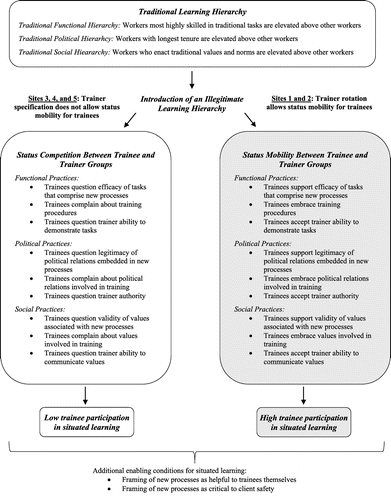
In addition to variation in degree of trainee participation in situated learning between sites 1 and 2, on the one hand, and sites 3, 4, and 5, on the other hand, there was variation in this learning across all of the sites and across the 11 processes. This additional variation highlights two additional enabling conditions associated with participation in situated learning: frames that justify the new processes as helpful to members and frames that justify the new processes as critical to client safety. At the end of the findings section, we explain how these two additional factors enabled trainee participation in situated learning.
Status Competition vs. Status Mobility Between Trainees and Trainers
To illustrate, in depth, the dynamics around situated learning that occurred between trainers and trainees at the five sites, we provide examples of MA and PSR situated learning around 4 of the 11 processes: (1) Pap smear labeling, (2) same-day visit screening, (3) screening colonoscopy referral and tracking, and (4) new patient intake. These four processes were selected because two of the processes required situated learning of relatively less complex computer, expert thinking, and communication skills (Pap smear labeling and same-day visit screening) and two of the processes required learning relatively more complex computer, expert thinking, and communication skills (screening colonoscopy referral and tracking and new patient intake). We present examples of situated learning around these new processes generated from field notes, interviews, and standard work documentation to illustrate the rich dynamics observed at the sites as trainers attempted to train trainees in new tools and techniques in everyday work.
Functional Aspects of the New Role: Status Competition at Sites 3, 4, and 5 vs. Status Mobility at Sites 1 and 2
Regarding the functional aspects of the new MA and PSR role, headquarters managers asked trainers across the sites to help trainees master the key tasks associated with the new processes.
Functional Aspects of the Role: Status Competition Between Trainees and Trainers at Sites 3, 4, and 5
At sites 3, 4, and 5, where trainees perceived that it was not possible for them to leave the trainee group and join the trainer group (e.g., status group boundaries were perceived to be impermeable), trainees responded to training attempts by engaging in status competition with trainers; they questioned the efficacy of the tasks involved in the new processes, complained about the training procedures, and questioned the ability of trainers to teach them the new processes. Regarding questioning the efficacy of the tasks involved in the new processes, a PSR trainee at one of these sites questioned the steps in the same-day visit process. According to the new process, PSRs were now expected to determine routing and turnaround time for calls according to urgency by following guidelines in new, standard EMR templates for “red, yellow or green” calls. The PSR trainee said,
With red [very ill patient], it doesn’t make sense for us to transfer live [to the doctor to speak with a patient] and also send a clinical message to the doctor. If we’re going to put the patient through [to the doctor] anyway, it’s just creating more steps [to also send a clinical message].
A different PSR trainee questioned the steps in the new patient intake process, in which the PSR was now expected to mediate communications between the new patient and central registration and to sort and organize for the doctor each new patient’s prior paper and electronic medical records according to clinical categories such as family history, prior vaccinations, prior procedures, and so on. The PSR said,
Why does there need to be a warm hand-off to central registration [in which the PSR is required to make contact with registration before transferring the patient]? Sometimes central registration picks up right away, but sometimes they don’t. And, then it’s a waste of [PSR] time.
Site 3, 4, and 5 trainees also complained about the new training procedures that the headquarters managers had created. An MA trainee at one of these sites said,
They shouldn’t push so many [new processes] on us at one time. Last month, they gave us three or four different things. We have way too much on our plates as it is.
Another trainee noted,
Recently there’s just been too much. Too much at one time. There’s a lot going on and now [headquarters managers] want us to do the new [screening colonoscopy] process on top of everything else. It’s way too much, and they’re asking us to do it.
Finally, trainees at these sites responded to training attempts by questioning the ability of the trainers to teach them the new processes. One MA trainee noted,
We had a couple of “you didn’t tell us” changes. MA [trainers] were supposed to bring back certain things, but they blew it off. . . . [Headquarters managers] came in with their asses on fire. It was the craziest scene. We literally stood there thinking, “What are they talking about?” That had a bad effect on the office. . . . It wasn’t our fault. We were lacking information because of [trainer, who didn’t train us properly] and were flogged to death for our ignorance.
Functional Aspects of the Role: Status Mobility Between Trainees and Trainers at Sites 1 and 2
As in the other sites, site 1 and 2 trainers were asked to help trainees master the key tasks associated with the new processes. However, at these two sites, where trainees perceived that it was possible for them to leave the lower-status trainee group and join the higher-status trainer group (e.g., status group boundaries were perceived to be permeable), trainees engaged in status mobility rather than engaging in status competition with the trainers as they had at the other three sites. Here, trainees supported the efficacy of the tasks involved in the new processes, embraced the training procedures, and accepted the ability of trainers to teach them the new processes.
Trainees at sites 1 and 2 supported the efficacy of the tasks involved in the new processes. For example, in the Pap smear labelling process, MAs were required not only to complete a laboratory requisition for the Pap smear specimen on behalf of the doctor and print patient labels from the scheduling system but also to engage in an additional series of steps designed to improve the accuracy of the process. Now, MAs were also expected to ask the patient her name and date of birth; compare the patient’s response to the printed label in order to ensure proper identity; affix the printed label onto the printed laboratory requisition; apply the label to the container only after obtaining the specimen from the doctor; and do a second check to verify that the specimen, labels, and requisition matched.
Whereas MA trainees at sites 3, 4, and 5 complained about all of these extra steps, MA trainees at sites 1 and 2 supported them. One MA trainee explained, “For the Pap smears, after the doctor puts on the label, I double check it. So if the doctor forgets, we’ll make sure that the label is right.” Similarly, for the same-day visit process, in which PSRs were now expected to manage calls according to urgency by following guidelines in new, standard EMR templates for red, yellow or green calls, a PSR trainee said,
With red you have to transfer live, and you also have to send a clinical message [to the doctor] . . . it’s creating more steps. . . . But, now we know what to do when patients call for certain things. . . . It’s also nice because, if it’s a green appointment, I know I can just book it.
Whereas trainees at sites 3, 4, and 5 complained about the new training procedures that the headquarters managers had created, trainees at sites 1 and 2 embraced these procedures. Site 1 and 2 trainees reported that they were motivated to learn new tasks in order to earn the trainer role. An MA who had been both a trainer and trainee said,
I’m glad they rolled out something that MAs can work hard towards. It gives us something to work towards, to get education and to learn.
Similarly, a PSR trainee noted,
I think it helps that a lot of us are going to have a chance to be [trainers] . . . I think that makes us more open to doing all of the training.
Finally, whereas trainees at sites 3, 4, and 5 responded to training attempts by questioning the ability of the trainers to teach them the new processes, trainees at sites 1 and 2 accepted the ability of the trainers to teach them the new processes. A PSR trainee who had also been a trainer related,
From my perspective, this has been working really well. . . . [The trainers have] done a great job teaching us how to do everything.
Another PSR trainee said,
The last [process] we had was the new patient intake. It was [PSR trainer] who did that one. She made sure we all knew how to do it.
Political Aspects of the Role: Status Competition at Sites 3, 4, and 5 vs. Status Mobility at Sites 1 and 2
Headquarters managers also asked trainers across all five sites to help trainees understand the the new political relations embedded in the 11 processes.
Political Aspects of the Role: Status Competition Between Trainees and Trainers at Sites 3, 4, and 5
At sites 3, 4, and 5, where trainees perceived that it was not possible for them to leave the lower-status trainee group and join the higher-status trainer group, trainees responded to training attempts by questioning the legitimacy of the new political relations embedded in the 11 processes, by complaining about the political relations involved in the training procedures, and by refusing to accept the authority of the trainers.
Regarding questioning the legitimacy of the political relations embedded in the new processes, trainees questioned the need for them to change their relationships with their doctors in order to implement the new processes. One MA trainee said,
For the Pap smears [where MAs were now required not only to complete a lab requisition on behalf of the doctor and print patient labels from the scheduling system but also to engage in an additional series of steps designed to improve accuracy of the process, including applying the label to the container only after obtaining the specimen from the doctor] … the problem is that all the doctors do it differently. If you want us to do standard work, you need to get the doctors to do standard work. And the doctors are refusing to do it. … Doctors should be trained in how to do the standard work. That’s the only way we can do it.
A different MA trainee questioned the legitimacy of the political relations embedded in the new screening colonoscopy referral and tracking process. Historically, MAs had not been involved in this process. Instead, the doctor had referred the patient to the gastroenterology (GI) office to schedule a colonoscopy, and there was no tracking of patients to determine whether they had followed through on the referral. According to the new process, MAs were expected to use a new electronic tracking system embedded in the EMR to follow each patient’s course in the process, from doctor recommendation for colonoscopy through colonoscopy procedure and follow-up. MAs were also required to contact patients who had not gone in for their colonoscopies. An MA trainee complained,
It has to start with the doctor. For colonoscopies the very first thing that has to happen is that the doctor sends a clinical message to the PSR, and then the PSR forwards it on [to the GI office]. But if the doctor doesn’t send [that message], then nothing happens. So the doctors have to be the ones to adopt standard work. The MA can’t change the doctors.
Trainees at sites 3, 4, and 5 also complained about the political relations involved in the training procedures. A PSR trainee noted,
I think that it’s a problem [to have one person be the trainer]. You can’t have one person always going into the office and saying, “Do this.” Especially someone doing the same job as you. If a different person did it each time, then we wouldn’t feel like, “Here she comes again with the list [of new things we have to do].”
Finally, trainers at sites 3, 4, and 5 reported that the trainees did not accept the trainers’ authority. A PSR trainer noted,
I work with veterans. They’ve been here forever. They have created their own standard work, and they own it. It is a challenge to try [to train them]. There is a lot of swearing. . . . [They say], “Oh are you kiddin’ me, I’m doin’ this and now you’re tellin’ me I need to do that?!”
Another trainer said,
The big problem is trying to get [trainees] who are resistant. Corporate needs to reiterate that this is standard work and everyone is to follow it. It can’t just come from me. It needs to be someone who they have to respect to come in and say, “Listen, you need to be doing it. . . . ” [So they say], “Oh no, so and so is coming, so I better do it.” [Otherwise, a lot of the trainees] have been here for so long that they think they can get away with things. You need someone higher on the totem pole [to tell them to do it].
Political Aspects of the Role: Status Mobility Between Trainees and Trainers at Sites 1 and 2
As at the other sites, at sites 1 and 2, headquarters managers asked trainers to help trainees understand the changes to informal relationships that the new processes required. However, at these two sites, where trainees perceived that it was possible for them to leave the lower-status trainee group and join the higher-status trainer group, trainees responded differently to training attempts than they did at sites 3, 4, and 5. At sites 1 and 2, trainees supported the legitimacy of the new political relations embedded in the new processes, did not complain about the political relations involved in the training procedures, and accepted trainer authority.
Here, MA trainees accepted the need for MAs to change their relationships with their doctors in order to implement the new processes, even though the doctors at sites 1 and 2 were no more supportive of the new processes than were the doctors at the other sites. One MA trainee said of the Pap smear process,
With [all of these new processes], we need to think about how we can get the doctors on board.…With Pap smears, it’s a matter of getting the doctors to be comfortable doing it differently because they’ve been doing in a different way. . . . Some of them you have to talk to.
Site 1 and 2 MA trainees also accepted the need for MAs to change their political relationships with people in other offices in order to implement the new processes. For example, regarding the screening colonoscopy referral and tracking process, MA trainees at sites 2, 3, and 4 complained that they could not control whether the GI offices were efficient in booking appointments and that, when the GI offices were inefficient, this meant that the MA had to follow up with them. At sites 1 and 2, the GI offices were no more efficient in booking appointments. But, here, an MA trainee said,
I think that the [colonoscopy tracking] process is pretty easy. The doctor sends [the PSR] an email…the PSR pulls up the template and sends it to Gastro[enterology]. [I] wait two weeks. If I don’t hear from them, then I contact them.
In addition, whereas trainees at sites 3, 4, and 5 complained about the political relations involved in the training procedures, site 1 and 2 trainees did not. A PSR peer trainee who had also been a trainer explained, “I think it helps that a lot of us are doing [training].…It’s not the same person every time, telling people what to do.”
Finally, at sites 1 and 2, trainees did not question the ability of the trainers to teach them the new processes, even when they had the occasion to do so. An MA trainee who had also been a trainer noted to us,
[Headquarters managers] did an audit of our folders and found that doctors weren’t doing the agreements for controlled substances and having them signed by the patients.... What happened was that the person [who had been the trainer for the medication refill process] was on medical leave, and a different person went to [the training at headquarters for this process]. But somehow it didn’t get reported back to us that we needed to be doing [those agreements]. . . . This controlled substance agreement was probably something that was talked about in passing [in the headquarters training], so it was easy [for the trainer] to miss.
Social Aspects of the Role: Status Competition at Sites 3, 4, and 5 vs. Status Mobility at Sites 1 and 2
Regarding the social aspects of training, headquarters managers asked trainers across all five sites to help trainees understand the changes to values and norms that the new processes required.
Social Aspects of the Role: Status Competition Between Trainees and Trainers at Sites 3, 4, and 5
At sites 3, 4, and 5, where trainees perceived that it was not possible for them to leave the lower-status trainee group and join the higher-status trainer group, trainees responded to training attempts by questioning the validity of the values associated with the 11 new processes, complaining about the values involved in the training procedures, and questioning the values of the trainers.
For example, regarding questioning the validity of the values associated with the 11 new processes, a PSR trainee at one of these sites exclaimed about the new patient intake process, which required asking patients questions about their social history, family history, health monitoring, problem list, procedure list, and medications,
Patients shouldn’t have to tell anyone but their doctor about these things. What happened to the old days when patients actually got to see their doctors?!
Similarly, about the new Pap smear process, an MA trainee noted,
We’re trying to take care of patients. [The goal of headquarters’ managers with standard work] is to save time and be more efficient. But it’s tough when they give you a paper [detailing the standard work steps]. . . . You feel like you’re being a made into a machine.
Trainees at sites 3, 4, and 5 also argued that the 11 new processes did not actually reflect the new values that they were supposed to be reflecting. For example, a PSR trainee argued that the new patient intake process did not reflect the new value of increasing patient access: “They say that this is about increasing patient access, but it’s about cash. It’s all about volume.” A different PSR trainee argued that this process would not increase patient access:
This isn’t going to get more patients in [and so improve patient access]. We have no-shows, but it’s not on the new patients. [Also], we’ve got a bunch of doctors accepting new patients, so sometimes we can get these people in the next day. I had a lady the other day who wanted to book her daughter who was 22. [If we had done the new patient intake process], I would have had to tell [the mother] to have her daughter call before booking the daughter, because the Mom couldn’t answer these questions without it being a HIPAA violation. But the daughter would have never called back.
Regarding complaining about the values involved in the training procedures, site 3, 4, and 5 trainees complained about the value of standard work and about their ability to understand it. An MA trainee said, “They call it standard work. But, it’s a problem when corporate rolls things out here that were developed in a different facility. . . . We’re not all the same.” One PSR trainee reported: “The standard work [document] is confusing. I read it, and I say, “What? I can’t do that!”
Finally, trainees responded by questioning the trainers’ ability to explain the new values. An MA trainee from one of these sites related,
[Trainer] doesn’t explain why you’re doing it. . . . It says in the slides that they’re worried about mislabeled Pap smears. But she should tell us some more things around why this is such a problem, how many problems did we have, and how those are going to get fixed [with the new process].
Social Aspects of the Role: Status Mobility Between Trainees and Trainers at Sites 1 and 2
As at other sites, headquarters managers asked trainers at sites 1 and 2 to help trainees understand the changes to values and norms that the new processes required. However, at these two sites, where trainees perceived that it was possible for them to leave the lower-status trainee group and join the higher-status trainer group, trainees responded differently to training attempts than they did at sites 3, 4, and 5. Site 1 and 2 trainees supported the validity of the values associated with the 11 new processes, supported the values involved in the training procedures, and did not question trainers’ ability to communicate new values.
Regarding supporting the validity of the values associated with the 11 new processes, a PSR trainee noted,
The new patient [intake] process is going well. In the beginning, we saw it as babying some of the patients. . . . But, now we’re all doing it. . . . What matters is that the patient’s being cared for.
Regarding supporting the values involved in the training procedures, an MA trainee noted without complaint, “[To be a trainer] you need to learn why we’re doing these things.” Site 1 and 2 trainees reported that were motivated to learn new values and norms, in part, to earn the trainer role. An MA trainee who had not yet been a trainer said,
Site manager [at site 1] says that she wants everyone to be a [trainer]. First, we need to show that we understand the importance of standard work, and that we’re willing to learn it. . . . Then, we’re going to learn things even more by teaching others how to do them.
Finally, at sites 1 and 2, trainees did not question the trainers’ ability to explain the new values, even when the trainees had occasion to do so. For example, in the headquarters training of trainers around the Pap smear labeling process, the headquarters trainer emphasized both the technical aspects of the new process (how and when to affix the labels to the Pap smear specimens to avoid mislabeling) and how the new process would affect patient experience (how it was a “huge dissatisfaction for patients to return” to go through the uncomfortable process of giving another Pap smear specimen). An MA trainer who trained trainees on the Pap smear labelling process explained to us how she focused on the technical aspects of the process rather than on the patient experience because the technical details were quite complicated:
One issue is that sometimes specimens are being pre-labeled before being collected. So I really emphasized how to affix the sticker and who should be putting the sticker on the specimen and when . . . I spent my time [training the trainees] on that.
But even though this trainer did not focus on explaining why the new Pap smear labelling process would improve the patient experience, trainees did not question the trainer’s ability to explain the new values as they had at other sites. Instead, trainees told us that they liked that different trainers had different styles and points of focus.
Participation in Situated Learning: Higher at Sites 1 and 2 Than at Sites 3, 4, and 5
At sites 1 and 2, trainees participated in situated learning of the new processes at the very high rates of 98% and 70%, respectively. An MA trainee noted, “Things we’ve rolled out so far are standard rooming, Pap smears, new patient [intake] process, med rec, a couple of others. Everything’s been going pretty smoothly.”
By contrast, at sites 3, 4, and 5, trainees participated in situated learning of the new processes at lower rates (45%, 39%, and 28%, respectively). Trainees at these sites often did not set up time for training, even though staffing ratios were similar at all of the sites. One MA trainee said,
I can’t get to this training. I’m rooming patients and [entering charges] and prior authorizations, and I’m seeing patients on Tuesdays and Fridays for tests. There’s just not enough time in the day to do [the training]. There’s just not enough time in the day.
An MA trainer echoed this same issue that trainees were not setting up time for training:
Right now, I’m supposed be rolling out this Pap smear labeling. [MA trainees] do the test and they get a certificate. But I still haven’t received everyone’s. Our deadline was a week ago. Everyone gets the email with the packet in the video and the test…I have to meet with each one of them to have them demonstrate it. …Today I called and left messages for the different people who haven’t done it. I said I’m coming down in 20 minutes to check in with you. No one’s called me back yet. Some people haven’t demonstrated it. It’s not like they don’t know they’re supposed to do it.
Additional Enabling Conditions and Alternative Explanations for Situated Learning
Additional Enabling Conditions
Our analysis to this point has focused on how trainee perception of status permeability (related to trainer role rotation) facilitated trainee participation in situated learning. Yet the variation in situated learning that we observed across processes highlights two additional enabling conditions associated with trainee participation in situated learning: the creation and framing of the new processes as helpful to the workers themselves and the framing of new processes as critical to client safety.
First, the creation and framing of the new processes as helpful to the workers themselves enabled participation in situated learning. This explains why there was such a high rate of trainee participation across all sites for the first two new processes—standard rooming (100% across all sites) and medical refill protocol (100% across all sites). Headquarters managers reported that they had started with these two processes because they had received feedback from MA community members that these were “pain points” and “rock in the shoe” problems for them. Managers framed these two new processes as being helpful to the trainees themselves. One headquarters manager went around to the different offices ahead of the rollout of the 11 new processes and communicated this message. We observed the headquarters manager say,
A lot of people say, “I don’t like change. I have what works for me now, or it’s only a little bit broken.” …Yes, this is about improving things for patients, but it’s also about improving things for you. So that you are not running around not having what you need, feeling like you will make a mistake, knowing something will fall through the cracks….
Our observations at CP during the rollout of the first two processes suggested that trainees across the five sites hoped that the new processes would make their work easier. As the standard rooming process was being rolled out, one MA trainee said,
I like the idea of standard work [for standard rooming] because it [will] protect us. Sometimes the doctors want MAs to do more work for them [such as discontinuing a patient’s medication]. [Standard work] will allow the MAs to stand up for ourselves [by doing only the work specified in the standard rooming process].
However, once trainees across the five sites began to implement these two new processes, many did not feel that the processes made their jobs easier. Some reported that they did not feel like the processes allowed them to push back on doctors. The same MA trainee who had been optimistic about the aforementioned standard rooming process said of the medication refill process:
Another thing we’ve rolled out is med refills. That hasn’t worked very wel. . . . [According to the new standard work], I’m not allowed to change, discontinue, or add meds . . . I tried to change the way the doctor looked at it . . . I tried to say I wouldn’t do it, because it didn’t follow standard work. . . . But he refused to do it differently.
Others noted that they felt that the new processes had intensified their work. Thus, after participating in the training around the first two processes, they were less enthusiastic about participating in training around the next nine processes. After the first two processes had been rolled out, one MA trainee related,
Before, we had more time to discuss things, and now we can barely catch up. Work volume has become much more. It is not the way they present it at corporate. The workload we have now is much more than before. And, every month, they’re giving us something new.
An MA trainer echoed this sentiment:
There have been three official new processes since [headquarters managers] started the [training]. The first was standard rooming, then there was a new medication refill process, and most recently there’s been a new patient intake process. The first two rollouts went pretty well. But we’re getting pushback on the third. . . . Now people are seeing that we’re going to keep [rolling out new processes for them to do].
Despite the fact that the rate of participation in situated learning dropped off after the first two processes, the fact that the rate was so high for these first two processes suggests that creating new processes to address pain points of community members, and framing the new processes as helpful to community members themselves, is an important enabling condition for situated learning.
A second factor that enabled participation in situated learning was the framing of new processes as critical to client safety. This explains why there was a higher rate of trainee participation in situated learning across sites for the new process of medication and vaccine administration (75% participation across the sites) than for the other processes that were rolled out after the previously discussed initial two. During the training around this process for medication and vaccine administration, one of the managers highlighted that “the reason we developed a new process for medication and vaccine administration was that we’ve had a rash of errors around vaccines.” This manager highlighted that “vaccine errors include delivering the wrong vaccine or the wrong dose or giving it to the wrong patient.” One of the headquarters managers told us that rolling out the new medication and vaccine administration process was “high priority for us because of the multiple vaccine errors” that were experienced and that “the staff are taking it very seriously.”
Addressing Alternative Explanations
There are two important alternative explanations to the explanation advanced here of a greater degree of perceived status group permeability in sites 1 and 2 for the higher rate of situated learning in sites 1 and 2 than in sites 3, 4, and 5: (1) a greater degree of opportunity for financial gain in sites 1 and 2 and (2) greater exposure to headquarters in sites 1 and 2.
First, one may wonder whether variation in trainee participation in situated learning across sites could have been due not to variation across sites in the perceived degree of status group permeability (opportunity for trainees to exit the new low-status group and join the higher-status trainer group) but instead to variation across sites in the perceived degree of opportunity for financial gain (opportunity to gain a higher salary through a progression up the career ladder). To investigate this alternative explanation of greater opportunity to gain financial incentives, we revisited our data to see whrther we had any cases that would allow us to separate these two alternative explanations. We did have these cases, because managers did not implement a new PSR career ladder during the study period, so serving in the trainer role was not associated with the opportunity for PSR promotion during the study period. If variation in trainee participation in situated learning across sites was due to variation in the perceived degree of opportunity for financial gain (opportunity to gain a higher salary through a progression up the career ladder), then we would have expected that, for PSRs, there would not be variation in situated learning across sites. However, we did see variation: participation in the learning of the new PSR processes was lower at sites 3, 4, and 5 than at sites 1 and 2. This provides suggestive evidence that a trainee’s perceived degree of status group permeability (opportunity to gain status) was important above and beyond opportunity for financial gain. But this evidence is only moderately strong because PSRs did hope that, at some point, there would be a PSR career ladder and that having served as a trainer would be a criterion for promotion. We do think that for cases such as those of the MAs, where trainees both perceived a high degree of status permeability and a high opportunity for financial gain, the opportunity for financial gain did help to increase trainee participation in situated learning.
Second, one may wonder whether variation in trainee participation in situated learning across sites could have been due not to variation across sites in the perceived degree of status group permeability (opportunity to gain status) but instead to variation across sites in exposure to headquarters. More exposure to headquarters could have made MAs and PSRs feel special or influenced them more around the broader objectives of the training, making them more open to change. Site 1 and 2 MAs and PSRs had more exposure to headquarters than did MAs and PSRs at sites 3, 4, and 5 because a higher percentage of site 1 and 2 MAs and PSRs served as trainers and so had gone to headquarters for training. To investigate this alternative explanation of exposure to headquarters, we revisited our data to see whether we had any cases of site 1 or 2 MAs or PSRs who had had a lot of exposure to headquarters but limited status group permeability. We found that one of the MAs in site 1 had had a lot of exposure to headquarters because, prior to the rollout of the training, she had participated as a member of an ongoing quality improvement council at headquarters. With the rollout of the training, she had had hoped to be designated as a trainer. But, concurrent with the rollout of training, she had an incident (she missed work without calling in) that led her site manager to refrain from designating her as a trainer. Our observations showed that she subsequently began to covertly engage in some of the status competition behaviors we saw trainees engage in at the other sites (e.g., in her conversations with us, this MA questioned the ability of the site 1 trainers) and to resist participation in the situated learning of new processes. This suggests that the perceived degree of status group permeability (opportunity to gain status) is a stronger explanation than is exposure to headquarters for participation in situated learning. That said, we do think that in cases where the two were not at odds (where trainees both perceived a high degree of status permeability and had high exposure to headquarters), exposure to headquarters did help to increase trainee participation in situated learning.
Discussion
By studying MAs and PSRs engaged in situated learning within master-apprentice communities of practice, we found that the traditional master-apprentice training model worked well when established practices were being conferred to trainees. However, when environmental change demanded introducing new tools and techniques with which the masters had no experience, managers chose particular members who they judged to be agile learners, less committed to traditional hierarchies, and more willing to deviate from traditional norms to train others on the new processes. In doing so, managers bestowed illegitimate “status” on these trainers and challenged community members’ existing status, which was based on historical distinctions of long tenure, expertise in traditional tasks, and enactment of traditional norms.
CP managers needed to create a new, illegitimate learning hierarchy in order to facilitate situated learning around the 11 processes because, as shown in Table 4, the hierarchy of learning required by the 11 processes was negatively correlated with the existing hierarchy of learning in almost every aspect. This may hold true in many organizations facing rapidly changing environments. But although CP managers in all sites created a new, illegitimate learning hierarchy, they varied in whether they paired this illegitimate learning hierarchy with opportunities for trainee status mobility. In the sites where managers failed to create opportunities for trainee status mobility (by giving the trainer role to a small rather than large number of members), trainees engaged in status competition with trainers to achieve positive status for their trainee group and resisted situated learning. By contrast, in the sites where managers created opportunities for trainee status mobility (by rotating the trainer role among community members), trainees adopted an upward mobility strategy and embraced the situated learning of new tools and techniques (see Figure 1).
To explicate these dynamics, we draw on ideas from the status literature around third parties redefining status hierarchies. Although it has been long recognized that status distinctions are rooted in shared community values or conceptions of what is more or less worthy (Veblen 1899, Mills 1956, Goode 1978), recent research has extended this insight. This recent research shows that changes in both (1) the bases of status distinction and (2) the manner in which these bases are adjudicated can powerfully influence the distribution of status. New bases of status distinction can threaten the existing status hierarchy, as occurred in the field of finance with the change from valuing regulatory actors to valuing market-based actors (Lounsbury 2002) and in the field of French cuisine with the change from valuing classical chefs to valuing nouvelle cuisine chefs (Rao et al. 2005). In addition, new ways of determining status can threaten the existing status hierarchy. For example, third-party judges may redefine status hierarchies by certifying quality or producing public assessments, as has happened in stock markets (Zuckerman 1999, Zuckerman et al. 2003), higher education markets (Espeland and Sauder 2007), and Bordeaux wine markets (Roberts and Reagans 2007). When status hierarchies are threatened, actors who were members of a high-status group in the traditional hierarchy may be downgraded to become members of a low-status group in the new hierarchy (Rao et al. 2005).
When group members have their status downgraded, they may adopt several strategies to achieve a more positive social identity and status (Tajfel and Turner 1979, 1986; Tajfel 1981), and two of these strategies are relevant to the argument presented here. Group members may engage in social action intended to change the existing situation (collective status competition). Or they may individually leave the negativity-laden group in order to seek membership in another, more satisfactory group (individual status mobility).
Two dimensions of the social structure that shape the responses of actors in the low-status group are important in our setting. First is the perceived legitimacy of the current hierarchy—the extent to which the hierarchy is seen to be based on fair criteria and to have been established in a fair manner (Wright et al. 1990, Ellemers et al. 1993). Second is the perceived degree of permeability of boundaries between the higher-status group and the lower-status group—the extent to which individual group members can leave one group and join another in order to progress up the hierarchy while working within the system (Tajfel and Turner 1979, 1986; Taylor and McKirnan 1984).
When group boundaries are seen to be both illegitimate and impermeable (as was the case at sites 3, 4, and 5), members of low-status groups are likely to engage in collective status competition to achieve positive identity for their group (Ellemers et al. 1988, 1990). Yet when group boundaries are perceived to be permeable, even if they are perceived to be illegitimate (as was the case at sites 1 and 2), members of low-status groups are likely to disassociate from their in-groups and adopt an individual upward mobility strategy, attempting to achieve individual advancement within the system rather than attempting disruptive forms of action (Wright et al. 1990, Martorana et al. 2005).
We believe that highlighting the concepts of the legitimacy and permeability of status hierarchies is particularly useful in helping to understand the situated learning that occurred at a greater rate at sites 1 and 2 than at sites 3, 4, and 5. Here, we build on this research on status hierarchy legitimacy, permeability, and redefinition by third parties. We argue that (third party) managers introduced an illegitimate learning hierarchy into all five sites when they designated particular members as trainers on the basis of manager assessment of their learning agility, willingness to challenge the existing hierarchy, and willingness to enact the new values and norms associated with 11 processes. This illegitimate learning hierarchy challenged community members’ existing status, which was based on historical distinctions of expertise in traditional tasks, long tenure, and enactment of traditional norms. At sites 1 and 2, but not at sites 3, 4, and 5, managers paired this illegitimate hierarchy with the opportunity for trainee status mobility by rotating the trainer role; here, trainees embraced learning in order to exit the lower-status trainee group and join the higher-status trainer group, and rates of situated learning were high.
Our theoretical contribution is to show that the third-party pairing of an illegitimate learning hierarchy with the opportunity for trainee status mobility is a mechanism for enabling the situated learning of new techniques when traditional expertise erodes.
Third-Party Pairing of a New, Illegitimate Learning Hierarchy with the Opportunity for Trainee Status Mobility in Other Contexts
We expect that the third-party pairing of an illegitimate learning hierarchy with the opportunity for trainee status mobility would be most useful for situated learning in master-apprentice communities of practice when the environment changes in a way that demands introducing new tools or techniques with which the experienced members have no expertise. Here, trainees who succeed may need to learn from members who are agile learners, less committed to traditional hierarchies, and more willing to deviate from traditional norms. This may mean that more experienced members may need to learn from newer members (e.g., Beane 2019, Kessinger and Kellogg 2020, and Pachidi and Tschan 2019).
The argument presented in this article suggests that, under these conditions, third parties (e.g., managers) can facilitate situated learning by introducing a new, illegitimate learning hierarchy in which members they judge to be agile learners who are less committed to traditional hierarchies and more willing to deviate from traditional norms teach new practices to experienced members. However, because introducing an illegitimate learning hierarchy will challenge community members’ existing status, which is based on historical distinctions of expertise in traditional tasks, long tenure, and the enactment of traditional norms, the situated learning of new tools and techniques may fail unless managers also provide opportunities for trainee status mobility (e.g., by rotating the trainer role among members). When trainees have an opportunity for status mobility, even up an illegitimate hierarchy, they may embrace the situated learning of new tools and techniques, because doing so allows them to exit the lower-status trainee group and join the higher-status trainer group.
It is interesting to consider the boundary conditions delineating where third parties could successfully enable situated learning in master-apprentice communities of practice in this way. Scholars of status would suggest that the strategy of providing opportunities for trainee status mobility up an illegitimate hierarchy would likely be quite robust across settings, even in settings where experienced members are powerful. They would point out that, when group boundaries are perceived to be permeable, regardless of whether they are perceived to be legitimate, members of low-status groups are likely to disassociate from their in-groups and adopt an individual upward mobility strategy rather than to collectively engage in status competition (e.g., Wright et al. 1990 and Martorana et al. 2005).
However, one could imagine that managers might be less able to redefine existing learning hierarchies in this way when licensing requirements formally prevent newer members from gaining entrance into the higher-status group of experienced members, even if these newer members do deliver training to more experienced members. For example, third-party attempts to provide opportunities for trainee status mobility up an illegitimate hierarchy would likely fail in communities of senior and junior structural engineers or senior surgeons and junior surgical residents, because providing such opportunities for mobility would violate licensing requirements in these communities.
Contributions to Our Understanding of Situated Learning of New Tools and Techniques in Communities of Practice
Our paper makes several contributions to the literature on the situated learning of new tools and techniques within communities of practice (see Table 5). First, regarding barriers to situated learning, in a teaching-learning ecology populated with independent but interacting specialists (Bailey and Barley 2011), a key barrier to community members learning new skills amid rapid change is that help giving requires time and effort and may lower a worker’s productivity (e.g., Perlow and Weeks 2002, Hargadon and Bechky 2006, and Grodal et al. 2015). In a teaching-learning ecology populated with masters and apprentices, key barriers to community members learning new skills amid rapid change are that the learning of new tools and techniques poses a jurisdictional threat to experienced members (e.g., Barley 1986 and Kellogg 2011), that trainee removal from the site of practice prevents legitimate peripheral participation (Beane 2019), and that invisibility of experts prevents identification of members with relevant expertise (Leonardi 2007). We add to this understanding by showing that an additional barrier to members learning new skills amid rapid change in master-apprentice communities of practice is that experienced members may not be the most capable of training members in new tools and techniques. In fact, the most experienced members may be the worst positioned to teach new members novel tools and techniques, precisely because the experienced members are the ones most familiar with “how we do things.”
|
Table 5. Contributions to the Literatures on Situated Learning of New Tools and Techniques
| Work and employment literature | Work and occupations literature on interacting specialist communities | Work and occupations literature on master/apprentice communities | Trainee status mobility up an illegitimate hierarchy | |
|---|---|---|---|---|
| Barriers to situated learning of new tools and techniques | • Training requires storing and processing new information | • Helping requires time and effort and may lower a worker’s productivity | • Learning of new tools and techniques poses jurisdictional threat to experienced members | • Experienced members may not be most capable of training members in new tools and techniques |
| • Historic lack of trust between managers and workers | • Trainee removal from the site of practice prevents legitimate peripheral participation | |||
| • Invisibility of experts prevents identification of members with relevant expertise | ||||
| Key factors facilitating situated learning of new tools and techniques | • Experienced trainers | • Frames, norms, and routines that support help seeking and giving | • Relatively equal skill in using new tools between higher- and lower-status members | • Powerful third party who can introduce a new learning hierarchy |
| • Training materials tailored to local context | • Technology that affords transparency of expertise | o Illegitimate hierarchy (new bases of status distinction; new methods for determining status) | ||
| • Well-designed training routines | • Availability of private spaces away from masters | o Permeable hierarchy (e.g., through trainer rotation) | ||
| • Adequate resources | ||||
| Key processes for situated learning of new tools and techniques | • Formal process improvement teams carry out projects to develop new work practices in response to changing external conditions, and members designated as trainers train peers on these new processes | • Reciprocal exchange | • Subterfuge | • Trainee status mobility rather than status competition facilitates the following: |
| o Help seeking and help giving | o Clandestine teaching | o Functional practices: Supporting efficacy of tasks, training procedures, and trainers | ||
| o Shadow learning | o Political practices: Supporting new informal relations embedded in the new processes and training procedures | |||
| • Collective challenge by community members | ||||
| o Activation of informational capabilities | o Social practices: Supporting the legitimacy of values associated with the new processes and training procedures | |||
| o Relational mobilization |
Second, regarding when the situated learning of new tools and techniques amid rapid change is likely to occur, in a teaching-learning ecology populated with independent but interacting specialists, this learning can be facilitated by frames, norms, and routines that support help seeking and help giving (e.g., Perlow and Weeks 2002, Grodal et al. 2015, Fisher et al. 2018, Brennecke 2020, and Brooks et al. 2020). In a teaching-learning ecology populated with masters and apprentices, key factors facilitating situated learning of new tools and techniques are relatively equal skill in using new tools between higher- and lower-status members (Black et al. 2004), technology that affords transparency of expertise (Leonardi 2007), and the availability of private spaces away from masters (Kellogg 2009, Beane 2019). We demonstrate that in a master-apprentice community, this learning can also be facilitated by powerful third parties (in this case, managers) who both challenge the existing learning hierarchy by introducing new bases of status distinction and ways of determining status and allow for trainee status mobility by increasing the permeability of boundaries between the new high-status group (trainers) and low-status group (trainees).
Third, regarding how the situated learning of new tools and techniques in everyday work occurs, in a teaching-learning ecology populated with independent but interacting specialists, this learning can occur through the practices of help seeking and help giving (e.g., Bailey et al. 2010, Bailey and Barley 2011; Grodal et al. 2015; and Lim et al. 2020). In a teaching-learning ecology populated with masters and apprentices, this learning can occur through a process of subterfuge that preserves the existing learning hierarchy (Barley 1986, Beane 2019) or through collective action by community members (Leonardi 2007; Kellogg 2009, 2011). We add to the existing understanding by demonstrating that new skills can be brought into master-apprentice communities of practice also via third-party pairing of an illegitimate learning hierarchy with the opportunity for trainee status mobility (through trainer role rotation or otherwise). Under such conditions, trainees may master the new role by supporting rather than questioning the efficacy, political relations, and values of the tasks involved in the new processes; by embracing rather than complaining about the training procedures; and by accepting rather than questioning trainers’ ability, authority, and values.
We also find that when status group boundaries are seen to be illegitimate, even when they are seen to be permeable, low-status members may modify the higher-status role even as they engage in mobility into the higher-status group. Low-status members may rework the functional dimensions of the higher-status role by engaging in experimentation, alter the political dimensions of the role by exploiting the lack of high-status role member authority to change the informal relations embedded in the role, and refashion the social dimensions of the role by drawing on a broad tool kit of a range of different demeanors and values enacted by higher-status role members.
Contributions to Our Understanding of Work and Employment
Our findings also contribute to the literature on work and employment in several ways (see Table 5). First, this literature has emphasized that two key barriers to workers learning new tools and techniques are that acquiring, storing, retrieving, and processing new information is difficult (e.g., Osterman 1995 and Liu and Batt 2007) and that there is often an historic lack of trust between managers and workers (e.g., Kochan and Rubinstein 2000; Gittell et al. 2004; and Kochan et al. 2008, 2013). We demonstrate that workers’ learning of new tools and techniques may also be difficult because managers’ implementation of training can introduce a new, illegitimate learning hierarchy into a master-apprentice community of practice. This new learning hierarchy may create a discrepancy between community members’ existing status (e.g., based on expertise in traditional tasks, long tenure, and enactment of traditional norms) and the illegitimate “status” bestowed on members by managers when they designate particular community members as trainers not based on these historical distinctions. Under these conditions, existing community members who are designated as trainees (the new low-status group) are likely to experience status threat. And, unlike new recruits, existing community members designated as trainees by outsiders may not see the need to undergo training to master what they may see as tasks, informal relationships, and values that are peripheral to their real jobs.
Second, in terms of factors that facilitate situated learning, the current literature suggests that skilled trainers, training materials tailored to the particular organizational context, and adequate resources are critical to facilitating learning of new tools and techniques in everyday work (e.g., Hodson et al. 1992; Litwin 2011; Canales 2018, 2019; and Ranganathan 2018). We contribute to this understanding by explaining several other factors that facilitate such learning. One factor we highlight is trainer rotation. Rotating trainers can facilitate situated learning by allowing trainees to perceive that they can easily leave the lower-status trainee group and join the higher-status trainer group. Trainees may be more willing to engage in training under these conditions. Another factor that facilitates situated learning is the framing of new processes as helpful to the workers themselves and as critical to client safety.
Our finding about trainer rotation builds on the concept of “role switching” put forth by Adler and his colleagues (Adler 1995, Adler et al. 1999) and Karunakaran’s (2019) concept of “role rotation.” Adler and his colleagues emphasize the effectiveness of role switching between trainer and trainee for increasing flexibility (by training employees to engage in both production and improvement tasks) and efficiency (by providing employees with separate times for routine production versus nonroutine improvement tasks). Karunakaran highlights the usefulness of role rotation for increasing perspective taking and decentering individual role identities in order to enable employees to focus on an overarching organizational goal. Our findings highlight a third mechanism for the usefulness of role rotation and, therefore, a different lever for potential interventions—the decreasing of status competition between trainees and trainers.
Third, regarding how the situated learning of new tools and techniques in everyday work occurs, work and employment theorists show that it can be accomplished by employee involvement during the development of new tools and techniques (e.g., Liu and Batt 2007; Litwin 2011, 2015; Kochan et al. 2013; and Gittell 2016). We show that situated learning can also be accomplished by facilitating individual status mobility rather than collective status competition on the part of trainees. Facilitating individual status mobility, through trainer rotation or otherwise, can contribute to situated learning by leading trainees to accept, rather than resist, new tasks, informal relations, and values associated with new work processes.
Future Research
These findings raise several questions for future research. First, we have shown how opportunity for trainee status mobility (in this case, through the rotation of trainers) can lead to higher rates of trainee participation in the situated learning of new skills, but we were not able to identify the conditions under which managers may choose to allow such trainee status mobility. Second, our measure for trainee participation in the situated learning of new skills was judged by trainers. Trainer measurement of trainee participation in situated learning has the advantage of being applicable across new processes with different outcome measures, and it has the advantage of measuring trainee participation in the situated learning rather than trainee ability to persuade members higher in the hierarchy to change their work processes. However, the absence of objective measures of situated learning is a key limitation of this study. For example, trainers at Sites 2, 3, and 4 could have been frustrated with the trainees’ lack of engagement, which biased their ratings downward. The fact that trainers measured situated learning for each of the processes at four different points in time helps to mitigate this concern, as does the fact that situated learning rates in Sites 3, 4, and 5 were not lower for all processes (e.g., the new process for medication and vaccine administration). However, future research should strive for an objective outcome measure of situated learning. Achieving this will likely require the researcher to focus on new processes with clear outcome measures that do not also require changes in the practices of other organization members. Finally, our findings raise the question of whether this kind of peer training is too costly or logistically challenging for organizations to implement broadly. Future research could explore the trade-off between the costs and logistical challenges associated with implementing this kind of training and the productivity gains associated with doing so.
This study has practical as well as theoretical implications. In response to rapid changes in their external environments, workers will need to incorporate innovative tools and techniques into their work in order to deliver value. When experienced workers have no expertise in using these innovative tools and techniques, managers may choose particular workers to be trainers, because managers judge them to be agile learners less committed to traditional hierarchies and more willing to deviate from traditional norms. But managers should realize that designating such workers to be trainers may introduce an illegitimate learning hierarchy in which experienced members designated as trainees rather than trainers are placed into a new low-status group. Here, managers’ pairing of the illegitimate learning hierarchy with the opportunity for trainee status mobility (through trainer role rotation or otherwise) may lead trainees to embrace learning in order to exit the lower-status trainee group. Managers’ use of such status-based processes can enable the situated learning of innovative tools and techniques that will be required as organizations adapt to the vast transformations taking place in the world of work.
The authors thank Lotte Bailyn for her insightful comments on multiple versions of this paper. This article also benefited from the thoughtful feedback from Melissa Mazmanian and the Organization Science reviewers and from Matt Beane, Julia DiBenigno, Tom Kochan, Hayagreeva Rao, the KVEJJ group, and seminar participants in the MIT Economic Sociology Working Group. This article would not have been possible without the time donated by the medical staff at Community Practice.
References
- (1995) Interdepartmental interdependence and coordination: The case of the design/manufacturing interface. Organ. Sci. 6(2):147–167.Link, Google Scholar
- (1997) Ergonomics, employee involvement, and the Toyota Production System: A case study of NUMMI’s 1993 model introduction. Indust. Labor Relations Rev. 50(3):416–437.Crossref, Google Scholar
- (1999) Flexibility vs. efficiency? A case study of model changeovers in the Toyota production system. Organ. Sci. 10(1):43–68.Link, Google Scholar
- (2018) A self-fulfilling cycle of coercive surveillance: Workers’ invisibility practices and managerial justification. Organ. Sci. 29(2):247–263.Link, Google Scholar
- (2018) To question or accept? How status differences influence responses to new epistemic technologies in knowledge work. Acad. Management Rev. 43(4):661–679.Crossref, Google Scholar
- (2011) Teaching-learning ecologies: Mapping the environment to structure through action. Organ. Sci. 22(1):262–285.Link, Google Scholar
- (2012) The lure of the virtual. Organ. Sci. 23(5):1485–1504.Link, Google Scholar
- (2010) Minding the gaps: Understanding technology interdependence and coordination in knowledge work. Organ. Sci. 21(3):713–730.Link, Google Scholar
- (1993) Breaking the Mold: Women, Men, and Time in the New Corporate World (Simon & Schuster, New York).Google Scholar
- (2009) Employee help-seeking: Antecedents, consequences and new insights for future research. Martocchio JJ, Liao H, eds. Research in Personnel and Human Resources Management, vol. 28 (Emerald Group Publishing, Bingley, UK), 49–98.Crossref, Google Scholar
- (1986) Technology as an occasion for structuring: Evidence from observations of CT scanners and the social order of radiology departments. Admin. Sci. Quart. 31(1):78–108.Crossref, Google Scholar
- (2015) Why the internet makes buying a car less loathsome: How technologies change role relations. Acad. Management Discoveries 1(1):5–35.Crossref, Google Scholar
- (2006) Gurus, Hired Guns, and Warm Bodies: Itinerant Experts in a Knowledge Economy (Princeton University Press, Princeton, NJ).Google Scholar
- (2019) Shadow learning: Building robotic surgical skill when approved means fail. Admin. Sci. Quart. 64(1):87–123.Crossref, Google Scholar
- (2003) Sharing meaning across occupational communities: The transformation of understanding on a production floor. Organ. Sci. 14(3):312–330.Link, Google Scholar
- (2006) Gaffers, gofers, and grips: Role-based coordination in temporary organizations. Organ. Sci. 17(1):3–21.Link, Google Scholar
- (2019) Evaluative spillovers from technological change: The effects of “DNA envy” on occupational practices in forensic science. Admin. Sci. Quart., ePub ahead of print June 14, https://doi.org/10.1177/0001839219855329.Google Scholar
- (1961) Boys in White: Student Culture in Medical School (University of Chicago Press, Chicago).Google Scholar
- (2012) Status conflict in groups. Organ. Sci. 23(2):323–340.Link, Google Scholar
- (2012) The transparency paradox: A role for privacy in organizational learning and operational control. Admin. Sci. Quart. 57(2):181–216.Crossref, Google Scholar
- (2004) A dynamic theory of expertise and occupational boundaries in new technology implementation: Building on Barley’s study of CT scanning. Admin. Sci. Quart. 49(4):572–607.Google Scholar
- (1964) Exchange and Power in Social Life (John Wiley & Sons, New York).Google Scholar
- (2003) A relational view of information seeking and learning in social networks. Management Sci. 49(4):432–445.Link, Google Scholar
- (1979) Forgive and Remember: Managing Medical Failure (University of Chicago Press, Chicago).Google Scholar
- (2020) Dissonant ties in intraorganizational networks: Why individuals seek problem-solving assistance from difficult colleagues. Acad. Management J. 63(3):743–778.Google Scholar
- (2020) Working around hierarchy: Resident and medical assistant teaming. Health Care Management Rev. 45(3):232–244.Crossref, Google Scholar
- (1991) Organizational learning and communities-of-practice: Toward a unified view of working, learning, and innovation. Organ. Sci. 2(1):40–57.Link, Google Scholar
- (2018) Assessing the effectiveness of procedural justice training for police officers: Evidence from the Mexico City Police. Paper presented at the MIT Institute for Work and Employment Research seminar, October 16, MIT Sloan School of Management, Cambridge, MA.Google Scholar
- (2019) How procedural justice training changes police officer behavior in the field: Experimental evidence. Yale SOM working paper, Yale School of Management, New Haven, CT.Google Scholar
- (2002) A pragmatic view of knowledge and boundaries: Boundary objects in new product development. Organ. Sci. 13(4):442–455.Link, Google Scholar
- (2004) Transferring, translating, and transforming: An integrative framework for managing knowledge across boundaries. Organ. Sci. 15(5):555–568.Link, Google Scholar
- (2017) Algorithms in practice: Comparing web journalism and criminal justice. Big Data Soc. 4(2), https://doi.org/10.1177/2053951717718855.Crossref, Google Scholar
- (2016) Generating novelty through interdependent routines: A process model of routine work. Organ. Sci. 27(3):659–677.Link, Google Scholar
- (2020) Rapid relationality: How peripheral experts build a foundation for influence with line managers. Admin. Sci. Quart. 65(1):20–60.Crossref, Google Scholar
- (2016) Helping others most when they are not too close: Status distance as a determinant of interpersonal helping in organizations. Acad. Management Discoveries 2(2):155–174.Crossref, Google Scholar
- (2001) Disrupted routines: Team learning and new-technology implementation in hospitals. Admin. Sci. Quart. 46(4):685–716.Crossref, Google Scholar
- (1990) The influence of permeability of group boundaries and stability of group status on strategies of individual mobility and social change. British J. Soc. Psych. 29(3):233–246.Crossref, Google Scholar
- (1993) Effects of the legitimacy of low group or individual status on individual and collective status-enhancement strategies. J. Personality Soc. Psych. 64(5):766–778.Crossref, Google Scholar
- (1988) Social identification and permeability of group boundaries. Eur. J. Soc. Psych. 18(6):497–513.Crossref, Google Scholar
- (2007) Rankings and reactivity: How public measures recreate social worlds. Amer. J. Sociol. 113(1):1–40.Crossref, Google Scholar
- (2003) Reconceptualizing organizational routines as a source of flexibility and change. Admin. Sci. Quart. 48(1):94–118.Crossref, Google Scholar
- (2018) Deep help in complex project work: Guiding and path-clearing across difficult terrain. Acad. Management J. 61(4):1524–1553.Crossref, Google Scholar
- (2003) How much should I give and how often? The effects of generosity and frequency of favor exchange on social status and productivity. Acad. Management J. 46(5):539–553.Crossref, Google Scholar
- (2018) When does respectful engagement with one’s supervisor foster help-seeking behaviors and performance? J. Vocational Behav. 104(February):184–198.Crossref, Google Scholar
- (2016) Transforming Relationships for High Performance: The Power of Relational Coordination (Stanford University Press, Redwood City, CA).Crossref, Google Scholar
- (2004) Mutual gains or zero sum? Labor relations and firm performance in the airline industry. Indust. Labor Relations Rev. 57(2):163–179.Crossref, Google Scholar
- (1997) Training and turnover in the evolution of organizations. Organ. Sci. 8(1):84–96.Link, Google Scholar
- (1967) The Discovery of Grounded Theory: Strategies for Qualitative Research (Aldine, Chicago).Google Scholar
- (1978) The Celebration of Heroes (University of California Press, Berkeley).Google Scholar
- (2012) Challenging the norm of self-interest: Minority influence and transitions to helping norms in work units. Acad. Management Rev. 37(4):547–568.Crossref, Google Scholar
- (2015) Help-seeking and help-giving as an organizational routine: Continual engagement in innovative work. Acad. Management J. 58(1):136–168.Crossref, Google Scholar
- (1995) Total quality management: Empirical, conceptual, and practical issues. Admin. Sci. Quart. 40(2):309–342.Crossref, Google Scholar
- (2006) When collections of creatives become creative collectives: A field study of problem solving at work. Organ. Sci. 17(4):484–500.Link, Google Scholar
- (1987) Working Knowledge: Skill and Community in a Small Shop (University of Chicago Press, Chicago).Google Scholar
- (1992) Customized training in the workplace. Work Occupations 19(3):272–292.Crossref, Google Scholar
- (2009) Seeking help in the shadow of doubt: The sensemaking processes underlying how nurses decide whom to ask for advice. J. Appl. Psych. 94(5):1261–1274.Crossref, Google Scholar
- (2014) The erosion of expert control through censure episodes. Organ. Sci. 25(6):1633–1661.Link, Google Scholar
- (1995) Cognition in the Wild, vol. 1 (MIT Press, Cambridge, MA).Google Scholar
- (1999) Provisional selves: Experimenting with image and identity in professional adaptation. Admin. Sci. Quart. 44(4):764–791.Crossref, Google Scholar
- (2019) Front-line professionals in the wake of social media scrutiny: Examining the paradox of public accountability. Acad. Management Proc. 2019(1): 13114.Google Scholar
- (2009) Operating room: Relational spaces and microinstitutional change in surgery. Amer. J. Sociol. 115(3):657–711.Crossref, Google Scholar
- (2011) Hot lights and cold steel: Cultural and political toolkits for practice change in surgery. Organ. Sci. 22(2):482–502.Link, Google Scholar
- (2020) Pairing big data assessment with friendship in a firm. Presentation, Academy of Management Annual Meeting, Vancouver.Google Scholar
- (2015) Shaping the Future of Work: What Future Worker, Business, Government, and Education Leaders Need to Do for All to Prosper (Business Expert Press, New York).Google Scholar
- (2000) Toward a stakeholder theory of the firm: The Saturn Partnership. Organ. Sci. 11(4):367–386.Link, Google Scholar
- (2013) Healing Together: The Labor-Management Partnership at Kaiser Permanente Permanente (Cornell University Press, Ithaca, NY).Google Scholar
- (2008) The potential and precariousness of partnership: The case of the Kaiser Permanente Permanente Labor Management Partnership. Indust. Relations 47(1):36–65.Google Scholar
- (1988) Cognition in Practice: Mind, Mathematics and Culture in Everyday Life (Cambridge University Press, Cambridge, UK).Crossref, Google Scholar
- (1991) Situated Learning: Legitimate Peripheral Participation (Cambridge University Press, Cambridge, UK).Crossref, Google Scholar
- (2020) Fostering positive relational dynamics: The power of spaces and interaction scripts. Acad. Management J. 63(1):96–123.Crossref, Google Scholar
- (2007) Activating the informational capabilities of information technology for organizational change. Organ. Sci. 18(5):813–831.Link, Google Scholar
- (2018) Social media and the development of shared cognition: The roles of network expansion, content integration, and triggered recalling. Organ. Sci. 29(4):547–568.Link, Google Scholar
- (2008) Transformational technologies and the creation of new work practices: Making implicit knowledge explicit in task-based offshoring. MIS Quart. 32(2):411–436.Crossref, Google Scholar
- (2018) Dismantling knowledge boundaries at NASA: The critical role of professional identity in open innovation. Admin. Sci. Quart. 63(4):746–782.Crossref, Google Scholar
- (2020) Soliciting resources from others: An integrative review. Acad. Management Ann. 14(1):122–159.Google Scholar
- (2011) Technological change at work: The impact of employee involvement on the effectiveness of health information technology. Indust. Labor Relations Rev. 64(5):863–888.Crossref, Google Scholar
- (2015) Nose to tail: Using the whole employment relationship to link worker participation to operational performance. Lewin D, Gollan PJ, eds. Advances in Industrial and Labor Relations, Vol. 21 (Emerald Group Publishing, Bingley, UK), 143–176.Crossref, Google Scholar
- (2007) The economic pay-offs to informal training: Evidence from routine service work. Indust. Labor Relations Rev. 61(1):75–89.Crossref, Google Scholar
- (2002) Institutional transformation and status mobility: The professionalization of the field of finance. Acad. Management J. 45(1):255–266.Crossref, Google Scholar
- (1992) Integrating technology and human resources for high-performance manufacturing: Evidence from the international auto industry. Kochan TA, Useem M, eds. Transforming Organizations (MIT Press, Cambridge, MA), 209–226.Google Scholar
- (2008) Muscles, morals and mind: Craft apprenticeship and the formation of person. British J. Ed. Stud. 56(3):245–271.Crossref, Google Scholar
- (2005) From system justification to system condemnation: Antecedents of attempts to change power hierarchies. Thomas-Hunt MC, ed. Status and Groups (Emerald Group Publishing, Bingley, UK), 283–313.Crossref, Google Scholar
- (2011) Transcending socialization: A nine-year ethnography of the body’s role in organizational control and knowledge workers’ transformation. Admin. Sci. Quart. 56(3):325–368.Crossref, Google Scholar
- (1956) The Power Elite (Oxford University Press, Oxford, UK).Google Scholar
- (2020) State actor orchestration for achieving workforce development at scale: Evidence from four U.S. states. Indust. Labor Relations Rev. Forthcoming.Crossref, Google Scholar
- (1996) Talking About Machines: An Ethnography of a Modern Job (Cornell University Press, Ithaca, NY).Google Scholar
- (1995) Skill, training, and work organization in American establishments. Indust. Relations 34(2):125–146.Google Scholar
- (2019) Learning through the algorithm: Algorithmic technologies and learning in the legal profession. Paper presented at the Academy of Management Annual Meeting, August 12, Academy of Management, Briarcliff Manor, NY.Google Scholar
- (1997) Finding Time: How Corporations, Individuals, and Families Can Benefit from New Work Practices (Cornell University Press, Ithaca, NY).Crossref, Google Scholar
- (2002) Who’s helping whom? Layers of culture and workplace behavior. J. Organ. Behav. 23(4):345–361.Crossref, Google Scholar
- (2017) Artful and contorted coordinating: The ramifications of imposing formal logics of task jurisdiction on situated practice. Acad. Management J. 60(2):720–742.Crossref, Google Scholar
- (1968) On-the-job training and adjustment to technological change. J. Human Resources 3(4):435–449.Crossref, Google Scholar
- (2006) Constructing professional identity: The role of work and identity learning cycles in the customization of identity among medical residents. Acad. Management J. 49(2):235–262.Crossref, Google Scholar
- (2018) Train them to retain them: Work readiness and the retention of first-time women-workers in India. Admin. Sci. Quart. 63(4):879–909.Crossref, Google Scholar
- (2020) Getting your hands dirty: How female supervisors motivate female worker productivity through subordinate scut work. Management Sci. Forthcoming. Google Scholar
- (2005) Border crossing: Bricolage and the erosion of categorical boundaries in French gastronomy. Amer. Sociol. Rev. 70(6):968–991.Crossref, Google Scholar
- (2007) Critical exposure and price-quality relationships for new world wines in the US market. J. Wine Econom. 2(1):84–97.Crossref, Google Scholar
- (1995) A worker-centered approach to education and training. Babson S, ed. Lean Work: Empowerment and Exploitation in the Global Auto Industry (Wayne State University Press, Detroit), 326–342.Google Scholar
- (1987) Plans and Situated Actions: The Problem of Human-Machine Communication (Cambridge University Press, Cambridge, UK).Google Scholar
- (1981) Human Groups and Social Categories: Studies in Social Psychology (Cambridge University Press, Cambridge, UK).Google Scholar
- (1979) An integrative theory of intergroup conflict. Austin WG, Worchel S, eds. The Social Psychology of Intergroup Relations (Brooks/Cole, Monterey, CA), 33–47.Google Scholar
- (1986) An integrative theory of intergroup relations. Worchel S, Austin WG, eds. Psychology of Intergroup Relations, 2nd ed. (Nelson-Hall, Chicago), 7–24.Google Scholar
- (1984) Theoretical contributions: A five‐stage model of intergroup relations. British J. Soc. Psych. 23(4):291–300.Crossref, Google Scholar
- (2013) Emotion helping by managers: An emergent understanding of discrepant role expectations and outcomes. Acad. Management J. 56(2):334–357.Crossref, Google Scholar
- (2017) Recognizing expertise: Factors promoting congruity between individuals’ perceptions of their own expertise and the perceptions of their coworkers. Comm. Res. 44(2):198–224.Crossref, Google Scholar
- (2020) Participation control: How organization members exercise influence over crowds. Presentation, Academy of Management Annual Meeting, Vancouver.Google Scholar
- (2017) Renegotiating spheres of obligation: The role of hierarchy in organizational learning. Admin. Sci. Quart. 63(3):570–606.Crossref, Google Scholar
- (1973) Observations on the making of policemen. Human Organ. 32(4):407–418.Crossref, Google Scholar
- (1975) Police socialization: A longitudinal examination of job attitudes in an urban police department. Admin. Sci. Quart. 20(2):207–228.Crossref, Google Scholar
- (1982) Occupational communities: Culture and control in organizations. Report TR-ONR-10, Alfred P Sloan School of Management, Massachusetts Institute of Technology, Cambridge.Google Scholar
- (1979) Toward a theory of organizational socialization. Staw BM, ed. Research in Organizational Behavior, Vol. 1 (JAI Press, Greenwich, CT), 209–264.Google Scholar
- (1899) The Theory of the Leisure Class: An Economic Study of Institutions (Oxford University Press, New York).Google Scholar
- (1998) Communities of practice: Learning as a social system. Systems Thinker 9(5):2–3.Google Scholar
- (1990) Responding to membership in a disadvantaged group: From acceptance to collective protest. J. Personality Soc. Psych. 58(6):994–1003.Crossref, Google Scholar
- (1999) The categorical imperative: Securities analysts and the illegitimacy discount. Amer. J. Sociol. 104(5):1398–1438.Crossref, Google Scholar
- (2003) Robust identities or nonentities? Typecasting in the feature-film labor market. Amer. J. Sociol. 108(5):1018–1074.Crossref, Google Scholar
Katherine C. Kellogg is the David J. McGrath Jr (1959) Professor of Management and Innovation at the MIT Sloan School of Management. She uses comparative ethnographic methods to study the changing nature of work and employment, with a particular focus on healthcare. She is interested in how social change can be accomplished in organizations in response to new technologies, social movements, and legal regulation.
Jenna E. Myers is a PhD candidate in work and organizations at the MIT Sloan School of Management. She uses qualitative field methods to study the changing nature of work at the intersection of learning and technological change. She is particularly focused on how frontline workers respond to the ways that new technologies disrupt power relations, shift existing sources of expertise, and give rise to new ways of organizing within their occupations and organizations.
Lindsay Gainer is the vice president of operations development for Mass General Brigham Ambulatory Care. Her areas of expertise are in clinical operations, improvement science, change management, lean, care model redesign, spread of innovation, strategy deployment, high reliability systems, and population health management. Her research interests lie in healthcare policy and systems issues, with primary focuses in quality, patient safety, process improvement, and professional development.
Sara J. Singer is a professor of medicine at Stanford School of Medicine and professor of organizational behavior (by courtesy) at the Stanford Graduate School of Business. She studies healthcare teams and organizations to understand how leaders and policy makers can improve the safety and quality of healthcare delivery through changes in institutional culture, leadership, organization design, and team dynamics.

