


Local Adaptation Without Work Intensification: Experimentalist Governance of Digital Technology for Mutually Beneficial Role Reconfiguration in Organizations
Abstract
This 1.5-year ethnographic study of a U.S. medical center shows that avoiding loss of autonomy and work intensification for less powerful actors during digital technology introduction and integration presents a multisited collective action challenge. I found that technology-related participation problems, threshold problems, and free rider problems may arise during digital technology introduction and integration that enable loss of autonomy and work intensification for less powerful actors. However, the emergence of new triangles of power allows for novel coalitions between less powerful actors and newly powerful third-party actors that can help mitigate this problem. I extend the political science perspective of experimentalist governance to examine how a digital technology-focused, iterative collective action process of local experimentation followed by central revision can facilitate mutually beneficial role reconfiguration during digital technology introduction and integration. In experimentalist governance of digital technology, local units are given discretion to adapt digital technologies to their specific contexts. A central unit composed of diverse actors then reviews progress across local units integrating similar digital technology to negotiate a new shared understanding of mutually beneficial technology-related tasks for each group of actors. The central unit modifies both local routines and the technology itself in response to problems and possibilities revealed by the central revision process, and the cycle repeats. Here, accomplishing mutually beneficial role reconfiguration occurs through an experimentalist, collective action process rather than through a labor-management bargaining process or a professional-led tuning process.
Introduction
The combination of increasing use of digital technologies in combination with the lack of labor protections in many contemporary organizations is creating a perfect storm for loss of autonomy and work intensification for less powerful actors. When new technology is introduced, it does not automatically produce effects. In order for things to happen, technology is mediated by labor, and there is often contestation around who takes on that labor (Shestakofsky 2017, Barley 2020, Kellogg et al. 2020a). Powerful professionals frequently reconfigure the work of less powerful actors to fill the gaps between the capabilities of a new technology and professionals’ desired work practices (Barley 1986, 1990; Barrett and Walsham 1999; Leonardi 2011; Pine and Mazmanian 2017). This in situ role reconfiguration often results in negative outcomes for the less powerful actors (Bailey et al. 2012, Beane and Orlikowski 2015, Galperin 2017). For example, pharmacist-drive role realignment around a new dispensing robot in a hospital pharmacy resulted in work intensification for pharmacy assistants, whose work became more hectic as pharmacists inserted the robot into assistants’ daily practices, rearranging their workflows and restructuring their tasks and schedules (Barrett et al. 2012).
Throughout most of the 20th century, unions and collective bargaining have been powerful mechanisms for addressing loss of autonomy and work intensification for less powerful actors in organizations (MacDuffie 1995). In recent decades, however, declining union membership and bargaining power has reduced the role of unions as a spur to high-road managerial practices (Kochan et al. 2019). In addition, because of key characteristics of digital technologies (e.g., loose coupling, reprogrammability, and distributedness; Yoo et al. 2010, Kallinikos et al. 2013, Leonardi and Vaast 2017), individuals can, much more frequently than they could in the past, make direct local changes to technologies that reconfigure the work practices of less powerful actors (Leonardi 2011, Yoo et al. 2012, Bailey and Barley 2020). This raises a question: how can mutually beneficial role reconfiguration during digital technology introduction and integration be accomplished in contemporary organizations?
The literature on technology, work, and employment and the literature on digital innovation, institutions, and professional work each address this question. Scholars of technology, work, and employment suggest that loss of control and work intensification for less powerful actors around technology introduction and integration can be minimized by formal worker protections (Kochan et al. 2013, Kochan and Rubinstein 2000, Kelly and Moen 2020), which facilitate periodic collective bargaining (Batt 1999, Gittell et al. 2004, Kochan et al. 2013) and worker participation during technology implementation (Adler et al. 1997, 1999; Liu and Batt 2007; Litwin 2011, 2015). Yet, as noted, formal worker protections are in decline (Kochan et al., 2019).
Scholars of digital innovation, institutions, and professional work can help here because they highlight the potential for in situ, collaborative rather than conflictual role reconfiguration, and for ongoing, rather than periodic, negotiation during digital technology introduction and integration (Beane and Orlikowski 2015, Berente et al. 2016). These scholars show that professionals often resist using new digital technologies when these technologies challenge their professional logics (Berente and Yoo 2012, Berente et al. 2016, Lifshitz-Assaf 2017) or jurisdictions (Barley 2015, Pine and Mazmanian 2015, Bechky 2021), or when the technologies’ material properties offer limited affordances for their desired actions (Leonardi 2011, Pine et al. 2016, Beane 2019). Yet, when professionals see digital technologies as allowing them to maintain control at a distance and free up their time to engage in complex work, they often embrace them (Boland et al. 2007, Beane and Orlikowski 2015). Here, rather than engaging in decoupling (Berente and Yoo 2012, Berente et al. 2019), they may engage in cooperative tuning (Barrett et al. 2012) or imbrication (Leonardi 2011) during digital technology introduction and integration—an ongoing process of revisions to goals, shifts in human frames and activities, modifications to the material form of the technology, and adjustments in the social or political relations associated with the innovation through which both the users’ activities and the technology itself are transformed.
However, although scholars of digital innovation, institutions, and professional work empirically demonstrate how roles may be cooperatively realigned during digital technology introduction and integration at the work site (Majchrzak et al. 2000, Edmondson et al. 2001, Schultze and Orlikowski 2004, Leonardi 2007), most of their studies do not attempt to build theory about this phenomenon. The handful of studies in this literature that do theorize about mutually beneficial role reconfiguration suggest that it can be accomplished by professionals including less powerful actors in the initial adoption and ongoing troubleshooting meetings related to modifying the technology and related routines (Barrett et al. 2012, Sergeeva et al. 2020). Yet, even when professionals are supportive of mutually beneficial role reconfiguration during digital technology introduction and integration, loss of autonomy for less powerful actors may ensue (Barrett et al. 2012).
In a prior article, I drew on data from this project to focus on a different outcome—the implementation of reforms that professionals saw as interfering with their ability to engage in complex work with clients and, therefore, resisted. There, I highlighted how the mechanism of subordinate activation (Kellogg 2019) can be used to accomplish reform implementation under conditions of professionals’ resistance. In this article, I use different data from the project to focus on a different outcome—mutually beneficial role reconfiguration during digital technology introduction and integration when professionals embrace digital technology because they see it as allowing them to maintain control at a distance and free up their time to engage in complex work.
In this paper, I demonstrate how a digital technology-focused iterative process of local experimentation followed by central revision—rather than a labor-management bargaining process or a professional-led tuning process—can accomplish mutually beneficial role reconfiguration during digital technology introduction and integration. As we would expect given the current literature, I find that professional-driven role reconfiguration during digital technology introduction and integration may result in loss of autonomy and work intensification for less powerful actors. However, I also find that the emergence of new triangles of power allows for novel coalitions between newly powerful actors and less powerful actors that can help address this loss of autonomy and work intensification. I draw on and extend recent insights from political science on field-level experimentalist governance (Zeitlin 2015, Sabel et al. 2018) to propose a perspective for understanding mutually beneficial role reconfiguration during digital technology introduction and integration in our contemporary economy.
In the next section, I review the literature on technology, work, and employment and the literature on digital innovation, institutions, and professional work and describe the experimentalist governance perspective. I then present my research methods, followed by my analysis and discussion. I conclude by highlighting the implications of my study for research and practice on mutually beneficial role reconfiguration during digital technology introduction and integration.
Role Reconfiguration During Digital Technology Introduction and Integration in Contemporary Organizations
Theory of Technology, Work, and Employment
Technology, work, and employment theorists suggest that key factors such as an historic lack of trust between managers and workers (Kochan and Rubinstein 2000, Kochan et al. 2013), a lack shared goals, shared knowledge, and shared respect between groups (Gittell 2016), and digital technologies that facilitate real-time, interactive, finely grained, and visible direction of employee work and evaluation of employee output in ways that were previously hard to judge (Orlikowski and Scott 2014, Bernstein 2017, Kellogg et al. 2020a, Ranganathan and Benson 2020) may drive loss of autonomy and work intensification for less powerful workers (Batt 2015, Levy 2015, Shestakofsky 2017, Karunakaran 2019). For example, managers may introduce work processes that require platform workers to pick up jobs on a first-come, first-served basis, leading workers to spend many hours sorting through tasks and be on call day and night (Lehdonvirta 2018, Gray and Suri 2019, Rahman and Valentine 2021). Also, managers may use surveillance technologies that lead workers to discipline themselves even when they do not know who is tracking their performance at any given moment (Turco 2016, Anteby and Chan 2018, Christin 2018).
In addressing the conditions under which loss of autonomy and work intensification for less powerful actors during technology introduction and integration can be minimized, technology, work, and employment scholars have focused on the importance of formal structures: (1) worker protections that are part of employee security agreements and labor-management partnerships (Batt 1999, Kochan et al. 2013, Vallas and Schor 2020); (2) a dual structure of workplace level online and offline teams combined with functional level bargaining teams (Litwin 2011, 2015); and (3) high performance work systems that include innovative practices for selection, staffing, training, and performance measurement (Adler 1992, Batt and Colvin 2011, Ranganathan 2018, Kelly and Moen, 2020, Myers and Kellogg 2020). For example, these scholars detail how a labor management partnership was critical to accomplishing mutually beneficial role reconfiguration during electronic health records (EHR) innovation at Kaiser Permanente (Kochan et al. 2013). Here, there was both a formal role for union representatives on local teams and an employment security clause in place so that workers could make suggestions during digital technology introduction and integration without fear of job loss related to the improvements (Litwin 2011).
Regarding how mutually beneficial role reconfiguration during technology introduction and integration can occur, this literature highlights the importance of periodic collective bargaining and employee involvement during technology introduction and integration. In periodic collective bargaining, labor representatives make suggestions for improvement during technology implementation and use while protecting workers’ wages and jobs (Batt 1999, Gittell et al. 2004, Kochan et al. 2013). With employee involvement during technology introduction and integration, workers exercise voice to change work processes related to the technology at the workplace level and, through formal labor representatives, at functional level of the organization (Litwin 2011, 2015; Litwin and Eaton 2018; Myers 2020).
In my setting, the primary care department of River Medical Center (a pseudonym), there were no formal worker protections. The technology, work, and employment literature is helpful for explaining how, in the absence of such protections, doctors introduced work processes during digital technology introduction and integration that led to loss of autonomy and work intensification for the less powerful medical assistants (MAs). However, we need to extend this literature to fully explain my findings. Despite the lack of formal protections for MAs, although MAs initially accepted this loss of autonomy and work intensification, they later indirectly renegotiated mutually beneficial roles with doctors related to the digital technology.
Theory of Digital Innovation, Institutions, and Professional Work
Scholars of digital innovation, institutions, and professional work help to extend our understanding of the mutually beneficial role reconfiguration that occurred at River, but they also cannot fully explain my findings. Institutional theorists have called systems such as the EHR system studied here digital institutional building blocks (Hinings et al. 2018), because they are both comprised of customizable modules encompassing sets of digital technologies for running organizations and come with value-laden designs (Berente and Yoo 2012) and varying degrees of technological affordances (Leonardi 2011, Faraj and Azad 2012). Although some scholars of digital innovation, institutions, and professional work have focused on digital technology introduction and integration in born digital organizations (Davis 2016, Majchrzak et al. 2018), I focus here on digital technology introduction and integration in an incumbent organization with strong traditional logics (Gawer and Phillips 2013) and physical and geographical restrictions (Polykarpou et al. 2020).
Studies of digital innovation in incumbent organizations suggest several barriers to mutually beneficial role reconfiguration. Professionals may resist digital technology altogether if the technology challenges their professional logics (Berente and Yoo 2012, Berente et al. 2016, Lifshitz-Assaf 2017) or jurisdictions (Barley 2015, Pine and Mazmanian 2015, Kellogg et al. 2020b), or if the technology’s material properties offer limited affordances for their desired actions (Beane 2019, Christin 2017, Leonardi 2011). Professionals may also embrace digital technology but unintentionally drive uncollaborative role reconfiguration by neglecting to solicit input from less powerful actors in the implementation of technology simply because they overlook subordinates’ activities (Hinds and Bailey 2003, Hinds and Mortensen 2005Mazmanian et al. 2013), which often constitute back-end invisible work (Star and Strauss 1999). Finally, professionals may intentionally drive loss of autonomy and work intensification for less powerful actors during digital technology introduction and integration to protect their own valued tasks and hive off their less valued tasks to less powerful actors (Bailey et al. 2012, DiBenigno and Kellogg 2014, Truelove and Kellogg 2016).
However, digital technology can be mutually beneficial to professionals and less powerful actors (Mazmanian 2013, Beane and Orlikowski 2015, Berente et al. 2016, Sergeeva et al. 2020). When professionals see new roles as holding positive implications for their professional groups’ aspirations, they may embrace egalitarian work arrangements with less powerful actors during digital technology introduction and integration (Dougherty and Dunne 2012, Beane 2019, Galperin 2020). In particular, when the technology is consistent with professional logics because it allows professionals to maintain control at a distance and free up their time to engage in complex work, they are likely to embrace it (Barrett et al. 2016, Berente et al. 2019, Sergeeva et al. 2020).
When professionals embrace new technology, they may change both local routines (Barley 1986, 1990; Orlikowski 2000, Boland et al. 2007) and the technology itself (Yoo 2010, Leonardi 2011, Barrett et al. 2012, Yoo et al. 2012) to achieve their goals despite any constraints they perceive the technology has created for them. They can do so by engaging in cooperative tuning (Barrett et al. 2012) or imbrication (Leonardi 2011). For example, in the study of Barrett et al. (2012) of the introduction of robotic technology into a hospital pharmacy, although pharmacists unintentionally intensified work for pharmacy assistants, pharmacists avoided work intensification for pharmacy technicians by engaging in a cooperative tuning process with them. Pharmacists involved technicians both in pharmacists’ initial plans and decisions regarding the introduction of the technology and in their ongoing accommodations to the material agencies of the technology.
This literature helps to explain some of my findings because it highlights how professionals may engage less powerful actors in a tuning process during digital technology introduction and integration. In my setting, doctors included less powerful MAs in local team meetings focused on the initial adoption of and ongoing, local troubleshooting related to digital technology introduction and integration. However, despite doctors’ inclusion of MAs in these local team meetings, MAs did not speak up in these meetings, and this initially led to loss of autonomy and work intensification for them. Later, MAs renegotiated mutually beneficial roles with doctors but not through a tuning process.
Bringing Experimentalist Governance into Our Understanding of Mutually Beneficial Role Reconfiguration During Digital Technology Introduction and Integration
Taken together, the literature on technology, work, and employment and the literature on digital innovation, institutions, and professional work propose that loss of autonomy and work intensification for less powerful actors during digital technology introduction and integration can be avoided through a labor-management bargaining process or a professional-led tuning process. Yet, key characteristics of digital technologies (e.g., loose coupling, reprogrammability, and distributedness; Yoo et al. 2010, Kallinikos et al. 2013, Leonardi and Vaast 2017) provide professionals with many opportunities to make direct local changes to technologies that reconfigure work practices of less powerful actors. In addition, many contemporary organizations lack an overarching authority who can enforce cooperation among federated professionals (Empson and Langley 2015, Smets et al. 2017, Huising and Silbey 2018, Chreim et al. 2020), and lack formal protections for less powerful actors (Kochan et al. 2019).
I find that these conditions present collective action challenges to mutually beneficial role reconfiguration during digital technology introduction and integration. In particular, participation problems (in which less powerful actors perceive lack of safety and efficacy in voicing their information, values, and interests during digital technology introduction and integration), threshold problems (in which a sufficient number of actors must cooperate for a proposed technology-related solution to become beneficial, but enough other actors might not join), and free rider problems (in which everyone would benefit from cooperative practices related to the digital technology, but individuals prefer others to bear the cost of its provision) may arise during digital technology introduction and integration. Because of these problems, even when professionals are supportive of mutually beneficial role reconfiguration, loss of autonomy and work intensification for less powerful actors may occur. Thus, we do not fully understand how mutually beneficial role reconfiguration during digital technology introduction and integration can be accomplished in contemporary organizations.
I argue that accomplishing such mutually beneficial role reconfiguration requires addressing the collective action problems of participation, threshold requirements, and free riding, in addition to addressing lack of trust between managers and workers, challenges to professional logics or jurisdictions, and varying degrees of technological affordances of digital technologies. The perspective of experimentalist governance, which has been developed by political scientists to make sense of field level change around issues such as environmental sustainability (Sabel and Zeitlin 2008, Sabel et al. 2018, Zeitlin 2015) can help to address this question of how mutually beneficial role reconfiguration during digital technology introduction and integration can be accomplished in contemporary organizations. In the multisited, mutually beneficial collective-action process of experimentalist governance, local actors are given substantial discretion to pursue collective-action goals in ways adapted to their local contexts. In return for this autonomy, however, these actors must regularly report their progress to a central set of actors who compare local actors’ results with those pursuing other means to the same general ends. Where local actors are not making good progress toward agreed on goals, they are expected to take corrective measures, informed by the experience of their peers. The central actors revise goals and processes in response to problems and possibilities revealed by the review, and the cycle repeats.
I found that this collective action perspective was particularly useful in my empirical examination of role reconfiguration during digital technology introduction and integration at River Medical Center. My experimentalist, collective action analysis contributes to the literatures on technology, work, and employment and on digital innovation, institutions, and professional work, and extends the concept of experimentalist governance in three different areas. First, I demonstrate that, because of key characteristics of digital technologies, accomplishing mutually beneficial role reconfiguration during digital technology introduction and integration in contemporary organizations can present a multisited collective action challenge; digital technology-related participation problems, threshold problems, and free rider problems may arise that enable loss of autonomy and work intensification for less powerful actors. Second, I show that the emergence of new triangles of power in our contemporary economy allows for novel coalitions that can help mitigate this loss of autonomy and work intensification. Third, I elaborate how mutually beneficial role reconfiguration during digital technology introduction and integration in contemporary organizations may be better accomplished through an experimentalist, multisited collective action process than through a labor-management bargaining process or a professional-led tuning process.
Methods
Research Setting
To develop a rich understanding of how and when mutually beneficial role reconfiguration during digital technology introduction and integration can be accomplished, I conducted an ethnographic study of the introduction of new clinical decision support technology in the primary care department of River Medical Center. The department was divided into six office areas (each with a secretarial desk, patient waiting area, and set of clinic rooms). Doctors, medical assistants, secretaries, and nurses were each permanently assigned to a local team, and each team took care of the patients seen by the doctors on their team. Depending on patient volume, each team contained seven to nine staff doctors, two to three MAs, two to three nurses, and four to five secretaries.
Historically, River doctors had made all decisions about patient diagnosis and treatment during patient visits, as they saw patients during four-hour clinical sessions. MAs had reactively responded to doctors’ requests as they “roomed” the patients for the doctors; MAs brought patients from the waiting room to the exam room, weighed them, and took their blood pressure in preparation for the doctors’ arrival. MAs each worked for the same three to four staff doctors on a regular basis, and each doctor was supported by one MA. A few of the River MAs had associate degrees (which take approximately two years to complete), but most had only an MA diploma, which requires one year of training in topics such as medical terminology and insurance procedures.
River received a large grant, governed by the River Primary Care Medical Director, to implement patient-centered medical home (PCMH) reforms, which require primary care doctors to change their daily work practices by moving from reactive care to prevention and by using evidence-based guidelines with patients who have chronic illnesses. The Medical Director, in coordination with the Operations Director, appointed four clinical managers (doctors who served as managers) to lead change informally in line with PCMH reforms (with part of their salaries funded by the grant monies). To minimize the use of multiple terms, I use the term manager to refer to all the managers. The Medical Director also asked a doctor on each team to volunteer to be an informal team leader to work with the other actors of their teams (doctors, MAs, secretaries, and nurses) to implement the changes required by PCMH (grant money funded this additional administrative work also).
The managers set up biweekly local team meetings for the doctors, MAs, secretaries, and nurses on each team, as specified in the grant. Managers encouraged team members to attend these meetings and to discuss process improvement ideas in the areas targeted by PCMH reforms. As part of the grant requirements, managers also set up a department-wide, interdisciplinary problem-solving team that included doctors, MAs, and managers, secretaries, and nurses.
Description of the Digital Technology and Sample Selection
River doctors were concerned that implementing several of the PCMH reforms would interfere with their ability to engage in complex work with clients, and the doctors resisted these reforms. However, from the beginning, doctors embraced the implementation of new digital technology that they hoped would allow them to maintain control at a distance and free up their time to engage in complex work. The customizable clinical decision support technology built into the EHR system was designed to prompt (1) delivering required vaccinations; (2) conducting required in-visit diabetes testing; and (3) delivering required pap smears.
This EHR clinical decision support (CDS) technology integrated patient information from River’s laboratory system, pharmacy system, and claims system and applied decision support rules to the data to flag, for each patient, whether the patient was due for a vaccine, diabetes testing, or a pap smear. For example, the vaccine feature of the CDS technology used information on patient age, sex, medical condition, and previous vaccinations on the one hand and standardized criteria for each vaccine in the form of a decision support rule on the other to generate patient-speci□c reminders (regarding any vaccinations due) in a particular section of the patient’s electronic medical record.
Ethnographic Data Collection
I observed day-to-day work in the River primary care department for three months before doctors began to engage in local experimentation around the three CDS features (which flagged needed vaccinations, diabetes testing, and pap smears). As I will describe later, although these CDS features had existed within the EHR before, no one in the River primary care department had previously used them; hereafter, I will refer to these three CDS features as “the digital technology.” I then watched role reconfiguration attempts for 18 months, by which time River accomplished mutually beneficial role reconfiguration. During my initial observations, I noted that doctors and MAs were the key players involved in day-to-day changes associated with the digital technology introduction and integration. Managers were the key players involved in strategic discussions with doctors regarding introduction and integration of the digital technology. Once I saw this, I began to focus most of my observations on the interactions among the managers, doctors, and MAs. I studied all the managers (6) and MAs (14) in the department. Although I observed all 47 of the doctors in the practice during local care team meetings, in order to focus my observations, I randomly selected the smaller subset of doctors to shadow in clinic and to interview throughout the course of the study. This set of doctors (28 of a total of 47 doctors) included doctors from each of the six local teams in the practice, so that I could follow the role reconfiguration process on each local team.
I drew on three data sources—observations, informal interviews, and documents used by doctors, MAs, and managers—to study the role reconfiguration process. To establish a baseline for determining how role reconfiguration during digital technology introduction and integration occurred, for the first three months I focused my research on documenting traditional day-to-day practices at River, before they began to use the digital technology. To examine how role reconfiguration unfolded at River, for the next 18 months, I spent 5+ hours per week onsite observing actors in the daily clinics and in meetings related use of the new digital technology. I varied my days and times of observation.
To understand both traditional and new work practices, I conducted one- to two-hour sessions shadowing managers, doctors, MAs, and secretaries. During the time period of October 2012 through June 2014, I conducted more than 400 shadowing sessions at River (108 manager, 145 doctor, 129 MA, 24 nurse, and 13 secretary shadowing sessions). I shadowed actors in clinic and in meetings where the digital technology was discussed (e.g., manager meetings, doctor staff meetings, MA staff meetings, department-wide, cross-functional team meetings, and local care team meetings). I took extensive notes during my observation sessions. During my shadowing in clinic, I took detailed notes by hand, which I typed up within 24 hours. During my shadowing in meetings, I typed notes in real time directly into the computer.
I also conducted informal interviews to understand three main issues: actors’ descriptions of their daily work practices; actors’ use of the digital technology; and particular key incidents that actors perceived to be related to the role reconfiguration during digital technology introduction and integration. Interviews took place during breaks in daily work, lasted between 10 and 30 minutes depending on how busy the day was for a member, and took place in private settings—clinic rooms or conference rooms. When I shadowed a particular member, I was often able to briefly interview other team actors directly before or after my shadowing session.
In addition, I drew on organizational documents to triangulate my impressions from observations and interviews about the factors shaping role reconfiguration attempts and outcomes over time. I had access to documents that River department actors used in day-to-day work and to others that were circulated in the meetings in which the digital technology was discussed. These included documents such as PowerPoint presentations, forms, and clinic paperwork developed to facilitate the use of the digital technology.
Data Analysis
In my inductive, open-ended analysis, I traveled between the data and the literature and emerging theory. In this process of gradual abstraction, I categorized raw data, linked categories to themes, and aggregated these into a theoretical framework (Miles and Huberman 1994). Data analysis occurred in several steps. First, during data collection, I performed coding focused on understanding role reconfiguration related to the digital technology. This coding led me to identify five important themes, about which I wrote weekly memos: (1) doctor-led role reconfiguration at the work site to address what doctors saw as opportunities and constraints associated with the digital technology; (2) MA loss of autonomy and work intensification that resulted from doctor-led role reconfiguration; (3) central revision; (4) related changes in MA activities at the work site and how these led to new perceived opportunities and constraints for the doctors; and (5) iterative cycles of local experimentation, central revision, and mutually beneficial role reconfiguration over time. Second, after I left the field, I focused more specifically on identifying the process of mutually beneficial role reconfiguration during digital technology introduction and integration over time. I began by looking for events that were viewed by managers, doctors, or MAs as disjunctures from normal practice. Informants’ own experiences with their work suggested three cycles of role reconfiguration during the digital technology introduction and integration detailed here: baseline (10/2012–12/2012); cycle 1 (1/2013–12/2013); cycle 2 (1/2014–3/2014); and cycle 3 (4/2014–6/2014). Third, to track changes in the shared understanding of each group’s tasks related to the digital technology, I analyzed data from my observations in meetings and private interviews with doctors, MAs, and managers during each month. Fourth, through my data analysis, I uncovered an iterative process of doctor-led local experimentation related to the digital technology that led to loss of autonomy and work intensification for MAs, followed by central revision between doctors, MAs, and managers that led to mutually beneficial role reconfiguration for doctors, MAs, and managers. I saw that this process then repeated as doctors attempted to locally address digital technology-related opportunities and constraints that arose. I searched for literature that could help me better make sense of this finding and found that the concept of experimentalist governance (Zeitlin 2015, Sabel et al. 2018) was quite useful. I returned to my data, and my consideration of this concept helped me to deepen my understanding of the local experimentation and central revision process I had observed. I used my analysis to generate a process model of the negotiation of mutually beneficial roles during digital technology introduction and integration in a contemporary organization. Although I observed three cycles of experimentalist governance during my study, it is quite likely that the new practices agreed on in the third cycle I observed raised new digital technology-related constraints that then needed to be addressed in further cycles of experimentalist governance at River.
Iterative, Local Experimentation, and Central Revision During Digital Technology Introduction and Integration at River
Each of the three cycles I observed consisted of three parts: (1) local experimentation with digital technology, (2) technology-focused central revision, and (3) mutually beneficial role reconfiguration (Figures 1 and 2). In the first part of each cycle—local experimentation with digital technology—doctors on local teams perceived a new opportunity or constraint related to the integration of the digital technology and led a local experimentation process in which they attempted to address this. In the process, the doctors intensified work for the MAs. In the second part of each cycle—technology-focused central revision— doctors, MAs, and managers engaged in a central revision process to build a new shared understanding of tasks related to the digital technology and possible gains for each group. In the third part of each cycle—mutually beneficial role reconfiguration—this both reduced MA work intensification and specified MA and doctor tasks related to the digital technology at the work site. MAs and doctors began to engage in a new set of digital-technology related tasks to honor this new shared understanding. While I observed three cycles of experimentalist governance of digital technology at River, this was a recurring process rather than a finite one.

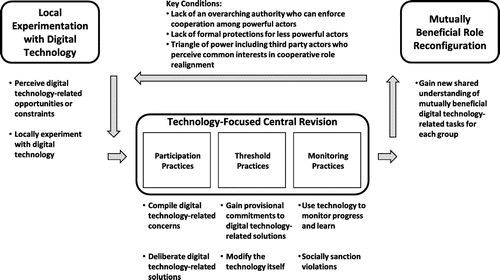
I describe the first cycle I observed in detail and the next two cycles I observed more briefly to elaborate the iterative local experimentation and central revision process that River actors used to accomplish mutually beneficial role reconfiguration during digital technology introduction and integration.
Cycle 1, Part 1: Doctor-Led Local Experimentation and MA Work Intensification Related to Integration of the Digital Technology
Seeing the Digital Technology as Offering New Opportunities and Presenting New Constraints
The first cycle of role reconfiguration during digital technology introduction and integration (cycle 1) began when River doctor team leaders, MAs, and managers attended a “Learning Session” held by the granting agency. During the Learning Session, doctor team leaders discussed implementing the digital technology, which they perceived would help them to deliver higher-quality, cost-effective primary care, with a focus on preventative care, especially for people with chronic health conditions, by flagging needed vaccines, diabetes testing, and pap smears. Although the department already used the EHR, which included the clinical decision support technology to flag these needs, no one in the department had previously used this digital technology, and using it required a significant change in workflow. Before this change, most of the MAs’ work was paper-based, and their use of the EHR was very limited.
Back at River, in their local care team meetings, doctors began to discuss the implementation of the vaccine feature of the digital technology. Although they were excited about the opportunity to both better deliver preventative care and free up their time to engage in complex work, they also highlighted what they saw as a constraint related to the technology. Doctors were concerned that the process for delivering vaccinations should not become so automatic that the technology rather than the doctors was deciding whether to deliver the vaccines. One doctor noted to local care team members:
“It gets challenging to automate that. That's where the rubber meets the road. I worry that [MA and MA] aren’t really trained well enough to discriminate those things.”
Engaging in Local Experimentation During Digital Technology Introduction and Integration
Doctors had goals that the digital technology made possible but difficult to achieve, so they changed local routines so they could still achieve their goals despite the constraints they perceived that the technology created for them. Doctors proposed a role reconfiguration in which MAs would do previsit work by using the digital technology to determine, the day before each patient’s visit, if the patient was due for vaccinations. MAs would use the digital technology to view any needed vaccinations (e.g., pneumovax) for each patient and record these on the doctors’ daily schedule for the following day. The next morning, the MA would consult each of their doctors about needed vaccines in a two- to three-minute huddle before the beginning of the session. The MA and the doctor would briefly review vaccinations due for each patient that the MA had marked on the daily schedule, and the MA would get their doctor’s approval before proceeding. The new process would allow the patient to receive necessary vaccinations before the patient went in to see the doctor, if the doctor was running late, reducing the likelihood that patients would leave the office before receiving needed vaccinations.
Experiencing Digital Technology-Related Work Intensification
This doctor-led, local experimentation intensified MAs’ work. Historically, MAs had not had digital technology-related previsit work, and they had not consulted with doctors during presession huddles about the recommendations that the digital technology provided. MAs had been very busy during days and times when they had doctors in session, but they had used the time when their doctors were not in session to catch up on non–visit-related work such as following up on calls from patients regarding their prescriptions. MAs now needed to use the technology to do previsit work the day before the patient visits to identify, for each patient coming in the next day, if the patient was due for vaccinations. The MA previsit work and consultation with the doctors in huddles meant that MAs had more work to do outside of rooming patients during clinic visits. One MA explained to me:
MA: Most days, we don’t have any downtime at all. When I started it was not as much work to be an MA. I take care of three regular docs and eight [trainees]. They don't all work every day, but I need to deal with all of their patients every day. Now there's a new MA role. Now I’m in charge of doing time-consuming previsit work [using the digital technology] and huddling [with doctors about the recommendations provided by the technology]. And nothing went away. Stuff was just added.
Yet, although MAs related their concerns about work intensification related to the use of the digital technology privately to me, they initially accepted the work intensification and did not voice their concerns to doctors in the local care team meetings. Instead, in the meetings I observed, the doctors did most of the talking, and the topics addressed were the ones that were of most concern to the doctors rather than those that were of most concern to the MAs. One MA told me: “The only thing that ever comes out of those meetings is more work for us.”
Perceiving an Opportunity for Mutually Beneficial Role Reconfiguration During Digital Technology Introduction and Integration
Managers became interested in cooperative role reconfiguration when, in response to the work intensification related to the use of the digital technology, two of the best MAs began to look for less stressful jobs elsewhere at River. The managers wanted to retain the best MAs in the primary care department because managers were responsible for maintaining a steady supply of MAs to provide clinical and administrative support to the doctors. One manager related:
I’m concerned that the MAs are thinking about leaving. It’s a problem with the amount of innovation and impact on their job. I was over the edge at the beginning of the week. [MA] is thinking about leaving. She’s thinking about going to work in oncology. Their work isn’t changing constantly. I’m worried about also losing [MA, other MA, and other MA]…. This is an emergency, and we need to stem the tide.
Cycle 1, Part 2: Manager-Led Central Revision Between Doctors and MAs Related to Integration of the Digital Technology
The key change that sparked the beginning of cycle 1, part 2 was that the managers began to lead a technology-focused central revision process that helped to negotiate a new shared agreement about doctors’ and MAs’ tasks related to integration of the digital technology. Central revision helped to address three problems—an MA participation problem that suppressed the identification of local, digital-technology-related problems, a doctor threshold problem, and a doctor free rider problem that stalled the implementation of potential digital technology-related solutions. These three problems arose because of the flexibility of the digital technology, the lack of formal protections for MAs, and the lack of an overarching authority who could enforce cooperation by doctors.
Compiling Digital Technology-Related Concerns and Deliberating to Address Participation Problems
The participation problem that arose in cycle 1 was that, although doctors included MAs in local meetings related to implementing the digital technology, in the absence of formal worker protections, MAs did not express their concerns about work intensification stemming from doctors’ role reconfiguration during digital technology introduction and integration for fear of sanction or termination. One MA related that MAs were scared of speaking up in meetings because they did not want to be labeled “troublemakers.” Another MA said:
“At the team meetings, there’s not an opportunity to speak your mind. Sometimes you are sitting there thinking, ‘Absolutely not’ but won’t say it out loud. You don’t want to be that person.”
To encourage MAs to voice their concerns related to the use of the digital technology, in order to facilitate collective problem solving, managers set up a new meeting structure for MA–manager staff meetings. In the first half of each staff meeting, they began to allow the MAs to meet with one another and without managers to discuss work process changes that could help to alleviate MA work intensification related to the use of the digital technology. A River manager told me that the managers had decided to do this because they heard that Lakeview, an organization of multiple suburban medical practices, had tried this meeting structure to great effect. Managers did not make this ostensibly small change lightly. They told me that they were concerned about “letting them all meet together and then tell us what we need to be doing.”
MAs compiled digital technology-related concerns with one another in the MA-only part of the staff meetings, and this allowed them to subsequently voice these concerns on behalf of the MA group. One MA said: “It’s easier to give feedback when it is from all MAs; if it’s just me telling [the managers], then it’s hard. Now no names need to be put out there, so no one worries.” Another MA noted: “Now, when we want something said, it can be worded as—a few of us are concerned—and we can figure out how best to say it so [the managers] will listen.”
In cycle 1, MAs’ primary digital technology-related concern was that doctors expected them to use the technology to do previsit work for the next day’s patients, and this required MAs to have free time outside of clinic time when their doctors were in session. The problem that arose was that, when MAs did not have doctors in session, MAs were often pulled off their teams to cover in the department’s blood laboratory. In the past, this had not been a problem because, when MAs did not have doctors in session, they had not been very busy. However, now the doctors expected the MAs to use the digital technology to do previsit work for the next days’ patients, and when MAs were rotated to cover in the department blood laboratory, the MAs did not have adequate time to do this. As one MA said in an MA-only meeting:
It’s crazy. If I've got three doctors and full schedules then I'm just doing that…It’s really stressful, but then I think to myself, okay I'll have a block of time free and I can do previsit work [using the digital technology] then. But then, in the lulls, I get pulled into the laboratory…When we’re pulled to the laboratory, that’s a problem because we’re counting on that time to catch up on previsit work.
MAs voiced this digital technology-related concern to managers in the second half of staff meetings between MAs and managers. This enabled deliberation of potential digital technology-focused solutions between MAs and managers and, in cycle 1, led MAs and managers to identify a particular solution to the problem of MA work intensification related to use of the digital technology. MAs would use the vaccine feature of the technology to flag needed vaccinations for the patients of all the doctors on their team as long as managers no longer rotated MAs to cover in the department blood laboratory. From my fieldnotes of an MA–manager meeting:
MA: Our biggest concern is that, when we get pulled to cover, we’re not getting our previsit work [using the digital technology] done. Floating takes a huge amount of time. Then we’re behind when we come back…
Manager: I hear you that MAs need protected time when physicians aren’t in. You need [to use the digital technology] to be prepping for the next session…We need to make sure that every MA has the opportunity to do the previsit work required to identify which patients are due for what…If I make commitment, I want to be true to it. So, let me not respond right away, and I’ll see what I can do on this.
Gaining Provisional Commitments and Modifying Technology to Address Threshold Problems
The solution of managers no longer rotating MAs to cover in the department blood laboratory required doctors to send their patients downstairs to the hospital blood laboratory whenever the department blood laboratory was short staffed. However, this proposed solution presented a threshold problem—it required cooperation by a sufficient number of doctors in order to be effective. If enough doctors cooperated, managers could efficiently run the department blood laboratory whenever it was short staffed without rotating MAs to cover in it. However, a sufficient number of doctors might not agree to send their patients downstairs for labs.
Managers addressed the threshold problem by gaining a provisional commitment from team leader doctors to this proposed new local routine and then modifying both the local routine and the EHR technology itself in response to learning from initial attempts. The team leader doctors were, at first, concerned that sending patients downstairs would both inconvenience patients and lead doctors to be kept waiting, thereby interfering with the smooth running of doctors’ clinic schedules. However, the team leader doctors were willing to agree to provisionally commit to the solution, because they saw this move as allowing MAs to free up time to use the digital technology. From my field notes of a manager–team leader doctor meeting:
Manager 1: The MAs are willing to do the previsit work [using the digital technology] and huddling around vaccines. But, they can’t get to it when they’re always being pulled to cover in the [department’s blood] lab. So what we want to try is sending patients downstairs for labs when we don’t have staff.
Team leader doctor 1: Ha. [Resistant doctor on his team] is just going to love being kept waiting while his patients sit around on the 2nd floor [blood laboratory]…
Team leader doctor 2: The problem is that we’ve got momentum [around MAs using the technology to do previsit work and huddling], and that would be uprooted if we don’t find a way to handle this…
Manager 2: We’ll send out an announcement and tell everyone that this is just a pilot. If it comes up in your meetings, it would be great if you could explain why we’re doing it.
Team leader doctor 3: And that we can always change back if it doesn’t work.
From doctors’ initial attempts to send patients downstairs to the hospital blood laboratory when the department’s laboratory was short staffed, managers and doctors learned that doing so worked well as long as a patients had their visits the same day, but that it did not work well for patients who needed to come in for routine laboratory tests without a visit. Because of the way the EHR was configured, River’s primary care patient labels could not be printed in the downstairs laboratory. Therefore, River patients had to come to the department to get labels printed before going down to the laboratory. From my field notes of a manager–team leader doctor meeting:
Team leader doctor 1: The [sending patients downstairs to the blood] laboratory thing isn’t working well. The patients have to come here to get labels printed before going down. We can’t tell them to go right there, even if we know they need labs…
Team leader doctor 2 [suggests going back to the historical arrangement]: Let’s just do whatever it takes to keep our own blood laboratory open…
Manager 1: When we’re short staffed in the lab, and we rotate MAs to cover, they don’t have time to do their previsit work [using the digital technology].
Manager 2: We can solve this. Let me talk to [IT] to figure out a way [to modify the EHR] for our patients to go directly there instead of coming here first [for labels].
Managers altered the technology itself to address this problem. They worked with IT staff to modify the EHR so that labels for River patients could be printed in the downstairs blood laboratory.
Using Technology to Monitor and Socially Sanctioning to Address Free Rider Problems
During this central revision process between managers, doctors, and MAs in cycle 1, a free rider problem arose. Doctors and MAs would all benefit from MAs using nonclinic time to do previsit work (using the vaccine feature of the digital technology to flag needed vaccinations) rather than rotating to cover in the department blood laboratory. Yet, in the absence of an overarching authority who could enforce doctor participation in sending their patients downstairs for labs, it was better for each individual doctor if other doctors bore this cost of potentially waiting for their patients to return from the downstairs laboratory.
Managers addressed the free rider problem by monitoring electronically whether doctors were sending their patients downstairs to the blood laboratory. Through this monitoring, managers learned that particular doctors were not doing this, and managers told the team leaders which doctors were not cooperating. Team leader doctors emphasized in their local care team meetings that there was a new agreement that doctors would send their patients downstairs when the department laboratory was short-staffed and that, although some of the team doctors were doing it, the team leader doctors wanted to increase the percent of doctors on their teams who were doing it. One team leader doctor explained:
We’re never going to get all of [the doctors] to do it. But, when I told them that our team is doing worse than the other teams, that helped light a fire…Now most of them are doing it.
Cycle 1, Part 3: Mutually Beneficial Role Reconfiguration
Through the use of this local experimentation and central revision process in cycle 1, doctors, MAs, and managers accomplished mutually beneficial role reconfiguration during digital technology introduction and integration. MAs began to take time to use the vaccine feature of the digital technology to identify needed vaccines and highlight them during huddles for all their assigned doctors. Reports from doctors, MAs, and managers suggested that they each benefitted from this cooperative role reconfiguration:
Doctor: Before I’d have to review the record, and order [the vaccine] post visit. Now a lot of that is getting done previsit [by my MA using the digital technology], so it’s not getting missed.
MA: I like huddles because it helps me know specific things about each patient. I bring my list of what to do with each patient [based on the digital technology’s recommendations]. I tell the providers what the patient needs, and they add things…that helps me keep everything running [smoothly].
Manager: We haven’t lost any more MAs.
Additional examples of Cycle 1 experimentalist governance practices are provided in Table 1.
In what follows, and in Figure 1, I summarize the local experimentation and central revision that occurred in cycle 2 and cycle 3 to demonstrate how the use of a process of experimentalist governance of digital technology introduction and integration allowed for the iterative accomplishment of mutually beneficial role reconfiguration at River. Supporting data for this high-level overview is provided in Tables 2 and 3.
|

Table 1. Supporting Data for Experimentalist Governance of Digital Technology in Cycle 1
| Practice | Description | Illustrative data | |
|---|---|---|---|
| Cycle 1, part 1: local experimentation | |||
| Professionals engage in local experimentation with digital technology | Doctors realign MA work to include digital technology-related previsit work and huddling | From my fieldnotes of a local care team meeting: Doctor: The MAs could use the [digital technology to flag needed vaccinations] and tell the patient, ‘You’re due for your tetanus vaccine,’ and the patient could get the vaccine before seeing the doctor. | |
| Less powerful actors experience work intensification | MAs experience work intensification related to tasks added without tasks removed | MA: Right now we’re swimming and barely keeping our heads above water. We are supposed to be prepping for the huddle [using the digital technology]. And [the doctors are] still adding more work. | |
| Newly powerful third-party actors perceive common interests in cooperative role reconfiguration | Managers are concerned about the best MAs leaving | Manager: It’s going to become a revolving door of MAs if we’re not careful. | |
| Cycle 1, part 2: central revision | |||
| Compile digital technology-related concerns and opportunities | MAs identify that floating to department laboratory does not allow for MA previsit work using the technology | From my fieldnotes of an MA-only meeting: MA: When you get pulled [to cover the laboratory or another team], they think it is free time, downtime, but you get pulled and nothing is getting done. You’ve waited for that day to get your previsit work [using the digital technology] done, and then you’re in the laboratory for half the day. You may say, “OK Tuesday morning only have one provider, so I’ll do it then,” but then you get pulled. | |
| Deliberate digital technology-related solutions | MAs and managers deliberate key solution of no more MA floating by closing dept. blood laboratory when it is short-staffed | Manager: Now the MAs actually speak up and tell us what they think…Because doctors aren’t in the room, they’re willing to tell us a full range of things they think might work [to alleviate work intensification related to digital technology use]…even if they think doctors won’t like it…It was their idea to get doctors to send patients downstairs rather than rotating MAs to cover in the [department’s blood] laboratory. | |
| Gain provisional commitments to digital technology-related solutions | Doctors provisionally commit to send patients to the downstairs laboratory when department laboratory is short-staffed | Doctor: One of the things we agreed to try was to pilot sending patients downstairs to the laboratory. There’s no way I would have gotten all the doctors in my team to agree to that. But we needed to do something, [so some of us agreed to try it]. | |
| Modify the technology itself | Managers work with IT to modify technology to print labels at downstairs laboratory | From my fieldnotes of a manager-team leader doctor meeting: Team leader doctor: There seem to be some arbitrary rules. Like patients can’t get labels [directly at the downstairs laboratory]. That seems crazy…If all [a patient] needs is to get this laboratory checked in 6 months, they just need this blood drawn, then they shouldn’t have to come here first…Manager: I’ll work with IT to get that changed. | |
| Use technology to monitor progress and learn | Managers monitor doctors by tracking downstairs laboratory visits | Manager: [Doctor] always says that he's just sending one person [to the department laboratory when it is short staffed], but it’s never just one person…We can see from the data that he’s not ever sending his patients downstairs. | |
| Socially sanction violations | Team leader doctors bring up in local team meetings that not all doctors on the team have been cooperating | Team leader doctor: I don’t confront anyone directly. I just bring up that the data show that we haven’t all been sending our patients to the downstairs laboratory, and that we need to start doing that so that the MAs have time to do previsit work [using the digital technology] and huddle. | |
| Cycle 1, part 3: mutually beneficial role reconfiguration | |||
| For doctors | More time for complex patient work | Doctor: Now that [MA] is flagging vaccinations, that’s one less thing I need to do. | |
| For MAs | Adequate pace of work, new skills | MA: I like learning new things. It is nice to be doing something in addition to prescriptions and vital signs. It’s good to learn how to [use the digital technology] to see what they need. | |
| For managers | Prevention of further MA turnover | Manager: We seem to have stopped the [MA] turnover, so let’s keep it up. | |
|
Table 2. Supporting Data for Experimentalist Governance of Digital Technology in Cycle 2
| Practice | Description | Illustrative data |
|---|---|---|
| Cycle 2, part 1: local experimentation | ||
| Professionals engage in local experimentation with digital technology | Doctors realign MA work to include handling digital technology-related exceptions and patient questions, and begin to overload the permanent MAs | From my fieldnotes of a doctor-only meeting: Doctor: “It’s a lot to keep track of the exceptions [between what I want and what the digital technology recommends], and you can’t expect a temp to do it. Doing everything required to flag the correct immunizations [by not only using the digital technology, but also searching for additional information in the patient’s electronic medical record] is too high level for a temp… |
| Other doctor: One of our MAs is getting overloaded, because she’s doing previsit work [using the digital technology] and huddling [to communicate digital technology-related results to the doctors] for more than half the team [of doctors]…We’ve got a temp on the other side. | ||
| Less powerful actors experience work intensification | Permanent MAs experience work intensification related to overloading and explaining | MA: All [the temps] know is how to room patients. They don’t know how to do previsit work [using the digital technology], so everyone comes to me for everything…It’s double the workflow, because I’m covering both sides of the team. |
| Newly powerful third-party actors perceive common interests in cooperative role reconfiguration | Managers are concerned about the best MAs leaving and about dissatisfied patients | Manager: We’re giving the physicians an inch, and they’re taking a mile. They’re overloading the MAs who know how to do the previsit work...and now, they’re [also] asking them to explain things to patients [about which tests and vaccines the patients are due for]…if we’re not careful, the best MAs are going to leave. They’re not going to stick around when the work is a lot less stressful elsewhere. |
| Cycle 2, part 2: central revision | ||
| Compile digital technology-related concerns and opportunities | MAs identify that permanent MAs are being overloaded, that pneumovax and shingles algorithms require addtl work, that MAs on one team are required to print vaccine info sheets | From my fieldnotes of several different MA-only meetings: MA: The temps are only rooming patients. So, it’s double the workflow, if one of us is covering all of the previsit work for both sides of the team… |
| MA: Now we’re being asked not only to explain things to patients but also [use the newly modified technology to] print out a copy of what TDAP is and put that in the packets. So that [the patients] can read it while they are waiting. | ||
| Deliberate digital technology-related solutions | MAs and managers deliberate key solutions of replacing temps with permanent MAs, reprogramming two algorithms, MA training, and rolling out the info sheet capability dept-wide | From my fieldnotes of an MA-Manager meeting: MA: There’s something wrong with pneumo [rules built into the digital technology]. So every time pneumo gets flagged, we need to go in [to the patient’s EMR] and check [when the patient received] the last pneumo… |
| Manager: I’ll talk to the doctors about fixing pneumo [algorithm to better match doctors’ personal guidelines for the pneumo vaccination] | ||
| Gain provisional commitments to digital technology-related solutions | Doctors provisionally commit to interviewing permanent MA candidates and to reprogramming these two algorithms | From my fieldnotes of a manager-team leader doctor meeting: Manager [in a manager-team leader doctor meeting]: Our problem is that we have some good MAs and then a bunch of temporary people. The good MAs have stepped up to bat [to help doctors who are not assigned to them with previsit work], but are overwhelmed…. |
| Team leader doctor: We’ve got momentum, and that would be uprooted if [our permanent MA] stopped doing previsit work for all of [our team’s doctors]. | ||
| Other team leader doctor: I don’t want to go back to MAs not using [the digital technology], just because we've got a shortage of good MAs. We’re trying to move things forward…. Rather than pull back, why don’t we figure out how to get the right MAs… | ||
| Manager: We’re willing to go out and find good permanent MAs to replace the temps, but we’ll need your help with interviewing. | ||
| Modify the technology itself | Managers work with IT to reprogram the two algorithms and allow for printing vaccine information sheets dept-wide | From my fieldnotes of a manager-team leader doctor meeting: Manager: The question is, do you want an incredibly complex [pneumovax] algorithm or do you want to make it less complex, but also give the doctor some information to make their own decision…We also need to decide if we want to err on the side of sensitivity or specificity…We can have the reason why a patient is not qualifying for pneumovax appear on the front sheet, so that then the doctor can see if they think that's a good reason… |
| Team leader doctor: When the decision rules become complicated, I'd rather be able to see the information, rather than build that into an algorithm. | ||
| Team leader doctor: [I disagree]. I don't like to have anything on that face sheet that goes to the patient. If pneumo shows up, then the patient sees it and says how come I don't get a Pneumovax? Then, I spend a lot of time explaining it to them… | ||
| Manager: There could be a prompt in health maintenance [which is not patient-facing]. | ||
| Team leader doctor: You can do that. Just please don't put on the face sheet. | ||
| Manager: OK, I’ll talk to [contact in IT]. We’ll err on the side of sensitivity and I'll investigate that health maintenance page. | ||
| Use technology to monitor progress and learn | Managers track which doctors are not doing candidate interviews | From my fieldnotes of a manager-team leader doctor meeting: Manager: I’ve been working really hard to recruit for permanent positions. One of challenges is I have a candidate and want to bring her in, but [doctor] isn’t making time for interviews. He says he can only do it during a certain timeframe on a certain day in a certain window, and he keeps pushing it back…We’re committed to filling the temp positions with permanent MAs, but we need your help. |
| Socially sanction violations | Team leader doctors socially sanction peers who are not setting aside time to do interviews by using “personal detailing” | From my fieldnotes of a manager-team leader doctor meeting: Team leader doctor: I’ll talk to [doctor who is not setting aside time to interview]. |
| Cycle 2, part 3: mutually beneficial role reconfiguration | ||
| For doctors | More time for complex patient work; more highly skilled clinical and administrative support | Doctor: I’m so excited that we’re doing this. One of my patients who has refused pneumovax for years has now said yes [because my MA explained to her why she needed to get the vaccine]. |
| For MAs | Adequate pace of work, new skills | MA: Now that we’ve been trained on the vaccines, we can get the conversation started with the patient. Even if they say No to us, when they [later] hear about it from the doctor, they’ve already had a chance to think about it. |
| For managers | Prevention of further MA turnover; improved patient satisfaction now that patients are receiving information about vaccinations | Manager: MAs are really stepping up and doing a lot of preparation for the huddles. They’re [using the digital technology to see] what patients need ahead of time, and making sure [the patients] get it. |
|
Table 3. Supporting Data for Experimentalist Governance of Digital Technology in Cycle 3
| Practice | Description | Illustrative data |
|---|---|---|
| Cycle 3, part 1: local experimentation | ||
| Professionals engage in local experimentation with digital technology | Doctors realign MA work to include technology-related idiosyncratic tailoring and extending work | From my fieldnotes of a local care team meeting: Doctor: I'm not convinced that [MA1] doing this is really saving me time... With [the pap smear feature of the digital technology], I’ve been going through that ahead of time anyway. We can set up ourselves. |
| Other doctor: I think we should let [MA and other MA] talk individually to their doctors about how we each to do it… | ||
| Doctor: I’m just thinking of what else could come off of our plate. [MA and other MA] should not only look at the flags [using the digital technology], but also do the orders. And then I can see another patient that day. We’re being asked to increase our panel size and access, and this will allow us to fit in more patients. The visit will cost less. Now I’m spending 15 minutes a day doing routine order entry for this, and it’s not intellectually or technically needed…This will give us more time for counseling and complex stuff… | ||
| Less powerful actors experience work intensification | MAs report work intensification related to tailoring and extending | MA: Now that we’re doing previsit work [using the digital technology], my doctors seem to want to hand off everything to me. And, there’s no standard regarding what’s OK to hand off and what isn’t. No one is keeping track of that. |
| Newly powerful third-party actors perceive common interests in cooperative role reconfiguration | Managers are concerned about lack of efficiency | Manager: It’s not efficient for the MAs to be doing deep dives [into patient charts] as part of their previsit work. |
| Cycle 3, part 2: central revision | ||
| Compile digital technology-related concerns and opportunities | MAs identify problem of unclear work and performance expectations related to the digital technology, and that one team’s doctor has modified the technology to print “face” sheets | From my fieldnotes of several different MA-only meetings: MA: One problem with telling us that we need to do this [additional work] is that there are no standard expectations for the doctors. Like huddling. [Doctor] doesn’t want to huddle. I take the time to do previsit work on his patients the day before he comes in. For diabetes testing, I [use the digital technology to] highlight the patients overdue for testing, and even put in the requisitions for laboratory tests for him to sign off on, but then the patients come back with no signed requisitions. We’re being evaluated on this. But we don’t have control over it. It depends on whether the doctor is doing it or not… |
| MA: One of our doctors has [modified the digital technology to provide] a health maintenance summary and face sheets, so we don’t need to go into the [EHR]. [The recommended vaccines and tests] print out automatically. | ||
| Deliberate digital technology-related solutions | MAs and managers develop key solutions of developing MA standard work, instituting new performance review process, and making “face” sheet printing available dept-wide | From my fieldnotes of an MA-Manager meeting: MA: What does it take to get a 5 [highest evaluation] now that we’re supposed to be doing previsit work [using the digital technology] and huddling?... If we don’t get a 5, tell us why we didn’t. What is it that we are not doing? |
| Gain provisional commitments to digital technology-related solutions | Doctors provisionally commit to limiting MA requests and evaluating MA performance according to standard work | From my fieldnotes of a manager-team leader doctor meeting: [Manager hands out the preliminary MA standard work around the digital technology]. |
| Team leader doctor: Can we edit some of the stuff? Everyone’s MA is doing different previsit work. | ||
| Manager: We don’t have a perfect way to do it. My thought is that if this group is regularly meeting and discussing, we can come to a consensus of the best way, and revise accordingly. | ||
| Modify the technology itself | Managers work with IT to modify the information included on the “face” sheets and make this capability available dept-wide | From my fieldnotes of a manager-team leader doctor meeting: |
| Team leader doctor: [Doctor in our pod has modified the technology. So] one thing we’re doing in our pod is having the MAs print out the health maintenance page, and review both the front sheet and the health maintenance page. This allows them to catch all immunizations without going into to the chart. Before, they were going to the chart to look at the health maintenance text. Now they're getting it printed on the previsit form, so it's saving a lot of time…. | ||
| Manager: We could do that practice-wide, but we’d need to [make that modification to the technology available to] the other teams. I'll follow-up with [person in the IT department]. | ||
| Use technology to monitor progress and learn | Managers track which doctors are not limiting MA requests | From my fieldnotes of a manager-team leader doctor meeting: |
| Team leader doctor: Huddling is going well. The MAs who were below the bar starting to take more charge. One thing that's been surprising is one of the physicians [on my team] has taken the opportunity to get a lot of scut off their plate onto the MA. | ||
| Manager: Somebody needs to confront that provider. | ||
| Team leader doctor: I feel comfortable addressing a lot of things as a [team leader doctor], but I don't feel comfortable addressing team politics. I'm happy to do innovation work and huddles, but when it comes to team politics and someone's overusing an MA, I'm not the one who should be dealing with that. | ||
| Manager: We need to get some ammunition to go to the doc who’s overusing that MA. | ||
| Socially sanction violations | Team leader doctors socially sanction peers who are not limiting requests by presenting MA time spent per doctor | From my fieldnotes of a manager-team leader doctor meeting: |
| Team leader doctor: [I did what you all suggested regarding tracking MA time per doctor]. We showed that most MAs were taking 10 minutes, 10 minutes, 10 minutes, [using the technology to do the previsit work needed to prepare for huddles], and then this one MA was taking 50 minutes or more….It was delicate. [That doctor] got defensive….We took the next meeting to talk about the list of things we want the MAs to do. [MAs tasks should be limited to standard work. So] it should be a 5 to 7- minute huddle, max. | ||
| Cycle 3, part 3: mutually beneficial role reconfiguration | ||
| For doctors | More time for complex patient work; more MA proactive suggestions during digital technology introduction and integration | Doctor: This process has allowed our MA and me to be more collaborative. Now she’s part of the process. She's now bringing stuff into my office. And I'm coming to her and saying I need your expertise on this. |
| For MAs | Adequate pace of work, clear scope of work, clear performance expectations | MA: Doing previsit work [using the digital technology] and huddles has made a huge difference. It’s given us an opportunity to discuss the patients for the day. It’s brought us together…We like each other and work well together. |
| For managers | Improved efficiency; increased MA engagement | Manager: When [the MAs] tell me something, I follow up on it. I make a concerted effort to do that. In the [MA staff] meetings and follow-up meetings. Before, I would ask for their opinion [in those meetings], and no one would say anything. Now they’re really engaged. |
Cycle 2, Part 1: Doctor-Led Local Experimentation and MA Work Intensification Related to Integration of the Digital Technology
Once MAs began to use the vaccine feature of the digital technology to identify needed vaccines and highlight them during huddles for their assigned doctors, doctors identified two new technological constraints that sparked cycle 2 (detailed in Figure 1 and Table 2): discrepancies between doctors’ own personal guidelines for vaccinations and the guidelines built into the digital technology; and patients, resistance to receiving the recommended vaccines before discussing them with their doctors during the doctor visit.
To address the first constraint, doctors experimented in their local teams with a role reconfiguration in which, when there were discrepancies between doctors’ own personal guidelines for vaccinations and the guidelines built into the digital technology (e.g., for the shingles vaccine and pneumovax vaccine), MAs would also double check particular information contained in the patient’s electronic medical record before flagging the need for vaccines. In addition, to address the problem of resistant patients, some doctors began to ask their MAs to explain to patients the need for particular vaccinations.
Doctors found that the permanent MAs were able to keep track of discrepancies between what the digital technology dictated and what each of their doctors wanted them to do and to provide patients with basic information about the vaccines, but that temporary MAs often did not have the skills to do this. Thus, doctors who were assigned to work with temporary MAs began to redirect work away from their assigned temporary MA toward the permanent MA on their team, despite the fact that these permanent MAs were assigned to support a different set of doctors. Thus, the doctor-led, local experimentation intensified work for MAs overall and especially for permanent MAs. Historically, MAs had not gone into patient records to find information, and they had not played any role in persuading patients to get necessary vaccines.
As MAs began to experience work intensification associated with this overloading, managers continued to worry about the best MAs leaving. In addition, the managers were concerned that patients would be dissatisfied when they were told by MAs to receive vaccines before meeting with their doctors. Managers sought information from MAs about the details of the in situ use of the digital technology so that managers could help address these problems.
Cycle 2, Part 2: Manager-Led Central Revision Between Doctors and MAs Related to Integration of the Digital Technology
The MA-only part of the staff meetings allowed the MAs to identify and compile digital technology-related concerns and subsequently voice them on behalf of the MA group. These discussions highlighted that, on one team, a doctor had modified the technology so that the MAs on that team could print out information sheets for each of the common vaccines. On the one hand, this reduced the frequency of patient questions about the need for particular vaccines. On the other hand, it intensified work for the MAs on this team because it formalized the expectation that MAs on this team would both put these information sheets into each patient’s packet the night before and answer any additional questions that patients had about the vaccines.
In the MA–manager part of the staff meetings, deliberation between MAs and managers led them to identify several solutions to the problem of MA work intensification related to use of the digital technology. First, managers could reprogram the two algorithms (for shingles and pnemovax vaccines) that were the source of most of the discrepancies. Second, they could replace temporary MAs with permanent MAs. Third, they could reconfigure the technology so that MAs on all teams could print out vaccine information sheets. Finally, they could train the MAs on the reasons for the different vaccines.
However, these proposed solutions presented two threshold problems. First, replacing temporary MAs with permanent MAs required a sufficient number of doctors to participate in time-consuming interviewing of MA candidates. Managers addressed the threshold problem by working with one of the team leader doctors to persuade the doctors on her team to do the interviewing required to replace the temporary MA on their team. The team leader doctor did this, and it demonstrated that this solution really did address the MA work intensification problem. Consequently, the team leader doctors on other teams staffed by temporary MAs became willing to persuade doctors on their own teams to set aside time for interviewing.
Second, reprogramming the two algorithms that resulted in most of the discrepancies required a sufficient number of doctors to agree to the new decision rules. Doctors perceived that modifying the decision rules for the shingles vaccine was quite straightforward; the vaccine feature of the digital technology flagged patients over 50 (U.S. Food and Drug Administration approved), and team leader doctors agreed that it should instead flag patients over 60 (recommended by Advisory Committee on Immunization Practices). However, the new decision rules for the pneumovax algorithm were more complicated and more contested.
After much deliberation with team leader doctors in the manager–team leader doctors’ meetings, managers addressed this threshold problem by working with the IT department to change the digital technology so that it not only included new decision rules but also provided doctors with information, in a nonpatient facing part of the EHR, on why the patient was not qualifying for pneumovax. This allowed doctors to check whether they agreed with the pneumovax recommendation provided by the digital technology.
During this central revision between doctors and MAs in cycle 2, a free rider problem arose. Although doctors and MAs would all benefit from replacing temporary with permanent MAs, without an overarching authority to enforce doctor participation in interviewing for new MAs, some individual doctors preferred to let other doctors on their teams do the interviewing. Managers used technology to monitor which doctors were participating in the interviewing and told the team leader doctors which doctors on their teams were not interviewing permanent MA job applicants. Team leader doctors talked offline to doctors on their team who were not cooperating and, in the words of one team leader doctor, “used a little personal detailing,” to encourage them to set aside time for interviewing MA candidates.
Cycle 2, Part 3: Mutually Beneficial Role Reconfiguration
After several months, the managers had replaced all the temporary MA positions with permanent MAs, reconfigured the technology to allow for department-wide printing of vaccine information sheets, and worked with the information technology (IT) department to build new decision rules for shingles and pneumovax into the digital technology. In turn, doctors stopped asking MAs not assigned to them to use the digital technology to do previsit work for them. In addition, MAs were trained in the reasons why patients qualified for the various vaccines and began to answer patients’ questions about the need for particular vaccines. They also used the modified technology to print information sheets on required vaccinations and put them into each patient’s packet, reducing patients’ questions about the need for particular vaccines. Once managers helped to reduce MA work intensification by renegotiating the shared agreement of each group’s tasks related to the digital technology, MAs regularly performed previsit work around, consulted with the doctors on, and offered explanations to patients for all the different vaccinations. Reports from doctors, MAs, and managers suggested that they each benefited from this cooperative role reconfiguration.
Cycle 3, Part 1: Doctor-Led Local Experimentation and MA Work Intensification Related to Integration of the Digital Technology
Next, some doctors began to ask their MAs to use the digital technology to do the previsit work and consultation around diabetes testing and pap smears, as well as around vaccinations. This sparked cycle 3 (detailed in Figure 1 and Table 3) by raising a new technological constraint—differing doctor views of the usefulness of the diabetes and pap smear features. Although many doctors supported the use of all three features—vaccines, diabetes testing, and pap smears—some were not sure whether the additional two features were, in fact, useful to them.
To address their differing perceptions regarding technology usefulness, doctors in local care team meetings proposed a role reconfiguration in which MAs would tailor their use of the digital technology to particular doctors. For example, some doctors wanted their MAs to use the technology to identify needed pap smears and set up the pap smear materials ahead of the visit, whereas other doctors wanted to do this themselves. As multiple doctors began to tailor and extend MA work related to the digital technology, norms about what was appropriate for doctors to ask MAs to do became unclear, leading doctors to ask MAs to do an even broader range of new tasks (e.g., asking MAs to input orders for vaccines and tests) that intensified MAs’ work.
Cycle 3, Part 2: Manager-Led Central Revision Between Doctors and MAs Related to Integration of the Digital Technology
The managers sought to reconfigure roles by delineating MA standard work related to use of the digital technology, both to reduce MA work intensification and to help managers shape the use of the technology to be consistent with managerial goals around cost, quality, and PCMH reform implementation. Although doctors included MAs in local care team meetings related to using the pap smear and diabetes testing features of the digital technology, MAs did not initially express their concerns about work intensification stemming from tailoring their technology use to each doctor and from extending their digital technology-related work depending on a doctor’s idiosyncratic needs. The MA-only part of the staff meetings developed in cycle 1, however, allowed the MAs to identify these digital technology-related concerns and subsequently to voice them on behalf of the MA group.
MAs suggested that the managers should clarify which tasks MAs were expected to do using the digital technology and that all doctors should ask the MAs to do only those tasks. Managers agreed and referred to these tasks as “MA standard work.” Because MAs were worried that they would be negatively evaluated if some of their doctors refused to implement some features of the technology or tried to implement them in a different way than their other doctors, MAs further suggested that a new performance review process was needed.
In these meetings, MAs also discovered that MAs on one team were using “face sheets” (documents that gave a patient’s key information at a quick glance) to see what required vaccines and tests the digital technology had flagged, which was much quicker than MAs going into the EHR to see this. Managers investigated and found that a doctor on that team had modified the digital technology for the doctors on his team so that MAs could print out a face sheet for each patient that provided information on flagged vaccines, pap smears, and in-visit diabetes testing. The MAs suggested to the managers that MAs on all the teams use such face sheets to see flagged vaccines and tests rather than going into the EHR for this.
These suggested solutions presented new threshold problems. In order to establish MA standard work related to digital technology use, a sufficient number of doctors had to cooperate by limiting their requests to MA standard work rather than making idiosyncratic requests of their MAs. In addition, for the new MA performance review process to be successful, a sufficient number of doctors needed to evaluate their MAs according to their performance of only MA standard work tasks.
Managers obtained provisional commitments from team leader doctors around limiting their idiosyncratic requests, helping to implement the MA standard work, and holding MAs accountable for only MA standard work in MA annual performance reviews. Managers also obtained the provisional commitment from team leader doctors to try having their MAs use the now modified face sheets to identify which vaccines and tests had been flagged by the digital technology rather than having them go into the EHR to check this. This required deliberation between managers and team leader doctors because the face sheet, as initially reconfigured by the doctor on the one team, did not provide some of the nuanced information that some doctors liked the MAs to use the digital technology to retrieve. Managers worked with team leader doctors to negotiate what information should appear on the modified face sheets, and with the IT department to reconfigure the technology to include this additional information on the face sheets and to make the face sheets available to all teams.
During this central revision between doctors and MAs in cycle 3, a free rider problem arose. In the absence of an overarching authority who could enforce doctor limiting of requests to the new MA standard work, it was better for individual doctors not to limit their requests but to let other doctors on their team do so. Managers monitored progress by asking MAs to self-report on a tracking spreadsheet how they were doing vaccines, diabetes testing, and pap smears for each of the doctors on their teams and what other tasks they were doing related to use of the digital technology. Managers then informed the team leader doctors which doctors on their teams were not limiting requests. Through this monitoring, managers learned that one doctor was requiring his MA to do “deep dives” into the patient charts to retrieve additional information. Further inquiry revealed that the MA was doing over an hour of previsit work each day for this one doctor.
Managers subsequently brought this up in a manager–team leader doctor meeting, but the team leader doctor on this team was uncomfortable directly confronting this doctor. The managers and other team leader doctors proposed that this team leader doctor should ask the MAs on her team to track how long they were spending on doing previsit work for each doctor as a way to highlight the discrepancy, and to review that data in a care team meeting. The team leader doctor did this and reported back in a manager–team leader doctor meeting that, although she found it uncomfortable to review the data in a care team meeting, she had done so, and the offending doctor had stopped asking for these additional tasks.
Cycle 3, Part 3: Mutually Beneficial Role Reconfiguration
Through this local experimentation and central revision, doctors eliminated their idiosyncratic requests for MA work related to use of the digital technology, began to evaluate their MAs according to their performance on only MA standard work tasks, and began to allow their MAs to use the modified face sheets to see what vaccines and tests the technology had flagged. Once managers helped to reduce MA work intensification by renegotiating the shared agreement of each group’s tasks related to the digital technology, MAs began to regularly do previsit work around and consult with all their assigned doctors around vaccinations, diabetes testing, and pap smears. Reports from doctors, MAs, and managers suggested that they each benefitted from this cooperative role reconfiguration. They also noted that their new practices would likely raise new digital technology-related constraints that would need to be addressed, suggesting the need for further cycles of experimentalist governance of digital technology.
Discussion
This study provides a model of experimentalist governance of digital technology (Figure 2) to demonstrate how mutually beneficial role reconfiguration during digital technology introduction and integration can be accomplished through an iterative process of digital technology-focused local experimentation followed by central revision. In this process, first, local actors experiment to adapt digital technology to their local contexts. Next, a central unit composed of diverse actors addresses loss of autonomy and work intensification for less powerful actors that has been brought about by this local experimentation; the unit uses a central revision process to solve digital technology-related participation problems, threshold problems, and free rider problems. Central actors address digital-technology participation problems by using a meeting structure that facilitates less powerful actors compiling technology-related concerns and deliberating potential solutions. Central actors address digital technology-related threshold problems by gaining incremental provisional commitments from both more powerful and less powerful actors, and by modifying the digital technology itself to attempt solutions to the technology-related concerns. Finally, central actors address digital technology-related free rider problems by using technology to monitor compliance with and learn from implementation of the proposed solutions, and by using social sanctions to control opportunism. This central revision process, in turn, allows for the negotiation of a new shared understanding of mutually beneficial digital technology-related tasks for each group, and the cycle repeats.
I elaborate on the significance of this model in three different areas. First, I discuss how, because of key characteristics of digital technologies, avoiding loss of autonomy and work intensification for less powerful actors during digital technology introduction and integration in contemporary organizations can present a multisited collective action challenge. Digital technology-related participation problems, threshold problems, and free rider problems may arise during role reconfiguration that enable loss of autonomy and work intensification for less powerful actors. Second, I elaborate how the emergence of new triangles of power in our contemporary economy may afford the possibility for novel coalitions that can help mitigate this problem. Third, I examine how mutually beneficial role reconfiguration during digital technology introduction and integration in contemporary organizations may be better accomplished through an experimentalist, multisited collective action process than through a labor-management bargaining process or a professional-led tuning process.
Mutually Beneficial Role Reconfiguration During Digital Technology Introduction and Integration Presents a Multisited Collective Action Challenge
Scholars studying digital technology introduction and integration in incumbent organizations have highlighted several barriers to mutually beneficial role reconfiguration: lack of trust between managers and workers (Kochan et al. 2013), challenges to professional logics (Berente and Yoo 2012, Berente et al. 2016, Lifshitz-Assaf 2017) and jurisdictions (Mazumanian et al. 2013, Barley 2015, Pine and Mazmanian 2015, Kellogg et al. 2020a), professionals’ unintentional neglect of less powerful actors (Hinds and Bailey 2003, Hinds and Mortensen 2005Mazmanian, Orlikowski and Yates, 2013), and professionals’ intentional hiving off of less valued tasks to less powerful actors (Bailey et al. 2012, DiBenigno and Kellogg 2014, Truelove and Kellogg 2016, Galperin 2020).
I demonstrate that, because of key characteristics of digital technologies such as loose coupling, reprogrammability, and distributedness, accomplishing mutually beneficial role reconfiguration during digital technology introduction and integration presents a multisited collective action problem in which three additional barriers can arise: digital technology-related participation, threshold, and free rider problems. The digital technology-related participation problem is that less powerful actors may not express their interests related to the digital technology, even when professionals include them in local meetings related to the introduction and integration of it, because less powerful actors may fear sanction or termination. The digital technology-related threshold problem is that a sufficient number of actors must cooperate for a proposed technology-related solution to become beneficial, but, in the absence of an overarching authority who can enforce cooperation among federated professionals, enough professionals might not join. The digital technology-related free rider problem is that, although both professionals and less powerful actors could benefit from cooperation with particular digital technology-related solutions, in the absence of an overarching authority who can enforce cooperation among federated professionals, it is better for each individual if others bear its cost.
These three problems become particularly important as digital technologies become increasingly pervasive in organizations. Because of key characteristics of digital technology, individuals can, much more frequently than they could in the past, make direct local changes to technologies that reconfigure work practices of less powerful actors (Leonardi 2011, Yoo et al. 2012, Bailey and Barley 2020). These changes, in combination with declining union membership and bargaining power (Kochan et al. 2019), and the lack of an overarching authority who can enforce cooperation among federated professionals in many modern organizations (Empson and Langley 2015, Smets et al. 2017, Huising and Silbey 2018, Chreim et al. 2020), may lead to an increase in digital technology-related participation problems, threshold problems, and free rider problems during digital technology introduction and integration. This, in turn, may accelerate loss of autonomy and work intensification for less powerful actors our contemporary economy.
Further research could explore the extent to which the conceptualization of mutually beneficial role reconfiguration during digital technology introduction and integration as a multisited collective action problem is generalizable to other instances of digital technology introduction and integration. The digital technology introduction and integration I studied represents a case of mutually beneficial role reconfiguration inside of one incumbent organization. Yet, digital technology introduction and integration increasingly involves “a continuous flow of augmenting, expanding, and integrating new technologies into infrastructure and broader ecosystems” (Nambisan et al. 2020, p. 2), and societal change increasingly emerges from users’ varied appropriation of digital technology into new practices that spread across the wider society (Barrett et al. 2016, Leonardi et al. 2016, Faik et al. 2020). One could imagine that digital technology-related participation, threshold, and free rider problems related to loss of autonomy and work intensification for less powerful actors could increase in importance and could manifest in different ways, as digital technology introduction and integration increasingly encompasses actors across levels, setting, and technologies, and this should be studied.
New Triangles of Power in Our Contemporary Economy Afford the Possibility for Novel Coalitions During Digital Technology Introduction and Integration
A second area of contribution concerns how the emergence of new triangles of power in our contemporary economy affords the possibility for novel coalitions that could help to avoid loss of autonomy and work intensification for less powerful actors during digital technology introduction and integration. Theorists have demonstrated several facilitators of mutually beneficial role reconfiguration during technology introduction and integration including: formal worker protections (Batt 1999, Gittell et al. 2004, Kochan et al. 2013), a dual structure of workplace teams combined with functional level bargaining teams (Litwin 2011, 2015), high performance work systems (Adler 1992, Batt and Colvin 2011, Ranganathan 2018, Kelly and Moen 2020, Myers and Kellogg 2020), peer training (Adler et al. 1999, Karunakaran 2019, Kellogg et al. 2020b), the support of powerful professionals (Beane 2019, Galperin 2020), and the inclusion of less powerful actors in the initial adoption and ongoing local troubleshooting meetings related to modifying digital technology and related routines (Barrett et al. 2012, Sergeeva et al. 2020). However, in recent decades, declining union membership and bargaining power has reduced the use of formal worker protections (Kochan et al. 2019). Also, even when professionals are supportive of mutually beneficial role reconfiguration, loss of autonomy for less powerful actors may ensue (Barrett et al. 2012).
The findings presented in this paper demonstrate that the emergence of newly powerful third-party actors in our contemporary economy (in this case, organization managers in a professional services organization) affords the possibility for novel coalitions during digital technology introduction and integration that can help minimize loss of autonomy and work intensification for less powerful actors. Scholars of triangles of power (see Lopez 2010 for a review) have shown that changing institutional conditions can lead to the rise in power of a third party in the labor process (for these scholars, the third party has been clients). The rise in power of a third party, in turn, can provide an opportunity for the newly powerful third party to ally with either workers or their superordinates (Leidner 1993, Sallaz 2009).
I extend the concept of triangles of power to demonstrate that newly powerful third-party actors in our contemporary economy and traditionally less powerful actors may become “strange bedfellows” vis-à-vis digital technology introduction and integration, as they may share several common interests. First, both newly powerful third-party actors and less powerful actors may be interested in standardizing local routines related to the digital technology or in making particular changes to the technology itself; less powerful actors may hope that this will reduce their loss of autonomy and work intensification, and newly powerful third-party actors may want to shape the technology itself or related local routines to be consistent with their own goals (in this case, managerial goals of improving service efficiency and standardization). Second, when digital technology introduction and integration involves physical and geographical restrictions, and local labor markets are tight, the two groups may be interested in reducing loss of autonomy and work intensification for less powerful actors in order to retain the services of these actors. Finally, newly powerful third-party actors and less powerful actors may be interested in having the third-party actors gain information about local professional-driven role reconfiguration practices related to digital technologies. Less powerful actors may hope that sharing such information with the third-party actors will allow these actors to help reduce loss of autonomy and work intensification for less powerful actors at the work site; third-party actors may want to gain visibility into the digital technology integration process so that they can identify issues they see as important and respond by trying to shape digital technology integration at the work site to address these issues. In sum, when newly powerful third-party actors share interests with less powerful actors, these third-party actors may be willing to facilitate a central revision process to help accomplish mutually beneficial role reconfiguration during digital technology introduction and integration.
I argue that emergence of new triangles of power in our contemporary economy affords the possibility for novel coalitions. To what extent is this generalizable to other instances of digital technology introduction and integration? Inside professional services organizations, such as the case studied here, organization managers are newly powerful third-party actors because of changing institutional conditions that increase the need for their expertise—increasing costs, unmet demand for some professional services, a greater emphasis on consumer preferences, and the encoding of expert knowledge in digital technology (Smets et al. 2017, Chreim et al. 2020). Other cases of newly powerful third-party actors inside the boundaries of organizations include professionals with expertise to solve pressing problems (DiBenigno 2020) such as digital interactivity professionals (Truelove 2019) and algorithmic curators, brokers, and articulators who help employers use algorithms to facilitate improved decision making, coordination, and organizational learning (Kellogg et al. 2020a). Outside of the boundaries of organizations, newly powerful third-party actors include online communities (O’Mahony and Bechky 2008, Fayard et al. 2016, Lindberg and Levina 2018), technology vendors (Myers 2020, Kellogg 2021), platform organizations that help focal organizations harness work and expertise from the crowd (Lifshitz-Assaf 2017), and arbiters of the digital economy such as online content creators (Powell et al. 2017, Christin and Lewis 2021). In cases where these newly powerful third-party actors share common interests with less powerful actors, this affords the possibility for novel coalitions that could help less powerful actors avoid loss of autonomy and work intensification during digital technology introduction and integration.
Experimentalist Governance Can Facilitate Mutually Beneficial Role Reconfiguration During Digital Technology Introduction and Integration
Finally, this study highlights how mutually beneficial role reconfiguration during digital technology introduction and integration can be accomplished through experimentalist governance of digital technology in which diverse actors engage in an iterative process of digital technology-focused local experimentation followed by central revision. Scholars have shown that mutually beneficial role reconfiguration during digital technology introduction and integration can be accomplished by labor-management bargaining and employee involvement (Litwin 2011, 2015; Kochan et al. 2013) and by professional-supported tuning (Barrett et al. 2012) or imbrication (Leonardi 2011), in which professionals include less powerful actors in the initial adoption and ongoing local troubleshooting meetings related to digital technology.
Labor-management bargaining and employee involvement during technology implementation can help mitigate loss of autonomy and work intensification for less powerful actors, but formal worker protections are critical to their effectiveness, and these are in decline. Also, professional-supported tuning can enable collaborative role reconfiguration in some cases, but can also fail to do so because of the absence of a central authority that can adjudicate, monitor, or enforce. I demonstrate that, because contemporary organizations are characterized by lack of formal protections for less powerful actors and lack of an overarching authority who can enforce cooperation among federated professionals, a digital technology-focused, multisited collective action process may be a better way of avoiding loss of autonomy and work intensification for less powerful actors during digital technology introduction and integration than a labor-management bargaining process or a professional-led tuning process. First, a multisited experimentalist approach accommodates diversity of digital technology user needs by allowing for adaptation of goals and digital technology to different local contexts. Second, central revision supports coordinated learning from comparative review of varied local digital technology-focused experiments. Third, this same central revision provides nonhierarchical mechanisms for holding both more powerful and less powerful actors accountable for their progress toward mutually agreed on goals. Finally, the explicitly provisional character of this approach allows digital technology-related problems and opportunities that arise in one cycle to be addressed in the next.
My concept of experimentalist governance of digital technology builds on several related concepts related to innovation in professional organizations. Adler and colleagues elaborate the concept of collaborative community to explain how mutually beneficial collaboration between professionals and less powerful actors can be accomplished in contemporary organizations through the use of a collaborative organizational structure—a structure characterized by a shared purpose, an ethic of contribution, scaleable processes for coordinating people’s efforts, and an infrastructure in which collaboration is valued and rewarded (Adler et al. 2003, 2008; Adler 2006; Heckscher and Adler 2006). Currie and colleagues delineate the concepts of shared leadership (Currie and Spyridonidis 2019) and two-step institutional work (Radaelli et al. 2017), in which managers reconfigure regulative, normative, and cognitive institutional pillars to enable professionals’ enactment of radical innovation. Gibbons and colleagues explain the concept of relational contract (Baker et al. 2002, Gibbons and Henderson 2012), the unwritten understanding about how two groups will work with one another (Canales and Greenberg 2015), which, when violated, must be repaired to avoid workers reducing their felt obligations to managers and neglecting their job duties (Rousseau 1990, Gibbons et al. 2020). My concept of experimentalist governance of digital technology extends these concepts by highlighting the important role that key characteristics of digital technologies (e.g., loose coupling, reprogrammability, and distributedness) play in shaping collaborative collective action. I also delineate particular pragmatic practices that can be used to restore loss of autonomy and reduce work intensification for less powerful actors that have been occasioned by professional-led local experimentation during digital technology introduction and integration.
My findings also extend the literature on experimentalist governance (Sabel and Zeitlin 2008, Sabel et al. 2018, Zeitlin 2015). That literature focuses on the process that actors can use to locally experiment with new routines that can then be productively reviewed and revised by a central unit. I suggest that, more and more, experimentalist governance will involve digital technologies. With digital technologies, local actors will likely experiment not only by changing their routines, but also by changing the technologies themselves to achieve their goals. For example, local actors will likely write new scripts, develop new modules, and modify the functionality of applications. Scholars of experimentalist governance should attend to the fact that these opportunities for local actors to modify digital technologies both create new kinds of problems for actors in the central unit and offer new opportunities for central actors to quickly spread digital technology-related solutions across a broad range of distributed actors.
Future research is needed to explore the conditions that shape the temporal evolution of experimentalist governance of digital technology within any given organization and that shape the degree of use of experimentalist governance of digital technology across organizations. First, one may wonder whether, after a few cycles of experimentalist governance of a particular digital technology in a particular organization, professionals would begin to see the payoffs of cooperating with less powerful actors at the work site and would actively solicit solutions from them, precluding the need for revision of local routines and the technology itself by a central unit composed of diverse actors. Second, it is clearly quite time consuming for actors to engage in the process of experimentalist governance of digital technology described here; in addition to requiring actors to commit time to engaging in the process, it is possible that the central revision part of the process could become a bottleneck for digital technology introduction and integration in local units. Third, a key benefit of experimentalist governance of digital technology is that it allows local units to learn from one another, and to benefit from similar technology changes, and this requires some degree of similarity among local units.
Thus, under what conditions might we see a finite number of cycles versus sustained use of experimentalist governance of digital technology within a particular organization? Also, under what conditions would we expect to see the use of experimentalist governance of digital technology across a broad range of organizations? Some conditions that could be tested include the flexibility of the digital technology, the degree of powerful actor support for use of the digital technology, the degree of strategic uncertainty around the goals of the digital technology and how best to achieve them, the degree of polyarchic distribution of power among key actors, the degree of power of interested third parties vis-à-vis more powerful actors, the degree of formal protections for less powerful actors, and the degree of diversity among and interdependence between local units.
Practical Implications
This study offers practical implications for practitioners involved in managing the introduction and integration of digital technologies in organizational contexts. The increasingly pervasive use of digital technologies in combination with lack of labor protections in many contemporary organizations is accelerating loss of autonomy and work intensification for less powerful workers. When new technology is introduced, powerful professionals frequently reconfigure the work of less powerful workers to fill the gaps between the capabilities of the new technology and professionals’ desired work practices. This role reconfiguration often results in negative outcomes for the less powerful workers.
Throughout most of the 20th century, unions and collective bargaining have been powerful mechanisms for addressing loss of autonomy and work intensification for less powerful workers in organizations, but declining union membership and bargaining power has reduced the role of unions as a spur to high-road managerial practices. In addition, because of the flexibility of digital technologies, professionals can, much more frequently than they could in the past, make direct local changes to technologies that intensify work for less powerful workers.
Even when professionals attempt to avoid uncooperative outcomes, they may face digital technology-related voice problems, threshold problems, and free rider problems that make it difficult for them to accomplish mutually beneficial digital technology implementation. When newly powerful third-party actors share common interests with less powerful workers, they can facilitate experimentalist governance of digital technology—an iterative process of digital technology-focused local experimentation followed by central revision. Across multiple cycles, local departments or units can be given discretion to adapt digital technology to their specific contexts. A central unit composed of diverse actors can then review progress across local areas pursuing similar digital technology introduction and integration to facilitate negotiation of mutually beneficial roles rather than work intensification for less powerful actors.
For example, experimentalist governance of digital technology could be used for mutually beneficial role reconfiguration during digital technology introduction and integration in contemporary law firms. There, new digital technologies assist lawyers with the production of wills, divorce agreements, contracts, and incorporation papers (Armour et al. 2020, Kronblad 2020). Newly powerful organization managers, powerful lawyers, and less powerful paralegals in law firms could engage in experimentalist governance of digital technology to lessen paralegal work intensification brought about by local, lawyer-driven role reconfiguration. First, local units of lawyers could be given discretion to adapt digital technologies to their specific contexts. Next, a central unit composed of managers, paralegals, and lawyers could review progress across local units integrating similar digital technologies and help negotiate a new shared understanding of mutually beneficial technology-related tasks for each group. The central unit could modify both local routines and the technology itself in response to problems and possibilities revealed by the central revision process in order to enable local digital technology adaptation for lawyers without work intensification for paralegals.
In sum, contemporary organization are often characterized by lack of an overarching authority who can enforce cooperation among federated professionals and lack of formal protections for less powerful actors. Because digital technologies are so flexible, individuals can directly modify them much more frequently than they could in the past. These local adaptations often lead to work intensification and loss of autonomy for less powerful actors. Negative outcomes can be mitigated if newly powerful third parties, less powerful actors, and powerful professionals engage in an iterative process of digital technology-focused local experimentation followed by central revision. Such experimentalist governance of digital technology can facilitate mutually beneficial role reconfiguration while also allowing for the creative responses required to productively compete in our contemporary economy.
The author thanks Lotte Bailyn, Bob Gibbons, Tom Kochan, and Woody Powell for insightful comments on multiple versions of the paper. This article also benefited from the thoughtful feedback of Pam Hinds and the Organization Science reviewers and Matt Beane, Julia DiBenigno, Erica Foldy, Jody Hoffer-Gittell, Erin Kelly, Wanda Orlikowski, Vicky Parker, Jenny Rudolph, Emily Truelove, Cat Turco, John Van Maanen, JoAnne Yates, Social Innovation group, and seminar participants in the MIT Economic Sociology Working Group, Cambridge Judge Seminar, Cornell Industrial and Labor Relations Seminar, INSEAD Organizational Behavior Seminar, Oxford Professional Services Conference, Stanford Center for Advanced Study in the Behavioral Sciences Summer Institute for Organizational Effectiveness, University of California Davis Conference on Qualitative Research, and Warwick Business School Distinguished Seminar Series. This article would not have been possible without the time donated by the medical staff at River Medical Center.
References
- (1992) The Learning Bureaucracy (JAI Press, Greenwich, CT).Google Scholar
- (2006) Beyond hacker idiocy: A new community in software development. The Firm as a Collaborative Community: Reconstructing Trust in the Knowledge Economy (Oxford University Press, New York), 198–259.Google Scholar
- (1997) Ergonomics, employee involvement, and the Toyota Production System: A case study of NUMMI’s 1993 model introduction. ILR Rev. 50(3):416–437.Crossref, Google Scholar
- (1999) Flexibility vs. efficiency? A case study of model changeovers in the Toyota production system. Organ. Sci. 10(1):43–68.Link, Google Scholar
- (2008) Perspective—professional work: The emergence of collaborative community. Organ. Sci. 19(2):359–376.Link, Google Scholar
- (2003) Performance improvement capability: Keys to accelerating performance improvement in hospitals. California Management Rev. 45(2):12–33.Crossref, Google Scholar
- (2018) A self-fulfilling cycle of coercive surveillance: Workers’ invisibility practices and managerial justification. Organ. Sci. 29(2):247–263.Link, Google Scholar
- (2020) Augmented lawyering. European Corporate Governance Institute - Law Working Paper 558/2020. European Corporate Governance Institute, Brussels.Google Scholar
- (2020) Beyond design and use: How scholars should study intelligent technologies. Inform. Organ. 30(2):1–12.Google Scholar
- (2012) The lure of the virtual. Organ. Sci. 23(5):1485–1504.Link, Google Scholar
- (1986) Technology as an occasion for structuring: Evidence from observations of CT Scanners and the social order of radiology departments. Admin. Sci. Quart. 31(1):78–108.Crossref, Google Scholar
- (2002) Relational contracts and the theory of the firm. Quart. J. Econom. 117(1):39–84.Google Scholar
- (1990) The alignment of technology and structure through roles and networks. Admin. Sci. Quart. 35(1):61–103.Crossref, Google Scholar
- (2015) Why the Internet makes buying a car less loathsome: How technologies change role relations. Acad. Management Discoveries 1(1):5–35.Crossref, Google Scholar
- (2020) Work and Technological Change. (Oxford University Press, New York).Crossref, Google Scholar
- (1999) Electronic trading and work transformation in the London insurance market. Inform. Systems Res. 10(1):1–22.Link, Google Scholar
- (2016) Creating value in online communities: The sociomaterial configuring of strategy, platform, and stakeholder engagement. Inform. Systems Res. 27(4):704–723.Link, Google Scholar
- (2012) Reconfiguring boundary relations: Robotic innovations in pharmacy work. Organ. Sci. 23(5):1448–1466.Link, Google Scholar
- (1999) Work organization, technology, and performance in customer service and sales. ILR Rev. 52(4):539–564.Crossref, Google Scholar
- (2015) Electronic monitoring and control at work: What is it good for? LERA 14:1–2.Google Scholar
- (2011) An employment systems approach to turnover: Human resources practices, quits, dismissals, and performance. Acad. Management J. 54(4):695–717.Crossref, Google Scholar
- (2019) Shadow learning: Building robotic surgical skill when approved means fail. Admin. Sci. Quart. 64(1):87–123.Crossref, Google Scholar
- (2015) What difference does a robot make? The material enactment of distributed coordination. Organ. Sci. 26(6):1553–1573.Link, Google Scholar
- (2021) Blood, Powder, and Residue: How Crime Labs Translate Evidence into Proof (Princeton University Press, Princeton, NJ).Google Scholar
- (2012) Institutional contradictions and loose coupling: Post-implementation of NASA’s enterprise information system. Inform. Systems Res. 23(2):376–396.Link, Google Scholar
- (2016) Routines as shock absorbers during organizational transformation: Integration, control, and NASA’s enterprise information system. Organ. Sci. 27(3):551–572.Link, Google Scholar
- (2019) Institutional logics and pluralistic responses to enterprise system implementation: A qualitative meta-analysis. Management Inform. Systems Quart. 43(3):873–902.Crossref, Google Scholar
- (2017) Making transparency transparent: The evolution of observation in management theory. Acad. Management Ann. 11:217–266.Crossref, Google Scholar
- (2007) Wakes of innovation in project networks: The case of digital 3-D representations in architecture, engineering, and construction. Organ. Sci. 18(4):631–647.Link, Google Scholar
- (2015) A matter of (relational) style: Loan officer consistency and exchange continuity in microfinance. Management Sci. 62(4):1202–1224.Link, Google Scholar
- (2020) Constructing and sustaining counter-institutional identities. Acad. Management J. 63(3):935–964.Crossref, Google Scholar
- (2017) Algorithms in practice: Comparing web journalism and criminal justice. Big Data Society 4(2):1–14.Google Scholar
- (2018) Counting clicks: Quantification and variation in web journalism in the United
States and France . Amer. J. Sociol. 123:1382–1415.Crossref, Google Scholar - (2021) The drama of metrics: Status, spectacle, and resistance among YouTube drama creators. Social Media Soc. 1:1–14.Google Scholar
- (2019) Sharing leadership for diffusion of innovation in professionalized settings. Human Relations 72(7):1209–1233.Crossref, Google Scholar
- (2016) Can an economy survive without corporations? Technology and robust organizational alternatives. Acad. Management Perspective 30(2):129–140.Crossref, Google Scholar
- (2020) Rapid relationality: How peripheral experts build a foundation for influence with line managers. Admin. Sci. Quart. 65(1):20–60.Google Scholar
- (2014) Beyond occupational differences: The importance of crosscutting demographics and dyadic toolkits for collaboration in a US hospital. Admin. Sci. Quart. 59(3):375–408.Crossref, Google Scholar
- (2012) Digital science and knowledge boundaries in complex innovation. Organ. Sci. 23(5):1467–1484.Link, Google Scholar
- (2001) Disrupted routines: Team learning and digital technology introduction and integration in hospitals. Admin. Sci. Quart. 46(4):685–716.Crossref, Google Scholar
- (2015) Leadership and professionals. Empson L, Muzio D, Broschak J, Hinings C, eds. The Oxford Handbook of Professional Service Firms (Oxford University Press, Oxford, UK), 163–188.Google Scholar
- (2020) How information technology matters in societal change: An affordance-based institutional logics perspective. Management Inform. Systems Quart. 44(3):1359–1590.Crossref, Google Scholar
- (2012) The materiality of technology: An affordance perspective. Leonardi P, Nardi B, Kallinikos J, eds. Materiality and Organizing: Social Interaction in a Technological World (Oxford University Press, Oxford, UK), 237–258.Google Scholar
- (2016) Framing innovation opportunities while staying committed to an organizational epistemic stance. Inform. Systems Res. 27:302–323.Link, Google Scholar
- (2017) Mass-production of professional services and pseudo-professional identity in tax preparation work. Acad. Management Discoveries 3(2):208–229.Crossref, Google Scholar
- (2020) Organizational powers: Contested innovation and loss of professional jurisdiction in the case of retail medicine. Organ. Sci. 31(2):508–534.Link, Google Scholar
- (2013) Institutional work as logics shift: The case of Intel’s transformation to platform leader. Organ. Stud. 34(8):1035–1071.Crossref, Google Scholar
- (2012) Relational contracts and organizational capabilities. Organ. Sci. 23(5):1350–1364.Link, Google Scholar
- (2020) Building an equilibrium: Rules versus principles in relational contracts. Presentation, Organization Science Special Issue Conference on Experiments and Organizational Theory, May 8.Google Scholar
- (2016) Transforming Relationships for High Performance: The Power of Relational Coordination (Stanford University Press, Redwood City, CA).Crossref, Google Scholar
- (2004) Mutual gains or zero sum? Labor relations and firm performance in the airline industry. ILR Rev. 57(2):163–179.Crossref, Google Scholar
- (2019) Ghost Work: How to Stop Silicon Valley from Building a New Global Underclass (HMH Books, New York).Google Scholar
- (2006) The Firm as a Collaborative Community: Reconstructing Trust in the Knowledge Economy (Oxford University Press, Oxford, UK).Crossref, Google Scholar
- (2003) Out of sight, out of sync: Understanding conflict in distributed teams. Organ. Sci. 14(6):615–632.Link, Google Scholar
- (2005) Understanding conflict in geographically distributed teams: The moderating effects of shared identity, shared context, and spontaneous communication. Organ. Sci. 16(3):290–307.Link, Google Scholar
- (2018) Digital technology introduction and integration and transformation: An institutional perspective. Inform. Organ. 28(1):52–61.Crossref, Google Scholar
- (2018) From nudge to culture and back again: Coalface governance in the regulated organization. Annu. Rev. Law Soc. Sci. 14:91–114.Crossref, Google Scholar
- (2013) The ambivalent ontology of digital artifacts. Management Inform. Systems Quart. 37(2):357–370.Crossref, Google Scholar
- (2019) Front-line professionals in the wake of digital scrutiny: The paradox of public accountability. Academy of Management Proc. (Academy of Management, Briarcliff Manor, NY), 13114.Google Scholar
- (2019) Subordinate activation tactics: Semi-professionals and micro-level institutional change in professional organizations. Admin. Sci. Quart. 64(4):928–975.Crossref, Google Scholar
- (2021) Covert operations: Managing vendor intentional secrecy during ML tool development in a high technology organization. Presentation, MIT Economic Sociology Working Group Seminar, Cambridge, MA.Google Scholar
- (2020a) Algorithms at work: The new contested terrain of control. Acad. Management Ann. 14(1):366–410.Crossref, Google Scholar
- (2020b) Moving violations: Pairing an illegitimate learning hierarchy with trainee status mobility for acquiring new skills when traditional expertise erodes. Organ. Sci. 32(1):181–209.Google Scholar
- (2020) Overload: How Good Jobs Went Bad and What We Can Do About It (Princeton University Press, Princeton, NJ).Google Scholar
- (2000) Toward a stakeholder theory of the firm: The Saturn partnership. Organ. Sci. 11(4):367–386.Link, Google Scholar
- (2013) Healing Together: The Labor-Management Partnership at Kaiser Permanente (Cornell University Press, Ithaca, NY).Google Scholar
- (2019) Worker participation in America: Is there a gap between what actors expect and what they experience? ILR Rev. 72(1):3–38.Crossref, Google Scholar
- (2020) How digitalization changes our understanding of professional service firms. Acad. Management Discoveries 6(3):436–454.Google Scholar
- (2018) Flexibility in the gig economy: Managing time on three online piecework platforms. New Tech. Work Employment 33(1):13–29.Crossref, Google Scholar
- (1993) Fast Food, Fast Talk: Service Work and the Routinization of Everyday Life (University of California Press, Berkeley, CA).Google Scholar
- (2007) Activating the informational capabilities of information technology for organizational change. Organ. Sci. 18(5):813–831.Link, Google Scholar
- (2011) When flexible routines meet flexible technologies: Affordance, constraint, and the imbrication of human and material agencies. Management Inform. Systems Quart. 35(1):147–167.Crossref, Google Scholar
- (2017) Social media and their affordances for organizing: A review and agenda for research. Acad. Management Ann. 11(1):150–188.Crossref, Google Scholar
- (2016) Multiplex appropriation in complex systems implementation: The case of brazil’s correspondent banking system. Management Inform. Systems Quart. 40(2):461–474.Crossref, Google Scholar
- (2015) The contexts of control: Information, power, and truck-driving work. Inform. Soc. 31(2):160–174.Crossref, Google Scholar
- (2017) Dismantling knowledge boundaries at NASA: From problem solvers to solution seekers. Admin. Sci. Quart. 63(4):746–782.Google Scholar
- (2018) The evolution of a boundary organization in an online field. Presentation, Open and User Innovation Conference, Stern School of Business at New York University, New York, August 6–8.Google Scholar
- (2011) Technological change at work: The impact of employee involvement on the effectiveness of health information technology. ILR Rev. 64(5):863–888.Crossref, Google Scholar
- (2015) Nose to tail: Using the whole employment relationship to link worker participation to operational performance. Adv. Indust. Labor Relations 21:143–176.Crossref, Google Scholar
- (2018) Complementary or conflictual? Formal participation, informal participation, and organizational performance. Human Resources Management 57(1):307–325.Crossref, Google Scholar
- (2007) The economic pay-offs to informal training: Evidence from routine service work. ILR Rev. 61(1):75–89.Crossref, Google Scholar
- (2010) Workers, managers, and customers: Triangles of power in work communities. Work Occupations 37(3):251–271.Crossref, Google Scholar
- (1995) Human resource bundles and manufacturing performance: Organizational logic and flexible production systems in the world auto industry. ILR Rev. 48(2):197–221.Crossref, Google Scholar
- (2018) Catalyst organizations as a new organization design for innovation: The case of hyperloop transportation technologies. Acad. Management Discovery 4(4):472–496.Crossref, Google Scholar
- (2000) Digital technology introduction and integration: The case of a computer-supported inter-organizational virtual team. Management Inform. Systems Quart. 24(4):569–600.Crossref, Google Scholar
- (2013) Avoiding the trap of constant connectivity: When congruent frames allow for heterogeneous practices. Acad. Management J. 56(5):1225–1250.Crossref, Google Scholar
- (2013) The autonomy paradox: The implications of mobile email devices for knowledge professionals. Organ. Sci. 24(5):1337–1357.Link, Google Scholar
- (1994) Qualitative Data Analysis: An Expanded Sourcebook (SAGE, Thousand Oaks, CA).Google Scholar
- (2020) Direct vs. indirect vendor channels and the scaling of worker voice around digital technologies. Academy of Management Proc. (Academy of Management, Briarcliff Manor, NY), 17349.Google Scholar
- (2020) State actor orchestration for achieving workforce development at scale: Evidence from four US states. ILR Rev., ePub ahead of print June 20.Crossref, Google Scholar
- (2020) Digital innovation: Towards a transdisciplinary perspective. Nambisan S, Lyytinen K, Yoo Y, eds. Handbook of Digital Innovation (Edward Elgar Publishing, Cheltenham, UK).Google Scholar
- (2008) Boundary organizations: Enabling collaboration among unexpected allies. Admin. Sci. Quart. 53(3):422–459.Crossref, Google Scholar
- (2000) Using technology and constituting structures: A practice lens for studying technology in organizations. Organ. Sci. 11(4):404–428.Link, Google Scholar
- (2014) What happens when evaluation goes online? Exploring apparatuses of valuation in the travel sector. Organ. Sci. 25(3):868–891.Link, Google Scholar
- 2015) Emerging insights on building infrastructure for data-driven transparency and accountability of organizations. iConf. 2015 Proc. (University of California Irvine, Donald Bren School of Information and Computer Sciences, University of California Irvine, Newport Beach, CA).Google Scholar
- (2017) Artful and contorted coordinating: The ramifications of imposing formal logics of task jurisdiction on situated practice. Acad. Management J. 60(2):720–742.Crossref, Google Scholar
- (2016) The work of reuse: Birth certificate data and healthcare accountability measurements. iConf. 2016 Proc. (College of Computing and Informatics, Drexel University, Philadelphia).Google Scholar
- (2020) Place and organizing for emerging technologies: Challenges of scaling 3D printing in a UK hospital. Atinc G, ed. Proc. Acad. Management (Briafcliff Manor, NJ), 92.Google Scholar
- (2017) Institutional analysis in a digital era: Mechanisms and methods to understand emerging fields. Krücken G, Mazza C, Meyer R, Walgenbach P, eds. New Themes in Institutional Analysis: Topics and Issues from European Research (Edward Elgar Publishing, Northampton, MA).Crossref, Google Scholar
- (2017) The role of managers in enacting two‐step institutional work for radical innovation in professional organizations. J. Production Innovative Management 34(4):450–470.Crossref, Google Scholar
- (2021) How client managers use collaborative leniency to keep control: Evidence from technologically-mediated ‘gigs’. Organ. Sci. Forthcoming.Link, Google Scholar
- (2018) Train them to retain them: Work readiness and the retention of first-time women actors in India. Admin. Sci. Quart. 63(4):879–909.Crossref, Google Scholar
- (2020) A numbers game: Quantification of work, auto-gamification and worker productivity. Amer. Sociol. Rev. 85(4):573–609.Crossref, Google Scholar
- (1990) New hire perceptions of their own and their employers’ obligations: A study of psychological contracts. J. Organ. Behav. 11(5):389–400.Crossref, Google Scholar
- (2008) Learning from difference: The new architecture of experimentalist governance in the EU. Eur. Law J. 14(3):271–327.Google Scholar
- (2018) Regulation under uncertainty: The co-evolution of industry and regulation. Regulation Governance 12(3):371–394.Crossref, Google Scholar
- (2009) The Labor of Luck: Casino Capitalism in the United States and South Africa (University of California Press, Berkeley, CA).Crossref, Google Scholar
- (2004) A practice perspective on technology-mediated network relations: The use of Internet-based self-serve technologies. Inform. Systems Res. 15(1):87–106.Link, Google Scholar
- (2020) Losing touch: An embodiment perspective on coordination in robotic surgery. Organ. Sci. 31(5):1248–1271.Link, Google Scholar
- (2017) Working algorithms: Software automation and the future of work. Work Occupation 44(4):376–423.Crossref, Google Scholar
- (2017) 25 years since ‘P2’: Taking stock and charting the future of professional firms. J. Professional Organ. 4(2):91–111.Crossref, Google Scholar
- (1999) Layers of silence, arenas of participation: The ecology of visible and invisible work. Computer supported cooperative work. J. Collaborative Comput. 8:9–30.Crossref, Google Scholar
- (2019) The changing nature of professional work inside an incumbent firm in the age of social media: Examining the challenge of coproduction. Doctoral dissertation, Massachusetts Institute of Technology, Cambridge, MA.Google Scholar
- (2016) The radical flank effect and cross-occupational collaboration for technology development during a power shift. Admin. Sci. Quart. 61(4):662–701.Crossref, Google Scholar
- (2016) The Conversational Firm: Rethinking Bureaucracy in the Age of Social Media (Columbia University Press, New York).Crossref, Google Scholar
- (2020) What do platforms do? Understanding the gig economy. Annuual Rev. Sociol. 46:273–294.Google Scholar
- (2010) Computing in everyday life: A call for research on experiential computing. Management Inform. Systems Quart. 34(2):213–231.Crossref, Google Scholar
- (2010) Research commentary—the new organizing logic of digital innovation: An agenda for information systems research. Inform. Systems Res. 21(4):724–735.Google Scholar
- (2012) Organizing for innovation in the digitized world. Organ. Sci. 23(5):1398–1408.Link, Google Scholar
- Zeitlin J, ed. (2015) Extending Experimentalist Governance?: The European Union and Transnational Regulation (Oxford University Press, Oxford, UK).Crossref, Google Scholar
Katherine C. Kellogg is the David J. McGrath Jr (1959) Professor of Management and Innovation at MIT Sloan School of Management. She uses comparative ethnographic methods to study the changing nature of work and employment, with a particular focus on healthcare. She is interested in how social change can be accomplished in organizations in response to new technologies, social movements, and legal regulation.

