


Cultural Roots of Entrepreneurship: Evidence from Second-Generation Immigrants
Abstract
Does national culture influence entrepreneurship? Given that entrepreneurship and the economic, formal institutional, and cultural characteristics of nations are deeply intertwined and co-vary, it is difficult to isolate the effect of culture on entrepreneurship. In this study, we examine the self-employment choices of second-generation immigrants who were born, educated, and currently live in one country, but were raised by parents stemming from another country. We argue that entrepreneurship is influenced by durable, portable, and intergenerationally transmitted cultural imprints such that second-generation immigrants are more likely to become entrepreneurs if their parents originate from countries characterized by a strong entrepreneurial culture. Our multilevel analysis of two independent samples—65,323 second-generation immigrants of 52 different ancestries who were born, were raised, and live in the United States and 4,165 second-generation immigrants of 31 ancestries in Europe—shows that entrepreneurial culture is positively associated with the likelihood that individuals are entrepreneurs. Our results are robust to alternative non-cultural explanations, such as differences in resource holdings, labor market discrimination, and direct parent-child linkages. Overall, our study highlights the durability, portability, and intergenerational transmission of entrepreneurial culture as well as the profound impact of national culture on entrepreneurship.
Supplemental Material: The online appendix is available at https://doi.org/10.1287/orsc.2022.1645.
1. Introduction
How do sociocultural imprints affect the decision to become an entrepreneur? One line of inquiry has highlighted the role of individual- or organization-level social imprints such as parental role modeling (Sørensen 2007, Lindquist et al. 2015), peer effects (Nanda and Sørensen 2010, Kacperczyk 2013, Qin and Estrin 2015), and mentors (Roach and Sauermann 2015, Azoulay et al. 2017, Rocha and Van Praag 2020). This literature stresses the importance of socially transmitted individual-level differences in attitudes and preferences regarding entrepreneurship. Another line of inquiry at the national level has argued that crossnational differences in cultural values, preferences, and dispositions are socially imprinted and consequential for entrepreneurship (Mitchell et al. 2000, Stephan and Uhlaner 2010, Autio et al. 2013). The purpose of our study is to better understand the relationship between national culture and individual-level entrepreneurship by drawing attention to the critical role of durable, portable, and intergenerationally transmitted national cultural imprints.
Although it has long been argued that certain cultural values may foster entrepreneurship—for example, high levels of individualism and low levels of uncertainty avoidance (McGrath et al. 1992, Shane 1993, Hayton et al. 2002)—recent reviews of the literature demonstrate that the overall evidence is inconclusive and partially conflicting (Hayton and Cacciotti 2013, Stephan 2022). For example, uncertainty avoidance values have been associated with entrepreneurship positively (Hofstede et al. 2004, Wennekers et al. 2007, Stephan and Pathak 2016), nil (Autio et al. 2013), and negatively (Shane 1993, Bowen and De Clercq 2008). Given that entrepreneurship, economic development, formal institutions, and culture are deeply intertwined and co-vary across nations, it is difficult to isolate the effect of culture on entrepreneurship (Hayton et al. 2002, Acs et al. 2008). Understanding the role of national culture in entrepreneurship hence poses a critical challenge.
To address this theoretical and empirical challenge, we analyze the occupational choices of second-generation immigrants of different ancestries, i.e., individuals who were born and educated in the same country and face the same economic and institutional environment, but who were socialized in families that come from different countries (Fernández and Fogli 2009). We argue that because culture is durable and portable, the intergenerational transmission of cultural dispositions will also take place outside of the environment in which the cultural imprints were originally formed. If certain cultural dispositions are important for decision-making regarding entrepreneurship and if culture is durable, portable, and transmitted intergenerationally, we would expect individuals of different ancestries to make different occupational choices despite being embedded in the same economic and institutional context. This leads us to hypothesize that second-generation immigrants whose parents stem from a country characterized by a strong entrepreneurial culture are more likely to be entrepreneurs than second-generation immigrants whose country of ancestry culture is less entrepreneurial.
To test our hypothesis, we analyze the occupational choices of 65,323 second-generation immigrants who were born and raised in the United States (U.S.) and whose parents stem from 52 different countries of origin. We crossvalidate our analysis using data on 4,165 second-generation immigrants of 31 different ancestries who were born and raised in Europe. To conceptualize entrepreneurial culture, we follow a revealed preference approach that captures country-level differences in entrepreneurial behavior. Our findings demonstrate that a strong entrepreneurial culture in the parents’ country of origin increases the chances that second-generation immigrants are self-employed both in the U.S. and in Europe. We further show that second-generation immigrants in one locality (the U.S. or Europe) are more likely to be self-employed if their hypothetical second-generation “cousins”—that is, second-generation immigrants of the same ancestry who were born and live in another locality (Europe or the U.S.)—exhibit a higher propensity for entrepreneurship. We corroborate these findings using instrumental variable regressions and an alternative measure of entrepreneurial culture derived from stated preferences. Our results are robust to a number of alternative explanations often put forward in the (immigrant) entrepreneurship literature (Fairlie and Lofstrom 2015), such as the potential role of unobserved entrepreneurship-specific human capital, financial resources, labor market discrimination, family support, and direct parent-child linkages, including parental self-employment status (Sørensen 2007, Lindquist et al. 2015). We also show that the effect of entrepreneurial culture is stronger—i.e., positively moderated—if immigrants stem from cultures that practice more intensive parenting styles, a result that directly speaks to the intergenerational transmission of cultural dispositions. These findings highlight the intergenerational transmission and persistence of entrepreneurial culture in various contexts and its importance for understanding why some people become entrepreneurs and others do not.
Our work contributes to three important streams of literature. We contribute to the entrepreneurship literature that has highlighted the social transmission of individual- or organizational-level attributes (Sørensen 2007, Nanda and Sørensen 2010, Kacperczyk 2013, Qin and Estrin 2015) by emphasizing the critical role of national cultural imprints in the social transmission of entrepreneurial dispositions. Our findings also speak to comparative international entrepreneurship research (Autio et al. 2013, Estrin et al. 2013b, Stephan et al. 2015, Terjesen et al. 2016) by highlighting the intergenerational transmission of entrepreneurial dispositions as a particular channel through which culture influences entrepreneurial activity. We, moreover, demonstrate the persistence of entrepreneurial culture over at least two generations even outside of the context where these cultural imprints were initially formed. Our study of second-generation immigrants advances a methodology that allows us to disentangle national cultural effects from other contextual and country-specific determinants, such as economic and institutional conditions. This complements existing work on the role of culture in entrepreneurship that has typically relied on comparing the prevalence of entrepreneurial behaviors across countries (Hayton et al. 2002, Stephan 2022). The methodological advantages presented in this study are also relevant for cross-cultural research more broadly because the challenge of isolating national cultural effects extends beyond entrepreneurship research (Kirkman et al. 2006, Beugelsdijk et al. 2017, Devinney and Hohberger 2017).
In sum, while researchers have long sought to understand the determinants of entrepreneurship and past research has studied an abundance of individual-, firm-, and industry-level drivers (see, e.g., Parker 2018 for an overview), the role of national culture has remained elusive. Theorizing on the durability, portability, and intergenerational transmission of cultural dispositions, we relate variations in country of ancestry entrepreneurial culture to contemporaneous differences in second-generation immigrants’ entrepreneurship propensities. Using this novel approach, we demonstrate that national culture influences entrepreneurship and that entrepreneurial culture persists, under various economic and institutional conditions, even outside of the context in which these cultural imprints were originally formed.
2. Theory and Hypotheses
2.1. Entrepreneurship and National Culture
Entrepreneurship is socially and contextually embedded, and it is a long-standing question how the national cultural context influences entrepreneurship (Weber 1930). National cultures are shared values systems that reflect the prevailing societal orientations, desirable goals, and aspired end-states, which are rooted in historical conditions, leave a lasting imprint on societies and individuals, and distinguish one society from another (Kroeber and Kluckhohn 1963, Schwartz 1994, Hofstede 2001). As such, national cultures are composed of and reflected in systematic patterned variations in values, norms, preferences, worldviews, judgements, and cognitions, jointly forming attitudinal and behavioral dispositions. These cultural dispositions are not simply automatically internalized but emerge as a product of individuals’ experiences during their formative period early in life—with parents and social learning playing a critical role in the process of transmitting cultural dispositions to the next generation—and remain relatively stable over individuals’ life courses (Kroeber and Kluckhohn 1963, Kiley and Vaisey 2020). All theories of national culture attribute a critical role to intergenerational transmission (McClelland 1961, Schwartz 1994, Hofstede 2001). Intergenerational transmission generates inertia in the process of cultural change and makes crossnational differences in culture highly persistent (Beugelsdijk and Welzel 2018).
In line with the individual-level behavioral approach to entrepreneurship (Davidsson 2016), we define entrepreneurship as individuals’ occupational choice to work for their own account and assume the corresponding risks and uncertainty (Kihlstrom and Laffont 1979, Evans and Leighton 1989). This is a commonly used approach in comparative entrepreneurship research (Stephan and Uhlaner 2010, Levie and Autio 2011, Estrin et al. 2016).1
National culture affects the relative occurrence of (potential) entrepreneurs across societies by shaping individuals’ values, traits, preferences, and cognition (Busenitz and Lau 1996, Mitchell et al. 2000, Uhlaner and Thurik 2007, Laskovaia et al. 2017) as well as by affecting the normative legitimacy of entrepreneurship (Etzioni 1987) and the ease of mobilizing support for entrepreneurship (Stephan and Uhlaner 2010). Based on a rich body of research (Hayton et al. 2002, Stephan 2022), we argue that in entrepreneurial cultures, individuals’ dispositions and societal norms are aligned with and facilitate entrepreneurial behaviors such that more individuals will become entrepreneurs.
2.2. National Culture in Comparative Entrepreneurship Research
The dominant approach toward analyzing the relation between culture and entrepreneurship relies on multidimensional cross-cultural models elicited from survey responses (Schwartz 1994, Hofstede 2001, House et al. 2004). Specific cultural dimensions, derived from the stated preferences of the respondents used in each of these cultural models, are used to theorize and empirically assess the importance of cross-cultural differences in entrepreneurship (Shane 1993, Wennekers et al. 2007). This commonly used stated preference approach is not without theoretical challenges. Different cultural components (e.g., values, traits, preferences, and cognition) and dimensions (e.g., individualism and uncertainty avoidance) are not independent of one another but conceptually related and also empirically correlated (Schwartz 1994, Hofstede 2001, House et al. 2004). In addition, different cultural components and dimensions interact in intricate ways in shaping (entrepreneurial) behavior (Kroeber and Kluckhohn 1963). These conceptual challenges of the stated preference approach make it difficult to attribute cultural effects to specific components or dimensions and to come up with generalizable statements if and how national culture influences entrepreneurship.
An alternative avenue to theorizing on culture is to follow a revealed preference approach. The revealed preference approach uses observations on individuals’ actual choices and behavior to infer their underlying preferences and dispositions (e.g. Necker and Voskort 2014). Focusing on entrepreneurial culture as revealed preferences is theoretically attractive because it yields a single domain-specific construct that encapsulates all cultural components (e.g., values, traits, preferences, norms, and cognition) and dimensions (e.g., individualism and uncertainty avoidance) that are relevant for entrepreneurship, including their interdependencies and interactions. With this in mind, we define entrepreneurial culture as patterned variation of values, preferences, cognitions, and norms across societies that consciously and unconsciously affect entrepreneurial behavior (Beugelsdijk 2007, Peterson and Barreto 2018), and we conceptualize entrepreneurial culture as cross-country variation in entrepreneurial behavior. This revealed preference approach complements the stated preference approach in the literature. Irrespective of whether entrepreneurial culture is conceptualized as a revealed or stated preferences, both approaches give rise to the need to isolate the cultural roots of entrepreneurship from other contextual drivers of entrepreneurship.
2.3. Entrepreneurship, Culture, Institutions, and Economic Development
Although a large body of literature has argued that culture influences entrepreneurship (Hayton et al. 2002, Hayton and Cacciotti 2013, Urbano et al. 2019, Stephan 2022), it is difficult to isolate the cultural channel because the determinants of entrepreneurship—cultural, formal institutional, and economic conditions—are interlinked in myriad ways and may themselves be influenced by the entrepreneurial activity within society (Hayton et al. 2002, Acs et al. 2008, Alesina and Giuliano 2015).
Going back to the thesis of Weber (1930) on the “Protestant work ethic”, culture has been argued to influence economic development and individuals’ economic behavior (Gorodnichenko and Roland 2017). In contrast, according to modernization theory, economic development also influences culture (Inglehart and Baker 2000). Culture shapes formal institutions because formal institutions are rooted in the prevailing system of values and norms (Williamson 2000), but culture is also influenced by formal institutions (Alesina and Fuchs-Schündeln 2007). Formal institutions drive economic development (Acemoglu et al. 2001), but their quality and functioning also improve with economic development. In other words, culture, formal institutions, and economic development influence each other reciprocally and vary simultaneously across societies.
The implication thereof is that findings regarding the relation between culture and entrepreneurship could be driven by mediating or recursive effects. It could be that culture has a positive effect on entrepreneurship, but it may be that this effect operates through the influence of culture on formal institutions. For example, bankruptcy laws are important for entrepreneurship and could be rooted in culturally held beliefs about personal responsibility and forgiveness (Lee et al. 2011, Estrin et al. 2017; cf. Williamson 2000). Conversely, it could also be that culture exerts an effect on entrepreneurship but that this effect stems from the (former) political system. For example, the negative effect on entrepreneurship of having lived under socialism partly operates through culturally held values and beliefs (Wyrwich 2013). Moreover, social and institutional entrepreneurship theories highlight entrepreneurs’ role in altering economic, institutional, and cultural conditions such that entrepreneurship also influences the context in which it takes place (Li et al. 2006, Pacheco et al. 2010, Henrekson and Sanandaji 2011, Bjørnskov and Foss 2016). Consequently, the common approach of relating country-level scores of culture to national rates of entrepreneurship or individuals’ self-employment status is unlikely to provide well-identified evidence.
2.4. Isolating the Cultural Channel in Entrepreneurship
We argue that a promising avenue to confront the challenge of isolating the cultural channel is to study the occupational decisions of second-generation immigrants, i.e., the children of immigrants who were born, were educated, and currently live in one country, but who were socialized in families that stem from different countries of origin. First-generation immigrants arrive in the country of destination with distinct cultural backgrounds, shaped by their own upbringing and the culture of their country of origin, which they partially transmit to their offspring (Fernández and Fogli 2009, Bisin and Verdier 2011). The relevance of the intergenerational transmission of culture is reflected in the manifold findings of a positive correlation between parents’ and children’s values (Cavalli-Sforza et al. 1982, Farré and Vella 2013), which extends to entrepreneurial values, such as tolerance for risk (Dohmen et al. 2012) and preferences for entrepreneurship (Sørensen 2007, Laspita et al. 2012, Wyrwich 2015). It is also illustrated by findings documenting that first-generation immigrants’ values, preferences, and choices in the country of residence are influenced by the culture of their country of origin (Guiso et al. 2006, Luttmer and Singhal 2011, Lassmann and Busch 2015). In sum, second-generation immigrants likely differ in their values and preferences in ways that reflect the culture of their country of ancestry, i.e., the country of birth of their parents.
Because second-generation immigrants with different backgrounds live in the same country, they are operating in a similar institutional and economic context. This enables us to hold the context constant—including, for example, the demand for entrepreneurship—and to focus on the role of entrepreneurial culture in shaping the supply side of entrepreneurship. Following our argumentation, we expect country of ancestry entrepreneurial culture and the self-employment propensity of second-generation immigrants to be positively related. This is our first hypothesis:
Second-generation immigrants are more likely to be entrepreneurs if their parents stem from countries characterized by a strong entrepreneurial culture than second-generation immigrants whose parents stem from countries characterized by a weak entrepreneurial culture.
Our theory on the durability, portability, and intergenerational transmission of entrepreneurial dispositions logically extends to the hypothetical “cousins” of the second-generation immigrants in our study. Parents who migrated to one country and their “brothers and sisters” who migrated elsewhere (the “aunts and uncles” of the second-generation immigrants in our sample) share a common cultural background based on their socialization in their common country of origin, which they transmit to their offspring, i.e., to second-generation immigrants. For example, imagine two Turkish migrants, one who moves to the U.S. and the other who moves to the United Kingdom, and two Canadian migrants, one who moves to the U.S. and one who moves to the United Kingdom. Following our theoretical reasoning, we expect that the difference in the propensity for entrepreneurship between the children of these Turkish and Canadian immigrants is similar in the U.S. and the United Kingdom. Ancestral group-level differences in revealed preferences for entrepreneurship observed among second-generation immigrants in one country should, therefore, capture differences in the cultural background transmitted to second-generation immigrants in another country. Extending the logic of Hypothesis 1(a), to corroborate our cultural argument, we predict that ancestral group-level differences in revealed preferences for entrepreneurship of second-generation immigrants in Country A (Country B) are positively related to the likelihood that second-generation immigrants in Country B (Country A) are self-employed.
Second-generation immigrants are more likely to be entrepreneurs if other second-generation immigrants who share the same ancestry but were born and raised in another country exhibit a strong entrepreneurial culture.
3. Empirical Strategy
3.1. Setting and Empirical Approach
3.1.1. Main Estimation Strategy.
Our strategy for isolating the effect of culture on entrepreneurship relies on exploiting variation in entrepreneurial culture observed across the countries of ancestry of second-generation immigrants to explain their occupational choices made within the same country. Because second-generation immigrants were born, were raised, and live outside of their country of ancestry, their occupational choices can only be affected by characteristics of their ancestry countries that are intergenerationally transmitted, of which culture is a key aspect. In our main analysis, we conceptualize entrepreneurial culture as revealed preferences for entrepreneurship proxied for by past country of ancestry self-employment rates. To filter out the variation in self-employment rates that is due to economic and institutional differences, we control for the level of GDP per capita and institutional quality in the countries of ancestry. Under the assumption that the remaining variation in self-employment rates—that is unrelated to economic and institutional factors—captures the cultural component of entrepreneurship, the coefficient estimate for self-employment rates will then only reflect the influence of culture on entrepreneurship.2
3.1.2. Samples.
We test our predictions on two samples. Our main sample consists of second-generation immigrants who were born in the U.S. To corroborate our findings, we use an alternative sample covering second-generation immigrants in Europe. There are substantial differences in immigration and integration policies across countries (Algan et al. 2010, Drouhot and Nee 2019). Therefore, if we observe similar patterns for second-generation immigrants in the U.S. and in Europe, this would point to the limited influence of factors specific to the destination country, such as post-migration experiences or the composition of the immigrant pool because of selection effects of first-generation migrants into destination countries (Luttmer and Singhal 2011). Studying an alternative sample also permits us to shed light on the generalizability and external validity of our results from the U.S. context, an approach also referred to as “self-replication” (Davidsson 2016, Anderson et al. 2019).
3.1.3. Alternative Estimation Strategy.
The idea of Hypothesis 1(b) is that if entrepreneurial culture is transmitted intergenerationally in a variety of different contexts, the self-employment propensities of second-generation immigrants in the U.S. and Europe who share the same ancestry should be positively correlated with one another. Hence, if our cultural argument holds, we can use differences in self-employment propensities across ancestries observed among second-generation immigrants in Europe (the U.S.), estimated via country of ancestry fixed effects, as an alternative measure for entrepreneurial culture to explain the self-employment choices of second-generation immigrants in the U.S. (Europe). This cross-sample estimation is conceptually attractive because it allows us to provide additional support for our cultural channel. The approach is also methodologically attractive because it allows us to derive a measure of entrepreneurial culture that is not directly influenced by the economic or institutional conditions in the country of ancestry. We note that we also use this alternative measure as an instrument for our main measure of entrepreneurial culture. These different approaches complement one another.
3.1.4. Selection into Emigration.
Immigration theory highlights the role of selection into emigration (Borjas 2014). For example, people who decide to (or are forced to) migrate may be particularly risk-tolerant, perseverant, and entrepreneurial (Jaeger et al. 2010, Fairlie and Lofstrom 2015, Kerr and Kerr 2020). Whether selection into emigration influences our main findings regarding the relation between entrepreneurial culture and second-generation immigrant self-employment depends on the specific nature of possible cross-country differences in selection into emigration on entrepreneurial dispositions. First, emigrants could be positively (self-)selected on entrepreneurial dispositions, with an on average constant level of selection across countries (Figure 1(a)). In this case, our main coefficient of interest would be unbiased. Second, emigrants from origin countries with low levels of entrepreneurial culture could be positively selected on entrepreneurial dispositions to a larger extent than emigrants from more entrepreneurial cultures (Figure 1(b)). In this case, the variation in entrepreneurial dispositions among first-generation immigrants across ancestries would be smaller than the variation in entrepreneurial dispositions between countries, and our main coefficient of interest would be biased downward. Third, emigrants could be positively selected on entrepreneurial dispositions to an extent that increases in origin country entrepreneurial culture (Figure 1(c)). In this case, the variation in entrepreneurial dispositions among first-generation immigrants across ancestries would be larger than the variation in entrepreneurial dispositions between countries, and we would observe an upward bias in our coefficient of interest.
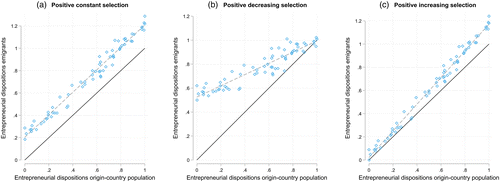
Notes. This figure plots three plausible patterns of cross-country differences in selection into emigration on entrepreneurial dispositions. The average entrepreneurial dispositions of non-migrating compatriots are shown on the x axis, and the average entrepreneurial dispositions of emigrants are shown on the y axis. In the online appendix, we conceptually discuss patterns of cross-country differences in selection into emigration on entrepreneurial dispositions in detail. There, we also present empirical evidence consistent with the pattern shown in (b) (positive decreasing selection), whereas we do not find any evidence that supports the pattern visualized in (c) (positive increasing selection). The implication of this is that we consider it unlikely that selection into emigration on entrepreneurial dispositions is driving our main findings.
In the online appendix, we discuss in more detail possible scenarios of how emigrants could be selected on entrepreneurial dispositions from the origin-country population and analyze empirically how emigrants differ from nonmigrating compatriots. The findings of these analyses support the case that the coefficients we observe in our main analyses that follow are biased downward and constitute conservative estimates for the “true” effect of culture on entrepreneurship.
3.2. Samples and Dependent Variable
3.2.1. Main Sample.
Our main sample consists of second-generation immigrants in the U.S., i.e., individuals who were born in the United States but have at least one foreign-born parent. We use data from the Current Population Survey (Flood et al. 2020), which has been frequently used both in entrepreneurship (Evans and Leighton 1989, Levine and Rubinstein 2017) and in cross-cultural research (Giuliano 2007, Alesina and Giuliano 2010, Alesina et al. 2015). The March supplement of the Current Population Survey reports the country of origin of each respondent’s parents starting in 1994. This, together with information about each respondent’s birthplace, enables us to identify second-generation immigrants while excluding first- and later-generation immigrants from the sample. We pool information from all waves between 1994 and 2018 to obtain a representative sample of the second-generation immigrant population in the United States. Hence, our database is of repeated cross-sectional nature.
Individuals’ ancestry is defined as their fathers’ country of origin. This is standard practice in the literature (Fernández and Fogli 2009, Alesina and Giuliano 2010) and expands our sample coverage substantially compared with analyzing second-generation immigrants whose parents both stem from the same country of origin (Giuliano 2007). We note, though, that our results are quantitatively similar when we identify individuals’ ancestry based on their mother’s country of origin or when we focus only on individuals whose both parents stem from the same country (see online appendix). We only include second-generation immigrants for whose parents the exact country of origin is reported. Furthermore, we exclude second-generation immigrants whose parents stem from former planned economies because low or unavailable entrepreneurship rates there are not indicative of the presence or absence of an entrepreneurial culture.3
3.2.2. Dependent Variable.
We operationalize entrepreneurship as individuals’ occupational choice to work for their own account (Kihlstrom and Laffont 1979, Evans and Leighton 1989, Astebro et al. 2011). Our dependent variable is a dichotomous indicator capturing whether or not individuals report being self-employed or family workers (OECD 2018).4 In an extension, we also distinguish between incorporated and unincorporated entrepreneurship (Levine and Rubinstein 2017). To estimate the likelihood of being an entrepreneur, we focus on individuals who actively participate in the labor market and compare individuals in self-employment and wage employment. Individuals who are younger than 18 years or older than 65 years, full-time students, taking care of the home, in the military, unemployed, or retired are not considered. We also exclude all individuals who report a disability because we do not know to what extent this influences their ability to start and run a venture. We focus on non-agricultural work; all individuals who report working in the agricultural sector are excluded. Furthermore, we impose a threshold of at least 25 observations per second-generation ancestry group. After imposing these conditions and matching with the predictor and controls, we are left with 65,323 individuals from 52 different countries of ancestry.
3.2.3. Alternative Sample.
To corroborate our findings and to test Hypothesis 1(b), we use an alternative sample covering second-generation immigrants in Europe, which we draw from the European Social Survey (ESS 2020a, b). We pool information from the earliest survey wave that contains information on the parents’ countries of birth (2004) until the latest available wave (2018). The dependent variable is operationalized just like in the U.S. case as individuals’ self-employment status. We also apply the same sample criteria (such as age thresholds, exclusion of retired individuals and agriculture) as in the U.S. case. More details on the European sample are provided in the online appendix.
3.3. Independent Variable
We operationalize entrepreneurial culture as long-run averages of past self-employment rates in the parental country of origin to test Hypothesis 1(a). We follow the OECD definition of self-employment: “employment of employers, workers who work for themselves, members of producers' co-operatives, and unpaid family workers” (OECD 2018). Data on self-employment rates are obtained from ILOSTAT of the International Labor Organization (ILO 2017) and constructed from international census microdata (Minnesota Population Center 2018).5 We want to measure long-run averages of entrepreneurship rates in the period around the time when the parents of our sample of second-generation immigrants left their home country. Due to data limitations, we employ averages over the period 1980–1993, i.e., before the first Current Population Survey wave. As explained in Section 3.1, we adjust this measure for differences in the level of economic development and institutional quality (averaged over the same period, 1980–1993) such that our independent variable captures variation in entrepreneurial culture net of the level of self-employment that can be expected for a given level of economic and institutional development in the country of ancestry.
To test Hypothesis 1(b), we operationalize entrepreneurial culture as differences in self-employment propensities between second-generation immigrants of different ancestries who were born and live in another country. To implement this, we first measure ancestral group-level differences in revealed preferences for entrepreneurship among second-generation immigrants in the U.S. and in Europe, respectively, by estimating country of ancestry fixed effects while controlling for individual-level controls, ancestral human capital and network effects, as well as destination and year fixed effects (see Section 3.5). The average marginal effects of these country of ancestry fixed effects capture the actual entrepreneurial behavior of second-generation immigrants in the U.S. and in Europe. We then use these ancestral group-level differences from the European (U.S.) sample as an alternative measure of revealed entrepreneurial culture to predict the likelihood that second-generation immigrant “cousins” in the U.S. (Europe) are self-employed.6
3.4. Control Variables
We use control variables at the individual, country of ancestry, destination, and country of ancestry by destination levels, where “destination” refers to states in the U.S. case and countries in the European case (see online appendix for further details). At the individual level, we use a well-established battery of sociodemographic characteristics that have been commonly related to entrepreneurship (Parker 2018). Specifically, we include age, age-squared, gender, education, education-squared, marital status, and whether children live in the household. In robustness checks, we add a number of additional controls, including measures of labor market discrimination, the strength of family ties, and the parental self-employment status.
At the ancestry-by-destination level, we control for differences in human capital and ethnic network effects. Ancestral group-level human capital proxies for parental human capital (Card et al. 2000, Alesina and Giuliano 2010) and captures coethnic human capital spillover effects (Borjas 1992). We measure this as the average years of schooling of first-generation immigrants who in terms of their age could be the potential parents of the second-generation immigrants in our sample, i.e., first-generation immigrants who were aged 20–60 years in 1970 based on U.S. Decennial Census and American Community Survey data covering the period 1960–2018. Ethnic network and “enclave” effects may facilitate entrepreneurship by enhancing access to resources and information or depress entrepreneurship through oversaturated demand and downward competition (Wilson and Portes 1980, Borjas 1986, Marinoni 2022). To capture this, we construct a measure of the contemporaneous share of coethnics of the same ancestry who reside in the same state (Yuengert 1995) using information for more than 54,000,000 individuals covered in the U.S. Decennial Census and American Community Survey files between 1990 and 2018.
At the country of ancestry level, we control for GDP per capita to capture differences in economic development (Wennekers and Thurik 1999, Wennekers et al. 2005). We use (ln)real GDP data from the Maddison Project (Bolt et al. 2018) and take averages over the period 1980–1993 in line with our measure of revealed entrepreneurial culture. We also control for formal institutional quality in the country of ancestry (North 1990, Williamson 2000, Djankov et al. 2002). For this, we use data from the Polity IV database (Marshall et al. 2017) and take the average value from 1980 to 1993 of the polity2 indicator, which captures the level of democracy in a country. By controlling for GDP per capita and institutional quality, we isolate the effect of entrepreneurial culture solely from variation in self-employment rates between countries with the same level of economic and institutional development.
We control for destination-level differences by including 50 (N − 1) state fixed effects for the 50 U.S. states and the District of Columbia (in the European sample, this corresponds to country fixed effects). These destination dummies control for differences in the economic, institutional, and cultural environments second-generation immigrants are embedded in, such as labor market conditions, industrial structure, and state-level formal institutions, including tax policies or entry barriers. In robustness checks, we also specify these destinations dummies at the level of counties in the U.S. and subnational regions in Europe. We also include year dummies to account for common time trends driven by, for example, correlated business cycles.
3.5. Method
Our hypotheses relate country of ancestry entrepreneurial culture to individuals’ entrepreneurship status. The appropriate methodology for testing our hypotheses is multilevel analysis which allow us to conceptualize each construct at its corresponding level of analysis (Robinson 1950) and to empirically account for the nested structure of the data (Snijders and Bosker 2012). Specifically, we estimate the following multilevel logit model:
4. Results
Table 1 presents descriptive statistics for the U.S. sample and the European sample. The individual-level and aggregate-level correlations are provided in the online appendix for brevity. To evaluate potential multicollinearity, we calculate variance inflation factors after running the main regression model. Only the linear and squared terms of age and education, respectively, which are highly correlated by construction, are above the conventional threshold of 10. We assess the applicability of multilevel modeling by comparing our multilevel model with a single-level logit model under the null that the inclusion of random effects does not improve the model fit. The likelihood-ratio test is rejected (p < 0.000) and hence multilevel modeling is warranted. Variance-partition coefficients indicate that 8% of the total variance is attributable to country of ancestry influences. Given our study design, these variance-partition coefficients are of substantial size (Estrin et al. 2013b, Stephan and Pathak 2016).
|

Table 1. Descriptive Statistics
| Variables | U.S. sample | European sample | ||||||||
|---|---|---|---|---|---|---|---|---|---|---|
| Observations | Mean | SD | Min | Max | Observations | Mean | SD | Min | Max | |
| Dependent variable | ||||||||||
| Self-employment | 65,323 | 0.09 | 0.28 | 0.00 | 1.00 | 4,165 | 0.13 | 0.34 | 0.00 | 1.00 |
| Individual-level control variables | ||||||||||
| Age | 65,323 | 37.30 | 12.53 | 18.00 | 65.00 | 4,165 | 38.65 | 11.90 | 18.00 | 65.00 |
| Gender (men) | 65,323 | 0.52 | 0.50 | 0.00 | 1.00 | 4,165 | 0.53 | 0.50 | 0.00 | 1.00 |
| Education | 65,323 | 11.96 | 2.83 | 1.00 | 18.00 | 4,165 | 13.63 | 3.36 | 0.00 | 21.00 |
| Married | 65,323 | 0.53 | 0.50 | 0.00 | 1.00 | 4,165 | 0.51 | 0.50 | 0.00 | 1.00 |
| Children in household | 65,323 | 0.49 | 0.50 | 0.00 | 1.00 | 4,165 | 0.54 | 0.50 | 0.00 | 1.00 |
| Ancestral group-level control variables | ||||||||||
| GDP per capita country of ancestry | 52 | 14,916 | 11,903 | 768 | 52,511 | 31 | 19,714 | 13,193 | 768 | 52,511 |
| Institutional quality country of ancestry | 52 | 5.03 | 5.79 | −7.86 | 10.00 | 31 | 5.75 | 6.43 | −7.86 | 10.00 |
| Human capital ancestral group | 1,860 | 12.30 | 1.94 | 0.00 | 18.00 | 225 | 13.60 | 2.17 | 7.84 | 18.00 |
| Size of ancestral network | 1,860 | 0.01 | 0.04 | 0.00 | 0.37 | 225 | 0.53 | 1.21 | 0.01 | 14.45 |
| Ancestral group-level independent variables | ||||||||||
| Entrepreneurial culture | 52 | 0.35 | 0.21 | 0.10 | 0.95 | 31 | 0.30 | 0.21 | 0.09 | 0.95 |
Notes. Shown are the descriptive statistics for the U.S. sample and the European sample. A detailed data description is presented in the online appendix. The descriptive statistics are split into individual-level and aggregate-level sections to accurately reflect their means and standard deviations (SDs).
We first present findings from the baseline model testing Hypothesis 1(a) in Table 2 and the results for Hypothesis 1(b) in Table 3. We discuss extensions and robustness checks in Section 5.
|
Table 2. Multilevel Logistic Regressions on Second-Generation Immigrants' Individual-Level Entrepreneurship Status (odds ratios and p-values)
| (1) | (2) | (3) | (4) | |
|---|---|---|---|---|
| U.S. sample | European sample | |||
| Self-employment | Self-employment | Self-employment | Self-employment | |
| Individual-level control variables | ||||
| Age | 1.142*** | 1.142*** | 1.081** | 1.080** |
| (0.000) | (0.000) | (0.017) | (0.019) | |
| Age squared | 0.999*** | 0.999*** | 0.999 | 0.999 |
| (0.000) | (0.000) | (0.176) | (0.184) | |
| Gender (men) | 1.842*** | 1.843*** | 1.560*** | 1.561*** |
| (0.000) | (0.000) | (0.000) | (0.000) | |
| Education | 1.191*** | 1.190*** | 0.985 | 0.983 |
| (0.000) | (0.000) | (0.854) | (0.834) | |
| Education squared | 0.994*** | 0.994*** | 1.002 | 1.002 |
| (0.000) | (0.000) | (0.500) | (0.494) | |
| Married | 1.316*** | 1.316*** | 1.020 | 1.010 |
| (0.000) | (0.000) | (0.859) | (0.928) | |
| Children in household | 1.058* | 1.059* | 1.240* | 1.248* |
| (0.096) | (0.096) | (0.078) | (0.071) | |
| Ancestral group-level control variables | ||||
| (ln)GDP per capita country of ancestry | 1.175* | 1.480*** | 0.986 | 1.753** |
| (0.060) | (0.000) | (0.942) | (0.034) | |
| Institutional quality country of ancestry | 0.995 | 1.007 | 1.004 | 0.976 |
| (0.713) | (0.570) | (0.838) | (0.303) | |
| Human capital ancestral group | 1.043** | 1.058*** | 0.967 | 1.010 |
| (0.031) | (0.003) | (0.386) | (0.809) | |
| Size of ancestral network | 0.713 | 0.776 | 0.889** | 0.901* |
| (0.525) | (0.623) | (0.039) | (0.072) | |
| Ancestral group-level independent variable | ||||
| Entrepreneurial culture | 1.395*** | 1.561*** | ||
| (0.001) | (0.001) | |||
| Destination fixed effects | Yes | Yes | Yes | Yes |
| Year fixed effects | Yes | Yes | Yes | Yes |
| Observations | 65,323 | 65,323 | 4,165 | 4,165 |
| Countries of ancestry | 52 | 52 | 31 | 31 |
| Wald test () | 1671 | 1702 | 171 | 181 |
| Wald test p > | 0.000 | 0.000 | 0.000 | 0.000 |
| Log likelihood | −17,496 | −17,492 | −1,509 | −1,504 |
| Likelihood-ratio test () | 9.095 | 11.17 | ||
| Likelihood-ratio test p > | 0.003 | 0.001 | ||
Notes. The results are presented as odds ratios and p-values are presented in parentheses; ***p < 0.01; **p < 0.05; *p < 0.1; two-tailed tests. The constant and random terms are estimated but are not reported. Destination fixed effects refer to state fixed effects for the U.S. sample and country fixed effects for the European sample. The likelihood-ratio tests () compare the main models with controls-only models that include all control variables, but not the independent variable. They indicate whether the inclusion of the predictor improves the model fit. For Models (2) and (4), the comparison controls-only models are Models (1) and (3), respectively.
|
Table 3. Alternative Measure of Entrepreneurial Culture (odds ratios and p-values)
| (1) | (2) | |
|---|---|---|
| U.S. sample | European sample | |
| Self-employment | Self-employment | |
| Panel A: Reduced form approach | ||
| Entrepreneurial culture: Observed amongst second-generation immigrants in Europe (hypothetical “cousins”) | 1.101** | |
| (0.016) | ||
| Entrepreneurial culture: Observed amongst second-generation immigrants the U.S. (hypothetical “cousins”) | 1.159** | |
| (0.014) | ||
| Panel B: Two-stage approach (2SLS) | ||
| Entrepreneurial culture | 1.511** | 1.869** |
| (0.016) | (0.014) | |
| F-test first-stage regression | 7.282 | 7.882 |
| (0.013) | (0.01) | |
| Observations | 27,568 | 3,883 |
| Countries of ancestry | 28 | 28 |
Notes. The results are presented as odds ratios, and p-values are presented in parentheses; ***p < 0.01; **p < 0.05; *p < 0.1; two-tailed tests. All control variables, the constant, and random terms were included in the estimation but are not reported for brevity. In Panel A we report the reduced form estimations relating ancestral-group level differences in revealed preferences for entrepreneurship observed among second-generation immigrants in Europe (the U.S.) to the likelihood that second-generation immigrants in the U.S. (in Europe) are self-employed. In Panel B, we employ two-stage least squares instrumental variable regressions and we use ancestral-group level differences in entrepreneurship propensities observed amongst second-generation immigrants in Europe and the U.S. in columns (1) and (2), respectively as our instrument for entrepreneurial culture.
4.1. The Positive Effect of Entrepreneurial Culture
Hypothesis 1(a) predicts a positive effect of country of ancestry entrepreneurial culture on the odds of second-generation immigrants being self-employed. We first test this hypothesis using our main sample of second-generation immigrants in the U.S. Table 2 presents the results. Model (1) includes all control variables. Model (2) adds entrepreneurial culture in the country of ancestry. A likelihood-ratio test shows that the addition of entrepreneurial culture in Model (2) improves the model compared with Model (1) (p = 0.003). We find a positive and significant effect of entrepreneurial culture on the likelihood of being self-employed (OR = 1.395; p = 0.001). This positive relation is economically relevant; all else equal, a one-standard-deviation increase in entrepreneurial culture in the country of ancestry is associated with a 39.5% increase in the likelihood of second-generation immigrants being self-employed. For comparison, this effect is almost three times as large as the effect of a similar change in ancestral group-level human capital (a one-standard-deviation increase would raise the odds by 12%).
The results for second-generation immigrants in Europe are presented in Model (3) (controls only) and Model (4) (full model) of Table 2. We observe a positive effect of country of ancestry entrepreneurial culture on second-generation immigrants’ likelihood of being self-employed (OR = 1.561; p = 0.001). A one-standard-deviation increase in entrepreneurial culture is associated with a 56% rise in the odds of being self-employed, and the inclusion of entrepreneurial culture improves the model fit (p = 0.001). We find support for Hypothesis 1(a) in both the U.S. and the European samples.
4.2. The Positive Effect of Entrepreneurial Culture Observed Among Second-Generation Immigrants in a Different Context
Hypothesis 1(b) predicts that ancestral group-level differences in revealed preferences for entrepreneurship observed among second-generation immigrants in Europe (the U.S.) are positively related to the likelihood that second-generation immigrants in the U.S. (Europe) are self-employed. The results are presented in Panel A of Table 3. In Model (1), we test whether second-generation immigrants in the U.S. are more likely to be self-employed if their second-generation “cousins” in Europe exhibit a strong entrepreneurial culture. We find a positive relationship (OR = 1.101; p = 0.016). In Model (2), we relate the ancestral group differences in entrepreneurship propensities of second-generation immigrants in Europe to the revealed entrepreneurial culture of their “cousins” who were born in the U.S. We again observe a positive effect of entrepreneurial culture on individuals’ odds of being entrepreneurs (OR = 1.159; p = 0.014). These findings in both the European and U.S. samples render support to Hypothesis 1(b) and, by extension, further corroborate Hypothesis 1(a).
As an alternative to these reduced form results, we also employ two-stage least squares instrumental variable regressions (2SLS) to tie the reasoning underlying Hypothesis 1(a) and Hypothesis 1(b) together conceptually and to test them in a unified empirical framework. We instrument entrepreneurial culture—measured in the country of ancestry—by ancestral group-level differences in revealed preferences for entrepreneurship observed amongst second-generation immigrants who were born and raised in another context. Specifically, we use ancestral group-level differences observed in Europe (the U.S.) as an instrument for entrepreneurial culture when regressing entrepreneurial culture on the self-employment status of second-generation immigrants in the U.S. (Europe). The exclusion restriction requires that second-generation immigrants’ ancestral group-level differences in revealed preferences for entrepreneurship in the U.S. (Europe) are not related to the self-employment status of second-generation immigrants in Europe (the U.S.) through channels other than the intergenerational transmission of entrepreneurial culture. The second-stage results presented in Panel B of Table 3 confirm the positive effect of entrepreneurial culture on individuals’ odds of being entrepreneurs (U.S.: OR = 1.511; p = 0.016; Europe: OR = 1.869; p = 0.014).8
Jointly, the findings presented in Tables 2 and 3 highlight the role of culture in entrepreneurship. They also alleviate potential concerns regarding selection effects and the importance of postmigration experience. It is unlikely that these will be the same in the U.S. and Europe given the big differences in the social and institutional environments. Our results underline that entrepreneurial culture is transmitted intergenerationally under a variety of contextual conditions.
5. Extensions and Robustness Checks
We begin by extending the applicability of our cultural argument to different types of entrepreneurship in Table 4. We then go on to test the robustness of our results to considering alternative explanations and using a stated preference approach to operationalizing entrepreneurial culture in Table 5. Post-hoc, we also highlight the underlying intergenerational transmission mechanism in Table 6. Finally, we present additional robustness tests in the online appendix.
|
Table 4. Alternative Types of Entrepreneurship (odds ratios and p-values)
| (1) | (2) | |
|---|---|---|
| Multinomial logit multilevel model | ||
| Incorporated self-employment | Unincorporated self-employment | |
| Entrepreneurial culture | 1.950*** | 1.271*** |
| (0.000) | (0.000) | |
| Observations | 65,276 | |
| Countries of ancestry | 52 | |
Notes. The results are presented as odds ratios, and p-values are presented in parentheses; ***p < 0.01; **p < 0.05; *p < 0.1; two-tailed tests. The results are based on a multinomial logit three-level multilevel model estimated on the U.S. sample where the wage-employed constitute the base category. All control variables, the constant, and random terms were included in the estimation but are not reported for brevity. We reject the null that the impact of entrepreneurial culture is the same on the incorporated and the unincorporated (p < 0.000) based on a test for equality of coefficients.
|
Table 5. Assessing Robustness to Alternative Explanations (odds ratios and p-values)
| (1) | (2) | (3) | (4) | (5a) | (5b) | (6) | |
|---|---|---|---|---|---|---|---|
| Unobserved entrepreneurship-specific human capital | Labor market frictions and discrimination | Asset holdings | Family support | Parental self-employment (proxy) and role modeling | Parental self-employment | Alternative predictor: Stated-preference measure of entrepreneurial culture | |
| Dependent variable | Hourly income from self-employment | Self-employment | Self-employment | Self-employment | Self-employment | Self-employment | Self-employment |
| Entrepreneurial culture | −0.008 | 1.330*** | 1.386*** | 1.521*** | 1.330*** | 1.548*** | 1.190** |
| (0.799) | (0.007) | (0.001) | (0.000) | (0.001) | (0.001) | (0.028) | |
| Additional control variable | None | 0.991 | 1.000 | 0.913 | 1.084*** | 2.218*** | None |
| (0.165) | (0.360) | (0.436) | (0.000) | (0.000) | |||
| Observations | 4,654 | 65,323 | 65,323 | 60,803 | 65,129 | 4,165 | 21,551 |
| Countries of ancestry | 52 | 52 | 52 | 37 | 52 | 31 | 21 |
Notes. The results are presented as odds ratios (except for Model (1), where we report a standardized β coefficient), and p-values are presented in parentheses; ***p < 0.01; **p < 0.05; *p < 0.1, two-tailed tests. All controls, the constant, and random terms were included and estimated, but they are not reported for brevity. Further details regarding the operationalization of the additional variables are presented in the online appendix. All models are estimated on our main sample (the U.S. sample) except for Model (5b), which is based on the European sample.
|
Table 6. The Moderating Role of Parenting Intensity (odds ratios and p-values)
| (1) | |
|---|---|
| Self-employment | |
| Entrepreneurial culture | 1.455*** |
| (0.000) | |
| Parenting intensity | 1.155** |
| (0.017) | |
| Entrepreneurial culture parenting intensity | 1.153** |
| (0.015) | |
| Observations | 64,220 |
| Countries of ancestry | 47 |
Notes. The results are presented as odds ratios, and p-values are presented in parentheses; ***p < 0.01; **p < 0.05; *p < 0.1; two-tailed tests. All control variables, the constant, and the random terms were included in the estimation, but they are not reported for brevity. The predictor and moderator are z standardized to facilitate the interpretation of the results.
5.1. Different Forms of Entrepreneurship
Entrepreneurs differ in terms of their characteristics, the nature of the activities they perform, and their (economic) impact (Davidsson 2016, Parker 2018). To distinguish between different types of entrepreneurship, one well-established approach is to consider the status of incorporation. The incorporated tend to perform more complex nonroutine tasks and are generally more successful economically than their unincorporated counterparts (Levine and Rubinstein 2017). Results presented in Table 4 indicate that country of ancestry entrepreneurial culture is positively associated with both incorporated (OR=1.950; p<0.000) and unincorporated self-employment (OR=1.271; p < 0.000). Formally assessing the equality of coefficients, we reject the null that the effect of entrepreneurial culture is the same for incorporated and unincorporated self-employment (p < 0.000). Entrepreneurial culture influences both incorporated and unincorporated self-employment, but the effect is larger for incorporated self-employment.
5.2. Accounting for Alternative Explanations
In this section, we explore whether our results are robust to the incorporation of alternative explanations, especially those proposed by immigrant entrepreneurship research (see, e.g., Fairlie and Lofstrom 2015, Kerr and Kerr 2020, Sinkovics and Reuber 2021). Specifically, we seek to control for factors that may be correlated with entrepreneurial culture but do not capture cultural factors and as such could challenge our identifying assumption. In each column in Table 5, we re-estimate the main regression model (Model (2) in Table 2) while undertaking one adjustment at a time. For brevity, we only report the coefficient for entrepreneurial culture and the coefficients for the additional control variables and provide further details on the construction of the additional variables in the online appendix.
5.2.1. Entrepreneurship-Specific Human Capital.
A first concern is that our results could be driven by differences in (unobserved) entrepreneurship-specific human capital (Yuengert 1995). It could be that the estimated coefficient on entrepreneurship rates in the countries of ancestry reflects not only the hypothesized cultural effect but also, intergenerationally transmitted cross-country differences in entrepreneurial skills. If there are relevant differences in unobserved entrepreneurial human capital that are correlated with entrepreneurship rates in the country of ancestry, entrepreneurs from countries with a strong entrepreneurial culture should also be more successful and earn higher incomes. To assess this alternative explanation, we focus only on the sample of self-employed second-generation immigrants in the U.S. and regress entrepreneurship rates in the country of ancestry on their hourly income from self-employment after accounting for the controls of the main model, working hours, and industry fixed effects. Results presented in Model (1) in Table 5 do not show an association between entrepreneurial culture and hourly income from self-employment (β = −0.008; p = 0.799), suggesting that our results are unlikely to be driven by unobserved entrepreneurship-specific human capital.
5.2.2. Labor Market Frictions and Discrimination.
Another possible concern is that the effect observed for country of ancestry entrepreneurial culture could capture the fact that for some groups, it may be more profitable to be self-employed relative to working in wage employment than for others (Fairlie and Meyer 1996); for example, because of discriminatory practices (Pager et al. 2009) or information asymmetries between firms and potential employees (Hegde and Tumlinson 2021). If some ancestral groups face worse employment prospects than others, second-generation immigrants belonging to these groups should derive relatively higher excess returns from self-employment. To assess whether labor market friction or discrimination drives our findings, we include a measure of group-specific differences in returns from self-employment relative to returns from wage employment.9 Results presented in Model (2) in Table 5 show that controlling for group-level differences in relative returns to self-employment does not alter our main finding of a positive association between country of ancestry entrepreneurial culture and second-generation immigrants’ self-employment status (OR = 1.330; p = 0.007).10
5.2.3. Wealth.
It could be that differences in resource holdings across ancestral groups are driving our main effect by enabling individuals to become self-employed. There are substantial differences in resource holdings across immigrant groups, and it may be easier for second-generation immigrants of wealthier ancestries to become self-employed (Fairlie and Lofstrom 2015); for example, through coethnic investment ties (Hegde and Tumlinson 2014). To control for ancestral group-level differences in resource holdings, we average information on first-generation immigrants’ incomes from interest, dividends, and net rentals as a proxy for wealth at the ancestry-by-state level (Fairlie and Meyer 1996). Results shown in Model (3) in Table 5 indicate that the inclusion of this additional control does not alter our main finding (OR = 1.386; p = 0.001).
5.2.4. Family Support.
The observed effects for entrepreneurial culture may be driven by differences in the structure of families, which has been argued to influence (potential) entrepreneurs’ ability to mobilize support and resources (Sanders and Nee 1996; Aldrich and Cliff 2003; Ruef 2010, 2020). If immigrants originating from countries with a strong entrepreneurial culture also have access to a stronger support network within the family, the estimated effect for entrepreneurial culture may partially reflect the effect of family structure and family support. We proxy for family structure and the ease of mobilizing family support with the cultural strength of family ties present in the country of ancestry. To measure the strength of family ties, we follow Alesina and Giuliano (2014) and construct a measure that reflects country of ancestry differences in the extent to which people regard the family as important, emphasize respect and love for parents, and parents’ responsibility toward their children.11 As visible from Model (4) in Table 5, adding the strength of family ties as an additional control does not alter our main results (OR = 1.521; p < 0.000).
5.2.5. Parental Self-Employment.
It could be that the observed effect for entrepreneurial culture does not reflect an effect of culture per se but is driven by direct linkages between parents and children or noncultural characteristics of parents. Children of parents who are entrepreneurs are more likely to become entrepreneurs themselves because self-employed parents transmit entrepreneurial dispositions but also, social, financial, and (entrepreneurial) human capital to their offspring (Sørensen 2007, Laspita et al. 2012, Lindquist et al. 2015, Wyrwich 2015, Vladasel et al. 2021). Although we have no information on parental occupations for the individuals in our U.S. sample, we can construct a proxy for parental self-employment that reflects the past ancestry by state-level self-employment rates of first-generation immigrants based on the 1960–1990 U.S. Decennial Census files. This variable also captures broader socializing and learning mechanisms, such as role-modeling and mentoring effects of coethnics. Alternatively, we leverage the European sample of second-generation immigrants for whom the parental occupation when respondents were 14 years old is reported. This allows us to directly control for parental self-employment during the formative years of second-generation immigrants. In line with the literature, we find that parental self-employment is positively associated with second-generation immigrants’ self-employment status both in the U.S. sample (Model (5a) in Table 5) and in the European sample (Model (5b) in Table 5). The inclusion of this additional variable, however, does not alter our main finding (U.S.: OR = 1.330; p = 0.001; Europe: OR = 1.548; p = 0.001).12
5.2.6. Stated Preference Approach.
To corroborate our revealed preference approach, we also follow a stated preference approach. To obtain a domain-specific singular measure of stated preference for entrepreneurship, we use the representative crossnational Flash Eurobarometer Surveys 192, 283, and 354 to calculate the country-level share of individuals who indicate they would prefer to be self-employed rather than wage employed when being presented with a hypothetical choice.13 The country-level correlation between our main revealed preference measure of entrepreneurial culture and stated preferences for entrepreneurship is 0.87 (p < 0.000). Result shown in Model (6) in Table 5 corroborate the positive effect of entrepreneurial culture on self-employment (OR = 1.190; p = 0.028).
5.2.7. Further Robustness Checks.
We run an extensive number of further robustness checks that we present in the online appendix. There, we show that our results are robust to using alternative measures of revealed entrepreneurial culture. We also demonstrate that our results hold for a variety of subsamples, such as for highly educated individuals who have obtained at least a bachelor’s degree. We furthermore include an exhaustive battery of additional controls: for example, fixed effects for ethnicity, industry, occupation, or religious denomination; measures of coethnic residential clustering; genetic factors; occurrence of wars in the country of ancestry; and parental human capital. These robustness checks further corroborate our main findings.
5.3. The Moderating Role of Parenting Intensity
Having shown that our results are robust to these alternative explanations, we probe the key mechanism underlying our hypotheses: intergenerational cultural transmission. The individual-level socialization literature has shown that parents influence their children’s dispositions to a greater extent if they spend more time with their offspring (Zumbühl et al. 2021), and the extent of parenting intensity likely varies across cultures (cf. Doepke and Zilibotti 2017). Expanding upon our hypotheses, we posit that the positive effect of country of ancestry entrepreneurial culture on individuals’ self-employment status increases in the extent of parenting intensity because more intense parent-child interactions should strengthen the intergenerational transmission of entrepreneurial culture. We operationalize parenting intensity as ancestral group-level differences in the time parents spent with their children by using fine-grained daily time use diaries obtained from the American Time Use Survey (ATUS 2003–2018). To quantify ancestral group-level variation in parenting intensity, we identify first-generation immigrants in the ATUS files and estimate country of origin fixed effects after accounting for individual- and family-level controls (see online appendix).
Table 6 presents the results. As before, entrepreneurial culture positively influences the likelihood that second-generation immigrants are self-employed (OR = 1.455; p < 0.000). Importantly, as expected, we can see from the interaction that this effect is strengthened—i.e., moderated positively—by parenting intensity (OR = 1.153; p = 0.015). We plot the predicted probabilities of individual-level self-employment at various levels of entrepreneurial culture and parenting intensity in Figure 2. We clearly see that the effect of entrepreneurial culture on individuals’ self-employment status is stronger if immigrants stem from cultures where parents are more involved in rearing their children. This positive moderation effect further supports our key argument that culture is transmitted intergenerationally and consequential for entrepreneurship.
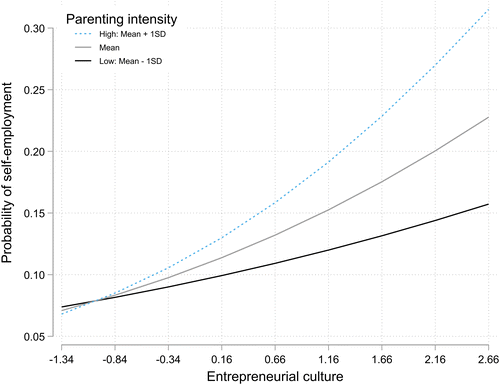
Notes. Plotted is the predicted effect of entrepreneurial culture on individual-level self-employment for three different levels of parenting intensity (mean minus one standard deviation, mean, and mean plus one standard deviation) based on the findings shown in Table 6. All other covariates are held constant at their respective means. The predictor and moderator were z standardized prior to estimating the moderated regression model on which this predicted probabilities plot is based.
6. Discussion
In this paper, we show that culture is an important and deeply rooted determinant of entrepreneurship. We document that second-generation immigrants are more likely to be self-employed if their parents stem from a country with a strong entrepreneurial culture. Our design of studying second-generation immigrants of different ancestries yet residing in the same country allows us to isolate the effect of culture on entrepreneurship from other macro-level determinants. Culture is related to entrepreneurship, and entrepreneurial culture is persistent across at least two generations and different contexts.
6.1. Contributions
We contribute to the literature in three ways. First, we complement the entrepreneurship literature that has emphasized the social transmission of individual- and organizational-level attributes for explaining variation in the decision to become an entrepreneur (Nanda and Sørensen 2010, Kacperczyk 2013, Qin and Estrin 2015, Rocha and Van Praag 2020). We extend this literature by drawing attention to the role of durable and portable national cultural imprints in intergenerational socialization. Socialization influences individuals’ values, preferences, cognitive processes, and decisions, including entrepreneurship. This matters because the effects are long lasting and leave a permanent imprint. An important part of intergenerational socialization reflects nationally shared and deeply rooted cultural dispositions. Our paper shows that such intergenerationally transmitted cultural dispositions are systematically related to individuals’ choices for self-employment. In addition, the intergenerational transmission of cultural dispositions for entrepreneurship can also take place outside of the context where these imprints were initially formed. This is because individuals’ values and preferences are formed in childhood and adolescence and remain largely stable afterward. Thus, individuals carry their cultural background with them when they migrate to another environment, where they then partially pass on this background to their children. This way, cultural dispositions for entrepreneurship span across time and space. We show that the intergenerational transmission of country of ancestry entrepreneurial culture indeed takes place under various economic and institutional conditions.
Second, we add to comparative entrepreneurship research that has explored the determinants of cross-country variation in entrepreneurial activity (Jones et al. 2011, Terjesen et al. 2016), including the role of culture (Autio et al. 2013, Stenholm et al. 2013, Stephan and Pathak 2016), formal institutions (Autio and Acs 2010, Levie and Autio 2011, Estrin et al. 2013a), and the level of economic development (Wennekers and Thurik 1999, Wennekers et al. 2005). These country characteristics are inherently interrelated and co-vary across nations, which poses the conceptual challenge of clearly isolating cultural effects. Existing correlational evidence for the relation between culture and entrepreneurship has been mixed and partly conflicting (Hayton et al. 2002, Hayton and Cacciotti 2013, Stephan 2022). Our study of second-generation immigrants advances this long-standing discussion by clearly separating the effect of culture from other contextual factors and by demonstrating that culture is a deeply rooted determinant of entrepreneurship. This matters because it helps explain the persistent crossnational differences in entrepreneurial activity that have been observed even for countries with similar levels of economic and institutional development (Freytag and Thurik 2007, Global Entrepreneurship Monitor 2018).
Third, the above discussion logically extends to the broader comparative analysis of cultural effects. The challenge of conceptually and empirically isolating cultural effects from other country-specific characteristics is generally acknowledged in cross-cultural research (Kirkman et al. 2006). Our methodology of studying second-generation immigrants of different ancestries that grew up and reside in the same country can be leveraged in other domains, such as finance—e.g., individuals’ investment decisions (Li et al. 2013, Siegel et al. 2013)—and human resource management—e.g., compensation schemes (Schuler and Rogovsky 1998, Tosi and Greckhamer 2004). This is important because the comparative analysis of cultural effects has been criticized for an overreliance on broad cultural dimensions—e.g., Hofstede and Schwartz—and for correlating these dimensions with outcomes of interest (Beugelsdijk et al. 2017, Devinney and Hohberger 2017). Our study contributes to this discussion by suggesting a research design, namely studying second-generation immigrants, that allows for isolating cultural effects.
6.2. Limitations and Future Research
We acknowledge some limitations of our study that offer opportunities for future research. First, we have followed the occupational choice conceptualization of entrepreneurship (Kihlstrom and Laffont 1979), which is common in (comparative) entrepreneurship research (Stephan and Uhlaner 2010, Levie and Autio 2011) but has some drawbacks (Parker 2018). We have shown that the cultural effect holds for both incorporated and unincorporated self-employment, with a stronger effect on the incorporated, and we think that our findings on the importance of cultural effects will also extend to other conceptualizations of entrepreneurship. Additional research may want to explore, for example, high-growth entrepreneurship or intrapreneurship. Second, our sample is based on individuals whose parents migrated to the U.S. largely between the 1950s and 1980s. This implies that we are unable to make statements about the consequences of contemporaneous migration patterns. Although we believe that our findings will also extend to more recent migration experiences, only future research can shed definitive light on this. Relatedly, there may be cultural attenuation effects from the first to subsequent generations of immigrants. Quantifying attenuation effects is beyond the scope of this paper, but it is an interesting question for future research.
We see several promising avenues for further research to expand this study. First, future research may leverage recent advances in big data analytics and the growing availability of social media data (Obradovich et al. 2020) and other online resources (Michel et al. 2011) to construct new measures of (entrepreneurial) culture and assess their relevance for understanding differences in (entrepreneurial) behavior. Second, future research may unpack the bundle of acquired dispositions that together create an entrepreneurial culture and identify systematically which cultural components (e.g., values, preferences, and norms) and cultural dimensions (e.g., individualism and uncertainty avoidance) are particularly important. Third, future research may also explore the emergence and historical drivers of entrepreneurial cultures. Promising avenues could include past geo-climatic conditions (Kashima and Kashima 2003, Stuetzer et al. 2016), historical institutional practices—such as inheritance rules (Fritsch and Wyrwich 2019)—or historical trade patterns (Godley 2009).
To conclude, second-generation immigrants who were born, raised, and educated within the same country and face the same economic and institutional circumstances are more likely to be entrepreneurs if their parents stem from countries characterized by a strong entrepreneurial culture rather than a weak entrepreneurial culture. National cultural imprinting effects are portable and persist over at least two generations and across different economic and institutional contexts. Entrepreneurship has deep cultural roots.
The authors are grateful for the numerous valuable comments and suggestions of the editor and three anonymous reviewers. The authors thank Saul Estrin, Juliette de Wit, Anita McGahan, Tomasz Mickiewicz, Paolo Santini, Christopher Schlägel, Ute Stephan, Božidar Vlačić, Theodor Vladasel, and Michael Wyrwich for valuable feedback on prior versions of this manuscript. The authors also appreciate the comments of participants at the Academy of Management Conference 2020, the Academy of International Business Conference 2022, the Babson College Entrepreneurship Research Conference 2021, the Centre for Research in Economics and Management Workshop on Culture and Comparative Development 2018, the European Public Choice Society Annual Meeting 2019, the European International Business Academy Conference 2019, Oxford Residence Week for Entrepreneurship Scholars 2019, the Strategic Management Society Conference 2020, the Wharton Migration and Organizations Conference 2022, and seminar participants at Aston, Birmingham, Copenhagen Business School, Groningen, Henley, Jönköping, Leuven, Linköping, Liverpool, Manchester, and Utrecht. J. Kleinhempel gratefully acknowledges the support of The University of Manchester, where parts of this paper were written.
1 To assess the applicability of our cultural argument to distinct types of entrepreneurship, we also distinguish between incorporated and unincorporated self-employment (Levine and Rubinstein 2017) in Section 5.1.
2 In Section 5.1, we discuss various conditions under which this assumption may fail. We demonstrate that our results are robust to accounting for other factors that may be correlated with entrepreneurial culture and transmitted intergenerationally but are unrelated to culture.
3 As we describe in Section 3.5, we use entrepreneurship rates as a measure of the country of ancestry-level entrepreneurial culture, which we average over the period 1980–1993 to capture long-run trends. Because entrepreneurship was essentially nonexistent during the communist era because of formal restrictions and because formerly planned economies experienced massive economic and institutional changes after the Perestroika (Estrin and Mickiewicz 2011), there are serious doubts about whether self-employment rates observed over the period 1980–1993 would capture any long-run trends for these countries.
4 In line with the OECD (2018) definition of entrepreneurship, unpaid family workers are classified as self-employed in our main sample. We note, however, that there are very few unpaid family workers; they constitute 0.07% of the total sample and 0.83% of the self-employed. Excluding them from the analyses does not alter the results.
5 We pool ILO and international census microdata to obtain data for as many countries of ancestry as possible. In the online appendix, we show that separately using either ILO data or the values obtained from international census microdata data produces similar results.
6 In a robustness check, we also crossvalidate our revealed preference approaches by using a stated preference measure of entrepreneurial culture that captures the country of ancestry share of individuals who state that they would rather be self-employed than wage employed when prompted with the hypothetical choice.
7 We assessed the robustness of our findings to using (1) probit multilevel models, (2) linear probability multilevel models, and (3) logit models with cluster-robust standard errors clustered at the country of ancestry level. We also replicated our results with (4) additive cross-classified multilevel models and (5) multiplicative cross-classified multilevel models using multilevel Markov chain Monte Carlo models (Rasbash et al. 2012). These corroborate our results and are available upon request.
8 The point estimates obtained based on these instrumental variable regressions are slightly larger than the point estimates shown in Table 2 and Panel A of Table 3. This pattern is commonly observed in the literature (e.g., Hegde and Tumlinson 2014). Two-stage residual inclusion regressions (Wooldridge 2015) corroborate these findings obtained using the two-stage least squares approach. Furthermore, the first-stage results indicate that our main independent variable—entrepreneurial culture in the country of ancestry—is positively associated with both ancestral group-level differences in entrepreneurship propensities observed amongst second-generation immigrants in the U.S. (β = 0.214; p = 0.013; F test = 7.3) and second-generation immigrants in Europe (β = 0.219; p = 0.010; F test = 7.9). The first-stage F statistics of 7.3 and 7.9 imply that the bias introduced by the instruments is at most 15%–20% of the bias that would result in the noninstrumented case (Stock and Yogo 2005). This is not very different from the bias under the “rule of thumb” that the first-stage F statistic should be 10 or higher, in which case the bias is at most 10%–15% of that resulting from a noninstrumented regression depending on whether one is concerned about the general bias of the instrumental variable estimator or the size distortion of the Wald test (Stock and Yogo 2005). In the online appendix, we present further details as well as a complementary instrumental variable regression that leverages the distinction between incorporated and unincorporated self-employment and produces an F statistic of 18.98. This corroborates the findings presented here.
9 We derive this measure by first estimating an (ordinary least squares) earnings equation for all second-generation immigrants that relates hourly income earned to our main controls, hours worked, industry fixed effects, self-employment status, country of ancestry fixed effects, and the interaction of self-employment status with country of ancestry fixed effects. These predicted interaction effects capture unexplained differences in returns between self-employment and wage employment across ancestral groups, which we use as an additional control variable.
10 Studying the role of labor market frictions and discrimination is a difficult undertaking. We present several further robustness checks in the online appendix that complement the approach presented here (as well as one another). Amongst others, we show that accounting for race, religion, or individual-level self-reported discrimination does not alter our findings.
11 The underlying data stem from the European Values Study and the World Values Survey; for further details, see the online appendix and Alesina and Giuliano (2014). In additional analyses presented in the online appendix, we also control for (i) household size, assuming that it is correlated with the structure of the extended family; (ii) the country-level percentage of informal investors who provide funds to close family members; and (iii) country of ancestry-level differences in propensity for family financial support observed amongst immigrants in the United States. These tests further support our main findings.
12 We also tentatively assessed whether the effect of parental self-employment strengthens or weakens the relation between entrepreneurial culture and individuals’ self-employment status by estimating the interaction parental self-employment entrepreneurial culture. We found no evidence for a significant interaction: neither in the U.S. sample nor in the European sample. We, moreover, assessed whether entrepreneurial culture influences the self-employment choices of those second-generation immigrants whose parents were not self-employed and found this to be the case.
13 Specifically, we use the item “Suppose you could choose between different kinds of jobs; which one would you prefer: being an employee or being self-employed?”
References
- (2001) The colonial origins of comparative development: An empirical investigation. Amer. Econom. Rev. 91(5):1369–1401.Crossref, Google Scholar
- (2008) Entrepreneurship, economic development and institutions. Small Bus. Econom. 31(3):219–234.Crossref, Google Scholar
- (2003) The pervasive effects of family on entrepreneurship: Toward a family embeddedness perspective. J. Bus. Venturing 18(5):573–596.Crossref, Google Scholar
- (2007) Goodbye Lenin (or not?): The effect of communism on people’s preferences. Amer. Econom. Rev. 97(4):1507–1528.Crossref, Google Scholar
- (2010) The power of the family. J. Econom. Growth 15(2):93–125.Crossref, Google Scholar
- (2014)
Family ties . Aghion P, Durlauf SN, eds. Handbook of Economic Growth (Elsevier, Amsterdam), 177–215.Google Scholar - (2015) Culture and institutions. J. Econom. Literature 53(4):898–944.Crossref, Google Scholar
- (2015) Family values and the regulation of labor. J. Eur. Econom. Assoc. 13(4):599–630.Crossref, Google Scholar
- (2010) The economic situation of first and second-generation immigrants in France, Germany and the United Kingdom. Econom. J. 120(542):F4–F30.Google Scholar
- (2019) Enhancing quantitative theory-testing entrepreneurship research. J. Bus. Venturing 35(5):1–11.Google Scholar
- (2011) Stars and misfits: Self-employment and labor market frictions. Management Sci. 57(11):1999–2017.Link, Google Scholar
- (2010) Intellectual property protection and the formation of entrepreneurial growth aspirations. Strategic Entrepreneurship J. 4(3):234–251.Crossref, Google Scholar
- (2013) Consequences of cultural practices for entrepreneurial behaviors. J. Internat. Bus. Stud. 44(4):334–362.Crossref, Google Scholar
- (2017) Social influence given (partially) deliberate matching: Career imprints in the creation of academic entrepreneurs. Amer. J. Sociol. 122(4):1223–1271.Crossref, Google Scholar
- (2007) Entrepreneurial culture, regional innovativeness and economic growth. J. Evolutionary Econom. 17(2):187–210.Crossref, Google Scholar
- (2018) Dimensions and dynamics of national culture: Synthesizing Hofstede with Inglehart. J. Cross-Cultural Psych. 49(10):1469–1505.Crossref, Google Scholar
- (2017) An overview of Hofstede-inspired country-level culture research in international business since 2006. J. Internat. Bus. Stud. 48(1):30–47.Crossref, Google Scholar
- (2011)
The economics of cultural transmission and socialization . Benhabib J, Bisin A, Jackson MO, eds. Handbook of Social Economics, vol. 1A (Elsevier, Amsterdam), 339–416.Google Scholar - (2016) Institutions, entrepreneurship, and economic growth: What do we know and what do we still need to know? Acad. Management Perspect. 30(3):292–315.Crossref, Google Scholar
- (2018) Rebasing “Maddison”: New income comparisons and the shape of long-run economic development. GGDC Research Memorandum No. 174.Google Scholar
- (1986) The self-employment experience of immigrants. J. Human Resources 21(4):485–506.Crossref, Google Scholar
- (1992) Ethnic capital and intergenerational mobility. Quart. J. Econom. 107(1):123–150.Crossref, Google Scholar
- (2014) Immigration Economics (Harvard University Press, Cambridge, MA).Crossref, Google Scholar
- (2008) Institutional context and the allocation of entrepreneurial effort. J. Internat. Bus. Stud. 39(4):747–767.Crossref, Google Scholar
- (1996) A cross-cultural cognitive model of new venture creation. Entrepreneurship Theory Pract. 20(4):25–40.Crossref, Google Scholar
- (2000)
The more things change: Immigrants and the children of immigrants in the 1940s, the 1970s, and the 1990s . Borjas GJ, ed. Issues in the Economics of Immigration (University of Chicago Press, Chicago), 227–270.Google Scholar - (1982) Theory and observation in cultural transmission. Science 218(4567):19–27.Crossref, Google Scholar
- (2016) Researching Entrepreneurship: Conceptualization and Design, 2nd ed. (Springer, Cham, Switzerland).Crossref, Google Scholar
- (2017) The past is prologue: Moving on from culture’s consequences. J. Internat. Bus. Stud. 48(1):48–62.Crossref, Google Scholar
- (2002) The regulation of entry. Quart. J. Econom. 117(1):1–37.Crossref, Google Scholar
- (2017) Parenting with style: Altruism and paternalism in intergenerational preference transmission. Econometrica 85(5):1331–1371.Crossref, Google Scholar
- (2012) The intergenerational transmission of risk and trust attitudes. Rev. Econom. Stud. 79(2):645–677.Crossref, Google Scholar
- (2019) Assimilation and the second generation in Europe and America: Blending and segregating social dynamics between immigrants and natives. Annual Rev. Sociol. 45(1):177–199.Crossref, Google Scholar
ESS (2020a) European Social Survey Cumulative File, ESS 1-8 (2020). Data file edition 1.0. NSD - Norwegian Centre for Research Data, Norway—Data Archive and distributor of ESS data for ESS ERIC. Accessed December 2, 2021, https://www.europeansocialsurvey.org/data/.Google ScholarESS (2020b) European Social Survey Round 9.1 Data. Data file edition 3.0 NSD - Norwegian Centre for Research Data, Norway—Data Archive and distributor of ESS data for ESS ERIC. Accessed December 2, 2021, https://www.europeansocialsurvey.org/data/.Google Scholar- (2011)
Entrepreneurship in transition economies: The role of institutions and generational change . Minniti M, ed. The Dynamics of Entrepreneurship: Evidence from Global Entrepreneurship Monitor Data (Oxford University Press, Oxford, United Kingdom), 181–208.Crossref, Google Scholar - (2013a) Which institutions encourage entrepreneurial growth aspirations? J. Bus. Venturing 28(4):564–580.Crossref, Google Scholar
- (2017) Prospect theory and the effects of bankruptcy laws on entrepreneurial aspirations. Small Bus. Econom. 48(4):977–997.Crossref, Google Scholar
- (2013b) Entrepreneurship, social capital, and institutions: Social and commercial entrepreneurship across nations. Entrepreneurship Theory Practice 37(3):479–504.Crossref, Google Scholar
- (2016) Human capital in social and commercial entrepreneurship. J. Bus. Venturing 31(4):449–467.Crossref, Google Scholar
- (1987) Entrepreneurship, adaptation and legitimation: A macro-behavioral perspective. J. Econom. Behav. Organ. 8(2):175–189.Crossref, Google Scholar
- (1989) Some empirical aspects of entrepreneurship. Amer. Econom. Rev. 79(3):519–535.Google Scholar
- (2015)
Immigration and entrepreneurship . Chiswick BR, Miller PW, eds. Handbook of the Economics of International Migration (Elsevier, Amsterdam), 877–911.Google Scholar - (1996) Ethnic and racial self-employment differences and possible explanations. J. Human Resources 31(4):757–793.Crossref, Google Scholar
- (2013) The intergenerational transmission of gender role attitudes and its implications for female labour force participation. Economica 80(318):219–247.Crossref, Google Scholar
- (2009) Culture: An empirical investigation of beliefs, work, and fertility. Amer. Econom. J. Macroeconomics 1(1):146–177.Crossref, Google Scholar
- (2020) Integrated Public Use Microdata Series, Current Population Survey: Version 8.0 (IPUMS, Minneapolis). Accessed October 2, 2021, https://doi.org/10.18128/D030.V8.0.Google Scholar
- (2007) Entrepreneurship and its determinants in a cross-country setting. J. Evolutionary Econom. 17(2):117–131.Crossref, Google Scholar
- (2007) Living arrangements in western Europe: Does cultural origin matter? J. Eur. Econom. Assoc. 5(5):927–952.Crossref, Google Scholar
Global Entrepreneurship Monitor (2018) Global Report 2017/18. Accessed November 30, 2021, https://www.gemconsortium.org/report/gem-2017-2018-global-report.Google Scholar- (2017) Culture, institutions, and the wealth of nations. Rev. Econom. Statist. 99(3):402–416.Crossref, Google Scholar
- (2006) Does culture affect economic outcomes? J. Econom. Perspect. 20(2):23–48.Crossref, Google Scholar
- (2013) Is there an entrepreneurial culture? A review of empirical research. Entrepreneurship Regional Development 25(9–10):708–731.Crossref, Google Scholar
- (2002) National culture and entrepreneurship: A review of behavioral research. Entrepreneurship Theory Practice 26(4):33–52.Crossref, Google Scholar
- (2014) Does social proximity enhance business partnerships? Theory and evidence from ethnicity’s role in U.S. venture capital. Management Sci. 60(9):2355–2380.Link, Google Scholar
- (2021) Information frictions and entrepreneurship. Strategic Management J. 42(3):491–528.Crossref, Google Scholar
- (2011) The interaction of entrepreneurship and institutions. J. Institutional Econom. 7(1):47–75.Crossref, Google Scholar
- (2001) Culture’s Consequences: Comparing Values, Behaviors, Institutions and Organizations Across Nations (Sage, Thousand Oaks, CA).Google Scholar
- (2004)
Culture’s role in entrepreneurship: Self-employment out of dissatisfaction . Brown TE, Ulijn J, eds. Innovation, Entrepreneurship and Culture: The Interaction Between Technology, Progress and Economic Growth (Edward Elgar, Cheltenham, United Kingdom), 162–203.Crossref, Google Scholar - (2004) Culture, Leadership, and Organizations: The GLOBE Study of 62 Societies (Sage, Thousand Oaks, CA).Google Scholar
ILO (2017) International Labour Organization: ILOSTAT Employment indicators. Accessed March 20, 2019, http://www.ilo.org/ilostat/.Google Scholar- (2000) Modernization, cultural change, and the persistence of traditional values. Amer. Sociol. Rev. 65(1):19–51.Crossref, Google Scholar
- (2010) Direct evidence on risk attitudes and migration. Rev. Econom. Stat. 92(3):684–689.Crossref, Google Scholar
- (2011) International entrepreneurship research (1989–2009): A domain ontology and thematic analysis. J. Bus. Venturing 26(6):632–659.Crossref, Google Scholar
- (2013) Social influence and entrepreneurship: The effect of university peers on entrepreneurial entry. Organ. Sci. 24(3):664–683.Link, Google Scholar
- (2020) Immigrant entrepreneurship in America: Evidence from the survey of business owners 2007 & 2012. Res. Policy 49(3):103918.Crossref, Google Scholar
- (1979) A general equilibrium entrepreneurial theory of firm formation based on risk aversion. J. Political Econom. 87(4):719–748.Crossref, Google Scholar
- (2020) Measuring stability and change in personal culture using panel data. Amer. Sociol. Rev. 85(3):477–506.Crossref, Google Scholar
- (2006) A quarter century of culture’s consequences: A review of empirical research incorporating Hofstede’s cultural values framework. J. Internat. Bus. Stud. 37(3):285–320.Crossref, Google Scholar
- (1963) Culture: A Critical Review of Concepts and Definitions (Vintage Books, New York).Google Scholar
- (2017) National culture, effectuation, and new venture performance: Global evidence from student entrepreneurs. Small Bus. Econom. 49(3):687–709.Crossref, Google Scholar
- (2012) Intergenerational transmission of entrepreneurial intentions. J. Bus. Venturing 27(4):414–435.Crossref, Google Scholar
- (2015) Revisiting native and immigrant entrepreneurial activity. Small Bus. Econom. 45(4):841–873.Crossref, Google Scholar
- (2011) How do bankruptcy laws affect entrepreneurship development around the world? J. Bus. Venturing 26(5):505–520.Crossref, Google Scholar
- (2011) Regulatory burden, rule of law, and entry of strategic entrepreneurs: An international panel study. J. Management Stud. 48(6):1392–1419.Crossref, Google Scholar
- (2017) Smart and illicit: Who becomes an entrepreneur and do they earn more? Quart. J. Econom. 132(2):963–1018.Crossref, Google Scholar
- (2006) Institutional entrepreneurs. Amer. Econom. Rev. 96(2):358–362.Crossref, Google Scholar
- (2013) How does culture influence corporate risk-taking? J. Corporate Finance 23(C):1–22.Crossref, Google Scholar
- (2015) Why do entrepreneurial parents have entrepreneurial children? J. Labor Econom. 33(2):269–296.Crossref, Google Scholar
- (2011) Culture, context, and the taste for redistribution. Amer. Econom. J. Econom. Policy 3(1):157–179.Crossref, Google Scholar
- (2022) Immigration and entrepreneurship: The role of enclaves. Management Sci. (in press).Google Scholar
- (2017) Polity IV Project, Political Regime Characteristics and Transitions, 1800-2016 [Data Set]. Accessed April 25, 2017, https://www.systemicpeace.org/index.html.Google Scholar
- (1961) The Achieving Society (Van Nostrand Co, Princeton, NJ).Crossref, Google Scholar
- (1992) Elitists, risk-takers, and rugged individualists? An exploratory analysis of cultural differences between entrepreneurs and non-entrepreneurs. J. Bus. Venturing 7(2):115–135.Crossref, Google Scholar
- ;
Google Books Team (2011) Quantitative analysis of culture using millions of digitized books. Science 331(6014):176–182.Crossref, Google Scholar Minnesota Population Center (2018) Integrated Public Use Microdata Series, International: Version 7.1 [Dataset] (IPUMS, Minneapolis, MN). Accessed March 20, 2019, https://doi.org/10.18128/D020.V7.1.Google Scholar- (2000) Cross-cultural cognitions and the venture creation decision. Acad. Management J. 43(5):974–993.Crossref, Google Scholar
- (2010) Workplace peers and entrepreneurship. Management Sci. 56(7):1116–1126.Link, Google Scholar
- (2014) Intergenerational transmission of risk attitudes: A revealed preference approach. Eur. Econom. Rev. 65:66–89.Crossref, Google Scholar
- (1990) Institutions, Institutional Change and Economic Performance. (Cambridge University Press, Cambridge, UK).Crossref, Google Scholar
- (2020) Expanding the measurement of culture with a sample of two billion humans. NBER Working Paper No. 27827, National Bureau of Economic Research, Cambridge, MA.Google Scholar
OECD (2018) Self Employment Rate. Retrieved January 24, 2018, https://data.oecd.org/emp/self-employment-rate.htm#indicator-chart.Google Scholar- (2010) The coevolution of institutional entrepreneurship: A tale of two theories. J. Management 36(4):974–1010.Crossref, Google Scholar
- (2009) Discrimination in a low wage labor market: A field experiment. Amer. Sociol. Rev. 74(5):777–799.Crossref, Google Scholar
- (2018) The Economics of Entrepreneurship (Cambridge University Press, Cambridge, UK).Crossref, Google Scholar
- (2018) Interpreting societal culture value dimensions. J. Internat. Bus. Stud. 49(9):1190–1207.Crossref, Google Scholar
- (2015) Does social influence span time and space? Evidence from Indian returnee entrepreneurs. Strategic Entrepreneurship J. 9(3):226–242.Crossref, Google Scholar
- (2012) Multilevel and Longitudinal Modeling Using Stata, 3rd ed. (STATA Press, College Station, TX).Google Scholar
- (2012) A User’s Guide to MLwiN, v2. 26 (Center for Multilevel Modelling, University of Bristol, Bristol, UK).Google Scholar
- (2015) Founder or joiner? the role of preferences and context in shaping different entrepreneurial interests. Management Sci. 61(9):2160–2184.Link, Google Scholar
- (1950) Ecological correlations and the behavior of individuals. Amer. Sociol. Rev. 15(3):351–357.Crossref, Google Scholar
- (2020) Mind the gap: The role of gender in entrepreneurial career choice and social influence by founders. Strategic Management J. 41(5):841–866.Crossref, Google Scholar
- (2010) The Entrepreneurial Group: Social Identities, Relations, and Collective Action (Princeton University Press, Princeton, NJ).Crossref, Google Scholar
- (2020) The household as a source of labor for entrepreneurs: Evidence from New York City during industrialization. Strategic Entrepreneurship J. 14(1):20–42.Crossref, Google Scholar
- (1996) Immigrant self-employment: The family as social capital and the value of human capital. Amer. Sociol. Rev. 61(2):231–259.Crossref, Google Scholar
- (1998) Understanding compensation practice variations across firms: The impact of national culture. J. Internat. Bus. Stud. 29(1):159–177.Crossref, Google Scholar
- (1994)
Beyond individualism-collectivism: New cultural dimensions of values . Kim U, Triandis HC, Kâğitçibaşi Ç, Choi SC, Yoon G, eds. Individualism and Collectivism: Theory, Method, and Applications (Sage, Newbury Park, CA), 85–119.Google Scholar - (1993) Cultural influences on national rates of innovation. J. Bus. Venturing 8(1):59–73.Crossref, Google Scholar
- (2013) Egalitarianism, cultural distance, and foreign direct investment: A new approach. Organ. Sci. 24(4):1174–1194.Link, Google Scholar
- (2021) Beyond disciplinary silos: A systematic analysis of the migrant entrepreneurship literature. J. World Bus. 56(4):101223.Crossref, Google Scholar
- (2012) Multilevel Analysis: An Introduction to Basic and Advanced Multilevel Modeling, 2nd ed. (Sage Publishers, London).Google Scholar
- (2007)
Closure and exposure: Mechanisms in the intergenerational transmission of self-employment . Ruef M, Lounsbury M, eds. The Sociology of Entrepreneurship, Research in the Sociology of Organizations, vol. 25 (Emerald Group Publishing Limited, Bingley, UK), 83–124.Crossref, Google Scholar - (2013) Exploring country-level institutional arrangements on the rate and type of entrepreneurial activity. J. Bus. Venturing 28(1):176–193.Crossref, Google Scholar
- (2022) Cross-cultural innovation and entrepreneurship. Annual Rev. Organ. Psych. Organ. Behav. 9(1):277–308.Crossref, Google Scholar
- (2016) Beyond cultural values? Cultural leadership ideals and entrepreneurship. J. Bus. Venturing 31(5):505–523.Crossref, Google Scholar
- (2010) Performance-based vs socially supportive culture: A cross-national study of descriptive norms and entrepreneurship. J. Internat. Bus. Stud. 41(8):1347–1364.Crossref, Google Scholar
- (2015) Institutions and social entrepreneurship: The role of institutional voids, institutional support, and institutional configurations. J. Internat. Bus. Stud. 46(3):308–331.Crossref, Google Scholar
- (2005)
Testing for weak instruments in linear IV regressions . Andrews DW, Stock JH, eds. Identification and Inference in Econometric Models (Cambridge University Press, New York), 80–108.Crossref, Google Scholar - (2016) Comparative international entrepreneurship: A review and research agenda. J. Management 42(1):299–344.Crossref, Google Scholar
- (2004) Culture and CEO compensation. Organ. Sci. 15(6):657–670.Link, Google Scholar
- (2007) Postmaterialism influencing total entrepreneurial activity across nations. J. Evolutionary Econom. 17(2):161–185.Crossref, Google Scholar
- (2019) Institutions, Entrepreneurship, and Economic Performance (Springer, Cham, Switzerland).Crossref, Google Scholar
- (2021) On the origins of entrepreneurship: Evidence from sibling correlations. J. Bus. Venturing 36(5):106017.Crossref, Google Scholar
- (1930) The Protestant Ethic and the Spirit of Capitalism (Routledge Classics, London).Google Scholar
- (1999) Linking enterpreneurship and economic growth. Small Bus. Econom. 13(1):27–55.Crossref, Google Scholar
- (2007) Uncertainty avoidance and the rate of business ownership across 21 OECD countries, 1976–2004. J. Evolutionary Econom. 17(2):133–160.Crossref, Google Scholar
- (2005) Nascent entrepreneurship and the level of economic development. Small Bus. Econom. 24(3):293–309.Crossref, Google Scholar
- (2000) The new institutional economics: Taking stock, looking ahead. J. Econom. Literature 38(3):595–613.Crossref, Google Scholar
- (1980) Immigrant enclaves: An analysis of the labor market experiences of Cubans in Miami. Amer. J. Sociol. 86(2):295–319.Crossref, Google Scholar
- (2015) Control function methods in applied econometrics. J. Human Resources 50(2):420–445.Crossref, Google Scholar
- (2013) Can socioeconomic heritage produce a lost generation with regard to entrepreneurship? J. Bus. Venturing 28(5):667–682.Crossref, Google Scholar
- (2015) Entrepreneurship and the intergenerational transmission of values. Small Bus. Econom. 45(1):191–213.Crossref, Google Scholar
- (1995) Testing hypotheses of immigrant self-employment. J. Hum. Resources 30(1):194–204.Crossref, Google Scholar
- (2021) Parental involvement and the intergenerational transmission of economic preferences, attitudes and personality traits. Econom. J. 131(638):2642–2670.Google Scholar
Johannes Kleinhempel is a postdoctoral researcher at Copenhagen Business School. His primary research interests are in entrepreneurship and comparative international business.
Mariko J. Klasing is an associate professor in the Department of Global Economics and Management at the University of Groningen. Her main fields of interest are in the areas of economic development and cultural economics.
Sjoerd Beugelsdijk is a professor of international business at the University of Groningen. His main research interests are in international business and comparative cultural analysis.

