Shared Fate and Entrepreneurial Collective Action in the U.S. Wood Pellet Market
Abstract
Although studies underscore the importance of creating a coherent collective identity in order to legitimate a new market category, strategy and entrepreneurship research is divided on whether and to what degree an entrepreneur will engage in collective action to promote the identity. To reconcile the inconsistency, we introduce the concept of entrepreneurial shared fate—the belief of a focal venture that it and its competitors are bound together by a sense of belongingness and equally experience similar consequences—and explore how external threats can influence the degree of shared fate. We conceptually distinguish between communal and individual threats and propose that communal threats will increase, whereas individual threats will decrease, shared fate. We also explore boundary conditions that strengthen and weaken the main effects of perceived communal and individual threats on collective identity promotion. Empirically, we examine venture identity framing in response to forest-conservation activism in the U.S. wood pellet market. Implications for research on new market categories, collective identity, optimal distinctiveness, and forest management are discussed.
Introduction
Research on new market creation has emphasized the importance of promulgating a collective identity for legitimating nascent market categories (Wry et al. 2011, Georgallis et al. 2019). Critical to the formation of a collective identity are the efforts of individual ventures to use similar narratives that describe their identity in terms of who they are and what they do (Lounsbury and Glynn 2001, Kennedy 2008). However, the literature on new market creation is divided on whether and to what extent entrepreneurs will work collectively to legitimate a new market. Some studies argue that entrepreneurs will naturally collaborate in an emergent stage where the new market category lacks legitimacy (Weber et al. 2008, Navis and Glynn 2010), whereas others point to strategic differentiation and other collective action problems that make entrepreneurial collaboration for new market formation less likely (Ozcan and Santos 2015, Lee et al. 2018, Barlow et al. 2019). Little is known about the sources and mechanisms that can explain these inconsistencies, a serious omission that prevents scholars from illuminating the full complexity and richness of entrepreneurial action for collective identity promotion.
This study seeks to address this limitation by bringing external threats from the social movement literature together with the collective action and new-market-category literatures to create a theoretical framework that explains entrepreneurial collaboration for promoting a collective identity. Specifically, we highlight the role of external threats as an understudied factor that may promote or hinder entrepreneurial shared fate and thus whether and to what extent entrepreneurs will work together. We define entrepreneurial shared fate as the degree to which entrepreneurs perceive that they are subject to an equal risk of negative consequences and are bound together by a sense of belongingness to members of the market category as a whole. Absent a shared fate, a venture will naturally compete using tactics that emphasize unique individual characteristics, such as idiosyncratic identity, in order to highlight the different value of its products and services and to stake out a distinctive competitive position (Porter 1980, Cattani et al. 2017, Zhao et al. 2017, Grimes 2018). We theorize that a higher shared fate will be associated with a greater likelihood that entrepreneurs will engage in collective identity promotion.
As a primary source of variation in entrepreneurial shared fate, we differentiate between communal threats that target the entire market category and individual threats that target individual entrepreneurs (Goldstone and Tilly 2001, Almeida 2019). We suggest that the different types of threats have different impacts on shared fate and collective action to legitimate a new market. If external threats are perceived to equally affect entrepreneurs and increase the sense of belongingness in the new market category, they will enhance shared fate and thereby activate collaboration for the market category. On the other hand, if a focal venture perceives external threats to unequally burden it in comparison with its peers and decreases its sense of belongingness, the threats will reduce shared fate. We also examine a set of moderators that can significantly alter the main effects of perceived communal and individual threats on entrepreneurial collective action.
We test these arguments by examining how forest-conservation activism influences the identity claims of wood pellet entrepreneurs. To legitimate and create value for venture products, market pioneers established and codified a market-category identity in the emergent stage and then encouraged all producers to incorporate renewable-biomass-energy frames into their venture identity descriptions. However, wood pellet producers also faced opposition from forest-conservation activists who sought to stop all wood manufacturing, including wood pellet production. We tracked all producers’ identity claims from 1983 to 2010, a span that includes both the early and the transitional stages of the wood pellet market, and found wide variation across their efforts to project the promoted identity. Using textual analysis of ventures’ identity claims, we seek to capture the degree to which entrepreneurs identify with the promoted identity in the emergence and growth of the market.
This study contributes to the literature on collective action and market-category creation in a few ways. First, it highlights the unexplored influence of external threats on entrepreneurial shared fate, thereby addressing the inconsistency of prior work on whether and to what extent entrepreneurs collaborate in the promotion of a collective identity (Lee et al. 2018, Struben et al. 2020). Second, it paints a nuanced picture of the temporality of collective identity promulgation and optimal distinctiveness by showing that the demands of identity conformity and differentiation may shift over time, according to a nonlinear trajectory of industry development associated with external threats (Navis and Glynn 2010, Zhao et al. 2017). Third, our focus on opposition activism enables scholars to gain greater practicality in theorizing the complex relationship between environmental threats and entrepreneurial collective action. Although scholars have generally noted external forces that shape new market formation (e.g., Gurses and Ozcan 2015), no explicit attempt has yet been made to illuminate how collective identity promotion unfolds under conditions of opposition from social activists—a significant omission, given that empirical observations clearly point to the substantial role of social activism in the emergence and evolution of new market categories, including renewable energy (Sine and Lee 2009, Hiatt and Carlos 2019), organic food (Lee et al. 2017), and nanotechnology (Grodal 2018).
Theory
Collective Identity Legitimation in New Market Categories
An entrepreneurial collective identity indicates an intersubjective shared attribute that defines a collection of ventures operating in a particular market category (Kennedy 2008). Critical to the formation of an entrepreneurial collective identity are collaborative efforts to promulgate a consistent identity frame. This process involves identity work that constructs and presents a form of accounts and narratives describing what ventures are and do and thereby serves as a key means for making sense of the value of products and services and creating expectations of actor roles (Kreiner et al. 2006, Navis and Glynn 2011, Anthony et al. 2016, Raffaelli et al. 2019). If ventures promulgate a similar identity, external audiences can more easily recognize nascent entrepreneurial groups as distinct and appropriate in a market, which can contribute to market-category legitimation (Khaire and Wadhwani 2010, Wry et al. 2011, Kahl and Grodal 2016). In contrast, inconsistent, idiosyncratic identity claims among a group of organizations paint an unclear picture of the group, making it difficult for audiences to assess the value of products and identify a distinct market (Lounsbury and Glynn 2001, Ozcan and Santos 2015, Zuzul and Tripsas 2020).
To promulgate similar identity frames, ventures need to agree on what their identity in the market will be. Market pioneers and prominent producers often take the initiative to coordinate individual efforts to legitimate nascent markets by articulating the narratives, texts, and keywords that new ventures should use when describing their organizational identity and products (Kahl 2018). For example, farm associations sought to create an industry narrative describing biodiesel as a sustainable, renewable-energy product that reduced dependence on foreign petroleum (Hiatt and Carlos 2019). Similarly, the California Certified Organic Farmers framed organic farming as holistic agriculture that was free of synthetic chemicals, and they sent newsletters to producers encouraging them to adopt the same framing in their communication (Lee et al. 2017). In the wood pellet market, early market producers from the beginning sought to establish wood pellets as renewable-biomass energy and coordinated with other pellet ventures to describe the market, producers, and products as such.
Given the importance and benefits of collective action for creating and legitimating new market categories, one may assume that new ventures will heed the initiative of pioneering firms in the nascent market and work together to promote a collective identity. However, the literature on new market creation is divided on how and whether new ventures will make common efforts toward identity promotion. Some scholars argue that new ventures are motivated to work together in the early stages of market emergence (Barnett 2006, Weber et al. 2008, Navis and Glynn 2011, Gorbatai et al. 2021). This line of work argues that lacking legitimacy for a new market category is a key condition that motivates entrepreneurs to put aside their individual differences and emphasize similar features and labels that can establish the shared meaning of a new market category. It follows that ventures may not engage in collective action once the new market category is legitimated in the latter stages of market development. For example, Navis and Glynn (2010) provide an example of early conformity in the evolution of the U.S. satellite radio market. In the stage of market emergence, firms like Sirius and XM worked collectively to legitimate their collective identity as satellite radio providers. They also show that as the market category gained legitimacy, however, the firms differentiated themselves within the market: Sirius as a provider of sports events and XM as a music purist.
In contrast, strategy scholars argue that new ventures are not likely to collaborate in promoting a collective identity because competitive forces shape a general tendency to pursue unique competitive positions, and conformity and imitation undermine competitive advantage (Cattani et al. 2017). Similarly, organizational theorists suggest that collective action aimed at enhancing coherence and conformity is difficult to arise. For instance, Ozcan and Santos (2015) argue that market participants in emerging markets lack joint-collaboration experience and hold different beliefs about relative bargaining power. Anthony et al. (2016, p. 179) find that ventures in emerging markets resist promoting a category’s shared meaning; instead, they promote “a cacophony of meanings to advance their individual strategic interests,” especially when different audiences favor different meanings of the category. Summarizing these prior studies, Lee et al. (2018) use a theoretical framework to show that market formation is fraught with collective action problems due to several reasons, such as lack of infrastructure that supports the stable operation of a new market, low excludability of benefits from collective actions, and limited substitutability of individual contributions. More recently, Struben et al. (2020) provide additional evidence for this argument by showing that ventures fail to engage in collective action when they undervalue the benefits of market-oriented resource allocation and contribute resources that are imperfectly substitutable.
The inconsistency in prior studies suggests that entrepreneurial collective action is a more complicated process that cannot be characterized simply by a linear progression of new market legitimation (Zhao et al. 2017). In particular, the debate in the two streams of research makes it imperative to understand the mechanisms and conditions under which entrepreneurs either follow the leading members to promote a uniform identity or pursue a different identity to enhance their individual value in the early and transitional stages of market emergence. Below, we suggest that the notion of a shared fate can be useful in explaining individual firms’ decisions to participate in collective action.
Entrepreneurial Shared Fate and External Threats
A shared fate arises when individual firms in a market category share a commons, which, if damaged, may pose a pooled risk to all firms in that market category (Lenox 2006, Barnett and King 2008). Although prior work on common-pool resources has traditionally focused on natural resources such as water and fish (Hardin 1968, Ostrom 1990), more recent studies examine intangible forms of commons that have broad influence on members in a market category. For example, King et al. (2002) introduced the concept of “reputation commons” to describe how the attainment or damage of collective reputation can affect all firms in an industry (see also Barnett 2006 and Barnett and King 2008). In addition, a key touchstone for shared fate is a sense of belongingness that binds a focal venture and its peers together within a market category. Identity scholars suggest that the degree to which an actor feels psychologically linked to other actors in a group is critical to understanding why and to what extent the focal actor works together with other actors in response to common problems that question the group’s identity (Ashforth and Mael 1989, Petriglieri and Devine 2016). If entrepreneurs perceive that they are all subject to the same influence of common-pool resources and bound together by a sense of belongingness, they are more likely to experience shared fate and see beyond individual interests and stand together (Gehman and Grimes 2017, Lee et al. 2018).
Following this line of reasoning, we suggest that a collective identity can be viewed as an intangible commons that binds all entrepreneurs who share it. If audiences recognize an entrepreneur as a distinct entity independent of its competitors, no commons exists (Barnett and King 2008). However, since a collective identity represents an attribute that is shared among certain ventures, audiences will view those ventures as members of the same group or category. In this situation, ventures are likely to perceive that they are linked with respect to the influence of collective identity. If a collective identity is well accepted and taken for granted, all ventures will benefit from their link to the identity (Wry et al. 2011). Conversely, if a collective identity is new, unknown, or challenged, all ventures associated with it will suffer. Therefore, a commons arises that intertwines the fates of entrepreneurs in a market category.
We propose that a shared fate is relevant to understanding when individual entrepreneurs will work together to promulgate a collective identity. Because a shared fate is not given as a fixed condition, but is subject to change, it can have varying effects on entrepreneurial collective action. A strong sense of shared fate will enable individual entrepreneurs to promote a collective identity by minimizing the incentive to opportunistically pursue idiosyncratic interests through strategic differentiation (Anthony et al. 2016, Lee et al. 2018). As a result, ventures will prioritize the greater benefits of collective action to address the equal risk posed by common problems (Weber et al. 2008). By contrast, a weak sense of shared fate will fail to motivate new ventures to alter their strategy to compete with peers by enhancing different market positions and projecting unique identities (Porter 1980, Cattani et al. 2017, Barlow et al. 2019).
We propose that external threats can be a key source that generates the variation in entrepreneurial shared fate. In the literature on social movements, collective action can be stimulated by political opportunities, such as positive environmental cues and regulatory incentives, that enhance the perception of success or by threats that generate fear of losing current benefits (Tilly 1978, Goldstone and Tilly 2001). Threats are defined as “the probability that existing benefits will be taken away or new harms inflicted if challenging groups fail to act collectively” (Almeida 2003, p. 347). Although threats have received relatively less attention than opportunities, social movement scholars have recently highlighted the value of studying threats (Andrews and Seguin 2015), even suggesting that “groups experiencing potential losses are more motivated to engage in collective action than groups facing the possibility of new gains” (Almeida 2019, p. 45).
The literatures on market creation and identity also point to the need for illuminating the full complexity of external conditions, such as threats (King et al. 2011, Wry et al. 2011). Numerous studies, including those in renewable energy (Sine et al. 2005), organic food (Lee et al. 2017), and nanotechnology (Grodal 2018), have documented that new market development and growth are typically characterized by substantial barriers or threats, such as resistance of market incumbents, legal issues, and opposition activism. Additionally, identity scholars have found that when external demands and events threaten one’s identity and social position, they trigger a reconstruction of individual identity claims (Kreiner et al. 2006, Elsbach 2009, Grimes 2018, Piening et al. 2020). Nevertheless, these literatures have yet to explain how threats affect the way entrepreneurs work together to promote a collective identity.
Hypotheses
We propose that external threats can promote or hinder the development of shared fate among entrepreneurs. The strategic positioning perspective has long emphasized differentiation as a way to gain competitive advantage and establish a defensible position (Porter 1980, Cattani et al. 2017). The pursuit of individual profits independent of members of the market category continues, especially when entrepreneurs face no significant threats that change ventures’ awareness and perception of an equal risk of consequences (Barnett and King 2008, Klandermans and van Stekelenburg 2013). External threats may change this general tendency in two opposing ways, according to whether threats are communal or individual.
On one hand, communal threats pose an equal risk of negative consequences for all members in the new market category, thereby strengthening a focal venture’s perception that it will be affected by the same external force that shapes the fate of its competing entrepreneurs. Such a perception, in turn, fosters a sense of belongingness that connects the venture to its peers (Ashforth and Mael 1989, Piening et al. 2020). As a result, a strong shared fate emerges, causing the venture to look beyond individual interests to reach agreement on the identity-promotion efforts. For instance, in the emergent U.S. biodiesel market, when environmental organizations began attacking biodiesel made from virgin seed oil, entrepreneurs who produced biodiesel from soybean, corn, canola, and other virgin oils collaboratively sponsored information sessions that rebutted the environmentalists’ arguments and defended their business models (Hiatt and Carlos 2019).
On the other hand, individual threats have unequal impacts on a focal venture and its competitors, which can negatively affect its shared fate. The targeted venture is likely to feel that the threats impose a lower burden on its competitors who are not specifically targeted. The unequal risk of negative consequences breeds a belief that competitors will not engage in collective action to address the threats. Such a belief can also reduce the sense of belongingness by causing targeted entrepreneurs to “view themselves as different from” and as “outsiders” to the other, nontargeted ventures in the market category (Grimes 2018, p. 1710). As targeted entrepreneurs feel that they have less in common with their competitors, they are less likely to internalize specific roles and activities linked to a collective identity, and their perception of shared fate will likewise decrease (Stryker and Burke 2000). Consequently, focal entrepreneurs become less committed to collective identity promotion; instead, they will view individual action as an effective means to address the threat, including pursuing a differentiation strategy that emphasizes their unique identities and attributes in order to defend their threatened positions (Porter 1980, Grimes 2018). An example of this effect appears to have occurred among breweries in response to threats arising from the American temperance movement in the late 19th and early 20th centuries (Hiatt et al. 2009). By singling out and targeting individual breweries, the temperance activists reduced the targeted individual breweries’ sense of shared fate and instead fostered greater “competition in trade, anxiety to increase the output of manufactured product, [and] feelings of retaliation against competitors in business” (U.S. Brewers’ Association 1909, p. 144).
Taking these points together, we propose two main predictions. First, if external threats are perceived as communal and as affecting most entrepreneurs in the new market category, they will enhance shared fate and thereby activate collaboration for the market category as a whole. Second, if external threats are perceived as individual and as singling out a focal venture, they will hinder the development of shared fate and make entrepreneurs focus more on individual competitive actions.
Perceived communal threats will have a positive effect on the promulgation of the promoted collective identity.
Perceived individual threats will have a negative effect on the promulgation of the promoted collective identity.
Moderating Effects
To illuminate boundary conditions of our arguments, we examine a set of moderators that can significantly alter the main effects of perceived communal and individual threats on entrepreneurial shared fate. Social identity studies have proposed frameworks that explain variation in the strength of belongingness to a group or category using insider and outsider perspectives (Ashforth and Mael 1989, Piening et al. 2020). The model by Dutton et al. (1994) predicts that an individual’s beliefs about the attributes of the collective and the beliefs of outsiders’ perceptions of the collective will affect an individual’s sense of belongingness to the group or category. Similarly, we propose that the sense of belongingness in our setting is shaped by the beliefs of an entrepreneur regarding the attributes that define collective identity and the beliefs of external audiences about the collective identity. For factors that affect the former, we examine how a venture’s peer firms use the same attributes to define and promulgate their identity (peer framing) and what relationship the venture has with its peers (industry churn). We also examine whether collective identity gains cognitive acceptance by external audiences for the latter (collective identity recognition). We expect these three factors to moderate the impact of communal and individual threats on collective identity promulgation.
Peer Framing
The influence of threats on a focal entrepreneur’s collective identity promulgation may be moderated by peer framing, or the extent to which the focal entrepreneur’s peer group engages in promulgating the same collective identity. Scholars have suggested that a focal actor—whether an individual or a firm—often refers to others in a group to understand normatively appropriate behavior before acting (Lawrence 2006, Haas and Park 2010). The similar behaviors of peers not only induce a sense of belongingness, but also engender mutual monitoring and sanctioning, strengthening normative influence on the focal actor’s conformity.
Applying this literature to communal threats, we suggest that the normative influence from high levels of peer framing can increase internal solidarity and linkage that binds ventures more strongly together (Evans et al. 1978, Kandel and Lazear 1992, Barron and Gjerde 1997). As the greater level of perceived linkage under high peer framing strengthens shared fate, ventures are more likely to collectively see the risk of negative consequences and reach agreement on the collective action to address communal threats. Accordingly, we predict that the main effects of communal threats on collective identity promulgation will be stronger if peer framing is high.
As noted, the negative effects of individual threats are based on the focal venture’s perception that competitors will not engage in collective identity promulgation in response to threats (Stryker and Burke 2000, Grimes 2018). Those beliefs are challenged if the focal venture observes that most peers conform to the collective identity. A high peer framing can impose normative pressures that counteract a sense of being different and thus discourage deviation from the role expectations for collective action (Merton and Rossi 1950, Jackson 1965). Consequently, the venture is less likely to view a differentiation strategy as an appropriate response to address the threat. Thus, we predict that peer framing will positively moderate the negative influence of individual threats on collective identity promulgation.
The main effects of external threats on the promulgation of the promoted collective identity will be positively moderated by peer framing, such that the positive influence of communal threats will become more positive, and the negative influence of individual threats will be less negative.
Industry Churn
The history of prior relations and interactions between entrepreneurs in the market category may moderate the effect of social activism on collective identity promulgation. Studies of industry churn highlight a dynamic environment with a high rate of entries and exits as a key process with which to explain industry evolution and firm-level competitive dynamics (de Figueiredo and Silverman 2007). According to this view, frequent entries of new members and exits of old ones can reshape interfirm competitive and collaborative dynamics in ways that make it difficult for firms to maintain extended, stable relationships with each other, accumulate positive experiences of collaboration, and develop “social-psychological bonds of mutual norms, sentiments, and friendships” that enhance the sense of belongingness (Ring and Van de Ven 1994, p. 93).
Building on this line of work, we propose that high industry churn will interact with communal threats. As long as high industry churn prevents ventures from developing positive common experiences and subsequent social bonding for collective action, the relational basis for connecting a venture to its market rivals is less likely to emerge. Studies also suggest that lack of common experience with peer companies can lead to disagreements about collaborative work for the emerging market (Ozcan and Santos 2015). Therefore, the absence or limited history of stable relationships under high industry churn creates a condition under which ventures are less likely to perceive a strong sense of belongingness and sensitivity to the risk of negative consequences, even if they face communal threats. We thus predict that the positive effect of communal threats on collective identity promulgation will be weaker when industry churn is high.
High industry churn is also likely to amplify the negative influence of individual threats on collective identity promotion. As high industry churn inhibits the development of social bonds of mutual norms and values, a venture facing individual threats will be more likely to feel psychologically disconnected from its competitors and have stronger perceptions that it is different from them (Grimes 2018). Under this situation, the entrepreneur becomes more sensitive to the unequal risk of negative consequences, a belief that reduces shared fate. Consequently, we predict that individually targeted ventures under high industry churn will opportunistically pursue their own interests to a greater extent and shift away from the collectively promoted identity.
The main effects of external threats on the promulgation of the promoted collective identity will be negatively moderated by industry churn, such that the positive influence of communal threats will become less positive, and the negative influence of individual threats will be more negative.
Collective Identity Recognition.
The influence of communal and individual threats on collective identity promulgation may also be moderated by external audience recognition of the collective identity. Formal recognition of a collective identity in state law and policy represents evidence of cognitive legitimacy, as legislation rarely passes unless at least a plurality of constituents endorses it (Page and Shapiro 1983). Moreover, organizational scholars have shown that state actions, such as policy adoption and implementation, have cognitive legitimating effects on organizational forms and identities (Lee 2009). For instance, state laws that formally recognize the identity of a new market category in their text signal an acceptance of the collective identity, thereby helping to foster market-category legitimacy.
We believe that collective identity recognition will interact with communal threats. As collective identity recognition signals cognitive acceptability and credibility for the entire market category (Wry et al. 2011), entrepreneurs may consider that external threats equally targeting all members of the category are less consequential. In addition, the attainment of category legitimacy may lead to “a shift in the focus of attention … from a market category of undifferentiated organizations to a competitive space in which each firm claimed distinctiveness and leadership over its rival” (Navis and Glynn 2010, p. 457). Such a shift in attentional focus can make entrepreneurs less sensitive to the benefits of addressing the communal threats collectively. In this situation, a strong shared fate is difficult to arise. Accordingly, we predict that formal recognition of a collective identity will weaken the positive effect of communal threats on collective identity promulgation.
Collective identity recognition is also likely to interact with individual threats. If a focus of attention shifts toward relative distinctiveness, a venture facing individual threats will become more sensitive to its uniqueness, compared with those who face not such threats, further weakening the sense of belongingness (Grimes 2018). Shared fate is then reduced as a result of individual threats, making the venture pursue differentiation strategies to highlight its distinct position vis-à-vis that of its competitors (Cattani et al. 2017, Zhao et al. 2017). We predict that collective identity recognition will strengthen the negative influence of individual threats on collective identity promulgation.
The main effects of external threats on the promulgation of the promoted collective identity will be negatively moderated by audience recognition of a collective identity, such that the positive influence of communal threats will become less positive, and the negative influence of individual threats will become more negative.
Empirical Context
Historical Origins of U.S. Wood Pellet Production
Wood pellet producers trace their technological origins to 1933, when the Potlatch Lumber Company of Lewiston, Idaho, developed a technology for producing low-moisture logs and briquettes from sawmill shavings. Later technological advances allowed for much smaller wood pellets. Briquettes and pellets are made by compacting wood shavings into dense cylinders with a moisture content of 8%–12%. The result is a product with almost the same energy content per unit volume as that of coal, that burns hotter and more completely than wood, and that produces no smoke and very little ash or air particulates (Spelter and Toth 2009). However, market exploitation of this technology did not occur until the late 1970s and early 1980s, when rising energy costs increased demand for alternative methods of heating homes and commercial buildings; several entrepreneurs in the forest-products arena founded wood pellet companies using technologies that grew out of Potlatch’s research. The market grew exponentially over the next two decades, from a yearly production of 1 million metric tons in the late 1990s to more than 6.2 million metric tons by 2009 (Spelter and Toth 2009). Most wood pellet ventures were small (well under 100,000 metric tons per year), and most of their products were sold for commercial and domestic heating; the rest were sold for feedstock in thermal electricity production in lieu of coal.1
Collective Identity Promotion
Early pellet entrepreneurs and university academics interested in this new product realized that in order to create a new market category for wood pellets, it was important to establish a coherent collective identity showcasing the market’s distinct qualities compared with those of traditional wood-combustion technologies, such as wood-burning stoves. For that purpose, a handful of market pellet pioneers with the assistance of professors from the University of Minnesota extension offices in Duluth formed the Fiber Fuels Institute (FFI) in December 1982 (which later changed its name to the Pellet Fuels Institute, hereafter FFI/PFI) and held their first conference six months later at the University of Minnesota Technical College to agree on pellet producers’ identity-framing efforts.2 The newly elected executive director distributed a “Glossary of Fiber Fuels Terms” to conference participants that included definitions for terms such as biomass fuel and pellet. He explained:
People typically develop the language they need spontaneously and to suit the occasion in all fields, especially in new and emerging or growing and expanding areas of activity. Such is true of the use of biomass for energy. This new language in a relatively new industry, in similarly typical fashion, varies greatly from location to location and user to user. Such variations often cause confusion and inhibit the spread as well as the harmonious use of new technology…. This glossary is intended as a beginning step toward cleaning up the language and codifying usage among a cross section of persons most commonly interested and involved in the use of Fiber Fuels. (Fiber Fuels Institute 1983, p. 2, appendix)
The conference established that pellet entrepreneurs should hereafter describe themselves as biomass-renewable-energy firms. “Done correctly,” the FFI/PFI leadership asserted, “we feel our industry could be recognized as one of the most important in the recycling of our natural resources” (Fiber Fuels Institute/Pellet Fuels Institute 1983–1995, November 1988).
To coordinate member firms’ linguistic framing and promotion of their collective identity, the institute’s leadership distributed talking points and promotional literature and videos describing pellet ventures as renewable-energy producers and their products as sustainable and environmentally friendly sources that decrease carbon emissions. Pellet producers used these templates in their press releases and interviews with media outlets. For example, some talking points stressed “the unique advantages of pellet appliances and our renewable, environmentally friendly fuels” (FFI/PFI 1983–1995, October 1993). Other pellet firms wanted producers to state that the industry “is recycling carbon rather than contributing to the growth of CO2 in the atmosphere” (FFI/PFI 1983–1995, February 1990). Some narratives sought to locate the market in relation to other energy sources (Wry et al. 2011), such as this relational positioning story shared by a producer in an FFI bimonthly newsletter:
I always include a description of the fuel, its history, its present condition, and a look into the future. I like to explain that pellet fuel provides an excellent heating alternative with one of the lowest impacts to the environment, and I like to compare this to the other energy options available: Fossil fuels (high costs of exploring and retrieving them); Crude oil (the balance of trade problems with importing it and destruction caused by spills); Petroleum products (CO and CO2 emissions); Nuclear power (creates a deadly waste); Hydro-electric dams (destroy northwest salmon runs). (FFI/PFI 1983–1995, September 1995)
Forest-Conservation Activism
The institute’s efforts to promote the collective identity were complicated by the activism of forest-conservation groups, which sought to stop manufacturing of wood fibers, including wood pellet production.3 Forest-conservation groups such as Earth First! and the Wilderness Society engaged in litigation and various forms of protests such as tree sitting, tree spiking, and the destruction of company assets to slow and prevent wood harvesting and manufacturing.4 Their actions targeted both wood pellet producers and organizations at the broader category level, including loggers, sawmills, furniture makers, and plywood manufacturers. After the passage of numerous environmental laws in the 1970s, conservation groups gained more opportunities to legally contest timber harvesting and manufacturing (Malmsheimer et al. 2004). For instance, pellet producers complained that the Endangered Species Act was used by forest-conservation groups to file lawsuits and protest to prevent wood harvesting and manufacturing. In one newsletter, the FFI/PFI’s president reported on a ruling about the Mexican spotted owl, a bird on the endangered species list:
One of the scariest stories circulating concerns the Mexican spotted owl issue near Rob Davis’ operation by Flagstaff, AZ. A recent federal court injunction [on timber harvesting] has nation-wide implications. Judge Carl Muecke has ruled that studying where the owl actually has been found is not enough; you have to study where he might want to live as well. (FFI/PFI September 1995, September 1995, p. 4)
Activist actions against firms in the broader wood-manufacturing category that reduced or halted firms’ business activities were perceived as a communal threat to pellet producers because these organizations provided the raw material (sawdust and wood shavings) commonly used to make wood pellets. In sum, we believe that the wood pellet market provides a suitable setting for exploring how external threats can influence ventures’ sense of shared fate and their efforts to project a coherent collective identity.
Methods
Our study examines the influence of forest-conservation activism on U.S. wood pellet producers’ efforts to promote a coherent collective identity. The window of observation begins in 1983, when an agreement on the collective identity was codified, and ends in 2010. The sample includes data from all 227 U.S. wood pellet plants, comprising 214 unique firms over 41 states. During this period, 207 new production facilities were founded, 104 failed, and 123 were still operational when the period ended. Upon failure, producers were dropped from the sample; upon founding, new producers were added. Data on pellet producers and their ownership structure came from reports from the U.S. Forest Service and from the FFI/PFI. We also obtained archival materials from the FFI/PFI, including bimonthly member newsletters, conference proceedings, and technical reports dating from 1983.
Dependent Variables
Identity Frames.
To measure how stakeholder activism affects ventures’ efforts to promote frames aligned with the promoted identity narrative, we created a dictionary that would measure the renewable-energy identity frames used by individual producers. To do so, we engaged in an inductive process grounded in qualitative data gathered from interviews with industry stakeholders, FFI/PFI quarterly newsletters and publications, newspaper articles, and books chronicling the history of the wood pellet market. The renewable-energy frame projected an identity related to environmental sustainability and renewable-biomass energy, and this was the identity endorsed by the institute’s leadership.
To create these empirical constructs, we first collected articles on wood pellet ventures from two primary sources. The first was the Access World News digital archive of hundreds of local and national U.S. newspapers in all states and the District of Columbia. The second source was the PR Newswire and Business Wire press-release database found in Lexis-Nexis. A total of 829 articles comprising 196 press releases and 633 news pieces were identified and downloaded during our study period. We searched for every article that mentioned a pellet producer’s name. Each article was matched to the specific pellet venture that either issued a statement or was interviewed. To identify the degree to which a venture projected a renewable-energy identity, we initially identified numerous unique keywords or keyword combinations that best reflected the perspective of the three identity frames, and then we developed a search dictionary specific to each one. Following prior research (Helms et al. 2012, Hiatt and Carlos 2019), we took an iterative approach to identify the most common terms and word groupings reflecting the underlying values and features of the biomass-renewable-energy frame, and we included the final word groupings. We then compared our qualitative identification of the keywords with quantitative analysis of the articles and developed finer-grained keyword categorization. The terms included in each dictionary are listed in Table A1 in the online appendix, along with where the word stems (with wildcard searches) or co-occurrence of word pairs were used in the search. Full-text searches of each article using these dictionaries generated an overall frequency score, for each article, represented as the frequency of words from each dictionary per 1,000 words in the article. The words-per-thousand scores were then summed by firm and year for the frame, Σ(frequencyij), where i is the firm and j is the year.
To ascertain the reliability of the coding scheme for the renewable-biomass-energy identity frame, we hired two coders who were blind to the study’s arguments and had them read a random sample of 200 news articles and press releases independently. They evaluated whether the renewable-biomass-energy frame was different from other types of identity frames that we identified in the process of creating our renewable-energy identity dictionary, what we call forestry and general pellet frames (see Table A1 in the online appendix). The forestry frame projected an identity of timber harvesting or lumber manufacturing. The general pellet frame projected an identity that referenced neither forestry nor renewable-energy topics and keywords; instead, it described wood pellets as sui generis—an alternative heating-source category that could be substituted for existing products. The intercoder reliability, or Cohen’s kappa for the two ratings, was 0.78, indicating substantial agreement (Landis and Koch 1977). The observed agreement on each frame was 87.72%, and tests indicated a rejection of the null hypothesis that the two coders made their assignments randomly (Z = 10.80, p < 0.001). Additionally, we examined whether the coding scheme based on the keyword searches was consistent with the two manual ratings by assuming that the 200 articles were rated into one of three categories of identity frames based on the highest number of words per thousand of any given frame. Kappa of the three ratings (one keyword-based and two manual) was 0.63 on the renewable-energy frame.
Predictor and Moderator Variables
We are interested in how communal versus individual threats influence shared fate and the impact of these on organizational efforts to promulgate the promoted collective identity. In the wood pellet market, we identified two types of communal threats—category-directed protests and lawsuits—and one type of individual threat, firm-directed protests. (None of the pellet producers were sued by forest-conservation activists in our study period.) All predictor and moderator variables are lagged by one year.
Category Protests.
Our first measure of communal threats is category protests. To capture category protests in the local environment, we summed the number of protests against wood pellet resource suppliers by state and year of the focal firm, following prior research (King and Soule 2007, Hiatt and Park 2013, Hiatt et al. 2015).5 As mentioned in the Empirical Context section, quarterly reports from the FFI/PFI noted the potential threat that such activism against the broader forestry and wood-manufacturing category held for pellet producers. We obtained these data from searching and coding more than 73,650 local newspaper articles from Access World News and logged them to normalize the distribution.
Category Lawsuits.
Our second measure of communal threats is category lawsuits that could influence the suppliers of raw materials for wood pellet producers for a couple of reasons. First, forest-management and endangered-species litigation was a common and effective public political tactic used by forest-conservation activists to contest the emerging wood pellet market (Malmsheimer et al. 2004). Second, and more importantly, the lawsuits affected the entire wood-manufacturing ecosystem, not just a pellet firm, because they stopped the harvesting and manufacturing of wood. Pellet producers depend on wood shavings and chips from upstream harvesters and manufacturers. Throughout the litigation process, moratoriums are generally placed on the harvesting and manufacturing of timber products, thereby benefiting conservation groups, regardless of the final legal outcome. Similar to category-directed protests, pellet producers’ response to lawsuits will likely vary depending on the perception that peers also face the same threat. Accordingly, lawsuits presented a wider threat that could shape entrepreneurial collective action in the emerging pellet market.6 We identified, summed, and logged the total number of lawsuits filed in a state and year of the focal firm that sought to prevent timber harvesting and wood processing. These data came from the Lexis-Nexis database. We use the state as a natural boundary to capture meaningful discontinuity across the organizational field because forestry lawsuits focused on particular geographic areas are generally bounded by state lines.
Firm Protests.
To measure individual threats, we summed the number of protests against individual wood pellet producers by searching newspaper articles from Access World News, matching the protest to the pellet producer’s name and address, and eliminating duplicate articles from the count.7
Peer Framing.
We captured peer-framing effects by averaging the renewable-biomass-energy frame score as described above for all other pellet firms within that focal pellet firm’s state and year.
Industry Churn.
We measured industry churn as the number of pellet-venture new entrants and firm exits divided by the total number of pellet firms operating in a given state and year.
Collective Identity Recognition.
This is a binary measure (1 = yes, 0 = no) that captures whether and when a state’s Renewables Portfolio Standard (RPS) included wood pellets on its list of renewable-energy sources (RPS inclusion). Inclusion in an RPS is a signal that the state’s government recognizes their renewable-energy identity claims as legitimate. From the beginning, the FFI/PFI stated that government recognition of their collective identity was a key step in their goal to become known as a renewable energy market (Fiber Fuels Institute 1983).
Control Variables
We controlled for organizational, market, and state factors that could affect ventures’ efforts to promulgate the promoted collective identity. At the organizational level, we included measures of firm age and size; the latter captured the total annual production capacity in metric tons and was square-rooted in the analysis to normalize the distribution.8 Data on size came from bimonthly economic reports generated by the FFI/PFI. We captured whether the venture was a de novo entrant (startup) versus a de alio or diversifying entrant using a binary variable (Vedula et al. 2022). We also controlled for whether they were a specialist and only focused on wood pellet production, using a binary term. Our models included the total of news articles per year in which the identity frames were promulgated (total news articles). We controlled for market competition using Herfindahl analysis of producer size by state and year. At the state level, we controlled for institutional factors such as the state government ideology and local environmental preferences. In harmony with prior research (Sine and Lee 2009), we used a measure based on interest-group ratings of elected officials and state and federal election outcomes to capture state government ideology.9 This variable ranges from zero to one (1 = most liberal). Like others, we measured local environmental preferences using the League of Conservation Voters National Environmental Scorecard for the state’s Senate delegation (Doshi et al. 2013). This variable ranges from 0 to 100 and calculates the proportion of environmental bills favored by a state’s Senate delegation using their voting record.
Analysis
To test whether and how different threats influenced the identity-projection efforts of pellet ventures, we conducted a fixed-effects Poisson quasi-maximum likelihood estimation (PQMLE). Unlike traditional Poisson models, the PQMLE applies consistent robust standard errors on all the coefficients and does not impose equi-dispersion conditions (Wooldridge 1999). This allows the estimator to correct for overdispersion and for arbitrary patterns of serial correlation (Agrawal et al. 2020). All models included state and year fixed effects. Tests for multicollinearity indicated that variance-inflation factors in all the analyses were less than 1.51, indicating an acceptable level of multicollinearity.
Results
Descriptive statistics and bivariate correlations appear in Table 1. The results of the fixed-effects PQMLE of renewable-energy identity frames appear in Table 2. Turning to the control variables, Table 2 shows that larger producers were more likely to promulgate renewable-energy frames, whereas firms surrounded by competitors promoting the collective identity were less likely to do so. This latter effect could be due to an optimal distinctiveness reaction in which new ventures felt the need to differentiate to some degree from their competitors (Zhao et al. 2018). In Hypothesis 1, we proposed that communal threats would foster greater promulgation of the promoted collective identity. The results in model 4 offer support for this argument. The findings show that for every logged-unit increase in category protests, the incident rate of renewable-energy framing increases by 98% (p < 0.05); for every lawsuit, the incident rate increases by 10% (p < 0.05).10 In Hypothesis 2, we predicted that individual threats would reduce the promulgation of the promoted collective identity. The results in model 4 support our argument and indicate that for every protest against an individual pellet producer, the incident rate of identity framing is reduced by 48% (p < 0.001).
|

Table 1. Descriptive Statistics and Bivariate Correlations
| Variables | Mean | Std. Dev. | 1 | 2 | 3 | 4 | 5 | 6 | 7 | 8 | 9 | 10 | 11 | 12 | 13 | 14 | |
|---|---|---|---|---|---|---|---|---|---|---|---|---|---|---|---|---|---|
| 1 | Renewable-energy identity frame | 0.611 | 3.854 | 1 | |||||||||||||
| 2 | Category protests | 1.932 | 3.931 | −0.023 | 1 | ||||||||||||
| 3 | Category lawsuits | 0.461 | 0.899 | 0.035 | 0.204 | 1 | |||||||||||
| 4 | Firm protests | 0.012 | 0.148 | 0.055 | 0.027 | 0.082 | 1 | ||||||||||
| 5 | Peer framing | 1.559 | 7.036 | 0.085 | 0.067 | 0.044 | 0.119 | 1 | |||||||||
| 6 | Industry churn | 0.307 | 0.475 | 0.017 | −0.055 | −0.090 | −0.009 | −0.065 | 1 | ||||||||
| 7 | RPS inclusion | 0.127 | 0.333 | 0.059 | −0.113 | 0.049 | −0.006 | 0.196 | 0.019 | 1 | |||||||
| 8 | Firm age | 6.442 | 6.372 | −0.012 | 0.161 | 0.284 | −0.010 | 0.058 | −0.266 | −0.044 | 1 | ||||||
| 9 | Firm size | 27.76 | 32.67 | 0.162 | −0.052 | 0.006 | −0.012 | 0.069 | 0.001 | 0.059 | 0.059 | 1 | |||||
| 10 | De novo entrant | 0.446 | 0.497 | 0.008 | 0.006 | −0.033 | −0.062 | −0.030 | 0.039 | 0.066 | −0.067 | 0.118 | 1 | ||||
| 11 | Specialist | 0.439 | 0.496 | 0.053 | −0.093 | −0.070 | 0.002 | −0.041 | 0.064 | 0.015 | −0.166 | 0.157 | 0.622 | 1 | |||
| 12 | Total news articles | 0.283 | 1.316 | 0.418 | 0.009 | 0.036 | 0.191 | 0.084 | 0.072 | 0.080 | −0.026 | 0.157 | −0.017 | 0.034 | 1 | ||
| 13 | Competition | 0.432 | 0.300 | −0.015 | −0.134 | −0.187 | −0.028 | −0.157 | −0.088 | −0.199 | −0.026 | 0.014 | 0.106 | 0.067 | −0.020 | 1 | |
| 14 | Local environmental preferences | 49.07 | 32.88 | 0.055 | 0.130 | −0.060 | 0.067 | 0.217 | 0.016 | 0.268 | −0.031 | 0.071 | 0.125 | 0.041 | 0.067 | −0.101 | 1 |
| 15 | State government ideology | 49.82 | 13.57 | 0.033 | 0.060 | −0.127 | 0.041 | 0.159 | 0.113 | 0.140 | −0.155 | 0.082 | 0.148 | 0.062 | 0.071 | −0.080 | 0.533 |
Note. Std. Dev., standard deviation.
|
Table 2. Poisson Quasi-Maximum-Likelihood Estimation of Renewable-Energy Identity Framing
| Variables | Model 1 | Model 2 | Model 3 | Model 4 | Model 5 | Model 6 | Model 7 |
|---|---|---|---|---|---|---|---|
| Category protests | 0.767** | 0.785** | 0.688* | 1.112*** | 0.565 | 0.702* | |
| (0.286) | (0.283) | (0.286) | (0.268) | (0.483) | (0.273) | ||
| Category lawsuits | 0.078* | 0.094* | 0.146 | 0.126** | 0.222 | ||
| (0.034) | (0.042) | (0.102) | (0.038) | (0.147) | |||
| Firm protests | −0.655*** | −0.627 | −1.937*** | −0.668*** | |||
| (0.106) | (0.562) | (0.388) | (0.124) | ||||
| Category protests × Peer framing | 0.019** | ||||||
| (0.006) | |||||||
| Category lawsuits × Peer framing | 0.058*** | ||||||
| (0.010) | |||||||
| Firm protests × Peer framing | −0.021 | ||||||
| (0.034) | |||||||
| Category protests × Industry churn | −0.582 | ||||||
| (1.131) | |||||||
| Category lawsuits × Industry churn | −0.089 | ||||||
| (0.281) | |||||||
| Firm protests × Industry churn | −4.617** | ||||||
| (1.558) | |||||||
| Category protests × RPS inclusion | −2.054*** | ||||||
| (0.582) | |||||||
| Category lawsuits × RPS inclusion | −0.307 | ||||||
| (0.289) | |||||||
| Firm protests × RPS inclusion | −17.533*** | ||||||
| (0.962) | |||||||
| Moderator variables | |||||||
| Peer framing | −0.013* | −0.015** | −0.014** | −0.012*** | −0.021* | −0.013** | −0.011** |
| (0.006) | (0.005) | (0.005) | (0.003) | (0.009) | (0.004) | (0.004) | |
| Industry churn | −0.636+ | −0.604+ | −0.612+ | −0.708* | −0.853* | −0.955 | −0.682* |
| (0.342) | (0.340) | (0.322) | (0.351) | (0.337) | (0.599) | (0.335) | |
| RPS inclusion | 0.114 | 0.126 | 0.109 | 0.109 | 0.453 | −0.005 | −0.702** |
| (0.399) | (0.335) | (0.321) | (0.307) | (0.357) | (0.318) | (0.251) | |
| Control variables | |||||||
| Firm age | 0.020 | 0.016 | 0.017 | 0.009 | 0.002 | 0.008 | 0.013 |
| (0.035) | (0.035) | (0.034) | (0.030) | (0.023) | (0.032) | (0.031) | |
| Firm size | 0.134*** | 0.139*** | 0.140*** | 0.128*** | 0.136*** | 0.124*** | 0.127*** |
| (0.020) | (0.021) | (0.021) | (0.019) | (0.019) | (0.021) | (0.021) | |
| De novo entrant | 0.061 | 0.055 | 0.055 | −0.144 | −0.211+ | −0.177 | −0.163 |
| (0.128) | (0.119) | (0.118) | (0.119) | (0.123) | (0.132) | (0.111) | |
| Specialist | 0.264 | 0.305 | 0.292 | 0.706** | 0.629*** | 0.740*** | 0.721** |
| (0.294) | (0.296) | (0.292) | (0.245) | (0.176) | (0.213) | (0.237) | |
| Total news articles | 0.387*** | 0.394*** | 0.393*** | 0.425*** | 0.420*** | 0.418*** | 0.428*** |
| (0.055) | (0.055) | (0.055) | (0.054) | (0.047) | (0.057) | (0.055) | |
| Competition | −0.864+ | −0.903+ | −0.904+ | −0.883* | −1.464*** | −1.008* | −0.772+ |
| (0.471) | (0.474) | (0.469) | (0.427) | (0.442) | (0.412) | (0.449) | |
| Local environmental preferences | −0.006 | −0.006 | −0.007 | −0.008 | −0.011+ | −0.007 | −0.008 |
| (0.004) | (0.006) | (0.006) | (0.006) | (0.006) | (0.005) | (0.006) | |
| State government ideology | −0.020 | −0.024 | −0.025 | −0.032 | −0.037 | −0.031 | −0.037 |
| (0.029) | (0.030) | (0.029) | (0.030) | (0.029) | (0.029) | (0.035) | |
| State fixed effects | Yes | Yes | Yes | Yes | Yes | Yes | Yes |
| Year fixed effects | Yes | Yes | Yes | Yes | Yes | Yes | Yes |
| Observations | 1,272 | 1,272 | 1,272 | 1,272 | 1,272 | 1,272 | 1,272 |
| AIC | 3,012 | 2,966 | 2,966 | 2,900 | 2,760 | 2,882 | 2,888 |
| Log likelihood | −1,456 | −1,432 | −1,431 | −1,397 | −1,324 | −1,385 | −1,388 |
Notes. Robust standard errors are in parentheses. AIC, Akaike information criterion.
+p < 0.1; *p < 0.05; **p < 0.01; ***p < 0.001.
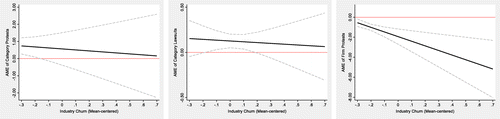
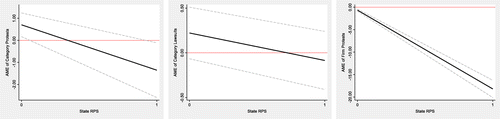
Because our model specifications include product terms that generate nonlinear interactions, we used marginal effects to provide accurate information about the magnitude and significance of all sets of interactions between two types of external threats and three moderators, following prior research (York et al. 2018). In our setting, marginal effects summarize change in the predicted number of words from the search dictionary per 1,000 words in the articles on the focal firm due to a one-unit change in the independent variable. Figures 1–3, which are based on models 5, 6, and 7, respectively, illustrate the average marginal effects (AME) of external threats on predicted change in the use of renewable-energy frames at various values of the moderators, along with the 95% confidence intervals.
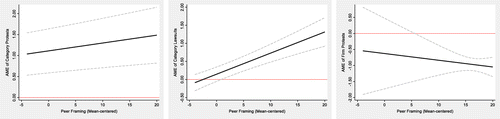
In Hypothesis 3, we predicted that peer-framing effects would positively moderate the effects of communal threats and reduce the negative effects of individual threats on entrepreneurial promotion of the collective identity. The results in model 5 show partial support for this hypothesis. The left panel in Figure 1 shows that the marginal effect of category protests was 1.112 (p < 0.001) for pellet firms whose peer framing had a mean value.11 For those firms that had a high peer framing (mean + 1 SD), the marginal effect was 1.377 (p < 0.001). The difference between the two marginal effects was statistically significant (0.266, p < 0.01), confirming the presence of interaction effects. The center panel suggests that the effect of category lawsuits at a high value of peer framing (AMEmean+SD = 0.976, p < 0.001) was significantly larger than the effect of category lawsuits at the mean value of peer framing (AMEmean = 0.146, p is not significant), with an AME difference of 0.830 (p < 0.001). The right panel shows that the difference between AMEmean+SD and AMEmean was −0.297 (p is not significant), indicating no significant interaction. This nonsignificant interaction may be driven by the effects of individual threats, which are strong enough to inhibit the rise of predicted moderating effects. Additionally, the incongruence between expected behavior under individual threats and normative influence exerted by high peer framing may play a role. The expected action in response to venture-directed activism is strategic differentiation, which is inconsistent with the normative effects of peer framing. The incongruence may create a mixed signal that prevents significant interaction.
In Hypothesis 4, we predicted that industry churn would weaken the positive impact of communal threats and strengthen the negative impact of individual threats. The results in model 6 provide partial support for Hypothesis 4. Figure 2 shows that the marginal effects of category protests and category lawsuits appear to decrease with industry churn, yet such changes do not reach statistical significance (left and center panels). By contrast, the right panel illustrates that the marginal effects of individual threats significantly decrease as industry churn increases: The marginal effect of firm protests at a high industry churn (AMEmean+SD = −4.015, p < 0.001) was more negative than that of firm protests at the mean (AMEmean = −1.937, p < 0.001), and the difference was statistically significant (−2.078, p < 0.01). Similar to Hypothesis 3, the differing results may be shaped by the (in)consistency implicit in activists’ tactics and industry churn. As long as the limited history of prior interactions with other competitors signifies a lack of common experiences and subsequent social bonding for collective action, the expected action is strategic differentiation—an expectation congruent with the behavior that individual threats may generate. However, communal threats foster collective collaboration for the market category, which is incongruent with the expected action under high industry churn. The interaction may be significant only under the condition of congruence.
In Hypothesis 5, we proposed that audience recognition of the promoted collective identity would have a negative interactive influence on both communal and individual threats. The results in model 7 provide partial support for this argument. The left panel of Figure 3 indicates that the marginal effect of category protests was 0.702 (p < 0.05) when a state’s RPS did not include wood pellets in the list of renewable-energy sources and −1.352 (p = 0.05) when the RPS included wood pellets. We tested for equality of marginal effects and found that the difference between the marginal effects was statistically significant (−2.054, p < 0.001). The center panel shows no significant interaction between category lawsuits and state RPS (AME difference of −0.307, p is not significant). The right panel suggests that the AME of firm protests was more negative under the RPS condition (−18.201, p < 0.001) than under the non-RPS condition (−0.668, p < 0.001) and that the difference was significant (−17.533, p < 0.001).
Robustness Tests
In order to rule out endogeneity concerns that stakeholder activism results from venture identity framing (King and McDonnell 2015), we conducted several tests. First, we examined all the news articles related to stakeholder activism, and the activism appeared to be directed at the core business model of using wood fiber. None of the news articles suggested that the activism was in response to a particular pellet firm’s identity statement or press release. Second, a review of the FFI/PFI trade association documents shows that the industry association leadership decided from the outset, independent of activism, to adopt a renewable-energy identity as a way to legitimate the market and differentiate pellet producers from existing home-heating-product substitutes such as firewood, natural gas, and heating oil. Third, we conducted analyses to see whether renewable-energy identity frames predicted individual firm protests and whether firm protests predicted greater renewable-energy frames. The results revealed no significant effect in either direction.
In order to rule out potential bias between how firms frame themselves in a press release and how a reporter might edit their quotes and passages in a news article, we conducted two empirical tests. First, we conducted a Pearson’s correlation test on the words-per-thousand coding of both press releases and news articles from the same firm. The test indicated a Pearson correlation coefficient (r) of 0.61 (p < 0.001), indicating a strong association between a venture’s identity framing in its press releases and in news articles on that venture. Second, we examined the correlation between the words-per-thousand coding of news articles and the manual coding of renewable energy frames from firm quotes in the news articles. A high correlation would show that our current measure based on the words-per-thousand coding of news articles essentially captures renewable frames included in the quoted part of the news articles and that the other part of the article generally lacks keywords representing the renewable-energy identity frames. The Pearson’s correlation test showed a very high correlation coefficient (r) of 0.88 (p < 0.001), indicating that our measure is consistent with the renewable-energy identity frames in the quoted part of the news articles.
Discussion
Research theorizing entrepreneurial collective efforts to promote a coherent market identity shows mixed findings. Some research suggests that new ventures will work together to promote a common identity (Weber et al. 2008, Navis and Glynn 2010, Wry et al. 2011); other studies posit that collective action for new market formation does not always arise (Ozcan and Santos 2015, Lee et al. 2018, Struben et al. 2020). In addressing this dilemma, we examine how the differential influence of external threats impacts a focal venture’s shared fate, or the perception that it experiences an equal risk of negative consequences with its competitors and members of the market category are bound together by a sense of belongingness. The level of shared fate, we argue, influences whether and to what extent entrepreneurs promulgate the promoted collective identity frames. We find general support for these main arguments in an empirical study of new-venture identity framing in response to forest-conservation activism in the U.S. wood pellet market. The results show that communal and individual threats differentially influenced shared fate and led to bifurcated impacts on venture identity framing. We examine internal and external sources of variation in the strength of belongingness by focusing on peer framing, industry churn, and collective identity recognition to illuminate boundary conditions of our arguments. The results show that the effect of communal threats in the form of category protests and lawsuits on the promulgation of collective identity is positively moderated by peer framing, and category protests are negatively moderated by collective identity recognition, whereas the effect of individual threats is negatively moderated by industry churn and collective identity recognition.
This study contributes to the literature on new-market-category creation in a few ways (Lee et al. 2017, Durand and Georgallis 2018, McDonald and Gao 2019). First, we address the inconsistent findings on entrepreneurial collaboration and answer the research call to explore “the mechanisms and enabling conditions that facilitate … collective identity legitimation” (Wry et al. 2011, p. 460) by uncovering how external threats facilitate or hinder collective identity legitimation. Although recent studies have begun to examine external threats and collective action, they tend to focus on established markets with strong regulations (Gurses and Ozcan 2015). Unfortunately, not only do they fail to consider a concrete mechanism, such as shared fate, for explaining why entrepreneurs choose to promote a particular identity frame, but their findings in established markets offer limited insight to entrepreneurial collective action in emerging and transitional markets where neither strong market incumbents nor regulators exist and a dominant identity frame is not established (Hiatt and Carlos 2019). Central to our argument is the understudied role of social activism as an important source of external threats that shape entrepreneurial shared fate. Although social movement scholars have proposed political opportunities and threats as the two general forces driving collective action (Tilly 1978, Goldstone and Tilly 2001), threats have received relatively less attention than opportunities. Threats can generate grievances, or “troublesome matters or conditions, and the feelings associated with them—such as dissatisfaction, fear, indignation, resentment, and moral shock” (Snow and Soule 2010, p. 23). More recently, scholars in this tradition suggest that grievances, if felt collectively by social groups, can be an important pre-existing condition for collective action (Almeida 2003, Andrews and Seguin 2015, Almeida 2019). Our study not only considers the renewed interest of threats, but also extends this research by differentiating between two types of external threats and examining the boundary conditions on entrepreneurs’ efforts to collectively legitimate a new market category (Waldron et al. 2013). We believe that future studies on collective action could benefit by exploring how the different types of environmental threats and opportunities are differently perceived at the individual and collective levels.
Second, we believe that the notion of shared fate can paint a more nuanced picture of optimal distinctiveness in emerging markets (Zhao et al. 2018, Barlow et al. 2019). Collective identity legitimation is a critical process of an emerging industry, where entrepreneurs strive to be recognized by audiences as members of a viable market category. Cultural entrepreneurship studies tend to describe the legitimation process as a linear transition from collective efforts to promote the category in a prelegitimation period to individual endeavors to enhance differentiation in a postlegitimation period (Lounsbury and Glynn 2001, Navis and Glynn 2010, Lo et al. 2020). According to this logic, entrepreneurs are unlikely to stand together in the postlegitimation stage. In contrast, our study shows that entrepreneurial collective action for category legitimacy does not follow a linear path, because it is shaped by external threats that may arise even if the market transitions toward taken-for-grantedness. In this sense, although there may exist a natural time trend with collective identity legitimation, the distinction between prelegitimation and postlegitimation may be less meaningful in understanding whether ventures engage in collaborative endeavors for a collective identity: Entrepreneurial collective action may occur not simply because it is in an early stage of market development, but because ventures in that stage perceive the lack of market-category legitimacy as a significant threat to resource attainment. By focusing on external threats that can occur at any point during the market’s developmental stages, we develop a more generalized theoretical explanation that illuminates the temporality of collective identity promulgation and delineates specific conditions under which entrepreneurial collective action occurs. Our study also reconciles inconsistent findings of two contradictory industry development patterns: Some nascent markets begin with substantial differentiation, but, over time, conformity among firms ensues (Zhao et al. 2017), whereas other markets commence with high conformity and only after attaining legitimacy does differentiation among firms occur (Navis and Glynn 2010). We propose that shared fate could be the missing mechanism that explains the opposite observations.
Third, this study shows that new market categories offer an attractive setting in which to examine movement and countermovement interaction—an important dynamic that social movement scholars view as underexplored (Zald and Useem 1987, Simon and Klandermans 2001). We add insight for such a dynamic by illustrating that the collective action of social activists opposing a new market category is sufficiently intertwined with the collective reaction of entrepreneurs. More research is needed to explore how such interaction further affects dynamic changes in activist tactics and the consequential impacts of such changes on entrepreneurial collective action and market developments. For instance, how would the adversarial attributions to common enemies affect collective grievances and shared fate? Although threats from common enemies have been argued to induce collective action (Carroll and Swaminathan 2000, Georgallis and Lee 2020, Odziemkowska and Dorobantu 2021), our findings suggest that some actions of common enemies have the opposite effect, depending on the degree to which they are perceived to single out individual producers. We call for future studies that more thoroughly examine how complex manifestations of entrepreneurial collective action are shaped by interactive influences of the focal venture’s perception and interpretations regarding shared fate and the broader contexts, such as external threats that engender differential responses of targeted (and nontargeted) firms within a market category (Waldron et al. 2013). Exploring these complex interactions can foster the development of a more nuanced theory of new market creation and entrepreneurial collective identity.
As with many studies on new market categories, this one is not without limitations. Because our study begins well before the internet was established, our options for collecting identity frames were limited. Most new ventures in our setting are private and small and, in general, abstain from issuing press releases; thus, we triangulate press releases with news articles about the pellet companies. We recognize that although news articles include entrepreneur quotes and interviews, they may not accurately reflect the entrepreneur’s true framing in the rest of the text. To justify the use of this measure, we conduct robustness tests and include additional details of how we addressed these issues in the online appendix. Future research may more easily capture how entrepreneurial identity frames evolve by analyzing new markets that arise after internet emergence using social media platforms, blog posts, and business websites via the Internet Archive’s Wayback Machine (Wry et al. 2014, Younger and Fisher 2020). Moreover, studies may be able to examine how a broader portfolio of individual and communal threats might interact to affect identity framing (Eesley et al. 2016). Although we were able to measure category lawsuits and protests, as well as individual protests, our setting lacked lawsuits targeting individual ventures. Future research could capture how a variety of individual- and market-level threats interact and affect the degree to which a venture will differentiate itself from or align with the promoted collective identity.
Finally, this paper has practical implications for business and the environment. Public and private forests deliver a wide variety of economic and environmental benefits. They provide roughly 76% of North America’s net terrestrial carbon sequestration and, when properly managed, are a sustainable renewable resource (Fei et al. 2019). Yet, biological invasions, climate change, and ensuing forest fires from dead, diseased wood have become a serious ecological and economic concern. Between 2008 and 2018, native and nonnative insects killed more than 79 million acres of trees in the United States and were the major contributor to 70 million acres of wildfires, with a peak of 10.3 million acres burned in 2020 alone (United States Forest Service 2020, Congressional Research Service 2021). Not only do wildfires emit millions of tons of atmospheric carbon and particulate matter, but they also levy considerable economic costs (Reinhardt et al. 1997, Thomas et al. 2017). By processing diseased wood into pellets, research shows that wood pellet production can be a prospective forest-management solution that can reduce devastating wildfires, increase carbon uptake rates, and maintain recreation and wildlife habitat (Dale et al. 2017).
The authors express appreciation to senior editor Glen Dowell and the anonymous reviewers for their guidance, as well as Paul Adler, Ana Aranda, Daniel Armanios, Shaz Ansari, Chad Carlos, Tom Cummings, Chuck Eesley, Mary Ann Glynn, Matthew Grimes, Kira Fabrizio, Peer Fiss, Byungchae Jin, Candace Jones, Mark Kennedy, David Kirsch, Lauren Lanahan, Christopher Marquis, Chad Navis, Kelly Patterson, Joseph Raffiee, Tal Simons, Wesley Sine, Paul Tracey, Edward Walker, Frank Wijen, and Lori Yue for their helpful comments. The authors also thank seminar participants at Boston University, Brigham Young University, Cornell University, Erasmus University (RSM), KAIST, SKK University, Stanford University, the University of California Los Angeles, the University of Cambridge, the University of Central Florida, the University of Edinburgh, and the University of Wisconsin-Madison. Recognition for their research assistance goes to Altantsetseg Battulga, Hyeonjin Cha, Dasom Jeong, Timothy Kim, and Ye Joon Lee. The authors appreciatively acknowledge visiting scholar positions at Católica Lisbon School of Business and Economics and the Scheller College of Business at the Georgia Institute of Technology. The ordering of authorship is alphabetical; both authors contributed equally. A previous version of this paper received the 2016 Best Paper Award from the Academy of Management’s Organizations and Natural Environment Division and the 2016 People’s Choice Award from the Alliance for Research in Corporate Sustainability.
1 Europe is the largest purchaser of U.S. wood pellets for electricity generation; biomass is legally recognized as a carbon-neutral energy source and is eligible for carbon credits (Hiatt 2012).
2 Records indicate that 10 pellet ventures were involved in the formation of the FFI. The FFI’s mission was to represent the “clean burning technology of renewable bio-mass energy sources” and to advance the “promotion of fiber and densified (pellets) fuel technology that will help solve global ecological problems through the utilization of locally renewable energy sources” (FFI/PFI 1983–1995, November 1993).
3 Forest-conservation groups viewed wood pellet producers as members of the forest products industry, notwithstanding pellet producers’ efforts to carve out a separate identity for themselves.
4 Tree sitting entails sitting in the upper reaches of a tree to prevent it from being harvested. Tree spiking involves hammering a metal rod or other sharp object into the base of a tree trunk to discourage harvesting by endangering loggers.
5 The news article search terms included [wood biomass OR pellet, wood manufacturing, tree, timber harvest, lumber, logging, OR sawmill] + [protest, boycott, OR blockade].
6 Because lawsuits can take three to six years to settle, we also tried three-, five-, and seven-year moving averages of lawsuits, as a robustness check; the alternative measures did not change the results.
7 The news article search terms for firm protests included [“pellet firm name”] + [protest, boycott, OR blockade]. Supplemental analyses showed that activists were largely indiscriminate and targeted a variety of ventures regardless of size, specialization, or other firm characteristics.
8 About 19% of firms were missing production data; for these, we used the median plant capacity for that state and year using aggregated FFI/PFI reports. Excluding this variable does not alter results.
9 For more details on how this measure was constructed, see Berry et al. (2010).
10 The smaller effect size of category lawsuits compared with category protests in the models could be due to lawsuits being less publicly known: A separate analysis we conducted showed that only 13% of category lawsuits in our study were covered in news articles.
11 An increase of one in category protests (logged) is associated with 1.112 more words for renewable-energy frames.
References
- (2003) Opportunity organizations and threat‐induced contention: Protest waves in authoritarian settings. Amer. J. Sociol. 109(2):345–400.Crossref, Google Scholar
- (2019) Social Movements: The Structure of Collective Mobilization (University of California Press, Berkeley, CA).Google Scholar
- (2015) Group threat and policy change: The spatial dynamics of prohibition politics, 1890–1919. Amer. J. Sociol. 121(2):475–510.Crossref, Google Scholar
- (2016) “Who are you? … I really wanna know”: Product meaning and competitive positioning in the nascent synthesizer industry. Strategy Sci. 1(3):163–183.Link, Google Scholar
- (2020) Tax credits and small firm R&D spending. Amer. Econom. J. Econom. Policy 12(2):1–21.Crossref, Google Scholar
- (1989) Social identity theory and the organization. Acad. Management Rev. 14(1):20–39.Crossref, Google Scholar
- (2006) Waves of collectivizing: A dynamic model of competition and cooperation over the life of an industry. Corporate Reputation Rev. 8(4):272–292. Crossref, Google Scholar
- (2008) Good fences make good neighbors: A longitudinal analysis of an industry self-regulatory institution. Acad. Management J. 51(6):1150–1170.Crossref, Google Scholar
- (1997) Peer pressure in an agency relationship. J. Labor Econom. 15(2):234–254.Crossref, Google Scholar
- (2019) Optimal distinctiveness, strategic categorization, and product market entry on the Google Play app platform. Strategic Management J. 40(8):1219–1242.Crossref, Google Scholar
- (2010) Measuring citizen and government ideology in the American states: A re-appraisal. State Polit. Policy Quart. 10(2):117–135.Crossref, Google Scholar
- (2000) Why the microbrewery movement? Organizational dynamics of resource partitioning in the U.S. brewing industry. Amer. J. Sociol. 106(3):715–762.Crossref, Google Scholar
- (2017) How commitment to craftsmanship leads to unique value: Steinway & Sons’ differentiation strategy. Strategy Sci. 2(1):13–38.Link, Google Scholar
Congressional Research Service (2021) Wildfire statistics. Report IF10244, Congressional Research Service, Washington DC.Google Scholar- (2017) How is wood-based pellet production affecting forest conditions in the southeastern United States? Forest Ecol. Management 396:143–149.Crossref, Google Scholar
- (2007) Churn, baby, churn: Strategic dynamics among dominant and fringe firms in a segmented industry. Management Sci. 53(4):632–650.Link, Google Scholar
- (2013) How firms respond to mandatory information disclosure. Strategic Management J. 34(10):1209–1231.Crossref, Google Scholar
- (2018) Differential firm commitment to industries supported by social movement organizations. Organ. Sci. 29(1):154–171.Link, Google Scholar
- (1994) Organizational images and member identification. Admin. Sci. Quart. 39(2):239–263.Crossref, Google Scholar
- (2016) Through the mud or in the boardroom: Examining activist types and their strategies in targeting firms for social change. Strategic Management J. 37(12):2425–2440.Crossref, Google Scholar
- (2009) Identity affirmation through “signature style”: A study of toy car designers. Human Relations 62(7):1041–1072.Crossref, Google Scholar
- (1978) Deterring the onset of smoking in children: Knowledge of immediate physiological effects and coping with peer pressure, media pressure, and parent modeling. J. Appl. Soc. Psych. 8(2):126–135.Crossref, Google Scholar
- (2019) Biomass losses resulting from insect and disease invasions in US forests. Proc. Natl. Acad. Sci. USA 116(35):17371–17376.Crossref, Google Scholar
Fiber Fuels Institute (1983) Fiber Fuels—A Renewable Resource: Conference Proceedings (Fiber Fuels Institute, Arlington, VA).Google ScholarFiber Fuels Institute/Pellet Fuels Institute (1983–1995) Bimonthly Newsletter (Fiber Fuels Institute/Pellet Fuels Institute, Duluth, MN).Google Scholar- (2017) Hidden badge of honor: How contextual distinctiveness affects category promotion among certified B corporations. Acad. Management J. 60(6):2294–2320.Crossref, Google Scholar
- (2020) Toward a theory of entry in moral markets: The role of social movements and organizational identity. Strategic Organ. 18(1):50–74.Crossref, Google Scholar
- (2019) Shine on me: Policy support for the emergent solar photovoltaic industry in Europe. Admin. Sci. Quart. 64(3):503–541.Crossref, Google Scholar
- (2001)
Threat (and opportunity): Popular action and state response in the dynamic of contentious action . Aminzade RR, Goldstone J, McAdam D , eds. Silence and Voice in the Study of Contentious Politics (Cambridge University Press, Cambridge, UK), 179–194.Crossref, Google Scholar - (2021) Making space for emotions: Empathy, contagion, and legitimacy’s double-edged sword. Organ. Sci. 32(1):42–63.Link, Google Scholar
- (2018) The pivot: How founders respond to feedback through idea and identity work. Acad. Management J. 61(5):1692–1717.Crossref, Google Scholar
- (2018) How core and peripheral communities shape the boundaries of an emerging field. Admin. Sci. Quart. 63(4):783–818.Crossref, Google Scholar
- (2015) Entrepreneurship in regulated markets: Framing contests and collective action to introduce pay TV in the US. Acad. Management J. 58(6):1709–1739.Crossref, Google Scholar
- (2010) To share or not to share? Professional norms, reference groups, and information withholding among life scientists. Organ. Sci. 21:873–891.Link, Google Scholar
- (1968) The tragedy of the commons. Science 162(3859):1243–1248.Crossref, Google Scholar
- (2012) Antecedents of settlement on a new institutional practice: Negotiation of the ISO 26000 standard on social responsibility. Acad. Management J. 55(5):1120–1145.Crossref, Google Scholar
- (2012) Sykué Bioenergya. Harvard Business School Case 412062, Harvard Business School, Boston.Google Scholar
- (2019) From farms to fuel tanks: Stakeholder framing contests and entrepreneurship in the emergent U.S. biodiesel market. Strategic Management J. 40(6):865–893.Crossref, Google Scholar
- (2013) Lords of the harvest: Regulatory-agency decision making in the approval of genetically modified organisms. Acad. Management J. 56(4):923–944.Crossref, Google Scholar
- (2015) Organizational responses to public and private politics: An analysis of climate change activists and US oil and gas firms. Organ. Sci. 26(6):1769–1786.Link, Google Scholar
- (2009) From Pabst to Pepsi: The deinstitutionalization of social practices and the creation of entrepreneurial opportunities. Admin. Sci. Quart. 54(4):635–667.Crossref, Google Scholar
- (1965)
Social stratification, social norms, and roles . Steiner ID, Fishbein M, eds. Current Studies in Social Psychology (Holt, Rinehart, & Winston, New York), 301–309.Google Scholar - (2018) The role of trade associations in market discourse and cognition. J. Management Inquiry 27(1):13–15.Crossref, Google Scholar
- (2016) Discursive strategies and radical technological change: Multilevel discourse analysis of the early computer (1947–1958). Strategic Management J. 37(1):149–166.Crossref, Google Scholar
- (1992) Peer pressure and partnerships. J. Polit. Econom. 100(4):801–817.Crossref, Google Scholar
- (2008) Getting counted: Markets, media and reality. Amer. Sociol. Rev. 73(2):270–295.Crossref, Google Scholar
- (2010) Changing landscapes: The construction of meaning and value in a new market category—Modern Indian art. Acad. Management J. 53(6):1281–1304.Crossref, Google Scholar
- (2015)
Good firms, good targets: The relationship between corporate social responsibility, reputation, and activist targeting . Tsutsui K, Lim A, eds. Corporate Social Responsibility in a Globalizing World: Toward Effective Global CSR Frameworks (Cambridge University Press, Cambridge, UK), 430–454.Crossref, Google Scholar - (2007) Social movements as extra-institutional entrepreneurs: The effect of protests on stock price returns. Admin. Sci. Quart. 52(3):413–442.Crossref, Google Scholar
- (2011) Identity realization and organizational forms: Differentiation and consolidation of identities among Arizona’s charter schools. Organ. Sci. 22(3):554–572.Link, Google Scholar
- (2002)
Strategic responses to the reputation commons problem . Hoffman A, Ventresca M, eds. Organizations, Policy, and the Natural Environment: Institutional and Strategic Perspectives (Stanford University Press, Stanford, CA), 393–406.Google Scholar - (2013)
Social movements and the dynamics of collective action . Huddy L, Sears DO, Levy JS, eds. Oxford Handbook of Political Psychology (Oxford University Press, New York), 774–811.Crossref, Google Scholar - (2006) Where is the “me” among the “we”? Identity work and the search for optimal balance. Acad. Management J. 49(5):1031–1057.Crossref, Google Scholar
- (1977) The measurement of observer agreement for categorical data. Biometrics 33(1):159–174.Crossref, Google Scholar
- (2006) Organizational reference groups: A missing perspective on social context. Organ. Sci. 17(1):80–100.Link, Google Scholar
- (2009) The infrastructure of collective action and policy content diffusion in the organic food industry. Acad. Management J. 52(6):1247–1269.Crossref, Google Scholar
- (2017) Market mediators and the tradeoffs of legitimacy-seeking behaviors in a nascent category. Organ. Sci. 28(3):447–470.Link, Google Scholar
- (2018) Collective action and market formation: An integrative framework. Strategic Management J. 39(1):242–266.Crossref, Google Scholar
- (2006) The role of private decentralized institutions in sustaining industry self-regulation. Organ. Sci. 17(6):677–690.Link, Google Scholar
- (2020) Category viability: Balanced levels of coherence and distinctiveness. Acad. Management Rev. 45(1):85–108.Crossref, Google Scholar
- (2001) Cultural entrepreneurship: Stories, legitimacy, and the acquisition of resources. Strategic Management J. 22(6-7):545–564.Crossref, Google Scholar
- (2004) National Forest litigation in the US courts of appeals. J. Forestry 102(2):20–25.Google Scholar
- (2019) Pivoting isn’t enough? Managing strategic reorientation in new ventures. Organ. Sci. 30(6):1289–1318.Link, Google Scholar
- (1950)
Contributions to the theory of reference group behavior . Merton RK, Lazarsfeld PF, eds. Continuities in Social Research (Free Press, New York), 40–105.Google Scholar - (2010) How new market categories emerge: Temporal dynamics of legitimacy, identity, and entrepreneurship in satellite radio, 1990–2005. Admin. Sci. Quart. 55(3):439–471.Crossref, Google Scholar
- (2011) Legitimate distinctiveness and the entrepreneurial identity: Influence on investor judgments of new venture plausibility. Acad. Management Rev. 36(3):479–499.Crossref, Google Scholar
- (2021) Contracting beyond the market. Organ. Sci. 32(3):776–803.Link, Google Scholar
- (1990) Governing the Commons: The Evolution of Institutions for Collective Action (Cambridge University Press, Cambridge, UK).Crossref, Google Scholar
- (2015) The market that never was: Turf wars and failed alliances in mobile payments. Strategic Management J. 36(10):1486–1512.Crossref, Google Scholar
- (1983) Effects of public opinion on policy. Amer. Polit. Sci. Rev. 77(1):175–190.Crossref, Google Scholar
- (2016)
Mobilizing organizational action against identity threats: The role of organizational members’ perceptions and responses . Pratt MG, Schultz M, Ashforth BE, Ravasi D, eds. Oxford Handbook of Organizational Identity (Oxford University Press, Oxford, UK), 239–256.Google Scholar - (2020) Standing together or falling apart? Understanding employees’ responses to organizational identity threats. Acad. Management Rev. 45(2):325–351.Crossref, Google Scholar
- (1980) Competitive Strategy (Free Press, New York).Google Scholar
- (2019) Frame flexibility: The role of cognitive and emotional framing in innovation adoption by incumbent firms. Strategic Management J. 40(7):1013–1039.Crossref, Google Scholar
- (1997) First order fire effects model: FOFEM 4.0: User’s guide. General Technical Report INT-GTR-344. U.S. Forest Service. Ogden, UT.Google Scholar
- (1994) Developmental processes of cooperative interorganizational relationships. Acad. Management Rev. 19(1):90–118.Crossref, Google Scholar
- (2001) Politicized collective identity: A social psychological analysis. Amer. Psych. 56(4):319–331.Crossref, Google Scholar
- (2009) Tilting at windmills? The environmental movement and the emergence of the US wind energy sector. Admin. Sci. Quart. 54(1):123–155.Crossref, Google Scholar
- (2005) Risky business? Entrepreneurship in the new independent-power sector. Admin. Sci. Quart. 50(2):200–232.Crossref, Google Scholar
- (2010) A Primer on Social Movements (Norton, New York).Google Scholar
- (2009) North America’s wood pellet sector. Research Paper FPL-RP-656, Laboratory UFP, Madison, WI.Google Scholar
- (2000) The past, present, and future of an identity theory. Soc. Psych. Quart. 63:284–297.Crossref, Google Scholar
- (2020) Collective action problems during market formation: The role of resource allocation. Strategy Sci. 5(3):245–270.Link, Google Scholar
- (2017) The costs and losses of wildfires: A literature survey. NIST Special Publication 1215. U.S. Department of Commerce, Washington, DC.Google Scholar
- (1978) From Mobilization to Revolution (Addison‐Wesley, Reading, MA).Google Scholar
U.S. Brewers’ Association (1909) The Yearbook of the United States Brewers’ Association (United States Brewers’ Association, New York).Google ScholarU.S. Forest Service (2020) Major Forest Insect and Disease Conditions in the United States: 2018 (United States Department of Agriculture, Washington, DC).Google Scholar- (2022) Green to gone? Regional institutional logics and firm survival in moral markets. Organ. Sci. Forthcoming.Link, Google Scholar
- (2013) Explaining firm and industry differences in responses to activism. Acad. Management Rev. 38(3):397–417. Crossref, Google Scholar
- (2008) Forage for thought: Mobilizing codes in the movement for grass-fed meat and dairy products. Admin. Sci. Quart. 53(3):529–567.Crossref, Google Scholar
- (1999) Distribution-free estimation of some nonlinear panel data models. J. Econometrics. 90(1):77–97.Crossref, Google Scholar
- (2011) Legitimating nascent collective identities: Coordinating cultural entrepreneurship. Organ. Sci. 22(2):449–463.Link, Google Scholar
- (2014) Hybrid vigor: securing venture capital by spanning categories in nanotechnology. Acad. Management J. 57(5):1309–1333.Crossref, Google Scholar
- (2018) It’s not easy building green: The impact of public policy, private actors, and regional logics on voluntary standards adoption. Acad. Management J. 61(4):1492–1523.Crossref, Google Scholar
- (2020) The exemplar enigma: New venture image formation in an emergent organizational category. J. Bus. Venturing 35(1):105897.Crossref, Google Scholar
- (1987)
Movement and countermovement interaction: Mobilization, tactics, and state involvement . Zald MN, McCarthy JD, eds. Social Movements in an Organizational Society (Transaction Publishers, New Brunswick, NJ), 247–271.Google Scholar - (2017) Optimal distinctiveness: Broadening the interface between institutional theory and strategic management. Strategic Management J. 38(1):93–113.Crossref, Google Scholar
- (2018) Optimal distinctiveness in the console video game industry: An exemplar-based model of proto-category evolution. Organ. Sci. 29(4):588–611.Link, Google Scholar
- (2020) Start-up inertia vs. flexibility: The role of founder identity in a nascent industry. Admin. Sci. Quart. 65(2):395–433.Crossref, Google Scholar
Shon R. Hiatt is an associate professor of business administration at the University of Southern California’s Marshall School of Business. He researches entrepreneurship, ESG strategy, and sustainability innovation in domestic and international contexts, with a particular emphasis on food/agribusiness and energy industries. He received his PhD from Cornell University.
Sangchan Park is an associate professor of management and organization at KAIST (the Korea Advanced Institute of Science and Technology) College of Business. His research explores issues related to organization theory and strategic management with a focus on the legitimation of nonlegitimate ideas, categories, technologies, and managerial practices. He received his PhD from Cornell University.