


Public Opinion and Impression Management in the Communication of Performance During the Second Iraq War
Abstract
Although studies show that organizations engaged in controversial actions often aim to minimize the release of threatening information, scholars know relatively little about what may prompt organizations to increase transparency in these situations. In this study, we focus on support from public opinion as a condition that may influence the disclosure of sensitive performance information to the public. Using the second Iraq War as an empirical context, we focus on the extent to which public officials—Pentagon spokespersons—release and frame information about war performance. This outcome is critical because the way in which organizations communicate their performance to outsiders has often been regarded as a key defensive impression management tactic. We hypothesize that high public support for the war will increase the likelihood that Pentagon officials release information about sensitive combat performance indicators in their press briefings and identify contingencies, such as adversity and organizational spokespersons’ power, that moderate this relationship. We also explore whether high public support decreases the strategic use of alternate performance frames that emphasize metrics that signal progress toward a desirable end state. Using a unique data set based on the coding of press briefings, public opinion data, and other public sources, we find support for several of our hypotheses. We discuss implications for understanding the relationship between public opinion and impression management and highlight the importance of extending this research to nongovernmental organizations.
Supplemental Material: The online appendix is available at https://doi.org/10.1287/orsc.2022.1598.
A popular Government, without popular information, or the means of acquiring it, is but a Prologue to a Farce or a Tragedy; or, perhaps both. —James Madison
Introduction
Organizations seek to gain influence over their environments by obtaining the support and endorsement of critical audiences. Because engaging in controversial actions threatens this support, organizations often try to reduce direct scrutiny by resorting to impression management tactics—efforts intended to positively influence the image held by target audiences (Elsbach and Sutton 1992, Bolino et al. 2008). A way in which threatened organizations engage in this strategic “presentation of self” (Goffman 1959) is through impression management tactics, such as minimizing the release of organizationally threatening information (Bolino et al. 2008, Graffin et al. 2016). Indeed, evidence suggests that organizations engaged in controversy reduce transparency, the timely disclosure of publicly relevant information (Albu and Flyverbom 2019), by managing their informational environment to influence the impressions of critical audiences, such as shareholders and investors (Davidson et al. 2004, Graffin et al. 2016), customers (Elsbach et al. 1998), stock analysts (Busenbark et al. 2017), and the media (Dutton and Dukerich 1991).
Although prior research has generated a wealth of insights into why and how organizations strategically manage the disclosure of threatening information, almost no attention has been devoted to the factors that may increase transparency when organizations carry out controversial actions. Journalists, analysts, and watchdog organizations often comment on, and usually regret, the lack of transparency that plagues institutions involved in contentious public matters. Interestingly, these commentators note that despite advances in information technology and increased pressure from activists, organizations, such as large corporations, healthcare institutions, and governments, still hide much relevant information from the public (Pearson 2018). This continued lack of transparency suggests that studying the factors that encourage the release of sensitive performance information is critical to extend our understanding of the use (or nonuse) of impression management tactics and to promote accountability to the public.
In this study, we focus on public opinion—the cumulative preferences and sentiments of the population (Hobolt and Klemmemsen 2005, Stimson 2018)—as a factor that may alter transparency when organizations are engaged in controversial actions. Specifically, we expect that high public support, a condition that can lower organizational members’ defensiveness, will increase the disclosure of sensitive outcomes, whereas low public support will decrease it. However, public opinion may not only influence the level of disclosure of sensitive outcomes but also, affect what type of information organizational members disclose and how they frame performance outcomes. Unsupportive public opinion, for example, may lead organizational members to highlight outcomes that help maintain a favorable image and boost public support. Thus, we also explore how public opinion may influence the strategic use of alternate frames (Goffman 1974, Benford and Snow 2000, Fiss and Zajac 2006). This comprehensive examination of the influence of public opinion on impression management enables us to identify contingencies that may modify how organizational members respond to the pressures of the public—a source of pressure that differs from those previously analyzed in the literature, such as activists and social movements (Elsbach et al. 1998, McDonnell and King 2013), journalists (Westphal et al. 2012), stock analysts (Busenbark et al. 2017), and foreign competitors (Ravasi and Schultz 2006). A deeper understanding of public opinion is critical given the continued growth of opinion polls, which has led to a higher pervasiveness and relevance of public opinion (Watts and Dodds 2007). As suggested by recent work, social networks disseminate the public’s views with greater velocity and emotionality than in the past (Etter et al. 2019), reaching a larger and more heterogeneous set of constituents than ever before (Wang et al. 2021).
In our analysis, we address three questions. First, does public support for a controversial course of action increase the extent to which organizational members release information about sensitive performance indicators? Second, does public support reduce the extent to which organizational members use alternate performance frames that signal progress and obfuscate sensitive information? Third, what factors influence the extent to which organizational members respond in these ways? To address these questions, we chose as an empirical setting: the second Iraq War from its inception in March 2003 to December 2006. We chose this setting for two main reasons. First, although the influence of public opinion on organizations has been noted in previous studies, the Iraq War is an “extreme” context characterized by extraordinary consequences (e.g., losses of large numbers of human lives, allocation of considerable economic resources) and in which public opinion is conspicuous (Eisenhardt and Graebner 2007, Hällgren et al. 2018). Not only are government organizations managing a contentious war particularly sensitive to public opinion, which involves a broad audience rather than narrow groups of activists, but an extreme context, such as war, increases the chances of observing behaviors that are less prominent in the kinds of settings that organizational researchers typically examine. Second, the fast pace of modern war operations combined with the strong public interest in war events created a context in which military leaders continuously reported on the progress of the second Iraq War. Press conferences are an important venue that provides organizational members with opportunities for impression management (Ginzel et al. 1993), and using Pentagon biweekly press briefings allows us to detect the use of impression management tactics on a relatively real-time basis.
In this setting, we examine the extent to which public officials—Pentagon spokespersons—talked about (i.e., disclosed) war performance metrics in press briefings. We focus on this outcome because how organizations communicate their performance to outsiders has often been regarded as a defensive impression management tactic aimed at maintaining a favorable image (Meyer and Rowan 1977, Bansal and Clelland 2004). We expect that high public support for the war will increase the likelihood that Pentagon officials discuss sensitive combat performance indicators in their press briefings. Additionally, we hypothesize that adversity evidenced by troop deaths and lack of resources decreases this effect, whereas higher power of spokespersons increases it. Considering the strategic use of alternate performance frames, we explore whether high public support reduces the release of information about performance metrics that signals progress in the war, such as those related to Iraq’s reconstruction and rebuilding, an effect that might be stronger when members simultaneously disclose sensitive performance information. We test these relationships using a unique data set based on the coding of press briefings, public opinion data, and other public sources.
Controversy, Impression Management, Transparency, and Public Opinion
Impression management research describes the efforts undertaken by organizations to create, maintain, or alter the image held by target audiences (Elsbach and Sutton 1992, Bolino et al. 2008). Just as individuals manage how they present themselves to others in social interactions (Goffman 1959), organizations, through the actions of spokespersons, engage in impression management tactics to influence the way critical audiences perceive them; these tactics are used to secure audience support and to cultivate a more positive evaluation (Wayne and Liden 1995). Research shows that organizations deploy impression management tactics for a variety of strategic reasons, such as responding to image threats in the face of controversial issues (Elsbach and Sutton 1992, Ravasi and Schultz 2006), anticipating controversies (Elsbach et al. 1998, Arndt and Bigelow 2000), influencing investors and stock analysts (Westphal and Graebner 2010, Washburn and Bromiley 2014, Aguilera et al. 2017), convincing nonshareholding stakeholders (Bansal and Kistruck 2006, Carter 2006, McDonnell and King 2013), and reassuring external constituents about the quality of a firm’s leadership (Westphal et al. 2012).
This literature suggests that defensive and anticipatory impression management tactics become most evident in times of crisis or controversy when organizational legitimacy is threatened (Elsbach 2003, Graffin et al. 2016). Scholars have found that firms offset negative information regarding controversial acquisitions (Graffin et al. 2016), conceal negative financial data (Abrahamson and Park 1994), and obfuscate information regarding events critical to stakeholders (Dutton and Dukerich 1991, Elsbach et al. 1998, Graffin et al. 2011).
Despite the multiple circumstances that prompt organizations engaged in controversial actions to minimize the release of threatening information, impression management scholars have accumulated relatively few insights about factors that might decrease the perceived intensity of external pressures felt by organizational members, thus leading to transparency in times of crisis. In particular, public opinion—the prevalent views and preferences among the general public (Hobolt and Klemmemsen 2005)—may be a critical factor influencing the disclosure of sensitive information by organizations facing controversy. Given that their legitimacy is threatened, these organizations should be particularly responsive to varying levels of public support, which may in turn affect information disclosure. High public support may buffer organizational members from external pressures, lowering their defensiveness and leading to higher disclosure of sensitive outcomes. Conversely, low support for controversial actions may further activate tactics aimed at defending perceptions of the organization not only by reducing the disclosure of sensitive information but also, by elevating the use of alternate frames to report performance (Goffman 1974, Fiss and Zajac 2006, Kaplan 2008). In short, public opinion should influence the intensity with which organizations pursuing controversial actions employ defensive impression management tactics.
Although empirical organizational research on public opinion is scarce, some scholars suggest that public opinion may influence organizations (Oliver 1991, Deephouse 1996). Social movement researchers claim that stakeholders can mobilize public opinion in favor of or against the actions of certain firms (Vergne 2012, McDonnell and King 2013), and some empirical evidence suggests that multinational companies try to conform to local public opinion as a way to show deference and gain legitimacy in foreign contexts (e.g., Li et al. 2007). Additionally, negative public opinion polls regarding environmental degradation contributed to a substantial increase in capital expenditures by chemical firms and the creation of the Responsible Care Program, an effort to maintain self-regulatory institutions without external sanctions (Hoffman 1999, King and Lenox 2000). Although these studies tend to relegate public opinion to the background, they indicate that organizations will often strive to align themselves with public sentiment.
To develop theory on the specific mechanisms by which public opinion may influence impression management, we draw on social psychological research on accountability (Tetlock 1983, Lerner and Tetlock 1999). Accountability theory applies well to our context because military officials view the public as a critical audience to whom they are accountable. Although public opposition to military action makes elected officials and military leaders reluctant to use military intervention as a means to resolve international conflicts (Luttwak 1994, Record 2007), commitment to war has often been found to foster defensive behaviors (Hackett and Zhao 1994). Indeed, communication through press releases during the second Iraq War was a key strategic concern for military leaders and thus, represents a critical venue for exploring impression management.
Accountability and Public Opinion
The social psychological literature on accountability provides a valuable foundation for disentangling the relationship between public opinion and impression management. From this theoretical perspective, feeling obligated to explain or justify one’s conduct to some significant other affects how individuals think and behave (Scott and Lyman 1968, Tetlock 1992). A key distinction in the literature on accountability is that between predecision and postdecision accountability (Lerner and Tetlock 1999). Perceptions of being accountable to an audience before deciding (or forming an opinion) are generally associated with openness to others’ viewpoints. When the audience’s views are known, individuals often display an inclination to conform to those views (Tetlock 1983, Tetlock et al. 1989). Alternatively, if audiences’ views are unknown and conformity is not an option, individuals engage in preemptive self-criticism, whereby they form more complex judgments, take more time to process available evidence, and consider multiple perspectives on the issue (Tetlock 1983, Koonce et al. 1995, Mero and Motowidlo 1995, Carnaghi and Yzerbyt 2006). In doing so, they try to secure support by anticipating audiences’ objections.
However, research on accountability suggests that openness cedes the way to defensiveness when individuals have irrevocably committed themselves to a course of action. Moreover, strong commitment primes decision makers to view audiences as critical of their views and actions (Tetlock et al. 1989, Lerner and Tetlock 1999). In such circumstances, studies find that individuals engage in “defensive bolstering,” a tendency to generate thoughts that justify the original commitments. Instead of acknowledging their mistakes, individuals form more rigidly defensive views (Morris and Moore 2000) and have a hard time writing off sunk costs (Simonson and Staw 1992).
Accountability research not only is compatible with core tenets of impression management but also, offers the possibility of variance in the degree of defensiveness displayed by individuals committed to a course of action. This research suggests, for instance, that accountable actors are likely to reduce their defensiveness when they expect audiences to evaluate their actions less harshly than originally anticipated or when audiences signal that controversial actions will be less severely assessed or sanctioned (Frink et al. 2008, Hall et al. 2017). These conditions may prompt organizational members to feel protected from external pressures, prompting them to become more transparent in their information disclosure. Hence, we build on these insights to explore how variations in public support influenced the disclosure of performance information in the context of the second Iraq War.
Hypotheses
Public Opinion and Release of Information About Performance
As we noted earlier, a key tactic to dilute accountability pressures in the face of controversy is avoiding the discussion of performance information that may undermine external support. Pfeffer (1981, p. 29) suggests that “one of the interesting aspects of many organizations is the efforts undertaken to systematically avoid assessment, especially assessment of outcomes that are of potential interest to various groups or individuals in contact with the organizations.” To illustrate this tactic, he uses examples of hospitals unwilling to publicly disclose mortality and morbidity figures, schools reluctant to communicate scores on standardized tests to outsiders, and public companies opposing disclosures of adverse legal actions. In essence, organizations avoid assessment, Pfeffer notes, by not disclosing performance data that, regardless of its valence, may attract scrutiny and may have potentially damaging effects on external support. Here, we refer to this type of performance information as sensitive performance information.
Organizational research on symbolic management also suggests that managers will often control the flow of sensitive information in ways that allow them to mitigate scrutiny and secure stakeholders’ support (Elsbach 1994, Westphal and Zajac 1998, Schnackenberg et al. 2019). This literature suggests that deemphasizing sensitive outcomes may be a particularly suitable symbolic tactic used to report organizational outcomes in a way that is acceptable to stakeholders, particularly under conditions of ambiguity or uncertainty. For example, start-ups that do not yet have a proven track record substitute in their communication to external stakeholder performance metrics, such as revenues, with less conventional achievements, such as partially completed products (Zott and Huy 2007). Analogously, public companies under scrutiny engage in selective disclosure of their environmental performance—a critical and sensitive indicator for various stakeholders—as a symbolic tactic aimed at obfuscating less favorable information and maintaining a positive impression (Marquis et al. 2016). Selective disclosure of sensitive performance data also appears in other contexts. For example, in the highly regulated hedge fund industry, funds terminate voluntary reporting of performance indicators to commercial databases when managers believe disseminating this information may repel prospective investors (Agarwal et al. 2013).
During times of war, government organizations may find reducing the release of sensitive performance information a particularly useful defensive impression management tactic. Indeed, the ability to shift the focus away from performance is particularly valuable for government officials who engage in actions that receive considerable external scrutiny, such as costly military operations (Gelpi et al. 2009). Research in political science shows that governments aim to frame public perceptions of war performance in a way that favors the maintenance of public support (Boettcher and Cobb 2006), especially because public belief in a war’s likely success makes the public more tolerant of war sacrifices, such as troop deaths (Gelpi et al. 2005).
In the specific context of the second Iraq War, we expect that Pentagon officials may have responded to public opinion by altering the release of information about performance indicators that can raise apprehension and concern from the public, such as those related to combat outcomes. Unsupportive public opinion should decrease the release of information about combat performance because this information could cast doubt on the chosen path of action, thus increasing criticism and raising questions about the existence of compelling reasons to use military force (Kull et al. 2003). Moreover, the release of information about combat performance may remind the public about the individual sacrifices involved in war, making it harder to elicit public consent for military action. Conversely, public support for the war should reduce government organizational members’ defensiveness because such support indicates that engaging in war will be assessed less severely by the public (Frink et al. 2008, Hall et al. 2017). Furthermore, government officials may interpret public opinion favorable to war as a “vote of confidence” on their competency to handle the crisis (Voeten and Brewer 2006), thus expecting audiences to be more tolerant about combat performance indicators that remind them of the human and material costs of the war. This sense of security may prime organizational members to feel buffered from external pressures, prompting them to become more transparent in their disclosure of sensitive outcomes. These arguments suggest that organizational members reporting on controversial actions increase the release of information about sensitive performance indicators when public support is high. Hypothesis 1 states this formally.
The stronger public support for contentious actions is, the greater organizational members’ release of information about sensitive performance indicators.
Contingencies Affecting the Influence of Public Opinion
Although public support may prompt an increase in the release of information regarding sensitive performance indicators, the context in which organizational members assess public support may condition this effect. The same level of support from public opinion may take on different meanings depending on organizational members’ perceptions of other conditions that may impact their perceptions of threat.
Adverse Outcomes Known to Organizational Members
A prominent condition that shapes perceptions of threat is adversity. Adversity increases threat because it raises concrete doubts regarding the consequences of controversial actions, leading organizational members to anticipate that such actions will be more severely assessed than in other circumstances. For instance, organizational members in firms undertaking risky unrelated acquisitions (which could destroy shareholder value) are well aware that these actions violate stakeholders’ expectations and thus, manage their information disclosure accordingly (Graffin et al. 2016). Similarly, a change in Chief Executive Officer raises defensiveness in board members because markets tend to label such events as ambiguously negative (Graffin et al. 2011). Other forms of adversity, such as boycotts, also increase perceptions of threat because they can pose severe reputational damage to firms (McDonnell and King 2013).
The evidence from these studies suggests that because adversity raises perceptions of threat, it may erode the effect of public support for a course of action. Organizational members may still discuss sensitive performance indicators as a response to war support but do so less intensely than when adversity is less prominent. Therefore, adversity should negatively moderate the relationship between public support and the release of sensitive information.
Here, we examine two indicators of adversity that are particularly relevant to our empirical setting. A first critical indicator of adversity during a war is the cumulative number of U.S. troops lost in combat (Karol and Miguel 2007, Gelpi et al. 2009). Because deaths of U.S. troops occur mostly before occupying forces can restore public order and conclude war operations, a higher number of U.S. troop deaths may generate perceptions of threat that erode the buffer created by a supportive public opinion. A second indicator of adversity concerns the availability of resources for the military budget. Research on accountability suggests that variance in the level of resources and capabilities available to accountable entities should moderate the relationship between external demands and felt accountability (e.g., Frink et al. 2008, Hall et al. 2017). In the context of war, adversity in the form of a reduction in the financial resources available may debilitate the buffer created by a supportive public opinion among organizational members, as they perceive the need to justify a course of action in a situation where autonomy is becoming severely constrained. In both cases, we anticipate that adversity will weaken the link between public support and the release of information regarding sensitive performance indicators.
The positive relationship between public support for contentious actions and organizational members’ release of sensitive performance indicators will be weaker when facing higher levels of adversity.
Power of Organizational Members
Organizational members reporting on controversial actions may not be uniform in their reactions to public support. An individual attribute that may alter their reactions to supportive public opinion is the power they possess within the organizational hierarchy, which we define as “asymmetric control over valued resources in social relations” (Magee and Galinsky 2008, p. 361). Specifically, the power they possess may alter the extent to which they pay attention to a supportive public opinion and view it as a vote of confidence.
An extensive body of work in social psychology finds that those who possess low power are particularly attentive to the constraints that outsiders place on their actions and vigilant about possible negative evaluations from audiences (Keltner et al. 2003, Guinote 2017, Cho and Keltner 2020). Because they are more sensitive to threats than to rewards, low-power organizational members may give limited attention to high public support. High power, on the other hand, makes people more focused on the pursuit of valued rewards and more attentive to information aligned with such desired outcomes (Keltner et al. 2003, Guinote 2017, Cho and Keltner 2020). Because a supportive public opinion is a key condition that makes the goal of winning the war more attainable, high-power organizational members may pay careful attention to it and also view it as a confirmation of the appropriateness of their actions. So, although a supportive public opinion reduces the defensiveness that thwarts the release of information concerning sensitive performance indicators, research on the psychological effects of power suggests that its influence on this impression management tactic will be greater for organizational members who possess high power than for those who possess low power. Based on our analysis, we expect that, in response to public support for the war, officials who possess high power release more information about sensitive performance indicators than officials who possess low power. This is stated formally in Hypothesis 3.
The positive relationship between public support for contentious actions and organizational members’ release of sensitive performance indicators will be weaker for organizational members who possess lower power.
Public Opinion and the Deployment of Alternate Frames
In addition to influencing the release of information about sensitive performance indicators, public opinion may also impact how organizational members use other tactics to report performance. Here, we explore the possibility that organizational members engage in the strategic use of alternate performance frames that shift audiences’ attention away from sensitive outcomes likely to prompt opposition. A frame is a “schemata of interpretation” (Goffman 1974, Snow et al. 1986) that enables individuals to make sense of ambiguous signals by keeping some features in view while downplaying or even hiding others. Studies show that organizational members strategically employ specific frames to secure internal and external support (Fiss and Zajac 2006, Kaplan 2008, Kellogg 2009). For instance, temporal framing of competitive action announcements enables firms to garner positive media and investor reactions while delaying retaliation from competitors (Nadkarni et al. 2019). Firms also frame controversial actions by issuing statements that direct the attention of investors to the positive (or nonnegative) outcomes of these actions (Rhee and Fiss 2014, Blagoeva et al. 2020). Although these studies have made substantial inroads, understanding of the conditions that influence the strategic use of alternate frames remains limited. As noted, organizational members charged with communicating to outsiders how the organization is performing may choose different frames to characterize performance. They may, therefore, reduce transparency by using frames that emphasize progress—that is, developments that signal getting closer to a desirable end state. Because an unsupportive public opinion raises defensiveness, as we have suggested in our analysis leading to Hypothesis 1, low public support may lead organizational members to deploy alternate frames emphasizing progress. Conversely, if supportive public opinion increases transparency, it may reduce the use of such alternate performance frames.
In the war context, the strategic use of alternate frames to articulate progress likely involves resorting to the disclosure of indicators that correlate with victory and highlight a sense of achievement. Specifically, Pentagon officials may emphasize progress indicators, such as those related to Iraq’s reconstruction and rebuilding. Indeed, large-scale efforts were directed to reconstruct Iraq after the invasion, as reflected in the vast resources assigned to infrastructure (e.g., roads, sanitation, electric power, oil production) and democratization efforts (Tarnoff 2009). However, Pentagon officials may have developed a discourse around reconstruction and rebuilding efforts to justify occupation and “sell” military actions to an increasingly doubtful public (e.g., Sovacool and Halfon 2007). As public support decreased, rhetorical emphasis on these progress indicators might have been how Pentagon officials framed performance because these goals resonated with the values and beliefs of the American public and persuasively articulated controversial war actions “as a necessary cost of war” (Gelpi et al. 2005, p. 10). Strong public support, in contrast, may have reduced the use of this impression management tactic.
The stronger public support for contentious actions is, the less organizational members release information about progress performance indicators.
Organizational members may also combine the release of information about progress performance indicators with the disclosure of sensitive performance information. They may respond to shifts in public opinion by alternating between different types of performance information sequentially. However, abrupt changes or inconsistencies in information disclosure can increase audience suspicion (Ashforth and Gibbs 1990, Gelpi et al. 2009), thus reducing public confidence and casting doubt on the legitimacy of the organization.
A plausible alternative may be that, facing low public support, organizational members deploy alternate frames emphasizing progress in combination with sensitive performance information as a way to obfuscate such unfavorable information. Disclosure of information about progress indicators may enable the organization to manage decreasing public support by framing performance in a manner that resonates with the public, defending the organization’s public image. However, this tendency may operate most strongly when organizations inform the public about sensitive outcomes that raise doubts about whether the organization is achieving its goal. Thus, if public support reduces the use of alternate frames emphasizing progress (as per Hypothesis 4), the magnitude of such a reduction might be higher when members are simultaneously disclosing sensitive information.
The negative relationship between public support for contentious actions and organizational members’ mentions of progress performance indicators will be stronger (i.e., more negative) when members release information about sensitive performance indicators.
Methods
Empirical Context and Data
Multinational forces, led by the United States under the administration of George W. Bush, started the second Iraq War on March 20, 2003 as a response to the threat posed by Iraq’s failure to unconditionally comply with United Nations weapons inspections. A month after the beginning of the invasion, the Pentagon reported that combat operations had ended and that the reconstruction phase had begun (DePalma 2003), but that assessment turned out to be premature. When attacks against U.S. armed forces accelerated during the summer of 2003, the Pentagon reconsidered its earlier evaluation and admitted that the war was still on (Department of Defense 2003). The situation continued to deteriorate during the first year. In October 2003, for example, the press reported that U.S. soldiers came under attack more than 100 times per week across Iraq (Berenson 2003). As the first year of war operations ended, insurgents gained control of several cities. As our data show, military operations continued to spiral out of control in the second and third years of the war.
The Iraq War—plagued by emergencies, unexpected disruptions, and the potential for considerable physical and material losses—represents what scholars categorize as an “extreme” context (Eisenhardt and Graebner 2007, Hällgren et al. 2018). Extreme contexts are useful for building and testing theory for at least two reasons. First, they provide a unique context in which to study “hard to get at” organizational phenomena. Second, they are likely to generate a higher level of information than ordinary cases, increasing the chances that often concealed behaviors become more observable than in other instances. As noted earlier, during a war, public opinion becomes prevalent and easy to track, governments continuously attend to public opinion, and real-time organizational responses rise above the surface (e.g., via press conferences).
Among recent wars, the Iraq War is a particularly appropriate context for testing our theory because impression management was a central concern for the Pentagon. An investigation by the New York Times revealed that Pentagon officials met with military analysts who covered the war in the media to provide them with firsthand information that urged them to speak favorably of the war (Barstow 2008). From the Pentagon side, this active public relations strategy was justified on the grounds that if governments “don’t manage their message strategy, and counter misinformation, they soon will find themselves unable to execute policy” (Basile 2017, p. 3). The Pentagon also engaged in various new tactics aimed at influencing audiences, such as “embedding” reporters within the military (because reports coming from within military lines often have a more positive view of the military), controlling photographic coverage of battlefield events (e.g., returning wounded soldiers after midnight so the press would not take pictures of them), and of course, altering the extent to which they discuss performance information. In short, the Pentagon during the Bush administration prioritized effectively managing its informational environment. As summarized by Colonel Kenneth Allard, the Iraq War “will be remembered as a conflict in which information fully took its place as a weapon of war” (Miller 2004).
We examine how Pentagon officials disclosed information about war performance during the period that extends from March 2003 to December 2006. The period under study coincides with Donald Rumsfeld’s tenure as Secretary of Defense, during which he oversaw the war. Rumsfeld left after the Iraq Study Group, chaired by former Secretary of State James Baker, formulated a negative assessment of the situation in Iraq. His departure led to the appointment of a new Secretary of Defense and new high-ranking generals. The accountability effects we are investigating in this study were likely less prominent after December 2006 because people generally feel less accountable for actions initiated by others (Simonson and Staw 1992).
Our data source is Pentagon press briefings, which provide on the record indications of the views of the Pentagon. Online Appendix A provides an example of a transcript of a briefing. We retrieved press briefings from the Department of Defense (DOD) website. During our observation period, briefings were typically held on a biweekly basis and were the main vehicle by which the Secretary of Defense and military leaders disseminated information about war developments. For each speech, we coded only the introductory section in which Pentagon officials gave updates on the war in Iraq before they took any questions from the press. We followed this approach because it was in this preliminary part of each briefing, rather than during the later question and answer sessions with the press, that Pentagon officials could choose whether and how they talked about war performance. The interpretation of the question and answer part of the briefing, although informative of how Pentagon officials might use a broader range of impression management strategies in response to a potentially skeptical audience, would instead reflect the influence of a combination of factors that are more difficult to disentangle.
Coding Procedure
To measure the release of information about performance information, two research assistants who were unaware of the hypotheses being tested coded each of the 182 speeches included in our analysis. We instructed the coders to code any statement that gave the reader a sense of progress, failure to progress, or desire to progress during the war. We excluded references from consideration of the war in Afghanistan, the general performance of the U.S. military, and oblique references to the international war on terror. The speeches were coded in a randomized order. To develop the coding framework, we followed a grounded theory approach (Strauss and Corbin 1990) and allowed the performance metrics to emerge from the data without any preconceptions. Specifically, we followed Krippendorff (2004) and Campbell et al. (2013), who recommend analyzing a random selection of 10% of the total qualitative documents, which in our study, meant 20 speeches. Analyzing these speeches in batches of three, the coders added any newly found types of performance metrics to the coding framework until they reached a saturation point where no new performance indicators were found. This procedure generated 32 performance metrics, which ranged from “ending terrorism,” and “disarming Iraq” to “rebuilding Iraq’s government” and “autonomy for Iraq.”
As expected, coding the speeches of Pentagon officials involved dealing with more ambiguities than many other types of discourse. One of the most persistent issues was the level of abstraction used. Although sometimes the performance measurement used was quite clear (e.g., “Yesterday four American marines … were killed”), at other times the performance measurement was more abstract (“This tiny minority of thugs is growing weaker”). The codes developed also reflect this variance in abstraction (e.g., United States and allies killed and strength of the enemy, respectively). Performance metrics also varied in the frequency with which they were used. “Security” was used in 78 speeches. “Killing enemy leadership” was used in only five speeches. The performance metrics are also related to broad outcome goals (“freedom and liberty”) and specific process goals (“kill enemies”). Of the 32 performance metrics identified by the coders, 22 were used by Pentagon officials at least three times and are included in our analysis. Examples of metrics that were dropped are “enemy surrender,” “end of terrorism,” and “diplomacy and negotiations.”1 Table 1 presents a representative quote for each of the 22 performance metrics, and Table 2 offers examples of block quotes with and without performance metrics. To calculate interrater reliability at the speech level, we tabulated coincidences within units (i.e., performance metrics) and then, computed Krippendorff's alpha intercoder reliability coefficient. Krippendorff’s alpha value was 0.68, a score above the minimum threshold of 0.6 and a satisfactory result considering the high complexity of the coding. When coders did not agree about a performance metric appearing in a speech, we coded that metric as not appearing in that speech. This coding produced a conservative measure for the use of a performance metric. We then scaled up codes to the month level of analysis. If any speech during a particular month included a specific metric of performance, then we coded that performance metric as one for that month, and if no speech during that month included a particular performance measurement, then we coded that performance metric as zero for that month.
|

Table 1. Examples of Performance Metrics Used in Pentagon Press Briefings
| Quote | |
|---|---|
| Combat | |
| End Saddam’s regime | “As the coalition makes progress, the Iraqi people are losing the fear of the regime … Let me assure them that life without Saddam Hussein is not a distant dream” |
| Capture leaders | “This week Saddam Hussein’s trade minister was captured by coalition forces” |
| Kill leaders | “Tuesday was a good day for the Iraqi people. The brutal careers of Uday and Qusay Hussein came to an end” |
| Capture enemies | “We have more than 7,000 enemy prisoners” |
| Kill enemies | “Coalition forces killed several of the attackers” |
| Strength of enemy | “The threat posed by the insurgents is very real. They continue their attacks on the coalition and have recently increased attacks on Iraqi forces and civilians” “They are a tough, aggressive enemy” |
| Disarming Iraq | “Of the 800-plus tanks they began with, all but a couple of dozen have been destroyed or abandoned” |
| Violence | “We do believe that about 350 civilians have been killed as a result of the sectarian violence following the bombing” |
| Attacks by enemy | “Insurgents have killed approximately 100 security forces” |
| United States and allies wounded | “Also, more than 150 have been wounded in battle” |
| United States and allies deaths | “The 85 brave U.S. service members killed remind us of the heavy price we often pay for freedom” |
| Strength of the United States and allies | “We have over 340,000 coalition forces in the region” |
| Mistakes | “I’d like to express our regrets to the families of the Iraqis killed yesterday at the check point … Loss of any innocent life is tragic” |
| U.S. and allies weapon use | “Our forces have fired more than 700 cruise missiles and dropped more than 9,000 precision-guided munitions” |
| Reconstruction and rebuilding | |
| Security | “There are now about 7,000 Iraqi policemen back at work in Bagdad and that number should also increase in the days ahead” |
| Reconstruction | “Reconstruction momentum is building. In June there were only 230 projects … By the end of November there were over 1,000” |
| Quality of life | “Children in Iraq are returning to school, and basic services like healthcare, electricity, and water … are improving every day” |
| Economy | “On the economic front, we have introduced a new currency that will be actually given to the Iraqi people in October” |
| Foreign aid | “Thirty-eight nations have made offers of financial assistance totaling more than $1.8 billion” |
| Autonomy for Iraq | “The Iraqi people are now experiencing the right of democracy and everything that goes with the responsibility of democracy, as they work to form a government of their choice” |
| Rebuilding government | “Local governments and town councils are being formed in virtually every city and town across the country” |
| Liberty/freedom | “In Karbala, over a million Shi’a Muslims were able to complete their pilgrimage without interference … since 1977. That is an important accomplishment, a sign that free expression and religious liberty are returning to Iraq” |
|
Table 2. Examples of Block Quotes with and Without Performance Metrics
| Quote | |
|---|---|
| Block quote with performance metrics (capture enemies, U.S. and allies weapon use) | “A growing number of Iraqi intelligence operatives have been arrested while others simply ignore their orders to attack coalition targets, waiting for the Iraqi regime to collapse. And, where are Iraqi’s leaders? The night before the ground war began, coalition forces launched a strike on a meeting of Iraqi’s senior command and control and they have not been heard from since. The fact that Saddam Hussein did not show up for his televised speech today is interesting. With each passing day more regime targets are being hit and more coalition forces are pouring into the country.” |
| Block quote without performance metrics | “One of the most important aspects of a free society is, of course, free expression, including the expression of minority views. One of the ways that minority opinion can be expressed in free nations is through protests and demonstrations. Here in the U.S., for example, the majority of Americans supported the war in Iraq, but some opposed it, and some took to the streets to make their opposition heard. The same is true for other democracies. On Tuesday, for example, hundreds of people marched in Moscow to celebrate Lenin’s birthday and called for a restoration of the Soviet Union.” |
As Table 1 reveals, the performance metrics to which Pentagon officials referred in their speeches fell into three broad aspects of military performance: combat, reconstruction, and rebuilding government (Schadlow 2003). Our coding framework fits the view that the successful completion of a war often follows a natural sequence (Schadlow 2003, p. 83). Upon entering the country, the military effort focuses primarily on combat operations, and after displacing the regime, greater attention is given to rebuilding the country’s infrastructure and its government. In Figure 1, which shows the percentage of performance metrics used by Pentagon officials falling in these three performance categories, we see that in 2003 and 2004 the focus was primarily on combat. Combat continued to be extremely relevant through the four-year period. However, in relation to other metrics, it began to lose its dominant position in 2005 and 2006, as the release of information about reconstruction and rebuilding government metrics increased.
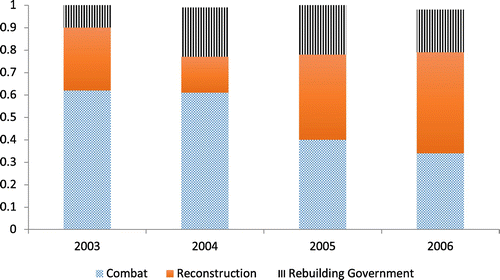
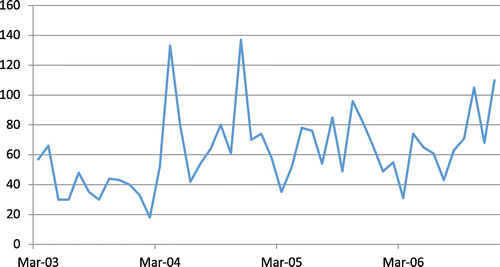
At first glance, this progression seems to suggest that having obtained one set of objectives (e.g., removing Hussein from power using military force), Pentagon officials then turned their attention to the next logical set of issues (e.g., repairing the damage from the military effort and setting up a new government). The war’s progression, however, casts doubt on this interpretation. As Figure 2 suggests, U.S. military deaths continued to be significant in 2005 and 2006, leading the Iraq Study Group chaired by former Secretary of State James Baker to conclude in December 2006 that “the situation is grave and deteriorating.” Despite these difficulties, as we have seen in Figure 1, information about combat actually declined as a percentage of all performance information released in those years, a pattern that may reflect impression management efforts.
Variables and Hypotheses Testing
Dependent Variables.
To measure the disclosure of sensitive performance information, we focus on combat metrics because they represent not only a critical performance dimension by which military leaders judge their success but also, a critical determinant of public attitudes toward the war (Gelpi et al. 2005). We develop two measures; the first is the probability that any combat metric identified by the coders was included in a month’s briefings, and the second is the count of combat metrics released in a given month’s press briefings. To measure the disclosure of information concerning progress indicators, we focus on reconstruction and rebuilding metrics because they are generally viewed as indicating transition to a war stage that is closer to war success (Sovacool and Halfon 2007). Here, we also develop two measures that mirror the approach used for combat metrics; the first measure captures the probability that any reconstruction and rebuilding metric was included in a month’s briefing, and the second is the count of reconstruction and rebuilding metrics mentioned in a given month’s press briefings.
Independent Variables.
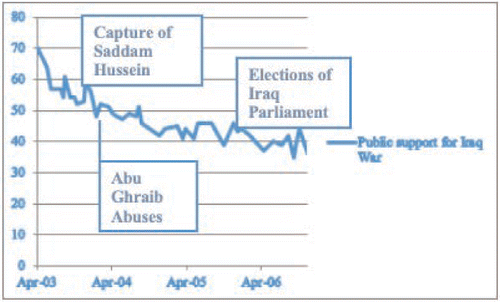
To measure public support for the war, we used public opinion polls conducted by ABC. The survey asked the following: “All in all, considering the costs to the United States versus the benefits to the United States, do you think the war with Iraq is worth fighting, or not?” The sample of respondents was random, was nationwide, and typically had a 4.5-point error margin. Our measure is the percentage of individuals who said they felt “somewhat” or “strongly” that the war was worth fighting. The survey, conducted by telephone 38 times between March 2003 and December 2006, usually had approximately 500 respondents. For the months in which we had missing values, we used interpolated values. As Figure 3 displays, public support for the war declined over time from a high value of 70 in April 2003 to a low value of 35 in October 2006. Nonetheless, several major events impacted public support for the war in both positive and negative ways during the observation period. Between November and December 2003, public support increased from 52% to 59%, likely as a result of news on the capture of Saddam Hussein. Four months later, the dissemination of pictures documenting abuses by American soldiers in the Abu Ghraib prison contributed to public support for the war declining to 49%. Public support for the war spiked up, on the other hand, at the end of 2005, when millions of Iraqis cast ballots to elect members of the newly formed Iraq Parliament. Public support for the war was 39% in November 2005, but Iraq’s elections boosted it to 46%.
As proposed in our theory section, we consider two measures of adversity. The first is the cumulative number of U.S. troop deaths caused by car bombs, improvised explosive devices (IEDs), mortar attacks, and helicopter losses. We refer to these as deaths caused by IEDs. We focus on IED deaths because they became associated with the guerrilla strategy pursued by the insurgents. IEDs, in particular, exposed the vulnerability of the U.S. military because they were difficult to locate and could be activated wirelessly. The sense of vulnerability created by IEDs is palpable in the words of a sergeant who admitted that “we were all very fearful of the thought of being blown up, disfigured by these bombs. However, there’s nothing we could do” (ABC News 2006). These deaths accounted for more than 50% of all U.S. deaths incurred in the Iraq War. The Department of Defense and the Directorate for Information Operations and Reports are the sources of information regarding U.S. troop deaths. Because this variable is a cumulative count of troops killed, higher values indicate more adverse outcomes. In supplemental analyses, not reported here, we obtained the same results when we computed U.S. troop deaths as a percentage of U.S. troops, as one could imagine that U.S. troop deaths are dependent on the number of U.S. troops on the battlefield.
The second measure of adversity represents a change in the level of resources apportioned to the military budget, measured as the DOD budget increase. The DOD budget measures the total resources that go to military-related expenditures. Thus, we expect that an increase in the military budget would boost organizational members, thus increasing the extent to which they release information about war performance metrics in response to public support. We obtained these data from The Costs of War Project from The Watson Institute of International and Public Affairs at Brown University (Crawford 2018).
To capture the degree of spokespersons’ power (to test Hypothesis 3), we manually coded the ranks of all military officials who participated in press releases throughout our study period. As Berg et al. (2010, p. 160) suggest, “formal power most often accrues to those who hold positions in the organization that reflect higher rank or position in the organization” (see also Ragins and Sundstrom 1989, p. 51). Military officials with high rank derive greater power both from authority (i.e., their formal position) and from their ability to provide or withhold resources as well as provide punishments to those lower in the hierarchy. The regular Army ranks range from O1 to O10, and the lowest rank in our data set is O3. Thus, we awarded each official a number analogous to that of their military rank. For instance, Richard Myers, an O10 four-star general, was given a 10. Les Brownlee, an O6 Colonel, was coded as six. The most powerful individual, Secretary of Defense Donald Rumsfeld, was coded as 11. Our final measure represents the sum of all ranks of spokespersons in a given speech. We obtained the same results when we measured this variable using the rank of the most powerful person involved in the speech.
Control Variables.
On average, 4.51 speeches were coded for each month, and Secretary of Defense Donald Rumsfeld gave 52% of these speeches. To control for the possibility that the release of information about performance emerging in the data could be biased by Rumsfeld’s personal characteristics, we include in our analyses the percentage of briefings in which Secretary of Defense Donald Rumsfeld spoke during any particular month—Rumsfeld’s speeches. Additionally, we included U.S. deaths caused by “friendly” fire—nonhostile fire deaths—which could be salient indicators that may have influenced the propensity of organizational members to disclose war performance.
The release of sensitive information about performance may have been influenced by war protests, as noted by social movement scholars (McDonnell and King 2013, McDonnell et al. 2015). Because the war in Iraq was met with substantial resistance from activists, we controlled for the number of war-related protests. In line with prior research (e.g., McDonnell and King 2013), we compiled this information by searching keywords, such as “Iraq protests” and “Iraq War,” from the Factiva database for the corresponding period. Our search encompassed several media outlets, including national newspapers, such as the New York Times, Wall Street Journal, and Washington Post.
We also controlled for important goals related to the Iraq War. First, we included the level of Iraq’s oil production. Iraq’s oil production reflected—although only partially and speculatively—the extent to which an armed invasion of Iraq was able to secure an inflow of oil. Securing oil was perceived as critical for the U.S. Government, and insiders have recognized that “oil did play a role in the decision to go to war” (Vogler 2017, p. 14) and that “it cannot be denied that the Bush administration had close ties to the oil industry” (Walker 2019, p. 94). These accounts suggest that securing oil inflow was a critical indicator during the war (and a central goal of reconstruction) and that increases in oil production would be seen as a positive indicator. We obtained this information from the Federal Reserve Bank of St. Louis.
Similarly, we control for prices of the Dow Jones Industrial Average Index. We focused on this indicator because it is an often-used measure of economic strength during times of war (Schneider and Troeger 2006). Furthermore, the Dow Index is sensitive to disruptive events, such as wars (Charles and Darné 2014) and thus, provides a good indicator of investors’ sentiments. In supplemental analyses not reported here, we obtained the same results when using the Standard & Poor‘s 500 and National Association of Securities Dealers Automated Quotation indices.
Additionally, we included the total spending on Iraq reconstruction assistance. We obtained these data from the “Iraq: Reconstruction Assistance” report, elaborated by Curt Tarnoff for members of the U.S. Congress (Tarnoff 2009). This report provides estimates of U.S. financial aid to Iraq (in millions of dollars), which was intended to stabilize the country, recover the economic infrastructure, and introduce a representative government (among other goals). Finally, we include month fixed effects in all our models.
Analyses.
To test Hypotheses 1–3, our first step is to use logistic regressions with the robust standard errors of White (1980) where the dependent variable is the probability that any given combat performance metric is mentioned in the press briefings held in any given month. Because some of our variables are highly correlated, we refrained from including all interactions in one model to avoid multicollinearity. The maximum Variance Inflation Factor (VIF) in our models was 8.9 (Dow Jones Index); the mean VIF was 3.64, below the rule of thumb cutoff of 10. As we noted, performance metrics identified by coders varied regarding abstraction and frequency. To control for this variance, these models include combat metric fixed effects. The sample size for this analysis is 644, which results from estimating the probability of any of the 14 combat performance metrics being mentioned in the 46 months included in our observation period. Our second step is to employ Poisson regression models with robust standard errors to examine the relationships between the independent variables and the count of combat metrics in the press briefings held in a given month. Because these are monthly models, our sample is 46, which is the number of months covered by our analysis.
To test Hypotheses 4 and 5, we follow the same approach used to test Hypotheses 1–3. We start by running logistic regressions in which the dependent variable is the probability that any given reconstruction and rebuilding performance metric (i.e., progress indicator) is mentioned in a given month’s press briefings. The sample size for this analysis is 368, which results from estimating the probability of any of the eight reconstruction and rebuilding performance metrics being mentioned in the 46 months included in our observation period. Next, we employ Poisson regression models with robust standard errors, where the dependent variable is the number of mentions given to reconstruction and rebuilding metrics in the press briefings held in any given month. Again, because these are monthly models, the sample size is 46.
Results
Tables 3 and 4 provide descriptive statistics for models on the release of performance information at the metric and month levels, respectively. Table 5 displays the results of the logistic regression on the release of information about combat performance. A look at the control variables reveals that Rumsfeld’s involvement in the press briefing did not alter the disclosure of combat performance metrics. However, the total number of war protests displays significant coefficients across the different models; protests were associated with an increase in the release of information about combat performance. Regarding our hypotheses, in Model (2) we see that the coefficient of public support for the war is positive and significant (b = 0.067, p = 0.005). This effect of public opinion is also sizeable. A one-standard deviation (SD) increase in war support increased the likelihood of releasing information about combat performance by 39%. This result is consistent with the month-level models, as shown in Model (2) of Table 6. Therefore, Hypothesis 1 received support.
|
Table 3. Descriptive Statistics and Correlations for Analyses of Release of Performance Information (Metric Level), N = 644
| No. | Variable | Mean | SD | 1 | 2 | 3 | 4 | 5 | 6 | 7 | 8 | 9 | 10 | 11 |
|---|---|---|---|---|---|---|---|---|---|---|---|---|---|---|
| 1 | Combat performance | 0.239 | 0.426 | |||||||||||
| 2 | Reconstruction and rebuilding performance | 0.358 | 0.480 | |||||||||||
| 3 | War support | 48.347 | 8.707 | 0.176 | −0.025 | |||||||||
| 4 | IED deaths | 0.391 | 0.333 | 0.064 | 0.181 | −0.641 | ||||||||
| 5 | DOD budget | 19.9 | 10.301 | 0.171 | 0.028 | 0.625 | 0.582 | |||||||
| 6 | Power spokespersons | 45.847 | 31.624 | 0.178 | 0.224 | 0.026 | 0.311 | 0.098 | ||||||
| 7 | Rumsfeld’s speeches | 0.528 | 0.357 | 0.016 | 0.185 | 0.461 | 0.688 | 0.273 | 0.237 | |||||
| 8 | Nonhostile deaths | 10.695 | 5.089 | 0.073 | 0.022 | 0.359 | 0.374 | 0.503 | 0.051 | 0.117 | ||||
| 9 | War protests | 1.5 | 4.023 | 0.103 | 0.083 | 0.018 | 0.068 | 0.068 | 0.160 | 0.067 | 0.103 | |||
| 10 | Iraq oil production | 1.765 | 0.502 | 0.191 | 0.056 | 0.683 | 0.449 | 0.679 | 0.267 | 0.272 | 0.551 | 0.005 | ||
| 11 | Dow Jones | 10.146 | 0.915 | 0.164 | 0.056 | 0.751 | 0.835 | 0.737 | 0.080 | 0.526 | 0.427 | 0.062 | 0.691 | |
| 12 | Rebuilding assistance | 8.707 | 5.904 | 0.116 | 0.182 | 0.090 | 0.312 | 0.548 | 0.512 | 0.332 | 0.192 | 0.131 | 0.370 | 0.041 |
Notes. IED deaths and Dow Jones are expressed in thousands, Iraq oil production is in millions of barrels, and rebuilding assistance is in billions of dollars. For correlations between the reconstruction and rebuilding performance (variable 2) and independent and control variables (variables 3–12), N = 368.
|
Table 4. Descriptive Statistics and Correlations for Analyses of Release of Performance Information (Month Level), N = 46
| No. | Variable | Mean | SD | 1 | 2 | 3 | 4 | 5 | 6 | 7 | 8 | 9 | 10 | 11 |
|---|---|---|---|---|---|---|---|---|---|---|---|---|---|---|
| 1 | Combat performance | 3.347 | 2.359 | |||||||||||
| 2 | Reconstruction and rebuilding performance | 4.478 | 3.462 | 0.343 | ||||||||||
| 3 | War support | 48.347 | 8.707 | 0.450 | 0.301 | |||||||||
| 4 | IED deaths | 0.391 | 0.333 | 0.164 | 0.600 | 0.641 | ||||||||
| 5 | DOD budget | 19.9 | 10.301 | 0.437 | 0.081 | 0.625 | 0.582 | |||||||
| 6 | Power spokespersons | 45.847 | 31.624 | 0.455 | 0.683 | 0.026 | 0.311 | 0.098 | ||||||
| 7 | Rumsfeld’s speeches | 0.528 | 0.357 | 0.040 | 0.487 | 0.461 | 0.688 | 0.273 | 0.237 | |||||
| 8 | Nonhostile deaths | 10.695 | 5.089 | 0.188 | 0.050 | 0.359 | 0.374 | 0.503 | 0.051 | 0.117 | ||||
| 9 | War protests | 1.5 | 4.023 | 0.264 | 0.123 | 0.018 | 0.068 | 0.068 | 0.160 | 0.067 | 0.103 | |||
| 10 | Iraq oil production | 1.765 | 0.502 | 0.491 | 0.062 | 0.683 | 0.449 | 0.679 | 0.267 | 0.272 | 0.551 | 0.005 | ||
| 11 | Dow Jones | 10.146 | 0.915 | 0.422 | 0.283 | 0.751 | 0.835 | 0.737 | 0.080 | 0.526 | 0.427 | 0.062 | 0.691 | |
| 12 | Rebuilding assistance | 8.707 | 5.904 | 0.298 | 0.460 | 0.090 | 0.312 | 0.548 | 0.512 | 0.332 | 0.192 | 0.131 | 0.370 | 0.041 |
Note. IED deaths and Dow Jones are expressed in thousands, Iraq oil production is in millions of barrels, and rebuilding assistance is in billions of dollars.
|
Table 5. Logit Models of Release of Information About Combat Performance Metrics
| Variables | Model (1) | Model (2) | Model (3) | Model (4) | Model (5) |
|---|---|---|---|---|---|
| Main effect | |||||
| Public support for the war (Hypothesis 1) | 0.067** | 0.143*** | 0.131* | 0.020 | |
| (0.024) | (0.042) | (0.064) | (0.039) | ||
| Interactions | |||||
| Public support IED deaths (Hypothesis 2) | 0.161* | ||||
| (0.065) | |||||
| Public support DOD budget (Hypothesis 2) | 0.009*** | ||||
| (0.003) | |||||
| Public support Power spokespersons (Hypothesis 3) | 0.002** | ||||
| (0.001) | |||||
| Independent variables and controls | |||||
| IED deaths | 0.715 | 7.443* | 2.173 | 3.354 | |
| (1.791) | (3.728) | (2.091) | (2.065) | ||
| DOD budget increase | 0.040 | 0.001 | 0.313** | 0.059 | |
| (0.063) | (0.066) | (0.105) | (0.064) | ||
| Power spokespersons | 0.030*** | 0.028*** | 0.032*** | 0.045† | |
| (0.006) | (0.007) | (0.007) | (0.025) | ||
| Rumsfeld’s speeches | 0.155 | 0.524 | 0.357 | 0.641 | 0.671 |
| (0.416) | (0.517) | (0.518) | (0.511) | (0.513) | |
| Nonhostile fire deaths | 0.006 | 0.062† | 0.093* | 0.096* | 0.064† |
| (0.029) | (0.036) | (0.040) | (0.040) | (0.038) | |
| Number of war-related protests | 0.072* | 0.100** | 0.112** | 0.109** | 0.089** |
| (0.030) | (0.033) | (0.034) | (0.035) | (0.033) | |
| Iraq oil production | 0.601 | 0.339 | 0.626 | 1.069* | 0.293 |
| (0.381) | (0.468) | (0.492) | (0.541) | (0.475) | |
| Dow Jones | 0.341 | 0.071 | 0.416 | 1.038† | 1.072† |
| (0.224) | (0.417) | (0.479) | (0.546) | (0.566) | |
| Reconstruction assistance | 0.025 | 0.013 | 0.062 | 0.254* | 0.063 |
| (0.022) | (0.086) | (0.093) | (0.122) | (0.090) | |
| Constant | 2.487 | 6.627 | 17.844* | 16.881* | 12.856* |
| (2.205) | (5.656) | (7.634) | (6.935) | (6.169) | |
| Month fixed effects | Yes | Yes | Yes | Yes | Yes |
| Combat metric fixed effects | Yes | Yes | Yes | Yes | Yes |
| N | 644 | 644 | 644 | 644 | 644 |
| McFadden’s pseudo-R2 | 0.184 | 0.225 | 0.234 | 0.241 | 0.237 |
Note. Robust standard errors are in parentheses.
*p < 0.05 (two-tailed tests); **p < 0.01 (two-tailed tests); ***p < 0.001 (two-tailed tests); †p < 0.1 (two-tailed tests).
|
Table 6. Poisson Models of Release of Information About Combat Performance Metrics in a Month
| Variables | Model (1) | Model (2) | Model (3) | Model (4) | Model (5) |
|---|---|---|---|---|---|
| Main effect | |||||
| Public support for the war (Hypothesis 1) | 0.041*** | 0.076*** | 0.053 | 0.007 | |
| (0.011) | (0.020) | (0.040) | (0.024) | ||
| Interactions | |||||
| Public support IED deaths (Hypothesis 2) | 0.082* | ||||
| (0.040) | |||||
| Public support DOD budget (Hypothesis 2) | 0.004* | ||||
| (0.002) | |||||
| Public support Power spokespersons (Hypothesis 3) | 0.001† | ||||
| (0.000) | |||||
| Independent variables and controls | |||||
| IED deaths (in thousands) | 0.736 | 3.639 | 0.820 | 1.311 | |
| (1.068) | (2.819) | (1.742) | (1.151) | ||
| DOD budget increase | 0.047 | 0.019 | 0.153*** | 0.045 | |
| (0.038) | (0.045) | (0.046) | (0.038) | ||
| Power spokespersons | 0.018*** | 0.017*** | 0.017*** | 0.007 | |
| (0.003) | (0.003) | (0.003) | (0.016) | ||
| Rumsfeld’s speeches | 0.046 | 0.373 | 0.240 | 0.348 | 0.377 |
| (0.330) | (0.379) | (0.308) | (0.310) | (0.333) | |
| Nonhostile fire deaths | 0.001 | 0.042† | 0.055* | 0.051* | 0.039† |
| (0.022) | (0.022) | (0.023) | (0.021) | (0.022) | |
| Number of war-related protests | 0.041** | 0.061*** | 0.067*** | 0.065*** | 0.057*** |
| (0.016) | (0.011) | (0.012) | (0.013) | (0.012) | |
| Iraq oil production | 0.380 | 0.260 | 0.363 | 0.491* | 0.184 |
| (0.279) | (0.243) | (0.222) | (0.233) | (0.269) | |
| Dow Jones (in thousands) | 0.168 | 0.153 | 0.093 | 0.315 | 0.184 |
| (0.214) | (0.236) | (0.286) | (0.320) | (0.349) | |
| Rebuilding assistance (in thousands) | 0.017 | 0.037 | 0.012 | 0.096 | 0.041 |
| (0.016) | (0.056) | (0.072) | (0.099) | (0.056) | |
| Constant | 3.655† | 0.322 | 5.362 | 3.846 | 1.271 |
| (2.056) | (3.080) | (4.731) | (3.788) | (3.207) | |
| Month fixed effects | Yes | Yes | Yes | Yes | Yes |
| N | 46 | 46 | 46 | 46 | 46 |
| McFadden’s pseudo-R2 | 0.165 | 0.261 | 0.274 | 0.282 | 0.270 |
Note. Robust standard errors are in parentheses.
*p < 0.05 (two-tailed tests); **p < 0.01 (two-tailed tests); ***p < 0.001 (two-tailed tests); †p < 0.1 (two-tailed tests).
Hypothesis 2 predicts that adversity negatively moderates the positive relationship between public support and the release of information about combat performance. We tested Hypothesis 2 using two different proxies for adversity: IED deaths and DOD budget increase. In Model (3) of Table 5, the coefficient of the interaction term between IED deaths and public support is negative and significant (b = −0.161, p = 0.016). When public support for the war was high (one SD above the mean), Pentagon spokespersons were 37% less likely to mention a war performance metric when IED deaths were high (one standard deviation above mean) than when they were at the mean. Figure 4(a) graphs this interaction effect, showing that the likelihood of releasing information about sensitive combat performance increases as public support increases, but it increases to a lesser extent when adversity is high.
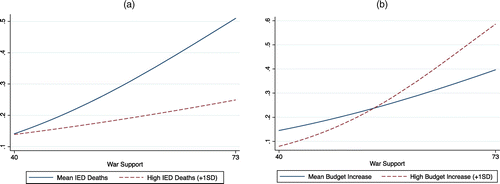
Note. (b) Effect of DOD budget increase and public support on the release of information about combat performance.
Model (4) provides support for the other adversity indicator, showing that the interaction term between the DOD budget and public support is positive and significant (b = 0.009, p < 0.001). Here, the interaction coefficient is positive because a higher increase in the budget suggests a lower degree of adversity. Indeed, when public support was high, spokespersons were 8% more likely to discuss war performance metrics when they received a substantial budget increase (one standard deviation above the mean) compared with an average budget increase. Figure 4(b) shows that the likelihood of discussing a combat metric increases as public support increases, but, when the DOD budget increase is high (i.e., adversity is low), disclosure of such metrics increases at a faster rate.
Together, Models (3) and (4) indicate that the positive effect of public support on Pentagon officials’ release of information about sensitive combat performance was reduced by adversity. The aggregate month-level models show a similar pattern, as reported in Models (3) and (4) of Table 6. This evidence, therefore, lends strong support to Hypothesis 2.
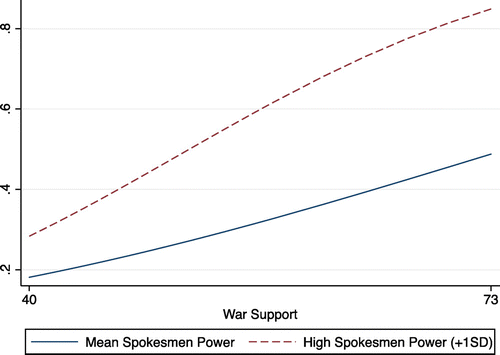
Hypothesis 3 predicts that the power of spokespersons positively moderates the effect of public support on the disclosure of combat performance. Model (5) in Table 5 shows that the interaction term between spokespersons’ power and public support is positive and significant (b = 0.002, p = 0.005). Indeed, when public support for the war was high, Pentagon spokespersons were 90% more likely to discuss combat performance metrics when their power was high (one standard deviation above the mean) compared with when they held average levels of power. Figure 5 graphs the interaction effect of spokespersons’ power and public support on the likelihood that members discussed combat performance. This graph shows that the likelihood of discussing combat performance increases as public support increases, but it increases at a faster rate when power is high. This result is also replicated in our month-level models, as shown in Model (5) of Table 6, although significance levels are reduced to 10%. Overall, these findings support Hypothesis 3.
We now turn our attention to empirical tests of Hypotheses 4 and 5 concerning the strategic use of alternate frames of performance emphasizing progress. Table 7 reports the results of the logistic regressions, in which the dependent variable is the release of information about any reconstruction and rebuilding metric in a given month’s press briefings, whereas Table 8 reports the results of the Poisson models of the count of reconstruction and rebuilding metrics mentioned in a month’s briefings. The signs of the coefficients of the independent variables of interest are in line with Hypotheses 4 and 5, but the coefficients are significant only in the count models in Table 8. So, the probability of releasing information about any reconstruction and rebuilding metric is not significantly related to public support, but the total number of progress metrics mentioned is. In Table 8, we see a significant and negative coefficient of public support for the overall count of such metrics (b = −0.026, p = 0.029) and a significant and negative coefficient of the interaction between combat metrics and public support (b = −0.007, p = 0.039). Offering a visual representation of this interaction effect reported in Table 8, Figure 6 shows that mentions of reconstruction and rebuilding metrics included in press briefings decrease as public support increases, as proposed in Hypothesis 4, and this decrease is significantly steeper when mentions of combat metrics are high, as proposed in Hypothesis 5. Notably, when mentions of combat metrics are high, mentions of progress metrics decrease by 40% when public support increases by one standard deviation. Consistent with the view advanced in this study that supportive public opinion increases transparency, Pentagon spokespersons released information about reconstruction and rebuilding mostly when simultaneously facing lower public support levels and disclosing sensitive combat indicators.
|
Table 7. Logit Models of Release of Information About Reconstruction and Rebuilding Performance Metrics
| Variables | Model (1) | Model (2) |
|---|---|---|
| Main effect | ||
| Public support for the war (Hypothesis 4) | 0.005 | 0.036 |
| (0.029) | (0.056) | |
| Interaction | ||
| Public support Combat metrics (Hypothesis 5) | 0.009 | |
| (0.010) | ||
| Independent variables and controls | ||
| Combat metrics | 0.074 | 0.549 |
| (0.105) | (0.543) | |
| IED deaths (in thousands) | 0.021 | 0.024 |
| (0.015) | (0.015) | |
| DOD budget increase | 0.046 | 0.062 |
| (0.048) | (0.050) | |
| Power spokespersons | 0.018* | 0.018* |
| (0.009) | (0.009) | |
| Rumsfeld’s speeches | 0.097 | 0.308 |
| (0.601) | (0.639) | |
| Nonhostile fire deaths | 0.007 | 0.004 |
| (0.045) | (0.045) | |
| Number of war-related protests | 0.009 | 0.017 |
| (0.044) | (0.044) | |
| Iraq oil production | 0.544 | 0.549 |
| (0.592) | (0.588) | |
| Dow Jones (in thousands) | 0.292 | 0.620 |
| (0.566) | (0.627) | |
| Rebuilding assistance (in thousands) | 0.068 | 0.091 |
| (0.065) | (0.067) | |
| Month fixed effects | Yes | Yes |
| Combat metric fixed effects | Yes | Yes |
| N | 368 | 368 |
| McFadden’s pseudo-R2 | 0.303 | 0.305 |
Note. Robust standard errors are in parentheses.
*p < 0.05 (two-tailed tests).
|
Table 8. Poisson Models of Release of Information About Reconstruction and Rebuilding Performance Metrics in a Month
| Variables | Model (1) | Model (2) | Model (3) |
|---|---|---|---|
| Main effect | |||
| Public support for the war (Hypothesis 4) | 0.026* | 0.009 | |
| (0.012) | (0.022) | ||
| Interaction | |||
| Public support Combat metrics (Hypothesis 5) | 0.007* | ||
| (0.003) | |||
| Independent variables and controls | |||
| Combat metrics | 0.055 | 0.388* | |
| (0.041) | (0.153) | ||
| IED deaths (in thousands) | 2.009* | 2.003** | 2.187** |
| (0.919) | (0.769) | (0.699) | |
| DOD budget increase | 0.004 | 0.001 | 0.003 |
| (0.035) | (0.035) | (0.035) | |
| Power spokespersons | 0.015*** | 0.010** | 0.011** |
| (0.002) | (0.004) | (0.004) | |
| Rumsfeld’s speeches | 0.095 | 0.108 | 0.079 |
| (0.345) | (0.318) | (0.326) | |
| Nonhostile fire deaths | 0.018 | 0.012 | 0.006 |
| (0.021) | (0.023) | (0.021) | |
| Number of war-related protests | 0.005 | 0.006 | 0.012 |
| (0.009) | (0.013) | (0.013) | |
| Iraq oil production | 0.127 | 0.330 | 0.249 |
| (0.225) | (0.223) | (0.215) | |
| Dow Jones (in thousands) | 0.357† | 0.426* | 0.627** |
| (0.195) | (0.217) | (0.238) | |
| Rebuilding assistance (in thousands) | 0.007 | 0.004 | 0.008 |
| (0.047) | (0.047) | (0.044) | |
| Constant | 3.632 | 6.111* | 6.545* |
| (2.485) | (2.864) | (2.919) | |
| Month fixed effects | Yes | Yes | Yes |
| N | 46 | 46 | 46 |
| McFadden’s pseudo-R2 | 0.386 | 0.394 | 0.400 |
Note. Robust standard errors are in parentheses.
*p < 0.05 (two-tailed tests); **p < 0.01 (two-tailed tests); ***p < 0.001 (two-tailed tests); †p < 0.1 (two-tailed tests).
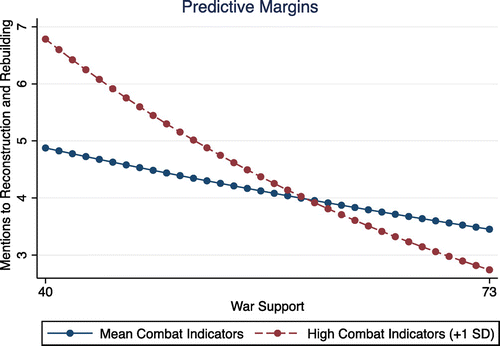
In retrospect, these results point to a scenario that, although partly unexpected, is still consistent with our suggestion that spokespersons use alternate performance frames to preserve external support. When support is low, spokespersons obfuscate the release of information about sensitive performance metrics by hammering home the point that progress is being achieved by releasing information about a greater number of progress metrics than they would usually consider including in a month’s press briefings. In those situations, spokespersons highlight a large set of progress metrics to amplify the saliency of this information to the public. These results lend qualified support to Hypotheses 4 and 5.
As a whole, the data we report rule out the possibility that the negative relationship between public support and mentions of combat metrics reflects the passage of time. By that account, over time, as the war progressed, combat became less relevant, and reconstruction and rebuilding took center stage. That account, however, is at odds with the way the war unfolded. Combat did not become less important as time went by. Indeed, IED deaths did not decline, as shown in Figure 2. In addition, the interaction effect in support of Hypothesis 5 implies that at least some of the speeches referred to combat and reconstruction as occurring simultaneously.
Robustness Checks
Although our analysis implies a potential causal relationship where the arrow goes from public support for the war to the release of sensitive performance information, one can easily conceive of a relationship in which the arrow goes in the other direction. We consider this potential endogeneity by using an instrumental variable approach in which a variable unrelated to the outcome variable is used as a predictor (instrument) of the explanatory variable suspected to be a source of endogeneity.
Our instrument is the monthly volume of media coverage of the Iraq War as evidenced by the minutes of the weeknight news broadcasts of ABC, CBS, and NBC news dedicated to coverage of the Iraq War (i.e., invasion, occupation, insurgency). Although media coverage is independent of whether news is positive or negative, it has been found to be positively linked to public support for the war, presumably because it increases the salience of the war among members of the public (Gelpi et al. 2009). The source of data regarding media coverage is Andrew Tyndall, producer of the Tyndall Report (http://www.tyndallreport.com), who generously made available monthly data regarding two distinct indicators: media coverage of combat during the Iraq War and media coverage of the Iraq War (combat included). Whereas media coverage of combat displays a small but significant correlation with the disclosure of combat metrics, media coverage of the Iraq War has a positive but not significant correlation with the disclosure of combat metrics (r = 0.037, not significant). Additionally, the p-value of Cragg–Donald’s Wald F weak instrument test statistic is below 0.001, rejecting the null hypothesis that the instrument is weak. We, therefore, use media coverage of the Iraq War as the instrument variable. The average media coverage was 226 minutes, with a minimum value of 49 minutes in July 2006 and a maximum value of 710 in March 2003.
To study the effect of public support—instrumented by media coverage—on the release of information about sensitive performance metrics, such as combat metrics, we use a two-stage least squares. In the first stage, we regress public opinion support on media coverage, including all covariates and year and performance metric fixed effects. As expected, media coverage significantly increases war support (b = 0.016, p < 0.001). The predicted values from this equation provide “instrumented” public support (i.e., the exogenous component of public support for war). In the second stage, we then reestimate our models using “public support (instrumented)” instead of public support. Interactions are also calculated using the instrumented public support variable. Because of space constraints, we present these results in Table A1 in the online appendix. Reassuringly, the results in this alternative specification remain entirely consistent with our previous results.
The pattern of the results remains unchanged also when we conducted robustness checks that used alternative measures of IED deaths and the power of spokespersons and eliminated some of the control variables to mitigate concerns of overfitting. Also, we found that a sudden increase in the number of IED deaths (over 75% increase from prior month) reduced the positive effect of public support on mentioning combat metrics, although this effect was not greater than the effect of the measure of cumulative deaths. All these analyses are available from the authors upon request.
Discussion
This study seeks to shed new light on how organizations respond to public opinion by examining public opinion’s influence on organizations’ propensity to disclose performance information to the public. Although researchers have noted the increasingly critical role of public opinion in assessing controversial practices in large private companies (e.g., Clemente and Roulet 2015) and news media continuously report on changes in public opinion regarding controversial matters, such as drug pricing by pharmaceutical companies (Hancock 2017), the disclosure of nutritional information by food companies (Surowiecki 2016), and the collection of private information by social media companies (Leetaru 2018), little is known about the influence of these important aggregate public views on organizational actions.
Our theory and empirical results demonstrate starkly different implications regarding the use of defensive impression management tactics based on whether an organization receives support from public opinion. Relying on the second Iraq War as an empirical context and examining how Pentagon’s spokespersons communicate about war performance in press briefings, we find that public support for the war significantly increased the release of information about sensitive combat performance indicators. Furthermore, we show that the positive relationship between public support and the disclosure of combat performance information decreased with adversity in the form of higher U.S. deaths and lower organizational resources and increased when the power of spokespersons holding press briefings was higher. We also report evidence that when the disclosure of sensitive combat information was high, public support lowered the strategic use of alternate performance frames that placed greater emphasis on progress indicators, such as those related to Iraq’s reconstruction and rebuilding.
This paper makes several contributions. First, we provide a deeper understanding of the relationship between public opinion and impression management. Our purpose was to theorize and empirically show that public opinion influences the use of impression management tactics and that this relationship is contingent upon various factors. In this way, we complement prior impression management research, which has focused on pressures stemming from actors, such as activists and social movements (Elsbach et al. 1998, McDonnell and King 2013), journalists (Westphal et al. 2012), financial analysts (Westphal and Graebner 2010, Busenbark et al. 2017), and foreign competitors (Ravasi and Schultz 2006), but has neglected broader, collective pressures from sources, such as public opinion—a source that has gained preeminence over the last decade. Adding consideration of public opinion to this literature is important not only because of its growing pervasiveness and relevance but also, because organizations often confront external influences that are not uniform. To the extent that supportive public opinion serves as a buffer from perceptions of threat, as this study indicates, it may attenuate the use of impression management expected to stem from pressures generated by activists, media, or regulators. In fragmented environments in which organizations are exposed to scrutiny and support from actors that are not aligned in their assessments, strong support from the public may underlie variations in transparency.
Second, we provide relatively rare evidence that public opinion influences whether an organization will increase transparency by varying the release of performance information. By doing so, we validate the early intuition of Pfeffer (1981) that impression management may consist of avoiding assessment through the omission of publicly sensitive performance information. However, our study extends this insight by providing some evidence that unsupportive public opinion may also lead organizational members to rely on alternate performance frames that highlight progress, especially when simultaneously disclosing sensitive performance information. In the Iraq War context, organizational members mitigated the potential impact of sensitive combat information by focusing on the more positive reconstruction and rebuilding indicators, arguably to obfuscate information that threatens external support. We view our analysis of alternate frames as exploratory because spokespersons for the Department of Defense may have used other tactics to present and frame performance information besides what we were able to capture in our data. Nonetheless, we hope that our results will encourage scholars to further investigate how organizational members articulate different types of performance information in contexts in which organizational members exercise considerable discretion over the content of the communication. For instance, in corporations, organizational members may manage the release of performance information to make overall outcomes appear better than they really are through a combination of tactics, such as selectively disclosing performance metrics, using persuasive language, or changing performance reference groups (Jordan and Audia 2012, Marquis et al. 2016, Pan et al. 2018, de Vaan et al. 2019, Audia et al. 2022). Building on this study and adding to other work on the strategic use of frames in organizations (Rhee and Fiss 2014, Nadkarni et al. 2019, Blagoeva et al. 2020), future research might consider whether and when corporations vary the release of information about progress indicators that signal getting closer to a desirable end state.
Third, by applying theory from organizational research on impression management to the study of the Iraq War, this study yields new insights into how government organizations communicate during a war. Political scientists recognize that the management of external perceptions by the government is a critical activity in the conduct of a war, and much work focuses on how governments secure the necessary support to initiate a war (e.g., Basile 2017). Additionally, political scientists have studied the importance of international institutions on public support for war (Grieco et al. 2011), how public opinion processes war outcomes through local (Gartner and Segura 2008) and personal lenses (Gartner 2008), and what factors influence public sensitivity to sensitive outcomes, such as death counts (Gelpi et al. 2005). Our analysis adds to that body of work by shedding light on how the management of external perceptions unfolds once a war begins and how organizational and contextual factors shape the direction and intensity of the response to public opinion.
Regarding the potential limitations of our findings, although management scholars have relied on extreme events, such as wars, for studying diverse phenomena, such as industry emergence (Baum and McGahan 2013), the effect of organizational structure on attention (Jacobides 2007), and recovery from psychological injury (de Rond and Lok 2016), the uniqueness of our empirical setting can limit the generalizability of our findings to other contexts. Because wars involve death, destruction, and the fate of nations, it is difficult to dispute that they subject policy makers to high levels of external pressures uncommon in other settings. Moreover, our window of examination of the Iraq War occurs in close proximity to two presidential elections. It is, therefore, plausible that the effect of public opinion on the release of performance information emerging in our data may be less potent in other settings. Additionally, it is important to exercise caution in generalizing our findings to other impression management tactics. Limiting the release of sensitive performance information and deploying alternate performance frames may be just two of the impression management tactics organizations use to influence external perceptions. Pentagon officials may have used other impression management tactics while talking in public about performance.
A fruitful avenue for future research consists of extending research on the role of public opinion to the private sector. As both governments and businesses increasingly espouse values of transparency and openness (Van der Wal et al. 2006), they will likely face more intense scrutiny from the general public (Wang et al. 2021). Consider the example of Big Tech firms. Public opinion polls show that Americans are relatively split regarding the regulation (and eventual dismantling) of Big Tech firms, including Amazon, Google, Apple, and Facebook (Saad 2019). However, as public opinion on this subject shifts, these firms may respond by altering their level of defensive impression management tactics accordingly. Indeed, some journalistic evidence suggests that some of these firms already expect a turn in public opinion (because of growing public concerns regarding data privacy and tax avoidance schemes), which has led them to launch anticipatory Public Relations (P.R.) tactics, such as paying newspapers to promote positive content about them or increasing their lobbying expenditures (The New Yorker 2019).
Public opinion may also influence firm actions when government regulation is limited or absent. Firms in agrichemical and food industries, for example, face strong public opposition that may influence their choices and actions. According to the Pew Research Center, 51% of the public in the United States believes that genetically modified foods “pose a serious risk to their health.”2 This public sentiment has led firms in this field to engage in various types of strategic actions, from promoting scientists’ views that genetically modified foods are safe to engaging in what watchdog organizations position as impression management tactics, which include P.R. campaigns, lobbying, and hiding information regarding the health risks of such products (Ruskin 2015). Nonetheless, some firms in the industry are willing to engage with the public by increasing transparency, suggesting that not all firms embrace impression management tactics to the same extent. For instance, Hershey Foods has opted to share ingredients and sourcing information online to regain the trust of consumers.3 This example suggests that future work may build on this study to further disentangle the link between public opinion and impression management in nongovernmental organizations, exploring other contingencies, such as competitive, governance, or managerial factors, that may influence this relationship.
Conclusion
This study explores how organizations engaged in controversial actions alter their transparency in response to public opinion—a critical source of pressure that received little attention in impression management research. Incorporating public opinion in analyses of the external pressures that prompt impression management reactions is important because organizations increasingly face fragmented environments. High public support, for instance, may reduce sensitivity to other sources of pressure (e.g., activists, investors) and as investigated here, alter how organizations disclose performance information. Relying on the second Iraq War context, we show that public support increases the disclosure of sensitive performance information and attenuates the propensity to strategically employ alternate performance frames that signal progress. In summary, this study reveals that public opinion influences transparency through its influence on the kinds of performance information organizations communicate to outsiders. Our theory and findings apply especially to government organizations and large business organizations that are subject to high levels of scrutiny. Conversely, the effects we report may be weaker in contexts where organizational members are less exposed to public scrutiny or when other more direct external pressures prevail over the effect of public opinion. In all, we hope our study will prompt more research seeking to understand how public opinion influences impression management and promotes accountability to the public.
The authors thank Barry Staw and Phil Tetlock for their comments on earlier versions of the paper, Wes Sine for his excellent editorial guidance, and three anonymous reviewers for offering many valuable suggestions that helped strengthen the paper. The authors also benefited from suggestions made by seminar participants at Cornell University, the Massachusetts Institute of Technology Sloan School of Management, and the Yale School of Management. Pino Audia and Horacio Rousseau contributed equally to the paper.
1 The list of 32 metrics is available from the authors upon request.
2 See https://www.pewresearch.org/science/2018/11/19/public-perspectives-on-food-risks/.
3 See https://www.foodbusinessnews.net/articles/11532-transparency-critical-for-the-future-of-food.
References
ABC News (2006) Roadside bombs: The greatest danger in Iraq. Nightline Accessed January 30, https://abcnews.go.com/WNT/International/story?id=1554858.Google Scholar- (1994) Concealment of negative organizational outcomes: An agency theory perspective. Acad. Management J. 37(5):1302–1334.Crossref, Google Scholar
- (2013) Inferring reporting-related biases in hedge fund databases from hedge fund equity holdings. Management Sci. 59(6):1271–1289.Link, Google Scholar
- (2017) The governance impact of a changing investor landscape. J. Internat. Bus. Stud. 48(2):195–221.Crossref, Google Scholar
- (2019) Organizational transparency: Conceptualizations, conditions, and consequences. Bus. Soc. 58(2):268–297.Crossref, Google Scholar
- (2000) Presenting structural innovation in an institutional environment: Hospitals’ use of impression management. Admin. Sci. Quart. 45(3):494–522.Crossref, Google Scholar
- (1990) The double-edge of organizational legitimation. Organ. Sci. 1(2):177–194.Link, Google Scholar
- (2022) CEO power and nonconforming reference group selection. Organ. Sci. 33(2):831–853.Link, Google Scholar
- (2004) Talking trash: Legitimacy, impression management, and unsystematic risk in the context of the natural environment. Acad. Management J. 47(1):93–103.Crossref, Google Scholar
- (2006) Seeing is (not) believing: Managing the impressions of the firm’s commitment to the natural environment. J. Bus. Ethics 67(2):165–180.Crossref, Google Scholar
- (2008) Behind TV analysts, Pentagon’s hidden hand. New York Times (April 30), https://www.nytimes.com/2008/04/20/us/20generals.html.Google Scholar
- (2017) Tough Sell: Fighting the Media War in Iraq (University of Nebraska Press, Lincoln, NE).Crossref, Google Scholar
- (2013) The reorganization of legitimate violence: The contested terrain of the private military and security industry during the post-Cold War era. Res. Organ. Behav. 33:3–37.Google Scholar
- (2000) Framing processes and social movements: An overview and assessment. Annual Rev. Sociol. 26(1):611–639.Crossref, Google Scholar
- (2003) The struggle for Iraq: Anatomy of an ambush: Iraqi civilians caught in crossfire of Guerrilla war. New York Times (April 1), https://www.nytimes.com/2004/04/01/world/struggle-for-iraq-occupation-4-us-killed-ambush-iraq-mob-drags-bodies.html.Google Scholar
- (2010) Perceiving and responding to challenges in job crafting at different ranks: When proactivity requires adaptivity. J. Organ. Behav. 31(2–3):158–186.Crossref, Google Scholar
- (2020) Who violates expectations when? How firms’ growth and dividend reputations affect investors’ reactions to acquisitions. Strategic Management J. 41(9):1712–1742.Crossref, Google Scholar
- (2006) Echoes of Vietnam? Casualty framing and public perceptions of success and failure in Iraq. J. Conflict Resolution 50(6):831–854.Crossref, Google Scholar
- (2008) A multi-level review of impression management motives and behaviors. J. Management 34(6):1080–1109.Crossref, Google Scholar
- (2017) Foreshadowing as impression management: Illuminating the path for security analysts. Strategic Management J. 38(12):2486–2507.Crossref, Google Scholar
- (2013) Coding in-depth semistructured interviews: Problems of unitization and intercoder reliability and agreement. Sociol. Methods Res. 42(3):294–320.Crossref, Google Scholar
- (2006) Social consensus and the encoding of consistent and inconsistent information: When one’s future audience orients information processing. Eur. J. Soc. Psych. 36(2):199–210.Crossref, Google Scholar
- (2006) The interaction of top management group, stakeholder, and situational factors on certain corporate reputation management activities. J. Management Stud. 43(5):1145–1176.Crossref, Google Scholar
CBS News (2004) U.S. troops get trained on how to deal with IEDs. Evening News with Dan Rather.Google Scholar- (2014) Large shocks in the volatility of the Dow Jones industrial average index: 1928–2013. J. Banking Finance 43:188–199.Crossref, Google Scholar
- (2020) Power, approach, and inhibition: Empirical advances of a theory. Curr. Opin. Psych. 33:196–200.Crossref, Google Scholar
- (2015) Public opinion as a source of deinstitutionalization: A “Spiral of Silence” approach. Acad. Management Rev. 40(1):96–114.Crossref, Google Scholar
- (2018) United States budgetary costs of the post-9/11 wars through FY2019: $5.9 trillion spent and obligated. Retrieved November 2019, https://watson.brown.edu/costsofwar/papers/2018/united-states-budgetary-costs-post-911-wars-through-fy2019-59-trillion-spent-and.Google Scholar
- (2004) Earnings management following duality-creating successions: Ethnostatistics, impression management, and agency theory. Acad. Management J. 47(2):267–275.Crossref, Google Scholar
- (1996) Does isomorphism legitimate? Acad. Management J. 39(4):1024–1039.Crossref, Google Scholar
- (2003) End of ‘major’ combat, fall of Tikrit, anxiety over Syria. New York Times (April 15). https://www.nytimes.com/2003/04/15/world/nation-war-overview-april-14-2003-end-major-combat-fall-tikrit-anxiety-over.html.Google Scholar
Department of Defense (2003) News briefing by Mr. Di Rita and Gen. Abizaid. Retrieved July 16, https://www.c-span.org/video/?177450-1/centcom-news-briefing.Google Scholar- (2016) Some things can never be unseen: The role of context in psychological injury at war. Acad. Management J. 59(6):1965–1993.Crossref, Google Scholar
- (2019) Obscured transparency? Compensation benchmarking and the biasing of executive pay. Management Sci. 65(9):4299–4317.Link, Google Scholar
- (1991) Keeping an eye on the mirror: Image and identity in organizational adaptation. Acad. Management J. 34(3):517–554.Crossref, Google Scholar
- (2007) Theory building from cases: Opportunities and challenges. Acad. Management J. 50(1):25–32.Crossref, Google Scholar
- (1994) Managing organizational legitimacy in the California cattle industry: The construction and effectiveness of verbal accounts. Admin. Sci. Quart. 39(1):57–88.Crossref, Google Scholar
- (2003) Organizational perception management. Res. Organ. Behav. 25:297–332.Crossref, Google Scholar
- (1992) Acquiring organizational legitimacy through illegitimate actions: A marriage of institutional and impression management theories. Acad. Management J. 35(4):699–738.Crossref, Google Scholar
- Elsbach KD, Sutton RI, Principe KE (1998) Averting expected challenges through anticipatory impression management: A study of hospital billing. Organ. Sci. 9(1):68–86.Google Scholar
- (2019) Social media and the formation of organizational reputation. Acad. Management Rev. 44(1):28–52.Crossref, Google Scholar
- (2006) The symbolic management of strategic change: Sensegiving via framing and decoupling. Acad. Management J. 49(6):1173–1193.Crossref, Google Scholar
- (2008)
Meso-level theory of accountability in organizations . Martocchio J, ed. Research in Personnel and Human Resources Management (Emerald Group Publishing Limited, Bingley, United Kingdom), 177–245.Crossref, Google Scholar - (2008) Ties to the dead: Connections to Iraq war and 9/11 casualties and disapproval of the president. Amer. Sociol. Rev. 73(4):690–695.Crossref, Google Scholar
- (2008) All politics are still local: The Iraq war and the 2006 midterm elections. PS Political Sci. Politics 41(1):95–100.Crossref, Google Scholar
- (2005) Success matters: Casualty sensitivity and the war in Iraq. Internat. Security 30(3):7–46.Crossref, Google Scholar
- (2009) Paying the Human Costs of War: American Public Opinion and Casualties in Military Conflicts (Princeton University Press, Princeton, NJ).Crossref, Google Scholar
- (1993)
Organizational impression management as a reciprocal influence process: The neglected role of the organizational audience . Cummings LL, Staw BM, eds. Research in Organizational Behavior (JAI Press, Greenwich, CT), 227–266.Google Scholar - (1959) The Presentation of Self in Everyday Life (Doubleday, Oxford, United Kingdom).Google Scholar
- (1974) Frame Analysis: An Essay on the Organization of Experience (Harvard University Press, Boston).Google Scholar
- (2011) What’s all that (strategic) noise? Anticipatory impression management in CEO succession. Strategic Management J. 32(7):748–770.Crossref, Google Scholar
- (2016) Ready, AIM, acquire: Impression offsetting and acquisitions. Acad. Management J. 59(1):232–252.Crossref, Google Scholar
- (2011) Let’s get a second opinion: International institutions and American public support for war. Internat. Stud. Quart. 55(2):563–583.Crossref, Google Scholar
- (2017) How power affects people: Activating, wanting, and goal seeking. Annual Rev. Psych. 68:353–381.Crossref, Google Scholar
- (1994) Challenging a master narrative: Peace protest and opinion/editorial discourse in the US press during the Gulf War. Discourse Soc. 5(4):509–541.Crossref, Google Scholar
- (2017) An accountability account: A review and synthesis of the theoretical and empirical research on felt accountability. J. Organ. Behav. 38(2):204–224.Crossref, Google Scholar
- (2018) A matter of life or death: How extreme context research matters for management and organization studies. Acad. Management Ann. 12(1):111–153.Crossref, Google Scholar
- (2017) Everyone wants to reduce drug prices. So why can’t we do it? New York Times (September 11), https://www.nytimes.com/2017/09/23/sunday-review/prescription-drugs-prices.html.Google Scholar
- (2005) Responsive government? Public opinion and government policy preferences in Britain and Denmark. Political Stud. 53(2):379–402.Crossref, Google Scholar
- (1999) Institutional evolution and change: Environmentalism and the U.S. chemical industry. Acad. Management J. 42(4):351–371.Crossref, Google Scholar
- (2007) The inherent limits of organizational structure and the unfulfilled role of hierarchy: Lessons from a near-war. Organ. Sci. 18(3):455–477.Link, Google Scholar
- (2012) Self-enhancement and learning from performance feedback. Acad. Management Rev. 37(2):211–231.Crossref, Google Scholar
- (2008) Framing contests: Strategy making under uncertainty. Organ. Sci. 19(5):729–752.Link, Google Scholar
- (2007) The electoral cost of war: Iraq casualties and the 2004 U.S. presidential election. J. Politics 69(3):633–648.Crossref, Google Scholar
- (2009) Operating room: Relational spaces and microinstitutional change in surgery. Amer. J. Sociol. 115(3):657–711.Crossref, Google Scholar
- (2003) Power, approach, and inhibition. Psych. Rev. 110(2):265–284.Crossref, Google Scholar
- (2000) Industry self-regulation without sanctions: The chemical industry’s responsible care program. Acad. Management J. 43(4):698–716.Crossref, Google Scholar
- (1995) Justification of decisions in auditing. J. Accounting Res. 33(2):369–384.Crossref, Google Scholar
- (2004) Reliability in content analysis: Some common misconceptions and recommendations. Human Comm. Res. 30(3):411–433.Google Scholar
- (2003) Misperceptions, the media, and the Iraq war. Political Sci. Quart. 118(4):569–598.Crossref, Google Scholar
- (2018) Social media companies collect so much data even they can’t remember all the ways they surveil us. Forbes (October 25), www.forbes.com/sites/kalevleetaru/2018/10/25/social-media-companies-collect-so-much-data-even-they-cant-remember-all-the-ways-they-surveil-us/.Google Scholar
- (1999) Accounting for the effects of accountability. Psych. Bull. 125(2):255–275.Crossref, Google Scholar
- (2007) Identity, community, and audience: How wholly owned Foreign subsidiaries gain legitimacy in China. Acad. Management J. 50(1):175–190.Crossref, Google Scholar
- (1994) Where are the great powers? At home with the kids. Foreign Affairs 73(4):23–28.Crossref, Google Scholar
- (2008) Social hierarchy: The self-reinforcing nature of power and status. Acad. Management Ann. 2(1):351–398.Crossref, Google Scholar
- (2016) Scrutiny, norms, and selective disclosure: A global study of greenwashing. Organ. Sci. 27(2):483–504.Link, Google Scholar
- (2013) Keeping up appearances: Reputational threat and impression management after social movement boycotts. Admin. Sci. Quart. 58(3):387–419.Crossref, Google Scholar
- (2015) A dynamic process model of private politics: Activist targeting and corporate receptivity to social challenges. Amer. Sociol. Rev. 80(3):654–678.Crossref, Google Scholar
- (1995) Effects of rater accountability on the accuracy and the favorability of performance ratings. J. Appl. Psych. 80(4):517–524.Crossref, Google Scholar
- (1977) Institutionalized organizations: Formal structure as myth and ceremony. Amer. J. Sociol. 83(2):340–363.Crossref, Google Scholar
- (2004) The domination effect. The Guardian (January 8), https://www.theguardian.com/world/2004/jan/08/usa.iraqandthemedia.Google Scholar
- (2000) The lessons we (don’t) learn: Counterfactual thinking and organizational accountability after a close call. Admin. Sci. Quart. 45(4):737–765.Crossref, Google Scholar
- (2019) Only timeline will tell: Temporal framing of competitive announcements and rivals’ responses. Acad. Management J. 62(1):117–143.Crossref, Google Scholar
- (1991) Strategic responses to institutional processes. Acad. Management Rev. 16(1):145–179.Crossref, Google Scholar
- (2018) Give it to us straight (most of the time): Top managers’ use of concrete language and its effect on investor reactions. Strategic Management J. 39(8):2204–2225.Crossref, Google Scholar
- (2018) Is lack of openness and transparency in government a serious problem? PA Times (June 11), https://patimes.org/is-lack-of-openness-and-transparency-in-government-a-serious-problem/.Google Scholar
- (1981)
Management as symbolic action: The creation and maintenance of organizational paradigms . Cummings LL, Staw BM, eds. Research in Organizational Behavior (JAI Press, Greenwich, CT), 1–52.Google Scholar - (1989) Gender and power in organizations: A longitudinal perspective. Psych. Bull. 105(1):51–88.Crossref, Google Scholar
- (2006) Responding to organizational identity threats: Exploring the role of organizational culture. Acad. Management J. 49(3):433–458.Crossref, Google Scholar
- Record J (2007) Back to the Weinberger-Powell doctrine? Strategic Stud. Quart. 1(1):79–95.Google Scholar
- (2014) Framing controversial actions: Regulatory focus, source credibility, and stock market reaction to poison pill adoption. Acad. Management J. 57(6):1734–1758.Crossref, Google Scholar
- (2015) Seedy business: What big food is hiding with its slick PR campaign on GMOs. U.S. Right to Know (January 20), https://usrtk.org/gmo/seedy-business/.Google Scholar
- (2019) Americans split on more regulation of Big Tech. Gallup News (August 21), https://news.gallup.com/poll/265799/americans-split-regulation-big-tech.aspx.Google Scholar
- (2003) War and the Art of Governance: Consolidating Combat Success into Political Victory (Georgetown University Press, Washington, DC).Crossref, Google Scholar
- (2019) Capitalizing on categories of social construction: A review and integration of organizational research on symbolic management strategies. Acad. Management Ann. 13(2):375–413.Crossref, Google Scholar
- (2006) War and the world economy: Stock market reactions to international conflicts. J. Conflict Resolution 50(5):623–645.Crossref, Google Scholar
- (1968) Accounts. Amer. Sociol. Rev. 33(1):46–62.Crossref, Google Scholar
- (1992) Deescalation strategies: A comparison of techniques for reducing commitment to losing courses of action. J. Appl. Psych. 77(4):419–426.Crossref, Google Scholar
- (1986) Frame alignment processes, micromobilization, and movement participation. Amer. Sociol. Rev. 51(4):464–481.Crossref, Google Scholar
- (2007) Reconstructing Iraq: Merging discourses of security and development. Rev. Internat. Stud. 33(2):223–243.Crossref, Google Scholar
- (2018) Public Opinion in America: Moods, Cycles, and Swings (Routledge, New York).Crossref, Google Scholar
- (1990) Basics of Grounded Theory Methods (Sage, Beverly Hills, CA).Google Scholar
- (2016) A Big Tobacco moment for the sugar industry. New Yorker (September 5), https://www.newyorker.com/business/currency/a-big-tobacco-moment-for-the-sugar-industry.Google Scholar
- (2009) Iraq: Reconstruction Assistance (Congressional Research Service, Washington, DC).Google Scholar
- (1983) Accountability and complexity of thought. J. Personality Soc. Psych. 45(1):74–83.Crossref, Google Scholar
- (1992)
The impact of accountability on judgment and choice: Toward a social contingency model . Zanna MP, ed. Advances in Experimental Social Psychology (Academic Press, San Diego), 331–376.Crossref, Google Scholar - (1989) Social and cognitive strategies for coping with accountability: Conformity, complexity, and bolstering. J. Personality Soc. Psych. 57(4):632–640.Crossref, Google Scholar
The New Yorker (2019) Mark Zuckerberg, Elizabeth Warren, and the case for regulating Big Tech. (April 11), https://www.newyorker.com/tech/annals-of-technology/mark-zuckerberg-elizabeth-warren-and-the-case-for-regulating-big-tech.Google Scholar- (2006) Central values of government and business: Differences, similarities and conflicts. Public Admin. Quart. 30(3):314–364.Google Scholar
- (2012) Stigmatized categories and public disapproval of organizations: A mixed-methods study of the global arms industry, 1996–2007. Acad. Management J. 55(5):1027–1052.Crossref, Google Scholar
- (2006) Public opinion, the war in Iraq, and presidential accountability. J. Conflict Resolution 50(6):809–830.Crossref, Google Scholar
- (2017) Iraq and the Politics of Oil: An Insider’s Perspective (University Press of Kansas, Kansas City, MO).Google Scholar
- (2019) American Foreign Policy and Forced Regime Change Since World War II: Forcing Freedom (Springer, Cham, Switzerland).Crossref, Google Scholar
- (2021) Faster, hotter, and more linked in: Managing social disapproval in the social media era. Acad. Management Rev. 46(2):275–298.Crossref, Google Scholar
- (2014) Managers and analysts: An examination of mutual influence. Acad. Management J. 57(3):849–868.Crossref, Google Scholar
- (2007) Influentials, networks, and public opinion formation. J. Consumer Res. 34(4):441–458.Crossref, Google Scholar
- (1995) Effects on impression management on performance ratings: A longitudinal study. Acad. Management J. 38(1):232–260.Crossref, Google Scholar
- (2010) A matter of appearances: How corporate leaders manage the impressions of financial analysts about the conduct of their boards. Acad. Management J. 53(1):15–44.Crossref, Google Scholar
- (1998) The symbolic management of stockholders: Corporate governance reforms and shareholder reactions. Admin. Sci. Quart. 43(1):127–153.Crossref, Google Scholar
- (2012) Helping other CEOs avoid bad press. Admin. Sci. Quart. 57(2):217–268.Crossref, Google Scholar
- (1980) A heteroskedasticity-consistent covariance matrix estimator and a direct test for heteroskedasticity. Econom. J. Econom. Soc. 48(4):817–838.Google Scholar
- (2007) How entrepreneurs use symbolic management to acquire resources. Admin. Sci. Quart. 52(1):70–105.Crossref, Google Scholar
Pino G. Audia is a professor of management and organizations at the Tuck School of Business at Dartmouth College. His research focuses on learning from performance feedback, self-enhancement in organizations, the social networks of individuals, and the influence of geographic communities on organizational outcomes. He received his PhD from the University of Maryland at College Park.
Horacio E. Rousseau is an associate professor of strategic management at Florida State University. His current interests include strategic interactions between organizations and their communities as well as decision making, with particular emphasis on the drivers and consequences of deviance and nonconformity. He received his PhD from Instituto de Estudios Superiores de la Empresa Business School (Spain).
Mary Kate Stimmler is a member of the Google People Analytics team, where she combines social science methodologies, statistics, data, and organizational theory to inform decisions that influence company culture. She received her PhD from the Haas School of Business at the University of California, Berkeley.

