Analyst Reaction to War-Related Language: Source Domains and the Role of Market Structure and Market Share
Abstract
Corporate executives often use metaphors, particularly those derived from war imagery, when communicating their strategic intentions. This study examines the influence of metaphorical framing in corporate communication, particularly its effect on analyst reactions to firms’ acquisition announcements. We theorize and analyze the impact of metaphor families that either emphasize or downplay competition while considering the diverse source domains from which these metaphors originate. We propose a theoretical framework that integrates conceptual metaphor theory with the risk-as-feelings perspective, suggesting that certain metaphors can evoke visceral perceptions of danger. Our findings reveal that using metaphors in acquisition announcements generally elicits negative reactions. Notably, metaphors from the competition family, especially war-related ones signifying competitive aggression, evoke stronger adverse reactions. The detrimental impact of war language substantially diminishes in contexts where aggressive competition is expected. We contribute to strategic communication research by highlighting the contingent influence of metaphorical framing on audience reactions, emphasizing the importance of metaphor families, source domains, and contextual factors.
Funding: J. C. Salvado acknowledges funding through the FCT – Foundation for Science and Technology, I.P., within the scope of the grant “UID/GES/00407/2020”. D. Crilly was supported by the H2020 European Research Council [Grant 820075].
We’re going to run them out of business and buy that building, which we’re going to bulldoze. After that, we’ll salt the earth. Then we’ll go after their families. —Larry Ellison, Executive Chairman of Oracle
Introduction
Corporate executives often use war imagery when articulating their strategies (Koller 2002, Audebrand 2010), using expressions such as “corporate battlefield” (Solman and Friedman 1982) coupled with terminology evoking mission, command, and control. In addition, they have the flexibility to convey their strategies using alternative metaphors, including sports and racing metaphors, such as “outpace our competitors” or “go for gold,” which are commonly used to depict competition (Lakoff et al. 1991). Conversely, managers may also opt for language that avoids direct competition altogether (e.g., “building a strong organization” (Morgan 1986)). Notably, the impact of figurative communication—where words deviate from their conventional meaning—is profound. Recent research indicates that although journalists respond positively to such language, analysts often have a less favorable reception (König et al. 2018).
A critical inquiry concerns how different metaphors are interpreted and perceived. Metaphors vary in their communicative intent, with scholars categorizing them into metaphor “families” that emphasize or downplay competition (Morgan 2008). Even when metaphors share a common communicative purpose, they diverge in the conceptual domains from which they derive their expressions. Metaphors function by associating attributes from a source domain (e.g., war) to a target domain (e.g., strategy). These associations result in different interpretations (Semino et al. 2018) and distinct reactions (Landau et al. 2018) to the same phenomenon.
We theorize and examine the impact of war language, which belongs to the competition metaphor family, on analyst reactions to firms’ acquisition announcements. We compare this with other metaphorical language choices. Acquisitions have the potential to disrupt the competitive landscapes of firms (Uhlenbruck et al. 2016) as acquirers redeploy resources from target firms (Capron et al. 1998) and risk intensifying market rivalry (Markman et al. 2009). The conventional belief is that metaphors aid in comprehension (Lakoff and Johnson 1980) and that assertive language, such as “declare war on the competition,” conveys confidence (Bochkay et al. 2020). In cases where metaphors elicit negative reactions, obfuscation has been proposed as a contributing factor (König et al. 2018). However, our theoretical framework, which integrates conceptual metaphor theory and the risk-as-feelings perspective (the notion that risk perceptions are formed based on images and associations (Loewenstein et al. 2001, Slovic et al. 2004)), proposes that certain metaphors evoke visceral perceptions of danger, unlike other metaphorical descriptions of strategy. Although war-related metaphors exemplify this effect, other source domains, such as predation, also involve violence and the potential for harm, distinguishing them from other competition metaphors and those unrelated to competition (Morgan 2008).
Our empirical analysis demonstrates that the use of metaphor in acquisition announcements tends to evoke negative reactions overall. However, this negativity is not uniform across all metaphors. The negative effect is pronounced in the competition family of metaphors, especially in the case of war and war-related metaphors that imply competitive aggression. We theorize that in contexts where the expected loss from increased competition is higher, the negative effect of war language is amplified. Specifically, we hypothesize that war metaphors receive more negative reactions from analysts in highly concentrated markets and when the acquirer holds a substantial market share. Conversely, we find in additional analyses that metaphors from the cooperation family received more negative reactions from analysts in fragmented markets, where heightened competitive aggression might be expected. Also, additional analyses revealed that the impact of war-related language in acquisition announcements is amplified during periods of higher market volatility or more pessimistic investor sentiment.
Our research contributes to the field of strategic communication by introducing a fresh perspective on the use of metaphors during acquisition announcements. We argue that it is imperative to consider distinctions in metaphor families, source domains, and contextual usage. Metaphors not only shape cognitive processes but also evoke associations that influence audience reactions, particularly in uncertain circumstances. Metaphors communicating competition through the lens of war and conflict are pervasive and disproportionately foster perceptions of risk that bear relevance for financial decision making. We offer a context-sensitive understanding of how audiences react to metaphor in the context of acquisition announcements, highlighting three sources of variability: the metaphor family, the metaphor source domain, and the contextual application. We call for future research to substantiate these effects in other contexts.
Theory and Hypotheses
Metaphorical Communication in Strategic Discourse
A metaphor is a linguistic device that explains a complex or abstract concept, known as the target domain, in terms of a more familiar or concrete concept, known as the source domain (Lakoff and Johnson 1980). For example, time is sometimes explained in terms of the source domains of money (“time is money”) and space (“the distant future”). Conceptual metaphor theory posits that mappings between domains create new ways of understanding the world (Morgan 1986, Lakoff 1987). Metaphors form semantic frames, encompassing the imagery and distinctive attributes linked to a particular concept (Alan 2001, Cruse 2004). This process is accomplished by accentuating certain attributes of the target domain while concealing others (Lakoff and Johnson 1980). For instance, the statement “entering via acquisition will save us time” frames time in terms of money, highlighting time as a valuable and limited resource. In this way, source domains “define in significant part what one takes as reality” (Chilton and Lakoff 1995, p. 56).
Metaphors guide thought processes (Cornelissen and Durand 2014) and shape decision making (Gavetti et al. 2005). Because metaphors enable managers and entrepreneurs to make the unfamiliar understandable (Cornelissen and Clarke 2010), they find extensive application in financial market communication. Within this context, strategy presentations are tools that shape analysts’ and investors’ impressions (Graffin et al. 2016, Whittington et al. 2016, Busenbark et al. 2017), with language serving as a critical component (e.g., Pan et al. 2018). Metaphors play an instrumental role in guiding the interpretation of information by accentuating specific facets of the target domain (e.g., a strategy) (Cornelissen et al. 2011). For instance, when assessing stock price trends, investors are influenced by the metaphors employed by commentators to describe these price trajectories (Morris et al. 2007). The significance of metaphors is potentially magnified under ambiguity (Giorgi 2017). Major corporate strategy announcements serve as a case in point, with acquisitions having particularly complex consequences on firms’ performance (King et al. 2004). In addition to its first-order effects, an acquisition can reshape the competitive context and provoke reactions from rivals (Ghemawat and Ghadar 2000).
However, the use of metaphor can have negative consequences. Where the comparison of source and target domains lacks coherence, metaphorical communication can come across as overly simplistic (Black 1962). Informed audiences may perceive this oversimplification as an attempt to obscure information, particularly when the performance implications of crucial strategy announcements are unpredictable (Campbell et al. 2016). Indeed, existing literature has found a general propensity among analysts to react negatively to metaphors and has proposed obfuscation as a plausible underlying mechanism (König et al. 2018). Analysts may prefer concrete information, as evidenced by research showing that they are less likely to downgrade those firms making acquisitions that have provided substantial proprietary information (Busenbark et al. 2017).
Beyond this cognitive explanation, which centers on the availability and precision of information, metaphors can also trigger an “emotional jolt” (Landau et al. 2018, p. 135). Metaphors may elicit negative perceptions if they deviate from the established rhetorical conventions familiar to analysts (König et al. 2018). Even commonplace metaphors, often termed conventionalized metaphors, have the capacity to evoke specific reactions in audiences, a phenomenon explored in studies by Citron and Goldberg (2014) and Citron et al. (2016). Although as we will discuss below, these reactions are not uniformly unfavorable, they tend to be negative. This arises from the increased cognitive effort required for processing metaphors compared with literal language (Ortony 1979), thus inducing a negative affective reaction.
Guided by the prior literature, we establish the following baseline hypothesis.
The more top managers use metaphorical language during acquisition announcements, the more negatively analysts will react.
Variance Between and Within Metaphor Families
Although this baseline hypothesis is aligned with prior literature, it neglects a crucial factor: the diversity of metaphors employed by executives. One source of diversity is the different “families” of metaphors, which are groupings characterized by shared attributes and communicative intentions (Morgan and Bales 2002). Notably, three metaphor families pertain to social interactions: competition, cooperation, and interconnection (Morgan 2008). The competition family revolves around the concept of striving for a goal through struggle, the cooperation family emphasizes collaborative efforts to attain a shared objective, and the interconnection family centers on the idea that one party’s actions may affect another party. These families encompass a wide array of source domains (see Table 1). Of particular interest to strategy scholars is the competition family, which comprises six source domains—war, hand-to-hand combat, predation, racing, team sports, and games—conceptualizing competition as an endeavor involving at least two participants, only one of whom can fully achieve its goal (Dancygier and Sweetser 2014) so that one party’s victory means another’s loss. This framing highlights well-established facets of competition, such as winning, losing, and opposing sides. In contrast, metaphors associated with cooperation and interconnection downplay notions of victory and defeat.
|

Table 1. Metaphor Families and Source Domains
| Metaphor family | Source domains |
|---|---|
| Competition | War Hand-to-hand combat Team sports Game Racing Predation |
| Cooperation | Family Friends Partners Work crew Sports team Military unit Community Animal group |
| Interconnection | Organisms Constructed objects Natural objects |
All three metaphor families find representation when firms announce mergers and acquisitions. Vocabulary such as battleground, warfare, and fight is found in this context, as are terms relating to partnership and mutual dependence (Koller 2002). However, reactions to these metaphors are unlikely to be uniform. Metaphors from the competition family are often associated with negative reactions. For example, even racing metaphors may carry negative connotations, such as the idea of being an also-ran (Charteris-Black 2017). Hendricks et al. (2018) observed that war and battle imagery frequently evoked adverse reactions. In contrast, source domains within the cooperation and interconnection families may be linked to more positive reactions, with family and friendship—prominent cooperation source domains—readily connected to positive affect and constructed and natural objects—source domains for interconnection—connected to positive or neutral affect (Bradley and Lang 1999).
A second source of diversity emerges within metaphor families, particularly within the competition family. As Dancygier and Sweetser (2014, p. 69) note, “despite the shared competition frame, the differences between these domains are just as important in determining mappings as the similarities.” Competition source domains exhibit variations along three dimensions (see Table 2): the likelihood of death, the use of physical violence, and the presence of rules (Morgan 2008). War language, encompassing themes related to attacks, enemies, and weapons (Lakoff et al. 1991), evokes imagery associated with death and violence. Managers might employ war language to declare war on high costs or highlight battles with competitors during corporate restructuring (Dunford and Palmer 1996). The concept of a competitive war between firms implies “extreme aggression and destruction” (Yu et al. 2022, p. 306), reflecting a lack of competitive restraint aimed at directly impeding the success of other organizations and that is aligned with inordinate risk-taking (Hughes-Morgan et al. 2018). This framing fosters a perception of adversarial relationships (Eubanks 2000) and considerable threats (Schnepf and Christmann 2022), which can engender a sense of apprehension (Semino et al. 2018). In light of the risk that acquisitions upset firms’ competitive contexts, potentially leading to harsh reactions from rivals (Markman et al. 2009), war and war-related language is likely to be particularly salient in this context.
|
Table 2. Prototypical Characteristics of the Members of the Competition Family of Metaphors
| Source domain | Death | Physical violence | Rules |
|---|---|---|---|
| War | + | + | +/− |
| Hand-to-hand combat | +/− | + | (−) |
| Predation | + | + | − |
| Racing | − | − | + |
| (Team) sports | − | + | + |
| Games | − | − | + |
Source. Morgan (2008).
Note. −, absent; +/−, may be present or absent; +, present; (−), usually absent.
Other source domains in the competition family vary in their similarity to the semantic frame of war. The hand-to-hand combat and predation source domains share attributes, such as death and violence, aligning them closely to the concept of war (Morgan 2008). Conversely, racing, team sports, and games are also employed as metaphors in corporate discourse (Fehn 2016), with expressions such as outpace the market, achieve quarterly goals, and have good odds. Notably, these source domains do not inherently convey notions of death and physical violence, with sporadic exceptions in the realm of sports (e.g., tackle a problem (Morgan 2008)). Furthermore, source domains belonging to the cooperation and interconnection families, such as family, friends, organisms, or natural objects, convey even less aggressiveness and imply greater divergence from the semantic frame of war.
Against the background of intense rivalry, war and war-like language implies an element of danger (Dancygier and Sweetser 2014). War-related language is frequently employed in political rhetoric to depict societal problems, such as drugs (Alexandrescu 2014) and disease (George et al. 2016), amplifying the perceived gravity of addressing these focal problems. So, for instance, evoking a war on climate change (Flusberg et al. 2017) or a war on coronavirus disease 2019 (Wicke and Bolognesi 2020) likely elicits anxiety because of the inherent uncertainty and severity of the outcomes (Flusberg et al. 2018). This heightened perception of risk can reinforce negative reactions (Elwood 1995, Panzeri et al. 2021), potentially causing audiences to experience fear in response (Schnepf and Christmann 2022). In contrast, competition source domains that do not convey imagery of violence and death tend to provoke milder reactions. As Morgan (2008, p. 494) notes, “prototypical games and races are definitionally and crucially rule-governed and noninjurious … GAMES and RACES are therefore not usually taken seriously enough to be conceived of in terms of … struggle for survival … Similarly, GAMES and RACES have no trace of the bloodthirstiness found in the domains of war.”
Although limited research directly compares audience reactions to war-related metaphors and those from other source domains, Flusberg et al. (2018) observed that using war language to communicate climate change elicited greater apprehension than employing another metaphor from the same competition family, namely racing language. This finding aligns with contemporary perspectives on risk perception. Similar to the processing of metaphors (Leung et al. 2012), risk perception often operates beyond conscious awareness (Loewenstein et al. 2001). According to the risk-as-feelings perspective, the “most natural and common way to respond to risk … relies on images and associations” (Slovic et al. 2004, p. 311). Reactions to risky situations involve both cognitive assessments and emotions triggered by the decision context and anticipated outcomes (Loewenstein et al. 2001). Affective reactions to risk occur rapidly and involuntarily (Slovic et al. 2004) and typically carry negative reactions (Sobkow et al. 2016).
Therefore, although analysts may logically want executives to pursue risky strategies under specific circumstances, reactions to such risk-taking actions often tend to be negative (Finucane et al. 2000, Skagerland et al. 2020). Notably, even though financial analysts are highly trained specialists, they are still susceptible to behavioral biases (Bodnaruk and Simonov 2016, Brauer and Wiersema 2018). Such biases include the first impression bias (Hirshleifer et al. 2021), decision fatigue, and overreliance on heuristics (Hirshleifer et al. 2019). In the management research domain, studies have highlighted that factors like chief executive officer (CEO) charisma (Fanelli et al. 2009), humility (Petrenko et al. 2019), or the performance of other stocks followed by the analyst (Bowers 2015) can influence their recommendations.
Overall, we argue that analysts will particularly receive more negatively top managers’ use of war language and semantically related metaphors while announcing acquisitions. Given this, we hypothesize the following.
The more top managers use war language and semantically related metaphors during acquisition announcements, the more (disproportionately) negatively analysts will react.
The Roles of Market Structure and Market Share
The context in which metaphors are used plays a significant role in shaping audience reactions. Language expectancy theory posits that deviating from expected communication patterns can diminish the persuasiveness of a message, particularly when such deviations are perceived as unsuitable for the context (Burgoon 1993). This relationship is consistent with robust evidence that negative reactions are amplified when expectations are violated (Levy and Harmon-Jones 2013). Conversely, when messages align with expectations, they typically elicit milder reactions. Accordingly, we argue that the impact of war language and semantically related metaphors will be more pronounced when analysts expect competitive restraint but less so when they do.
The industrial organization literature acknowledges that aggressive competition, such as expanding production volumes, can trigger competitive reactions from rivals, leading to reduced prices and profits for multiple firms within a market. Such lack of competitive restraint is often intended to disrupt the status quo in a market but may yield negative consequences for a firm’s revenue and stock prices. The so-called revenue destruction effect occurs when firms must lower prices to sell their increased output, potentially resulting in all competitors experiencing diminished profitability (Besanko et al. 1996). Therefore, under specific circumstances, firms are expected to exercise self-restraint in engaging in aggressive actions, thereby lessening the competitive intensity and bolstering market-wide profits (Makadok 2011). The magnitude of this revenue destruction effect (and consequently, expectations about rivalry restraint) is influenced by both the overall market structure and individual firm attributes. In this section, we discuss two primary factors that moderate the effects of war-related language: market-level concentration and the acquirer’s market share. These factors affect how competition influences firm profitability and hence, the expected loss associated with increased competition.1
Market structure plays a pivotal role in shaping expectations regarding firms’ behavior, either heightening or tempering expectations of competitive intensity. Typically, a market with more firms suggests heightened competitive fervor. In such markets, the impact of the revenue destruction effect on any specific firm is proportionately lower (Besanko et al. 1996). Conversely, as market concentration increases, firms may engage in tacit collusion to avoid provoking competitors and to preserve the status quo (Young et al. 1996). This leads to expectations of a softer competitive outlook (Besanko et al. 1996). When market share is concentrated among a few dominant players, the likelihood of competitive retaliation is higher than in fragmented markets (Tirole 1990), thereby elevating the stakes of acting aggressively. Consequently, a high level of industry concentration may induce a firm to engage in self-restraint, which has been substantiated by empirical research (Ramaswamy et al. 1994). This self-restraint in competition within concentrated markets yields higher profits (Young et al. 1996). However, as market concentration falls, the capacity for effective tacit coordination among firms similarly declines.
Research confirms the link between market concentration and increased corporate self-restraint (Rhoades and Rutz 1982, Salas and Saurina 2003). As a result, in concentrated markets, employing war-related language and closely related metaphors emphasizing violence and death is likely to provoke particularly adverse reactions among analysts. When there is a prevailing expectation favoring subtle competitive actions that do not directly harm other players (Compte et al. 2002), metaphors that do not imply aggressive competition (e.g., racing or team sports language) or do not imply competition at all (e.g., cooperation and interconnection metaphors) tend to be better received. Conversely, in fragmented markets where bolder actions are expected and the fear of retaliation is diminished, the use of war language is less likely to incur penalties in comparison with other forms of communication.
Given these arguments, we hypothesize the following.
The negative reaction of analysts to the use of war language and semantically related metaphors by top managers during acquisition announcements will be amplified by the concentration of the acquirer’s market.
An acquirer’s market share will also play a significant role in influencing the reception of its use of war-related language. Firms with a dominant market position stand to gain disproportionately from exercising restraint in competition (Greve 2008), largely because of their vulnerability to the revenue destruction effect associated with falling prices. Consequently, as their market share increases, firms are more inclined to pursue defensive strategies that reduce risk (Hurdle 1974, Woo 1987). Managers of firms with market power often aim for the “quiet life” as described by Hicks (1935, p. 8). In scenarios where heightened competition is not on the horizon, the influence of war language and semantically related metaphors will be amplified.
In contrast, firms with lower market shares stand to gain less from sticking to collusive pricing and instead, stand to gain more from aggressive actions (Sengul et al. 2012). As Besanko et al. (1996, p. 185) argue, “small firms are often most willing to disrupt price stability.” This occurs because they have more to gain from deviation and fewer repercussions from retaliation (Ivaldi et al. 2003). Their actions are less observable by peers and have less impact, reducing the likelihood of a backlash resulting from aggressive competition. The lower the market share, the more likely it is that deviation benefits will outweigh the revenue destruction effect incurred from defection, a situation less applicable to firms with large market shares (Besanko et al. 1996). Under such circumstances, the use of war and war-related language is less likely to contravene analysts’ expectations.
Given these arguments, we hypothesize the following.
The negative reaction of analysts to the use of war language and semantically related metaphors by top managers during acquisition announcements will be amplified by the acquirer’s market share.
Methods
We analyze the impact of metaphorical language used by top managers in live strategy presentations, specifically in the context of acquisition conference calls (Kimbrough and Louis 2011). These calls are hosted by the top managers of a public company following an acquisition announcement, aiming to explain the deal (Frankel et al. 1999) and articulate the plan for value creation and capture. Given the ambiguity in valuing acquisitions (Morck et al. 1990), how managers communicate acquisitions can shape analyst reactions.
Sample and Data
The sample consists of 999 conference calls associated explicitly with mergers and acquisitions announced between January 1, 2004 and December 31, 2016 in the United States. We excluded calls that were not organized on day 0 or day 1 following the deal’s announcement, which typically occurs in the form of a press release. We included an announcement in our data if it met the following criteria. (1) The acquirer was a publicly traded company, (2) the transcript of the conference call was available through Thomson Reuters Eikon, (3) there was at least one postannouncement analyst report located in Thomson One, (4) information about the transaction was available in SDC Platinum, and (5) company data were available in the CRSP/Compustat merged database.
Dependent Variable
We operationalized analyst reaction using the sentiment of financial analysts’ reports immediately after the acquisition conference call. Analysts are important information intermediaries to the market (Busenbark et al. 2017). It is very rare for analysts to update their recommendations in these reports; instead, they use these reports to convey their perception of the deal’s potential for value creation and capture. Any update to recommendations may follow weeks later and may not be attributable to the deal. Consistent with the risk-as-feelings theory, the affective reaction to risk is often negative (Loewenstein et al. 2001, Slovic et al. 2004). We collected all analyst reports released after the announcement for each acquisition in our sample. Using a five-day window (from day 0 to day +5), we used Thomson One to locate all relevant reports.2 On average, we obtained 8.87 reports (min. = 1; max. = 39; standard deviation = 6.57) per announcement. We calculated analyst reaction in three steps. First, we computed (for each report) the number of positive and negative emotion words. These words were classified using the positive and negative emotion categories in the Linguistic Inquiry and Word Count (LIWC) software (Pennebaker et al. 2015), which classifies over 600 words and stems reflecting positive emotion (e.g., amazing, promising, wise) and over 700 words and stems as reflecting negative emotion (e.g., adverse, inadequate, foolish). Second, we computed (for each report) the ratio between the number of positive and negative emotion words. So, if a particular report has 140 positive emotion words and 100 negative emotion words, then the ratio is 1.4. Third, we computed the average of these ratios across the reports for each acquisition. So, supposing that one acquisition announcement has two analyst reports in the corresponding five-day window with ratios between positive and negative emotion words of, for example, 1 and 1.4, then the analyst reaction associated with this acquisition will be 1.2.
Independent Variable
To operationalize our independent variable, metaphorical language, in the acquisition conference calls, we relied on the Morgan (2008) categorization of metaphors for social contexts into competition, cooperation, and interconnection families. We created dictionaries associated with the core members of each of these families (hand-to-hand combat, war, team sports, game, racing, and predation for the competition family; family, friends, partners, work crew, community, and animal group for the cooperation family;3 and organisms, constructed objects, and natural objects for the interconnection family). To compute these variables, we followed four steps. First, we compiled comprehensive lists of words associated with each core member. Second, we validated these word lists. Third, we reviewed the transcripts to ascertain whether these words were used metaphorically. Finally, we calculated the frequency of each core member’s usage in the call transcripts. To calculate metaphorical language for a particular family, we summed the values for all core members associated with that family. We explain below the steps in detail for the specific case of war language. In Appendix A, we list the words associated with each of these dictionaries.
First, to create the dictionary, we searched for synonyms of “war” and related words. We first searched for synonyms using Thesaurus, a large and trusted online thesaurus. Using the same process, we also looked for synonyms of the most relevant synonyms (e.g., battle). We complemented this procedure using three other sources: Collins English Thesaurus, Lexico, and Macmillan Thesaurus. Finally, we used Related Words and Reverse Dictionary. These online services use algorithms to find words related to a focal word or phrase (Wicke and Bolognesi 2020). We merged all words and expressions into a single list. We removed words with salient nonmilitary meanings in other contexts (e.g., exercise, mobilize, occupation). Given our use of strategy disclosures, we excluded the word “strategy” (and its derivations, such as “strategic”) so as not to confound our analysis, although the results remain similar when we include these words. Finally, we converted words and expressions to their corresponding word stems to capture word families and account for potential misclassifications. So, for instance, we substituted “hostile” and “hostility” with “hostil*.” We did not follow this procedure when derived words could not be part of the list. We performed this process to guarantee maximum precision. This procedure yielded a list of 190 words, expressions, or word stems.
The second step was to validate the dictionary. For this purpose, we adapted the procedure of Gamache et al. (2015) and enlisted 49 Amazon Mechanical Turk (MTurk) master workers based in the United States and educated to degree level. Each worker rated to what extent a word or expression was related to war. We used only one word from each word family, resulting in a list of 141 war words/expressions to be validated. We supplemented this list with 87 nonmilitary words/expressions and attention checks to ensure that the rating process was robust.4 Each master worker rated a subset of 70 words/expressions so that each word/expression had approximately 12 ratings. We asked raters, “Is this word/expression related to …?” We provided three options: “war/conflict,” “war/peace,” “neither war/conflict nor war/peace.” We split the war category into conflict and peace to ensure that words were identified correctly. A word was considered part of the final dictionary if at least 50% of the raters selected either “war/conflict” or “war/peace.” Of the 141 words and expressions, only two (“booty” and “mass”) were misclassified and were, therefore, excluded from the dictionary.
In the third step, we determined whether the words in our dictionary were used metaphorically in the call transcripts.5 We used WordStat 8 to extract the sentences containing at least one word/expression from our dictionary (in total, 5,936 sentences). We then applied an adapted version of the metaphor identification procedure proposed by the Pragglejaz Group (2007). Two coders examined each sentence and compared the war word/expression’s contextual meaning conveyed in the sentence with its basic war-related meaning. The word usage was classified as metaphorical if the contextual meaning differed from the basic war-related meaning. For instance, in the sentence “We think this transaction only enhances our ability to participate and attack the growth that we see, primarily in the Asian markets” (John Eaves, Arch Coal, Inc., President and CEO, May 2, 2011), the word attack is used metaphorically. On the other hand, in the sentence “Their customer base includes some of the most demanding customers in the world, including the U.S. Army” (Dan Warmenhoven, Network Appliance, CEO, June 16, 2005), the basic war-related meaning of army is the same as its contextual meaning. We considered the word to be used metaphorically in the corpus if it was used metaphorically at least in 50% of the sentences in which it appeared. We observed a bimodal distribution, with most words being used almost exclusively metaphorically or literally. After removing words/expressions used nonmetaphorically, the final word list has 42 words/expressions.
The final stage was to calculate each of the metaphorical language variables. For this purpose, we used the LIWC software (Pennebaker et al. 2015). We calculated each metaphorical language variable as its percentage in top management’s remarks in the conference calls.6 On average, 1.158% of words in a strategy presentation are used metaphorically (approximately 0.513% belonging to the competition family, 0.343% belonging to the cooperation family, and 0.302% belonging to the interconnection family). War language accounts for 0.151% of the words in the call. Table 3 includes sentences from our data for the illustrative case of war language.
|
Table 3. Illustrative Sentences of War Language
| Sentence | Source |
|---|---|
| “The stakes have never been higher for newspapers and journalism in this country than they are today and we dare not go into battle with anything less than the best and strongest company we can create.” | The McClatchy Company Acquisition Conference Call (March 13, 2006) |
| “And this is the big move that puts us on the offensive.” | First Solar Acquisition Conference Call (March 2, 2009) |
| “We anticipate that with the webOS we will be able to aggressively deploy an integrated platform that will allow HP to own the entire customer experience, to effectively nurture and grow the developer community, and to provide a rich, valued experience for our customers.” | Hewlett-Packard Acquisition Conference Call (April 4, 2010) |
| “Being armed with an end-to-end offering will open up new opportunities with our existing customers, as well as opportunities with new ones.” | KEYW Holding Corp. Acquisition Conference Call (July 28, 2011) |
| “2012 is about solid execution, getting fit to fight while repositioning the Company to capture the opportunities in front of us.” | Advanced Micro Devices Acquisition Conference Call (February 2, 2012) |
| “And it is a duopolistic market, so that’s the kind of market that I have always fought in Japan and we have a track record of beating them.” | SoftBank Acquisition Conference Call (October 15, 2012) |
| “Smartphones with flexible displays will be a key battleground in the mobile market.” | Veeco Instruments Inc. Acquisition Conference Call (September 19, 2013) |
| “So we believe this combined consulting team will be very effective front line for us in serving our existing clients and continuing to expand our business with new clients.” | Cognizant Technology Solutions Corp. Acquisition Conference Call (September 15, 2014) |
Note. The war-related words and expressions are highlighted in bold.
Moderating Variables
Market Concentration.
We used the Herfindahl–Hirschman Index to capture this variable (e.g., Dess and Beard 1984, Boyd 1990). We calculated this variable by summing the squared market shares for all firms in the acquirer’s corresponding market (using the four-digit Standard Industrial Classification (SIC) code) in a given fiscal year. The mean and standard deviation for this variable are 0.224 and 0.191, respectively. The median is 0.172.
Market Share.
We calculated this variable by dividing the acquirer’s total sales (for each fiscal year) by the entire market sales (using the four-digit SIC code) for that same fiscal year. The mean and standard deviation for this variable are 0.131 and 0.213, respectively. The median is 0.032.
Controls
Acquirer Characteristics.
We controlled for the acquirer’s capital structure using its debt-to-equity ratio and cash-to-assets ratio expressed as percentages (Vermeulen and Barkema 2002). Further, we included its book-to-market ratio at the start of the fiscal year expressed as a percentage (Kimbrough and Louis 2011). We also controlled for financial performance using lagged return on assets, expressed as a percentage, to capture the acquirer’s profitability the year before the announcement (e.g., Schijven and Hitt 2012, Graffin et al. 2016). To account for acquisition experience, we measured the count of acquisitions made in the three preceding years (Carow et al. 2004, Graffin et al. 2016). In addition, we controlled for the timing of the CEO’s appointment (new CEO) by assigning the value one if the CEO was appointed in the same year or the year before the acquisition announcement and zero otherwise. We obtained this information from the Compustat Executive Compensation data set and searched firms’ press releases online for missing observations. Finally, we included the acquirer’s market division7 dummies based on its primary SIC code.
Target Characteristics.
We controlled for whether the target firm was a public company, using a dummy equal to one if the target was publicly owned and zero otherwise. A second dummy, national company, was equal to one if the acquisition was within the country and zero if it was international. Both variables impact the information asymmetry related to acquisition (Kimbrough and Louis 2011). Finally, we included a relatedness dummy, which took the value of one if the target was in the same three-digit primary SIC code as the acquirer and zero otherwise (Sleptsov et al. 2013). The results do not substantially change if we measure this variable using two- or four-digit SIC codes.
Deal Characteristics.
We measured the value of the transaction as the amount, expressed in billions of dollars, offered for the target, excluding fees and expenses (Cuypers et al. 2017). Second, the deal’s consideration structure was operationalized as a dummy equal to one if it was a cash-only consideration structure and zero otherwise (Schijven and Hitt 2012). We also included the number of competing bidders for the target firm (Sleptsov et al. 2013).
Announcement Characteristics.
To account for the amount of information disclosed, we controlled for the length of the press release and the length of the conference call transcript, which we measured as the number of words in each document. We controlled for the number of analyst reports released during our analysis window (from day 0 to day +5) and for text variables that might influence metaphorical language use and analyst reactions. One such variable was language complexity measured using the Fog Index (Guo et al. 2020). High scores may indicate obfuscation (Bushee et al. 2018). To complement this, we controlled for language concreteness using the measure of Pan et al. (2018). We also controlled for variables that could capture executives’ tone: positive-negative language measured using the ratio between LIWC’s positive and negative emotion categories (Pennebaker et al. 2015) and active-passive language using the ratio between Harvard-IV General Inquirer’s active and passive orientation categories (Stone and Hunt 1963). Finally, we controlled for the announcement year using dummy variables.
Analysis and Results
Table 4 displays descriptive statistics and correlations for all covariates.8 The magnitude of the correlations does not suggest multicollinearity issues in our models, and all variance inflation factors (VIFs) of our explanatory variables are below the critical value of 10 (the average is 2.55). Hence, multicollinearity should not be a primary concern (Greene 2012). The impact threshold of a confounding variable (ITCV) (Busenbark et al. 2021) for our model is −0.026, implying that the correlations between the omitted variable and both analyst reaction and war language would have to be approximately 0.161 to invalidate our inference on the main effect of war language. The highest product of correlations for our controls is −0.022, which is lower (in absolute terms) than the ITCV. Therefore, it is unlikely that our model has an unknown omitted variable issue.
|
Table 4. Descriptive Statistics and Bivariate Correlations
| Variable | Mean | s.d. | 1 | 2 | 3 | 4 | 5 | 6 | 7 | 8 | 9 | 10 | 11 | 12 | 13 | 14 | 15 | 16 | 17 | 18 | 19 | 20 | 21 | 22 | 23 | 24 | 25 | 26 | 27 | |
|---|---|---|---|---|---|---|---|---|---|---|---|---|---|---|---|---|---|---|---|---|---|---|---|---|---|---|---|---|---|---|
| 1 | Analyst reaction | 3.830 | 1.645 | |||||||||||||||||||||||||||
| 2 | Metaphorical language (total) | 1.158 | 0.453 | −0.062 | ||||||||||||||||||||||||||
| 3 | Competition metaphor family, only war | 0.151 | 0.147 | −0.100 | 0.437 | |||||||||||||||||||||||||
| 4 | Acquirer market concentration | 0.224 | 0.191 | 0.045 | 0.016 | −0.048 | ||||||||||||||||||||||||
| 5 | Acquirer market share | 0.131 | 0.213 | 0.004 | 0.054 | −0.093 | 0.678 | |||||||||||||||||||||||
| 6 | Acquirer debt-to-equity ratio | 2.422 | 16.87 | 0.039 | 0.037 | −0.013 | −0.022 | −0.012 | ||||||||||||||||||||||
| 7 | Acquirer cash-to-assets ratio | 13.31 | 14.10 | −0.146 | 0.052 | 0.148 | −0.042 | −0.168 | −0.057 | |||||||||||||||||||||
| 8 | Acquirer book-to-market ratio | 0.437 | 0.307 | 0.019 | −0.046 | 0.000 | −0.052 | −0.077 | −0.036 | −0.131 | ||||||||||||||||||||
| 9 | Acquirer financial performance | 4.525 | 10.63 | 0.017 | 0.027 | −0.107 | 0.047 | 0.122 | −0.012 | −0.128 | −0.099 | |||||||||||||||||||
| 10 | Acquirer acquisition experience | 3.214 | 3.874 | −0.018 | 0.017 | −0.034 | 0.025 | 0.170 | 0.020 | −0.139 | −0.062 | 0.135 | ||||||||||||||||||
| 11 | New CEO | 0.135 | 0.342 | 0.049 | 0.008 | 0.005 | −0.037 | −0.022 | 0.002 | −0.005 | 0.064 | −0.032 | −0.060 | |||||||||||||||||
| 12 | Target is a public company | 0.359 | 0.480 | −0.011 | −0.131 | −0.064 | −0.086 | 0.092 | 0.049 | −0.071 | −0.036 | 0.075 | 0.148 | 0.009 | ||||||||||||||||
| 13 | Target is a national company | 0.797 | 0.403 | 0.011 | 0.037 | 0.051 | −0.108 | −0.035 | 0.017 | −0.076 | 0.037 | 0.003 | 0.001 | 0.018 | 0.103 | |||||||||||||||
| 14 | Relatedness | 0.555 | 0.497 | −0.068 | −0.053 | −0.039 | −0.243 | −0.184 | 0.023 | 0.025 | −0.015 | −0.065 | −0.028 | 0.030 | 0.092 | 0.023 | ||||||||||||||
| 15 | Value of transaction | 2.315 | 7.879 | −0.016 | −0.039 | −0.024 | −0.085 | 0.047 | 0.145 | −0.120 | −0.055 | 0.074 | 0.184 | −0.033 | 0.239 | 0.028 | 0.062 | |||||||||||||
| 16 | Consideration structure | 0.536 | 0.499 | −0.050 | 0.016 | 0.017 | 0.129 | 0.139 | −0.046 | 0.002 | −0.119 | 0.169 | 0.079 | 0.028 | −0.001 | −0.046 | −0.019 | −0.118 | ||||||||||||
| 17 | Number of competing bidders | 1.034 | 0.187 | 0.020 | −0.052 | −0.038 | −0.024 | 0.006 | 0.099 | −0.021 | −0.058 | 0.088 | 0.038 | 0.006 | 0.221 | 0.052 | 0.045 | 0.111 | −0.013 | |||||||||||
| 18 | Length of the press release | 1.596 | 0.944 | −0.012 | 0.070 | 0.026 | −0.088 | −0.029 | 0.054 | −0.014 | −0.013 | −0.077 | 0.102 | 0.025 | 0.299 | 0.046 | 0.114 | 0.218 | −0.135 | 0.103 | ||||||||||
| 19 | Length of the conference call | 2.307 | 1.164 | −0.013 | 0.011 | 0.034 | −0.078 | 0.001 | 0.074 | −0.052 | 0.048 | −0.026 | 0.107 | −0.028 | 0.106 | 0.069 | −0.024 | 0.172 | −0.176 | 0.036 | 0.240 | |||||||||
| 20 | Number of analyst reports | 8.872 | 6.575 | −0.123 | 0.128 | 0.031 | −0.109 | 0.114 | 0.000 | −0.129 | −0.179 | 0.178 | 0.246 | 0.005 | 0.184 | 0.006 | 0.079 | 0.298 | 0.077 | 0.055 | 0.103 | 0.194 | ||||||||
| 21 | Language complexity | 15.41 | 1.643 | −0.082 | 0.082 | 0.177 | −0.034 | −0.021 | −0.003 | 0.129 | −0.053 | −0.067 | −0.045 | 0.029 | 0.049 | 0.070 | 0.032 | 0.051 | −0.027 | 0.045 | 0.163 | 0.024 | −0.020 | |||||||
| 22 | Language concreteness | −0.010 | 2.687 | 0.033 | −0.124 | −0.020 | −0.012 | −0.048 | 0.008 | −0.038 | 0.063 | −0.053 | −0.003 | −0.010 | −0.139 | 0.018 | −0.020 | −0.088 | −0.007 | −0.014 | −0.109 | 0.103 | −0.130 | −0.384 | ||||||
| 23 | Positive-negative language | 21.04 | 61.02 | 0.068 | 0.100 | −0.077 | 0.002 | 0.070 | 0.020 | −0.057 | 0.000 | 0.042 | 0.035 | −0.027 | 0.046 | 0.012 | −0.008 | 0.037 | −0.023 | 0.040 | −0.033 | −0.117 | 0.043 | −0.060 | −0.047 | |||||
| 24 | Active-passive language | 2.330 | 0.359 | 0.019 | 0.105 | 0.107 | −0.006 | 0.045 | 0.072 | 0.041 | 0.023 | −0.008 | 0.057 | 0.045 | −0.001 | −0.069 | −0.015 | 0.094 | 0.041 | −0.068 | −0.028 | −0.063 | 0.036 | 0.174 | −0.185 | 0.024 | ||||
| 25 | Interconnection metaphor family | 0.302 | 0.218 | −0.013 | 0.562 | 0.058 | 0.035 | 0.090 | 0.044 | −0.041 | −0.065 | 0.069 | 0.130 | −0.011 | −0.101 | 0.013 | −0.076 | −0.009 | 0.053 | −0.028 | −0.003 | 0.028 | 0.120 | −0.037 | 0.005 | 0.143 | 0.093 | |||
| 26 | Cooperation metaphor family | 0.343 | 0.233 | −0.001 | 0.569 | 0.090 | −0.018 | −0.004 | 0.052 | 0.019 | −0.018 | 0.043 | −0.044 | −0.032 | −0.066 | 0.017 | 0.005 | −0.062 | −0.007 | 0.003 | −0.001 | −0.068 | 0.006 | 0.075 | −0.155 | 0.027 | −0.026 | 0.063 | ||
| 27 | Competition metaphor family | 0.513 | 0.287 | −0.087 | 0.691 | 0.572 | 0.014 | 0.020 | −0.016 | 0.098 | −0.009 | −0.045 | −0.037 | 0.046 | −0.077 | 0.034 | −0.030 | −0.005 | −0.009 | −0.064 | 0.113 | 0.051 | 0.106 | 0.096 | −0.074 | 0.028 | 0.117 | 0.077 | 0.041 | |
| 28 | Competition metaphor family, excl. war | 0.361 | 0.236 | −0.044 | 0.570 | 0.075 | 0.047 | 0.082 | −0.012 | 0.027 | −0.011 | 0.012 | −0.024 | 0.054 | −0.054 | 0.010 | −0.013 | 0.009 | −0.022 | −0.054 | 0.122 | 0.041 | 0.110 | 0.007 | −0.078 | 0.082 | 0.076 | 0.058 | −0.007 | 0.861 |
Note. s.d., standard deviation.
We estimated all models using ordinary least squares (OLS) with clustered standard errors at the firm level. We present our results in Table 5. Model (1) in Table 5 is our baseline model, which shows a marginally significant negative coefficient for metaphorical language in general (β = −0.253, p = 0.056). In Model (2) in Table 5, we decompose metaphorical language into its three families (interconnection, cooperation, and competition) and find a significant effect for competition (β = −0.403, p = 0.033) but not for interconnection (β = −0.220, p = 0.344) and cooperation (β = −0.055, p = 0.830). Model (3) in Table 5 focuses on war language and estimates its effect on analyst reaction. We split the competition family into only war and excluding war, and as expected, we find a negative effect for war language (β = −0.789, p = 0.007). These results suggest that analyst reaction becomes more negative as the use of war language increases, even when controlling for other categories of metaphorical language.
|
Table 5. Regression Models of Analyst Reaction
| Variable | Dependent variable: Analyst reaction | |||||||||
|---|---|---|---|---|---|---|---|---|---|---|
| Full sample | Low market concentration | High market concentration | Full sample | Low market share | High market share | Full sample | ||||
| (1) | (2) | (3) | (4) | (5) | (6) | (7) | (8) | (9) | (10) | |
| Acquirer market concentration | 0.607 | 0.625 | 0.630 | 6.262 | 1.601 | 1.004 | 1.799 | 0.766 | 0.482 | 6.589 |
| (0.684) | (0.686) | (0.686) | (5.198) | (1.681) | (0.873) | (4.068) | (0.953) | (1.002) | (5.198) | |
| Acquirer market share | −0.350 | −0.354 | −0.395 | 0.000 | −0.991 | −0.429 | 0.005 | 2.129 | −0.844 | 0.005 |
| (0.467) | (0.467) | (0.471) | (0.003) | (1.179) | (0.531) | (0.004) | (11.176) | (0.699) | (0.004) | |
| Acquirer debt-to-equity ratio | 0.001 | 0.001 | 0.001 | 0.000 | 0.002 | 0.001 | 0.001 | 0.001 | 0.002 | 0.000 |
| (0.002) | (0.002) | (0.002) | (0.002) | (0.001) | (0.007) | (0.002) | (0.002) | (0.003) | (0.002) | |
| Acquirer cash-to-assets ratio | −0.016** | −0.015** | −0.015** | −0.015** | −0.023** | −0.007 | −0.015** | −0.015** | 0.004 | −0.015** |
| (0.003) | (0.003) | (0.003) | (0.003) | (0.005) | (0.005) | (0.003) | (0.004) | (0.009) | (0.003) | |
| Acquirer book-to-market ratio | −0.270 | −0.266 | −0.260 | −0.244 | −0.492* | 0.235 | −0.259 | −0.868** | 0.286 | −0.249 |
| (0.204) | (0.206) | (0.205) | (0.204) | (0.239) | (0.357) | (0.204) | (0.290) | (0.297) | (0.204) | |
| Acquirer financial performance | 0.004 | 0.003 | 0.003 | 0.003 | 0.008 | 0.001 | 0.001 | 0.003 | −0.017 | 0.001 |
| (0.004) | (0.004) | (0.004) | (0.005) | (0.005) | (0.007) | (0.005) | (0.004) | (0.013) | (0.005) | |
| Acquirer acquisition experience | 0.006 | 0.006 | 0.006 | 0.005 | 0.003 | 0.004 | 0.005 | 0.005 | 0.001 | 0.005 |
| (0.011) | (0.011) | (0.011) | (0.010) | (0.018) | (0.014) | (0.011) | (0.032) | (0.011) | (0.010) | |
| New CEO | 0.359+ | 0.366* | 0.360+ | 0.349+ | 0.280 | 0.484+ | 0.353+ | 0.381 | 0.313 | 0.353+ |
| (0.186) | (0.186) | (0.184) | (0.184) | (0.275) | (0.272) | (0.185) | (0.238) | (0.279) | (0.185) | |
| Target is a public company | 0.029 | 0.030 | 0.036 | 0.017 | −0.020 | −0.077 | 0.009 | −0.001 | 0.089 | 0.013 |
| (0.130) | (0.131) | (0.132) | (0.126) | (0.155) | (0.210) | (0.126) | (0.139) | (0.238) | (0.126) | |
| Target is a national company | 0.064 | 0.069 | 0.075 | 0.062 | 0.207 | −0.086 | 0.072 | 0.187 | −0.096 | 0.072 |
| (0.117) | (0.116) | (0.117) | (0.118) | (0.167) | (0.163) | (0.118) | (0.151) | (0.174) | (0.118) | |
| Relatedness | −0.181 | −0.189 | −0.196 | −0.215+ | −0.281 | −0.050 | −0.207+ | −0.210 | −0.108 | −0.207+ |
| (0.120) | (0.120) | (0.120) | (0.112) | (0.183) | (0.169) | (0.112) | (0.173) | (0.165) | (0.112) | |
| Value of transaction | 0.001 | 0.001 | 0.001 | 0.001 | −0.001 | 0.039+ | 0.001 | 0.004 | −0.003 | 0.001 |
| (0.004) | (0.004) | (0.004) | (0.004) | (0.003) | (0.023) | (0.004) | (0.014) | (0.006) | (0.004) | |
| Consideration structure | −0.088 | −0.086 | −0.081 | −0.089 | −0.001 | −0.155 | −0.074 | −0.051 | −0.112 | −0.082 |
| (0.117) | (0.117) | (0.117) | (0.118) | (0.158) | (0.175) | (0.118) | (0.151) | (0.193) | (0.119) | |
| Number of competing bidders | 0.160 | 0.148 | 0.151 | 0.150 | 0.128 | 0.342 | 0.153 | 0.319 | 0.169 | 0.148 |
| (0.252) | (0.254) | (0.252) | (0.251) | (0.329) | (0.555) | (0.250) | (0.411) | (0.316) | (0.251) | |
| Length of the press release | −0.017 | −0.012 | −0.017 | −0.011 | −0.104 | 0.142 | −0.012 | −0.048 | 0.064 | −0.010 |
| (0.053) | (0.053) | (0.053) | (0.052) | (0.090) | (0.104) | (0.052) | (0.069) | (0.103) | (0.052) | |
| Length of the conference call | 0.016 | 0.018 | 0.019 | 0.015 | 0.015 | 0.026 | 0.017 | 0.008 | 0.032 | 0.018 |
| (0.050) | (0.050) | (0.049) | (0.050) | (0.075) | (0.064) | (0.050) | (0.088) | (0.063) | (0.050) | |
| Number of analyst reports | −0.037** | −0.037** | −0.037** | −0.040** | −0.037** | −0.034** | −0.039** | −0.030* | −0.052** | −0.040** |
| (0.010) | (0.010) | (0.010) | (0.010) | (0.013) | (0.012) | (0.010) | (0.015) | (0.015) | (0.010) | |
| Language complexity | −0.067 | −0.066 | −0.060 | −0.062 | −0.093 | −0.010 | −0.059 | −0.102+ | 0.007 | −0.060 |
| (0.042) | (0.043) | (0.042) | (0.042) | (0.062) | (0.064) | (0.042) | (0.060) | (0.065) | (0.042) | |
| Language concreteness | −0.018 | −0.016 | −0.014 | −0.013 | −0.018 | 0.012 | −0.013 | −0.029 | 0.005 | −0.013 |
| (0.024) | (0.023) | (0.024) | (0.024) | (0.032) | (0.034) | (0.023) | (0.033) | (0.033) | (0.024) | |
| Positive-negative language | 0.001+ | 0.001+ | 0.001+ | 0.001 | 0.002* | 0.000 | 0.001+ | 0.002+ | 0.000 | 0.001+ |
| (0.001) | (0.001) | (0.001) | (0.001) | (0.001) | (0.001) | (0.001) | (0.001) | (0.001) | (0.001) | |
| Active-passive language | 0.221 | 0.239+ | 0.247+ | 0.230+ | 0.172 | 0.299 | 0.220 | 0.119 | 0.338 | 0.220 |
| (0.141) | (0.139) | (0.139) | (0.137) | (0.169) | (0.212) | (0.137) | (0.199) | (0.206) | (0.137) | |
| Metaphorical language (total) | −0.253+ | |||||||||
| (0.132) | ||||||||||
| Interconnection metaphor family | −0.220 | −0.207 | −0.211 | −0.428 | −0.186 | −0.203 | −0.191 | −0.301 | −0.203 | |
| (0.232) | (0.234) | (0.229) | (0.296) | (0.340) | (0.231) | (0.326) | (0.312) | (0.229) | ||
| Cooperation metaphor family | −0.055 | −0.030 | −0.039 | −0.699* | 0.514 | −0.034 | 0.113 | 0.129 | −0.028 | |
| (0.257) | (0.255) | (0.252) | (0.304) | (0.350) | (0.251) | (0.300) | (0.424) | (0.250) | ||
| Competition metaphor family | −0.403* | |||||||||
| (0.189) | ||||||||||
| Competition metaphor family, excl. war | −0.248 | −0.257 | −0.147 | −0.257 | −0.250 | −0.227 | −0.264 | −0.259 | ||
| (0.233) | (0.233) | (0.374) | (0.256) | (0.232) | (0.362) | (0.280) | (0.232) | |||
| Competition metaphor family, only war | −0.789** | −1.058** | −0.615 | −1.169* | −0.869** | −0.617 | −1.178* | −1.177** | ||
| (0.290) | (0.379) | (0.391) | (0.453) | (0.288) | (0.399) | (0.457) | (0.002) | |||
| Competition metaphor family, only war × Acquirer market concentration | −29.327 | −31.306+ | ||||||||
| (18.330) | (18.171) | |||||||||
| Competition metaphor family, only war × Acquirer market share | −0.009** | −0.010** | ||||||||
| (0.003) | (0.004) | |||||||||
| Constant | 4.849** | 4.840** | 4.710** | 4.985** | 5.223** | 4.709* | 4.923** | 5.280** | 3.824* | 4.973** |
| (1.092) | (1.090) | (1.091) | (1.047) | (1.330) | (2.032) | (1.043) | (1.334) | (1.761) | (1.047) | |
| Year of announcement dummies | Yes | Yes | Yes | Yes | Yes | Yes | Yes | Yes | Yes | Yes |
| Acquirer market division dummies | Yes | Yes | Yes | Yes | Yes | Yes | Yes | Yes | Yes | Yes |
| No. of observations | 999 | 999 | 999 | 999 | 499 | 500 | 999 | 499 | 500 | 999 |
| R2 | 0.122 | 0.124 | 0.125 | 0.124 | 0.229 | 0.139 | 0.124 | 0.218 | 0.142 | 0.126 |
Note. Standard errors are clustered by firm in parentheses.
*p < 0.05; **p < 0.01; +p < 0.10.
Table 6 replicates Model (3) in Table 5 using relative war language, which is war language divided by total metaphorical language. If war language and semantically related metaphors have a disproportionate effect, then the coefficient associated with relative war language should be negative and statistically significant. We confirm this in both Model (1) in Table 6 (β = −0.959, p = 0.025) and Model (4) in Table 6 (β = −1.214, p = 0.009), where we also control for the other metaphor categories. Moreover, we observe the same disproportional effect when using semantically related metaphors, namely violence-related metaphors or death-related metaphors, according to the Morgan (2008) classification. The coefficients associated with these variables are negative and statistically significant whether we control for the other metaphor categories (Models (4) and (5) in Table 6) or not (Models (2) and (3) in Table 6).
|
Table 6. Regression Models of Analyst Reaction (Using Relative War Language Specification)
| Variable | Dependent variable: Analyst reaction | |||||
|---|---|---|---|---|---|---|
| Without metaphor controls | With metaphor controls | |||||
| (1) | (2) | (3) | (4) | (5) | (6) | |
| Acquirer market concentration | 0.636 | 0.625 | 0.632 | 0.636 | 0.612 | 0.632 |
| (0.688) | (0.686) | (0.688) | (0.686) | (0.686) | (0.686) | |
| Acquirer market share | −0.448 | −0.391 | −0.432 | −0.403 | −0.357 | −0.386 |
| (0.472) | (0.466) | (0.469) | (0.470) | (0.468) | (0.466) | |
| Acquirer debt-to-equity ratio | 0.001 | 0.000 | 0.001 | 0.001 | 0.000 | 0.001 |
| (0.002) | (0.002) | (0.002) | (0.002) | (0.002) | (0.002) | |
| Acquirer cash-to-assets ratio | −0.016** | −0.016** | −0.016** | −0.015** | −0.015** | −0.015** |
| (0.003) | (0.003) | (0.003) | (0.003) | (0.003) | (0.003) | |
| Acquirer book-to-market ratio | −0.262 | −0.266 | −0.272 | −0.269 | −0.278 | −0.278 |
| (0.205) | (0.207) | (0.205) | (0.205) | (0.206) | (0.205) | |
| Acquirer financial performance | 0.003 | 0.003 | 0.002 | 0.003 | 0.003 | 0.002 |
| (0.004) | (0.004) | (0.004) | (0.004) | (0.004) | (0.004) | |
| Acquirer acquisition experience | 0.006 | 0.005 | 0.006 | 0.007 | 0.006 | 0.006 |
| (0.011) | (0.011) | (0.011) | (0.011) | (0.011) | (0.011) | |
| New CEO | 0.357+ | 0.373* | 0.357+ | 0.365* | 0.377* | 0.365* |
| (0.186) | (0.187) | (0.186) | (0.185) | (0.186) | (0.185) | |
| Target is a public company | 0.079 | 0.068 | 0.075 | 0.038 | 0.024 | 0.033 |
| (0.128) | (0.127) | (0.127) | (0.132) | (0.132) | (0.131) | |
| Target is a national company | 0.063 | 0.055 | 0.062 | 0.076 | 0.068 | 0.076 |
| (0.118) | (0.117) | (0.118) | (0.117) | (0.117) | (0.118) | |
| Relatedness | −0.179 | −0.174 | −0.175 | −0.194 | −0.185 | −0.190 |
| (0.119) | (0.120) | (0.119) | (0.120) | (0.121) | (0.120) | |
| Value of transaction | 0.002 | 0.002 | 0.002 | 0.001 | 0.001 | 0.001 |
| (0.004) | (0.004) | (0.004) | (0.004) | (0.004) | (0.004) | |
| Consideration structure | −0.083 | −0.089 | −0.082 | −0.078 | −0.081 | −0.077 |
| (0.117) | (0.118) | (0.117) | (0.116) | (0.117) | (0.116) | |
| Number of competing bidders | 0.166 | 0.150 | 0.164 | 0.147 | 0.138 | 0.144 |
| (0.251) | (0.254) | (0.252) | (0.249) | (0.250) | (0.251) | |
| Length of the press release | −0.031 | −0.028 | −0.030 | −0.016 | −0.015 | −0.014 |
| (0.053) | (0.052) | (0.053) | (0.053) | (0.053) | (0.052) | |
| Length of the conference call | 0.017 | 0.020 | 0.019 | 0.021 | 0.024 | 0.023 |
| (0.050) | (0.049) | (0.050) | (0.049) | (0.049) | (0.050) | |
| Number of analyst reports | −0.039** | −0.040** | −0.039** | −0.037** | −0.038** | −0.037** |
| (0.010) | (0.010) | (0.010) | (0.010) | (0.010) | (0.010) | |
| Language complexity | −0.057 | −0.064 | −0.062 | −0.058 | −0.063 | −0.062 |
| (0.043) | (0.042) | (0.043) | (0.043) | (0.042) | (0.043) | |
| Language concreteness | −0.011 | −0.012 | −0.011 | −0.014 | −0.014 | −0.015 |
| (0.024) | (0.024) | (0.024) | (0.024) | (0.023) | (0.024) | |
| Positive-negative language | 0.001 | 0.001 | 0.001 | 0.001+ | 0.001+ | 0.001+ |
| (0.001) | (0.001) | (0.001) | (0.001) | (0.001) | (0.001) | |
| Active-passive language | 0.209 | 0.202 | 0.202 | 0.243+ | 0.237+ | 0.237+ |
| (0.142) | (0.140) | (0.142) | (0.139) | (0.140) | (0.139) | |
| Interconnection metaphor family | −0.323 | −0.427 | −0.320 | |||
| (0.239) | (0.267) | (0.243) | ||||
| Cooperation metaphor family | −0.137 | −0.244 | −0.136 | |||
| (0.266) | (0.287) | (0.267) | ||||
| Competition metaphor family, excl. war | −0.360 | |||||
| (0.238) | ||||||
| Competition metaphor family, excl. violence | −0.326 | |||||
| (0.343) | ||||||
| Competition metaphor family, excl. death | −0.398 | |||||
| (0.243) | ||||||
| Competition metaphor family, only war (relative) | −0.959* | −1.214** | ||||
| (0.426) | (0.464) | |||||
| Competition metaphor family, only violence (relative) | −0.607+ | −0.941* | ||||
| (0.348) | (0.446) | |||||
| Competition metaphor family, only death (relative) | −0.669+ | −0.944* | ||||
| (0.398) | (0.447) | |||||
| Constant | 4.651** | 4.872** | 4.706** | 4.835** | 5.086** | 4.901** |
| (1.086) | (1.106) | (1.088) | (1.091) | (1.115) | (1.095) | |
| Year of announcement dummies | Yes | Yes | Yes | Yes | Yes | Yes |
| Acquirer market division dummies | Yes | Yes | Yes | Yes | Yes | Yes |
| No. of observations | 999 | 999 | 999 | 999 | 999 | 999 |
| R2 | 0.122 | 0.121 | 0.120 | 0.126 | 0.125 | 0.125 |
Note. Standard errors are clustered by firm in parentheses.
*p < 0.05; **p < 0.01; +p < 0.10.
Models (4)–(10) in Table 5 examine the contingencies of the effect of war language. We predict that analysts’ reaction to war language is more pronounced when (1) market concentration is high and (2) when the acquirer’s market share is high. To examine this, we used continuous interactions and subsample analysis based on the median of these variables. Given the skewness of both market concentration and market share, we estimated the continuous interaction models after inverting each of the moderators. We also apply a symmetric transformation to interpret the sign of the coefficients in the same way as in the other models. Using subsample analysis is a more general approach compared with interaction effects models because it does not impose limitations on the coefficients of other covariates (e.g., Boone et al. 2019, Post et al. 2022), permitting the impact of all variables to vary across the levels of both market share and market concentration. Doing so lets us assess all effects rather than include many interactions (e.g., one interaction for each category of metaphors). In Model (4) in Table 5, we add the interaction between market concentration and war language, and in Models (5) and (6) in Table 5, we partition our sample using the market concentration median (which is equal to 0.172). When market concentration is high (above the median), the effect of war language is negative and statistically significant (β = −1.169, p = 0.010). However, under conditions of low market concentration (below the median), the effect’s magnitude decreases, and it is no longer statistically significant (β = −0.615, p = 0.117).9 The interaction term between market concentration and war language (Model (4) in Table 5) is negative and only close to marginal statistical significance (β = −29.327, p = 0.110). However, in Model (10) in Table 5, which is the most robust model including both interactions simultaneously, the interaction term between market concentration and war language is marginally significant (β = −31.306, p = 0.085). In the low-market concentration subsample, the cooperation family has a negative and statistically significant effect (β = −0.699, p = 0.022). In the high-market concentration subsample, this effect is positive but not statistically significant (β = 0.514, p = 0.143). This is consistent with the argument that less aggressive forms of metaphor might be received more negatively when analysts expect more aggressive orientations.
Regarding market share, in Model (7) in Table 5, we add the interaction between market share and war language, and in Models (8) and (9) in Table 5, we partition our sample using the market share median (which is equal to 0.032). In line with our conjecture, when market share is high (above the median), the effect of war language is negative and statistically significant (β = −1.178, p < 0.001). However, when market share is low (below the median), the effect diminishes in magnitude and is no longer statistically different from zero (β = −0.617, p = 0.123). The interaction term between market share and war language is negative and statistically significant both if we add only the interaction with that moderator (Model (7) in Table 5) (β = −0.009, p = 0.007) and when we add the interaction terms with both moderators (β = −0.010, p = 0.006).10
Additional Analyses
An alternative explanation for audiences reacting negatively to war language is that they perceive the strategic decision as driven by emotion. To examine this possibility, we conducted two sets of additional analyses. First, we used the LIWC software to compute the variable analytic thinking in the conference call. Based on algorithms derived from prior empirical research, this variable captures the extent to which language implies structured, rational, and hierarchical modes of thought (Pennebaker et al. 2015). If war language implied a less rational decision-making process, we would expect it to be associated with less perceived analytic thinking in the top managers’ initial remarks. Using a model with a similar specification as the ones before, we find that war language does not predict top managers’ analytic thinking (β = −1.305, p = 0.386).
Second, we used the Harvard-IV General Inquirer’s cognitive orientation dictionaries to compute the variables think (“words referring to the presence of rational thought process”), know (“words indicating awareness or unawareness, certainty or uncertainty, similarity or difference, generality or specificity, importance or unimportance, presence or absence, as well as components of mental classes, concepts or ideas”), causal (“words denoting presumption that occurrence of one phenomenon is necessarily preceded, accompanied or followed by the occurrence of another”), and solve (“words referring to the mental processes associated with problem solving”) (General Inquirer 2023). If war language implied a less rational decision-making process, we would expect it to be associated with fewer think, know, causal, and solve words in the top managers’ initial remarks. Using a model with a similar specification as before, we find that war language does not predict top managers’ think (β = 0.003, p = 0.677), know (β = 0.039, p = 0.789), causal (β = 0.112, p = 0.270), or solve (β = 0.066, p = 0.587).
Another potential explanation for the negative reaction to war language is that audiences perceive top managers who use war language as being impulsive. To investigate this explanation, we focused on the transcripts with the highest and lowest war language. We selected 274 transcripts, which accounted for roughly 27% of the complete sample. We recruited 44 investors from Prolific and Upwork to code the transcripts, and on average, each document was assessed by 11 separate coders. We used the Barratt impulsiveness scale to measure perceived impulsivity, focusing on motor impulsiveness (speed of decision making) and nonplanning impulsiveness (acting without planning). We adapted the items to reflect how participants evaluated the management decision-making process.11
We calculated the impulsivity measures for each document by computing the average ratings for each question. This process resulted in three variables: a general impulsivity variable that took into account all scale questions, a motor impulsivity variable that considered only questions associated with that dimension, and a nonplanning impulsivity variable that factored in the remaining questions. We regressed these variables on war language while controlling for announcement characteristics except for the length of the press release and the number of analyst reports as these other documents were not available to the coders. Our findings indicate that war language does not significantly predict perceived impulsivity. When we specify war language as a dummy (high/low), we do not find an effect on general impulsiveness (β = −0.258, p = 0.216), motor impulsiveness (β = −0.141, p = 0.312), or nonplanning impulsiveness (β = −0.116, p = 0.220). Similarly, when we use a continuous measure of war language, we do not observe effects on general impulsiveness (β = −0.317, p = 0.411), motor impulsiveness (β = −0.202, p = 0.432), or nonplanning impulsiveness (β = −0.114, p = 0.515).
Finally, to provide additional evidence for our theorized mechanism, we further assessed the market conditions where the effect of war language might be amplified. Specifically, if our proposed mechanism is correct, the impact of war language should be more pronounced when market aversion to risk is higher, such as during periods of heightened market volatility or diminished investor sentiment—times when investors eschew stocks that they perceive as risky. To verify this, we examined how investors’ risk perception affects the main effect of war language in two ways: first, using the VIX Index and second, using investor sentiment.
The VIX Index—also known as “the fear index”—is a widely used measure of the financial market’s general expectation of 30-day forward-looking volatility (e.g., Whaley 2000, Bloom 2009). The VIX Index was created by the Chicago Board Options Exchange to indicate expected market volatility based on averaging the weighted prices of Standard & Poor’s (S&P) 500 firms’ out-of-the-money puts and calls. Hence, it represents the market’s sentiment about overall risk. To conduct this analysis, we partition our sample based on low and high VIX (using its median). In line with our conjecture, when the VIX is high (above the median), the effect of war language is negative and statistically significant (β = −0.852, p = 0.017). However, the effect is no longer statistically different from zero when the VIX is low (below the median; β = −0.776, p = 0.118). We find similar results when using relative war language; when the VIX is above its median, the effect of war language is negative and marginally significant (β = −1.075, p = 0.054), but it is no longer statistically significant when the VIX is below the median (β = −0.811, p = 0.230).
In examining investor sentiment, we used the American Association of Individual Investors (AAII) survey. The AAII has, since 1987, run a weekly survey capturing the percentage of individual investors who are bullish, bearish, and neutral on the stock market over the coming six months. The AAII indexes are a widely used survey-based sentiment measure (e.g., Brown and Cliff 2004, Waggle and Agrrawal 2015). Our primary metric is the weekly bullish-bearish spread, the differential between bullish and bearish investor percentages.12 Given the weekly data cadence, we uniformly allocated each week’s sentiment value to its constituent days. As in the previous analyses, we partition our sample based on the median of investor sentiment. Consistent with our conjecture, the effect of war language is negative and statistically significant (β = −0.989, p = 0.017) under more negative investor sentiment (bullish-bearish spread below the median). Yet, this effect is no longer statistically different from zero when the investor sentiment is more favorable (bullish-bearish spread above the median; β = −0.561, p = 0.216). We find similar results when using relative war language; when the investor sentiment is more pessimistic, the effect of war language is negative and marginally significant (β = −1.150, p = 0.065), but it is no longer statistically significant when investor sentiment is more optimistic (β = −0.753, p = 0.223).
Robustness Checks
Our results are robust to changes in how we measure the dependent and independent variables, specify the ratio control variables, and include comprehensive controls for the content of the strategy announcement. First, we re-estimated our models using a different operationalization of the dependent variable. We followed the same steps as explained above but used the Harvard-IV General Inquirer’s positive and negative valence categories (instead of the LIWC ones) (General Inquirer 2023). This is another commonly used dictionary to measure sentiment (e.g., Kothari et al. 2009). As shown in Appendix C, we replicate most of our results; the main effect of war language is negative and marginally significant (β = −0.448, p = 0.052), and it is only significant for the high-market concentration subsample (β = −0.874, p = 0.014) and the high-market share subsample (β = −0.927, p = 0.011).
Second, we re-estimated our models using a restrictive version of the war language specification. Specifically, we removed from the dictionary words that have a war-related meaning but may have a stable unrelated meaning in the business context (operation, mission, and target). We then re-estimated all models. As shown in Appendix C, we replicate the results; the main effect of war language is negative and statistically significant (β = −0.638, p = 0.049). The effect of war language is marginally statistically significant for the high-market concentration subsample (β = −0.947, p = 0.047) and the high-market share subsample (β = −0.853, p = 0.068).
Regarding the specification of the ratio control variables, we re-estimated all models after winsorizing the numerators and denominators of our ratio variables (debt-to-equity ratio, cash-to-assets ratio, book-to-market ratio, and financial performance) at the 5th and 95th percentiles before computing the ratios. The dispersion of the original variables used to calculate these ratios may produce inaccurate parameter estimations and reduced statistical power (Certo et al. 2018). Winsorizing is a useful method to reduce this dispersion and the sensitivity to outliers (Carow et al. 2004). As shown in Appendix C, we replicate the results; the main effect of war language is negative and statistically significant (β = −0.789, p = 0.007). Finally, the effect of war language is only statistically significant for the high-market concentration subsample (β = −1.247, p = 0.006) and the high-market share subsample (β = −1.216, p = 0.009).
Third, we conducted an additional test to account for the content of the strategy announcement. For this test, we utilized topic modeling (Hannigan et al. 2019) to identify and extract key themes from our data. We employed the most common topic modeling method—latent Dirichlet allocation (LDA)—to analyze the conference calls and analysts’ reports. We ran multiple iterations of the LDA model, varying the number of topics, and manually examined the terms for each topic. Based on the document length, themes covered, and manual inspection, we used 30 topics for the managers’ remarks and 30 topics for the analysts’ reports. We then included the frequencies of each topic in the corresponding document as control variables in our primary models. As detailed in Appendix C, our findings are consistent with our previous findings; metaphorical language has a negative and significant effect (β = −0.344, p = 0.014) as well as war language (β = −0.611, p = 0.032). The effect of war language is only marginally statistically significant when market concentration is high (β = −0.814, p = 0.081) and market share is high (β = −0.977, p = 0.051).
Finally, we noted that the correlation between market concentration and market share is high, which may create problems if we want to identify their moderation effects separately. Thus, we conducted some additional analyses. First, we split the sample between low and high market concentration and assessed the interaction between war language and market share. This interaction is not statistically significant for low market concentration (β = −8.66, p = 0.216) or high market concentration (β = −0.43, p = 0.830). If we do the reverse (i.e., splitting the sample based on market share and assessing the interaction between war language and market concentration), the results look similar. Second, we split the sample into four (based on the median of both moderators) and replicated the primary model (Model (3) in Table 5). The main effect of war language is not statistically significant when both market concentration and market share are below the median (β = −0.31, p = 0.486, n = 351), but it is when they are both above the median (β = −1.15, p = 0.030, n = 352). For low market concentration and high market share, the effect of war language is marginally significant (β = −1.90, p = 0.055, n = 148). The same effect is not statistically significant for high market concentration and high market share (β = −1.27, p = 0.145, n = 148).
These results provide mixed evidence about this issue. Market share and market concentration are not necessarily orthogonal constructs, although each construct is theoretically distinct, and we are controlling for both variables in all models of our analyses. Even when we include the two interactions in the same model, we do not have any identifiable multicollinearity problem (which could be the most salient problem in cases where two variables have a relatively high correlation). The VIFs for market share and market concentration are among the highest (2.65 and 2.76, respectively) but below the problematic threshold values. Given that the VIF analysis reveals no significant multicollinearity among our moderators, we can be more confident in the stability and interpretability of our model’s coefficients. This also suggests that the significance of the interaction terms is less likely to be adversely affected by multicollinearity. However, it remains important to interpret these terms cautiously (Figures 1 and 2).
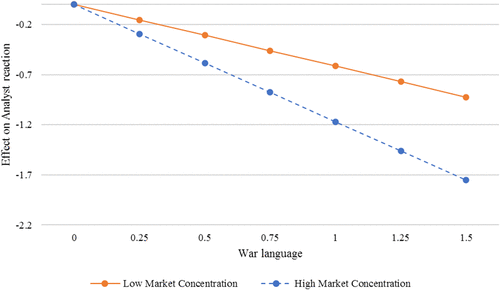
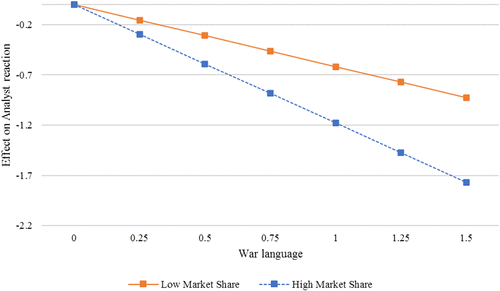
Discussion
Our study was motivated by the idea that not all forms of metaphorical communication are alike. Emanating from distinct families with different communicative intent and drawing on different source domains, metaphors give rise to distinct images that shape audiences’ perceptions and reactions. Analysts often respond negatively to metaphors, but this negativity intensifies for metaphors drawing from war imagery denoting aggressive competition. We emphasize the pivotal role of both the market environment and firm-specific characteristics. Specifically, war-related metaphors receive more negative reactions from analysts in scenarios where heightened competition is not expected. We outline the implications for distinguishing metaphor families, source domains, and contextual applications for research on strategic communication.
Source Domains and Audience Reactions
Scholars recognize language as a tool to elicit positive reactions (Rindova et al. 2004; Graffin et al. 2011, 2016; Guo et al. 2021). For example, using concrete language (Pan et al. 2018) and appropriate framing techniques (Rhee and Fiss 2014, Pan et al. 2020) can have a positive impact on stock prices. Recently, management research has assessed the effects of metaphorical communication in a general sense (e.g., König et al. 2018, Clarke et al. 2019). Our research departs from this approach by advocating for an approach that distinguishes between various metaphor families, source domains, and the contextual use of metaphors.
We paid particular attention to the competition family of metaphors, which is directly relevant to strategy communication and highly salient when firms communicate acquisitions. Not all competition metaphors yield identical reactions. Scholars identify physical violence, death, and rules as the attributes along which competition-related source domains differ. Using language from source domains associated with death and violence to describe strategy produces different reactions compared with the vocabulary of racing or games, for example. A promising endeavor for future research will be to assess variance across source domains of the cooperation and interconnection metaphor families. This would involve identifying specific mechanisms through which source domains from these families influence reactions to strategic communication. For instance, a notable source domain within the cooperation family is that of partnerships (e.g., we are tying the knot), whereas the interconnection family includes the construction domain (e.g., we are constructing a vision or building on our strengths). It is plausible that metaphors stemming from these domains may elicit fewer perceptions of risk and less negative affect as many of the ideas inherent to these source domains are typically associated with positive or neutral reactions (Bradley and Lang 1999), or these metaphors may evoke less intense reactions compared with war metaphors (Bates 2020).
An important implication is that the appropriateness of a source domain varies depending on contextual circumstances. In this study, factors, such as market concentration and market share, shape expectations regarding the appropriateness of perceived competitive aggressiveness, and they moderate the typically negative effect of war-related language on analyst reactions. Of course, it is important to recognize that reactions to metaphorical communication are not universal. Therefore, our discovery of the adverse effects of war language may not hold in entirely different settings where firms are not announcing acquisitions. Contexts influence the effectiveness of framing (Rhee and Fiss 2014), and we encourage scholars to investigate two specific kinds of contextual variations. The first comprises settings unrelated to acquisitions. In other types of strategy disclosures, source domains other than war may be more salient and influential in shaping analyst reactions. A second contingency concerns the nature of the audience. Our study focuses on analyst reactions. When announcing acquisitions, top managers aim to influence the perceptions of not only analysts but also, the media (e.g., Gamache and McNamara 2019), investors (e.g., Graffin et al. 2016), and the acquired companies and their employees (Agarwal et al. 2012). It would be valuable to investigate how different metaphors elicit distinct reactions from these various stakeholders.
Finally, we provide some evidence for our proposed mechanism and rule out some alternative ones, but future research should more directly establish the link between the use of war language and the perception of risk. Laboratory experiments could be particularly useful in examining this relationship more closely. An exploratory experiment developed by the authors looking at war versus race metaphors and nonmetaphorical language hints that this may be the case. These early results, available upon request, are promising, but they only represent a starting point. More detailed and extensive research is required to confirm and clarify these findings.
Metaphor and Behavioral Strategy
Behavioral research within the realm of corporate strategy has examined sensemaking (e.g., behavioral drivers of acquisitions (Devers et al. 2020)) and sense giving (e.g., the influence of impression management (Graffin et al. 2016)). Metaphors are important in both sensemaking and sense giving, and studying the source domains of metaphors can make a valuable contribution to our understanding of these processes. Metaphors are typically processed automatically, allowing them to bypass analytical thinking (Epstein 2010, Leung et al. 2012) and tap into imagery and intuition. Therefore, metaphors are relevant when considering constructs, such as risk perception, and understanding various elements of strategy and resource acquisition where “system 1” thinking is at play (Dushnitsky and Sarkar 2022). In addition, metaphors can also be a sensemaking tool, helping managers in conceptualizing abstract strategy problems in more concrete ways (e.g., Gavetti et al. 2005). For instance, using war metaphors when discussing medical treatments often results in more aggressive treatment options (Chiang and Duann 2007). A useful follow-up study could investigate whether the use of war metaphors by managers is associated with subsequent changes in their behavior, such as a shift toward more adversarial relationships with competitors.
Top managers’ language is consequential in shaping analysts’ impressions (Busenbark et al. 2017), preempting competitive behavior (Guo et al. 2020), managing change (Fiol 2002, Vaara et al. 2016), and fostering innovation (Bartel and Garud 2009). We encourage managers to be mindful of their use of metaphors, ensuring that they align with the context at hand. Corporate executives often have strategic intent in choosing their language (Gao et al. 2015). However, it remains unclear to what extent managers intentionally employ war-related language. Although metaphors can be used deliberately (Breeze 2013), much evidence suggests that they are often used less consciously (Kövecses 2010, Gibbs 2011). The metaphors that we draw on are frequently rooted in early life experiences (see Lizardo 2012). Early on, children become aware of competition as a form of conflict, which may influence the metaphors used later when describing competition (see Dancygier and Sweetser 2014). A productive avenue would be to disentangle whether analyst reactions differ according to whether metaphorical communication is deliberately chosen to shape reactions or whether it emerges more naturally. In our archival data, we analyzed live strategy conference calls discussing just-announced acquisitions. Corporate documents prepared longer in advance are likely to be scrutinized by executive team members and communications professionals, making their language more deliberate.
Although we have theorized about differences between source domains, there may also be differences within source domains. A crucial dimension is whether metaphors are novel or conventional (Gentner and Bowdle 2001, Bowdle and Gentner 2005). Speakers often revert to a limited set of established metaphors (Semino 2008). It is worth exploring whether metaphors that have become so commonly used that they are not clearly distinguishable as metaphorical language have the same effects on analyst reactions as more creative metaphors (Goatly 2007, Semino 2008). Many war metaphors are highly conventionalized, such as “most speakers would not even notice that they use metaphor when they use the expression” (Kövecses 2010, p. 34). Firms use terms such as operation and mission that have military roots, but these military roots may not be at the forefront of the audience’s consciousness. Thus, if a firm describes itself as “joining forces with an alliance partner,” do audiences react similarly as to more overtly military language? Ostensibly, one might expect not, but Goatly (2007) argues that conventional and dead metaphors may be even more impactful than more vivid and novel metaphors insofar as their influence may be especially subtle and pernicious. Even conventional metaphors have been shown to elicit affective reactions in ways that literal language does not (Citron et al. 2016).
The authors are grateful to Senior Editor Metin Sengul and three anonymous reviewers for their exceptionally constructive feedback.
Appendix A. Dictionary Validation
|
Table A.1. Dictionary Validation
| Metaphor source domain | Word list before validation | Word list after validationa |
|---|---|---|
| Competition | ||
| War | accord, accords, affray*, aftermath*, aggression*, aggressor*, alliance*, allied, allies, ally, ambush*, antagonism*, armament*, armed, armies, armistice*, armories, armory, arms, army, artiller*, assault*, atrocit*, attack*, attrition*, battl*, belliger*, blitz*, blood*, bomb, bombard*, bombed, bomber*, bombing*, bombs, booties, booty, came to blows, campaign*, captur*, captive*, carnag*, casualt*, ceasefire*, cease-fire*, civil, civilian, civilians, civils, clash*, collid*, collis*, combat*, compliance*, come to blows, comes to blows, coming to blows, conflict*, confront*, conquer*, contend*, contention*, counterattack*, counteroffensive*, crusade*, damag*, danger*, demobilize, demoli*, defensive*, deploy*, destruct*, disarm*, disput*, dogfight*, drawdown*, enemies, enemy, engag*, enmit*, escalate, escalated, escalates, escalation, exploit*, feud*, fight*, foe, foes, fought, forc*, fray*, frontline*, grappl*, grenade*, guerrilla*, hatred*, hit, hits, hitting, hostil*, imperial*, incursion*, insurrection*, invad*, invas*, kill*, liberat*, lock horns, locked horns, locking horns, locks horns, loot*, man-of-war, martial*, massacr*, mass, masses, massed, massing, melee*, men-of-war, milit*, mission*, murder*, offensive*, operation, pacif*, panzer*, peace*, pillage*, plunder*, postwar*, raider*, rebel*, reconnaissanc*, reconquer*, reconquest*, reinforc*, reparation*, retreat*, riot*, rival*, scuffl*, shoot*, siege*, skirmish*, soldier*, sortie*, struggl*, sword*, take the field, take up arms, taken on, taken the field, taken up arms, takeover*, takes the field, takes up arms, taking the field, taking up arms, target*, terrain*, territor*, threat*, took the field, took up arms, treaties, treaty, trench*, troop*, truce*, tussl*, vanguard*, vendetta*, veteran*, violence*, war, warfare*, warlike*, warlord*, warmonger*, warring*, warrior*, wars, wartime*, warzone*, weapon*, withdraw* | antagonism*, armament*, armed, armies, attrition*, battl*, campaign*, captive*, captur*, compliance*, conflict*, confront*, contend*, defensive*, deploy*, disput*, drawdown*, engag*, escalate, escalated, exploit*, fight*, forc*, fought, frontline*, grappl*, hit, hits, hitting, hostil*, liberat*, melee*, mission*, offensive*, operation, peace*, reinforc*, rival*, struggl*, sword*, target*, veteran* |
| Hand-to-hand combat | abuse, abusi*, affray*, aggress*, aikido, altercat*, assault*, attack*, axe*, bash*, battl*, bayonet*, beat, beats, beating, beaten, biff*, blade*, blow with the fist, blows with the fist, blowing with the fist, blew with the fist, box, boxer*, boxing, brawl*, brutal, clash*, clobber*, clout*, combat*, confront*, counterpunch*, dagger*, destroy*, destruct*, dogfight*, dropkick, drop-kick, down for the count, drub*, duel*, encounter*, featherweight*, fencer, fencers, fencing, feroc*, feud*, fiery, flog*, flyweight*, fistfight*, fist fight*, fight*, fought, fight with the fists, fights with the fists, fighting with the fists, fought with the fists, fisticuff*, fracas*, furious, fury, gladiator*, glove game, glove games, gloved fist, gloved fists, grappl*, gunfight*, haymaker*, heavyweight*, hit, hits, hitting, jab, jabs, jabbed, jabbing, joust*, judo, judoka, jiujitsu, jujitsu, jujutsu, karate, kayo, kickbox*, knife, knives, knockdown*, knock-down*, knock down, knocks down, knocking down, knocked down, knockout*, knock-out*, knock out, knocks out, knocking out, knocked out, ko, krav maga, machete*, martial art, martial arts, matchet*, melee*, middleweight*, offens*, out for the count, prizefight*, prize-fight*, prize fight, prize fights, prize fighting, prize fought, prize fighter, poke*, poking, pocketknife, pocketknives, pummel*, punch*, pugil*, ring, samurai*, scuffl*, shiv, shivs, shot*, slap, slaps, slapped, slapping, slugfest*, smack*, smash*, smite*, smote, smitten, spank*, spar, spars, sparred, sparring, spear*, squared circle, stiletto*, strike, strikes, striking, struck, sumo, switchblade*, sword*, taekwondo, thrash*, thrust*, tko, trounc*, tussl*, uppercut*, vicious*, violent*, wallop, weapon*, whack*, wrestl* | abuse, abusi*, aggress*, beat, beats, beating, beaten, brutal, confront*, destroy*, fencing, hit, hits, hitting, knockdown*, knock down, knock out, offens*, smash*, spear*, strike, strikes, striking, struck, thrust*, wrestl* |
| (Team) sport | 3-pointer*, athleti*, backboard*, backstop*, badminton*, ball, balls, ballpark*, ballplayer*, basketball*, baseball*, baseman, basemen, bat, bats, batted, batting, blindside*, blind-sid*, bunt, bunts, bunting, bunted, catcher*, championship*, close of play, club, coach*, court, courts, cornerback*, cover bases, covers bases, covering bases, covered bases, cover the bases, covers the bases, covering the bases, covered the bases, cover all the bases, covers all the bases, covering all the bases, covered all the bases, cricket*, crossbar*, defenseman, defensemen, disk, dribbl*, drop the ball, drops the ball, dropping the ball, dropped the ball, dodgeball*, down to the wire, downfield*, end run, eye off the ball, faceoff*, face-off*, fastball*, field goal, football*, free throw, free throws, fullback*, fumbl*, foul, fouls, fouled, fouling, game plan, get into the swing, gets into the swing, getting into the swing, got into the swing, get the ball rolling, gets the ball rolling, getting the ball rolling, got the ball rolling, get to first base, gets to first base, getting to first base, got to first base, goal*, golf*, grounder*, halfback*, handball*, hardball*, header*, hockey*, home run*, homerun*, infielder*, inning*, interception*, jump the gun, jumps the gun, jumping the gun, jumped the gun, keeper*, kick, kicks, kicking, kicked, kicker, kickoff*, korfball*, lacrosse*, league*, linebacker*, lineman, linemen midfield*, netball*, netkeeper*, nba, nhl, offside*, on target, onside*, outfielder*, pass, passes, passing, passed, penalt*, pitcher*, placekick*, player*, playmak*, power play, puck, pucks, punt, punts, punting, punted, punter*, putout*, quarterback*, racquetball*, rugby, rugger*, running back*, rusher*, score*, scoring, shinny, shot, shots, shortstop*, skate*, skating, slugger*, soccer*, softball*, sport*, stadium*, stick, sticks, stickball*, strike zone*, strikeout*, striker*, team*, tackl*, tailback*, tennis*, three-pointer*, tight end*, touchdown*, tournament*, up to scratch, volley*, water polo, wide receiver*, winger*, squad* | backstop*, ballpark*, bat, dribbl*, eye off the ball, game plan, goal*, header*, homerun*, home run*, inning*, interception*, jumping the gun, kick, kicked, kicking, kicks, offside*, on target, pass, passed, passes, passing, penalt*, player*, puck, quarterback*, score*, scoring, shot, shots, stick, strike zone*, tackl*, team* |
| Game | ace, aces, act out of turn, acts out of turn, acted out of turn, acting out of turn, all-in, arcade, baccarat*, backgammon*, bet, bets, betted, betting, bishop*, bluff*, blackjack*, board game*, captur*, card, cards, casino*, castling, checker*, checkmate*, chess*, chips are down, clubs, close to the vest, close to our vest, coin flip, close to my vest, console, consoles, crown, deal*, deck, decks, diamonds, dice, dices, dicer, discard*, downcard*, downbet*, draw, draws, en passant, endgame*, family pot*, final table*, flush, fork, forks, full boat, full house, gambl*, gambit*, gamecube, gaming*, grandmaster*, hand, hand-for-hand, hearts, jack, jacks, jackpot*, joker*, king, kings, knight, lotter*, lotto, material, middlegame*, monopoly, nintendo, offsuit*, odd*, opening*, pawn*, pinball*, play, plays, played, playstation, poker*, queen, queens, raffl*, reshuffl*, role*, rook, rooks, roulette*, score, scrabble, sega, sicilian defence, slot machine*, spades, stack*, stalemate*, stand pat, stands pat, standing pat, stood pat, suit, suits, sweepstake*, sweeten the pot, sweetens the pot, sweetened the pot, sweetening the pot, take a chance, takes a chance, took and chance, taken a chance, taking a chance, take my chances, takes my chances, took my chances, taken my chances, taking my chances, toss-up, turn, turns, up the ante, upcard*, video game*, videogame*, wii, xbox, zugzwang | bet, bets, betting, close to the vest, deck, decks, draw, draws, odd*, play, played, plays, role |
| Racing | accelerat*, ahead, athletic*, biathlon*, boat-rac*, bolt*, champion*, circuit*, course*, cycling*, dart*, dash, dashes, dashed, dashing, decathlon*, downhill*, drift*, frontrunner*, go after, goes after, went after, gone after, go hell for leather, goes hell for leather, went hell for leather, gone hell for leather, hasten*, head start, head-to-head, hurtl*, jockey*, jog*, jostl*, lane*, lap, laps, make excellent time, makes excellent time, made excellent time, making excellent time, make good time, makes good time, made good time, making good time, marathon*, medal*, olympic*, outpac*, outstrip*, pace*, pedal*, pelt along, pelts along, pelting along, pelted along, personal best, photo finish, pit against, pits against, pitted against, pitting against, playoff*, podium*, pole, poles, poled, poling, prix, racer*, rally*, rallies, rapid*, ready, set, go, ready, steady, go, rerun*, reran, rider*, rocket*, runner*, rush*, scoot, scoots, scooted, scooting, semifinal*, slalom*, speed*, sprint*, starter’s orders, starting block, steeplechas*, step on it, steps on it, stepped on it, stepping on it, streak*, tiebreak*, time trial, tournament*, track*, triathlon*, triumph*, trot*, velocit*, vie, vies, vied, vying, whizz*, whoosh*, zap, zaps, zapped, zapping, zing*, zip* | accelerat*, ahead, go after, gone after, head start, head-to-head, jockey*, medal*, outpac*, outstrip*, pace*, podium*, pole, runner*, rush*, speed*, track*, vie |
| Predation | bait*, beater*, birdlime*, bring to bay, brings to bay, bringing to bay, brought to bay, bycatch*, captur*, carnivor*, catch*, caught, chase*, chasing, decoy*, dinosaur*, dragnet*, endanger*, ensnar*, entic*, entrap*, escap*, extinction*, falcon*, feline*, fish*, foil*, forag*, foxhound*, foxhunt*, go to ground, goes to ground, going to ground, went to ground, gone to ground, grab*, hawk*, hit, hits, hitting, hitter, hook, hooks, hooked, hooking, hound*, hunt, hunts, hunted, hunting, hunter*, insectivor*, lasso*, lion, lions, lure*, luring, mousetrap*, noos*, pitfall*, poach*, predat*, prey*, quest, quests, rapacious, raptor*, run to ground, runs to ground, ran to ground, scaveng*, seiz*, setline*, spiller*, stalk*, surviv*, shark*, shoot*, shotgun*, snap*, snake*, snatch*, trace, traces, traced, tracing*, track down, tracks down, tracked down, tracking down, trap, traps, trapped, trapping, trawl*, trencher-fed, troll, trolls, trolled, trolling, trotline* | catch*, caught, chasing, decoy*, entic*, entrap*, escap*, grab*, hooked, hunting, lion, lions, predate*, raptor*, seiz*, stalk*, trace, traces, traced, tracking down, track down, trap, trapped, trapping |
| Cooperation | ||
| Family | ancest*, aunt*, babies, baby, bloodlin*, bride*, brother*, conjugal*, consanguin*, cousin*, couple, couples, dad, dads, daddy, daughter*, descend*, divorce, espous*, famil*, father*, fiancee*, filiat*, firstborn*, forefather*, genealog*, generation, godchild*, goddaughter*, godfather*, godmother*, godparent*, grandchild*, granddaughter*, grandfather*, grandma*, grandmother*, grandnephew*, grandniece*, grandpa*, grandson*, granny, great-grandchild*, great-granddaughter*, great-grandfather*, great-grandma*, great-grandmother*, great-grandnephew*, great-grandniece*, great-grandpa*, great-grandson*, groom*, half-brother*, half-sister*, heir*, heredit*, herit*, honeymoon*, household*, husband*, inherit*, kin, kins*, lineag*, marital*, marries, married, marrier, marriers, marriage, marriages, matern*, stepfamil*, marry*, mother*, mum, mums, mummy, nephew, newborn*, newlywed*, niece*, nuptial*, offspring*, parent*, stepfam*, pregnan*, prenuptial*, progen*, related, relation*, relative, relatives, scion*, sibling*, sister*, son, sons, spous*, stepaunt*, stepbrother*, stepdaughter*, stepfamily*, stepfather*, stepmother*, stepsist*, stepson*, stepuncle*, successor*, unborn*, uncle, uncles wedding*, wife*, wive* | ancest*, couple, couples, descend*, famil*, first generation, first-generation, next generation, next-generation, new generation, new-generation, second generation, second-generation, third generation, third-generation, latest generation, latest-generation, our generation, herit*, inherit*, lineag*, marries, married, marriage, marry*, parent*, related, relation*, relative, sister*, successor* |
| Friends | accomplice*, acquaint*, ally, amigo*, babe*, beau, befriend*, beloved, bestfriend*, classmate*, clique*, colleague*, comrad*, contact*, fellow*, follower*, gang*, guest*, squad*, sumpath*, friend, friends, friendship, friendly, friendlier, girlfriend*, boyfriend*, buddi*, buddy*, camarad*, chum, chums, chummy, cobber*, co-mate*, comate*, companion*, confidant*, crony, cronies, homeboy*, homegirl*, intimate*, intimacy, mate, mates, pal, pals, palled, palling, schoolfriend*, sidekick* | beloved, companion*, friendly, friendlier, intimacy, intimate* |
| Partners | accomplice*, affiliate*, associate*, classmate*, collaborator*, colleague*, comrad*, compeer*, confederate*, consociate*, cooperator*, fella, fellow*, flat mate*, flatmate*, helpmate*, pardner*, partner*, playmate*, peer, peers, roommate*, roomie*, schoolfellow*, schoolmate*, workfellow*, workmate* | affiliate*, associate*, partner*, peer, peers |
| Work crew | assembly, band, bands, bench of judges, bench of magistrates, cast of actors, choir*, cohort*, company of actors, conference of delegates, congregation*, convent, convents, coven, covens, coworker*, co-worker*, crew, crews, damning of jurors, disputation of lawyers, drift of fishermen, dynast*, faculty, fraternit*, gang*, group of dancers, henchm*, mob, monaster*, nunner*, panel of experts, parade*, patrol, posse, troop of scouts, troupe*, orchestra*, sororit*, squad | assembly, orchestra* |
| Community | aggregation*, clan, clans, coalition*, collective*, community, communities, compatriot*, congress*, crowd*, neighborhood*, parish*, political movement*, quaker*, social movement*, society*, tribal*, tribe*, village* | aggregation*, coalition*, collective*, community, communities, crowd*, neighborhood* |
| Animal group | bed of oyster*, bevy, bevies, bloat, bloats, brood, broods, camel caravan, camel train, caravan of camels, cattle, cloud of insects, clowder, clowders, clutch, clutches, colony, colonies, dog pack*, drove, droves, fauna, fish school*, flock*, gaggle, gaggles, haul, hauls, herd*, hive, hives, kennel*, kindle, leach, lion pride*, litter, litters, menagerie*, oyster bed*, pack of wolves, pack of dogs, pandemon*, pride of lion*, pod, pods, school of fish*, shoal*, shrewdness*, skulk*, string of horse*, stud, studs, swarm*, train of camels, wolf pack*, zoo* | cattle, flock*, pods |
| Interconnection | ||
| Organisms | alive*, biodivers*, birth, bloom*, born, branch*, breed*, bud, buds, budded, budding, conservat*, crossbreed, crossbred, cultivat*, dead, death*, decompos*, die, dies, died, dying, ecolog*, ecosystem*, egg laying, embryo*, exting*, extinct*, fertil*, flower*, foal*, geminat*, gene, genes, genetic*, gestat*, grow*, grew, habitat*, inbreed*, inbred, incubat*, interbreed*, interbred, immort*, inseminat*, lifecycle*, life cycle*, life-cycle*, life stage*, lifespan*, life span*, lifetime, life-time, longevity, metamorph*, microorg*, mutant*, mutat*, natural selection, nurtur*, organic*, organism*, outgrow*, outgrew, ovulat*, parasit*, parent*, photosynth*, plant*, pollinat*, procreat*, progen*, pupat*, rebirth*, reborn, reproduc*, root*, seed*, spawn*, speciat*, specie*, spring up, springs up, sprang up, sprung up, superorgani*, surviv*, thriv*, vital, vitals, vitality, wean*, whelp* | branch*, breed*, best-of-breed, cultivat*, dead, ecologies, ecosystem*, embryo*, exting*, fertile, fertilization, cross-fertil*, gestat*, grow, grower, growing, grown, growth, grew, incubat*, lifecycle*, life cycle*, life-cycle*, lifetime, longevity, nurtur*, organic, organically, outgrow*, outgrew, parent, pollinat*, cross-pollinat*, root*, deep-root*, seed*, spawn*, survive, surviving, thriv*, vital, vitality |
| Constructed objects | architect*, assemble*, assembling, automat*, blueprint*, braid*, break apart, breaks apart, breaking apart, broke apart, broken apart, breakdown*, break down, breaks down, broke down, broken down, brick by brick, build*, built, buttress*, collaps*, configure*, construct*, crochet*, customiz*, deconstruct*, decorat*, demoli*, design*, disassembl*, dismantl*, dye*, embroider*, engineer*, erect, erects, erected, factory, factories, fabricat*, fall apart, falls apart, falling apart, fell apart, fallen apart, fine-tun*, floor, floors, forge, forged, forges, greas*, ground up, knit*, lighthouse*, lubricat*, machinery, manufactur*, moving parts, net, nets, ornament*, patchwork*, piece together, piecing together, pieced together, pieces together, put together, putting together, puts together, quilt*, ravel, ravels, ravelling, ravelled, raw material*, rearrang*, reassembl*, reengineer*, rip apart, rips apart, ripped apart, ripping apart, roof, roofs, sew*, spin, spinning, spins, span, spun, tangl*, unravel*, well-oiled, weav*, wove* | architect*, assemble, assembled, assembles, assembling, blueprint*, braid*, build, builds, building, built, customiz*, dismantl*, fine-tun*, floor, floors, forge, forged, forges, ground up, knit*, moving parts, piece together, pieces together, put together, putting together, puts together, rearrang*, under one roof |
| Natural objects | autumn*, blizzard*, breeze*, canal, canals, canaliz*, canyon*, cave, caves, cliff*, cloud*, crater*, creek*, crystal, crystaliz*, day*, diamond*, desert*, drought*, firestorm*, flame*, fog, fogs, foggy, forest, forests, force of nature, forces of nature, garden, gardens, glacier*, gold*, hill*, hurricane*, iceberg*, lagoon*, lake*, landscape, mountain*, night*, oasis*, ocean*, peak*, plateau*, pond, rain*, ravine*, reservoir*, ridge*, river*, rock, rocks, rocky, rose, roses, sea, seas, season*, slope*, silver*, snow*, spring, storm*, stream*, summer, sunshine, swamp*, thunderstorm*, valley*, volcano*, waterfall*, wattershed*, wave*, weather*, wildfire*, wind, winds, windy, winter | cloud*, crystalliz*, iceberg*, landscape, peak*, plateau*, pond, river of information, rock-solid, season*, swamp*, waterfall*, wave of, wind down, wind up, winds up |
aWe only validate words that appear in the actual corpus. Many of the words that do not appear in the postvalidation word list are absent from the corpus (and likely rarely occur in corporate discourse).
Appendix B. Regression Models of Analyst Reaction (Replication of Main Results Controlling for Investor Reactions)
|
Table B.1. Regression Models of Analyst Reaction Controlling for Short-Term CAR
| Variable | Dependent variable: Analyst reaction | ||||||
|---|---|---|---|---|---|---|---|
| Full sample | Low market share | High market share | Low market concentration | High market concentration | |||
| (1) | (2) | (3) | (4) | (5) | (6) | (7) | |
| Short-term market reaction | 0.001 | 0.001 | 0.001 | −0.010 | 0.010 | 0.009 | 0.005 |
| (0.006) | (0.006) | (0.006) | (0.009) | (0.011) | (0.009) | (0.010) | |
| Acquirer market concentration | 0.608 | 0.626 | 0.631 | 0.775 | 0.494 | 1.642 | 1.020 |
| (0.684) | (0.686) | (0.687) | (0.944) | (1.001) | (1.675) | (0.873) | |
| Acquirer market share | −0.352 | −0.356 | −0.397 | 1.846 | −0.875 | −0.956 | −0.443 |
| (0.465) | (0.465) | (0.469) | (11.159) | (0.700) | (1.175) | (0.529) | |
| Acquirer debt-to-equity ratio | 0.001 | 0.001 | 0.001 | 0.001 | 0.002 | 0.002 | 0.001 |
| (0.002) | (0.002) | (0.002) | (0.002) | (0.003) | (0.001) | (0.007) | |
| Acquirer cash-to-assets ratio | −0.016** | −0.015** | −0.015** | −0.015** | 0.004 | −0.023** | −0.006 |
| (0.003) | (0.003) | (0.003) | (0.004) | (0.009) | (0.005) | (0.005) | |
| Acquirer book-to-market ratio | −0.270 | −0.266 | −0.260 | −0.882** | 0.291 | −0.495* | 0.243 |
| (0.204) | (0.206) | (0.205) | (0.295) | (0.292) | (0.236) | (0.357) | |
| Acquirer financial performance | 0.004 | 0.003 | 0.003 | 0.003 | −0.015 | 0.008 | 0.001 |
| (0.004) | (0.004) | (0.004) | (0.004) | (0.012) | (0.005) | (0.007) | |
| Acquirer acquisition experience | 0.006 | 0.006 | 0.006 | 0.003 | 0.000 | 0.003 | 0.004 |
| (0.011) | (0.011) | (0.011) | (0.032) | (0.011) | (0.018) | (0.014) | |
| New CEO | 0.360+ | 0.367* | 0.360+ | 0.371 | 0.320 | 0.289 | 0.488+ |
| (0.187) | (0.186) | (0.185) | (0.234) | (0.278) | (0.274) | (0.274) | |
| Target is a public company | 0.030 | 0.032 | 0.038 | −0.030 | 0.113 | 0.001 | −0.067 |
| (0.130) | (0.131) | (0.132) | (0.140) | (0.240) | (0.162) | (0.207) | |
| Target is a national company | 0.064 | 0.068 | 0.074 | 0.211 | −0.092 | 0.191 | −0.090 |
| (0.119) | (0.118) | (0.118) | (0.154) | (0.173) | (0.170) | (0.165) | |
| Relatedness | −0.181 | −0.189 | −0.196 | −0.217 | −0.115 | −0.285 | −0.050 |
| (0.120) | (0.120) | (0.120) | (0.174) | (0.167) | (0.184) | (0.169) | |
| Value of transaction | 0.001 | 0.001 | 0.001 | 0.005 | −0.002 | −0.001 | 0.039 |
| (0.004) | (0.004) | (0.004) | (0.014) | (0.006) | (0.004) | (0.024) | |
| Consideration structure | −0.088 | −0.086 | −0.081 | −0.053 | −0.119 | −0.005 | −0.155 |
| (0.117) | (0.118) | (0.117) | (0.150) | (0.195) | (0.158) | (0.175) | |
| Number of competing bidders | 0.160 | 0.148 | 0.152 | 0.298 | 0.160 | 0.143 | 0.348 |
| (0.252) | (0.254) | (0.252) | (0.407) | (0.315) | (0.326) | (0.555) | |
| Length of the press release | −0.017 | −0.013 | −0.018 | −0.039 | 0.058 | −0.110 | 0.137 |
| (0.052) | (0.053) | (0.052) | (0.066) | (0.104) | (0.092) | (0.103) | |
| Length of the conference call | 0.016 | 0.018 | 0.018 | 0.011 | 0.030 | 0.015 | 0.023 |
| (0.050) | (0.050) | (0.050) | (0.089) | (0.062) | (0.075) | (0.064) | |
| Number of analyst reports | −0.037** | −0.037** | −0.036** | −0.031* | −0.050** | −0.036** | −0.033** |
| (0.010) | (0.010) | (0.010) | (0.015) | (0.015) | (0.013) | (0.013) | |
| Language complexity | −0.066 | −0.065 | −0.059 | −0.107+ | 0.008 | −0.087 | −0.009 |
| (0.043) | (0.043) | (0.043) | (0.062) | (0.065) | (0.062) | (0.064) | |
| Language concreteness | −0.018 | −0.016 | −0.014 | −0.028 | 0.007 | −0.017 | 0.013 |
| (0.024) | (0.024) | (0.024) | (0.033) | (0.033) | (0.032) | (0.034) | |
| Positive-negative language | 0.001+ | 0.001+ | 0.001+ | 0.002+ | 0.000 | 0.002* | 0.000 |
| (0.001) | (0.001) | (0.001) | (0.001) | (0.001) | (0.001) | (0.001) | |
| Active-passive language | 0.221 | 0.238+ | 0.246+ | 0.131 | 0.337 | 0.168 | 0.296 |
| (0.142) | (0.140) | (0.140) | (0.198) | (0.205) | (0.169) | (0.213) | |
| Metaphorical language (total) | −0.252+ | ||||||
| (0.131) | |||||||
| Interconnection metaphor family | −0.217 | −0.205 | −0.231 | −0.278 | −0.394 | −0.175 | |
| (0.231) | (0.233) | (0.326) | (0.311) | (0.295) | (0.335) | ||
| Cooperation metaphor family | −0.054 | −0.029 | 0.100 | 0.149 | −0.707* | 0.529 | |
| (0.258) | (0.255) | (0.299) | (0.429) | (0.304) | (0.354) | ||
| Competition metaphor family | −0.403* | ||||||
| (0.189) | |||||||
| Competition metaphor family, excl. war | −0.248 | −0.228 | −0.242 | −0.132 | −0.252 | ||
| (0.233) | (0.359) | (0.286) | (0.373) | (0.256) | |||
| Competition metaphor family, only war | −0.788** | −0.623 | −1.171* | −0.636 | −1.154* | ||
| (0.290) | (0.405) | (0.453) | (0.386) | (0.449) | |||
| Constant | 4.846** | 4.836** | 4.706** | 5.352** | 3.782* | 5.107** | 4.709* |
| (1.092) | (1.091) | (1.091) | (1.358) | (1.754) | (1.310) | (2.042) | |
| Year of announcement dummies | Yes | Yes | Yes | Yes | Yes | Yes | Yes |
| Acquirer market division dummies | Yes | Yes | Yes | Yes | Yes | Yes | Yes |
| No. of observations | 999 | 999 | 999 | 499 | 500 | 499 | 500 |
| R2 | 0.122 | 0.124 | 0.125 | 0.220 | 0.144 | 0.230 | 0.140 |
Note. Standard errors are clustered by firm in parentheses.
*p < 0.05; **p < 0.01; +p < 0.10.
|
Table B.2. Regression Models of Analyst Reaction Controlling for Long-Term CAR
| Variable | Dependent variable: Analyst reaction | ||||||
|---|---|---|---|---|---|---|---|
| Full sample | Low market share | High market share | Low market concentration | High market concentration | |||
| (1) | (2) | (3) | (4) | (5) | (6) | (7) | |
| Long-term market reaction | 0.000 | 0.000 | 0.000 | −0.001 | 0.001 | 0.001 | −0.001 |
| (0.001) | (0.001) | (0.001) | (0.001) | (0.001) | (0.001) | (0.001) | |
| Acquirer market concentration | 0.605 | 0.623 | 0.628 | 0.749 | 0.472 | 1.637 | 1.005 |
| (0.682) | (0.684) | (0.685) | (0.947) | (1.010) | (1.681) | (0.872) | |
| Acquirer market share | −0.349 | −0.352 | −0.393 | 1.917 | −0.834 | −1.009 | −0.431 |
| (0.466) | (0.466) | (0.470) | (11.218) | (0.706) | (1.182) | (0.531) | |
| Acquirer debt-to-equity ratio | 0.001 | 0.001 | 0.001 | 0.001 | 0.002 | 0.001 | 0.001 |
| (0.002) | (0.002) | (0.002) | (0.002) | (0.003) | (0.001) | (0.007) | |
| Acquirer cash-to-assets ratio | −0.016** | −0.015** | −0.015** | −0.015** | 0.004 | −0.023** | −0.007 |
| (0.003) | (0.003) | (0.003) | (0.004) | (0.009) | (0.005) | (0.005) | |
| Acquirer book-to-market ratio | −0.262 | −0.258 | −0.254 | −0.844** | 0.262 | −0.520* | 0.263 |
| (0.205) | (0.207) | (0.206) | (0.289) | (0.302) | (0.243) | (0.359) | |
| Acquirer financial performance | 0.004 | 0.004 | 0.003 | 0.003 | −0.018 | 0.008 | 0.002 |
| (0.004) | (0.004) | (0.004) | (0.004) | (0.013) | (0.006) | (0.007) | |
| Acquirer acquisition experience | 0.006 | 0.006 | 0.006 | 0.005 | 0.001 | 0.003 | 0.004 |
| (0.011) | (0.011) | (0.011) | (0.032) | (0.011) | (0.018) | (0.014) | |
| New CEO | 0.360+ | 0.367* | 0.360+ | 0.379 | 0.306 | 0.281 | 0.490+ |
| (0.186) | (0.186) | (0.184) | (0.238) | (0.279) | (0.276) | (0.274) | |
| Target is a public company | 0.026 | 0.027 | 0.034 | −0.002 | 0.105 | −0.015 | −0.090 |
| (0.128) | (0.129) | (0.130) | (0.139) | (0.234) | (0.153) | (0.208) | |
| Target is a national company | 0.067 | 0.071 | 0.077 | 0.201 | −0.096 | 0.197 | −0.078 |
| (0.118) | (0.117) | (0.117) | (0.152) | (0.174) | (0.167) | (0.164) | |
| Relatedness | −0.181 | −0.189 | −0.196 | −0.211 | −0.108 | −0.280 | −0.049 |
| (0.120) | (0.120) | (0.120) | (0.173) | (0.165) | (0.183) | (0.170) | |
| Value of transaction | 0.001 | 0.001 | 0.001 | 0.003 | −0.003 | −0.001 | 0.038 |
| (0.004) | (0.004) | (0.004) | (0.014) | (0.006) | (0.003) | (0.023) | |
| Consideration structure | −0.087 | −0.084 | −0.080 | −0.046 | −0.116 | −0.007 | −0.148 |
| (0.117) | (0.117) | (0.117) | (0.152) | (0.193) | (0.159) | (0.174) | |
| Number of competing bidders | 0.162 | 0.150 | 0.153 | 0.314 | 0.159 | 0.121 | 0.346 |
| (0.252) | (0.254) | (0.252) | (0.415) | (0.314) | (0.326) | (0.560) | |
| Length of the press release | −0.016 | −0.012 | −0.017 | −0.048 | 0.063 | −0.103 | 0.145 |
| (0.053) | (0.053) | (0.053) | (0.069) | (0.104) | (0.090) | (0.104) | |
| Length of the conference call | 0.017 | 0.019 | 0.019 | 0.011 | 0.030 | 0.016 | 0.031 |
| (0.050) | (0.050) | (0.050) | (0.089) | (0.062) | (0.074) | (0.064) | |
| Number of analyst reports | −0.037** | −0.037** | −0.037** | −0.029* | −0.052** | −0.038** | −0.034** |
| (0.010) | (0.010) | (0.010) | (0.015) | (0.015) | (0.013) | (0.012) | |
| Language complexity | −0.067 | −0.066 | −0.060 | −0.103+ | 0.008 | −0.091 | −0.010 |
| (0.042) | (0.043) | (0.042) | (0.060) | (0.065) | (0.062) | (0.064) | |
| Language concreteness | −0.018 | −0.016 | −0.013 | −0.028 | 0.004 | −0.019 | 0.013 |
| (0.024) | (0.024) | (0.024) | (0.033) | (0.033) | (0.032) | (0.034) | |
| Positive-negative language | 0.001+ | 0.001+ | 0.001+ | 0.002+ | 0.000 | 0.002* | 0.000 |
| (0.001) | (0.001) | (0.001) | (0.001) | (0.001) | (0.001) | (0.001) | |
| Active-passive language | 0.222 | 0.240+ | 0.247+ | 0.123 | 0.337 | 0.173 | 0.304 |
| (0.141) | (0.139) | (0.140) | (0.201) | (0.206) | (0.169) | (0.213) | |
| Metaphorical language (total) | −0.253+ | ||||||
| (0.132) | |||||||
| Interconnection metaphor family | −0.225 | −0.212 | −0.212 | −0.292 | −0.411 | −0.204 | |
| (0.231) | (0.233) | (0.322) | (0.314) | (0.292) | (0.342) | ||
| Cooperation metaphor family | −0.054 | −0.030 | 0.098 | 0.110 | −0.695* | 0.526 | |
| (0.258) | (0.255) | (0.298) | (0.428) | (0.302) | (0.352) | ||
| Competition metaphor family | −0.403* | ||||||
| (0.190) | |||||||
| Competition metaphor family, excl. war | −0.249 | −0.221 | −0.252 | −0.146 | −0.263 | ||
| (0.233) | (0.361) | (0.278) | (0.374) | (0.257) | |||
| Competition metaphor family, only war | −0.785** | −0.596 | −1.185** | −0.615 | −1.147* | ||
| (0.292) | (0.408) | (0.457) | (0.389) | (0.455) | |||
| Constant | 4.834** | 4.824** | 4.697** | 5.223** | 3.857* | 5.230** | 4.588* |
| (1.095) | (1.093) | (1.094) | (1.352) | (1.767) | (1.329) | (2.048) | |
| Year of announcement dummies | Yes | Yes | Yes | Yes | Yes | Yes | Yes |
| Acquirer market division dummies | Yes | Yes | Yes | Yes | Yes | Yes | Yes |
| No. of observations | 999 | 999 | 999 | 499 | 500 | 499 | 500 |
| R2 | 0.122 | 0.124 | 0.125 | 0.219 | 0.143 | 0.230 | 0.140 |
Note. Standard errors are clustered by firm in parentheses.
*p < 0.05; **p < 0.01; +p < 0.10.
Appendix C. Further Regression Models of Analyst Reaction
|
Table C.1. Regression Models of Analyst Reaction Using a Different Specification of the Dependent Variable (Based on the Harvard–IV General Inquirer)
| Variable | Dependent variable: Analyst reaction | ||||||
|---|---|---|---|---|---|---|---|
| Full sample | Low market share | High market share | Low market concentration | High market concentration | |||
| (1) | (2) | (3) | (4) | (5) | (6) | (7) | |
| Acquirer market concentration | 0.567 | 0.584 | 0.589 | 0.342 | 0.770 | 0.527 | 0.730 |
| (0.418) | (0.420) | (0.418) | (0.458) | (0.758) | (1.159) | (0.557) | |
| Acquirer market share | −0.772* | −0.769* | −0.812** | −2.023 | −1.008+ | −0.897 | −0.748* |
| (0.302) | (0.304) | (0.302) | (6.633) | (0.560) | (0.663) | (0.355) | |
| Acquirer debt-to-equity ratio | −0.001 | −0.001 | −0.001 | 0.001 | −0.001 | 0.000 | −0.007 |
| (0.002) | (0.002) | (0.002) | (0.001) | (0.003) | (0.002) | (0.007) | |
| Acquirer cash-to-assets ratio | −0.004 | −0.004 | −0.004 | −0.004 | 0.001 | −0.005 | −0.003 |
| (0.003) | (0.003) | (0.003) | (0.003) | (0.007) | (0.004) | (0.004) | |
| Acquirer book-to-market ratio | −0.163 | −0.164 | −0.158 | −0.291 | −0.187 | −0.476* | 0.317 |
| (0.166) | (0.165) | (0.165) | (0.250) | (0.260) | (0.229) | (0.244) | |
| Acquirer financial performance | 0.001 | 0.001 | 0.000 | 0.001 | −0.012 | 0.005 | −0.003 |
| (0.005) | (0.005) | (0.005) | (0.005) | (0.011) | (0.007) | (0.005) | |
| Acquirer acquisition experience | 0.012 | 0.013 | 0.013 | 0.026 | 0.006 | −0.002 | 0.025 |
| (0.011) | (0.011) | (0.011) | (0.020) | (0.013) | (0.012) | (0.020) | |
| New CEO | −0.115 | −0.108 | −0.115 | −0.141 | −0.117 | −0.1960+ | −0.067 |
| (0.090) | (0.090) | (0.090) | (0.121) | (0.140) | (0.102) | (0.159) | |
| Target is a public company | −0.052 | −0.055 | −0.048 | −0.038 | −0.140 | −0.107 | −0.048 |
| (0.084) | (0.085) | (0.085) | (0.109) | (0.156) | (0.088) | (0.181) | |
| Target is a national company | −0.037 | −0.031 | −0.025 | −0.128 | 0.060 | −0.047 | 0.016 |
| (0.085) | (0.084) | (0.085) | (0.133) | (0.110) | (0.128) | (0.116) | |
| Relatedness | −0.179* | −0.189* | −0.195** | −0.227+ | −0.130 | −0.236* | −0.261* |
| (0.075) | (0.075) | (0.075) | (0.118) | (0.113) | (0.117) | (0.109) | |
| Value of transaction | 0.002 | 0.002 | 0.002 | 0.016 | 0.000 | 0.004 | −0.002 |
| (0.003) | (0.003) | (0.003) | (0.021) | (0.003) | (0.003) | (0.017) | |
| Consideration structure | −0.002 | 0.003 | 0.008 | 0.018 | 0.067 | 0.037 | −0.019 |
| (0.075) | (0.076) | (0.076) | (0.101) | (0.137) | (0.093) | (0.130) | |
| Number of competing bidders | 0.071 | 0.059 | 0.063 | −0.086 | 0.087 | −0.059 | 0.188 |
| (0.206) | (0.208) | (0.207) | (0.249) | (0.285) | (0.252) | (0.377) | |
| Length of the press release | −0.010 | −0.007 | −0.012 | −0.091* | 0.136* | −0.082+ | 0.108 |
| (0.036) | (0.035) | (0.035) | (0.044) | (0.069) | (0.046) | (0.079) | |
| Length of the conference call | −0.018 | −0.014 | −0.014 | −0.049 | 0.003 | −0.018 | −0.023 |
| (0.030) | (0.030) | (0.030) | (0.045) | (0.043) | (0.040) | (0.047) | |
| Number of analyst reports | −0.021** | −0.020** | −0.020** | −0.017+ | −0.022* | −0.022** | −0.023+ |
| (0.007) | (0.007) | (0.007) | (0.010) | (0.011) | (0.007) | (0.013) | |
| Language complexity | −0.033 | −0.033 | −0.027 | −0.062+ | 0.006 | −0.009 | −0.049 |
| (0.025) | (0.026) | (0.026) | (0.036) | (0.039) | (0.032) | (0.044) | |
| Language concreteness | −0.019 | −0.015 | −0.013 | −0.049* | 0.020 | −0.027 | 0.000 |
| (0.016) | (0.016) | (0.016) | (0.023) | (0.022) | (0.021) | (0.025) | |
| Positive-negative language | 0.000 | 0.000 | 0.000 | −0.001 | 0.001 | −0.001 | 0.001+ |
| (0.000) | (0.000) | (0.000) | (0.001) | (0.001) | (0.001) | (0.001) | |
| Active-passive language | 0.207+ | 0.233* | 0.241* | 0.167 | 0.355* | 0.096 | 0.326+ |
| (0.106) | (0.105) | (0.106) | (0.145) | (0.170) | (0.126) | (0.171) | |
| Metaphorical language (total) | 0.082 | ||||||
| (0.087) | |||||||
| Interconnection metaphor family | −0.026 | −0.012 | 0.161 | −0.209 | 0.144 | 0.020 | |
| (0.166) | (0.165) | (0.232) | (0.230) | (0.201) | (0.235) | ||
| Cooperation metaphor family | 0.361+ | 0.388* | 0.726* | 0.135 | 0.484 | 0.386+ | |
| (0.185) | (0.185) | (0.290) | (0.217) | (0.305) | (0.211) | ||
| Competition metaphor family | −0.037 | ||||||
| (0.139) | |||||||
| Competition metaphor family, excl. war | 0.128 | 0.059 | 0.145 | 0.077 | 0.027 | ||
| (0.176) | (0.248) | (0.237) | (0.228) | (0.239) | |||
| Competition metaphor family, only war | −0.448+ | −0.223 | −0.927* | −0.083 | −0.874* | ||
| (0.230) | (0.323) | (0.362) | (0.314) | (0.354) | |||
| Constant | 5.407** | 5.382** | 5.244** | 5.881** | 4.796** | 5.302** | 5.324** |
| (0.761) | (0.754) | (0.766) | (0.756) | (1.404) | (0.796) | (1.680) | |
| Year of announcement dummies | Yes | Yes | Yes | Yes | Yes | Yes | Yes |
| Acquirer market division dummies | Yes | Yes | Yes | Yes | Yes | Yes | Yes |
| No. of observations | 998 | 998 | 998 | 499 | 499 | 499 | 499 |
| R2 | 0.081 | 0.085 | 0.088 | 0.150 | 0.125 | 0.152 | 0.139 |
Note. Standard errors are clustered by firm in parentheses.
*p < 0.05; **p < 0.01; +p < 0.10.
|
Table C.2. Regression Models of Analyst Reaction Using a Restricted War Language Specification
| Variable | Dependent variable: Analyst reaction | ||||||
|---|---|---|---|---|---|---|---|
| Full sample | Low market share | High market share | Low market concentration | High market concentration | |||
| (1) | (2) | (3) | (4) | (5) | (6) | (7) | |
| Acquirer market concentration | 0.607 | 0.625 | 0.640 | 0.798 | 0.477 | 1.672 | 1.013 |
| (0.684) | (0.686) | (0.687) | (0.952) | (1.008) | (1.664) | (0.874) | |
| Acquirer market share | −0.350 | −0.354 | −0.373 | 2.570 | −0.820 | −0.928 | −0.415 |
| (0.467) | (0.467) | (0.469) | (11.200) | (0.699) | (1.184) | (0.529) | |
| Acquirer debt-to-equity ratio | 0.001 | 0.001 | 0.001 | 0.001 | 0.002 | 0.002 | 0.001 |
| (0.002) | (0.002) | (0.002) | (0.002) | (0.003) | (0.001) | (0.007) | |
| Acquirer cash-to-assets ratio | −0.016** | −0.015** | −0.016** | −0.015** | 0.003 | −0.023** | −0.007 |
| (0.003) | (0.003) | (0.003) | (0.004) | (0.008) | (0.005) | (0.005) | |
| Acquirer book-to-market ratio | −0.270 | −0.266 | −0.279 | −0.897** | 0.266 | −0.505* | 0.192 |
| (0.204) | (0.206) | (0.205) | (0.288) | (0.295) | (0.240) | (0.360) | |
| Acquirer financial performance | 0.004 | 0.003 | 0.004 | 0.003 | −0.017 | 0.009 | 0.002 |
| (0.004) | (0.004) | (0.004) | (0.004) | (0.013) | (0.005) | (0.007) | |
| Acquirer acquisition experience | 0.006 | 0.006 | 0.007 | 0.005 | 0.001 | 0.003 | 0.005 |
| (0.011) | (0.011) | (0.011) | (0.033) | (0.011) | (0.018) | (0.014) | |
| New CEO | 0.359+ | 0.366* | 0.367* | 0.384 | 0.324 | 0.283 | 0.499+ |
| (0.186) | (0.186) | (0.185) | (0.239) | (0.282) | (0.275) | (0.277) | |
| Target is a public company | 0.029 | 0.030 | 0.039 | 0.006 | 0.084 | −0.018 | −0.067 |
| (0.130) | (0.131) | (0.132) | (0.138) | (0.239) | (0.154) | (0.212) | |
| Target is a national company | 0.064 | 0.069 | 0.069 | 0.188 | −0.104 | 0.201 | −0.085 |
| (0.117) | (0.116) | (0.116) | (0.150) | (0.174) | (0.164) | (0.163) | |
| Relatedness | −0.181 | −0.189 | −0.184 | −0.195 | −0.096 | −0.267 | −0.037 |
| (0.120) | (0.120) | (0.120) | (0.170) | (0.167) | (0.181) | (0.170) | |
| Value of transaction | 0.001 | 0.001 | 0.001 | 0.004 | −0.003 | −0.001 | 0.037 |
| (0.004) | (0.004) | (0.004) | (0.014) | (0.006) | (0.003) | (0.023) | |
| Consideration structure | −0.088 | −0.086 | −0.080 | −0.045 | −0.123 | 0.000 | −0.157 |
| (0.117) | (0.117) | (0.117) | (0.150) | (0.195) | (0.159) | (0.177) | |
| Number of competing bidders | 0.160 | 0.148 | 0.146 | 0.300 | 0.175 | 0.117 | 0.364 |
| (0.252) | (0.254) | (0.255) | (0.414) | (0.319) | (0.332) | (0.554) | |
| Length of the press release | −0.017 | −0.012 | −0.016 | −0.050 | 0.071 | −0.103 | 0.142 |
| (0.053) | (0.053) | (0.053) | (0.070) | (0.103) | (0.090) | (0.106) | |
| Length of the conference call | 0.016 | 0.018 | 0.017 | 0.009 | 0.024 | 0.013 | 0.022 |
| (0.050) | (0.050) | (0.050) | (0.089) | (0.062) | (0.076) | (0.064) | |
| Number of analyst reports | −0.037** | −0.037** | −0.037** | −0.031* | −0.052** | −0.039** | −0.033** |
| (0.010) | (0.010) | (0.010) | (0.015) | (0.015) | (0.013) | (0.012) | |
| Language complexity | −0.067 | −0.066 | −0.065 | −0.102+ | −0.005 | −0.097 | −0.017 |
| (0.042) | (0.043) | (0.043) | (0.060) | (0.063) | (0.062) | (0.064) | |
| Language concreteness | −0.018 | −0.016 | −0.015 | −0.030 | 0.002 | −0.019 | 0.012 |
| (0.024) | (0.023) | (0.024) | (0.033) | (0.032) | (0.032) | (0.034) | |
| Positive-negative language | 0.001+ | 0.001+ | 0.001+ | 0.002+ | 0.000 | 0.002* | 0.000 |
| (0.001) | (0.001) | (0.001) | (0.001) | (0.001) | (0.001) | (0.001) | |
| Active-passive language | 0.221 | 0.239+ | 0.227 | 0.095 | 0.322 | 0.149 | 0.295 |
| (0.141) | (0.139) | (0.139) | (0.202) | (0.205) | (0.169) | (0.213) | |
| Metaphorical language (total) | −0.253+ | ||||||
| (0.132) | |||||||
| Interconnection metaphor family | −0.220 | −0.200 | −0.169 | −0.293 | −0.395 | −0.220 | |
| (0.232) | (0.233) | (0.330) | (0.310) | (0.289) | (0.340) | ||
| Cooperation metaphor family | −0.055 | −0.049 | 0.111 | 0.075 | −0.713* | 0.479 | |
| (0.257) | (0.256) | (0.301) | (0.426) | (0.307) | (0.350) | ||
| Competition metaphor family | −0.403* | ||||||
| (0.189) | |||||||
| Competition metaphor family, excl. war | −0.256 | −0.231 | −0.264 | −0.160 | −0.248 | ||
| (0.231) | (0.362) | (0.276) | (0.375) | (0.255) | |||
| Competition metaphor family, only war | −0.638* | −0.663 | −0.853+ | −0.571 | −0.947* | ||
| (0.323) | (0.457) | (0.466) | (0.460) | (0.475) | |||
| Constant | 4.849** | 4.840** | 4.724** | 5.265** | 3.838* | 5.261** | 4.570* |
| (1.092) | (1.090) | (1.098) | (1.346) | (1.757) | (1.335) | (2.058) | |
| Year of announcement dummies | Yes | Yes | Yes | Yes | Yes | Yes | Yes |
| Acquirer market division dummies | Yes | Yes | Yes | Yes | Yes | Yes | Yes |
| No. of observations | 999 | 999 | 999 | 499 | 500 | 499 | 500 |
| R2 | 0.122 | 0.124 | 0.122 | 0.217 | 0.137 | 0.227 | 0.135 |
Note. Standard are errors clustered by firm in parentheses.
*p < 0.05; **p < 0.01; +p < 0.10.
|
Table C.3. Regression Models of Analyst Reaction After Winsorizing Ratio Variables
| Variable | Dependent variable: Analyst reaction | ||||||
|---|---|---|---|---|---|---|---|
| Full sample | Low market share | High market share | Low market concentration | High market concentration | |||
| (1) | (2) | (3) | (4) | (5) | (6) | (7) | |
| Acquirer market concentration | 0.601 | 0.619 | 0.624 | 0.723 | 0.478 | 1.361 | 1.043 |
| (0.682) | (0.684) | (0.684) | (0.947) | (0.996) | (1.616) | (0.864) | |
| Acquirer market share | −0.334 | −0.337 | −0.378 | 3.571 | −0.865 | −0.889 | −0.420 |
| (0.465) | (0.464) | (0.469) | (11.095) | (0.700) | (1.175) | (0.529) | |
| Acquirer debt-to-equity ratio (winsorized) | 0.001 | 0.001 | 0.001 | 0.014 | 0.000 | 0.001 | 0.005 |
| (0.002) | (0.003) | (0.002) | (0.021) | (0.003) | (0.002) | (0.006) | |
| Acquirer cash-to-assets ratio (winsorized) | −0.015** | −0.015** | −0.014** | −0.013** | 0.000 | −0.022** | −0.005 |
| (0.003) | (0.004) | (0.004) | (0.004) | (0.009) | (0.005) | (0.005) | |
| Acquirer book-to-market ratio (winsorized) | −0.103 | −0.099 | −0.098 | −0.700* | 0.345 | −0.428 | 0.679 |
| (0.234) | (0.235) | (0.234) | (0.307) | (0.383) | (0.260) | (0.414) | |
| Acquirer financial performance | 0.007 | 0.006 | 0.005 | 0.005 | −0.024+ | 0.017* | −0.001 |
| (0.007) | (0.007) | (0.007) | (0.007) | (0.015) | (0.007) | (0.012) | |
| Acquirer acquisition experience | 0.007 | 0.006 | 0.007 | 0.009 | 0.001 | 0.002 | 0.007 |
| (0.011) | (0.011) | (0.011) | (0.032) | (0.011) | (0.019) | (0.014) | |
| New CEO | 0.353+ | 0.360+ | 0.353+ | 0.373 | 0.307 | 0.287 | 0.473+ |
| (0.186) | (0.186) | (0.184) | (0.236) | (0.278) | (0.272) | (0.270) | |
| Target is a public company | 0.030 | 0.031 | 0.038 | 0.015 | 0.085 | −0.017 | −0.077 |
| (0.131) | (0.132) | (0.133) | (0.140) | (0.240) | (0.155) | (0.214) | |
| Target is a national company | 0.053 | 0.058 | 0.064 | 0.172 | −0.091 | 0.168 | −0.086 |
| (0.117) | (0.116) | (0.116) | (0.152) | (0.172) | (0.166) | (0.165) | |
| Relatedness | −0.185 | −0.192 | −0.199+ | −0.193 | −0.104 | −0.277 | −0.069 |
| (0.120) | (0.120) | (0.120) | (0.175) | (0.166) | (0.184) | (0.170) | |
| Value of transaction | 0.001 | 0.002 | 0.002 | 0.006 | −0.004 | 0.000 | 0.037 |
| (0.004) | (0.004) | (0.004) | (0.014) | (0.006) | (0.003) | (0.024) | |
| Consideration structure | −0.078 | −0.076 | −0.071 | −0.042 | −0.101 | −0.002 | −0.141 |
| (0.119) | (0.119) | (0.118) | (0.153) | (0.196) | (0.163) | (0.175) | |
| Number of competing bidders | 0.163 | 0.151 | 0.156 | 0.317 | 0.225 | 0.130 | 0.428 |
| (0.254) | (0.257) | (0.255) | (0.413) | (0.317) | (0.327) | (0.570) | |
| Length of the press release | −0.014 | −0.010 | −0.015 | −0.049 | 0.057 | −0.094 | 0.132 |
| (0.053) | (0.053) | (0.053) | (0.069) | (0.103) | (0.089) | (0.104) | |
| Length of the conference call | 0.015 | 0.017 | 0.017 | 0.007 | 0.033 | 0.024 | 0.025 |
| (0.050) | (0.050) | (0.050) | (0.088) | (0.063) | (0.075) | (0.064) | |
| Number of analyst reports | −0.036** | −0.036** | −0.035** | −0.028+ | −0.052** | −0.039** | −0.030* |
| (0.010) | (0.010) | (0.010) | (0.015) | (0.015) | (0.013) | (0.012) | |
| Language complexity | −0.067 | −0.066 | −0.060 | −0.103+ | 0.010 | −0.097 | −0.013 |
| (0.042) | (0.043) | (0.043) | (0.060) | (0.064) | (0.062) | (0.065) | |
| Language concreteness | −0.017 | −0.015 | −0.013 | −0.027 | 0.008 | −0.015 | 0.010 |
| (0.024) | (0.024) | (0.024) | (0.033) | (0.033) | (0.032) | (0.033) | |
| Positive-negative language | 0.001+ | 0.001+ | 0.001+ | 0.002+ | 0.000 | 0.002* | 0.000 |
| (0.001) | (0.001) | (0.001) | (0.001) | (0.001) | (0.001) | (0.001) | |
| Active-passive language | 0.218 | 0.234+ | 0.242+ | 0.113 | 0.341+ | 0.195 | 0.293 |
| (0.141) | (0.139) | (0.139) | (0.200) | (0.201) | (0.166) | (0.211) | |
| Metaphorical language (total) | −0.245+ | ||||||
| (0.132) | |||||||
| Interconnection metaphor family | −0.199 | −0.187 | −0.118 | −0.297 | −0.397 | −0.161 | |
| (0.232) | (0.234) | (0.331) | (0.315) | (0.297) | (0.336) | ||
| Cooperation metaphor family | −0.055 | −0.030 | 0.113 | 0.148 | −0.697* | 0.531 | |
| (0.258) | (0.255) | (0.304) | (0.428) | (0.306) | (0.349) | ||
| Competition metaphor family | −0.400* | ||||||
| (0.191) | |||||||
| Competition metaphor family, excl. war | −0.245 | −0.198 | −0.243 | −0.125 | −0.248 | ||
| (0.234) | (0.363) | (0.279) | (0.377) | (0.256) | |||
| Competition metaphor family, only war | −0.789** | −0.624 | −1.216** | −0.565 | −1.247** | ||
| (0.292) | (0.407) | (0.460) | (0.389) | (0.449) | |||
| Constant | 4.746** | 4.739** | 4.611** | 5.114** | 3.741* | 5.165** | 4.522* |
| (1.097) | (1.095) | (1.094) | (1.370) | (1.729) | (1.323) | (2.049) | |
| Year of announcement dummies | Yes | Yes | Yes | Yes | Yes | Yes | Yes |
| Acquirer market division dummies | Yes | Yes | Yes | Yes | Yes | Yes | Yes |
| No. of observations | 999 | 999 | 999 | 499 | 500 | 499 | 500 |
| R2 | 0.119 | 0.121 | 0.122 | 0.208 | 0.144 | 0.225 | 0.145 |
Note. Standard errors are clustered by firm in parentheses.
*p < 0.05; **p < 0.01; +p < 0.10.
|
Table C.4. Regression Models of Analyst Reaction Controlling for Conference Call and Analysts Reports’ Topics
| Variable | Dependent variable: Analyst reaction | ||||||
|---|---|---|---|---|---|---|---|
| Full sample | Low market share | High market share | Low market concentration | High market concentration | |||
| (1) | (2) | (3) | (4) | (5) | (6) | (7) | |
| Acquirer market concentration | 0.693 | 0.688 | 0.690 | 0.992 | −0.274 | 0.814 | 1.032 |
| (0.543) | (0.545) | (0.546) | (0.661) | (0.763) | (1.733) | (0.638) | |
| Acquirer market share | −0.474 | −0.474 | −0.496 | 2.937 | −0.083 | −0.355 | −0.410 |
| (0.374) | (0.373) | (0.372) | (9.808) | (0.407) | (1.040) | (0.411) | |
| Acquirer debt-to-equity ratio | −0.001 | −0.001 | −0.001 | 0.002 | −0.002 | 0.000 | 0.003 |
| (0.002) | (0.002) | (0.002) | (0.002) | (0.003) | (0.002) | (0.005) | |
| Acquirer cash-to-assets ratio | −0.004 | −0.005 | −0.004 | −0.003 | 0.003 | −0.005 | −0.006 |
| (0.003) | (0.003) | (0.003) | (0.004) | (0.007) | (0.005) | (0.005) | |
| Acquirer book-to-market ratio | −0.230 | −0.232 | −0.227 | −0.543* | 0.202 | −0.326 | 0.331 |
| (0.162) | (0.164) | (0.163) | (0.235) | (0.298) | (0.220) | (0.310) | |
| Acquirer financial performance | 0.006 | 0.006 | 0.006 | 0.011* | −0.018 | 0.011 | 0.004 |
| (0.005) | (0.005) | (0.004) | (0.005) | (0.012) | (0.008) | (0.007) | |
| Acquirer acquisition experience | 0.000 | 0.001 | 0.001 | 0.013 | 0.002 | 0.010 | −0.009 |
| (0.008) | (0.008) | (0.008) | (0.031) | (0.012) | (0.016) | (0.013) | |
| New CEO | 0.288+ | 0.290+ | 0.287+ | 0.343+ | 0.195 | 0.312 | 0.320+ |
| (0.154) | (0.154) | (0.155) | (0.184) | (0.230) | (0.253) | (0.193) | |
| Target is a public company | 0.057 | 0.056 | 0.062 | −0.071 | −0.051 | 0.039 | −0.113 |
| (0.132) | (0.132) | (0.134) | (0.152) | (0.180) | (0.141) | (0.185) | |
| Target is a national company | 0.088 | 0.097 | 0.102 | 0.234 | 0.165 | 0.127 | 0.041 |
| (0.096) | (0.095) | (0.095) | (0.148) | (0.154) | (0.124) | (0.155) | |
| Relatedness | −0.090 | −0.089 | −0.092 | −0.220 | −0.075 | −0.221 | 0.013 |
| (0.105) | (0.105) | (0.105) | (0.173) | (0.129) | (0.189) | (0.134) | |
| Value of transaction | −0.002 | −0.002 | −0.002 | −0.001 | −0.004 | 0.000 | 0.006 |
| (0.004) | (0.004) | (0.004) | (0.015) | (0.004) | (0.007) | (0.027) | |
| Consideration structure | −0.120 | −0.120 | −0.120 | −0.129 | −0.091 | −0.015 | −0.125 |
| (0.109) | (0.110) | (0.110) | (0.153) | (0.154) | (0.157) | (0.160) | |
| Number of competing bidders | −0.024 | −0.026 | −0.023 | 0.369 | 0.105 | 0.054 | 0.552 |
| (0.201) | (0.203) | (0.201) | (0.303) | (0.288) | (0.260) | (0.459) | |
| Length of the press release | 0.003 | 0.005 | 0.002 | 0.017 | 0.058 | −0.025 | 0.050 |
| (0.043) | (0.043) | (0.043) | (0.058) | (0.106) | (0.047) | (0.101) | |
| Length of the conference call | −0.010 | −0.009 | −0.010 | 0.077 | −0.065 | 0.017 | 0.043 |
| (0.057) | (0.057) | (0.057) | (0.098) | (0.076) | (0.084) | (0.070) | |
| Number of analyst reports | −0.043** | −0.043** | −0.042** | −0.033** | −0.052** | −0.032** | −0.042** |
| (0.009) | (0.009) | (0.009) | (0.012) | (0.014) | (0.010) | (0.014) | |
| Language complexity | −0.025 | −0.025 | −0.022 | −0.052 | 0.057 | −0.094 | 0.056 |
| (0.046) | (0.046) | (0.045) | (0.045) | (0.074) | (0.062) | (0.063) | |
| Language concreteness | −0.018 | −0.015 | −0.013 | −0.039 | −0.010 | 0.010 | −0.013 |
| (0.024) | (0.023) | (0.024) | (0.030) | (0.034) | (0.033) | (0.031) | |
| Positive-negative language | 0.001 | 0.001+ | 0.001 | 0.002* | 0.000 | 0.001 | 0.001 |
| (0.001) | (0.001) | (0.001) | (0.001) | (0.001) | (0.001) | (0.001) | |
| Active-passive language | 0.132 | 0.139 | 0.144 | 0.207 | 0.211 | −0.047 | 0.232 |
| (0.124) | (0.124) | (0.125) | (0.193) | (0.184) | (0.175) | (0.197) | |
| Metaphorical language (total) | −0.344* | ||||||
| (0.139) | |||||||
| Interconnection metaphor family | −0.565* | −0.552* | −0.488 | −0.588+ | −0.823* | −0.516 | |
| (0.228) | (0.228) | (0.313) | (0.339) | (0.355) | (0.317) | ||
| Cooperation metaphor family | −0.155 | −0.133 | 0.217 | 0.040 | −0.502 | 0.431 | |
| (0.217) | (0.214) | (0.296) | (0.378) | (0.349) | (0.298) | ||
| Competition metaphor family | −0.354* | ||||||
| (0.174) | |||||||
| Competition metaphor family, excl. war | −0.240 | −0.197 | −0.469 | −0.080 | −0.290 | ||
| (0.214) | (0.311) | (0.306) | (0.330) | (0.264) | |||
| Competition metaphor family, only war | −0.611* | −0.544 | −0.977+ | −0.476 | −0.814+ | ||
| (0.285) | (0.363) | (0.499) | (0.464) | (0.465) | |||
| Constant | 2.535 | 2.575 | 2.507 | 0.552 | 5.315* | 6.077** | 2.212 |
| (1.672) | (1.657) | (1.640) | (1.632) | (2.550) | (2.065) | (3.523) | |
| Topics (conference call) | Yes | Yes | Yes | Yes | Yes | Yes | Yes |
| Topics (analyst reports) | Yes | Yes | Yes | Yes | Yes | Yes | Yes |
| Year of announcement dummies | Yes | Yes | Yes | Yes | Yes | Yes | Yes |
| Acquirer market division dummies | Yes | Yes | Yes | Yes | Yes | Yes | Yes |
| No. of observations | 999 | 999 | 999 | 499 | 500 | 499 | 500 |
| R2 | 0.389 | 0.390 | 0.391 | 0.521 | 0.444 | 0.496 | 0.463 |
Note. Standard errors are clustered by firm in parentheses.
*p < 0.05; **p < 0.01; +p < 0.10.
Appendix D. Supplementary Analyses Using Continuous Interactions with Market Share and Concentration
|
Table D.1. Regression Models of Analyst Reaction Using Continuous Interactions Between Market Share and Concentration and Competition Metaphor Family
| Variable | Dependent variable: Analyst reaction | ||
|---|---|---|---|
| Full sample | |||
| (1) | (2) | (3) | |
| Acquirer market concentration | 2.092 | 10.142 | 10.482 |
| (4.018) | (6.532) | (6.529) | |
| Acquirer market share | 0.006 | 0.000 | 0.006 |
| (0.004) | (0.003) | (0.004) | |
| Acquirer debt-to-equity ratio | 0.001 | 0.000 | 0.000 |
| (0.002) | (0.002) | (0.002) | |
| Acquirer cash-to-assets ratio | −0.016** | −0.015** | −0.016** |
| (0.003) | (0.003) | (0.003) | |
| Acquirer book-to-market ratio | −0.267 | −0.254 | −0.261 |
| (0.205) | (0.204) | (0.204) | |
| Acquirer financial performance | 0.002 | 0.003 | 0.002 |
| (0.005) | (0.005) | (0.005) | |
| Acquirer acquisition experience | 0.005 | 0.006 | 0.006 |
| (0.011) | (0.010) | (0.010) | |
| New CEO | 0.357+ | 0.348+ | 0.349+ |
| (0.186) | (0.186) | (0.186) | |
| Target is a public company | 0.005 | 0.008 | 0.003 |
| (0.126) | (0.126) | (0.126) | |
| Target is a national company | 0.065 | 0.057 | 0.067 |
| (0.117) | (0.117) | (0.117) | |
| Relatedness | −0.202+ | −0.214+ | −0.206+ |
| (0.112) | (0.112) | (0.112) | |
| Value of transaction | 0.001 | 0.001 | 0.001 |
| (0.004) | (0.004) | (0.004) | |
| Consideration structure | −0.080 | −0.090 | −0.083 |
| (0.118) | (0.118) | (0.118) | |
| Number of competing bidders | 0.148 | 0.145 | 0.142 |
| (0.253) | (0.251) | (0.251) | |
| Length of the press release | −0.007 | −0.008 | −0.006 |
| (0.052) | (0.053) | (0.053) | |
| Length of the conference call | 0.017 | 0.016 | 0.018 |
| (0.050) | (0.050) | (0.050) | |
| Number of analyst reports | −0.039** | −0.040** | −0.040** |
| (0.010) | (0.010) | (0.010) | |
| Language complexity | −0.065 | −0.066 | −0.065 |
| (0.042) | (0.042) | (0.042) | |
| Language concreteness | −0.016 | −0.016 | −0.016 |
| (0.023) | (0.023) | (0.023) | |
| Positive-negative language | 0.001+ | 0.001+ | 0.001+ |
| (0.001) | (0.001) | (0.001) | |
| Active-passive language | 0.214 | 0.211 | 0.201 |
| (0.137) | (0.138) | (0.138) | |
| Interconnection metaphor family | −0.217 | −0.213 | −0.206 |
| (0.229) | (0.228) | (0.228) | |
| Cooperation metaphor family | −0.064 | −0.068 | −0.063 |
| (0.254) | (0.255) | (0.254) | |
| Competition metaphor family | −0.424* | −0.578* | −0.612** |
| (0.189) | (0.232) | (0.232) | |
| Competition metaphor family × Acquirer market concentration | −17.985+ | −18.553+ | |
| (10.159) | (10.145) | ||
| Competition metaphor family × Acquirer market share | −0.006** | −0.006** | |
| (0.002) | (0.002) | ||
| Constant | 5.071** | 5.129** | 5.136** |
| (1.037) | (1.043) | (1.042) | |
| Year of announcement dummies | Yes | Yes | Yes |
| Acquirer market division dummies | Yes | Yes | Yes |
| No. of observations | 999 | 999 | 999 |
| R2 | 0.123 | 0.123 | 0.124 |
Note. Standard errors are clustered by firm in parentheses.
*p < 0.05; **p < 0.01; +p < 0.10.
1 The relationship between competitive actions and firm performance also depends on the nature of market competition over and beyond market concentration. Firms interact with rivals as complements or substitutes (Bulow et al. 1985, Huyghebaert and Van de Gucht 2004). Acting as a complement implies that an acquirer’s aggressive actions increase its rival’s profits, whereas acting as a substitute implies that its aggressive actions decrease its rival’s profits. We encourage future research to take account of the additional role of strategic complements and substitutes.
2 In total, 43.8% of the analyst reports were released on day 0, 34.5% of the analyst reports were released on day +1, 7.8% of the analyst reports were released on day +2, 6.1% of the analyst reports were released on day +3, 4.5% of the analyst reports were released on day +4, and 3.3% of the analyst reports were released on day +5. We fixed +5 days as the upper bound because there were very few additional reports devoted to the focal acquisition and because of the risk of confounding events if we took a longer period.
3 In the original taxonomy (Morgan 2008), sports team and military unit are part of the cooperation family. However, their proximity with war and team sports (part of competition family) made us exclude them.
4 We evaluated all of the other dictionaries using the same relative number of nonrelated words (i.e., around 40%).
5 Before implementing this third step, we ensured that all of the relevant forms of each word were included in our dictionary. We identified each word’s base form and included all relevant inflected forms in the corresponding dictionary.
6 To calculate our measure, consistent with most prior research, we excluded responses to analysts’ questions as these responses vary according to the kinds of questions asked.
7 This is measured according to the 10 divisions presented in the SIC Division Structure (https://www.osha.gov/pls/imis/sic_manual.html).
8 We note that the correlation between market concentration and market share is particularly high, and we discuss this issue more thoroughly in the robustness checks. In short, we acknowledge that market share and market concentration are not necessarily orthogonal constructs, although each construct is theoretically distinct. Given that our analyses point to no significant multicollinearity among our moderators, we can have greater confidence in the stability and interpretability of our models’ coefficients and the reliability of the interaction terms’ significance.
9 To rule out additional endogeneity concerns, we replicated our results taking into consideration (1) investors’ initial reaction to the acquisition and (2) the value creation and capture potential of the acquisition. In practice, we replicated Models (1)–(5) in Table 5 controlling for both short- and long-term cumulative abnormal returns (CARs) associated with the announcement (Hayward and Hambrick 1997, Schijven and Hitt 2012). The results for these estimations (displayed in Appendix B) are consistent with our predictions.
10 We ran a general Chow test to assess whether the regression models for the two sets of subsamples were statistically different (Chow 1960), and we found that there is a statistically significant difference (for the market concentration split sample, the p-value is approximately 0.033, and for the market share split sample, the p-value is 0.026). This indicates that the relationships modeled in the two pairs of subsamples are different. As reported in our analysis, we find a statistically significant effect of war language when market share/concentration is high but not when market share/concentration is low. We test for the difference between the coefficient associated with war language. The z-scores for the coefficient difference between the two samples are approximately 0.925 (market share) and 0.926 (market concentration). The corresponding two-tailed p-value is approximately 0.355, and the one-tailed p-value is approximately 0.178. Given the proximity in terms of magnitude and significance between these coefficients (possibly associated with lower than necessary statistical power), we cannot say that the two sets of coefficients are significantly different. For the case of the cooperation metaphor family, the test indicates that the difference between the two coefficients is statistically significant (p = 0.001) for the market concentration analysis.
11 We did not collect data on the items from the attentiveness subscale as those items relate directly to student attention to lecture material (e.g., tendency to squirm in lectures).
12 These data can be found and downloaded directly from the AAII website (https://www.aaii.com/).
References
- (2012) Spillovers across organizational architectures: The role of prior resource allocation and communication in post‐acquisition coordination outcomes. Strategic Management J. 33(6):710–733.Crossref, Google Scholar
- (2001) Natural Language Semantics (Blackwell, Oxford, UK).Google Scholar
- (2014) Mephedrone, assassin of youth: The rhetoric of fear in contemporary drug scares. Crime Media Culture 10(1):23–37.Crossref, Google Scholar
- (2010) Sustainability in strategic management education: The quest for new root metaphors. Acad. Management Learn. Ed. 9(3):413–428.Google Scholar
- (2009) The role of narratives in sustaining organizational innovation. Organ. Sci. 20(1):107–117.Link, Google Scholar
- (2020) The (in)appropriateness of the WAR metaphor in response to SARS-CoV-2: A rapid analysis of Donald J. Trump’s rhetoric. Frontiers Comm. 5(50):1–12.Google Scholar
- (1996) Economics of Strategy (John Wiley & Sons, Hoboken, NJ).Google Scholar
- (1962) Models and Metaphors: Studies in Language and Philosophy (Cornell University Press, Ithaca, NY).Crossref, Google Scholar
- (2009) The impact of uncertainty shocks. Econometrica 77(3):623–685.Crossref, Google Scholar
- (2020) Hyperbole or reality? Investor response to extreme language in earnings conference calls. Accounting Rev. 95(2):31–60.Crossref, Google Scholar
- (2016) Loss-averse preferences, performance, and career success of institutional investors. Rev. Financial Stud. 29(11):3140–3176.Crossref, Google Scholar
- (2019) Top management team nationality diversity, corporate entrepreneurship, and innovation in multinational firms. Strategic Management J. 40(2):277–302.Crossref, Google Scholar
- (2005) The career of metaphor. Psych. Rev. 112(1):193–216.Crossref, Google Scholar
- (2015) Relative comparison and category membership: The case of equity analysts. Organ. Sci. 26(2):571–583.Link, Google Scholar
- (1990) Corporate linkages and organizational environment: A test of the resource dependence model. Strategic Management J. 11(6):419–430.Crossref, Google Scholar
- (1999) Affective norms for English words (ANEW): Instructional manual and affective ratings. Technical Report No. C-1, Center for Research in Psychophysiology, University of Florida, Gainesville.Google Scholar
- (2018) Analyzing analyst research: A review of past coverage and recommendations for future research. J. Management 44(1):218–248. Crossref, Google Scholar
- (2013) Corporate Discourse (A&C Black, London).Google Scholar
- (2004) Investor sentiment and the near-term stock market. J. Empirical Finance 11(1):1–27.Crossref, Google Scholar
- (1985) Multimarket oligopoly: Strategic substitutes and complements. J. Political Econom. 93(3):488–511.Crossref, Google Scholar
- (1993) Interpersonal expectations, expectancy violations, and emotional communication. J. Language Soc. Psych. 12(1–2):30–48.Crossref, Google Scholar
- (2017) Foreshadowing as impression management: Illuminating the path for security analysts. Strategic Management J. 38(12):2486–2507.Crossref, Google Scholar
- (2021) Omitted variable bias: Examining management research with the impact threshold of a confounding variable (ITCV). J. Management 48(1):17–48.Google Scholar
- (2018) Linguistic complexity in firm disclosures: Obfuscation or information? J. Accounting Res. 56(1):85–121.Crossref, Google Scholar
- (2016) Fuzzy logic and the market: A configurational approach to investor perceptions of acquisition announcements. Acad. Management J. 59(1):163–187.Crossref, Google Scholar
- (1998) Resource redeployment following horizontal acquisitions in Europe and North America, 1988–1992. Strategic Management J. 19(7):631–661.Crossref, Google Scholar
- (2004) Do early birds get the returns? An empirical investigation of early‐mover advantages in acquisitions. Strategic Management J. 25(6):563–585.Crossref, Google Scholar
- (2018) Divided we fall: How ratios undermine research in strategic management. Organ. Res. Methods 23(2):211–237.Crossref, Google Scholar
- (2017)
Competition metaphors and ideology: Life as a race . Wodak R, Forchtner B, eds. The Routledge Handbook of Language and Politics (Routledge, New York), 202–217.Crossref, Google Scholar - (2007) Conceptual metaphors for SARS: “War” between whom? Discourse Soc. 18(5):579–602.Crossref, Google Scholar
- (1995)
Foreign policy by metaphor . Schaffner C, Wenden A, eds. Language and Peace (Ashgate, Aldershot, UK), 37–60.Google Scholar - (1960) Tests of equality between sets of coefficients in two linear regressions. Econometrica 28(3):591–605. Crossref, Google Scholar
- (2014) Metaphorical sentences are more emotionally engaging than their literal counterparts. J. Cognitive Neuroscience 26(11):2585–2595.Crossref, Google Scholar
- (2016) Conventional metaphors in longer passages evoke affective brain response. NeuroImage 139(1):218–230.Crossref, Google Scholar
- (2019) Actions speak louder than words: How figurative language and gesturing in entrepreneurial pitches influences investment judgments. Acad. Management J. 62(2):335–360.Crossref, Google Scholar
- (2002) Capacity constraints, mergers, and collusion. Eur. Econom. Rev. 46(1):1–29.Crossref, Google Scholar
- (2010) Imagining and rationalizing opportunities: Inductive reasoning and the creation and justification of new ventures. Acad. Management Rev. 35(4):539–557.Crossref, Google Scholar
- (2014) Moving forward: Developing theoretical contributions in management studies. J. Management Stud. 51(6):995–1022.Crossref, Google Scholar
- (2011) The role of analogy and metaphor in the framing and legitimization of strategic change. Organ. Stud. 32(12):1701–1716.Crossref, Google Scholar
- (2004) Meaning in Language. An Introduction to Semantics and Pragmatics (Oxford University Press, Oxford, UK).Google Scholar
- (2017) When the target may know better: Effects of experience and information asymmetries on value from mergers and acquisitions. Strategic Management J. 38(3):609–625.Crossref, Google Scholar
- (2014) Figurative Language (Cambridge University Press, Cambridge, UK).Google Scholar
- (1984) Dimensions of organizational task environments. Admin. Sci. Quart. 29(1):52–73.Crossref, Google Scholar
- (2020) An integrative review of the emerging behavioral acquisition literature: Charting the next decade of research. Acad. Management Ann. 14(2):869–907.Crossref, Google Scholar
- (1996)
Metaphors in popular management discourse: The case of corporate restructuring . Grant D, Oswick C, eds. Metaphor and Organizations (Sage, Beverly Hills, CA), 95–109.Google Scholar - (2022) Here comes the sun: The impact of incidental contextual factors on entrepreneurial resource acquisition. Acad. Management J. 65(1):66–92.Crossref, Google Scholar
- (1995) Declaring war on the home front: Metaphor, presidents, and the war on drugs. Metaphor Symbol 10(2):93–114.Crossref, Google Scholar
- (2010) Demystifying intuition: What it is, what it does, and how it does it. Psych. Inquiry 21(4):295–312. Crossref, Google Scholar
- (2000) A War of Words in the Discourse of Trade: The Rhetorical Construction of Metaphor (SIU Press, Carbondale, IL).Google Scholar
- (2009) In charisma we trust: The effects of CEO charismatic visions on securities analysts. Organ. Sci. 20(6):1011–1033.Link, Google Scholar
- (2016) The effects of metaphorical framing in CEOs’ communication on stakeholders’ evaluations of firms. Acad. Management Proc., vol. 2016, no. 1 (Academy of Management, Briarcliff Manor, NY), 17098.Google Scholar
- (2000) The affect heuristic in judgments of risks and benefits. J. Behav. Decision Making 13(1):1–17.Crossref, Google Scholar
- (2002) Capitalizing on paradox: The role of language in transforming organizational identities. Organ. Sci. 13(6):653–666.Link, Google Scholar
- (2017) Metaphors for the war (or race) against climate change. Environ. Comm. 11(6):769–783.Crossref, Google Scholar
- (2018) War metaphors in public discourse. Metaphor Symbol 33(1):1–18.Crossref, Google Scholar
- (1999) An empirical examination of conference calls as a voluntary disclosure medium. J. Accounting Res. 37(1):133–150.Crossref, Google Scholar
- (2019) Responding to bad press: How CEO temporal focus influences the sensitivity to negative media coverage of acquisitions. Acad. Management J. 62(3):918–943.Crossref, Google Scholar
- (2015) Motivated to acquire? The impact of CEO regulatory focus on firm acquisitions. Acad. Management J. 58(4):1261–1282.Crossref, Google Scholar
- (2015) The use of public language in strategy: A multidisciplinary review and research agenda. J. Management 42(1):21–54.Google Scholar
- (2005) Strategy making in novel and complex worlds: The power of analogy. Strategic Management J. 26(8):691–712.Crossref, Google Scholar
General Inquirer (2023) Descriptions of inquirer categories and use of inquirer dictionaries. Retrieved September 11, https://inquirer.sites.fas.harvard.edu/.Google Scholar- (2001) Convention, form, and figurative language processing. Metaphor Symbol 16(3–4):223–247.Crossref, Google Scholar
- (2016) Asking more of our metaphors: Narrative strategies to end the “war on Alzheimer’s” and humanize cognitive aging. Amer. J. Bioethics 16(10):22–24.Crossref, Google Scholar
- (2000) The dubious logic of global megamergers. Harvard Bus. Rev. 78(4):65–72.Google Scholar
- (2011) Are “deliberate” metaphors really deliberate?: A question of human consciousness and action. Metaphor Soc. World 1(1):26–52.Crossref, Google Scholar
- (2017) The mind and heart of resonance: The role of cognition and emotions in frame effectiveness. J. Management Stud. 54(5):711–738.Crossref, Google Scholar
- (2007) Washing the Brain: Metaphor and Hidden Ideology (John Benjamins Publishing, Amsterdam).Crossref, Google Scholar
- (2011) What’s all that (strategic) noise? Anticipatory impression management in CEO succession. Strategic Management J. 32(7):748–770.Crossref, Google Scholar
- (2016) Ready, AIM, acquire: Impression offsetting and acquisitions. Acad. Management J. 59(1):232–252.Crossref, Google Scholar
- (2012) Econometric Analysis (Pearson, Boston).Google Scholar
- (2008) Multimarket contact and sales growth: Evidence from insurance. Strategic Management J. 29(3), 229–249.Crossref, Google Scholar
- (2020) Rivals’ negative earnings surprises, language signals, and firms’ competitive actions. Acad. Management J. 63(3):637–659.Crossref, Google Scholar
- (2021) The impact of executive verbal communication on the convergence of investors’ opinions. Acad. Management J. 64(6):1763–1792.Crossref, Google Scholar
- (2019) Topic modeling in management research: Rendering new theory from textual data. Acad. Management Ann. 13(2):586–632.Crossref, Google Scholar
- (1997) Explaining the premiums paid for large acquisitions: Evidence of CEO hubris. Admin. Sci. Quart. 42(1):103–127.Crossref, Google Scholar
- (2018) Emotional implications of metaphor: Consequences of metaphor framing for mindset about cancer. Metaphor Symbol 33(4):267–279.Crossref, Google Scholar
- (1935) Annual survey of economic theory: The theory of monopoly. Econometrica 3(1):1–20.Crossref, Google Scholar
- (2019) Decision fatigue and heuristic analyst forecasts. J. Financial Econom. 133(1):83–98.Crossref, Google Scholar
- (2021) First impression bias: Evidence from analysts’ forecasts. Rev. Finance 25(2):325–364.Crossref, Google Scholar
- (2018) A meta-analytic review of competitive aggressiveness research. J. Bus. Res. 85:73–82.Crossref, Google Scholar
- (1974) Leverage, risk, market structure and profitability. Rev. Econom. Statist. 56(4):478–495.Crossref, Google Scholar
- (2004) Incumbent strategic behavior in financial markets and the exit of entrepreneurial start-ups. Strategic Management J. 25(7):669–688.Crossref, Google Scholar
- Ivaldi M, Jullien B, Rey P, Seabright P, Tirole J (2003) The economics of tacit collusion. IDEI Working Paper No. 186, European Commission, Brussels, Belgium.Google Scholar
- (2011) Voluntary disclosure to influence investor reactions to merger announcements: An examination of conference calls. Accounting Rev. 86(2):637–667.Crossref, Google Scholar
- (2004) Meta-analyses of post-acquisition performance: Indicators of unidentified moderators. Strategic Management J. 25(2):187–200.Crossref, Google Scholar
- (2002) “A shotgun wedding”: Co-occurrence of war and marriage metaphors in mergers and acquisitions discourse. Metaphor Symbol 17(3):179–203.Crossref, Google Scholar
- (2018) Silver bullet or ricochet? CEOs’ use of metaphorical communication and infomediaries’ evaluations. Acad. Management J. 61(4):1196–1230.Crossref, Google Scholar
- (2009) The effect of disclosures by management, analysts, and business press on cost of capital, return volatility, and analyst forecasts: A study using content analysis. Accounting Rev. 84(5):1639–1670.Crossref, Google Scholar
- (2010) Metaphor: A Practical Introduction (Oxford University Press, Oxford, UK).Google Scholar
- (1987) Image metaphors. Metaphor Symbolic Activity 2(3):219–222.Crossref, Google Scholar
- (1980) Metaphors We Live by (University of Chicago Press, Chicago).Google Scholar
- (1991) Master Metaphor List (University of California, Berkeley).Google Scholar
- (2018) Do metaphors in health messages work? Exploring emotional and cognitive factors. J. Experiment. Soc. Psych. 74:135–149.Crossref, Google Scholar
- (2012) Embodied metaphors and creative “acts”. Psych. Sci. 23(5):502–509.Crossref, Google Scholar
- (2013) Emotional responses to violated expectations. Frontiers Human Neuroscience 7.Google Scholar
- (2012) The conceptual bases of metaphors of dirt and cleanliness in moral and non-moral reasoning. Cognitive Linguistics 23(2):367–393.Crossref, Google Scholar
- (2001) Risk as feelings. Psych. Bull. 127(2):267–286.Crossref, Google Scholar
- (2011) The four theories of profit and their joint effects. J. Management 37(5):1316–1334.Google Scholar
- (2009) Factor-market rivalry. Acad. Management Rev. 34(3):423–441.Crossref, Google Scholar
- (1990) Do managerial objectives drive bad acquisitions? J. Finance 45(1):31–48.Crossref, Google Scholar
- (1986) Images of Organization (Sage, Beverly Hills, CA).Google Scholar
- (2008)
Competition, cooperation, and interconnection: “Metaphor families” and social systems . Kristiansen G, Dirven R, eds. Cognitive Sociolinguistics: Language Variation, Cultural Models, Social Systems (De Gruyter Mouton, Berlin), 483–516.Crossref, Google Scholar - (2002) Competition, cooperation, and connection: How these metaphors affect child advocacy. Frameworks Inst. Kids Count E-Zine 11:1–2.Google Scholar
- (2007) Metaphors and the market: Consequences and preconditions of agent and object metaphors in stock market commentary. Organ. Behav. Human Decision Making Processes 102(2):174–192.Crossref, Google Scholar
- (1979) Beyond literal similarity. Psych. Rev. 86(3):161–180.Crossref, Google Scholar
- (2020) Sounds novel or familiar? Entrepreneurs’ framing strategy in the venture capital market. J. Bus. Venturing 35(2):105930.Crossref, Google Scholar
- (2018) Give it to us straight (most of the time): Top managers’ use of concrete language and its effect on investor reactions. Strategic Management J. 39(8):2204–2225.Crossref, Google Scholar
- (2021) Does the COVID-19 war metaphor influence reasoning? PLoS One 16(4):e0250651.Crossref, Google Scholar
- (2015) Linguistic Inquiry and Word Count: LIWC2015 (Pennebaker Conglomerates, Austin, TX).Google Scholar
- (2019) The case for humble expectations: CEO humility and market performance. Strategic Management J. 40(12):1938–1964.Crossref, Google Scholar
- (2022) What changes after women enter top management teams? A gender-based model of strategic renewal. Acad. Management J. 65(1):273–303.Crossref, Google Scholar
Pragglejaz Group (2007) MIP: A method for identifying metaphorically used words in discourse. Metaphor Symbol 22(1):1–39.Crossref, Google Scholar- (1994) Competitive marketing behavior in industrial markets. J. Marketing 58(2):45–55.Crossref, Google Scholar
- (2014) Framing controversial actions: Regulatory focus, source credibility, and stock market reaction to poison pill adoption. Acad. Management J. 57(6):1734–1758.Crossref, Google Scholar
- (1982) Market power and firm risk: A test of the “quiet life” hypothesis. J. Monetary Econom. 9(1):73–85.Crossref, Google Scholar
- (2004) Enacting competitive wars: Competitive activity, language games, and market consequences. Acad. Management Rev. 29(4):670–686.Crossref, Google Scholar
- (2003) Deregulation, market power and risk behaviour in Spanish banks. Eur. Econom. Rev. 47(6):1061–1075.Crossref, Google Scholar
- (2012) The vicarious wisdom of crowds: Toward a behavioral perspective on investor reactions to acquisition announcements. Strategic Management J. 33(11):1247–1268.Crossref, Google Scholar
- (2022) “It’s a war! It’s a battle! It’s a fight!”: Do militaristic metaphors increase people’s threat perceptions and support for COVID-19 policies? Internat. J. Psych. 57(1):107–126.Crossref, Google Scholar
- (2008) Metaphor in Discourse (Cambridge University Press, Cambridge, UK).Google Scholar
- (2018) An integrated approach to metaphor and framing in cognition, discourse, and practice, with an application to metaphors for cancer. Appl. Linguistics 39(5):625–645.Google Scholar
- (2012) Strategic delegation: A review, theoretical integration, and research agenda. J. Management 38(1):375–414.Crossref, Google Scholar
- (2020) The affect heuristic and risk perception—Stability across elicitation methods and individual cognitive abilities. Frontiers Psych. 11(970):1–10.Google Scholar
- (2013) Relational configurations with information intermediaries: The effect of firm‐investment bank ties on expected acquisition performance. Strategic Management J. 34(8):957–977.Crossref, Google Scholar
- (2004) Risk as analysis and risk as feelings: Some thoughts about affect, reason, risk, and rationality. Risk Anal. 24(2):311–322.Crossref, Google Scholar
- (2016) The affective bases of risk perception: Negative feelings and stress mediate the relationship between mental imagery and risk perception. Frontiers Psych. 7:932.Google Scholar
- (1982) Life and Death on the Corporate Battlefield: How Companies Win, Lose, Survive (Simon & Schuster, New York).Google Scholar
- (1963) A computer approach to content analysis: Studies using the general inquirer system. Spring Joint Comput. Conf. (AFIPS 1963), 241–256.Google Scholar
- (1990) The Theory of Industrial Organization (MIT Press, Cambridge, MA).Google Scholar
- (2016) Rivals’ reactions to mergers and acquisitions. Strategic Organ. 15(1):40–66.Crossref, Google Scholar
- (2016) Narratives as sources of stability and change in organizations: Approaches and directions for future research. Acad. Management Ann. 10(1):495–560.Crossref, Google Scholar
- (2002) Pace, rhythm, and scope: Process dependence in building a profitable multinational corporation. Strategic Management J. 23(7):637–653.Crossref, Google Scholar
- (2015) Investor sentiment and short-term returns for size-adjusted value and growth portfolios. J. Behavioral Finance 16(1):81–93.Crossref, Google Scholar
- (2000) The investor fear gauge. J. Portfolio Management 26(3):12–17.Crossref, Google Scholar
- (2016) Cheap talk? Strategy presentations as a form of chief executive officer impression management. Strategic Management J. 37(12):2413–2424.Crossref, Google Scholar
- (2020) Framing COVID-19: How we conceptualize and discuss the pandemic on Twitter. PLoS One 15(9):e0240010.Crossref, Google Scholar
- (1987) Path analysis of the relationship between market share, business-level conduct and risk. Strategic Management J. 8(2):149–168.Crossref, Google Scholar
- (1996) “Austrian” and industrial organization perspectives on firm-level competitive activity and performance. Organ. Sci. 7(3):243–254.Link, Google Scholar
- (2022) Glue or gasoline? The role of interorganizational linkages in the occurrence and spillover of competitive wars. Acad. Management J. 65(1):304–330.Crossref, Google Scholar
João Cotter Salvado is an assistant professor of strategy and entrepreneurship at Católica Lisbon School of Business and Economics, Universidade Católica Portuguesa. He received his PhD from the London Business School. His research interests lie at the intersection of strategy, entrepreneurship, and organization theory, focusing on the strategic use of communication by top managers and entrepreneurs.
Donal Crilly is a professor of strategy and entrepreneurship at the London Business School. He received his PhD from the Institut Européen d’Administration des Affaires (INSEAD) and a second PhD from University College London. His research interests include stakeholder relations, nonmarket strategy, and intertemporal choice with particular emphasis on the role of cognition and language in explaining the actions of organizations and their stakeholders.