Value Creation Tradeoff in Business Ecosystems: Leveraging Complementarities While Managing Interdependencies
Abstract
Complementary assets play an important role in shaping an innovation’s commercialization success. In this paper, we broaden the locus of complementarities to examine the role of complementary technologies residing in the business ecosystems that are becoming an important source of value creation for innovating firms. We argue that, on one hand, complementary technologies help innovations create more value for their users. On the other hand, they can also limit the focal innovation’s value creation by exposing them to performance bottlenecks as the underlying technological architecture of the ecosystem evolves. We further extend the notion of specialization of complementary assets to ecosystems by considering complementary technologies that are specialized to a focal ecosystem and those that are available across multiple ecosystems. We highlight that, although the complementary technologies that are specialized to an ecosystem facilitate greater value creation, they are more likely to subject the focal innovation to performance bottlenecks. Evidence from 244,034 apps launched by software developers for Apple’s iPhone ecosystem during 2008–2015 offers strong support for our framework. In summary, the study sheds light on the value creation tradeoff for firms innovating in business ecosystems—the opportunities associated with leveraging complementarities and the challenges associated with managing technological interdependencies.
Funding: S. Agarwal was funded by the McCombs School of Business at The University of Texas at Austin [Research Excellence Grant].
Introduction
Strategy scholars have long recognized that many promising innovations by firms fail to achieve commercialization success (Teece 1986, Cohen et al. 2000, Ceccagnoli 2009). The complementary assets framework offered by Teece (1986) has been instrumental in informing the role of complementary assets in shaping the value that firms derive from their innovations. Despite the seminal contribution of the framework, the primary form of inquiry within the literature has been premised on complementary assets that correspond to industry-level value chains such as those related to manufacturing, sales, marketing, and distribution (Helfat 1997, Tripsas 1997, Gans and Stern 2003, Rothaermel and Hill 2005). Much less attention has been paid to complementary assets and technologies in the ecosystem that are increasingly becoming important to an innovation’s value creation (Teece 2006, Kapoor and Furr 2015). With rapid digitalization, the locus of value creation by firms has shifted from industry-level value chains to business ecosystems, and hence, the importance of considering complementary assets in the ecosystem is increasingly relevant (Iyer and Subramaniam 2015, Teece 2018a, Adner et al. 2020).
An ecosystem encompasses a set of firms that interact with each other around a focal value proposition such that the value created in the ecosystem is higher than the standalone value of their independent offers (Adner 2017). Value creation in an ecosystem is a result of the complementarities that are generated when participating firms connect their offers with other elements in the ecosystem (Baldwin 2020c). For example, in a Smartphone ecosystem, a software application (app) can create value through its connections with hardware components (e.g., Camera, Bluetooth) and other software applications (e.g., Navigation, Cloud Storage). Such connections correspond to technological linkages between the focal offer and other elements in the ecosystem that allow for the realization of complementarities (Kapoor 2018). In this paper, we explore how an innovation’s connections with ecosystem-level complementary technologies can facilitate its commercialization success (Teece 2006, Ceccagnoli et al. 2012) and can also expose it to performance bottlenecks that can limit its value creation as the underlying technological architecture evolves (Adner and Kapoor 2010).1
We unpack the role of complementary technologies in an ecosystem by considering complementary technologies that are specialized to an ecosystem and those available across multiple ecosystems. We consider a complementary technology to be specialized to an ecosystem if it is uniquely available to the innovations participating in the focal ecosystem and contributing to the focal value proposition. For example, in an electric car ecosystem, the electric car value proposition is dependent on complementary technologies of battery packs, charging stations, and semiconductors. Some of these complementary technologies can be specialized to the electric car ecosystem such as battery packs and charging stations, whereas others such as semiconductors can have a much more general-purpose and might be applicable in both the electric and the internal combustion engine car ecosystems. In so doing, we expand the notion of specialized complementary assets from innovation-level specialization (Teece 1986) to ecosystem-level specialization.
On the one hand, complementary technologies that are applicable across multiple ecosystems can have a high impact in ecosystems (Bresnahan and Trajtenberg 1995, Teece 2018b). However, their broad applicability can also subject such technologies to performance tradeoffs because of challenges in aligning the performance contribution of the technology for multiple ecosystems (Ganco et al. 2020, Gambardella et al. 2021). On the other hand, complementary technologies that are specialized to the ecosystem tend to be better aligned to the focal ecosystem’s value proposition, and in so doing, facilitate the generation of nongeneric complementarities (Jacobides et al. 2018; Baldwin 2020a, c). However, the greater alignment tends to be associated with a higher degree of technological interdependencies within the ecosystem, which can be challenging for ecosystem participants to manage as the ecosystem undergoes architectural change (Henderson and Clark 1990, Kapoor and Agarwal 2017).
The empirical setting for the study is Apple’s iPhone ecosystem between 2008 and 2015 within the U.S. market. This context provides a relevant and important opportunity to study the role of ecosystem-level complementary technologies available in an ecosystem on an innovation’s commercialization success. The focal firms are app developers that participate in the iPhone ecosystem. The iPhone ecosystem represents one of the largest and most valuable business ecosystems, with the App Store revenue estimated to be more than $20B in 2016 (Delgado 2017). Hundreds of thousands of app developers participate in this ecosystem by frequently launching new apps. Moreover, apps launched by developers vary in terms of their connections with the complementary technologies available in the ecosystem, providing us with significant variance to test our predictions with respect to the role of ecosystem-level complementary technologies in shaping an innovation’s commercialization success. Finally, we are able to exploit yearly architectural changes in the iPhone ecosystem through Apple’s introduction of new generations of operating system (iOS) to consider the challenges that app developers may face as the ecosystem evolves from an old to a new technological architecture.
The analysis is performed on a unique data set of 244,034 iPhone apps launched by 31,466 developers with detailed information on the focal app and the app developer, along with novel measures for apps’ connection with ecosystem-specific and ecosystem-generic complementary technologies. An app’s successful commercialization is measured based on its likelihood of being listed in the Top 500 list by revenue (Davis et al. 2016, Kapoor and Agarwal 2017). The Top 500 list is an important indicator of an app’s successful commercialization as apps that make it into this list represent approximately 95% of the total revenue generated by apps in the iPhone ecosystem (SensorTower 2016). Such a list is keenly followed by industry observers and analysts as a reference for successful apps.
We find that the greater number of connections with complementary technologies available in an ecosystem is generally associated with a greater likelihood of the focal innovation’s commercialization success. This effect is particularly strong for connections with ecosystem-specific complementary technologies. We also find that the positive effect of connections with complementary technologies is weakened by the architectural newness of the ecosystem, and much more so for connections with ecosystem-specific complementary technologies. Hence, while connections with complementary technologies can facilitate an innovation’s commercialization success by bundling additional functionalities accorded by the complementary technologies, these connections can limit an innovation’s value creation. This is because such connections subject the innovation to high levels of technological interdependencies. When an ecosystem undergoes architectural change, high levels of technological interdependencies can subject the focal innovation to performance bottlenecks (Adner and Kapoor 2010) and the users and focal innovators to significant adjustment costs (Helfat and Eisenhardt 2004). These results are robust to instrumental variable analyses deploying several different instruments and matching techniques to account for the potential endogeneity with respect to an innovation’s connections with different types of complementary technologies.
Overall, these findings highlight the value creation tradeoff in ecosystems and the implications for participating firms. Firms participating in an ecosystem can enhance the value of their innovations by leveraging a broad array of complementary technologies. However, this interconnected architecture of value creation can subject firms to challenges with respect to managing technological interdependencies during periods of ecosystem-level architectural change. In so doing, the study contributes to the emerging literature on business ecosystems in showing how complementarities and technological interdependencies interact to shape an innovation’s value creation in a business ecosystem (Adner and Kapoor 2010, Adner 2017, Jacobides et al. 2018, Kapoor 2018, Baldwin 2020c). More broadly, the study contributes to the complementary assets framework that has been instrumental in explaining the commercialization outcomes of firms’ innovations (Teece 1986, 2006). Our findings illustrate how ecosystem-level complementary technologies, especially those that are specialized to an ecosystem, can facilitate an innovation’s commercialization success. The traditional conceptualization of specialized complementary assets has focused on specialization at the level of the innovation (Teece 1986). For example, in the pharmaceutical industry, complementary assets such as sales force and Food and Drug Administration (FDA) management teams tend to be specific to a given drug or therapeutic class. The pharmaceutical firms leverage these specialized complementary assets to commercialize their innovations (Rothaermel 2001, Rothaermel and Hill 2005). We build on this conceptualization to consider specialization at the level of the ecosystem. Finally, we offer an evolutionary perspective on the role of complementary technologies and highlight that the generational evolution of complementary technologies in an ecosystem can spur an ecosystem-level architectural change and can limit the innovation’s value creation.
Literature and Hypotheses
Many novel innovations fail to achieve commercial success. Teece (1986) was among the first to highlight this problem and underscore that successful commercialization requires innovating firms to access complementary assets such as those related to manufacturing, sales, marketing, distribution, and service, especially those that are specialized to the innovation. This perspective has been widely deployed by scholars to explain innovating firms’ strategies and their performance outcomes (Tripsas 1997, Rothaermel 2001, Rothaermel and Hill 2005, Arora and Ceccagnoli 2006, Ceccagnoli 2009). For example, in a large survey of managers in the U.S. manufacturing sector, Cohen et al. (2000) found that access to complementary assets such as those related to sales, service, and manufacturing were critical in helping firms commercialize and appropriate value from their product and process innovations respectively. Ceccagnoli (2009) provided further evidence that it was the ownership of the complementary assets that were specialized to the innovation that was instrumental in enabling a firm’s value appropriation from its innovation.
Despite highlighting the important linkage between an innovation and complementary assets as a basis for explaining commercialization outcomes, the original thesis by Teece and the literature stream that followed have primarily confined the treatment of complementary assets to industry-level value chains (Teece 2006). In so doing, the extant literature has tended to overlook the role of complementary assets that may reside in an innovation’s ecosystem and that may be critical to an innovation’s value creation (Kapoor and Furr 2015). This limitation has also recently been echoed by Teece (2018a, p. 1375): “Ecosystems were absent from PFI [profiting from innovation] in 1986 and only mentioned in passing in PFI-2006. Digital convergence now makes a discussion of ecosystem imperative.” With the rapid digitization of the economy, an innovation’s value creation is increasingly being enabled by ecosystem-level complementary assets that include complementary technologies (Ceccagnoli et al. 2012, Adner et al. 2020).2 For example, an innovation in the iPhone smartphone ecosystem (e.g., smartphone app) can create significant value by leveraging complementary technologies from ecosystem participants such as operating system from Apple, navigation application from Google, and cloud storage from Dropbox. Similarly, an innovation in the Amazon Web Services (AWS) ecosystem can leverage complementary technologies provided by ecosystem participants such as the cloud storage space provided by Amazon, the security technologies provided by Cisco, and the Blockchain technology provided by Coinbase.
In this study, we consider the focal innovation in the context of an ecosystem of complementary technologies and explore how these technologies shape the innovation’s commercialization success. Such a perspective allows us to show that, although access to complementary technologies in the ecosystem can facilitate an innovation’s commercialization success (Teece 2006, Ceccagnoli et al. 2012), the underlying technological interdependencies can also expose the innovation to performance bottlenecks that can limit its value creation (Ethiraj 2007, Adner and Kapoor 2010, Hannah and Eisenhardt 2018). In so doing, we highlight that an examination of the role of ecosystem-level complementary assets on an innovation’s commercialization success requires consideration of both the benefits of complementarities and the challenges associated with technological interdependencies (Kapoor 2018). Furthermore, we also characterize complementary technologies based on their specialization to an ecosystem and study how the effect of complementary technologies on an innovation’s commercialization success is shaped by the extent to which these technologies are specialized to an ecosystem.
To explain how ecosystem-level complementary technologies shape an innovation’s commercialization success, one needs to understand their effect on an innovation’s value creation and value appropriation (Teece 1986). Value creation for an innovation is based on the utility that a user derives from the bundle of functionalities accorded by the focal innovation. An innovating firm can expand the core functionality of its innovation by connecting it to complementary technologies that are available in an ecosystem (Baldwin 2020b). These connections enable additional functionalities that are distinct from the core functionality of the focal innovation, and in so doing, enhance the value proposition of the focal innovation. For example, the core functionality of the TurboScan app, an application software available on iPhone and Android Smartphone ecosystems, is to scan documents efficiently. However, it enabled additional functionalities for its users by connecting with the Dropbox app, allowing them to store, access, and share the scanned documents via Dropbox cloud-based storage technology. Furthermore, it is possible that a focal innovation can connect with multiple complementary technologies for the same additional functionality. For example, an app might connect with the Dropbox app and the Box app for the same cloud storage functionality. By so doing, it can address the demands of different user groups that only use Dropbox or Box app and hence increase its potential value creation.
It is also possible that users can combine the complementary technologies to uncover the additional functionality themselves (Baldwin et al. 2006, Agarwal and Shah 2014, Shah and Tripsas 2007). However, to do so, users would need to search for the appropriate complementary technology, evaluate its feasibility, and then integrate it. Such a process is costly and uncertain and can severely limit the benefits that users can derive from the additional functionality accorded by the complementary technology. In contrast, when the focal innovation connects with readily available ecosystem-level complementary technologies, it provides users with a bundle of functionalities without incurring significant search and integrations costs. Moreover, connecting with multiple complementary technologies in the ecosystem can also help create a bundle of unique complementarities such that each connected technology creates more value for the user in the presence of other connected technologies (Argyres and Zenger 2012, Lee and Kapoor 2017). Accordingly, focal innovation’s connections with complementary technologies in the ecosystem can increase the utility that users may derive from the focal innovation.
Connections with ecosystem-level complementary technologies also enable value creation by allowing an innovating firm to access expertise residing outside its own boundaries. This, in turn, enables the innovating firm to recombine expertise available within multiple firms. In so doing, it reduces the firm’s cost of developing the functionalities provided by the complementary technologies. By leveraging readily available complementary technologies, firms can also reduce uncertainty and avoid commercialization setbacks associated with the launch of innovations within an ecosystem (Rothaermel 2001, Adner and Kapoor 2010, Kapoor and Furr 2015). For example, the Uber app in the smartphone ecosystem did not build its own mapping, payment, and communication technology. Instead, it connected with complementary technologies that best provided those functionalities—Google maps for navigation, Braintree for payments, Twilio for mobile SMS, and SendGrid for email services. Finally, connecting with complementary technologies that are widely adopted can facilitate the adoption of innovation as users are generally familiar with these technologies and are more likely to adopt innovation that connects with the familiar technology (Rogers 2003, Hall 2004).
Connecting with ecosystem-level complementary technologies cannot only enhance the focal innovation’s value creation, but it can also sustain its value appropriation by protecting against imitation. An imitator would find it harder to imitate an innovation that draws complementarities from multiple sources in the ecosystem, as the multiple linkages might conceal the exact source of value creation for the focal innovation (Snihur et al. 2021). The imitator would find it difficult to decipher the exact combination of complementary technologies and specific interactions among them (Rivkin 2000, Kapoor and Agarwal 2017). Furthermore, even if the imitator attempts to replicate the exact combination, a small error in imitation can generate considerable performance penalties (Levinthal 1997, Rivkin 2000). In summary, connecting with multiple ecosystem-level complementary technologies will enhance the focal innovation’s value creation and can also help to sustain its value appropriation. Accordingly, we predict the following.3
The greater the number of complementary technologies that an innovation connects with, the higher will be the likelihood of its commercialization success.
We next consider how the benefits accorded by connecting with multiple complementary technologies in the ecosystem may be offset by the challenges imposed by technological interdependencies in the ecosystem. To do so, we draw on the fundamental characteristic of an ecosystem as one of a modular system comprising of focal innovations and connected complementary technologies (Jacobides et al. 2018, Baldwin 2020c). Like any other modular system, the underlying technological architecture of the ecosystem can be decomposed into modules that are nested hierarchically, with some modules being core and connected to other modules, and others being peripheral (Simon 1962, Murmann and Frenken 2006, Baldwin et al. 2014).
Although every module in an ecosystem can go through its own technological evolution, the evolution of core modules, such as the introduction of new generations, can also represent an instance of architectural newness within the ecosystem—It changes the interaction between modules while keeping the core design concepts and associated knowledge intact (Henderson and Clark 1990, Kapoor and Agarwal 2017). For example, in the lithography ecosystem, the introduction of the new generation of the core module, that is, the lithography tool, changed the interaction involving the complementary technologies of the resist and the mask (Adner and Kapoor 2010). Similarly, in the iPhone ecosystem, the introduction of the new generation of the operating system changed the interactions involving different types of application software (Kapoor and Agarwal 2017).
Although the introduction of the new generation of the core module with improved functionality can present significant opportunities for value creation within the ecosystem, the newness of the architecture can also impose significant challenges for innovations connected with multiple complementary technologies. Connections with multiple complementary technologies create an array of technological interdependencies between the focal innovation and the complementary technologies such that a change in one can affect the contribution of the other toward the innovation’s value proposition (Ganco et al. 2020). Innovations that are subject to a wide array of technological interdependencies are likely to experience performance bottlenecks, constraining their value proposition (Ethiraj 2007, Adner and Kapoor 2010). This is because architectural newness can trigger a complex set of interactions between the connected modules which are difficult to anticipate. In so doing, the functionality of the connected complementary technologies can either adversely be impacted on their own or in combination with the focal innovation, undermining the value that the focal innovation derives from the connected complementary technologies (Burford et al. 2020, Ganco et al. 2020).4 The multiplicity of interactions between the participants in an ecosystem makes it difficult for the firm that initiates the architectural change to ex ante identify, coordinate, and resolve the performance bottlenecks experienced by the participating innovation firms in the presence of significant uncertainty and limited time.
The architectural newness of the ecosystem can also create significant adjustment costs for the innovating firms as they need to ensure that users are able to benefit from the functionalities that are “designed-in” with respect to the focal innovation embedded within the new ecosystem architecture (Helfat and Eisenhardt 2004, Argyres et al. 2019). It is difficult for firms to know a priori about the potential interactions that the innovation may be subject to within the new architecture, and that may limit its performance-as-used (Adner and Kapoor 2016). Many performance challenges are only revealed after users adopt the innovation (Rosenberg 1982, Baldwin 2020b). These challenges are particularly amplified for innovations that create value through connections with complementary technologies in an ecosystem as in the case of aerospace (Mowery and Rosenberg 1981) and smartphone ecosystems (Kapoor and Agarwal 2017). Firms often need to respond to these challenges in a limited period, thereby subjecting them to time compression diseconomies (Dierickx and Cool 1989, Vermeulen and Barkema 2002) and constraints on their managerial cognitive capacity needed to address these challenges (Penrose 1959, Henderson and Clark 1990).
Therefore, the greater the number of complementary technologies that the focal innovation connects with, the greater the likelihood of innovations being subjected to performance bottlenecks and the extent of the adjustment costs that innovators might face with the new architecture of the ecosystem. Accordingly, we predict the following.
The positive effect of complementary technologies on the innovation’s commercialization success will be negatively moderated by the architectural newness of the ecosystem.
Having discussed how complementary technologies in an ecosystem can enhance an innovation’s value creation and subject them to performance bottlenecks, we now consider how these effects are shaped by the extent to which these complementary technologies are specialized to an ecosystem. Some complementary technologies have broad applicability and can span multiple ecosystems, whereas others tend to be much more specific to an ecosystem. We refer to the former complementary technology as ecosystem-generic and the latter as ecosystem-specific complementary technology. These differences in complementary technologies can stem from the functionality offered by the technology and the extent to which firms fine-tune the technology to achieve the desired performance contribution across multiple ecosystems.5 Firms offering complementary technologies need to connect their offers within the underlying technological architecture of an ecosystem to create value (Kapoor 2018). They need to design their offers by accounting for the technological architecture of the ecosystem, such that they would incur additional costs associated with fine-tuning their offer to achieve the desired performance contribution across multiple ecosystems. Gambardella et al. (2021) refers to this as an applicability/cost tradeoff concerning broader applicability across multiple ecosystems and additional cost associated with fine-tuning the technologies to each ecosystem’s architecture. For example, the alexandrite laser technology has broader applicability across industrial drilling and dermatology applications and tends to be less fine-tuned to either of its applications than the glass laser technology designed specifically for dermatology applications (Bresnahan and Gambardella 1998). Similarly, Cennamo et al. (2018) provide empirical evidence of performance challenges that are faced by complementary technologies that span multiple video game ecosystems. Their study highlights that video game developers find it challenging to design high-quality video games for multiple video gaming consoles.
The broader applicability across multiple ecosystems also subject firms offering complementary technologies with a second tradeoff—the applicability/value tradeoff. That is, broader applicability may impose design constraints, and that may limit the performance contribution in the focal ecosystem (Gambardella et al. 2021). Ecosystem-specific complementary technologies that are fine-tuned to the focal ecosystem’s architecture can generate unique complementarities in the ecosystem such that only innovations participating in the focal ecosystem can leverage these complementarities (Jacobides et al. 2018, Baldwin 2020c). In contrast, ecosystem-generic complementary technologies that span across multiple ecosystems often face performance challenges with respect to fine-tuning their design across multiple ecosystems and tend to be somewhat limited in their value creation in a given ecosystem (Bresnahan and Trajtenberg 1995, Cennamo et al. 2018, Gambardella et al. 2021).
Thus, we argue that the connections with ecosystem-specific complementary technologies will create greater value for the innovation within an ecosystem than the connections with ecosystem-generic complementary technologies. Accordingly, we predict the following.
The positive effect of connections with complementary technologies on an innovation’s commercialization success is greater for ecosystem-specific complementary technologies than for ecosystem-generic complementary technologies.
As discussed in Hypothesis 2, connections with complementary technologies can subject the innovations to performance bottlenecks and impose adjustment costs during periods of architectural changes in the ecosystem, thereby constraining their value creation. The multiplicity of interactions among the ecosystem participants makes it difficult for firms to ex-ante identify and resolve these bottlenecks (Rosenberg 1982). We now consider how these mechanisms are impacted by the specialization of complementary technologies to the ecosystem. As ecosystem-specific complementary technologies are designed to account for the focal ecosystem’s technological architecture, they are more susceptible to the changes in the ecosystem’s architecture. Introducing a new generation of the ecosystem architecture can trigger a complex set of interactions involving ecosystem-specific complementary technologies such that their performance contribution might decline with the new generation (Rosenberg 1982, Adner and Kapoor 2010, Kapoor and Agarwal 2017). In contrast, the ecosystem-generic complementary technologies are designed relatively independently of a focal ecosystem and might not be impacted by the architectural changes in the ecosystem. Accordingly, the technologies would more likely retain their performance contribution within the new architecture of the ecosystem. The greater level of technological interdependencies associated with ecosystem-specific complementary technologies are more likely to exacerbate challenges imposed by the new architecture of the ecosystem for innovations that connect with ecosystem-specific complementary technologies. Hence, we argue that innovations that connect with ecosystem-specific complementary technologies are more likely to experience performance bottlenecks with the architectural changes in the ecosystem (Ethiraj 2007, Adner and Kapoor 2010). Furthermore, focal innovators are also likely to face greater adjustment costs with respect to specialized complementary technologies that are embedded within the changing architecture of the ecosystem. Accordingly, we argue the following.
The negative moderation effect of the architectural newness of the ecosystem on the innovation’s commercialization success is greater for connections with ecosystem-specific complementary technologies than for those with ecosystem-generic complementary technologies.
Methodology
The empirical setting for the study is Apple’s iPhone ecosystem, and the focal innovations are applications (apps) developed by software developers who participated in the ecosystem from 2008 to 2015 within the U.S. market. The setting provides an important and relevant context to study how the commercialization success of innovation in an ecosystem is shaped by the complementary technologies and the architectural changes in the ecosystem. The iPhone ecosystem represents one of the largest and most valuable business ecosystems, with App Store revenue estimated to be more than $20B in 2016. Hundreds of thousands of app developers participate in this ecosystem by frequently launching new apps, their focal product innovations. Moreover, apps launched by developers vary in terms of the extent to which they leverage ecosystem-level complementary technologies such as camera, accelerometer, and navigation software. The complementary technologies also differ with respect to their specialization to the ecosystem. Some complementary technologies are available only in the iOS ecosystem (e.g., Siri and Apple Map provided by Apple) whereas some complementary technologies are available in multiple ecosystems (e.g., Facebook app, Dropbox app, Google Map). Finally, between 2008 and 2015, there were six episodes of architectural changes within the iPhone ecosystem when Apple launched new versions of the smartphone operating system and the handset, allowing us to observe the impact of architectural newness in the ecosystem on apps’ commercialization success.
Data
The primary sources of data are App Annie (www.appannie.com) and AppShopper (www.appshopper.com), which are the leading data aggregating and archiving sources for information on iPhone apps since 2008. Using two different sources helped us to ensure the accuracy of the information and minimize missing data. We identified 796,876 unique apps that were launched between July 2008 and March 2013. We collected information on the app-category, the launch date, textual description of the app, content rating, language, app size, download price, in-app purchases, and average user rating for each of these apps. We supplemented this with additional information from iTunes on an app’s connection with complementary technologies provided by Apple, and all version updates up to December 2015.6
In the analysis, we only consider those apps whose primary source of revenue is from the App Store through either paid downloads or in-app purchases. We did that for two reasons. First, firms from many industries, such as retail and financial services, offer iPhone apps as an additional channel to support their existing business. Hence, the app on its own is not their focal product innovation. Second, many firms also offer apps for free and rely on an ad-based revenue model. In such cases, the apps’ primary source of revenues is ad-based, but these revenues are not captured by App Store and, hence do not allow us to draw inferences regarding their commercialization success. We note that during the period of study, ad-based revenue was estimated to be less than 10% of the total app revenue (Dogtiev 2017). In parallel, we identified all apps that were included in Apple’s daily list of top-grossing apps by revenue. These apps are among the Top 500 apps in terms of the total daily revenue of the App Store. App Annie has archived this information from Apple going back to February of 2010. To avoid any left censoring in the data, we excluded 127,703 iPhone apps that were introduced before February 2010. Finally, because we draw on the textual description of a focal app to identify its connections with other complementary apps using a keyword-based approach, we excluded focal apps that were offered in languages other than English. We also excluded books, news, and reference apps, whose descriptions typically include portions of the actual content, which made the keyword-based approach less effective. The final sample, after all these exclusions, comprises a total of 244,034 apps launched by 31,446 app developers. We constructed a panel data set of these apps with monthly observations to account for the hypercompetitive nature of the setting and explore the effect of new iPhone generations that were launched every year.
Measures
Dependent Variable.
We measured the successful commercialization of innovation by examining whether the focal app made it to the Top 500 apps list by revenue (Davis et al. 2016, Kapoor and Agarwal 2017, Tidhar and Eisenhardt 2020). Ideally, we would like to use actual revenues or profits to measure commercialization success, but data on revenues earned by apps in an iOS ecosystem are not available publicly. Apple only discloses a daily list of Top 500 apps based on revenues. The revenue distribution for smartphone apps is heavily skewed. According to SensorTower, a leading vendor for App Store marketing and sales tracking software, the top 1% of the app developers in the iPhone ecosystem represent approximately 95% of total ecosystem-level revenue (SensorTower 2016). An app that makes it into the Top 500 list based on revenue offers clear evidence of performance superiority among hundreds of thousands of other apps. Such a list is also keenly followed by industry observers and analysts as a reference for successful apps. Therefore, this stratification provided by the Top 500 list is a salient indicator of an app’s performance, and we use it as a dichotomous measure of an app’s performance in our main analysis. We also checked our findings’ robustness to two alternative measures of performance—the time that an app takes to enter into the Top 500 list and the time that it stays in the Top list. We discuss the results using these alternative measures in the robustness checks section.
Complementary Technologies.
We measured an app’s connections with complementary technologies based on the number of complementary technologies that the focal app is connected to in the iPhone ecosystem. We include the complementary technologies provided by Apple, such as Camera, Siri, Bluetooth, and iCloud, and those provided by other firms participating in the iOS ecosystem, such as Facebook, Dropbox, and Google. We extracted the information on the connections with the complementary technologies provided by Apple from the iTunes website.7 For apps’ connections with complementary technologies provided by other firms, we extracted the information from the textual description of each of the focal app by capturing the names of any other apps that were included in the description. The main assumption here is that if an app developer mentions other apps in its app’s description, it’s leveraging the complementary functionalities accorded by those apps. We validated this assumption by scanning through more than a hundred randomly selected app descriptions across the different app categories. For example, one of the apps, ReaddleDocs, describes its connections with other complementary apps such as MobileMe iDisk, Dropbox, and Google Docs in its description:
“…readdleDocs is all-in-one document reader for iPhone and iPod touch…readdleDocs allows you to download and upload files from MobileMe iDisk, Dropbox, Google Docs…”
Almost 90% of apps referred to apps in a different app category, supporting the assumption that the focal apps are leveraging these apps for complementary functionalities.8 The variable Complementary technologies was operationalized as the total number of complementary technologies provided by Apple and other firms in the iOS ecosystem connected to the focal app. We also examined the apps’ version history updates to identify if the connections to the complementary technologies were introduced as part of the app’s version update and updated the Complementary technologies variable accordingly.
Ecosystem-Specific Complementary Technologies.
We categorized all the complementary technologies available in the iOS ecosystem as ecosystem-specific or ecosystem-generic complementary technologies based on whether these technologies are specialized to the iOS ecosystem or not. We considered a complementary technology to be specialized to the iOS ecosystem if it is available only to the apps participating in the iOS ecosystem. This includes the set of complementary technologies provided by Apple, such as Camera, and software applications such as Apple Map, Siri, and iCloud, as well as software applications by other developers that are only available in the iOS ecosystem. The variable Ecosystem-specific complementary technologies was operationalized as the total number of ecosystem-specific complementary technologies leveraged by the focal app.
Ecosystem-Generic Complementary Technologies.
Furthermore, we considered a complementary technology to be ecosystem-generic if it is also available in the Android ecosystem. For example, complementary technologies such as the Facebook app, the YouTube app, and the Dropbox app are available in both Android and iPhone ecosystems. The variable Ecosystem-generic complementary technologies was operationalized as the total number of ecosystem-generic complementary technologies leveraged by the focal app.
Architectural Newness.
Between 2008 and 2015, the iPhone ecosystem underwent six episodes of architectural changes that were enabled by new generations of the iOS. These changes included changes in the iOS and in the handset. More than 70% of iPhone users have been shown to migrate to the new operating system within the first three months, whereas the migration to the new handset is much more gradual (Mixpanel 2017). From an app developer’s perspective, changes in iOS are a major consideration as it impacts almost the entire iPhone user base. This is evident in Figure 1, which plots the normalized monthly trend of U.S. search volume on Google for the search term “app not working” from January 2010 to December 2015. There were significant spikes in the search volume during the months when Apple launched the new generation of iOS. Hence, the introduction of new generations of the core module triggers architectural change for the ecosystem and can impose significant adjustment costs for the participating firms. The variable, architectural newness, is the number of months between the observation month and the month in which the latest generation of the iOS was launched. We multiplied this measure by −1 for ease of interpretation with respect to the hypotheses. Hence, higher values correspond to an early period of the new technological architecture within the ecosystem.
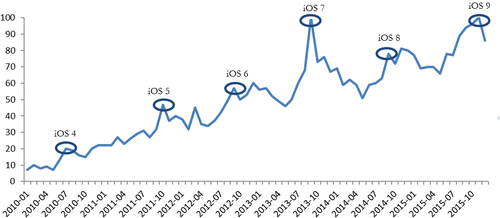
Source: Google Trends, http://www.google.com/trends/; last accessed August 23, 2017.
Notes. The additional peaks during March 2011, March 2012, December 2012, January 2014, and December 2014 correspond to new Android generations (i.e., Honeycomb, Ice cream Sandwich, Jellybean, Kitkat, and Lollipop). The timing for the generation releases is determined based on when the new generations of the operating system were made available by the wireless carriers in the U.S. market.
Control Variables.
We controlled for a number of firm-level and app-level characteristics that can influence the likelihood of the focal app’s successful commercialization. First, we controlled for firms’ experience in the ecosystem using the variable firm experience, which is the total number of months that a firm has been participating in the ecosystem. To obtain this measure, we first identified the month in which the firm introduced its first app in the ecosystem (i.e., the month of entry) and then calculated the number of months between the observation month and the month of entry. Second, app developers often try to gain visibility among their potential users by providing free apps. We controlled for this firm-level effect through a dummy variable, top 500 free, that takes a value of one if any of the apps developed by the firm were also part of the Top 500 ranking based on the number of downloads for free apps in a given month. Furthermore, an app’s successful commercialization is likely to be influenced by the overall demand for its app-category (e.g., Games, Productivity, Utility, and Business). An app in a high-demand category might find it relatively easier to achieve successful commercialization. We account for this possibility using the proxy variable category demand, which is the total number of apps in the Top 500 list in a given month in the same category as the focal app. In addition, we also controlled for any category-level differences by using category fixed effects.
We controlled for the quality of the app based on consumer ratings received by the focal app. Users can rate an app from one to five, with five being the highest quality. We only observed the cumulative rating offered by the users for a given app as of March 2013, but not the changes in the rating over time. The variable app rating is the cumulative rating received by the focal app as of March 2013. We also controlled for the extent of efforts by firms to improve their apps. We did this by using two different variables. The variable 3-month updates is the number of updates to the focal app in the past three months, and the variable Total updates is the total number of updates since the app was launched. To account for differences in the cost of development across apps, we used the app’s file size as a proxy for an app’s complexity and development cost (Boehm et al. 2000, Boudreau 2018). Furthermore, we controlled for the costs undertaken by firms to resolve software-related errors (commonly referred to as bug fixes) after the launch of the app via the variable Total bug fixes. The variable is the total count of updates that correspond to bug fixes but without the addition of new functionality.9 Apple promotes certain apps selectively, and such promotion can significantly impact the apps’ commercialization success (Rietveld et al. 2019). In May 2012, Apple introduced a feature called “Editor’s Choice” in its App Store to promote a small number of apps. We accounted for this effect of Apple’s promotion on an app’s commercialization success through a categorical variable called Apple promoted app that takes a value of one if Apple promoted an app and zero otherwise. Additionally, we controlled for other app-level characteristics like the price for download (App price), recommended age rating for the app (content rating), whether the app has an in-app purchase option or not (in-app purchase), and whether the app is only available for iPhone or also for Android smartphones (multihoming app). Finally, we controlled for ecosystem age through the number of months since the launch of the iPhone in 2007.
Analysis
The hypotheses are tested using continuous-time event history models, which estimate the hazard rate of an app achieving successful commercialization. We constructed the data in the long form to account for time-varying covariates. We started analyzing all the apps since their first month of launch on the iPhone ecosystem. For the apps that made it to the Top 500 list by revenue, we included information for the months from their launch to when they first appeared in the Top 500 list. For those apps that did not appear in the Top 500 list until December 2015 (i.e., the last month of observation), we classified their last month’s observation as censored observation only if there was an update to that app after December 2014. This is because, whereas apps continue to be available in the App Store over a prolonged time, many of these apps represent the case of a “living dead” phenomenon (Bourgeois and Eisenhardt 1987), with app developers not expending any efforts to improve them. Censoring these apps based on the last month of observation might be problematic because the likelihood of them making it to the Top 500 list in the future may be very low. To account for this possibility, we only include monthly observations for these apps until 12 months after their last update. As an additional robustness check, we also estimated a model where we only include observations for these apps until six months after their last update. We report this additional analysis in the robustness checks section after presenting our main results.
We used the Cox proportional hazard model, a robust technique for hazard rate analysis that does not require making an additional assumption about the shape of the baseline hazard, which may be increasing, decreasing, constant, or nonmonotonous (Cox 1975). This helps address concerns about the incorrect distributional assumptions yielding biased estimates and the choice of parametric specification based on observed data generating inconsistent results (Blossfeld 2001). Furthermore, we tested for the proportionality hazard assumption by checking if the slope of the regression equation of scaled Schoenfeld residuals on time is nonzero for the full model as well as for all predictor variables (Grambsch and Therneau 1994). The proportional hazard assumption was not violated for the full model and all predictor variables. Finally, apps introduced by the same firm often differed with respect to their connections with complementary technologies within the ecosystem, allowing us to control for unobserved firm-level heterogeneity by treating each firm as a separate stratum (Allison 1996).
Results
We report the summary statistics and correlations between our covariates in Table 1. The results from the Cox model are reported in Table 2. The reported coefficients can be exponentiated to obtain hazard ratios, which are interpreted as the multiplier of the baseline hazard for the app being included in the Top 500 list when the variables increase by one unit (Allison 2010). An increase in hazard can also be interpreted as an increase in the likelihood of an app achieving successful commercialization. All standard errors reported were corrected for nonindependence across multiple observations for the same app by clustering observations for each app. All the models included category-fixed effects. Model 1 is a baseline model with only control variables. In Models 2, we included the variable complementary technologies to test Hypothesis 1. Model 2 included the interaction term between complementary technologies and architectural newness to test Hypothesis 2. In Model 3, we separate an app’s connections with complementary technologies into two variables, ecosystem-specific complementary technologies and ecosystem-generic complementary technologies, to test Hypothesis 3. Finally, we include the interaction terms between these two variables and architectural newness in Model 5 to test Hypothesis 4.
|

Table 1. Descriptive Statistics and Correlations
| No. | Variables | Mean | Standard deviation | 1 | 2 | 3 | 4 | 5 | 6 | 7 | 8 | 9 | 10 | 11 | 12 | 13 | 14 | 15 | 16 | 17 |
|---|---|---|---|---|---|---|---|---|---|---|---|---|---|---|---|---|---|---|---|---|
| 1 | Comp. Technologies | 0.85 | 0.81 | 1.000 | ||||||||||||||||
| 2 | Eco.specific comp. tech | 0.63 | 0.77 | 0.764 | 1.000 | |||||||||||||||
| 3 | Eco. generic comp. tech | 0.22 | 0.42 | 0.545 | 0.003 | 1.000 | ||||||||||||||
| 4 | Architectural newness | −6.90 | 3.80 | 0.032 | 0.034 | 0.005 | 1.000 | |||||||||||||
| 5 | Apple promoted app | 0.00 | 0.03 | 0.020 | 0.015 | 0.017 | 0.000 | 1.000 | ||||||||||||
| 6 | Multihoming app | 0.13 | 0.33 | −0.017 | −0.010 | −0.012 | 0.002 | 0.015 | 1.000 | |||||||||||
| 7 | Total bug fixes | 0.23 | 0.64 | 0.060 | 0.054 | 0.036 | 0.010 | −0.002 | 0.045 | 1.000 | ||||||||||
| 8 | App rating | 1.48 | 2.07 | 0.103 | 0.049 | 0.137 | 0.006 | 0.047 | 0.051 | 0.130 | 1.000 | |||||||||
| 9 | App content rating | 138.40 | 108.36 | 0.010 | −0.008 | 0.026 | 0.000 | 0.010 | 0.014 | 0.023 | 0.040 | 1.000 | ||||||||
| 10 | App file size | 0.05 | 0.23 | 0.000 | −0.011 | 0.025 | 0.000 | 0.124 | −0.017 | −0.024 | 0.030 | 0.040 | 1.000 | |||||||
| 11 | In-app purchase | 0.31 | 0.46 | 0.205 | 0.218 | 0.072 | 0.021 | 0.013 | 0.010 | 0.105 | 0.268 | 0.055 | 0.006 | 1.000 | ||||||
| 12 | 3- months updates | 0.53 | 0.89 | 0.057 | 0.035 | 0.052 | 0.025 | 0.025 | 0.028 | 0.127 | 0.133 | 0.025 | −0.005 | 0.083 | 1.000 | |||||
| 13 | Total updates | 2.73 | 2.61 | 0.064 | 0.025 | 0.084 | 0.021 | 0.023 | 0.047 | 0.463 | 0.261 | 0.032 | −0.015 | 0.113 | 0.317 | 1.000 | ||||
| 14 | App price | 2.56 | 12.53 | −0.163 | −0.184 | −0.032 | −0.016 | 0.016 | −0.029 | −0.092 | −0.170 | −0.033 | 0.124 | −0.587 | −0.045 | −0.056 | 1.000 | |||
| 15 | Firm experience | 26.42 | 15.82 | 0.157 | 0.152 | 0.052 | 0.001 | 0.020 | 0.010 | 0.066 | 0.003 | 0.024 | 0.045 | 0.147 | −0.104 | 0.094 | −0.061 | 1.000 | ||
| 16 | Ecosystem age | 52.88 | 15.68 | 0.312 | 0.354 | 0.024 | 0.048 | 0.016 | 0.021 | 0.106 | −0.083 | 0.025 | 0.035 | 0.263 | −0.080 | 0.094 | −0.176 | 0.613 | 1.000 | |
| 17 | App in Top 500 free | 0.02 | 0.14 | 0.051 | 0.017 | 0.085 | 0.000 | 0.028 | 0.004 | 0.008 | 0.149 | 0.016 | 0.035 | 0.079 | 0.029 | 0.013 | −0.048 | 0.066 | −0.030 | 1.000 |
| 18 | Category demand | 136.51 | 187.48 | 0.188 | 0.271 | −0.021 | 0.049 | 0.005 | 0.042 | 0.023 | 0.173 | 0.040 | 0.015 | 0.285 | −0.020 | −0.047 | −0.249 | 0.108 | 0.183 | 0.084 |
Notes. Correlations greater than 0.01 or smaller than −0.01 are significant at p < 0.05. N = 3,797,947.
|
Table 2. Cox Proportional Hazard Model Estimates for the App Achieving Successful Commercialization
| Variables | Model 1 | Model 2 | Model 3 | Model 4 | Model 5 |
|---|---|---|---|---|---|
| Complementary technologies | 0.200*** | 0.242*** | |||
| (0.028) | (0.036) | ||||
| Comp. tech × Architectural Newness | −0.152** | ||||
| (0.077) | |||||
| Ecosystem-specific comp. tech. | 0.216*** | 0.261*** | |||
| (0.028) | (0.036) | ||||
| Ecosystem-generic comp. tech | 0.107*** | 0.092*** | |||
| (0.026) | (0.032) | ||||
| Ecosystem-specific comp. tech × Arch. Newness | −0.164** | ||||
| (0.074) | |||||
| Ecosystem-generic comp. tech × Arch. Newness | 0.057 | ||||
| (0.071) | |||||
| Architectural Newness | 0.215*** | 0.202*** | 0.397*** | 0.189*** | 0.309*** |
| (0.064) | (0.063) | (0.117) | (0.064) | (0.105) | |
| Apple promoted app | 0.624*** | 0.598*** | 0.593*** | 0.575*** | 0.572*** |
| (0.063) | (0.063) | (0.063) | (0.063) | (0.063) | |
| Multihoming app | 0.350*** | 0.349*** | 0.346*** | 0.352*** | 0.350*** |
| (0.042) | (0.042) | (0.042) | (0.043) | (0.043) | |
| Total bug fixes | 0.095** | 0.088* | 0.088* | 0.089* | 0.088* |
| (0.046) | (0.046) | (0.046) | (0.046) | (0.046) | |
| App rating | 0.833*** | 0.840*** | 0.841*** | 0.843*** | 0.842*** |
| (0.076) | (0.076) | (0.076) | (0.076) | (0.076) | |
| App rating2 | −0.070*** | −0.072*** | −0.072*** | −0.073*** | −0.073*** |
| (0.010) | (0.010) | (0.010) | (0.010) | (0.010) | |
| App content rating | 0.089*** | 0.085*** | 0.085*** | 0.085*** | 0.084*** |
| (0.016) | (0.016) | (0.016) | (0.016) | (0.016) | |
| App file size | −0.159** | −0.162** | −0.162** | −0.167** | −0.167** |
| (0.062) | (0.067) | (0.067) | (0.069) | (0.069) | |
| In-app purchase | 0.376*** | 0.349*** | 0.346*** | 0.348*** | 0.346*** |
| (0.054) | (0.054) | (0.054) | (0.054) | (0.054) | |
| 3-month updates | 0.259*** | 0.254*** | 0.254*** | 0.252*** | 0.253*** |
| (0.030) | (0.030) | (0.030) | (0.030) | (0.030) | |
| Total updates | 0.104*** | 0.104*** | 0.104*** | 0.103*** | 0.103*** |
| (0.024) | (0.025) | (0.025) | (0.024) | (0.024) | |
| App price | 0.201*** | 0.203*** | 0.203*** | 0.208*** | 0.208*** |
| (0.026) | (0.026) | (0.026) | (0.026) | (0.026) | |
| Firm experience | −0.058*** | −0.052*** | −0.052*** | −0.051*** | −0.050*** |
| (0.018) | (0.018) | (0.018) | (0.019) | (0.019) | |
| Ecosystem age | 0.041** | 0.034* | 0.034* | 0.032* | 0.031 |
| (0.018) | (0.018) | (0.018) | (0.019) | (0.019) | |
| Top 500 free app | 0.826*** | 0.819*** | 0.819*** | 0.817*** | 0.817*** |
| (0.071) | (0.071) | (0.071) | (0.071) | (0.071) | |
| Category demand | 0.004** | 0.004* | 0.004* | 0.004* | 0.004* |
| (0.002) | (0.002) | (0.002) | (0.002) | (0.002) | |
| Category demand2 | −0.000** | −0.000* | −0.000* | −0.000* | −0.000* |
| (0.000) | (0.000) | (0.000) | (0.000) | (0.000) | |
| Category dummies | Yes | Yes | Yes | Yes | Yes |
| Firm-level stratification | Yes | Yes | Yes | Yes | Yes |
| Total observations | 3,797,947 | 3,797,947 | 3,797,947 | 3,797,947 | 3,797,947 |
| Total apps | 244,034 | 244,034 | 244,034 | 244,034 | 244,034 |
| Total events | 4,213 | 4,213 | 4,213 | 4,213 | 4,213 |
| Log likelihood | −6,930.14 | −6,913.20 | −6,912.05 | −6,904.85 | −6,903.25 |
| p (Ecosystem-specific = ecosystem-generic) | 0.006 | 0.001 | |||
| p (Eco.Specif × Arch new = Eco-Generic × Arch New) | 0.039 |
*p < 0.1; **p < 0.05; ***p < 0.01.
The results from the baseline model (Model 1) suggest that apps that have higher consumer rating, those in categories with high demand, those offering an in-app purchase, those promoted by Apple, those whose developers are responsive to user experiences by resolving any software-errors, and those which are being frequently updated are more likely to make it to the Top 500 list. At the firm-level, app developers who are new to the iOS ecosystem and who are visible in terms of their apps making it to the Top 500 free app list based on the number of downloads are more likely to have an app in the Top 500 list by revenue.
In Hypothesis 1, we predicted that the greater the number of complementary technologies that an innovation connects with in an ecosystem, the greater would be its likelihood of achieving successful commercialization. We find support for this prediction in Models 2 and 3. The estimated coefficient for complementary technologies is positive with p = 0.000 (Model 2). In considering the magnitude of the estimated coefficient in Model 2, we find that a connection with one additional complementary technology is associated with a 20.0%10 higher likelihood of the focal app making it into the Top 500 list by revenue.
In Hypothesis 2, we predicted that the positive effect of complementary technologies on an innovation’s successful commercialization would be weaker with architectural newness. The result from Model 3 supports the prediction. The estimated coefficient for the interaction term between complementary technologies and architectural newness is negative, with p = 0.047 (Model 4). This suggests that the benefits of ecosystem-level complementarities that accrue to app developers whose apps connect with complementary technologies available in an ecosystem may be buffered by the challenges of managing additional technological interdependencies during periods of architectural change in the ecosystem.11
In Hypothesis 3, we predicted that the positive effect of connecting with complementary technologies in the ecosystem would be stronger for those connections with ecosystem-specific complementary technologies than for those with ecosystem-generic complementary technologies. We test this hypothesis by introducing variables Ecosystem-specific complementary technologies and Ecosystem-generic complementary technologies and then calculating the difference between the estimated coefficients of these two variables. We report the results for this analysis in Model 4. The estimated coefficients for both Ecosystem-specific complementary technologies and Ecosystem-generic complementary technologies are positive and statistically significant (as predicted in Hypothesis 1). However, the difference between the estimated coefficients is positive (0.109) and statistically significant (p = 0.006), supporting Hypothesis 3.
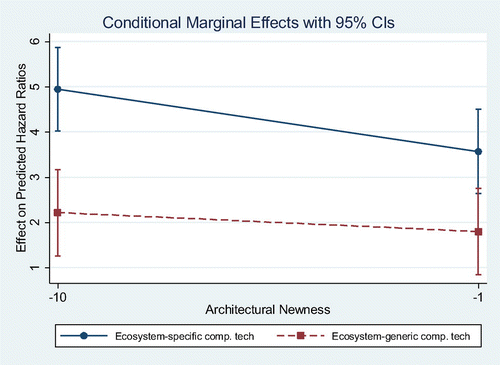
Finally, in Hypothesis 4, we predicted that the negative moderating effect of architectural newness of the ecosystem on an innovation’s commercialization success would be exacerbated for ecosystem-specific complementary technologies than that of ecosystem-generic complementary technologies. We test this hypothesis by interacting the Ecosystem-specific complementary technologies and Ecosystem-generic complementary technologies variables with Architectural newness. We report the results in Model 5. The estimated coefficients for the interaction term with Ecosystem-specific complementary technologies is negative and significant, whereas it is positive but not statistically significant for Ecosystem-generic complementary technologies. The difference between the estimated coefficients for the interaction term is negative (−0.220) and statistically significant (p = 0.038). Thus, this result supports our prediction that the negative moderation effect of architectural newness is significantly greater for the innovations’ connections with ecosystem-specific complementary technologies than those with ecosystem-generic complementary technologies. We illustrate the different interaction effects graphically in Figure 2.
Robustness Checks
We conduct a number of additional checks to establish the robustness of our findings. First, we consider the potential endogeneity with respect to an app’s connections with the complementary technologies and its successful commercialization. We use both an instrumental variable approach and a matching estimator approach to assess the robustness of our results. Second, we evaluate several alternative explanations.
Instrumental Variable Analysis.
For this analysis, we needed to identify instruments that are correlated with an app’s connection with the complementary technologies but uncorrelated with the app’s commercialization success beyond its effect on the endogenous regressor (Angrist and Pischke 2008). To do so, we drew upon StackOverflow (stackoverflow.com), the largest online community for software developers. A key feature of this website is that developers post and respond to queries about software development. Because of the high complexity and breadth of the queries asked, StackOverflow has created a sophisticated tagging schema where each query is tagged with multiple keywords. We started with downloading all the queries from the website that were tagged “iOS.” This provided us with a large-scale database of app developers’ public queries with respect to iPhone app development going back to July 2008. Within these queries, we then identified tags with respect to specific complementary technologies in our data set.
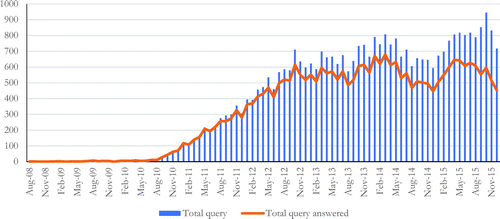
We leveraged two features of this online community to identify instrumental variables (IV). First, queries posted by developers were tagged to indicate whether developers were able to successfully resolve them or not. Figure 3 plots the trend in the total number of queries pertaining to the complementary technologies available in the ecosystem and the total number of the queries that were resolved. The proportion of queries pertaining to a complementary technology that were unresolved among developers is a reasonable proxy for the challenges that developers might be facing in connecting their focal innovation with the focal complementary technology. The extent of challenges faced by the developer community is likely to be negatively correlated with the likelihood of a focal app having a connection with the given complementary technologies. However, the proportion of unresolved queries with the developer community is unlikely to be correlated with the focal app’s commercialization success, for reasons beyond its effect on an app’s connections with the complementary technologies.
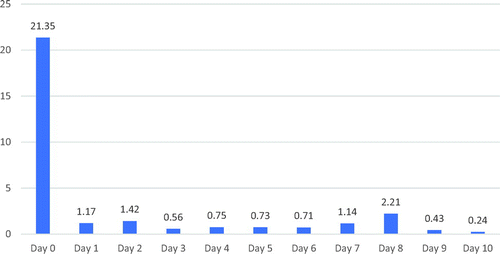
StackOverflow also tracks the number of views received for each query. The number of views received by queries for a given complementary technology can be a good proxy for the awareness among developers regarding the opportunity to connect with that complementary technology. It is possible that the views received by a query could also indirectly reflect the extent of challenges faced by the developer community in connecting with the focal complementary technology. We ruled out this alternative explanation by exploring whether the query received the majority of its views shortly after being posted as developers were more likely to view the queries that are posted recently or in a staggered manner as and when developers faced challenges related to the connection with a given complementary technology. We did this by hand-collecting additional data on the daily views received by a random sample of 250 new queries related to complementary technologies posted on Stackoverflow.com for 45 days between December 2020 and January 2021. As shown in Figure 4, we found that a query on StackOverflow tends to receive the majority of its views in the first two to three days of being posted, suggesting that the views received by queries are not driven by challenges faced by the developers over time but rather reflect the extent of contemporaneous awareness about the related complementary technology among the developer community. The higher the level of awareness that the developer community has, the greater the likelihood that a focal app might connect with that component or app during that month. Again, this developer community-level measure is unlikely to be correlated with the focal app’s commercialization success for reasons beyond its effect on an app’s connections with the complementary technologies.
The first set of instruments, Queries Unresolved, are operationalized as the proportion of queries related to focal complementary technologies that were not resolved within three months prior to the launch of the app. The second set of instruments, Queries Views, are operationalized as the number of views received by queries about the focal complementary technologies within three months prior to the launch of the app. They are divided by the total number of “iOS” queries views to account for the increasing trend in the number of queries and views over time. It is important to note that both these instruments are operationalized based on the total number of queries by all developers on stackoverflow.com with respect to the focal complementary technologies and not the queries by the developer of the focal app. Furthermore, we separated these variables for the ecosystem-specific and the ecosystem-generic complementary technologies to test Hypotheses 3 and 4.
The estimates from the instrumental variable analysis are reported in Tables 3 and 4 using the ivreg2 procedure in STATA on the cross section of all apps and using the last month of observation for the control variables. Each model’s results comprise both the first-stage (Table 3) and the second-stage estimates (Table 4). Models 6, 9, and 12 include the estimates for the full sample to test Hypotheses 1 and 3. To explore the interaction effect of architectural newness of the ecosystem (Hypotheses 2 and 4), we divide the sample into apps that are launched within the first six months of the introduction of the new iOS generation (Models 7, 10, and 13), and those that are launched after the six months (Models 8, 11 and 14). In the first stage (Models 6a–14a), the estimated coefficients for Queries Unresolved are negative and statistically significant (p < 0.001), suggesting that a greater proportion of unresolved queries about a complementary technology is associated with a lower likelihood of apps connecting with that complementary technology. The estimated coefficients for Queries Views are positive and statistically significant (p < 0.001), suggesting that the higher number of views received by queries about a complementary technology is associated with a higher likelihood of apps connecting with that complementary technology. These results offer support for the validity of the different instruments. We also ran a series of tests to ascertain the quality of the instruments (Kennedy 2008, Semadeni et al. 2014). First, the Cragg Donald statistics for the second-stage models are greater than 10% maximal IV size, the recommended threshold provided by Stock and Yogo (2002) to satisfy instrument relevance condition. Second, for all models, the Anderson LM test rejects the null hypothesis of underidentification. Finally, the Sargan test statistics cannot be rejected for all the models, providing us additional confidence that both sets of instruments are exogenous and affect an app’s successful commercialization only through its connection with the complementary technologies.
|
Table 3. Instrumental Variable Analyses (First-Stage Models)
| Variables | Model 6a | Model 7a | Model 8a | Model 9a | Model 10a | Model 11a | Model 12a | Model 13a | Model 14a |
|---|---|---|---|---|---|---|---|---|---|
| Query Views | 0.812*** | 0.806*** | 0.895*** | ||||||
| (0.023) | (0.030) | (0.044) | |||||||
| Queries Unresolved | −0.224*** | −0.162** | −0.413*** | ||||||
| (0.058) | (0.073) | (0.145) | |||||||
| Query Views (Eco-specific) | 1.514*** | 1.435*** | 1.552*** | ||||||
| (0.046) | (0.059) | (0.082) | |||||||
| Queries Unresolved (Eco-specific) | −0.142*** | −0.151*** | −0.046*** | ||||||
| (0.031) | (0.037) | (0.007) | |||||||
| Query Views (Eco-generic) | 0.408*** | 0.488*** | 0.277*** | ||||||
| (0.025) | (0.033) | (0.039) | |||||||
| Queries Unresolved (Eco-generic) | −0.200*** | −0.192*** | −0.040*** | ||||||
| (0.029) | (0.035) | (0.009) | |||||||
| Architectural Newness | −0.002 | −0.022** | 0.128 | −0.015** | −0.008 | −0.058 | 0.013** | −0.009 | 0.265** |
| (0.009) | (0.011) | (0.153) | (0.006) | (0.007) | (0.098) | (0.006) | (0.008) | (0.113) | |
| Apple promoted app | 0.603*** | 0.575*** | 0.604*** | 0.502*** | 0.462*** | 0.530*** | 0.104*** | 0.113** | 0.079 |
| (0.060) | (0.079) | (0.092) | (0.044) | (0.060) | (0.066) | (0.038) | (0.050) | (0.059) | |
| Multihoming app | −0.100*** | −0.108*** | −0.090*** | −0.067*** | −0.068*** | −0.066*** | −0.034*** | −0.042*** | −0.025*** |
| (0.006) | (0.009) | (0.010) | (0.004) | (0.006) | (0.007) | (0.005) | (0.006) | (0.006) | |
| Total bug fixes | 0.012*** | 0.018*** | 0.002 | 0.016*** | 0.016*** | 0.015*** | −0.005** | 0.001 | −0.013*** |
| (0.003) | (0.004) | (0.004) | (0.002) | (0.002) | (0.003) | (0.002) | (0.003) | (0.003) | |
| App rating | 0.017*** | 0.019*** | 0.014* | −0.010*** | −0.010** | −0.010* | 0.026*** | 0.028*** | 0.023*** |
| (0.005) | (0.007) | (0.008) | (0.004) | (0.005) | (0.005) | (0.004) | (0.006) | (0.005) | |
| App rating2 | 0.006*** | 0.005*** | 0.007*** | 0.004*** | 0.004*** | 0.004*** | 0.002** | 0.001 | 0.003** |
| (0.001) | (0.002) | (0.002) | (0.001) | (0.001) | (0.001) | (0.001) | (0.001) | (0.001) | |
| App content rating | −0.000*** | −0.000*** | −0.000*** | −0.000*** | −0.000*** | −0.000*** | 0.000*** | 0.000*** | −0.000 |
| (0.000) | (0.000) | (0.000) | (0.000) | (0.000) | (0.000) | (0.000) | (0.000) | (0.000) | |
| App file size | −0.041*** | −0.046*** | −0.035*** | −0.078*** | −0.081*** | −0.074*** | 0.037*** | 0.036*** | 0.039*** |
| (0.008) | (0.011) | (0.009) | (0.008) | (0.009) | (0.013) | (0.008) | (0.011) | (0.011) | |
| In-app purchase | 0.152*** | 0.187*** | 0.096*** | 0.088*** | 0.104*** | 0.060*** | 0.065*** | 0.082*** | 0.037*** |
| (0.006) | (0.008) | (0.010) | (0.004) | (0.006) | (0.007) | (0.004) | (0.006) | (0.007) | |
| 3-month updates | 0.017*** | −0.005 | 0.066*** | 0.018*** | 0.010*** | 0.035*** | 0.008** | −0.003 | 0.031*** |
| (0.005) | (0.005) | (0.009) | (0.003) | (0.004) | (0.005) | (0.004) | (0.004) | (0.006) | |
| Total updates | 0.014*** | 0.012*** | 0.018*** | 0.002*** | 0.002* | 0.002** | 0.011*** | 0.008*** | 0.015*** |
| (0.001) | (0.001) | (0.002) | (0.001) | (0.001) | (0.001) | (0.001) | (0.001) | (0.001) | |
| App price | −0.032*** | −0.029*** | −0.039*** | −0.037*** | −0.034*** | −0.042*** | 0.004** | 0.004 | 0.003 |
| (0.003) | (0.004) | (0.004) | (0.002) | (0.003) | (0.003) | (0.002) | (0.003) | (0.003) | |
| Firm experience | −0.001*** | −0.002*** | −0.000 | −0.003*** | −0.003*** | −0.003*** | 0.002*** | 0.001*** | 0.002*** |
| (0.000) | (0.000) | (0.000) | (0.000) | (0.000) | (0.000) | (0.000) | (0.000) | (0.000) | |
| Ecosystem age | 0.008*** | 0.007*** | 0.007*** | 0.011*** | 0.011*** | 0.010*** | −0.002*** | −0.003*** | −0.002*** |
| (0.000) | (0.001) | (0.001) | (0.000) | (0.000) | (0.000) | (0.000) | (0.000) | (0.000) | |
| Top 500 free app | 0.457*** | 0.440*** | 0.477*** | 0.112*** | 0.100*** | 0.128*** | 0.348*** | 0.342*** | 0.355*** |
| (0.019) | (0.026) | (0.028) | (0.013) | (0.018) | (0.019) | (0.013) | (0.017) | (0.021) | |
| Category demand | −0.001 | 0.000 | −0.000 | 0.003*** | 0.003*** | 0.005*** | −0.004*** | −0.003*** | −0.005*** |
| (0.000) | (0.001) | (0.001) | (0.000) | (0.000) | (0.000) | (0.000) | (0.000) | (0.000) | |
| Category demand2 | 0.000* | 0.000 | 0.000 | −0.000*** | −0.000*** | −0.000*** | 0.000*** | 0.000*** | 0.000*** |
| (0.000) | (0.000) | (0.000) | (0.000) | (0.000) | (0.000) | (0.000) | (0.000) | (0.000) | |
| Constant | 0.087 | 0.052 | 0.270* | −0.212*** | −0.231*** | −0.362*** | 0.370*** | 0.415*** | 0.150** |
| (0.054) | (0.067) | (0.148) | (0.029) | (0.036) | (0.077) | (0.029) | (0.036) | (0.062) | |
| Observations | 237,218 | 136,909 | 100,309 | 237,268 | 136,931 | 100,337 | 237,218 | 136,909 | 100,309 |
***p < 0.01; **p < 0.05; *p < 0.1.
|
Table 4. Instrumental Variable Analyses (Second-Stage Models)
| Variables | Model 6 | Model 7 | Model 8 | Model 9 | Model 10 | Model 11 | Model 12 | Model 13 | Model 14 |
|---|---|---|---|---|---|---|---|---|---|
| Complementary tech. | 0.236*** | 0.215*** | 0.263*** | ||||||
| (0.008) | (0.009) | (0.013) | |||||||
| Eco.-specific comp. tech. | 0.589*** | 0.455*** | 1.117*** | ||||||
| (0.037) | (0.032) | (0.154) | |||||||
| Eco.-generic comp. tech | 0.429*** | 0.418*** | 0.482*** | ||||||
| (0.014) | (0.019) | (0.024) | |||||||
| Architectural Newness | 0.010*** | 0.015*** | −0.140*** | 0.017*** | 0.015*** | −0.091* | 0.001 | 0.015*** | −0.357*** |
| (0.002) | (0.003) | (0.042) | (0.003) | (0.003) | (0.049) | (0.004) | (0.004) | (0.129) | |
| Apple promoted app | 0.313*** | 0.318*** | 0.287*** | 0.238*** | 0.246*** | 0.185*** | 0.397*** | 0.393*** | 0.357*** |
| (0.020) | (0.026) | (0.032) | (0.023) | (0.029) | (0.039) | (0.027) | (0.033) | (0.069) | |
| Multihoming app | 0.047*** | 0.045*** | 0.046*** | 0.051*** | 0.050*** | 0.054*** | 0.043*** | 0.040*** | 0.051*** |
| (0.002) | (0.002) | (0.003) | (0.002) | (0.003) | (0.004) | (0.003) | (0.003) | (0.008) | |
| Total bug fixes | 0.007*** | 0.006*** | 0.008*** | 0.003*** | 0.002** | 0.001 | 0.012*** | 0.009*** | 0.023*** |
| (0.001) | (0.001) | (0.001) | (0.001) | (0.001) | (0.002) | (0.001) | (0.001) | (0.004) | |
| App rating | −0.004*** | −0.003 | −0.005** | 0.005*** | 0.006** | 0.005* | −0.016*** | −0.012*** | −0.027*** |
| (0.001) | (0.002) | (0.002) | (0.002) | (0.002) | (0.003) | (0.003) | (0.003) | (0.007) | |
| App rating2 | 0.001** | 0.001 | 0.001 | 0.000 | −0.000 | 0.000 | 0.001** | 0.001** | −0.000 |
| (0.000) | (0.000) | (0.000) | (0.000) | (0.000) | (0.001) | (0.001) | (0.001) | (0.001) | |
| App content rating | 0.000*** | 0.000*** | 0.000*** | 0.000*** | 0.000*** | 0.000*** | 0.000** | 0.000 | 0.000** |
| (0.000) | (0.000) | (0.000) | (0.000) | (0.000) | (0.000) | (0.000) | (0.000) | (0.000) | |
| App file size | 0.001 | 0.002 | −0.000 | 0.025*** | 0.026*** | 0.026*** | −0.031*** | −0.024*** | −0.053*** |
| (0.003) | (0.003) | (0.004) | (0.004) | (0.004) | (0.008) | (0.005) | (0.006) | (0.013) | |
| In-app purchase | −0.009*** | −0.015*** | 0.003 | −0.010*** | −0.018*** | −0.000 | −0.011*** | −0.012*** | −0.014 |
| (0.002) | (0.003) | (0.003) | (0.002) | (0.003) | (0.004) | (0.004) | (0.004) | (0.010) | |
| 3-month updates | 0.082*** | 0.069*** | 0.108*** | 0.080*** | 0.065*** | 0.107*** | 0.085*** | 0.073*** | 0.090*** |
| (0.001) | (0.002) | (0.003) | (0.002) | (0.002) | (0.003) | (0.002) | (0.002) | (0.009) | |
| Total updates | −0.013*** | −0.011*** | −0.015*** | −0.010*** | −0.009*** | −0.011*** | −0.017*** | −0.013*** | −0.027*** |
| (0.000) | (0.000) | (0.000) | (0.000) | (0.000) | (0.001) | (0.001) | (0.001) | (0.002) | |
| App price | 0.019*** | 0.017*** | 0.022*** | 0.028*** | 0.024*** | 0.033*** | 0.008*** | 0.008*** | 0.008** |
| (0.001) | (0.001) | (0.001) | (0.001) | (0.001) | (0.002) | (0.001) | (0.001) | (0.004) | |
| Firm experience | −0.000*** | −0.000*** | −0.001*** | 0.000*** | 0.001*** | 0.001*** | −0.002*** | −0.001*** | −0.004*** |
| (0.000) | (0.000) | (0.000) | (0.000) | (0.000) | (0.000) | (0.000) | (0.000) | (0.000) | |
| Ecosystem age | −0.005*** | −0.005*** | −0.005*** | −0.008*** | −0.008*** | −0.009*** | −0.001*** | −0.001*** | −0.001*** |
| (0.000) | (0.000) | (0.000) | (0.000) | (0.000) | (0.000) | (0.000) | (0.000) | (0.000) | |
| Top 500 free app | 0.037*** | 0.040*** | 0.026** | 0.096*** | 0.092*** | 0.087*** | −0.058*** | −0.019 | −0.244*** |
| (0.007) | (0.009) | (0.012) | (0.007) | (0.009) | (0.012) | (0.016) | (0.015) | (0.061) | |
| Category demand | −0.001*** | −0.002*** | −0.001*** | −0.003*** | −0.003*** | −0.003*** | 0.001*** | −0.001*** | 0.005*** |
| (0.000) | (0.000) | (0.000) | (0.000) | (0.000) | (0.000) | (0.000) | (0.000) | (0.001) | |
| Category demand2 | 0.000*** | 0.000*** | 0.000*** | 0.000*** | 0.000*** | 0.000*** | −0.000*** | 0.000** | −0.000*** |
| (0.000) | (0.000) | (0.000) | (0.000) | (0.000) | (0.000) | (0.000) | (0.000) | (0.000) | |
| Constant | 0.177*** | 0.180*** | 0.191*** | 0.299*** | 0.316*** | 0.321*** | 0.022*** | 0.035*** | 0.025 |
| (0.006) | (0.007) | (0.011) | (0.009) | (0.013) | (0.017) | (0.007) | (0.008) | (0.023) | |
| Cragg-Donald test | 719.5 | 433.400 | 276.798 | 567.920 | 306.305 | 237.513 | 176.621 | 149.439 | 54.006 |
| Anderson canon. corr. LM statistic | 1261.42*** | 728.39*** | 537.97*** | 1062.94*** | 588.72*** | 449.70*** | 276.70*** | 221.26*** | 28.367*** |
| Sargan statistic | 0.219 | 0. 164 | 0.112 | 0.059 | 2.902 | 0.893 | 1.673 | 0.233 | 0.257 |
| Total observations | 237,218 | 136,909 | 100,309 | 237,268 | 136,931 | 100,337 | 237,218 | 136,909 | 100,309 |
| Log likelihood | −18,385.81 | −2,169.13 | −13,935.20 | −61,526.85 | −33,539.00 | −35,139.29 | −151,849.64 | −58,872.43 | −121,229.74 |
| p (Eco. specific = Eco.-generic) | 0.000 | ||||||||
| p (Eco. specific. × Arch new = Eco-Generic × Arch New) | 0.000 |
*p < 0.1; **p < 0.05; ***p < 0.01.
The estimates from the second-stage estimate continue to offer support for our predictions. Consistent with the prediction for Hypothesis 1, the coefficients for Complementary Technologies are positive and statistically significant (Models 6–8). Moreover, the difference between the average marginal effects for Complementary Technologies in Model 8 (i.e., for apps launched six months after the introduction of the new generation of iOS) and in Model 7 (i.e., for apps launched during the first six months of the new generation of iOS) is positive and statistically significant (p = 0.000), offering support for Hypothesis 2. Furthermore, to test Hypotheses 3 and 4, we constructed the variables query unresolved and query views for only the queries that pertain to complementary technologies that were ecosystem-specific and ecosystem-generic, respectively. Consistent with Hypothesis 3, the difference between the average marginal effects for Ecosystem-specific Complementary Technologies (Model 9) and Ecosystem-generic Complementary Technologies (Model 12) is positive and statistically significant (p = 0.000). Finally, we also find support for Hypothesis 4 as the difference between the average marginal effects for Ecosystem-specific Complementary Technologies for the apps launched during the first six months of the new iOS generation (Model 10) and the apps launched after six months of the new iOS generation (Model 11) is much lower than that of the Ecosystem-generic Complementary Technologies (Models 13 and 14, respectively).12 These results provide greater confidence that our findings are not impacted by the endogeneity with respect to an app’s connections with complementary technologies.
Matching on Features.
An additional concern with our analysis could be that apps that connect with complementary technologies might be inherently different in their functionality from the ones that do not, and therefore, those differences in the functionality could be affecting our estimates and making the inferences problematic. Although we cannot directly observe the functionality of apps in our data set, we used recently developed machine learning methods to match apps that offer similar functionality. We followed the framework developed by Wang et al. (2018) to identify apps with similar functionality by using machine learning methodologies based on the app descriptions. We discussed the methodology in detail in the Appendix. This procedure helped us to identify apps that are similar in functionality and group them in a cluster. The number of clusters within each category ranged from 10 (for the music category) to 324 (for the game category). We then used the propensity score matching to match apps within each cluster based on their other attributes such as average rating, content rating, download size, price, in-app purchases, number of updates, and year of entry. For every treatment app, that is, the app that connects with at least one complementary technology in the ecosystem, we created a control group of two apps with similar features and other attributes listed previously but with no connections with any complementary technology in the iPhone ecosystem. We then used this sample of treatment and control group to run our analysis and report our results in Models 15–17 in Table 5. Even after controlling for the differences in functionalities, we continue to find support for the hypotheses.
|
Table 5. Robustness Checks (Part I)
| Variables | Model 15 | Model 16 | Model 17 | Model 18 | Model 19 | Model 20 | Model 21 | Model 22 | Model 23 |
|---|---|---|---|---|---|---|---|---|---|
| Complementary technologies | 0.184*** | 0.313*** | −0.017*** | 0.004*** | |||||
| (0.060) | (0.031) | (0.003) | (0.000) | ||||||
| Comp. tech × Arch. Newness | −0.135* | −0.151*** | 0.014*** | −0.001*** | |||||
| (0.106) | (0.040) | (0.003) | (0.000) | ||||||
| Ecosystem-specific comp. tech. | 0.356*** | 0.301*** | −0.028*** | 0.005*** | |||||
| (0.104) | (0.031) | (0.004) | (0.000) | ||||||
| Ecosystem-generic comp. tech | 0.126*** | 0.083*** | −0.001 | 0.002*** | |||||
| (0.048) | (0.026) | (0.003) | (0.000) | ||||||
| Eco.-specific × Arch. Newness | −0.197*** | −0.144*** | 0.027*** | −0.001** | |||||
| (0.064) | (0.035) | (0.004) | (0.001) | ||||||
| Eco.-generic × Arch. Newness | 0.074 | 0.092** | −0.011*** | 0.001 | |||||
| (0.124) | (0.039) | (0.004) | (0.001) | ||||||
| Architectural Newness | 0.119 | 0.007 | 0.157 | 0.170*** | 0.106** | 0.069*** | 0.069*** | 0.002** | 0.001** |
| (0.272) | (0.224) | (0.166) | (0.060) | (0.053) | (0.004) | (0.004) | (0.001) | (0.001) | |
| Apple promoted app | 1.535*** | 1.540*** | 1.530*** | 1.190*** | 1.149*** | −0.382*** | −0.382*** | 0.247*** | 0.247*** |
| (0.155) | (0.156) | (0.155) | (0.068) | (0.067) | (0.070) | (0.070) | (0.005) | (0.005) | |
| Multihoming app | −0.132*** | −0.133*** | −0.132*** | 0.562*** | 0.548*** | 0.003 | 0.003 | 0.009*** | 0.009*** |
| (0.019) | (0.019) | (0.019) | (0.037) | (0.037) | (0.003) | (0.003) | (0.001) | (0.001) | |
| Total bug fixes | 0.002*** | 0.002*** | 0.002*** | 0.034 | 0.027 | 0.013*** | 0.013*** | −0.001 | −0.001 |
| (0.000) | (0.000) | (0.000) | (0.037) | (0.037) | (0.002) | (0.002) | (0.001) | (0.001) | |
| App rating | 0.000* | 0.000** | 0.000 | 1.564*** | 1.579*** | 0.070*** | 0.070*** | −0.006*** | −0.006*** |
| (0.000) | (0.000) | (0.000) | (0.057) | (0.058) | (0.003) | (0.003) | (0.001) | (0.001) | |
| App rating2 | 0.741*** | 0.743*** | 0.734*** | −0.142*** | −0.143*** | −0.010*** | −0.010*** | 0.002*** | 0.002*** |
| (0.083) | (0.083) | (0.083) | (0.008) | (0.008) | (0.001) | (0.001) | (0.000) | (0.000) | |
| App content rating | 0.474*** | 0.471*** | 0.483*** | 0.002*** | 0.002*** | −0.006*** | −0.006*** | 0.002*** | 0.002*** |
| (0.048) | (0.049) | (0.048) | (0.00) | (0.000) | (0.001) | (0.001) | (0.000) | (0.000) | |
| App file size | −0.082** | −0.083** | −0.084** | 0.005 | 0.006 | 0.011 | 0.011 | −0.009*** | −0.009*** |
| (0.034) | (0.035) | (0.034) | (0.006) | (0.005) | (0.008) | (0.008) | (0.001) | (0.001) | |
| In-app purchase | 0.511*** | 0.511*** | 0.510*** | 1.105*** | 1.117*** | −0.004 | −0.004 | 0.011*** | 0.011*** |
| (0.049) | (0.049) | (0.048) | (0.045) | (0.045) | (0.005) | (0.005) | (0.001) | (0.001) | |
| 3-month updates | 0.005 | 0.005 | 0.004 | 0.644*** | 0.642*** | −0.212*** | −0.212*** | 0.036*** | 0.036*** |
| (0.003) | (0.003) | (0.003) | (0.011) | (0.011) | (0.005) | (0.005) | (0.006) | (0.006) | |
| Total updates | −0.004 | −0.004 | −0.003 | −0.321*** | −0.315*** | 0.064*** | 0.064*** | −0.031*** | −0.031*** |
| (0.004) | (0.004) | (0.004) | (0.010) | (0.010) | (0.001) | (0.001) | (0.006) | (0.006) | |
| App price | 1.755*** | 1.771*** | 1.739*** | 0.326*** | 0.339*** | 0.015*** | 0.015*** | 0.005*** | 0.005*** |
| (0.084) | (0.084) | (0.084) | (0.021) | (0.021) | (0.003) | (0.003) | (0.000) | (0.000) | |
| Firm experience | −0.009** | −0.009** | −0.008* | −0.038*** | −0.037*** | 0.008** | 0.008** | −0.003*** | −0.003*** |
| (0.004) | (0.004) | (0.004) | (0.001) | (0.001) | (0.004) | (0.004) | (0.001) | (0.001) | |
| Ecosystem age | 0.000** | 0.000** | 0.000* | −0.021*** | −0.023*** | −0.010*** | −0.010** | 0.003*** | 0.003*** |
| (0.000) | (0.000) | (0.000) | (0.001) | (0.001) | (0.004) | (0.004) | (0.001) | (0.001) | |
| Top 500 free app | 0.119 | 0.007 | 0.157 | 0.908*** | 0.932*** | −0.137*** | −0.137*** | 0.034*** | 0.034*** |
| (0.272) | (0.224) | (0.166) | (0.046) | (0.046) | (0.019) | (0.019) | (0.002) | (0.002) | |
| Category demand | 1.535*** | 1.540*** | 1.530*** | −0.007*** | −0.009*** | 0.001*** | 0.001*** | −0.000*** | −0.000*** |
| (0.155) | (0.156) | (0.155) | (0.002) | (0.002) | (0.000) | (0.000) | (0.000) | (0.000) | |
| Category demand2 | −0.132*** | −0.133*** | −0.132*** | 0.000*** | 0.000*** | −0.000** | −0.000** | 0.000*** | 0.000*** |
| (0.019) | (0.019) | (0.019) | (0.000) | (0.000) | (0.000) | (0.000) | (0.000) | (0.000) | |
| Category dummies | Yes | Yes | Yes | Yes | Yes | Yes | Yes | Yes | Yes |
| Firm-level stratification | No | No | No | Fixed-effect | Fixed-effect | Fixed-effect | Fixed-effect | Fixed-effect | Fixed-effect |
| Total observations | 2,703,251 | 2,703,251 | 2,703,251 | 236,911 | 236,911 | 226,302 | 226,302 | 223,724 | 223,724 |
| Total apps | 173,441 | 173,441 | 173,441 | 236,911 | 236,911 | 226,302 | 226,302 | 223,724 | 223,724 |
| Total events | 3795 | 3795 | 3795 | 3014 | 3014 | 2,938 | 2,938 | 2413 | 2413 |
| Log likelihood | −17,762.03 | −17,763.48 | −17,762.43 | −26,392.89 | −26,351.91 | −603,900.04 | −603,756.24 | ||
| p (Eco. specific = Eco.- generic) | 0.045 | 0.000 | 0.000 | 0.000 | |||||
| p (Eco. specific.*Arch new = Eco-Generic × Arch New) | 0.052 | 0.000 | 0.000 | 0.078 |
Additional Checks.
We conducted a number of additional checks to establish the robustness of our findings with respect to several alternative explanations. First, we test the robustness of our findings using alternative measures for the dependent variable, that is, an innovation’s commercialization success. Ideally, we would like to use revenue indicators to measure commercialization success, but we are limited in our ability to do so because of the availability of data as the revenues earned by apps in an iOS ecosystem are not available publicly. Apple only discloses a list of Top 500 apps based on revenue. Because the empirical setting is very hypercompetitive, apps stay in the top list by revenue only for a short duration of time. On average, an app stayed in the Top 500 list only for two months during our observation period. Therefore, the number of months that an app remains in the Top list by revenue is a good indicator of its commercialization success. We conduct an additional analysis using the number of months an app stays in the Top 500 list by revenue as the dependent variable. For this analysis, we used a fixed-effect negative binomial model given that our dependent variable is a count-based measure and has several observations with zero values. To ensure that the error term is independent and identically distributed, we conducted this analysis on cross-sectional data of all apps, using the last month of observation for the control and independent variables. The variable Architectural Newness takes the value of one if the app is launched within six months of the launch of the new iOS generation and zero otherwise. The results are reported in Models 18 (Hypotheses 1 and 2) and 19 (Hypotheses 3 and 4) in Table 5 and continue to support all our hypotheses. Because a fixed-effect negative binomial model might not be robust (Allison and Waterman 2002), we reran the analysis using a fixed-effect Poisson model and continue to find support for our hypotheses.
Similarly, another characteristic of our empirical setting is that apps either achieve success in a very short duration of time or are never successful. On average, ∼75% of the top-performing apps took less than two months to enter the Top 500 list. Therefore, we used the months that an app took to enter the Top 500 list as an additional indicator of an app’s commercialization success. For the apps that never entered the Top list, the variable takes the value of the number of months that the app developer actively updated the focal app. The smaller value of the variable indicates that the focal app entered the Top 500 list in a shorter time frame. We also conducted this analysis on cross-sectional data of all apps, using the last month of observations for the independent and the control variables. The results are reported in Models 20 (Hypotheses 1 and 2) and 21 (Hypotheses 3 and 4) in Table 5 and continue to provide support for all our hypotheses.
Furthermore, we performed an analysis that included firm fixed effects to account for unobserved differences across firms, such as the quality of the developer team and access to funding. For this analysis, we used a linear probability model because proportional hazard models are not amenable for explicitly incorporating fixed effects for a large number of firms that we have in our sample (Allison 1996). Similar to the previous analyses, we conducted this analysis on cross-sectional data of all apps, using the last month of observation for the control and independent variables. The results are reported in Models 22 (Hypotheses 1 and 2) and 23 (Hypotheses 3 and 4) in Table 5 and are consistent with our main results. We also explored the sensitivity of these findings by excluding from the analysis apps that were promoted by Apple. The results are reported in Models 24 (Hypotheses 1 and 2) and 25 (Hypotheses 3 and 4) in Table 6 and are consistent with our main findings, with an exception for the differences between the coefficients for interaction terms in Model 25 that had slightly larger standard errors (p = 0.114). This result could be because Apple may be more likely to promote apps that use ecosystem-specific complementary technologies, and therefore such apps were disproportionately removed from the sample that we used to test Model 25. We also tested whether our results are sensitive to the choice of using a 12-month window to identify the living dead apps. As an additional check, Models 26 (Hypotheses 1 and 2) and 27 (Hypotheses 3 and 4) report results using the six-month window, and the estimates are consistent with our main analysis. Moreover, to rule out any issues related to reverse causality between connectedness and performance, we ran an analysis by excluding apps that connected with some complementary technologies after becoming commercially successful. The results are reported in Models 28 (Hypotheses 1 and 2) and 29 (Hypotheses 3 and 4) and continue to support our hypotheses.
|
Table 6. Robustness Checks (Part II)
| Variables | Model 24 | Model 25 | Model 26 | Model 27 | Model 28 | Model 29 |
|---|---|---|---|---|---|---|
| Complementary technologies | 0.248*** | 0.245*** | 0.246*** | |||
| (0.039) | (0.038) | (0.041) | ||||
| Comp. tech × Arch. Newness | −0.155* | −0.141* | −0.264*** | |||
| (0.082) | (0.080) | (0.085) | ||||
| Ecosystem-specific comp. tech. | 0.254*** | 0.206*** | 0.193*** | |||
| (0.039) | (0.029) | (0.031) | ||||
| Ecosystem-generic comp. tech | 0.110*** | 0.085** | 0.093** | |||
| (0.036) | (0.034) | (0.039) | ||||
| Ecosystem-specific comp. tech × Arch. Newness | −0.150* | −0.157*** | −0.185*** | |||
| (0.081) | (0.058) | (0.063) | ||||
| Ecosystem-generic comp. tech × Arch. Newness | 0.036 | 0.068 | −0.021 | |||
| (0.079) | (0.073) | (0.075) | ||||
| Architectural Newness | 0.369*** | 0.279** | 0.413*** | 0.335*** | 0.522*** | 0.388*** |
| (0.121) | (0.110) | (0.122) | (0.101) | (0.126) | (0.108) | |
| Apple promoted app | 0.707*** | 0.662*** | 0.588*** | 0.571*** | ||
| (0.070) | (0.071) | (0.076) | (0.076) | |||
| Multihoming app | 0.381*** | 0.384*** | 0.416*** | 0.420*** | 0.348*** | 0.352*** |
| (0.046) | (0.047) | (0.045) | (0.045) | (0.047) | (0.048) | |
| Total bug fixes | 0.065 | 0.063 | 0.097** | 0.096** | 0.097* | 0.097* |
| (0.049) | (0.049) | (0.046) | (0.046) | (0.052) | (0.052) | |
| App rating | 0.803*** | 0.805*** | 0.870*** | 0.870*** | 0.908*** | 0.906*** |
| (0.077) | (0.077) | (0.082) | (0.082) | (0.089) | (0.088) | |
| App rating2 | −0.066*** | −0.067*** | −0.073*** | −0.074*** | −0.081*** | −0.081*** |
| (0.010) | (0.010) | (0.010) | (0.010) | (0.011) | (0.011) | |
| App content rating | 0.086*** | 0.086*** | 0.091*** | 0.091*** | 0.085*** | 0.084*** |
| (0.018) | (0.018) | (0.017) | (0.017) | (0.019) | (0.019) | |
| App file size | −0.135* | −0.143* | −0.147** | −0.156** | −0.201** | −0.210** |
| (0.081) | (0.084) | (0.065) | (0.068) | (0.084) | (0.087) | |
| In-app purchase | 0.370*** | 0.372*** | 0.389*** | 0.394*** | 0.266*** | 0.272*** |
| (0.059) | (0.059) | (0.058) | (0.058) | (0.060) | (0.060) | |
| 3-month updates | 0.265*** | 0.264*** | 0.328*** | 0.325*** | 0.244*** | 0.242*** |
| (0.033) | (0.033) | (0.036) | (0.035) | (0.032) | (0.032) | |
| Total updates | 0.104*** | 0.103*** | 0.068*** | 0.068*** | 0.112*** | 0.112*** |
| (0.026) | (0.025) | (0.025) | (0.025) | (0.027) | (0.027) | |
| App price | 0.213*** | 0.217*** | 0.200*** | 0.206*** | 0.173*** | 0.177*** |
| (0.028) | (0.028) | (0.028) | (0.028) | (0.031) | (0.031) | |
| Firm experience | −0.051*** | −0.050*** | −0.027 | −0.030 | −0.049*** | −0.050*** |
| (0.019) | (0.019) | (0.035) | (0.035) | (0.018) | (0.018) | |
| Ecosystem age | 0.030 | 0.028 | 0.006 | 0.008 | 0.033* | 0.033* |
| (0.019) | (0.019) | (0.035) | (0.035) | (0.018) | (0.019) | |
| Top 500 free app | 0.843*** | 0.841*** | 0.845*** | 0.850*** | 0.864*** | 0.867*** |
| (0.075) | (0.075) | (0.077) | (0.077) | (0.080) | (0.080) | |
| Category demand | 0.004* | 0.004* | 0.005** | 0.004** | 0.002 | 0.002 |
| (0.002) | (0.002) | (0.002) | (0.002) | (0.002) | (0.002) | |
| Category demand2 | −0.000* | −0.000* | −0.000** | −0.000** | −0.000 | −0.000 |
| (0.000) | (0.000) | (0.000) | (0.000) | (0.000) | (0.000) | |
| Category dummies | Yes | Yes | Yes | Yes | Yes | Yes |
| Firm-level stratification | Yes | Yes | Yes | Yes | Yes | Yes |
| Total observations | 3,793,920 | 3,793,920 | 2,925,262 | 2,925,262 | 3,796,389 | 3,796,389 |
| Total apps | 243,497 | 243,497 | 244,034 | 244,034 | 243,445 | 243,445 |
| Total events | 3,858 | 3,858 | 4,213 | 4,213 | 3,642 | 3,642 |
| Log likelihood | −6,188.82 | −6,181.93 | −6,471.15 | −6,464.42 | −5,658.03 | −5,655.06 |
| p (Ecosystem-specific = Ecosystem- generic) | 0.008 | 0.007 | 0.045 | |||
| p (Eco.Specif × Arch new = Eco-Generic × Arch New) | 0.114 | 0.016 | 0.094 |
Finally, because our dependent variable is operationalized using revenue-based ranking, it might not capture differences in cost associated with developing apps with high levels of connections, potentially making inferences around commercialization success problematic. Although we accounted for this issue by including proxies for the cost of app development (app’s file size, total bug fixes), we also explored other ways to get at this issue. We were able to gather granular technical data of software “teardowns” of 375 iPhone apps. The data provided us with information about the first time that any of the code files for the focal app were modified. According to our understanding from the firm that performed the teardown, this time closely corresponds to the beginning of the app’s coding process once the initial specification is defined. Hence, the time difference between the app’s initial launch and the first modification to a code file could be a useful proxy for the app’s time-to-market and its cost of development.13 Based on the data from the teardowns, we did observe that apps that connect with complementary technologies took an average of seven additional days during the coding process. We also tried to understand the upfront time spent by the developer in designing the app functionalities through connections with complementary technologies by interviewing several app developers. We consistently heard that the additional time spent by developers in designing, coding, and testing an app that connects with ecosystem-level complementary technologies ranges from few days to two to three weeks. Here is a quote from a senior developer at one of the top utility apps:
“It usually takes a couple of weeks to build a functionality that involves a connection with other apps [i.e., complementary technology] in the ecosystem. The longest time I have spent on building such functionality was roughly three weeks. The majority of time was spent in understanding the documentation provided by the third-party app and in the QA [quality assurance] process.”
This additional analysis provides some suggestive evidence that connections with complementary technologies can also lead to increased cost or delayed time-to-market for an iPhone app by several days. However, this difference in terms of time seems rather short, in contrast to the much longer period of upfront app design and specification that typically spans several weeks or months.14 Overall, these analyses help us address concerns around endogeneity and measurements of our variables and give us even greater confidence with our findings.
Discussion
The profiting from innovation (PFI) framework advanced by Teece (1986) offered a seminal contribution in underscoring the role of complementary assets in shaping an innovation’s commercialization success. Extant literature has drawn on this framework to explain innovating firms’ strategies and their performance outcomes (Tripsas 1997, Rothaermel 2001, Rothaermel and Hill 2005, Arora and Ceccagnoli 2006, Ceccagnoli 2009). Although this literature has been influential in highlighting an important linkage between an innovation and complementary assets as a basis for explaining commercialization outcomes, it has primarily confined the treatment of complementary assets to industry-level value chains (Teece 2006). In so doing, the extant literature has tended to overlook the role of complementary assets that may reside in an innovation’s ecosystem and that may be critical to an innovation’s value creation (Kapoor and Furr 2015). In this paper, we broaden the locus of complementarities and examine the role of complementary technologies that reside in the business ecosystems that are increasingly becoming an important source of value creation by innovating firms (Adner and Kapoor 2010, Jacobides et al. 2018, Kapoor 2018).
We argue that, although an innovation’s connections with complementary technologies in an ecosystem can facilitate an innovation’s value creation by increasing the utility that the user derives from the bundle of functionalities accorded by the innovation, they can also subject the innovation to performance bottlenecks and increase adjustment cost of the innovating firm when the underlying architecture of the ecosystem goes through generational transition. Furthermore, we also expand the notion of specialization of complementary assets from an innovation-level specialization to ecosystem-level specialization and argue that ecosystem-specific complementary technologies will facilitate greater value creation as these technologies are more fine-tuned to the underlying architecture of the ecosystem. Although greater fine-tuning with the ecosystem architecture increases the performance contribution of ecosystem-specific complementary technologies, it also subjects them to greater technological interdependencies, resulting in performance bottlenecks and adjustment costs for the focal innovation, especially during periods of architectural changes in the ecosystem.
We explore these arguments for the app developers that participated in Apple’s iPhone ecosystem between 2008 and 2015 in the U.S. market. We find that connections with complementary technologies in an ecosystem are associated with a higher likelihood of an app’s commercialization success. However, the benefits accorded by connections with complementary technologies are constrained by the architectural newness of the ecosystem. Furthermore, we also explore how these effects are shaped by the extent to which the complementary technologies are specialized to the focal ecosystem. We find that specialization to the focal ecosystem enhances the benefits accorded by complementary technologies such that the connections with them increase an innovation’s likelihood of commercialization success. However, the specialization of complementary technologies also increases technological interdependencies within the architecture of the ecosystem such that they are more likely to become bottlenecks and limit the connecting innovation’s value creation during the period of architectural changes in the ecosystem.
The study contributes to the emerging perspective on business ecosystems in which focal firms’ value creation is shaped by the technological architecture and complementarities in the ecosystem (Adner and Kapoor 2010, Adner 2017, Jacobides et al. 2018, Kapoor 2018, Baldwin 2020c). It does so by considering the different types of complementary technologies that innovation can connect within an ecosystem to increase its value creation. Furthermore, it also highlights that such connections can also subject the focal innovation to performance bottlenecks, especially when an ecosystem undergoes architectural changes. Accordingly, it presents a novel synthesis of how structure and dynamics interact to shape focal innovation’s value creation in a business ecosystem.
Our findings also highlight an important tradeoff for firms producing core modules in an ecosystem, such as the platform owners (Gawer and Cusumano 2002, Ceccagnoli et al. 2012) or the ones whose core module forms the basis of technological architecture of the ecosystem (Adner and Kapoor 2010, Baldwin 2020c). Although architectural changes stemming from changes in the core modules are important for sustaining the technological trajectory of the ecosystem, we show that such changes can subject the participating innovations to performance bottlenecks and increase their adjustment costs. In so doing, we highlight the tradeoffs faced by firms whose innovations spur architectural changes in the ecosystem. On the one hand, such innovations are an important mode by which these firms create value over time. On the other hand, the resulting architectural changes can limit value creation for other ecosystem participants.
More generally, the study contributes to the strategy literature on complementary assets. It has long been recognized that complementary assets, especially those that are specialized to the focal innovation, play an important role in its commercial success (Teece, 1986). However, the bulk of the attention in this literature has been on complementarities that lie within industry-level value chains, such as those with respect to manufacturing, marketing, sales, and distribution. The role of complementary technologies that reside in the external business ecosystem has remained relatively underexplored (Teece 2006, Kapoor and Furr 2015). We show that the complementary assets and technologies in an ecosystem, especially the ones that are specialized to an ecosystem, can facilitate an innovation’s commercialization success. We offer an evolutionary perspective on the role of complementary technologies and highlight that while such technologies in an ecosystem facilitate value creation, they can also subject innovation to technological interdependencies and limit value creation through performance bottlenecks and adjustment costs, especially when the ecosystem undergoes architectural changes.
Finally, this study also contributes to the literature on complex engineering systems that characterize products and innovations as modular systems comprising multiple modules that work together to achieve the desired functionality of the innovation (Baldwin and Clark 2000, Baldwin and Woodard 2009). Although our finding underscores the power of modularity that allows firms to independently develop their innovations and leverage complementarities from modules provided by other firms, it also showcases that the modular architecture may still present ecosystem actors with significant adjustment costs and performance bottlenecks during periods of ecosystem-level architectural change. In so doing, it highlights the tradeoffs and challenges associated with modularization that the innovating firm needs to account for while designing a complex engineering system.
The findings of the study are subject to some limitations that provide opportunities for future research. First, they are based on a single ecosystem. Although the iPhone ecosystem is one of the most valuable ecosystems in the world, the validity of our findings needs to be established through explorations in other settings. Second, the cost that a firm might incur to connect its innovation with a given complementary technology may vary across firms, complementary technologies, and ecosystems. Because the iPhone ecosystem is a modular system where apps and complementary technologies are independent modules, and the connections between them are driven by application programming interfaces, the cost of connections is somewhat low. The high degree of modularity of the ecosystem and the digital nature of interfaces, therefore, may impose important boundary conditions that can be explored in future research. For example, it would be interesting to explore how the extent of modularity in an ecosystem impacts the benefits of different types of complementarities. Third, we do not explicitly account for nontechnological complementary assets and interdependencies in the ecosystem (e.g., distribution channels). Such type of complementary assets may not be subject to ecosystem-level architectural change as it relates to performance bottlenecks and adjustment costs. Fourth, our measure for successful commercialization is based on whether the focal app is ranked within the Top 500 apps in terms of revenue in the iPhone ecosystem. Although this measure is consistent with our theory and is widely accepted as a proxy for successful commercialization among practitioners, it may neither represent superior economic performance for firms nor the persistence of that performance in general. It would be interesting for future work to explore the role of complementary technologies in explaining persistence of firms’ superior performance (Kapoor and Agarwal 2017). Fifth, although we have attempted to address the potential endogeneity concerns with respect to an innovation’s connections with complementary technologies through a series of additional analyses, we cannot completely rule out these concerns. Finally, our theoretical framework was premised on the trade-off associated with the economic complementarities and technological interdependencies enabled by the complementary technologies in an ecosystem. It does not explicitly consider strategic interactions and asymmetries between firms in terms of their roles, capabilities, technological control, and competitive interactions, which provides several important avenues for future research. There could also be other long-term strategic considerations around connecting with complementary technologies, such as complementors diversifying or vertically integrating into their focal offers (Kang and Suarez 2020, Adner and Lieberman 2021), or preventing them from leveraging opportunities outside the focal ecosystems. Future research can explore these considerations and shed more light on the effect of connections with ecosystem-level complementary technologies on an innovation’s performance. Despite these and other limitations, the study sheds light on the value creation trade-off for firms innovating in business ecosystems—the opportunities associated with leveraging complementarities and the challenges associated with managing technological interdependencies. We hope that such a perspective can yield valuable insights regarding how innovating firms compete and create value in business ecosystems.
The authors thank Rajshree Agarwal, Paul Allison, Carliss Baldwin, Gary Dushnitsky, Riitta Katila, Francisco Polidoro, Ram Ranganathan, P. K. Toh, and the seminar participants at Georgia Tech, INSEAD, The Ohio State University, Stanford University, Temple University, University of Connecticut, and The University of Texas at Austin for helpful comments and suggestions. The authors also thank the reviewers for critical feedback and useful guidance in improving the paper. Nicole Jiang provided excellent research assistance. All errors are our own.
Appendix: Methodology to Match Smartphone Apps Based on Their Functionalities
The main purpose of this analysis is to map each individual software application to a bundle of functionalities and then cluster them based on similarities in their functionalities. We conducted textual mining on the app description to extract the bundle of functionalities for each app. We conducted this analysis separately for each category to control for category-specific differences in the app description and ensure that the calculated similarities between apps are not the artifact of the category-level differences. We started by first cleaning the app description to remove any special characters, stop words, and numbers. We then transformed the cleaned app description into a bag of words and stemmed each word to identify their original word forms. After creating the bag of words based on the original word form, we identified unique nouns and verbs in an app’s description to identify a bundle of functionalities for the focal app. We kept only the nouns and the verbs because we believed that they are more relevant to an app functionality than other word categories. Table A.1 provides an example of few app descriptions and their corresponding bag of unique nouns and verbs. Second, we identified which words are more important in an app’s description using the standard term frequency-inverse document frequency (TF-IDF) (Salton and Buckley 1988). By doing so, we mapped each app to a vector of functionalities. In this vector, each value represents the weighted frequencies of app functionality that appeared in its description. Third, we conducted the latent semantic analysis to account for synonymy, polysemy, and the underlying correlation between words. We achieved this by applying singular value decomposition (SVD) to the TF-IDF vector. SVD is a widely accepted methodology in large-scale data mining contexts to reduce dimensionality and independence between words (Landauer et al. 1998). Fourth, we calculate the functional similarity between apps by taking a cosine of their functionality vector. The cosine similarity is a value between zero and one that captures the probability of being identical. A larger value indicates that the pair of apps share a stronger functional similarity based on their textual descriptions. Finally, we used the Markov cluster algorithm to identify clusters of apps similar to each other in functionality (Enright et al. 2002). Figure A.1 illustrates all clusters that emerged in the health and fitness category after following the algorithm. Figure A.2 provides details of the apps that were grouped together in one cluster. As shown in the figure, all the apps whose primary function is to provide physical workouts are grouped as part of one cluster.
|
Table A.1. Example of Description of Software Applications and the Corresponding Bag of Nouns and Verbs Identified by the Textual Mining Algorithm
| App description | Bag of nouns and verbs |
|---|---|
Track your daily food intake using Trackit - Macronutrient Nutrition Tracker.
| Goal use create composition nutrition calculator recipe micronutrient select macronutrient meal item day tracker access custom food calorie calculate intake track copy composition databases |
| Tracking calories works! Join the millions who have lost weight with Calorie Tracker the most user-friendly way to track your calories and stay fit on your Apple Phone. makes tracking calories EASY.
| Running goal journey helpful information monitor set tracker stay intake water get reminder integrate phone use equipment code review item keep time custom food enter workout protein browse exercise profile work fiber support find community scanner make device activity walk weight log sodium create join base detail burn meal progress data calorie bar member lose way track apple |
Professional Gains Meals offers a fantastic range of weekly meal offers. No matter what your goals, nutrition is the key to success when it comes to any plan. Here at Professional Gains, we take all the hassle, stress and worry out of knowing your macro and micros. Our food is so healthy and fresh, with just the right combination of protein, carbs and fat. They would help you build a better body composition and maintain good health.
| Goal sign composition nutrition health profile choose fat select package stress nutrient week achieve menu system set allergy change worry product matter friend plan need value log build maintain provide serf hassle macro success contain gain choice key view everything range know recipe order take body come meal day amount portion subscribe food combination message protein offer help setting |
1 We consider innovation as the commercialization (bringing to market) of invention(s), and commercialization success based on the economic outcomes of an innovation to the focal innovator (Teece 1986).
2 The term complementary assets is an umbrella term that is used to identify the different types of complementary resources, capabilities, technologies, and activities that are required for the commercialization of a given innovation (Teece 2006).
3 It is important to note that the consideration of an innovation’s connections with complementary technologies in the ecosystem is distinct from the consideration of indirect network effects that have been widely studied by scholars examining multi-sided markets. The indirect network effect primarily stems from the availability of complements or the size of the “market” whereas our arguments primarily stem from how connections with complementary technologies enable the focal innovator to bundle complementary functionalities and enhance the innovation’s value proposition. Both theoretically and empirically, we focus on connections that require explicit technological linkages between the innovation and the complementary technologies.
4 Our theory is focused on the architectural changes initiated by the introduction of new generation of the core module of the ecosystem. It does not consider modular changes in specific complementary technologies that are somewhat peripheral within the ecosystem.
5 It is important to note that the differences between ecosystem-specific and ecosystem-generic complementary technologies are not driven by technological standards that are defined as formal or informal agreements regarding how components of a technical system interact (Leiponen 2008). Connections with both forms of complementary technologies can be facilitated via standards. For example, in the iPhone ecosystem, Apple creates and shares standards regarding Siri (ecosystem-specific complementary technology), and Google creates and shares standards regarding Google Maps (ecosystem-generic complementary technology).
6 App developers have to disclose to Apple the list of iPhone components that the app is connected to.
7 In the sample of apps, there were a total of 17 iPhone components that the apps were connected to. These components were accelerometer, bluetooth, camera, flash, gamekit, GPS, gyroscope, healthkit, location services, magnetometer, metal, microphone, OpenGLES, SMS, telephony, video, and WiFi.
8 A related consideration is whether the connected app is offered by the same app developer. We don’t find much occurrence of this in our data set. Only 2.3% of apps with a connected complement referred to a connected complement that was launched by the same app developer, and the majority of developers specialize in a single app-category.
9 To capture the updates that only cater to bug fixes and not new functionality, we identified several keywords that are typically used by app developers to refer to bug fixes in describing the changes in the new version of an existing app. The keywords used were bug, fix, issue, crash, problem, error, and glitch. We excluded those updates where the description also included the keywords new, introduc, featur, add, support, performance, improv, upgrad, enabl, updat, enhan, modif, optimiz, fast, adjust, multitask, and where the description of update was more than 200 characters (longer descriptions are often used to describe new functionality).
10 This is a percentage change in the probability of an app entering into the Top 500 list by revenue. The mean unconditional probability of an app entering into the Top 500 list is only 1.73%. Using this mean unconditional probability, the estimated effect of an additional connection with complementary technology increases the apps probability of entering into the Top list by 0.35 (0.017 × 0.20 × 100) percentage points, that is, from the baseline 1.73% to 2.07%.
11 The challenges posed by the new architecture of ecosystem are quite persistent as ∼90.9% of apps that exited the Top 500 list by revenue within three months of introduction of the new architecture were not able to return to the Top list within six months after their exit.
12 We also estimated the models with interaction effects by including the interaction between instrumental variables and Architectural newness variable. Although the results from the models were fully consistent with our main models, the Cragg-Donald test statistics was somewhat low (it was 9.06 as opposed to the threshold of 10) for the model that included interaction effects between ecosystem-generic complementary technologies and architectural newness. This could be because architectural newness variable and the instruments (query views, unresolved queries) may not be uncorrelated. That is, it is possible that change in architecture (i.e., new iOS generation) at the ecosystem-level can systematically impact queries related to certain types of complementary technologies.
13 This time period will not include the upfront time to come up with the idea and the specification of the app, which often takes several weeks or even months. It will only include the time period when the app specification is translated into the actual app through software codes.
14 Although this analysis helps us mitigate the concerns related to the cost associated with establishing and managing the connections, we do not observe other types of costs that app developers might incur such as payments made to the complementary technology provider for using the technology. However, such unobserved costs are unlikely to affect our inferences with respect to the dependent variable (Top 500 apps by revenue). This is because the revenue distribution in the iPhone ecosystem is heavily skewed. An app that makes it into the Top 500 list based on revenue offers clear evidence of performance superiority among hundreds of thousands of other apps, regardless of the payments that it might be making to certain providers of complementary technologies.
References
- (2017) Ecosystem as structure: An actionable construct for strategy. J. Management 43(1):39–58.Crossref, Google Scholar
- (2010) Value creation in innovation ecosystems: How the structure of technological interdependence affects firm performance in new technology generations. Strategic Management J. 31(3):306–333.Crossref, Google Scholar
- (2016) Innovation ecosystems and the pace of substitution: Re-examining technology S-curves. Strategic Management J. 37(4):625–648.Crossref, Google Scholar
- (2021) Disruption through complements. Strategy Sci. 6(1):91–109.Link, Google Scholar
- (2020) What is different about digital strategy? From quantitative to qualitative change. Strategy Sci. 4(4):253–261.Link, Google Scholar
- (2014) Knowledge sources of entrepreneurship: Firm formation by academic, user and employee innovators. Res. Policy 43(7):1109–1133.Crossref, Google Scholar
- (1996) Fixed-effects partial likelihood for repeated events. Sociol. Methods Res. 25(2):207–222.Crossref, Google Scholar
- (2010) Survival Analysis Using SAS: A Practical Guide (SAS Institute, Cary, NC).Google Scholar
- (2002) Fixed–effects negative binomial regression models. Sociol. Methodology 32(1):247–265.Crossref, Google Scholar
- (2008) Mostly Harmless Econometrics: An Empiricist’s Companion (Princeton University Press, Princeton, NJ).Crossref, Google Scholar
- (2012) Capabilities, transaction costs, and firm boundaries. Organ. Sci. 23(6):1643–1657.Link, Google Scholar
- (2019) Strategic responses to shocks: Comparative adjustment costs, transaction costs, and opportunity costs. Strategic Management J. 40(3):357–376.Crossref, Google Scholar
- (2006) Patent protection, complementary assets, and firms’ incentives for technology licensing. Management Sci. 52(2):293–308.Link, Google Scholar
- (2020a) Design rules, volume 2: How technology shapes organizations: Chapter 5 complementarity. Working paper, Harvard Business School, Cambridge, MA.Google Scholar
- (2020b) Design rules, volume 2: How technology shapes organizations: Chapter 6 the value structure of technologies, part 1: Mapping functional relationships. Working paper, Harvard Business School, Cambridge, MA.Google Scholar
- (2020c) Design rules, volume 2: How technology shapes organizations: Chapter 14 introducing open platforms and business ecosystems. Working paper, Harvard Business School, Cambridge, MA.Google Scholar
- (2000) Design Rules: The Power of Modularity, vol. 1 (MIT Press, Cambridge, MA).Crossref, Google Scholar
- (2006) How user innovations become commercial products: A theoretical investigation and case study. Res. Policy 35(9):1291–1313.Crossref, Google Scholar
- (2014) Hidden structure: Using network methods to map system architecture. Res. Policy 43(8):1381–1397.Crossref, Google Scholar
- Baldwin CY, Woodard CJ (2009) The architecture of platforms: A unified view. Platforms, Markets and Innovation 32:19–44.Google Scholar
- (2001) Techniques of Event History Modeling: New Approaches to Casual Analysis (Psychology Press, East Sussex, UK).Crossref, Google Scholar
- (2000) Software development cost estimation approaches—A survey. Ann. Software Engrg. 10(1-4):177–205.Crossref, Google Scholar
- (2018) Amateurs crowds & professional entrepreneurs as platform complementors. NBER Working Paper No. 24512, National Bureau of Economic Research, Cambridge, MA.Google Scholar
- (1987) Strategic decision processes in Silicon Valley: The anatomy of a Living Dead. California Management Rev. 30(1):143–159.Crossref, Google Scholar
- (1998) The division of inventive labor and the extent of the market. Helpman E, ed. General Purpose Technologies and Economic Growth (MIT Press, Cambridge, MA), 253–281.Google Scholar
- (1995) General purpose technologies ‘Engines of growth’? J. Econometrics 65(1):83–108.Crossref, Google Scholar
- (2020) Indirect interdependence: How ecosystem structure affects firms’ adaptation to environmental changes. INSEAD Working paper, Fontainebleau, France.Google Scholar
- (2009) Appropriability, preemption, and firm performance. Strategic Management J. 30(1):81–98.Crossref, Google Scholar
- (2012) Cocreation of value in a platform ecosystem: The case of enterprise software. Management Inform. Systems Quart. 36(1):263–290.Crossref, Google Scholar
- (2018) Platform architecture and quality trade-offs of multihoming complements. Inform. Systems Res. 29(2):461–478.Link, Google Scholar
- (2000) Protecting their intellectual assets: Appropriability conditions and why US manufacturing firms patent (or not). NBER Working Paper No. 7552, National Bureau of Economic Research, Cambridge, MA.Google Scholar
- (1975) Partial likelihood. Biometrika. 62(2):269–276.Crossref, Google Scholar
- (2016) Experimentation strategies and entrepreneurial innovation: Parallel and sequential innovation in the iPhone App ecosystem. Working paper.Google Scholar
- (2017) The App Economy Forecast: $6 Trillion in New Value (App Annie).Google Scholar
- (1989) Asset stock accumulation and sustainability of competitive advantage. Management Sci. 35(12):1504–1511.Google Scholar
- (2017) App Revenues 2017. Accessed September 8, 2017, http://www.businessofapps.com/app-revenue-statistics/.Google Scholar
- (2002) An efficient algorithm for large-scale detection of protein families. Nucleic Acids Res. 30(7):1575–1584.Crossref, Google Scholar
- (2007) Allocation of inventive effort in complex product systems. Strategic Management J. 28(6):563–584.Crossref, Google Scholar
- (2021) Profiting from enabling technologies? Strategy Sci. 6(1):75–90.Link, Google Scholar
- (2020) From rugged landscapes to rugged ecosystems: Structure of interdependencies and firms’ innovative search. Acad. Management Rev. 45(3):646–674.Crossref, Google Scholar
- (2003) The product market and the market for “ideas”: Commercialization strategies for technology entrepreneurs. Res. Policy 32(2):333–350.Crossref, Google Scholar
- (2002) Platform Leadership: How Intel, Microsoft, and Cisco Drive Industry Innovation (Harvard Business School Press, Boston).Google Scholar
- (1994) Proportional hazards tests and diagnostics based on weighted residuals. Biometrika. 81(3):515–526.Crossref, Google Scholar
- (2004) Innovation and Diffusion (National Bureau of Economic Research, Cambridge, MA).Crossref, Google Scholar
- (2018) How firms navigate cooperation and competition in nascent ecosystems. Strategic Management J. 39(12):3163–3192.Crossref, Google Scholar
- (1997) Know‐how and asset complementarity and dynamic capability accumulation: The case of R&D. Strategic Management J. 18(5):339–360.Crossref, Google Scholar
- (2004) Inter‐temporal economies of scope, organizational modularity, and the dynamics of diversification. Strategic Management J. 25(13):1217–1232.Crossref, Google Scholar
- (1990) Architectural innovation: The reconfiguration of existing product technologies and the failure of established firms. Admin. Sci. Quart. 35(1):9–30.Crossref, Google Scholar
- (2015) The strategic value of APIs. Harvard Bus. Rev. 1(7).Google Scholar
- (2018) Towards a theory of ecosystems. Strategic Management J. 39(8):2255–2276.Crossref, Google Scholar
- (2018) Ecosystems: Broadening the locus of value creation. J. Organ. Design 7(1):12.Crossref, Google Scholar
- (2017) Sustaining superior performance in business ecosystems: Evidence from application software developers in the iOS and Android smartphone ecosystems. Organ. Sci. 28(3):531–551.Link, Google Scholar
- (2015) Complementarities and competition: Unpacking the drivers of entrants’ technology choices in the solar photovoltaic industry. Strategic Management J. 36(3):416–436.Crossref, Google Scholar
- (2020) Intra-platform envelopment: The coopetitive dynamics between platform owners and platform complementors. Working paper, Academy of Management, Briarcliff Manor, NY.Google Scholar
- (2008) A Guide to Econometrics, 2nd ed. (Blackwell, Oxford, UK).Google Scholar
- (1998) An introduction to latent semantic analysis. Discourse Process 25(2–3):259–284.Crossref, Google Scholar
- (2017) Complementarities and coordination: Implications for governance mode and performance of multiproduct firms. Organ. Sci. 28(5):931–946.Link, Google Scholar
- (1997) Adaptation on rugged landscapes. Management Sci. 43(7):934–950.Link, Google Scholar
- Leiponen AE (2008) Competing through cooperation: The organization of standard setting in wireless telecommunications. Management Sci. 54(11):1904–1919.Google Scholar
Mixpanel (2017) iOS 10 adoption. Accessed September 8, 2017, https://mixpanel.com/trends/#report/ios_10.Google Scholar- (1981) Technical change in the commercial aircraft industry, 1925–1975. Tech. Forecasting Soc. Change 20(4):347–358.Crossref, Google Scholar
- (2006) Toward a systematic framework for research on dominant designs, technological innovations, and industrial change. Res. Policy 35(7):925–952.Crossref, Google Scholar
- (1959) Self-reproducing machines. Sci. Amer. 200(6):105–117.Crossref, Google Scholar
- (2019) Platform strategy: Managing ecosystem value through selective promotion of complements. Organ. Sci. 30(6):1232–1251.Google Scholar
- (2000) Imitation of complex strategies. Management Sci. 46(6):824–844.Link, Google Scholar
- (2003) Elements of diffusion. Diffusion Innovations 5:1–38Google Scholar
- (1982) Inside the Black Box: Technology and Economics (Cambridge University Press, Cambridge, UK).Google Scholar
- (2001) Incumbent’s advantage through exploiting complementary assets via interfirm cooperation. Strategic Management J. 22(6‐7):687–699.Crossref, Google Scholar
- (2005) Technological discontinuities and complementary assets: A longitudinal study of industry and firm performance. Organ. Sci. 16(1):52–70.Link, Google Scholar
- (1988) Term-weighting approaches in automatic text retrieval. Inform. Processing Management 24(5):513–523.Crossref, Google Scholar
- (2014) The perils of endogeneity and instrumental variables in strategy research: Understanding through simulations. Strategic Management J. 35(7):1070–1079.Crossref, Google Scholar
SensorTower (2016) 94% of U.S. app store revenue comes from the top 1% of monetizing publishers. Accessed July 30, 2016, https://sensortower.com/blog/app-store-one-percent?platform=hootsuite.Google Scholar- (2007) The accidental entrepreneur: The emergent and collective process of user entrepreneurship. Strategic Entrepreneurial J. 1(1–2):123–140.Crossref, Google Scholar
- (1962) The architecture of complexity. Proc. Amer. Philosophical Soc. 106:467–482.Google Scholar
- (2021) Managing the value appropriation dilemma in business model innovation. Strategy Sci. 26(1):22–38.Link, Google Scholar
- (2002) Testing for weak instruments in linear IV regression. Working paper, Department of Economics, Harvard University, Cambridge, MA.Google Scholar
- (1986) Profiting from technological innovation: Implications for integration, collaboration, licensing and public policy. Res. Policy 15(6):285–305.Crossref, Google Scholar
- (2006) Reflections on “profiting from innovation”. Res. Policy 35(8):1131–1146.Crossref, Google Scholar
- (2018a) Enabling Technology, Social Returns to Innovation, and Antitrust: The Tragedy of Depressed Royalties (CPI Antitrust Chronicle).Google Scholar
- (2018b) Profiting from innovation in the digital economy: Enabling technologies, standards, and licensing models in the wireless world. Res. Policy 47(8):1367–1387.Crossref, Google Scholar
- (2020) Get rich or die trying… finding revenue model fit using machine learning and multiple cases. Strategic Management J. 41(7):1245–1273.Crossref, Google Scholar
- (1997) Unraveling the process of creative destruction: Complementary assets and incumbent survival in the typesetter industry. Strategic Management J. 18(S1):119–142.Crossref, Google Scholar
- (2002) Pace, rhythm, and scope: Process dependence in building a profitable multinational corporation. Strategic Management J. 23(7):637–653.Crossref, Google Scholar
- (2018) Copycats vs. original mobile apps: A machine learning copycat-detection method and empirical analysis. Inform. Systems Res. 29(2):273–291.Link, Google Scholar
Shiva Agarwal is an assistant professor of management at McCombs School of Business, the University of Texas at Austin. She received her PhD from the Wharton School at the University of Pennsylvania. Her research is at the intersection of technological innovation and strategy. In her research, she explores strategies pursued by firms in a business ecosystem, with an emphasis on explaining firm performance and innovation outcomes.
Rahul Kapoor is the David W. Hauck Professor at the Wharton School of the University of Pennsylvania. He received his PhD from INSEAD. In his research, he focuses on the management of industry disruption and ecosystems related to new technologies and business models.