Generation Gap? The Branching Influence of Historical Myths
Abstract
Despite recent theorizing on the power of rhetorical histories, scholars have yet to consider the dynamics of organizational generations (i.e., collectives defined by temporally proximal organizational entry and shared experiences and memories of organizational events) involved in their creation and long-term effects. Based on a comparative case study of two union organizations that participated in failed initiatives, we produce a parallel process model of cross-generational historical branching explaining the divergent and long-term influences of using history strategically across generational lines. Our model unpacks how theoretically distinct forms of what has been deemed “historical myth” offered by senior generations, while harboring similar utility in building cross-generational support, underlie divergent outcomes regarding how members across generations respond to subsequent failure and, in turn, historically position the initiative. We further suggest these processes have a lingering impact on an organization’s willingness to engage in a subsequent initiative. Our theory sheds light on the ways in which historical myths shared across generational divides, in tandem with the cross-generational mnemonic communities they create, engender divergent, long-term, and potentially unexpected consequences.
Funding: This work was supported by Ministry of Education of the Republic of Korea and National Research Foundation of Korea [Grant NRF-2020S1A5A8042404], the Japan Society for the Promotion of Science [KAKENHI Grant JP16K17159], and the Yonsei Signature Research Cluster Program [Grant 2024-22-0167].
Introduction
In their attempts to launch initiatives, strategic decision makers often use rhetorical history, defined as the strategic manipulation of the past (Suddaby et al. 2010). Such histories foster collective support by shaping organizational memories (Foster et al. 2011, Anteby and Molnar 2012, Suddaby et al. 2016, Hatch and Schultz 2017) and influencing how the collective situates the initiative in their history (Lyle et al. 2022). Building on earlier research emphasizing the importance of narrative devices (Gergen and Gergen 1988, Ybema 2010), recent scholarship (Suddaby et al. 2023a) has underscored the importance of “historical myths,” which consist of emotionally charged, culturally understood tropes oriented toward both past and future (e.g., nostalgia, dystoria, postalgia, and dystopia). Studies suggest that these myths can enhance the effectiveness of rhetorical history, bolstering stakeholder support due to the widely understood nature of the tropes they contain. For example, a narrative portraying an organization’s recent past as setting the stage for an impending financial crisis that can be avoided through a corporate merger (Mantere et al. 2012) can be readily comprehended and embraced by organization members, thus generating the support necessary for the initiative’s success. In this manner, rhetorical histories, and the historical myths that structure them, play a crucial role in building the support that underlies successful initiatives (Suddaby and Foster 2017, Suddaby et al. 2023b).
Despite these advancements in understanding historical myths, most studies have focused on their deployment and outcomes within a single initiative, therefore missing their potentially divergent and long-term effects. Importantly, such past- and future-oriented narratives are constructed and interpreted not only by decision makers who initially construct and spread them but also by rank-and-file members who are exposed to their initial construction and their evolving social interactions (Zerubavel 1996, Olick and Robbins 1998, Foroughi 2020). One primary determinant of these social processes is organizational generations, or tenure cohorts based on “successive entry into the organizational portal” (Joshi et al. 2011, p. 185). Considering generations in these rhetorical processes is crucial as organizations often manage “at least four generations spanning more than 60 years” (Cogin 2012), with more senior members often broadcasting myths and juniors receiving them (Foroughi 2020). The presence of, and dynamics associated with, generations suggest underexplored complexities associated with historical myths, particularly concerning their divergent and long-term effects.
Specifically, examining organizational generations during historical myth deployment could enhance our understanding of their divergent, possibly unexpected effects. Research on generations (Mannheim 1970, Joshi et al. 2011, North 2019) indicates that individuals entering an organization simultaneously accumulate common experiences that shape their collective memories (Lippmann and Aldrich 2016) that both unite and distinguish generations within organizations. These differences likely underlie divergent and potentially conflicting responses to the use of historical myths when generational cohorts interpret organizational narratives differently based on their unique experiences and memories (Mannheim 1970, Schuman and Scott 1989). This disparity could result in unintended and unexpected outcomes that impact both the initiative and the intergenerational relationships within the organization.
Such an investigation could also elucidate the evolving, lingering effects of historical myths beyond a single initiative. For instance, both senior and junior members who embraced proposed historical myths and supported an initiative motivated by them are unlikely to simply “move on” once the initiative concludes, in essence leaving behind the narratives presented to them (Mantere et al. 2012). Instead, it is expected that the version of history to which they were recently exposed will shape how members make sense of, and respond to, an initiative’s aftermath and an organization’s future endeavors (Heracleous and Bartunek 2021). Interactions between generations could significantly impact these processes, especially when centralized narratives are absent, with research suggesting that members of distinct generations often, although not always, transfer memories, knowledge, impetus and perspectives (Joshi et al. 2011, Gerpott et al. 2017). In this manner, the above-mentioned generational dynamics that unfold within an initiative motivated by history could impact the organization long after its conclusion. Understanding cross-generational interactions during and after such initiatives could thus uncover myths’ evolving, long-term effects.
Therefore, in this paper, we attempted to answer our research question (how do generational dynamics influence the effects of historical myths?) to build a theory of cross-generational historical branching, which we define as evolving processes through which historical myths affect members’ historical understanding and behaviors within and beyond a single strategic initiative, facilitated by cross-generational interactions and relationships. We invoke the term “branching” to reflect how historical myths told across generations, once planted, produce unexpected branches from a single trunk.
We develop our model by comparatively studying the Media Broadcasting Union (MBU) and Channel Broadcasting Union (CBU), which are union organizations in the public broadcasting companies Media Broadcasting Network (MBN) and Channel Broadcasting Network (CBN) (all pseudonyms), that initiated failed strikes to force resignations from their chief executive officers (CEOs). We reveal how members of a senior generation (hereafter, seniors) in both organizations constructed and shared historical myths with a junior generation (henceforth, juniors) that gained their support and developed cross-generational mnemonic communities, or groups of organizational generations whose character is rooted in shared remembering (Coraiola et al. 2023). As the initiatives’ failures became imminent, cross-generational negotiations emerged as juniors contested or consented to seniors’ plans based on their understanding of history contained within earlier-deployed myths. These negotiations consolidated or disrupted cross-generational mnemonic communities and led the unions to position—or not—the initiatives in their shared histories. These processes later contributed to a willingness (CBU) or hesitancy (MBU) to re-engage in a similar initiative.
Our study aims to make several theoretical contributions. First, we advance work on rhetorical history by illuminating its unexpected, divergent, and longer-term consequences (Maclean et al. 2020) through generational dynamics. Second, we further nascent conversations on social dynamics of mnemonic communities (Coraiola et al. 2023) by theorizing how seniors’ use of historical myths affects the formation, consolidation, and disruption of cross-generational mnemonic communities during and after an initiative. Last, we provide a more complete understanding of how organizational generations manage and cope with failure by explaining how historical myths can degrade or strengthen cross-generational mnemonic communities, thus extending our knowledge of organizational failure and relational resilience (Williams et al. 2017, Schwarz et al. 2021).
Theoretical Background
Effects of Using Historical Myths in Organizations
Uses of the Past in Organization Studies and Historical Myths.
Drawing from sociological scholarship on the socially constructed nature of the past (Halbwachs 1992, Olick 1999, Hobsbawm and Ranger 2012), organizational scholars have studied how members represent it for present use (Wadhwani et al. 2018, Decker et al. 2021). Accepting “the hybridity of history as partly truth and partly fiction” (Suddaby et al. 2023b, p. 246), many of these inquiries concern “how organizations, mostly leaders, muster the past for purposes in the present” (Foroughi 2020, p. 1730) by crafting histories to strategically manage members’ memories (Rowlinson et al. 2010). For instance, reinterpreting history can build support for leadership changes (Suddaby et al. 2016, Hatch and Schultz 2017) or identity claims (Foster et al. 2011, Anteby and Molnar 2012). Even painful events, such as resource destruction (Crawford et al. 2022) or loss of a major employer (Do et al. 2019) can be represented to promote generative outcomes. Per Suddaby and Foster (2017, p. 30), “the process of interpreting the past is highly agentic and can be deliberately manipulated for strategic purposes.”
Adopting this view of history as rhetoric (Suddaby and Foster 2017), scholars have further explored the form of these persuasive narratives. Importantly, many scholars have pointed to the combined use of past- and future-oriented rhetoric within them (Ybema 2010, Do et al. 2019). For instance, Ybema (2010, p. 488) characterized the coauthoring of organizational identity as clashes between nostalgic (longing to reconnect with the past) and postalgic (desire to look forward to a bright future) narratives, as members “reflect on, and actively deploy, the past, present and future … to formulate or reformulate, applaud or oppose a collective identity” (see also Ybema (2004)). Building on these ideas, Do et al. (2019) explained the evolution of nostalgic and nostophobic (i.e., longing to escape the past) narratives, rooting the decline of adherents to the latter in material shifts emboldening adherents to the former. This work thus holds that historical rhetoric involves emotionally resonant components that instill in listeners a desire to honor or abandon the past.
Integrating these insights are Suddaby et al. (2023a) in their conceptualization of historical myths, which they define as combinations of paired, emotionally and culturally resonant past- and future-oriented tropes, or narrative devices that communicate a broadly understood significance to listeners. For instance, detective stories such as Sherlock, True Detective, and The Mare of Eastown deploy the “troubled detective” trope by strategically shaping a detective character’s words and actions (i.e., distance from loved ones, preference for being alone, and emotional outbursts). These details activate a schema of sorts, one that creates for audience members a sense of familiarity allowing them to quickly categorize, and thus comprehend, the character and story. Importantly, the efficacy of such tropes lies in our societal understanding of, and affective responses to, such storytelling devices (Suddaby et al. 2023a). For instance, although possibly unfamiliar with the term, organization members will likely understand a leader mentioning “what lies behind the bend, over the mountain, behind the horizon” (Ybema 2004, p. 826) as the use of postalgia to build affective support for change, just as phrases like “it takes you back [to] when you were a kid” (Do et al. 2019, p. 1322) create a shared understanding that the speaker longs to return to the past (i.e., nostalgia). Such historical myths are thus populated by familiar tropes that make them potentially potent resources in gaining support for strategic initiatives.
According to the authors, the skillful deployment of historical myths involves the pairing of four particular past- and/or future-oriented tropes: nostalgia, dystoria, postalgia, and dystopia (Suddaby et al. 2023a). For instance, the pairing of nostalgia and dystopia, or fear rooted in a foreboding future (Gill 2019), creates the myth of apocalypse, one spurring action based on the perceived need to represent a proud past to avoid a disastrous future. Lyle et al. (2023) exemplify the use of this myth in Salem, Massachusetts, as entrepreneurs positioned cannabis dispensaries as drawing upon Salem’s honored past to prevent an economic downturn. Combining dystoria, or dissatisfaction rooted in an archaic past (Lowenthal 1985), and postalgia creates the progress myth, wherein leaders argue for needed change to realize a brighter future as in Cornelissen’s (2013) work outlining how entrepreneurs gain stakeholder support by framing their businesses as addressing historical issues. Other myths include entropy, which combines dystoria and dystopia to instill a fear of continued decline without immediate action (Mantere et al. 2012), and renewal, which links nostalgia and postalgia to instill optimism for a future that will arrive through evolutionary change (Lyle et al. 2022).
Each of these pairings builds on the foundational theorizing of Gergen and Gergen (1988) on the narrative construction of the self. Here, the “user” can combine past- and future-oriented tropes to argue for a continuation of the past, akin to what Gergen and Gergen (1988) called stability narratives, reflected as renewal and apocalypse from Suddaby et al. (2023a). Other combinations include those advocating for an improvement on the past, known as progressive narratives or myths, and those depicting the worsening of an already-regrettable past, termed regressive narratives or entropy myths. This work thus advances the understanding of rhetorical history and the use of persuasive narratives more broadly by theorizing the ways in which strategic decision makers combine past- and future-oriented tropes to build organizational support for their strategic plans.
Divergent and Lingering Effects of Historical Myths.
Although research on historical myths primarily emphasizes their coherent and generative effects on organizations by systematically identifying their patterns (Suddaby et al. 2023a), recent evidence suggests they can also engender divergent, lingering, and largely unexpected outcomes when intraorganizational groups interpret and respond differently to them. For instance, although painful memories ignite in some organization members a sense of purpose for the future (i.e., progress myth), others may find their broadcasting a violation of an unspoken norm of silence (Coraiola and Derry 2020, Crawford et al. 2022). Moreover, those receiving historical myths may view those telling them as inauthentic “agents of memory” (Vinitzky-Seroussi 2002, p. 46), whose interpretations sanitize or dismiss critical elements (Booth et al. 2007). Indeed, sociologists have long noted the multivocal nature of mnemonic processes (Halbwachs 1992, Zerubavel 1996) that has influenced organizational scholars to adopt a more polyphonic approach to the study of history. Specifically, Foroughi et al. (2020, p. 1362) demonstrated that different subgroups within an organization maintain different narratives about its founding, suggesting a plurality that has the potential to “feed and project multiple vernacular identities” within an organization. Little guarantees thus seem to surround whether historical myths, even when composed of well understood tropes, achieve their intended outcomes of garnering collective support for an initiative.
Furthermore, historical myths may yield not only short-term intended outcomes but also lingering unexpected consequences. Although scholars have predominantly examined the use of the tropes embedded in historical myths to legitimize or garner support for a strategic initiative (Foster et al. 2011, Anteby and Molnar 2012, Suddaby et al. 2016, Hatch and Schultz 2017), such initiatives are best understood as unfolding processes encompassing sequential events including launch, progress/downturn, and termination with variable success or failure (Isabella 1990, Schwarz et al. 2021). In this way, myths shared during earlier stages can engender a cascading effect (Armenakis et al. 2000) and influence subsequent initiatives (Do and Lyle 2022). One notable example is when myths are used for deceptive purposes, such as concealing a history of corporate irresponsibility (Mena et al. 2016) and detrimental health effects (Coraiola and Derry 2020). Even if these myths effectively mobilize organizational members around a shared goal, they may lead to unintended outcomes in the long run, including reputational damage, internal conflict, and turnover. That is, an organization’s past shaped “by the strategic, rhetorical work of managers” may be later subject to “subsequent interpretations and modifications” (Linde 2009; Ybema 2014; Foroughi 2020, p. 1349) that produce unintended consequences. However, the relative scarcity of these longer-term examinations of historical myths leaves us ill prepared to predict these effects.
Organizational Generations and the Divergent and Long-Term Effects of Historical Myths
Although the short- and longer-term effects of historical myth deployment remain largely unstudied, what appears clear is that these effects are shaped by evolving social processes between those who broadcast and receive such myths, and, per the observations of a host of scholars who have studied the strategic use of such histories (Foster et al. 2011, Ybema 2014, Suddaby et al. 2016, Hatch and Schultz 2017, Basque and Langley 2018, Foroughi 2020), possibly between senior and junior organizational generations.
Although once understood simply as those born in the same era, scholars have adopted a view of generations as rooted in, and affected by, shared experiences (Schuman and Scott 1989, Eyerman and Turner 1998) and, consequently, shared memories. For instance, scholars theorize that shared experiences, such as establishing ventures in a nascent industry, can lead entrepreneurs to form a generational unit bound by similar cognitive and behavioral patterns and that “memor[ies] help create and sustain entrepreneurial generations over the course of time” (Lippmann and Aldrich 2016, p. 669).
Within organizational boundaries, Joshi et al. (2011) suggest organizational generations develop based on successive organizational entries, shared experiences, and constructed memories accompanying them. Employees of the same organizational generation, themselves groupings of tenure cohorts, are likely to have similar knowledge and values based on memories formed through jointly experiencing formative events (i.e., training, socialization and pivotal initiatives). For instance, those who experienced the intense re-establishment of organizational identity (Howard-Grenville et al. 2013, Schultz and Hernes 2013), observed the collective resignation of senior managers (Balogun et al. 2015) or endured the processes of an initial public offering (Joshi et al. 2011) will construct unique, autobiographical memories of those events that differ from subsequent generations who did not directly observe them (Lippmann and Aldrich 2016). Organizational generations could thus be considered mnemonic communities, groups whose character is based on shared remembering (Coraiola et al. 2023), as their members tend to draw upon shared memories in interpreting current events and plans (Foroughi 2020).
Exploring intraorganizational generational dynamics would enhance our understanding of the effects of historical myths in two ways. First, generational dynamics could lead responses to initiatives based on historical myths in divergent directions, especially as the past depicted in myths often reflects direct experiences (Foroughi 2020) or acquired historical knowledge (Basque and Langley 2018) of a senior generation that a junior generation lacks. These discrepancies, coupled with the aforementioned tendency of senior generations to be the ones spearheading strategic initiatives (Balogun et al. 2015), could prompt disagreements and even conflicts over history. For instance, given the ability of junior members to research, and thus identify issues with, myths proffered by seniors (Booth et al. 2007), their lack of autobiographical memories or time spent learning their organization’s history might not confer seniors’ carte blanche in framing the past (Coraiola et al. 2023). Indeed, they may view seniors as manipulative (Vinitzky-Seroussi 2002) and exacerbate generational tensions by leveraging counter-narratives (Aeon and Lamertz 2021). Conversely, given their rootedness in cultural tropes (Suddaby et al. 2023a), seniors’ myths might instill overcommitment in juniors embracing an influential history told by those who lived through it and/or know it best. Such variable outcomes reflect scholarship showing how juniors might inherit, reject, and/or alter what seniors offer (Joshi et al. 2011, Foroughi 2020). Examining historical myths told across generations could thus deepen our understanding of how they are differently received and responded to during a strategic initiative.
Second, even if myths are initially accepted across generations, they might exact a lingering and potentially unintended impact through cross-generational relational dynamics. This becomes particularly evident in the later stages, or aftermaths of strategic initiatives when established historical myths are no longer relevant or a centralized historical narrative is lacking. During this phase, the relational dynamics between different organizational generations, especially those of more junior and senior tenure, can significantly shape the lingering effects of previously presented historical myths. Research indicates that the continuation or absence of historical input from seniors to juniors influences juniors’ historical interpretations (Joshi et al. 2011, Gerpott et al. 2017). For instance, senior civic leaders in Eugene, Oregon, once embraced a plan to pivot away from their “track town” identity but later shared its historic importance, leading to its cross-generational “rekindling” (Howard-Grenville et al. 2013). Conversely, senior civic leaders in South Bend, Indiana, initially maintained an informal norm of silence surrounding their shuttered Studebaker Factory following its 1963 closure. When a new generation of civic leaders sought to incorporate Studebaker into their communal identity in the 1980s, these seniors haltered this plan by proffering dystorian counter-memories before it ultimately materialized in the 2000s as seniors’ vocalized mnemonic opposition waned (Do et al. 2019). In each case, seniors’ mnemonic input influenced juniors’ attempts to “move forward,” thus highlighting the importance of memories shared across generations for collective outcomes long after an initiative has launched. However, the underlying relational dynamics between distinct generations contributing to these long-term effects, extending beyond seniors merely sharing with juniors, remain largely unexplored.
In sum, our review led us to conclude that studies of rhetorical history have not yet fully examined how organizational generations influence the effects of historical myths, particularly variability in how juniors receive those proferred by seniors and their evolving and lingering effects. We thus set out to explore how generational dynamics influenced the divergent and long-term effects of historical myths by studying MBU and CBU.
Methods
Research Context
We developed a comparative case study (Eisenhardt 1989, Yin 2003) to analyze MBU and CBU, two union organizations within major South Korean broadcasters. Despite institutional and situational similarities, during our study these organizations showed distinct uses of history and generational dynamics that made them ideal for comparative study. To begin, both MBU and CBU function as trade unions within comparable broadcasters, MBN and CBN. These networks, part of the country’s three major terrestrial networks, are public service broadcasters akin to the BBC in the United Kingdom and CBC in Canada. Both networks enjoy a large and diverse audience and are recognized as reputable sources of information. Furthermore, MBN and CBN harbor similar governance structures; their CEOs are selected by their boards, the composition of which is influenced by ruling governmental parties. As a result, CEOs who align with these parties have historically been favored in the appointment process.
The initiatives to which we refer unfolded as many within MBN and CBN perceived an increase in governmental control over them during the latter years of the Myung-Bak Lee administration (2008–2013). As antigovernment sentiment spread in response to the administration’s market-oriented policies, government officials blamed it on what they viewed as negative, biased coverage from MBN and CBN. The Press Secretary to the President publicly called for the removal of “leftists from the official broadcasting station” (Archival data 2008). Soon after, MBN and CBN’s boards appointed individuals favorable to the administration as network CEOs, with union organizations in both broadcasters accusing the administration of “parachuting” progovernment figureheads into their companies to undermine journalistic integrity by exerting influence over news coverage. For a span of two to three years following the appointment of the new CEOs (CBN, 2009–2012; MBN, 2010–2012), journalists perceived internal pressure to provide biased coverage alongside public criticism for it. Although both unions went on strike in 2012 to remove their CEOs and restore journalistic values (Ramstad 2012), both ended without achieving their initial goals as a societal event, the unexpected victory of the conservative, ruling party in the 2012 general election, severely diminished their chances of success. Table 1 provides a chronology summarizing key societal and organizational events salient to our cases, with Table 2 summarizing our informants and the phases in which we conducted interviews with them.
|

Table 1. Event Chronology
| Date | Society | CBN (CBU) | MBN (MBU) | |
|---|---|---|---|---|
| Phase I | 2008. Feb. |
| ||
| 2008. Aug. |
|
| ||
| 2009. Nov. |
|
| ||
| 2010. Feb. |
|
| ||
| 2010. Apr.-Jun. |
|
| ||
| 2011. Sep. |
| |||
| 2012. Jan. |
|
| ||
| 2012. Mar. |
| |||
| Phase 2 | 2012. Apr-May. |
|
|
|
| 2012. Jun. |
| |||
| 2012. Jul.-Aug. |
|
| ||
| Phase 3 | 2012. Dec. |
| ||
| 2013. Feb. |
|
| ||
| 2013. Jun. |
| |||
| 2014. Jan. |
| |||
| Phase 4 | 2014. Apr. |
| ||
| 2014. May |
|
|
| |
| 2014. Jun. |
|
|
Table 2. Composition of Informants
| Organization | Generation | No. of interviews (no. of new informants) | Sum (no. of informants) | ||
|---|---|---|---|---|---|
| Wave 1 During the strike (2012.1–2012.5) | Wave 2 Aftermathof the strike (2012.8–2013.12) | Wave 3 Long-term aftermath of the strike (2014.4–2015.12) | |||
| MBU | Juniors | 5 | 29 | 22 | 54 |
| Seniors | 3 | 10 | 6 | 19 | |
| Sum | 8 (8) | 39 (31) | 28 (12) | 73 (51)a | |
| CBU | Juniors | 3 | 23 | 10 | 36 |
| Seniors | 2 | 7 | 3 | 12 | |
| Sum | 5 (5) | 30 (26) | 15 (7) | 50 (37)b | |
| Sum | 13 (13) | 69 (56) | 42 (19) | 123 (88) | |
aAll participants at MBU in Wave 1 participated in Wave 2 and Wave 3 interviews. Eight of 31 participants recruited for Wave 2 joined Wave 3 for their second interview.
bFour participants at CBU in Wave 1 participated in Wave 2 and three of them did in Wave 3 interviews. Five of 26 participants recruited for Wave 2 joined Wave 3 for their second interview.
Generations and History in MBU and CBU.
Although we first selected these sites to examine interactions among professionals during collective action (Kochan and Dyer 1976, Desmond and Wilson 2019), the importance of self-described senior and junior generations, alongside the value placed on history in both broadcasters and unions, led us to amend our research aims to examine the interplay of historical myths and organizational generations.
MBU and CBU appeared suitable for this purpose for three reasons. First, both exhibited clear and prominent tenure cohorts. Like many Korean organizations at the time, MBN and CBN experienced low turnover rates and conducted annual open recruitment, where employees were hired as a group once a year at the same time and collectively underwent socialization processes, including orientations and training. Important here is the Korean term “Gi,” used in MBN and CBN to denote one’s year of hire (i.e., 32nd Gi reporters = those hired during the 32nd open recruitment). Each member of MBN and CBN knew their own, as well as others’, Gi, which became an integral part of their work. This culture extended to their union organizations, where members expressed awareness of other participants’ names and Gi, thus reinforcing the salience of tenure cohorts in these settings.
Second, both MBU and CBU displayed distinct generations of cohorts shaped by experiences and memories of South Korea’s media democratization struggles from the late 1980s to the early 1990s, a period of nationwide activism advocating for press freedom, independence, and accountability against government censorship and authoritarian rule. Many activists, citizens, and journalists, including members of the MBU and CBU, demanded transparency, unbiased reporting, and the end of media control by political forces. Indeed, the proliferation of democratization movements within and beyond public broadcasters (e.g., politics, education, and religion) has led many in South Korea to refer to those who experienced this period as the democratization generation (Chung 2012, Kang 2017).
Furthermore, annual hiring was disrupted during this period and resumed with increased numbers beginning in 1996, making the generational distinction more pronounced. Consequently, the organizations comprised those who directly experienced and fought for media democratization1 and those who did not. These generational distinctions, and their effects on generational dynamics, became more evident as our study unfolded. For example, during union leadership elections held every two years, a member of either union’s senior generation, typically with more than 20 years of union experience, would run unopposed and win the majority vote. These victories were attributed to the perception that such individuals had experienced the highly esteemed struggle for media democratization. This view aligns with the framings of generations as commonly experiencing formative events (Schuman and Scott 1989, Eyerman and Turner 1998, Joshi et al. 2011). We thus categorized those hired before 1996 as seniors and those hired after as juniors in our data analysis.
Last, and perhaps most importantly, during data collection, we observed seniors, even those outside leadership positions, strategically deploying stories of media democratization struggles to gain juniors’ support. These attempts appeared to influence generational dynamics, including solidarity, tension, and conflict in MBU and CBU, although how solidarity emerged and how tension and conflict were handled differed across them (Table 3). We thus began to wonder what connections might exist between the deployment of history and generational dynamics and viewed MBU and CBU as extreme cases (Eisenhardt 1989) in which we might theorize these connections.
|
Table 3. Illustrative Quotes
| Illustrative quotes | Open codes | Axial codes | Theoretical codes |
|---|---|---|---|
| Panel A: Cross-generational historical myths | |||
| Citizens proudly remember the MBU for being at the forefront of the broadcasting reform and democratization. They also understand very well that when the MBU went on a general strike the goals were always to ‘democratize broadcasting media’ and to ‘protect the integrity of public broadcasting.’ With hopes that MBU will continue this proud history of conflict under the current administration, we again reaffirm our solidarity with the movement. (From a Statement of Citizens’ Coalition for Democratic Media (CCMC)) MBN members are a group of people who are united by the pride of working at the best company in Korea, or, some argue, even the best company in the galaxy. Then, how can they sit idly by when they are told that this pride is about to be taken away from them? They would rather die than live as an ordinary salary man (Senior M#43) I feel sorry for CBN comrades, but a lot of our talks at the bar were about worries that we might end up like CBN. “Are we OK with that?” Seniors asked because we all agreed that was not an ideal image of a broadcaster (Junior M#27) We are different from those … who think that as long as they themselves as individuals survive and ensure the security of their respective futures, everything will be fine … this difference in mindset could be a result of our past struggle. Since the resistance in ‘87 that led to the establishment of the union we have continued this fight- and these things accumulate over time (Junior M#45). You’ve done a lot of interviews, so you know the nature of MBN members. They are those who live in their own little bubble. They don’t do things just because their seniors tell them. They have to be convinced to act. It was the same with the strike, they didn’t participate in it because their seniors told them to, they joined the strike because they sympathized that if they remained a bystander here, it would no longer be the organization they loved (Senior M#32) | Seniors engage in continuation, sharing memories of success from the distant past (i.e., nostalgia) Seniors frame a strategic initiative as necessary to overcome an otherwise bleak future (i.e., dystopia) Juniors indirectly experience and identify with memories of success and are motivated to defend the endangered future A cross-generational mnemonic community forms based on an apocalypse myth (i.e., nostalgia and dystopia) | Cross-generational apocalypse myth | Cross-generational historical myth |
| As we were advised to stay close to the company for possible rallies [during the strike], we usually went to nearby pubs in between the rallies. Drinking in the middle of the day, the typical repertoire of senior leaders was like: ‘It was worse in the past’, ‘I am sorry for you juniors about our legacy’, ‘It’s going to be different this time’, ‘Thank you for fighting with us” and so on. (Junior C#8) I’d never been involved in student activism in college, and never imagined a strike. But, since I joined CBN, I’ve seen a lot of things that did not make sense at all, including the program I was working on getting shut down overnight. That’s when my seniors said, “A strike is not a big deal. It’s about stopping such nonsenses from happening ever again". And that moved me (Junior C#13) During the rally, hearing the testimonies by senior leaders on how they endured the years of hardship, I learned they had struggled in their own way. It felt like they were filled with resentment about the past. I sympathized with them since we (juniors) were going through the same hardships (as a journalist) as theirs (Junior C#15) It was impossible for all producers to get together for discussion since we all were all busy with our own programs … However, during the strike, we got to have organized voices on issues … there were lots of conversation with juniors. We even went to the one-night-two-days retreat for discussion. It was the first time for many juniors to have such an experience and later some of them joked that we’d like to have another strike. (Senior C#17) | Seniors engage in periodization, sharing shameful memories from the distant and recent past (i.e., dystoria) Seniors frame a strategic initiative as an opportunity to shape a brighter future (i.e., postalgia) Juniors indirectly experience and confront shameful memories and are motivated to create a better future. A cross-generational mnemonic community forms based on a progress myth (i.e., dystoria and postalgia). | Cross-generational progress myth | |
| Panel B: Cross-generational historical negotiation | |||
| This is a fight with no end in sight. As the situation worsens, members are especially more adamant that they see this through and not compromise. They think that this strike cannot end like this. In fact, leaders are trying to pick up on what their younger members are thinking and constantly look over their shoulders (Junior M#1) Where most were pushing for strike to continue, the union chairman suddenly announced the end of strike. ‘Let’s stop, we get more hurt if we extend and if layoffs increase, we don’t have a solution.’ Members could not accept being told that it was right to end it at this point. ‘Does it make sense?’ The younger folks became quite agitated there (Junior M#25) There was a connection between seniors and members. There was a sense of reciprocity without antagonism. And though every organization has the odd few who are incompetent, we all got along. After a hundred days of strike last year that fell to pieces. (Junior M#17) I can’t deny that we are becoming fragmented. It is every man for himself. It is certainly very hard to predict how the situation will progress from here now. Anyways, we are definitely becoming more fragmented. Everybody. We once used to share wide range of concerns, individual pain, and sorrows with each other but now the range of shared concerns have become considerably narrow. (Senior M#31) | Seniors propose continuing the strike on a limited basis Juniors’ commitment to myth breeds opposition to the present failure Seniors are reluctant to openly discuss the present failure and make a unidirectional decision to terminate the initiative | historical contesting | cross-generational historical negotiation |
| Before the strike is over, a place has to be prepared to explain to the union members the process about how we end up temporarily terminating the negotiation and the strike. So … it is time for the chairman and vice-chairman to listen to the opinions and questions of the members and answer them. Many members came forward and candidly continued to speak about their personal feelings and views on the strike, regret over the situation of ending the strike, and inadequate procedures. In some cases, the members’ stories were mixed with bitter words about the [union] executives, and the chairman and vice-chairman did not look always happy. Still, they sincerely and calmly added explanations of the internal and external situation and sought the understanding of the members. With regret, lamenting our lack of power to embrace a perfect victory, sorry for the viewers for failing to reset, and looking back on the hard journey for 95 days, the union members’ eyes turn red everywhere (Archival data 2012) I’d be lying if I said I didn’t have some regrets when the strike ended, because there were quite a few junior producers, including myself, who saw the strike as an outlet to get things off our chest. But, I think a lot of us realized that things were getting better than before, when we didn’t have a voice. So we were able to put that regrets behind us (Junior C#30) We thought ‘we should believe members of CBU and ‘they are capable of managing that [the end of the strike]’. With these thoughts, we were [union leaders] able to decide to open discuss the condition for ending the strike at the general assembly of the union at that time (Senior C#12) | Seniors propose ending the strike Juniors’ commitment to the myth breeds acceptance of failure Seniors organize free space where seniors and juniors have open discussions about their memories and failure | Historical consenting | |
| Panel C: Cross-generational historical positioning | |||
| This café used to be crowded. If you were in search of fresh ideas or when the work wasn’t progressing well, people would leave their desks and meander around the building to come here to have a cup of coffee. Look at it now. All quiet. Nobody here. Since the end of the strike, it has been like this. Everybody is wary of revealing their thoughts. We became cautious. It has been a while, actually, since I last talked about the strike. (Junior M#37) It is so regretful, but we cannot turn back time. Unfortunately, I think of what could have happened if we did not go on a strike. Yes, the strike itself was very passionate and it was nice to re-evaluate myself, but this organization has been so damaged that it can almost never be as it were. (Junior M#27) I am not sure that I agree with the sentiment that we have a stronger bond as a result of the general strike. We had much closer relationship with each other initially and we lost more [than we gained] through the strike. That’s why it is hard to say that we should do it again. Now it is pure perseverance. Personally, it feels like Paradise Lost. It felt like there was something before, and now there is a strong sense that it is all ruined (Senior M#33) In the past, we loved MBN as people love their girlfriends or boyfriends because its great members raised their voices together and had a great sense of duty and ownership about the organization, like ‘this is my company. I contribute to society through this company.’ We thought of such things a lot…But now, in this kind of situation, it is so unfortunate that we had this failure in the past, unlike before.” (Junior M#22) | Members avoid talking about the present failure (social silencing) that is misaligned with the myth Members individually fantasize for about a distant, proud past (escapist nostalgia) | Collected backgrounding | Cross-generational historical positioning |
| Anyway, the last strike was closer to a failure than a success. At least looking at the results. Even so, … [we] came together on the same agenda and organized a strike. True, we could not implement many changes. But I think the strike itself functioned as an inflection point [of CBU’s history]. It was to be an opportunity to look back and reflect (Junior C#24) ‘We have to keep records of our fight, whether winning or losing.’ That’s one of the lessons of the 2012 strike. Then you can always look back on that time and strengthen your mind. So, I’m recording each of the union members’ remarks this time, and I’m planning to organize and publish them in a book [white paper]. (Junior C#18) They say that our subconscious consists of memories and records. The memories and records associated with the last ‘95 days of strike’ is not something that has passed us, but a force that is used to shape our present and future. Because we share this subconscious impetus through the memories and records of ‘95 days of strike,’ it compels us to not give up during hopeless times and strive to live as a conscientious journalist. (Reset K) There is a need to evaluate the reality we face today, within the greater context of how media is changing. Innovative changes in broadcasting platforms are continuously emerging, but, public broadcasters act like a ghost. They are floating around on their own, blinding themselves from the external change around them, like a ghost in midair. There will probably be a change in our organization. A great change that will be caused by a revolution in the platform. I think there will be violent reorganization soon. So with my fellow producers, we have started book clubs and regular meetings with engineers at Google. I think it is a point in time when we must think deeply about how our roles will change according to future changes in the media industry landscape. (Senior C#11) | Members collectively affirm the present failure as a milestone aligned with the myth (historical landmarking) Seniors and juniors collectively create material and social mnemonic traces of failure to align it with the myth (social commemorating) Members collectively ready for future initiatives (progressive postalgia) | Collective foregrounding | |
| Panel D: Legacy effects of historical myth | |||
| At that time, it was difficult to recruit new union leaders, because there were no applicants. (Because of the Sewol Ferry incident), there were complaints from below [members], but there was not enough capacity to put it into a strike. The fatigue of the [2012] strike was still there among the union members. (Senior M#43) Would you sacrifice yourself for public good? It’s not that easy. Think about it. You have a stable job with good income and work till 60. You aren’t Che Guevara- you wouldn’t be able to just throw it all away. It’s not possible (Junior M#02) People who have hit a lot shudder even if others raise their hands, and we have been in that state for a while. After the strike in 2012 ... active forms of resistance such as ‘the stoppage of news production’ has been close to an impossible option. (Junior M#17) | Exogenous threat reignites talk of a strategic initiative Collective discussions fail to emerge regarding a possible strategic initiative for fear of dystopia | Collective inaction | Legacy effects of historical myth |
| We will continue to take action until the allegations about the [government’s] control of broadcasters and censoring of reporting have been thoroughly investigated, the guilty parties disciplined, and measures taken to reform the system and prevent such abuses from reoccurring.” (Archival – from one of the microcommunities at C, 2014) In 2012, the CBU had the longest strike in its history for 95 days. We went on strike to ensure fair broadcasting. But the reality hasn’t changed much since then. In terms of fair broadcasting, it is difficult to say that it has ever improved. … We will accept it as our destiny. If we have to strike again for fair broadcasting, we will not avoid it. We will raise the flag in the front, and we won’t back down (Archival data 2014). It is clear that the first step toward the normalization of public broadcasting CBN is ‘the resignation of [the CEO’s name]. We promise that we will make sure to oust the CEO who has served the government through a general strike (Members of CBU at the general meeting of the union declaring the 2014 strike). | Exogenous threat reignites talk of a strategic initiative Leaders and members view nostalgic recent past as a reason to engage in a new strategic initiative to progress | Collective action | |
Data Collection
Data consisted of direct interviews, material traces, and nonparticipant observation. Direct, semistructured interviews (121; MBU = 73, CBU = 48) were conducted by the first author with staff at MBU and CBU from January 2012 to December 2015. Covering a range of topics including motivations for participation, thoughts about the strike, and reflections on its meaning, interviews lasted an average of 87 minutes and were recorded and transcribed. Material traces included fliers, pamphlets, books, and newsletters issued by the unions, occupational associations, and management that we did not formally cite to preserve the anonymity of the organizations (1,965 pages) and 121 newspaper articles covering events from 2008 (when the Lee administration took power) to 2015 (when CBN’s CEO resigned following a second strike). We also analyzed MBU and CBU’s online message boards (65 posts and accompanying threads) used by seniors and juniors to share news and offer opinions alongside 30 YouTube videos produced by the unions.
We supplemented this data with approximately 112 hours of nonparticipant observation during which the first author shadowed rallies and protests and spent time on the road engaging in informal conversations with leaders and members. As data collection progressed, the first author managed to forge invaluable relationships with members who often invited him to intimate social gatherings such as after dinner drinks during and after rallies and protests, thus allowing us to experience firsthand the differences in the discourse and atmosphere within MBU and CBU.
Data Analysis
We first utilized material traces to generate a chronology of events from 2008–2015, identifying disruptive events (Hoffman 1999) that changed the nature of social processes among members of MBU and CBU (Table 1), refining it through discussions with key informants. We used these events to separate data into four distinct interdependent phases and analyze similarities and differences in processes across them (Langley 1999): (1) genesis, (2) impending failure, (3) aftermath, and (4) reignition. The first phase lasted approximately from the inauguration of President Myung-Bak Lee to the beginning of the 2012 strikes and included mobilization led by seniors in MBU and CBU. The second phase began with South Korean general elections in April 2012, a landslide victory for the conservative ruling party that instilled in strike participants a shared sense of impending failure and ultimately led to termination after 170 (MBU) and 90 (CBU) days. The third phase was characterized by nonevents: The ruling party’s victory in the presidential election made replacing network CEOs appear even more unattainable for both unions. MBU and CBU thus refrained from further action, focusing instead on reckoning with, individually or collectively, the aftermath of their prolonged strikes. The tragic 2014 sinking of the Sewol Ferry triggered the fourth and final phase, with coverage of the event sparking a public outcry against the broadcasters and CBU (but not MBU) organizing a strike.
We followed temporal bracketing with a fine-grained analysis of transcripts within each phase, using a comparative case study design (Eisenhardt 1989) to examine generational dynamics, especially those related to history, at MBU and CBU before reviewing material and observational data. We employed an iterative, theory-building approach (Locke 2001, Corbin and Strauss 2008), traveling between data and an emerging structure of what we deemed cross-generational historical branching. We outline our nonlinear coding below.
Open Coding.
We began by identifying statements showing participants’ understanding of and reactions to each phase of the strike. These open codes remained descriptive and were identified in multiple iterations and reviews of the raw data (Locke 2001). Sample open codes included seniors engaging in continuation by selectively sharing memories of success from the distant past, seniors framing a strategic initiative as necessary to overcome an otherwise bleak future, juniors indirectly experiencing and identifying with memories of success and being motivated to defend the endangered future, and a cross-generational mnemonic community forming.
Axial Coding.
We then revised and abstracted open codes following a critical reading of extant theoretical perspectives to create broader, more theoretical axial codes (Locke 2001). We began this step with within-organization analyses, separating descriptive codes primarily identified in the MBU and CBU and analyzing them in sequence (Strauss and Corbin 1998). For instance, a closer reading of Suddaby et al. (2023a) led us to view the aforementioned open codes as describing seniors’ offering of an apocalypse myth, combining nostalgia and dystopia to gain juniors’ support. We thus aggregated these codes into the axial code cross-generational apocalypse myth. Once developing a set of axial codes associated with the MBU, we similarly analyzed open codes associated with the CBU. For instance, CBU’s seniors, although also offering a historical myth, focused on a shameful past and framed the initiative as an opportunity to shape a brighter future (abridged open codes). We thus aggregated this data into the axial code cross-generational progress myth (Suddaby et al. 2023a). We ended this stage with a cross-case reinterrogation of codes to ensure we were not forcing artificial distinctions onto the MBU and CBU (Lyle et al. 2024). This process led us to reconsider certain similarities (i.e., the formation of cross-generational mnemonic communities early in both strikes), whereas the differences we observed (i.e., the myths on which these communities emerged) led us to see continued value in treating them as unique cases (Cloutier and Langley 2020).
Theoretical Coding.
We then explored how axial codes related in a larger theoretical story (Locke 2001, Charmaz 2006). For example, although reference to the rhetorical history literature revealed similarities in MBU’s and CBU’s uses of the past, reinterrogation of axial codes revealed differences in the use of this strategy that “proliferat[ed] into alternative pathways depending upon key contingencies” (Cloutier and Langley 2020, p. 11). This process generated four theoretical codes which generated a parallel process theory of cross-generational historical branching. We then discussed and modified our theory based on conversations with key informants and through peer debriefing activities (i.e., informal feedback sessions) following each revision to the data structure, most recently in 2023.
Findings
Our analysis revealed the divergent, long-term influence of historical myths through generational dynamics. Cross-generational historical myths were salient in both union organizations as seniors shared them with juniors, creating cross-generational mnemonic communities (CGMCs). As failure became imminent and seniors outlined steps forward, these myths influenced cross-generational historical negotiation as juniors contested or consented to seniors’ plans based on their perceived consistency with those historical myths, actions that either disrupted or consolidated CGMCs. These dynamics influenced cross-generational historical positioning as members, influenced by the nature of their CGMCs, variably situated the initiatives in their collective histories. These three dimensions served as different rhetorical constructions, or collective efforts at shaping narratives that influenced how MBU and CBU understood their reality (Table 4), that ultimately influenced the extent to which members avoided or embraced a future initiative (legacy effects of historical myth).
|
Table 4. Rhetorical Constructions in Cross-Generational Historical Branching
| Cross-generational historical myth | Cross-generational historical negotiation | Cross-generational historical positioning | |
|---|---|---|---|
| Definition | Combinations of emotionally laden, past- and future-oriented tropes developed by one organizational generation and shared with another. Cross-generational apocalypse/progress myth | Social process wherein the generation that deployed a historical myth and the one that received it collectively respond to an unfolding initiative under the looming influence of that historical myth. Historical contesting/consenting | Social process through which those across organizational generations variably situate recent events (i.e., a recently concluded initiative) into their collective histories. Collected backgrounding/foregrounding |
| Example | Senior leaders motivate junior employees to support a corporate buyout by highlighting a successful history of organizational change initiatives while framing the buyout as necessary for the company’s survival | Seniors, sensing the buyout will not be as lucrative as they thought, broadcast intentions to stop it. Juniors contest, remaining committed to the change to reflect their proud history and prevent failure. | The attempted buyout does not become materially represented in the organization’s history as seniors and juniors, owing to generational disruption, do not discuss it. |
| Propositions | P1a: The use of cross-generational historical myths (i.e., apocalypse vs. progress) generates organization-wide, past- and future-oriented support for an initiative. P1b: The use of cross-generational historical myth underlies the emergence of cross-generational mnemonic communities (CGMCs) | P2a: The unexpected unfolding of an initiative prompts cross-generational historical negotiation (i.e., contestation vs. consent) rooted in the cross-generational historical myth P2b: Cross-generational historical negotiation either consolidates or disrupts newly emerged CGMCs. | P3a: Consolidated or disrupted CGMCs determine the form of cross-generational historical positioning (i.e., backgrounding or foregrounding). P3b: Cross-generational historical positioning influences the creation of mnemonic traces related to recent events. |
| Boundary conditions |
|
|
|
| Theoretical utility |
|
|
|
| (All provide insights into the role of organizational generations in achieving the goal of using rhetorical history.) | |||
Phase 1—Genesis: Cross-Generational Myths
During the early stages of the strike, seniors in both organizations offered cross-generational historical myths, defined as combinations of emotionally laden, past- and future-oriented tropes constructed within, and shared across, organizational generations. As with historical myths in entrepreneurial contexts, the aim of these narratives was to build internal stakeholder (i.e., junior) support by embedding the meaning of a strategic initiative in emotionally evocative narratives of the past and future. Although these efforts mobilized juniors in both organizations, the character of these myths, and the resultant framing of the current initiative in light of them, differed starkly. We first illustrate MBU’s apocalypse myth before contrasting it with CBU’s progress myth.
MBU: Cross-Generational Apocalypse Myth.
From the inception of the 2012 strike, MBU’s seniors deployed a myth combining a positive, proud past and imminent, horrendous future (i.e., apocalypse) to spur juniors’ participation. Seniors highlighted the continuous nature of historical triumphs for the MBU, focusing on an earlier history of successful strikes (i.e., 1992), one that juniors did not experience, while ignoring recent failures (i.e., 2009 and 2010). For example, seniors shared how, as South Korea’s democratic movement gained momentum in the late 1980s, MBU successfully organized to resist political pressure. Particularly salient was a 1992 strike that forced out a progovernment CEO, one similar to the current strike and with a positive outcome. Senior leaders drew juniors’ attention to tangible artifacts from this period to transmit nostalgic memories of the strike, including a video posted on MBU’s YouTube channel with the description, “This video was produced one year after the end of the 1992 50-day strike. The situation was almost exactly the same as today, 20 years later. … We, the Union, should bear in mind this past. And we will surely return to it.”
Leaders of the 1992 initiative, including one now approaching retirement, spoke at rallies and emphasized the link between the past and the present initiative, impressing on juniors how the past provided a roadmap for MBU: “I worked as a compere in the first rally of the 1992 strike right here. But I didn’t think I’d be able to grab the microphone here again with a year and ten months before my retirement…[but] we are going to win because we are doing the right thing.” Photographs and stories of this and other successful strikes were also shared during rallies.
This focus helped juniors indirectly remember MBU’s successes. For instance, many expressed pride in joining the 2012 strike as it connected them to MBU’s successful past, often considering their involvement to make them “spearheads of Korean broadcasters against political oppression” (Junior M#1). An administrative staff member said:
“MBN had been the first public broadcasting company to form a union and the first to act. So, although I work in administration [not in production or the newsroom], the culture within MBN, the union’s history of struggle, for instance, gives me a sense of strong self-identification as a member of a public broadcaster.” (Junior M#48)
Seniors also highlighted a potentially disastrous future should the strike fail, describing the current situation as “falling into the abyss to the point where it is hard to guess where the end is” and losing “the fairness and reliability that MBN was once known for” (Archival data 2012) as “viewers are increasingly turning their backs on MBN. The ratings fell to third place [from first], and citizens’ coldness felt at the scene of coverage is more serious” (Archival data 2012). Seniors reinforced these fears by suggesting a repeat of tragic events in 1980, during which an angry mob, before the consolidation of MBU, burned down a local MBN station due to inadequate coverage of a military massacre of prodemocracy citizens. A senior emphasized at a rally how “the burned-out Gwangju MBN building is a symbolic space that illustrates the consequences of power’s suppression of the media and the media’s obedience to power. Press freedom is not free, and if we remain silent, the 1980 Gwangju building will be our future.” The union chairman echoed this concern: “If we fail to oust the CEO and give in, we will regret it for the rest of our lives” (Archival data 2012). Juniors embraced this dystopia: “I’m embarrassed and worried about how I can continue as a reporter with the credibility that has already fallen to the bottom if the administration and leadership don’t change” (Archival data 2012).
Taken together, this approach appeared consistent with theorizing on apocalypse myths, in which actors present a proud past (i.e., nostalgia) to internal stakeholders as a roadmap for avoiding a disastrous future (i.e., dystopia), thus mobilizing support. This shared focus also appeared to create a CGMC or collective that “shares a common recollection of [a] past incident” (Mena et al. 2016, p. 720) and whose character is influenced by that shared past. One junior reflected:
“Over the past few months, I have been closely watching the appearances of many seniors who have worked hard to protect the ‘true people’s broadcast’ MBN. I think the reason why MBN was able to exist as a fair broadcast despite countless storms is because of the sincere passion for MBN by these seniors. [I will] always remember that ‘the media will stand right only when MBN does so’, without forgetting the path the seniors walked and the drops of blood they shed.” (Archival data 2012)
CBU: Cross-Generational Progress Myth.
By contrast, seniors at the CBU shared a largely shameful past in motivating juniors to help them achieve a brighter future through the strike. Indeed, historical record would suggest CBU did not have many successful initiatives to glorify; insiders described CBN as South Korea’s longest operating, taxpayer-supported public broadcaster, a “conservative” and “bureaucratic” (Senior C#6) entity since its inception in the 1970s. Even in the face of political pressure, they tended to accept this as the “destiny of a public broadcaster.” (Senior C#39). Rather than concealing this history from juniors, seniors emphasized an eagerness to break from this long history by bringing it to the forefront, declaring, “Ashamed, yet we start over” and lamenting, “We were too weak to prevent CBN from turning into a slave to power” (Archival data 2012). We refer to this narrative as a cross-generational progress myth that creates a discontinuity between a negative past (i.e., dystoria) and a positive future (i.e., postalgia).
In addition to sharing such dystorian narratives from the distant past, which juniors only experienced secondhand, more recent stories evoking dystoria were also shared. The most shared stories revolved around “the 8/8 raid” on August 8, 2008, a seeming rekindling of the antidemocratization movement wherein CBU’s seniors attempted to block the government’s removal of their more liberal CEO. Seniors lamented how most union members, including many juniors still employed at CBN, did not protect their colleagues, framing the current initiative as an opportunity to start over:
“We will start over right now. We had failed because we crumbled helplessly before the tyranny of power. We are sad that we were unable to prevent the police commando from overrunning and ravaging the company. We don’t exist to throw away our journalist duties and become servants of power. We know that. We know that our resistance and struggle were there, but have ever been infinitesimally weak. Comrades of CBU! Let’s start over! (Archival data 2012)”
CBU’s juniors appeared to fully embrace this dystorian trope, calling their past “shameful and apologetic” (Junior C#13) and expressing a strong sense of duty to fulfill an unmet obligation, not only from the distant past before their tenure but also from the past that they directly experienced: “On August 8, 2008, the police were sent into the largest public media outlet in Korea. They came with their military boots and carried out whatever action they wanted. …Whether you’re a journalist or not, a person with sense should not be like that. It was wrong” (Junior C#21).
Seniors also presented a postalgic view of CBU as a union that, should they succeed, would be more vocal in ensuring fair broadcasting at CBN. In line with this vision, CBU set out smaller goals tied to the strike, including expanding and fortifying the labor union, enhancing monitoring mechanisms to promote fairness and justice and rectifying human resource management systems:
“We establish clear goals for CBN, which include monitoring and criticizing those in power, as well as creating excellent programs that ensure autonomy and creativity. We demand the resignation of the CEO as the first step in the journey to restore CBN to its rightful position. We urge him to step down without further damaging CBN.” (Archival data 2012)
Seniors frequently drew clear distinctions between their shameful past and imagined future. In a union newsletter titled “Memories You Want to Erase and Records You Need to Make,” CBU’s president wrote, “It is in our hands which will be our record in the future, whether ‘the parachute CEO came to CBN and finished his term, and became the starting point of the rush of parachute CEOs,’ or ‘the parachute CEO was kicked out of CBN and appeared as a witness for the National Assembly hearing.’ Our strike begins to turn [our] shameful ‘past record’ into a ‘glory record’” (Archival data 2012).
Juniors came to embrace seniors’ progress myth, releasing statements with Gi cohorts expressing support. For instance, the 36th Gi reporters collectively issued a statement reading:
“You [the CEO and other executives promoted by him] must honorably step down. We request that you attentively listen to the voices of frontline journalists who are in the field. It is the first step for our news to embark on the path of recovery, and it is our belief that it is the last opportunity for you to preserve your own honor.” (Archival data 2012)
In sum, our findings revealed seniors transmitting memories of a shameful past and vision for a better future in ways that, much like in MBU, generated a CGMC. Said one member, “every time we came to a rally, we met senior leaders, ate with them, listened to their stories, and that’s what we liked, finding a new community coming here. …It wasn’t just about achieving something politically, it was about a feeling of belonging” (Junior C#22). It thus appeared that cross-generational historical myths were broadly capable of spurring stakeholder (i.e., juniors’) involvement.
Phase 2—Impending Failure: Cross-Generational Historical Negotiation
Contrary to expectations, the ruling party expected to lose the upcoming general election won handily, underlying widespread expectations that both strikes would fail. What followed were discrete generational dynamics within MBU and CBU that we termed cross-generational historical negotiation, a social process wherein the generation that deployed a historical myth and the one that received it collectively respond to an unfolding initiative under the looming influence of that historical myth.
MBU: Historical Contesting.
In the face of impending failure, seniors framed returning to work not as a failure but as a shift from collective walkouts to on-site resistance (i.e., “on-site battle”; Archival data 2012). However, most juniors contested this approach, viewing it as inconsistent with their proud past and inadequate to prevent the bleak future outlined in the apocalypse myth. “‘On-site battle’ is irresponsible and insignificant,” said one junior, adding, “if that were possible, then why go on strike in the first place?” (Junior M#10). Juniors’ embrace of the nostalgic element of the apocalypse myth in particular seemed to catalyze vehement resistance to termination. One said, “we were repeatedly told that we had never lost a strike, so it was unacceptable to end the strike without any impact, no matter how wretched it was” (Junior M#51). Another interviewee recalled juniors’ psychological states:
“I think we were all too engrossed in self-righteousness and conceit. Our fight is a righteous fight, and we have a cause, so we can’t lose. Historically, our fight has always won. Basically, having that idea, it was too hard to accept the failure.” (Junior M#29)
Although seniors continued encouraging juniors to join them in ending the strike, they also expressed regret for not achieving “real results” (Senior M#32). Many felt constrained by the nostalgic vision they had shared, with a former union executive saying, “No one can back down now. The union is telling the CEO to leave, and the position is that he cannot leave. So how can we return to work? There is no justification when the goal is not achieved” (Senior M#11). One informant explained:
“[After seeing the election results] the union executives were about to end it, but others wouldn’t allow it. So, the executives had no choice but to continue the strike. But then a month, two months, three months passed. …The executives themselves thought that they had to achieve at least something to end the strike. …But because they couldn’t do so, they turned to the politicians…hoped that the parliament would do something.” (Senior M#31)
That is, the apocalypse myth now prevented seniors from convincing juniors to terminate the strike. Many, including one informant, became hesitant to openly discuss termination out of fear:
“At the end…seniors tried to prevent heated debate. …When they finally said, ‘we were ending the strike,’ union executives were fearful of someone raising their hand to say, ‘I have a question,’ because once that starts, it will go sideways, and there’s nothing you can do.” (Senior M#39)
Rooted in this fear, union leaders made a unilateral decision to end the strike on July 30, 2012, without the open discussions or vote typically practiced in MBU. The decision upset many juniors, one of whom recalled, “In a situation where we were trying to redouble our efforts, the union chairman suddenly declared the strike was over. We could not accept it because it simply didn’t make sense to us. We were very upset” (Junior M#25). Members also began sensing a disconnect from senior leadership:
“It seemed overall that the older and more senior they were, the more they wanted the strike to end. They have mouths to feed. Seeing the older co-workers reduced to shells of their former selves like that, I thought that I did not want to get married. I feel sorry for saying this but I did not want to end up so pathetic like that when I become old.” (Junior M#21)
This strong contestation from juniors fractured the CGMC that emerged at the strike’s outset. Said one senior, “We vented like ‘what did I do wrong? Why do juniors blame me that much?’ Then they get emotional and say, ‘they are spoiled brats.’ These juniors then say, ‘coward seniors’ (Senior M#68).” Others described these generational fault lines:
“There was a flow between seniors and juniors. There was interaction, no hostility, and of course, every organization has people who can’t [get along] and are weird, but still…we were laughing with each other, and after the strike, we completely cracked.” (Senior M#43)
In sum, acceptance of the apocalypse myth underlaid juniors’ contestation of seniors’ narratives and plans, viewing termination as inconsistent with a proud past and preventing them from avoiding a disastrous future. These contests led seniors to delay termination until making a unilateral decision to do so, thus disrupting the CGMC that had formed less than six months prior.
CBU: Historical Consenting.
CBU’s seniors also desired termination. Interestingly, while they also planned a shift to on-site resistance, they more explicitly framed the strike as ending when talking to juniors. One described the goal as “to have an orderly retreat, quickly as possible, maintaining the maximum number of troops and protecting them with safe return” (Senior C#12). This comfortability proposing an end to the strike appeared rooted in the progress myth’s focus on past failures, during which union members had in some cases not even attempted to resist government intervention, leaving more space for seniors to frame small wins achieved during the strike as offering the postalgia that was promised. Many expressed how “the status of the union” (Senior C#06 and Senior C#07) was elevated to a counterpart of management and center of public attention: “The moment we went on strike, we got everything we could. The moment we went on strike, we revealed the identity of the once-shameful public broadcaster. We couldn’t speak through the programs or through news reports in the past, so we are showing it with our bodies. We gained everything by showing our bodies” (Senior C#07). Said one senior, “if we can get dirt under our nails, we’re satisfied. I don’t think it’s a good thing to define it as a failure simply because we didn’t get everything we wanted. We gained a lot. A committee was created on fairness, and various disciplinary actions were eased. The management listened” (Senior C#12).
Initially, CBU’s juniors also resisted seniors’ proposals to terminate. However, juniors’ exposure to a progress myth, one that embraced past failures (i.e., dystoria) and did not explicitly frame current success as necessary to avoid disaster (i.e., postalgia), led them to consent. That is, despite desires to continue, CBU’s juniors were not as militant against official termination as MBU’s. Said one junior:
“One of the seniors had told me that a strike is a success if you don’t go home crippled afterward psychologically…like the atmosphere in the organization after the strike is over. He said, ‘If we don’t do that and come back, we’ve succeeded.’” (Junior C#18)
CBU’s members thus appeared to view shifts in rhetoric within and surrounding the union as evidence of the initiative’s small wins. This view empowered seniors to organize general assemblies to discuss official termination across generations. One senior described the decision as rooted in a prevailing belief that the strike was an important transition in CBN’s history:
“Even within union leadership, there were some objections to a general meeting. With the growing distrust of union leadership among members, there were natural concerns that holding a general meeting would fuel the burning fire. In the end, however, the prevailing opinion was that we should accept this as a growing pain. Do you know that insects and crayfish feel tremendous pain when they molt? It’s the same principle. The pain of conflict is inevitable because we are a labor union that must continue to molt and grow. We had to embrace it.” (Senior C#48)
CBU thus called a series of three assemblies to hold a referendum on terminating the strike, meetings that served as opportunities to understand each other’s views and consolidate the CGMC that emerged three months prior. For example, juniors came to respect seniors for creating venues where their voices were heard and included in the decision-making process, describing them as “a pure, direct form of democracy” (Junior C#13, Junior C#25). Seniors also gained an understanding of, and appreciation for, juniors’ commitment, feeling “proud of their wishes to continue despite potential financial sacrifice” (Senior C#10). CBU’s leader recollected:
“We [union executives] felt quite proud. …The general meeting put up the agenda, and the members rejected it. …We were criticized for starting a fight with the promise to make the network CEO resign but then failing to do so and withdrawing the strike. …So, we declared that we would take the responsibility and resign. Then they [juniors] encouraged us, asking us to lead the union for longer and shouting slogans to fight till the end. …It was that day that I said, ‘I’m going to fight because you guys have said that you want to fight more,’ but, I’m not going to simply carry on like this. I told them that we would end this strike at the appropriate time.” (Senior C#10)
This account reflects how, through assembly meetings, seniors recognized juniors’ passion and juniors recognized seniors’ insights. Five weeks later, when seniors called a meeting to ratify the end of the strike, most juniors accepted and declared the end of the strike “in tears” (Junior C#13) while voting to reappoint the seniors who had offered to resign, thus further strengthening the CGMC. In contrast to MBU, CBU’s juniors seemingly consented to seniors’ plans for termination as they aligned more closely with the progress myth with which they had been presented.
Phase 3—Aftermath: Cross-Generational Historical Positioning
Despite the lack of news-generating events from MBU and CBU in the immediate aftermath of their strikes, we observed different dynamics within them. Of particular theoretical importance were their different efforts at cross-generational historical positioning, a social process through which those across organizational generations variably situate a recently concluded initiative into their collective histories. We found this process influenced by the outcomes of cross-generational historical negotiation from the previous phase, which had either disrupted or consolidated CGMCs and influenced their willingness to discuss the recent initiatives across generations.
MBU: Collected Backgrounding.
Despite divides between MBU’s juniors and seniors, these generations seemed to tacitly agree on one thing: The 2012 strike should not be discussed. We deem their actions collected backgrounding, through which members across generations, while holding individual memories of recent events, refused to discuss them in favor of personally foregrounding other historical events.2 These efforts initially manifested as social silencing, as many felt that “talking about ongoing situations only makes us lose our appetite” (Senior M#31). Interviews a year after termination included many confessing that it was their first time talking about it: “It has been a while, actually, since I last talked about the strike” (Junior M#57), while another shared how “I removed it from my memory because it hurts when I think about it” (Junior M#47).
Seniors appeared nervous to inadvertently violate this norm of silence, with one expressing hesitancy toward involving juniors in any planning events for fear of reminding them of the strike:
“If our union asked people [juniors] to participate or give us a thought regarding any upcoming event, it might evoke the painful memory. Participating in those events would lead them to recall the difficult time, and that would be stressful. People get defensive about it.” (Senior M#42)
Social silencing across organizational generations in turn impacted how individual juniors interpreted the recent failure from a historical perspective. Notably, seniors held a more comprehensive understanding of MBU’s history, including failures that they had not shared in their historical myths. One senior said, “historically, we moved one step forward and half a step back, but our ‘freshmen and sophomores [Juniors]’ do not know this, how slowly history rolls, like a big rock. They have just pushed the rock and complain it doesn’t move forward a minute after pushing. Those juniors do not understand because they haven’t experienced it” (Senior M#40). However, the contestation seniors experienced from juniors and the resultant social silencing in the fractured CGMC kept them from sharing these historical details.
As a result, MBU’s members, particularly its juniors, engaged in escapist nostalgia, or the desire to connect with and fanaticize about positively valenced elements of the past to escape more recent, painful ones. Many focused on the nostalgic memories leaders had used to mobilize them. Said one junior, “It is sad, but we can’t rewind history. I wish we hadn’t done it. So many things that I used to appreciate as an organization disappeared. It is sad that we can’t go back to the earlier MBN” (Junior M#22). “I remember the glory days,” said one producer, “it can become a powerful source for recovering. When we drink, we talk about the good old times” (Senior M#31). Another said:
“A lot of attachment [to MBN] went away. More importantly, we are disappointed. I was so passionate about the company, but the disparity between the reality and the proud memory of the company that I had grew too big. It’s unfortunate because this was really a company that everybody was envious of.” (Junior M#12)
One junior, who had praised the strike as a manifestation of MBN’s glorious history during his first interview in its early days, reevaluated the strike as a source of regret:
“If we could go back to a time before the strike, honestly speaking, I would do it. I would discourage others around me from participating as well. In retrospect, we began the strike without thinking properly through it. We thought that we would prevail without a doubt as it was with the previous strikes. What pains me is that in the end, what we began with this cavalier attitude came back to haunt us and cause hardship.” (Junior M#05)
MBU’s members thus appeared rooted in the past, specifically, the nostalgic version of it shared through the earlier-deployed apocalypse myth, that preceded the 2012 strike. As a result, no actions were taken to collectively position the failed strike in their recent history, let alone acknowledge it.
CBU: Collective Foregrounding.
Conversely, CBU members expressed a desire to openly discuss, and as such find collective meaning in, the failed strike. We termed this process collective foregrounding, through which members incorporated recent events in their shared history. This foregrounding manifested first through historical landmarking, or the collective framing of an event (i.e., failure) as marking a historic step toward a longer-term goal. Reflecting the CGMC established during the strike, senior and junior members often met for drinks following its termination to reflect on the strike, with juniors relating how many seniors talked about the much worse poststrike situations of the past (Junior C#26 and Junior C#45) and how CBU had now shifted from a “labor aristocracy” to “a righteous voice” (Junior C#18). These contrasts between past and present led juniors to view the 2012 strike as a transition from CBU’s time as a politically inactive organization to its current incarnation as a proud, politically active one. For example, juniors’ sense of having improved CBU led them to view themselves as protagonists in a painful yet essential experience that altered its historical trajectory, an interpretation summated by one junior:
“What it was like in the past (before the strike)? It wasn’t very nice. In fact, we were nicknamed ‘the mouthpiece of the government’ for some time. There was a time when we forgot about the rightful role of media and stood with the government to essentially become their political mouthpiece. The important thing is that, ever since we became more democratized, these things have been moving toward a more positive direction. We try to perform the duty required of the media continuously. When we came out of a dark, shameful period and began to recover, new people entered to become key players for change and continued to push for change.” (Junior C#6)
These views formed a collective, cross-generational consensus that the strike was a necessary component of CBU’s historical growth toward becoming a respectable labor union.
Discussions further inspired seniors and juniors to coordinate in commemorating the failed strike, creating material (i.e., a white paper) and social (i.e., organized microcommunities) traces of it. Regarding the white paper, participants across generations contributed to a paper published eight months after the strike’s termination that affirmed its historical importance.3 Titled “Reset C” in commemoration of a popular slogan used during the 2012 strike, it described a resuscitation of CBN’s long-dormant journalistic integrity and situated the strike as a critical event in their history:
“After the June ‘87 [national] conflict and subsequent large-scale strikes in July, August and September, the CBU was created. Starting from the broadcasting media’s reform and democratization movement in August of 1990, members of CBU sought to ‘transfer control from the government to the public’ and continued the fight for independent media despite government crackdown where countless numbers of people were fired, arrested, and faced disciplinary actions. … Despite the fact that its goal is not yet realized, the 95 days of strike in 2012 resuscitated the spirit of CBN as a public broadcaster. It will be remembered as a pivotal moment for purging and reforming CBN of the previous system that existed the last 5 years.” (Archival data 2013)
The process of writing and editing the white paper, during which participants related deeply personal experiences from the strike, further served to maintain solidarity across generations. Included in the paper was the following attestation from a union leader:
“Sadly, we were not able to score a victory. …In some ways, this white paper could be read as a record of our failure. However, we proudly publish this book with a sense of honor. ‘Reset C’ involved 1,200 people who gave their utmost for 95 consecutive days. This experience will be preserved by the ‘1,200’ as the most beautiful moment of resistance in their lives and will forever be remembered…as a source of inspiration for the continuing movement.” (Reset C, p. 3)
The second mnemonic trace took shape as informal social gatherings evolved into more formalized microcommunities in which members discussed the strike. Many of these communities involved members of varying ages, tenures and union ranks, as did the “Monday Gathering” formed shortly after the failure to unite and support members of different occupations:
“A gathering across occupational groups has been created called Monday Gathering. It is there that we continuously confirm our sense of solidarity and discuss our current issues, and that is a bond. A bond of solidarity. That is where we maintain our sense of identity so that even if people are starting to feel weary and tired, those ties will not dissolve.” (Junior C#29)
This group, at which juniors and seniors shared often painful memories of the 2012 strike, ensured it would not fade from memory. Furthermore, the framing of these meetings as opportunities to “maintain our sense of identity” (Junior C#29) fostered a widespread belief amongst juniors and seniors that a strategic initiative to promote freedom of the press was, and should continue to be, a central tenet of working for CBN. We further observed the emergence of progressive postalgia (i.e., “a longing for a heavenly future…central to change-talk and change-initiatives in organizations”; Ybema 2004, p. 825) during these meetings, with one member saying, “we keep hearing, ‘we will be striking around ten more times, so we will have to consistently improve.’ The point was that we were not going to wait for things to get better themselves, and that it is inevitably the fate of CBU to have more strikes” (Junior C#18). A leader illustrated the solidarity of these sentiments:
“The freedom of the press is not given freely. You fight to secure it. This does not come naturally through the progression of history. Without that force, that independent struggle within the organization, and the accumulation of resistance, it comes and goes easily. ‘Easy come, easy go’-anybody can wait for something to happen. …The younger generations in CBN are very strong-minded. They are going to take action someday. They are much stronger than what people outside think. They are preparing. They are not kids who sit idly by and hope.” (Senior C#39)
MBU and CBU thus showed different patterns of positioning recent events in their organizations’ histories, with MBU collectedly backgrounding and CBU collectively foregrounding them in their immediate aftermath (i.e., 2012–2014). In the final section, we compare how these differences shaped responses to a subsequent opportunity for organizing.
Phase 4—Reignition: Legacy Effects of Historical Myth
On April 11, 2014, the sinking of a ferry killing 304 people sparked accusations of governmental negligence (Yu et al. 2020) and claims that MBN and CBN had distorted coverage in the government’s favor. Juniors from MBN and CBN were accused of being “puppets of the government” (Archival data 2014) and faced verbal derision and physical assault while filming reports. We observed different responses between MBU and CBU that we view as legacy effects of historical myth, or future actions rooted in the telling and outcomes associated with earlier-deployed historical myths.
MBU: Collective Inaction.
Public backlash led some of MBU’s journalists to propose a second strike, with one writing, “If we fiercely point out the government’s erroneous crisis management and properly cover the issue, won’t the country take even one step forward? The public knows everything. [If we are silent about] the sinking, MBU will lose the viewers who can save us” (Bulletin Board 2014).
However, these grievances fell short of catalyzing collective action due to a fear of worsening the dystopian situation in which members felt they were currently living. A former union executive said:
“The atmosphere now is like, ‘Fight is not everything.’ The prevailing opinion is that it is time to save strength to make efforts at a time when the regime changes again [through the Presidential election]. Everyone is still struggling with the 2012 strike, and I feel it is bad for the union members to go on strike again and, frankly, we don’t have the strength to do so. If something goes wrong, the roots of the pillars could be pulled out. Rather, the management would want us to strike now, because then that would be an opportunity for it to firmly suppress us.” (Senior M#48)
Another senior described the situation similarly: “failure happened in 2012 when everyone believed we would be successful, but 2014 is even more bleak. Sorry to the members, but I had to say it’s time to build up strength.” Owing largely to these perceptions, MBU postponed collective action as, in their words, “we’re in an indefinite wait” (Junior M#33). Said another member, “now MBU is a vegetative person in human terms. You can think of it as a state in which there is no response to any stimulus from the outside, and you cannot even guess when you will wake up” (Junior M#30).
CBU: Collective Action.
CBU’s juniors also described their experiences on the company’s online bulletin board, with one writing, “I’m afraid to even wear a jacket with the CBN logo at Paengmok Port [site of the sinking]. My first thought is how I’m going to avoid being glared at and rebuked by the public.” Many juniors agreed, creating the thread “Shameless Reporting of the Network in Charge of Disaster Coverage” on the company’s message board and encouraging juniors to use it to share their experiences and speak out against management for their perceived disrespect of bereaved families.
Unlike at MBU, seniors at CBU chose to support their cause. For example, a senior replied to a post on the “Shameless Reporting” board: “With the juniors taking action, we can’t just sit here and do nothing.” As these discussions both online and across various microcommunities became more frequent, CBU declared another strike to expel the network president. Although concerns did surface, the continued view that the 2012 strike had delivered on the postalgia promised by seniors led to a cross-generational sense of quiet confidence. Said one senior, “One thing that worries me is that if the CEO is able to hold out and prolong this strike, the union may be eradicated. …But that’s a problem for later. For now we’re going to have a strike no matter what (Senior C#47).” Juniors responded to this support:
“Yesterday…looking at the footage of the [failed] strike in 1990, I noticed every face [of now senior members] with the protest headband. If the seniors continued to support juniors enough to sit down with them, they had reason to do so. Everybody must have something that they are eager to protect. …Starting a new strike, I think about this. There is a relatively calmer atmosphere around this strike, much more than there was two years ago.” (Junior C#21, Facebook posting, ‘On the beginning day of the 2014 strike’)
Widespread commitment to the 2014 strike, which involved a sizable number of nonparticipants from 2012, underlaid its success as the network president resigned within two weeks. One junior related the moment of delivering upon the postalgia they had conjured in 2012 as “a whirlwind, a frenzy. That day, there were no seats available at the bars near our office” (Junior C#18). Although acknowledging the complex dynamics that contributed to this success, CBN’s union leader proudly emphasized the willingness of juniors to advocate for the collective action that triggered it: “Of course, the resignation of the CEO was not achieved purely by our strike. Still, what is certain is that our strikes [2012 and 2014] were triggers. …I am grateful and proud of the indignation of my juniors” (Senior C#47).
Discussion
Model of Cross-Generational Historical Branching
Figures 1 and 2 depict our model of cross-generational historical branching at different levels of theoretical abstraction. The model holds that a senior generation’s sharing of historical myths can build cross-generational support for strategic initiatives rooted in the CGMCs they create. However, as initiatives unfold unexpectedly, these myths act as points of reference as members from different organizational generations negotiate new directions and position the initiatives in their organizational history. Thus, although historical myths can immediately unite generations, they can ultimately underlie unexpected and undesirable long-term consequences.
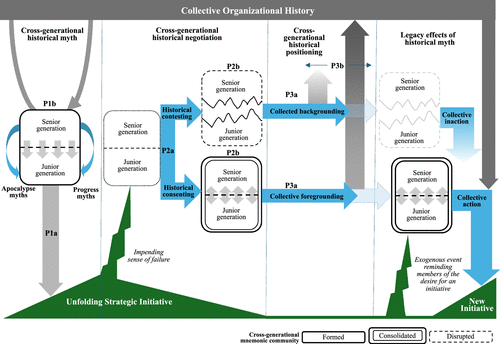
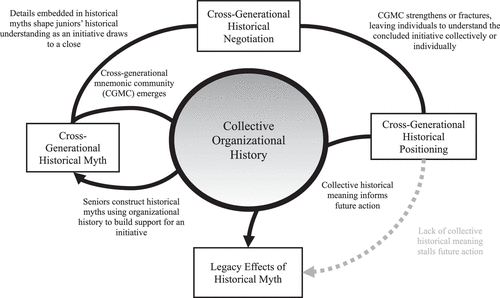
Specifically, our model unveils processes through which the use of cross-generational historical myths generates organization-wide past- and future-oriented support for an initiative (Proposition 1a: The use of cross-generational historical myths generates organization-wide, past- and future-oriented support for an initiative). In the early stages of strategic initiatives, a senior generation can deploy apocalypse myths, by drawing on a nostalgic past to avoid a supposedly dystopian future, or progress myths, by framing initiatives as opportunities to depart from a shameful past and pursue a postalgic one. The capability of these myths to confer legitimacy and urgency to initiatives (Foster et al. 2017) and forge CGMCs (Proposition 1b: The use of cross-generational historical myth underlies the emergence of cross-generational mnemonic communities) reinforces and expands our understanding of the power of narrative tropes (Gergen and Gergen 1988, Ybema 2010, Suddaby et al. 2023a) on cross-generational interactions.
However, when an initiative unfolds in unexpected ways, these now-embraced myths influence discussions regarding how to respond, or cross-generational historical negotiation (Proposition 2a: The unexpected unfolding of an initiative prompts cross-generational historical negotiation rooted in the cross-generational historical myth). Scholarship on organizational generations has highlighted how “tension and conflict between generations is more likely in declining organizations” (Joshi et al. 2011, p. 195). Adding to (or alleviating) these tensions are the historical myths embraced by senior and junior generations, which influence how they negotiate their future. Despite their utility in gaining stakeholder support, apocalypse myths can become a liability as juniors, concerned with failing to uphold a nostalgic vision and prevent a dystopian future, contest senior’s efforts to abandon their initial goal, thus compounding generational tensions and revealing the enduring strength of rhetorical history. The resultant generational fault lines, rooted in unfulfilled desires to echo a historical myth, disrupt cross-generational interactions and CGMCs (Olekalns et al. 2020).
Progress myths, conversely, serve to retain a community experiencing tensions as juniors’ exposure to a dystorian past primes them to appreciate smaller wins and consent to seniors’ revised plans. Seniors may find it easier to acknowledge and discuss changes with juniors, as they can frame the mere commitment to the failed initiative as a historic turning point between dystoria and postalgia, thus sustaining cross-generational cohesion and purpose. The resulting ease in openly discussing the unexpected unfolding of an initiative can facilitate cross-generational communication and strengthen bonds, a far cry from the restricted communication and generational fractures that arise when initiatives motivated by apocalypse myths do not go according to plan (Proposition 2b: Cross-generational historical negotiation either consolidates or disrupts newly emerged CGMCs).
The nature of CGMCs following these discussions further underlies cross-generational historical positioning, or the extent to which recent events are positioned in organizational histories shortly after their conclusion (Proposition 3a: Consolidated or disrupted CGMCs determine the form of cross-generational historical positioning). The absence of cross-generation communication in a disrupted mnemonic community spurs collected backgrounding, as individuals avoid discussing recent events across generations (i.e., social silencing), choosing instead to fantasize about a time before them (i.e., escapist nostalgia) in isolation. Nostalgia thus becomes a trap of sorts, as a trope that once spurred juniors’ commitment now keeps them silent and siloed. Conversely, those in a consolidated mnemonic community are likely to engage in collective foregrounding by coconstructing a view of recent events as a historical turning point (i.e., historical landmarking) and coordinating to create mnemonic traces of it (i.e., social commemorating) and shifting interpretations of the future (i.e., progressive postalgia) across generations. That is, unlike collected backgrounding, collective foregrounding leads to the creation of mnemonic traces, offering material for future use in recounting the organization’s history and potentially engaging again in rhetorical history (Proposition 3b: Cross-generational historical positioning influences the creation of mnemonic traces related to recent events). This sequence of rhetorical constructions thus appears to tip the balance of the organizations toward, or away from, future action (Abrams 1982).
Theoretical Contributions
Our model of cross-generational historical branching weaves together organizational history, generations and failure and in so doing makes several theoretical contributions. First, we shed light on the evolving effects of historical myths. Consistent with prior research (Hatch and Schultz 2017, Suddaby and Foster 2017), our findings indicate that, initially, the sharing of historical myths effectively mobilizes organizational members. However, as the initiative’s chances of outright success begin to wane, members negotiate the next steps in light of the previously embraced myths. These findings underscore the endurance of embraced historical myths over time and across situations. As noted by Suddaby et al. (2023b, p. 249), “historical events, despite their seemingly innocuous or disinterested nature, can be repurposed or…’transformed’ in the service of rhetoric to establish persuasive forms of identification.” Our work extends the time horizon of this persuasive influence, as the transformative power of rhetoric continues to sway individuals as an initiative unfolds and guides their collective negotiation when it begins to veer off course.
Relatedly, we provide empirical support for the presence and long-term influence of discrete historical myths. Although Suddaby et al. (2023a) conceptualized four historical myths (i.e., apocalypse, progress, entropy, and renewal) that combine past-oriented and future-oriented tropes, our research extends this line of theorizing by offering empirical evidence for two of these myths and elucidating their distinctive, evolving effects. Per our findings, individuals exposed to apocalyptic myths, having committed to an initiative they view as resurrecting the past to prevent a catastrophic outcome, tend to contest plans that stop the initiative short of achieving their goal in totality. Conversely, those exposed to progress myths, wherein relatively smaller successes seem more significant against a dystorian backdrop, are more likely to consent to revised strategies. Our findings suggest that the immediate success of using historical myths to legitimize an initiative does not guarantee later adaptability. Rather, the use of certain historical myths may backfire when subsequent situations contradict these embraced myths, limiting the learning and growth that might otherwise follow (Vinitzky-Seroussi 2002, Booth et al. 2007).
Second, our research emphasizes the importance of organizational generations in shaping the divergent and unexpected effects of historical myths. As discussed above, the nature of historical myths influences how organizational members respond to an unfolding initiative. However, their effects may not be as pronounced without generational divides within the organization that lead to varied interpretations of and responses to these shared myths. Although much attention in rhetorical history scholarship is devoted to leaders interpreting events they did not personally witness, such as founding stories (Hatch and Schultz 2017, Basque and Langley 2018), many organizations draw upon recent or near past events that some members, if not all, directly experienced (Schultz and Hernes 2013, Schultz and Hernes 2020), or, per Mannheim (1970, p. 174), “personally acquired memories” rather than “appropriated” ones. We delve into the complexities arising when senior generations interpret their autobiographical memories, or “memory of the events that individuals personally experienced” (Do et al. 2019, p. 1326), for junior generations who may have had varying degrees of direct experience with those events.
Notably, the inherent simplifications that characterize rhetorical history (Suddaby and Foster 2017) imply juniors exposed to seniors’ historical myths act on a less comprehensive understanding of organizational history. Consequently, historical myths composed of secondhand memories, insofar as seniors experienced the events, whereas juniors have only heard of them (Do et al. 2019), lack the detail necessary for juniors to understand and act based on the intricacies of that which preceded their organizational tenure. Although these different levels of historical understanding are unlikely to meaningfully interrupt cross-generational interactions during an organization’s daily operation, seniors’ choice to deliberately simplify a more distant past for juniors during the emotionally charged launch of an initiative (Isabella 1990, Oreg et al. 2018) might lead juniors to form strong affective ties with that oversimplified past. As a result, juniors are likely to strongly contest compromising actions they view as a betrayal of their proud history (Foroughi 2020), as we observed in the case of MBU, where junior members strongly contested the termination of the strike because they viewed their broadcaster as never having experienced failure in such situations. However, historical records indicating several past failures could have served as blueprints for executing the retreat that senior members wished them to undertake willingly. This result suggests a seeming dormancy of history in organizations, where the distant past fails to evoke generational conflict until it is brought to the fore, quickly transforming it from largely undiscussed to a crux of cross-generational decision making.
However, we theorize that members might not be as trapped by history should the part of the past contained within historical myths be commonly experienced across generations. Notably, as the CBU case revealed, myths including past events that juniors directly experienced (i.e., the 8/8 raid at CBU only four years prior) likely enabled among them a more accurate understanding of what exactly senior leaders wanted CBU to escape from, notably their history of inaction. Following the failure, juniors likely saw seniors’ attempts to frame their very actions as a step forward as legitimate, given their similarly negative memories of the raid. Echoing Mannheim (1970), who argued that small cross-generational differences become salient during uncertain, changing situations (Lyons and Kuron 2014), our findings suggest that generational differences, especially mnemonic ones, can trigger a “plurality of voices and interpretations in mnemonic processes” (Foroughi 2020, p. 1733) during an unfolding initiative, and that relative familiarity with the past contained within historical myths might mitigate the divergence in the mnemonic processes.
Third, and relatedly, exploring the intersection of rhetorical history and generational dynamics enriches nascent conversations on the social dynamics of mnemonic communities (Coraiola et al. 2023) and their long-term effects. We suggest that the mnemonic communities these social dynamics form and/or erode between generations wield a formative, long-term influence over how historical myths shape perceptions and behaviors. In line with existing studies (Eisenman and Frenkel 2021, Coraiola et al. 2023), we demonstrate how effective historical myths not only shape members’ beliefs and actions but also foster cohesive cross-generational mnemonic communities between those deploying and accepting them. By extending the temporal scope of these outcomes, we illustrate that these mnemonic communities can either be solidified or disrupted depending on subsequent circumstances. Reflecting on scholarship addressing the fragility of cross-generational relationships during crises (McCain et al. 1983, Becker 1992, Gusfield 2017), we suggest the theoretical importance of a cross-generational mnemonic community in shaping the long-term effects of historical myths.
Understanding how historical myths shape cross-generational mnemonic communities within an organization is particularly important as these communities have the potential to influence the interpretation and positioning of shared experiences within the organization’s history. Although the past is subject to constant reinterpretation in the present (Suddaby and Foster 2017), mnemonic traces and sites of memory, such as museums, serve as foundational elements for these interpretations (Schultz and Hernes 2013, Mena et al. 2016). However, why certain events become represented as physical pieces of history, whereas others become largely forgotten, especially in their immediate aftermath and without a strong impulse for powerful figures to suppress them (Decker 2013), has remained less well understood. We address this paucity of understanding by demonstrating how disrupted cross-generational mnemonic communities tend to background shared experiences, leaving minimal traces for future historical narratives. In contrast, consolidated communities appear more willing to foreground these experiences, leaving behind social and material traces that future generations can utilize to create and deploy historical myths for subsequent initiatives. Historical myths therefore do not engender a branching effect on their own but rather do so through the mnemonic communities they variably enable and constrain.
In this sense, our findings illuminate not only the initial formation of a mnemonic community but also its subsequent consolidation and maintenance. Previous studies have addressed the importance and complexities of maintaining a mnemonic community across various contexts and temporalities, particularly when its members belong to different pre-existing social groups and communities (Mena et al. 2016, Suddaby et al. 2023a). We concur with these scholars insofar as sharing compelling historical myths galvanized organizational members who align with and are dedicated to the tropes embedded in the myths (Suddaby et al. 2023a). However, as our findings suggest, such a newly established mnemonic community, founded primarily on embraced narratives, may become vulnerable as circumstances change in ways that render a once embraced myth obsolete or unconvincing. Although our cases only indirectly hint at this phenomenon, we can infer that newly emerged, vulnerable mnemonic communities are either consolidated (and thus enduring) or disrupted (and thus dissipating) based on their intracommunal interactions, such as silencing or open discussions, and their level of collective behavioral engagement, in relation to the creation of mnemonic traces. Further investigation into intragroup social dynamics within mnemonic communities is therefore warranted.
Lastly, regarding failure, we extend conversations surrounding its processes and outcomes (De Keyser et al. 2021, Schwarz et al. 2021) by demonstrating how the presentation of a historical myth may influence them. Recent studies have explored temporalities associated with the failure of strategic objectives, framing it as “not just a terminal end point” but rather something that “may alternate between cycles of generating success as well as producing destruction over longer periods of time” (Schwarz et al. 2021, p. 160). We enrich conversations on these processes by analyzing the role of history in failure. Notably, when failure violates historical myth, members appear impelled to avoid collective discussions, thus missing opportunities to learn from it. Conversely, if failing adheres to an embraced historical myth, members are more likely to discuss and include it in their collective histories (Newson et al. 2021), possibly learning from it in ways that enhance chances of future success (Crawford et al. 2022). That is, although an initiative may fail on its surface, a willingness to foreground failure in history may underlie successful changes to deep structures, such as an organization’s meaning and conventions (Gersick 1991, Heracleous and Bartunek 2021). Our findings thus illustrate how the interplay of various elements related to the past (historical myth, negotiation, and positioning) can hinder or facilitate collective responses to failure, which may further influence organizational learning and growth (Schwarz et al. 2021).
Alternative Explanations
There may be alternative explanations for our findings. For instance, both unions experienced leadership changes between 2012 and 2014 that might explain strike-related decisions in 2014. However, incoming leadership at both unions emphasized a desire to follow the approaches of outgoing leadership. MBU’s new leader explicitly declared, “we, the new leadership team, will strive to continue the spirit of struggle of the outgoing team to recover the pride of MBN” (Archival data 2013), whereas CBU retained some members of the previous leadership team during this change, often referring to “the achievements made through strikes by the previous union [administration]” (Archival data 2013). Interviews with leaders from both unions also revealed a reluctance toward striking in 2014, with both stating a preference for on-site battles on their appointments. Therefore, we did not observe significant differences between MBU and CBU in their new leadership’s attitudes toward the failed strike or the possibility of a new one.
We also considered differences in MBU and CBU’s risk assessments in 2014. However, upon thorough examination of the data, we found no significant disparities in perceived risk between the two unions. In fact, interviews at both MBU and CBU, owing to the dismissal of union leaders during the 2012 strike, revealed a shared understanding of the potential consequences associated with further collective action. Members of both unions expressed concerns that such actions might jeopardize their employment and careers. One CBU member expressed, “Management is setting a precedent that anyone who resists can be fired (Junior C#14).” Consequently, we concluded that the decisions to strike in 2014 were not driven by a desire from MBU’s leaders to avoid a strike nor CBU’s leaders to pursue one, nor were they influenced by differences in the perceived risk of engaging in subsequent strike actions.
Boundary Conditions, Limitations, and Future Research Directions
Our findings are rooted in a particular organizational and societal context in which juniors of union organizations grant seniors respect based on having lived through a difficult past, namely navigating a crisis and enduring organizational and societal oppression that retains cultural relevance. These contextual factors undoubtedly impelled juniors to view myths as authentic (Hatch and Schultz 2017) and join seniors’ initiatives as a result. Given these conditions, even apocalypse myths, theorized as inherently risky due to their tendency to paralyze stakeholders with fear (Suddaby et al. 2023a), can spur participation. However, although the formative nature of these experiences may be less extreme, our work, alongside extant theories of organizational generations (Joshi et al. 2011), suggests that divides between organizational generations are common across industrial and national contexts, as those who directly experienced transitions (Euro adoption, 2008 financial crisis, COVID-19 pandemic) and other organization-specific events often work alongside those who have not (Lyle et al. 2022). We thus expect different organizational generations to experience similar, if not identical, dynamics following historical myth deployment, given these commonalities and the inherent power of historical narrative.
Regardless, future work is needed to explore contextual factors influencing cross-generational historical branching. For instance, this process may differ in societies in which concepts such as “Gi” do not exist or juniors do not view seniors as necessitating respect based on their experiences (Booth et al. 2007). Differing cultural norms alone likely do not account for these differences, as experience with formative events might grant seniors across contexts substantial leeway in telling persuasive myths. For instance, although the National Organization for the Reform of Marijuana Laws’ (NORML’s) juniors rejected the postalgic vision of a senior generation, they, after forcing their resignations, accepted a nearly identical one from the organization’s founder who rejoined shortly thereafter (Lyle et al. 2022). Although tropes and intradiegetic details certainly matter, we suggest that cultural norms and conferred respect to seniors (based on experience) impact juniors’ willingness to embrace their myths, and we encourage scholars to investigate the impact of each.
Relatedly, we examined cross-generational historical branching during failure. We do, however, view our insights as generalizing to other outcomes of strategic initiatives, including pivots (Mantere et al. 2012) and even success. For example, we suggest cross-generational myths engender a branching effect as members negotiate next steps based on knowledge acquired from historical myths, position initiatives in organizational histories depending on the nature of CGMCs, and more willingly pursue future initiatives as a result. Therefore, if MBN’s CEO resigned following seniors’ telling of an apocalypse myth, historical negotiation would lead juniors to see success as consistent with the myth, strengthen the CGMC, and underlie greater willingness to pursue future objectives. Given that our cases represented instances of failure, however, we encourage future scholars to directly investigate the branching effects of historical myths following an initiative’s success and, ideally, through multiple change initiatives to unpack how these branches spread and impact future myths and initiatives over time. We also encourage investigations of entropy and renewal myths (Suddaby et al. 2023a) to deepen our understanding of cross-generational historical branching.
Finally, the divergent and long-term effects of rhetorical history require further exploration within broader relational and temporal contexts. For instance, although we theorized the experiences of those engaged in an initiative, we did not address those whom the organizations attempted to expel or those who observed it. This omission limits our ability to theorize how interactions with those outside a focal mnemonic community might affect mnemonic processes during and after the initiative. Further research may explore these additional entities to explain how a broader ecology of memories might interrupt or alter this process. Additionally, although our investigation spanned more than three years, allowing us to analyze myths’ immediate and longer-term effects, our temporal window did not enable us to examine its historical effects, particularly those rooted in cross-generational historical positioning. Future research could explore how collectedly backgrounded or collectively foregrounded events influence how organizational members interact with each other and their organizations in the years that follow.
Practical Implications
Managers, in using history strategically, should consider the long-term outcomes of deploying nostalgic and dystopian rhetoric. Although they can spur participation, failure could lead members to feel they have betrayed their organization and lessen support for future initiatives. Narrowly focusing on an apocalypse myth thus serves as an “all-or-nothing” strategy that proves devastating in the wake of failure. Managers may instead nuance myths by framing initiatives as opportunities to build on proud elements of their past while amending for shameful ones. Should initiatives fail, managers can then represent them as attempts to grow. We also highlight the importance of CGMCs in responding to failure. Such communities provide members with opportunities to discuss failure. Managers should be mindful of generational divides and encourage seniors to share, openly and honestly, their memories. Such community building can enhance juniors’ understanding of history and provide them with the necessary nuance to learn from a more complete past rather than defend a limited understanding of it.
Conclusion
“Only where events occur in such a manner as to demarcate a cohort in terms of its ‘historical-social’ consciousness, should we speak of a true generation” (Schuman and Scott 1989, p. 359).
Although generations have been extensively discussed in management discourse, their meaningful implications cannot be fully realized without comprehending their collective memories and associated mnemonic processes. Similarly, managing conflicts and coordination across generations may not be achieved without understanding their historical-social dynamics. Our theorizing suggests not only the criticality of organizational generations during the deployment of historical myths but also how these tellings of history can engender variable evolving and long-term effects on an organization’s historical record and cross-generational bonds. In this manner, history does not exist alongside but rather within organizational generations, with the relative willingness to share it across generational boundaries underlying the extent to which generations intertwine to produce meaningful change into the future or remain siloed in ways that halt future action. In either case, we broadly suggest that history serves as the cornerstone of generational, and, indeed, organizational, experience.
The authors thank senior editor, Sonali Shah, and the anonymous reviewers for developmental and constructive feedback and the members of two public broadcasters in South Korea who generously gave so much of their time for multiple interviews in the midst of their ongoing strike and demanding work schedules. All remaining errors are the author’s own. The three authors equally contributed to the paper.
1 During interviews, we also asked about participants’ engagement in antigovernment rallies or assumption of leadership roles in student activism during their college years. Responses were markedly divided: individuals hired before 1996 were frequently associated with democratization movements and other forms of social activism during college, with their decisions to join public broadcasters often stemming from desires to continue such involvement; post-1996 hires had limited experience in these activities, with motivations for joining public broadcasters often centering on professionalism, reputation, and favorable job conditions.
2 Collected backgrounding is different from selective forgetting (Anteby and Molnar 2012) as selective forgetting is a process of actively erasing past events potentially misaligned with a current initiative to engender collective support. Collected backgrounding describes the erasure of a recently experienced event from members’ broader understanding of organizational history through lack of discussion (Do et al. 2019).
3 Although MBU had written white papers for most other, more successful strike initiatives in their past, they did not do so for their 2012 strike.
References
- (1982) Historical Sociology (Cornell University Press, Ithaca, NY).Google Scholar
- (2021) Those who control the past control the future: The dark side of rhetorical history. Organ. Stud. 42(4):575–593.Crossref, Google Scholar
- (2012) Collective memory meets organizational identity: Remembering to forget in a firm’s rhetorical history. Acad. Management J. 55(3):515–540.Crossref, Google Scholar
- (2000)
Making change permanent: A model for institutionalizing change interventions . Passmore W, Woodman R, eds. Research in Organizational Change and Development, vol. 12 (JAI Press, Stanford, CT), 97–128.Google Scholar - (2015) Senior managers’ sensemaking and responses to strategic change. Organ. Sci. 26(4):960–979.Link, Google Scholar
- (2018) Invoking Alphonse: The founder figure as a historical resource for organizational identity work. Organ. Stud. 39(12):1685–1708.Crossref, Google Scholar
- (1992)
A pattern of generations and its consequences . Becker HA, ed. Dynamics of Cohort and Generations Research (Thesis Publishers, Amsterdam), 221–222.Google Scholar - (2007) Accounting for the dark side of corporate history: Organizational culture perspectives and the Bertelsmann case. Critical Perspectives Accounting 18(6):625–644.Crossref, Google Scholar
- (2006) Constructing Grounded Theory: A Practical Guide through Qualitative Analysis (Sage, London).Google Scholar
- (2012) Korean voting behavior and generation in the 2010 local elections. J. Korean Politics 21(2):1–21.Google Scholar
- (2020) What makes a process theoretical contribution? Organ. Theory 1(1):2631787720902473.Crossref, Google Scholar
- (2012) Are generational differences in work values fact or fiction? Multi-country evidence and implications. Internat. J. Human Resource Management 23(11):2268–2294.Crossref, Google Scholar
- (2020) Remembering to forget: The historic irresponsibility of US Big Tobacco. J. Bus. Ethics 166(2):233–252.Crossref, Google Scholar
- (2023) Ecologies of memories: Memory work within and between organizations and communities. Acad. Management Ann. 17(1):373–404.Crossref, Google Scholar
- (2008) Basics of Qualitative Research: Techniques and Procedures for Developing Grounded Theory (Sage, Thousand Oaks, CA).Crossref, Google Scholar
- Cornelissen JP (2013) Portrait of an entrepreneur: Vincent Van Gough, Steve Jobs, and the entrepreneurial imagination. Acad. Management Rev. 38(4):700–709.Google Scholar
- (2022) Painful memories as mnemonic resources: Grand Canyon Dories and the protection of place. Strategic Organ. 20(1):51–79.Crossref, Google Scholar
- (2021) On the dynamics of failure in organizational change: A dialectical perspective. Human Relations 74(2):234–257.Crossref, Google Scholar
- Decker S (2013) The silence of the archives: Business history post-colonialism and archival ethnography. Management Organ. History 8(2):155–173.Google Scholar
- (2021) Rethinking history and memory in organization studies: The case for historiographical reflexivity. Human Relations 74(8):1123–1155.Crossref, Google Scholar
- (2019) Democracy and worker representation in the management of change: Lessons from Kurt Lewin and the Harwood studies. Human Relations 72(11):1805–1830.Crossref, Google Scholar
- (2022) Memory-based change management: Using the past to guide the future. Organ. Psych. Rev. 12(3):306–331.Crossref, Google Scholar
- (2019) Driving down memory lane: The influence of memories in a community following organizational demise. Organ. Stud. 40(9):1307–1329.Crossref, Google Scholar
- (1989) Building theories from case study research. Acad. Management Rev. 14(4):532–550.Crossref, Google Scholar
- (2021) Remembering materiality: A material–relational approach to organizational memory. Organ. Theory 2(3):1–24.Crossref, Google Scholar
- (1998) Outline of a theory of generations. Eur. J. Soc. Theory 1(1):91–106.Crossref, Google Scholar
- (2020) Collective memories as a vehicle of fantasy and identification: Founding stories retold. Organ. Stud. 41(10):1347–1367.Crossref, Google Scholar
- (2020) Organizational memory studies. Organ. Stud. 41(12):1725–1748.Crossref, Google Scholar
- (2011) History as social memory assets: The example of Tim Hortons. Management Organ. History 6(1):101–120.Google Scholar
- (2017) The strategic use of historical narratives: A theoretical framework. Bus. History 59(8):1176–1200.Crossref, Google Scholar
- (1988)
Narrative and the self as relationship . Advances in Experimental Social Psychology, vol. 21 (Elsevier, Amsterdam), 17–56.Google Scholar - (2017) A phase model of intergenerational learning in organizations. Acad. Management Learn. Ed. 16(2):193–216.Crossref, Google Scholar
- (1991) Revolutionary change theories: A multilevel exploration of the punctuated equilibrium paradigm. Acad. Management Rev. 16(1):10–36.Crossref, Google Scholar
- (2019)
A dialectic of utopia/dystopia in the public imagination of the 21st century . Faessel V, Falk RA, Curtin M, eds. On Public Imagination: A Political and Ethical Imperative (Routledge, New York), 95–98.Crossref, Google Scholar - (2017)
The problem of generations in an organizational structure . Barney G, ed. Organizational Careers (Routledge, New York), 359–368.Crossref, Google Scholar - (1992/1941) On Collective Memory (University of Chicago Press, Chicago).Crossref, Google Scholar
- (2017) Toward a theory of using history authentically: Historicizing in the Carlsberg Group. Admin. Sci. Quart. 62(4):657–697.Crossref, Google Scholar
- (2021) Organization change failure, deep structures and temporality: Appreciating Wonderland. Human Relations 74(2):208–233.Crossref, Google Scholar
- (2012/1983) The Invention of Tradition (Cambridge University Press, New York).Crossref, Google Scholar
- (1999) Institutional evolution and change: Environmentalism and the US chemical industry. Acad. Management J. 42(4):351–371.Crossref, Google Scholar
- (2013) Rekindling the flame: Processes of identity resurrection. Acad. Management J. 56(1):113–136.Crossref, Google Scholar
- (1990) Evolving interpretations as a change unfolds: How managers construe key organizational events. Acad. Management J. 33(1):7–41.Crossref, Google Scholar
- (2011) Generations in organizations. Res. Organ. Behav. 31:177–205.Crossref, Google Scholar
- (2017) Exuberant politics on the internet: Two forms of popular politics in South Korea’s 2008 beef protests. Internat. J. Comm. 11:19328036.Google Scholar
- (1976) A model of organizational change in the context of union-management relations. J. Appl. Behav. Sci. 12(1):59–78.Crossref, Google Scholar
- (1999) Strategies for theorizing from process data. Acad. Management Rev. 24(4):691–710.Crossref, Google Scholar
- (2009) Working the Past: Narrative and Institutional Memory (Oxford University Press, New York).Crossref, Google Scholar
- (2016) A rolling stone gathers momentum: Generational units, collective memory, and entrepreneurship. Acad. Management Rev. 41(4):658–675.Crossref, Google Scholar
- (2001) Grounded Theory in Management Research (Sage, Thousand Oaks, CA).Google Scholar
- (1985) The Past Is a Foreign Country (Cambridge University Press, Cambridge, UK).Google Scholar
- (2024) Up in smoke? The lingering influence of history on community identity dynamics. Strategic Organ. 22(4):825–851.Crossref, Google Scholar
- (2022) What is NORML? Sedimented meanings in ambiguous organizational identities. Organ. Stud. 43(12):1991–2012.Crossref, Google Scholar
- (2014) Generational differences in the workplace: A review of the evidence and directions for future research. J. Organ. Behav. 35(S1):S139–S157.Crossref, Google Scholar
- (2020) Historical Organization Studies: Theory and Applications (Routledge, London).Crossref, Google Scholar
- (1970) The problem of generations. Psychoanalytic Rev. 57(3):378–404.Google Scholar
- (2012) Reversal of strategic change. Acad. Management J. 55(1):172–196.Crossref, Google Scholar
- (1983) The effects of departmental demography on turnover: The case of a university. Acad. Management J. 26(4):626–641.Crossref, Google Scholar
- (2016) On the forgetting of corporate irresponsibility. Acad. Management Rev. 41(4):720–738.Crossref, Google Scholar
- (2021) United in defeat: Shared suffering and group bonding among football fans. Managing Sport Leisure 28(2):164–181.Crossref, Google Scholar
- (2019) A GATE to understanding “older” workers: Generation, age, tenure, experience. Acad. Management Ann. 13(2):414–443.Crossref, Google Scholar
- (2020) Gradual drifts, abrupt shocks: From relationship fractures to relational resilience. Acad. Management Ann. 14(1):1–28.Crossref, Google Scholar
- (1999) Collective memory: The two cultures. Sociol. Theory 17(3):333–348.Crossref, Google Scholar
- (1998) Social memory studies: From” collective memory” to the historical sociology of mnemonic practices. Annu. Rev. Sociol. 24:105–140.Crossref, Google Scholar
- (2018) An affect-based model of recipients’ responses to organizational change events. Acad. Management Rev. 43(1):65–86.Crossref, Google Scholar
- (2012) In South Korea, journalists protest government. Accessed August 20, 2022, https://www.wsj.com/articles/SB10001424052970203370604577264851543837924.Google Scholar
- (2010) Social remembering and organizational memory. Organ. Stud. 31(1):69–87.Crossref, Google Scholar
- (2013) A temporal perspective on organizational identity. Organ. Sci. 24(1):1–21.Link, Google Scholar
- (2020) Temporal interplay between strategy and identity: Punctuated, subsumed, and sustained modes. Strategic Organ. 18(1):106–135.Crossref, Google Scholar
- (1989) Generations and collective memories. Amer. Sociol. Rev. 54(3):359–381.Crossref, Google Scholar
- (2021) Organizational change failure: Framing the process of failing. Human Relations 74(2):159–179.Crossref, Google Scholar
- (1998)
Techniques and procedures for developing grounded theory . Basic of Qualitative Research (Sage, Thousand Oaks, CA), 860–886.Google Scholar - (2017) History and Organizational Change (Sage Publications, Los Angeles, CA).Crossref, Google Scholar
- (2010)
Rhetorical history as a source of competitive advantage . Baum J, Lampel J, eds. The Globalization of Strategy Research (Emerald Group Publishing Limited, Leeds, UK), 147–173.Crossref, Google Scholar - (2016)
Remembering: Rhetorical history as identity work . The Oxford Handbook of Organizational Identity (Oxford University Press, Oxford, UK), 297–316.Google Scholar - (2023a) Entrepreneurial visions as rhetorical history: A diegetic narrative model of stakeholder enrollment. Acad. Management Rev. 48(2):220–243.Crossref, Google Scholar
- (2023b) Rhetorical history as institutional work. J. Management Stud. 60(1):242–278.Crossref, Google Scholar
- (2002) Commemorating a difficult past: Yitzhak Rabin’s memorials. Amer. Sociol. Rev. 67(1):30–51.Crossref, Google Scholar
- (2018) History as organizing: Uses of the past in organization studies. Organ. Stud. 39(12):1663–1683.Crossref, Google Scholar
- (2017) Organizational response to adversity: Fusing crisis management and resilience research streams. Acad. Management Ann. 11(2):733–769.Crossref, Google Scholar
- (2004) Managerial postalgia: Projecting a golden future. J. Managerial Psych. 19(8):825–841.Crossref, Google Scholar
- (2010) Talk of change: Temporal contrasts and collective identities. Organ. Stud. 31(4):481–503.Crossref, Google Scholar
- (2014) The invention of transitions: History as a symbolic site for discursive struggles over organizational change. Organization 21(4):495–513.Crossref, Google Scholar
- (2003) Case Study Research, Design and Methods (Sage Publications, Beverly Hills, CA).Google Scholar
- (2020) The partial organization of networked corruption. Bus. Soc. 59(7):1377–1409.Crossref, Google Scholar
- (1996) Social memories: Steps to a sociology of the past. Qual. Sociol. 19(3):283–299.Crossref, Google Scholar
Sung-Chul Noh is an associate professor at the Hitotsubashi University Business School in Japan. His research interests include professional work and nonstandard work arrangements with a particular focus on the impacts of work precarity on career, identity work, and collective action.
Matthew C. B. Lyle is an assistant professor of strategy at the Binghamton University School of Management. He studies processes associated with organizational memories, particularly those that flow from attempts to alter them for strategic purposes. He is more broadly interested in studying and theorizing social cognitive processes.
Boram Do is an associate professor of management at Yonsei University School of Business. Her research examines how emotions and memories shape change processes within complex and dynamic organizational and societal contexts.