When Data Scientists Meet Domain Experts: Artificial Intelligence, Epistemic Conflict, and Knowledge Transformation
Abstract
Predictive artificial intelligence (AI) models developed by data scientists promise to transform organizational knowledge, yet in practice, the predictions remain inscrutable to domain experts. Existing explanations situate the problems in the opacity of the AI tools, failed adoption, or jurisdictional conflict but offer limited insight into how to make the knowledge accessible. Here, we show how the problem emerges from the competing epistemic stances of data scientists and domain experts, which create conflict over how to produce and evaluate knowledge. We then ask how data scientists and domain experts address that conflict so that their work with AI satisfies each group’s standards for producing and evaluating knowledge. Drawing on an 18-month inductive study of three large Indian banks, we show that the data scientists produce new knowledge, but domain experts hold the power to decide whether it is deployed. Our findings distinguish between epistemic and jurisdictional conflict. We show that data scientists first try to address the epistemic conflict directly through assimilative practices that follow one epistemic stance or the other. When these practices fail to transform knowledge, data scientists learn to address the conflict indirectly through four bridging practices. These practices help the domain experts transform knowledge by embedding the data scientists’ predictions in the boundary objects and practices that the domain experts already use. Our findings reveal how power based on expertise rather than jurisdictional control can make possible the coproduction of knowledge.
Funding: This research was supported in part by funding from the Social Sciences and Humanities Research Council [Grant 430-2024-01156] to M. Joshi.
New occupations often emerge around new technologies (Bechky 2020), and on the surface, artificial intelligence (AI) seems to be no different. With AI comes a new set of information professionals, data scientists, who produce “actionable knowledge from large data sets with the use of sophisticated digital technologies such as programming languages, visualization techniques, and [AI]” (Vaast and Pinsonneault 2021, p. 1087). Rather than capturing domain knowledge in an expert system (Forsythe 1993), data scientists begin with data and construct AI models based on relationships induced from these data (Avnoon and Eyal 2026).
The promise of data science comes with a challenge, however. Data scientists must make their new knowledge accessible to the domain experts—the radiologists (Lebovitz et al. 2021), accountants and lawyers (Faulconbridge et al. 2024), police officers (Waardenburg et al. 2022), and human resources (HR) professionals (van den Broek et al. 2021), for example—who draw knowledge from their experience and expertise. The two groups are inherently different, however (Viaene 2013). More than a decade ago, Digvijay Lamba—then the distinguished architect for platform initiatives at Walmart Labs—described the challenge (Ferguson 2012): “What’s happening is there are domain experts—buyers, merchandisers, product managers and others have worked in retail for years and years—these people know the market really well… They throw these ideas over the wall to data scientists, who go through the data and come up with these brilliant ideas to answer questions. But there is a wall there. The data scientists are not domain experts.”
Scholars characterize this barrier in two ways. One account treats AI as a tool and examines the challenges domain experts face in accessing knowledge from the tools that the data scientists develop (Anthony et al. 2023). In contrast to traditional epistemic technologies, these AI technologies generate opaque and inscrutable predictions that make the new knowledge inaccessible (Anthony et al. 2023), and this limits their value to domain experts. Research shows that radiologists unable to interpret the predictions of a diagnostic algorithm either ignore or blindly accept the predictions of the tool (Lebovitz et al. 2022), loan officers assert their authority and defend the value of their professional judgment over the recommendations offered by AI (Strich et al. 2021), and art experts repair an AI model so that its predictions match their expectations (Sachs 2020). A second account situates the problems of integrating knowledge in the need to build common ground so that knowledge might be transferred, translated, or transformed to make it accessible to another occupational community (Carlile 2002, 2004; Bechky 2003b). Research shows that boundary objects and brokers can help build this common ground (Barley 1996, Bechky 2003a, Levina and Vaast 2005), yet with AI, these collaborative mechanisms repeatedly fail. Instead, data scientists seeking to secure the cooperation of domain experts limit their value by dropping their analytic standards (Stice-Lusvardi et al. 2024) or by reproducing domain experts’ assumptions (van den Broek et al. 2021). In other instances, both data scientists and domain experts only symbolically conform to the AI models and avoid real change (Pachidi et al. 2021).
To understand how data scientists and domain experts overcome these challenges, we need to better understand what leads to the differences across the boundaries. We do that by analyzing differences between domain experts and data scientists across what others have identified as an epistemic stance: an approach to generating knowledge that shapes what actors treat as worth knowing, how they investigate problems, and how they evaluate potential solutions (Fayard et al. 2016). These different approaches to producing knowledge reflect fundamental differences in their style of reasoning, their mode of evaluation, and their assumptions about what can be known (Levina et al. 2026). We examine these differences across epistemic stances in a qualitative, inductive study of data scientists building AI models for domain experts across multiple projects in three large banks in India. Given their competing epistemic stances, the data scientists and the domain experts bring very different expectations for the AI systems they propose, leading to epistemic conflict over how to produce and evaluate knowledge with AI. Although the two groups enjoy comparable status, the domain experts hold the power over developing and deploying the models. How, then, can the data scientists address the epistemic conflict so that they produce AI models that satisfy the epistemic stances of both groups?
Our findings turn on a set of bridging practices that allowed the data scientists to engage the domain experts’ existing boundary objects and practices. Rather than focusing on their own models, the data scientists learned to identify the domain experts’ problems and agendas and set their AI models in the existing system of work. With our findings, we make three contributions. We separate epistemic conflict from jurisdictional conflict in knowledge transformation, we show how power differences make direct responses to epistemic conflicts ineffective, and we show how less powerful actors transform knowledge by embedding their claims in the system of work the powerful actors follow.
Technology, Occupational Boundaries, and Knowledge Transformation
With the rise of AI, data science is becoming an elite occupation. The U.S. Bureau of Labor Statistics projects 36% employment growth for data scientists from 2023 to 2033, far outpacing most occupations (Bureau of Labor Statistics 2025). Data scientists now command top salaries (Davenport and Patil 2012, 2022) and work with senior executives through autonomous corporate “centers of excellence” (Stobierski 2021). Their work seems clear enough: they acquire data, build data sets, and analyze the data relevant to the domain; they then use machine learning to train AI models; finally, they build trust and communicate the implications of those models to the domain experts (Avnoon 2024b). The promise of that work also seems clear enough. With their expertise, they can parse vast quantities of structured and unstructured data (see Constantiou and Kallinikos 2015) without the constraints of purposeful search (Murray et al. 2021; see also Yoo 2015). That exploratory search has the potential to alter what organizations know (Sturm et al. 2021) to solve novel problems (Raisch and Fomina 2025) and to combine humans and AI to produce better outcomes than domain experts alone can (Murray et al. 2021).
In practice, working with AI has proven more challenging than anticipated (Anthony et al. 2023): firms repeatedly struggle to deploy their AI projects (Davenport and Malone 2021). Rather than aiding collaboration, AI seems to inhibit knowledge sharing. Data scientists may embed the knowledge they produce in predictive AI models that are intended to serve as tools for domain experts, but the knowledge claims embedded in those tools remain inaccessible to the domain experts (Lebovitz et al. 2022, Anthony et al. 2023). We know well that knowledge can be both a barrier and a source of new opportunities, and transforming knowledge requires dealing with increasingly complex boundaries in organizations (Carlile 2002, 2004). But the relationship between data scientists and domain experts introduces new challenges in producing and evaluating knowledge that we need to understand.
Accessing Knowledge Embedded in AI Tools
A long and rich tradition of research on work, technology, and occupations shows that domain experts use epistemic technologies to accomplish their work (Barley 1986, Knorr-Cetina 1999, Nelson and Irwin 2014, Anthony 2021). Increasingly, these tools incorporate algorithms that experts draw on to do their work and deepen their knowledge (Anthony 2021). These epistemic technologies are often built by developers who embed domain expertise in the tool to help experts accomplish complex work (Byrd et al. 1992, Forsythe 1993). Experts may black box these tools and take their predictions for granted (Anthony 2018, 2021), but they are legible enough that experts can check the outputs against their expectations and understanding should they wish to do so (Knorr-Cetina 1999, Owen-Smith 2001, Bailey and Barley 2011).
Predictive AI introduces an important twist on how these epistemic technologies are built. With earlier AI technologies, such as expert systems, developers embedded domain expert knowledge and experience in a decision-making tool (Forsythe 1993). In contrast, predictive AI embeds knowledge that does not originate from domain experts. Data scientists draw inferences directly from large data sets through their analytic work, resulting in models that may outperform epistemic technologies grounded in expert knowledge (Avnoon and Eyal 2026). The predictions of these models then provide knowledge claims—a diagnostic marker or measurement for clinicians (Lebovitz et al. 2022, Kim et al. 2025), a creditworthiness score for bankers (Strich et al. 2021), or a recommendation for professional service workers (Faulconbridge et al. 2024)—that can transform the work of domain experts (Murray et al. 2021).
In practice, domain experts find these AI-generated knowledge claims difficult to integrate with their own judgments. Domain experts typically draw on a range of practices to integrate the knowledge claims of an epistemic technology into their work, such as questioning (Anthony 2018), articulating (Kellogg et al. 2020), validating (Anthony 2021), and brokering (Kellogg et al. 2020). Studies of predictive AI show that domain experts struggle with these practices. Diagnostic radiologists in three hospital departments found that the AI tool increased their epistemic uncertainty, and in two of the three departments, radiologists either ignored or blindly accepted the predictions (Lebovitz et al. 2022). Loan officers at a bank responded to AI systems by asserting their authority and defending the value of their professional judgment rather than using the new knowledge in their credit assessment practices (Strich et al. 2021). In professional service firms, experts devalued the tasks related to machine learning algorithms and reorganized their work rather than integrating the knowledge behind the predictions (Faulconbridge et al. 2024). Art experts who disagreed with the predictions of an algorithm designed to evaluate the similarity between art images and artists chose to repair the AI model so that its outputs better matched their expectations rather than using the predictions to transform their knowledge (Sachs 2020).
Researchers attribute these difficulties to opaque and inscrutable AI tools (Anthony et al. 2023). For example, radiologists found that their AI tools frequently either predicted cancer when the radiologists did not or did not predict cancer when they did (Lebovitz et al. 2022). The competing AI predictions increased their uncertainty. Such inscrutability can be built directly into the models as when predictive models combine variables in such complex ways that humans cannot understand how they relate to one another (Rudin and Radin 2019). This inscrutability may also be a consequence of the knowledge that goes into the models. For example, the ground truth used to train an AI tool’s predictions may focus on know-what, but leave out the know-how experts use to deal with the uncertainties of practice (Lebovitz et al. 2021). This tool view of AI appears even in studies in which in-house data scientists or managers participate in model design, implementation, and evaluation. When data scientists build a predictive model to select sales leads, the sales representatives “make way for the algorithm” only symbolically, leading to cycles of symbolic conformity rather than learning from the model’s predictions (Pachidi et al. 2021, p. 18). When data scientists build a predictive model to improve policing, algorithmic brokers emerge after the model is put in place (Waardenburg et al. 2022). When data scientists build a model to improve hiring decisions, the action emerges “when the machine meets the expert,” and data scientists alter their model when it does not match the predictions of the experts (van den Broek et al. 2021, p. 1557). And when hospital managers must confront the disappointing performance of the machine learning AI tools that they selected, they question whether ground truth in the models is “really true” (Lebovitz et al. 2021, p. 1501).
But focusing on the tool alone misses the significance of the data scientists who build the models. Their machine learning algorithms make it possible to develop predictive models by identifying relationships in the data that domain experts may not have seen (Avnoon and Eyal 2026). The data scientists bring a different form of knowledge to the domain experts’ work as demonstrated in the distinction between the know-what of an AI model and the know-how of the domain expert (Lebovitz et al. 2021). That means that we need to think about the problem relationally. With older forms of AI, developers worked directly with domain experts to design decision support or expert systems that made the domain experts’ knowledge explicit in the models (e.g., Forsythe 1993). In contrast, contemporary forms of AI use machine learning to induce knowledge directly from data, giving data scientists a greater role in shaping the knowledge claims embedded in the model (Avnoon and Eyal 2026). In response, we need to consider how each group understands that new knowledge.
Integrating Knowledge Across Boundaries
Knowledge is socially situated, so integrating knowledge across boundaries involves accommodating the domain-specific meanings and understandings of different communities of practice (Carlile 2002, 2004; Bechky 2003a, b). Solving problems across communities depends on building common understanding so that knowledge can be transferred, translated, or transformed, depending on the complexity of the boundary (Carlile 2002, Bechky 2003b, Seidel and O’Mahony 2014). Structural solutions build common understanding by sending information through a single individual who becomes an obligatory point of passage: the story “is necessarily told from the point of view of…the manager, entrepreneur, or scientist” (Star and Griesemer 1989, p. 390, emphasis in original). Brokers and boundary spanners can also facilitate the flow of information, meaning making, and dialogue across boundaries to build common understanding (Barley 1996, Gittell 2002, Levina and Vaast 2005). Finally, epistemic technologies can serve as boundary objects that provide the common ground through which members of different communities negotiate their differences and dependencies (Carlile 2002, Bechky 2003b).
Epistemic technologies such as predictive AI may facilitate such collaborative work between data scientists and domain experts (Anthony et al. 2023), but they introduce a significant challenge: navigating the ambiguous role of the data scientist in that work (Avnoon 2024a). The labels given to data scientists in the literature—technologists (Pachidi et al. 2021), developers (van den Broek et al. 2021), data analysts (Stice-Lusvardi et al. 2024), or “so-called data scientists” (Waardenburg et al. 2022, p. 62)—reflect that ambiguity. Data scientists, like domain experts, draw on specialized analytic knowledge, methods, and standards that define how their work should be done (Avnoon 2024b). And data scientists, like technicians (Barley 1996), often work at the discretion of domain experts, who must recognize the value of what the data scientists bring. Yet data scientists differ from both domain experts and technicians in that they bring a different regime of knowing to their work (Pachidi et al. 2021). The practices of domain experts and technicians depend on close contextual knowledge (Carlile 2002, Bechky 2003b), whereas data scientists generate knowledge by using machine learning algorithms to process large data sets (Pachidi et al. 2021). Data scientists enter a domain and produce knowledge that can be used within that domain, but their expertise can be applied across a range of different domains (Viaene 2013; Avnoon 2021, 2024a).
These differences yield a very limited zone of overlap between data scientists and domain experts, making collaborative work difficult to sustain. An effective boundary object provides interpretive flexibility so that members of different occupational communities can use it within their community of practice (Star and Griesemer 1989, Anthony et al. 2023) and meets the information requirements of each community (Star and Griesemer 1989, Bechky 2003b). AI models do not seem to help build common ground across the differences. The inscrutable predictions of contemporary algorithms—the diagnostic markers in radiology (Lebovitz et al. 2022, Kim et al. 2025), the creditworthiness scores in banking (Strich et al. 2021), or the auditing recommendations in professional services (Faulconbridge et al. 2024)—offer neither interpretive flexibility nor the information necessary to build common ground.
Structural solutions appear to work no better. Data scientists working in support of domain experts risk losing their autonomy and “becoming controlled” (Anteby et al. 2016, p. 189) as “servants” of the domain experts (Barley 1996, p. 429). To produce valid knowledge, data scientists must maintain their analytic standards, avoid the domain experts’ biases, and yet satisfy the interests of the domain experts. Given the need to sustain a collaborative relationship with domain experts, data scientists may compromise their standards. For example, data analysts in a financial technology company faced pressure to perform analyses that compromised the data-driven and scientific rigor of their work; in response, they frequently lowered their standards and even worked to legitimate those lower standards (Stice-Lusvardi et al. 2024). Similarly, when developers used machine learning to produce AI models that challenged the expectations of the HR experts they were supporting, the developers repeatedly adapted their models to match the domain experts’ models (van den Broek et al. 2021). Although the two groups worked together to build the model, the underlying knowledge about a good hire remained largely unchanged.
Knowledge brokers also struggle to translate knowledge effectively. Intelligence officers who served as brokers between data scientists, their predictive policing models, and the police officers who were to use those models could not build common ground with the data scientists (Waardenburg et al. 2022). The intelligence officers ultimately concluded that “data scientists don’t have a clue about police work” (Waardenburg et al. 2022, p. 72). Rather than translate knowledge across boundaries, the intelligence officers concluded that the knowledge boundaries were impassable, replaced the data scientists’ models with their own data and predictions, and built common ground with the police alone.
Consolidating jurisdiction under the data scientists also falls short. As with other epistemic technologies that shape the allocation of tasks and jurisdiction (Zetka 2001, Bechky 2003b, Pine and Mazmanian 2017, Anthony 2021), AI technologies can shape jurisdictions as when radiographers use algorithmic ways of knowing to carve out a new role supporting radiologists (Kim et al. 2025). But the battles between domain experts and data scientists are less about who should do the work and more about how to produce knowledge. The developers using machine learning to build a hiring tool for an HR team did not claim jurisdiction over the domain experts. Instead, when the domain experts could not understand their models, the developers tried to adapt their models (van den Broek et al. 2021). Similarly, when data analysts working in a financial technology company encountered resistance to their practices, they changed their own practices to collaborate better with the domain experts rather than making claims over their jurisdiction (Stice-Lusvardi et al. 2024). Even when data scientists building customer behavior prediction models for account managers gained jurisdiction over the domain experts’ work of identifying sales opportunities (Pachidi et al. 2021), there is no evidence that the data scientists sought or even wanted that expanded jurisdiction. Instead, it is a story of ceremonial claims that got out of control during a debate over how knowledge should be produced.
These conflicts confound the hopes for collaborative work (Murray et al. 2021, Anthony et al. 2023) and knowledge integration across occupational boundaries (e.g., Carlile 2002, Bechky 2003b). Both domain experts and data scientists may use AI models to produce knowledge and improve outcomes, but the knowledge that the data scientists produce remains inaccessible to the domain experts. Good faith responses by data scientists can undermine their expertise if they lower their standards to satisfy the domain experts (Stice-Lusvardi et al. 2024) or build hybrid models that simply replicate the domain experts’ beliefs (van den Broek et al. 2021). Using brokers to make their predictions accessible to the domain experts leads to the replacement of the data scientists and their predictions by the brokers (Waardenburg et al. 2022). Even handing data scientists jurisdiction over part of the domain experts’ work does not help to transform domain knowledge (Pachidi et al. 2021). AI may reproduce existing domain knowledge when data scientists accommodate domain experts, but valuable data-induced knowledge remains unused.
Competing Approaches to Knowledge
Why does the data scientists’ knowledge remain inaccessible to domain experts? As Pachidi et al. (2021) show, the tensions between data scientists and domain experts run deeper than differences in knowledge across boundaries. They also reflect different approaches to knowledge: what is worth knowing, how to acquire that knowledge, and who gets to answer those questions. Data scientists and domain experts bring different expectations for AI and follow different approaches to building effective knowledge claims. To understand why the knowledge remains inaccessible, we need to do more than consider how the domain experts use the data scientists’ knowledge; we need to consider how they produce knowledge.
Here, we do that by examining differences between the data scientists and domain experts over what researchers have identified as an epistemic stance (Fayard et al. 2016, Levina et al. 2026): an attitude that determines how an individual makes claims about the world rather than a specific claim about the world (Chakravartty 2011, Levina et al. 2026). Data scientists and domain experts agree on the value of empirical methods, but they disagree on the dimensions of an epistemic stance: where to identify new knowledge, how to generate understanding, how to make inferential claims, how to evaluate claims to knowledge, and how to decide what can be known and how (Levina et al. 2026). (We describe these dimensions in more detail in our methods.) These differences go to the heart of what constitutes knowledge and cast a different light on the problems of using AI to produce actionable knowledge. Data scientists are agnostic to domains in their epistemic stance. They produce knowledge claims from large data sets (Avnoon and Eyal 2026), and they evaluate those knowledge claims for their predictive validity (cf. March et al. 1991, Rerup and Zbaracki 2021). Domain experts, however, care deeply about their domains in their epistemic stance. They produce knowledge claims from their expertise and experience (Zbaracki and Bergen 2010), and they must build common ground—or reliability (cf. March et al. 1991, Rerup and Zbaracki 2021)—across domains and then encode those knowledge claims in their domain-based procedures. Each epistemic stance brings value, so reconciling the two stances requires more than resolving differences about what is known. It requires bridging differences about what can be known and how it can be known. It also requires preserving the distinct contribution of each epistemic stance. So how do data scientists and domain experts incorporate their competing epistemic stances so that their work with AI satisfies each group’s standards for producing and evaluating knowledge? In what follows, we answer that question.
Methods
We conducted a qualitative, inductive study of how predictive AI applications were integrated into knowledge work in three large Indian banks (pseudonyms: AlphaBank, BetaBank, GammaBank). Following existing work (Lebovitz et al. 2021, Pachidi et al. 2021, Strich et al. 2021, van den Broek et al. 2021, Waardenburg et al. 2022), we treated AI as a set of predictive models powered by machine learning algorithms that were built by data scientists to produce knowledge from data. We drew on the first author’s banking knowledge, experience, and industry ties to approach several banks with AI experience. The three banks that gave us access had award-winning data science teams building in-house AI models. (Table 1 offers more details on the research sites.) At the time of our fieldwork, the three banks were among the top 10 banks in India based on market capitalization with assets ranging from INR 2,500 to 15,000 billion (approximately equivalent to US$34 to 204 billion). Each bank had tens of thousands of employees in corporate and branch offices across India with multiple units, functions, and products managed through a matrix structure. They offered services through multiple channels, including merchant partnerships, bank branches, ATMs, and other digital platforms.
|

Table 1. Research Sites
| Characteristica | AlphaBank | BetaBank | GammaBank |
|---|---|---|---|
| Age | 26 years | 16 years | 26 years |
| Assetsb | 3,072 | 2,578 | 15,305 |
| Depositsb | 2,020 | 1,054 | 11,475 |
| Number of bank branches | 1,911 | 1,135 | 5,416 |
| Total employees | 30,674 | 22,973 | 116,971 |
| Data science team size | 30 | 47 | 160 |
| Digitalization status and initiatives | Digital payments: >80% retail transactions Digital onboarding: 75% retail liability, 47% personal loans, 24% cards Initiatives: Blockchain for remittances | Digital payments: >30% market share of Aadhaarc/United Payments Interface (UPI) payments Digital onboarding: 40% deposits booked Initiatives: underwriting automation, integrated value chain for vehicle loans, chatbotsc | Digital payments: >95% retail transactions Initiatives: more than 200 Application Programming Interfaces (APIs) on partner/public gateways, several industry-first digital assets products, country-wide digital innovation summits and hackathons, chatbots |
aAll figures as of March 31, 2020 (end of the financial year 2019–2020).
bBillions of Indian rupees (100 Indian rupees are approximately equivalent to US$1.36).
cAadhaar is India’s national biometric digital identity system.
All three banks had begun to build data science units with data scientists either drawn from premier university programs such as the Indian Institutes of Management and the Indian Institutes of Technology or laterally hired from professional service firms. Senior managers at all three sites wanted to integrate AI across the business units, functions, and product lines. As a result, in contrast to past research that examines the implementation of a single AI project in a domain (e.g., van den Broek et al. 2021, Lebovitz et al. 2022), we observed data scientists and domain experts collaborating across a portfolio of projects as they developed and deployed several AI models. The hiring practices, skills, and structural position meant that the two groups enjoyed comparable status, but as we show in our findings, the work practices gave the domain experts more power.
Data Collection
We used grounded theory methods in our collection and analysis of qualitative data (Strauss and Corbin 1990). The first author approached data science leaders in the Indian banking industry in the spring of 2018, and formal data collection ran from January 2019 to June 2020. The first author began by conducting virtual meetings in January 2019 to understand the context. We then conducted initial nonparticipant observation and interviews in April and May 2019. Our initial research design reflected a tool view of AI (Anthony et al. 2023): we expected the data scientists to build models to the specifications of the domain experts, much as software developers build tools for users. We changed our approach when we saw that data scientists instead wanted to build AI models based on patterns they identified in the data, which led to conflict between data scientists and domain experts.
To understand this conflict, we adapted our research design in two ways. First, we saw that the data scientists both depended on and shaped the work of domain experts. In response, we expanded our research protocol to capture the role, work, and expectations of the domain experts. Second, we realized that we would need to ensure that our observations about the relationship between the data scientists and the domain experts were not an artifact of AlphaBank’s size and experience. At AlphaBank we could see all the data science activity as it had the smallest data science group, but it also had numerous new recruits and junior data scientists. We added BetaBank, which had a mix of new recruits and long-tenured data scientists. Finally, we added GammaBank—the largest bank with the largest data science unit and a mix of junior and senior data scientists—to validate what we learned at the first two banks.
The first author resumed on-site data collection in August 2019 and continued through January 2020 when he was confident that his observations had captured the variation in behavioral patterns. Altogether, our data sources included approximately 600 hours of on-site observations, numerous informal in situ interviews, 67 semistructured formal interviews, and a range of internal documents. Substantive data analysis began in January 2020 though the first author continued to engage with informants virtually till June 2020. See Table 2 for a summary of the data.
|
Table 2. Summary of Data Collected
| Data | AlphaBank | BetaBank | GammaBank |
|---|---|---|---|
| On-site observations and informal interviews (600 hours) | Shadowing: two data scientists and one domain expert Meetings attended: 9 In situ interviews: 8 Total observations: 200 hours | Shadowing: four data scientists and one domain expert Meetings attended: 13 In situ interviews: 14 Total observations: 400 hours | |
| Semistructured interviewsa (n = 67) | Data scientists: 15 Domain experts: 2 Total: 17 | Data scientists: 34 Domain experts: 6 Total: 40 | Data scientists: 10 |
| Documents and artifacts | Algorithmic codes (SAS, Python), vendor algorithms, model outputs, and slide decks | Emails, slide decks, consultant proposals/reports, organizational chart, minutes of meetings, algorithmic codes (R), automated dashboards (Tableau), and model documentation. | Standard operating procedures documents and process manuals. |
aAdditional eight interviews were conducted at the field level to understand the phenomenon better.
Observation.
Our primary data source was nonparticipant observation (Van Maanen 1988). The first author spent between four and six days a week for 20 weeks observing data scientists and domain experts in their daily work at AlphaBank and BetaBank. Our observations include shadowing select informants (two to three days a week) and formal and informal meetings and interactions with other informants (two to three days a week). Whenever possible, the first author interacted informally with the informants and often joined the informants during lunch and tea breaks. (In India, any meaningful discussion is customarily taken up over tea at a roadside tea stall.) On several occasions, the first author also joined some informants on their daily commute to the office by train. At all sites, formal communication was conducted in English, but informal communication often happened in the local language, Hindi. The first author’s ability to speak Hindi was essential to those connections.
The first author also conducted short in situ interviews of data scientists and domain experts to probe how they understood and experienced their work. These sessions lasted 15 to 20 minutes although some discussions went longer, especially at the end of the day. When possible, these were recorded and transcribed; otherwise, the first author took extensive notes. We include these in situ interviews in our observation hours in Table 2.
Interviews.
In addition to the in situ interviews, the first author conducted 67 semistructured interviews at the three sites. At AlphaBank and BetaBank, he interviewed a substantial share of the data scientists as well as the corresponding domain experts on those projects. At GammaBank, he conducted 10 interviews for the purpose of replication. The interview protocols were tailored to the work of the data scientists and the domain experts. Out of these 67 formal interviews, 50 were audio-recorded; in the remaining interviews, the first author took extensive notes.
We used these interviews to probe the meanings the informants gave to their work and roles (Bechky 2011). The initial interviews were open-ended, but as the study progressed, the interviews focused on specific themes. We initially assumed that the domain experts simply used the AI tools that the data scientists built to their specifications, but when we saw that data scientists wanted to build AI models that the domain experts never imagined, we began to interview both domain experts and data scientists to capture what each group expected from the same AI model. We focused on the differences between the groups, the challenges those differences raised, and how the groups tried to address their differences. We used a replication strategy (Leonard-Barton 1990) for the interviews at GammaBank to validate our findings and clarify some of the puzzling observations from the other sites.
Internal Documents and Artifacts.
Internal documents and other artifacts played a very important role in clarifying the different epistemic stances of the domain experts and the data scientists. Domain experts used organizational charts, project proposals and reports, process manuals, and key performance indicator dashboards to codify their standard procedures, decision rules, and expectations. These documents stabilized the procedures and measures they used to establish expectations and to monitor performance against those expectations. For instance, process documents encoded agreements between different functional groups (e.g., underwriters, policy managers, and sales managers) about how work would be done and about what data would settle differences between them. These documents reflected what organizational members accepted as both reliable (public, stable, and shared) and valid (effective for understanding, prediction, and control) knowledge (March et al. 1991, Anthony 2021, Rerup and Zbaracki 2021).
In contrast, the documents of the data scientists were primarily explanatory. They used modeling artifacts such as data schemas, raw data repositories, digital dashboards, feature lists, coding software and coding notebooks, AI model outputs, and analysis memos to trace the decisions that they made in developing their models. They also used documents to communicate their model outputs and explanations, including Excel extracts with a list of observations with predicted propensities, emails, and presentation decks. We used these materials to reconstruct their modeling rationales and warrants: what counts as a good model, what constitutes good data, and why. The first author observed model-building sessions in Python and R and inquired about feature selection to understand what variables they chose to include or exclude. Presentation decks further clarified what was warranted, what was left out, and why.
Data Analysis
We analyzed our data iteratively and inductively following grounded theory methods (Strauss and Corbin 1990). When we began our fieldwork at AlphaBank, we focused on the data scientists’ projects. We wanted to understand how data scientists analyzed data and built AI models that domain experts found useful. When we coded incidents around how projects were identified, a striking pattern emerged: the data scientists sorted their work into “our” and “their” projects. When we spoke to some domain experts informally, we found that they made the same distinction. From their descriptions, we also inferred that proposals by one group were rebuffed by the other group. Some projects were rejected outright, whereas others cycled through lengthy delays before quiet abandonment. We realized that data scientists did not simply build AI models and then hand them over to domain experts. Domain experts had a substantive say in how the models were built and deployed. We added our second site, BetaBank, with its larger data science unit, more experienced data scientists, and a greater number of projects, to make sure that the distinctions were not unique to AlphaBank. When we again witnessed similar dynamics, we extended our study to the third site, GammaBank, one of the largest banks in India that also hosts one of the largest data science units in India, where we again saw the same distinctions. This pattern became the core insight of our analysis.
To understand these differences between occupational groups, we next assembled our data around each project to understand how it emerged and evolved. (See Tables 3 and 4 for a list of data extraction and model-building projects, respectively.) Our empirical sample comprises 23 projects across two types: eight projects focused on data extraction for reporting and monitoring (DX1–DX8, Table 3) and 15 model-building projects focused on prediction and action (MB1–MB15, Table 4). The domain experts initiated all eight data-extraction projects that recurred across the banks. The model-building projects were initiated by either data scientists or domain experts, and each project addressed specific business problems at specific banks. Some projects were smoothly implemented; some were rejected initially and only implemented as much as two years later; the remaining projects were either rejected or dropped. We traced each project across time to follow the trajectory and to understand the relationship between projects.
|
Table 3. Data Extraction Projects
| Salient epistemic conflict | Project | Description | Practices attempted by data scientists |
|---|---|---|---|
| Projects initiated by domain experts and all experienced epistemic conflict (n = 8) | |||
| Role of data | DX1: Savings accounts dashboard | Dashboard included parameters such as region wise yearly/quarterly/monthly trends (in comparison with budgets) on number of new savings accounts acquired, value of savings book size, product variant wise analysis, managed versus nonmanaged segments analysis, employee productivity, under- and over-performing branches/regions. | Assimilation (contesting data requests) as initial response and subsequently leveraged as infrastructure for bridging (revealing potential problems) in model building projects. |
| DX2: Current accounts dashboard | Same as above with additional details on industry segments. | ||
| DX3: Personal loans dashboard | Parameters included region wise yearly/quarterly/monthly trends (in comparison with budgets) on number of new loans approved, value of new loans approved (average and total), overall asset size, interest rates charged (average), rejection ratio, proportion of risky loans, loan repayments, employee productivity, under and over performing branches/regions. | ||
| DX4: Business loans dashboard | Same as above with additional details on industry segments. | ||
| DX5: Life insurance dashboard | Parameters included region wise yearly/quarterly/monthly trends (in comparison with budgets) on number of policies sourced, value (premiums and sum assured) of new policies sourced (average and total), income generated, product variant wise analysis, managed versus nonmanaged segments analysis, employee productivity, under- and over-performing branches/regions. | ||
| DX6: Portfolio intelligence | Whether overall product portfolio signifies a hygienic balance applied to range of products (savings and current accounts, personal and business loans, mortgages, credit cards). | ||
| DX7: Loan rejections analysis | What happens to customers whose loan applications are rejected, do they get it approved elsewhere, and how do they repay? | ||
| DX8: Data cuts | Savings account holders who are business owners not having current accounts, demat account holders not having mutual fund accounts, demat account holders not trading in stocks, current account holders not transacting with the bank, and savings account holders only maintaining minimum balance in the accounts. | ||
Note. All dashboards reported data on actual performance against the budgeted one.
|
Table 4. Model Building Projects
| Salient epistemic conflict | Project | Description | Bank | Practices attempted by data scientists |
|---|---|---|---|---|
| Projects initiated by domain experts and all experienced epistemic conflict (n = 4) | ||||
| Epistemology of a model | MB1: Underwriting automation | Automating the underwriting process for personal loans. | Beta | Iterative approach: Assimilation (conforming to model specifications) in first iteration, followed by bridging (retrofitting procedures with data-driven models) in second iteration. |
| MB6: Netbanking usage | To increase internet banking usage among savings and current accounts customers to bring the costs of branch transactions down. | Gamma | ||
| MB10: Online overdraft | Developing algorithm to automatically calculate the eligibility of micro, small, and medium enterprises overdraft applications and setting up the limits in account online. | Beta | ||
| MB12: Next best products | Bank can predict the next set of products/services that the customers are likely to engage with using advanced algorithms. Accordingly, the relationship managers can pitch those products and increase the conversion ratio. | Alpha | ||
| Projects initiated by data scientists that experienced local epistemic conflict (n = 7) | ||||
| Ontology of a problem | MB4: Attrition prediction | Predicting churn—savings accounts that can leave the bank and taking anticipatory action. | Alpha | Iterative approach: Assimilation (proclaiming novel business problems) in first iteration, followed by bridging (revealing potential problems) in second iteration. |
| MB7: Segmentation | Advanced algorithms can help in identifying profitable current account segments to target and for each segment there should be unique strategy (pricing, product features, service delivery). | Alpha | ||
| MB8: Household mapping | Text analytics and other AI algorithms can help grouping family members of a household so that they can be offered family-oriented products. | Gamma | ||
| Ontology of a problem | MB9: Foreign exchange (forex) offerings | Instead of customers coming to banks for their foreign exchange–related needs, the bank can reach out to the customers by predicting their foreign exchange requirements. | Gamma | Iterative approach: Assimilation (proclaiming novel business problems) in first iteration, followed by bridging (creating alliances) in second iteration. |
| MB14: Customer complaints analytics | Customers’ complaints can be analyzed using text-mining methods and accordingly corrective actions can be taken. | Beta | ||
| MB15: Extracting customer feedback from CRM system | Customers’ experiences and feedback on various banking products as captured in Customer Relationship Management (CRM) system by relationship managers can be systematically analyzed and important information can be extracted. | Gamma | ||
| MB3: Liability movements | Predicting the movement of liability values at portfolio level to manage asset–liability balance. | Alpha | Project was dropped by data scientists themselves. | |
| Projects initiated by data scientists that did not experience local epistemic conflict (n = 4) | ||||
| None | MB2: Underwriting automation | Automating the underwriting process for business loans. | Beta | Projects were born out of bridging: mobilizing peer-group replication (using projects MB1 and MB4, respectively). |
| MB5: Attrition prediction | Predicting churn—current accounts that can leave the bank and taking anticipatory action. | Alpha | ||
| MB11: Email tagline | Designing tagline of emails being sent by the bank such that it increases the likelihood of customers opening, and engaging with the proposed product/feature, in this case demat accounts. | Gamma | Assimilation (proclaiming novel business problems), succeeded through serendipitous convergence: the data scientists discovered novel patterns that domain experts already regarded as relevant problems. | |
| MB13: RFM analysis of debit card usage | Clustering analysis (recency, frequency, and monetary) of customers into novel categories based on their debit card usage and then offering them tailored products and services to increase the wallet share. | Beta | ||
Notes. Epistemic conflict surfaced in 11 of the 15 model-building projects. Ten of these 11 projects subsequently transformed domain knowledge through bridging practices; MB3 was dropped without knowledge transformation. Of the four projects that did not experience a local conflict, MB2 and MB5 were initiated through peer-group replication of models that had already bridged elsewhere, whereas MB11 and MB13 advanced through serendipitous convergence. Overall, knowledge was transformed in 14 of the 15 model-building projects.
This analysis surfaced differences between the two groups in their expectations for the work of the data scientists. Domain experts saw data scientists as information technology (IT) professionals who would extract and prepare data and would code and implement AI models to support their work. In contrast, data scientists described themselves as experts in using data to build unbiased and rational models. Both data scientists and domain experts were committed to data-driven decision making, but data scientists struggled to define their role. They did not want to be servant technicians (e.g., Barley 1996) or compromise their standards (e.g., Stice-Lusvardi et al. 2024), but they also did not want to claim jurisdiction over the domain experts’ work (e.g., Pachidi et al. 2021).
Our subsequent analysis focused on why the two groups diverged despite their shared commitment to data-driven decision making. We began by delineating the processes and practices each occupational group followed to design, develop, implement, and integrate AI. Our analysis revealed that the two groups diverged on three key issues across projects: how to use data (what counts as relevant, sufficient, acceptable), how to build and evaluate AI models (how to define the quality and value of a model), and how to formulate a problem to be solved with AI. Domain experts followed a procedure that used data and codified rules to stabilize a problem definition and solution; they then turned to data scientists to build AI models to solve the problems they had defined. Data scientists used data for discovery, seeking models with predictive validity that they then sought to apply to the domain experts’ problems. The conflict was not simply about roles—who does what—but rather about how knowledge should be produced with AI. Epistemic conflict surfaced in 11 of the 15 model-building projects we tracked (see Table 4), including all four model-building projects initiated by domain experts (MB1, MB6, MB10, MB12) and 7 of the 11 initiated by data scientists. The remaining four data scientist–initiated projects did not experience local epistemic conflict. On two projects (MB11, MB13), the data scientists discovered relationships that the domain experts already found relevant. The other two (MB2, MB5) directly replicated projects the domain experts had already accepted. (See the findings for details.)
The differences between the two groups reflected what others have called an epistemic stance: “an enacted attitude [that] reflects beliefs about reality, knowledge, and the sources of knowledge, and includes certain ways of investigating problems, reasoning about them, and evaluating potential solutions” (Fayard et al. 2016, p. 303).1 We returned to the literature to identify the dimensions of an epistemic stance. Using the five dimensions of an epistemic stance identified by Levina et al. (2026)—the domain of inquiry, mode of investigation, style of reasoning, mode of evaluation, and onto-epistemological assumptions—we characterized the domain experts’ and the data scientists’ approach to knowledge. These dimensions revealed clear differences between the two occupations. (See Table 5 for a summary of these differences.) Data scientists and domain experts differ on where best to identify new knowledge. Domain experts develop knowledge within their organizational function (Carlile 2002, Zbaracki and Bergen 2010) or their occupation (Bechky 2003b), whereas data scientists are agnostic about domains; they look for new knowledge in large data sets that they can accumulate in any domain (Leonelli 2020, Levina et al. 2026). Data scientists and domain experts also differ on how best to generate understanding about a phenomenon. Both use empirical methods, but domain experts situate those methods in their procedures (Cyert and March 1963, Bechky 2003b), whereas data scientists use exploratory methods to examine patterns in data (Vaast and Pinsonneault 2021, Hopf et al. 2025). They also differ on how to make inferential claims. Domain experts use deductive reasoning to make causal claims situated in their relationships and expertise (Pakarinen and Huising 2025, Avnoon and Eyal 2026), whereas data scientists use inductive reasoning through their algorithms (Dhar 2013, Avnoon and Eyal 2026). They further differ on how to make judgments about knowledge claims. Domain experts compare evidence for competing claims to build common ground (Bechky 2003b, Zbaracki and Bergen 2010), whereas data scientists use predictive validity to evaluate competing claims (Pachidi et al. 2021, Levina et al. 2026). These differences come together in their assumptions about what can be known and how. Domain experts encode knowledge in their procedures (Cyert and March 1963, Knorr-Cetina 1999), whereas data scientists identify what they can know in digital traces that they capture through their computational methods (Levina et al. 2026).
|
Table 5. Literature-Informed Comparison of Epistemic Stances
| Dimension | Domain experts | Data scientists |
|---|---|---|
| Domain of inquiry | Function (Carlile 2002, Zbaracki and Bergen 2010) or occupation (Bechky 2003b) | Big data (Yoo 2015, Leonelli 2020, Levina et al. 2026) |
| Style of reasoning | Deductive, theoretical, causal (Avnoon and Eyal 2026) | Inductive, inferential, probabilistic (Dhar 2013, Avnoon and Eyal 2026) |
| Mode of investigation | Empiricist, procedural, problemistic (Cyert and March 1963, Bechky 2003b) | Empiricist, exploratory (Vaast and Pinsonneault 2021, Hopf et al. 2025) |
| Mode of evaluation | Evidence for competing claims (Bechky 2003b, Zbaracki and Bergen 2010); common ground/shared support (Carlile 2002, Bechky 2003b, Anthony 2021) | Predictive validity (Pachidi et al. 2021, Levina et al. 2026) |
| Assumptions about what can be known and how | Empirical phenomena captured through domain-based data (Cyert and March 1963, Knorr-Cetina 1999) | Empirical phenomena captured in digital traces (Avnoon and Eyal 2026, Levina et al. 2026) |
We followed these differences to trace the paths of the different projects and coded how data scientists responded to epistemic conflict. Comparing recurring responses across projects revealed two broad sets of practices. Data scientists used one set of practices—what we labeled assimilative practices—to address conflict directly by privileging either the domain experts’ or the data scientists’ approach to producing and evaluating knowledge, much like what is described in the existing literature on AI. Data scientists used a second set of practices—what we labeled bridging practices—to address the conflict indirectly by changing how they introduced their knowledge claims into domain work. This combination of epistemic conflict and the two sets of practices in response to the conflict became central to our findings, discussed below.
Along with the practices, we also coded the outcomes. Domain knowledge was transformed in 14 of the 15 model-building projects. We coded knowledge as transformed when three empirical conditions were present. First, the data scientists’ work introduced a relationship, a predictor variable, or a problem formulation that was not already contained in the domain experts’ rules or problem definition. Second, the data scientists’ knowledge claims became part of the domain experts’ knowledge work either implicitly or explicitly. Third, that acceptance changed at least one observable element of domain knowledge: what domain experts recognized as a problem; what evidence, explanation, or solution they accepted; or how they made decisions in ongoing work. We coded no knowledge transformation when a model merely reproduced existing rules, remained an isolated analytical output or proposal, was rejected or used symbolically, or failed to alter ongoing domain work.
The difference between the practices the data scientists chose was largely across time rather than cross-sectional. The progression from assimilative to bridging practices reflected the data scientists’ collective learning over a portfolio of projects rather than variance in the different modelers’ skills. Data scientists were more homogeneous than the domain experts: they shared training, professional standards, and a common in-house workspace, and they observed and discussed one another’s projects. Practices that advanced one project could diffuse to other projects. Assimilative responses were more common in earlier projects, whereas bridging practices appeared after data scientists accumulated experience with how domain experts responded to their models. In some projects, this learning was visible within the project itself as data scientists shifted from an assimilative response to a bridging response; in others, they carried practices developed on earlier projects into subsequent ones.
Finally, we abstracted from the codes to construct a process model. We found that bridging practices were often followed by knowledge transformation, whereas assimilative practices were not. Our theory turns on how assimilative practices targeted the epistemic conflict directly, whereas bridging practices worked indirectly through the objects and procedures that domain experts already used. To understand why the indirect route enabled knowledge transformation, we compared how much each group depended on the other. Data scientists built the models but depended on domain experts to use them, whereas domain experts could do their work without the data scientists. Working through the boundary objects and practices that domain experts already used allowed the data scientists to address this power difference without contesting it. We linked these observations through a process model that shows how competing epistemic stances are revealed in the epistemic conflicts. The model distinguishes the assimilative practices, which addressed the conflict unsuccessfully through the downstream AI models, and the bridging practices, which led to knowledge transformation by working with the procedures and practices that the more powerful domain experts already used. Yet, even as bridging practices transformed knowledge, the two epistemic stances remained distinct, so new conflicts arose on later projects. In what follows, we explain these dynamics in greater depth.
Findings
Our findings show how data scientists responded to epistemic conflict that they encountered as they sought to transform knowledge in the banking domain with their AI models. That conflict reflects the competing epistemic stances of the domain experts and the data scientists, so we order our findings around three moments in which those differences were revealed and addressed. (Figure 1 illustrates the structure of our findings.) We begin by showing how three forms of epistemic conflict in the AI projects revealed the different epistemic stances of the domain experts and data scientists. We then show how the data scientists used what we label assimilative practices to address the conflict by choosing one epistemic stance over the other. Those practices left one or both groups unsatisfied. Finally, we show how the data scientists developed bridging practices to encourage knowledge transformation across the conflicting epistemic stances. These bridging practices made the knowledge produced by the data scientists’ AI models accessible to the domain experts.
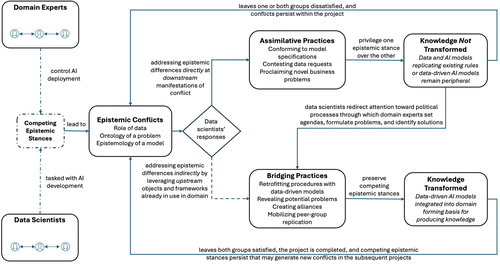
Epistemic Conflict from Competing Epistemic Stances
Given their different epistemic stances, the domain experts and data scientists had very different approaches to developing and using AI applications. They both expected AI to improve work in the banks, but they disagreed on how to do so. The domain experts expected to use AI models to implement solutions in response to performance shortfalls. They used data to help identify the issue causing the performance shortfall and then build common knowledge around a problem definition and a potential solution. Domain experts then expected data scientists to build a model to implement their solution. Data scientists, in contrast, used AI for exploratory analyses to identify unrecognized patterns in the data they had accumulated. They expected to create new models that would help the domain experts improve their practices. These competing epistemic stances led to conflict over the role of data, the epistemology of a model, and the ontology of a problem. (Table 6 summarizes the two epistemic stances and the conflict that followed from them.)
|
Table 6. Competing Epistemic Stances and Epistemic Conflict
| Dimension | Domain-anchored epistemic stance (domain experts) | Data-inducedepistemic stance (data scientists) | Epistemic conflict |
|---|---|---|---|
| Domain of inquiry | Occupationally situated procedures: Organizationally recognized deviations from codified decision rules, budgeted thresholds, policies, and performance expectations surfaced through dashboards and deliberation. | Behaviors and relations captured in data: Digitally captured behavioral traces, relationships, segments, propensities, and opportunities not yet visible in existing monitoring infrastructures or procedural categories. | Ontology of a problem: What counts as a problem worth investigating, and how should the problem be formulated? |
| Style of reasoning | Deductive: reason from established rules, categories, thresholds, and causal narratives toward a problem definition and solution space. | Inductive: reason from statistical regularities, associations, and predictive patterns toward provisional problem and solution candidates. | |
| Mode of investigation | Monitoring and deliberation: use dashboards, scorecards, data cuts, and domain-based reviews to compare what is happening with what should be happening. | Exploration and experimentation: use feature engineering, exploratory analysis, algorithmic search, and model iteration to discover what could be happening. | Role of data: Are data a form of monitoring infrastructure or a generative substrate for discovery? |
| Mode of evaluation | Common ground and reliability: a good AI model inscribes agreed upon decision rules, performs predictably within existing workflows, and is auditable and explicable to front-line teams, so it holds up as evidence in the deliberation where domain experts build common ground. | Predictive validity: a good AI model maximizes accuracy, precision, and recall on held-out data with variables determined empirically rather than assumed from existing rules. | Epistemology of a model: What makes an AI model a good warrant for action? |
| Assumptions about what can be known and how | Truth lies in knowledge that reflects procedurally authorized categories, monitored deviations, and causal narratives that domain experts can defend and enact. | Truth lies in knowledge that reflects statistical regularities explicating raw patterns in data and robust and scientific modeling practices enacted by data scientists that facilitate discovery and resolution of novel problems. | Cross-cutting foundation of all three forms of conflict. |
Conflict over the Role of Data.
Both domain experts and data scientists followed an empirical mode of investigation, but they used data in very different ways. Domain experts used data to monitor and evaluate performance. A domain expert at BetaBank explained, “My work requires my engagement with several activities, but the most significant issues I need to attend to are the ones in my dashboard. These are the parameters that also form part of my performance appraisal. If I manage these parameters well, my job is done. But it is tricky because you never know if you can trust the data in these manual scorecards” (interview, Beta-DE1).
The quote demonstrates two significant aspects of the role of data in the domain experts’ epistemic stance. First, the domain experts used dashboard data to monitor and investigate the bank’s performance. For instance, the domain experts used their experience and expertise to establish the bank’s credit policy, which dictated an appropriate ratio of secured and unsecured loans. That ratio became a key parameter that the domain experts used to track actual performance.
Second, when a dashboard signaled a potential problem, the domain experts gathered more data, making what they called “data cuts” as they formulated statements of the performance problem and identified possible solutions. A domain expert at AlphaBank explained the importance of data: “Our decisions depend a great deal on data. Every time we make a decision to change direction or strategy, it is always backed by data, which help us figure out what the problem was in the first place. If you attend our meeting, you will see that everyone is debating based on the data they have. I have been using data for a long time in order to build my arguments” (informal interview, Alpha-DE2).
These data cuts served as boundary objects between domain experts seeking to develop a statement of the problem and identify possible solutions. For instance, if a dashboard flagged a performance shortfall, the domain experts asked the data scientists for granular data to help them build their case in debates over why the performance had changed. They used these data to evaluate their competing claims as they tried to arrive at common ground on the cause of the problem and on the proposed solution.
In contrast, the data scientists used data to generate discoveries. They searched the banks’ servers and data warehouses for data that might reveal hidden relationships. For the data scientists, discovering new relations in the data made their work exciting. A modeler on the attrition project explained, “I love feature engineering. You see, in this model I created 300 features from the initial variables. So I included all the possible combinations that allowed me to build a nice model even if the data were not normal. This is the activity in which I usually spend most of my time. It is actually wonderful to see how you can extract information from data using these machine learning algorithms by tweaking parameters and creating new features. The best part is that I don’t need to decide this up front” (interview, Alpha-DS2).
The quote reveals two aspects of how the data scientists used data as part of their epistemic stance. First, they valued data as a potential source of new information that they captured as digital traces of relationships within the data. Second, extracting information from the data depended on inductive reasoning as they identified characteristics of the data that could predict outcomes. These data-derived relationships produced provisional new knowledge on which the bank could act. For example, rather than treating customer age as a single continuous variable, the data scientists could divide the variable into discrete data-driven bins (e.g., age ranges) and then combine those bins with other variables such as tenure and balance patterns to generate features that could be used in a model to predict whether a customer was likely to leave the bank.
Although both the domain experts and data scientists used an empirical mode of investigation, their approaches differed. Domain experts used data within existing procedures as a resource for confirming or questioning what should be. They used dashboards and data cuts to evaluate competing claims, so data served to build common ground by either supporting or challenging existing claims to knowledge. For data scientists, data were a resource for revealing what could be. Data scientists used data to generate discoveries. They relied on feature engineering, exploratory analysis, algorithmic search, and model iteration to discover what could be happening through inductive and inferential reasoning and then evaluated their discoveries for their predictive validity.
These differences erupted in overt conflict. The data scientists resented the data extraction projects (see Table 3). On these projects, when domain experts needed data to build common ground, they turned to the data scientists to provide dashboard data or data cuts. Data scientists called these projects “shit requests.” Conversely, data scientists would spend considerable time exploring data at the beginning of any new project. The domain experts dismissed the data scientists’ quest for discoveries as “blind explorations.” Neither group appreciated how the other group used data.
Conflict over the Ontology of a Problem.
Both domain experts and data scientists focused on business problems, but their competing epistemic stances meant that they disagreed on how to identify and formulate a problem. For the domain experts, data showing a gap between expected performance budgeted at the beginning of the year and actual performance tracked monthly signaled a potential problem. When dashboards and data cuts showed a persistent gap, the domain experts used deductive reasoning to test different theories of what caused the shortfall. The next best products (MB12) project at AlphaBank illustrates their approach. The problem surfaced from the portfolio intelligence dashboard (DX6) for high–net worth customers who had dedicated relationship managers (RMs) for their business and family needs as a group. The dashboard tracked each client group’s product mix with the bank (savings and current accounts, personal and business loans, mortgages, and credit cards). The project followed a theory that the bank should try to deepen the relationship with high–net worth client groups through a larger portfolio of products that would increase the likelihood that the clients would stay with the bank. The dashboard showed that experienced RMs consistently achieved balanced portfolios—and, hence, deeper relationships—whereas junior RMs lagged. Domain experts from three different functions—the regional branch banking team, the regional human resources team, and the central relationship banking product team—gathered to formulate the problem. The domain experts spent several weeks working together, testing both their understanding of why the junior RMs lagged the senior RMs and identifying possible responses. When they agreed that the senior RMs had better customer relationship expertise than the junior RMs, they proposed a solution that would embed the expertise of the senior RMs in an AI model that the junior RMs could use. Then they turned to the data scientists.
In contrast, for the data scientists, problems emerged from independent exploratory analysis that used inductive and inferential reasoning on projects that they chose. As one modeler explained, “I love working on our own projects. We are free to explore as much and in whichever direction we want. We focus on each minor detail to build the best possible models that we can, given the data… It feels like working in a start-up, you know. You make mistakes, you learn, and you grow” (interview, Alpha-DS4).
Data scientists preferred to initiate their own projects and identify novel insights without the bias of the domain experts’ proposed models. They sought patterns in the data that produced a predictively valid model. The patterns could then be used to identify possibilities that the domain experts had not seen.
These differences emerged in covert conflict that took one of two forms. When domain experts originated a project, they sought to produce reliable outcomes against a clear standard of performance. When performance did not meet that standard, they used their domain experience and expertise to work through their differences, reconsider their procedures, and arrive at a revised understanding of how to produce the outcomes they wanted. Only after they were confident that they had defined the problem and identified a solution space did they turn to the data scientists to help implement the solution through an AI model. The data scientists thought that the domain experts’ approach to these projects introduced biases, leading to less-valid models. The data scientists believed they needed to thoroughly analyze the data themselves so that the biases were not built into the AI models. For example, when the domain experts asked the data scientists to build a model as part of the next best products (MB12) project, the data scientists welcomed the goals of predicting which products to sell to which customers. However, rather than trying to build a predictive model based on the senior RMs’ tacit (and presumably biased) knowledge, the data scientists wanted to use machine learning algorithms to identify performance patterns directly from data on client behavior.
Conversely, when the data scientists pursued their own projects, they turned to the domain experts only after they were confident that they had a clear pattern with predictions that had implications for firm performance. Yet, when the domain experts encountered those projects, they could not see the significance of what the data scientists had identified as a problem. They argued that the data scientists were “making the problems up” or solving problems that “did not exist.” As a domain expert (Beta-DE2) said, “If you come and say that, look, this is a new thing we never pursued before, I would most likely tell you that we did not pursue it for a reason.”
Conflict over the Epistemology of a Model.
Finally, whereas both groups agreed that AI models could help their bank, they disagreed on how a model should be built and what it should do. Domain experts used models to ensure reliable performance on important bank outcomes within established domains of inquiry such as loan underwriting. These models helped build common ground for expectations about what should be happening in a business domain: which customers were creditworthy, what level of risk was acceptable, what portfolio mix was desirable, what sales targets were reasonable, and which deviations required attention. They then evaluated the model to ensure that behavior fit their rules. When outcomes or behavior deviated from expectations, they returned to the model to understand the deviation, its causes, and how the model should be revised. The underwriting automation project (MB1) illustrates their approach. When underwriting outcomes deviated from expectations, the domain experts examined the existing process to understand where and why the deviations occurred. They used the process to transform their knowledge and build common ground around a new underwriting model that they believed would produce reliable outcomes. Only then did they ask the data scientists to encode it in an AI system.
In contrast, data scientists evaluated models for their predictive validity. On their own projects, data scientists tried to discover relationships in the data through an unbiased, exploratory mode of investigation. The attrition prediction model (MB4) illustrates the process:
[A data scientist] started by first defining what attrition means, i.e., a drop in savings account balance by x% [e.g., 50%] in y period [e.g., 3 months] compared with z period [e.g., past 6 months]. Having defined the dependent variable (DV), she started exploring the data using various charts and summary statistics. Based on the visual analyses, she identified a set of variables that seem to be correlated with customer churn behavior. She then applied various feature engineering techniques to preprocess the data, which she collected from various sources. She created approx. 300 features from the given variables and then started modeling with Random Forest, a machine learning algorithm. In doing so, she went back to the definition of DV and tweaked it to explore it further. Many times for a single iteration the computer would take 12–14 hours to run the code. She would then have a look at the results, interpret the results, see which variables were significant, compare the results from the previous iteration, tweak some parameters, and run the code again. Overall, she was very happy with a model that she developed that took her about 5 months. (field notes, Alpha-DS2)
Unlike the domain experts, who selected only a small set of continuous predictors for their models, the data scientists’ “brute force” approach used machine learning to search for patterns in the data systematically and exhaustively. They let algorithms induce useful predictors through feature engineering, creating, transforming, and combining variables to surface a signal before fitting a model.
These differences emerged in another covert form of conflict. The data scientists argued that the domain experts’ rules embedded existing biases in the models, compromised the “fidelity of the models,” and led to weaker predictive validity. They resented having to replicate what they saw as the domain experts’ biases in their models. Yet, when the data scientists built models through their exploratory investigations, the domain experts struggled to see how those models could produce the reliable outcomes that they needed. The domain experts ignored or rejected these models, saying that the predictions made “no sense.”
Assimilative Practices
Given that domain experts controlled whether AI models entered their ongoing work, the burden of finding a way through the conflict fell largely on the data scientists. They initially responded to the epistemic conflict with three forms of what we label assimilative practices: conforming to model specifications, contesting data requests, and proclaiming novel business problems. Each assimilative practice responded to the conflict by choosing the epistemic stance of one group over the other. These assimilative practices all focused on the project output or artifact—the AI model, the dashboard, the data extract, or the problem proposal—at the epistemic boundary between domain experts and data scientists. (See Table 7.)
|
Table 7. Assimilative Practices
| Salient epistemic conflict | Assimilative practice | Type of project | Assimilative mechanism | How assimilation often failed to transform knowledge | Exemplar projects |
|---|---|---|---|---|---|
| Epistemology of a model | Conforming to model specifications | Domain-expert-initiated projects in which the problem and solution were already specified through deliberation before data scientists were engaged. | Supporting domain experts. Data scientists yield to domain experts’ specifications and build models that replicate existing decision rules, predictors, and solution logic rather than pursuing data-induced discovery. The epistemic conflict is addressed at the output: predictive validity is subordinated to procedural reliability. | The model automates existing knowledge rather than altering what domain experts monitor, recognize, warrant, or enact. The domain-anchored stance remains intact, whereas the data-induced stance is absorbed into it. The conflict is suppressed rather than resolved and resurfaces in later iterations. | MB1, MB6, MB10, MB12 (initial iterations) |
| Role of data | Contesting data requests | Data-extraction requests routed to data scientists by domain experts: dashboards, ad hoc data cuts, and routine monitoring support. | Not supporting domain experts. Data scientists refuse data requests that position them as providers of monitoring infrastructure, treating such requests as a reduction of data science to data extraction or delivery science. | Domain experts route requests back to IT or in-house analysts, leaving the role-of-data conflict unresolved within the project. Refusal protects the data-induced stance but isolates it from the political practices through which domain experts set agendas, formulate problems, and identify solutions. | DX1–DX8 (initial refusals) |
| Ontology of a problem | Proclaiming novel business problems | Data-scientist-initiated projects in which statistically validated discoveries are presented directly to domain experts as warranting joint action. | Claiming epistemic control. Data scientists treat predictive validity as sufficient warrant for problem candidacy, presenting model outputs and discovered patterns as business problems that domain experts should recognize and act on. | The practice produces stalled or orphaned AI models. The model may be analytically valid, but it does not enter the work of domain experts as they did not recognize the discovered problem as relevant to ongoing work. | MB4, MB7, MB8, MB9 (initial proposals); MB11, MB13 (serendipitous exceptions) |
Conforming to Model Specifications.
In conforming to model specifications, the data scientists built the model that the domain experts wanted. This move appeared most clearly on projects initiated by domain experts (MB1, MB6, MB10, MB12). The domain experts saw these as obvious projects. They had already formulated the problem and identified a solution that would reliably produce the outcomes that they wanted. A product manager on the underwriting automation project (MB1) at BetaBank explained, “We have a robust underwriting process in the bank. In fact, we have won awards for the best-in-class personal loans portfolio. We have only been able to do so because of our expertise in this domain. We know what the customers want and which customers are worthy to be granted the loans. Each new application goes through robust scrutiny through our underwriting process. For data scientists, it’s an easy job, a no-brainer. They just need to replicate the process in their model” (informal interview, Beta-DE6).
Initially, data scientists often did what the domain experts wanted. They worried that they would lose the work if they insisted on using their discovery-oriented, data-driven approach. Nevertheless, the data scientists resented these requests. For them, replicating a model with rules and variables that the domain experts had already specified produced analytically hollow models. The data scientist on the underwriting project (MB1) explained,
It has been very hard to work on this underwriting project, not because it is a complex model or anything, but because I can’t do anything that I would love to in this project. For this project, they don’t need data scientists. Ideally, I like to let the data speak. However, in this case, the product team wants us to replicate their existing underwriting process with the set of predictors. If I follow the instructions, I am going to create a very similar model to what they already have, with the only change of it being automated. Following this path, I will never get my hands dirty with the data and, hence, I will never find any novel insights. (interview, Beta-DS3)
For the data scientists, replicating an existing model produced an inferior model and also baked the domain experts’ assumptions into the model. That foreclosed opportunities to discover better predictors––the very reason the data scientists had been hired. By conforming to model specifications, data scientists reduced immediate friction over the model, but by following the domain experts’ epistemic stance, they produced a limited model that reproduced existing domain knowledge. The underlying disagreement over how a model should be built and evaluated remained unresolved and could resurface when the model was revised or redeveloped.
Contesting Data Requests.
In this practice, the data scientists held fast to their approach to data and rejected the domain experts’ requests for data extraction or dashboard support. In the past, domain experts had asked the banks’ IT teams to produce these data cuts. When data scientists were hired, domain experts asked them to build dashboards for savings accounts (DX1), current accounts (DX2), personal loans (DX3), business loans (DX4), life insurance (DX5), portfolio intelligence (DX6), and rejection analyses (DX7). They also asked data scientists for ad hoc data cuts (DX8) to provide reliable data for their deliberations. A domain expert explained, “When I request the Management Information Systems guys in my team for any analysis, I also ask them to share with me a raw data file. I always want to see where they are coming from in order to form my own opinion. Now, with the data science folks, it is much better to get the right data swiftly, whenever we need” (informal interview, Alpha-DE2).
Data scientists resented the data extraction projects. For example, we observed the head of the data science team challenge the vice president of a business domain in a heated argument about these requests: “You know, the bank has not hired us for this. We don’t run a data center. You should place these requests with the IT team. We are here to help you with building models that can help in making better decisions” (field notes, Beta-DS1).
These projects conflicted with the data scientists’ epistemic stance that used data for discovery and model building. The data scientists also feared that repeated extraction work would relegate them to upgraded IT service work and make them peripheral to knowledge production at the banks. They said those projects were “just delivery science and not data science” and said that “we can easily extract data, but should we? That is not our job!”
Contesting data requests protected the data scientists’ exploratory mode of inquiry by insisting that data practices follow their epistemic stance. The data scientists viewed the domain experts’ data requests as a selective examination of the phenomena, which reinforced existing biases. Refusing the requests protected the data scientists’ standards but did little to alter the domain experts’ work: domain experts could continue obtaining the data they needed from IT specialists. Instead, it isolated data scientists from the domain experts’ problems. The data scientists could not participate in building more accurate models, and yet the disagreement over how data should be used remained unresolved.
Proclaiming Novel Business Problems.
By proclaiming novel business problems, the data scientists embraced the conflict and treated their discoveries as valid business problems that domain experts should appreciate. The data scientists engaged in this practice when they presented discoveries from their own projects (MB4, MB7–MB9) to the domain experts. They believed that their methods produced models with actionable knowledge that the organization could use. The path to the attrition project at AlphaBank (MB4) illustrates the process: “Before this attrition project, I spent quite some time with the data to see overall balance movements in the savings and current account bases. After spending several months, I realized that a similar problem was already being addressed by the asset-liability matching team; hence, I did not pursue it further. But then I started working on this attrition project. This has never been done in the bank before. If this project goes through, it will put me on the map, on the appraisal scorecard of my superboss” (informal interview, Alpha-DS2).
As the quote indicates, the project began with the data scientists’ exploratory analyses of liability movements (MB3). That project yielded patterns in the data, and the data scientists began building an AI model. They dropped that project when they learned that the bank already tracked liability movements. Nevertheless, their work surfaced the possibility of predicting customer attrition, an adjacent problem that the bank had not recognized. That led to the attrition prediction project (MB4), and the data scientists built a model to predict which savings account customers were likely to leave the bank.
Similar projects occurred at other banks. On the household mapping project (MB8) at GammaBank, the data scientists used text analytics and other algorithms to infer family units in data on the customer base so that the bank could propose offers to households instead of individuals. On the forex offerings project at GammaBank (MB9), the data scientists combined behavioral signals such as country visa applications and travel-related expenditures to identify potential demand for foreign exchange products that the domain experts’ monitoring processes had missed.
Although these projects risked making jurisdictional claims over problem definition, the data scientists did not try to take over the domain experts’ jobs. Instead, they believed that the predictions had implications for the domain experts’ interests. However, domain experts defined problems through their procedures to address performance shortfalls. The problems the data scientists identified did not fit those procedures. For example, the domain experts rejected the attrition prediction project (MB4):
The domain expert explained that they had been very aggressive in their sourcing of savings accounts for several years. In particular, AlphaBank had spent its last decade in increasing the savings accounts share of total deposits from 6% (in 2008) to 30% (2018). The targets for the front-line executives were usually steep, and hence, they expected that, along with the quality accounts, some junk will also enter the system. This was an agreement among all business teams and sourcing channels. They were not worried about the junk as the system eventually threw it out. They did not see value in the attrition-prevention logic as they considered it illogical to try and retain the junk. (field notes, Alpha-DE1)
The domain experts did not see attrition as a problem to track. Their aggressive strategy of growth would bring in what they called junk: low-value accounts for customers that they expected to leave. They expected their strategy to produce attrition.
Proclaiming novel business problems preserved the data scientists’ epistemic stance, but domain experts controlled whether those problems entered the business agenda and whether the models were used. Data scientists could not demonstrate the value of their discoveries, and domain experts described these projects as “non–value–adding activities” that were a “waste of time.” The domain experts left the data scientists’ models orphaned.
The Limits of Assimilation.
When data scientists encountered epistemic conflict, they initially responded to the downstream manifestation of the conflict directly by focusing on the output of their work: the models, the data requests, and the problems they identified. Each of these assimilative practices responded to the conflict by choosing one epistemic stance over the other. When the data scientists built models that conformed to the domain experts’ specifications, they subordinated predictive validity to the domain experts’ biased knowledge. When they contested the domain experts’ data requests, they chose predictive validity over providing potentially biased data. Finally, when they defined problems based on their valid models, they again chose predictive validity but could not change existing practice. The assimilative practices either reproduced existing domain knowledge or left the data-induced insights of the data scientists isolated from ongoing domain work.2 The differences in how the two groups produced and evaluated knowledge remained unresolved, and the epistemic conflict persisted.
The Politics of Dependence
The burden of addressing the epistemic conflict while preserving both epistemic stances landed with the data scientists. The two groups held comparable organizational status, but the domain experts held more power than data scientists. Data scientists developed the models, but the domain experts determined whether, when, and how those models entered ongoing domain work. The domain experts wanted the data scientists to automate their practices, but given their epistemic stance, they did not think that increased predictive validity justified changing the established specifications and procedures. The domain experts could also work without the data scientists. For data requests and dashboard work, the domain experts could turn to IT specialists as they had done in the past. The data scientists, in contrast, depended on the domain experts to implement their data-derived models, so they needed to persuade the domain experts of the value of models with better predictive validity. And data scientists did not want jurisdiction over the domain experts’ work. As the head of data science at BetaBank said, “We don’t want to do their job; we just want to make sure that they leverage AI meaningfully.”
As data scientists accumulated experience across projects, they began to recognize the political dynamics as the domain experts set agendas, formulated problems, and identified solutions. The next best products initiative (MB12) illustrates these dynamics. As described above, the project originated as the domain experts identified a performance gap between senior and junior RMs. Three domain leaders spent weeks presenting their theories about the gap and developing a problem formulation and a solution space that all three could accept. A brief segment from our field notes describes both the causal theory that each of the three domain experts held and the tentative solution each proposed.
Regional branch banking head:
Cause: By pointing to the data cuts, the regional head inferred this as an issue of how the book was allocated. He argued that senior RMs hold legacy clients with richer product depth; junior RMs are inheriting thinner books. This is evident from the data.
Tentative solution: He suggested revisiting assignment rules and rotation: seed junior RMs with a minimum balance of multiproduct clients; cap the proportion of single-product accounts in any junior RM’s book.
Regional human resources manager:
Cause: By pointing to the skills and experience curve, the HR manager identified this as an issue of skills. She pointed to the hiring data on difficulty in hiring RMs with the required skills.
Tentative solution: She suggested developing a structured training and shadowing program: a two-week module on life cycle selling paired with ride–alongs.
Central relationship banking product manager:
The relationship banking manager did not agree with these diagnoses from the other domain experts, but more importantly, he did not see the solutions to be feasible. He proposed an alternative cause and solution.
Cause: The product manager argued that senior RMs use tacit rules; they “know” what’s next; junior RMs don’t. He referred to the data cuts, which showed how senior RMs went from one product to three in much shorter windows than the junior RMs. He disagreed with shuffling the portfolio, while he agreed with the training, but cautioned that it would take a very long time.
Tentative solution: He suggested capturing senior RMs’ expertise in an AI model: a next-best-product engine to guide junior RMs immediately, then use the same outputs as a training asset. (field notes, Alpha-DE1/2/3)
The field notes reveal two aspects of how domain experts set agendas and solved problems that the data scientists’ assimilative practices overlooked. First, the summary shows the political deliberations as the different domain experts interpreted the same performance gap through their different jurisdictional interests and understandings. The regional branch banking head focused on product assignments, the regional HR manager focused on the training procedures, and the product manager focused on the variance in product knowledge. In practice, however, the RMs coordinated across all three elements: the product assignments controlled by the branch banking head, the training controlled by the HR manager, and the product knowledge controlled by the product manager. If they did not perform those procedures reliably, they would not get the outcomes that they expected. The domain experts therefore used their negotiations to develop common ground around a problem statement, a solution, and revised procedures.
Second, the domain experts depended on the dashboards and the data requests as inputs into their work of setting agendas and solving problems. The problem formulation began when the dashboard flagged a potential problem, and then, as the summary shows, each domain expert relied on data cuts to support their arguments. The regional branch banking head presented evidence on the RM book size, the HR manager presented data on RM skills at hiring, and the product manager presented data on the differences in how quickly the junior and senior RMs increased their product portfolio. As the data scientists accumulated experience across projects, they realized that the domain experts depended on these objects and frameworks to build common ground. This shift became the basis for the bridging practices that the data scientists developed to address the epistemic conflict without getting drawn into jurisdictional conflict.
Bridging Practices
As they recognized the politics of the domain experts’ agenda setting and problem solving, the data scientists developed what we label bridging practices. Unlike assimilative practices, which addressed the downstream manifestations of epistemic conflict directly, bridging practices addressed the conflict indirectly. The data scientists used bridging practices to change where, when, and how they intervened to make knowledge transformation possible. We observed four bridging practices: retrofitting procedures with data-driven models, revealing potential problems, creating alliances, and mobilizing peer-group replication. (See Table 8 for details.) These practices used the boundary objects, procedures, relationships, and comparisons that domain experts already used to notice problems, evaluate solutions, and build common ground.
|
Table 8. Bridging Practices
| Salient epistemic conflict | Bridging practice | Type of project | Bridging mechanism | How bridging transformed knowledge while preserving both stances | Exemplar projects |
|---|---|---|---|---|---|
| Epistemology of a model | Retrofitting procedures with data-driven models | Domain expert– initiated projects with a prespecified solution; problem is already defined, and the AI model is expected to inscribe an existing rule set. | Temporal decoupling. Iteration 1: data scientists deliver a procedurally legible model that inscribes domain experts’ agreed rules and thresholds and ship it as the solution. Iteration 2: once the model is in production and domain experts’ attention has shifted, data scientists substitute a data-induced model (learned features, inductive thresholds) beneath the same artifact name, interface, and operational workflow. | Procedural reliability and common ground among domain experts govern the artifact boundary visible to domain experts; predictive validity governs the model underneath. Domain experts continue to act through an accepted solution space that reflects their common ground, but the knowledge informing those actions shifts from replicated rules to data-induced relationships. | MB1, MB6, MB10, MB12 |
| Ontology of a problem and role of data | Revealing potential problems | Data scientist– initiated projects in which a statistically valid pattern lacks procedural recognition. | Embedding via dashboards and durable data objects already in use in domain. Data scientists insert new performance parameters into dashboards alongside requested parameters, so domain experts encounter data-induced discoveries through their own monitoring routines. Alternatively, they seed novel data objects (e.g., Family ID) permanently into data repositories. | Domain experts continue to rely on monitoring and deliberation. Previously unrecognized relationships and potential problems enter routine monitoring and, when noticed, change what domain experts treat as a problem or opportunity worthy of deliberation. | MB4, MB7 (dashboard parameter insertion using DX1–DX5); MB8 (durable data object seeding using DX6–DX8) |
| Creating alliances | Data scientist– initiated projects with a clear discovery but no organizational sponsor. | Partnering with receptive insiders. Rather than persuading all relevant domain experts, data scientists supply validated models and evidence to a single insider: a data-savvy line manager who owns the relevant metric, or a high-status support manager who has influence but lacks data to advance an agenda. The insider carries the discovery into domain experts’ political processes. | Data scientists retain modeling standards and epistemic stance independence. A domain insider introduces the discovery into domain expert deliberations, in which it changes the organizational agenda, the evidence available to domain experts, or the action they collectively support. | MB9 (data-savvy line manager); MB14, MB15 (high-status support managers) | |
| Ontology of a problem and epistemology of a model | Mobilizing peer-group replication | Data scientist–initiated projects that travel laterally from a proven implementation. | Cross-domain comparisons. After a data-induced model succeeds in one unit, data scientists circulate a short success-story deck to peer units competing for the same senior managers’ attention. The adjacent unit pulls the model in to avoid falling behind, bypassing the local problem-recognition sequence. Data scientists, thus, change how demand for the model arises rather than directly resolving the epistemic conflict. | Peer success changes what the receiving unit recognizes as a relevant problem or opportunity and provides a comparative warrant for action before local monitoring and deliberation have occurred. Data scientists retain modeling latitude, while domain experts justify action through cross-unit comparison. | MB2 (replicated from MB1); MB5 (replicated from MB4) |
Retrofitting Procedures with Data-Driven Models.
Retrofitting procedures addressed the conflict over the epistemology of a model by separating the epistemic stances of the two groups over time. Data scientists would first build and implement the model the domain experts requested and then, when the domain experts turned their attention elsewhere, replace it with a new, data-driven model. This pattern appeared in domain expert–initiated projects (MB1, MB6, MB10, and MB12), in which the domain experts had already defined the problem and decided what they thought was a good model, leaving the data scientists no opportunities to refine the model. Rather than contesting either the domain experts’ jurisdiction or the epistemology of their models, the data scientists learned to build a bridge from the domain experts’ proposed model to a model with better predictive validity.
The practice proceeded in three stages. First, the domain experts would build common ground around the problem and the solution space: the decision rules for the model, the independent variables that mattered, and the relationships between independent and dependent variables. Second, the data scientists developed an AI model that embedded those rules. A modeler on the MB1 project explained, “In the first round of this underwriting project, I had to include some variables that did not make sense, and I did not have much time to tune the parameters and try different algorithms. But I had to do it; otherwise, the project would not have proceeded” (informal interview, Beta-DS10).
Once they had built the model the domain experts requested, the data scientists demonstrated to the domain experts that it accomplished what they needed. For example, in the MB1 project, the data scientists reported the performance indices for the model—model accuracy, precision, and recall—and presented diagrams that showed which variables—credit utilization, debt-to-income ratio, or income, for example—had the greatest influence on the model’s decisions. Once the domain experts accepted the data scientists’ model, it was integrated into the bank’s loan-sourcing system. Then, as a modeler said, “You got to wait for your moment.” Third, when the domain experts shifted their attention to other concerns, the data scientists had their opportunity. The MB1 modeler explained:
After the project was in production and the model started working, the product team was happy and no longer bothered about what I was doing with the model in the background. …I tried many different things and developed a much [more] robust model on my own. I waited till the existing model decayed and then proposed this new model. The decay, in fact, helped me in highlighting the need for change. This time, since the project was already in production, they did not bother much with the specifics of the model so far as I could show it performing better than the previous model. (informal interview, Beta-DS10)
The new model worked within the domain experts’ solution space—the same business problem, the same workflow, and the same parameters for evaluating the model—but within that space, the data scientists could introduce different features, algorithms, and relationships with better predictive validity.
Domain experts who appreciated data-driven approaches also proposed this temporal decoupling strategy to preserve the two epistemic stances (projects MB10 and MB12). For example, the regional branch banking head on AlphaBank’s next best products project (MB12, described above) thought that the data scientists’ methods could extract better customer insights than the senior RMs’ experience would provide. He proposed that the data scientists move tactically: “We first need an automated model that predicts the next best products based on what the senior RMs feel. Once we have the model, the line managers will be happy and will then carry on with their other agendas. That would be the moment for experimenting with different possibilities. Can AI tell us which next products would be best for our customers without listening to the RMs? That would be cool!” (interview, Alpha-DE1).
Retrofitting AI models was opportunistic. On the projects we observed, data scientists used retrofitting only after domain experts had accepted the initial model and shifted their attention to other problems. Data scientists sometimes found themselves “waiting forever” for that right time. Moreover, data scientists could change the models to include independent variables with better predictive validity inside the solution space, but they were still constrained by the problems and dependent variables that the domain experts had defined. When the data scientists developed models that redefined the dependent variables or business problems, they explored other ways to transform knowledge.
Revealing Potential Problems.
Data scientists learned to address both the conflict over the ontology of a problem and the role of data by embedding evidence of the problem in dashboards or durable data objects. With this practice, the data scientists stopped trying to proclaim a novel business problem as they had with the assimilative practices and let the domain experts encounter the problem through their monitoring routines. The practice emerged from the dashboard automation projects (DX1–DX7) that the data scientists initially resented. A reporting analyst on the data science team explained, “If you want the business managers to take some action on your reports, you need to find a way to influence their business [agenda]. While preparing the dashboards for business, I often try to add a few new parameters in the composite view. Sometimes it triggers action” (interview, Alpha-DS11).
Rather than treating the dashboards as static spaces defined by the domain experts, the data scientists turned them into dynamic spaces. They provided the parameters the domain experts wanted and then added evidence from their own discoveries. The dashboards served as epistemic objects that made the data scientists’ predictions evident to domain experts. That gave the domain experts the opportunity to build common ground across their interests and agendas with boundary objects that they already used.
The data scientists on the attrition prediction project (MB4, described above) used this tactic to transform the domain experts’ understanding of customer attrition. The data scientists had built a model to predict which customers were at risk for leaving the bank, but the domain experts dismissed the predictions. The domain experts argued that they had developed a campaign of aggressive growth, so they naturally expected to lose some poor-quality accounts. On an unrelated project, the domain experts asked for a savings-product dashboard (DX1). The data scientists saw an opportunity to introduce an epistemic object that would make their predictions visible. They built a dashboard that included the parameters that domain experts had requested and then quietly added a new tab tracking current and projected balance movements for the top 10% of customers. That tab revealed that, in addition to the marginal accounts, the bank was also losing high-value accounts. Senior managers realized that attrition was a problem. The next year, “attrition control” appeared on the business agenda, and the data scientists could deploy their model.
Another approach introduced novel data objects that revealed opportunities when the data scientists’ projects cut across domains within the bank. For example, at GammaBank, data scientists had proposed a household mapping (MB8) project. They had used text analytics and other AI algorithms to identify a significant number of customers whose family members also had accounts with the same bank. The data scientist responsible for the project explained,
Based on my analysis, I identified a good-sized customer base to work on. This spanned the boundaries of traditional product teams as one customer can have a savings account, but their family member can have a fixed deposit with us and so on. For this project to go live, all related product teams will need to sign it off. The data were lying there for several months, but business did not pick it up as each business team had its own focus and varying perspectives on how to move forward. The project did not kick off as is. What we were able to do, though, was to create a new field of family ID in the data warehouse. So, wherever applicable, each existing account as well as each new account opened gets assigned a family ID. Since this is a permanent field, the business managers are also able to see it from their own data extraction, and it by default becomes part of the projects they are working on. (interview, Gamma-DS9)
The data scientists had already proposed multiple projects to develop customized products for families instead of individual customers, but the bank had dedicated RMs who handled a high–net worth customer portfolio for customers grouped by family. The data scientists’ proposal was different: it brought together customers who did not yet qualify for high–net worth grouping but could bring more value if they were offered group-specific products and services. Rather than trying to get the domain experts to accept their proposal, the data scientists developed a permanent data object, “Family ID.” The Family ID created a potential boundary object that could be visible across multiple domain teams, operating within their monitoring infrastructure. Any time a domain expert requested a data cut, the data extracts would then include the Family ID that surfaced opportunities from this category of customers. Any domain expert who recognized an opportunity could then initiate a project to design customized family products.
Revealing potential problems changed what the domain experts could see through their existing monitoring arrangements. Attrition became a parameter that mattered to the domain experts. When the domain experts saw the balance movement of the high-value customers on the savings accounts dashboard, they could choose to work out the differences in their interests themselves. Household opportunity became a category of customer that the domain experts could monitor when the Family ID appeared in the data warehouse. Data scientists preserved their epistemic stance, and they could continue to use data to create models that revealed new problems. And domain experts could see the consequences through the data in their monitoring processes and then use those data to transform knowledge as part of their own epistemic stance.
Revealing potential problems did not guarantee action. It worked when domain experts noticed the data and chose to pursue the problem or opportunity. But the data scientists’ discoveries no longer arrived as challenges to the domain experts’ perceptions. Instead, the data scientists’ discoveries arrived through epistemic objects that invited the domain experts to work out their own differences through their political processes.
Creating Alliances.
Data scientists also learned to build alliances with domain experts who would champion their discoveries. The data scientists supplied validated models and evidence, whereas a domain expert served as a broker who could build common ground with other domain experts. These alliances took two forms. Sometimes, data scientists built alliances with domain experts who were motivated to champion their projects. For example, on the forex offerings (MB9) project, data scientists had built a model that identified behavioral signals—payments for travel visas or purchases from merchants selling travel-related products or services—that revealed customers who would need the bank’s foreign-exchange products. However, the branch banking sales teams were performing well, so they saw no need for the project. Then, a foreign exchange product manager learned about the project. He used the data scientists’ model to get senior managers to put the project on the agenda. A data scientist at GammaBank explained,
I worked on this intensive project on forex, where I explored various keywords to identify customer behaviors related to their foreign travel or purchases. I built a great solution for a forex campaign. However, the solution was not executed [by the business]. I had no visibility on what happened with the campaign until last year, when the forex product was under the radar, and it was made the product of the year by senior management. Only then, they ran a dedicated campaign on the same data [based on the model she prepared] that I shared earlier… This happens many times. You work on something, build a model, share insights, but then it is just lying there. You need to find those moments when the product [team] is ready to look at it. (interview, Gamma-DS4)
After that experience, the modeler learned to look for insiders who were open to the data scientists’ methods and who could influence how the senior managers viewed a problem.
Data scientists also sought sponsors in high-status support groups who had influence but lacked data to advance their agendas. For example, in the Extracting Customer Feedback from Customer Relationship Management (CRM) System project (MB15), the data scientists applied text mining methods to an open-ended CRM field on reporting documents. The field provided evidence on how customers had responded to the specific products and services that the RMs delivered, but the bank had long ignored it. When the data scientists compared the responses across customer groups, RMs, and geographies, they uncovered unique patterns in how customers responded to specific products and services the RMs delivered. Their analysis linked those patterns to whether the customers pursued the products and services. The data scientists expected that the product managers operating out of headquarters would value the project, but those managers thought that they already knew what their customers needed. The data scientists then approached the high–net worth relationship unit. The customers in that unit were valuable to the bank, and their RMs had influence but lacked reliable data to support their claims. With the data scientists’ models, they could demand specific products and features from the domain experts in the central product teams.
Creating alliances addressed conflict over the role of data and over the ontology of a problem. An alliance carried the data-induced discovery into the organizational agenda and could change what evidence domain experts treated as persuasive or what action they supported. The epistemic disagreement did not disappear, however. Instead, data scientists were able to preserve their standards for using data to identify new problems, whereas receptive insiders served as brokers who translated the discovery into the bank’s agenda. These brokers did more than translate knowledge across boundaries. They fought the political battles to overcome the differences raised by the data scientists’ discoveries. This preserved the competing epistemic stances.
This practice also had limits. The data scientists needed receptive insiders who valued the discovery, had the authority to influence an agenda, and were willing to fight the political battles to put it on the agenda. Without a sponsor, the data scientists’ models might be analytically compelling, but they lacked a home in the bank with domain experts who believed that the model advanced their agenda.
Mobilizing Peer-Group Replication.
Mobilizing peer-group replication took advantage of the ways that domain experts competed for attention, recognition, and resources. Teams selling related products and services—for example, savings accounts and current accounts or personal loans and business loans—watched one another. Data scientists learned to use this social comparison to promote their success stories. When the peers of the teams with successful projects heard those stories, they asked why they were not using similar models. The head of the data science unit at BetaBank (Beta-DS1) described the practice: “Once we implement a solution, we prepare a two-slide deck and share it with all. One successful implementation usually results in 3–4 replications across other products.”
Peer-group replication addressed the conflict over the ontology of a problem by shifting how demand for a model emerged and, by extension, the epistemology of a model by making space for data-driven models. With the two-slide deck, the data scientists bypassed the domain experts’ process of building common ground around the problem. Instead, the comparison with their peers created the pressure. For example, at AlphaBank, data scientists mobilized replication pressure by porting the attrition prediction model from savings accounts (MB4) to current accounts (MB5). The savings and current account teams reported to the same senior manager. Once the savings accounts team demonstrated the value of the attrition prediction model, the question shifted from whether attrition prediction was a problem to why a similar model should not be tried in a neighboring product area. When the current accounts replication outperformed the original project, it further reinforced the replication dynamic.
Peer-group replication preserved the competing epistemic stances of both groups. Domain experts could justify the model based on its success in solving problems for their peers. Data scientists could then use their exploratory modeling practice to identify the nature of the problem. This was so effective that data scientists even used storytelling on projects that they did not see as their best work. For instance, the data scientists believed that the underwriting automation (MB1) project constrained them, but they sold multiple underwriting automation projects to other unsecured loans teams at BetaBank. With no financial performance shortfall motivating these projects, the domain experts did not engage in their usual work of building common ground. This freed the data scientists to select their own predictor variables and build valid models without the constraints imposed by domain experts.
This practice also revealed an important boundary condition: replication pressure could bypass important domain deliberation. A post hoc diagnosis of the second underwriting automation (MB2) project revealed what happened when the data scientists missed some domain-expert insights:
In this project [Underwriting Automation for Business Loans, MB2], the business managers trusted data scientists’ expertise in building a robust model that already worked successfully for personal loans. The business managers did not engage in the model-building activities, which they would otherwise do. The data scientists got all the freedom to build the data-driven model they always wanted. However, due to a lack of business understanding of the data generation processes, they missed to include some variables [e.g., checks returned] in the model. The data scientists also did not realize how the front-line sales teams were not even logging some loan applications in the system, and hence, it never captured data about those applications. (field notes, Beta-DS1/3/17)
As the field notes show, when replication pressure overrode the process of building common ground that connected the AI models to practice, an apparently valid AI model could fall short. Both epistemic stances play an important role.
Transforming Knowledge Through Bridging Practices.
The data scientists used bridging practices to address the limits of assimilative practices. When they used assimilative practices, the knowledge from one group remained inaccessible to the other, so the benefits of the two epistemic stances were lost. In contrast, data scientists used the bridging practices to preserve the different epistemic stances while creating conditions that increased the likelihood of knowledge transfer, translation, or transformation. This was important given that the data scientists could develop models with greater predictive validity, but the domain experts controlled whether, when, and how those models entered ongoing domain work. By retrofitting models, data scientists preserved the domain experts’ problemistic search while opening space for exploratory discoveries through their data science methods. By revealing potential problems, data scientists began with the problems that they found in their exploratory work and opened space for the domain experts to negotiate their different interests and agendas. When creating alliances, data scientists used brokers who could help other domain experts use the data scientists’ discoveries. Finally, by invoking peer-group replication, the data scientists let the domain experts encourage each other to incorporate the data scientists’ discoveries into their procedures. In each case, the data scientists made their knowledge claims available to the domain experts through the processes they already used to produce common ground across domains. Yet the two epistemic stances did not converge. Their approaches to producing and evaluating knowledge remained distinct, generating new conflict on subsequent projects.
Discussion
Our findings show how the different epistemic stances of data scientists and domain experts shape what it means to work with AI. A litany of research shows the problems domain experts encounter in accessing knowledge embedded in AI tools. This research typically begins after an AI model has become available to domain experts and examines how those experts interpret, question, resist, accommodate, or use its outputs (Anthony et al. 2023). Even studies that follow AI development often begin once an organizational problem or use case has already been recognized and examine how data scientists and domain experts develop, adapt, or implement a model around that problem (e.g., Pachidi et al. 2021, van den Broek et al. 2021, Waardenburg et al. 2022, Stice-Lusvardi et al. 2024). We entered this process earlier and followed a portfolio of projects initiated by domain experts and by data scientists and observed the dynamics that occur before an organizational problem and an AI model have been established within a domain. Our findings show how the different epistemic stances of data scientists and domain experts lead to three different arenas of epistemic conflict between the two groups. We also find the problems that domain experts encounter in both accessing knowledge embedded in AI tools and using AI to integrate knowledge across boundaries (cf. Anthony et al. 2023), but we situate the difficulties in the epistemic conflict. We then show how the data scientists learned to address that conflict so that knowledge could be transformed.
Our focus on epistemic conflict makes three contributions to existing theory. First, our findings show how different epistemic stances yield conflicting knowledge claims that impede knowledge transformation, making it possible to separate epistemic conflict from jurisdictional conflict in knowledge transformation. Second, our findings show how power differences between domain experts and data scientists make direct responses to epistemic conflict ineffective in transforming knowledge. Our data scientists learned to address these power differences in a way that would preserve the competing epistemic stances. Third, our findings show that the data scientists succeed in transforming knowledge by embedding their work in the boundary objects and problem identification procedures that the domain experts are already using. Our findings show how understanding AI in a system of work requires a model of power based in a system of expertise (cf. Eyal 2013) rather than jurisdiction in a system of professions (Abbott 1988).
Epistemic Stances, Epistemic Conflict, and Knowledge Transformation
Our first contribution is to show how the different epistemic stances of the domain experts and the data scientists contribute to the problems of knowledge transformation. The domain experts and data scientists followed fundamentally different learning processes that yield different knowledge claims. Knowledge claims can be evaluated according to two standards: reliability and validity (March et al. 1991, Maslach et al. 2018, Anthony 2021, Rerup and Zbaracki 2021). Reliable knowledge claims are public, stable, and shared; valid knowledge claims can be used for understanding, prediction, and control. Ideally, knowledge claims combine both reliability and validity as organizational members all arrive at an accurate understanding of reality. In practice, however, there is some conflict between the two (March et al. 1991, Rerup and Zbaracki 2021). Building stable, shared knowledge is essential to establishing reliable practices, yet new valid knowledge challenges existing stable and shared knowledge.
Our findings show how the trade-offs between the competing epistemic stances enacted by the two groups produce conflict between the different knowledge claims. The domain experts seek reliable knowledge claims: they build common ground so that the knowledge becomes public, stable, and shared. They know that information is not innocent (March 1987). Domain experts selectively present information to serve their interests. That means that knowledge transformation for domain experts is necessarily political; it involves reconciling differences around local knowledge that is embedded and invested in practice (Carlile 2002). The bankers we studied recognized this when they were identifying problems and solutions, so they used data to resolve their differences and arrive at common ground. For them, knowledge transformation followed from building a truce across their competing interests and interpretations. They sought a reliable process that all the domain experts would follow; for them, reliable processes produced valid outcomes.
In contrast, data scientists pursue valid knowledge claims: they seek knowledge that can be used for understanding, prediction, and control. They seek to make the information they use as innocent as possible. Data scientists focus on the quality of the data and then evaluate knowledge claims based on the predictive validity of the relationships they discover in the data (Pachidi et al. 2021, Levina et al. 2026). The data scientists that we studied were very attentive to the biases in the data that the domain experts used. They did not want to compromise the validity of their analyses, and they actively resisted getting drawn into the interests and agendas of the domain. Yet they needed the domain experts to make their discoveries public, stable, and shared.
This distinction separates epistemic conflict from jurisdictional conflict. Epistemic and jurisdictional conflict can coexist and become intertwined, but one is not reducible to the other. Jurisdictional conflicts concern the allocation and control of work: who controls, supervises, or is qualified to perform particular tasks (Abbott 1988, Bechky 2003a) as when digital technologies change the content and control of work and reorganize tasks around new divisions of labor (Kim et al. 2025). Epistemic conflict concerns something different: how actors determine what constitutes warranted knowledge. In our setting, data scientists developed AI models, whereas domain experts controlled whether, when, and how those models entered ongoing domain work. Yet the two groups continued to encounter conflict over the role of data, what counted as a problem worth pursuing, and how models should be built and evaluated.
Researchers theorize this conflict as the opacity of AI-generated knowledge (Lebovitz et al. 2021, 2022), as threats to expertise and role identity (Strich et al. 2021), as a tension between independence and relevance in developing models (van den Broek et al. 2021), as a contest over valuation and authority (Pachidi et al. 2021), as a question of legitimacy of analytic standards (Stice-Lusvardi et al. 2024), and as a problem of translating algorithmic predictions (Waardenburg et al. 2022). Our findings show how these apparently distinct theoretical accounts emerge from conflict over where actors look for knowledge, how they formulate problems, how they reason from evidence, and how they evaluate knowledge claims. To add value, the data scientists need to find a way to preserve their independence in identifying valid understandings and yet find a way to ensure that domain experts will make those new, valid understandings public, stable, and shared. Our findings show that doing so does not require the epistemic conflict to disappear.
Power, Dependence, and Assimilative Practices
Our second contribution is to show how power differences between the domain experts and the data scientists prevent the data scientists from directly responding to the epistemic conflict. As our findings show, the assimilative practices conform to the epistemic stance of one group or the other. Whereas the data scientists and domain experts enjoy equivalent status within the bank, in practice, the domain experts have structural control of the procedures for defining projects. This creates two problems for the data scientists. First, on the projects the domain experts define, the data scientists depend on the domain experts to give them access to problems to work on. This dependence creates a classic power-dependence asymmetry (Emerson 1962) in which the data scientists, as the dependent party, cede power to the domain experts, as the dominant party that controls access to the work. As we show in our findings, the data scientists initially responded to this power difference by conforming to the model specifications of the domain experts. Similar asymmetries arise in the case of captive occupations (Bechky 2021) as when analysts depend on organizational clients’ cooperation to demonstrate the value of their expertise and accomplish their work (Stice-Lusvardi et al. 2024).
Second, the data scientists’ models can challenge the domain experts’ power. As Abbott (1988) shows, an occupation’s jurisdictional claims depend on the ability to diagnose, infer, and treat a problem. When the data scientists we studied followed their epistemic stance to identify novel problems, they were doing more than simply bringing new knowledge; they were also threatening the jurisdiction of the domain experts. As our findings show, the domain experts in all three banks had carefully calibrated processes that formed what Abbott (1988, p. 40) describes as “the cognitive structure of a jurisdictional claim.” That cognitive structure becomes the basis by which the domain experts maintain their dominant occupation. When the data scientists that we studied proposed to replace one diagnosis of a problem with another and offer solutions that would work better, they challenged those jurisdictional claims, whether intentionally or not. Similarly, AI models that offer crime predictions (Waardenburg et al. 2022), identify cancer markers (Lebovitz et al. 2022), or provide accounting or legal diagnosis (Faulconbridge et al. 2024) may challenge the jurisdiction of those doing the diagnosis before the AI models arrive on the scene.
These findings contrast with existing work on the dynamics of problem solving across jurisdictional boundaries, which examines boundary work in a relatively stable regime of interdependent work (e.g., Carlile 2002, 2004; Bechky 2003b; Seidel and O’Mahony 2014). Actors in those settings use prototypes, drawings, and machines (Bechky 2003b) or stories and metaphors (Seidel and O’Mahony 2014) to negotiate meaning and stabilize jurisdictions. While there is some evidence of efforts to challenge those stable jurisdictions, the stories are more about jurisdictional stability than change. For example, Bechky (2003a) shows that when assemblers and technicians used machines as artifacts to challenge the jurisdiction of engineers the engineers responded by using drawings to assert their authority and legitimacy through the superiority of their abstract knowledge.
The contrast points to the central puzzle that the data scientists face: as do engineers, they possess abstract knowledge that, as Abbott (1988) shows, is usually a source of jurisdictional control, yet in repeated empirical examples in both our research and other studies, they struggle to make room for that abstract knowledge (e.g., Pachidi et al. 2021, van den Broek et al. 2021, Waardenburg et al. 2022, Stice-Lusvardi et al. 2024). In our setting, bridging used an existing shared object, so knowledge transformation could draw on common ground that had already been built through past social and political work rather than constructing new common ground.
AI in a System of Work
Our third contribution is to situate the development of predictive AI within a system of work (cf. Anthony et al. 2023). We show how data scientists use indirect practices to address the epistemic conflict and establish themselves in a cooperative network of expertise (Eyal 2013, Avnoon 2024b) without becoming a captive occupation (Bechky 2021, Stice-Lusvardi et al. 2024) or claiming jurisdiction (Abbott 1988, Bechky 2003a). The critical distinction in our findings is the shift to the bridging practices in the bottom right part of Figure 1, in which the data scientists we studied learned to embed their knowledge claims within the problem diagnosis practices of the domain experts. By using indirect practices, the data scientists found a way to intervene in the domain experts’ practices and preserve both their own epistemic stance and that of the domain experts. This distinction is particularly important given that predictive AI can generate knowledge that does not originate with domain experts. Whereas earlier epistemic technologies encoded domain expertise into tools, data scientists can now use predictive AI to induce relationships directly from data, leading to predictions that diverge from the problems, categories, and procedures the domain experts follow (Avnoon and Eyal 2026). The knowledge claim can, therefore, arrive before the domain experts recognize the problem.
When this happened, the data scientists learned to show the domain experts that this was a problem worth attending to. In response, their bridging practices introduced a number of differences in how the data scientists used AI to transform knowledge within the system of work that we studied. Surprisingly, the data scientists’ bridging practices depended on what have elsewhere been labeled as inscrutable and opaque models (Anthony et al. 2023). To the data scientists we studied, however, that apparent opacity of AI models was a feature, not a bug (cf. Avnoon and Eyal 2026). The models were not opaque to them; rather, as we show, the data scientists reveled in their ability to reveal insights directly from data. The data scientists’ models were not always opaque to domain experts, but as we show above, in many instances, our data scientists encountered the opacity concerns that existing research predicts.
The data scientists’ bridging practices introduced two interventions to reduce the apparent opacity for the domain experts. One intervention was to use the dashboards to help the domain experts appreciate the implications of their data science–informed models. To do this, the data scientists simply used the real estate where the domain experts’ attention and agenda were already directed to show what the predictions of their AI models revealed about the domain experts’ tasks and problems. The domain experts could then use the data on the dashboard to discover for themselves (cf. Golden-Biddle 2020) what Abbott (1988, p. 36) identifies as the “objective qualities” of their occupational tasks: behaviors that matter however they are interpreted. The second intervention targeted what Abbott (1988, p. 36) labels the “subjective qualities” of an occupation’s tasks: the ways that an occupation classifies a problem, reasons about it, and takes action on it. Again, the data scientists did not directly confront these activities themselves. Instead, they identified either allies in the organization or organizational dynamics that could shape how the domain experts worked with a problem and let the domain experts reshape their practices themselves.
The data scientists’ use of these bridging practices has two important implications for how we think of AI in a system of work. First, it suggests that the problems of opacity of AI models (Anthony et al. 2023) are less about AI models themselves and more about how data scientists make those abstractions relevant in an existing system of work. The data scientists that we studied overcame the epistemic differences by using the domain experts’ existing practices for integrating knowledge: what have been variously labeled as questioning (Anthony 2018), articulating (Kellogg et al. 2020), or validating (Anthony 2021) practices. To do that effectively, however, the data scientists needed to acquire an understanding of what the domain experts were already trying to do.
Second, the bridging practices suggest that, to understand the application of AI in a system of work, we may need to follow recent work in shifting from analyzing power in a system of professions (e.g., Abbott 1988) to power in a system of expertise (Eyal 2013). The epistemic stance of the data scientists produces what Abbott (1988, p. 102) describes as “the ultimate abstraction” that gives a single occupation a monopoly over knowledge and autonomy over its application. Yet repeated evidence shows that AI does not provide jurisdictional control for the data scientists. Abbott’s (1988) framework would read this as revealing the limits of abstraction as a source of power in obtaining jurisdictional control, but the data scientists we studied did not seek jurisdictional control. Instead, their approach to power was closer to what Eyal (2013, p. 876) describes as a system of expertise in which experts gain the cooperation of others by finding a way to incorporate their “modes of seeing, doing, and judging” as well as their concepts and discourse into what others are doing. The data scientists that we studied learned to do just this. They needed some measure of autonomy to protect their data and analysis, but they depended on access to problems that the domain experts cared about. For the data scientists, the real power of their expertise was in their ability to coproduce knowledge with the domain experts.
Boundary Conditions and Analytical Generalizability
We studied a specific empirical setting: large banks with in-house data science teams; multiple AI projects; and institutionalized, data-rich procedures, which created repeated opportunities for data scientists to observe and intervene in domain work. The data scientists were organizational insiders, and this gave them alternatives to claiming jurisdiction. They had repeated exposure to existing processes; they could change artifacts such as dashboards and data objects; and they had relationships across a portfolio of projects. The performance monitoring in the banks both heightened epistemic differences and provided the artifacts that data scientists could use in bridging. Finally, whereas the banking decisions were important, they were not life-and-death; in a higher stakes domain such as clinical diagnostics or aviation, liability and compliance concerns could limit the data scientists’ discovery work.
Power, occupational structure, and AI sourcing all matter to how epistemic stances interact. Embedding data scientists within a domain gives them access to upstream artifacts, but it could also lead data scientists to begin to think like domain experts and vice versa (van den Broek et al. 2021, Cepa and Schildt 2023) or it could lead to compromised standards under domain pressure (Stice-Lusvardi et al. 2024). When data scientists hold decision rights, we expect less upstream coproduction and more mandate-driven standardization. In-house AI design preserves room for upstream discovery, whereas outsourced development or platform-based services constrain upstream embedding and could push organizations back toward post hoc adaptation and symbolic use (Strich et al. 2021, Lebovitz et al. 2022, Waardenburg et al. 2022). In-house AI development facilitated the bridging practices by giving data scientists access to dashboards and the relationships that domain experts used to build common ground.
These conditions open several avenues for research. Comparative studies could examine how procedures, organizational scale, organizational structure, and regulatory scrutiny affect boundary work and the use of bridging practices. Longitudinal work could assess whether bridges stabilize into new routines, drift toward hybrid solutions, invite jurisdictional change, or lead to disengagement. Portfolio studies could trace how models evolve as they move across projects and domains (Glaser et al. 2021). Mapping these contingencies would show more clearly when the bridging practices we observed are possible and when hybrid solutions, jurisdictional change, or formal decoupling may be more effective.
Practical and Managerial Implications
Our findings may offer insights to practitioners. For data scientists, the lesson is that an AI model is an inadequate bridge across epistemic stances, and building more transparent models or post hoc explanations may not work either. Instead, opportunities for intervention often lie upstream in the procedures domain experts already use to identify problems and build common ground. Data scientists can learn how domain experts use procedures and boundary objects such as dashboards to monitor performance, formulate problems, and evaluate alternatives. These provide opportunities to help domain experts make data-induced knowledge reliable without sacrificing its predictive validity. Data scientists can also cultivate domain insiders, such as line managers or high-status managers, who can serve as brokers and bring their discoveries into the deliberative processes of domain experts.
For managers, there are important implications for organizational design in AI use. In our setting, bridging was facilitated by three conditions: in-house data scientists with access to upstream artifacts, multiple AI projects over time so practices can develop and diffuse, and procedures for building common ground that support embedding boundary objects in domain expert work. Organizations with outsourced AI, one-off AI projects, or limited access to the procedures through which domain experts build common ground may have fewer opportunities for the forms of bridging we observed. Managers can support bridging practices by establishing data scientists’ access to the domain experts’ upstream procedures, sustaining a portfolio of AI projects over time, and resisting the urge to compromise or favor one epistemic stance. The findings we report turn on the ability to preserve the different epistemic stances and reconcile the differences that emerge.
Concluding Remarks
We began with a puzzle: predictive AI can generate new knowledge in a domain yet fail to change what domain experts know and do. Whereas existing research locates this difficulty in the opacity of AI models or in failed boundary work between data scientists and domain experts, we show how it arises from their competing epistemic stances. The two groups differed in where they looked for knowledge, how they formulated problems, how they reasoned from evidence, and how they evaluated knowledge claims. Knowledge transformation with AI requires both epistemic stances. Data scientists can bring new valid knowledge, but it must be made reliable by domain experts. The challenge, therefore, is for the data scientists to learn to address the epistemic conflict arising from the competing epistemic stances.
In our setting, data scientists’ initial assimilative practices failed to transform knowledge when they addressed the epistemic conflict directly at its downstream manifestations by privileging one epistemic stance over the other. Knowledge transformation became possible when data scientists learned to address that conflict indirectly, changing where, when, or through whom their knowledge claims entered the domain experts’ procedures. In doing so, data scientists and domain experts did not converge on a single way of knowing. Our findings, therefore, locate knowledge transformation with AI in a system of work. A model may be adopted, explained, or given authority without ever changing domain knowledge, but knowledge is transformed when data-induced claims matter to what domain experts recognize as relevant. The competing stances do not need to disappear once this happens, but those differences become productive when organizations build bridges that preserve both the reliability domain experts require and the predictive validity data scientists pursue. The challenge of transforming knowledge with AI is making their different ways of knowing work together.
The authors are grateful to the members of AlphaBank, BetaBank, and GammaBank, who generously shared their experiences. The authors are also grateful to the senior editor, Siobhan O’Mahony, and the anonymous reviewers for their deep, thoughtful, and patient engagement throughout the review process. The authors thank Robert Austin, Beth Bechky, Nicholas Berente, Mathieu Bouchard, Christine Beckman, Ioanna Constantiou, Dilan Eren, Isam Faik, Martha Feldman, Vern Glaser, Wendy Günther, Ruthanne Huising, Marleen Huysman, Natalia Levina, Stella Pachidi, Paolo Quattrone, Anastasia Sergeeva, Marta Stelmaszak, JP Vergne, and Lee Watkiss as well as members of the Ontario Qualitative Methods Working Group, the Work Tech Writing Group, BricoLab (McGill), the Organization Theory Research Group (Cambridge), Telfer New Faculty Seminar Series, and the Ivey Strategy Research series for generative conversations that greatly improved the paper. The authors thank seminar participants at the John Molson School of Business, Smith School of Business, and University of Waterloo as well as attendees of the conferences at which they presented earlier drafts of this manuscript. The first author collected the data as a doctoral student under the supervision of the second author. The first and third authors contributed equally to data analysis, theory construction, writing, and revisions.
1 We are grateful to an anonymous reviewer for suggesting this idea, which was essential to helping us make sense of our findings.
2 Two projects, MB11 and MB13, are exceptions. On these projects, the assimilative practice of proclaiming novel business problems succeeded in transforming knowledge when the data scientists discovered novel patterns that domain experts also wanted to address, so they readily collaborated.
References
- (1988) The System of Professions: An Essay on the Division of Expert Labor, 1st ed. (University of Chicago Press, Chicago, IL).Crossref, Google Scholar
- (2016) Three lenses on occupations and professions in organizations: Becoming, doing, and relating. Acad. Management Ann. 10(1):183–244.Crossref, Google Scholar
- (2018) To question or accept? How status differences influence responses to new epistemic technologies in knowledge work. Acad. Management Rev. 43(4):661–679.Crossref, Google Scholar
- (2021) When knowledge work and analytical technologies collide: The practices and consequences of black boxing algorithmic technologies. Admin. Sci. Quart. 66(4):1173–1212.Crossref, Google Scholar
- (2023) “Collaborating” with AI: Taking a system view to explore the future of work. Organ. Sci. 34(5):1672–1694.Link, Google Scholar
- (2021) Data scientists’ identity work: Omnivorous symbolic boundaries in skills acquisition. Work Employment Soc. 35(2):332–349.Crossref, Google Scholar
- (2024a) The gates to the profession are open: The alternative institutionalization of data science. Theory Soc. 53(2):239–271.Crossref, Google Scholar
- (2024b) Replace, absorb, serve: Data scientists talk about their aspired jurisdiction. Current Sociol. 72(6):1107–1125.Crossref, Google Scholar
- (2026) It’s not a bug, it’s a feature: How AI experts and data scientists account for the opacity of algorithms. Soc. Stud. Sci. 56(1):28–52.Crossref, Google Scholar
- (2011) Teaching-learning ecologies: Mapping the environment to structure through action. Organ. Sci. 22(1):262–285.Link, Google Scholar
- (1986) Technology as an occasion for structuring: Evidence from observations of CT scanners and the social order of radiology departments. Admin. Sci. Quart. 31(1):78–108.Crossref, Google Scholar
- (1996) Technicians in the workplace: Ethnographic evidence for bringing work into organizational studies. Admin. Sci. Quart. 41(3):404–441.Crossref, Google Scholar
- (2003a) Object lessons: Workplace artifacts as representations of occupational jurisdiction. Amer. J. Sociol. 109(3):720–752.Crossref, Google Scholar
- (2003b) Sharing meaning across occupational communities: The transformation of understanding on a production floor. Organ. Sci. 14(3):312–330.Link, Google Scholar
- (2011) Making organizational theory work: Institutions, occupations, and negotiated orders. Organ. Sci. 22(5):1157–1167.Link, Google Scholar
- (2020) Evaluative spillovers from technological change: The effects of “DNA envy” on occupational practices in forensic science. Admin. Sci. Quart. 65(3):606–643.Crossref, Google Scholar
- (2021) Blood, Powder, and Residue: How Crime Labs Translate Evidence into Proof (Princeton University Press, Princeton, NJ).Google Scholar
Bureau of Labor Statistics (2025) Occupational outlook handbook, data scientists. Accessed September 24, 2025, https://www.bls.gov/ooh/math/data-scientists.htm.Google Scholar- (1992) A synthesis of research on requirements analysis and knowledge acquisition techniques. MIS Quart. 16(1):117–138.Crossref, Google Scholar
- (2002) A pragmatic view of knowledge and boundaries: Boundary objects in new product development. Organ. Sci. 13(4):442–455.Link, Google Scholar
- (2004) Transferring, translating, and transforming: An integrative framework for managing knowledge across boundaries. Organ. Sci. 15(5):555–568.Link, Google Scholar
- (2023) Data-induced rationality and unitary spaces in interfirm collaboration. Organ. Sci. 34(1):129–155.Link, Google Scholar
- (2011) A puzzle about voluntarism about rational epistemic stances. Synthese 178(1):37–48.Crossref, Google Scholar
- (2015) New games, new rules: Big data and the changing context of strategy. J. Inform. Tech. 30(1):44–57.Crossref, Google Scholar
- (1963) A Behavioral Theory of the Firm (Prentice Hall, Englewood Cliffs, NJ).Google Scholar
- (2021) Deployment as a critical business data science discipline. Harv. Data Sci. Rev. 3(1).Google Scholar
- (2012) Data scientist: The sexiest job of the 21st century. Harvard Bus. Rev. 90(10):70–76.Google Scholar
- (2022) Is data scientist still the sexiest job of the 21st century? Harvard Bus. Rev. Accessed July 15, https://hbr.org/2022/07/is-data-scientist-still-the-sexiest-job-of-the-21st-century.Google Scholar
- (2013) Data science and prediction. Comm. ACM 56(12):64–73.Crossref, Google Scholar
- (1962) Power-dependence relations. Amer. Sociol. Rev. 27(1):31–41.Crossref, Google Scholar
- (2013) For a sociology of expertise: The social origins of the autism epidemic. Amer. J. Sociol. 118(4):863–907.Crossref, Google Scholar
- (2024) Accommodating machine learning algorithms in professional service firms. Organ. Stud. 45(7):1009–1037.Crossref, Google Scholar
- (2016) Framing innovation opportunities while staying committed to an organizational epistemic stance. Inform. Systems Res. 27(2):302–323.Link, Google Scholar
- (2012) It’s all about the platform: What Walmart and Google have in common. MIT Sloan Management Rev. Accessed December 5, https://sloanreview.mit.edu/article/its-all-about-the-platform-what-walmart-and-google-have-in-common/.Google Scholar
- (1993) Engineering knowledge: The construction of knowledge in artificial intelligence. Soc. Stud. Sci. 23(3):445–477.Crossref, Google Scholar
- (2002) Coordinating mechanisms in care provider groups: Relational coordination as a mediator and input uncertainty as a moderator of performance effects. Management Sci. 48(11):1408–1426.Link, Google Scholar
- (2021) The biography of an algorithm: Performing algorithmic technologies in organizations. Organ. Theory 2(2):1–27.Google Scholar
- (2020) Discovery as an abductive mechanism for reorienting habits within organizational change. Acad. Management J. 63(6):1951–1975.Crossref, Google Scholar
- (2025)
Data-based craft: How data scientists craft their data, models, and products . Glaser VL, Moser C, Anderson DA, Jennings PD, eds. Algorithmic Organizing, Research in the Sociology of Organizations, vol. 95 (Emerald Publishing Limited, Leeds, UK), 19–43.Crossref, Google Scholar - (2020) Algorithms at work: The new contested terrain of control. Acad. Management Ann. 14(1):366–410.Crossref, Google Scholar
- (2025) Interlacing situated and algorithmic modes of knowledge work: A workplace jurisdiction perspective. Acad. Management J. 68(5):907–938.Crossref, Google Scholar
- (1999) Epistemic Cultures: How the Sciences Make Knowledge (Harvard University Press, Cambridge, MA).Crossref, Google Scholar
- (2021) Is AI ground truth really “true”? The dangers of training and evaluating AI tools based on experts’ know-what. MIS Quart. 45(3):1501–1525.Crossref, Google Scholar
- (2022) To engage or not to engage with AI for critical judgments: How professionals deal with opacity when using AI for medical diagnosis. Organ. Sci. 33(1):126–148.Link, Google Scholar
- (1990) A dual methodology for case studies: Synergistic use of a longitudinal single site with replicated multiple sites. Organ. Sci. 1(3):248–266.Link, Google Scholar
- (2020)
Scientific research and big data . Zalta EN, ed. The Stanford Encyclopedia of Philosophy. Accessed May 29, https://plato.stanford.edu/archives/sum2020/entries/science-big-data/.Google Scholar - (2005) The emergence of boundary spanning competence in practice: Implications for implementation and use of information systems. MIS Quart. 29(2):335–363.Crossref, Google Scholar
- (2026) Predictive data science as an epistemic stance: Benefits, risks, and opportunities for knowledge pursuit in organizations. Strategic Organ. 24(2):357–373.Crossref, Google Scholar
- (1987) Ambiguity and accounting: The elusive link between information and decision making. Accounting Organ. Soc. 12(2):153–168.Crossref, Google Scholar
- (1991) Learning from samples of one or fewer. Organ. Sci. 2(1):1–13.Link, Google Scholar
- (2018) Noise as signal in learning from rare events. Organ. Sci. 29(2):225–246.Link, Google Scholar
- (2021) Humans and technology: Forms of conjoined agency in organizations. Acad. Management Rev. 46(3):552–571.Crossref, Google Scholar
- (2014) “Defining what we do—All over again”: Occupational identity, technological change, and the librarian/internet-search relationship. Acad. Management J. 57(3):892–928.Crossref, Google Scholar
- (2001) Managing laboratory work through skepticism: Processes of evaluation and control. Amer. Sociol. Rev. 66(3):427–452.Crossref, Google Scholar
- (2021) Make way for the algorithms: Symbolic actions and change in a regime of knowing. Organ. Sci. 32(1):18–41.Link, Google Scholar
- (2025) Relational expertise: What machines can’t know. J. Management Stud. 62(5):2053–2082.Crossref, Google Scholar
- (2017) Artful and contorted coordinating: The ramifications of imposing formal logics of task jurisdiction on situated practice. Acad. Management J. 60(2):720–742.Crossref, Google Scholar
- (2025) Combining human and artificial intelligence: Hybrid problem-solving in organizations. Acad. Management Rev. 50(2):441–464.Crossref, Google Scholar
- (2021) The politics of learning from rare events. Organ. Sci. 32(6):1391–1414.Link, Google Scholar
- (2019) Why are we using black box models in AI when we don’t need to? A lesson from an explainable AI competition. Harvard Data Sci. Rev. 1(2):1–9.Crossref, Google Scholar
- (2020) The algorithm at work? Explanation and repair in the enactment of similarity in art data. Inform. Comm. Soc. 23(11):1689–1705.Crossref, Google Scholar
- (2014) Managing the repertoire: Stories, metaphors, prototypes, and concept coherence in product innovation. Organ. Sci. 25(3):691–712.Link, Google Scholar
- (1989) Institutional ecology, “translations” and boundary objects: Amateurs and professionals in Berkeley’s Museum of Vertebrate Zoology, 1907-39. Soc. Stud. Sci. 19(3):387–420.Crossref, Google Scholar
- (2024) Legitimating illegitimate practices: How data analysts compromised their standards to promote quantification. Organ. Sci. 35(2):432–452.Link, Google Scholar
- (2021) How to structure your data analytics team. Harvard Business School Online Business Insights Blog Accessed March 9, https://online.hbs.edu/blog/post/analytics-team-structure.Google Scholar
- (1990) Basics of Qualitative Research (Sage Publications, Newbury Park, CA).Google Scholar
- (2021) What do I do in a world of artificial intelligence? Investigating the impact of substitutive decision-making AI systems on employees’ professional role identity. J. Assoc. Inform. Systems 22(2):304–324.Google Scholar
- (2021) Coordinating human and machine learning for effective organizational learning. MIS Quart. 45(3):1581–1602.Crossref, Google Scholar
- (2021) When digital technologies enable and threaten occupational identity: The delicate balancing act of data scientists. MIS Quart. 45(3):1087–1112.Crossref, Google Scholar
- (2021) When the machine meets the expert: An ethnography of developing AI for hiring. MIS Quart. 45(3):1557–1580.Crossref, Google Scholar
- (1988) Tales of the Field: On Writing Ethnography (University of Chicago Press, Chicago, IL).Google Scholar
- (2013) Data scientists aren’t domain experts. IT Professional 15(6):12–17.Crossref, Google Scholar
- (2022) In the land of the blind, the one-eyed man is king: Knowledge brokerage in the age of learning algorithms. Organ. Sci. 33(1):59–82.Link, Google Scholar
- (2015) It is not about size: A further thought on big data. J. Inform. Tech. 30(1):63–65.Crossref, Google Scholar
- (2010) When truces collapse: A longitudinal study of price-adjustment routines. Organ. Sci. 21(5):955–972.Link, Google Scholar
- (2001) Occupational divisions of labor and their technology politics: The case of surgical scopes and gastrointestinal medicine. Soc. Forces 79(4):1495–1520.Crossref, Google Scholar
Mayur Joshi is an assistant professor of technology and organizing at Telfer School of Management, University of Ottawa. He received his PhD from Ivey Business School. His research explores how AI and other emerging technologies shape and are shaped by how organizations and institutions function, and has appeared in MIS Quarterly, Journal of Management Studies, Journal of the Association for Information Systems, and MIT Sloan Management Review, among other outlets.
Ning Su is an associate professor of general management, strategy, and information systems at Ivey Business School. He received a PhD from New York University’s Stern School of Business. His research explores the intersection of technology design, strategy, and policy in the digital economy and global society.
Mark Zbaracki is an associate professor at the Ivey Business School at the University of Western Ontario. His research interests include the social construction of managerial practices and technologies, strategic decision making, strategy implementation, routine dynamics, and organizational learning. He received his PhD from Stanford University.