


Working Around the Clock: Temporal Distance, Intrafirm Communication, and Time Shifting of the Employee Workday
Abstract
This paper examines the effects of temporal distance generated by time zone separation on communication in geographically distributed organizations. We build on prior research, which highlights time zone separation as a significant challenge, but argue that employees may time shift—move work-related communication to outside of regular business hours—to counteract temporal distance. We propose a theory in which employees’ tendency to time shift depends on the demands of their tasks and collaborative relationships and individuals’ ability to supply work outside of regular business hours. Analyzing communication-level data from 12,038 employees of a large multinational firm and using cities’ shifts to/from daylight saving time for identification, we find that temporal distance leads to sizable but smaller than expected reductions in volumes of rich, synchronous communication between employees. Consistent with our arguments, increased temporal distance significantly increases time shifting of work-related communication, especially among workers whose jobs are nonroutine and interactions in strong collaborative relationships. We further document that female employees and employees based in countries with stricter legal work hour limits engage in significantly less time-shifted communication. Our study improves understanding of a ubiquitous source of collaboration friction. It also sheds light on a potential source of inequities in workplace outcomes stemming from differences in individuals’ ability to work outside of regular business hours.
Supplemental Material: The online appendix is available at https://doi.org/10.1287/orsc.2023.17558.
“We no longer list vacancies by city, but rather time zones. …The pandemic has taught us that it doesn’t matter in which city you live. Only the time zone is important in order to communicate and work together in this world.”
Bret Taylor, Co-CEO Salesforce
2022 interview with German newspaper Welt am Sonntag
1. Introduction
How temporal distance generated by time zone separation between workers affects intraorganizational communication is a question of interest for organizational scholars, managers of distributed teams, and individuals planning their workdays (and often work nights). Prior studies have argued that temporal distance poses a significant challenge because it reduces business hour overlap (BHO)—the number of shared hours in a standard workday (e.g., 8 a.m.–6 p.m.)—and thus limits opportunities for real-time, synchronous communication (Espinosa and Carmel 2003, O’Leary and Cummings 2007). This friction is important because synchronous modes of communication, such as virtual calls and meetings, are considered “rich” (Daft and Lengel 1986), and frictions in this type of communication are conjectured to be the key mechanism through which temporal distance contributes to adverse organizational outcomes, including delayed project completion, team conflict, and loss of productivity (Hinds and Bailey 2003, Cummings et al. 2009, Mell et al. 2021). Yet, there are important theoretical and empirical gaps in our understanding of whether, how, and how much temporal distance affects intraorganizational communication.
Two specific gaps in the literature motivate this study. First, to the best of our knowledge, we lack causal evidence of the magnitude of the effect of temporal distance on intraorganizational communication. Prior studies have hinted that even a one-hour time zone difference might result in disproportionate decreases in the volume of synchronous communication because of misaligned break times and multiple competing demands on workers’ time (Grinter et al. 1999, Sivunen et al. 2016). However, some papers suggest that individuals time shift, that is, move work-related synchronous communication to outside of regular business hours, in response to temporal distance from collaborators (Gibson and Gibbs 2006, Cummings et al. 2009, Cristea and Leonardi 2019). If time shifting is widely prevalent, a one-hour increase in temporal distance might result in less than proportionate decreases in synchronous communication or, in the extreme case, have no effect at all. Given these competing possibilities, establishing causal evidence regarding the magnitude of temporal distance effects on synchronous communication is an important empirical priority. Second, and more importantly, we do not adequately understand which types of communicative interactions are most at risk for being lost due to temporal distance, given the countervailing force of time shifting. If workers vary in their propensity to time shift, the average effect of temporal distance on synchronous communication might conceal important differences between those who adapt by time shifting and those who do not.
To address these gaps, we integrate organizational and economic perspectives to unpack the determinants of time shifting and examine how temporal distance affects intraorganizational communication, assuming time shifting is possible. Our theorizing is premised on the notion that working outside of regular business hours incurs high opportunity cost in terms of lost personal time (Becker 1965, Hamermesh 1999). Therefore, we argue that individuals will time shift work-related communication only if their work’s demands to do so are high. We further argue that individuals’ ability to supply work outside of regular business hours determines the extent of time shifting.
Our framework identifies three theoretical determinants of time shifting, which relate to employees’ tasks, collaborative relationships, and individual characteristics. First, combining insights from the media richness theory of Daft and Lengel (1986) and the media synchronicity theory of Dennis et al. (2008), we theorize that employees whose work is intensive in nonroutine tasks face greater demands for synchronous communication and are more likely to time shift. Therefore, we predict that greater temporal distance will reduce the volume of synchronous communication less and increase shifting of synchronous communication to outside of business hours more, among employees whose work is intensive in nonroutine tasks. Second, building on the notion that synchrony in communication is more salient in strong collaborative relationships (Hinds and Kiesler 1995, Cramton 2001, Bikard et al. 2015), we predict that greater temporal distance will reduce the volume of synchronous communication less, and increase the shifting of synchronous communication to outside of business hours more, for interactions among employees in strong collaborative relationships. Finally, we consider individual characteristics that affect the ability to supply work outside of regular business hours. Combining insights from the literature on schedule flexibility (Briscoe 2007) and schedule predictability and gender (Perlow and Kelly 2014), we theorize that greater temporal distance will increase the shifting of synchronous communication to outside of business hours more among men than women. We also build on the literature on cross-country variation in work–life balance (Ollier-Malaterre and Foucreault 2017, Bick et al. 2018) to predict that greater temporal distance will increase the shifting of synchronous communication to outside of business hours more among workers based in countries with higher legal limits on weekly work hours.
We test these arguments using rich data from 12,038 employees of a Fortune 100 multinational company (“the Firm”), which provides an ideal empirical setting because its employees are distributed across all major time zones. We observe daily communication volumes between all pairs of employees and whether each communication (e.g., video call, email) occurred inside or outside of an employee’s local business hours. We also observe employee job titles, work addresses, reporting relationships, and proxies for gender. To determine the causal effects of temporal distance on intraorganizational communication, we exploit discrete changes in BHO that result from cities’ shifts into and out of daylight saving time (DST). Although we are, to our knowledge, the first to exploit DST as a shock to temporal distance, prior studies have used a similar research design to estimate the causal effects of ambient light on road accidents (Smith 2016, Bünnings and Schiele 2021) and on criminal activity (Doleac and Sanders 2015).
Results, using difference-in-differences (DiD) and regression discontinuity (RD) research designs, demonstrate that an approximately one-hour increase in temporal distance reduces synchronous communication volumes by an average of 11.0%.1 At the sample’s mean level of BHO (5.7 hours), this is a less than proportionate decrease, on average. Furthermore, we find no statistically significant reductions in synchronous communication among employees whose work is intensive in nonroutine tasks and among pairs in strong collaborative relationships. However, we find that the increase in temporal distance leads to significant increases in the volume of work-related communication taking place outside of employees’ local business hours, that is, time shifting. Such increases are significantly higher among employees whose work is intensive in nonroutine tasks and employees in strong collaborative relationships. Finally, proxies for individuals’ ability to work outside of business hours—whether an employee is female and whether they are based in a country with stricter legal limits on weekly work hours—indicate that such employees conduct a significantly lower share of work-related communication outside of regular business hours; within a coworker pair, they are less likely to communicate outside of regular hours. However, we detect no discernible differences in the tendency to increase time shifting following the reduction in BHO induced by DST among these employees. We instead find that all employees increase time shifting similarly at the margin.
To our knowledge, this study is the first to causally establish how temporal distance affects communication patterns using a large sample of employees embedded in an organization and to propose and test a theory of time shifting. The rest of the paper proceeds as follows. Section 2 summarizes related prior literature and lays out our conceptual framework that theorizes the determinants of employee time shifting. Section 3 discusses our empirical context and data. Section 4 describes the empirical strategy using DST. Section 5 presents the results. Section 6 discusses our findings and concludes.
2. Theory and Hypotheses
This section integrates insights from the organizational literature on communication and collaboration in distributed work, the labor economics literature on the allocation of time, and the literature on flexibility and work-life balance to theorize how temporal distance affects intraorganizational communication and which communicative interactions are at greatest risk of being lost due to temporal distance. The novel aspect of our conceptual discussion is the notion that temporal distance is a soft constraint that workers can circumvent by shifting work-related communication to outside of regular business hours. We theorize the determinants of time shifting, which we argue relate to heterogeneity in tasks, collaborative relationships, and individual characteristics.
2.1. Baseline Hypothesis Regarding Temporal Distance Effects
Prior work posits that temporal distance among noncolocated employees poses a critical challenge because it reduces the number of hours in which both are likely to be working and thus limits opportunities for synchronous communication. Although temporal distance is universally understood to make synchronous communication more difficult, the literature offers contrasting views of the expected magnitude of this effect.2 Some studies note that even small time zone differences can generate disproportionate frictions. Sivunen et al. (2016) report that employees of global companies experience even a one-hour time zone difference from coworkers as disruptive, given multiple demands on their time from work and nonwork activities. Grinter et al. (1999) also note that small time zone differences can have disproportionate effects because they create other schedule misalignments. Specifically, they note that due to a one-hour time zone difference between two sites of a global software company, there are four hours of the day during which the teams’ work time does not overlap: one at the beginning of the day, one at the end of the day, and one during each site’s lunch break.
Yet, other work suggests that individuals time shift, that is, engage in synchronous communication after regular business hours; this could cause the effects of temporal distance on synchronous communication to be muted. With the development of technologies that enable continual connectivity, workers are less constrained by their BHO (Mazmanian et al. 2013). Recent studies using qualitative (Cristea and Leonardi 2019) and quantitative (DeFilippis et al. 2022) data reveal that workers frequently communicate before and after regular business hours. Therefore, it is plausible that employees who are temporally distant from their coworkers adjust by shifting their synchronous communication beyond the boundary of the standard work day. Although the “less-BHO” and “time-shifting” views of prior studies both hint that greater temporal distance will reduce synchronous communication, they offer contrasting views on whether this reduction will be disproportionately large or less than proportionate.3 However, unless time shifting entirely compensates for lost BHO, we expect that at least some synchronous communication that would have otherwise taken place is lost due to temporal distance. Our baseline hypothesis, therefore, states the following.
Other things equal, greater temporal distance will reduce volumes of synchronous communication.
2.2. Unpacking Heterogeneity: Time Shifting Costs and Demands
Foundational economic theories of individual time allocation posit that people compare the returns derived from a unit of time spent on work versus nonwork activities (e.g., leisure, household tasks) and allocate time to the activity that yields the higher return (Becker 1965, Gronau 1977). Building on these elements, Hamermesh (1999) presents a model in which the shadow value of workers’ time differs over the hours of the day. Time use data reveal that most people prefer to work during regular business hours (8 a.m.–6 p.m.) and view work in early mornings, evenings, and nights as undesirable. In other words, the opportunity cost of working is U-shaped over the hours of the day: it is high in the early mornings, evenings, and nights and lower during regular business hours.
A related organizational literature echoes this perspective and documents the personal costs incurred by workers who are expected to work beyond regular business hours, that is, to time shift, to communicate with coworkers. Cummings et al. (2009) state that only 20% of their study subjects work outside of 7 a.m.–7 p.m. local time. Workers at two global firms interviewed by Cristea and Leonardi (2019) report “sacrificing” their personal lives to maintain an online presence after local business hours: one employee explained, “we are taking the bus 2 hours to get to work and 2 hours home. The bus only leaves two times in the evening—at 6 p.m. or 9 p.m. Therefore, if they want to schedule a meeting at 5:30–6:30 my time I am going to miss the bus and will have to stay another 2.5 hours” (Cristea and Leonardi 2019, p. 561). In their study of global professionals in an engineering firm, Nurmi and Hinds (2020) report that workers feel strong pressure to connect after regular business hours to communicate with temporally distant colleagues but that many workers find these demands frustrating and only some conform to them.
These insights into the opportunity costs of time shifting imply that employees are unlikely to time shift unless the demands to do so are high. We next theorize that such demands crucially depend on the need for synchronous communication given by employees’ tasks and collaborative relationships.
2.2.1. Task Heterogeneity and the Effects of Temporal Distance.
Not all tasks require synchronous communication to the same degree. In a classic article, Daft and Lengel (1986) propose that intraorganizational communication serves two fundamental functions: (1) it reduces uncertainty (i.e., fills in missing data or information) and (2) it reduces equivocality (creates shared meaning or interpretation). They further propose that reducing equivocality requires communication that is “rich,” that is, it can shape the receiver’s understanding. Synchronous modes of communication are considered rich because they facilitate frequent and rapid feedback, multiple cues (e.g., tone of voice, body language), personalized messages, and language variety; asynchronous communication modes are considered “lean.” A key conclusion of media richness and media synchronicity theories is that optimal communication involves matching the communication needs of the task to the mode of communication (Daft and Lengel 1986, Dennis et al. 2008). Whereas rich, synchronous communication is ideal for reducing equivocality, lean asynchronous communication such as email can efficiently transmit clear instructions that reduce uncertainty (Hinds and Kiesler 1995, Kraut et al. 2002, Barry and Fulmer 2004). Therefore, collaboration on nonroutine tasks—which involve “unanalyzable problems” with “many exceptions” Perrow (1967, p. 196)—is likely to imply greater demands for rich, synchronous communication than collaboration on routine tasks.
The labor economics literature elevates nonroutineness from a task-based to an occupation-level construct by categorizing occupations according to their “task content.” Acemoglu and Autor (2011, p. 1080) argue that all occupations combine elements of routine and nonroutine tasks, but that generally, “professional, managerial and technical occupations are specialized in non-routine cognitive tasks; clerical and sales occupations are specialized in routine cognitive tasks; production and operative occupations are specialized in routine manual tasks; and service occupations are specialized in non-routine manual tasks.” Combining the task-based perspective of occupations with insights from the above theories implies that workers in occupations more intensive in nonroutine tasks will face greater demands for synchronous communication. We, therefore, reason that such workers will have greater incentives to time shift; as a result, synchronous communication among them might be less at risk from the negative effects of temporal distance. We predict the following.
Greater temporal distance will reduce the volume of synchronous communication less and will increase time shifting more among employees whose work is intensive in nonroutine tasks.
2.2.2. Heterogeneity in Collaborative Relationships and the Effects of Temporal Distance.
Not all communicative interactions require synchronous communication to the same degree; we posit that employees in strong collaborative relationships have a greater need for synchronous communication. Bikard et al. (2015) build on Porac et al. (2004) and present a theoretical framework that explores the tradeoffs of collaboration; both the benefits of strong collaborative relationships and their high coordination costs, such as frequent and synchronous communication. Relative to one-off or ad-hoc interactions, strong collaborative relationships tend to imply longer-term commitment and more interdependence and have greater needs for coordination, a key mechanism of which is ongoing communication (Srikanth and Puranam 2011).
The need for synchronous communication in strong collaborative relationships is especially salient for geographically dispersed workers because of what Cramton (2001) calls the “mutual knowledge” problem. Synchrony is needed in this scenario because it is difficult for team members working apart from each other to convey contextual information, to communicate and understand the salience of this information, and to interpret the meaning of silence (e.g., the meaning of not receiving a reply to an email). In prior research on distributed workers, Hinds and Kiesler (1995) observe that synchronous communication permits employees to exchange a large amount of information in a given unit of time and to receive ongoing feedback so they can make adjustments, correct misunderstandings, and fill in details. Hinds and Kiesler (1995) therefore theorize that synchronous communication is more important for workers in stronger collaborative relationships. Hinds and Mortensen (2005) further argue that creating opportunities for informal, spontaneous communication is critical in distributed teams both because it helps to reduce the incidence of conflict by building shared identity and shared context and to resolve conflicts when they arise.
A different strand of the organizational literature offers a complementary view of why workers might face greater demands to time shift in stronger collaborative relationships, which relate to managerial control and sociological pressures to show commitment to the work. Perlow (1998) conceptualizes a permeable boundary between employees’ work and personal time and studies the mechanisms managers use to exert “boundary control” over their subordinates, which include scheduling meetings, reviews, and internal deadlines outside of regular business hours. Perlow (1999) describes that managers send frequent and apparently urgent requests to employees to perpetuate a “crisis mentality,” which, in turn, forces employees to work before or after business hours. Cristea and Leonardi (2019) also note the pressures workers feel to show “face time” to signal dependability and commitment to the organization and team, especially in interactions involving direct superiors and team members. We posit therefore that the extent to which workers shift communication beyond the standard work day also depends on the nature of the interaction, with employees facing greater demands to time shift in strong collaborative relationships. Therefore, we predict the following.
Greater temporal distance will reduce the volume of synchronous communication less and will increase time shifting more among employees in strong collaborative relationships.
2.2.3. Heterogeneity in Individual Characteristics and the Ability to Supply Time Shifting.
Thus far, we theorized that heterogeneity in tasks performed and in collaborative relationships creates different demands for synchronous communication and affects incentives to time shift. Next, we consider factors that affect workers’ ability to supply time-shifted communication, focusing on employee gender and cultural context. A long-standing sociology literature documents gender-based disparities in the ability to work after hours. As Schieman et al. (2009, p. 697) explain, men “work longer hours and extra hours without notice.” Schieman et al. (2009) also note that work–nonwork interference is most salient for women aged 35–44. Citing the “gendered patterns of caregiving within families,” Perlow and Kelly (2014, p. 127) argue that women are more likely than men to pursue accommodations that give them control over their after-business-hours schedule. In a similar vein, Briscoe (2006) finds that women (and caregivers in general) are more prevalent in organizations that offer greater “schedule flexibility,” that is, give workers greater ability to decide when (and for how long) to engage in a core work activity. Based on this work, we predict that women may be more constrained than men in their ability to time shift.
Workers’ ability to time shift might also depend on the cultural context and the socio-cultural norms related to work hours. Bick et al. (2018) build an internationally comparable database of the number of hours worked and document that adults in low-income countries work substantially more hours, on average, than those in high-income countries. Prior research traces the role of national legislation on work hours. Lehndorff (2014) documents how the working-time act of 1994 set a limit of 8 hours per day in Germany and how since the late 1990s, France, Denmark, and Belgium have mandated limits of 35, 37, and 38 hours per week, respectively. Relatedly, work–family scholars universally agree that the national context influences work–family experiences (Powell et al. 2009, Ollier-Malaterre and Foucreault 2017). Contextual factors that support workers’ ability to time shift (e.g., mandated total hours and financial incentives for childcare) vary across countries. For instance, in France, factors such as long legal parental leaves and tax cuts for large families enable high proportions of both men and women to work full time (Letablier and Jönsson 2005). This leads to our final hypothesis.
Greater temporal distance will increase time shifting more among employees with greater ability to supply work outside of regular business hours.
3. Empirical Setting and Data
Our empirical setting is a large U.S.-headquartered multinational company in the natural resource extraction industry. We have data on nearly all employees of its largest division by revenue, distributed across 167 cities and 48 countries spanning most of the world’s time zones (Figure 1). Our data include information on each employee’s assigned work location (country, city, building), job title, and business function (e.g., research and development (R&D), information technology (IT), production), and direct measures of communication among all employees. Our main sample consists of 12,038 employees who communicated at least once with another employee in the sample during the data collection period, which occurred from September 10 to November 30, 2017, well before the COVID-19 pandemic (“sample employees”). Because temporal distance is conceptualized between employee pairs, most of our analysis is conducted at the employee-pair (“dyad”) level. Next, we describe the construction of the main variables.
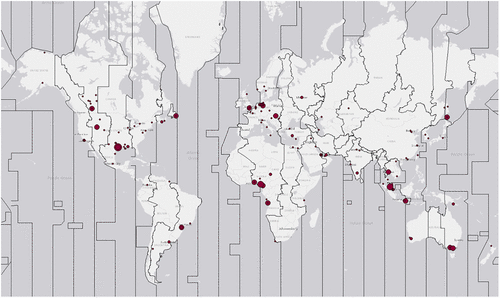
Notes. This figure shows the assigned work locations of sample employees. Node size is proportional to the number of employees. Vertical lines indicate time zones.
3.1. Measurement
3.1.1. Communication Volume.
Communication volume is measured as the amount of time (in minutes) employees devote to communicating with one another via four modes: (1) scheduled calls and meetings, (2) unscheduled calls, (3) instant message chats, and (4) email using data from Outlook and Skype, the primary communication technologies used by the Firm during the data collection period. Following prior studies (Hinds and Kiesler 1995), we sum communication conducted via modes 1–3 to measure Synchronous communication; email is Asynchronous communication. We briefly describe the measurement of each mode (and provide more detail in the Online Appendix, Section A.1):
Communication volume via scheduled calls and meetings is estimated using the beginning and end time stamps of Outlook calendar events featuring multiple employees. From each employee’s perspective, their “attention” (the total length of the event) is allocated equally among the other coparticipants. For example, a 30-minute meeting on the calendar of employee A that also features employees B and C results in 15 minutes of volume for the AB and AC dyads (the dyads BA, BC, CA, and CB also record 15 minutes each). Because event time is divided among coparticipants, scheduled calls and meetings involving many participants, such as a division-wide conference call, carry little weight in the communication volume of each dyad.
Communication volume via unscheduled calls is calculated like that of scheduled calls and meetings but using the beginning and end time stamps of Skype calls that fall outside of a scheduled Outlook calendar event. This prevents overlap with the measure of scheduled calls and meetings, some of which take place over Skype.
Communication volume via instant message chats is estimated using the count of instant messages sent via Skype. For each message, 40 seconds are allocated to the sending employee. For example, if employee A sends six instant messages to B, the dyad AB records four minutes.4
Communication volume via email is calculated from Outlook data using a similar method as instant message chats. The time spent composing each email is estimated based on its length, up to 10 minutes per message.
3.1.2. Temporal Distance.
Following the literature (Cummings et al. 2009, Mell et al. 2021), we operationalize temporal distance using BHO, which is the number of shared hours in an 8 a.m.–6 p.m. workday; we demonstrate robustness to alternative workday lengths in Section 5.3. BHO ranges from 10 for employees in the same time zone to 0 for those 10 or more time zones apart.5
3.1.3. Inside/Outside of Business Hours.
Each communication generates a time stamp in the participant’s local time and is designated as occurring either Inside Business Hours (IBH) (8 a.m.–6 p.m. local time) or Outside Business Hours (OBH). At the undirected dyad level, we code scheduled calls and meetings and unscheduled calls as IBH if both participants are within local business hours, and OBH otherwise. Instant message chats and e-mails are considered IBH if the sending party is within their local business hours, and OBH otherwise. The OBH share is the share of synchronous communication occurring outside of business hours, equal to OBH Synchronous communication/Synchronous communication.
3.1.4. Nonroutine Tasks.
We proxy for the degree to which employees’ work is intensive in nonroutine tasks by matching their job titles to measures of occupational nonroutineness from Acemoglu and Autor (2011), which use data from the Occupational Information Network (O*NET). Because the Firm’s job titles are not standard, we manually match them to Standard Occupational Classification (SOC) codes, then merge on the SOC code.6 This yields nonroutineness scores for 8,276 sample employees with nonmissing job titles and whose SOC occupation contains O*NET data. We create an indicator variable, Nonroutine, which takes a value of one if an employee’s score on the “Nonroutine cognitive: Analytical” metric is above the sample median. In addition, we classify all managers as Nonroutine, as dealing with unstructured, ad hoc, nonroutine problems is core to the managerial function (Mintzberg 1971). An employee is a Manager if they have a least one direct report based on data on the Firm’s reporting relationships.
3.1.5. Strong Collaborative Relationships.
We identify strong collaborative relationships using data on the Firm’s reporting structure, which provides the name of employees’ direct supervisor. We can identify the direct supervisor for 81% of sample employees.7 We define a team as all employees with the same direct supervisor. We thus identify strong vertical (Superior and direct report) and strong horizontal (Same team) collaborative relationships. The mean weekly communication volume among Superior and direct report dyads (37.0 minutes) and Same team dyads (14.2 minutes) is significantly higher than among other dyads (1.5 minutes) (Online Appendix, Table A.2).
3.1.6. Ability to Supply Work Outside of Regular Business Hours.
We use two proxies for employees’ ability to work outside of regular business hours. The first is an indicator variable, Female, which we construct using data on employee names and name–gender matching algorithms. We can assign a gender to 77% of sample employees.8 The second is a categorical variable, Work hours limit category, which we construct using employees’ work location (country) and the International Labour Organization’s (ILO) working conditions law database,9 which classifies countries into five categories of weekly work hours limits: (1) 35–39 hours, (2) 40–41 hours, (3) 42–45 hours, (4) more than 45 hours, or (5) no legal limit.
3.2. Sample Summary Statistics
Table 1, Panel A, reports summary statistics at the dyad level. The dyad-level sample consists of 859,092 pairs of noncolocated employees who communicated at least once via any mode during the 12-week sample period.10 Most coworkers do not communicate in a given week; the mean weekly communication across all dyads is 1.69 minutes. Others communicate intensively, up to 36 hours per week. Synchronous communication accounts for 85% of total communication, reflecting the Firm’s widespread use of scheduled calls and meetings. On average, 57% of synchronous communication takes place within both employees’ business hours and 43% when at least one employee is outside of their local business hours. The mean BHO before the moves to/from DST is 5.7 hours. Both members are nonroutine in 25% of the dyads, 0.2% of dyads represent a superior-direct report relationship, and 1% represent members of the same team. Panel B presents employee-level summary statistics. The data capture 7.7 hours of weekly communication with other sample employees, which appears reasonable and constitutes an important share of employees’ work activities. At the employee level, 13% of synchronous communication takes place outside of local business hours, 14% of sample employees are managers, and 25% are female.
|

Table 1. Sample Summary Statistics and Correlations
| Mean | Standard deviation | Minimum | Maximum | 1 | 2 | 3 | 4 | 5 | 6 | 7 | 8 | 9 | 10 | 11 | ||
|---|---|---|---|---|---|---|---|---|---|---|---|---|---|---|---|---|
| Panel A: Employee-pair (dyad) level (N = 859,092) | ||||||||||||||||
| 1 | Total communication (min/week) | 1.69 | 9.75 | 0 | 2,187 | 1 | ||||||||||
| 2 | Synchronous comm. (min/week) | 1.44 | 8.63 | 0 | 2,165 | 0.985 | 1 | |||||||||
| 3 | Asynchronous comm. (min/week) | 0.25 | 1.94 | 0 | 211 | 0.642 | 0.500 | 1.000 | ||||||||
| 4 | IBH synchronous comm. (min/week) | 0.97 | 6.81 | 0 | 2,082 | 0.890 | 0.908 | 0.433 | 1.000 | |||||||
| 5 | OBH synchronous comm. (min/week) | 0.47 | 3.76 | 0 | 516 | 0.649 | 0.652 | 0.363 | 0.274 | 1.000 | ||||||
| 6 | OBH share | 0.43 | 0.45 | 0 | 1 | −0.044 | −0.043 | −0.032 | −0.099 | 0.081 | 1.000 | |||||
| 7 | BHO (hours) | 5.70 | 3.71 | 0 | 10 | 0.042 | 0.042 | 0.024 | 0.092 | −0.071 | −0.690 | 1.000 | ||||
| 8 | Both nonroutine | 0.25 | 0.43 | 0 | 1 | −0.002 | −0.001 | −0.002 | −0.006 | 0.008 | 0.104 | −0.150 | 1.000 | |||
| 9 | Superior & direct report | 0.002 | 0.05 | 0 | 1 | 0.166 | 0.139 | 0.212 | 0.123 | 0.097 | −0.014 | 0.019 | 0.000 | 1.000 | ||
| 10 | Same team | 0.010 | 0.10 | 0 | 1 | 0.131 | 0.121 | 0.118 | 0.110 | 0.078 | −0.029 | 0.048 | −0.020 | −0.005 | 1.000 | |
| 11 | Increased temporal distance × Post | 0.25 | 0.43 | 0 | 1 | −0.017 | −0.017 | −0.009 | −0.024 | 0.005 | 0.027 | −0.187 | 0.090 | −0.008 | −0.029 | 1.000 |
| Panel B: Employee level (N = 12,038) | ||||||||||||||||
| 1 | Total communication (hr/week) | 7.69 | 6.38 | 0 | 60 | 1 | ||||||||||
| 2 | Synchronous comm. (hr/week) | 6.61 | 5.74 | 0 | 55 | 0.989 | 1.000 | |||||||||
| 3 | OBH synchronous comm. (hr/week) | 0.66 | 1.14 | 0 | 18 | 0.448 | 0.446 | 1.000 | ||||||||
| 4 | OBH share | 0.13 | 0.19 | 0 | 1 | −0.171 | −0.170 | 0.452 | 1.000 | |||||||
| 5 | Manager | 0.14 | 0.35 | 0 | 1 | 0.316 | 0.302 | 0.185 | −0.047 | 1.000 | ||||||
| 6 | Female | 0.25 | 0.43 | 0 | 1 | 0.090 | 0.084 | −0.037 | −0.118 | −0.044 | 1.000 | |||||
| 7 | Work hours limit category | 2.78 | 1.27 | 1 | 5 | −0.024 | −0.018 | 0.199 | 0.260 | −0.001 | −0.056 | 1.000 | ||||
| 8 | BHO with direct superior | 9.23 | 2.27 | 0 | 10 | 0.035 | 0.039 | −0.161 | −0.167 | −0.051 | 0.054 | −0.062 | 1.000 | |||
| 9 | Mean BHO with team | 9.12 | 1.92 | 0 | 10 | −0.003 | 0.000 | −0.192 | −0.158 | −0.056 | 0.003 | −0.041 | 0.637 | 1.000 | ||
Notes. This table displays summary statistics at the employee-pair and employee level. Statistics refer to communication with other in-sample employees. IBH stands for inside of business hours; OBH stands for outside of business hours. BHO stands for business hour overlap and is measured before shifts to/from daylight saving time.
4. Empirical Strategy
Beyond the scarcity of large-sample data on interpersonal communication, two empirical challenges have led to a lack of causal evidence on the effects of temporal distance. First, temporal distance is highly correlated with other dimensions of distance (e.g., geographic distance, language differences), making it difficult to tease out their separate effects. Second, firms may choose to temporally colocate employees who need to regularly communicate, thus introducing reverse causality into the relationship. An ideal experiment would randomly assign employees across different degrees of time zone separation or randomly vary the temporal distance among employees and observe its effects on communication patterns. We approximate the latter ideal by exploiting changes in temporal distance between employees induced by DST, which can under assumptions discussed in Section 4.2 be used to identify its causal effects.
4.1. Identification Using Shifts to/from DST
We exploit cities’ shifts into and out of DST in the fall of 2017, which occurred on different dates but all overlapped with our data collection period (Online Appendix, Figure B.1). During this time, cities in the northern hemisphere that observe DST (most cities in the United States, Canada, Mexico, and many European countries) shift out of DST and move their clocks backward one hour. Cities in the southern hemisphere that observe DST (most cities in Brazil, Australia, and New Zealand) shift into DST and move their clocks forward one hour.11 Other cities do not observe DST and hence do not move their clocks (e.g., cities in China, Russia, India).
Cities’ shifts into/out of DST discretely change BHO for some employee pairs but not others. For example, when DST ends in the United States and Houston sets its clocks backward by one hour, Houston loses an hour of BHO with Moscow and gains an hour with Seoul, neither of which observes DST. However, Houston experiences no change in BHO with Vancouver, which also moves its clocks backward. Although most affected cities gain or lose one hour, some cities gain or lose up to two hours. For example, Houston lost two hours of BHO with Rio de Janeiro, which moved into DST and set its clocks forward by one hour.12 These discrete changes in BHO between employees offer a natural experiment that allows us to identify the causal effects of temporal distance on intraorganizational communication.
4.2. Research Design and Empirical Models
We implement two separate research designs. The first, a DiD research design, compares trends in communication volumes for employee pairs that experience a decrease in BHO (“treated”) versus those whose BHO remains unchanged (“control”). The key advantage of this research design is that it allows us to control for time-invariant determinants of communication between employees using employee-pair fixed effects (e.g., their degree of interdependence, geographic distance, language differences) and identify the effects of temporal distance by observing changes in communication volumes within a pair following a change in BHO. The key identifying assumption is that conditional on controls, the communication volumes of treated employees would have followed parallel trends with respect to the control group. Although this assumption cannot be directly tested, we can gain confidence in it by examining whether treated and control groups exhibit parallel trends before the moves to/from DST. This analysis will also help us detect any anticipatory effects, for example, the possibility that treated employees reacted to the future increase in temporal distance in advance, for example, by communicating more than the control group in the weeks leading up to the moves to/from DST.
We implement the DiD strategy by creating the binary variable Increased temporal distance Post, which equals one after the shifts to/from DST for the treated group, and estimate13
We estimate Equation (1) using a (pseudo) Poisson maximum likelihood (PPML) estimator with the dependent variable measured in levels, which has advantages over log-linear ordinary least squares (OLS) models when the dependent variable is a count and features many zeros, as in our empirical setting (Silva and Tenreyro 2006).14 Recent studies highlight biases that can arise in standard DiD models when the treatment is staggered and treatment effects are not constant over time (Goodman-Bacon 2021, Borusyak et al. 2024). Although our large control group of untreated employees mitigates these biases, for robustness, we estimate versions of Equation (1) using the Borusyak et al. (2024) DiD imputation estimator and the extended two-way fixed effects (ETWFE) strategy proposed by Wooldridge (2021, 2023). Dyadic data sets can exhibit complex error correlations across observations because members may participate in multiple dyads (Aronow et al. 2015). Therefore, we cluster standard errors at the level of each employee pair and each employee. We thus allow for error correlation both within pairs over time and across all communications of each employee in the pair.15
One potential concern associated with the DiD research design is spillover effects on the control group. For example, if employees substitute communication away from coworkers with whom they lose overlap to coworkers with whom overlap remains unchanged, the DiD estimates could overstate the magnitude of the causal effect within each dyad. We implement a second empirical approach, an RD research design, which focuses only on treated pairs and examines whether they exhibit discrete changes in communication volumes near the timing of the switch to/from DST. The identifying assumption behind the RD design is that absent the moves to/from DST, communication volumes for the treated would have changed continuously in the days around the transition. We define the running variable, , which is the number of days before/after the pair experiences a reduction in BHO with day 0 being the first day and estimate:
5. Results
5.1. Baseline Effect of Temporal Distance: Direction and Magnitude
Table 2 presents the DiD results of the effects of temporal distance on intraorganizational communication volumes estimated via Equation (1). The results in column 1 imply that the approximately one-hour increase in temporal distance induced by moves to/from DST led to a % decline in communication volumes among employees (p = 0.000). Consistent with expectations, column 2 indicates that this decline is entirely concentrated in synchronous communication, which falls by % from baseline levels (). This effect is sizable but less than proportionate considering that the “treatment” constitutes a mean reduction in BHO of 19.3% (an average loss of 1.1 hours on a mean BHO of 5.7), which is outside of the 95% confidence interval (CI) of the estimated effect (CI: 6.2%–15.5%).
|
Table 2. Effects of Increased Temporal Distance on Communication Volumes: Difference-in-Differences Estimates
| Dependent variable | Total communication | Synchronous communication | Asynchronous communication |
|---|---|---|---|
| (1) | (2) | (3) | |
| Increased temporal distance × Post | −0.099*** | −0.116*** | −0.007 |
| (0.023) | (0.026) | (0.023) | |
| Employee-pair fixed effects | Yes | Yes | Yes |
| Week fixed effects | Yes | Yes | Yes |
| Mean of dependent variable | 1.72 | 1.59 | 1.30 |
| Employee pairs | 776,581 | 716,974 | 153,248 |
| N (employee pair-weeks) | 9,318,972 | 8,603,688 | 1,838,976 |
| Pseudo-R2 | 0.679 | 0.656 | 0.551 |
Notes. This table displays the estimated effects of increased temporal distance on communication volumes (measured in minutes per week) using the DiD strategy. Synchronous communication refers to scheduled calls and meetings, unscheduled calls, and instant message chats. Asynchronous communication is email. Employee pairs appear in each model if they had nonzero, time-varying communication volume in that mode over the sample period. Increased temporal distance takes a value of one for employee pairs who lost BHO due to moves to/from DST and zero for pairs whose BHO remained unchanged. Post indicates weeks after moves to/from DST. Models estimated via PPML; robust standard errors in parentheses, multiway clustered at the employee-pair and each employee level.
*p < 0.10; **p < 0.05; ***p < 0.01.
For comparison, column 3 shows the estimated effect of increased temporal distance on asynchronous communication volumes. The coefficient is negative but small and not statistically significant (, ). This null effect is consistent with the notion that temporal distance does not directly affect asynchronous communication; it also suggests that in our empirical setting, asynchronous communication does not necessarily substitute for synchronous communication. This result echoes that of Cummings et al. (2009), who find evidence pointing to complementarities between the use of synchronous communication and email.
Figure 2 (left plot) presents the estimates of a weekly event-study version of Equation (1), which replaces the Increased temporal distance Post indicator with a set of indicator variables for each week before and after the moves to/from DST.17 This figure validates the parallel-trends assumption, showing that the treated and control groups exhibited no significant differences in communication trends leading up to the moves to/from DST. Echoing the baseline result, it shows negative effects for the treated group in the weeks after the moves to/from DST; four of the six weekly coefficients are statistically significant. These patterns are similar using the Borusyak et al. (2024) imputation estimator (middle plot) and the ETWFE strategy proposed by Wooldridge (2021, 2023) (right plot).
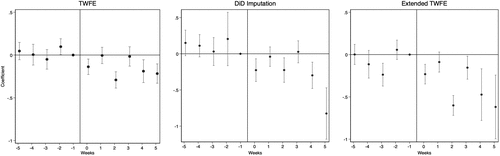
Notes. This figure displays the estimated coefficients on the Increased temporal distance × Week indicators from three different event study models featuring weekly leads and lags. The left plot shows coefficients from a two-way fixed effects (TWFE) model with employee pair and week fixed effects estimated via Poisson Pseudo Maximum Likelihood (PPML). The middle plot shows coefficients from the Borusyak et al. (2024) DiD imputation estimator with employee pair and week fixed effects. The right plot shows the coefficients from an extended two-way fixed effects (ETWFE) estimator proposed by Wooldridge (2021, 2023) with cohort, week, and treated cohort × week fixed effects. The reference period is the week before an employee pair experiences a change in BHO; Week 0 represents the first seven days of treatment. Two percent of employee pairs experience more than 5 weeks of treatment; these are consolidated into the Week 5 indicator. Error bars represent 95% confidence intervals based on robust standard errors clustered at the employee-pair and each employee level, except for the imputation estimator where standard errors are clustered at the city-pair level.
Table 3 presents the results of the RD research design estimated via Equation (2). Following Doleac and Sanders (2015) and Smith (2016), we use two bandwidths: 25 and 50 days.18 As in the DiD results, the RD results point to statistically significant negative effects of increased temporal distance on synchronous communication volumes (, p = 0.003 at 25 days; , p = 0.079 at 50 days). The sizes of the estimated coefficients again imply a less than proportionate reduction in communication volumes. Figure 3 presents the RD strategy visually. It depicts a sharp negative discontinuity on the day of the transition to/from DST for employee pairs that experience an increase in temporal distance.
|
Table 3. Effects of Increased Temporal Distance on Synchronous Communication Volumes: RD Estimates
| Dependent variable: Synchronous communication | ||
|---|---|---|
| 25 days | 50 days | |
| (1) | (2) | |
| Post | −0.145*** | −0.071* |
| (0.049) | (0.040) | |
| days | 0.005* | 0.003** |
| (0.003) | (0.001) | |
| days × Post | −0.002 | −0.005*** |
| (0.004) | (0.002) | |
| Employee-pair fixed effects | Yes | Yes |
| Day of week fixed effects | Yes | Yes |
| Mean of dependent variable | 0.24 | 0.19 |
| Employee pairs | 145,228 | 176,592 |
| N (employee pair-days) | 7,355,288 | 13,606,968 |
| Pseudo-R2 | 0.56 | 0.54 |
Notes. This table displays the estimated effects of increased temporal distance on synchronous communication volumes (measured in minutes per day) using the RD strategy. Employee pairs appear in each model if their temporal distance increased due to moves to/from DST and if they had nonzero synchronous communication volume over the bandwidth period. Post indicates days after moves to/from DST. All models include a dummy variable indicating the day of and days adjacent to Thanksgiving (not shown). Models estimated via PPML; robust standard errors in parentheses, multiway clustered at the employee-pair and each employee level.
*p < 0.10; **p < 0.05; ***p < 0.01.
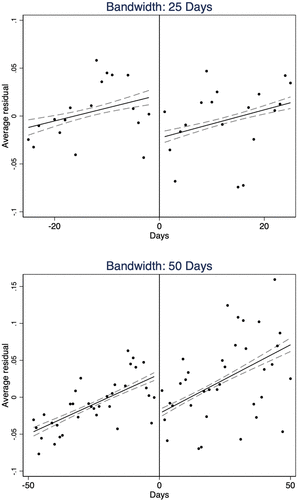
Notes. This figure displays two plots generated using the rdplot command in Stata in the sample of employee pairs who experienced an increase in temporal distance. It displays plots for two bandwidths: (i) 25 days and (ii) 50 days. All graphs use a uniform kernel and the mimicking-variance evenly spaced method to select the number of bins. Weekends are omitted for presentation purposes. The fitted lines are based on local linear regressions for residuals after absorbing day-of-week fixed effects and a Thanksgiving dummy variable. Dashed curves represent 95% confidence intervals based on standard errors clustered at the employee-pair level.
Overall, the RD results are consistent with those using DiD design in direction and magnitude. Taken together, the results offer strong support for the baseline hypothesis and show that greater temporal distance reduces volumes of synchronous communication. The average effect—an 11% reduction for an average of 1.1 hours of overlap lost—is sizable but less than proportionate given the mean levels of overlap in the sample.19
5.2. Heterogeneous Effects and Time Shifting of Work
5.2.1. Heterogeneity by Task and Relationship Demands for Synchronous Communication.
We hypothesized that greater temporal distance will reduce the volume of synchronous communication less among employees whose work is intensive in nonroutine tasks and among employees in strong collaborative relationships. We further reasoned that the underlying mechanism relates to time shifting and that greater temporal distance will increase time shifting more among these employees. We test these hypotheses in two steps; first by estimating Equation (1) in subsamples featuring only dyads in which both employees in the pair are Nonroutine and dyads that represent Strong collaborative relationships, then comparing the effects of temporal distance on communication volumes to those of other dyads.20 Second, we directly test whether temporal distance increases time shifting and whether the tendency to increase time shifting differs across types of interactions.
Table 4 reports the results of the analysis of communication volumes. Unlike “All” dyads (column 1), coworkers in which both members hold nonroutine jobs and coworkers in strong vertical collaborative relationships show no statistically significant reductions in communication volumes following increases in temporal distance (, in column 2 and , in column 3). Coworkers in strong horizontal relationships (column 4) also display no significant effects, although the coefficient in this subsample is imprecisely estimated, and its size is similar to that in the full sample (, ). A formal test of the hypothesis that the negative effect in the nonroutine subsample is equal to that in the “All other” subsample has a p value of 0.079; an equivalent test that the effect in superior and direct report dyads is equal to that in “All other” has a p value of 0.102. This evidence allows us to conclude that the effects of temporal distance on communication volumes in these subsamples are substantially less negative than those in other dyads. Together, these results provide initial support for Hypotheses 1 and 2, showing that greater temporal distance reduces the volume of synchronous communication less among employees whose work is intensive in nonroutine tasks and in strong collaborative relationships, especially strong vertical relationships.
|
Table 4. Effects of Increased Temporal Distance on Synchronous Communication Volumes by Nature of Task and Collaborative Relationship
| Dependent variable: Synchronous communication | |||||
|---|---|---|---|---|---|
| All | Both nonroutine | Superior and direct report | Same team | All other | |
| (1) | (2) | (3) | (4) | (5) | |
| Increased temporal distance × Post | −0.116*** | −0.055 | −0.025 | −0.168 | −0.134*** |
| (0.026) | (0.049) | (0.081) | (0.115) | (0.028) | |
| Test of | (2) = (5) | (3) = (5) | (4) = (5) | ||
| p value | 0.079 | 0.102 | 0.389 | ||
| Employee-pair fixed effects | Yes | Yes | Yes | Yes | Yes |
| Week fixed effects | Yes | Yes | Yes | Yes | Yes |
| Mean of dependent variable | 1.59 | 1.52 | 30.23 | 12.61 | 1.43 |
| Employee pairs | 716,974 | 177,383 | 1,552 | 7,516 | 532,193 |
| N (employee pair-days) | 8,603,688 | 2,128,596 | 18,624 | 90,192 | 6,386,316 |
| Pseudo-R2 | 0.656 | 0.667 | 0.588 | 0.630 | 0.634 |
Notes. This table displays the estimated effects of increased temporal distance on synchronous communication volumes (measured in minutes per week) in different samples. Employee pairs appear in each model if they had nonzero, time-varying synchronous communication volume over the sample period and if they meet the sample criterion indicated in the column heading. Increased temporal distance takes a value of one for employee pairs who lost BHO due to moves to/from DST and zero for pairs whose BHO remained unchanged. Post indicates weeks after moves to/from DST. Models estimated via PPML; robust standard errors in parentheses, multiway clustered at the employee-pair and each employee level. p values reported are from a one-tailed test that the coefficients in the indicated samples are equal, under the alternative hypothesis that the effect is smaller (less negative) in columns 2–4 than in column 5.
*p < 0.10; **p < 0.05; ***p < 0.01.
Next, we directly test the mechanism and ask whether temporal distance increases time shifting by estimating Equation (1) using three alternative dependent variables: IBH synchronous communication, OBH synchronous communication, and the OBH share. These tests allow us to directly observe whether communications occurring during regular business hours fall and whether employees shift work-related communication beyond the standard workday into hours typically considered personal time. As in Table 4, we examine this tendency among nonroutine dyads, strong collaborative relationships, and all others.
The results in columns 1–4 of Table 5 show that increased temporal distance leads to statistically significant and larger than proportionate reductions in synchronous communication taking place inside of business hours across all types of employees. The magnitudes of the estimated effects range from a 19% reduction () among superior and direct report dyads to a 31% reduction () among same-team dyads.21 Columns 5–8 further show that increased temporal distance concurrently leads to significant increases in communication volumes taking place outside of regular business hours. The sizes of the estimated coefficients imply a 21%, 31%, and 30% increase among nonroutine, superior and subordinate, and same-team dyads, respectively. The increases in these samples are significantly larger than the 8% increase among “All other” dyads (this difference is statistically significant with p values of 0.071, 0.058, and 0.045, respectively). Offering further evidence, Table 6 shows that increased temporal distance leads to significant increases in the share of synchronous communication taking place outside of business hours, and these increases are significantly higher among employees whose work is intensive in nonroutine tasks and those in strong collaborative relationships than all other dyads (p value of 0.008, 0.000, and 0.000, respectively). Overall, the results in Tables 5 and 6 provide direct evidence that increased temporal distance increases time shifting, especially among employees whose work is intensive in nonroutine tasks and employees in strong collaborative relationships; they offer strong support for Hypotheses 1 and 2.
|
Table 5. Effects of Increased Temporal Distance on Time Shifting by Nature of Task and Collaborative Relationship
| Dependent variable | IBH synchronous communication | OBH synchronous communication | ||||||
|---|---|---|---|---|---|---|---|---|
| Both nonroutine | Superior and direct report | Same team | All other | Both nonroutine | Superior and direct report | Same team | All other | |
| (1) | (2) | (3) | (4) | (5) | (6) | (7) | (8) | |
| Increased temporal distance × Post | −0.275*** | −0.210*** | −0.374*** | −0.269*** | 0.193*** | 0.266** | 0.265** | 0.074* |
| (0.047) | (0.085) | (0.132) | (0.029) | (0.068) | (0.114) | (0.104) | (0.044) | |
| Test of | (1) = (4) | (2) = (4) | (3) = (4) | (5) = (8) | (6) = (8) | (7) = (8) | ||
| p value | 0.453 | 0.256 | 0.218 | 0.071 | 0.058 | 0.045 | ||
| Employee-pair fixed effects | Yes | Yes | Yes | Yes | Yes | Yes | Yes | Yes |
| Week fixed effects | Yes | Yes | Yes | Yes | Yes | Yes | Yes | Yes |
| Mean of dependent variable | 1.50 | 23.29 | 10.47 | 1.40 | 0.82 | 11.55 | 5.10 | 0.85 |
| Employee pairs | 119,262 | 1,439 | 6,692 | 384,330 | 111,239 | 1,161 | 4,850 | 264,113 |
| N (employee pair-days) | 1,431,144 | 17,268 | 80,304 | 4,611,960 | 1,334,868 | 13,932 | 58,200 | 3,169,356 |
| Pseudo-R2 | 0.661 | 0.585 | 0.630 | 0.622 | 0.603 | 0.645 | 0.606 | 0.589 |
Notes. This table displays the estimated effects of increased temporal distance on synchronous communication volumes (measured in minutes per week) taking place inside of employees’ local business hours (IBH) and outside of business hours (OBH) in different samples, where business hours mean 8 a.m.–6 p.m. Employee pairs appear in each model if they had nonzero, time-varying synchronous communication volume over the sample period and if they meet the sample criterion indicated in the column heading. Increased temporal distance takes a value of one for employee pairs who lost BHO due to moves to/from DST and zero for pairs whose BHO remained unchanged. Post indicates weeks after moves to/from DST. Models estimated via PPML; robust standard errors in parentheses, multiway clustered at the employee-pair and each employee level. p values reported are from a one-tailed test that the coefficients in the indicated samples are equal, under the alternative hypothesis that the effect is smaller (less negative) in columns 1–3 than in column 4 and that it is larger in columns 5–7 than in column 8.
*p < 0.10; **p < 0.05; ***p < 0.01.
|
Table 6. Effects of Increased Temporal Distance on the Share of Communication Outside of Regular Business Hours by Nature of Task and Collaborative Relationship
| Dependent variable | OBH share | |||
|---|---|---|---|---|
| Both nonroutine | Superior and direct report | Same team | All others | |
| (1) | (2) | (3) | (4) | |
| Increased temporal distance × Post | 0.028*** | 0.091*** | 0.062*** | 0.015*** |
| (0.005) | (0.016) | (0.012) | (0.003) | |
| Test of | (1) = (4) | (2) = (4) | (3) = (4) | |
| p value | 0.008 | 0.000 | 0.000 | |
| Employee-pair fixed effects | Yes | Yes | Yes | Yes |
| Week fixed effects | Yes | Yes | Yes | Yes |
| Mean of dependent variable | 0.13 | 0.25 | 0.22 | 0.15 |
| Employee pairs | 111,239 | 1,161 | 4,850 | 264,113 |
| N (employee pair-days) | 1,334,868 | 13,932 | 58,200 | 3,169,356 |
| Adjusted R2 | 0.255 | 0.601 | 0.514 | 0.308 |
Notes. This table displays the estimated effects of increased temporal distance on the share of synchronous communication taking place outside of employees’ business hours (OBH) in different samples, where business hours mean 8 a.m.–6 p.m. Employee pairs appear in each model if they had nonzero, time-varying communication volume in that mode over the sample period and if they meet the sample criterion indicated in the column heading. Increased temporal distance takes a value of one for employee pairs who lost BHO due to moves to/from DST and zero for pairs whose BHO remained unchanged. Post indicates weeks after moves to/from DST. Models estimated via OLS; robust standard errors in parentheses, multiway clustered at the employee-pair and each employee level. p values reported are from a one-tailed test that the coefficients in the indicated samples are equal, under the alternative hypothesis that the effect is larger in columns 1–3 than in column 4.
*p < 0.10; **p < 0.05; ***p < 0.01.
5.2.2. Heterogeneity by Ability to Time Shift.
We theorized that in addition to facing varying demands for synchronous communication, workers differ in their ability to supply time-shifted communication due to factors such as gender and country institutional context. We next provide descriptive evidence related to this conjecture before testing Hypothesis 3.
Figure 4 displays descriptive evidence of employee-level time shifting, measured as the volume (left) and share (right) of their total synchronous communication that takes place outside of local business hours. Male employees in our sample engage in significantly more communication outside of regular business hours than female employees, with a mean OBH share of 13.9% among men and 8.8% among women. We also observe significant differences by country institutional context. The OBH share ranges from a mean of 9% for employees in countries with a weekly work hour limit of 35–39 hours to 32% in countries with no legal limit.
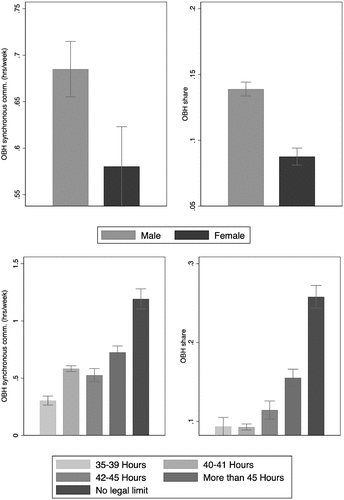
Notes. This figure displays the mean OBH synchronous communication (hr/week) and the mean OBH share (outside of business hours synchronous communication/synchronous communication) for male and female employees (top) and for employees in countries with different categories of legal limits on the number of weekly work hours (bottom). Means calculated using in-sample communication and sample weeks before moves to/from DST. Vertical bars represent 95% confidence intervals.
Figure 5 incorporates a proxy for time shifting demands by plotting the OBH share (y axis) against an employee’s BHO with their superior (top) and mean BHO with their team (bottom). The OBH share tends to systematically fall as overlap with one’s superior and team increases. It ranges from 24.6% (32.4%) among employees with 2 hours or less overlap with their superior (team) to 11.9% (12.9%) among those who enjoy complete overlap. This relationship is more muted among female employees and those in countries with legal limits on weekly work hours, who tend to exhibit a lower OBH share at each level of overlap.
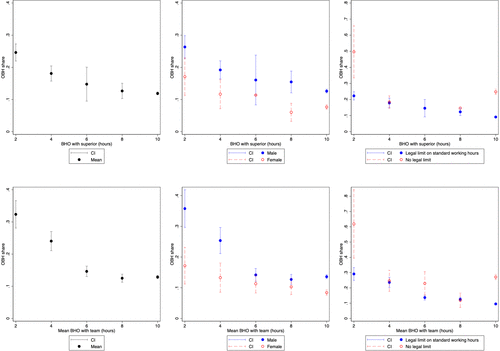
Notes. This figure displays the mean OBH share (outside of business hours synchronous communication/synchronous communication) at different levels of temporal distance to employees’ superior (top) and team (bottom). Panels show means for all employees (left), male and female employees (middle), and employees in countries with and without a legal limit on the number of weekly work hours (right). Means calculated using in-sample communication and sample weeks before moves to/from DST. BHO levels are grouped into 0–2, 3–4, 5–6, 7–8, and 9–10 hours to allow sufficient observations in each interval. Vertical bars represent 95% confidence intervals.
Table 7 formally tests whether individual characteristics predict which member of the dyad is more likely to communicate outside of local business hours and whether employees with greater ability to supply work outside of regular business hours increase time shifting more in response to temporal distance. Because we are interested in the effects of employee-level characteristics, we move the analysis to the directed employee-pair level, where each observation is a directed employee-pair-week and communication is defined as OBH if the focal employee is outside of their local business hours. We first estimate Equation (1) in the directed data set after introducing the indicator variable Female. With the employee-pair fixed effects in place, the coefficient on this variable indicates whether gender helps explain which employee is more likely to communicate outside of business hours within a pair. We then interact Female with the treatment indicator. The coefficient on the triple-interaction term, Increased temporal distance Post Female, indicates whether female employees exhibit a greater or lesser tendency to increase time shifting from baseline levels when temporal distance increases. We perform a similar analysis after introducing an indicator variable for whether a country has a legal limit on weekly work hours.
|
Table 7. Increased Temporal Distance and the Effects on Communication Outside of Regular Business Hours by Gender and Country Context
| Dependent variable: OBH synchronous communication | ||||
|---|---|---|---|---|
| (1) | (2) | (3) | (4) | |
| Increased temporal distance × Post | 0.174*** | 0.172*** | 0.167*** | 0.149*** |
| (0.045) | (0.046) | (0.041) | (0.057) | |
| Female | −0.100*** | −0.101*** | ||
| (0.037) | (0.039) | |||
| Increased temporal distance × Post × Female | 0.009 | |||
| (0.095) | ||||
| No legal limit on weekly work hours | 0.085** | 0.080** | ||
| (0.033) | (0.035) | |||
| Increased temporal distance × Post × No legal limit | 0.033 | |||
| (0.068) | ||||
| Employee-pair fixed effects | Yes | Yes | Yes | Yes |
| Week fixed effects | Yes | Yes | Yes | Yes |
| Mean of dependent variable | 0.355 | 0.355 | 0.328 | 0.328 |
| Employee pairs | 266,291 | 266,291 | 326,971 | 326,971 |
| N (employee pair-days) | 5,081,304 | 5,081,304 | 7,004,460 | 7,004,460 |
| Pseudo-R2 | 0.501 | 0.501 | 0.501 | 0.501 |
Notes. This table displays the estimated effects of increased temporal distance on the volume of synchronous communication taking place outside of the focal employees’ business hours (OBH), where business hours mean 8 a.m.–6 p.m. Employee pairs appear in each model if they had nonzero, time-varying communication volume in that mode over the sample period and if they have nonmissing values for gender and country institutional context. Increased temporal distance takes a value of one for employee pairs who lost BHO due to moves to/from DST and zero for pairs whose BHO remained unchanged. Post indicates weeks after moves to/from DST. Models estimated via PPML; robust standard errors in parentheses, multiway clustered at the employee-pair and employee level.
*p < 0.10; **p < 0.05; ***p < 0.01.
Consistent with Table 5, the results in Table 7 establish that greater temporal distance significantly increases time shifting. The coefficient on Increased temporal distance Post is positive and statistically significant across all columns (e.g., , in column 1). They also show that within a coworker pair, female employees (columns 1 and 2) and employees in countries with a legal limit on weekly work hours (columns 3 and 4) communicate outside of their local business hours significantly less. However, we do not detect statistically significant differences in the tendency to increase time shifting in response to the approximately one-hour decrease in BHO among female employees (column 2) or employees in countries with no legal limit on weekly work hours (column 4); the coefficients on the triple-interaction term that includes Female is very small, and the coefficient on the indicator of countries with no legal work hour limit is positive but not statistically significant. Together, these results offer mixed support for Hypothesis 3.
5.3. Additional Analyses and Robustness Tests
5.3.1. Decreased Temporal Distance.
An important alternative explanation for reductions in synchronous communication following moves to/from DST relates to confusion. The change in clocks in some locations but not others might confuse employees about the scheduled meeting time. They may also lead to sleep loss and changes in diurnal rhythms that negatively affect employee productivity and tendency to communicate (Kamstra et al. 2000). To increase confidence that the effects we detect reflect the impact of temporal distance rather than temporary confusion or other mechanisms affected by the clock changes, we estimate Equations (1) and (2) using data on employee pairs that gained BHO. They should also suffer confusion and changes in diurnal rhythms, but they experience a decrease rather than an increase in temporal distance. However, in contrast to our main findings, the DiD results reveal no significant effects among these dyads (Online Appendix, Table B.6). The RD results detect positive short-term effects on communication volumes, but these diminish over time (Online Appendix, Table B.7). These results are more consistent with temporal distance effects than temporary confusion.22
5.3.2. Asynchronous Communication.
Our main results suggest that as temporal distance increases, asynchronous communication appears to be unrelated or complementary to synchronous communication in our empirical setting. We explore whether the nature of the task and the relationship between employees moderates the responses to increased temporal distance for asynchronous communication. We find little evidence that greater temporal distance affects the volume of asynchronous communication (Online Appendix, Table B.8). Nor do we find evidence of time shifting of asynchronous communication from inside to outside of business hours (Online Appendix, Table B.9).
5.3.3. Additional Robustness Tests.
The Online Appendix, Table B.11 presents the results of a series of additional robustness tests of the baseline results, including accounting for reading time in asynchronous communication, assuming alternative workday lengths to measure BHO, and analyses that drop the week of Thanksgiving and small values of communicative interactions. The results are robust to these variations.
6. Discussion
This paper investigates how temporal distance between workers affects patterns of intraorganizational communication and makes two important contributions to the literature. First, it settles an empirical debate about the magnitude of the effect of temporal distance on synchronous communication and presents, to the best of our knowledge, the first set of causal estimates of this effect in an organizational setting using DST as a quasi-experiment. Second, the paper makes a theoretical and empirical contribution by shedding light on time shifting and its role in understanding the relationship between temporal distance and communication. We propose and identify both demand-side (i.e., nature of the task, the strength of the collaborative relationship) and supply-side determinants (i.e., gender, country location) of time shifting. We then use rich, communication-level data from a large multinational firm to demonstrate how temporal distance affects the communication patterns of more than 12,000 employees located in 48 countries using a novel empirical approach that exploits the annual shift of clocks into and out of DST. In summary, we find that a one-hour increase in temporal distance reduces the volume of synchronous communication by an average of 11%—an effect that is sizable but smaller than expected given that the loss of approximately one hour of BHO represents a 19% reduction in opportunities to communicate synchronously during the standard workday among employees in our sample.
Probing further, we consider the timing of employee communication, specifically whether communication occurs inside or outside of regular business hours and find strong evidence that greater temporal distance leads employees to shift an increasing volume (and share) of their work-related communication to outside of regular business hours. We find that this time-shifting tendency is significantly more pronounced among employees in occupations intensive in nonroutine tasks and in communications involving employees and their direct superior or team. Descriptive analyses using data on employee gender and country location suggest that not all employees are equally well positioned to supply time-shifted communication when their work demands it.
The paper has several limitations. First, we analyze a single multinational corporation (MNC) and one three-month period. Future studies should validate the patterns we observe across an array of contexts, especially in organizations that have adopted cutting-edge asynchronous communication technologies like Slack that offer greater synchronicity and richness than email. Second, we acknowledge multiple limitations in our measures of communication. Espinosa et al. (2015) build on O’Reilly and Pondy (1979) to argue that both “communication patterns” (operationalized as communication frequency and turn taking) and “communication content” shape how temporal distance affects communication outcomes. Given that our communication data comes from a real-world setting, confidentiality concerns prevent us from observing its content. Nor does it capture communications sent and received using employees’ private accounts or other communication technologies. Third, we empirically capture only some determinants of employees’ ability to time shift. Future work can investigate the role of additional determinants of time shifting (e.g., Internet connectivity at home, broader caregiving responsibilities).
Despite these limitations, this paper contributes to our understanding of a ubiquitous source of collaboration friction by demonstrating that, all else equal, greater temporal distance between employees leads to sizable reductions in volumes of rich synchronous communication. This finding complements research on the sources of geographic friction for communication and collaboration. This literature, dating back to Allen (1977) and Van den Bulte and Moenaert (1998), has shown that even microgeographic distances reduce the likelihood of impromptu and face-to-face communication within organizations and collaborative teams (Chown and Liu 2015, Boudreau et al. 2017, Catalini 2018, Chai and Freeman 2019, Hasan and Koning 2019, Dimitriadis and Koning 2023). A separate strand of the literature, which takes a macrogeographic approach, has documented negative effects from geographic distance and travel time between potential collaborators based in different cities (Forman and van Zeebroeck 2012, Singh and Marx 2013, Bikard and Marx 2020, Catalini et al. 2020, Bahar et al. 2023, Bai et al. 2023) and from social distance in networks of employees based in different units and countries of global firms (Ghoshal et al. 1994, Singh 2005, Balachandran and Hernandez 2018) on collaboration, communication, and knowledge diffusion. Our study contributes to this work by highlighting the negative and heterogeneous effects of temporal distance. Temporal distance can help explain why spatial distribution remains a relevant source of friction for some collaborative relationships, even in the age of low-cost digital communication technologies (Agrawal and Goldfarb 2008). It is especially important to document these effects given the rise in the global coproduction of knowledge in MNCs (Phene and Almeida 2008, Alcácer and Zhao 2012, Choudhury 2017, Kerr and Kerr 2018, Branstetter et al. 2019, Bahar 2020) and the increase in cross-country scientific collaborations (Freeman et al. 2014, Bahar et al. 2023), which critically depend on real-time communication between collaborators.
We also advance the literature on distributed and remote work (Hinds and Kiesler 1995, 2002; Olson et al. 2000; Cummings et al. 2009; Edmondson 2012; Espinosa et al. 2015), which has long acknowledged time zone differences as a challenge in global work. For example, Olson and Olson (2000) and Edmondson (2012) describe various difficulties associated with coordinating workers in different time zones and on different diurnal rhythms. Nevertheless, Espinosa et al. (2015, p. 160) note that “the literature that focuses specifically on temporal separation is very sparse.” Key challenges associated with studying this topic include objectively observing intraorganizational communication at a large scale and finding settings in which temporal distance varies exogenously. As a result, research in this area has primarily been based on surveys of employees’ self-reported communication patterns (Cummings et al. 2009); a notable causal study was conducted in a laboratory experiment (Espinosa et al. 2015). In the spirit of work by Kleinbaum et al. (2013) and recent studies highlighting research opportunities offered by communication data (Impink et al. 2020, DeFilippis et al. 2022), we use computer-generated metadata to devise rich, objective measures of intraorganizational communication.
Within this literature, our work also extends the handful of studies that document the practice of time shifting using interview data (Cummings et al. 2009, Cristea and Leonardi 2019, Nurmi and Hinds 2020). We show that this practice is significant but not pervasive; it depends on the task- and relationship-based demands for time shifting as well as individuals’ ability to work outside of business hours. We find that women in our sample are less likely to communicate outside of regular business hours, but that in the short term, both men and women significantly increase time shifting as temporal distance to coworkers increases. This result suggests that employees are willing to incur personal sacrifices at the margin to further organizational outcomes; yet employees might make adjustments to limit such sacrifices in the longer term, for example, by selecting into collaborations and tasks that place fewer demands for time-shifted communication. These results relate to the findings of two recent studies, which show that in firms with greater temporal distance to customers (Bøler et al. 2018) and headquarters (Gagliardi et al. 2024), women exhibit larger wage gaps and lower promotion rates.
Our findings are also relevant to recent studies on remote work. For instance, Dingel and Neiman (2020) construct a measure of remote work using surveys from O*NET. Their measure is a task-level analysis of remote work potential, taking into account, for example, whether the task involves “handling and moving objects” or being “exposed to diseases or infection” (in which cases, it cannot be performed remotely). However, as Yang et al. (2022) point out, remote work often leads to an increase in both the duration of the workday and unscheduled call hours. This implies that workers’ heterogeneous ability to supply synchronous communication after hours—a key finding of our study—should also be considered in measures of remote work potential for tasks and workers. Our study further implies that both men and women performing nonroutine jobs and those who are temporally distant from their managers and teams are especially likely to experience pressure to work nontraditional or nonlinear workdays. Anecdotal evidence suggests that nontraditional and nonlinear workdays can both benefit and harm workers depending on their preferences; our study highlights the need to study the factors that give rise to such workdays.23 Although some workers might prefer working nontraditional hours, others (e.g., workers with caregiving responsibilities and/or workers in countries with lower preferences for after-hours work) might prefer the work day to start and end at traditional business hours. Future research should explore how nontraditional workdays arise and how they affect worker satisfaction and productivity.
Finally, our findings hold practical implications for managers of global companies and for firms choosing where to open offices. “Follow-the-sun” arrangements (Espinosa and Carmel 2003, Carmel et al. 2010), in which globally distributed employees work sequentially around the clock, can be very effective for employees engaged in highly routine, noncomplex, administrative, or predictable patterns of collaboration, who require very little synchronous communication; they may be less so for workers collaborating on nonroutine tasks. Our results suggest that employees collaborating on nonroutine tasks place a premium on synchronous communication and that employees who are constrained in their ability to work outside of regular business hours benefit from being located in a way that minimizes temporal distance—that is, largely on a North–South axis. For example, though Seattle and San Francisco, or New York and São Paulo, are geographically distant, workers in each location pair will experience near-complete BHO. Overall, our study highlights the importance of carefully weighing locations’ benefits as sites of distributed or offshored work (e.g., access to human capital, lower wages) against the incremental coordination costs created by temporal distance frictions.
As the pace of global collaboration accelerates and firms increasingly explore distributed, remote, and “work from anywhere” work arrangements (Hinds and Kiesler 2002, Barrero et al. 2021, Choudhury et al. 2021), our study provides causal evidence of how temporal distance affects synchronous communication and theorizes both demand- and supply-side determinants of employee time shifting. Our results have practical implications for managers organizing within-firm temporal boundaries, suggesting that North–South geographic corridors (which have no temporal distance between dispersed collaborators) might generate different synchronous communication patterns and different employee workday structures than East–West corridors.
The authors thank the senior editor Michaël Bikard and three anonymous reviewers for insightful suggestions; Dany Bahar, Heather Berry, Kirill Borusyak, Scott Ganz, Adam Kleinbaum, Wesley Koo, Megan Lawrence, Jeffrey Macher, Ferdinando Monte, Lindsay Oldenski, and Michael O’Leary for comments on earlier drafts; and Taemie Kim, Talha Oz, and Ben Waber for help with data access. This paper benefited from discussions with seminar and conference participants at Georgetown University, George Washington University, Harvard Business School, University College London, University of California, Los Angeles, the Wharton School, Academy of Management Annual Meeting, Global Strategy and Emerging Markets Conference, Gran Sasso Science Institute, INFORMS Annual Meeting, Organization Science Winter Conference, Rice Strategy Symposium on Emerging Markets, Sumantra Ghoshal Strategy Conference, Society for Institutional & Organizational Economics Conference, Strategic Management Society Annual Conference, Strategy Science Conference, Wharton Technology and Innovation Conference, and the Wharton People and Organizations Conference. Shaila Sundram provided excellent research assistance. Any errors are our own.
1 Importantly, results discussed in robustness sections using data on employees whose temporal distance decreased due to the moves to/from DST show that this increased synchronous communication in the short term and provide confidence that the effects we detect are not the result of scheduling confusion (which would reduce communication following either change) but reflect the causal impacts of increased temporal distance.
2 In contrast, temporal distance does not directly constrain asynchronous modes of communication, such as email, and can even enable “follow-the-sun” workflows, which primarily rely on asynchronous coordination and sequential handoffs of work (Carmel et al. 2010). Therefore, we focus our theorizing on synchronous communication and provide exploratory analyses of email in Section 5.3.
3 Changes in BHO might also have less than proportionate effects if workers successfully reshuffle interactions within regular business hours to accommodate the reduced overlap. In Section 5.2.1 and Endnote 21, we explain that we do not find evidence of successful reshuffling in our empirical context.
4 In a robustness test, we allocate an equal amount of time to the receiving employee for reading the instant message (or email). The results are very similar (Online Appendix, Table B.11).
5 We collect 2018 city-level time zones from geonames.org. For 5% of city pairs with fractional overlaps (e.g., 8.5 hours), we round up to a full hour.
6 The list of SOC codes was downloaded from https://www.bls.gov/soc/2010/#materials in January 2021, and the occupational non-routineness scores from David Autor’s web page (https://economics.mit.edu/faculty/dautor/data/acemoglu). Approximately 5,000 unique job titles were coded to the list of 1,110 SOC codes. Two coders independently coded each job title; a third reviewed these choices and selected the best match if they were different. The research team coded a 5% random sample of titles and calculated the overlap rates with the coders’ final choice. These checks exceeded 80% inter-coder overlap. In further assurance, Table A.1 in the Online Appendix displays nonroutineness scores by employee function: those in arguably more complex roles (R&D and “Other,” which includes roles in strategy, marketing, law, tax, etc.) have significantly higher nonroutineness scores than production and IT employees.
7 The data on reporting relationships were collected in March 2018, four months after the communication data. To minimize measurement error resulting from changes in the reporting structure during this period, we code a relationship as Superior & direct report and Same team only if the focal employee did not change their designated subunit between November 2017 and March 2018. Subunits in the Firm are larger than teams but smaller than business functions; 15% of employees changed their subunit during this period. We cannot identify Superior & direct report dyads if either the employee or their manager left the Firm during the four-month period. As a result of these two data limitations, we fail to identify some strong collaborative relationships and code them as “other” dyads. This measurement error, if severe, makes it more difficult for us to detect differences between strong collaborative relationships and other dyads and hence constitutes a harder test of our theory.
8 We provide a detailed description of the approach in Section A.4 of the Online Appendix. Data on employee names were collected in December 2019. We cannot assign gender either when a name is of ambiguous gender or if the employee left the firm in the interim period. Employees to whom we cannot assign a gender for either reason are not included in the analyses using gender.
9 See https://www.ilo.org/dyn/travail/travmain.home. We use data on the limits on “Normal weekly working hours,” which are hours of work fixed as such by laws and regulations in excess of which any time worked is remunerated at overtime rates.
10 With 12,038 sample employees, the number of potential dyads equals (). However, most employee pairs do not communicate during the sample period and would drop out of the analysis, which includes employee-pair fixed effects. We also only include pairs not colocated in the same building (i.e., who are geographically distributed).
11 In 2019, Brazil passed a law under which it no longer observes DST (DECRETO N°9.772).
12 Among dyads who lost BHO in our sample, 87% lost 1 hour; the mean loss was 1.1 hours. Among dyads who lost overlap, the mean value of BHO before the moves to/from DST was 4.9 hours.
13 Because cities move into/out of DST at different times, some pairs experience a change in BHO when one city in the dyad shifts and a second change when the other city shifts. For example, Australia and the United States gained one hour of BHO when Australian cities shifted their clocks forward on October 1, 2017, and a second hour when U.S. cities shifted their clocks backward on November 5, 2017. We define Post using the week of the earliest shift. During the sample period, 22% of employee pairs experience an increase in temporal distance and 68% no change. The remaining 10% experience a decrease in temporal distance (Online Appendix, Figure B.2). In robustness tests reported in Section 5, we create a binary variable Decreased temporal distance Post, which equals one for pairs that experienced an increase in BHO and zero for the control group and examine the effects of decreases in temporal distance.
14 Silva and Tenreyro (2006) point out that in such settings, estimations using log-linear OLS models are inconsistent. The PPML estimation can be easily implemented using the ppmlhdfe Stata package developed by Correia et al. (2020). For comparison, we also show OLS estimates in the Online Appendix, Tables B.1 and B.2.
15 The did_imputation Stata command does not support inference results for multiway clustering. To allow for error correlation beyond the focal employee pair, we cluster at the city-pair level for the imputation analysis.
16 We present the RD results using dyads that gained BHO as a robustness test in the Online Appendix. As with the DiD results, these point to increased communication volumes and alleviate concerns that the effects we detect are due to confusion.
17 All cities in our sample shift clocks on Sunday (with the exception of those in New Zealand, which shift on Monday), which we define as the first day of the week. Week 0 is the first week in which a pair experiences a change in BHO, that is, the first seven days of treatment.
18 Beyond being in line with prior studies, these bandwidths are also well suited to our empirical context because 25 days is the length of time most employees are observed after treatment (as most cities move to/from DST on November 5 and our sample period ends on November 30) and 50 days is roughly the maximum amount of time pairs are observed. For transparency, we also present results using the Calonico et al. (2017) mean squared error-optimal bandwidth in the Online Appendix, Table B.2, which tends to be shorter (nine days) due to our large sample size; however, concerns about bias in larger bandwidths are lessened in our context because covariates do not change discontinuously around the cutoff. We use a uniform kernel, as Imbens and Lemieux (2008) argue that other weighting schemes generate few practical benefits.
19 As an additional check, we present the results of a cross-sectional “gravity style” regression of communication volumes on temporal distance and other dimensions of distance (geographic, cultural, language differences) in Section B.7 of the Online Appendix. Although these correlational results should be interpreted with caution given the empirical challenges we describe in Section 4, they are consistent with the causally identified results in direction; they are somewhat smaller in magnitude.
20 Given that the DiD and RD results showed similar patterns in the main analysis, we proceed with the DiD strategy, especially because the sample sizes of treated dyads in many of the subsamples are small, which significantly limits the power for an RD analysis. For added robustness, we also present the results of DiD models using triple-interaction terms in Section B.3 of the Online Appendix.
21 These patterns help to rule out an alternative “time reshuffling” mechanism, that is, the possibility that total communication volumes remain unchanged or fall less than proportionally because they are successfully reshuffled inside business hours.
22 Like other studies using DST, for example, Smith (2016), we find that the magnitude of effects is not symmetric. The negative effects of increased temporal distance appear more significant and persistent than the positive effects of decreased temporal distance, which diminish over time. This could imply that employees initially over-respond positively to increased opportunities to communicate synchronously, then adjust over time. It could also point to heterogeneity in effects among employees who tend to communicate more frequently and thus are more likely to contribute to identifying effects in the shortest 10-day bandwidth and those who communicate more sporadically.
References
- (2011)
Skills, tasks and technologies: Implications for employment and earnings . Handbook of Labor Economics, vol. 4 (Elsevier, New York), 1043–1171.Google Scholar - (2008) Restructuring research: Communication costs and the democratization of university innovation. Amer. Econom. Rev. 98(4):1578–1590.Crossref, Google Scholar
- (2012) Local R&D strategies and multilocation firms: The role of internal linkages. Management Sci. 58(4):734–753.Link, Google Scholar
- (1977) Managing the Flow of Technology: Technology Transfer and the Dissemination of Technological Information Within the R&D Organization (MIT Press, Cambridge, MA).Google Scholar
- (2015) Cluster–robust variance estimation for dyadic data. Political Anal. 23(4):564–577.Crossref, Google Scholar
- (2020) The hardships of long distance relationships: Time zone proximity and the location of MNC’s knowledge-intensive activities. J. Internat. Econom. 125:103311.Crossref, Google Scholar
- (2023) Innovation on wings: Nonstop flights and firm innovation in the global context. Management Sci. 69(10):6202–6223.Google Scholar
- (2023) Proximity and knowledge spillovers: Evidence from the introduction of new airline routes. Management Sci., ePub ahead of print December 28, https://doi.org/10.1287/mnsc.2021.01717.Link, Google Scholar
- (2018) Networks and innovation: Accounting for structural and institutional sources of recombination in brokerage triads. Organ. Sci. 29(1):80–99.Link, Google Scholar
- (2021) Why Working from Home Will Stick (National Bureau of Economic Research, Cambridge, MA).Crossref, Google Scholar
- (2004) The medium and the message: The adaptive use of communication media in dyadic influence. Acad. Management Rev. 29(2):272–292.Crossref, Google Scholar
- (1965) A theory of the allocation of time. Econom. J. 75(299):493–517.Google Scholar
- (2018) How do hours worked vary with income? Cross-country evidence and implications. Amer. Econom. Rev. 108(1):170–199.Crossref, Google Scholar
- (2020) Bridging academia and industry: How geographic hubs connect university science and corporate technology. Management Sci. 66(8):3425–3443.Link, Google Scholar
- (2015) Exploring trade-offs in the organization of scientific work: Collaboration and scientific reward. Management Sci. 61(7):1473–1495.Link, Google Scholar
- (2018) Working across time zones: Exporters and the gender wage gap. J. Internat. Econom. 111:122–133.Crossref, Google Scholar
- Borusyak K, Jaravel X, Spiess J (2024) Revisiting event-study designs: Robust and efficient estimation. The Rev. Econom. Stud. Forthcoming.Google Scholar
- (2017) A field experiment on search costs and the formation of scientific collaborations. Rev. Econom. Statist. 99(4):565–576.Crossref, Google Scholar
- (2019) The IT revolution and the globalization of R&D. Innovative Policy Econom. 19(1):1–37.Crossref, Google Scholar
- (2006) Temporal flexibility and careers: The role of large-scale organizations for physicians. Industry Labor Related Rev. 60(1):88–104.Crossref, Google Scholar
- (2007) From iron cage to iron shield? How bureaucracy enables temporal flexibility for professional service workers. Organ. Sci. 18(2):297–314.Link, Google Scholar
- (2021) Spring forward, don’t fall back: The effect of daylight saving time on road safety. Rev. Econom. Statist. 103(1):165–176.Crossref, Google Scholar
- (2017) Rdrobust: Software for regression-discontinuity designs. Stata J. 17(2):372–404.Crossref, Google Scholar
- (2010) “Follow the sun” workflow in global software development. J. Management Inform. Stud. 27(1):17–37.Crossref, Google Scholar
- (2018) Microgeography and the direction of inventive activity. Management Sci. 64(9):4348–4364.Link, Google Scholar
- (2020) How do travel costs shape collaboration? Management Sci. 66(8):3340–3360.Link, Google Scholar
- (2019) Temporary colocation and collaborative discovery: Who confers at conferences. Strategic Management J. 40(13):2138–2164.Crossref, Google Scholar
- (2017) Innovation outcomes in a distributed organization: Intrafirm mobility and access to resources. Organ. Sci. 28(2):339–354.Link, Google Scholar
- (2021) Work-from-anywhere: The productivity effects of geographic flexibility. Strategic Management J. 42(4):655–683.Crossref, Google Scholar
- (2015) Geography and power in an organizational forum: Evidence from the U.S. Senate Chamber. Strategic Management J. 36:177–196.Crossref, Google Scholar
- Correia S, Guimarães P, Zylkin T (2020) Fast Poisson estimation with high-dimensional fixed effects. Stata J. 20(1):95–115.Google Scholar
- (2001) The mutual knowledge problem and its consequences for dispersed collaboration. Organ. Sci. 12(3):346–371.Link, Google Scholar
- (2019) Get noticed and die trying: Signals, sacrifice, and the production of face time in distributed work. Organ. Sci. 30(3):552–572.Link, Google Scholar
- (2009) Crossing spatial and temporal boundaries in globally distributed projects: A relational model of coordination delay. Inform. Systems Res. 20(3):420–439.Link, Google Scholar
- (1986) Organizational information requirements, media richness and structural design. Management Sci. 32(5):554–571.Link, Google Scholar
- (2022) The impact of Covid-19 on digital communication patterns. Humanities Soc. Sci. Comm. 9(1):1–11.Google Scholar
- (2008) Media, tasks, and communication processes: A theory of media synchronicity. Management Inform. Systems Quart. 32(3):575–600.Crossref, Google Scholar
- (2023) Won’t you be my neighbor? Events, knowledge spillovers, and entrepreneur performance in Togo. Preprint, submitted February 6, https://dx.doi.org/10.2139/ssrn.4024700.Google Scholar
- (2020) How many jobs can be done at home? J. Public Econom. 189:104235.Crossref, Google Scholar
- (2015) Under the cover of darkness: How ambient light influences criminal activity. Rev. Econom. Statist. 97(5):1093–1103.Crossref, Google Scholar
- (2012) Teaming: How Organizations Learn, Innovate, and Compete in the Knowledge Economy, 1st ed. (Jossey-Bass, San Francisco).Google Scholar
- (2003) The impact of time separation on coordination in global software teams: A conceptual foundation. Software Process Improvement Practice 8(4):249–266.Crossref, Google Scholar
- (2015) Temporal distance, communication patterns, and task performance in teams. J. Management Inform. Stud. 32(1):151–191.Crossref, Google Scholar
- (2012) From wires to partners: How the Internet has fostered R&D collaborations within firms. Management Sci. 58(8):1549–1568.Link, Google Scholar
- (2014)
Why and wherefore of increased scientific collaboration . The Changing Frontier: Rethinking Science and Innovation Policy (University of Chicago Press, Chicago), 17–48.Google Scholar - Gagliardi L, Mariani M, Breschi S (2024) Temporal availability and women career progression: Evidence from cross-time-zone acquisitions. Organ. Sci. Forthcoming.Google Scholar
- (1994) Interunit communication in multinational corporations. Management Sci. 40(1):96–110.Link, Google Scholar
- (2006) Unpacking the concept of virtuality: The effects of geographic dispersion, electronic dependence, dynamic structure, and national diversity on team innovation. Admin. Sci. Quart. 51(3):451–495.Crossref, Google Scholar
- (2021) Difference-in-differences with variation in treatment timing. J. Econometrics 225(2):254–277.Crossref, Google Scholar
- (1999) The geography of coordination: Dealing with distance in R&D work. Hayne SC, ed. Proc. 1999 ACM Internat. Conf. Supporting Group Work (Association for Computing Machinery, New York), 306–315.Google Scholar
- (1977) Leisure, home production, and work: The theory of the allocation of time revisited. J. Political Econom. 85(6):1099–1123.Crossref, Google Scholar
- (1999) The timing of work over time. Econom. J. 109(452):37–66.Google Scholar
- (2019) Prior ties and the limits of peer effects on startup team performance. Strategic Management J. 40(9):1394–1416.Crossref, Google Scholar
- (2003) Out of sight, out of sync: Understanding conflict in distributed teams. Organ. Sci. 14(6):615–632.Link, Google Scholar
- (1995) Communication across boundaries: Work, structure, and use of communication technologies in a large organization. Organ. Sci. 6(4):373–393.Link, Google Scholar
- (2002) Distributed Work (MIT Press, Cambridge, MA).Crossref, Google Scholar
- (2005) Understanding conflict in geographically distributed teams: The moderating effects of shared identity, shared context, and spontaneous communication. Organ. Sci. 16(3):290–307.Link, Google Scholar
- (2008) Regression discontinuity designs: A guide to practice. J. Econometrics 142(2):615–635.Crossref, Google Scholar
- (2020) Measuring collaboration in modern organizations. AEA Papers Proc. 110:181–186.Crossref, Google Scholar
- (2000) Losing sleep at the market: The daylight saving anomaly. Amer. Econom. Rev. 90(4):1005–1011.Crossref, Google Scholar
- (2018) Global collaborative patents. Econom. J. 128(612):F235–F272.Google Scholar
- (2013) Discretion within constraint: Homophily and structure in a formal organization. Organ. Sci. 24(5):1316–1336.Link, Google Scholar
- (2002)
Understanding effects of proximity on collaboration: Implications for technologies to support remote collaborative work . Hinds PJ, Kiesler S, eds. Distributed Work (MIT Press, Cambridge, MA).Crossref, Google Scholar - (2014) It’s a long way from norms to normality: The 35-hour week in France. Industry Labor Related Rev. 67(3):838–863.Crossref, Google Scholar
- (2005)
Caring for children: The logics of public action . Working Mothers in Europe. A Comparison of Policies and Practices (Edward Elgar Publishing, Cheltenham, UK), 41–57.Google Scholar - (2013) The autonomy paradox: The implications of mobile email devices for knowledge professionals. Organ. Sci. 24(5):1337–1357.Link, Google Scholar
- (2021) Bridging temporal divides: Temporal brokerage in global teams and its impact on individual performance. Organ. Sci. 32(3):731–751.Link, Google Scholar
- (1971) Managerial work: Analysis from observation. Management Sci. 18(2):B97–B110.Link, Google Scholar
- (2020) Work design for global professionals: Connectivity demands, connectivity behaviors, and their effects on psychological and behavioral outcomes. Organ. Stud. 41(12):1697–1724.Crossref, Google Scholar
- (2007) The spatial, temporal, and configurational characteristics of geographic dispersion in teams. Management Inform. Systems Quart. 31(3):433–452.Crossref, Google Scholar
- (1979)
Organizational communication . Kerr S, ed. Organizational Behavior (Grid, Columbia, OH), 119–150.Google Scholar - (2017) Cross-national work-life research: Cultural and structural impacts for individuals and organizations. J. Management 43(1):111–136.Crossref, Google Scholar
- (2000) Distance matters. Human Comput. Interaction 15(2–3):139–178.Crossref, Google Scholar
- (1998) Boundary control: The social ordering of work and family time in a high-tech corporation. Admin. Sci. Quart. 43(2):328–357.Crossref, Google Scholar
- (1999) The time famine: Toward a sociology of work time. Admin. Sci. Quart. 44(1):57–81.Crossref, Google Scholar
- (2014) Toward a model of work redesign for better work and better life. Work Occupation 41(1):111–134.Crossref, Google Scholar
- (1967) A framework for the comparative analysis of organizations. Amer. Sociol. Rev. 32(2):194–208.Crossref, Google Scholar
- (2008) Innovation in multinational subsidiaries: The role of knowledge assimilation and subsidiary capabilities. J. Internat. Bus. Stud. 39(5):901–919.Crossref, Google Scholar
- (2004) Human capital heterogeneity, collaborative relationships, and publication patterns in a multidisciplinary scientific alliance: A comparative case study of two scientific teams. Res. Policy 33(4):661–678.Crossref, Google Scholar
- (2009) Toward culture-sensitive theories of the work–family interface. J. Organ. Behav. 30(5):597–616.Crossref, Google Scholar
- (2009) When work interferes with life: Work-nonwork interference and the influence of work-related demands and resources. Amer. Sociol. Rev. 74(6):966–988.Crossref, Google Scholar
- (2006) The log of gravity. Rev. Econom. Statist. 88(4):641–658.Crossref, Google Scholar
- (2005) Collaborative networks as determinants of knowledge diffusion patterns. Management Sci. 51(5):756–770.Link, Google Scholar
- (2013) Geographic constraints on knowledge spillovers: Political borders vs. spatial proximity. Management Sci. 59(9):2056–2078.Link, Google Scholar
- (2016) When a one-hour time difference is too much: Temporal boundaries in global virtual work. Proc. Annual Hawaii Internat. Conf. System Sci. (IEEE, Piscataway, NJ), 511–520.Google Scholar
- (2016) Spring forward at your own risk: Daylight saving time and fatal vehicle crashes. Amer. Econom. J. Appl. Econom. 8(2):65–91.Crossref, Google Scholar
- (2011) Integrating distributed work: Comparing task design, communication, and tacit coordination mechanisms. Strategic Management J. 32(8):849–875.Crossref, Google Scholar
- (1998) The effects of R&D team co-location on communication patterns among R&D, marketing, and manufacturing. Management Sci. 44(11-part-2):S1–S18.Link, Google Scholar
- (2021) Two-way fixed effects, the two-way mundlak regression, and difference-in-differences estimators. Preprint, submitted August 17, https://dx.doi.org/10.2139/ssrn.3906345.Google Scholar
- (2023) Simple approaches to nonlinear difference-in-differences with panel data. Econom. J. 26(3):C31–C66.Crossref, Google Scholar
- (2022) The effects of remote work on collaboration among information workers. Nature Human Behav. 6(1):43–54.Crossref, Google Scholar
Jasmina Chauvin is an assistant professor at the McDonough School of Business at Georgetown University. She earned her PhD from Harvard Business School. Her research focuses on firm spatial organization, intrafirm resource allocation, and the effects of communication and transportation costs on firm performance.
Prithwiraj Choudhury is the Lumry Family associate professor at Harvard Business School. He was an assistant professor at Wharton prior to joining Harvard. He earned his PhD from Harvard University. His research is focused on studying the future of work, especially the changing geography of work.
Tommy Pan Fang is an assistant professor of strategic management at the Jones Graduate School of Business, Rice University. He earned his PhD from Harvard University. His research interests include technology diffusion, the economics of digitization, and innovation, with an emphasis on how digitization has impacted firms’ organization, strategic choices, and performance.

