Confronting the Limits of Symbolic Actions: How Entrepreneurs Narrow the Presentation-Performance Gap
Abstract
Entrepreneurs often skillfully leverage symbolic actions to manage impressions and gain acceptance for their innovations. Impression management can generate interest but also heighten expectations beyond an innovation’s capabilities, creating a gap between entrepreneurs’ symbolic presentations and an innovation’s performance. To convince critical audiences, entrepreneurs need to not just manage impressions but also show how their innovations will integrate and work in situ. Yet, little research explains what happens when symbolic actions meet their limits. How do entrepreneurs respond when critical audiences challenge their symbolic actions? We examine how 28 digital health start-ups were challenged by a critical audience (buyers), revealing a gap between entrepreneurs’ symbolic presentations and the performance of their innovations. We examine how entrepreneurs managed this gap with buyers at 13 organizations and identify three pathways. Continuing to manage impressions obfuscated the discovery of integration work, widening the gap. Iterating with substantive adaptations did not sufficiently narrow the gap. Only entrepreneurs who recalibrated expectations were able to enlist buyers in the mutual discovery of integration work. These entrepreneurs shared the costs of narrowing the gap with buyers, despite earlier symbolic promises. We contribute to an emerging appreciation of the duality of symbolic actions by explaining what happens when entrepreneurs’ symbolic actions are challenged and how their responses can exacerbate or eradicate that challenge.
Funding: The authors acknowledge the financial support of the Harvard Business School and the Questrom School of Business, Boston University.
When entrepreneurs or innovators leverage symbolic actions, like stories (Boje 1991; Lounsbury and Glynn 2001, 2019; Bartel and Garud 2009), narrative frames (Fiol 1994, Elsbach and Kramer 2003, Garud et al. 2014, Gurses and Ozcan 2015, Kaplan and Vakili 2015), labels (Granqvist et al. 2013), or discourse (Kahl and Grodal 2016), they can manage impressions (Elsbach and Kramer 2003, Zott and Huy 2007) and persuasively present their innovations to critical audiences. Symbolic actions include “any activities by organizational spokespersons that are used, at least in part, to affect audience perceptions of the organization” (Elsbach 2003, p. 298). For example, individuals use verbal and nonverbal methods in social interactions to gain positive social value (Goffman 1959). Since symbolic actions have the power to prevent or reduce negative perceptions, they are especially valuable to entrepreneurs attempting to convey a positive impression and overcome liabilities associated with a young firm’s size, knowledge, capabilities or experience (Stinchcombe 1965; Lounsbury and Glynn 2001, 2019; Posen and Chen 2013). Symbolic actions help those in “resource-poor, nascent organizations” convince others to support “potentially risky endeavors” (Zott and Huy 2007). In this manner, entrepreneurs and innovators often use symbolic actions to create meaning beyond the substance of their endeavors and cultivate positive impressions (Zott and Huy 2007). Symbolic actions help manage impressions by selectively directing an audience’s attention toward certain meanings over others (Ravasi and Rindova 2008, Westphal and Graebner 2010, Giorgi 2017), curating what is shared. When entrepreneurs manage impressions, they highlight desirable features of their innovations while obscuring less desirable one—such as when cigarette manufacturers de-emphasized the nicotine in new “low-tar” cigarettes with imperceptible labeling changes (Hsu and Grodal 2020).
However, the use of symbolic actions can generate a gap between the qualities promoted and their underlying substance (e.g., Granqvist et al. 2013). This lacuna can invite diverse audiences to map their own interpretations onto the substance projected (e.g., Elsbach and Kramer 2003, Grodal 2018). These interpretations can endear audiences to an entrepreneur’s venture or innovation as they perceive what entrepreneurs curate in a more favorable light (Garud et al. 2014). However, this gap can also generate misunderstandings, create hype (Rindova et al. 2011, Seidel et al. 2020, Gehman and Wry 2022), and elevate expectations beyond what is actually possible (Garud et al. 2014, 2023). For example, Murray and Fisher (2023) show how unbounded claims helped entrepreneurs mobilize resources but limited the long-term viability of start-ups seeking crowdsourced funding for consumer drones. Garud et al. (2014) explain how positive narratives of a possible future can create heightened and unrealistic expectations. In high-profile fiascos, such as Theranos, Wework, FTX, and the Anna Delvey Foundation, entrepreneurs’ symbolic efforts to generate positive impressions became dangerously imbalanced with substantive actions, posing critical consequences for organizational stakeholders, investors, and consumers (e.g., Garud et al. 2023).
When audience expectations are heightened by symbolic presentations, they may misconstrue what is possible and expect what cannot be delivered (Garud et al. 2014, Schnackenberg et al. 2019). Even without intent, entrepreneurs may experience adverse consequences when they rely on symbolic actions to manage impressions. Furthermore, it may not be easy for entrepreneurs to backpedal and reset expectations if they believe that maintaining consistency is needed to enhance credibility (Garud et al. 2014, McDonald and Gao 2019). Although symbolic actions help innovators and entrepreneurs initially curry favor with critical audiences (Lounsbury and Glynn 2001, 2019), they can also generate an interpretative gap between the substance underlying that can be difficult to later address. Although scholars have recently suggested that symbolic actions may have adverse consequences (Schnackenberg et al. 2019, Gehman and Wry 2022, Garud et al. 2023), little research examines what happens when entrepreneurs’ symbolic actions are tested or reach their limits. How do entrepreneurs respond when critical audiences challenge their symbolic actions?
To answer this question, we turned our analytic lens upstream from the point of adoption to the moment when established organizations evaluate novel innovations in advance of implementation or use (e.g., Leonardi and Barley 2008, Bailey and Barley 2020, Karp 2023). Entrepreneurs’ symbolic presentations are likely to be challenged when buyers from established organizations vet entrepreneurs’ innovations (e.g., Garud et al. 2023). Investors are an oft-studied target of symbolic actions (e.g., Zott and Huy 2007, Murray and Fisher 2023), but their interests differ from buyers. Buyers may not face investment risk, but they do face the risk of nonuse (Beane 2020, Lebovitz et al. 2022), misuse (DeSanctis and Poole 1994), or implementations gone awry. All too often, high-end, expensive innovations go unused (Beane 2020), such as when the advice of artificial intelligence is ignored (Lebovitz et al. 2022). What may underlie these problems is a lack of appreciation of the work required to integrate novel innovations with existing structures or systems. In addition, innovative technologies may be outright resisted by employees (Lifshitz-Assaf 2018, Kellogg et al. 2020) or change organizational roles in ways that resist assimilation (Barley 1986). Although investors may benefit from early investment in innovations as the rewards depend on the risks assumed, buyers generally do not desire early-stage risk (Moore 1991), fearing that entrepreneurs’ symbolic projections of new innovations will not deliver on their promise. Thus, impression management may initially open the doors, hearts, or minds of investors (Lounsbury and Glynn 2001, 2019; Zott and Huy 2007), but buyers may retain a critical eye and scrutinize how innovations will solve problems that matter to them. Examining how entrepreneurs present their innovations to buyers and the trajectory that follows affords an opportunity to examine what happens when symbolic actions are challenged. Most likely, there are consequences for both innovators and organizations.
We traced the efforts of 28 start-ups innovating in the field of digital health as entrepreneurs endeavored to sell innovations to buyers from 13 established organizations over 15 months. All entrepreneurs initially relied on symbolic actions to cultivate positive impressions but all later confronted an unintended gap between their symbolic presentations and their innovation’s current ability to perform in situ. This gap was revealed when buyers queried entrepreneurs as to how their innovations would integrate and perform in their organizations. Although all entrepreneurs confronted a gap between the symbolic presentation and the substantive performance of their innovations, they varied in how they managed this gap. To unpack this variation, we traced the queries that buyers posed and how entrepreneurs responded. Minimizing buyer queries with continued reliance on managing impressions widened the gap, obfuscating the discovery of integration work needed to allow innovations to perform. Yet, when entrepreneurs assumed full responsibility for substantive adaptations to their innovations, they ended up managing iterations that were insufficient to demonstrate the feasibility of integration. Only a third of our cohort discovered integration work, identifying and developing the technical and organizational adaptations required to operate a digital innovation within an organization’s existing systems and work environment. These entrepreneurs ceased managing impressions and instead, recalibrated expectations, broadening the problem space to set the stage for mutual discovery. Doing so enlisted buyers to engage and share in the costs of technical and organizational adaptations that could narrow the presentation-performance gap.
We contribute an important coda to the predominant theoretical emphasis on the persuasive power of symbolic actions (Lounsbury and Glynn 2001, 2019) by unpacking unintended adverse consequences: where a gap between the presentation and the performance of innovations is exposed before critical audiences that is not easily narrowed (Schnackenberg et al. 2019, Garud et al. 2023, Murray and Fisher 2023). Rather than manage impressions with symbolic actions or manage iterations with substantive actions, we show how the presentation-performance gap was only narrowed when entrepreneurs first used symbolic actions to recalibrate expectations and establish shared responsibility for the substantive adaptations that could narrow the gap. Our research reveals where impression management approaches meet their limits and how entrepreneurs can recalibrate rather than raise expectations to engage in the mutual discovery needed to integrate digital innovations in established organizations.
Entrepreneurs and Symbolic Actions
Much research shows that when entrepreneurs are skillful (Fligstein 2001) or adept at leveraging symbolic actions, they can effectively convince others that their ideas are valuable and worthy of investment (Elsbach and Sutton 1992; Lounsbury and Glynn 2001, 2019; Zott and Huy 2007; Lounsbury et al. 2019). Symbolic actions enable critical audiences to stretch current understandings and imagine new possibilities favorable to their innovation or start-up (Rao 1994, Hargadon and Douglas 2001). For example, Martha Stewart leveraged her image, narratives, and stories about ordinary and nonpropriety domestic activities to create the perception of a desirable yet accessible lifestyle that convinced investors of her ability to grow a multimedia empire (Lounsbury and Glynn 2019). Symbolic actions are one way that entrepreneurs curate or control the favorable impressions of evaluative others (Zott and Huy 2007) to allay potential concerns (Dalpiaz et al. 2010, Westphal and Graebner 2010). However, symbolic actions, by their nature, do not typically reveal all of the facts. Often, symbolic actions are more evocative than richly detailed. As Ashford (1986, p. 843) points out, “properly managed, symbols can become the cognitive skeletons around which controlled information flows … [to] flesh out the construction of organizational reality.” Symbolic actions are highly strategic and selective—evoking certain meanings while obscuring others (Giorgi 2017).
The curative power of symbolic actions can help entrepreneurs overcome hesitancy to commit to or invest in the unproven (Lounsbury and Glynn 2001, 2019; Zott and Huy 2007; Ravasi and Rindova 2008; Wry et al. 2011). They can also heighten expectations beyond what an innovation can presently deliver. For example, Garud et al. (2014) theorized that narratives positing positive projections of the future in uncertain markets later created disappointment for stakeholders when those projections did not come to fruition as expected (see also Murray and Fisher 2023). Symbolic actions can also generate hype. For example, Grodal and O’Mahony (2017) show how definitions of “nanotechnology” broadened, diluting a common understanding of what constituted nanotechnology and later, undermining the grand challenge of creating molecular manufacturing. When symbolic actions create interpretative room between what is projected and what is possible, audiences may develop their own understandings, which can deviate from that of the innovator or entrepreneur. A “dark side” can emerge from misuse or overuse of symbolic actions (Schnackenberg et al. 2019, Gehman and Wry 2022) that may not be intentional. When symbolic actions depart too far from the substance of an innovation, a gap between the presentation and the performance of an innovation can emerge that is difficult to narrow. Yet, little research examines how entrepreneurs manage gaps between their own symbolic presentations and the substantive performance of their innovations. This is a critical lacuna to address as we suspect that many entrepreneurs face this dilemma, yet little research examines this process.
Drawing from the literature on cultural entrepreneurship and innovation, we can infer two ways that entrepreneurs might manage this gap. Entrepreneurs could “double down” and continue using symbolic actions to propagate positive impressions. Lounsbury and Glynn (2019) suggest that continued use of symbolic actions can help entrepreneurs do more than just acquire investment in a venture’s early days but also, aid later efforts to generate revenue and profitability (Lounsbury and Glynn 2001). For example, the stories that founders generate can help sustain external and internal parties’ commitment to a venture (Boje 1991, Lounsbury and Glynn 2001). Continued impression management can help founders manage growth as new employees and stakeholders strive to contribute in unique ways (Wry et al. 2011) and as competitive markets evolve (e.g., Navis and Glynn 2010). Continued use of symbolic actions may help entrepreneurs develop legitimacy buffers that proactively mitigate risky operational events, such as missed shipped dates or production delays, that could produce doubt in the eyes of critical audiences.
Yet, if entrepreneurs’ symbolic actions heighten audience expectations, they can become trapped by those actions and resort to “misrepresentation and fabrication of facts to maintain legitimacy” (Schnackenberg et al. 2019, Garud et al. 2023). Initial benign uses of symbolic actions to entice audiences can complicate the ability of entrepreneurs to make later course corrections that align symbol and substance (McDonald and Gao 2019, Murray and Fisher 2023). Once entrepreneurs present their symbolic claims, they may become locked in to executing on a vision that cannot be realized to project consistency. Thus, continued reliance on symbolic actions could contribute to or exacerbate an interpretative gap between the stories that entrepreneurs tell about their innovations and the reality of how their innovations perform—widening the gap between the presentation and the performance of their innovations.
An alternative approach is to substantively adapt innovations to meet heightened expectations set in motion by symbolic actions. Practitioners and academics alike have long praised the usefulness of listening and attending to buyers and users to discover underappreciated adaptations that could satisfy unmet needs (von Hippel 1986, 2005; Sarasvathy 2009). These approaches can work well when users are enlisted in this process from the earliest stages and can fully take part in designing and creating an innovation that suits their purposes. However, adapting innovations to meet the needs of established organizations is no easy task and not a cost-free exchange. Beyond attempts to understand what customers desire, figuring out how to integrate a digital innovation with an organization’s existing systems is an innately challenging task (Hargadon and Douglas 2001, Carlile and Rebentisch 2003, Burt 2004, Lingo and O’Mahony 2010). Integration work—identifying and developing the technical and organizational adaptations needed to operate a novel digital innovation within an organization’s existing systems—may not be self-evident.
The challenge is that neither the innovator nor the established organization has perfect information on the scope of adaptations needed to integrate novel digital innovations with existing systems and processes. On one hand, entrepreneurs are often cautious about “opening the hood” of their innovations out of appropriation concerns (Katila and Ahuja 2002, Eisenhardt 2008). On the other hand, organizations often have bespoke ways of working. For example, in the early days of computing, insurance firms were loath to adapt their existing systems and processes to use computers (Kahl and Grodal 2016). Although tool kits can enable users to customize innovations to meet their needs (von Hippel 2005), they do not eliminate the need to integrate an innovation with the many systems used by a focal organization. Second, entrepreneurs are rewarded when they can demonstrate the ability to scale their innovations (Eisenmann 2006). Local customizations made for one organization may not generalize to others and maybe difficult to fold into subsequent development iterations. Third, adapting innovations to meet buyers’ heightened expectations may exhaust entrepreneurs’ limited resources at a time when they are looking to demonstrate viability or market traction. Responding to buyer requests for adaptations can entail unexpected costs that can derail entrepreneurs. Although it is not clear who might be responsible for integration costs ex ante (the entrepreneur or the buyer), buyers from established organizations are often in a more powerful position to shift those costs to start-ups. Buyers rarely desire the expense of changing their internal processes and systems to work with a novel innovation, especially when their expectations are heightened. Finally, the work of integration may not be attractive to either party as it does not entail the same open, creative challenges present in the early stages of innovation development.
Thus, managing the presentation-performance gap is not straightforward. Buyers may hold entrepreneurs accountable to their symbolic presentations, but entrepreneurs may not have enough information to understand the work required to integrate and see their innovations perform in situ. The work of integration is difficult to scope and may not be solely an entrepreneur’s responsibility—as mutual adaptation may be needed to achieve integration. Entrepreneurs’ symbolic presentations confront the material realities and concerns of organizations running mission critical operations (e.g., Orlikowski and Scott 2016) often in private and unavailable for study in any database. Scant research, beyond the micro techniques of persuasion, observes how entrepreneurs respond when their carefully curated and scripted symbolic presentations are challenged. How do entrepreneurs respond when critical audiences challenge their symbolic actions? What is needed is field research to examine how entrepreneurs present their innovations to organizational buyers interested in introducing them into the workplace (e.g., Bailey and Barley 2020, Karp 2023).
Methods
Over a 15-month period, we engaged in a qualitative field study examining the ways that 28 entrepreneurial start-ups (participating in a common accelerator program), focused on digital health, attempted to sell their innovations to buyers in established organizations. Informed by the literature (Lounsbury and Glynn 2001, 2019; Zott and Huy 2007), we expected entrepreneurs to use symbolic actions to convince decision makers in established organizations, and they did so skillfully. Organizational buyers in roles such as business unit heads, chiefs of medicine, and key hospital administrators were interested in entrepreneurs’ innovations, often signing nondisclosure agreements and contracts to partner with entrepreneurs. Yet, despite strong initial interest by buyers with budgetary authority, we observed that entrepreneurs struggle to “close the deal.” Thus, we proceeded to trace how entrepreneurs and buyers from established organizations engaged after initial expressions of interest.
Research Setting.
We traced a cohort of entrepreneurs with innovations at a similar stage of maturity, all attempting to gain market traction. All start-ups participated in a common accelerator, Alpha (pseudonym), focused on start-ups with viable (working) digital health innovations and evidence of revenue or funding. Accelerators offer competitive limited-duration programs that vet and admit cohorts of start-ups to receive support and culminate in a pitch or demo day (Cohen et al. 2019). Many accelerators target early-stage, preseed entrepreneurs looking to develop their ideas into viable products. To meet Alpha’s criteria, all start-ups had to have functional digital health innovations, and aiming to grow. As a medical device executive shared, “They are real teams, with real businesses, with existing ideas, looking to get things done.”
Second, as industry-related variance has the potential to complicate field research designs (e.g., Porter 1980), we sought start-ups in a common industry. Alpha was founded in 2016 solely to accelerate digital health start-ups. Digital health is often defined as the interface of healthcare and digital innovations that support medical administration, care delivery, prevention, medical diagnosis, patient education, and wellness (Mintzberg 2018). Alpha convened a rich ecosystem of industry experts, investors, partners, and potential customers to help accelerate the introduction of digital health technologies into established healthcare organizations. Healthcare has long been of interest to scholars (Barley 1986, Kellogg 2009), and it makes up a large portion of the U.S. gross domestic product (17.9% in 2017).1 Digital health, in particular, is critically important to our economy and society as it can improve patient outcomes and the efficiency and cost of healthcare operations and delivery (Mintzberg 2018).
The period of study included the 2-month vetting period prior to entry into Alpha, the 6 months during the Alpha program, and the 7 months following—for a total of 15 months. To gain admittance to Alpha’s six-month program, 230 start-ups submitted applications and were evaluated by randomly assigned health industry experts. In the first round, health industry expert judges evaluated start-ups based on evidence of a working product, customer acquisition or investment, the quality of the business plan, and the quality of the team. Of the 230 applicants, 60 finalists were invited to live pitch in a second round using the same criteria. Ultimately, 28 start-ups (almost half of those that live pitched) enrolled and completed the program. We observed the full cohort of 28 start-ups that matriculated through the program in 2017.
These start-ups spanned four subsectors of digital health, which included care management (management of patients across providers), virtual reality (applications that leverage virtual reality technologies to improve treatment or care), medical devices (digital hardware devices that improve either diagnosis or treatment), and patient education (applications that help patients manage their healthcare or chronic illness). In no instance was a single firm the sole representative of a given subsector. Table 1 provides an overview of the full cohort of start-ups that matriculated in 2017.
|

Table 1. Entrepreneurial Firm Cohort Entry Characteristics
| Firm | Digital health subsector | CEO gender | Firm age (years) | Initial annual revenue | Initial funding | No. of founders | Description |
|---|---|---|---|---|---|---|---|
| ALIGNPLAT | Care management | Male | 4 | High | High | 1 | Application to prevent cancelations |
| CARING | Female | 2 | High | Low | 1 | Platform to support care at home | |
| CORDCAR | Male | 4 | High | Mid | 2 | Platform to improve in hospital care | |
| DEVICEPACK | Female | 2 | High | Low | 2 | Platform for surgical planning and scheduling | |
| FALL | Male | 2 | High | Low | 3 | Platform to improve employee safety | |
| INSTRUCT | Male | 4 | Mid | Mid | 4 | Digital preoperative instructions | |
| INTEROP | Male | 3 | High | High | 4 | Integrated platform and APIs for health data | |
| MDCOR | Male | 5 | High | High | 5 | Platform to coordinate complex care cases | |
| OPSIGNAL | Female | 2 | Mid | High | 3 | Platform for ambulatory support and data exchange | |
| SIGNAL | Male | 2 | High | Mid | 2 | Real-time patient data delivery system | |
| TELEMED | Female | 5 | Low | Low | 2 | Telemedical diagnosis and support service | |
| PUBLIC | Male | 3 | High | High | 4 | Virtual diagnosis and support service | |
| DIETAP | Patient education | Male | 3 | Mid | Low | 4 | Dieting and nutrition application and service |
| EASE | Female | 2 | Low | Mid | 1 | Application that supports end-of-life planning | |
| FLAG | Male | 3 | Mid | Low | 2 | Nonverbal therapy and behavioral support | |
| HEALTHYAP | Female | 3 | Mid | High | 3 | Dieting and nutrition application and service | |
| NUDGE | Female | 1 | Low | Low | 2 | Behavioral support for addiction recovery | |
| PLAY | Female | 3 | Low | Mid | 1 | Application to improve treatment adherence | |
| HEARTBEAT | Medical device | Female | 2 | Mid | Mid | 2 | Wearable monitor of vital measurements |
| INSPECT | Female | 1 | Low | Mid | 2 | Device for early detection of cancer | |
| MONITORDEV | Female | 1 | Low | Low | 4 | Wearable blood pressure monitor | |
| SENSEDEVICE | Female | 4 | Mid | High | 2 | Brain stimulator | |
| SENSOR | Male | 2 | Low | High | 5 | Device that measures motion | |
| TESTDEVICE | Male | 2 | Low | Mid | 4 | Device for heart attack prevention and diagnosis | |
| PACK | Male | 1 | Low | Mid | 2 | Packages prescriptions for home distribution | |
| CAREVR | Virtual reality | Male | 1 | Low | Mid | 2 | Virtual reality recovery platform |
| CONTENTVR | Male | 2 | Mid | Low | 3 | Virtual reality experiences for the elderly | |
| QUICKD | Male | 8 | High | High | 4 | Device to analyze brain health using virtual reality |
Notes. Revenue ranges are as follows. Low is less than $1,000 in annual revenue, mid is between $1,001 and $200,000 in annual revenue, and high is more than $200,001 in annual revenue. Funding ranges are as follows. Low is less than $190,000 in total funding, mid is between $190,001 and $1,350,000 in total funding, and high is more than $1,350,001 in total funding. Revenue ranges selected because startups either had very low levels of revenue $1,000 or less; levels at $200,000 or slightly less; or levels above this range. API, application programming interface.
Most start-ups had a team size of 3 (one outlier, MDCOR, had 20 team members) and were, on average, three years of age when they started the Alpha program (one exception, QUICKD, was eight years of age). All 28 start-ups had either raised funding or generated revenue at program entry, and they shared a common objective (as indicated in their written applications to Alpha): to grow from one or two initial customers to many more. As Table 1 shows, digital innovations ranged from a pediatric hat to collect patient vitals, a virtual reality headset to diagnose concussions, and a patient education application to support opioid addicts in recovery to a surgical supply application to manage implant device inventory. The average admitted start-up was 2.75 years old and generated approximately $250,000 in revenue with $1,220,000 in funds raised. In contrast, start-ups entering accelerators, on average, generated $22,617 in revenue and raised $95,444 in funding. Start-ups admitted to Alpha were, on average, more mature than those admitted to the typical accelerator.
All 28 start-ups had access to a common set of resources in the form of mentors, space, and advisors. Unlike accelerators with a structured curriculum (e.g., Cohen et al. 2018), Alpha allowed entrepreneurs to freely choose which resources to leverage and when. This enabled us to study entrepreneurial ventures of similar characteristics rather than reveal particular effects of Alpha’s program design. In short, Alpha offered several research design advantages: a cohort of competitively vetted start-ups in a common industry at a common stage of maturity that entered and exited the program at the same time.
Data Collection.
To better understand entrepreneurs’ symbolic actions and the consequences of those actions, we collected three kinds of field data: observations and interviews with both entrepreneurs and buyers and entrepreneurial start-up data. We drew from 500 hours of ethnographic observations during the 15 months of study: 103 structured and unstructured interviews and entrepreneurial firm presentations and updates from every firm. Observations allowed us to witness how symbolic actions were used and received, while interviews allowed us to question entrepreneurs on their use of these practices and how buyers interpreted them. Entrepreneurial start-up data enabled us to track how relationships between firms and buyers evolved.
Observations.
Observations began by the first author working in the accelerator space one to two days per week as an active member (Adler and Adler 1987). When we entered the field, we began shadowing entrepreneurs, in line with the tenets of field observation (Lofland and Lofland 1995). As noted by Bechky (2003a, b), “building rapport was not an instantaneous process.” As time progressed, we became trusted “members of the accelerator team” and were invited to observe buyer meetings, status meetings, planning and strategy sessions, team brainstorms, postmortems, and even late night debrief sessions. We quickly noticed that many entrepreneurs were not in the accelerator office but in the field, visiting potential buyers and demonstrating their innovations. We began to be invited to join and observe these presentations and were able to observe meetings between buyers and entrepreneurs for every firm. These observations enabled us to understand the targets of entrepreneurs’ symbolic actions: the people who they hoped to persuade (buyers).
As our study evolved, we expanded our lens to observe and interview not only entrepreneurs but also, potential buyers in large established organizations who provided a useful counterpoint to entrepreneurs’ symbolic presentations. We often conducted informal conversations with buyers before and after meetings with entrepreneurs to debrief what occurred. We traced how the 28 start-ups in our sample engaged with buyers from 13 customer organizations of diverse types: 3 hospitals, 3 insurance companies, 2 medical device companies, 2 pharmaceutical companies, 2 technology companies, and 1 nonprofit. As Table 2 shows, all 13 buyer organizations had invested in innovation centers and staffed teams dedicated to the external sourcing, vetting, procurement, and discovery of digital health innovations. We included buyers in our interviews and observations to understand how entrepreneurs’ actions were received by their intended target audience.
|
Table 2. Buyer Organizations’ Characteristics
| Type | Customer name | No. of employees | Innovation efforts with digital health and technology | Buyers’ experience working with entrepreneurs |
|---|---|---|---|---|
| Health systems | Hospital 1 | 35,000 | Launched centralized innovation center dedication to health-related technology Support a technology ventures arm | High |
| Hospital 2 | 10,000 | Developed innovation accelerator and program dedicated to digital health | High | |
| Hospital 3 | 25,000 | Launched a digital health-specific innovation center | High | |
| Insurance companies | Insurer 1 | 4,000 | Dedicated innovation hub with organization focused on digital healthcare solutions | Moderate |
| Insurer 2 | 65,000 | Centralized innovation center dedication to health-related technology Support a technology ventures arm | High | |
| Insurer 3 | 50,000 | Launched centralized innovation center and laboratory Support a technology ventures arm | Moderate | |
| Medical device company | Medical Device 1 | 75,000 | Centralized innovation center dedication to health-related technology Support a technology ventures arm Partnerships with academic centers | High |
| Medical Device 2 | 75,000 | Centralized innovation center dedication to health-related technology Support a technology ventures arm Partnerships with academic centers Accelerator and incubator programs focused on digital health | High | |
| Nonprofit | Nonprofit | 5,000 | Centralized innovation center dedication to health-related technology | Moderate |
| Pharmaceutical companies | Pharma 1 | 25,000 | Centralized innovation center dedication to health-related technology Support a technology ventures arm Partnerships with academic centers Accelerator and incubator programs focused on digital health | High |
| Pharma 2 | 5,000 | Centralized innovation center dedication to health-related technology | High | |
| Technology companies | Tech 1 | 25,000 | Centralized innovation center dedication to health-related technology Support a technology ventures arm Partnerships with academic centers Accelerator and incubator programs focused on digital health | High |
| Tech 2 | 200,000 | Centralized innovation center dedication to health-related technology Support a technology ventures arm Partnerships with academic centers Accelerator and incubator programs focused on digital health | High |
Notes. Experience with start-ups ranked high when buyers shared that they had experience working with start-ups, that they had experience acquiring start-ups, or that they themselves were former founders of a start-up. Experience with start-ups ranked moderate when they shared that they had one type of experience working with start-ups, founding start-ups, or acquiring start-ups.
The 13 buyers that we interviewed worked in large multidivisional organizations, and several were targeted by multiple start-ups. As shown in Appendix C, each buyer organization engaged with two to six start-ups during the time of study. We observed interactions between every start-up and at least one buyer. After each field observation, we recorded our notes and typed up emerging insights (e.g., Emerson et al. 2011).
Interviews.
To supplement our observations, we conducted 103 interviews: 10 interviews with Alpha staff, 80 interviews with entrepreneurial founders (from each of the 28 start-ups), and 13 interviews with buyers with purchase authority in each of the 13 organizations (see Table 2). Thus, interviews with buyers could discuss more than one start-up. Many start-ups were interviewed multiple times with different members of the founding team where possible. Interviews ranged from 30 minutes to two hours each. Our interview guides varied for entrepreneurs and for buyers as shown in Appendix A. Start-up interviews focused on their digital innovation, the target market, growth, and sales strategies. Interviews with buyers focused on their commitment to digital health and experiences working with entrepreneurs. A buyer at each organization agreed to be interviewed.
Start-up Data.
Every start-up completed an application detailing their history, strategy, and target customers among other firm vitals at program entry and revised these data at program exit. We collected these data for every start-up along with strategy presentations, goals, milestones, blog posts, and press releases during the six-month program and for the months following. These data helped us triangulate where and when start-ups initiated and ended engagements with established organizations and the outcomes of their interactions with buyers. For example, partnerships, pilots, and engagements with established organizations were frequently announced in press releases.
Data Analysis.
Our analytic approach followed an iterative process of developing grounded categories and working concepts to understand how entrepreneurs tried to convince buyers (Glaser and Strauss 1967, Corbin and Strauss 1990). First, we reviewed our field notes by start-up (Locke et al. 2008) and engaged in open coding (Charmaz 2006, Locke et al. 2008). We observed how entrepreneurs’ initial use of impression management helped gain access to busy health executives. However, we noted that entrepreneurs’ symbolic actions were challenged when buyers questioned entrepreneurs’ symbolic promises of their innovations’ current capabilities. We began to understand these moments of inquiry as important as all start-ups received pushback when interacting with organizational buyers. Observing this, our research focus began to shift from entrepreneurs’ symbolic actions to the process that unfolded when these actions were challenged by buyers. Our analysis followed a phased process—moving from coding entrepreneurs’ initial symbolic actions to analyzing how both entrepreneurs and buyers responded when the efficacy of symbolic actions waned in the face of buyers’ inquiry.
Step 1: Coding Entrepreneurs’ Initial Use of Impression Management.
Initially, we observed all entrepreneurs using symbolic actions to cultivate positive impressions well identified in the literature. We defined symbolic actions as actions that control or manipulate “attributions formed by others (Tedeschi and Riess 1981, Elsbach and Kramer 2003) or by regulating the information presented about people or their organizations (Schlenker and Weigold 1992)” (cited in Zott and Huy 2007, p. 72). Motivated by this literature, we coded four types of actions that entrepreneurs used to cultivate favorable impressions with buyers: (1) showcasing your network (providing examples of prior experiences working with notable peer customers or partners), (2) parroting and blending in (dressing like or using the language or mannerisms of an adopting organization), (3) using analogies (leveraging well-known references to explain an innovation’s value), and (4) staging demonstrations (elaborate planning to highlight select features of an innovation). As shown in Appendix B, these actions were consistent with symbolic actions that entrepreneurs traditionally use to manage impressions and convey credibility (Zott and Huy 2007). Examining these initial symbolic actions was important as it helped explain how buyers’ expectations were raised.
Step 2: Tracing Buyers’ Expectations.
Next, we coded buyers’ reactions to entrepreneurs’ symbolic efforts to manage impressions and assessed if an innovation’s current capabilities aligned with buyer expectations. Building on Garud et al. (2023), we coded how entrepreneurs’ symbolic actions shaped buyers’ expectations of an innovation’s current capabilities (as shown in Table 3). Often, entrepreneurs claimed that their innovations were “plug and play” or “easy to integrate and implement.” Many buyers came away expecting an entrepreneur’s innovation to perform as presented. For example, CORDCAR explained to a chief information officer (CIO) at Hospital 1 that their comorbidity patient tracking application was live in a comparable peer health system. Hospital 1 CIO expected that it would be easy to get CORDCAR up and running but learned that it would require significant effort to integrate (see Table 3). We realized that entrepreneurs’ symbolic actions elevated buyers’ expectations, opening a gap between entrepreneurs’ presentations and their innovation’s performance.
|
Table 3. Impression Management: Symbolic Actions and the Presentation-Performance Gap
| Buyer type | Start-up | Representative symbolic actions | Buyers’ expectations | Innovation’s current performance | Presentation-performance gap |
|---|---|---|---|---|---|
| CIO: Hospital 1 | CORDCAR | Credentialing and showcasing: CORDCAR explained to the chief information officer that they were live with another large, comparable health system. CORDCAR did not share that they were live with a small test pilot, not fully rolled out across the health system. “They were not fully turned on,” shared one founder. | Hospital 1 CIO knew the peer health system referenced and believed their systems were comparable with the same EHR, similar security protocols. He believed it would be easy to get CORDCAR running in his organization. The CIO in conversation with CORDCAR: “this [deploying CORDCAR] should be pretty straightforward in our organization.” | CORDCAR’s offering was built as 19 separate modules, all with slightly different data architectures, almost like separate applications. Each piece required separate integration with Hospital 1’s systems. CORDCAR’s offering was not in accordance with Hospital 1 security protocol at the time. | The CIO shared that he liked the founders but “expected their application to be a bit easier to manage.” The CIO was curious as to how they got it up and running with the other health system referenced and doubtful of it. He shared that he wanted to call the other hospital to see what was really going on. |
| Head of Innovation: Hospital 2 | HEALTHYAP | Parroting and blending in: HEALTHYAP founder usually had purple hair and piercings but removed all to meet with Hospital 2. He removed his piercings before each meeting with Hospital 2 and then put them back in after. He explained how the executives were more “old school” and that he wanted them to believe he understood them. | Hospital 2 Head of Innovation believed HEALTHYAP would be easy to work with. Commented that the founder understood them, and although he came from a film-making background, he understood what it took to help children manage diabetes. | The founder had not made the HEALTHAP application HIPAA compliant, had never registered for a BA (business associate agreement), which were, in the words of the Head of Innovation, “obvious things.” | Head of Innovation asked about these “obvious” requirements. The HEALTHYAP founder reported him asking: “Can you fill out a BA contract, and we were huh? Why? And he was like wait, no one has asked you about this?” The Head of Innovation shared with us, “I couldn’t believe that. They seemed to know so much when we first met. That is sort of basic.” |
| Chief of Innovation: Hospital 3 | INTEROP | Analogy: INTEROP explained that their application was a “hub-and-spoke model,” which made integration and updating easy. From archival documents explaining INTEROPs’ hub and spoke model: “[U]nlike any other integration solution, [company’s name]’s industry leading platform can accommodate the inevitable … be it an EHR update, change of system, or adoption of a new data standard. Our hub-and-spoke model allows us to quickly make changes on an engine level that will ripple out and affect your application’s workflow.” | Chief of Innovation and CIO believed INTEROP could quickly make changes that should be repeatable, flexible, and turnkey. CIO: “[T]he hub and spoke model should make integration super easy. We will have to connect in one place and one place only.” | INTEROP had integration issues at the engine level. For example, INTEROP (at the time) was not FHIR compliant, and it was difficult to incorporate updates from EHRs into the engine. | The CIO was initially excited about the hub and spoke model, but upon asking questions about how to integrate with the engine, the CIO quickly realized that it would be difficult to do so. CIO: “I got excited by the hub and spoke—and assumed connecting to their engine would be easy. I am not sure that will be the case.” |
| SVP: Insurer 1 | EASE | Credentialing and showcasing: EASE CEO leveraged her extensive experience and education to gain access to executives at Insurer 1. Insurer 1 believed that, based on these experiences, the CEO knew how to work with large companies. Although the CEO of EASE had experience working for some large companies, she never had sold them an instance of her application. She had only worked with a couple of small companies and sold her product direct to consumers. | Insurer 1 SVP thought that the EASE platform could easily integrate into their ecosystem and that based on the CEO’s experience, they would take care of any issue that might arise. | The product required significant security and privacy enhancements. The EASE team was unaware that these types of requirements were fairly standard issue in corporate environments. “We didn’t understand all the privacy stuff. They thought we sort of did,” explained the CEO. | Insurer 1 SVP was concerned when he realized EASE was not secure. “I wasn’t sure we were going to be able to work with them. We had an expectation about their security standards. And after asking them some basic questions they didn’t know the answer to, we realized we were very wrong in our perceptions about what their app could do.” |
| SVP: Insurer 2 | CAREVR | Staging demonstrations: Prior to a meeting with Insurer 2, the CAREVR preloaded simulations to walk the team through relevant VR experiences. They also put together reports that the insurer might find useful around improvement to mental health through usage. | Summary from meeting in the field: SVP commented that it was “amazing” what CAREVR could do in real time. CAREVR team did not correct the comment. They also did not confirm the statement. | The team preloaded reports; the application could not pull reports in real time. | Insurer 2 SVP: “I thought that they could pull the reports and other reports in real time. They couldn’t. This was a problem, because we were interested in them because we thought they could provide us with quick information without much trouble.” |
| Head of Innovation: Nonprofit | CAREVR | Analogy: The team at CAREVR explained their experience as a healthcare supermarket, where customers could come into their platform and select from a wide variety of relevant content. | Head of Innovation: “We like the versatility of CAREVR. We can partner with them and as a result get access to lots of content.” | CAREVR had quite a few active applications on their platform, but it was not easy for customers to gain access and use these applications in real time. Each application required integration with a customer’s system independently (they did not work on a standard). | Founder of CAREVR: “[Nonprofit was] not happy when they realized they had an assumption about our platform that wasn’t true. I am not sure they are going to continue working with us.” |
| COO: Pharma 2 | PLAY | Staging demonstrations: Prior to meeting with the COO of Pharma 2, PLAY developed a set of wire frames that showed how their application could easily be repurposed, deployed, and used. | The COO at Pharma 2 believed that the application was “easily repurposed for us because they have the wireframes totally completed. They can use their existing application and tailor it for us.” | The wire frames were totally generic, and a repurposed application was not close to development. The existing infrastructure was not reusable for other purposes. It would require many more iterations on the user interface. | COO: “There is no way we can reuse their original application. Totally different audiences and models. I was totally wrong in my assumption and interpretation of what their app could do.” |
| Executive: Tech 2 | NUDGE | Credentialing and showcasing: The cofounder of NUDGE talked about her experience as a PhD at a very notable university and how through her experience, she came to know the CEO of a community health organization, and the application was deployed there for the last year. | Executive at Tech 2 believed that NUDGE’s application was totally scalable based on NUDGE’s experience with the community health center, “totally scalable with us to use with our employees.” | NUDGE’s application was deployed with 5% of the community health group users, and they had been iterating on the interface for 6 months. The users were not good about putting in their contacts or turning the application on. | The executive at Tech 2 shared that she had misunderstood what NUDGE could do: “We thought they were fully deployed at community health, not in a beta mode.” |
Notes. Tech 1, Pharma 1, Medical Device 1, Medical Device 2, and Insurer 3 are discussed in the body of this manuscript and not in the table. COO, chief operating officer; EHR, electric health record; FHIR, standard for exchanging healthcare data across systems; HIPAA, Health Insurance Portability and Accountability Act; SVP, senior vice president; VR, virtual reality.
Step 3: Coding Buyer Queries.
Buyers questioned entrepreneurs to understand how their digital innovations might perform. We coded buyers’ queries as shown in Table 4. We identified five common types of technical queries. (1) What was underneath the technology stack? (2) What was the nature of the data structure or model? (3) What would the data set include? (4) Would the interface be compatible? (5) How would users experience an innovation? All start-ups were asked detailed questions about the technical capabilities of their innovations. Some (but not all) start-ups were asked about the organizational implications of their innovations along three dimensions. Would the innovation (1) remove tasks, (2) add tasks, or (3) require the design of new roles? For example, entrepreneurs were asked to explain how their innovation might remove tasks from an existing process (routing a health request automatically) or require creation of entirely new roles within an organization (to maintain new data sets).
|
Table 4. Buyers’ Technological and Organizational Queries by Start-up
| Pathway | Start-up | Buyer technical queries | Buyer organizational queries | |||||||
|---|---|---|---|---|---|---|---|---|---|---|
| Technology stack | Data structure | Data sets | Interface compatibility | User experience | No. of technical queries | Remove task | Add task | Design new role | ||
| Recalibrating expectations | INSTRUCT | X | X | X | 3 | X | ||||
| INTEROP | X | X | X | 3 | X | X | ||||
| OPSIGNAL | X | X | X | X | X | 5 | X | |||
| SIGNAL | X | X | X | 3 | X | X | ||||
| TELEMED | X | X | 2 | X | X | X | ||||
| DIETAP | X | X | X | X | X | 5 | X | X | X | |
| EASE | X | X | X | 3 | X | X | ||||
| SENSEDEVICE | X | X | X | 3 | X | X | ||||
| TESTDEVICE | X | X | X | X | X | 5 | X | X | X | |
| QUICKD | X | X | 2 | X | X | |||||
| Managing iterations | ALIGNPLAT | X | X | 2 | ||||||
| CORDCAR | X | X | X | X | X | 5 | ||||
| FALL | X | X | X | 3 | ||||||
| MDCOR | X | X | X | 3 | ||||||
| FLAG | X | X | 2 | |||||||
| HEALTHYAP | X | X | X | X | 4 | |||||
| INSPECT | X | X | X | 3 | ||||||
| PACK | X | X | 2 | |||||||
| CAREVR | X | X | X | X | 4 | |||||
| PLAY | X | X | X | 3 | ||||||
| Managing impressions | CARING | X | X | X | 2 | |||||
| DEVICEPACK | X | X | X | 3 | ||||||
| PUBLIC | X | X | 2 | |||||||
| NUDGE | X | X | X | 3 | ||||||
| HEARTBEAT | X | X | X | 3 | ||||||
| MONITORDEV | X | 1 | ||||||||
| SENSOR | X | X | X | 3 | ||||||
| CONTENTVR | X | X | X | 3 | ||||||
Comparing Table 3 with Table 4, we realized that queries revealed a gap between buyers’ expectations and an innovation’s current capabilities. For example, when the CIO at Hospital 1 discovered that his expectations did not align with CORDCAR’s current capabilities, he confessed that he “expected their application to be a bit easier to manage.” Inspired by a buyer’s emic response (see The Presentation-Performance Gap), we named this gap the presentation-performance gap.
Step 4: Analyzing the Presentation-Performance Gap.
All entrepreneurs experienced moments when their presentations were challenged by buyers. Thus, we assessed what entrepreneurs did, if anything, to address the gap between buyers’ expectations and their innovations’ performance. We identified seven types of actions that could be used to manage the gap: (1) minimizing buyer queries, (2) acquiescing to buyer queries, (3) customizing innovations, (4) broadening the problem space, (5) creating shared artifacts, (6) cultivating expertise, and (7) delimiting scope. When entrepreneurs minimized buyer queries, they dismissed the validity of buyers’ concerns by referencing notable or peer organizations. For example, NUDGE tried to convince Nonprofit 1 that their queries regarding the usability of NUDGE’s user interface were misplaced and that “a healthcare provider had similar concerns that ended up not being a big deal,” which we coded as minimizing. When entrepreneurs acquiesced to buyer queries, they conceded to buyers’ requests to adapt their innovations. For example, when MDCOR agreed to augment the data set used for their innovation per a buyer’s request, we coded this as acquiescing. When entrepreneurs customized innovations, they independently adapted their innovations in response to buyer queries, manipulating the technology itself (e.g., Orlikowski and Scott 2016).
Broadening the problem space involved opening a discussion about the types of problems that an innovation could address. For example, we coded INTEROP as broadening the problem space when they shifted the conversation with a buyer from requests to change the interface for their middleware application to exploring partnerships. When entrepreneurs or buyers commented that a start-up had developed knowledge, skill, or expertise about a work process, system, or task within their organization, we coded this as cultivating expertise. We observed that some entrepreneurs and members from buyer organizations collaborated to create new artifacts—conceptual representations (e.g., Seidel and O’Mahony 2014) of new organizational processes and workflows to integrate an innovation. Some entrepreneurs delimited scope; rather than take on all buyer queries, these entrepreneurs selectively made adaptations that could be beneficial for their start-up and pushed some requests to members of the buying organization. We also coded whether actions were more symbolic or substantive in nature. As shown in Table 5, we considered actions to be substantive when they involved material adjustments to technology, artifacts, or an organization’s workflow (e.g., Bechky 2003a, b; Orlikowski and Scott 2016). Following our previous coding rubric, actions were coded as symbolic when entrepreneurs tried to control or manipulate the information presented to shape attributions formed by others (Tedeschi and Riess 1981, Elsbach and Kramer 2003).
|
Table 5. Entrepreneurial Actions by Start-up and Pathway
| Pathway | Start-ups | Symbolic | Substantive | |||||
|---|---|---|---|---|---|---|---|---|
| Minimizing: Dismissing the validity of buyers’ concerns by referencing experiences of other customers | Broadening the problem space: Opening discussion about problems that an innovation can solve | Delimiting scope: Making scalable adaptations while pushing other work to buyers | Cultivating expertise: Developing knowledge about working processes or systems | Creating new artifacts: Collaborating on conceptual representations of new processes and workflows | Acquiescing: Conceding to buyers’ requests | Customizing: Independently adapting innovations in response to buyer queries | ||
| Recalibrating expectations | INSTRUCT | X | X | X | X | |||
| INTEROP | X | X | X | X | ||||
| OPSIGNAL | X | X | X | X | ||||
| SIGNAL | X | X | X | X | ||||
| TELEMED | X | X | X | X | ||||
| DIETAP | X | X | X | X | X | |||
| EASE | X | X | X | |||||
| SENSEDEVICE | X | X | X | X | ||||
| TESTDEVICE | X | X | X | |||||
| QUICKD | X | X | X | X | ||||
| Managing iterations | ALIGNPLAT | X | X | |||||
| CORDCAR | X | X | ||||||
| FALL | X | X | X | |||||
| MDCOR | X | X | ||||||
| FLAG | X | X | ||||||
| HEALTHYAP | X | X | X | |||||
| INSPECT | X | X | ||||||
| PACK | X | X | X | |||||
| CAREVR | X | X | ||||||
| PLAY | X | X | ||||||
| Managing impressions | CARING | |||||||
| DEVICEPACK | X | |||||||
| PUBLIC | X | |||||||
| NUDGE | X | |||||||
| HEARTBEAT | X | |||||||
| MONITORDEV | X | |||||||
| SENSOR | X | |||||||
| CONTENTVR | X | |||||||
Step 5: Comparative Analyses Across Start-ups.
We compared and contrasted the actions that all 28 start-ups used to manage the presentation-performance gap. Following Anthony et al. (2023), we clustered firms that shared common action usage patterns into pathways. Three pathways emerged: managing impressions, managing iterations, and recalibrating expectations. Managing impressions involved reliance on symbolic actions to minimize buyer queries and disregard potentially legitimate concerns without taking substantive actions (by adapting or customizing their innovations). When managing iterations, entrepreneurs acquiesced to buyers’ technical queries and began independently customizing their innovations to appease buyers’ requests at their own expense. When recalibrating expectations, entrepreneurs introduced new types of symbolic actions (broadening the problem space and delimiting scope) while also taking substantive actions (creating shared artifacts and cultivating expertise), which required interactions with technology, artifacts, or workflow. Broadening the problem space and delimiting scope were symbolic actions as entrepreneurs tried to enlist buyers to participate in integration work. Table 5 provides details on the symbolic and substantive actions taken organized by the start-up by pathway.
Step 6: Analyzing Process Outcomes.
Over the course of the study, many buyers abruptly ceased working with entrepreneurs. When relationships with buyers ended, we conducted a “postmortem” analysis with data from both the start-up and the buyer to understand why the relationship ended when it did. When relationships continued, we analyzed how entrepreneurs demonstrated that their innovations could be integrated within buyers’ organizations—and who shared the burden of this effort. This required discovering integration work: identifying and developing technical and organizational adaptations required to embed a digital innovation within an organization’s existing systems and work environment. Armed with this insight, we reanalyzed our data to identify how integration work was discovered and how start-ups demonstrated the feasibility of integration. We tracked two types of outcomes. First, we traced if entrepreneurs demonstrated whether integration within buyers’ organizations was feasible—from the perspective of buyers (the ultimate arbiters of this determination). Second, we traced whether entrepreneurs or buyers shared in the costs of integration work.
Step 7: Inducting Grounded Theory.
In the final step of analysis, we returned to the literature and realized an underappreciated duality; although symbolic actions to manage impressions helped generate initial interest from buyers, they later obfuscated the discovery of integration work. This insight triggered us to revisit our analyses across all three pathways and compare which start-ups abandoned impression management actions and when. After the presentation-performance gap emerged, we mapped how start-up practices changed and how buyers responded. Consistent with the tenets of grounded theory (Glaser and Strauss 1967), we compared and contrasted which start-ups made substantive adaptations to their innovations to achieve integration and how these costs were born. We linked start-ups’ actions with buyers’ responses within and across the three pathways, noting if and when entrepreneurs demonstrated the feasibility of integration. We configured many tables and figures to conduct comparative analyses across start-ups and buyers as suggested by Locke et al. (2008), Bechky and O’Mahony (2015), and Cloutier and Ravasi (2021).
To account for both positive and negative outcomes, we inducted a process model for each pathway to explain the patterns observed across all 28 firms in our data. We compared and contrasted the three models to specify the actions that entrepreneurs did or did not take and analyzed the consequences for buyer expectations and the presentation-performance gap (whether it widened or narrowed). We iterated these models, creating 22 different versions before settling on a parsimonious theoretical explanation of how entrepreneurs respond when their attempts to manage impressions are challenged and how their responses either exacerbate or eradicate this challenge.
The Presentation-Performance Gap
To convince buyers that that their innovation was “the real thing,” all 28 start-ups leveraged well-known symbolic actions to create favorable impressions (e.g., Elsbach and Kramer 2003, Zott and Huy 2007): (1) showcasing their network, (2) parroting and blending in, (3) using analogies, and (4) staging demonstrations as shown in Appendix B. All start-ups drew from this set of symbolic actions but not always at the same time and not always with the same buyer. Two vignettes between start-up PACK and Hospital 1 and between start-up FALL and INSURER 3 illustrate entrepreneurs’ skillful use of symbolic actions to manage impressions with buyers. For example, Tom, the founder of PACK, artfully showcased his network—selectively highlighting and referencing prior implementations of PACK’s pill packaging innovation in peer organizations. Tom explained how showcasing opened doors: “I had sent the director at Hospital 1 a few emails in the past … No response. Silence. But then, I sent him a very short case study of how we were working with Big Hospital 10. Big response. Like an hour later—oh would love to meet with you guys.” But, when showcasing, entrepreneurs did not share everything. What Tom did not share was that the case study with Big Hospital 10 was an unpaid pilot that was not yet finished. Yet, in our interviews, the Director of Hospital 1 interpreted the case that Tom showcased as complete and successful and expected that Tom’s innovation was ready to go live in his organization. Showcasing raised buyer expectations beyond what was presently possible from an innovation as it tended to leave out key details. Collaborations with lower-status organizations or failed pilots were rarely highlighted.
Once they gained access to buyers, entrepreneurs engaged in parroting and blending in, borrowing the language favored by buyers’ organizations, dressing in similar styles, and engaging through buyers’ preferred communication channels to convey their understanding of the industry and the organization—even when they did not. Entrepreneurs from FALL who had developed a predictive analytic application to reduce work-related injury claims typically wore jeans and T-shirts in their home office. Yet, when presenting to Insurer 3, the FALL team dressed in suits—as Insurer 3’s office was quite formal. Parroting and blending in were initially convincing to decision makers, like the Head of Innovation at Insurer 3.
Lots of start-ups show up here in tee-shirts. We can’t have that. The business heads just stop taking them seriously immediately. They basically think they are “tech-bros,” which our team wants nothing to do with. So, you have to dress the part. We knew FALL was for real when they showed up, dressing like they understood our business.—Head of Innovation at Insurer 3.
The Head of Innovation expected FALL to be familiar with the insurance industry, but in fact, FALL had never worked with an insurance company before. The founder of FALL joked that he was personally uninsured in every sense of the word and admitted that “I really don’t know what it will take to get our product to work within [name of insurance company].” FALL had, for the moment, conveyed a false understanding of the insurance business, raising the buyer’s expectations of how FALL’s innovation would perform in situ.
When entrepreneurs staged demonstrations, they showed buyers how to use their innovations by highlighting select features prepared in advance. Prior to demoing FALL’s application, founder Jack rehearsed potential inquiries that Insurer 3 might pose. According to Jack, the key to staging a convincing demonstration was to anticipate and guide decision makers’ inquiries and “show” how an innovation could perform seemingly upon request. Jack and his team prepared prepopulated injury claim reports likely to interest Insurer 3: “We preloaded a set of reports. To make sure the demo went off without a hitch. So that when someone asked about blah blah claims analysis, we had it right there.” During the live demo, Jack showcased peer clients’ use of key reports. Insurer 3 “took the bait” and posed the questions that FALL expected. FALL staged how their injury claim reports could be produced in “real time,” and the Innovation Lead at Insurer 3 left the demonstration saying: “They can create a whole score of reports in real time.” In reality, FALL’s application could not perform as demonstrated. Doing so would require integrating data from multiple information systems that were presently disconnected. FALL’s staged demonstration was a curated performance as it lacked the underlying integration needed to perform. Staging demonstrations heightened buyers’ expectations of an innovation’s performance beyond what was possible at the time.
Finally, entrepreneurs used analogies to help make novel innovations appear familiar and easy to integrate and use. For example, Jack, the chief executive officer (CEO) of FALL, compared their predictive analytics application with a popular movie: “We don’t really do after the fact analysis of employee injury in the workplace. We are more like that movie with Tom Cruise, the Minority Report movie. We predict where a crime or, in this case, where an injury is more likely to take place and we recommend how to fix it.” Symbolic actions, like using analogies, helped excite buyers about the promise of an innovation but did not necessarily align with an innovation’s true capabilities. Walking away from that meeting, Bob, a key decision maker at Insurer 3, expected that FALL’s application would seamlessly predict injury in the workplace “like Minority Report right?” Yet, in reality, FALL knew that seamless predictions depended on integrated data systems not yet in place. As Bob began to inquire “how do they [FALL] predict injury” and Jack responded, “I’m not Tom Cruise,” the room burst into laughter. The gap between buyer expectations and the actual performance of FALL’s application was, for the moment, left unresolved.
We did not observe any notable differences among entrepreneurs’ initial impression management actions with buyers. As much literature would suggest (Lounsbury and Glynn 2001, 2019; Zott and Huy 2007), symbolic actions were generally effective in conveying positive impressions, helping entrepreneurs gain access to decision makers and generating interest or even excitement. After meeting with Jack and the rest of the FALL team, Bob and other decision makers at Insurer 3 left with high expectations of FALL. However, symbolic actions also obfuscated what was real (e.g., Garud et al. 2014, 2023; Murray and Fisher 2023). Entrepreneurs’ skillful use of symbolic actions created positive initial impressions but also elevated buyers’ expectations beyond innovations’ present performance, generating a presentation-performance gap. In other words, when symbolic actions departed from the actual substance of an innovation, they formed a gap between the presentation and the performance of an innovation. As shown in Table 3, symbolic actions ignited buyers’ interest but also their skepticism. We observed buyers skeptical of “being burned” by entrepreneurs’ symbolic presentations. As the head of innovation at Hospital 1 explained, “We like working with start-ups, but have been burned by start-ups seeming like they are further along than they are.” “Being burned” meant spending inordinate time learning about a new innovation only to discover that the promised functionality was “vaperware” and not actually ready to integrate and perform in a live operating environment.
Confronting the Presentation-Performance Gap
Buyers pushed entrepreneurs to demonstrate that their innovation “was the real thing” as shared by a Head of Innovation. Buyers peppered entrepreneurs with a barrage of queries to ascertain whether their innovations would really work with their organizations’ existing systems as presented. As shown in Table 4, buyers at the 13 organizations in our study raised five types of technical queries. (1) What was underneath the technology stack? (2) What was the nature of the data structure or model? (3) What would the data set include? (4) Would the interface be compatible? (5) How would users experience an innovation? Buyers wanted to know the following. “Does your innovation integrate with our existing systems?” “Does the data model fit with our system?” “Are your data sets robust?” “Will your user interface align with what we do?” All start-ups were queried and received, on average, three types of queries, with interface compatibility and user experience being the most common. However, not all start-ups received organizational queries. Entrepreneurs were rarely able to fully answer buyers’ questions, revealing a gap between entrepreneurs’ presentations and their innovation’s present performance that entrepreneurs were not eager to see exposed. In these moments, entrepreneurs’ convincing efforts to manage impressions through skillful use of symbolic actions were challenged.
As entrepreneurs struggled to acknowledge or respond to buyers’ technical queries, buyers began uncovering misconceptions and misunderstandings, exposing a gap between their expectations of what could be delivered and an innovation’s current capabilities. As one CIO at a health system explained:
After listening to the entrepreneurs and hearing how their product was implemented at comparable health systems, experiencing them demo their product, I thought the product would easily fit with the way we work today. If [comparable health system] was using it, we could too. But as we tried to integrate, it didn’t work and it would need a lot of modification to do so.
This need for modification to integrate with existing systems posed a real problem for both parties. Entrepreneurs worried that addressing buyers’ queries and modifying their innovations would require significant effort, expense, or adaptation, which they lacked the resources to address. “I really don’t want to do any of the crap they have asked us to do. It will take time away from other stuff, and we just aren’t in a position to do that,” shared the CEO of ALIGNPLAT. “Yet I want them as a customer.” Buyers were equally concerned. As the Head of Innovation at a large pharmaceutical company (and potential buyer) shared with us, “If we cannot figure out how to actually use it, it isn’t worth very much. And if there is a gap between what we thought the thing could do and how it works for us in reality that is even worse.” Entrepreneurs presented their innovations as “plug and play,” and buyers had that expectation, but never was there a case in our data where an entrepreneur’s innovation seamlessly integrated in an organization.
Managing the Presentation-Performance Gap
Entrepreneurs followed one of three pathways to manage the presentation-performance gap with varied consequences. Eight start-ups continued in their attempts to manage impressions without taking substantive actions to address the gap. Ten start-ups acquiesced to buyer demands, independently iterating on buyers’ technical requests to substantively customize their innovations at their own expense. Ten start-ups recalibrated buyer expectations by broadening the problem space that their innovations could address and discovering the integration work needed to narrow the gap. Only these start-ups (10 of 28) were able to narrow the gap and demonstrate the feasibility of integration. In so doing, entrepreneurs were able to shift some of the costs of integration work to buyer organizations. We trace how these three pathways unfolded and induct a single grounded theoretical explanation of how entrepreneurs can widen or narrow the presentation-performance gap.
Managing Impressions.
Eight start-ups (CARING, DEVICEPACK, PUBLIC, NUDGE, HEARTEAT, MONITORDEV, SENSOR, and CONTENTVR) did all that they could to sidestep buyer queries that might trigger opening their innovation to further interrogation or exploration. These entrepreneurs minimized queries, a symbolic practice that dismissed organizations’ potentially valid technical integration concerns as irrelevant or unimportant. One entrepreneur explained the logic of minimizing queries. By referencing the needs of peer organizations, he hoped to “assuage concerns, requests for adaptation or at the very least, convince organizations to take on the cost of change.” These eight start-ups aimed to continue presenting their innovations in a positive light and avoid adapting or customizing their innovations to meet the concerns of customers. They did not take substantive actions to address buyers’ queries during the time of study.
HEARTBEAT, a start-up producing a wearable device that captured pediatric vitals had successfully engaged with a large medical device company (Medical Device 2) interested in adopting their innovation. In their presentations, HEARTBEAT showed how their wearable device would supplant the many tubes on patients’ arms that typically monitor patient vitals with a simple wearable solution that would improve patient comfort as well as the quality and stability of vitals collected. Jean, a potential buyer and head of a business unit at Medical Device 2, was impressed with the potential of this device after hearing HEARTBEAT’s pitch: “Wow, it’s so easy to deploy their technology. We should be working with them.” But, as Jean became more specific in her queries, probing how HEARTBEAT’s wearable device would connect with other information systems in her organization, the veneer of usability eroded.
Jean raised a number of technical queries. She asked for interface changes to improve the compatibility of the device with their existing systems to make it easier for nurses to track patient vitals and integrate these data with medical records. HEARTBEAT founders tried to minimize Jean’s concerns without making substantive adaptations: “We didn’t want to make these changes, because they were custom requests and we don’t want to pay for anything that is not useful for the majority of our customers. So, we tried to tell her, refute her request. We were like, Jimmy at [customer name] didn’t require these changes, so you wouldn’t really need them.” Yet, minimizing queries did not sit well with Jean. HEARTBEAT founders had raised Jean’s expectations by presenting their wearable device as “easy to implement.” Jean began to ask more technical questions and worried if HEARTBEAT’s innovation was, as she put it (to us afterward), “more like vaporware … I had to ask, why would they not entertain my request? I don’t care if [Jimmy] doesn’t need it. Maybe they can’t do what I am asking? So, what else can’t they do?”
Referencing peer organizations held little pull over Jean’s mounting technical concerns. When HEARTBEAT minimized her queries, Jean began to doubt whether the performance presented was possible and halted engaging with them: “This was sort of a show stopper for us.” HEARTBEAT found themselves cut off from further conversations, and the possibility of demonstrating that their wearable device could work, which was once on the table, disappeared. The seven other start-ups that minimized queries without expressing willingness to substantively address the gap revealed between their presentations and their innovation’s performance faced similar fates. Buyers lost confidence in the innovation’s potential and terminated the relationship when their technical queries were not addressed. Why did entrepreneurs continue to rely on managing impressions when these actions did not advance relationships with buyers? We can only infer that entrepreneurs’ initial success with impression management bolstered their continued usage. These entrepreneurs may have been less attuned to observing or noticing when impression management began to falter.
Managing impressions through symbolic actions was initially persuasive in inviting buyers to consider how entrepreneurs’ digital innovations could help address pressing problems in their organizations. These symbolic actions heightened expectations of how an innovation would perform as shown in Figure 1, top panel. When buyers began asking how an innovation would actually perform in their organization, the gap between their heightened expectations and the current performance of entrepreneurs’ innovations emerged.
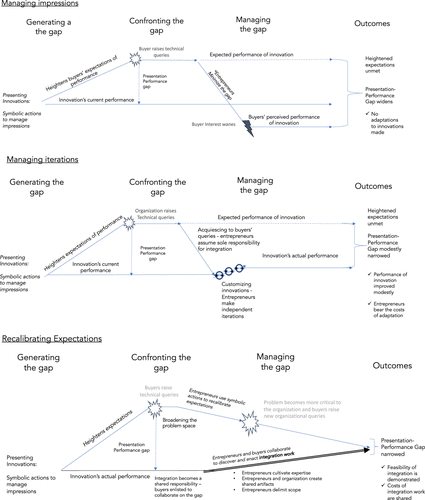
The top panel of Figure 1 explains how entrepreneurs that continue to rely on impression management actually exacerbate the gap that they try to obfuscate. Entrepreneurs who minimize buyer queries do not acknowledge the substance of buyers’ concerns nor do they take substantive actions to address the emerging gap between the presentation and the performance of their innovations. Attempts to manage impressions by minimizing queries widens the gap if buyers infer that entrepreneurs have something to hide. Continued attempts to manage impressions, in the face of technical queries, do not reset buyers’ raised expectations nor improve the underlying capabilities of an innovation. Thus, once the gap is revealed, managing impressions widens the gap, an unintended consequence that severs the relationship.
Managing Iterations.
Rather than minimizing queries, 10 entrepreneurs acquiesced to buyers’ queries and independently customized their innovations at their own expense in attempts to address the gap. These entrepreneurs took substantive actions to improve the current capabilities of their innovation but without addressing buyers’ heightened expectations. We trace how this pattern unfolded between MDCOR and Felipe, a buyer at Insurer 2. MDCOR had developed a novel way to manage the care of patients with comorbidities by combining disparate sources of data to improve patient outcomes. This innovation piqued the interest of Felipe and others at Insurer 2, who signed a preliminary agreement to purchase the application. Persuaded by MDCOR’s initial presentation, executives at Insurer 2 formed the expectation that MDCOR’s application could seamlessly integrate with their existing systems. Felipe was initially enthralled by MDCOR’s innovation as you could “just drop it in and bam (it would perform).” But, when executives at Insurer 2 began probing how the application would perform on site, they realized that MDCOR would need to rehaul their application to interoperate with Insurer 2’s existing systems. Felipe shared his thoughts with us privately.
We thought their thing, their app, would just quickly work with our stuff. After they had told us about their other implementations, with other companies, we thought that there would be little effort to get their thing to operate as we needed. But, when we asked some deeper questions, about the data they were using, etc. …
Insurer 2 demanded that MDCOR’s application capture and track “three more data points” to integrate with their existing systems. Initially, MDCOR told Insurer 2 that the three data points were not needed. “We wanted to avoid adding the exact 3 data points Insurer 2 requested. See, that data are a pain in the ass to maintain. We told Insurer 2 this. It actually would cost us a lot of time and effort to get these data, clean it and make it work with our systems.” To make this change, MDCOR would have to purchase the requested data and redeploy resources from other projects to reprogram their application.
Insurer 2 was not persuaded as they had heightened expectations formed by MDCOR’s prior presentations. As Felipe explained, “We thought this would be an easy, plug and play thing. We had that expectation. We weren’t then going to take a lot of our resources and time to make this thing work.” Felipe did not expect that these adaptations were Insurer 2’s problem to solve. Buoyed by the preliminary purchase agreement, MDCOR acquiesced and started customizing their application on their own—purchasing the three data points and reprogramming the data interface. Back at their office, MDCOR pulled three full-time people off another project to “invest 6 months of work, and … tons of iterations … At first, we thought, we could get it done quick. But no, not at all.” Three data points were just the beginning for Insurer 2. As MDCOR explained, “we thought we just needed to change one thing, but one thing turned into a million things and we just got so lost in these custom requests.” Each technical iteration was sequentially shown to Insurer 2 only to be met with additional requests for more technical changes. With each revision, something was still missing, but neither MDCOR nor Insurer 2 could pinpoint what it was—organizational changes to work processes and tasks and flows that never came to the fore. MDCOR made endless technical adaptations at their own expense without ever discovering Insurer 2’s full underlying organizational concerns. For the comorbidity application to perform at Insurer 2, it would need to replace existing systems, and staff would need to understand how to use the new data generated. But, these concerns never surfaced. Later, Felipe shared: “We really thought their [MDCOR] product was right for us and wanted to buy it. But we just could not figure out how to get it to well, fit in with the stuff we have.” In the end, despite many technical iterations, MDCOR did not sufficiently demonstrate how their innovation would “fit in” at Insurer 2, and Insurer 2 did not follow through on their preliminary purchase agreement, much to MDCOR’s dismay.
As Table 4 shows, Insurer 2 never raised any organizational queries about how internal roles or tasks would be implicated by MDCOR’s comorbidity application. Entrepreneurs managing iterations received a similar volume of technical queries as other start-ups in our study, but like entrepreneurs managing impressions, they did not receive organizational queries. Thus, there was little dialogue with buyers about changes to organizational systems, tasks, or roles that might be needed to achieve integration and narrow the gap. Unlike firms managing impressions, MDCOR and nine other firms (ALIGNPLAT, CORDCAR, FALL, FLAG, HEALTHYAPP, INSPECT, PACK, CAREVR, and PLAY) transitioned from managing impressions to engage in substantive actions, like acquiescing and customizing their innovations. All nine firms on this pathway assumed the full costs of customizing their innovations; yet, these improvements failed to convince buyers that integration in their organizations was feasible. Organizational changes needed to achieve integration were not addressed.
As shown in the middle panel of Figure 1, when entrepreneurs respond to technical queries with substantive actions—iterating independently on costly adaptations—they find themselves in reactive mode without enlisting participation from buyers’ organizations to help discover integration work. Buyers maintain heightened expectations, expecting any integration work needed to narrow the gap to be the responsibility of the entrepreneur alone.
Without recalibrating heightened expectations, entrepreneurs cannot enlist buyers’ participation and collaboration. Yet, entrepreneurs lack sufficient information about the organization to discover the integration work needed to narrow the gap on their own. Without discussing the organizational implications of using their innovation, entrepreneurs cannot demonstrate that integration is feasible. Although managing impressions widens the gap, managing iterations only narrows the gap modestly. Entrepreneurs make adaptations to their innovations, but these adaptations do little to ensure that entrepreneurs’ innovations integrate with buyers’ existing systems. There is no joint discovery of integration work nor mutual adaptation.
Recalibrating Expectations.
Rather than minimize buyers’ concerns or iterate on a “million technical requests,” 10 start-ups (INSTRUCT, INTEROP, OPSIGNAL, SIGNAL, TELEMED, DIETAP, EASE, SENSEDEVICE, TESTDEVICE, and QUICKD) took a different approach: counterbalancing prior impression management actions. These entrepreneurs used recalibrating actions (broadening the problem space and delimiting scope) to reset buyers’ heightened expectations and enlist their cooperation on integration work. Only after creating shared responsibility for discovering integration work did entrepreneurs substantively adapt the material capabilities of their innovations by creating shared artifacts and cultivating expertise. Buyers also contributed to integration work by making mutual adjustments: adapting work roles, flows, or processes to accommodate the innovation. We show how this pathway unfolded by explaining how DIETAP recalibrated Insurer 3’s expectations and how INSTRUCT enlisted Hospital 3 to discover technical and organizational adaptations that could narrow the gap.
Buyers at Insurer 3 found DIETAP’s health and wellness application intriguing as it could help them gather and analyze data to more accurately insure their customers. DIETAP’s presentation had given buyers the impression that it would easily integrate with their existing systems. After raising numerous technical queries, executives from Insurer 3 were unsure if “this would be so easy to implement as we originally thought.” They wanted DIETAP to reconfigure their data model to make implementation easier, but this request would take four weeks for DIETAP to complete alone. The team at DIETAP did not want to make this adaptation as it “was costly, a pain and just not where we were headed,” explained Don, the CEO of DIETAP.
In a meeting with Insurer 3, Don broadened the problem space, a symbolic move to help decision makers gain comfort with an unknown problem space that would require mutual work to explore. When an executive raised the data model question again, Don drew a small circle on the white board, saying “this is what we know.” Then, Don drew a massive circle to the right of the small circle, saying “this is what we don’t know or aren’t quite sure about. If we just focus on what we know, and go back and forth on these small things, where you think one thing, and well, we kinda think something else, we are not going to tackle these bigger things, that you and I don’t really know the answer to.” The executive agreed and gave Don the runway to talk about the journey into the unknown that DIETAP and Insurer 3 could take together. After the meeting, an executive (buyer) from Insurer 3 explained why he was convinced that his requests to reconfigure the data model could take a back seat: “We are innovators at [Insurer 3]. We like to focus on the big things. That is why we are here. That is what my group does. So, we totally get it.” Don and his team broadened the problem space, which elevated the conversation from technical requests for modifications to become more central to buyers’ interests. Through this action, Don recalibrated expectations away from Insurer 3’s requests to reconfigure their data model and toward solving a bigger unknown problem together: how to use patient data to improve insurance products and patient services.
Rather than minimizing queries or acquiescing to direct requests to customize the data model, broadening the problem space helped set the stage for joint exploration into the unknown. Instead of curating information to obfuscate, this action opened entrepreneurs up to engage in mutual discovery: “We have to be ok with not looking like we know everything and can fix their problems.” This approach stood in contrast to entrepreneurs who either minimized buyers’ technical queries or acquiesced to them by independently customizing their innovations. DIETAP received similar types of technical queries as other entrepreneurs and was equally disinterested in taking on these queries and expending effort customizing their innovations. Yet, rather than minimize or acquiesce, they broadened the problem space to recalibrate buyers’ expectations and make integration work a shared responsibility.
Entrepreneurs following this pathway not only recalibrated expectations but also, collaborated with buyers to improve the performance of their innovations. We show how this process unfolded between Hospital 3 and INSTRUCT. Hospital 3 was interested in INSTRUCT’s preoperative education application but was concerned with how it would integrate with the system used to share postoperative instructions. As the head of a department shared, “We sort of thought it was plug and play based on what they initially said. But we realized it wasn’t. If the patients use one system for preop and a different for post op, it makes no sense. We need them to fit the way they are doing things to what we already provide.” The department head asked INSTRUCT to adapt their preoperative application to fit their existing postoperative instruction system. Rather than acquiesce and customize their application to meet this request, INSTRUCT designed a collaborative workshop with hospital executives to learn more. During the workshop, the INSTRUCT team recalibrated Hospital 3’s expectation that their application was “plug and play.” The INSTRUCT team broadened the problem space and convinced hospital executives “not to worry about plug and play” and to instead focus on providing a cohesive care experience for patients—from preoperative to postoperative care. Hospital 3 became even more intrigued by INSTRUCT’s ideas to develop end-to-end patient care. In a subsequent workshop, the team at Hospital 3 was eager to understand how INSTRUCT’s application could solve this broader problem. They asked, “Do you think using this application can change the way we work?”
In response, the INSTRUCT team suggested exploring this new problem space (of end-to-end patient care) as their current application only addressed postoperative care. Through a series of on-site workshops, INSTRUCT discovered an issue inhibiting the hospital from delivering end-to-end patient care that was not just a technical problem but also, an organizational one. As the CEO of INSTRUCT relayed, “This wasn’t about just fixing our technology. Their process was so bad, they need new tasks, to support the tech.” After surfacing several organizational queries, a team leader at INSTRUCT mapped “the whole process out end to end. Where the patient starts in the process and all the way through the end of postop. There was stuff the heads [of the hospital] didn’t even know was happening.” The INSTRUCT team discovered inconsistencies in measuring compliance with both preoperative and postoperative instructions that spanned hospital departments previously unappreciated by administrators. In doing so, INSTRUCT cultivated new expertise that organization leaders respected. As a department head shared, “[INSTRUCT] knew the process better than us in the end. They were experts and thus, they became super valuable, and helped us really shore up a horrible process we had in the hospital, both from a technical and an organizational standpoint.” After gaining this insight, INSTRUCT and the hospital team created a shared artifact—an end-to-end workflow that showed how INSTRUCT’s application could work from preoperation to postoperation with technical adaptations to INSTRUCT’s application and organizational adaptations to the hospital’s process. This artifact essentially mapped the integration work needed.
Cultivating expertise granted INSTRUCT some leverage to delimit scope for “annoying refinements to their innovation” as the CEO of INSTRUCT shared. As the CEO explained, “[big organizations] are always going to have annoying requests that you don’t think make sense to address, or that they can address themselves. You need a way to bypass that.” Cultivating expertise in the eyes of the hospital gave INSTRUCT the leeway to delimit custom requests, despite prior claims of being “plug n play.” As one INSTRUCT founder shared: “Once we became a member of the team and our app was accepted as a reality, we could remind them that their annoying, trivial stuff would take us off course.” Members of the buyer’s organization took on integration work, adapting INSTRUCT’s user interface themselves to interoperate with their operating environment. With INSTRUCT’s newfound expertise, buyers were willing to take on integration work as they were now part of a team discovering how to solve a big problem that mattered to the organization: end-to-end patient care. Taken together, cultivating expertise and creating new artifacts enabled INSTRUCT to influence how integration costs were absorbed by both parties and allowed them to demonstrate the feasibility of integrating their application. For example, the new artifact (workflow diagram) detailed changes needed to the hospital’s process to accommodate the use of INSTRUCT’s application. Once it was clear to the hospital how their internal processes would integrate with INSTRUCT’s application, this hospital committed to a paid contract and piloted INSTRUCT’s application for both preoperative and postoperative care.
Entrepreneurs who recalibrated expectations (INSTRUCT, INTEROP, OPSIGNAL, SIGNAL, TELEMED, DIETAP, EASE, SENSEDEVICE, TESTDEVICE, and QUICKD) initially utilized symbolic actions to manage impressions when presenting their innovations to buyers. Like all other start-ups in our study, symbolic actions heightened buyers’ expectations of their innovations (Table 3). These start-ups received equivalent technical queries from similar buyers, revealing similar presentation-performance gaps (Table 4), but these 10 start-ups managed this gap very differently. These start-ups responded to buyer queries with recalibrating actions that explored rather than obfuscated the gap. Like start-ups managing iterations, these start-ups were willing to engage in substantive actions to adapt their innovations but did not pursue integration work on their own. Before adapting their innovations, they broadened the problem space, enlisting buyers to share responsibility for discovering integration work that neither party could identify on their own. These buyers not only contributed to technical adaptations but also, made organizational adaptations to their own workflows and processes. The 10 start-ups that recalibrated buyer expectations were all able to demonstrate the feasibility of integration within buyers’ organizations.
As the bottom panel of Figure 1 shows, recalibrating symbolic actions, like broadening the problem space, help entrepreneurs enlist buyers to jointly discover the integration work needed to narrow the presentation-performance gap. Broadening the problem space changes the conversation to surface vital information about the organizational processes, tasks, and roles implicated—which do not surface for entrepreneurs managing impressions or iterations.
This change in conversation enables entrepreneurs to cultivate organizational-specific expertise that helps them delimit the scope of integration work—which can be costly for entrepreneurs. Once entrepreneurs cultivate expertise, buyers are more willing to assume shared responsibility and share in the costs of making adaptations to both the organizational environment and an entrepreneur’s innovation. Buyers share in the cost of integration work two ways: creating new artifacts that explain changes in organizational workflows or systems and accepting responsibility for technical adaptations needed to integrate their systems. By sequencing substantive customizing actions only after recalibrating actions, entrepreneurs reground expectations heightened by impression management to enlist the participation needed to narrow a gap.
Conclusion
All entrepreneurs in our study started on similar paths, skillfully using symbolic actions to foster positive impressions with critical audiences, like buyers at established healthcare organizations. All entrepreneurs confronted equivalent types of technical queries from buyers that revealed a gap between entrepreneurs’ symbolic presentations and an innovation’s current performance. But, entrepreneurs diverged as to how they managed this gap. Table 6 compares the three pathways and links them to outcomes.
|
Table 6. Comparison of Different Pathways to Managing the Presentation-Performance Gap
| Pathway | Queries received | Type of actions | Outcomes | Representative data |
|---|---|---|---|---|
| Managing impressions N = 8 CARING, DEVICEPACK, PUBLIC, NUDGE, HEARTBEAT, MONITORDEV, SENSOR, CONTENTVR | Technical | Symbolic | Demonstrated feasibility = 0% Shared costs = 0% | No substantive performance improvement to innovations. Example: PUBLIC did not make adaptations to their innovation in response to technical queries by buyers at Hospital 1. Gap widened: “We really began to doubt their whole value proposition after these continued dismissive interactions.”—Executive Tech 2 Relationship ended in all relationships: NUDGE and Tech 2 ended their engagement after the executive at Tech 2 stopped communicating. “What really pissed me off was that they [Tech 2] did nothing.”—NUDGE cofounder |
| Managing iterations N = 10 ALIGNPLAT, CORDCAR, FALL, MDCOR, FLAG, HEALTHYAP, INSPECT, PACK, CAREVR, PLAY | Technical | Substantive | Demonstrated feasibility ∼ 10% Shared costs = 0% | Modest but insufficient performance improvement: “We needed PACK to scale—and thought that they would but they did not have the capabilities. We asked them to make modifications, which they did but they still could not just hit it. When we talk about the scale at which they can do a pilot, they become less attractive.”—COO Pharma 2 Relationship ended: “We terminated because we realized ‘PLAY’ wasn’t plug and play.”—COO Pharma 2 |
| Recalibrating expectations N = 10 INSTRUCT, INTEROP, OPSIGNAL, SIGNAL, TELEMED, DIETAP, EASE, SENSEDEVICE, TESTDEVICE, QUICKD | Technical and organizational | Symbolic and substantive | Demonstrated feasibility ∼ 95% Shared costs ∼ 95% | Demonstrated integration was feasible: “We figured out how it could be done. They were a great partner and now we know how to get their innovation to work within our company.”—Insurer 1 SVP Shared costs of integration work with buyer organization: “There was a lot of back and forth but in the end we could detail how to get our application to work with theirs. And we didn’t have to pay for it. They took on a lot of the stuff required, the changes needed to make this happen.”—CEO EASE |
Note. COO, chief operating officer; SVP, senior vice president.
By the study’s end, two thirds of entrepreneurs were cut off from continuing relationships with buyers—and moving on to potentially initiate the cycle with new buyers. Only those firms that recalibrated expectations and enlisted buyers to jointly discover integration work were able to (1) demonstrate feasibility of integration to buyers and (2) share the costs of integration work with buyers. Demonstrating feasibility was an important milestone as it helped entrepreneurs show how the performance of their innovations could narrow the gap, meet buyer expectations, and be put to use in the organization. Sharing the costs of integration work was an outcome that entrepreneurs desired as they did not want to assume the full expense of adapting their innovations to integrate with buyers’ organizations, particularly when requests were bespoke to the buyer’s organization.
Exploring Alternative Explanations
Consistent with the tenets of grounded theory (Glaser and Strauss 1967), we returned to the literature to consider alternative theoretical explanations for the variation that we observed, comparing and contrasting start-ups within and across the three paths. First, did start-ups harbor different objectives that might explain their different pathways? Scholars disagree as to how entrepreneurs vary in their motivations; although some seek autonomy from employment (Rindova et al. 2009), others seek exits (Guzman and Stern 2015). Thus, we recoded our data to assess if start-ups’ initial goals might have influenced the path pursued. We discovered that all firms shared two common objectives: (1) developing opportunities to conduct a paid pilot and (2) acquiring new customers or generating new sources of revenue. We did not discern any differences in what firms aimed to accomplish that could explain the variation observed.
Second, did differences in start-up characteristics influence the pathway they followed? Many scholars have studied how founding team demographics influence entrepreneurial outcomes (Beckman et al. 2007, Beckman and Burton 2008, Sorenson and Stuart 2008). Drawing on this literature, we evaluated founder gender, education, occupation, team size, sector, etc. to assess if these characteristics were associated with their usage of symbolic or substantive actions. As shown in Appendix D, we did not find any strong patterns according to founder or sector characteristics. For example, three start-ups with virtual reality innovations each followed a different path. All four sectors (care management, patient education, medical device, and virtual reality) had firms that followed all three paths. Start-ups that recalibrated expectations were slightly associated with founders with an advanced degree. Yet, we caution against overinferring from slight differences in such a small sample.
Third, did some firms begin with richer endowments that influenced their pathway? We analyzed each venture’s investment and revenue at entry to the study to assess whether ventures with “higher-quality” endowments were more likely to take certain actions than ventures with “lower-quality” endowments (e.g., Kerr et al. 2014, Guzman and Stern 2015). As shown in Appendix D, neither investment level nor revenue generated upon entry to the study explained variation in the pathway that start-ups followed.
Fourth, did differences in buyers’ organizations influence entrepreneurs’ ability to narrow the presentation-performance gap? All buyers’ organizations were interested in investing in digital health, and all had experience working with start-ups as shown in Table 2. All 28 firms confronted the presentation-performance gap in their interactions with buyers from 13 established organizations. We coded the difficulty of buyers’ questions and found no discernible patterns in the technical queries that buyers posed to entrepreneurs. Surprisingly, start-ups recalibrating expectations received more queries than others (on average) as they received organizational queries that other start-ups did not. Our unique research design enabled us to compare how the same start-up worked with different buyers. For example, we observed INSTRUCT work with buyers from two different organizations: Hospital 3 and Medical Device 2. We did not observe meaningful variation in start-up behavior across different buyers. Entrepreneurs engaged in each pathway attempted to partner with all buyer types. As Appendix C shows, we also compared start-ups nested within buyer organizations and by buyer type (e.g., hospital versus insurance company versus tech company). We did not observe start-ups on a given pathway interacting with only a single type of buyer. Thus, it is unlikely that buyers’ organizational characteristics influenced the pathway firms followed.
Discussion
Entrepreneurs’ deft use of symbolic actions can help persuade otherwise critical audiences by establishing credibility (Lounsbury and Glynn 2001, 2019; Zott and Huy 2007) and overcoming the well-known liabilities of young firms (Stinchcombe 1965, Posen and Chen 2013). This was true in our study as well. However, symbolic actions can also elevate the expectations of critical audiences (Garud et al. 2023) and create unanticipated adverse consequences (Schnackenberg et al. 2019, Murray and Fisher 2023). Few studies identify what happens when the persuasive power of entrepreneurs’ symbolic actions fade. We took on this lacuna by examining how entrepreneurs with digital innovations responded when their symbolic presentations were challenged by buyers at established organizations. Motivated by the risk of nonuse (e.g., Beane 2020, Lebovitz et al. 2022), misuse (e.g., DeSanctis and Poole 1994), or implementations gone awry, buyers turned a critical eye toward entrepreneurs’ promises of how their digital innovations would actually integrate with their organization’s existing technological systems and work processes.
Our research design enabled us to trace entrepreneurs’ use of symbolic actions and buyers’ responses. All 28 entrepreneurs in our study initially relied on common symbolic actions to manage impressions (showcasing, parroting and blending in, using analogies, and staging demonstrations). However, the persuasive power of entrepreneurs’ symbolic actions faded as buyers realized that their conceptions of an entrepreneurs’ innovation conflicted with an innovation’s underlying capabilities, revealing a gap between presentation and performance. We show how entrepreneurs manage these consequences by either narrowing or exacerbating the presentation-performance gap. Continued reliance on symbolic actions to manage impressions widened the gap between buyers’ expectations and the perceived performance of an innovation. Reliance on substantive actions to independently customize innovations produced modest but insufficient performance improvements without recalibrating buyers’ heightened expectations and narrowing the gap. Only one third of start-ups recalibrated buyers’ expectations, enlisting them to jointly discover and share in the costs of the integration work that could narrow the gap. Integration work required both technical and organizational adaptations that neither entrepreneurs nor organizations could discover and solve on their own. Recalibrating expectations set the stage for mutual adjustment on the part of buyers and entrepreneurs, which was not evidenced among entrepreneurs managing impressions or managing iterations.
The costs of integrating novel innovations within organizations are often underappreciated by both academics and practitioners. Entrepreneurs managing impressions shunned responsibility for the integration work that could narrow the gap. Entrepreneurs managing iterations shouldered responsibility for integration work: adapting their innovations on their own without sufficient expertise to sufficiently narrow the gap. Only once the discovery of integration work was made a shared responsibility were buyers willing to help produce artifacts that could demonstrate the feasibility of integration and share the costs of doing so. Under these conditions, both parties surfaced the mutual adaptations (to both organizational processes and innovations) needed to integrate digital innovations in established organizations and see them perform.
The Limits of Symbolic Actions
Why did the continued reliance on impression management actions not help narrow the presentation-performance gap? As cultural entrepreneurship theories would predict (Wry et al. 2011, Garud et al. 2014), symbolic actions were initially crucial to creating positive impressions and convincing buyers to engage with entrepreneurs. Symbolic actions to manage impressions lent entrepreneurs credibility and stimulated buyer interest. What was unexpected is that after buyers’ expectations were heightened, the power of impression management waned. Scholars often emphasize the power of symbolic actions but do not trace their evolution as relationships mature. In our study, continued attempts to manage impressions by minimizing queries and referencing peers as relationships matured obfuscated learning how to narrow the gap. These entrepreneurs did not discover how their innovations would implicate technical or organizational systems and processes. Entrepreneurs reliant on managing impressions did not understand the role that queries played in discovery (Golden-Biddle 2020). Rather, they saw queries as challenges to combat or distractions to ignore rather than as opportunities to further the relationship and learn about the context in which their innovation would be used. Buyers, in response, began doubting the underlying capabilities of innovations and entrepreneurs’ ability to deliver on their symbolic presentations. Without symbolic actions to recalibrate expectations or substantive actions to adapt innovations, the gap between what buyers expected and what entrepreneurs could deliver widened, leaving buyers unconvinced as to whether innovations could perform in their organization.
Building on this notion, Garud et al. (2014) theorized that when actors use symbolic actions to frame a positive potential future in highly uncertain markets, they can heighten expectations but leave audiences disappointed when that future develops differently. Once expectations are heightened, they can become difficult to realign (e.g., Bourmault and Anteby 2020) especially when entrepreneurs are concerned with preserving a consistent front (McDonald and Gao 2019). We show how heightened expectations are not just a product of the projective stories that entrepreneurs tell about possible futures (e.g., Boje 1991; Lounsbury and Glynn 2001, 2019; Garud et al. 2014) but also, stem from continued use of common impression management techniques (e.g., Elsbach and Kramer 2003; Zott and Huy 2007). In our case, entrepreneurs’ current promises rather than projective futures created buyer disappointment in the present.
Following recent calls to explore the dark side of symbolic actions (Schnackenberg et al. 2019, Gehman and Wry 2022), we contribute an underappreciated duality; although symbolic actions to manage impressions can initially incite interest from critical audiences, their curative properties can also generate a disquieting gap that neither symbolic actions nor substantive actions alone could easily narrow. Moreover, continued reliance on impression management techniques may dangerously tilt critical audiences’ views of entrepreneurs’ innovations from the positive to the impossible to believe. Our research suggests a flip side to impression management as relationships evolve from selling to implementing innovations. Different tactics may be needed to foster more revealing and authentic relationships. For example, in Karp (2023), entrepreneurs concealed the disruptive power of their innovations to staff (with executives’ full awareness). In our study, entrepreneurs’ symbolic presentations concealed the limits of their innovations from buyers. Although concealing an innovation’s disruptive attributes helped gain staff acceptance (Karp 2023), obscuring the limits of an innovation was detrimental to establishing credibility with buyers’ intent on integrating an innovation. Further research would do well to further develop the contours of this duality by probing with whom and under what conditions symbolic action tactics work as intended and where they meet their limits.
The Limits of Substantive Actions
Why did substantive actions not narrow the presentation-performance gap? Substantive actions may seem like the natural antidote to managing the presentation-performance gap as being highly responsive to customers’ unmet needs is a tried and true approach (von Hippel 1976, 1986). Substantive actions did help narrow the presentation-performance gap (as evidenced by entrepreneurs recalibrating expectations), but surprisingly, these actions were insufficient. Symbolic actions were also needed in advance to recalibrate expectations prior to taking substantive actions. Integration work cannot be discovered simply through conversation with customers or lead users (von Hippel 1986). It also requires organizational changes, which are not self-evident but require joint discovery. This challenges the notion that digital innovations can ever be “plug and play” (Bailey et al. 2022), at least in complex organizational settings. This may be why Oracle has over 10,000 in-house consultants dedicated to helping deploy their digital technologies in client organizations.
Despite the benefits of acquiring digital innovations from external sources (Pahnke et al. 2015), they require integration, which is an underappreciated and costly challenge (Leonardi 2007). Although stand-alone products might integrate simply, digital innovations rarely just hook into an organization’s existing infrastructure without modifications. When innovators are from outside an organization (Dahlander et al. 2016), they have only limited understanding of the context in which their digital innovations will be used. Symbolic efforts to manage impressions can inhibit discovery of integration work and how to integrate the new with the old (Fleming 2001, Burt 2004, Obstfeld 2005, Lifshitz-Assaf 2018) as integration often requires mutual adaptations to achieve synthesis (Carlile and Rebentisch 2003, Burt 2004). We found that neither buyers nor entrepreneurs could discover the integration work needed to see an innovation perform in situ on their own.
Furthermore, neither party had an interest in investing in the cost of integration. Much research hails the benefit of responding and adapting to customer or user inquiries (von Hippel 1986, 2005; Zott and Huy 2007; Denoo et al. 2022). Yet, doing so can entail unexpected costs. Entrepreneurs were not in equivalent positions of power with the buyers that they courted. Although entrepreneurs may be able to dictate terms to investors in certain markets (Hallen 2008), buyers or customers often have asymmetric power (e.g., Van de Ven et al. 2019) relative to entrepreneurs. In our study, buyers strove to dictate the terms, costs, and effort needed to narrow the gap and shift integration work to entrepreneurs. From the perspective of buyers, integration was entrepreneurs’ problem to solve; entrepreneurs had made symbolic presentations that their innovations would “plug and play.” Yet, buyers’ expectations of “plug and play” innovations were unlikely to be realized without adaptations from their organizations as well.
All entrepreneurs faced difficulty delimiting buyers’ bespoke requests, which could consume valuable resources. Entrepreneurs managing iterations succumbed to this difficulty, bearing the full costs of independently customizing their innovations to buyer’s demands and experiencing a state of “permanently beta” or “continual technological change” triggered by buyer queries. The organizational implications of using those innovations in situ were never revealed through inquiry, and entrepreneurs did not ultimately learn what the organization needed and demonstrate the feasibility of integration. When entrepreneurs acquiesced, they truncated mutual discovery of the technical and organizational adaptations needed to achieve integration. Golden-Biddle (2020) showed how mutual discovery to change internal systems occurred through doubt and inquiry—where healthcare professionals tried on and negotiated new habits. All entrepreneurs in our study also confronted doubt and inquiry from the buyers that they engaged with, but two thirds were not willing or able to translate inquiry into discovery. Most entrepreneurs did not leverage doubt and inquiry (e.g., Golden-Biddle 2020) to discover how their innovations would implicate organizations’ existing systems and processes. Buyers were thus unwilling to engage in discovering integration work, which they viewed as the responsibility of entrepreneurs alone. Yet, the work of integration could not be solved without their cooperation.
Recalibrating Expectations
How can entrepreneurs enlist buyers to narrow the presentation-performance gap? As much research would predict (Lounsbury and Glynn 2001, 2019; Zott and Huy 2007), impression management actions did help entrepreneurs initially gain access to buyers at established organizations. Yet, these actions obfuscated what could narrow the presentation-performance gap and did not help set the stage for mutual discovery. Research shows how the creation of shared artifacts fosters mutual understanding and adjustment inside organizations (Bechky 2003a, b; Okhuysen and Bechky 2009; Seidel and O’Mahony 2014). But, for this to occur, conditions for collaboration must be in place. In our setting, conditions for collaboration were weakened by entrepreneurs’ initial reliance on impression management and buyers’ growing awareness of a presentation-performance gap.
Recalibrating expectations helped create conditions that permitted mutual discovery and adjustment. These entrepreneurs counterbalanced initial impression management efforts: shifting from managing impressions to recalibrating expectations—which enabled both parties to explore the possible (e.g., Zander and Zander 2002). Recalibrating expectations demonstrates social skills: where actors maintain open-ended goals to frame new courses of action to induce the cooperation of others (Fligstein 1997). Those with social skills are “prepared to take what the system will give” rather than pursue their own narrow interests (Fligstein 1997, p. 113). When entrepreneurs broadened the problem space, the problem explored became more important, and buyers became more willing to reset their expectations. Creating a new problem space can help creative workers consider feedback from critical audiences that may be unwieldy or difficult (Harrison and Rouse 2015) and develop a sense of “we”. In our case, doing so not only generated room for feedback but also, helped avoid a reactive “iterative trap” by delimiting buyers’ requests for adaptations at start-ups’ expense. In fact, these entrepreneurs received more queries—queries about how innovations would interoperate with existing organizational systems and processes, which fostered mutual discovery. When firms are given the opportunity to learn, they often become willing to commit resources for development. This may help explain why only entrepreneurs who recalibrated expectations convinced buyers to engage in and share the costs of integration.
Existing theories of impression management suggest a singular direction where symbolic actions continue to convince or persuade, but they can also ratchet expectations (Garud et al. 2014, 2023; Schnackenberg et al. 2019; Murray and Fisher 2023) and create a gap with the substance underlying. The presentation-performance gap may be relevant to many contexts in addition to entrepreneurship—especially when attempts are made to convince or persuade others. We observed the power of recalibration in resetting expectations in the setting of digital health but suspect that recalibration practices would work to counterbalance failing impression management in other settings as well. Recalibrating expectations is critical to narrowing the presentation-performance gap as it regrounds expectations to initiate a path for mutual adaptation. A few scholars have examined how actors shift usage of symbolic actions over time as interest in their ideas or innovations grows, industries mature, or work changes (Navis and Glynn 2010, Wry et al. 2011, Lawrence and Phillips 2019). Building on this notion, we show how entrepreneurs shifted from impression management to recalibrating expectations to address deepening buyer scrutiny. As the relationship evolved from demonstrating credibility to making mutual discoveries, disclosure rather than obfuscation helped convince buyers that integration was feasible. It is often challenging for actors with low power to enlist collaboration from actors with more power and yet, little need to collaborate (Pfeffer 1981, Battilana and Casciaro 2021). In all cases, buyers tried to use their asymmetric power to push integration work and its associated costs on to start-ups that could ill afford customization efforts. Entrepreneurs that cultivated expertise that buyers lacked themselves were able to rebalance asymmetric power (Battilana and Casciaro 2021) and enlist buyers to discover and collaborate on integration work that could narrow the gap.
Implications
A crescendo of calls to reconsider common entrepreneurial practices that heighten expectations have recently come to the fore (New York Times). Without deft management of the presentation-performance gap, heightened expectations can easily transition into something more nefarious, such as in the cases of entrepreneurial fiascos such as Nikola, Theranos, Wework, the Anna Delvey Foundation, or the crypto start-up FTX (e.g., Garud et al. 2023). We did not observe nefarious or fraudulent actions in our study, but initial reliance on symbolic actions created an unanticipated challenge that was difficult for most entrepreneurs to address. With the growth of ecosystem resources devoted to entrepreneurship training, it is possible that entrepreneurs have become increasingly facile at managing impressions without commiserate training in recalibrating expectations. Scholars and practitioners alike may want to revisit what entrepreneurs are taught to pair excellence in symbolic actions with excellence with substantive actions. Our findings have implications beyond entrepreneurial firms and may inform situations where actors or organizations are trying to sell novel innovations to critical audiences.
Limitations
We studied start-ups innovating in the field of digital health at a common stage interacting with a common set of buyers from established organizations in the same region. Buyers in our study viewed integration as a condition for the use of digital innovations as the simplest innovation must integrate with patient records. These conditions are not unique to the field of health but relevant to other fields, such as energy (McKnight and Zietsma 2018) and financial services (Venkatraman 2017), where there is much institutional complexity, regulatory hurdles, data privacy issues, and competing standards. We acknowledge that other settings may not share the same emphasis on integration work to close the gap as we observed in the setting of digital health. Future research would do well to assess whether our findings apply in settings facing fewer integration needs. We studied the presentation-performance gap in the context of a power imbalance between start-ups and established firms (our findings may differ in settings where there is less power asymmetry, such as between two equally established firms).
We observed three distinct ways in which entrepreneurs managed the presentation-performance gap, but we cannot explain or predict what drove entrepreneurs to pursue these pathways, a promising area for future research. For example, did some entrepreneurs get caught up in their own hype, or were they overconfident? We cannot control for ways in which start-ups differed in their pre-existing resource endowments, but our robustness checks did not detect any patterns between pre-existing resources and the patterns observed. Future research would do well to investigate how entrepreneurs shift their approaches to using symbolic actions over longer periods of time and how symbolic actions might vary throughout the start-up life cycle and beyond. Much research has focused on how entrepreneurs use impression management to acquire resources and legitimacy from resource providers and critical stakeholders at an early stage, but this suggests consequences in only one direction: heightened expectations. Our research contributes an underappreciated side to this equation by showing how recalibrating actions can counter impression management and reground relationships with critical audiences and enable them to evolve and address misunderstandings.
Conclusion
Our research reveals an underappreciated duality; the very symbolic acts that entrepreneurs used to manage impressions and garner excitement from critical audiences also raised expectations, creating a presentation-performance gap that was difficult to narrow. Neither symbolic nor substantive actions alone were capable of narrowing that gap. Only by recalibrating expectations and engaging in the mutual discovery of integration work were entrepreneurs and buyers able to narrow this gap together—suggesting that any shortcut to integrating novel digital innovations in established organizations is but an illusion.
The authors thank their three anonymous reviewers and our fantastic, brillant editor. The authors acknowledge the helpful comments and feedback from Esther Leibel, Raghu Garud, Pinar Ozcan, Christine Beckman, Mark Zbaracki, Melissa Mazmanian, and attendees at the Boston University Research Seminar and the West Coast Research Conference. All errors are the responsibility of the authors.
Appendix A. Interview Protocols
|
| Interview Protocols (1 of 2) |
|---|
| Venture: Entrepreneur(s) |
| Innovation questions |
|
|
|
|
|
|
|
|
| Market/pipeline questions |
|
|
|
|
|
|
|
|
|
|
| Focal organization |
|
| Basic Interview Protocol (2 of 2) |
|---|
| Buyer organization: Buyer(s) |
| Working with start-ups |
|
| Working with focal start-up(s) |
|
Appendix B. Entrepreneurs’ Impression Management: Initial Use of Symbolic Actions
|
| Actor | Types of symbolic actions | |||
|---|---|---|---|---|
| (1) Showcasing | (2) Parroting and blending in | (3) Using analogies | (4) Staging demonstrations | |
| Entrepreneur | Highlighting prestigious advisory committee, mentors, investors, or customers engagements | Assimilating to adopting organizations’ dress, norms, and language, even when inconsistent with venture’s culture | Evoking known referents to help explain how innovation works and its value | Elaborate plans to highlight select features of an innovation and obscure lack of functionality |
| (CM) MDCOR: “One of our advisors is [name of advisor]. I think you know him? Ya, he wrote the book on this stuff.” | (E) PLAY: “They were more conservative than we are. I made sure to wear nice pants, a jacket and a blouse when meeting their executive team.” | (MD) SENSOR: “We are like a motion detection device on steroids.” | (E) PLAY: “We practiced and practiced our demo, preloading elements we thought they might ask for, so we could be seamless.” | |
| (CM) ALIGNPLAT: “We always tell everyone about the 3 big engagements we have with (customer name). That usually gets us firmly in the door.” | (CM) ALIGNPLAT: “I always try to figure out the lingo. Are they overtechnical, doctory? Are they more like tech bros? It’s critical to know because they like to feel like you know them. And I can do them all.” | (E) HEALTHYAP: “Imagine an urban cooler Zelda for diabetes education and management. That is us.” | (E) HEALTHYAP: “To show it worked for kids, we took our basic game and mocked up a couple scenes, just enough, so they could see we were ready to use it for kids.” | |
| (VR) QUICKD: “We have a prestigious board, so we tell people about it. And I have a ton of experience, so I share it. It’s my responsibility to put us in the best light.” | (MD) SENSEDEVICE: “Occasionally I break out my scrubs, for certain types of customer meetings. That way it looks like I came from the laboratory. Docs love that. If the meeting is informal.” | (MD) SENSEDEVICE: “We are like that those Frankenstein cartoons. I know that sounds totally scary, but yeah it isn’t.” | (VR) QUICKD: “We often ask for a chance to demo right away. Demoing is important. But you need to anticipate what they will ask, so you can demo the right stuff, stuff they will be impressed with.” | |
| Buyer reaction | CIO at Insurance Company: “They told us about their advisory board, and we were impressed.” | Executive at Pharmaceutical Company: “I just felt like Jamie really understood our company culture. She could fit right in. She understood us.” | Executive at Pharmaceutical Company: “I really understood the value SENSOR could bring when they explained how their technology was ‘like on steroids,’ I was like ok. I get it.” | Executive at Pharmaceutical Company: “Jamie’s demo really showed how the product could work easily in our company.” |
Note. CM, care management; PE, patient education; MD, medical device; VR, virtual reality.
Appendix C. Start-ups Nested in Buyer Organizations
|
| Organization | Start-up | Managing impressions | Managing iterations | Recalibrating expectations | |
|---|---|---|---|---|---|
| Hospitals (3) | Hospital 1 | ALIGNPLAT | 1 | ||
| Hospital 1 | CORDCAR | 1 | |||
| Hospital 1 | DEVICEPACK | 1 | |||
| Hospital 1 | PACK | 1 | |||
| Hospital 1 | PUBLIC | 1 | |||
| Hospital 1 | QUICKD | 1 | |||
| Hospital 2 | HEALTHYAP | 1 | |||
| Hospital 2 | MDCOR | 1 | |||
| Hospital 2 | MONITORDEV | 1 | |||
| Hospital 2 | PLAY | 1 | |||
| Hospital 2 | SIGNAL | 1 | |||
| Hospital 3 | HEARTBEAT | 1 | |||
| Hospital 3 | INSTRUCT | 1 | |||
| Hospital 3 | INTEROP | 1 | |||
| Hospital 3 | SENSOR | 1 | |||
| Hospital 3 | TELEMED | 1 | |||
| Total | 6 | 5 | 5 | ||
| Insurers (3) | Insurer 1 | DIETAP | 1 | ||
| Insurer 1 | EASE | 1 | |||
| Insurer 2 | CAREVR | 1 | |||
| Insurer 2 | MDCOR | 1 | |||
| Insurer 3 | DIETAP | 1 | |||
| Insurer 3 | FALL | 1 | |||
| Total | 2 | 1 | 3 | ||
| Medical device companies (2) | Medical Device 1 | DIETAP | 1 | ||
| Medical Device 1 | HEALTHYAP | 1 | |||
| Medical Device 2 | CAREVR | 1 | |||
| Medical Device 2 | HEARTBEAT | 1 | |||
| Medical Device 2 | INSTRUCT | 1 | |||
| Medical Device 2 | TELEMED | 1 | |||
| Medical Device 2 | TESTDEVICE | 1 | |||
| Total | 2 | 1 | 4 | ||
| Nonprofit (1) | Nonprofit | CAREVR | 1 | ||
| Nonprofit | CARING | 1 | |||
| Nonprofit | CONTENTVR | 1 | |||
| Nonprofit | NUDGE | 1 | |||
| Nonprofit | OPSIGNAL | 1 | |||
| Nonprofit | SENSEDVICE | 1 | |||
| Total | 3 | 1 | 2 | ||
| Pharmaceutical companies (2) | Pharma 1 | FLAG | 1 | ||
| Pharma 1 | PACK | 1 | |||
| Pharma 1 | SENSOR | 1 | |||
| Pharma 1 | TELEMED | 1 | |||
| Pharma 2 | QUICKD | 1 | |||
| Pharma 2 | HEALTHYAP | 1 | |||
| Pharma 2 | MONITORDEV | 1 | |||
| Pharma 2 | PACK | 1 | |||
| Pharma 2 | PLAY | 1 | |||
| Pharma 2 | SENSOR | 1 | |||
| Total | 3 | 5 | 2 | ||
| Technology companies (2) | Tech 1 | ALIGNPLAT | 1 | ||
| Tech 1 | CARING | 1 | |||
| Tech 1 | FALL | 1 | |||
| Tech 1 | INTEROP | 1 | |||
| Tech 1 | MDCOR | 1 | |||
| Tech 1 | DIETAP | 1 | |||
| Tech 2 | CONTENTVR | 1 | |||
| Tech 2 | INSPECT | 1 | |||
| Tech 2 | INTEROP | 1 | |||
| Tech 2 | NUDGE | 1 | |||
| Total | 3 | 4 | 3 |
Appendix D. Start-up Descriptives by the Presentation-Performance Gap Pathway
|
| Start-up | Digital health subsector | CEO gender | Firm age (years) | Initial annual revenue | Initial funding | No. of founders | Pathway |
|---|---|---|---|---|---|---|---|
| INSTRUCT | Care management | Male | 4 | Mid | Mid | 4 | Recalibrating expectations |
| INTEROP | Care management | Male | 3 | High | High | 4 | Recalibrating expectations |
| OPSIGNAL | Care management | Female | 2 | Mid | High | 3 | Recalibrating expectations |
| SIGNAL | Care management | Male | 2 | High | Mid | 2 | Recalibrating expectations |
| TELEMED | Care management | Female | 5 | Low | Low | 2 | Recalibrating expectations |
| ALIGNPLAT | Care management | Male | 4 | High | High | 1 | Managing iterations |
| CORDCAR | Care management | Male | 4 | High | Mid | 2 | Managing iterations |
| FALL | Care management | Male | 2 | High | Low | 3 | Managing iterations |
| MDCOR | Care management | Male | 5 | High | High | 5 | Managing iterations |
| CARING | Care management | Female | 2 | High | Low | 1 | Managing impressions |
| DEVICEPACK | Care management | Female | 2 | High | Low | 2 | Managing impressions |
| PUBLIC | Care management | Male | 3 | High | High | 4 | Managing impressions |
| SENSEDEVICE | Medical device | Female | 4 | Mid | High | 2 | Recalibrating expectations |
| TESTDEVICE | Medical device | Male | 2 | Low | Mid | 4 | Recalibrating expectations |
| INSPECT | Medical device | Female | 1 | Low | Mid | 2 | Managing iterations |
| PACK | Medical device | Male | 1 | Low | Mid | 2 | Managing iterations |
| HEARTBEAT | Medical device | Female | 2 | Mid | Mid | 2 | Managing impressions |
| MONITORDEV | Medical device | Female | 1 | Low | Low | 4 | Managing impressions |
| SENSOR | Medical device | Male | 2 | Low | High | 5 | Managing impressions |
| DIETAP | Patient education | Male | 3 | Mid | Low | 4 | Recalibrating expectations |
| EASE | Patient education | Female | 2 | Low | Mid | 1 | Recalibrating expectations |
| FLAG | Patient education | Male | 3 | Mid | Low | 2 | Managing iterations |
| HEALTHYAP | Patient education | Female | 3 | Mid | High | 3 | Managing iterations |
| PLAY | Patient education | Female | 3 | Low | Mid | 1 | Managing iterations |
| NUDGE | Patient education | Female | 1 | Low | Low | 2 | Managing impressions |
| QUICKD | Virtual reality | Male | 8 | High | High | 4 | Recalibrating expectations |
| CAREVR | Virtual reality | Male | 1 | Low | Mid | 2 | Managing iterations |
| CONTENTVR | Virtual reality | Male | 2 | Mid | Low | 3 | Managing impressions |
1 See https://www.cms.gov.
References
- (1987) Membership Roles in Field Research, vol. 6 (Sage, Thousand Oaks, CA).Crossref, Google Scholar
- (2023) “Collaborating” with AI: Taking a system view to explore the future of work. Organ. Sci. 34(5):1672–1694.Link, Google Scholar
- (1986) Feedback-seeking in individual adaptation: A resource perspective. Acad. Management J. 29(3):465–487.Crossref, Google Scholar
- (2020) Beyond design and use: How scholars should study intelligent technologies. Inform. Organ. 30(2):100286.Crossref, Google Scholar
- (2022) We are all theorists of technology now: A relational perspective on emerging technology and organizing. Organ. Sci. 33(1):1–18.Link, Google Scholar
- (1986) Technology as an occasion for structuring: Evidence from observations of CT scanners and the social order of radiology departments. Admin. Sci. Quart. 31(1):78–108.Crossref, Google Scholar
- (2009) The role of narratives in sustaining organizational innovation. Organ. Sci. 20(1):107–117.Link, Google Scholar
- (2021) Power, for All: How It Really Works and Why It’s Everyone’s Business (Simon and Schuster, New York).Google Scholar
- (2020) In storage, yet on display: An empirical investigation of robots’ value as social signals. Proc. 2020 ACM/IEEE Internat. Conf. Human-Robot Interaction (Association for Computing Machinery, New York), 83–91.Google Scholar
- (2003a) Sharing meaning across occupational communities: The transformation of understanding on a production floor. Organ. Sci. 14(3):312–330.Link, Google Scholar
- (2003b) Object lessons: Workplace artifacts as representations of occupational jurisdiction. Amer. J. Sociol. 109(3):720–752.Crossref, Google Scholar
- (2015)
Leveraging comparative field data for theory generation . Elsbach KD, Kramer R, eds. Handbook of Qualitative Organizational Research (Routledge, New York), 168–176.Google Scholar - (2008) Founding the future: Path dependence in the evolution of top management teams from founding to IPO. Organ. Sci. 19(1):3–24.Link, Google Scholar
- (2007) Early teams: The impact of team demography on VC financing and going public. J. Bus. Venturing 22(2):147–173.Crossref, Google Scholar
- (1991) Consulting and change in the storytelling organisation. J. Organizational Change Management 4(3):7–17.Crossref, Google Scholar
- (2020) Unpacking the managerial blues: How expectations formed in the past carry into new jobs. Organ. Sci. 31(6):1452–1474.Link, Google Scholar
- (2004) Structural holes and good ideas. Amer. J. Sociol. 110(2):349–399.Crossref, Google Scholar
- (2003) Into the black box: The knowledge transformation cycle. Management Sci. 49(9):1180–1195.Link, Google Scholar
- (2006) Constructing Grounded Theory: A Practical Guide Through Qualitative Analysis (Sage, Thousand Oaks, CA).Google Scholar
- (2021) Using tables to enhance trustworthiness in qualitative research. Strategic Organ. 19(1):113–133.Crossref, Google Scholar
- Cohen SL, Bingham CB, Hallen BL (2018) The role of accelerator designs in mitigating bounded rationality in new ventures. Administrative Sci. Quart. 64(4):810–854.Google Scholar
- (2019) The design of startup accelerators. Res. Policy 48(7):1781–1797.Crossref, Google Scholar
- (1990) Grounded theory research: Procedures, canons, and evaluative criteria. Qualitative Sociol. 13(1):3–21.Crossref, Google Scholar
- (2016) One foot in, one foot out: How does individuals’ external search breadth affect innovation outcomes? Strategic Management J. 37(2):280–302.Crossref, Google Scholar
- (2010)
Where strategy meets culture: The neglected role of cultural and symbolic resources in strategy research . Baum JAC, Lampel J, eds. The Globalization of Strategy Research, Advances in Strategic Management, vol. 27 (Emerald Group Publishing Limited, Leeds, UK), 175–208.Crossref, Google Scholar - (2022) The impact of customer ties and industry segment maturity on business model adaptation in an emerging industry. Strategic Entrepreneurship J. 16(3):602–632.Crossref, Google Scholar
- (1994) Capturing the complexity in advanced technology use: Adaptive structuration theory. Organ. Sci. 5(2):121–147.Link, Google Scholar
- (2008) CMR classics: Speed and strategic choice: How managers accelerate decision making. Calif. Management Rev. 50(2):102–116.Crossref, Google Scholar
- (2006) Internet companies’ growth strategies: Determinants of investment intensity and long‐term performance. Strategic Management J. 27(12):1183–1204.Crossref, Google Scholar
- (2003) Organizational perception management. Res. Organ. Behav. 25:297–332.Crossref, Google Scholar
- (2003) Assessing creativity in Hollywood pitch meetings: Evidence for a dual-process model of creativity judgments. Acad. Management J. 46(3):283–301.Crossref, Google Scholar
- (1992) Acquiring organizational legitimacy through illegitimate actions: A marriage of institutional and impression management theories. Acad. Management J. 35(4):699–738.Crossref, Google Scholar
- (2011) Writing Ethnographic Fieldnotes (University of Chicago Press, Chicago).Crossref, Google Scholar
- (1994) Consensus, diversity, and learning in organizations. Organ. Sci. 5(3):403–420.Link, Google Scholar
- (2001) Recombinant uncertainty in technological search. Management Sci. 47(1):117–132.Link, Google Scholar
- (1997) Social skill and institutional theory. Amer. Behavioral Scientist 40(4):397–405.Crossref, Google Scholar
- (2001) Social skill and the theory of fields. Sociol. Theory 19(2):105–125.Crossref, Google Scholar
- (2014) Entrepreneurial storytelling, future expectations, and the paradox of legitimacy. Organ. Sci. 25(5):1479–1492.Link, Google Scholar
- (2023) The dark side of entrepreneurial framing: A process model of deception and legitimacy loss. Acad. Management Rev. ja:amr-2022.Google Scholar
- (2022)
Cultural entrepreneurship: Theorizing the dark sides . Lockwood C, Soublière J-F, eds. Advances in Cultural Entrepreneurship (Emerald Publishing Limited, Leeds, UK), 97–110.Crossref, Google Scholar - (2017) The mind and heart of resonance: The role of cognition and emotions in frame effectiveness. J. Management Stud. 54(5):711–738.Crossref, Google Scholar
- Glaser BG, Strauss AL (1967) The Discovery of Grounded Theory; Strategies for Qualitative Research (Aldine Pub. Co, Chicago).Google Scholar
- (1959) The Presentation of Self in Everyday Life (Social Behavior Publisher, Garden City, NY).Google Scholar
- (2020) Discovery as an abductive mechanism for reorienting habits within organizational change. Acad. Management J. 63(6):1951–1975.Crossref, Google Scholar
- (2013) Hedging your bets: Explaining executives’ market labeling strategies in nanotechnology. Organ. Sci. 24(2):395–413.Link, Google Scholar
- (2018) Field expansion and contraction: How communities shape social and symbolic boundaries. Admin. Sci. Quart. 63(4):783–818.Crossref, Google Scholar
- (2017) How does a grand challenge become displaced? Explaining the duality of field mobilization. Acad. Management J. 60(5):1801–1827.Crossref, Google Scholar
- (2015) Entrepreneurship in regulated markets: Framing contests and collective action to introduce pay TV in the U.S. Acad. Management J. 58(6):1709–1739.Crossref, Google Scholar
- (2015) Where is Silicon Valley? Science 347(6222):606–609.Crossref, Google Scholar
- (2008) The causes and consequences of the initial network positions of new organizations: From whom do entrepreneurs receive investments? Admin. Sci. Quart. 53(4):685–718.Crossref, Google Scholar
- (2001) When innovations meet institutions: Edison and the design of the electric light. Admin. Sci. Quart. 46(3):476–501.Crossref, Google Scholar
- (2015) An inductive study of feedback interactions over the course of creative projects. Acad. Management J. 58(2):375–404.Crossref, Google Scholar
- Hsu G, Grodal S (2020) The double-edged sword of oppositional category positioning: A study of the U.S. E-cigarette category, 2007–2017. Administrative Sci. Quart. 66(1):86–132.Google Scholar
- (2016) Discursive strategies and radical technological change: Multilevel discourse analysis of the early computer (1947–1958). Strategic Management J. 37(1):149–166.Crossref, Google Scholar
- (2015) The double‐edged sword of recombination in breakthrough innovation. Strategic Management J. 36(10):1435–1457.Crossref, Google Scholar
- (2023) Gaining organizational adoption: Strategically pacing the position of digital innovations. Acad. Management J. 66(3):773–796.Crossref, Google Scholar
- (2002) Something old, something new: A longitudinal study of search behavior and new product introduction. Acad. Management J. 45(6):1183–1194.Crossref, Google Scholar
- (2009) Operating room: Relational spaces and microinstitutional change in surgery. Amer. J. Sociol. 115(3):657–711.Crossref, Google Scholar
- (2020) Algorithms at work: The new contested terrain of control. Acad. Management Ann. 14(1):366–410.Crossref, Google Scholar
- (2014) Entrepreneurship as experimentation. J. Econom. Perspect. 28(3):25–48.Crossref, Google Scholar
- (2019) Constructing Organizational Life: How Social-Symbolic Work Shapes Selves, Organizations, and Institutions (Oxford University Press, Oxford, UK).Crossref, Google Scholar
- (2022) To engage or not to engage with AI for critical judgments: How professionals deal with opacity when using AI for medical diagnosis. Organ. Sci. 33(1):126–148.Link, Google Scholar
- (2007) Activating the informational capabilities of information technology for organizational change. Organ. Sci. 18(5):813–831.Link, Google Scholar
- (2008) Materiality and change: Challenges to building better theory about technology and organizing. Inform. Organ. 18(3):159–176.Crossref, Google Scholar
- (2018) Dismantling knowledge boundaries at NASA: The critical role of professional identity in open innovation. Admin. Sci. Quart. 63(4):746–782.Crossref, Google Scholar
- (2010) Nexus work: Brokerage on creative projects. Admin. Sci. Quart. 55(1):47–81.Crossref, Google Scholar
- (1995) Developing analysis. Analyzing Social Setting, 183–203.Google Scholar
- (2008) Perspective—Making doubt generative: Rethinking the role of doubt in the research process. Organ. Sci. 19(6):907–918.Link, Google Scholar
- (2001) Cultural entrepreneurship: Stories, legitimacy, and the acquisition of resources. Strategic Management J. 22(6–7):545–564.Crossref, Google Scholar
- (2019) Cultural Entrepreneurship: A New Agenda for the Study of Entrepreneurial Processes and Possibilities (Cambridge University Press, Cambridge, UK).Crossref, Google Scholar
- (2019) Beyond homo entrepreneurus: Judgment and the theory of cultural entrepreneurship. J. Management Stud. 56(6):1214–1236.Crossref, Google Scholar
- (2019) Pivoting isn’t enough? Managing strategic reorientation in new ventures. Organ. Sci. 30(6):1289–1318.Link, Google Scholar
- (2018) Finding the threshold: A configurational approach to optimal distinctiveness. J. Bus. Venturing 33(4):493–512.Crossref, Google Scholar
- (2018)
Twenty-five years later … The illusive strategy . Bedeian AG, ed. Management Laureates (Routledge, London), 321–374.Crossref, Google Scholar - Moore GA (1991) Crossing the Chasm: Marketing and Selling High-Tech Goods to Mainstream Customers (HarperBusiness).Google Scholar
- (2023) When more is less: Explaining the curse of too much capital for early-stage ventures. Organ. Sci. 34(1):246–282.Link, Google Scholar
- (2010) How new market categories emerge: Temporal dynamics of legitimacy, identity, and entrepreneurship in satellite radio, 1990–2005. Admin. Sci. Quart. 55(3):439–471.Crossref, Google Scholar
- (2005) Social networks, the tertius iungens orientation, and involvement in innovation. Admin. Sci. Quart. 50(1):100–130.Crossref, Google Scholar
- (2009) 10 coordination in organizations: An integrative perspective. Acad. Management Ann. 3(1):463–502.Crossref, Google Scholar
- (2016)
Digital work: A research agenda . Czarniawska B, ed. A Research Agenda for Management and Organization Studies (Edward Elgar Publishing, Northampton, MA), 88–95.Crossref, Google Scholar - (2015) Who takes you to the dance? How partners’ institutional logics influence innovation in young firms. Admin. Sci. Quart. 60(4):596–633.Crossref, Google Scholar
- (1981) Understanding the role of power in decision making. Power Organ. 404:423.Google Scholar
- (1980) Industry structure and competitive strategy: Keys to profitability. Financial Analysts J. 36(4):30–41.Crossref, Google Scholar
- (2013) An advantage of newness: Vicarious learning despite limited absorptive capacity. Organ. Sci. 24(6):1701–1716.Link, Google Scholar
- (1994) The social construction of reputation: Certification contests, legitimation, and the survival of organizations in the American automobile industry: 1895–1912. Strategic Management J. 15(S1):29–44.Crossref, Google Scholar
- (2008)
Symbolic value creation . Barry D, Hansen H, eds. The SAGE Handbook of New Approaches in Management and Organization (Sage, Thousand Oaks, CA), 270–284.Crossref, Google Scholar - (2009) Entrepreneuring as emancipation. Acad. Management Rev. 34(3):477–491.Crossref, Google Scholar
- (2011) A cultural quest: A study of organizational use of new cultural resources in strategy formation. Organ. Sci. 22(2):413–431.Link, Google Scholar
- (2009) Effectuation: Elements of Entrepreneurial Expertise (Edward Elgar Publishing, Northampton, MA).Google Scholar
- (1992) Interpersonal processes involving impression regulation and management. Annual Rev. Psych. 43(1):133–168.Crossref, Google Scholar
- (2019) Capitalizing on categories of social construction: A review and integration of organizational research on symbolic management strategies. Acad. Management Ann. 13(2):375–413.Crossref, Google Scholar
- (2014) Managing the repertoire: Stories, metaphors, prototypes, and concept coherence in product innovation. Organ. Sci. 25(3):691–712.Link, Google Scholar
- (2020) Rumor communities, social media, and forthcoming innovations: The shaping of technological frames in product market evolution. Acad. Management Rev. 45(2):304–324.Crossref, Google Scholar
- (2008) Bringing the context back in: Settings and the search for syndicate partners in venture capital investment networks. Admin. Sci. Quart. 53(2):266–294.Crossref, Google Scholar
- (1965) Organization-creating organizations. Trans-action 2(2):34–35.Crossref, Google Scholar
- (1981)
Identities, the phenomenal self, and laboratory research . Tedeschi JT, ed. Impression Management Theory and Social Psychological Research (Elsevier, Amsterdam), 3–22.Crossref, Google Scholar - (2019) How outcome agreement and power balance among parties influence processes of organizational learning and nonlearning. J. Management 45(3):1252–1283.Crossref, Google Scholar
- (2017) The Digital Matrix: New Rules for Business Transformation Through Technology (LifeTree Media, Los Angeles).Google Scholar
- (1976) The dominant role of users in the scientific instrument innovation process. Res. Policy 5(3):212–239.Crossref, Google Scholar
- (1986) Lead users: A source of novel product concepts. Management Sci. 32(7):791–805.Link, Google Scholar
- (2005) Democratizing innovation: The evolving phenomenon of user innovation. J. Betriebswirtschaft 55(2005):63–78.Crossref, Google Scholar
- (2010) A matter of appearances: How corporate leaders manage the impressions of financial analysts about the conduct of their boards. Acad. Management J. 53(1):15–44.Crossref, Google Scholar
- (2011) Legitimating nascent collective identities: Coordinating cultural entrepreneurship. Organ. Sci. 22(2):449–463.Link, Google Scholar
- (2002) The Art of Possibility: Transforming Professional and Personal Life (Penguin, New York).Google Scholar
- (2007) How entrepreneurs use symbolic management to acquire resources. Admin. Sci. Quart. 52(1):70–105.Crossref, Google Scholar
Rebecca Karp is an assistant professor in the Strategy Unit at Harvard Business School. Her field research examines how companies formulate and execute strategies, focusing on the role that innovation and product development play in creating competitive advantage. Professor Karp’s research spans the healthcare, financial services, video gaming, media, and creative industries. She has also studied how large companies and entrepreneurs collaborate to innovate and achieve competitive advantage.
Siobhan O’Mahony is the Feld Family Professor in Innovation and Entrepreneurship, Management & Organizations at the Boston University Questrom School of Business and an Associate Editor at Administrative Science Quarterly. Professor O’Mahony studies how collective technical and creative projects organize. She examines how innovative projects manage the tension between maintaining open, and preserving boundaries, purpose, and mission.