


Demand for Research and the Composition of Scientific Response: Intellectual Distance, Research Productivity, and Research Outcomes
Abstract
When demand for research in a domain increases, scientific progress depends not only on whether more research is produced, but also on which scientists produce that research. This distinction is especially important in emerging domains, where technological trajectories remain uncertain and progress often requires the generation and integration of heterogeneous scientific knowledge. This study examines how academic scientists respond when demand for research increases in a domain and what research outcomes they produce within that domain. Empirically, I exploit the Zero Emission Vehicle (ZEV) mandate, which led to an unanticipated increase in demand for electric vehicle (EV) research. I find that scientists became more likely to produce EV research after the mandate. However, this response varied systematically across scientists: as intellectual distance from the EV domain increased, more-productive scientists were less responsive than less-productive scientists. Yet among scientists who produced EV research, the research outcomes of scientists from more distant domains were associated with greater novelty, while those of more-productive scientists from more distant domains were associated with greater scientific impact and greater use in downstream EV inventions. These findings suggest that increased demand for research shapes not only the volume of scientific activity in a domain, but also the composition of scientists who produce that research.
Supplemental Material: The online appendix is available at https://doi.org/10.1287/orsc.2023.17926.
1. Introduction
Advances in scientific knowledge often provide the intellectual foundations for downstream invention and commercialization. Scientific research can help identify technical bottlenecks, generate new principles and methods, and provide a map for subsequent technological search (Rosenberg and Nelson 1994, Fleming and Sorenson 2004). This role of science is especially important in emerging domains, where technological trajectories remain uncertain and progress often depends on the generation and integration of heterogeneous scientific knowledge (Moeen et al. 2020, Agarwal et al. 2025). As a result, the rate and direction of progress in emerging domains depend not only on downstream invention by firms, but also on whether academic scientists engage with the scientific problems that arise within these domains.
Yet academic scientists’ engagement with emerging domains cannot be taken for granted. Scientists often develop specialized research agendas, accumulate domain-specific expertise and collaborators, and face uncertainty about whether research in a new domain will generate meaningful scientific contributions. These challenges may be especially salient in emerging domains, where the relevant technical problems, evaluation criteria, and future trajectories are still unsettled. Moreover, because the supply of trained scientists within any given domain is often inelastic in the short run (Oi 1962), increased demand for research cannot be met immediately by simply training new scientists (Goolsbee 1998, Stephan 2015). Instead, progress may depend partly on whether scientists from other domains redirect their research toward emerging needs. Because such redirection is often costly (Myers 2020, Blomfield and Vakili 2023), increased demand may shape not only the amount of scientific activity in a domain, but also the composition of scientists who produce that research.
This study examines which academic scientists produce research in a domain when demand for research in that domain increases (hereafter, I refer to such a domain as the demand-relevant domain), and how their response patterns shape research outcomes within that domain. I focus on two dimensions that are central to scientists’ response decisions and to the outcomes they may produce: their prior research productivity and their intellectual distance from the demand-relevant domain. These dimensions are important because intellectual distance shapes the adjustment costs of redirecting research, while prior productivity shapes scientists’ opportunity costs and their potential to contribute to the demand-relevant domain.
I argue that an increase in demand for research in a domain raises scientists’ overall propensity to produce research in that domain. However, this response varies across scientists. As intellectual distance from the demand-relevant domain increases, more-productive scientists exhibit a weaker increase in their propensity to produce research in that domain than less-productive scientists. Yet, when more-productive scientists from more distant domains do produce research in the demand-relevant domain, their research outcomes are associated with greater scientific impact than those of other scientists, including more-productive scientists from closer domains. In addition, among scientists who produce research in the demand-relevant domain, the research outcomes of scientists from more distant domains are associated with greater novelty.
Using observational data to test these arguments presents several identification challenges. First, many unobservable factors can simultaneously influence both demand and scientists’ decisions to produce research in a domain. Furthermore, scientists’ decisions to produce research in a domain can endogenously affect subsequent scientific progress and future demand conditions in that domain. Addressing these challenges would ideally require an experiment in which certain domains are randomly assigned to an increase in demand for research. This would make it possible to observe whether more- or less-productive scientists from close or distant domains produce research in that domain and, equally importantly, what research outcomes these scientists generate in that domain. To approximate this ideal setting, I exploit the unexpected Zero Emission Vehicle (ZEV) mandate in September 1990 as an exogenous shock that led to an unanticipated increase in demand for research related to EV technologies.
The ZEV mandate was adopted by the California Air Resources Board (CARB) in 1990. Importantly, the mandate was introduced not in response to major ex ante progress in EV technologies but as part of CARB’s efforts to address California’s worsening air pollution. During the 1980s, California experienced increasingly severe air quality problems and consistently ranked among the most polluted states in the United States, placing it at risk for losing federal funding and regulatory support. Recognizing that a more aggressive approach was necessary to meet air quality goals, CARB introduced the ZEV mandate, which required, for the first time, the sale of electric vehicles. Automakers strongly opposed the mandate and argued that existing technologies were insufficient, but the regulation nevertheless compelled them to invest in developing EV technologies to meet the sales requirements. As implementation unfolded, automakers and government agencies came to recognize that meaningful progress in EV technologies required advances grounded in basic research across multiple scientific domains. Consequently, the ZEV mandate contributed to a substantial and unanticipated increase in demand for upstream scientific research related to EV technologies, particularly research drawing on knowledge from more distant domains and experimenting with new energy storage and conversion materials, lightweight materials, traction motors, and fuel cells.
Using a difference-in-differences methodology, I find that scientists, on average, became more likely to produce EV research following the ZEV mandate. However, as intellectual distance from the EV domain increased, this increase in propensity was smaller among more-productive scientists, indicating that, at greater intellectual distances, more-productive scientists were less responsive to the increased demand for EV research than less-productive scientists. Among scientists who produced EV research, the research outcomes of scientists from more distant domains were associated with greater novelty, while those of more-productive scientists from more distant domains were associated with greater scientific impact and greater use in downstream EV inventions.
Additional analyses provide suggestive evidence for the mechanisms underlying these patterns. The lower responsiveness of more-productive scientists at greater intellectual distances was especially pronounced when the opportunity costs of reallocating effort were plausibly higher, such as when their established home research domains offered expanding opportunities. This pattern is consistent with the interpretation that higher opportunity costs may have made more-productive distant scientists more selective about whether to produce EV research.1
This study contributes to research on the demand for science and the organization of scientific production by developing a compositional view of scientific response. Prior work has shown that funding, policy, technological change, and market demand can shape the rate and direction of scientific activity (Vakili and McGahan 2016, Sohn 2021, Blomfield and Vakili 2023, Goldfarb et al. 2026). This study shows that increased demand shapes scientific production not only by expanding research activity in a domain, but also by changing which scientists produce that research. This compositional perspective helps explain why increased demand may not necessarily draw the scientists whose research is associated with the greatest novelty and impact, conditional on entry. It also informs research on university-industry interaction by showing that demand arising from downstream technological development can create upstream scientific opportunities, but whether those opportunities translate into scientific output depends on academic scientists’ reallocation decisions, intellectual distance, and established research positions in their home domains.
The study also contributes to research on knowledge recombination and exploration. Prior work emphasizes that recombining knowledge across domains can produce novel ideas, but distant recombination can also be difficult to evaluate, integrate, and translate into influential outcomes (Fleming 2001, Uzzi et al. 2013, Kneeland et al. 2020). This study shifts attention from knowledge combinations themselves to the scientists who undertake them. The findings suggest that the value of knowledge from more distant domains depends not only on its novelty, but also on which scientists pursue such opportunities and whether they are positioned to combine that knowledge with complementary domain expertise. In doing so, the study links recombination and exploration by showing how opportunity costs, selection, scientists’ established research positions, and collaboration jointly shape when distant exploration is associated with impactful research outcomes (March 1991, Arts and Fleming 2018).
2. Theoretical Framework and Hypotheses
This study examines how academic scientists respond when demand for research in a domain increases and what research outcomes they produce within that domain. I refer to the domain in which demand has increased as the demand-relevant domain. I refer to scientists’ preexisting research domains as their home domains. These home domains represent the knowledge areas, collaborators, routines, and research trajectories around which scientists had already organized their research.
The central premise is that scientists’ response to increased demand reflects a research-reallocation decision.2 Producing research in the demand-relevant domain requires allocating time, attention, and other scarce research resources away from scientists’ established home domains. Increased demand can raise the expected returns to such reallocation, but scientists differ in the expected benefits, costs, and opportunity costs of redirecting their research effort from their home domains toward the demand-relevant domain.
I focus on two scientist characteristics that shape this reallocation decision: intellectual distance from the demand-relevant domain and research productivity. Intellectual distance refers to the extent to which a scientist’s preexisting research knowledge differs from the knowledge base of the demand-relevant domain.3 Research productivity serves as an indicator of scientists’ established research position in their home domains, including their accumulated expertise, recognized research output, and access to home-domain resources and collaborators.4 These two characteristics matter because intellectual distance shapes the adjustment costs of reallocating research effort, whereas research productivity shapes both the opportunity costs of leaving established home domains and the potential contribution scientists may make in the demand-relevant domain.
2.1. Demand for Research and Scientific Response
An increase in demand for research in a domain should, on average, make academic scientists more likely to produce research in that domain because it raises the expected returns to allocating research effort there. Increased demand may expand access to funding, equipment, data, materials, and applied problems that require scientific input (Rosenberg 1982, Stephan 2015). Government agencies may direct funding toward areas where additional research is needed (Azoulay et al. 2011), and firms may engage academic scientists when their R&D activities require scientific knowledge (Sohn 2021).
Increased demand can also attract scientists by revealing new research opportunities. Downstream technological development may expose empirical or technical bottlenecks that existing scientific knowledge cannot yet resolve, thereby creating opportunities for further academic research (Rosenberg 1982, Stokes 1997). This mechanism is especially salient in emerging domains, where technological trajectories remain unsettled and progress often depends on the development and integration of heterogeneous scientific knowledge (Moeen et al. 2020, Agarwal et al. 2025). In such settings, unresolved bottlenecks can create opportunities for academic researchers to develop new principles, methods, materials, and empirical understanding that guide subsequent technological search (Rosenberg and Nelson 1994, Fleming and Sorenson 2004).
However, scientists’ engagement with increased demand for research cannot be taken for granted. Academic scientists typically organize their research around established home domains, where they have accumulated specialized expertise, collaborators, routines, and research trajectories. Producing research in the demand-relevant domain may therefore require scientists to acquire new knowledge, adapt existing methods, build new collaborations, and evaluate uncertain research opportunities outside their established areas of expertise. These challenges are likely to be especially salient in emerging domains, where relevant technical problems and future trajectories remain uncertain. Moreover, because the supply of trained scientists in any domain is inelastic in the short run, increased demand cannot be met immediately by simply training new scientists (Oi 1962, Goolsbee 1998, Stephan 2015). Instead, scientific response often depends in part on whether existing scientists redirect effort from their home domains toward the demand-relevant domain.
This reasoning implies that increased demand may shape not only the volume of research produced in a domain, but also the composition of scientists who produce that research. Although demand can raise the average attractiveness of producing research in the demand-relevant domain, scientists differ in the expected benefits, costs, and opportunity costs of reallocating effort from their home domains. The next section examines how scientists’ response to increased demand varies with their intellectual distance from the demand-relevant domain and their research productivity.
2.2. Scientists’ Response to Increased Demand: Intellectual Distance and Research Productivity
Although increased demand can raise scientists’ average propensity to produce research in the demand-relevant domain, this response should weaken as intellectual distance increases. Scientists at greater intellectual distances may find that their existing knowledge, methods, collaborators, and routines transfer less directly to the demand-relevant domain, requiring greater investments in learning, adaptation, and the search for complementary expertise. These adjustment costs are especially important in scientific research because the expanding scientific frontier has led scientists to develop increasingly specialized expertise (Jones 2009). More broadly, research on scientific effort allocation shows that redirecting scientists’ research agendas in response to new opportunities is costly and incomplete (Myers 2020). Therefore, the increase in scientists’ propensity to produce research in the demand-relevant domain should be weaker as intellectual distance increases.
Moreover, as intellectual distance increases, the increase in scientists’ propensity to produce research in the demand-relevant domain should be weaker among more-productive scientists than among less-productive scientists. Scientists’ established research productivity shapes their reallocation decision because it affects both the expected return to entering the demand-relevant domain and the expected return to remaining in their home domains. More-productive scientists’ prior research productivity is likely to have built not only on individual expertise, but also on established collaboration networks, research routines, tacit knowledge, and access to resources that strengthened their positions in their home domains (Merton 1968, Stephan 2015). These accumulated assets may help more-productive scientists recognize and pursue demand-driven research opportunities. In particular, when the demand-relevant domain is close to a scientist’s home domains, many of these assets may transfer relatively easily, reducing some of the costs of entering that domain.
As intellectual distance increases, however, more-productive scientists cannot as readily rely on the home-domain collaboration networks, routines, and tacit understanding that supported their prior work. They may still draw on their expertise, reputation, resources, and access to collaborators, but applying these assets to relatively less familiar problems may require developing new domain-specific knowledge and accessing complementary expertise in the demand-relevant domain. By contrast, more-productive scientists can continue to use their accumulated assets within their established home domains. Thus, even when their capabilities reduce some of the costs of entering the demand-relevant domain, the opportunity costs of reallocating effort away from their home domains remain high.5 This argument is consistent with research on exploration and path dependence, which suggests that accumulated expertise and prior success can reinforce existing trajectories and make movement into new domains more costly (March 1991, Levinthal and March 1993, Audia and Goncalo 2007).
More-productive scientists must therefore weigh reallocating effort toward the demand-relevant domain against attractive opportunities in their home domains. Their decision depends not only on whether they possess the capabilities to enter, but also on whether the perceived prospects of the demand-relevant opportunity are sufficiently attractive relative to continuing in their home domains. As intellectual distance increases, more-productive scientists are therefore likely to require stronger perceived prospects that the opportunity is promising, feasible, or complementary to their existing research before producing research in that domain. Thus, at greater intellectual distances, the threshold for reallocating effort to the demand-relevant domain is likely to be higher for more-productive scientists than for less-productive scientists.
Accordingly, I expect that an increase in demand for research in a domain will raise scientists’ average propensity to produce research in that domain, but that this response will vary with scientists’ intellectual distance and prior research productivity. Scientists who are intellectually more distant from the demand-relevant domain should exhibit a weaker increase in their propensity to produce research in that domain. Moreover, as intellectual distance increases, this increase should be weaker among more-productive scientists than among less-productive scientists.
Following an increase in demand for research in a domain, the increase in scientists’ propensity to produce research in that domain is weaker as their intellectual distance from the domain increases. This negative association between intellectual distance and the increase in research propensity is more pronounced among scientists with higher research productivity.
2.3. Scientists’ Research Outcomes in the Demand-Relevant Domain
The preceding section examines how scientists’ response to increased demand for research varies with intellectual distance and research productivity. I next consider how these characteristics are associated with variation in the novelty and impact of research outcomes produced in the demand-relevant domain.
Conditional on producing research in the demand-relevant domain, intellectual distance should be positively associated with research novelty. Scientists at greater intellectual distances bring knowledge, methods, and problem framings that are less redundant with the existing knowledge base of the demand-relevant domain. These differences can create opportunities for combining knowledge from previously disconnected domains, thereby increasing the novelty of the research produced in the demand-relevant domain (Kneeland et al. 2020). Thus, greater intellectual distance should be associated with greater novelty among scientists who produce research in the demand-relevant domain.
Conditional on producing research in the demand-relevant domain, the novelty of scientists’ research outcomes in that domain is positively associated with their intellectual distance from the domain.
Novelty, however, does not necessarily imply impact (Uzzi et al. 2013). Research that draws on more distant knowledge may be harder to understand, evaluate, or integrate with ongoing research problems in the demand-relevant domain. Its impact should therefore depend not only on the nonredundant knowledge scientists bring from their home domains, but also on whether scientists are positioned to adapt that knowledge and combine it with complementary knowledge in the demand-relevant domain.
More-productive scientists may be better positioned to meet this condition. Their accumulated expertise can help them evaluate and integrate knowledge across domains, a process that is often uncertain (Fleming 2001, Fleming and Sorenson 2004). Their reputation, resources, and access to collaborators may also help them form connections with scientists who possess complementary expertise in the demand-relevant domain (Merton 1968, Zeng et al. 2022, Mindruta et al. 2025). These connections can help them adapt knowledge from their home domains and integrate it with domain-relevant knowledge, increasing the likelihood that such novel combinations become scientifically influential or useful for downstream invention.
In addition, the same reallocation logic that makes more-productive scientists more selective as intellectual distance increases helps explain why research productivity should matter for the impact of research produced in the demand-relevant domain. As intellectual distance increases, more-productive scientists face higher opportunity costs of reallocating effort away from their established home domains. They should therefore require stronger perceived prospects before producing research in that domain. This does not imply that scientists can precisely forecast the future impact of their research. Rather, it implies that, among more-productive scientists at greater intellectual distances, those who produce research in the demand-relevant domain are likely to constitute a positively selected subset. They are more likely to produce research in the domain when demand-relevant opportunities appear sufficiently promising, feasible, or complementary to their existing research, thereby justifying the reallocation of effort away from their home domains.
Together, these arguments suggest that, among scientists who produce research in the demand-relevant domain, research by more-productive scientists at greater intellectual distances should be associated with greater impact.
Conditional on producing research in the demand-relevant domain, research outcomes produced by more-productive scientists at greater intellectual distances are associated with greater impact.
3. The Zero Emission Vehicle (ZEV) Mandate and Electric Vehicle Technologies
I exploit the Zero Emission Vehicle mandate adopted in September 1990 as an exogenous event that led to an unanticipated increase in demand for research related to EV technologies. Importantly, the mandate was adopted not because of major ex ante progress in EV technologies, but rather as part of the government’s efforts to address the increasingly severe air pollution in California throughout the 1980s (Calef and Goble 2007, Collantes and Sperling 2008, Vergis and Mehta 2012).
3.1. Environmental and Regulatory Origins of the ZEV Mandate
California has long been a leader in U.S. air pollution policy, reflecting both the severity of its environmental challenges and its pioneering regulatory stance. Despite decades of tightening emission standards and technological improvements in vehicles, including catalytic converters and fuel-injection systems, by the 1980s there was limited improvement in California’s air quality. Population growth, increases in the number of registered vehicles, and rapid growth in numbers of vehicle miles traveled severely undercut gains from cleaner technologies. Between 1970 and 1995, vehicle miles traveled increased more than 2.5-fold, from 103 billion to 270 billion miles, while the state’s population grew by 60%, from 20 million to 32 million (Vergis and Mehta 2012). Compounding this trend was a marked consumer shift toward sport-utility vehicles and light trucks, which were substantially less fuel-efficient and more polluting than standard passenger cars (Heavenrich 2006).
As a result, California continued to rank among the worst states for air pollution by the late 1980s. Major metropolitan areas, particularly Los Angeles, regularly exceeded both federal and state ozone standards—often by substantial margins. In 1987, for example, several regions exceeded California’s ozone threshold (0.09 ppm for a 1-hour average) more than 100 times in a single year (South Coast Air Quality Management District 2003). Ground-level ozone levels and the frequency of smog events placed California cities at the top of national pollution indices. By 1990, gasoline-powered cars remained key culprits, responsible for more than half of nitrogen oxide emissions and nearly half of reactive organic gas emissions statewide (CARB 2005).
These environmental conditions also created growing political pressure. In 1988, Southern California exceeded federal ozone standards on more than 176 days (Reinhold 1989), placing the state at risk for losing federal transportation funding. At the national level, regulatory attitudes were also hardening. In a landmark 1987 ruling, the U.S. Court of Appeals held that the Environmental Protection Agency (EPA) must establish emission standards based solely on health considerations, rather than on industry costs or technological feasibility (Lewis 1987).6 Together, these developments reinforced the growing perception that traditional emissions-control strategies had reached their limits and that more transformative policy action was necessary.
Within this context, California’s regulatory institutions, led by the California Air Resources Board (CARB), concluded that a more aggressive approach was required to meet air quality goals. The perception that incremental improvements in combustion-engine technologies would be insufficient motivated CARB to take a bold step: mandating a shift away from internal combustion altogether.
3.2. Adoption of the ZEV Mandate and Increased Demand for EV Research
In response to these pressures, CARB adopted the Zero Emission Vehicle mandate in September 1990, a policy that marked a sharp departure from California’s previous emissions regulations. The ZEV mandate fundamentally reshaped the technological expectations placed on automakers operating in California. Unlike prior emissions regulations that could be met through refinements to combustion engines, this policy, for the first time in history, required automakers to manufacture and sell vehicles with zero tailpipe emissions, which at the time referred mainly to electric vehicles.7 The mandate specified a phased implementation schedule: beginning in 1998, large automakers were required to ensure that 2% of their new vehicle sales in California were zero-emission vehicles—a requirement that rose to 5% in 2001 and 10% by 2003. Noncompliance carried steep penalties, including fines of $5,000 per vehicle short of the quota. The mandate applied to major automakers with annual sales of 35,000 or more vehicles in the state, including GM, Ford, Chrysler, Toyota, Honda, Nissan, and Mazda.8
This unexpected regulatory push sparked intense opposition from the auto industry. Automakers argued that existing battery and powertrain technologies were insufficiently advanced and that premature commercialization would lead to failure in the consumer market. Nevertheless, because California was the nation’s largest auto market, the binding mandate and associated penalties compelled automakers to redirect substantial R&D investments toward EV development. For example, Chrysler, Ford, and GM pooled resources with the government to form the U.S. Advanced Battery Consortium, whose primary objective was to improve battery technologies and support the development of a viable EV by 1998. Automakers not directly mandated at the time, including BMW and Volkswagen, also increased investment in EV technologies because they were concerned about being targeted in the future.
Before the mandate, EV research had largely languished on the periphery of both industrial and academic attention (Cioffi 1995). As the implementation unfolded, automakers and government agencies came to recognize that meeting the mandate would require more than incremental engineering improvements—it would require fundamental advances grounded in basic research across physics, electrochemistry, materials science, electrical and mechanical engineering, chemical engineering, and other related disciplines. This recognition, in turn, prompted efforts to attract academic researchers to EV-relevant domains. For example, the Big Three automakers, the National Science Foundation, and the Department of Energy sponsored the 1995 conference Basic Research Needs for Vehicles of the Future. At the conference, scientists from the automotive industry highlighted critical areas in need of academic research, including the exploration of new energy storage and conversion materials, lightweight materials, traction motors, and emerging technologies such as fuel cells and flywheels.
The ZEV mandate is therefore well suited for examining which scientists produce research in a domain when demand for research in that domain increases and how their response patterns shape research outcomes within the domain. Policy studies suggest that many automobile companies, which had largely neglected research on EV technologies and advanced batteries since the 1970s, initially opposed the ZEV mandate and invested in EV technologies during the 1990s primarily as a result of the mandate (Calef and Goble 2007, Collantes and Sperling 2008, Vergis and Mehta 2012). Furthermore, in the early 2000s, major automakers, including GM, DaimlerChrysler, and Isuzu Motors, filed multiple lawsuits seeking to overturn the mandate (Los Angeles Times 2002). Therefore, the increase in demand for EV research during the 1990s was largely unexpected and unlikely to have been driven by significant ex ante scientific or technological advancements in EV technologies.
4. Data and Empirical Strategy
4.1. Data and Variable Construction
I examine how the increase in academic scientists’ propensity to produce EV research following the ZEV mandate varies with their research productivity and intellectual distance from the EV domain. Furthermore, I examine the implications of these response patterns for the research outcomes produced within the EV domain. I collect journal articles and conference proceedings from OpenAlex to capture scientists’ research activities (Priem et al. 2022).9
I began by constructing a sample of academic scientists who were at risk for entering the EV domain. Because the ZEV mandate was adopted in the United States, I first identified scientists affiliated only with U.S. institutions during the five years before the mandate (1986–1990) to ensure they were sufficiently exposed to the mandate. As my focus is on academic scientists, I restricted the sample to those with at least one publication affiliated with an academic institution both before and after the ZEV mandate.10 Additionally, to identify scientists “at risk” of producing EV research, I further restricted the sample to those who had published at least one paper in the physical sciences domain before the ZEV mandate.11,12 This process yielded a final sample of 154,206 scientists. I then collected all their journal articles and conference proceedings (across all domains) during the 15-year period from 1986 through 2000 (inclusive), representing five years of data before and ten years after the ZEV mandate. For each scientist, I exclude scientist-year observations before they start publishing any research, as measured by their first publication year in OpenAlex.
To collect publications in OpenAlex relevant to electric vehicle technologies, I identify papers with the topics “electric and hybrid vehicle technologies,” “advanced battery technologies research (for electric vehicles),” “electric motor drives (for electric vehicles),” and “electric vehicles and infrastructure.”
Next, I construct each scientist’s intellectual distance from the EV domain using their publications and the corpus of EV publications, both prior to the ZEV mandate. Specifically, I collect the titles and abstracts of all publications authored by the scientists in my sample during the five years before the ZEV mandate (1986–1990), as well as the titles and abstracts of the EV publications. I then use SciBERT to convert each title and abstract into an embedding vector (Beltagy et al. 2019). SciBERT is a fine-tuned text-embedding model trained on 1.14 million scientific articles and thus captures the semantic meaning of scientific text.13,14 I represent the EV domain by computing the mean embedding vector of all EV publications and represent each scientist’s intellectual domain by computing the mean embedding vector of their own publications, both based on papers published during 1986–1990 (Aceves and Evans 2024). Finally, I calculate each scientist’s intellectual distance from the EV domain as the cosine distance between the mean embedding vector of their own publications and that of the EV publications.
In addition, for scientists who produced EV research after the ZEV mandate, I construct measures of the scientific impact, novelty, and use in downstream EV inventions of their EV research. First, I measure the scientific impact of EV papers by counting the number of citations each paper received within five years of publication. Second, I measure the novelty of EV papers by comparing each paper’s embedding vector to that of prior EV papers. For each EV paper, I identify EV papers published in the preceding five years and compute the mean embedding vector of this prior research using SciBERT. I then calculate the cosine distance between the embedding vector of each focal EV paper and the mean embedding vector of prior EV papers; a larger cosine distance indicates that the focal paper is more intellectually distant from preceding EV research and is therefore considered more novel. Third, I capture the impact of each EV paper on downstream inventions by counting the number of times it was cited in EV patents.15 I identify patent citations using the Reliance on Science database (Marx and Fuegi 2020, 2022). I aggregate all these measures at the scientist-year level by computing the average number of citations per EV paper, the average novelty per EV paper, and the average number of EV-patent citations per EV paper. These averages account for differences in scientists’ baseline numbers of EV publications, as scientists from more distant domains may produce fewer EV papers.
4.2. Empirical Strategy
4.2.1. Intellectual Distance, Research Productivity, and Propensity to Produce EV Research After the ZEV Mandate.
My main analysis examines how academic scientists’ propensity to produce EV research following the ZEV mandate varies by their research productivity and intellectual distance from the EV domain. Formally, I estimate a difference-in-differences linear probability model using panel data at the scientist-year level for the years 1986–2000.16
The main coefficient of interest is . A negative estimated value would suggest that, following the ZEV mandate, more-productive scientists were relatively less responsive than less-productive scientists to the increased demand for EV research as their intellectual distance from the EV domain increased.
4.2.2. Intellectual Distance, Research Productivity, and Research Outcomes in the EV Domain.
After examining how academic scientists with different levels of research productivity and intellectual distance responded to increased demand for EV research, I next examine whether their EV research outcomes differ in novelty, scientific impact, and use in downstream EV inventions. To this end, I restrict the analysis to scientist-years with at least one EV publication during 1991–2000.22 Formally, I estimate an OLS model using this scientist-year panel for the years 1991 through 2000.
Because this analysis is restricted to post-ZEV scientist-years with at least one EV publication, I do not include scientist fixed effects.24 Instead, I include fixed effects for each scientist’s primary research field () along with controls for individual-level characteristics (), including the number of coauthors (1986–1990), research diversity (1986–1990), number of grants (1986–1990), and an indicator for whether the scientist published any EV papers during 1986–1990. Similarly, includes additional controls: scientist ’s career age in year , and incumbent EV scientist-year fixed effects to account for scientists’ preexisting propensity to produce EV research.
To assess Hypothesis 2a, I first estimate a specification with intellectual distance as the main independent variable and examine its coefficient. A positive coefficient would suggest that, among scientists who produced EV research, research outcomes produced by scientists at greater intellectual distances from the EV domain were associated with greater novelty. To assess Hypothesis 2b, the main coefficient of interest is the interaction between research productivity and intellectual distance. A positive interaction coefficient would suggest that, among scientists who produced EV research, research outcomes produced by more-productive scientists at greater intellectual distances from the EV domain were associated with greater scientific impact and greater use in downstream EV inventions. Because this analysis is conditional on producing EV research and does not include scientist fixed effects, I interpret these estimates as characterizing outcome heterogeneity among EV research producers, rather than as identifying causal effects of productivity or intellectual distance on research outcomes.
Table 1 reports the descriptive statistics for all variables.
|

Table 1. Descriptive Statistics
| Variable | Mean | Std. dev | Minimum | Maximum | Obs |
|---|---|---|---|---|---|
| Scientist-year panel (1986–2000) | |||||
| Publish any EV paper in a year | 0.001 | 0.04 | 0.00 | 1.00 | 2,232,126 |
| Number of EV papers in a year | 0.002 | 0.07 | 0.00 | 12.00 | 2,232,126 |
| Intellectual distance from EV domain (1986–1990) | 0.113 | 0.05 | 0.01 | 0.63 | 2,232,126 |
| Productivity (1986–1990; normalized by average productivity in scientist’s main research field) | 1.023 | 1.87 | 0.01 | 129.68 | 2,232,126 |
| After ZEV mandate | 0.691 | 0.46 | 0.00 | 1.00 | 2,232,126 |
| Incumbent EV scientist | 0.005 | 0.07 | 0.00 | 1.00 | 2,232,126 |
| Career age | 18.165 | 11.78 | 0.00 | 50.00 | 2,232,126 |
| Number of non-EV coauthors (1986–1990) | 17.602 | 51.59 | 0.00 | 1795.00 | 2,232,126 |
| Career age in 1990 | 14.948 | 11.27 | 0.00 | 40.00 | 2,232,126 |
| Change in home domain opportunities (in thousands of papers) | 4.324 | 4.08 | −1.16 | 49.20 | 2,232,126 |
| Scientist-year panel conditional on having published any EV paper (1991–2000) | |||||
| Average novelty of EV paper | 0.104 | 0.05 | 0.05 | 0.31 | 1,761 |
| Average citations per EV paper | 4.074 | 8.06 | 0.00 | 103.00 | 2,294 |
| Share of EV papers with citations in the top 10% | 0.194 | 0.37 | 0.00 | 1.00 | 2,294 |
| Share of EV papers with citations in the top 5% | 0.106 | 0.29 | 0.00 | 1.00 | 2,294 |
| Average number of citations from EV patents | 0.537 | 4.02 | 0.00 | 80.00 | 2,294 |
| Intellectual distance from EV domain (1986–1990) | 0.070 | 0.04 | 0.01 | 0.53 | 2,294 |
| Productivity (1986–1990; normalized by average productivity in scientist’s main research field) | 1.376 | 2.02 | 0.01 | 22.99 | 2,294 |
| Any EV papers before ZEV mandate | 0.296 | 0.46 | 0.00 | 1.00 | 2,294 |
| Number of coauthors (1986–1990) | 18.710 | 43.74 | 0.00 | 958.00 | 2,294 |
| Diversity of research (1986–1990) | 0.638 | 0.11 | 0.00 | 0.86 | 2,294 |
| Number of grants (1986–1990) | 0.156 | 0.78 | 0.00 | 11.00 | 2,294 |
| Career age | 21.504 | 11.63 | 1.00 | 50.00 | 2,294 |
5. Results
5.1. Increased EV Research Activity and Scientist Entry After the ZEV Mandate
Before presenting the main results, I first conduct a difference-in-differences analysis at the research-topic level to establish that the ZEV mandate led to an increase in EV research activity and in the number of scientists producing EV research. This analysis provides a foundation for my main analysis of which scientists responded to the increased demand for EV research and how their response patterns were associated with subsequent EV research outcomes. Appendix A presents the empirical analysis and results. Following the ZEV mandate, there was an average increase of 19.7 publications per year among EV research topics, representing a 43.9% increase relative to control topics. Similarly, the number of scientists and new-to-topic scientists in EV research topics increased by 40.7 (49%) and 35.8 (59%) per year, respectively, relative to control topics.
5.2. As Intellectual Distance from EV Increased, More-Productive Scientists Were Less Responsive to the Increased Demand for EV Research
This section presents the main results, which show that, following the ZEV mandate, more-productive scientists were less responsive to the increased demand for EV research than less-productive scientists as their intellectual distance from the EV domain increased.
Table 2, Column (1), shows that, following the ZEV mandate, scientists at greater intellectual distance from the EV domain were less responsive to the increased demand for EV research than scientists who were intellectually closer to the EV domain. A one-standard-deviation increase in intellectual distance was associated with a reduction equal to 54.7% of the mean post-ZEV likelihood of producing EV research. Figure 1(a) examines the timing of this effect to assess whether it occurred after the ZEV mandate. Specifically, I reestimate the specification in Column (1) but replace with a series of year-specific dummies, and plot the estimated coefficients on the interaction between the distance variable and these year dummies. The estimates were small and stable before the 1990 ZEV mandate but became negative following the mandate, consistent with lower responsiveness among scientists at greater intellectual distance from the EV domain.25
|
Table 2. Following the ZEV Mandate, Scientists at Greater Intellectual Distance from the EV Domain Were Less Responsive to Increased Demand for EV Research, and This Negative Relationship Was More Pronounced among More-Productive Scientists
| DV = 1 if any EV paper in a year | (1) | (2) Productivity above Median | (3) Continuous Productivity |
|---|---|---|---|
| Intellectual distance from EV domain × after ZEV mandate | −0.016*** (0.001) | −0.007*** (0.001) | −0.012*** (0.001) |
| More-productive scientist × after ZEV mandate | 0.003*** (0.000) | 0.001*** (0.000) | |
| More-productive scientist × intellectual distance from EV domain × after ZEV mandate | −0.026*** (0.003) | −0.007*** (0.001) | |
| R2 | 0.035 | 0.035 | 0.035 |
| Observations | 2,232,126 | 2,232,126 | 2,232,126 |
| Controls | Yes | Yes | Yes |
| Individual FE | Yes | Yes | Yes |
| Year FE | Yes | Yes | Yes |
| Incumbent EV scientist × year FE | Yes | Yes | Yes |
Notes. The data are a panel at the scientist-year level based on publication data for 1986–2000. The dependent variable equals 1 if the focal scientist published at least one EV paper in a year, and 0 otherwise. Column (2) uses a binary measure of productivity equal to 1 if the scientist’s productivity is above the median and 0 otherwise, and Column (3) uses a continuous measure of productivity. All models are OLS with robust standard errors clustered at the scientist level. Estimations presented as coefficient (SE).
* p < 0.10; ** p < 0.05; *** p < 0.010.
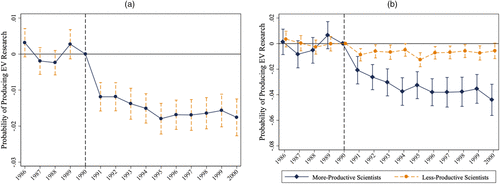
Notes. The panels plot difference-in-differences coefficient estimates of relative differences in scientists’ propensity to produce EV research by intellectual distance. Each point corresponds to the coefficient on the interaction term DistancefromEV × Year and thus describes the relative change in the likelihood of producing EV research associated with an increase in distance in a given year. The bars surrounding each point represent 95% confidence intervals. All values are relative to the base year of 1990. Panel (a) plots the estimates for all scientists, whereas Panel (b) plots the estimates for more-productive scientists (above-median productivity) and less-productive scientists (below-median productivity). The estimates are from a linear probability model using the full at-risk scientist sample. In Appendix Figure B7, I estimate a logit model with individual fixed effects, which effectively limits the analysis to scientists with within-scientist variation in EV publication, specifically scientists who produced EV research in at least one year during the observation period. In that specification, the estimates for the early post-1990 years are not statistically different from zero. In Figure B3, I repeat the analysis using discrete distance groups based on percentiles of scientists’ distance from the EV domain: top-quartile vs. bottom-quartile and above-median vs. below-median. The results remain robust.
After establishing the baseline relationship, I examine the difference between more- and less-productive scientists’ propensity to produce EV research as their intellectual distance from the EV domain increases. Table 2 Column (2) reports the result using a dummy measure of productivity, which equals 1 if a scientist’s productivity was above the median and 0 otherwise, and Column (3) reports the result using a continuous productivity measure. The results indicate that, as intellectual distance from the EV domain increased, more-productive scientists were less responsive to the increased demand for EV research than less-productive scientists. Specifically, a one-standard-deviation increase in intellectual distance was associated with an additional reduction in the likelihood of producing EV research equal to 90% of the mean among above-median-productivity scientists, relative to below-median-productivity scientists.
Figure 1(b) plots the year-specific differences. The difference between closer and more-distant scientists was small and stable before the 1990 ZEV mandate. Following the ZEV mandate, more-distant scientists were relatively less likely to produce EV research than closer scientists, and this difference was more pronounced among more-productive scientists (solid line) than among less-productive scientists (dashed line).
To provide a more intuitive interpretation of the regression results, Figure 2 plots the marginal effects using the dummy productivity measure (i.e., above or below median productivity). Specifically, Figure 2(a) uses a continuous measure of intellectual distance, while Figure 2(b) groups scientists into quintiles based on intellectual distance, allowing for a nonlinear relationship between intellectual distance and the probability of producing EV research.26 The results suggest that among scientists intellectually closer to the EV domain, more-productive scientists were more likely to produce EV research than their less-productive peers. However, at greater intellectual distances from the EV domain, more-productive scientists were less likely to produce EV research than less-productive scientists. Appendix Figure B4 repeats the analysis by comparing scientists in the top and bottom productivity quartiles. The results remain consistent, and the difference between more- and less-productive scientists becomes even more pronounced at greater intellectual distances from the EV domain.
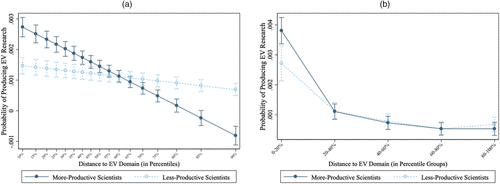
Notes. The panels plot marginal effects from the interaction between scientists’ research productivity and their intellectual distance from the EV domain on changes in their probability of producing EV research following the ZEV mandate. Panel (a) uses a continuous measure of intellectual distance; the x-axis displays the percentile rank of cosine distance, with each point corresponding to the value at that percentile. In Panel (b), scientists are grouped into quintiles based on their intellectual distance to allow for a nonlinear relationship between intellectual distance and the probability of producing EV research. Results are presented for more-productive scientists (above-median productivity) and for less-productive scientists (below-median productivity). In Appendix Figure B4, I repeat the analysis but compare scientists in the top productivity quartile with those in the bottom productivity quartile. The results remain robust, and the decline in the propensity to produce EV research among more-productive scientists at greater intellectual distances becomes even more pronounced.
5.3. More-Distant Scientists’ EV Research Was Associated with Greater Novelty, and More-Productive Distant Scientists’ EV Research Was Associated with Greater Impact and Use in EV Inventions
This section examines the implications of scientists’ response patterns for research outcomes in the EV domain. Specifically, among scientists who produced EV research, EV research by scientists at greater intellectual distances was associated with greater novelty, while EV research by more-productive scientists at greater intellectual distances was associated with greater scientific impact and greater use in downstream EV inventions.
Table 3 presents the regression results,27,28 and Figures 3 and 4 plot the marginal effects from both linear (Figures 3(a), 4(a) and (c)) and nonlinear (Figures 3(b), specifications. Column (1) and Figure 3 together show that, conditional on producing EV research, EV research outcomes by more-distant scientists were associated with greater novelty.29 Specifically, among scientists who produced EV research after the ZEV mandate, a one-standard-deviation increase in scientists’ intellectual distance from the EV domain was associated with an increase equal to 7% of the mean novelty of EV papers.30
|
Table 3. Conditional on Producing EV Research, Research Produced by Scientists at Greater Intellectual Distance from the EV Domain Was Associated with Greater Novelty, and Research by More-Productive Scientists at Greater Intellectual Distance Was Associated with Greater Impact and Citation by EV Patents
| DV: Average novelty of EV paper | DV: Average novelty of EV paper | DV: Average number of citations per EV paper | DV: Share of EV papers with citations in the top 10% | DV: Share of EV papers with citations in the top 5% | DV: Average number of citations from EV patents | |
|---|---|---|---|---|---|---|
| (1) | (2) | (3) | (4) | (5) | (6) | |
| Intellectual distance from EV domain | 0.171*** (0.042) | 0.116*** (0.045) | −2.959 (4.262) | −0.294 (0.258) | −0.127 (0.189) | 2.749 (2.061) |
| More-productive scientist | −0.016*** (0.006) | −0.407 (0.669) | −0.004 (0.038) | −0.016 (0.029) | −0.365 (0.329) | |
| More-productive scientist × intellectual distance from EV domain | 0.247*** (0.080) | 25.726*** (9.228) | 1.187*** (0.454) | 0.856** (0.338) | 13.326** (6.149) | |
| Any EV papers before ZEV mandate | −0.028*** (0.008) | −0.027*** (0.008) | 1.792*** (0.654) | 0.150** (0.058) | 0.138*** (0.051) | −0.637 (0.693) |
| Number of coauthors before ZEV mandate | 0.000* (0.000) | 0.000* (0.000) | 0.001 (0.003) | 0.000 (0.000) | 0.000 (0.000) | −0.002** (0.001) |
| Diversity of research before ZEV mandate | 0.044*** (0.015) | 0.045*** (0.015) | 2.044 (1.950) | −0.080 (0.105) | 0.012 (0.087) | 1.578** (0.772) |
| Number of grants before ZEV mandate | 0.000 (0.002) | −0.001 (0.002) | 0.631 (0.421) | 0.009 (0.014) | 0.014 (0.012) | −0.140*** (0.054) |
| Career age | −0.000 (0.000) | −0.000 (0.000) | −0.021 (0.016) | −0.001* (0.001) | −0.001 (0.001) | 0.013* (0.008) |
| R2 | 0.130 | 0.137 | 0.100 | 0.078 | 0.066 | 0.038 |
| Observations | 1,761 | 1,761 | 2,294 | 2,294 | 2,294 | 2,294 |
| Research field FE | Yes | Yes | Yes | Yes | Yes | Yes |
| Year FE | Yes | Yes | Yes | Yes | Yes | Yes |
| Incumbent EV scientist × year FE | Yes | Yes | Yes | Yes | Yes | Yes |
Notes. The data are a panel at the scientist-year level based on publication data for 1991–2000, conditional on having published an EV paper in a year. Different columns correspond to different dependent variables. The number of observations in Columns (1) and (2) is smaller because some EV papers lack abstracts in OpenAlex. Columns (2)–(6) use a binary measure of productivity, which equals 1 if the scientist’s productivity was above the median and 0 otherwise. In Appendix Table B9, I show that the results in Columns (2)–(6) remain consistent when using a continuous measure of productivity. All models are OLS with robust standard errors clustered at the scientist level. Estimations presented as coefficient (SE).
* p < 0.10; ** p < 0.05; *** p < 0.010.
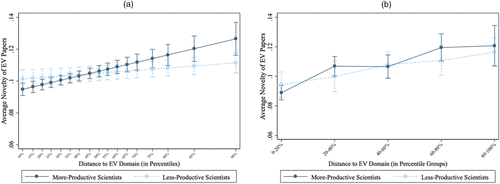
Notes. The panels plot marginal effects on the novelty of their EV papers from the interaction between scientists’ research productivity and their intellectual distance from the EV domain, conditional on their having published an EV paper in a year. Panel (a) uses a continuous measure of distance; the x-axis displays the percentile rank of cosine distance, calculated among scientists who published any EV paper during 1991–2000, with each point corresponding to the value at that percentile. Panel (b) uses the same sample, but scientists are grouped into quintiles based on their distance to allow for a nonlinear relationship between intellectual distance and EV-paper novelty. Results are presented for more-productive scientists (above-median productivity) and less-productive scientists (below-median productivity).
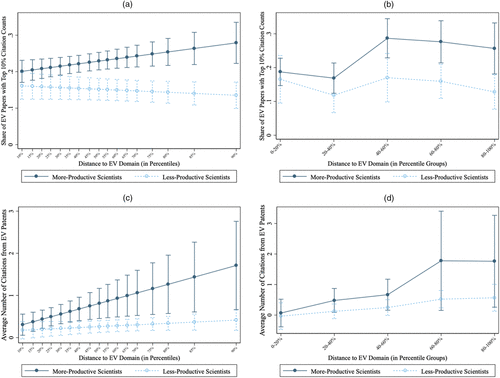
Notes. The panels plot marginal effects from the interaction between scientists’ research productivity and their intellectual distance from the EV domain on (a and b) the share of EV papers with citation count in the top 10% among all EV papers in that year, and (c and d) average number of citations from EV patents, conditional on having published an EV paper in a year. Panels (a) and (c) use a continuous measure of intellectual distance; the x-axis displays the percentile rank of cosine distance, calculated among scientists who published any EV paper during 1991–2000, with each point corresponding to the value at that percentile. Panels (b) and (d) use the same sample, but scientists are grouped into quintiles based on their intellectual distance to allow for nonlinear relationships between intellectual distance and, respectively, the scientific impact of EV papers and their use in EV patents. Results are presented for more-productive scientists (above-median productivity) and for less-productive scientists (below-median productivity).
Furthermore, Columns (3)–(5) and Figure 4, (a) and (b) suggest that, among scientists who produced EV research, research outcomes by more-productive scientists at greater intellectual distances were associated with greater impact than those of other scientists, including more-productive closer scientists. Column (6) and Figure 4, (c) and (d) suggest that the research outcomes by more-productive scientists at greater intellectual distances were more frequently cited by EV patents. Specifically, among scientists who produced EV research after the ZEV mandate, a one-standard-deviation increase in intellectual distance is associated with an additional increase of 26.8% of the mean in average citations per EV paper, 26% of the mean in the share of EV papers with citations in the top 10%, and 105% of the mean in average citations from EV patents for above-median-productivity scientists relative to below-median-productivity scientists.
Taken together, Section 5 shows that, following the ZEV mandate, scientists were, on average, more likely to produce EV research (Section 5.1). However, as scientists’ intellectual distance from the EV domain increased, more-productive scientists were less responsive to the increased demand for EV research than less-productive scientists (Section 5.2). Furthermore, among scientists who produced EV research, EV research by more-distant scientists was associated with greater novelty, while EV research by more-productive scientists at greater intellectual distances was associated with greater scientific impact and greater use in downstream EV inventions (Section 5.3). These findings suggest a potential compositional mismatch in scientists’ responses to increased demand for research: particularly at greater intellectual distances from the EV domain, the scientists who were more responsive to the increased demand for EV research were not necessarily those whose research was associated with the greatest scientific impact and use in downstream EV inventions.
6. Evidence for Potential Mechanisms
This section examines mechanisms that may help explain the main results. Section 6.1 provides suggestive evidence that, as intellectual distance from the EV domain increased, more-productive scientists faced higher opportunity costs of reallocating effort away from their home domains. Section 6.2 then examines the composition of scientists who produced EV research after the ZEV mandate.
6.1. More-Productive Scientists Were Less Responsive When Opportunity Costs Were Plausibly Higher
This section provides suggestive evidence that scientists’ opportunity costs help explain the main results. To assess this mechanism, I examine settings in which opportunity costs should be more salient and should therefore further reduce the responsiveness of more-productive scientists at greater intellectual distances from the EV domain: when scientists’ home domains are expanding, when they have more extensive non-EV collaboration networks, and when they are at later career stages.
First, pursuing EV research requires scientists to reallocate time and effort away from their home domains. The opportunity cost of this reallocation should be greater when research opportunities in scientists’ home domains are expanding, because the expected return to continuing along their established research trajectories remains comparatively attractive. This effect should be especially pronounced for more-productive scientists, who are already better positioned to exploit those home-domain opportunities.
To test this mechanism, I examine whether the lower responsiveness of more-productive scientists at greater intellectual distances is more pronounced when their home domains are expanding. Following Tandon and Toh (2022), I identify each scientist’s home domains as the OpenAlex topics associated with the scientist’s publications during the five years before the ZEV mandate (1986–1990). I then measure changes in research opportunities within these topics as the change in the total number of publications (by all scientists) over the same period. Specifically, for each scientist’s OpenAlex topics, I calculate the total number of papers published in 1990 minus the total number published in 1986. A larger value indicates that a scientist’s home domains were expanding and, therefore, that continuing along established home-domain trajectories may have remained comparatively attractive. Table 4 Column (1) shows that, as intellectual distance from the EV domain increased, more-productive scientists from expanding home domains were even less responsive to the increased demand for EV research.
|
Table 4. As Intellectual Distance from the EV Domain Increased, More-Productive Scientists Were Less Responsive to Increased Demand for EV Research, Especially When Their Home Domains Were Expanding, When They Had More Non-EV Coauthors, and When They Were at Later Career Stages
| DV = 1 if any EV paper in a year | (1) | (2) | (3) |
|---|---|---|---|
| Intellectual distance from EV domain × after ZEV mandate | −0.007*** (0.002) | −0.007*** (0.003) | −0.005* (0.003) |
| More-productive scientist × after ZEV mandate | 0.001* (0.001) | 0.001 (0.001) | 0.002 (0.001) |
| More-productive scientist × intellectual distance from EV domain × after ZEV mandate | −0.010** (0.005) | −0.012 (0.009) | −0.011 (0.009) |
| After ZEV mandate × change in home domain opportunities (in thousands of papers) | −0.000 (0.000) | ||
| More-productive scientist × after ZEV mandate × change in home domain opportunities (in thousands of papers) | 0.000** (0.000) | ||
| Intellectual distance from EV domain × after ZEV mandate × change in home domain opportunities (in thousands of papers) | −0.000 (0.001) | ||
| More-productive scientist × intellectual distance from EV domain × After ZEV mandate × change in home domain opportunities (in thousands of papers) | −0.003*** (0.001) | ||
| After ZEV mandate × number of non-EV coauthors (logged) | −0.000 (0.000) | ||
| More-productive scientist × after ZEV mandate × number of non-EV coauthors (logged) | 0.001 (0.000) | ||
| Intellectual distance from EV domain × after ZEV mandate × number of non-EV coauthors (logged) | 0.000 (0.001) | ||
| More-productive scientist × intellectual distance from EV domain × after ZEV mandate × number of non-EV coauthors (logged) | −0.006* (0.003) | ||
| After ZEV mandate × career age in 1990 (logged) | 0.000 (0.000) | ||
| More-productive scientist × after ZEV mandate × career age in 1990 (logged) | 0.000 (0.000) | ||
| Intellectual distance from EV domain × after ZEV mandate × career age in 1990 (logged) | −0.001 (0.001) | ||
| More-productive scientist × intellectual distance from EV domain × after ZEV mandate × career age in 1990 (logged) | −0.006* (0.004) | ||
| R2 | 0.035 | 0.035 | 0.035 |
| Observations | 2,232,126 | 2,232,126 | 2,232,126 |
| Controls | Yes | Yes | Yes |
| Individual FE | Yes | Yes | Yes |
| Year FE | Yes | Yes | Yes |
| Incumbent EV scientist × year FE | Yes | Yes | Yes |
Notes. The data are a panel at the scientist-year level based on publication data for 1986–2000. The dependent variable equals 1 if the focal scientist published at least one EV paper in a year, and 0 otherwise. Topic opportunity is measured as the change in the number of papers in scientists’ home topics and is divided by 1,000 to ease interpretation. All models are OLS with robust standard errors clustered at the scientist level. Estimations presented as coefficient (SE).
* p < 0.10; ** p < 0.05; *** p < 0.010.
Similarly, the opportunity cost of reallocating time and effort away from home domains should be higher among scientists with more extensive collaboration networks in their home domains and among scientists at later career stages, because these scientists may have more established research trajectories. To test these mechanisms, I examine whether the main effect is stronger among scientists with more non-EV coauthors during 1986–1990 and greater career age in 1990. Table 4 Columns (2) and (3) present the results. Column (2) suggests that, as intellectual distance from the EV domain increased, more-productive scientists with more non-EV coauthors were less responsive to the increased demand for EV research, potentially because their established home-domain collaboration networks increased the opportunity cost of reallocating effort toward EV research. Similarly, Column (3) suggests that more-productive scientists at later career stages were also less responsive as intellectual distance increased.
Taken together, Table 4 provides evidence consistent with the opportunity-cost interpretation. As intellectual distance from the EV domain increased, the lower responsiveness of more-productive scientists to the increased demand for EV research was especially pronounced when their home domains offered expanding research opportunities, when they had more extensive non-EV collaboration networks, and when they were at later career stages. These patterns suggest that more-productive scientists had more to forgo in their established home domains, making continued research in those domains comparatively more attractive than reallocating effort toward the EV domain.
6.2. Composition of Scientists Who Produced EV Research
The main results in Section 5.2 suggest that, following the ZEV mandate, more-productive scientists were less responsive to increased demand for EV research than less-productive scientists as their intellectual distance from the EV domain increased. This section examines the composition of scientists who produced EV research after the mandate.
Specifically, I compare the prior research productivity of scientists who produced EV research during 1991–2000. Table 5 presents the results. Column (1) shows that, among scientists who produced EV research, those at greater intellectual distances from the EV domain, on average, exhibited lower prior productivity. Column (3) shows that this negative association was present within the less-productive group. This pattern is consistent with the opportunity-cost interpretation of the main results: less-productive scientists may have less to forgo when reallocating effort from their home domains, potentially helping explain the lower average prior productivity observed among EV research producers at greater intellectual distances.
|
Table 5. Composition of Scientists Who Produced EV Research
| DV = Productivity | (1) Sample: All scientists | (2) Subsample: More-productive scientists | (3) Subsample: Less-productive scientists |
|---|---|---|---|
| Intellectual distance from EV domain | −2.408*** (0.834) | 0.421 (2.710) | −0.261*** (0.078) |
| Any EV papers before ZEV mandate | 0.030 (0.163) | −0.043 (0.237) | 0.027* (0.014) |
| Number of coauthors before ZEV mandate | 0.008*** (0.003) | 0.007** (0.003) | 0.000 (0.000) |
| Diversity of research before ZEV mandate | 4.525*** (0.459) | 3.710*** (0.981) | 0.567*** (0.045) |
| Number of grants before ZEV mandate | 0.488*** (0.133) | 0.474*** (0.151) | 0.022 (0.014) |
| Career age in 1990 | 0.010** (0.005) | 0.017** (0.007) | −0.000 (0.000) |
| R2 | 0.200 | 0.130 | 0.338 |
| Observations | 1,440 | 873 | 567 |
| Research Fields FE | Yes | Yes | Yes |
Notes. The data are a cross-section at the scientist level, using a subsample of scientists who published any EV paper during 1991–2000. All models are OLS with robust standard errors clustered at the scientist level. Estimations presented as coefficient (SE).
* p < 0.10; ** p < 0.05; *** p < 0.010.
Among more-productive scientists who produced EV research, however, the estimated association between intellectual distance and prior productivity was positive but statistically insignificant (Column (2) and Figure 5). This suggests that, conditional on producing EV research, more-productive scientists from more distant domains may have had prior productivity broadly similar to that of those from closer domains (although the estimate is imprecise).
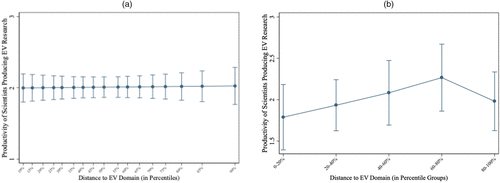
Notes. This figure plots marginal effects illustrating the relationship between scientists’ intellectual distance to the EV domain and their productivity among scientists who produced EV research during 1991–2000. The sample is restricted to scientists whose productivity is above the median; thus, this figure corresponds to Table 5 Column (2). Panel (a) uses a continuous measure of intellectual distance; the x-axis displays the percentile rank of cosine distance, calculated among more-productive scientists who published any EV paper during 1991–2000, with each point corresponding to the value at that percentile. Panel (b) uses the same sample, but scientists are grouped into quintiles based on their intellectual distance to allow for a nonlinear relationship between intellectual distance and research productivity.
That said, the evidence in Section 6 remains suggestive because scientists’ opportunity costs and ex ante expectations are not directly observed in these analyses.
7. Robustness Checks and Additional Analyses
In the main results, I find that, following the ZEV mandate, more-productive scientists were less responsive to the increased demand for EV research than less-productive scientists as their intellectual distance from the EV domain increased. I also find that, among scientists who produced EV research, EV research by more-distant scientists was associated with greater novelty, while EV research by more-productive distant scientists was associated with greater scientific impact and greater use in downstream EV inventions.
This section reports additional robustness checks assessing the robustness of the main results across alternative samples, measures, cutoff definitions, and empirical specifications (see Appendix B for detailed interpretations of the results). First, in Tables B1 and B2 and Figures B1 and B2, I use a narrower definition of at-risk scientists: those who had published at least one paper in engineering, materials science, energy, or chemistry, fields that are more directly related to electric vehicle research. The results remain robust and become stronger, suggesting that the main effect is concentrated among scientists with preexisting expertise in fields more closely related to EV research. Second, in Tables B3 and B4 and Figures B5 and B6, I replicate the analysis using conference proceedings and non-peer-reviewed articles, which capture research at earlier stages and thus more closely reflect scientists’ underlying research efforts. The results remain robust. Third, the results remain consistent when estimated using a logit model (Table B5 and Figure B7). Fourth, the results remain consistent when using a BERT model to measure scientists’ intellectual distance from the EV domain (Tables B6 and B7 and Figures B8 and B9). Fifth, the results remain consistent when using alternative cutoff definitions and model specifications (Figures B3 and B4 and Tables B8, B9, and B14). Sixth, I find that when more-productive scientists produced EV research, they were associated with a higher likelihood of collaborating with productive incumbent EV scientists (Table B10). Finally, I find that scientists without funding before the ZEV mandate (1986–1990) were more likely to pursue EV research and that scientists who produced EV research after the ZEV mandate were associated with greater funding and productivity (Tables B11, B12, and B13).
8. Discussion and Contribution
This study examines which academic scientists produce research in a domain when demand for research in that domain increases, and what research outcomes they produce. Using the ZEV mandate, which led to an unanticipated increase in demand for EV research, I find that scientists became more likely to produce EV research following the mandate. However, this response varied systematically across scientists: as intellectual distance from the EV domain increased, more-productive scientists were less responsive to the increased demand for EV research than less-productive scientists. Yet among scientists who produced EV research, EV research by more-distant scientists was associated with greater novelty, while EV research by more-productive scientists at greater intellectual distances was associated with greater scientific impact and greater use in downstream EV inventions.
These findings suggest that increased demand for research shapes not only the volume of scientific activity in a domain, but also the composition of scientists who produce that research. More-productive scientists at greater intellectual distances appear to face higher opportunity costs when reallocating effort toward the demand-relevant domain.
Several features of the empirical setting and design should guide the interpretation of these findings. First, the analysis observes realized research output rather than all attempts to pursue EV research.31 This scope is substantively meaningful because the study’s primary objective is to understand which scientists ultimately produce research in response to increased demand and what outcomes that research produces. The findings therefore speak most directly to scientists’ production of published research in the demand-relevant domain.32 At the same time, some scientists may have explored EV-related projects that did not result in publications or contributed through advising, consulting, conference presentations, or other activities not fully captured in publication data. To get closer to earlier-stage research activity, I replicate the main analyses using conference proceedings and non-peer-reviewed publications, including book chapters, which are less selective than journal publications. These analyses yield patterns consistent with the main results. Future research that can directly observe scientists’ research attempts could extend this line of inquiry by examining how increased demand shapes scientists’ effort allocation before those efforts result in observable research output.
Second, research productivity is used as an indicator of scientists’ established research position in their home domains rather than as a pure input-output measure. The measure may therefore capture associated differences in expertise, resources, collaboration networks, status, and institutional support. Although the empirical specifications account for several observable characteristics and the entry analysis includes scientist fixed effects, the estimates should not be interpreted as isolating a causal effect of research productivity independent of these associated attributes. In addition, the analyses of research outcomes are conditional on scientists producing EV research. These analyses therefore speak to variation in the novelty and impact of research outcomes among scientists who produced EV research. The outcome results may thus reflect both the knowledge and capabilities scientists bring to EV research and the selection processes that shape which scientists produce EV research in the first place.
Third, the scope of the findings should be understood in light of the study’s empirical context: scientists’ responses to increased demand for EV-related research following the ZEV mandate. EV technology was still emerging in the 1990s, and progress required research drawing on multiple knowledge domains, including energy storage and conversion materials, lightweight materials, traction motors, and related technologies. The findings may therefore generalize most directly to similar settings: emerging technological domains in which increased demand creates a sustained need for upstream scientific research, cross-domain knowledge integration, and experimentation. They may generalize less directly to acute demand shifts, to settings in which the relevant knowledge base is already mature, or to increases in demand whose social and technological objectives differ substantially from those in the EV context. Future research can examine how these dynamics vary across different types of demand, technologies, and institutional contexts.
This study makes several contributions. First, it contributes to research on the demand for science and the organization of scientific production by shifting attention from whether increased demand expands research activity on average to which scientists respond and what outcomes they produce. Prior work has shown that funding, policy, technological change, and market demand can shape the rate and direction of scientific activity (Azoulay et al. 2011, Furman and Teodoridis 2020, Sohn 2021, Blomfield and Vakili 2023, Lu 2025, Goldfarb et al. 2026). This study shows that the composition of responding scientists is central to understanding how increased demand translates into scientific output. Increased demand may expand research in a domain, but the scientists who are most responsive are not necessarily those whose research is most strongly associated with novelty and impact, conditional on entry. The study thus highlights a compositional mechanism through which demand shapes not only the volume of research in a domain, but also the direction and potential downstream relevance of that research.
This compositional perspective also contributes to research on university-industry interaction and the division of innovative labor between upstream science and downstream invention. Prior work suggests that firms and policymakers can shape academic research through resources, equipment, data, and applied problems (Rosenberg 1982, Sohn 2021, Babina et al. 2023), but also that academic scientists retain substantial autonomy in choosing research directions (Aghion et al. 2008, Stephan 2015). The findings help reconcile these perspectives by showing that responsiveness to demand varies systematically across scientists. Demand arising from downstream technological development can create upstream scientific opportunities, but whether scientists pursue those opportunities depends on their intellectual distance from the domain and their established research positions in their home domains. Thus, university-industry interaction should not be understood only in terms of the average effects of firms or policies on the rate of academic research activity; it also depends on which academic scientists reallocate effort and whether the scientists who respond are positioned to produce research that becomes useful for downstream invention (Rosenberg and Nelson 1994, Fleming and Sorenson 2004, Marx and Fuegi 2020).
The study further contributes to research on knowledge recombination and exploration. Prior work emphasizes that recombining knowledge across domains can generate novel ideas, but distant recombination can also be difficult to evaluate, integrate, and translate into impactful outcomes (Fleming 2001, Uzzi et al. 2013, Kaplan and Vakili 2015, Kneeland et al. 2020, Hill et al. 2025). The findings show that this tension depends partly on which scientists undertake distant recombination. EV research by scientists from more distant domains was associated with greater novelty, while EV research by more-productive scientists from more distant domains was also associated with greater impact. Additional analyses suggest a related mechanism: conditional on producing EV research, more-productive scientists were more likely to collaborate with productive scientists in the EV domain, which may have helped them combine knowledge from their home domains with domain-relevant expertise. This pattern suggests that the value of knowledge from more distant domains depends not only on its novelty, but also on which scientists pursue such opportunities and whether they can combine that knowledge with complementary domain expertise. The study therefore connects the recombination literature (Fleming 2001, Kneeland et al. 2020) with the exploration literature (March 1991, Levinthal and March 1993, Arts and Fleming 2018) by highlighting how opportunity costs, selection, scientists’ established research positions, and collaboration jointly shape when distant exploration is associated with impactful outcomes.
Finally, the findings have implications for policy and managerial efforts to stimulate research in emerging technological domains. When policymakers, firms, or other actors seek to accelerate scientific progress in a domain where new research is needed, increasing resources or attention may not be sufficient. Demand-side efforts may also need to address the opportunity costs faced by scientists whose expertise is valuable but not immediately adjacent to the domain, for example by supporting cross-domain collaborations, boundary-spanning conferences, shared research infrastructure, or programs that help scientists access complementary domain expertise. At the same time, these efforts should be evaluated against the value of scientists’ continued work in their home domains and the social value of the research domain being prioritized (Lu 2025). The central implication is not that all more-productive scientists at greater intellectual distances should be redirected, but that the effects of increased demand for research depend on how it reshapes the allocation of scarce scientific effort across domains.
1 For expositional simplicity, I use “more-productive distant scientists” to refer to more-productive scientists at greater intellectual distances from the EV domain; intellectual distance is measured continuously in the empirical analyses.
2 Appendix C presents a stylized model that formalizes this reallocation decision. In the model, scientists reallocate effort between the demand-relevant domain and their home domains in response to an increase in demand in the demand-relevant domain.
3 A boundary condition of the theoretical framework is that scientists’ home domains remain broadly relevant to the demand-relevant domain. Intellectual distance therefore captures distance within a broadly relevant knowledge space, rather than distance from wholly unrelated fields. Consistent with this boundary condition, the empirical analysis shows that the main results become stronger when the sample is restricted to scientists from research fields more directly related to EV research.
4 Empirically, I measure scientists’ research productivity using citation-weighted publication output based on publications before demand increased.
5 This argument does not require more-productive scientists to face higher absolute adjustment costs than less-productive scientists. Their expertise, reputation, resources, or access to collaborators may reduce some costs of entering a new domain. Rather, the reallocation decision reflects a comparison between the expected return to allocating effort toward the demand-relevant domain and the expected return to continuing in the home domains.
6 In the full court, Circuit Judge Robert H. Bork wrote: “[Toxic pollutant safety levels] must be based solely upon the risk to health. The [EPA] administrator cannot under any circumstances consider the cost and technological feasibility at this stage of the analysis” (Lewis 1987).
7 In this study, “electric vehicle” is used as an umbrella term encompassing various types of broadly defined electric vehicles, including battery electric vehicles, hybrid electric vehicles, and fuel cell electric vehicles.
8 See Appendix D for additional details on the institutional and historical background and impact of this mandate.
9 In the empirical section, when using the term publications, I refer to journal articles and conference proceedings, as these represent more serious research efforts by scientists than non-peer-reviewed outputs such as book chapters and reports. In Table B3 and Figure B5, I show that the main results remain robust when using conference proceedings. In Table B4 and Figure B6, I show that the main results remain robust when using non-peer-reviewed publications.
10 Following prior studies on academic scientists (e.g., Furman and Teodoridis 2020), I restrict the sample to those with at least one publication after the ZEV mandate to ensure that the results are not driven by scientists who stopped publishing afterward. The results remain robust without this restriction.
11 I identify research domains using OpenAlex’s research topic classification system, which follows a four-level hierarchical structure: domain, field, subfield, and topic. At the top level are four broad domains—physical sciences, life sciences, health sciences, and social sciences—each containing multiple narrower fields, subfields, and specific research topics.
12 I focus on the physical sciences domain because electric vehicle technologies draw broadly from several fields within this domain, including engineering, materials science, energy, and chemistry. Other fields within physical sciences include computer science, physics and astronomy, environmental science, mathematics, etc. I use this broad definition of physical sciences in the main analysis to avoid mechanically selecting scientists who are especially likely to enter EV-related research. In Tables B1 and B2 and Figures B1 and B2, I conduct a robustness check using a narrower definition of at-risk scientists: those who had published at least one paper in engineering, materials science, energy, or chemistry. The results are consistent with the main results. In particular, Table B1 shows larger magnitudes than Table 2, suggesting that the effect is concentrated among scientists with preexisting expertise in fields more directly relevant to EV research.
13 This technique has been increasingly adopted in recent innovation studies (e.g., Arora et al. 2023, Masclans et al. 2025).
14 In Tables B6 and B7 and Figures B8 and B9, I show that the results remain consistent when using BERT (Devlin et al. 2019), an embedding model trained on general-domain corpora such as Wikipedia and BookCorpus, to encode the titles and abstracts.
15 To identify EV patents, I use the sixteen EV patent subclasses under Y02T (Climate Change Mitigation Technologies Related to Transportation) and the three energy storage subclasses with applications for EV technologies under Y02E60 (Technologies with a Potential or Indirect Contribution to GHG Emissions Mitigation).
16 I choose a linear probability model over a logit model in my main analysis for two reasons. First, as Ai and Norton (2003) point out, the sign and magnitude of interaction coefficients in nonlinear models do not necessarily reflect the marginal effect of the interaction term. Second, compared with the total number of scientists in my sample, those who produced any EV paper were relatively rare; a logit model with individual fixed effects would drop individuals with no variation in the dependent variable—that is, scientists who never produced EV papers during the observation period. As a result, a logit model would restrict the analysis to the subset of scientists who published at least one EV paper, potentially limiting the generalizability of the results. Nevertheless, in Table B5 and Figure B7, I show that the results remain consistent when using a logit model.
17 For each publication, I count the number of forward citations received within five years of its publication year.
18 I identify each scientist’s primary research field as the field in which they had the highest proportion of publications during 1986–1990.
19 The results are robust to using the raw (unnormalized) citation-weighted publication count.
20 I calculate a scientist’s career age in year t as the number of years since the scientist’s first publication.
21 This approach follows prior work that employs group-specific year fixed effects to account for differential time trends across groups (e.g., Antecol et al. 2018, McDonald and Allen 2022).
22 This effectively restricts the sample to scientists who published at least one EV paper during 1991–2000.
23 Specifically, I calculate this as , where is the number of EV papers published by scientist in year with citation counts in the top 10% (or top 5%) of all EV papers published that year, and is the total number of EV papers published by scientist in year .
24 The key variables of interest, and , are time-invariant scientist characteristics. Including scientist fixed effects would therefore absorb these variables and prevent estimation of their associations with EV research outcomes.
25 In Figure B3, I replicate Figure 1 by assigning scientists to discrete distance groups based on percentiles of their distance from the EV domain. The results remain robust when distant and close scientists are defined either as the top and bottom quartiles of the distance distribution or as scientists above and below the median distance.
26 Specifically, to generate Figure 2(b), I plot the marginal effects based on the following regression, where denotes the five quintile distance groups:
27 In Table B8, I replicate the analysis from Table 3 but do not control for research field fixed effects, which allows for comparisons across research fields. The results are highly consistent with the main findings.
28 For ease of interpretation, Table 3 Columns (2)–(6) use a binary measure of productivity that equals 1 if the scientist’s productivity was above the median and 0 otherwise. As a robustness check, Table B9 replicates the analysis using a continuous measure of productivity. The results remain consistent.
29 Table 3 Column (2) allows the association between intellectual distance and novelty to vary with research productivity. Although the interaction is positive, it is not consistent across alternative specifications and novelty measures, including right-tail measures of EV-paper novelty in Table B14. I therefore interpret the novelty results primarily as reflecting the association between intellectual distance and novelty.
30 In Table B15, I construct an alternative measure of novelty based on the concepts of each paper (as identified by OpenAlex). I find that more-distant scientists were more likely than closer scientists to produce EV papers that introduced new concepts.
31 This approach follows prior innovation studies that use realized outputs, such as publications and patents, to infer the direction of scientists’ and inventors’ research and invention activities (e.g., Teodoridis 2018, Teodoridis et al. 2019, Nagle and Teodoridis 2020, Tandon and Toh 2022).
32 If more-productive scientists are more likely to convert research attempts into publications, publication-based measures would understate, rather than overstate, the lower responsiveness of more-productive scientists at greater intellectual distances.
References
- (2024) Mobilizing conceptual spaces: How word embedding models can inform measurement and theory within organization science. Organ. Sci. 35(3):788–814.Link, Google Scholar
- (2025) Creating new industries: The generative role of heterogeneous actors. Acad. Management Ann. 19(2):476–521.Crossref, Google Scholar
- (2008) Academic freedom, private‐sector focus, and the process of innovation. RAND J. Econom. 39(3):617–635.Crossref, Google Scholar
- (2003) Interaction terms in logit and probit models. Econom. Lett. 80(1):123–129.Crossref, Google Scholar
- (2018) Equal but inequitable: Who benefits from gender-neutral tenure clock stopping policies? Amer. Econom. Rev. 108(9):2420–2441.Crossref, Google Scholar
- (2023) The effect of public science on corporate R&D (No. w31899). National Bureau of Economic Research.Google Scholar
- (2018) Paradise of novelty—Or loss of human capital? Exploring new fields and inventive output. Organ. Sci. 29(6):1074–1092.Link, Google Scholar
- (2007) Past success and creativity over time: A study of inventors in the hard disk drive industry. Management Sci. 53(1):1–15.Link, Google Scholar
- (2011) Incentives and creativity: Evidence from the academic life sciences. RAND J. Econom. 42(3):527–554.Crossref, Google Scholar
- (2023) Cutting the innovation engine: How federal funding shocks affect university patenting, entrepreneurship, and publications. Quart. J. Econom. 138(2):895–954.Crossref, Google Scholar
- (2019) SciBERT: A pretrained language model for scientific text. Preprint, submitted March 26, https://arxiv.org/abs/1903.10676Google Scholar
- (2023) Incentivizing effort allocation through resource allocation: Evidence from scientists’ response to changes in funding policy. Organ. Sci. 34(1):100–128.Link, Google Scholar
- (2007) The allure of technology: How France and California promoted electric and hybrid vehicles to reduce urban air pollution. Policy Sci. 40:1–34.Crossref, Google Scholar
California Air Resources Board (2005) The 2005 California Almanac of Emissions and Air Quality (CARB, Sacramento, CA).Google Scholar- (1995) Physicists find challenges in building better cars. Phys. Today 48(4):73–75.Crossref, Google Scholar
- (2008) The origin of California’s zero emission vehicle mandate. Transportation Res. Part A Policy Practice 42(10):1302–1313.Crossref, Google Scholar
- (2019) BERT: Pre-training of deep bidirectional transformers for language understanding. Proc. 2019 Conf. North American Chapter Assoc. Comput. Linguistics Human Language Tech., Volume 1 (Long and Short Papers), 4171–4186.Google Scholar
- (2001) Recombinant uncertainty in technological search. Management Sci. 47(1):117–132.Link, Google Scholar
- (2004) Science as a map in technological search. Strategic Management J. 25(8–9):909–928.Crossref, Google Scholar
- (2020) Automation, research technology, and researchers’ trajectories: Evidence from computer science and electrical engineering. Organ. Sci. 31(2):330–354.Link, Google Scholar
- (2026) The evolution of quantum computing innovation: How companies engage in open science. Preprint, submitted July 1, https://doi.org/10.2139/ssrn.4922650.Google Scholar
- (1998) Does government R&D policy mainly benefit scientists and engineers? Amer. Econom. Rev. 88(2):298–302.Google Scholar
- (2006) Light-Duty Automotive Technology and Fuel Economy Trends: 1975 through 2006: Executive Summary (U.S. Environmental Protection Agency, Office of Transportation and Air Quality).Google Scholar
- (2025) The pivot penalty in research. Nature 642(8069):999–1006.Crossref, Google Scholar
- (2009) The burden of knowledge and the “death of the renaissance man”: Is innovation getting harder? Rev. Econom. Stud. 76(1):283–317.Crossref, Google Scholar
- (2015) The double‐edged sword of recombination in breakthrough innovation. Strategic Management J. 36(10):1435–1457.Crossref, Google Scholar
- (2020) Exploring uncharted territory: Knowledge search processes in the origination of outlier innovation. Organ. Sci. 31(3):535–557.Link, Google Scholar
- (1993) The myopia of learning. Strategic Management J. 14(S2):95–112.Crossref, Google Scholar
- (1987) Emission rules must be health-based. The Washington Post (July 29), https://www.washingtonpost.com/archive/politics/1987/07/29/emission-rules-must-be-health-based/89dbb497-318b-47f8-8505-48a170699d9a/.Google Scholar
Los Angeles Times (2002) Car companies team up to fight state’s ZEV rule. (January 23), https://www.latimes.com/archives/la-xpm-2002-jan-23-hy-green23-story.html.Google Scholar- (2025) Market demand, competition for knowledge workers, and impact on invention: Evidence from electric vehicle technologies. Organ. Sci. 36(6):2459–2479. Link, Google Scholar
- (1991) Exploration and exploitation in organizational learning. Organ. Sci. 2(1):71–87.Link, Google Scholar
- (2020) Reliance on science: Worldwide front‐page patent citations to scientific articles. Strategic Management J. 41(9):1572–1594.Crossref, Google Scholar
- (2022) Reliance on science by inventors: Hybrid extraction of in‐text patent‐to‐article citations. J. Econom. Management Strategy 31(2):369–392.Crossref, Google Scholar
- (2025) Measuring the commercial potential of science. Strategic Management J. 46(9):2199–2236.Crossref, Google Scholar
- (2022) A spanner in the works: Category-spanning entrants and audience valuation of incumbents. Strategy Sci. 7(3):190–209.Link, Google Scholar
- (1968) The Matthew effect in science: The reward and communication systems of science are considered. Science 159(3810):56–63.Crossref, Google Scholar
- (2025) Stars in their constellations: Great person or great team? Management Sci. 71(3):2170–2191.Link, Google Scholar
- (2020) Building industries by building knowledge: Uncertainty reduction over industry milestones. Strategy Sci. 5(3):218–244.Link, Google Scholar
- (2020) The elasticity of science. Amer. Econom. J. Appl. Econom. 12(4):103–134.Crossref, Google Scholar
- (2020) Jack of all trades and master of knowledge: The role of diversification in new distant knowledge integration. Strategic Management J. 41(1):55–85.Crossref, Google Scholar
- (1962) Labor as a quasi-fixed factor. J. Political Econom. 70(6):538–555.Crossref, Google Scholar
- (2022) OpenAlex: A fully-open index of scholarly works, authors, venues, institutions, and concepts. Preprint, submitted May 4, https://arxiv.org/abs/2205.01833.Google Scholar
- (1989) Drastic steps are voted to reduce southern California air pollution. New York Times (March 18), https://www.nytimes.com/1989/03/18/us/drastic-steps-are-voted-to-reduce-southern-california-air-pollution.html.Google Scholar
- (1982) Inside the Black Box: Technology and Economics (Cambridge University Press, Cambridge, UK).Google Scholar
- (1994) American universities and technical advance in industry. Res. Policy 23(3):323–348.Crossref, Google Scholar
- (2021) How local industry R&D shapes academic research: Evidence from the agricultural biotechnology revolution. Organ. Sci. 32(3):675–707.Link, Google Scholar
South Coast Air Quality Management District (2003) Historic ozone air quality trends. https://www.aqmd.gov/home/air-quality/historical-air-quality-data/historic-ozone-air-quality-trends.Google Scholar- (2015) How Economics Shapes Science (Harvard University Press, Cambridge, MA).Google Scholar
- (1997) Pasteur’s Quadrant: Basic Science and Technological Innovation (Brookings Institution, Washington, DC).Crossref, Google Scholar
- (2022) Who deviates? Technological opportunities, career concern, and inventor’s distant search. Strategic Management J. 43(4):724–757.Crossref, Google Scholar
- (2018) Understanding team knowledge production: The interrelated roles of technology and expertise. Management Sci. 64(8):3625–3648.Link, Google Scholar
- (2019) Creativity at the knowledge frontier: The impact of specialization in fast- and slow-paced domains. Admin. Sci. Quart. 64(4):894–927.Crossref, Google Scholar
- (2013) Atypical combinations and scientific impact. Science 342(6157):468–472.Crossref, Google Scholar
- (2016) Health care’s grand challenge: Stimulating basic science on diseases that primarily afflict the poor. Acad. Management J. 59(6):1917–1939.Crossref, Google Scholar
- (2012)
Technology innovation and policy: A case study of the California ZEV mandate . Nilsson M, Hillman K, Rickne A, Magnusson T, eds. Paving the Road to Sustainable Transport (Routledge, Abingdon, UK), 136–158.Google Scholar - (2022) Impactful scientists have higher tendency to involve collaborators in new topics. Proc. Natl. Acad. Sci. 119(33):e2207436119.Crossref, Google Scholar
Jino Lu is an Assistant Professor of Strategy and Entrepreneurship at the Olin Business School, Washington University in St. Louis. He received his PhD from the University of Southern California. His research examines how external technological and societal factors influence firms and their innovation processes, drawing on large-scale, novel data sets and a combination of causal-inference econometrics and machine-learning techniques.

