


Dominant Deceptions: How Future-Oriented Narratives Transform into Deception
Abstract
Drawing on a multiyear, qualitative study of a promising venture in a nascent industry, we develop a process model tracing how future-oriented narratives can transform into deception. In the venture that we studied, the founder’s future-oriented narratives were initially viewed as evidence of his visionary foresight. As these narratives traveled downward through the organization, employees responsible for operations translated this broad vision into specific targets and metrics. Some details described an attainable future; others were so far-fetched that they became liminal, falling into a gray zone between right and wrong. As internal and external demands for tangible progress grew, this expectations-reality gap prompted employees to engage in temporal reorientation, shifting their statements from “we will” to “we have.” Their statements crossed from liminal to deceptive, asserting as fact something that did not exist. Once formalized in presentations, websites, and other artefacts, the claims became dominant deceptions: codified, specific, past- or present-tense deceptions deliberately reproduced across the organization. In this codified form, the deceptions became misconduct that, if detected, could have been acted on by social control agents. We propose that three enabling conditions sustained this transformation: visionary attribution (belief in the founder’s unique foresight), interpretive flexibility (the ambiguity of new technologies that allows for multiple plausible meanings), and moral justification (the framing of deception as serving a higher mission). Because the process unfolded diffusely and incrementally, the transformation could only be observed retrospectively in the accumulation of actions across individuals and over time. By tracing this process, we extend research in narratives and in organizational misconduct.
Funding: Funding for this research was provided by the London Business School and the Harvard Business School.
Supplemental Material: The online appendix is available at https://doi.org/10.1287/orsc.2023.18038.
Author A: What were the best parts about working there?
Former employee: There were people who were knowledgeable and had good ideas … So it was fun to work with them.
Author A: And the negatives?
Former employee: Basically, all the lies.
In late 2017, a group of people towed a deceptively realistic shell of a truck to the top of a hill and recorded it rolling down. Far from being extraordinary, these people were only some of the many employees willing to perpetuate the illusion that was Nikola. Nikola was a start-up that staged demonstrations and presentations suggesting that it had successfully built a hydrogen-fueled, zero emission, full-size truck—despite never manufacturing a single hydrogen-fueled engine. The towed vehicle was little more than an empty shell, partially built from minivan parts and lacking functional components, like batteries or turbines. Reports alleged that employees taped part of the truck together, edited the video to change the angle so that it appeared to drive on a flat road, and uploaded it as proof of a “fully functional hydrogen-powered Nikola One in Motion.”1 Nikola is just one salient example of a start-up weaving a deception that was told and believed by many. Considering the scale of deception in cases like Nikola, Theranos, uBiome, and other scandalous ventures that occasionally capture the public’s attention, it is only reasonable to assume that similar—if less cinematic—deceptions are not rare among start-ups.
Like many other start-ups, Nikola had to convince critical resource providers—including employees, customers, investors, and the public—that the venture was plausible and desirable (Aldrich and Fiol 1994, Fisher et al. 2016). To do so, start-up founders often frame their ventures using ambitious, future-oriented narratives describing a preferred future that the company will help bring about (Rindova and Martins 2022). In Nikola’s case, the founder promised that the start-up would “literally revolutionize the trucking industry” (Huff 2016). Entrepreneurship scholars note that such narratives frequently contain hyperbole, overstatements, or elements that may mislead (Lounsbury and Glynn 2001, Logue and Grimes 2022, Murray and Fisher 2023) and point to a widely shared “fake-it-til-you-make-it” norm (Garud et al. 2025). But, as Nikola illustrates, some start-ups cross “the thin line between hype and deceit” (Oremus 2021, quoted in Logue and Grimes 2022, p. 1055) or in Nikola’s case, between an envisioned emission-free future and a shell of a truck.
Widely publicized cases like Nikola have fueled academic interest in why start-ups deceive, generating theoretical accounts that draw on the literature in organizational misconduct (e.g., Gehman and Wry 2022, Palmer and Weiss 2022, Scheaf and Wood 2022, Garud et al. 2025). Explanations typically map onto well-established streams emphasizing the criminal intent of founders and early employees (e.g., Clinard et al. 1979, Gottschalk 2019); financial incentives that reward deception (e.g., Becker 1968, Harris and Bromiley 2007, Balasubramanian et al. 2017, den Nieuwenboer et al. 2017); failures in behavioral ethics, including leadership and culture (e.g., Kanungo 1996, Treviño et al. 2003, Brown et al. 2005, Brown and Treviño 2006, Palmer and Weiss 2022); and pressure from investors and external stakeholders (e.g., Merton 1938, Garud et al. 2025). However, process studies tracing how a start-up crosses the line between “poetic license … and lies” (Gabriel 2004, p. 75) are rare. Although organizational misconduct scholars have richly theorized the normalization and diffusion of misconduct within and between mature organizations (e.g., Ashforth and Anand 2003, Pierce and Snyder 2008, Bennett et al. 2013, Aven 2015, den Nieuwenboer et al. 2017, Roulet and Pichler 2020, Andiappan and Dufour 2021, Bergemann and Aven 2023, Mohliver and Ody-Brasier 2023), these accounts typically take as their starting point conduct that is already constituted as wrongful: for example, how “an initial corrupt decision or act becomes … routinized” and spreads across people, units, and firms (Ashforth and Anand 2003, p. 1). Although wrongful practices often begin as liminal (Mohliver 2019, Zhang et al. 2023), existing in a gray zone between right and wrong, we know little about the internal sequences or steps through which a venture’s narratives cross the line into deception. We, therefore, ask the following question. How do a start-up’s future-oriented narratives transform into deception?
In this study, we did not set out to examine deception. Tiona (henceforth: Author A) conducted a longitudinal, qualitative study of a promising start-up to understand how ventures in nascent industries innovate and collaborate. Unexpectedly, Author A encountered deception perpetrated by founders, managers, and employees; shared externally with stakeholders and internally with colleagues; and eventually, codified into formal documents attributable to their authors. Discussing these findings with Aharon (henceforth: Author B), we recognized an opportunity to bring together the field data and the literature through a process of analytical abduction to contribute to theory (Sætre and Van de Ven 2021). We develop a process model tracing how the founder’s ambiguous, future-oriented narratives were gradually filled in with details by other organizational members because of translational constraints or the necessity of converting ambiguous forecasts into specific targets as they move down the organizational hierarchy (e.g., March and Simon 1993). Because these details described an envisioned future that remained far from reality, they were difficult to categorize as deception. But, over time, employees deployed a tense shift that we term temporal reorientation, shifting statements from future oriented to past- or present-oriented (that is, “we will” to “we have”) in response to a growing expectations-reality gap (Garud et al. 2025). Through this reorientation, their statements became verifiably deceptive. Finally, the necessity of formalization meant that the statements were codified into the organization’s formal documents, transforming into what we term dominant deceptions: codified, specific, past- or present-oriented deceptions perpetuated by multiple employees. Each step in this process—converting a vision into targets, answering stakeholders’ questions, and codifying claims into documents—appeared benign, and each employee could view their contribution as simply doing their job. Together, however, employees’ shifting statements produced and propagated deception.
By developing this process model, we extend research in narratives and in organizational misconduct. We offer coding rules that distinguish misstatement, deception, and dominant deception (cf. Scheaf and Wood 2022), answering long-standing calls for researchers to specify their definitions of misconduct (Palmer et al. 2016). We propose temporal reorientation as the rhetorical “tipping zone” where future-oriented narratives transform into deception, highlighting the critical importance of framing and language within start-ups (Lounsbury and Glynn 2001, Martens et al. 2007, Rindova and Martins 2022). We also propose three transitional mechanisms—translational constraints, the expectations-reality gap, and formalization—that move this process along. Finally, we surface three enabling conditions that appear to support the process: visionary attribution to the founder (Rindova and Martins 2022), interpretive flexibility (a shared sense, common in nascent industries, that there are multiple reasonable ways to construe the technology or ecosystem) (Pinch and Bijker 1984), and moral justification (framing “stretching” as necessary for a higher-order mission) (Sykes and Matza 1957, Bandura 1999, Moore 2008, Umphress and Bingham 2011, Moore et al. 2012). Although these conditions are well established in research on start-ups or nascent industries (e.g., Zuzul and Edmondson 2017, Zuzul 2019) and in studies of ethical leadership (e.g., Victor and Cullen 1988, Liu et al. 2012, Bonner et al. 2016) and organizational misconduct (e.g., Greve et al. 2010, Moore et al. 2012, Palmer 2012, Rixom and Mishra 2014, Blanken et al. 2015), we map how they come together to support the transformation of future-oriented narratives into deception.
Future-Oriented Narratives
Start-up founders draw on framing—the use of “rhetorical devices that actors strategically deploy through their communication” (Falchetti et al. 2022, p. 133)—to position their ventures within larger “webs of meaning” (Rindova et al. 2009, p. 485) that allow stakeholders to understand and appreciate their promise and potential (Kahl and Grodal 2016). Often, entrepreneurs frame their efforts through future-oriented narratives that communicate the start-up’s purpose and plans to create broader change (Lounsbury and Glynn 2001). This is particularly true for start-ups in nascent industries or developing new-to-the-world technologies because these are characterized by interpretive flexibility, meaning that the same technology can be understood in various ways by different stakeholders (Pinch and Bijker 1984). This latitude creates opportunities for entrepreneurs to draw on narratives to articulate a vision of the future that the firm will help to bring about (Rindova and Martins 2022). As Rindova and Martins (2022, p. 207) wrote, these future-oriented narratives “incorporate a large number of diverse elements, including current and imagined products … technological and business developments … [and] the future environments … within which these products and relationships will take hold.” Such narratives can help start-ups secure legitimacy (Fisher et al. 2016); attract resources, partners, and employees (Zuzul and Edmondson 2017); and generate positive media attention or even hype (Logue and Grimes 2022).
Because future-oriented narratives ask stakeholders to envision an unknown future, they inherently “blend the real and the imaginary” (Rindova and Martins 2022). Narratives that are anchored in the present and that prioritize accuracy over imagination risk appearing uninspiring and indistinct (Martens et al. 2007). In contrast, future-oriented narratives that incorporate fantastical elements or overstatements can effectively convince others to lend their capital, ideas, skills, and time (Rindova and Martins 2022, Murray and Fisher 2023). Amazon, for example, declared itself the “Earth’s biggest bookstore” before it had built a single store or an inventory of books. Murray and Fisher (2023) found that crowdfunding start-ups that made similarly “unbounded” claims—exaggerated, forward-looking statements about yet-to-be-developed technological features—attracted more attention and short-term resources that start-ups that used “bounded” claims anchored in their current reality. Both academics and practitioners have argued that hyperbolic narratives are expected by stakeholders (e.g., Parhankangas and Ehrlich 2014, Pollack and Bosse 2014, Cottle and Anderson 2020, Murray and Fisher 2023) as part of a common “fake-it-til-you-make-it” norm. Investors, in particular, are described as “eager to hear projections that they know have little possibility of becoming reality” (Cottle and Anderson 2020, p. e00190). Thus, fantastical elements of future-oriented narratives are at best normative and at worst liminal or ethically ambiguous (Rutherford et al. 2009, Mohliver 2019).
There is some suggestive evidence, however, that narratives that tilt toward the fantastical can be associated with negative start-up outcomes. Murray and Fisher (2023) found that start-ups using unbounded claims had lower long-term viability than those using bounded claims. Zuzul and Edmondson (2017) proposed that entrepreneurs who passionately deliver their future-oriented narratives can become convinced of the inevitability of their own success and that this can block internal learning and progress in a dynamic that they term the “advocacy trap.” Additionally, in a theoretical paper, Garud et al. (2025) proposed that overoptimistic entrepreneurial framing can lead stakeholders to develop expectations about a start-up’s future performance. When those expectations are not met, entrepreneurs may begin fabricating facts in response to stakeholders’ questions. Despite this suggestive evidence and long-standing calls to investigate the “effects of inauthentic entrepreneurial narratives” (Martens et al. 2007, p. 1126), studies have not examined how narratives about a possible future transform into detailed deceptions about the present.
Organizational Misconduct in Start-ups
Recent theoretical (e.g., Gehman and Wry 2022, Palmer and Weiss 2022, Garud et al. 2025) and review (Rutherford et al. 2009, Scheaf and Wood 2022) papers have sought to explain why deception occurs in start-ups, drawing primarily on theories derived from studies of organizational misconduct in larger firms. Misconduct, including various forms of deception and wrongful behavior, has been studied extensively in established firms (Greve et al. 2010). For example, 1/10th of public firms in the United States filed fraudulent financial statements, deceptions that destroyed nearly $830 billion in 2021 (Dyck et al. 2024). Other forms of wrongdoing have been documented in a wide range of public and private organizations, including firms filing deceptive information to achieve high-quality ratings in care homes (Ody‐Brasier and Sharkey 2019), falsifying emission tests (Bennett et al. 2013), and gaming organ transplant markets (Snyder 2010). Given the importance of this phenomenon, a large, crossdisciplinary body of work studies the drivers of misconduct in organizations (Greve et al. 2010). Organizations (rather than atomistic individuals) have gained in popularity among researchers of misconduct for two reasons: the outsized impact that organizational misconduct has on society, and the understanding that the social environment that actors are embedded in shapes (and is shaped by) their illicit behavior (Greve et al. 2010, Aven 2015).
Empirically, however, organizational misconduct research has rarely traced how deception evolves inside start-ups. Explanations for why deception might occur draw on theories such as criminal intent, incentives, behavioral ethics (including failures of ethical leadership), and an expectations-reality gap. The first explanation, criminal intent, comes from the criminology literature and involves founders or employees deliberately creating firms with the intent of enriching themselves by defrauding stakeholders, including consumers or investors (Clinard et al. 1979, Gottschalk 2019, Palmer and Weiss 2022). The second explanation, anchored in economic theories of crime and punishment (e.g., Becker 1968), centers on financial incentives, proposing that start-up founders and employees can be tempted by outsized financial rewards (including bonuses, stock options, restricted shares, or other instruments coupled to the valuation of a company) if their venture succeeds. In large firms, such financial rewards can drive individuals to exaggerate or falsify financial reports, numbers of clients, or other performance results (Harris and Bromiley 2007, Balasubramanian et al. 2017, den Nieuwenboer et al. 2017). The variance in anticipated rewards is exceptionally large in start-ups. If the venture fails, these instruments will have no value; if it succeeds, they can be extremely valuable. The potential for financial gain, therefore, seems to be a primary candidate to explain deceptive behavior.
A third explanation, rooted in the literature on behavioral ethics, emphasizes failures of ethical leadership and culture (Kanungo 1996, Treviño et al. 2003, Brown et al. 2005, Brown and Treviño 2006, Palmer and Weiss 2022, Mitchell et al. 2023) that can lead to moral disengagement (Bandura 1999). When leaders fail to model ethical conduct, do not discipline employees who violate ethical standards, or visibly prioritize success over ethical considerations, employees begin to justify unethical behavior (Bonner et al. 2016, Hsieh et al. 2020), and unethical practices can become normalized and institutionalized (Ashforth and Anand 2003). As Mitchell et al. (2023, p. 548) argued, “leaders construct organizations’ context and play a critical role in setting the ethics agenda for employees … through their communications, decisions, and behaviors.” This mechanism may be particularly important in start-ups given the outsize role that founders can play in shaping a start-up’s identity, strategy, and culture (e.g., Beckman 2006, Beckman and Burton 2008, Zuzul and Tripsas 2020). The final explanation—a modern, organizational variant of the Merton strain theory (Merton 1938)—argues that the expectations set by external stakeholders can lead organizations to a state of strain that triggers deviant behavior (Bennett et al. 2013, Garud et al. 2025). Expectations set by investors and other shareholders can be particularly acute in high-growth start-ups because they must secure funding and resources to survive (Rutherford et al. 2009, Pollack and Bosse 2014). When expectations exceed the company’s actual performance, entrepreneurs may be tempted to deceive rather than admit that they have fallen short (Garud et al. 2025).
Taken together, these accounts explain why start-ups might engage in misconduct, but they offer only coarse predictions about how such deceptions unfold inside a venture. For example, although financial incentives, ethical leadership, and external pressure may all play a role, we lack an understanding of how these triggers may interact to shape the evolution of deception. At the same time, canonical work theorizing how misconduct spreads typically begins with conduct already constituted as wrongful (Ashforth and Anand 2003); initial deviant acts become embedded as “the way we do things” (Anteby 2008, den Nieuwenboer et al. 2017), rationalized through shared ideologies (Aven 2015, Bergemann and Aven 2023), and passed to newcomers through socialization (Ashforth and Saks 1996, Andiappan and Dufour 2021). These accounts illuminate how misconduct persists and spreads once underway but not how future-oriented narratives tip into deception. We, therefore, extend this literature by documenting how deception emerges from and evolves out of a start-up’s narratives.
Method
Research Context
Studies of misconduct typically occur ex post on organizations caught engaging in it. This is because of the difficulty of identifying misconduct as it unfolds and without relying on social control agents who have uncovered it (Palmer 2012). As a result, research on misconduct usually focuses only on a subset of cases: those detected using statistical methods or insider econometrics. For example, although researchers using statistical methods to identify stock option manipulation estimate that nearly 20% of publicly traded firms have engaged in stock option backdating (Heron and Lie 2009), only 144 firms were investigated by the Securities and Exchange Commission for this practice (Forelle and Bandler 2006). Data that trace deception as it occurs are rare. Rarer still are data that include rich details of its context rather than uncovering it from uniformly reported archival data, like stock prices (Bianchi and Mohliver 2016) or emission test results (Pierce and Snyder 2008). Because we did not enter the field hoping to study deception but instead, want to follow a promising start-up not initially known for misconduct, we could document in real time how deception unfolded.
One of the challenges of this study was managing the tension between conveying sufficient detail to support our analytical claims and protecting our informants’ anonymity. To preserve the anonymity of the start-up that we studied, we remain vague about its specific identifiable details. For example, we do not report on the specifics of the venture (including its size or location), and we are vague about its timeline and some of the details of our data collection efforts (for example, the precise number of interviews). We have also disguised the venture’s industry. Although this abstraction leads to some loss of contextual richness, it preserves our commitment to our informants and to the venture.
We drew from Author A’s longitudinal, qualitative study of “the Enterprise” (pseudonym), a promising start-up in the nascent internet of medical things (IoMT) industry. The Enterprise aimed to use radically new technologies to reshape how large-scale healthcare systems and hospitals were managed. Author A conducted a multiyear study of the Enterprise as part of a larger research project on promising organizations in nascent industries. The Enterprise was initially chosen (as one of several research sites) because it was routinely identified by industry insiders, analysts, and the press as a leading start-up in the space. It was launched and led by a previously successful founder, Milo,2 and had attracted motivated employees. It received significant press attention for its business model and early ideas. Additionally, executives offered Author A extensive access to the start-up, including permission to shadow employees on site, access to meetings, and review of internal and external documents. Thus, the choice of the Enterprise as a field site represented what Pettigrew (1990, p. 274) labeled “planned opportunism” because there was an alignment between the initial research focus and the site and because it offered unusually extensive access that proved critical to our eventual analysis.
Early in the fieldwork, Author A was struck by what she conceptualized as “overselling” within the organization. Author A’s research began with virtual interviews with the Enterprise’s founder and executives shortly after the start-up was launched. Author A’s first visit to the field site took place the next month. A field memo written during her second day on site noted, “There is a real sense of dedication … and buy-in from employees is incredibly high. But I am having trouble believing it’s not oversold.” This resulted in feelings of discomfort as Author A attempted to disentangle if she lacked the contextual and organizational background needed to understand the Enterprise’s technology, value proposition, and development. Author A wrote in a memo, “Perhaps I just need to be less skeptical?”
By the end of Author A’s research, several years later, she had developed the necessary knowledge to understand that the Enterprise’s members had crossed a line from overselling to deception; employees were frequently and seemingly deliberately representing as factual a state of affairs—including a product—that did not exist. These deceptions occurred in internal status meetings, progress reports, one-on-one meetings, and town halls. Additionally, employees and other observers occasionally discussed these deceptions in small groups or directly with Author A. During a dinner, for example, three employees told Author A: “We feel like we are being lied to in our own all-hands meetings.” Other stakeholders also gradually uncovered the presence of deception. By the end of the study period, a number of employees had left; several cited deception as a reason in subsequent interviews with Author A. External healthcare consultants working with the Enterprise expressed concerns about the deception to one another and to Author A; eventually, several investors and partners withdrew their support and distanced themselves from the venture.
Thus, although the Enterprise was not chosen to study deception, we recognized an unusual opportunity to study deception based on real-time data. Following the advice of Pettigrew (1990, p. 275) to focus theorizing on “extreme situations, critical incidents, and social dramas,” we began to consider the start-up as an extreme example ideal for extending existing theory because the topic of interest—deception—was “transparently observable” (Pettigrew 1990, p. 275).
Data Collection
Our field data included observations, interviews, and documents shared by the Enterprise. Author A studied the Enterprise for multiple years, observing hundreds of hours of company operations. Over time, Author A became intimately familiar with our informants and their context. This closeness, as Van Maanen (2011) wrote, lends an informant comfort in sharing otherwise compromising or difficult information. Author A became a well-known face on site, spending entire days alongside informants. Author A detailed both what occurred and more general impressions of these events in real-time notes. Because at times, notetaking seemed intrusive and impractical, Author A wrote down impressions as soon as possible (sometimes on scraps of paper). Each evening, Author A compiled and expanded all notes into field memos. By the end of Author A’s time in the field, she had developed deep understandings of the start-up, its employees, and their language.
Author A also conducted more than 50 (recorded and transcribed) interviews, including with founders, employees, partners, investors, and healthcare consultants working with the Enterprise, ranging from 30 minutes to several hours. The purpose of the interviews was to understand the lived experiences of the Enterprise’s employees and other relevant stakeholders as the start-up evolved. Author A interviewed Enterprise employees multiple times over the course of the study. The interviews took place in private rooms on site and were typically scheduled during the Enterprise’s workday. Each Enterprise executive was interviewed multiple times; other employees were interviewed opportunistically, when they had time available, and when Author A was on site. Following Spradley (1979), Author A started the interviews with grand-tour questions (e.g., “tell me about your role at the Enterprise”) and progressed to specific questions (e.g., “how do you think that meeting went today?”). Author A also interviewed several former employees virtually after they left the firm. These retrospective interviews were important because during them, informants spoke about their own surprise regarding deception within the Enterprise. Interviews with professional healthcare consultants who advised the Enterprise also proved illuminating as they allowed us to compare how outsiders and insiders perceived and justified employees’ actions.
Finally, Author A collected strategic planning documents, investor presentations, financial projections, website snapshots, and other artefacts from the Enterprise. These documents were important to our analysis as they allowed us to triangulate our observations against data generated by employees themselves and to trace how deception was eventually codified.
Data Analysis
The analytical process that we followed can best be described as abduction (Sætre and Van de Ven 2021). Unlike inductive analysis that begins with observations and then, draws on them to develop inferences and build new theory, abduction starts by probing a surprising observation or anomaly and constructing explanations for it based on prior literature (Tavory and Timmermans 2019, Sætre and Van de Ven 2021). The goal is typically to extend theory. A critical part of our data analysis was embracing Author A’s role as an insider and Author B’s outsider perspective. As an insider familiar with the Enterprise, Author A acted as a research tool to decode deception (Davies 2012). At the same time, as an outsider, Author B maintained the objectivity needed to reflect on the phenomenon that we encountered in the field. Our process was highly dialectic; through frequent interactions, during which we debated the literature and the meanings in our data, we generated “insights that cannot easily be tracked” to any individual coauthor (Sætre and Van de Ven 2021, p. 695).
We first developed a temporal narrative of the Enterprise’s development. We then began the analytical process, focusing on understanding deception at the Enterprise. Our analysis began with a review of Author A’s field notes, memos, and interview transcripts. As Sætre and Van de Ven (2021, p. 689) wrote, “the purpose of these activities … [was] to become sufficiently familiar with the anomaly to be able to answer the journalist’s basic questions of who, what, where, when, why, and how the phenomenon exists.” We then followed a jointly developed six-step abductive process of (1) identifying misstatements, (2) clustering misstatements into groups based on the topic, (3) coding misstatements, (4) examining misstatements over time, (5) developing a process model, and (6) selecting and comparing existing research that could explain our findings. Although these stages did not always proceed in a perfectly linear manner, we present them in this way for clarity of exposition.
Step 1. Identifying misstatements. Author A first identified misstatements told by members of the Enterprise across field notes, interviews, and company documents. The Merriam-Webster Dictionary defines misstatement as “a false or incorrect statement.” We followed this definition and coded a misstatement as a statement that was (1) asserting or implying a state of affairs that at the time that it was made (time t), was either (2a) contradicted by available evidence or (2b) lacked any supporting evidence. Table 1 shows our definitions and coding rules for key constructs. Because misstatements can be either intentional or unintentional (Hennes et al. 2008), at this stage, we did not evaluate whether the misstatements were deliberately false (for example, an employee deliberately inflating the number of partners that the Enterprise had signed when they knew the true number) or unknowingly incorrect (for example, an employee repeating an incorrect number of partners because they had heard—and believed—the number in an internal meeting). We relied on triangulation across contemporaneous sources (field notes, interviews with role-relevant informants, or internal documents) to assess conditions (2a) and (2b). We compiled the 220 resulting statements into a spreadsheet that also captured for each statement, the date, speaker, and context (e.g., internal meeting, interview, or investment pitch).
We’ve been trying to partner with Company A. I wanted to tell Company A about our existing partnership with Company B, so that they could look for possible synergies and multiple opportunities. So I asked [an executive] if we had partnered with Company B, and he said yes.
I emailed Company A telling them about our partnership with Company B. And then I got a call from the [chief executive officer] of Company B, who was angry because my email had gotten back to him, and he said he had not partnered with the Enterprise. When I confronted [the executive], he said we had only signed a letter of intent, and not a partnership, with Company B. He knew the whole time.
Other misstatements were identified retrospectively by reviewing the field notes with a broader longitudinal understanding of the Enterprise. For example, in a meeting with a potential investor, the chief financial officer (CFO) stated that Company C is “making a cash investment; we’re negotiating how to use it.” In an interview a year later, the executive from Company C responsible for leading negotiations with the Enterprise described how at the time that the CFO’s statement was made, “I didn’t advise Company C to make any investments. I didn’t think it was the right thing to do at the time … And I wasn’t interested in doing anything without internal support.”Thus, an analysis of our field notes over time revealed that at the time of the CFO’s statement, Company C had not agreed to a cash investment.
Step 2. Clustering misstatements. Next, we ordered the misstatements over time. Jointly discussing the coding, we recognized that these were not unrelated statements. Rather, most of the misstatements were connected to each other and mapped onto two themes core to the Enterprise’s value proposition. Fifty-six misstatements revolved around the “Platform,” the Enterprise’s core technology; another 102 consisted of misstatements about the Enterprise’s “partner ecosystem.” The remaining 62 misstatements were largely unrelated statements about, for example, the company’s future valuation, relationship with a particular investor, the hiring of a promising employee, etc. Author A sorted the statements into three separate spreadsheets (the Platform, the partner ecosystem, and other). Because Author A gathered these data through opportunistic observation, these spreadsheets captured the statements that Author A was able to document rather than an enumeration of every misstatement made within the Enterprise. Nonetheless, they provided an unusually rich data source for tracing how deception unfolded, particularly given the challenges of collecting data on organizational misconduct in real time.
Step 3. Coding misstatements. Next, we engaged in detailed coding of each spreadsheet. Over multiple rounds of coding, where we iterated between engaging with the spreadsheet, our field notes, and our emerging ideas about the Enterprise’s evolution, we examined each statement to ask how it resembled and differed from the others (cf. Glaser and Strauss 2009). In doing so, we recognized that the misstatements varied across four dimensions that emerged from the data. Author A coded each statement along these dimensions; Table 2 provides examples of our coding. As we describe in Step 5 below, each of these dimensions was important in developing our process model.
First, some statements were informal, meaning verbal statements made in conversations, meetings, or interviews; others were codified into official Enterprise documents, like financial statements, PowerPoint presentations, and the firm’s website. Second, some statements were ambiguous or vague about details in a way that made them difficult to classify as untrue; others were specific, providing concrete details, like dates and financial figures, that could be easily verified by another party (in this case, Author A). Third, some statements were future oriented, stating expectations about the Enterprise’s future achievements, whereas others were past- or present-oriented, making descriptions of things that had occurred or were occurring.3 Fourth, we tracked who made each statement, distinguishing those originating with Milo, the founder, from those made by other employees across the organization.
Notably, the statements varied in our ability to determine if they were deliberate: known to be untrue by the speaker at the time that they were made. Our data did not allow us to discern definitively whether every statement was deliberately misleading. Even direct questioning is rarely sufficient to capture intent in studies of unethical behavior because the social desirability bias makes it uncommon for actors to admit to such behavior (Fisher 1993). This was especially true of future-oriented statements; because such statements referred to anticipated outcomes, it was impossible to distinguish whether a speaker genuinely believed in an optimistic projection. When this was unclear, we coded the statements as possibly unintentional. We coded statements as deliberate if we could confirm from the data that the speaker was aware that a claim was false at the time that it was made. We gauged intentionality in one of two ways: (1) if the speaker made clearly contradictory contemporaneous statements about the same topic (this was rare) or (2) more commonly, if the speaker’s organizational role conferred knowledge about the factual situation (for example, the Chief Technology Officer (CTO) describing a feature of the Platform as existing when it did not or the CFO describing how a company had agreed to a cash investment when it had not). This approach represented a conservative coding scheme; as a result, it is possible that we missed some deliberately misleading statements.
Step 4. Examining misstatements over time. Examining each spreadsheet, we noticed that statements about the Platform and partner ecosystem evolved in a similar way over time. Specifically, the statements first appeared in the field notes primarily as informal, ambiguous, future-oriented statements, many made by Milo, for which intentionality was difficult to ascribe. Over time, the statements shifted primarily into codified, specific, past- or present-oriented statements made by multiple employees (including Milo); they appeared to be deliberate according to at least one of our two criteria. That is, the distinctions that we had considered to be of type (see Table 2) turned into ones that evolved over time.
At this point, we categorized many of the statements as deception. We defined deception as (1) a misstatement that was (2) contradicted by available evidence at time t, (3) specific, (4) past- or present-oriented, and (5) deliberate (see Table 1). Unlike misstatement, deception had to be both verifiably false (contradicted rather than simply unsupported by available evidence) and deliberate; in practice, we were able to verify both coding rules because the statements were specific and past- or present-oriented.
We also noted an absence of temporal patterns across some dimensions in our spreadsheets. For example, we considered whether and how the statements’ context may have shifted (coding each statement as internal or external) but did not detect a distinctive pattern of evolution over time. We also did not uncover any notable patterns in the spreadsheet containing the 62 misstatements that did not relate to the two clusters of dominant deceptions (the Platform and the partner ecosystem).
Step 5. Developing a process model. Discussing these patterns, we recognized that misstatements about the Platform and the partner ecosystem began as a core part of the Enterprise’s future-oriented narrative. As is the case in most start-ups, this narrative started with the founder, Milo (Lounsbury and Glynn 2001).4 We, therefore, moved from our initially broad analysis to consider a more focused question. How do a start-up’s future-oriented narratives transform into deception?
To address this question, we began developing a process model tracing the evolution of future-oriented narratives. Following a temporal bracketing strategy (Langley 1999), we divided the data into successive periods marked by systematic shifts in our coding dimensions (see Step 3). We defined the end of the process as dominant deception (see Table 1). The first transition comprised a change from primarily ambiguous to specific statements. The second transition was a shift from primarily future-oriented statements to past- or present-oriented statements; at this stage, we also noted that the misstatements could be coded as deliberately deceptive. Finally, in the last transition, codification distinguished deceptions from dominant deceptions because embedding misstatements in organizational artefacts made them theoretically traceable by social control agents who could check their veracity. Of course, as is common in qualitative process research, our emergent model did not account for every statement (for example, even in the first phase, some statements were past-oriented and specific; in the final phase, some statements were future oriented and/or ambiguous); rather, it captured the patterns that emerged from examining the statements as a set.
Step 6. Comparing with the literature. Having developed the phases, we leveraged Author B’s expertise in the literature on organizational misconduct to ask what drove the transitions between them. Author B examined the prevailing theories used to explain how misconduct emerges and evolves in an organization. We compared our findings with these theories to see if we could generate plausible explanations for what occurred. We generated hunches based on each theory, went back to the data to search for evidence, and then, either ruled out that specific theory or incorporated it (or elements of it) to elaborate our model. We saw clear connections between aspects of our findings and research in ethical leadership. At the same time, some pieces of our findings (for example, the idea of interpretive flexibility) seemed to be new to the misconduct literature. Our process-oriented approach allowed us to both bring multiple explanations together and to examine how they operated jointly over time. Through this iteration, we developed a set of transitional mechanisms that facilitated the movement between phases and a set of enabling conditions that seemed to reinforce each phase before it transitioned to the next. The result was a model (Figure 1) that extends theory in narratives and organizational misconduct.
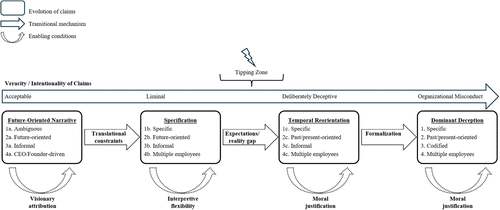
Note. CEO, chief executive officer.
|

Table 1. Definitions and Coding Rules for Key Constructs
| Construct | Definition | Coding rules | Truth threshold | Examples |
|---|---|---|---|---|
| Misstatement | A statement asserting or implying a state of affairs that at the time that it was made (time t), was either contradicted by available evidence or lacked any supporting evidence. | Statement is
| Contradicted or not supported by data; intentionality not required | “We will close 30 partner agreements this week” (all-hands meeting). Coded as misstatement because lacking any supporting evidence at t. “They agreed verbally to invest, we’re expecting a letter of intent on the 14th of this month, and closing in a month. The scale of their investment will be more than $25MM” (all-hands meeting). Coded as misstatement because lacking any supporting evidence at t. “We have found you a technology partner!” (executive to employee). Coded as misstatement because the meeting where the partnership was discussed, attended by Author A, did not end in agreement. |
| Deception | A specific, past- or present-oriented claim that was verifiably false at time t and made by an actor who had or by role, should have had access to information indicating falsity. | Statement is
| Contradicted by data; deliberate | “Company G is paying us to license the Platform” (interview with an employee with an overview of all revenue streams). Coded as deception because interview with Company G employee confirms no license or payments at that time: specific (“Company G”), present oriented (“is paying”), and employee role confers knowledge. “We have 600 partners in the pipeline” (partner-development lead, stated multiple times in all-hands meeting). Coded as deception because in an interview, the same employee said “40 partners are signed.” Milo later acknowledged “about 30 signed”: specific (“600”), present oriented (“we have”), and employee role confers knowledge. “We have MOUs under development with [Company H] and [Company I]” (partner lead, operations meeting). Coded as deception because a colleague that same month described [Company H] as “a company we’re thinking of working with”: specific (“Company H”), present oriented (“we have”), and employee role confers knowledge. |
| Dominant deception | Recurring, specific, past- or present-oriented claims that were verifiably false at time t, deliberately deceptive, codified in official artefacts, and propagated by multiple employees. | Statements
| Contradicted by data; deliberate | Website page listing “Our Partners” with logos of firms. Coded as dominant deception because internal records and interviews indicated that these were not signed partnerships at the time: codified and repeated across decks. Investor/partner/client document rendering images of Platform components. Coded as dominant deception because components did not exist: codified and reproduced across materials. White paper describing platform features. Coded as dominant deception because features did not exist and the white paper was signed by multiple employees. |
Note. MOU, Memorandum of Understanding.
|
Table 2. Coding Examples
| Coding dimensions | Contrasting dimensions |
|---|---|
| Ambiguous “We have a specific opportunity with two of the wealthiest individuals in the country.”—Milo “Multiple sources are financing [the flagship site].”—Employee | Specific “We had originally thought we’d have 300 partners by next year and we’ve scaled it down to about 100. [Company I] … [is] just about to be signed. They are days away from signature.”—Employee “Company G and Company H agreed to build [the hospital project].”—Milo |
| Future oriented “[Company J] is … coming out next week, and we’ll have terms in 4 weeks.”—Milo “When we IPO around March 20, our prices will be three times as high.”—Employee | Past- or Present-oriented “Our initial partner fees are beginning to come in.”—Employee “We are using [Company C’s] underlying technology in the Platform.”—Employee |
| Informal I have lunch with [Employee] and his family, and he tells me about the new hospital project. Apparently [world-famous leader] has agreed to work on it (????).—excerpt from field notes [In response to an employee’s question about slow rate of progress] “The technology is not the problem—getting the contracts finished is. The Platform is there, but we need places where it will be seen.”—Board Member, internal meeting | Codified “A sustainable healthcare system is achieved … via a comprehensive set of infrastructure, networks, sensors, and computing technology both on premise and in the cloud.”—executive deck “The Enterprise embeds this Platform into infrastructure, eliminating the need for dedicated data centers.”—document on Platform for potential customer |
| Possibly unintentional “There are many developments this week. We need to be careful about communication to external parties. If we were a public company, this is when we would go into a ‘quiet period.’ If you’re not sure, you don’t say anything for the next 6 weeks. You’ll soon know why. Our brand will become well-known.”—Milo “We’re talking to [governmental agency and leading medical school] about the pilot site.”—Milo | Deliberate “Company G is paying us to license the Platform.”—Employee (contradicted by counterparty interview; role-based knowledge established) “One of key drivers around [Hospital X] is the idea of building a green, waste-to-energy data center … We will be the integration piece. [Company C] was involved in redevelopment of [Hospital X] for last year, and they’ve officially put their efforts with [Hospital X] to go completely through us and the Platform.”—Employee (contradicted by counterparty interview; role-based knowledge established) |
Note. IPO, Initial Public Offering.
Findings
The Enterprise’s future-oriented narratives evolved into dominant deceptions through the process illustrated in Figure 1. Initially, these narratives were informal (1a), ambiguous (2a), future-oriented (3a) projections shared by Milo, the Enterprise’s chief executive officer and founder (4a). Employees initially found Milo’s optimistic statements acceptable as they were interpreted through the lens of visionary attribution: a belief in his ability to see and create the future. This phase is likely common in start-ups, and statements like these are rarely (if ever) considered as deception or fraud.
Over time, these narratives encountered translational constraints; as the Enterprise grew and professionalized, optimistic statements about the future moved down the organizational hierarchy, and employees responsible for operations were compelled by their internal responsibilities (planning, allocating resources, setting targets, and so on) to attach concrete details to them. Employees began to add specification to these ambiguous statements by filling in Milo’s narratives with smaller, measurable, specific (2b) details about future milestones and expectations. Specification appeared enabled by interpretive flexibility; Milo’s ambiguity created space for various employees (4b) to specify concrete and specific details according to their own functional goals, perspectives, and roles. Although some of the details were plausible, given the Enterprise’s current state of development, others were far from attainable and became liminal.
As the Enterprise attracted increasing attention for its vision and business model, employees began to experience an expectations-reality gap; internal and external stakeholders wanted evidence that the Enterprise was delivering tangible results aligned with its optimistic promises. Employees started engaging in temporal reorientation, shifting narratives from promises about the future to past- or present-oriented (3c) claims about what the Enterprise was doing or had already done. Although we could not identify a single point where members of the organization switched from making future-oriented statements to lying, there appeared to be a tipping zone where narratives transformed into deceptions that could be verified or falsified. No longer liminal, their collections of related and reinforcing statements became deliberately deceptive. This phase appeared enabled by moral justification; employees framed the falsehoods that they created or shared as acceptable because they served the Enterprise’s broader moral and social goals.
Eventually, the need for formalization of organizational artefacts for internal and external audiences led employees to embed these specific, past- or present-oriented details into official documents, presentations, and other artefacts, including a mock-up of their technology. The future-oriented narratives had become dominant deceptions: codified (1d), specific (2d), past- or present-oriented (3d) deceptions deliberately shared by multiple employees (4d) at all levels of the organization, including Milo. The deceptions took on the attributes normally associated with organizational misconduct (primarily those associated with intentional fraud), with one notable exception; by this point, employees “bought in” to the deceptions so much that they produced these traceable artefacts willingly without attempt to obscure their identities. Next, we illustrate the evolution of each of the Enterprise’s dominant deceptions over time.
The Enterprise’s Future-Oriented Narratives
From its founding, the Enterprise’s narratives revolved around its revolutionary “Platform” and its anticipated “partner ecosystem.” Author A’s first interview at the Enterprise was with Milo. During the conversation, Milo described the Enterprise’s value proposition and core product: sophisticated software that would connect healthcare systems and that would be delivered by an ecosystem of partners and integrated into a “unified architecture.” He emphasized how the Platform was critical in differentiating the Enterprise and would be key to its success. He elaborated, referring to two extremely well-known technology firms.
[Company C] and [Company D] started talking two years ago about building [a platform like ours]. But it never got off the ground and just stayed in theory. We are a small company that was able to say, f**k it, we’ll just go ahead and build one. A small, little company that took a leap of faith and said, “we’re going to make this work.” New monetization, a little bit of tech, and we’ll take the big guys down.
Milo frequently mentioned the Platform in meetings and conversations as the Enterprise’s “intellectual property” (IP) that would allow it to “change the game” in healthcare. Milo’s early statements about the platform were typically ambiguous about its details. “A platform,” after all, is a catchall phrase to describe any method (technological, physical, or even contractual) of connecting multiple sides in a market. The statements were also primarily focused on the future. For example, in an internal planning meeting held in order to explain the start-up’s technology to new board members and employees, he repeatedly emphasized the importance of the platform as the company’s core IP but was vague about its technical details, noting only that “we have its unifying architecture and some technology.” When a newly hired employee pushed for specifics (“What do we actually have?”), Milo shifted the focus from technical details to the platform’s value proposition and from the present to the future: “We will create solutions by integrating partner IP and our own IP.”
The second central aspect of the Enterprise’s narrative was its partner ecosystem; the Enterprise’s value proposition depended on partners that would sign onto, build applications on, and share data on top of the Platform. As Milo described in an internal meeting to newly hired employees: “We will figure out who to put together, combine that with our Platform, and figure out what will be best for [hospitals and healthcare facilities].” Milo’s early statements about the partner ecosystem were typically ambiguous and future oriented; in meetings and conversations, he spoke effusively about the many high-profile partners that the Enterprise would surely attract. For example, in an all-hands meeting, Milo described an anticipated relationship with a renowned technology firm: “They will invest in technology [to develop the Platform] … This is [Company E’s] most important deal.”
Enabling Condition: Visionary Attribution.
Our data suggest that employees accepted Milo’s optimistic statements because they were interpreted as evidence of Milo’s ability to foresee and create the future. That is, the founder’s future oriented narratives were enabled through a condition that we term visionary attribution. Employees frequently commented on the optimism of Milo’s claims. “The combination of his ability to see further, his intellect, and his self-belief … make him too optimistic. Almost pathologically,” an employee stated. Similarly, “[Milo can] be too sensational with some of the claims he is making,” an advisor recalled. Even Milo embraced this characterization, stating in an interview: “Entrepreneurs, by definition, can’t be rational. So I’m an eternal optimist.” Early in the fieldwork, many employees also described Milo’s statements as “overselling.” Over dinner with Author A, for example, an employee explained: “The management team is overselling to their own employees. Not … everyone is up for a partnership.”
But, employees described overselling as acceptable—sometimes with endearment—because it was a characteristic feature of Milo’s leadership and evidence that he was a visionary who saw what many others—including themselves—could not. One employee explained:
Milo is a very creative thinker. He’s thought so deeply about [the Enterprise’s] vision … When he says things like, “I’m going to build [the Platform],” it sounds glib … but that’s only because he’s thought quite a few years ahead of anybody else.
Another employee reflected, “His intellect and drive are incredible. He’s thought about things that I couldn’t even begin to understand.” A third employee framed Milo’s “overselling” and even “lies” as central to his vision and leadership:
Milo will always oversell … he gets into sales mode and keeps on talking … and goes a little beyond where he should be … Some may call it lies, some may call him a liar … Whatever you want to call it, I don’t care. He’s a great sales guy, he can pick a vision, he’s extremely knowledgeable—and extremely good.
An employee who left the Enterprise summarized how visionary attribution was key to the acceptance of Milo’s statements: “With Milo, you’re ready to believe in anything he says, thinking, ‘this guy has understood things I could not.’”
Thus, at the start of our research, Milo’s statements about the Platform and partner ecosystem largely represented the types of future-oriented projections that are distinct from reality but that are acceptable—to insiders and outsiders alike—given the “fake-it-til-you-make-it” norm that is frequently described as a key feature of start-ups (e.g., Garud et al. 2025). Employees appeared to accept overselling as a necessary part and evidence of Milo’s vision—evidence that he could see farther than they themselves could (also consistent with commonly held views of entrepreneurs as high in dispositional optimism) (e.g., Hmieleski and Baron 2009).
Specification: Filling in with Specific Details
Transitional Mechanism: Translational Constraints.
Our data suggest that although Milo’s future-oriented narratives were enabled through visionary attribution, they transformed over time as they trickled downward through the organization. This appeared to be driven by a mechanism that we term translational constraints: requirements inherent in role-based coordination that compel employees to convert broad, ambiguous goals into specific, time-bound tasks, metrics, and commitments as messages move down and across the organization (March and Simon 1993).
Although ambiguity can be effective at the top of the organization, it becomes increasingly untenable in middle and lower tiers where planning, coordination, and accountability are required (March and Simon 1993). This became especially salient as the Enterprise grew and professionalized. Responsible for operations and execution, the Enterprise’s employees could not only repeat Milo’s abstract visions of the future; they had to provide specific projections that could anchor internal planning. For example, in weekly all-hands meetings, employees working on technology development were expected to provide concrete plans for the Platform’s development; those responsible for partner development were expected to include specific, actionable expectations for the partner ecosystem. Employees in operational roles held meetings with the precise intention of converting the future-oriented narratives into more concrete targets and components; for example, a series of technology workshops aimed at, in the words of an executive, “defining the architecture, capabilities, and products that we need to gain in order to start real work.” In a conversation with a board member, the Enterprise’s Chief Operating Officer (COO)—brought in as part of a wave of new hires tasked with transforming the venture from a start-up to a professional organization—described his role as translating Milo’s optimistic vision into action:
This is a very entrepreneurial organization—with the most dedication I’ve ever seen. That’s the good side of Milo’s vision … My approach, since I came in … is that I work with Milo to free him to make promises, but then I catch them … My approach to management is building brick by brick, making every agreement and meeting a check box. Micro steps to a macro vision.
Specification.
Translational constraints were especially evident in all-hands meetings that structured a space for what we term specification; employees began to embellish Milo’s projections with granular but speculative specifics that aligned with their own roles and responsibilities within the organization. Team members focused on the Platform elaborated on its anticipated technical capabilities and architectural logic; employees focused on partner development described near-term deal closings and investment figures.
For example, although Milo had described the Platform in broad terms (as a “unifying architecture for healthcare systems”), employees translated that narrative into concrete, technical expectations about structure, capability, and use first in all-hands meetings and then, more broadly. For example, the employee responsible for leading MobileTech (a workstream that he described as focused on “moving people and intelligence” through healthcare systems) specified Milo’s description of the Platform by adding details related to data mobility: “It’s a platform to communicate between different systems—like an integrated sensor. We will put sensors into all the building systems … The result is hospital systems that make sense, that speak to you.” The employee responsible for running the Enterprise’s core technology workstream, HealthTech, added even more specifics to Milo’s ambiguous narrative of the platform, describing the following:
The Platform will serve as a holistic resolution to the problem of operating a healthcare system … Their operation will be managed efficiently through the system. We will use parametric modeling and dynamic modeling to understand how the hospitals are performing and transfer information through a “backbone” that will monitor everything from security to utilities.
Like Milo’s earlier narratives, these descriptions remained future oriented and speculative. But, they were also significantly more detailed, naming the Platform’s specific tools and performance features.
A similar pattern emerged as employees began to articulate increasingly specific, future-oriented projections about the partner ecosystem. In an all-hands meeting, the employee leading the partner development workstream reported: “By the end of the week, six [agreements] should be … completed.” In the following week’s meeting, the same employee stated, “We have 30 agreements being scoped or negotiated or finalized” without referencing whether the prior target had been met. Similarly, the executive responsible for partner and investor deals and governance offered a detailed timeline for Company C: “They agreed verbally to invest, and we’re expecting a letter of intent on the 14th of this month, and closing in a month. The scale of their investment will be more than $25MM.”
At this point, much of the Enterprise’s future-oriented narrative became liminal. Some details described a future that appeared plausible for the Enterprise to attain; others, however, stood far from the Platform and partner ecosystem’s actual state of development. During this phase, although Enterprise employees continued to work with fervor on various aspects of the company’s proposition, the Platform remained undeveloped. Author A was never shown a prototype (nor was a partner, who stated that “if I’m being honest … we don’t actually know what the Enterprise will put into the fabric of the hospital, because they haven’t been able to show it to us”). There were no servers hosting the Platform or any data. Field notes describe “everyone working constantly”—but to Author A’s surprise, nobody coded. Instead, over dinner with an employee and an external healthcare consultant, they lamented to Author A that “we just have high-level ideas and no actual solutions … What’s our IP? We have none.” An employee who had worked at the Enterprise in those early years recalled: “They talked a lot about the Platform. But there wasn’t a single line of code that was written when I was there.” Similarly, although employees pointed to dozens of partner agreements “being finalized,” describing her time at the company, a former employee explained that at that time, “I had a list of partners on my computer. We had something like eight signed partners.”
Enabling Condition: Interpretive Flexibility.
Specification appeared supported by the mechanism of interpretive flexibility: the condition where a technology or concept is open to multiple meanings, enabling divergent but plausible specifications to coexist (Pinch and Bijker 1984). While visionary attribution allowed employees to justify overselling as a part of Milo’s leadership style, interpretive flexibility was a feature of the nascent industry that made their own detailed projections feel reasonable to articulate and difficult to contest.
The Enterprise’s employees and other stakeholders repeatedly emphasized how the company was operating in a nascent industry characterized by significant ambiguity. “Even those of us who have been in start-ups before have never done it like this,” Milo reflected. He continued, “this is an order of magnitude more complex. We’re starting from a blank sheet.” This ambiguity meant that employees did not have experience with or fully understand the technologies that the industry would require or enable. A board member (with significant experience in a related industry) explained: “This is a new market … None of us are experts in building IoMT systems.” Another employee explained, “Nobody really knew what [the technology] should look like.” An executive at one of the Enterprise’s partner organizations described how the nascent industry made it impossible to be fully informed on technology:
I gave a presentation at a conference [for IoMT], and someone asked me, “How do you guys stay ahead of all the technology that’s being developed across the planet?” And there was only one answer—I’m not and I can’t.
Interpretive flexibility extended beyond the Platform to the partner ecosystem. In a meeting, Milo admitted that given how novel the Enterprise’s proposition around a partner ecosystem was, “there is a lot of confusion about what it even means to be a partner.”
This interpretive flexibility appeared to create a conceptual space where Milo’s early claims about the Platform and the partner ecosystem could be filled in with future projections that could not be evaluated against functioning technologies or known standards, no matter how untethered from reality. Our data indicated that likely because of the roles that they occupied within the organization, employees were often aware of the discrepancy between many of their statements and their current state of development. For instance, Author A was surprised by an exchange in an internal meeting that illustrated this awareness:
Board Member 1: What’s our IP right now?
Employee 1: Right now, the IP is the Platform.
Employee 2: We have the vision and the knowledge of customer needs. But we don’t actually have a product yet.
Board Member 1: That’s kind of a problem—selling what we don’t have.
Still, the deliberate nature of the future-oriented statements was difficult to evaluate; we propose that because of the interpretive flexibility inherent in their industry, it is plausible that employees saw them as accurate or provisional milestones that might soon be realized. “Milo points us to the future,” a board member described, “and I suspect a whole industry will be transformed. So, technically, who knows [what will happen].” Similarly, “there’s a lot of different understandings of the time and people it will take to do something,” an employee explained. Given a lack of precedent, specifying parametric modeling, a data “backbone,” or a partner that would be willing to invest $25MM in an undeveloped technology could be treated as plausible.
Temporal Reorientation: Shifting from the Future to the Past and Present
Transitional Mechanism: Expectations-Reality Gap.
But, as specific, future-oriented projections accumulated, they increasingly invited questions about whether the Enterprise was meeting its targets. This began internally as employees began benchmarking their progress against expectations set out by their colleagues. A former employee described this period:
In all the weekly meetings … things were always coming together … We thought, we are so close … But then, after one or two weeks, we started to realize nothing had really happened. So we started to track a bit more what was promised and what really happened … In all the weekly meetings, we started to write down things that were said, and then we would compare them to reality.
As they compared expectations to reality, employees began asking detailed questions about the Platform and the partner ecosystem. “Do we have the terms for that deal?” “Has [Company F] signed?” As the Enterprise began to attract attention, including press coverage and awards for its vision and business model, similar questions appeared at the organization’s boundary. Stakeholders, including partners and investors, began asking for evidence that the Enterprise was making progress toward its projections. In interviews, employees noted a shift in tone among stakeholders. One board member reflected: “People are becoming less tolerant of unmet expectations; we need to move into delivery mode. To continue to improve, [we] need to link our vision to execution.” An executive described how this pressure resulted from the Enterprise’s liminal future-oriented statements: “I think where we have failed was … expectations management … The fact that you are—I won’t say overpromising, but so enthusiastic—people have an expectation … And that puts pressure on you to deliver.” Another employee explained:
We’ve sent everybody on a journey of what [an] IoMT company could be. And nobody knew what IoMT was. People and companies are now looking for validation points because we set the vision so high. If we weren’t so visionary, we wouldn’t have had anybody looking at us. Now, everybody in the company has to be a sales person. We need to sell our company.
Even Milo acknowledged this pressure, writing in an email that “measurements, execution, and results have to be our focus now.”
Prior research describes this type of pressure as an expectations-reality gap and theorizes that it can lead leaders and employees to deceive (e.g., Garud et al. 2025). As the Enterprise grew, its employees began taking concrete steps to meet their optimistic projections: for example, hiring engineers to start building the Platform and dedicating a growing number of employees to partner acquisition. But, the development of both remained elusive. “We don’t have enough bandwidth and ability to work on each part of the Platform,” a newly hired engineer bemoaned in an interview. “The market has changed,” the employee in charge of partner development described, “so partners are much more selective and larger companies are much more regulated … Our deals are being delayed by those kinds of things.” Thus, despite their efforts, employees were unable to close the expectations-reality gap generated by their future-oriented statements. Instead, our data suggest that they began to close it rhetorically by shifting the tense of their statements.
Temporal Reorientation.
Specifically, our data suggest that employees engaged in temporal reorientation, responding to questions about progress by making statements about the past or current state of the Platform and partner ecosystem’s development rather than its future. During this phase, our data revealed an increase in statements describing what the Enterprise had already accomplished rather than about what it would accomplish in the future. For example, asked about the current state of the Platform, an executive told Author A that “the Enterprise has assets for the first time in its history: technology assets.” Another employee described in an interview how:
Our main product is the Platform … Nobody else has it. The hardware comes from [Company E], some software from [Company F], and we own the connection between them … Integration allows for really easy deployment.
He elaborated, noting that existing companies creating technologies for healthcare systems “are vertical solutions … But these types of vertical approaches don’t work, because the gains come from connecting everything. The Platform is a horizontal solution that ensures coordination between those systems.” Employees also offered precise details about the Platform’s current state of deployment. “[Company G] is paying us for licensing the Platform,” an early employee whose position gave him an overview of all revenue streams, declared in an interview. These statements described the Platform as an existing technology, a technological asset that integrated precise pieces of hardware and software developed by specific other companies and that was already generating revenue through licensing agreements with partners.
Yet, these statements were verifiably untrue at the time that they were made. An employee shared in an interview that at that precise time, the Platform, much less one that could integrate distinct pieces of hardware and software or coordinate between system, did not yet exist but rather, was “[only] conceptually worked out.” In another interview, an employee from Company G described how his company was not licensing the Platform but was only planning to sell its own technological solutions to the Enterprise:
The elements we [Company G] will be introducing [i.e., licensing] into the Enterprise, we’re using … and developing every day for our core marketplace. So, it hasn’t been a big distraction for us because we’re basically doing our day job.
A different employee, a newly hired technical lead, was honest in an interview that same month: “The Platform is not really production ready.”
Statements about the partner ecosystem evolved in a similar way as employees working on partner development increasingly offered details on the number and status of distinct partners that the Enterprise had already signed. “We have Memorandum of Understanding (MOUs) under development with [Company H] and [Company I],” a partner lead stated, listing two extremely well-known companies, although an interview with a different employee revealed that Company H was only “a company we were thinking of working with.” “We have 600 partners in the pipeline,” the employee responsible for the partner development workstream stated multiple times in all-hands meetings. In an interview, he gave a different figure, noting that “40 partners are signed.” A year later, Milo’s statements revealed this number as untrue as he noted: “We have had about 30 contracts signed.”
Like other employees, Milo engaged in temporal reorientation. He continued making optimistic statements about the Enterprise’s future. For example, in an internal meeting, he stated:
[Company E] has shipped us some equipment, which we will combine with some of [Company F’s] tools and sensor technology from partners. We have to figure out exactly what things will show up well … Our goal is to demonstrate how all this stuff fits together.
At the same time, he also paired these with past- or present-oriented statements that were contradicted by other data. For example, in an all-hands meeting, he described how “an external healthcare system is buying our technology kit, so it brings in revenue,” indicating a completed or ongoing purchase of the Platform. However, Author A’s notes from weekly meetings focused on that healthcare system indicated that the relationship was not finalized and that technology orders were not placed. The week of the all-hands meeting, the Enterprise’s finance lead noted how he was still “plugging financials in to calculate revenues,” meaning that the revenue was still only being modeled and not generated.
Our data suggest that temporal reorientation allowed employees to address the expectations-reality gap; rather than continuing to make promises about the future, they could assuage each other’s and stakeholders’ concerns by emphasizing what the Enterprise had already done. Rhetorically, temporal reorientation did not represent a large departure from employees’ previous statements; they did not become more grandiose or fantastical. Because it only involved a tense change from the future to the present, it was almost imperceptible. However, future-oriented statements, although possibly wildly optimistic, could not be shown to be false in the present and could possibly someday prove true; in contrast, past- or present-oriented statements could be contradicted by contemporaneous evidence and verified as untrue. By stating that the Enterprise had “600 partners in the pipeline” against an internal count of 40 or even 30 or that “[Company G] is paying us for licensing the Platform” when it was not, employees shifted from overstating about the future to representing as real a present that had not occurred. Additionally, whereas this had been difficult to establish previously, employees’ contradictory statements or role-based internal knowledge strongly suggested that deception was propagated deliberately. No longer liminal, employees’ statements existed in a tipping zone between narratives and misconduct.
Enabling Condition: Moral Justification.
Our data suggest that moral justification—a moral disengagement mechanism where actors cognitively frame norm-violating behaviors (in this case, violations against the norm of truth telling) as serving higher-order norms or socially beneficial ends (Bandura 1999, Moore 2008)—allowed employees at the Enterprise to rationalize temporal reorientation. By this point, the Enterprise had attracted a wide variety of employees who were motivated by a shared belief in the company’s potential to create profound and positive social change. As Author A repeatedly heard, employees sought to “do something I never thought would be possible” or “do something really important.” In the words of an early Enterprise employee, their goal was nothing short of “changing the world.”5 Another employee explained, “We’re all here because we want something … We’re not here to make money. We are solving problems that we have to solve if we want to keep living on this planet.”
Our data suggest that many Enterprise employees were aware of discrepancies between what was said and what existed. For example, a senior executive noted that some employees “came in on the basis that the vision was already being realized,” acknowledging that the Enterprise was inaccurately describing its present state of development. At the same time, temporal reorientation was not reproduced by every employee within the organization. Some, like the newly hired technical lead who described it as “not really production ready,” resisted speaking in present terms about the Platform’s development. However, the executives and employees who engaged in temporal reorientation articulated explicit reasons why overstating past- or present-tense progress was acceptable—and even necessary—for achieving the Enterprise’s transformative mission to revolutionize healthcare. For example, one board member stated how the Enterprise was inaccurately claiming the state of development of the Platform:
We are saying [to partners]: this is your opportunity. If you want to be part of the IoMT industry, the best way to do it is to integrate with our Platform. That’s both an arrogant and a true statement. Arrogant in the sense that we’re not yet of the scale that would make it completely obvious … True because there actually are no equivalents to the Platform that we are developing … To some extent, we are not there, because we’re only just now moving into the application phase [where the code for the Platform is written].
In this account, the board member acknowledged the “arrogance” of presenting as a fact a Platform that had not yet been built. He went on, justifying this as necessary to achieve the Enterprise’s aims and explicitly stating that the ends justified its means:
What excites me about the Enterprise is the application of technology to hospital systems, the ability of intelligence to be not only human to human, but machine to machine … It’s a tremendous opportunity. How we deliver is less important than that we do deliver … The objective is to be lead participants in a dramatic change, that we design healthcare systems for the benefit of all the people in them. If we can keep that goal, how you get there becomes secondary.
The Enterprise’s Dominant Deceptions
Transitional Mechanism: Formalization.
Finally, as the Enterprise developed, employees encountered the necessity of formalization: the creation and use of official artefacts that standardize communication internally and externally (Weber 1978). Employees had to create artefacts, including templates, process documents, slide decks, and press materials, to both help manage a growing volume of work and demonstrate progress externally. Milo summarized this pressure in an all-hands meeting, emphasizing the need to codify details about the partner ecosystem:
One of the biggest challenges in scaling is content … We need consolidated content by the end of the month … [including] decks … and a business plan with a clearer representation of our activities so the whole group can understand their roles and how they come together … There may be some additional things we might get asked for, and we should produce them quickly, including details on the partner ecosystem.
In the same meeting, an employee also described the need to codify the Platform, stating that “we need an outline of our technology infrastructure” to show potential partners and customers. Internal meetings and conversations contained explicit requests to create artefacts, including “partner profile forms,” “proper training packages and user guides” for the Platform, and “white papers” describing its features. In a meeting, one board member underscored the necessity of creating artefacts: “[T]he perennial problem in the organization is getting things … onto paper.”
Dominant Deceptions.
Following this pressure, in the final year of our research, the Enterprise’s future-oriented narratives about the Platform and the partner ecosystem transformed into dominant deceptions. Table 3 provides additional evidence of this evolution. By this time, the Enterprise’s small but growing engineering team had developed a “beta” version of the Platform. But, the beta—which according to the lead technologist, was “written in a frantic period two months ago”—was extremely limited in its capabilities. In an interview, another employee explained how “it’s quite a big step moving from a beta version to something that you can deploy in real life.” A third employee, an engineer, was even more circumspect, stating that “we have nothing tangible yet.” In a leadership meeting where the Platform was discussed as an existing product, one of the Enterprise’s executives interjected to correct the conversation, cautioning that the venture had only “a beta version of the product … We have long way to go before we can scale the Platform … Let’s not forget that.” However, nobody acknowledged or responded to the comment, and the meeting moved on.
|
Table 3. Evolution of Future-Oriented Narratives to Dominant Deceptions (Additional Data)
| Informal, ambiguous, future oriented, by founder | Informal, specific, future oriented, by multiple employees | Informal, specific, past- or present-oriented, deliberate, by multiple employees | Codified, specific, past- or present-oriented, deliberate, by multiple employees |
|---|---|---|---|
| The Platform | |||
| “Other companies are bringing forward knowledge that will be integrated into the Platform.”—Milo “As we do this, we’ll learn a lot. Whenever we deploy a new implementation [of the Platform], we will increase our IP … Future implementations of [the Platform] will be driven by partners, not managed by us. We will work on later iterations.”—Milo | “[Hospital X] could be a pilot for us for the Platform, working with [Company Y] and other local partners. The owners want to expand this pilot to 19 hospitals overall.”—Employee “Our partners are building 60 clinics, and our technology will be going into that. It will be our first deployment.”—Employee | “The current value of the Platform is $4MM”—Executive 4 (contradicted in multiple interviews; role-based knowledge established intent) “Our platform is being adapted by [Company L].”—Executive 2 (contradicted in multiple interviews; role-based knowledge established intent) | “The Platform achieves these goals, supplying a unified, open platform for sensing, real-time control, actuation, event distribution, data storage, analytics, and application support. This significantly lowers the cost of multilevel, real-time control and enables the continuous improvement of operational processes, with a significant positive impact on [healthcare systems] and quality of life.”—official enterprise document “The Platform provides data routing, marshalling, aggregation, life cycle management, and analytical capabilities … For this reason, the Platform is also a main point of integration for external services and capabilities such as remote data sources and cloud-sourced capacity.”—official enterprise document |
| The partner ecosystem | |||
| “[Company C] wants to make an investment in high tech company, and we have the technology and healthcare element. They will invest in the technology.”—Milo “[Company X] has consolidated their healthcare efforts, and they’re interested in all aspects of our business. They’re coming out to visit next week.”—Milo | “[Company C executive] shared an internal document … Their estimate for the value of the partnership to them by 20 is $6MM.”—Milo “We already have about 42 events and announcements coming up.”—Employee | “We have a Pipeline of 300 partners.”—Employee 4 (contradicted in multiple interviews; role-based knowledge established intent) “The [Company C] deal has three parts they’ve agreed to. The first is a cash investment.”—Executive 2 (contradicted by counterparty interview; role-based knowledge established intent) | “Our partners include [Company C]. At the core of our value proposition is our ecosystem of partners … With over 300 other organizations in our network.”—enterprise executive overview deck “Companies, large and small, work within our growing partner ecosystem to integrate their products and services with Platform and the innovative technologies of other partners.”—enterprise website |
Nonetheless, employees, including executives and Milo, developed a document for investors, partners, and clients fully describing and specifying the Platform as an existing product. It contained detailed descriptions of “how the Platform works.”
Data are combined and aggregated, analyzed and inspected to derive knowledge and insight … This combination of distributed sensing and processing with central command and control allows for … optimized operations of hospitals and healthcare systems.
The document was written in the present tense, describing how:
A tiered set of services provides everything from low-level access to data … up to vertically specific rich services that only need a small amount of user interface design to support a complete application.
Finally, it included rendered images of the Platform’s components, technical architecture, applications, and functions—none of which existed. The Online Appendix illustrates a disguised version of the document.
Similarly, the Enterprise’s website contained a page on “Our Partners” that detailed how the Enterprise’s partner ecosystem consisted of “partners such as Company C, Company D, Company E, Company F, and thousands of smaller partner companies from around the world”—despite Milo’s claim that the Enterprise had signed 30 partners. The website presented logos of well-known companies listed as “Our Partners” at the top of the page. Some of those companies were little more than service providers that the Enterprise had engaged (for example, a well-known healthcare consulting firm and a global public relations firm); Author A’s field notes and interviews specified that several other companies were no longer or had never been signed as partners. For example, in an interview, an executive revealed that one of the companies had terminated the relationship a year ago.
This codification of deception was noticed and criticized by the healthcare consultants who advised the Enterprise. One consultant described how his team was also asked to codify deception:
Healthcare consultant: [In our decks] we were being asked to paint a rosier picture than what was going on right now. That was really, really painful. Our professionalism was being tested … What are you supposed to do, as a consultant?
Author A: So what did you do?
Healthcare consultant: We were very careful to take our names and fingerprints off all the documents … It’s not our endorsement, recommendation, or finding.
Many of the Enterprise’s employees, in contrast, did not express these reservations, embedding their names into the artefacts that they created. They proudly claimed authorship of the documents that translated deception into organizational facts (“I’m getting feedback on a working paper right now” and “I’ve cleaned up content, incorporated updates, and am plugging financials” into a deck); they signed their names onto a white paper distributed to the press describing Platform features that did not exist. A healthcare consultant summarized the result as organizational misconduct: “This was like seeing an Enron unfold. I had conversations with other consultants saying … ‘I wonder if we should be blowing the whistle’ … That was painfully scary.”
Enabling Condition: Moral Justification.
The Enterprise’s shift to codification appeared supported, once again, by moral justification. Moral justification was especially present in interviews with former employees who explicitly linked their own role in codifying deception to the Enterprise’s moral mission. For example, in an interview after leaving the company, one former employee, a recent college graduate who joined the Enterprise because she was “enthusiastic about doing something different … and doing good for the world,” described how she came to realize the scale of deception at the Enterprise:
I started to ask more questions … And I started to realize bit-by-bit that we had nothing. So I started to get worried … I asked [Executives 1, 2, and 3]—I was trying to understand the elements they had. Everybody was pointing to other people—you should ask [Employees 1 and 2] for that—and I was starting to wonder, where are the documents. And I realized there were no documents.
She continued, explaining her reaction: “And then I asked: ‘OK, can I help you create some documents?’” As this quote illustrates, in response to uncovering deception (and in contrast to the external consultants), she asked if she could help create—and even codify—it. Eventually, she left the Enterprise. When asked about her participation in the deception, she pointed to the Enterprise’s moral mission:
I was convinced by the project and the idea … When you really want to believe in something, you are ready to close your eyes to so many things. It’s a bit like a love story … We had been seduced [by the idea], and we were crazy in love.
As the Enterprise’s deceptions became codified and pervasive, a number of other employees left the organization. Milo revealed in a board meeting that the venture had lost around 30 people “in four-to-five months.” Some of those who left were among the employees who had challenged or questioned the Enterprise’s claims to Author A. Author A asked one former employee about the experience of working at the Enterprise:
Author A: What were the best parts about working there?
Former employee: There were people who were knowledgeable and had good ideas … So it was fun to work with them.
Author A: And the negatives?
Former employee: Basically, all the lies.
But, executives emphasized how the employees who left were precisely those who did not subscribe to the Enterprise’s moral mission. One board member reflected that some employees who left or were let go had “created friction.” He noted that “each person had a different take on [the Enterprise’s] vision,” whereas those who remained were “more aligned.” Employees who remained were, in other words, those more willing to accept and reproduce the Enterprise’s account.
Epilogue
Although Author A ended the fieldwork as the originally planned study neared completion, the Enterprise’s story continued to unfold. Although Author A no longer tracked the organization—and although we do not attempt to explain success or failure—the Enterprise eventually shut down. In one of our last conversations, a former employee described how “there’s something really wrong in the company … There’s a lot of bulls**t flying around, and I don’t think the company is in a good situation.” Other accounts described additional “disillusioned” employees leaving and partners who had initially championed the Enterprise “taking the heat” from their companies when the Enterprise failed to deliver. Review of publicly available documents—withheld because of anonymity constraints—suggests that the Platform was never built or deployed.
Discussion
How do a start-up’s future-oriented narratives transform into deception? Drawing on a longitudinal study of an early-stage venture, we develop a process model illuminating how a founder’s ambiguous, future-oriented narratives were progressively specified, reoriented in tense, and codified into organizational artefacts, becoming dominant deceptions. These collectively produced falsehoods—similar to those seen in other high-profile start-up frauds, including Nikola and Theranos—involved employees fabricating evidence that core technologies or partnerships already existed. Narrative building is central to venture development (Martens et al. 2007), yet the stories that ventures share with outsiders and themselves are not always reflective of the real and substantive actions performed within the four walls of a firm (Zuzul and Edmondson 2017). Martens et al. (2007, p. 1126) highlighted “the need to investigate the nature and prevalence and effects of inauthentic entrepreneurial narratives” or narratives that enable the storyteller “to exaggerate, to omit, to draw connections where none are apparent to silence events that interfere with the storyline.” Yet, only theoretical work has explored, thus far, the process that tips aspirational narratives into collectively produced deception.
We therefore answer recent calls to investigate what happens within the firm as deception unfolds (Garud et al. 2025). Despite a long tradition of ethnographic studies of deviance (e.g., Anteby 2008), qualitative studies that examine deception have been relatively sparse. Most studies of organizational misconduct take a corrupt act as their analytical starting point and theorize or trace how it is normalized and diffused in an organization (Ashforth and Anand 2003, Palmer 2012). Although misconduct often begins in an ambiguous, liminal temporal space where the wrongfulness of an act is still undetermined (Mohliver 2019), the question of how narratives transform from visionary to deceptive has been unexamined. This gap is not surprising because data that capture deception in real time are difficult to come by, particularly in early ventures. In this context, longitudinal, qualitative research is particularly valuable because it allows researchers a rare opportunity to build deep understandings of how deception unfolds.
Our study reveals a form of deception that evolves incrementally, driven by mechanisms ordinarily seen as unremarkable features of organizing. Critically, we did not observe any moment or act that could be labeled as a “tipping point” where an actor resolved to defraud. What we observed instead was deception as an emergent phenomenon, evolving through what, at its narrowest, might be described as a “tipping zone” lasting many months. This is as close as process research may get to the moment of moral crossing given the fuzzy, socially constructed nature of organizational gray zones (Palmer 2012, Palmer et al. 2016). Deception emerged as employees met organizational demands—to develop a compelling narrative, to make a vision actionable, to report progress, and to formalize operations—in ways that appeared reasonable. Their statements transformed from liminal to deceptive through a subtle shift in tense; employees started describing future-oriented possibilities (e.g., “the product will have”) as present-tense facts (e.g., “the product has”). By the time that our study ended, the social environment within the Enterprise meant that employees accepted deception as the appropriate way of conducting their roles. The process, unfolding over several years, was so diffuse and incremental that only observers viewing the cumulative totality of actions across individuals and time could see it. Any employee involved in the process could understand themselves as simply performing their organizational role; experienced independently, one’s marginal statements and acts may not even have registered as unethical. But, for the organization, these statements and acts had outsized consequences: the production and propagation of dominant deception in codified, traceable artefacts that could have exposed the venture to legal and regulatory scrutiny and even prosecution if uncovered by social control agents.
The role-distributed quality of this process distinguishes our account from behavioral ethics explanations of misconduct, as that literature primarily locates wrongdoing in individual decision making (Treviño et al. 2014). It also extends work on the social production of deception and corruptive routine translation (e.g., Vaughan 1996, den Nieuwenboer et al. 2017) by showing how deception can emerge not only through coercive routines but also, through incremental, distributed efforts to make an ambitious future actionable. We propose that this transformation was facilitated by three conditions that are often seen as signs of a promising venture: visionary attribution to the founder (Lounsbury and Glynn 2001, Zuzul and Tripsas 2020), interpretive flexibility of a nascent industry (Pinch and Bijker 1984), and moral justification anchored in a social mission (Sykes and Matza 1957, Bandura 1999, Moore 2008, Umphress and Bingham 2011). An implication of our work is that the features that can make a start-up appear promising may be the ones that allow its narratives to harden into deception.
Contributions to Research in Narratives and Organizational Misconduct
Our model extends the literature in narratives and organizational misconduct. First, we draw a boundary between aspirational narratives and deception and between the liminal and the criminal. In sentencing Nikola founder Trevor Milton for securities fraud, U.S. Attorney Damian Williams declared that “fake-it-till-you-make-it is not an excuse for fraud” (United States Department of Justice 2023, p. 9). Yet, neither practitioners nor scholars have specified the distinction between the two. Misconduct research has long struggled with definitional ambiguity; for example, Palmer et al. (2016) noted that the “uncritical treatment of the definition of organizational wrongdoing” requires attention. Meanwhile, the entrepreneurship literature often treats narrative license as a legitimate practice (Lounsbury and Glynn 2001, Rindova and Martins 2022, Murray and Fisher 2023). As a result, there is a temptation to judge the ethicality of a statement by its eventual outcome: Nikola’s claim that it had built a “fully functional hydrogen-powered” truck appears wrong because it never came to fruition; Amazon’s claim that it was “Earth’s biggest bookstore” appears understandable or permissible because it eventually came true.
Our coding rules (see Table 1), in contrast, draw a clear distinction between visionary narratives, including those containing overselling, and deception. The granularity of our data allowed us to also map and code liminal stages—invisible to research that works backward from established fraud—that a visionary narrative passes through on its way to becoming deception. Ambiguous, forward-looking claims, however fantastical, are legitimate and even expected. Once specific details are added—a name, a date, or a number—the set of possible futures where a claim can come true narrows, leaving it legitimate but possibly liminal if the projected future appears to be far from reality. When specific statements shift in tense, they can no longer be categorized as overselling or even hype. The tense shift changes falsifiability: a claim about the present or the past can be contradicted by available evidence in a way that a promise about the future cannot and can, therefore, be classified as deception. In our coding, we added the condition that a deceptive claim must be made by an actor whose role gave them reason to know that it was false, but this is an empirical proxy; mental states are not observable, and we cannot otherwise discern whether an individual knew the truth behind the statements and artefacts that they created. Once codified into official artefacts and propagated by multiple employees, deceptions become dominant deceptions: recurring, attributable, traceable, and now, the kind of statements that social control agents can treat as fraud.
According to our coding rules, because Amazon’s claim was specific, present oriented, and contradicted by its actual capabilities—a fact that its executives were, by role, positioned to know—it was a deception at the time that it was made. The company’s later accomplishments do not render its earlier statements true. In offering criteria finer grained than prior research has offered, we hope to give future research a clearer basis for delineating deception from aspiration, overselling, or “fake-it-til-you-make-it.” We note that we developed these criteria in the context of a venture that ultimately failed. We, therefore, see significant potential for researchers to collect data that are granular enough for locating statements within the gray zone that separates overselling from deception in successful ventures. For example, researchers could apply our coding rules to the archival record of ventures that succeeded, including early investor materials, product announcements, and press statements, to examine whether their claims evolved in the ways we identified.
Second, despite our significant access to the Enterprise, we did not observe a single, decisive moment—a decision, a meeting, or an instruction—where narratives became deception. Our next contribution is, therefore, to propose that there exists a tipping zone between narratives and deception and that, moreover, this zone is a rhetorical one. The structure of language—a shift from future tense to past or present tense—appears to be the route through which narratives transform into deception. By developing this contribution, we extend research on framing (Lounsbury and Glynn 2001, Martens et al. 2007, Rindova et al. 2009, Fisher et al. 2016, Kahl and Grodal 2016). This research has attended primarily to what is framed—for example, the products, experiences, technologies, and ambitions that founders or leaders assemble into a compelling vision (e.g., Chai et al. 2026)—and to whether that content resonates with audiences (e.g., Raffaelli et al. 2025). Our findings suggest that a venture’s narratives can become deceptive while their content remains unchanged. The same claims—an integrated Platform or a roster of committed partners—can be evaluated differently if they describe a future (“we will connect healthcare systems”) or assert a present (“we connect healthcare systems”). If tense rather than content marks this boundary, we encourage future research that treats the grammatical form of narratives or framing as an object of study.
Third, we theorize three enabling conditions that supported the transformation of narratives into deception, and we propose that their conjunction makes a venture vulnerable to deception. The first is visionary attribution to the founder: employees’ belief that the founder was capable of seeing and creating the future. Much of the research in entrepreneurship celebrates visionary founders who shape how others see the world (e.g., Lounsbury and Glynn 2001). However, recent studies point to the dark side of visionary or revolutionary founders, including excessive advocacy (Zuzul and Edmondson 2017) and inertial firm behavior (Zuzul and Tripsas 2020). We propose that visionary attribution allowed employees to accept and normalize Milo’s early narratives, setting the stage for deception.
The centrality of the founder’s leadership in seeding the transformation of narratives into deception is consistent with and extends the literature on ethical leadership. An established and growing literature argues that leaders create the conditions for misconduct through their words and behaviors (Victor and Cullen 1988, Treviño et al. 2003, Brown et al. 2005, Brown and Treviño 2006). Although the challenge of single-case studies is an inability to observe the counterfactual, given the influence that he held over the Enterprise, we can reasonably assume that the venture’s narratives may not have transformed into deception had the founder tempered his overoptimism or done more to instill a culture of honesty within the organization. Our findings contribute to this work by suggesting the precise process through which a leader’s narratives can seed eventual deception.
We also highlight the dark side of interpretive flexibility, a construct celebrated in technology management but not typically considered in studies of organizational misconduct. Research describes interpretive flexibility—the openness of new technologies and categories to multiple, plausible meanings—as a driver of experimentation and differentiation (Pinch and Bijker 1984, Garud and Rappa 1994, Kaplan and Tripsas 2008, Grodal et al. 2015). At the Enterprise, the novelty of the IoMT domain meant no settled standards for what a “platform” was or what counted as a “partner.” This ambiguity appeared to create conceptual room for multiple actors to fill in founder narratives with divergent specifics that sounded right yet were unmoored from available evidence, legitimizing the addition of specific details to the founder’s visionary claims. Indeed, recent highly salient public examples of deceptive start-ups, including Theranos and Nikola, all claimed to be helping to usher in a nascent industry through their new technology. Our findings suggest that the interpretive flexibility inherent in nascent technologies and products—whether a hydrogen-fueled truck or a blood-testing machine—might invite others to both accept misstatements and fill them in with their own specific details.
Finally, we highlight how moral justification—a moral disengagement mechanism through which actors frame norm violations as serving a higher cause (Bandura 1999)—helped Enterprise members justify deception as necessary to achieve a socially valuable future. Moral justification is a well-established driver of organizational misconduct (e.g., Mohliver and Ody-Brasier 2023). Employees at the Enterprise justified their behavior through reference to a shared imagined future—what the Enterprise would accomplish in the future—rather than an existing status quo. Their justification was not tied to existing systems but to a prophetic vision that they deeply believed in, one in which their start-up would enact revolutionary change. Ethical principles were superseded by the moral imperative of achieving this better future. Our findings suggest that start-ups prophesizing to revolutionize healthcare (like the Enterprise), eliminate pollution, reverse global warming, or colonize the stars may be particularly vulnerable to these processes.
These three enabling conditions operated as a set, each supporting a distinct phase of the process that we identified. We note, however, that this same configuration can and has produced transformative companies. Although we only studied one case, our findings suggest that the same conditions might support both venture success and eventual deception, but the judgement and labeling of deception hinge on an unknown future in which the venture either succeeds or fails. Amazon and the Enterprise may have looked similar early in their histories, but Amazon delivered; its history is, therefore, narrated as visionary. The asymmetry lies not in the truth of the claims at the time that they were made. It lies in the events that followed as future success or failure shaped the retrospective interpretation of the claims, a classic instantiation of labeling theory (Becker 1968).
Limitations
As with all single-case, qualitative research, we caution readers against making causal claims based on our findings. Our goal is to draw on rich, contextualized evidence to propose new ideas that can extend current theory rather than to test theory; the phases, mechanisms, and enabling conditions that we theorize should be treated as suggestive until they are tested on a large sample of firms. Another issue common to any single-case study is generalizability; although our findings provide a rich, detailed account of how future-oriented narratives transformed into deception within the Enterprise, it remains an open question whether similar processes would unfold in other start-ups or even larger firms.
Another limitation of this type of research is an inability to fully dismiss alternative explanations. At the same time, our findings provide suggestive evidence against several important alternatives. Criminal intent (e.g., Palmer and Weiss 2022) is difficult to reconcile with the idealism of the employees who were attracted by the venture and with the sustained on-site access that would have made a founding fraud hard to conceal. Financial incentives (e.g., Becker 1968), although certainly present in the form of equity, cannot readily account for deception propagated by newer and midlevel members with limited financial upside. Although we cannot perfectly identify intent because the mental states of our informants were not observable, ignorance of the truth is unlikely to account for the patterns that we documented given that our coding of deception required role-based knowledge.
Opportunities for Future Research
The value of qualitative abductive research is precisely that it extends the literature to open up new possibilities for future research. Besides those listed above, several research paths follow our findings. For example, it remains unclear how the dynamics that we theorize may shift as firms mature or become more established. Do the mechanisms and enabling conditions that we identified operate in mature firms? Do they manifest differently as organizations gain legitimacy and resources? Moreover, how do these mechanisms interact with formalization of organizational structures and processes over time, including in ventures with different geographical structures (e.g., isolated locations versus areas with high density of start-ups)?
An especially important avenue for research is whether and how the process that we identified can be detected. In particular, if the tipping zone between narratives and deception is rhetorical, it may also be detectable. The tense shift that we identified leaves traces in a venture’s artefacts; investor updates, board decks, websites, and internal documents can be examined—including computationally—for a shift from future-tense to present-tense claims. Future research could establish whether such a shift is a leading indicator of a venture entering the tipping zone and whether boards and investors can use it as an early warning before claims are codified.
Another important set of questions relates to whether, how, and by whom the process that we identified can be stopped once detected. For example, future research can develop and test governance practices and agentic interventions (including by board members or venture capital firms) that make the process less likely to proceed across stages. Each transitional mechanism that we identified confronted organizational members with a demand that could be met in different ways. Translational constraints require that an ambiguous vision be made actionable; employees can meet them by inventing plausible specifics (“we will put sensors into all the building systems”) or by being explicitly open about what remains unresolved (“we have not yet worked out what systems in the building we will instrument”). The expectations-reality gap requires a response to stakeholders pressing for progress; this can take the form of a present-tense claim of accomplishment or of an honest account that admits shortcomings and pushes out the organization’s projected timeline. Formalization requires that claims be codified into artefacts; these can record aspiration as established facts or can clearly delineate what exists from what is planned. At each juncture, members of the Enterprise took the response that moved the venture toward deception. Research could examine the leadership behaviors and governance structures that make the more accurate response the natural way of doing one’s job.
Not every member of the Enterprise participated equally in the process that we observed; some never shifted tense, and some exited. Future research on a larger sample of firms might examine what distinguishes those who resist, those who leave, and those who comply when deception begins to unfold. Our findings also highlight the potential for research examining the relationship between turnover and deception. For instance, does very high turnover help perpetuate deceit as disillusioned members leave a firm and are replaced by newcomers who can be socialized into deception or have too little time to rebel against it? Or does low turnover foster an insular culture where the process can take hold?
Other questions relate to the way that the venture structures its operations. For example, future research can explore whether the sequencing of fundraising, sales, and business and product development choices shapes the likelihood that future-oriented narratives tip into deception. At the Enterprise, the founder prioritized building the business side of the organization, including by articulating a compelling narrative, before the underlying technology was developed. This sequencing is not unusual in early-stage ventures that often focus first on articulating a vision to secure stakeholder buy-in (e.g., Zuzul and Edmondson 2017) before investing heavily in technological development (partially because doing so allows them to secure the funding needed for such development) (cf. Martens et al. 2007). At the same time, doing so may heighten interpretive flexibility, if it is present, because the technology remains ambiguous, and the expectations-reality gap because stakeholders may expect rapid progress on a concept that has yet to be realized. Future research could explore this possibility through comparative or mixed-methods studies.
Future research could also examine the role of other industry-specific factors in enabling or constraining deception. Our findings highlight the impact of interpretive flexibility in nascent industries, but the extent to which deception is shaped by different industry contexts remains underexplored. For example, how might the enabling conditions of interpretive flexibility and moral justification differ in industries with higher regulatory oversight, such as pharmaceuticals or finance, compared with sectors where regulatory frameworks are still emerging, like generative artificial intelligence?
Finally, this paper develops an internal perspective into the operations of a single venture. Absent from this research is the role that the field—investors, educators, accelerators, mentors, and other entrepreneurs—may have played in shaping a climate where employees could engage in deception. For example, the expectations-reality gap was not the venture’s production alone. Our data suggest that stakeholders often ask their questions in the present tense (like what does the product do, how many partners have signed, and so on) and that present-tense questions invite present-tense answers. Research on the interaction between ventures and their audiences, including the question-and-answer dynamics of investor meetings and due diligence, could illuminate how audiences might coproduce the shift that later deceives them.
Conclusion
We set out to understand how a promising start-up grew, collaborated, and innovated. Instead, we uncovered deception. Our data offered a rare ability to trace how the start-up’s future-oriented narratives transformed into deception. The account that we offer suggests that deception can be driven by attributes and mechanisms shared by many start-ups and supported by often-valorized enabling conditions. Although each step in the process may appear incremental (and defensible in the minds of employees who undertake it), together, they can compound into deception. We hope that this account is of value both to scholars and to those who build and govern the ventures of the future.
2 All names are pseudonyms.
3 We are grateful to our anonymous reviewers for pointing us toward this distinction.
4 We are grateful to our anonymous reviewers for first suggesting this idea.
5 This statement was also made verbatim by both Elizabeth Holmes of Theranos and Trevor Milton of Nikola.
References
- (1994) Fools rush in? The institutional context of industry creation. Acad. Management Rev. 19(4):645–670.Crossref, Google Scholar
- (2021) The evolution of unethical behavior engagement amongst longshoremen in France: A 70-year perspective. Organ. Behav. Human Decision Processes 166:49–67. Crossref, Google Scholar
- (2008) Identity incentives as an engaging form of control: Revisiting leniencies in an aeronautic plant. Organ. Sci. 19(2):202–220.Link, Google Scholar
- (2003) The normalization of corruption in organizations. Res. Organ. Behav. 25:1–52.Crossref, Google Scholar
- (1996) Socialization tactics: Longitudinal effects on newcomer adjustment. Acad. Management J. 39(1):149–178.Crossref, Google Scholar
- (2015) The paradox of corrupt networks: An analysis of organizational crime at Enron. Organ. Sci. 26(4):980–996.Link, Google Scholar
- (2017) The wages of dishonesty: The supply of cheating under high-powered incentives. J. Econom. Behav. Organ. 137:428–444.Crossref, Google Scholar
- (1999) Moral disengagement in the perpetration of inhumanities. Personality Soc. Psych. Rev. 3(3):193–209.Crossref, Google Scholar
- (1968) Crime and punishment: An economic approach. J. Political Econom. 76(2):169–217.Crossref, Google Scholar
- (2006) The influence of founding team company affiliations on firm behavior. Acad. Management J. 49(4):741–758.Crossref, Google Scholar
- (2008) Founding the future: Path dependence in the evolution of top management teams from founding to IPO. Organ. Sci. 19(1):3–24.Link, Google Scholar
- (2013) Customer-driven misconduct: How competition corrupts business practices. Management Sci. 59(8):1725–1742.Link, Google Scholar
- (2023) Whistleblowing and group affiliation: The role of group cohesion and the locus of the wrongdoer in reporting decisions. Organ. Sci. 34(3):1243–1265.Link, Google Scholar
- (2016) Do good times breed cheats? Prosperous times have immediate and lasting implications for CEO misconduct. Organ. Sci. 27(6):1488–1503.Link, Google Scholar
- (2015) A meta-analytic review of moral licensing. Personality Soc. Psych. Bull. 41(4):540–558.Crossref, Google Scholar
- (2016) My boss is morally disengaged: The role of ethical leadership in explaining the interactive effect of supervisor and employee moral disengagement on employee behaviors. J. Bus. Ethics 137(4):731–742.Crossref, Google Scholar
- (2006) Ethical leadership: A review and future directions. Leadership Quart. 17(6):595–616.Crossref, Google Scholar
- (2005) Ethical leadership: A social learning perspective for construct development and testing. Organ. Behav. Human Decision Processes 97(2):117–134.Crossref, Google Scholar
Chai S, Doshi AR, Silvestri L, Zuzul T (2026) The promise–risk balance: Recalibrating design choices and strategic framing following catastrophic innovation failure. Admin. Sci. Quart. 71(3):527–572. Google Scholar- (1979) Illegal Corporate Behavior (Government Printing Office, Washington, DC).Google Scholar
- (2020) The temptation of exaggeration: Exploring the line between preparedness and misrepresentation in entrepreneurial pitches. J. Bus. Venturing Insights 14:e00190.Crossref, Google Scholar
- (2012) Reflexive Ethnography: A Guide to Researching Selves and Others (Routledge, London).Google Scholar
- (2017) Middle managers and corruptive routine translation: The social production of deceptive performance. Organ. Sci. 28(5):781–803.Link, Google Scholar
- (2024) How pervasive is corporate fraud? Rev. Accounting Stud. 29(1):736–769.Crossref, Google Scholar
- (2022) Start with “why,” but only if you have to: The strategic framing of novel ideas across different audiences. Strategic Management J. 43(1):130–159.Crossref, Google Scholar
Fisher RJ (1993) Social desirability bias and the validity of indirect questioning. J. Consumer Res. 20(2):303–315.Google Scholar- (2016) Changing with the times: An integrated view of identity, legitimacy, and new venture life cycles. Acad. Management Rev. 41(3):383–409.Crossref, Google Scholar
- (2006) The perfect payday. Wall Street Journal (March 18), https://www.wsj.com/articles/SB114265075068802118.Google Scholar
- (2004)
Narratives, stories and texts . Grant D, Hardy C, Oswick C, Putnam L, eds. The SAGE Handbook of Organizational Discourse, Part I (Sage, Thousand Oaks, CA), 61–78.Crossref, Google Scholar - (1994) A socio-cognitive model of technology evolution: The case of cochlear implants. Organ. Sci. 5(3):344–362.Link, Google Scholar
- (2025) The dark side of entrepreneurial framing: A process model of deception and legitimacy loss. Acad. Management Rev. 50(2):299–317.Crossref, Google Scholar
- (2022) Cultural entrepreneurship: Theorizing the dark sides. Res. Sociol. Organ. 80:97–110.Google Scholar
Glaser BG, Strauss AL (2009) The Discovery of Grounded Theory: Strategies for Qualitative Research (Transaction Publishers, London).Google Scholar- (2019) Convenience in criminal entrepreneurship: The case of a Norwegian hashish baron. Deviant Behav. 40(3):326–333.Crossref, Google Scholar
- (2010) Organizations gone wild: The causes, processes, and consequences of organizational misconduct. Acad. Management Ann. 4(1):53–107.Crossref, Google Scholar
- (2015) The coevolution of technologies and categories during industry emergence. Acad. Management Rev. 40(3):423–445.Crossref, Google Scholar
- (2007) Incentives to cheat: The influence of executive compensation and firm performance on financial misrepresentation. Organ. Sci. 18(3):350–367.Link, Google Scholar
Hennes KM, Leone AJ, Miller BP (2008) The importance of distinguishing errors from irregularities in restatement research: The case of restatements and CEO/CFO turnover. Accounting Rev. 83(6):1487–1519.Google Scholar- (2009) What fraction of stock option grants to top executives have been backdated or manipulated? Management Sci. 55(4):513–525.Link, Google Scholar
Hmieleski KM, Baron RA (2009) Entrepreneurs’ optimism and new venture performance: A social cognitive perspective. Academy Management J. 52(3):473–488.Google Scholar- (2020) Ethical leadership and employee unethical pro-organizational behavior: A moderated mediation model of moral disengagement and coworker ethical behavior. Leadership Organ. Development J. 41(6):799–812.Crossref, Google Scholar
- (2016) Inside the Nikola One: The electric semi is packed with tech to ‘revolutionize’ trucking. Equipment World (December 14), https://www.equipmentworld.com/trucks/class-7-8/article/14966356/inside-the-nikola-one-the-electric-semi-is-packed-with-tech-to-revolutionize-trucking.Google Scholar
- (2016) Discursive strategies and radical technological change: Multilevel discourse analysis of the early computer (1947–1958). Strategic Management J. 37(1):149–166.Crossref, Google Scholar
- (1996) Ethical Dimensions of Leadership (Sage, Thousand Oaks, CA).Crossref, Google Scholar
- (2008) Thinking about technology: Applying a cognitive lens to technical change. Res. Policy 37(5):790–805.Crossref, Google Scholar
Langley A (1999) Strategies for theorizing from process data. Academy Management Rev. 24(4):691–710.Google Scholar- (2012)
Ethical leadership and workplace deviance: The role of moral disengagement . Mobley WH, Wang Y, Li M, eds. Advances in Global Leadership (Emerald Group Publishing Limited, Leeds, UK), 37–56.Crossref, Google Scholar - (2022) Living up to the hype: How new ventures manage the resource and liability of future-oriented visions within the nascent market of impact investing. Acad. Management J. 65(3):1055–1082.Crossref, Google Scholar
- (2001) Cultural entrepreneurship: Stories, legitimacy, and the acquisition of resources. Strategic Management J. 22(6–7):545–564.Crossref, Google Scholar
- (1993) Organizations (John Wiley & Sons, New York).Google Scholar
- (2007) Do the stories they tell get them the money they need? The role of entrepreneurial narratives in resource acquisition. Acad. Management J. 50(5):1107–1132.Crossref, Google Scholar
- (1938) Social structure and anomie. Amer. Sociol. Rev. 3(5):672–682.Crossref, Google Scholar
- (2023) Unethical leadership: A review, analysis, and research agenda. Personnel Psych. 76(2):547–583.Crossref, Google Scholar
- (2019) How misconduct spreads: Auditors’ role in the diffusion of stock-option backdating. Admin. Sci. Quart. 64(2):310–336.Crossref, Google Scholar
- (2023) Religious affiliation and wrongdoing: Evidence from U.S. nursing homes. Management Sci. 69(1):533–554.Link, Google Scholar
- (2008) Moral disengagement in processes of organizational corruption. J Bus Ethics 80(1):129–139.Crossref, Google Scholar
- (2012) Why employees do bad things: Moral disengagement and unethical organizational behavior. Personnel Psych. 65(1):1–48.Crossref, Google Scholar
- (2023) When more is less: Explaining the curse of too much capital for early-stage ventures. Organ. Sci. 34(1):246–282.Link, Google Scholar
- (2019) Under pressure: Reputation, ratings, and inaccurate self‐reporting in the nursing home industry. Strategic Management J. 40(10):1517–1544.Crossref, Google Scholar
- (2021) Elizabeth Holmes’s trial spotlights Silicon Valley’s thin line between hype and deceit. Washington Post (September 21), https://www.washingtonpost.com/technology/2021/09/01/elizabeth-holmes-theranos-trial-analysis-silicon-valley/.Google Scholar
- (2012) Normal Organizational Wrongdoing: A Critical Analysis of Theories of Misconduct in and by Organizations (Oxford University Press, Oxford, UK).Crossref, Google Scholar
- (2022) The Unique Vulnerabilities of Entrepreneurial Ventures to Misconduct Entrepreneurialism and Society: New Theoretical Perspectives (Emerald Group Publishing Limited, Leeds, UK), 129–159.Crossref, Google Scholar
Palmer D, Smith-Crowe K, Greenwood R (2016) The imbalances and limitations of theory and research on organizational wrongdoing. Organizational Wrongdoing: Key Perspectives and New Directions (Cambridge University Press, Cambridge, UK), 1–16.Google Scholar- (2014) How entrepreneurs seduce business angels: An impression management approach. J. Bus. Venturing 29(4):543–564.Crossref, Google Scholar
- (1990) Longitudinal field research on change: Theory and practice. Organ. Sci. 1(3):267–292.Link, Google Scholar
- (2008) Ethical spillovers in firms: Evidence from vehicle emissions testing. Management Sci. 54(11):1891–1903.Link, Google Scholar
- (1984) The social construction of facts and artefacts: Or how the sociology of science and the sociology of technology might benefit each other. Soc. Stud. Sci. 14(3):399–441.Crossref, Google Scholar
- (2014) When do investors forgive entrepreneurs for lying? J. Bus. Venturing 29(6):741–754.Crossref, Google Scholar
Raffaelli R , Zuzul T, Gulati R, Rivkin J (2025) Outcome and process frames: Strategic renewal and capability reprioritization at the Federal Bureau of Investigation. Strategic Management J. 46(6):1325–1362.Google Scholar- (2022) Futurescapes: Imagination and temporal reorganization in the design of strategic narratives. Strategic Organ. 20(1):200–224.Crossref, Google Scholar
- (2009) Entrepreneuring as emancipation. Acad. Management Rev. 34(3):477–491.Crossref, Google Scholar
Rixom J, Mishra H (2014) Ethical ends: Effect of abstract mindsets in ethical decisions for the greater social good. Organ. Behav. Human Decision Processes 124(2):110–121.Google Scholar- (2020) Blame game theory: Scapegoating, whistleblowing and discursive struggles following accusations of organizational misconduct. Organ. Theory 1(4):2631787720975192.Google Scholar
- (2009) Ethical considerations of the legitimacy lie. Entrepreneurship Theory Practice 33(4):949–964.Crossref, Google Scholar
- (2021) Generating theory by abduction. Acad. Management Rev. 46(4):684–701.Crossref, Google Scholar
Scheaf DJ, Wood MS (2022) Entrepreneurial fraud: A multidisciplinary review and synthesized framework. Entrepreneurship Theory Practice 46(3):607–642.Google Scholar- (2010) Gaming the liver transplant market. J. Law Econom. Organ. 26(3):546–568.Crossref, Google Scholar
- (1979) The Ethnographic Interview (Waveland Press Inc., Long Grove, IL).Google Scholar
- (1957) Techniques of neutralization: A theory of delinquency. Amer. Sociol. Rev. 22(6):664–670.Crossref, Google Scholar
- (2019)
Abductive analysis and grounded theory . Bryant A, Charmaz K, eds. The SAGE Handbook of Current Developments in Grounded Theory (Sage, Thousand Oaks, CA), 532–546.Crossref, Google Scholar - (2003) A qualitative investigation of perceived executive ethical leadership: Perceptions from inside and outside the executive suite. Human Relations 56(1):5–37.Crossref, Google Scholar
Treviño LK , Den Nieuwenboer NA, Kish-Gephart JJ (2014) (Un) ethical behavior in organizations. Annual Rev. Psych. 65:635–660.Google Scholar- (2011) When employees do bad things for good reasons: Examining unethical pro-organizational behaviors. Organ. Sci. 22(3):621–640.Link, Google Scholar
- United States Department of Justice (2023) Trevor Milton sentenced to four years in prison for securities fraud scheme. (December 18), https://www.justice.gov/usao-sdny/pr/trevor-milton-sentenced-four-years-prison-securities-fraud-scheme.Google Scholar
- (2011) Tales of the Field: On Writing Ethnography (University of Chicago Press, Chicago).Crossref, Google Scholar
- (1996) The Challenger Launch Decision: Risky Technology, Culture, and Deviance at NASA (University of Chicago Press, Chicago).Google Scholar
- (1988) The organizational bases of ethical work climates. Admin. Sci. Quart. 33(1):101–125.Crossref, Google Scholar
- (1978) Economy and Society: An Outline of Interpretive Sociology, vol. 2 (University of California Press, Berkeley).Google Scholar
Zhang V, Mohliver AC, King M (2023) Where is all the deviance? Liminal prescribing and the social networks underlying the prescription drug crisis. Admin. Sci. Quart. 68(1):228–269.Google Scholar- (2019) “Matter battles”: Cognitive representations, boundary objects, and the failure of collaboration in two smart cities. Acad. Management J. 62(3):739–764.Crossref, Google Scholar
- (2017) The advocacy trap: When legitimacy building inhibits organizational learning. Acad. Management Discoveries 3(3):302–321.Crossref, Google Scholar
- (2020) Start-up inertia versus flexibility: The role of founder identity in a nascent industry. Admin. Sci. Quart. 65(2):395–433.Crossref, Google Scholar
Tiona Zuzul is the Ralph J. Maffei Associate Professor of Business Administration at Harvard Business School. She studies how leaders’ frames and narratives shape organizational decisions and behaviors in uncertain settings. She received her doctorate in strategy from Harvard Business School.
Aharon Cohen Mohliver is an assistant professor of strategy and entrepreneurship at London Business School. His research examines why organizations engage in behaviors that are harmful, contested, or ethically ambiguous. He holds a PhD from Columbia Business School.

