The Effects of Competition and Scarcity on Interpersonal Communication in Organizations
Abstract
When an organization’s environment changes, communication between its members is essential for a timely response. However, past observational studies suggest that communication declines when an organization is exposed to an adverse environmental event. To understand why this might happen, I examine the effects of competition and scarcity—two common features of adverse events—on information sharing and seeking—the microfoundations of organizational communication. In the present study, interactive groups of experimental participants play a novel n-armed bandit game where they work as salespeople for companies that offer a lot of different products (The Sales Game). Some groups experience stable customer demand, while others are exposed to negative or positive demand shifts. Participants earn variable rewards based on their individual performance, and competition is induced in half of the groups through a small bonus based on relative performance. Participants can choose to exchange information with their peers throughout the task. When participants freely exchange information, the increase in individual performance-based rewards is larger than the tiny competitive bonus. But, participants exposed to this competition share information significantly less often than those who are not. This produces a pattern of communication network contraction consistent with prior observational studies of organizations exposed to adverse events. In contrast to prior research, scarcity (negative demand shifts) has no effect on information exchange. These findings advance our understanding of the relationship between competition, scarcity, and interpersonal communication in organizations. They also have important implications for the design of incentive schemes in modern firms.
Funding: This research was supported by funds from the Chicago Booth Graduate School of Business and the Division of Social and Economic Sciences [Grant 2018173].
Supplemental Material: The online appendix is available at https://doi.org/10.1287/orsc.2023.18288.
Competition and scarcity are inescapable features of organizational life (Khandwalla 1972, Pfeffer and Salancik 1978, March and Simon 1993). Their purported effects on social behavior are myriad, but poorly understood (Prediger et al. 2014, Sapegina and Weibel 2017, Sonenshein et al. 2017, To et al. 2020). Part of the problem stems from the fact that these phenomena are frequently confounded with one another in both observational and experimental research (Prediger et al. 2014, Kristofferson et al. 2017, Goldsmith et al. 2020). Inconsistencies in the description and operationalization of these constructs have also led to incoherence in the extant literature (Castrogiovanni 1991, To et al. 2020). These limitations make it difficult for experts in competition and scarcity research to integrate findings generated within their own domains (Goldsmith et al. 2020, To et al. 2020). They also prevent interdisciplinary researchers from incorporating domain-specific insights into overarching theories of social behavior (Swab and Johnson 2018). Organization and management scholars are particularly affected by this predicament, as they investigate social systems where competition and scarcity may simultaneously influence behavior (and each other) at and across multiple levels (Castrogiovanni 1991).
Competition and scarcity arise exogenously from an organization’s environment, and endogenously from its internal structure and processes. As environmental factors, competition and scarcity may shape the internal characteristics of an organization, as well as its members’ behavior (Khandwalla 1972, Milburn et al. 1983, Yasai-Ardekani 1986, Sarkar and Osiyevskyy 2018). But, competition and scarcity arising from an organization’s internal characteristics also influence its response to the environment (Milburn et al. 1983, Yasai-Ardekani 1986, Sarkar and Osiyevskyy 2018). The same environmental shock can elicit a wide range of responses depending on an organization’s form (Yasai-Ardekani 1986, McKinley 1993, Sarkar and Osiyevskyy 2018). In order to develop theories that generate ex ante predictions for a particular organization’s response to changes in its environment, we need to disentangle the effects of competition and scarcity originating both within and outside that organization. The present research takes a small step in this direction.
The present study investigates the direct and interactive effects of competition and scarcity on interpersonal communication in groups of strategic decision makers. I use a controlled laboratory experiment to manipulate structural competition arising (endogenously) from an organization’s reward system, and scarcity arising (exogenously) from negative environmental resource shocks. I provide my rationale for focusing on these particular instantiations of competition and scarcity in Section 1, where I briefly review the present state of the literature. The article then proceeds as follows. Section 2 describes the empirical and analytical methods used in the present study. Section 3 presents the main results. Section 4 concludes with a discussion of the theoretical and practical implications of these results, as well as this study's limitations.
1. Introduction
The goal of the present study is to disentangle the effects of competition and scarcity on interpersonal communication. Before we proceed, it is necessary to clearly define these constructs. Below, I briefly review the most common definitions of each, and identify which variants are the focus of the present study. I also discuss the relationship between competition and scarcity, and explain why we need to disentangle the independent and interactive effects of these factors in order to understand social behavior in organizations. Following that discussion, I present an overview of extant observational and experimental research investigating the relationship between scarcity, competition, and interpersonal communication. I conclude by describing the methodological challenges in the extant literature, and highlighting the contributions of the present research.
1.1. Definitions
1.1.1. Competition.
Definitions of competition fall broadly into three major classes (Sapegina and Weibel 2017, Swab and Johnson 2018, To et al. 2020): (1) structural, (2) perceptual, and (3) dispositional.1 Structural definitions are the most common, and derive from Morton Deutsch’s (1949) social interdependence theory. A competition, in the structural sense, is an instance of negative goal interdependence between two or more individuals (Deutsch 1949, Murayama and Elliot 2012, To et al. 2020). Rewards are zero-sum—one person’s gain is another person’s loss. Perceptual definitions relate to a person’s interpretation of a situation. People may subjectively construe a situation as zero-sum, regardless of the formal goal structure (Murayama and Elliot 2012, Swab and Johnson 2018). Finally, dispositional definitions describe a tendency to seek out situations where personal outcomes depend on relative performance, or a preference for opportunities to make positive social comparisons against others (Murayama and Elliot 2012, Swab and Johnson 2018). The present study focuses on structural competition arising (endogenously) from an organization’s reward system.2
1.1.2. Scarcity.
The one element shared by nearly all definitions of scarcity is a negative discrepancy between the current level of an entity and a higher reference level (Castrogiovanni 1991, Cannon et al. 2019, Goldsmith et al. 2020). Objective definitions of scarcity compare the actual current level of some entity that exists outside the perceiver to historical levels, or to the level required to perpetuate some process or effect some outcome (Castrogiovanni 1991, Blocker et al. 2023). Subjective definitions of scarcity compare the perceived level of some entity within or outside the perceiver (e.g., cognitive skills, income) to the level that perceiver desires (Cannon et al. 2019, Goldsmith et al. 2020). There are two notable exceptions to this comparative reference-point definition of scarcity. The first expresses scarcity in terms of the likelihood an entity is encountered in the environment—the more scarce a resource, the lower the probability that an agent discovers that resource within a given unit of time (Garg et al. 2022). The second represents scarcity as chronic resource insufficiency (Blocker et al. 2023).3 The present study focuses on objective, episodic scarcity arising (exogenously) from a downward shift in the environmental resource distribution.4
1.1.3. Communication
The closer one gets to the organizational center of control and decision making, the more pronounced is the emphasis on information exchange … In this sense, communication—the exchange of information and the transmission of meaning—is the very essence of a social system or an organization. (Katz and Kahn 1978, p. 428)
The social behavior that is most central to the existence and persistence of organizations is interpersonal communication (Katz and Kahn 1978, Klauss and Bass 1982). Personal interaction is often the most efficient, and effective, mode of information transfer within organizations (Katz and Kahn 1978, Argote and Ingram 2000, Mero and Haapio 2022). Exchanging organizationally-relevant information is especially important when an organization’s environment changes (Krackhardt and Stern 1988, Mero and Haapio 2022). As such, interpersonal communication plays a critical role in the process of organizational learning and adaptation (Krackhardt and Stern 1988, Mero and Haapio 2022). The present study focuses on the first component of interpersonal communication—information exchange—which involves both the act of seeking information from others, and the act of sharing information with others (Katz and Kahn 1978).
1.2. Relationship Between Competition and Scarcity
1.2.1. Does Scarcity Cause Competition?
Organization scholars often talk about competition as if it is an unavoidable consequence of scarcity (Pfeffer and Salancik 1978, March and Simon 1993, Tjosvold and Poon 1998, Arora-Jonsson et al. 2020). This claim rests on the assumption that a reduction in available resources automatically renders agents’ goals incompatible. Two facts about the process of goal-striving in organizations undermine this assumption. First, organizations and their members usually respond to resource decline by adjusting their goals (aspiration levels) downward (March and Simon 1993, Greve 2003, Keum and Eggers 2018). People also take others’ goals and corresponding resource needs into account (Khandwalla 1977, Fishbach and Tu 2016, Arora-Jonsson et al. 2020), and may reduce their aspirations to accommodate the needs of others (Krackhardt and Stern 1988, Tjosvold and Poon 1998, Fishbach and Tu 2016). For example, during recent economic downturns, employees at several companies took voluntary pay cuts to protect their colleagues from dismissal (e.g., Crown 2016, Price 2020). These weren’t isolated incidents—80% of respondents to the 2015 NBC kindness poll reported that they would be willing to accept a pay cut to prevent their coworkers from losing their jobs (Raymond 2015).5
Second, organizations and their members abandon goals they recognize as unattainable, substituting new goals in their place (McKinley 1993, Greve 2003, Wrosch et al. 2003). Superordinate goals that induce cooperation6 are often preferred as substitutes (Drago and Turnbull 1991, Ingram and Yue 2008, Fishbach and Tu 2016), particularly under adverse environmental conditions (Khandwalla 1972, Sonenshein et al. 2017, Arora-Jonsson et al. 2020). Cooperative behavior insulates individuals and organizations from the effects of temporary resource shortages, improving the odds of survival over the long term (Kameda et al. 2003, Suleiman et al. 2015). For example, in Sonenshein and colleagues’ (2017) interviews with food truck owners and operators, informants invoked shared superordinate goals, like improving the public’s perception of mobile eateries, to explain increased engagement in cooperative behavior when confronted with scarcity.
We cannot assert that scarcity automatically creates competition given the evidence that people are willing to engage in other-regarding goal adjustment, and to adopt cooperative superordinate goals, when confronted with resource decline. But, scarcity can presage competition when people are unable to adapt their personal goals due to social constraints. Members’ personal goals do not arise spontaneously in organizations (Samnani and Singh 2014). The aspirations, incentives, structures, and processes set by an organization’s leaders shape its members’ personal goals, and induce cooperation or competition between them (Guthrie and Hollensbe 2004, Samnani and Singh 2014, Woike and Hafenbrädl 2020). So, from the perspective of individual members, the relationship between resource decline and interpersonal competition really depends on decisions made by their organization’s leaders.
There are potentially many organizational forms capable of meeting the demands of a given environment (Aldrich and Pfeffer 1976, Sarkar and Osiyevskyy 2018). When confronted with environmental scarcity, leaders can reduce or induce competition by adjusting features of their organization’s design (or by refusing to make adjustments). For example, suppose a collapse in market demand reduces the amount of revenue available to distribute as annual bonuses to employees. Executives could distribute smaller bonuses to all employees, or they could force employees to compete over an insufficient bonus pool. The first option alleviates interpersonal competition, while the latter exacerbates it. Environmental scarcity does not force these executives to privilege one of these options over the other. They are free to choose either. However, it is not clear which option they should choose, because the direct and interactive effects of competition and scarcity on individual and social behavior are not well understood.
1.2.2. Why Do We Need to Disentangle the Effects of Competition and Scarcity?
Disambiguating the effects of competition and scarcity will move us closer to a coherent theory of social action in organizations. Authors frequently equivocate between scarcity and competition (Ingram and Yue 2008, Anaza and Nowlin 2017, Swab and Johnson 2018). But, a well-specified theory provides unambiguous definitions of its relevant constructs, and plausible accounts of the causal relationship(s) between them (DiMaggio 1995, Bono and McNamara 2011). Semantic coherence is not merely an aesthetic goal, it is a necessary condition for theory to be useful (DiMaggio 1995, Luft 2016, Muthukrishna and Henrich 2019). When constructs are poorly specified, we can neither describe their relations nor identify the contextual factors that influence those relations (DiMaggio 1995, Bono and McNamara 2011, Luft 2016). As a result, we cannot evaluate the generalizability of those relations across contexts (DiMaggio 1995, Bono and McNamara 2011, Luft 2016). Equivocating between scarcity and competition obscures their relationship to each other, and to social behavior (Kristofferson et al. 2017, Goldsmith et al. 2019). The attribution of social behavior to either competition or scarcity then becomes somewhat arbitrary. We cannot build useful theories on such unstable ground.
Understanding the independent and interactive effects of competition and scarcity is also a matter of practical importance. Most modern firms base some portion of compensation on relative performance incentives, placing employees in a state of competition with one another (Luft 2016, Sapegina and Weibel 2017, Swab and Johnson 2018). In theory, these competitive incentives increase employees’ effort by insulating them from uncontrollable risks associated with environmental shocks (Dechenaux et al. 2015, Lazear 2018).7 But, the theoretical benefits of competitive incentives collapse under minimally realistic assumptions (Carpenter et al. 2010, Lazear 2018, Grosch et al. 2022). For example, if we assume that productivity increases when employees help each other, there are no conditions under which competitive incentives (theoretically) induce higher effort and performance than a noncompetitive incentive scheme (Drago and Turnbull 1991, Drago and Garvey 1998).
Surprisingly little empirical work has investigated the interpersonal consequences of competitive incentives in the context of environmental shocks (Connelly et al. 2014, Dechenaux et al. 2015, Sapegina and Weibel 2017). There is suggestive evidence that competitive incentive schemes reduce people’s willingness to communicate with each other (e.g., Beersma et al. 2003, Johnson et al. 2006, Hill et al. 2009). There is also suggestive evidence that “scarcity” reduces people’s willingness to communicate (e.g., Moh’d et al. 2021, Yu and Greer 2023). But, methodological challenges make it difficult to determine whether behavior observed in previous studies was driven by the presence of competition, the absence of cooperation, or the interaction between competition and scarcity. As a result, we can’t predict how employees exposed to competitive incentives will respond to negative shifts in their environment, or whether their response will differ from employes who are not exposed to those incentives. This presents a major challenge for designers of management control systems who need to construct compensation schemes that function well in good times and in bad (Luft 2016).
1.3. How Do Scarcity and Competition Affect Communication?
Few studies have directly examined the effects of competition or scarcity on interpersonal communication. I begin by reviewing observational studies that provide suggestive evidence of a relationship between competition, scarcity, and interpersonal communication. Then, I turn to experimental studies that manipulate competition or scarcity. At the end of this section, I highlight methodological challenges in the extant literature.
1.3.1. Observational Studies
1.3.1.1. Electronic Communication Networks.
Analyses of electronic communication records tend to find a pattern of network contraction when organizations are exposed to adverse shocks. This pattern involves a reduction in the average number of communication partners and severance of weak ties (Romero et al. 2019), increased interaction between strong ties (Diesner et al. 2005, Romero et al. 2019), and increased centralization (Diesner et al. 2005, Hossain et al. 2013). For example, analyses of emails exchanged by Enron employees during the company’s collapse find that employees’ communication networks became more centralized—a small number of employees sent the majority of messages (Diesner et al. 2005, Hossain et al. 2013). Employees also intensified communication with trusted partners (Diesner et al. 2005, Hossain et al. 2013).
There are some exceptions to this general pattern of network contraction. Srivastava (2015a) examined emails exchanged between leaders of a global information services firm following a period of increased market competition and stagnant growth. Communication decreased between leaders who shared only a formal relationship, and increased between those who shared only a semiformal or informal relationship.8 The increase in communication with (semi/in)formal ties was more pronounced among lower-ranking leaders, resulting in an overall pattern of network expansion. In Danowski and Edison-Swift’s (1985) study of a higher education agency confronted with state-imposed budget cuts, network expansion was observed across all members of the organization, regardless of role or rank.
In each of these studies, the complexity of the organizational context makes it difficult to determine which specific event-related factors drove the observed changes in communication patterns, or whether those changes resulted from an interaction between event-related factors and the organization’s internal characteristics. None of the authors cited in this section provide any information about employees’ compensation. So, we don’t know whether or to what extent employees in these studies were exposed to structural competition. Enron had already accumulated billions of dollars in debt before its stock crashed in 2001, and its highly competitive culture is often cited as the source of its downfall (Diesner et al. 2005, McMillan and Overall 2017). Srivastava’s (2015a) study occurred in the midst of a major reorganization involving layoffs. The budget cuts faced by Danowski and Edison-Swift’s (1985) organization occurred in the midst of a recession, and were accompanied by a merger and major reorganization. In each of these cases, changes in communication patterns may have been driven by a multitude of factors, including (at least) the information environment, emotions, strategic motives, and employee turnover. Or, changes could have been driven by an interaction between any or all of these factors and structural, perceptual, or dispositional competition. Changes could also have been driven by a decline in resource levels; an interaction between resource decline and competition; or an interaction between resource decline, competition, and any or all of the factors noted above.
1.3.1.2. Knowledge Exchange Surveys.
Survey studies investigating the relationship between competition and knowledge exchange have produced contradictory results. Some studies focused on knowledge hiding find a positive correlation with “competition” (Anaza and Nowlin 2017, Weng et al. 2020, Han et al. 2021, Sofyan et al. 2023); others find no relationship (Černe et al. 2014, study 1; Semerci 2019; He et al. 2021). Studies focused on knowledge sharing find a negative correlation with “competition” (He et al. 2014, Nguyen et al. 2018), while studies focused on knowledge seeking find a positive correlation (Tsai 2002, Homburg et al. 2024). These contradictions may stem from inconsistencies across measures of competition. Only one of these studies used an objective measure of structural competition (Tsai 2002).9 The rest elicited subjective evaluations of competitive perceptions (He et al. 2014, Semerci 2019, Han et al. 2021, Sofyan et al. 2023), dispositional competitiveness (Anaza and Nowlin 2017, He et al. 2021), or a mixture of the two (He et al. 2014, Weng et al. 2020).
The small number of survey studies that consider the effect of “scarcity” on knowledge exchange have also produced contradictory results. Some surveys find that “scarcity” is associated with lower rates of information sharing (Moh’d et al. 2021, Nguyen et al. 2022); others find no relationship between the two (De Dreu 2006). One study found a positive correlation between “scarcity” and a composite measure of “boundary spanning” that includes information sharing and seeking across departments (Faraj and Yan 2009). In each of these studies, scarcity was operationalized as subjective, chronic resource insufficiency. So, these surveys don’t allow us to draw strong inferences about the relationship between objective, episodic resource decline and knowledge exchange.
Knowledge exchange behavior is also measured inconsistently across studies. Some authors ask respondents to evaluate their colleagues’ behavior (De Dreu 2006, Faraj and Yan 2009, He et al. 2014, Nguyen et al. 2018, Moh’d et al. 2021), while others ask respondents to report their own behavior (Černe et al. 2014, study 1; Semerci 2019; Weng et al. 2020; He et al. 2021; Nguyen et al. 2022). Most of these studies ask respondents about specific behaviors, like knowledge hiding or sharing. But, some studies ask for aggregate measures of knowledge exchange (De Dreu 2006), and others ask about specific behaviors but only report an aggregate measure (Faraj and Yan 2009). Importantly, none of these authors describe the explicit structure of their respondents’ compensation.10 So, there is no way to know whether behavior was driven by (chronic) scarcity, the interaction between (chronic) scarcity and structural competition, or the interaction between either of these factors and competitive perceptions or dispositional competitiveness.
1.3.2. Experimental Studies
1.3.2.1. Cognitive Social Structures.
A small literature on cognitive social structures (CSS) investigates heuristics people use to “activate” (recall) specific members of their social networks. None of these studies have investigated the effect of competition or scarcity on this cognitive process. But, some have manipulated more general constructs like threat and negative affect. For example, Smith and colleagues (2012) asked participants to imagine how they would feel if they landed (“Low Threat”) or lost (“High Threat”) the “perfect” job, and to list the people with whom they’d usually discuss this kind of experience. Participants with higher (lower) self-reported socioeconomic status listed a larger (smaller) number of contacts under “High Threat” than “Low Threat.” Srivastava (2015b) asked managers to imagine that they might be demoted (promoted) in the near future, and to list the people with whom they’d usually discuss this kind of threat (opportunity). In contrast to Smith and colleagues’ (2012) results, both high- and low-status managers reported a larger number of contacts under the threat of demotion, and low-status managers listed even more contacts than high-status managers.11
While these CSS studies provide suggestive evidence of an association between resource-threatening events and patterns of cognitive network activation, they do not help us identify the effects of competition or scarcity on interpersonal communication. Participants do not report on the presence or absence of competition between themselves and their contacts. And, the trauma of job loss is not equivalent to an episode of (non-job-threatening) resource decline. Job loss or demotion involves both a decline in financial resources and a loss of social status and affiliation, and people grieve the loss of a job similarly to the death of a loved one (Archer and Rhodes 1987). Smith and colleagues (2020) also point out that moving from simple recall to interaction involves several steps that depend on the social skills and strategies of both parties. This is one reason why self-reported social networks do not match observed patterns of interaction (Bernard et al. 1980). In order to understand the relationship between cognitive network activation and social interaction, both Srivastava (2015b) and Smith and colleagues (2020) conclude that we must observe people’s behavior in situations where interaction actually occurs.
1.3.2.2. Competition vs. Cooperation.
In experimental tasks that require participants to exchange private information in order to discover a unique solution or optimal strategy, some authors find lower rates of information sharing (Beersma et al. 2003, Ferrin and Dirks 2003, Johnson et al. 2006, Hill et al. 2009) and seeking (Crawford and Haaland 1972) under competitive versus cooperative incentives. Steinel and colleagues (2010) found that the total amount of information shared was similar under competitive, cooperative, and independent (individualistic) incentives. However, participants were more likely to share important cues under cooperative incentives, and there was no difference between competitive and individualistic incentives. So, the main difference in this case seems to be the presence or absence of cooperation, not competition.12 Steinel and colleagues’ (2010) study illustrates why comparisons between positive and negative goal interdependence do not help us identify the unique effect of either goal structure.
The small number of experiments comparing negatively interdependent goals to independent goals have produced inconsistent results. Berger and colleagues (2019) manipulated competition by revealing relative performance information (RPI) to some experimental groups after members independently solved a maze task. Participants exposed to RPI were less likely to share the solution with a naive peer who was not a member of their original group. After completing a general knowledge test, Heursen (2023) exposed some experimental groups to RPI or to RPI accompanied by a top-performer bonus. Participants then completed a second test for which neither RPI nor a bonus were offered. Participants could pay a small fee to broadcast each of their answers to their peers during the second test. If a correct answer was shared, all participants earned a reward that was 25 times greater than the broadcast fee. During the second test, there was no difference in sharing rates between participants previously exposed to competition (RPI or RPI + bonus) and those who were not.
1.3.2.3. Scarcity and Competition.
He and colleagues (2020, study 2a) asked pairs of experimental participants to perform a negotiation simulation involving both distributive and integrative issues. Participants could increase joint gains on the integrative issues if they exchanged private information. Half of the negotiation pairs were told that the two best-performing individual participants (across all groups) would receive a cash prize. Under this tournament incentive, participants exposed to a chronic scarcity (versus sufficiency) mindset manipulation realized fewer joint gains on the integrative issues in the negotiation, suggesting lower rates of information sharing. There was no difference between “scarcity” and sufficiency participants in the absence of the tournament incentive, suggesting that the apparent effects of “scarcity” on information sharing may actually reflect an interaction between “scarcity” and competition. However, Yu and Greer (2023, studies 1 and 2) found that “scarcity” cues had no effect on participants’ self-reported rates of information sharing, despite the fact that all of the participants in their studies were exposed to both intra- and intergroup competition.13
1.3.2.4. Social Learning Strategies.
The social learning strategies (SLS) literature examines the rules that govern human and nonhuman animals’ decisions to learn about their environment asocially, by exploring it directly, or socially, by observing or interacting with others (Kendal et al. 2005, Hoppitt and Laland 2013). Independent (direct) exploration is assumed to be costly (it takes time and effort), but to return accurate, up-to-date information about the current state of the environment. Observing or interacting with others is assumed to be less costly to the individual, but to return information that may be less accurate or out of date (Kameda and Nakanishi 2002). So, when choosing to learn asocially versus socially, learners are faced with a trade-off between cost and accuracy (Kendal et al. 2005).
People tend to choose social over asocial learning when: (1) asocial learning is difficult or costly (Kameda and Nakanishi 2002, Morgan et al. 2012, Wisdom et al. 2013), (2) they experience uncertainty (McElreath et al. 2005, Toelch et al. 2009, Morgan et al. 2012, Wisdom et al. 2013), and (3) their current performance is unsatisfactory (Mesoudi 2008). The first two conditions are usually met following any type of environmental shock (positive or negative). The third condition is more likely to be met following a negative (versus positive) resource shock. So, we might expect people to seek information from their peers more often following a sudden shift in resource levels, especially if that shift is negative.
However, a resource shock can also change the perceived value of social information. If the resource distribution suddenly changes, everyone’s prior beliefs about the environment become outdated (Hoppitt and Laland 2013). Peer information may be perceived as irrelevant to the new state of the environment, making people less likely to seek this information out. Experimental evidence supports this hypothesis. Participants choose to view information about their peers less often when they experience frequent shifts in the reward distribution (Toelch et al. 2009), and when they are explicitly told that average rewards may shift (McElreath et al. 2005). The key distinction is whether people believe the environment has changed. If they believe the reward distribution is stable, but there is substantial variability across samples, it makes sense to observe others to get a more precise estimate of the average reward level. If they believe the distribution has shifted, it makes sense to sample the environment directly. So, these studies suggest that people will engage in lower rates of information seeking when they detect a shift in resource levels. However, SLS experiments do not allow participants to explicitly share (or hide) information, so these studies do not provide any insights into the relationship between environmental shocks and information sharing.
1.4. Methodological Challenges in the Extant Literature
Prior studies have inconsistently operationalized competition, scarcity, and information exchange. Archival studies tend to infer the presence of structural competition from the similarity of positions occupied by two groups in a resource network, and to operationalize scarcity as an objective decline in available resources. Survey studies tend to elicit subjective evaluations of competitive perceptions, dispositional competitiveness, and chronic resource insufficiency. Neither archival nor survey studies report whether people are exposed to incentives that induce structural competition. Archival and survey studies rarely measure information seeking explicitly, and those that capture both seeking and sharing often fail to differentiate between the two.
Experimental studies of competition employ designs that make it difficult to determine whether observed effects are driven by the presence of competition or the absence of cooperation. These studies usually compare competition to cooperation, with no independent goal state to serve as a baseline. Experimental studies have almost exclusively operationalized scarcity as chronic (subjective) resource insufficiency. Some of these studies also introduce competitive incentives “in the background” that make it difficult to determine whether results are driven by “scarcity” or competition, or by an interaction between the two. Experimental studies either focus exclusively on information sharing or seeking, or present aggregate measures of information exchange without differentiating between seeking and sharing.
1.5. Contributions of the Present Research
The present study is the first to independently manipulate both structural competition arising (endogenously) from relative performance incentives, and objective, episodic scarcity arising (exogenously) from negative environmental resource shocks. Modern firms frequently impose structural competition on their employees through incentives based on relative performance (Connelly et al. 2014, Sapegina and Weibel 2017). But, the effect of competitive incentives on social and organizational behavior has received relatively little attention in the literature (Sapegina and Weibel 2017, Swab and Johnson 2018). Organization scholars have traditionally delegated the study of these incentives to economists (Kaplan and Henderson 2005, Swab and Johnson 2018, Mitsuhashi and Nakamura 2022), whose empirical research has concentrated primarily on individual, rather than social, behavior (Connelly et al. 2014).14 The present study addresses this gap by examining the interpersonal consequences of competitive incentives in a situation where mutual assistance increases individual productivity.
The present study is also the first to capture explicit decisions to share, hide, and seek information in a strategic, real-effort learning task where participants are exposed to environmental shocks. Practitioners have criticized competitive incentives for decades (Samnani and Singh 2014, Sapegina and Weibel 2017), often citing a decline in information sharing and other helping behaviors as the most deleterious consequence of these schemes (Luft 2016, Swab and Johnson 2018). But, few studies have investigated the effect of either competition or scarcity on information exchange, and none have explicitly investigated their interaction. This is a serious problem, because the exchange of organizationally-relevant information among members is critical for an organization’s survival, particularly in the context of an adverse environmental shock (McMillan and Overall 2017). To preview the results of the present study, I find that competition reduces information sharing, resulting in an overall reduction in information exchange. I do not find any effect of positive or negative resource shocks on information exchange, nor do I find an interaction between competition and resource shocks.
2. Methods
Software code for the experimental procedure as well as data and code for reproducing the statistical analyses and figures described in the present text and in the Online Appendix are available at https://osf.io/fdg6v/.
2.1. Focal Task: The Sales Game
Imagine you work as a salesperson for a company that offers a lot of different products, and you are about to call on one of your customers. You’ve pitched a few different products to this customer before, so you have some idea about what this customer likes. But, the company expects you to sell their full catalog. You know that you won’t have time to discuss every product on this call, so how do you decide which products you’ll pitch? You could pitch the products that you know your customer likes, or you could pitch different products to learn how much your customer likes those. You could also ask some of the other salespeople what products their customers like. Or, you could use a hybrid of all these strategies.
The Sales Game captures the complexity of this challenge. In The Sales Game, participants play the role of Technical Sales Representative for three different software Companies. Each Company’s product catalog is distinct from the others, and they each sell to a different customer base. Participants are told that each platform provides a unique average value to a Company’s customers, but the value each platform generates varies slightly from customer to customer. Each Company sells a large number of software platforms, but participants have a limited number of opportunities to learn the average value of each platform. This mimics a common dilemma faced by employees who are given insufficient time to identify the best option among a large set of opportunities. Participants are allowed to include more than one platform in their Pitch to each customer. So, they can mix platforms that have performed well in the past (exploitation) with platforms whose value is unknown (exploration). Participants can also learn from their own experience (asocial learning) at the same time as they learn from their peers’ experiences (social learning).
The Sales Game proceeds in three Phases. Participants work for a different Company in each Phase. Each Company sells 20 different software platforms. The only information participants are provided about each platform is that platform’s code name. Each Phase comprises 15 Trials. On each Trial in a given Phase, participants pitch exactly 3 of the current Company’s 20 platforms to a different customer. Customers respond by assigning a point value to each platform included in the Pitch. Each platform’s realized point value is drawn from a normal distribution around that platform’s true average value (details below). Participants earn an individual monetary reward based on the realized point values they accumulate over all 45 Trials in the experiment (= 15 Trials/Company × 3 Companies).15
2.1.1. Communication.
Participants play The Sales Game in groups of six. Each group works for the same Company in each Phase, but participants confront different customers than their peers on each Trial. Groups are yoked—all six participants must complete a given Trial before the group can advance to the next Trial. After all six group members submit their Pitches, each participant is taken to a unique Results screen that displays the points that participant’s current customer assigned to each platform in that participant’s Pitch (see Figure 2.3 in the Online Appendix). Participants must choose whether or not to share these results with each of their peers before moving on to the next Trial. Starting with the second Trial of each Phase, participants can try to view their peers’ results from the previous Trial by clicking on each peer’s Player button (Figure 1).16 This information is only visible if both the participant and their peer chose to share their results with each other at the end of the previous Trial. If either the participant or the peer chose not to share their results with the other, then neither the participant nor the peer will be able to view the other’s results. This precludes participants from accessing information without providing it in return.
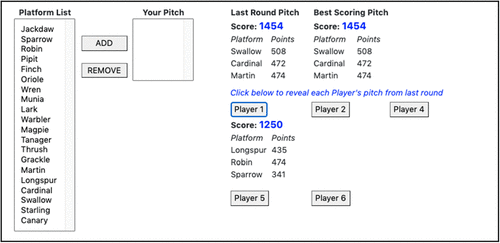
Notes. Pitch Selection screen on Trials 2–15 of each Phase. (Screenshot taken in Phase 1 from the perspective of Player 3 in the Control Condition.) Each peer is represented by a Player button in the lower right-hand quadrant of the screen. Participants click a peer’s button to view that peer’s results from the preceding Trial. Mutually shared results are displayed as above (for Player 1). Only one peer’s results can be viewed at a time, but participants can (attempt to) view each peer’s results as many times as they wish. If either the participant or the peer chose not to share their results with the other, participants see the message, “Not Shared,” after clicking the peer’s button. The participant's results from the previous Trial (Last Round Pitch), and from the participant's best-scoring Trial in the current Phase (Best Scoring Pitch) are persistently displayed above the Player button tray.20
Fear of exploitation and vulnerability (i.e., lack of trust) have been fingered as causes of knowledge hiding under competition (Steinel and De Dreu 2004, Connelly et al. 2012). Employing a task where peers only stand to gain from information sharing eliminates the risk of exploitation, reducing the role of trust in the exchange (Kelly 2010). It also precludes the use of sabotage and other antisocial strategies that are outside the scope of the present investigation. People do encounter cases of asymmetric exchange in modern organizations. But, in the absence of a formal hierarchy or other exogenous force, both sides usually need to proactively engage in information exchange in order to establish a line of communication (Kosfeld 2004). So, the present design provides an appropriate baseline against which we might compare behavior when these exogenous forces are introduced.
2.1.2. Competition States.
I manipulate competition by introducing a small monetary bonus based on relative performance to half of the experimental groups. In groups assigned to the Trivial Competition (TC) State, the three participants who accumulate the most points in their group win a small bonus.17 Participants in the No Competition (NC) State are not offered this competitive bonus. TC participants are informed of the bonus opportunity in the experimental instructions, and are reminded of the bonus during the Comprehension Check and at the start of each Phase. However, neither TC nor NC participants receive any information about their relative performance rank at any point during the procedure. At the end of the procedure, both NC and TC participants receive a summary of their individual performance-based rewards (described above), and TC participants are informed of their bonus outcome. Neither TC nor NC participants are provided any information about their peers’ ranks at any point in time.
Sapegina and Weibel (2017) and To and colleagues (2020) suggest that the negative interpersonal consequences of competition only arise when that competition is perceived as a threat. A competition is more likely to be perceived as a threat when: (1) losses and/or negative social comparisons are salient, (2) competitors are perceived as malicious, (3) there is uncertainty around the procedure for evaluating performance, and (4) demands of the task exceed competitors’ (personal) resources. These conditions are all minimized or suppressed by the present design. Trial-wise rewards are strictly positive, and the instructions emphasize pursuit of high-value options, focusing participants on (monetary) gains rather than losses.18 Relative performance ranks are never revealed to participants during the procedure, and the difference between winners’ and losers’ total compensation is trivially small.19 These features minimize the potential for perceived status loss because of negative social comparison or the experience of relative deprivation (Hannan et al. 2008, Berger et al. 2019, Kassab et al. 2021, Grosch et al. 2022).
There is no strategic reason for peers to behave maliciously, and no opportunity for peers to directly harm the participants’ performance. Hiding information from peers provides no expected pecuniary benefits, and sharing strictly increases expected rewards.21 The process used to determine the winners in The Sales Game is based on a simple, objective metric, and is fair, accurate, free of bias, and applied consistently across participants. This process has a low level of uncertainty and a high level of procedural justice (Sapegina and Weibel 2017). Finally, it is possible to maximize rewards in the task using simple heuristic strategies and peer information. No special skills or task-specific resources are required for success. If we observe a lower rate of communication under the present design, then it is unlikely this effect is driven by threat or its instigating factors (e.g., negative social comparison, relative deprivation, fear of exploitation, procedural uncertainty or injustice, or personal resource insufficiency).
2.1.3. Resource Conditions.
I manipulate resource shocks using three different levels of platform values. Each level is defined by the interval over which the platforms’ true average values are uniformly distributed: Low = [100, 300], Medium = [350, 550], and High = [600, 800].22 In the Control Condition, the average value of each platform is drawn from the Medium interval in all three Phases of the experiment. Participants in the Abundance Condition are exposed to two positive resource shocks. In the first Phase, each platform’s average value is drawn from the Low interval, then from the Medium interval in Phase 2, and finally, from the High interval in Phase 3. Participants in the Scarcity Condition are exposed to two negative resource shocks. Each platform’s average value is drawn from the High interval in Phase 1, from the Medium interval in Phase 2, and from the Low interval in Phase 3. The trajectory of platform values (stable, increasing, decreasing) is the focal manipulation of resource shocks in the present experiment.
2.2. Procedure
2.2.1. Baseline Measures, Instructions, and Comprehension Check.
The experimental procedure was approved by the Institutional Review Board at the University of Chicago. After providing informed consent, participants complete a Feelings Inventory to establish a baseline emotional state, then proceed to the instructions for The Sales Game.23 Other than the description of the competitive bonus, the instructions are identical for the Trivial Competition (TC) and No Competition (NC) groups. After reading the instructions, participants passively observe a demonstration Trial that illustrates the functionality of the experimental interface. Participants must then pass a Comprehension Check24 before entering a virtual waiting room where they are assigned to a group and advance to the focal experimental task (The Sales Game).
2.2.2. Midphase and Between-Phase Measures of Emotional State and Beliefs.
Following the 8th and 15th Trials of each Phase in The Sales Game, participants complete the Feelings Inventory again. Participants are then asked to estimate the average point value for each of the 20 platforms sold by the current Company and to rate their confidence in their estimates.25 At the end of each Phase, participants are shown a Company Summary with the total points (and dollars) earned for the current Company.26 Then, they are introduced to the next Company, and Trivial Competition participants receive a reminder about the competitive bonus scheme. The New Company Introduction includes a warning that the platform values participants are about to encounter may be significantly different than the values they encountered in the previous Phase. Control participants also see this warning. This allows me to separate the effect of a shift in the reward distribution from the challenge of learning where a new set of platforms each fall along a distribution that has been learned previously. The warning also allows me to separate the effect of a resource shift’s valence (positive, negative) from its occurrence. There is some evidence that people recognize negative shifts more quickly than positive shifts (Gershman 2015). The warning gives participants an equal opportunity to recognize that a shift occurred, regardless of its valence. This allows me to identify the specific effect of decline (versus growth).
2.2.3. Debrief.
After completing The Sales Game, participants are debriefed with a recap of their performance across all three Phases, and their final individual reward (in dollars). Trivial Competition participants are informed of their individual bonus outcome, but no other relative performance information is provided. Participants are asked to imagine a friend is about to play The Sales Game, and to describe what strategy their friend should use to perform well in the game. Participants are then asked to rate their performance and the helpfulness of their peers during the task. Finally, participants are given the option to provide open feedback on their experience.
2.3. Recruitment and Compensation
Participants were recruited through Amazon Mechanical Turk (MTurk). Participants were required to live in the United States, to have completed at least 1,000 Human Intelligence Tasks (HITs), and to have an approval rating of at least 98%.27 Participants were first screened through an Enrollment Survey that was posted to MTurk each day of the study period. Participants who passed the qualification criteria were eligible to participate in The Sales Game.28 The Sales Game was posted to MTurk each day starting on the second day of the study period. Eligible participants could choose to take part in The Sales Game during any available session, but could only participate once. Both the Enrollment Survey and The Sales Game were programmed in oTree (version 2.3.10) (Chen et al. 2016). Participants were paid a base fee of $6.00 USD upon completion of the focal procedure, and earned an Active Participation Bonus of $4.00 if they consistently submitted responses within the time limits.29 Participants also earned variable rewards based on their individual performance in the task (described above). The average individual performance-based reward was $6.80 (SD = $0.30). In groups assigned to the Trivial Competition State, the three participants with the highest cumulative points also earned a competitive bonus between $0.10 and $0.50 (described above).
2.4. Participants
Seven hundred and eighteen participants completed the focal procedure (mean (M) age = 38; SD age = 11; N female = 312).30 The average time to complete the procedure was 73.85 minutes (SD = 10.81). Each experimental group of six participants was assigned to one of six treatments based on the experimental session in which they chose to participate. The first three treatments cross Trivial Competition (TC) with each Resource Condition: (1) Control-TC, (2) Abundance-TC, and (3) Scarcity-TC. Treatments 4–6 cross No Competition (NC) with each Resource Condition: (4) Control-NC, (5) Abundance-NC, and (6) Scarcity-NC. Information and recruitment materials were identical across sessions. Treatments were cycled within and across days during the study period. The final counts of participants and groups across treatments are presented in Table 1.
|

Table 1. Counts of Groups and Participants in Each Condition and Competition State
| Condition | N (Groups) | N (Participants) | No Competition (NC) | Trivial Competition (TC) | ||
|---|---|---|---|---|---|---|
| N (Groups) | N (Participants) | N (Groups) | N (Participants) | |||
| Abundance | 42 | 243 | 22 | 125 | 20 | 118 |
| Control | 39 | 231 | 19 | 113 | 20 | 118 |
| Scarcity | 42 | 244 | 21 | 122 | 21 | 122 |
| Total | 123 | 718 | 62 | 360 | 61 | 358 |
Note. The number of participants reported for each Condition and Competition State exclude those marked as dropouts after repeatedly failing to submit their responses within the time limits.
2.5. Statistical Analysis
To investigate the effect of resource shifts and competition on information exchange, I look at the cumulative frequency of Shares (number of times participants chose to share with each of their peers) and View Attempts (number of times participants tried to view each of their peers’ results) in each Phase of the experiment. For each of these focal dependent variables, I fit a multilevel mixed linear regression model. The following simplified specification illustrates the structure of the fixed part of the model
I identify the effect of competition by comparing the average response value for participants under Trivial Competition versus No Competition within each Phase. Resource shifts are introduced between Phases, so to understand their effects, I compare the change in Control participants’ average response value between each Phase to the change in Abundance (Scarcity) participants’ average response value between each Phase. This amounts to comparing the effect of Phase2 (Phase3) on Control participants to the effect of Phase2 (Phase3) on Abundance (Scarcity) participants. I conduct these comparisons using planned contrasts, which can be expressed as a null hypothesis test of the equality of means between two subsamples of participants. For example, the contrast between Trivial Competition and No Competition participants in Phase 1 can be expressed as
3. Results
3.1. Manipulation Check
The presence of structural competition was transparent to participants in the Trivial Competition state. TC participants were informed of the competitive bonus at the end of the task instructions, and were reminded of this competition during the Comprehension Check and again at the start of each new Phase in the experiment. Resource shocks, on the other hand, were not explicitly announced, and participants in the Abundance-NC/TC and Scarcity-NC/TC Conditions had to discover these on their own. Participants’ estimates of each platform’s average value indicate that the manipulation of scarcity (abundance) was successful. Estimates collected on Trial 15 of each Phase are presented in Figure 2.34
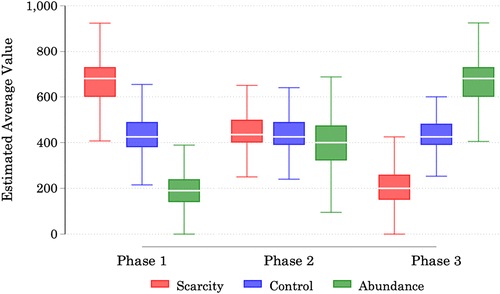
Notes. Distributions of estimated average platform values reported by participants on Trial 15 of each Phase, collapsed across Competition States within each Condition. Boxes are bordered at the 25th and 75th percentiles. White lines indicate the median estimate. Outside values are excluded. N = 718. Red = Scarcity NC/TC (244 participants, 42 groups); blue = Control-NC/TC (231 participants, 39 groups); green = Abundance-NC/TC (243 participants, 42 groups). The interquartile ranges of estimates fall within the true ranges of average platform values in each Phase. The distribution of Scarcity-NC/TC (Abundance-NC/TC) participants’ estimates shifts downward (upward) across Phases, indicating that these participants (correctly) detected changes in the reward distribution.
The distribution of Scarcity-NC/TC (Abundance-NC/TC) participants’ estimates shifts downward (upward) in Phase 2, and again in Phase 3. This indicates that Scarcity-NC/TC and Abundance-NC/TC participants (correctly) detected changes in the reward distribution across Phases. The distribution of Control-NC/TC participants’ estimates was stable across Phases, indicating that these participants (correctly) perceived no changes in the reward distribution across Phases. The interquartile range of participants’ estimates falls within the true range of average platform values participants faced in each Phase, indicating that participants formed reasonably accurate beliefs about the reward distributions.
3.2. The Effects of Competition and Scarcity on Information Exchange
I use two measures to capture information exchange: Shares and View Attempts. Shares represents the number of peers (out of five) with whom the participant chose to share their results at the end of each Trial (1–14). View Attempts represents the number of peers whose results the participant tried to view on each Trial (2–15).35 In the figures below, I present the average values of these measures on each Trial, in each Phase. Statistical analyses are performed on the cumulative sum of these measures across Trials within a given Phase. The total number of Shares (View Attempts) on a given Trial ranges from zero (the participant did not share with/attempt to view any peers) to five (the participant shared with/attempted to view all five peers). The cumulative number of Shares (View Attempts) in a given Phase ranges from 0 to 70 (= 5 peers × 14 trials).
3.2.1. Information Sharing.
Figure 3 presents the average number of Shares on each Trial (1–14), in each Phase of the experiment (1–3). Resource shocks did not affect sharing rates, so results are collapsed across Resource Conditions within each Competition State. Parameter estimates and fit statistics for the multilevel mixed linear regression model of the cumulative number of Shares in each Phase are presented in Table 2. Participants under Trivial Competition chose to share with their peers significantly less often than participants under No Competition in Phase 1 (−8.91, standard error of the mean (s.e.) = 1.98, p ≤ 0.001), Phase 2 (−12.43, s.e. = 2.11, p ≤ 0.001), and Phase 3 (−12.38, s.e. = 2.37, p ≤ 0.001).
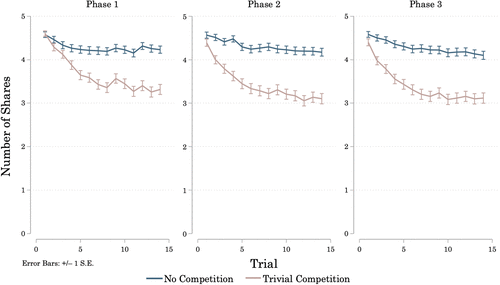
Notes. Average number of peers with whom participants chose to share their results on each Trial (1–14), by Phase, collapsed across Conditions within each Competition State. Error bars = ±1 s.e. N = 718. Teal = No Competition (360 participants; 62 groups); rose = Trivial Competition (358 participants; 61 groups). Note that curves are plotted across Trials 1–14 (participants do not have the option to share on Trial 15). TC participants chose to share their results with significantly fewer peers than NC participants, and this difference increases across Trials in each Phase of the experiment.
|
Table 2. Parameter Estimates and Fit Statistics for the Multilevel Mixed Linear Regression Models of Cumulative Shares and View Attempts
| Shares | View Attempts 1 | View Attempts 2 | ||||
|---|---|---|---|---|---|---|
| Estimate | s.e. | Estimate | s.e. | Estimate | s.e. | |
| Fixed effects | ||||||
| Intercept β0 | 61.29*** | 2.51 | 50.01*** | 2.25 | 17.81*** | 2.15 |
| Phase 2 β1 | 1.75 | 1.23 | −6.91*** | 1.23 | −7.83*** | 1.12 |
| Phase 3 β2 | −1.07 | 1.23 | −5.51*** | 1.23 | −4.95*** | 1.12 |
| AB β3 | −1.43 | 3.44 | −4.05 | 3.10 | −3.26 | 2.41 |
| SC β4 | −2.48 | 3.47 | −3.63 | 3.12 | −2.33 | 2.42 |
| TC β5 | −10.62** | 3.50 | −5.91 | 3.15 | −0.33 | 2.45 |
| AB × TC β6 | 1.93 | 4.88 | 3.65 | 4.39 | 2.59 | 3.41 |
| SC × TC β7 | 3.12 | 4.88 | 3.47 | 4.39 | 1.83 | 3.41 |
| AB × Phase 2 β8 | −2.72 | 1.69 | 1.15 | 1.70 | 2.55 | 1.55 |
| SC × Phase 2 β9 | −1.27 | 1.70 | 1.06 | 1.71 | 1.72 | 1.56 |
| TC × Phase 2 β10 | −6.74*** | 1.71 | −1.90 | 1.72 | 1.65 | 1.58 |
| AB × Phase 3 β11 | 1.02 | 1.69 | 1.93 | 1.70 | 1.37 | 1.55 |
| SC × Phase 3 β12 | 0.78 | 1.70 | 0.15 | 1.71 | −0.26 | 1.56 |
| TC × Phase 3 β13 | 0.97 | 1.71 | 2.10 | 1.72 | 1.60 | 1.57 |
| AB × TC × Phase 2 β14 | 4.55 | 2.39 | 0.92 | 2.40 | −1.46 | 2.20 |
| SC × TC × Phase 2 β15 | 4.92* | 2.39 | 2.13 | 2.40 | −0.49 | 2.19 |
| AB × TC × Phase 3 β16 | 0.37 | 2.39 | −2.78 | 2.40 | −2.96 | 2.19 |
| SC × TC × Phase 3 β17 | −3.07 | 2.39 | 0.51 | 2.40 | 2.08 | 2.19 |
| Shares β18 | 0.53*** | 0.02 | ||||
| Random effects | ||||||
| L3 RI Variance ψ11(3) | 62.50 | 15.47 | 20.00 | 12.87 | 4.83 | 7.24 |
| L3 RS Variance ψ22(3) | 6.17 | 1.90 | 0.43 | 1.69 | 0.63 | 1.16 |
| L2 RI Variance ψ11(2) | 279.95 | 19.17 | 386.02 | 25.73 | 260.78 | 17.75 |
| L2 RS Variance ψ22(2) | 17.82 | 3.10 | 35.01 | 4.33 | 28.87 | 3.48 |
| L1 RE Variance θ | 57.51 | 3.04 | 66.59 | 3.51 | 54.97 | 2.91 |
| Log likelihood | −8,685 | −8,894 | −8,613 | |||
| AIC | BIC | 17,419 | 17,561 | 17,839 | 17,980 | 17,278 | 17,426 | |||
Notes. Maximum likelihood estimates for the multilevel mixed linear regression models of cumulative Shares and View Attempts. N = 718 Participants (Level 2); 123 Groups (Level 3). Actions taken by participants marked as dropouts are excluded from the analysis. Shares and Views from an active participant to a dropout are included in the analysis. AB = Abundance; SC = Scarcity; TC = Trivial Competition; RI = Random Intercept; RS = Random Slope; RE = Residual Error; AIC = Aikake Information Criterion; BIC = Bayesian Information Criterion.
*p ≤ 0.05; **p ≤ 0.01; ***p ≤ 0.001.
3.2.2. Information Seeking.
Figure 4 presents the average number of peers whose results participants attempted to view on each Trial (2–15) in each Phase of the experiment (1–3). Resource shocks did not affect rates of information seeking, so results are collapsed across Conditions within each Competition State.36 Parameter estimates and fit statistics for the multilevel mixed linear regression model of the cumulative number of View Attempts in each Phase are presented in Table 2. Participants under Trivial Competition attempted to view their peers’ results significantly less often than participants under No Competition in Phase 1 (−3.49, s.e. = 1.78, p = 0.050) and in Phase 2 (−4.36, s.e. = 1.81, p = 0.016). This may reflect a reduced appetite for social information, or it may reflect participants’ beliefs about the availability of peer information.
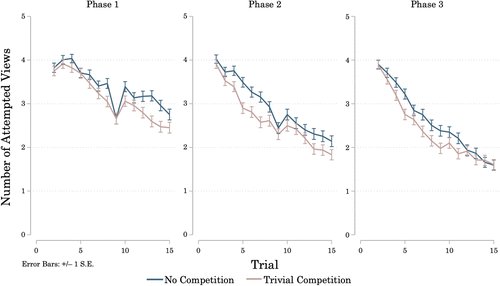
Notes. Average numbers of peers whose results the participants attempted to view in each Trial (2–15), by Phase, collapsed across Conditions within each Competition State. Error bars = ±1 s.e. N = 718. Teal = No Competition (360 participants; 62 groups); rose = Trivial Competition (358 participants; 61 groups). Note that curves only include Trials 2–15 (participants do not have an opportunity to view peer results on Trial 1). TC participants attempted to view fewer peers than NC participants in Phases 1 and 2.
Recall that Trivial Competition participants shared with fewer peers than No Competition participants on each Trial. If a participant chooses not to share his results with a given peer, he knows that peer’s results will not be visible on the next Trial. In this case, there is no reason to click on that peer’s Player button. So, having shared with fewer peers to begin with, Trivial Competition participants may have sought information from fewer peers than No Competition participants because they knew fewer peers’ information would be visible. If this is the case, then we should find no difference between Trivial Competition and No Competition participants’ View Attempts after controlling for the number of Shares. The results of this analysis are presented in the last two columns of Table 2.
Controlling for the number of Shares, there is no difference between the number of View Attempts under Trivial Competition versus No Competition in Phases 1 or 2. In Phase 3, View Attempts are slightly higher under Trivial Competition (3.46, s.e. = 1.48, p = 0.020). We should not interpret this result to mean that TC participants viewed their peers more often than NC participants in Phase 3. To understand why, consider the subset of peers with whom a participant chose to share as “Available Peers” (these are the peers whose results might be available to view on the next Trial). In Phases 1 and 2, TC and NC participants viewed a similar proportion of their Available Peers. In Phase 3, TC participants viewed a higher proportion of their Available Peers than NC participants. Since the total number of Available Peers is lower under Trivial Competition, TC participants still viewed their peers less often than NC participants in all three Phases. But, conditional on having shared with a peer, TC participants were slightly more likely than NC participants to view that peer in Phase 3.
3.2.3. Model Estimates.
Table 2 presents parameter estimates and fit statistics for the multilevel mixed linear regression models of the cumulative number of Shares and View Attempts in each Phase. View Attempts 1 does not control for cumulative Shares. View Attempts 2 controls for cumulative Shares.
3.3. Network Structure, Search Strategies, and Achievement
Investigating the structure of communication networks that emerge from participants’ information sharing and seeking behaviors is beyond the scope of the present discussion, but interested readers may find an exposition of this topic in Section 5 of the Online Appendix. The main result of this investigation is that groups under Trivial Competition developed networks that were less dense, with higher degrees of centralization and heterogeneity. Participants’ explore-exploit strategies, and their levels of achievement, are also outside the scope of the present discussion. An exposition of these topics can be found in Section 6 of the Online Appendix. The main results of these investigations are as follows. Competition had no direct effect on search behavior or achievement. In the absence of competition: (1) negative resource shocks increased exploration, (2) both negative and positive resource shocks decreased exploitation, and (3) positive resource shocks reduced achievement. In the presence of competition: (1) neither positive nor negative resource shocks had a significant effect on exploration or exploitation, and (2) both positive and negative resource shocks reduced achievement (those who experienced positive shocks exhibited more pronounced performance decrements than those who experienced negative shocks).
3.4. Exploratory Analyses: Individual-Level Mechanisms
The present experiment was designed to test hypotheses about the effects of two group-level mechanisms (structural competition and resource decline) on information exchange at the individual level. It was not designed to test hypotheses about mechanisms at the individual level. But, the results suggest that some individual-level mechanisms are less likely than others to drive the observed relationship between group-level structural competition and individual-level information exchange. The following discussion should be regarded as speculative as the analyses referenced in this section are exploratory.
3.4.1. Threat and Negative Emotions.
Some authors suggest that competition produces negative interpersonal consequences when it is perceived as a threat but not when it is perceived as a challenge (Sapegina and Weibel 2017, To et al. 2020). Perceiving a competition as a threat induces negative emotions, like frustration, anxiety, and hostility (Brandts et al. 2009, Grosch et al. 2022). Perceiving a competition as a challenge induces positive emotions, like success and happiness (Smith and Ellsworth 1985, Skinner and Brewer 2002). Ratings of positive and negative emotions related to challenge and threat, respectively, did not differ significantly between Competition States.37 Participants in both Competition States reported relatively low levels of negative emotions throughout the experiment, suggesting that neither TC participants nor NC participants perceive the present experimental task as a threat.38 Instead, relatively high ratings of positive emotions throughout the experiment suggest that participants in both Competition States perceive the task as a challenge (Smith and Ellsworth 1985, Skinner and Brewer 2002).39 Given this pattern of results, it is unlikely that Trivial Competition participants exchanged less information because they perceived the competition as a threat.
3.4.2. Cognitive Load.
Competition increases cognitive load by drawing people’s attention to activities outside the focal task (e.g., evaluating their chances of winning—see Hannan et al. 2008 and Nebel et al. 2016). For example, Hannan and colleagues (2008) found that participants rewarded based on relative performance (versus a piece rate) were more likely to report that they were distracted by thoughts about their rank, which interfered with their performance on the task. It is possible that TC participants engaged in lower rates of information exchange because they had insufficient cognitive resources. This explanation seem unlikely. Participants’ behavior during the task, and the strategies that they reported during the Debrief, suggest that TC participants made a conscious, effortful decision to hide information from their peers.
Participants are forced to indicate whether they wish to share their results with each peer by marking either “Yes” or “No” next to each peer’s Player label.40 It takes the same amount of time to click the “Yes” radial button next to each peer as it does to click “No.” But, Trivial Competition participants spent more time on the Results screens than No Competition participants did [mean difference = 40.56, s.e. = 12.67, Welch’s two-sample t test, t(716.24) = 3.20, p = 0.001].41 At the end of the experiment, participants are asked to describe a strategy for performing well in The Sales Game. The odds that a participant explicitly mentions information sharing in her strategy are about 36% higher under Trivial Competition versus No Competition [odds ratio (OR) = 1.36, s.e. = 0.17, p = 0.015].42 Conditional on having mentioned information sharing, the odds that a participant explicitly recommends some limit on sharing (e.g., “Stop sharing after the first few rounds.”) are about 370% higher under Trivial Competition than under No Competition (OR = 4.70, s.e. = 0.30, p ≤ 0.001). This suggests that TC participants intentionally engaged in information hiding as part of their strategy.
3.4.3. Social Comparison.
Performing better than others in a competition may produce a sense of superiority and entitlement that leads high performers to behave selfishly and unethically (Erkal et al. 2011). This was not the case for high performers in the present experiment. The top three performers in each group shared with their peers significantly more often than the bottom three performers [mean difference = 23.37, s.e. = 4.65, Welch’s two-sample t test, t(642.33) = 5.03, p ≤ 0.001].43 Performing worse than others in a competition may produce a sense of relative deprivation that leads people to behave aggressively or antagonistically toward higher performers (Sapegina and Weibel 2017, Kassab et al. 2021). This was not the case for low performers in the present experiment. There was no relationship between relative performance and the number of times that participants chose to share their results with a given peer.44
3.4.4. Trust and Expectations.
As discussed in Section 2.1.1, every effort was made to reduce participants’ vulnerability to exploitation by their peers in the present experiment. A peer could not access a participant’s results unless the participant explicitly shared those results with that peer (and vice versa). Platform values were also distributed uniformly, so knowledge of lower-value platforms increased participants’ expected rewards as much as knowledge of higher-value platforms. These features diminished the role of trust (a willingness to be vulnerable vis-à-vis another party) (Levin and Cross 2004). However, it is still possible that participants’ expectations about their peers’ behavior influenced their decisions (not) to share information (Kesebir et al. 2019). Carpenter and colleagues (2010) found that participants exposed to relative performance incentives engaged in sabotage even when their actions had no effect on their own or their peers’ outcomes. The apparent effect of relative incentives disappeared when the authors controlled for participants’ self-reported expectations that their peers would engage in sabotage. It is possible that Trivial Competition participants preemptively hid information from their peers because they anticipated that their peers would do the same. The results of the present experiment neither support nor contradict the potential role of expectations in shaping participants’ information-sharing behavior.
3.4.5. Demand Effects.
Experimental participants may infer the desired behavior in a given task from (real or imagined) signals that are unintentionally or inadvertently sent by the experimenter (De Quidt et al. 2018). Usually, these “demand effects” are a threat to experimental validity, as observed behavior may result from participants’ inferences about the experimenter’s desires rather than the experimental treatment. In the present experiment, “demand effects” arising from the presence of a competitive bonus would be a feature, not a bug. If Trivial Competition participants interpreted the competitive bonus as a signal that the experimenter wanted them to behave antagonistically toward their peers, then we have learned something important about the way that competitive incentive schemes operate in the real world. Employees may perceive competitive incentives as a signal that the organization wants them to focus their effort on outperforming their peers (Samnani and Singh 2014, Sapegina and Weibel 2017). The results of the present experiment neither support nor contradict the potential role of such demand effects.
3.5. Summary of Key Results
The present research investigated the effects of structural competition and negative resource shocks on information exchange. In an explore-exploit task where access to peers’ information improved participants’ total expected rewards, participants offered a trivially small bonus based on relative performance chose to share information with their peers less often than participants who were not exposed to this competitive incentive. In this task, participants could only access a peer’s information if both the participant and the peer chose to share with each other. Having shared with fewer peers, participants exposed to competition knew that fewer peers’ information would be available. As a result, participants exposed to competition sought information from their peers less often than participants who were not exposed to competition. Resource shocks had no effect on information exchange. Participants exposed to negative and positive resource shocks engaged in similar rates of information sharing and seeking as those who faced stable resource levels.
The present experiment was not designed to test individual-level mechanisms. However, features of the experimental procedure, as well as participants’ behavior and responses to a post-task questionnaire, cast doubt on the role of threat appraisals, negative emotions, cognitive load, social comparison, and trust in driving the observed relationship between competition and information exchange. However, it is possible that participants’ behavior was influenced by their expectations about the likelihood that their peers would reciprocate their attempts to share information. It is also possible that participants interpreted the competitive incentive as a signal that antagonistic behavior toward their peers was desired by the game designer. The results of the present experiment neither support nor contradict the potential role of expectations or demand effects in driving participants’ behavior.
4. Discussion
The goal of the present study was to advance our understanding of the relationship between competition, scarcity, and interpersonal communication. Although the literature offers some (contradictory) evidence that both competition and scarcity reduce information sharing and seeking, these factors are often confounded with one another in extant research. The present experiment is the first to isolate the independent and joint effects of these two factors on people’s willingness to supply information to their peers and to seek information from their peers. I find that competition reduces information exchange; people engage in information sharing and seeking less often. However, I do not find that resource shocks (positive or negative) affect information exchange, nor do I find an interaction between resource shocks and information exchange.
4.1. Theoretical Implications
Archival studies of electronic communication networks have found an association between network structure and adverse shocks involving both resource decline and competition. Extant theories of communication networks cannot fully account for these results. Aside from physical proximity, communication network theorists have largely ignored the effect of exogenous network-level variables on network structure (Entwisle et al. 2007, McFarland et al. 2014). And, the effect of competitive compensation schemes on communication network structure has never been explicitly studied.45 The present study advances theories of communication network emergence and evolution by examining the effects of two previously ignored network-level variables on the microprocesses that give rise to communication network structure. I find that competitive incentives reduce information sharing and seeking, resulting in networks that are less dense, more centralized, and more heterogeneous.46 But, I do not find any effect of resource shocks on network structure. This suggests that the presence of competition, but not resource decline, likely contributed to the observed changes in network structure uncovered by prior studies of organizations exposed to adverse environmental events.
The present study contributes to the knowledge exchange literature by disentangling the independent and joint effects of competition and resource decline on information-sharing and -seeking behavior. Survey studies provide suggestive evidence that competition and scarcity reduce knowledge exchange. But, methodological and conceptual limitations in these studies prevent researchers from making strong inferences about the causal relationships between competition, scarcity, and knowledge exchange behavior. The results of the present experiment suggest that competition increases information hiding, but resource decline does not seem to affect information exchange. The apparent effect of (perceived) resource decline on knowledge exchange in prior studies may have been caused by (unreported) competitive incentives or other features of the target organizations’ design that induced negative goal interdependence among respondents and their peers.
The present study also contributes to the social learning strategies literature by independently manipulating competition, and providing participants the option to explicitly hide information from their peers. I find that competition reduces people’s willingness to share information with their peers and that people’s willingness to seek social information may depend on their beliefs about the likelihood that peer information will be available. Contrary to the results of prior SLS studies, I do not find that participants are less likely to seek information from their peers when they are exposed to resource shocks (versus not). The present results also suggest that the relationship between resource shocks and preferences for social (versus asocial) learning may be moderated by features of the task environment. To accommodate human behavior in more complex social settings, the SLS inventory of decision-making heuristics should be updated to incorporate features of the observer-target relationship, such as negative goal interdependence.
4.2. Practical Implications
Most organizations try to increase knowledge exchange with interventions focused on knowledge sharing, while ignoring factors that promote knowledge hiding (Arain et al. 2021). The results of the present experiment suggest that interventions are more likely to fail if the firm’s compensation scheme incorporates rewards based on relative performance (e.g., tournaments, contests). Some authors suggest that it is possible to construct an “optimal mix” of incentives by balancing the proportion of individual, cooperative, and competitive rewards (Siemsen et al. 2007, Danilov et al. 2019, Jin and Noe 2022). For example, if helping a coworker increases total compensation by a much larger amount than outperforming that coworker, people are expected to exert more effort toward helping than outperforming. But, people do not seem to “rationally” allocate their effort across incentives in this way (Wageman 1995, Barnes et al. 2011).
Prior research finds that competition reduces people’s ability to cooperate, even when it is in their own self interest to do so (Barnes et al. 2011, Woike and Hafenbrädl 2020). One hypothesis offered to explain this tendency is that people prioritize whichever reward is more proximal and less uncertain, and cooperative rewards are perceived as more uncertain than individual rewards (Wageman 1995, Luft 2016). The present results contradict this hypothesis. In the present study, the competitive incentive is distal and uncertain—participants have no information about their relative rank, and the outcome of the competition is not revealed until the end of the task. The independent piece-rate incentive is proximal and less uncertain—participants watch monetary rewards from the piece rate cumulate at the top of their screen. Participants focus on the distal, uncertain competitive incentive at the expense of their proximal, less uncertain independent incentive.
Few studies investigating the effect of competition on social behavior employ a mix of independent and competitive incentives, like the one featured in the present experiment. This is a problem because incentive mixes that combine independent rewards with negatively interdependent rewards are common in modern organizations (Connelly et al. 2014, Park and Sturman 2022). For example, firms frequently offer salespeople a combination of quota-based (non-competitive) incentives and competitive incentives based on relative performance (Connelly et al. 2014). The value of these competitive incentives may comprise only a small portion of a salesperson’s total compensation (Gibbs et al. 2009, Sandvik et al. 2020), so they are often ignored by researchers investigating the behavioral consequences of different compensation schemes (Gibbs et al. 2009). However, the results of the present experiment demonstrate that even a trivially small relative performance incentive can have negative consequences. If an “optimal mix” of incentives does exist, it is unlikely to be identified by models based on “rational expectations” about each incentive’s relative contribution to total compensation.
4.3. Limitations and Future Directions
Three limitations of the present experimental design provide promising avenues for future research. First, participants were warned that shifts might occur in the environment. This feature of the design was selected to separate the effect of a resource shock’s valence (positive, negative) from its occurrence. There is some evidence that people recognize negative shifts more quickly than positive shifts (Gershman 2015). The warning gives participants an equal opportunity to recognize that a shift occurred regardless of its valence (positive, negative). This allows me to identify the specific effect of a decline. In the real world, people often have no warning that a resource shift might occur. Future research should investigate the effect of unannounced shifts on people’s information exchange behavior.
Second, groups in the present experiment comprised strangers with no face-to-face interaction. The observed effects may be more or less pronounced than what might occur among teams composed of familiar colleagues with face-to-face interaction. Some authors have found that revealing people’s identity (Heursen 2023) and allowing face-to-face interaction (Hill et al. 2009) promote cooperation. However, others have found that people are more willing to cooperate with strangers than familiars (Kistruck et al. 2016), and are less likely to help friends than strangers in situations involving identity-relevant social comparison (Tesser and Smith 1980). Future research should consider the effect of competitive incentives among groups of friends and familiars. In the meantime, the present results do provide insights into the potential effects of competitive incentives in temporary and distributed teams with low familiarity, which are becoming increasingly important in modern organizations (Ching et al. 2024).
Finally, the present study is subject to common limitations shared by all controlled laboratory experiments conducted with an online sample of participants. First, the task abstracts away some of the complexities of the real world. (This limitation is also one of the study’s strengths when it is viewed as a complement to extant observational research that sacrifices control for contextual richness.) Second, online samples involve some sacrifice over control of experimental participants’ environment and attention. Third, there is always the risk that experimental participants do not believe that their online counterparts are real people. This risk is somewhat mitigated in the present context because of participants’ experience in the virtual waiting room during group formation and the variance in wait times between trials. As with all experimental research, the present experiment should be replicated in different laboratories (virtual and physical) and with different participant samples to increase our confidence in the stability and generalizability of the results.
The author’s doctoral advisor, dissertation committee, and postdoctoral advisor provided critical feedback and support throughout the development of the present research program and manuscript: Ronald S. Burt, Jerker Denrell (postdoctoral advisor), Michael J. Gibbs, Reid Hastie (doctoral advisor/chair), Emir Kamenica, John Levi Martin, and Richard Thaler. The author is also grateful for feedback provided by Joshua Becker, Stephan Billinger, Morgan Dutton, Oliver Hahl (senior editor), David A. Kenny, Thorbjørn Knudsen, Ray Reagans, Edward B. Smith, Thomas Talhelm, Marlon Twyman, the TurkerView community, and the Theoretical Organizational Models (TOM) Society. The author is greatly indebted to Jeryl L. Mumpower and Robert E. O’Connor for their encouragement throughout the National Science Foundation grant application process, and to Chris Wickens and Philipp Chapkovski for their generous support while the author developed the present experiment in oTree. Any opinions, findings, and conclusions or recommendations expressed in this material are those of the author and do not necessarily reflect the views of the National Science Foundation or the Chicago Booth Graduate School of Business.
1 The present study focuses on interpersonal competition, which is distinct from intergroup and intrapersonal competition. The latter two involve different psychological and social processes (Murayama and Elliot 2012). Interpersonal competition is also distinct from conflict, which involves overt actions resulting from exogenous constraints or endogenous states that press an actor toward antisocial behavior (Katz and Kahn 1978, Tjosvold et al. 2022). Section 10 of the Online Appendix elaborates on the distinctions between these concepts.
2 For the remainder of the present article, the term competition refers to structural competition whenever it is not accompanied by any modifiers. I distinguish perceptual and dispositional classes of competition by using the terms competitive perceptions and dispositional competitiveness, respectively.
3 Authors frequently equivocate between scarcity and poverty (He et al. 2020). But, poverty is a complex social phenomenon that involves chronic and extreme resource insufficiency as well as structural, physical, and social constraints on resource access (Blocker et al. 2023). Scarcity and poverty are also sometimes confused with relative deprivation—the subjective feeling of being unfairly disadvantaged (Kassab et al. 2021). Section 10 of the Online Appendix elaborates on the distinctions between these concepts.
4 For the remainder of the present article, the term scarcity refers to objective, episodic scarcity whenever it is not accompanied by any modifiers.
5 Twenty-five percent of respondents reported that they would accept a pay cut unconditionally, and 55% reported that they would be open to taking a cut depending on the identity of the coworkers at risk of dismissal (Raymond 2015).
6 In the present discussion, “cooperation” refers to structural cooperation—positive interdependence between strivers’ goals.
7 If something bad happens that reduces everyone’s performance outcomes equally, relative ranks are supposed to capture differences in skill and effort that are independent of that shock (Dechenaux et al. 2015, Lazear 2018).
8 Srivastava (2015a) defined formal relationships as membership in the same department, and semiformal relationships as subscriptions to the same email listservs. Informal relationships were assumed to exist between employees who exchanged emails but shared no formal or semiformal relationship.
9 In Tsai’s (2002) study, departments that shared a similar pattern of resource dependencies were assumed to compete over those resources. This assumption is tenuous as respondents were not directly asked about any negative interdependencies between their goals and the goals of others who relied on the same resources.
10 Homburg and colleagues (2024) do describe the incentives faced by their respondents as a mix of (group and individual) quota-based rewards and rewards based on relative performance, but do not identify the relative contribution of each incentive to respondents’ total compensation.
11 Srivastava (2015b) operationalized status as organizational rank.
12 These results were echoed in a field study by Chan and colleagues (2014), who examined the performance trajectories of beauty counter employees exposed to either cooperative or individualistic incentives. Temporal patterns in the categories and volume of products sold by individual employees suggest higher rates of information sharing under cooperative versus individualistic incentives. (None of the employees in this study were exposed to competitive incentives.)
13 Participants were told that the top three individual performers, and the best-performing group, would be highlighted on the authors’ public website.
14 A few attempts have been made to incorporate incentive systems into organization theory, but none of these consider the explicit structure of monetary incentives or the use of relative performance as a basis for evaluation and compensation (e.g., Clark and Wilson 1961, Kaplan and Henderson 2005).
15 Participants earn $0.01 for every 100 game points.
16 Each participant is assigned a unique Player number in their group (1, …, 6), and this number determines their relative position on their peers’ screens. These positions are stable across Trials and Phases.
17 First place = $0.50 U.S. dollars (USD); second place = $0.30 USD; and third place = $0.10 USD.
18 Beersma and colleagues (2013) found that competition reduced communication when participants focused on avoiding negative outcomes, but had no effect when participants focused on achieving positive outcomes.
19 Grosch and colleagues (2022) found that competition reduced prosocial behavior under “high” wage dispersion (ratio of winners’ to losers’ total rewards ∼3:1), but not under “low” dispersion (∼3:2). The ratio of winners’ to losers’ total rewards in The Sales Game is usually around 1.04:1.
20 The cumulative points earned over all preceding Trials in the current Phase are also presented in the upper right-hand corner of the screen with the corresponding rewards earned in US dollars (see Figure 2.4 in the Online Appendix). The cumulative points (dollars earned) reset at the start of each Phase.
21 Bonus amounts were selected based on simulations of interactive groups of six agents playing ϵ-greedy or softmax strategies in the present experimental context. The expected value of the relative performance bonus in The Sales Game is $0.15, which is less than the average difference in individual performance-based rewards earned by agents who view zero peers on each Trial versus those who view three or more peers. See Section 3 of the Online Appendix for further details.
22 On each Trial, the points assigned to each platform in a participant’s Pitch are drawn from a normal distribution around that platform’s unique average value, with a standard deviation (SD) of 20 points.
23 The Feelings Inventory asks participants to report their emotional state by rating the extent to which they are currently experiencing each of the following six emotions on a scale of 0 (Not at all) to 100 (Very much): happy, frustrated, successful, friendly, hostile, and anxious. See Section 1.2.1 of the Online Appendix for further description of the Feelings Inventory. See Section 2.1 of the Online Appendix for a full description of the Experimental Instructions.
24 See Section 2.1.3 of the Online Appendix for a description of the Comprehension Check. Participants may attempt the Comprehension Check as many times as they wish.
25 Section 2.2 of the Online Appendix describes the elicitation of platform value estimates and confidence ratings with screenshots.
26 The Company Summary does not provide any information about peers’ performance or participants’ relative performance compared to their peers.
27 These requirements were selected in consultation with program managers at MTurk, and with members of the MTurk worker community on TurkerView (https://turkerview.com).
28 These criteria essentially amount to passing the attention checks and following the explicit instructions provided in the Survey (see Section 1.3 of the Online Appendix).
29 Each page of the focal procedure had a time limit for submitting responses (e.g., 60 seconds on the Pitch Selection screen, and 60 seconds on the Results screen). Time limits were selected based on pilot tests of the procedure. See Section 2.4 of the Online Appendix for additional details.
30 Twenty participants were marked as dropouts after repeatedly failing to submit their responses before the time limits. These participants are excluded from the present analyses. Dropouts were distributed across treatments as follows: (1) Control-NC = 1 dropout, (2) Abundance-NC = 7 dropouts ∼ 5 groups, (3) Scarcity-NC = 4 dropouts ∼ 3 groups, (4) Control-TC = 2 dropouts ∼ 2 groups, (5) Abundance-TC = 2 dropouts ∼ 2 groups, and (6) Scarcity-TC = 4 dropouts ∼ 4 groups. Section 2.4 of the Online Appendix describes the procedure for detecting/handling dropouts.
31 The Control Condition and No Competition are selected as baselines, and the effects of Abundance (positive shocks), Scarcity (negative shocks), and Trivial Competition are estimated as differences from these baselines.
32 A full exposition of the model is provided in Section 4 of the Online Appendix, along with instructions for running these models in Stata 17/18 using the mixed command.
33 Section 4 of the Online Appendix provides instructions for conducting these tests in Stata 17/18.
34 There were no significant differences between the distributions of estimates provided by participants under No Competition versus Trivial Competition. Distributions on Trial 8 are almost identical to those on Trial 15 in each Phase.
35 Note that not all of these attempts are successful. Participants only succeed in viewing a peer’s results if both the participant and the peer chose to share their results with each other at the end of the preceding Trial.
36 The sharp dip on Trial 9 of Phase 1 is likely caused by participants’ experience on the Platform Value Estimates screen encountered at the end of Trial 8. Participants are allowed two minutes to enter their estimates for each of the 20 platforms. This amount of time is sufficient (based on pilot tests and companion experiments), but the first time that participants encounter this task, some come close to exceeding the time limit or experience their first “time out.” As a result, they may feel rushed when they encounter the Pitch Selection screen on Trial 9. Participants acclimate to the estimation task as the experiment proceeds.
37 Figures 7.1 and 7.2 in Section 7 of the Online Appendix present participants’ ratings of positive and negative emotions by Trial, Phase, and Competition State.
38 Frustrated: M = 20.00, SD = 25.49. Anxious: M = 26.76, SD = 28.36. Hostile: M = 10.17, SD = 18.75.
39 Happy: M = 66.16, SD = 26.21. Successful: M = 63.14, SD = 25.84.
40 See Figure 2.3 in Section 2 of the Online Appendix for a screenshot of the Results screen.
41 The average cumulative time spent across the 42 Results screens encountered at the end of each Trial (1–14) was 497.94 seconds (SD = 165.93) under No Competition and 538.50 seconds (SD = 173.39) under Trivial Competition.
42 Two raters blind to the hypotheses of the present study independently coded participants’ self-reported strategies. A full description of this coding exercise and its results can be found in Section 8 of the Online Appendix.
43 Figure 9.1 in Section 9 of the Online Appendix presents the average number of peers Top-3 and Bottom-3 performers chose to share with on each Trial. There were no differences between Competition States.
44 See Section 9 of the Online Appendix for an analysis of the peer-level factors that predict participants’ decisions to share and to seek information.
45 The only other study to consider the effect of employee compensation on social network structure was conducted by Mitsuhashi and Nakamura (2022), who consider the effect of moving from seniority-based to noncompetitive individual performance incentives on patent networks in Japanese electronics firms.
46 See Section 5 of the Online Appendix for further discussion.
References
- (1976) Environments of organizations. Annual Rev. Sociol. 2:79–105.Crossref, Google Scholar
- (2017) What’s mine is mine: A study of salesperson knowledge withholding & hoarding behavior. Indust. Marketing Management 64:14–24.Crossref, Google Scholar
- (2021) Consequences of supervisor knowledge hiding in organizations: A multilevel mediation analysis. Appl. Psych. 70(3):1242–1266.Crossref, Google Scholar
- (1987) Bereavement and reactions to job loss: A comparative review. British J. Soc. Psych. 26(Part 3):211–224.Crossref, Google Scholar
- (2000) Knowledge transfer: A basis for competitive advantage in firms. Organ. Behav. Human Decision Processes 82(1):150–169.Crossref, Google Scholar
- (2020) Where does competition come from? The role of organization. Organ. Theory, https://doi.org/10.1177/26317877198899.Crossref, Google Scholar
- (2011) Mixing individual incentives and group incentives: Best of both worlds or social dilemma? J. Management 37(6):1611–1635.Crossref, Google Scholar
- (2013) Outcome interdependence shapes the effects of prevention focus on team processes and performance. Organ. Behav. Human Decision Processes 121(2):194–203.Crossref, Google Scholar
- (2003) Cooperation, competition, and team performance: Toward a contingency approach. Acad. Management J. 46:572–590.Crossref, Google Scholar
- (2019) I know something you don’t know: The effect of relative performance information and individual performance incentives on knowledge sharing. J. Management Accounting Res. 31(2):19–35.Crossref, Google Scholar
- (1980) Informant accuracy in social-network data. V. An experimental attempt to predict actual communication from recall data. Soc. Sci. Res. 11(1):30–66.Crossref, Google Scholar
- (2023) Rethinking scarcity and poverty: Building bridges for shared insight and impact. J. Consumer Psych. 33(3):489–509.Crossref, Google Scholar
- (2011) From the editors: Publishing in “AMJ”—Part 2: Research design. Acad. Management J. 54(4):657–660.Crossref, Google Scholar
- (2009) Competitive rivalry, social disposition, and subjective well-being: An experiment. J. Public Econom. 93(11–12):1158–1167.Crossref, Google Scholar
- (2019) A self‐regulatory model of resource scarcity. J. Consumer Psych. 29(1):104–127.Crossref, Google Scholar
- (2010) Tournaments and office politics: Evidence from a real effort experiment. Amer. Econom. Rev. 100(1):504–517.Crossref, Google Scholar
- (1991) Environmental munificence; a theoretical assessment. Acad. Management Rev. 16(3):542–565.Crossref, Google Scholar
- (2014) What goes around comes around: Knowledge hiding, perceived motivational climate, and creativity. Acad. Management J. 57(1):172–192.Crossref, Google Scholar
- (2014) Learning from peers: Knowledge transfer and sales force productivity growth. Marketing Sci. 33(4):463–484.Link, Google Scholar
- (2016) oTree—An open-source platform for laboratory, online, and field experiments. J. Behavioral Experiment. Finance 9:88–97.Crossref, Google Scholar
- (2024) Competitive familiarity: Learning to coordinate by competing. Organ. Sci. 35(4):1409–1426.Link, Google Scholar
- (1961) Incentive systems: A theory of organizations. Admin. Sci. Quart. 6(2):129–166.Crossref, Google Scholar
- (2014) Tournament theory: Thirty years of contests and competitions. J. Management 40(1):16–47.Crossref, Google Scholar
- (2012) Knowledge hiding in organizations. J. Organ. Behav. 33(1):64–88.Crossref, Google Scholar
- (1972) Predecisional information seeking and subsequent conformity in the social influence process. J. Personality Soc. Psych. 23(1):112–119.Crossref, Google Scholar
- (2016) Flexco: “We are spoiled rotten.” Chicago Tribune (November 11), https://www.chicagotribune.com/2016/11/11/flexco-we-are-spoiled-rotten/.Google Scholar
- (2019) Helping under a combination of team and tournament incentives. J. Econom. Behav. Organ. 162:120–135.Crossref, Google Scholar
- (1985) Crisis effects on intraorganizational computer-based communication. Comm. Res. 12(2):251–270.Crossref, Google Scholar
- (2006) When too little or too much hurts: Evidence for a curvilinear relationship between task conflict and innovation in teams. J. Management 32(1):83–107.Google Scholar
- (2018) Measuring and bounding experimenter demand. Amer. Econom. Rev. 108(11):3266–3302.Crossref, Google Scholar
- (2015) A survey of experimental research on contests, all-pay auctions and tournaments. Experiment. Econom. 18:609–669.Crossref, Google Scholar
- (1949) A theory of co-operation and competition. Human Relations 2:129–151.Crossref, Google Scholar
- (2005) Communication networks from the Enron email corpus: “It’s always about the people. Enron is no different.” Comput. Math. Organ. Theory 11:201–228.Crossref, Google Scholar
- (1995) Comments on what theory is not. Admin. Sci. Quart. 40(3):391–397.Crossref, Google Scholar
- (1998) Incentives for helping on the job: Theory and evidence. J. Labor Econom. 16(1):1–25.Crossref, Google Scholar
- (1991) Competition and cooperation in the workplace. J. Econom. Behav. Organ. 15(3):347–364.Crossref, Google Scholar
- (2011) Relative earnings and giving in a real-effort experiment. Amer. Econom. Rev. 101(7):3330–3348.Crossref, Google Scholar
- (2007) Networks and contexts: Variation in the structure of social ties. Amer. J. Sociol. 112(5):1495–1533.Crossref, Google Scholar
- (2009) Boundary work in knowledge teams. J. Appl. Psych. 94(3):604–617.Crossref, Google Scholar
- (2003) The use of rewards to increase and decrease trust: Mediating processes and differential effects. Organ. Sci. 14(1):18–31.Link, Google Scholar
- (2016) Pursuing goals with others. Soc. Personality Psych. 10(5):298–312.Crossref, Google Scholar
- (2022) Individual exploration and selective social learning: Balancing exploration–exploitation trade-offs in collective foraging. J. Roy. Soc. Interface 19(189):20210915.Crossref, Google Scholar
Gershman SJ (2015) Do learning rates adapt to the distribution of rewards? Psychon. Bull. Rev. 22:1320–1327.Google Scholar- (2009) Performance measure properties and incentive system design. Indust. Relations 48(2):237–264.Crossref, Google Scholar
- (2020) Scarcity and consumer decision making: Is scarcity a mindset, a threat, a reference point, or a journey? J. Assoc. Consumer Res. 5(4):358–364.Crossref, Google Scholar
- (2019) Can thoughts of having less ever promote prosocial preferences? The relationship between scarcity, construal level, and sustainable product adoption. J. Assoc. Consumer Res. 5(1):70–82.Crossref, Google Scholar
- (2003) Organizational Learning from Performance Feedback: A Behavioral Perspective on Innovation and Change (Cambridge University Press, Cambridge, UK).Crossref, Google Scholar
- (2022) Competition and prosociality: A lab-in-the-field experiment in Ghana. J. Behavioral Experiment. Econom. 99:101887.Crossref, Google Scholar
- (2004) Group incentives and performance: A study of spontaneous goal setting, goal choice and commitment. J. Management 30(2):263–284.Google Scholar
- (2021) Knowledge hiding as the dark side of competitive psychological climate. Leadership Organ. Development J. 42:195–207.Crossref, Google Scholar
- (2008) The effects of disseminating relative performance feedback in tournament and individual performance compensation plans. Accounting Rev. 83(4):893–913.Crossref, Google Scholar
- (2014) Modeling team knowledge sharing and team flexibility: The role of within-team competition. Human Relations 67(8):947–978.Crossref, Google Scholar
- (2021) How and when intragroup relationship conflict leads to knowledge hiding: The roles of envy and trait competitiveness. Internat. J. Conflict Management 32:383–406.Crossref, Google Scholar
- (2020) Financial vulnerability and the reproduction of disadvantage in economic exchanges. J. Appl. Psych. 105(1):80–96.Crossref, Google Scholar
- (2023) Does relative performance information lower group morale? J. Econom. Behav. Organ. 209:547–559.Crossref, Google Scholar
- (2009) Organizational context and face-to-face interaction: Influences on the development of trust and collaborative behaviors in computer-mediated groups. Organ. Behav. Human Decision Processes 108(2):187–201.Crossref, Google Scholar
- (2024) “Coopetition” in the presence of team and individual incentives: Evidence from the advice network of a sales organization. J. Acad. Marketing Sci. 52(2):306–328.Crossref, Google Scholar
- (2013) Social Learning: An Introduction to Mechanisms, Methods, and Models (Princeton University Press, Princeton, NJ).Google Scholar
- (2013) Communication network dynamics during organizational crisis. J. Informetrics 7(1):16–35.Crossref, Google Scholar
- (2008) Structure, affect and identity as bases of organizational competition and cooperation. Acad. Management Ann. 2(1):275–303.Crossref, Google Scholar
- (2022) The golden mean: The risk‐mitigating effect of combining tournament rewards with high‐powered incentives. J. Finance 77(5):2907–2947.Crossref, Google Scholar
- (2006) Cutthroat cooperation: Asymmetrical adaptation to changes in team reward structures. Acad. Management J. 49:103–119.Crossref, Google Scholar
- (2002) Cost–benefit analysis of social/cultural learning in a nonstationary uncertain environment. Evolution Human Behav. 23:373–393.Crossref, Google Scholar
- (2003) The logic of social sharing: An evolutionary game analysis of adaptive norm development. Personality Soc. Psych. Rev. 7(1):2–19.Crossref, Google Scholar
- (2005) Inertia and incentives: Bridging organizational economics and organizational theory. Organ. Sci. 16(5):509–521.Link, Google Scholar
- (2021) How relative deprivation increases aggressive behavior: Exploring the moderating roles of resource scarcity, deprivation intensity, and sanctions in a game task. Aggressive Behav. 47(2):215–225.Crossref, Google Scholar
- (1978) The Social Psychology of Organizations (Wiley, New York).Google Scholar
- (2010) The effects of incentives on information exchange and decision quality in groups. Behavioral Res. Accounting 22(1):43–65.Crossref, Google Scholar
- (2005) Trade‐offs in the adaptive use of social and asocial learning. Adv. Study Behav. 35:333–379.Crossref, Google Scholar
- (2019) Lay beliefs about competition: Scale development and gender differences. Motivation Emotion 43:719–739.Crossref, Google Scholar
- (2018) Setting the bar: The evaluative and allocative roles of organizational aspirations. Organ. Sci. 29(6):1170–1186.Link, Google Scholar
- (1972) Environment and its impact on the organization. Internat. Stud. Management Organ. 2(3):297–313.Google Scholar
- (1977) The Design of Organizations (Harcourt Brace Jovanovich, New York).Google Scholar
- (2016) Cooperation vs. competition: Alternative goal structures for motivating groups in a resource scarce environment. Acad. Management J. 59(4):1174–1198.Crossref, Google Scholar
- (1982) Interpersonal Communication in Organizations (Academic Press, New York).Google Scholar
- (2004) Economic networks in the laboratory: A survey. Rev. Network Econom. 3(1):20–42.Google Scholar
- (1988) Informal networks and organizational crises: An experimental simulation. Soc. Psych. Quart. 51(2):123–140.Crossref, Google Scholar
- (2017) The dark side of scarcity promotions: How exposure to limited-quantity promotions can induce aggression. J. Consumer Res. 43(5):683–706.Google Scholar
- (2018) Compensation and incentives in the workplace. J. Econom. Perspect. 32(3):195–214.Crossref, Google Scholar
- (2004) The strength of weak ties you can trust: The mediating role of trust in effective knowledge transfer. Management Sci. 50(11):1477–1490.Link, Google Scholar
- (2016) Cooperation and competition among employees: Experimental evidence on the role of management control systems. Management Accounting Res. 31:75–85.Crossref, Google Scholar
- (1993) Organizations (John Wiley & Sons, New York).Google Scholar
- (2005) Applying evolutionary models to the laboratory study of social learning. Evolution Human Behav. 26(6):483–508.Crossref, Google Scholar
- (2014) Network ecology and adolescent social structure. Amer. Sociol. Rev. 79(6):1088–1121.Crossref, Google Scholar
- (1993) Organizational decline and adaptation: Theoretical controversies. Organ. Sci. 4(1):1–9.Link, Google Scholar
- (2017) Crossing the chasm and over the abyss: Perspectives on organizational failure. Acad. Management Perspect. 31(4):271–287.Crossref, Google Scholar
- (2022) An effectual approach to executing dynamic capabilities under unexpected uncertainty. Indust. Marketing Management 107:82–91.Crossref, Google Scholar
- (2008) An experimental simulation of the “copy-successful-individuals” cultural learning strategy: Adaptive landscapes, producer–scrounger dynamics, and informational access costs. Evolution Human Behav. 29(5):350–363.Crossref, Google Scholar
- (1983) Organizational crisis. Part II: Strategies and responses. Human Relations 36(12):1161–1179.Crossref, Google Scholar
- (2022) Pay and networks in organizations: Incentive redesign as a driver of network change. Strategic Management J. 43(2):295–322.Crossref, Google Scholar
- (2021) An exploratory configurational analysis of knowledge hiding antecedents in project teams. Project Management J. 52(1):31–44.Crossref, Google Scholar
- (2012) The evolutionary basis of human social learning. Proc. Biol. Sci. 279(1729):653–662.Google Scholar
- (2012) The competition–performance relation: A meta-analytic review and test of the opposing processes model of competition and performance. Psych. Bull. 138(6):1035–1070.Crossref, Google Scholar
- (2019) A problem in theory. Nature Human Behav. 3(3):221–229.Crossref, Google Scholar
- (2016) From duels to classroom competition: Social competition and learning in educational videogames within different group sizes. Comput. Human Behav. 55:384–398.Crossref, Google Scholar
- (2022) Knowledge hiding in organizational crisis: The moderating role of leadership. J. Bus. Res. 139:161–172.Crossref, Google Scholar
- (2018) Cross-functional knowledge sharing, coordination and firm performance: The role of cross-functional competition. Indust. Marketing Management 71:123–134.Crossref, Google Scholar
- (2022) When perception is reality, there is more than one reality: The formation and effects of pay‐for‐performance perceptions. Personnel Psych. 75(3):529–555.Crossref, Google Scholar
- (1978) The External Control of Organizations (Harper & Row, New York).Google Scholar
- (2014) Resource scarcity and antisocial behavior. J. Public Econom. 119:1–9.Crossref, Google Scholar
- (2020) My employees took pay cuts instead of layoffs: We’re doing better than ever. Washington Post (August 12), https://www.washingtonpost.com/outlook/2020/08/12/employees-pay-cuts-productivity/.Google Scholar
- (2015) Would you take less money to help coworkers stay? NBC kindness poll says … CNBC (December 15), https://www.cnbc.com/2015/12/15/would-you-take-less-money-to-help-co-workers-stay-nbc-kindness-poll-says.html.Google Scholar
- (2019) Social networks under stress: Specialized team roles and their communication structure. ACM Trans. Web 13(1):6.Crossref, Google Scholar
- (2014) Performance-enhancing compensation practices and employee productivity: The role of workplace bullying. Human Resource Management Rev. 24(1):5–16.Crossref, Google Scholar
- (2020) Workplace knowledge flows. Quart. J. Econom. 135(3):1635–1680.Crossref, Google Scholar
- (2017) The good, the not so bad, and the ugly of competitive human resource practices: A multidisciplinary conceptual framework. Group Organ. Management 42(5):707–747.Crossref, Google Scholar
- (2018) Organizational change and rigidity during crisis: A review of the paradox. Eur. Management J. 36(1):47–58.Crossref, Google Scholar
- (2019) Examination of knowledge hiding with conflict, competition and personal values. Internat. J. Conflict Management 30(1):111–131.Crossref, Google Scholar
- (2007) Incentives that induce task-related effort, helping, and knowledge sharing in workgroups. Management Sci. 53(10):1533–1550.Link, Google Scholar
- (2002) The dynamics of threat and challenge appraisals prior to stressful achievement events. J. Personality Soc. Psych. 83(3):678–692.Crossref, Google Scholar
- (1985) Patterns of cognitive appraisal in emotion. J. Personality Soc. Psych. 48(4):813–838.Crossref, Google Scholar
- (2012) Status differences in the cognitive activation of social networks. Organ. Sci. 23(1):67–82.Link, Google Scholar
- (2020) Social networks and cognition. Annual Rev. Sociol. 46(1):159–174.Crossref, Google Scholar
- (2023) Does intraorganizational competition prompt or hinder performance? The risks for proactive employees who hide knowledge. Personnel Rev. 52(3):777–798.Crossref, Google Scholar
- (2017) Competition of a different flavor: How a strategic group identity shapes competition and cooperation. Admin. Sci. Quart. 62(4):626–656.Crossref, Google Scholar
- (2015a) Intraorganizational network dynamics in times of ambiguity. Organ. Sci. 26(5):1365–1380.Link, Google Scholar
- (2015b) Threat, opportunity, and network interaction in organizations. Soc. Psych. Quart. 78(3):246–262.Crossref, Google Scholar
- (2004) Social motives and strategic misrepresentation in social decision making. J. Personality Soc. Psych. 86(3):419–434.Crossref, Google Scholar
- (2010) The good, the bad and the ugly thing to do when sharing information: Revealing, concealing and lying depend on social motivation, distribution and importance of information. Organ. Behav. Human Decision Processes 113(2):85–96.Crossref, Google Scholar
- (2015) The sharing dilemma: Joining cooperative groups and sharing resources as a means of coping with environmental risk. Behavioral Decision Making 28(2):130–136.Crossref, Google Scholar
- (2018) Steel sharpens steel: A review of multilevel competition and competitiveness in organizations. J. Organ. Behav. 40(2):147–165.Crossref, Google Scholar
- (1980) Some effects of task relevance and friendship on helping: You don’t always help the one you like. J. Experiment. Soc. Psych. 16:582–590.Crossref, Google Scholar
- (1998) Dealing with scarce resources: Open-minded interaction for resolving budget conflicts. Group Organ. Management 23(3):237–255.Crossref, Google Scholar
- (2022) Open-minded discussion in organizations: A meta-analytic evaluation of cooperation and competition theory. J. Bus. Psych. 37(5):897–921.Crossref, Google Scholar
- (2020) When interpersonal competition helps and when it harms: An integration via challenge and threat. Acad. Management Ann. 14(2):849–875.Crossref, Google Scholar
- (2009) Decreased environmental variability induces a bias for social information use in humans. Evolution Human Behav. 30(1):32–40.Crossref, Google Scholar
- (2002) Social structure of “coopetition” within a multiunit organization: Coordination, competition, and intraorganizational knowledge sharing. Organ. Sci. 13:179–190.Link, Google Scholar
- (1995) Interdependence and group effectiveness. Admin. Sci. Quart. 40(1):145–180.Crossref, Google Scholar
- (2020) Loaded with knowledge, yet green with envy: Leader–member exchange comparison and coworkers-directed knowledge hiding behavior. J. Knowledge Management 24(7):1653–1680.Crossref, Google Scholar
- (2013) Social learning strategies in networked groups. Cognitive Sci. 37(8):1383–1425.Crossref, Google Scholar
- (2020) Rivals without a cause? Relative performance feedback creates destructive competition despite aligned incentives. Behavioral Decision Making 33(4):523–537.Crossref, Google Scholar
- (2003) Adaptive self-regulation of unattainable goals: Goal disengagement, goal reengagement, and subjective well-being. Personality Soc. Psych. Bull. 29(12):1494–1508.Crossref, Google Scholar
- (1986) Structural adaptations to environments. Acad. Management Rev. 11(1):9–21.Crossref, Google Scholar
- (2023) The role of resources in the success or failure of diverse teams: Resource scarcity activates negative performance-detracting resource dynamics in social category diverse teams. Organ. Sci. 34(1):24–50.Link, Google Scholar
Kariyushi Rao is an assistant professor of organizational behavior at the Frankfurt School of Finance & Management, and holds a PhD in behavioral science from the University of Chicago Booth School of Business. Dr. Rao’s research interests are related to pathologies that arise under suboptimal performance management systems, including performance appraisal elicitation and accuracy, as well as the (unintended) behavioral consequences of common incentive structures.