


Other People’s Children: How Diversity Without Inclusion Impacts Community Support for Public Schools
Abstract
Organizations pursuing activities that advance the public interest often require support from their local communities, but such support may be harder to come by in more racially diverse communities. In this study, we argue that this negative effect of racial diversity on support for organizations serving the public interest will be weaker the more inclusive the community, especially where community inclusion is accompanied by shared values among members of different groups and where the organizations themselves are racially representative. We test and find support for these predictions by looking at one specific type of public service organization: public schools in the United States. Specifically, we find that community support for public schools—both generally in terms of local spending per pupil and specifically as the bond amounts residents vote to approve—is negatively associated with racial diversity within a school district, but this negative relation only holds for less inclusive communities where members of different groups are less likely to live close to each other or to have social ties with each other. We further find that this moderating effect of community inclusion is complemented by shared values and organizational representativeness, so that diversity has the most negative effect in less inclusive communities where members of different races differ in their political beliefs and schools are relatively segregated, and no significant effect in inclusive communities with shared values and integrated schools. Our study sheds new light on the conditions under which organizations seeking to address grand challenges can benefit from strong community support.
Funding: This work was supported by the Carlson School of Management [DEI Research Grant] and the Responsible Research in Business and Management [Dare to Care Scholorship].
Supplemental Material: The online appendices are available at https://doi.org/10.1287/orsc.2024.19351.
Introduction
As we examine the role of organizations in addressing societal grand challenges (Mahoney et al. 2009, George et al. 2016, Luo and Kaul 2019), organizational scholars have grown increasingly interested in the intersection between organizations and civic engagement (Longhofer et al. 2019, Battilana et al. 2025, Porath et al. 2025). Building off insights from work on social capital (Coleman 1988, Nee and Ingram 1998, Portes 1998, Putnam 2000), this work suggests a reciprocal relationship between organizations and communities. On one hand, organizations may help build stronger communities by participating directly in civic activities (Marquis et al. 2007, 2013; Marquis and Battilana 2009; Galaskiewicz 2013; Tilcsik and Marquis 2013), driving civic wealth creation (Lumpkin and Bacq 2019), and enabling greater civic engagement (Pateman 1970, Longhofer et al. 2019, Lashitew et al. 2024, Hurst et al. 2025). On the other, community civic engagement may play a critical role in shaping organizational outcomes, with a community’s ability to organize and act in its collective interest determining how it engages with businesses and holds them accountable (Rao et al. 2010, Greve and Kim 2014, Yue 2015, Dorobantu et al. 2017, Kalnins and Dowell 2017, Odziemkowska and Dorobantu 2021), fosters entrepreneurship and innovation (Laursen et al. 2012, Kwon et al. 2013, Samila and Sorenson 2017), and supports a diversity of local organizations, including cooperatives (Yue et al. 2013, Rao and Greve 2018, Chatterji et al. 2021, Jeong et al. 2025), labor unions (Ferguson et al. 2018), nonprofits (Galaskiewicz et al. 2006, Berrone et al. 2016), and public providers (Leana and Pil 2006). In particular, this latter stream of work suggests that local community participation and support may be critical for organizations seeking to serve the public interest1 and address societal grand challenges (Ostrom 1990, Berrone et al. 2016, Luo et al. 2018, Luo and Kaul 2019, Ruebottom et al. 2026).
One challenging aspect of relying on support from their local communities is that such support may be stronger in more homogenous communities. As a substantial body of work across multiple disciplines has documented, civic engagement is often negatively associated with racial and ethnic diversity (Hero 2007, Portes and Vickstrom 2011): More racially diverse communities have lower levels of general trust and cohesion (Sampson et al. 2005, Dinesen and Sønderskov 2015, Yue 2015, Ananthakrishnan et al. 2024) and are less likely to contribute to collective goods (Alesina et al. 1999, 2019; Longhofer et al. 2019; McGhee 2021). This is problematic because it means that, other things being equal, racially or ethnically diverse communities may find it more challenging to engage in activism to hold firms accountable (Rao et al. 2010, Yue 2015) or to support organizations that provide valuable public services (Ostrom 2006, Yenkey 2015, Dutta 2019, Jeong et al. 2025). Thus, even as we seek to enhance social justice and equity of opportunity by fostering more diverse communities, such an increase in diversity may result in a decline in the ability of communities to support organizational activities that benefit them.
In this study we ask the following: Under what conditions is racial diversity within a community more or less likely to impact support for organizations offering public services? Building off a baseline prediction that increasing racial diversity in a community will be associated with declining support for such organizations, we argue that this negative association will be weaker, the more inclusive the community. Our logic is that racial diversity weakens perceptions of shared interests and compromises the ability to coordinate collective action across racial groups, but these problems may be overcome in more inclusive communities where members of different groups live in close proximity to each other and interact with each other socially (Hill and Matsubayashi 2005, Field et al. 2008, Alesina and Zhuravskaya 2011, Kwon and Adler 2014). We further contend that this moderating effect of community inclusion will be stronger under two conditions: shared community values and greater organizational representativeness. Where members of different racial groups share the same values, these may be the basis of value homophily (Lazarsfeld and Merton 1954, Ingram and Morris 2007), enabling intergroup collaboration and creating a sense of shared interests (Trounstine 2016, Han et al. 2020, Solomon and Hall 2023). Similarly, community inclusion may be enhanced if the organizations providing public services serve a racially representative population of stakeholders, because such organizations may serve as conduits for collective action (Longhofer et al. 2019) and foster greater civility and a stronger sense of shared interests (King et al. 2011).
We test our theory in the context of community support for public schools in the United States. We see this as an appropriate setting to test our arguments because public schools are a classic example of public service organizations, the quality of local schools is a highly salient community outcome, community support is a critical source of funding for public schools in the United States, and such support is the primary driver of differences in education investments across communities. Moreover, ensuring access to high quality education is an important societal grand challenge as reflected in its inclusion among the United Nations Sustainable Development Goals (SDG 4). In particular, inequalities in public school spending represent a fundamental form of social inequity because access to high-quality education is a prerequisite for equality of opportunity (Putnam 2016, Agarwal and Holmes 2019, Rivera and Tilcsik 2023). Besides, education is a rich empirical context that has long been used to advance our understanding of organizational scholarship (March and March 1977, Meyer and Rowan 1977, Ouchi 2006, Teodorovicz et al. 2023, Hasan and Kumar 2024).
Consistent with our theoretical predictions, we find a negative relation between racial diversity and local spending per student on public schools overall, as well as the amount per pupil approved by voters in the district to be raised through the issue of new bonds. This relationship is moderated by community inclusion, however, in that the negative effect of diversity is stronger in communities with lower levels of residential integration or social connectedness and disappears in communities where people from different groups live next door to each other and interact socially. These results are robust to a range of alternative measures and specifications, as well as to the use of a Bartik-style instrument to account for changes in racial diversity within a community (Card 2001, Goldsmith-Pinkham et al. 2020). We further find that this moderating effect of community inclusion is stronger in the presence of organizational representativeness and shared values, in that the negative effect of increasing diversity on community support for public schools is strongest in less inclusive communities where members of different racial groups are divided in their political views and where public schools themselves are relatively segregated and not significantly different from zero in inclusive communities with racially integrated schools and shared political preferences. Supplementary analyses confirm that these shortfalls in local support for public schools are consequential in that greater local support is associated with better student outcomes.
Our study contributes to research on addressing societal grand challenges (Mahoney et al. 2009, George et al. 2016) by offering a more nuanced picture of the factors that drive community support for public service organizations (Alesina et al. 1999, Yenkey 2015, McGhee 2021) and therefore the conditions under which community-based solutions to societal grand challenges may be most effective (Ostrom 1990, Luo and Kaul 2019, Chatterji et al. 2021, Jeong et al. 2025). In doing so it also speaks to work on the relationship between organizational actions and community characteristics (Battilana et al. 2025), offering a richer picture of how the diversity and inclusion of a community, as well as the presence of shared values, may impact support for local organizations (Oliver 1991, Rao et al. 2010, Yue 2015, Odziemkowska and Dorobantu 2021) while highlighting the role of racial representativeness at the organizational level as a complement to community inclusion (Ferguson 2016, Longhofer et al. 2019). Our study also contributes to research on the relationship between diversity and inclusion within organizations by extending the insights of this work to the community level (Roberson 2006, King et al. 2011, Roberson et al. 2017, Shore et al. 2018, Van Bommel et al. 2024, Randel 2025). Finally, we offer practical insight into a specific grand challenge: ensuring equitable access to quality education (Leana and Pil 2006; Ouchi 2006, 2008; Pil and Leana 2009; Rivera and Tilcsik 2023).
Theory and Hypotheses
Community Diversity, and Support for Public Service Organizations
Strategy and organizational scholars have become increasingly interested in the role that organizations play in addressing societal grand challenges and advancing the public interest (Mahoney et al. 2009; George et al. 2016, 2024; Cabral et al. 2019). This includes not only the prosocial efforts of traditional for-profit firms but also activities of social enterprises, cooperatives, and other hybrid organizations (Battilana and Lee 2014, Rao and Greve 2018, Jeong et al. 2025), as well as those of public organizations (Luo and Kaul 2019, Quelin et al. 2019, Teodorovicz et al. 2023). Whatever their governance form, these organizations often require support from local communities in order to effectively serve the public interest. A community that cannot organize and support civic engagement may be unable to either punish firms for generating negative externalities (Rao et al. 2010, Yue et al. 2013, Luo et al. 2018) or reward firms that generate positive externalities or provide public services (Dorobantu et al. 2017, Odziemkowska and Dorobantu 2021, Odziemkowska and Henisz 2021, Teodorovicz et al. 2023). The level of civic engagement in a community is thus a critical determinant of the support available to public service organizations as they address grand challenges (Berrone et al. 2016, Luo and Kaul 2019, Stein and Minniti 2025). This may be especially the case for organizations that generate bounded externalities, that is, benefits that largely or disproportionately impact a single community but are nonexcludable within that community (Luo and Kaul 2019), because members of the local community may be the strongest, or indeed the only, supporters of such organizations (Trounstine 2009, Jeong et al. 2025).
One challenge with this reliance on community support is that not all communities will be equally supportive of organizations seeking to provide a public service. In particular, a substantial body of prior research across economics, sociology, and organizational theory has found a negative association between increasing racial diversity in a community and various measures of civic engagement,2 including investments in public goods (Alesina et al. 1999, 2019; McGhee 2021), support for welfare spending (Lieberman 2003), reliance on public services (Trounstine 2015, 2016), market mobilization (Yue et al. 2013, Yenkey 2015), community activism (Rao et al. 2010, Yue 2015), environmental responsibility (Kalnins and Dowell 2017), union formation (Ferguson 2015), support for nonprofit campaigns (Longhofer et al. 2019), participation in parent teacher associations (Crawford and Levitt 1999), the formation of local health organizations (Dutta 2019), and social trust and cohesion (Stolle et al. 2008, Greve and Kim 2014, van der Meer and Tolsma 2014, Dinesen and Sønderskov 2015). Underlying this negative relationship is the recognition that a community’s social capital (Coleman 1988, Putnam 2000)—that is, the cohesiveness of its social ties that helps foster cooperation and reciprocity (Nee and Ingram 1998, Putnam 2000) and promotes mutual trust (Portes 1998, Portes and Vickstrom 2011)—is often based on homophilous (or bonding) social ties (McPherson et al. 2001, Mollica et al. 2003, Ingram and Morris 2007, Dahlander and McFarland 2013). Increasing diversity may therefore lower social cohesion by thinning out social ties (Reagans et al. 2004) and thus lower civic participation. Conversely, a decline in diversity may result in a more cohesive and cooperative community, one that is more willing to support its members, as reflected in work on minority entrepreneurship among segregated communities (Fairchild 2009, Fesselmeyer and Seah 2017), support for education among majority black communities (Orr 1999, Johnson 2013), and work on immigrant enclaves (Logan et al. 2002, Cutler et al. 2008).3
More specifically, the prior literature suggests two reasons why greater racial diversity may be associated with lower support for public service organizations. First, racial diversity may lower a community’s capacity to engage in collective action. To the extent that racial or ethnic minorities are less likely to trust or form social ties with members of majority groups (Mollica et al. 2003) they may end up relatively isolated or excluded from civic participation (van der Meer and Tolsma 2014). The resulting fragmentation and lack of trust within a community may in turn hinder its ability to organize and act in its collective interest (Putnam 2000, Greve and Kim 2014, Samila and Sorenson 2017, Odziemkowska and Dorobantu 2021). Not only may people with fewer ties to other members of their community be less socialized into community norms (Schneider 1987, Schneider et al. 1995) and less aware of opportunities to contribute (Schneider et al. 1997, Greve and Kim 2014, Dutta 2019), but their lower levels of social trust (Alesina and La Ferrara 2002, Stolle et al. 2008, van der Meer and Tolsma 2014, Abascal and Baldassarri 2015, Dinesen and Sønderskov 2015) may make it harder for them to cooperate with their neighbors.
Second, greater racial or ethnic diversity may also reduce the perception of shared interests among community members. To the extent that different groups have different preferences and priorities, increasing diversity may have negative preference externalities, reducing effective demand (George and Waldfogel 2003, Waldfogel 2007), diminishing economies of scale in collective goods (Alesina et al. 2004), and lowering community engagement (Dumas et al. 2024). Even where all members of the community do have shared interests, this may not always be apparent as members of different groups experience an increased sense of potential conflict (Pelled et al. 1999, Legewie and Schaeffer 2016) and a lower sense of belonging, reducing their motivation to contribute to the community (Phan 2008, Leslie et al. 2013, Fussell 2014). These problems may be worsened by biased stereotypes (Yenkey 2018), which may result in active hostility toward minority groups (Quillian 1995, 1996; Field et al. 2008; Alesina and Zhuravskaya 2011), further lowering civic participation and community resilience (Rao and Greve 2018) and increasing preference for community activities and policies that exclude minorities (Scheepers et al. 2002). For instance, as a substantial body of scholarship has shown, increasing racial diversity in the United States is associated with lower support for welfare spending because voters wrongly believe that such spending disproportionately benefits racial minorities (Lieberman 2003, Fellowes and Rowe 2004, Keiser et al. 2004, Soss et al. 2008). Greater diversity may also be associated with lower emotional attachments between members of different groups (Dumas et al. 2013, Sorenson and Rogan 2014), making community members less willing to contribute to collective action that benefits others that they see as less deserving or are less likely to feel empathetic toward (Galaskiewicz 2013, Bloom 2017).
The combination of a reduced ability to engage in collective action and a lowered perception of shared interests means that more diverse communities may be less willing to invest in public goods, as prior work shows (Alesina et al. 1999, McGhee 2021). We thus offer the following baseline hypothesis.
Support for public service organizations within a community is negatively associated with the racial diversity of that community.
Joint Effect of Diversity and Inclusion
As discussed, the possibility that increasing diversity will come at the cost of support for organizations providing public services represents a potential issue for efforts to address societal grand challenges. Building a more just and equitable society means embracing diversity by welcoming people from different racial or ethnic groups into our communities. Yet if that diversity results in lower civic participation and weakened investments in public services, then it may undermine community progress. If more diverse communities have poorer public services (Alesina et al. 1999, McGhee 2021), lower support for nonprofits and community organizations (Berrone et al. 2016, Longhofer et al. 2019), are less resilient to shocks (Rao and Greve 2018), and less able to bargain with large corporations (Odziemkowska and Dorobantu 2021) or hold them accountable (Ingram et al. 2010, Yue 2015, Luo et al. 2018), then the sustainability of community diversity is open to question. Worse, the lowering of support for public services with increasing community diversity may provoke a backlash against such diversity (Glover et al. 2017, Leslie 2019, Tilcsik 2021), prompting a threat response from majority groups (Blumer 1958, Bobo and Hutchings 1996), and increasing withdrawal by minorities (Yue et al. 2013, Yenkey 2018), potentially leading to a vicious cycle of increasing polarization and conflict (Hetey and Eberhardt 2014).
How may this negative effect of community diversity be overcome? We argue that what matters is not the level of diversity in the community per se, but the extent to which such diversity is (not) inclusive. Specifically, we define community inclusion as the extent to which different demographic groups within a community engage and participate in activities with each other. Such inclusion may have several aspects: It may include the extent to which members of different groups live in propinquity or have contact with each other (Hill and Matsubayashi 2005, Alesina and Zhuravskaya 2011, Trounstine 2016, Chua et al. 2020); the extent to which they form bridging social ties with each other (Putnam 2000; Portes and Vickstrom 2011; Chetty et al. 2022a, b); or the extent to which they feel generally trusting of others in the community (Alesina and La Ferrara 2002, Sampson et al. 2005, Nannestad 2008, Dinesen and Sønderskov 2015).4 Although each of these aspects is conceptually distinct, we expect them to be positively correlated with each other. Moreover, we expect these different aspects of inclusion to reinforce each other, with feelings of trust toward other racial groups being stronger if people from different groups live next door to each other or interact socially and vice versa. We therefore choose to use the term community inclusion as a broad umbrella concept that incorporates all these different aspects.
Our core argument is that community inclusion will help to ameliorate the negative effect of diversity on support for public service organizations. Scholarship on diversity within organizations (Roberson et al. 2017, Nishii et al. 2018) has long argued and shown that diversity and inclusion complement each other and warned against increasing diversity without inclusion (Roberson 2006, 2019; Shore et al. 2011; Randel 2025); we contend that a similar relationship may exist between diversity and inclusion at the community level. Specifically, frequent engagement and interaction between members of different groups may help overcome the collective action problem associated with diversity, with members being more strongly socialized into community norms and better informed about community activities and initiatives (Greve and Kim 2014, Ingram and Silverman 2016), and people from minority groups being especially likely to feel welcomed (Fussell 2014). Social interactions between members of different groups are also likely to enhance trust (Rydgren et al. 2013) as members of different racial or ethnic groups will have the opportunity to engage in small acts of mutual cooperation, making it easier for them to organize and work together for the collective good of the community (Stolle et al. 2008, Rydgren et al. 2013). This is consistent with prior research showing that more racially integrated communities have greater civic participation (Alesina and La Ferrara 2000, Alesina and Zhuravskaya 2011, Trounstine 2016).
Community inclusion may also help create a stronger sense of shared interests among community members. As members of different groups interact and participate in activities together they are more likely to see each other as individuals (Zhang 2017, Dumas et al. 2024), judge them to be competent (Levine et al. 2021), and discover that they truly do have interests in common (Stolle and Rochon 1998, Hill and Matsubayashi 2005), reducing intergroup conflict (Field et al. 2008). Members of more inclusive communities may also feel greater emotional attachment to others (Sorenson and Rogan 2014), making them more willing to contribute to community actions that benefit others more than themselves (Douds 2021). Greater integration within the community will also serve to more closely align interests of different groups, because immediate neighbors (or close friends) will tend to benefit from the same public services, and greater residential integration is often associated with lower wealth and income inequalities (Galaskiewicz et al. 2021), making members of different groups in inclusive communities more willing to invest in the same public services. In sum, we expect that more racially inclusive communities will see a less negative effect of racial diversity on support for public service organizations. We thus predict the following.
The negative relation between racial diversity and support for public service organizations within a community is weaker the more inclusive the community.
Moderating Role of Shared Values
Inclusion is not the only community characteristic that may influence the potential negative effect of community diversity on support for public service organizations. The negative effects of diversity may also be weaker where members of different groups share the same values. First, the presence of shared values may enable stronger collective action in the community. Research on value-homophily (Lazarsfeld and Merton 1954, Ingram and Morris 2007) suggests that shared values or higher order goals can form the basis of ties between individuals, allowing them to coordinate despite belonging to different groups (Sagiv and Schwartz 1995, Han et al. 2020, Solomon and Hall 2023). Conversely, where different groups within the community have different values or are ideologically polarized, this may undermine collective engagement (Hajnal and Trounstine 2014, Trounstine 2016, Dumas et al. 2024, Evans et al. 2024). Second, if members of different groups have similar values, they may also have a stronger perception of shared interests. Value similarity will create natural alignment among the interests of different groups, because they are more likely to see the same problems and prefer similar solutions to those problems. Value similarity may also reduce out-group bias, increasing empathy and concern for members of different racial or ethnic groups who share the same values (Swann et al. 2014); conversely, value differences may enhance perceptions of otherness and legitimize prejudice toward other groups (Effron and Knowles 2015).
Not only may the presence of shared values within a community thus ameliorate the negative effect of diversity directly,5 it may also complement community inclusion. On one hand, the presence of shared values may strengthen the moderating effect of community inclusion, with the interactions between members of different groups who live near each other or connect socially being deeper or more meaningful if they have similar values and preferences, and these shared values enabling stronger conformance to group norms (Portes 1998, Putnam 2000). On the other hand, where members of different groups differ in their values, then greater inclusion may have limited effect, because interaction between groups may remain relatively superficial, with people from different groups maintaining social niceties but being unable to agree on more fundamental topics like investing in their community. Worse, to the extent that greater interaction between members of different groups enables the discovery of value differences—after all, in the absence of such interaction members of different groups may be less aware of each other’s values—more frequent cross-group interaction may serve to exacerbate conflict and strengthen outgroup bias (Effron and Knowles 2015, Solomon and Hall 2023), offsetting any advantage from such connections. We therefore hypothesize the following.
The ameliorating effect of community inclusion on the negative relation between racial diversity and support for public service organizations is stronger in communities where members of different groups have similar values.
Moderating Role of Organizational Representativeness
A second factor that may impact the negative effect of community diversity on support for public service organizations is the extent to which those organizations are representative, that is, whether different groups receive services from the same organizations or not. In communities where public service organizations are relatively representative, these organizations may serve as a locus for members of different groups to connect and interact, thus enabling collective action within the community (Longhofer et al. 2019, Hurst et al. 2025). Greater representativeness of organizations providing public services will also create a natural convergence of interests among members of different groups because they will all stand to directly benefit from supporting such organizations and may be less concerned about the investments they make only helping other groups. Interactions among members of different groups in a context where both are receiving public services together may also help groups appreciate their common needs and serve as a basis of greater civility and respect toward other groups (King et al. 2011), as well as inspire greater trust in and cooperation with such organizations (Lucero et al. 2022).
As with community shared values, we expect organizational representativeness to not only directly moderate the negative effect of community diversity but to serve as a complement to community inclusion. Organizational representativeness is likely to further strengthen bonds between members of different groups formed elsewhere, with ties within and outside organizations mutually strengthening each other (Mouw and Entwisle 2006), habits of civility and civic participation learned within organizations bolstering engagement between individuals connected to each other outside the organization (Pateman 1970, Battilana et al. 2025, Hurst et al. 2025), and organizations serving as community spaces where members of groups that are already connected to each other can interact and organize (Rao and Dutta 2012, Longhofer et al. 2019). Conversely, the benefits of community inclusion may be undermined if organizations within the community remain relatively segregated because this may weaken the bond between community members and, at the very least, make it less likely that they will see supporting such organizations as a common cause. Even otherwise inclusive communities may be less likely to support and trust organizations that they see as unrepresentative of their community (King et al. 2011, Lucero et al. 2022). We therefore predict the following.
The ameliorating effect of community inclusion on the negative relation between racial diversity and support for public services organizations is stronger in communities where such organizations are racially representative.
Data and Methods
Empirical Context: Community Support for U.S. Public Schools
We test our theoretical arguments in the context of U.S. public schools, specifically by looking at a community’s financial support for its local public schools. We see this as an appropriate context to test our theory for several reasons. First, public schools are a classic example of public service organizations, providing a critical service—primary education—that offers private benefits but also advances the public interest (Trounstine 2015). Second, the quality of local schools is a salient community-level outcome in the United States. In addition to the direct benefits of better schooling for one’s children, the quality of local schools is an important driver of housing values in a community, and is therefore an outcome that everyone in the community is likely to be aware of and interested in, irrespective of whether they have school-age children or not (Boustan 2012). Moreover, because access to public schools is typically determined by school district boundaries—meaning only those living in the community can enroll in local schools—the quality of local schools constitutes a bounded externality (Luo and Kaul 2019); that is, it is nonexcludable within the community but excludable across community boundaries. Third, local financial support—generally in the form of local taxes—is a substantial source of revenues for most public schools in the United States, so community support is highly consequential for the quality of local schooling. On average, 44% of revenues for public schools come from local sources—with the balance coming from state (47%) and federal (9%) sources—and local revenues account for more than half of all revenue for 36% of U.S. public schools. Moreover, as discussed in more detail below, residents partly shape these revenues directly via their votes: They approve tax levies proposed by the school board through dedicated tax levy referenda or authorize bond issuance through bond referenda that frequently appear on local ballots. Community support is also a costly commitment for the community, reflected in higher property taxes or other levies, so it is a credible indication of community support. Fourth, school districts are locally managed, by a locally elected board, making them an important form of community organization. Finally, not only have scholars long recognized the critical role of community support in driving educational outcomes (Coleman 1988; Putnam 2000, 2007; Leana and Pil 2006; Nardi et al. 2024) but have also shown that interactions in schools are associated with community social capital (Longhofer et al. 2019).
Its relevance as a research context aside, ensuring inclusive and equitable quality education is also an important socio-economic grand challenge, as recognized by the United Nations’ Sustainable Development Goals (SDGs). Educational access is especially important for social equity: Although much of the recent discussion of economic equity has focused on inequalities in income and wealth (Piketty 2003, Piketty and Saez 2006, Davis and Cobb 2010, Cobb 2016), such differences may not represent inequity so long as everyone has equal access to economic opportunities (Agarwal and Holmes 2019). Disparities in public school spending, however, reflect fundamental differences in access to opportunity (Rivera and Tilcsik 2023). Yet public school spending—that is, what the government is spending on children’s education—remains highly unequal in the United States,6 with the negative impact of these differences falling disproportionately on historically marginalized groups (Rauscher and Shen 2022). As Figure 1 shows, total per student spending (adjusted for cost of living) in the top decile of U.S. public schools was almost three and a half times as high as comparable spending in the bottom decile during the period of our study, and the top quartile of public schools spent over twice as much per student as the bottom quartile. As the figure also shows, these differences were primarily driven by differences in support from the local community: The ratio of top to bottom decile spending was almost 5 for local spending but only about 1.5 for nonlocal spending.
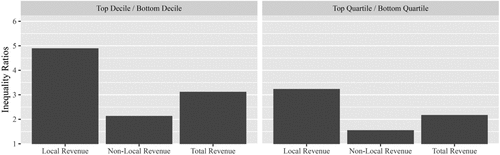
Notes. (Left) Spending ratio of U.S. traditional public schools from various funding sources, comparing the top 10% to the bottom 10% in total spending. (Right) Comparison of the top 25% to the bottom 25%. Revenue data come from Common Core Data (CCD), our main source, with all amounts adjusted to 2018 dollars and normalized for county-level cost of living, according to the Council for Community and Economic Research data.
Variables and Data Sources
We test our hypotheses using a detailed panel of U.S. public school spending data. We combine multiple data sources to construct measures of racial diversity, community inclusion, shared values, school representativeness, and community support for local schools. Our primary unit of analysis is the school district, which we believe maps well to our construct of community both in terms of its size and because school districts determine which public school children are eligible to attend. Pragmatically, school districts are the smallest unit for which we can get complete financial data for public schools across the United States. The sample period for our analyses runs from the 2009–2010 to the 2018–2019 school year. We begin with the 2009–2010 school year because it marks the start of a period of stable measurement in racial categories following the 2008 federal mandate for including biracial categories (Richards and Stroub 2020). We end our sample in 2018–2019 to avoid contamination by the effects of the COVID-19 pandemic, which posed a substantial shock to school districts from 2020 onward. Our data cover 497 U.S. states and the District of Columbia, giving us a final sample of 121,616 district-year observations8 across 12,766 school districts.9
Dependent Variable.
We measure local support for public schools in two ways. Our main measure is Per-pupil school spending from local sources, calculated by dividing the total revenue from local sources (property taxes, tuition, donations, and other income) for a given school district and year by the number of students enrolled in that district in the same year, based on the Common Core Data (CCD) from the National Center for Education Statistics (NCES). All dollar amounts are adjusted to 2018 dollars using the consumer price index for consistency. This measure has the advantage that it is consistently recorded across time and communities and fully and directly captures the extent to which a community invests in its local schools. One challenge with it, however, is that many elements of local spending may not be directly under the control of the community or may be determined by formula, so our main measure may reflect general changes in a community’s economic conditions (which impact school revenues) rather than the community’s deliberate choice to invest more in local schools.
To address this concern, we use Per-pupil voter-approved bond amount issued by the school district as a second measure of local support. As mentioned, school districts can vote to approve new bond issues—issuing new debt repayable through future taxes—to raise additional funds for their local schools (typically for capital investments). The successful issuance of such bonds, which are proposed and approved through referenda organized by school district residents, thus provides a direct measure of a community’s collective decision to invest in its schools (Rugh and Trounstine 2011, Trounstine 2016). To construct this measure, we compile a new data set of voter-approved school district bonds by analyzing the official statements of 100,298 bonds issued by school districts, collected from the Electronic Municipal Market Access (EMMA). This allows us to identify 10,167 unique school tax elections held by 3,182 school districts during the period of our panel, with the total approved amounts equal to about 9% of all revenue raised by school districts across the United States from local sources combined (for comparison, this is roughly equal to 50% of the amount contributed by the federal government to U.S. public K–12 education during our time period). We construct our measure of the per-pupil bond amount by dividing the total amount approved in the school tax referenda by the district’s total enrollment in the year the bond was approved. We focus on the bond amount approved rather than whether a bond was passed or not, because prior work has shown that diverse communities pass fewer but larger bonds, so focusing on bond amount approved allows us to combine these two effects (Rugh and Trounstine 2011). Note that this measure takes the value of zero when either no bond referenda were put forth or when they failed to pass, consistent with the idea that in either case the community is choosing not to invest more in its local schools. Although this per-pupil bond measure unambiguously captures the community’s decision to invest in local public schools, it is also limited in that a lack of new bond issues does not necessarily mean a lack of support for public schools—residents might support schools in other ways (e.g., through donations)—which is why we choose to triangulate across two different dependent variables to assess local support.
Independent Variables.
Our primary independent variable is the Racial diversity within each school district, which we measure using student enrollment data by race from the CCD. We calculate the Herfindahl-Hirschman index across six racial categories—American Indian, Asian, Black, Hispanic, White, and Other Races—which estimates the likelihood that any two randomly selected students in a school district will be from different racial groups. To ensure the robustness of our results, we also use racial entropy based on the same racial categories, calculated as , and get consistent results. Note that this measure is based on the racial composition of students rather than all residents in the district. An alternative would be to use data from the American Community Survey (ACS) to measure racial diversity in the community more generally. We prefer to use the CCD data for three reasons. First, they more directly measure the diversity of the population being served by our organization of interest (public schools). Second, the CCD provides annual measures, whereas ACS estimates at the school district level are five-year moving averages, which are less suitable given that our unit of analysis is district-year. Third, the ACS changed its coding of race several times during our study period, which makes measuring racial diversity in a comparable way over time challenging using these data. Prior research has shown that these changes in coding adversely affect the reliability of ACS race variables, especially for within-unit comparison (Arias et al. 2025, Sabol et al. 2025), and the census bureau itself warns against comparing across overlapping ACS surveys over time (U.S. Census Bureau 2024). Therefore, we refrain from doing so for our main explanatory variable. Moreover, the correlation between our measure and measures using the ACS variables is 0.87, so we do not see using CCD as introducing bias.
We construct two different measures of community inclusion: a measure of Community residential integration, which captures the extent to which people from different races live close to each other; and a measure of Community connectedness, which captures the extent to which members of different groups in the community interact with each other socially.10 These two measures thus reflect different aspects of inclusion as discussed in our theory: contact or propinquity between members of different races and the density of social ties and interactions between different groups. Theoretically, we expect both aspects of inclusion to have the same effect (which is why we did not offer separate hypotheses for the two measures), so by measuring inclusion in both ways we seek to not only triangulate our results across different aspects of inclusion, but also to explore whether the two aspects work in similar ways. As expected, the two measures of community inclusion are positively correlated, but not too strongly—in our final sample the correlation is 0.21—suggesting that they do capture distinct aspects of inclusion.
For our residential integration measure, we calculate one minus Theil’s index of racial segregation across census tracts that overlap with each school district, using tract-level racial composition data from Integrated Public Use Microdata Series – National Historical Geographic Information System (IPUMS NHGIS) (Trounstine 2016, Manson et al. 2020). We use R Segregation package for this calculation (Elbers 2021). The overlaps between census tracts and school districts are identified using the geographic relation files (GRFs) provided by the NCES education demographic and geographic estimates (EDGE). On average, a school district in our sample overlaps with 8.4 census tracts. Our community connectedness measure uses data from Opportunity Insights (Chetty et al. 2022a, b), which report social interactions at the level of Census ZIP Code Tabulation Areas. We aggregate these data to the school district level using NCES EDGE. The data set captures all friendship links between Facebook users and has been validated as a reliable proxy for real-world social connectedness within communities. One drawback of this measure is that it captures connectedness across different economic groups rather than specifically across different racial groups. Nevertheless, we think it is a reasonable proxy for the willingness of members of a community to socialize with those very different from them. In any case, we know of no other measure that would capture social connections between members of different races with the granularity and coverage we need.
To measure Shared values within the community, we build on work in political science that has examined differences in voting patterns between members of different races as a measure of racial polarization (Hajnal and Trounstine 2014, Trounstine 2016). Specifically, we use existing data on racial voting patterns from the 2016 and 2020 presidential elections constructed by Kuriwaki et al. (2024). We calculate one minus the weighted sum of the absolute differences between each racial group’s vote share for the Republican candidate and the overall Republican candidate’s vote share in the congressional district of the school district. The logic for this measure is that it captures how similar members of different races in the community are in their political ideologies, which we see as a strong measure of shared values across races. That said, we acknowledge that the measure is relatively crude, as it requires mapping racial voting shares from 435 congressional districts to over 12,000 school districts in our sample. In Online Appendix D, we therefore report results using two alternative measures of shared values: political homogeneity, defined as the absolute difference in vote share between Republican and Democratic candidates in state legislative elections, and religious integration, measured as the absence of Black churches in the school district.
To measure organizational representativeness, we draw on the CCD to analyze the racial composition of schools within each school district. We calculate racial segregation between schools of the same level within a district, constructing the measure as one minus Theil’s index of racial segregation, using the R Segregation package for this computation (Elbers 2021).
In addition to these main variables of interest, we include several control variables to account for potential confounds. First, we control for other characteristics of the school district that might be correlated with local funding. We control for nonlocal revenue per pupil because school districts that receive higher levels of funding from state or federal sources may have less need for local support. We also control for overall district enrollment as well as the percentages of special education students and students in English learning programs because these might impact the level of funding needed.
Second, we control for various characteristics of the local community. We control for communities’ median income and poverty rate, because richer communities with less poverty may be able to afford to spend more on local schools. We control for income inequality within the district, which has been shown to impact support for public education (Corcoran and Evans 2010, Boustan et al. 2013) by including the Gini coefficient of household incomes. We also control for the percentage of adults without a college education because higher educational attainment may be correlated with stronger willingness to invest in local schools. Further, we control for the cost-of-living index in the community to account for differences in the cost of operating schools and for district asset income to account for the financial resources available to the district. We also control for the political affiliation of residents of the district, measured as the proportion of residents who voted Democrat in the most recent congressional election, to account for the possibility that political ideology may impact support for public schools.
Third, we control for the number of for-profit and nonprofit charter schools within the focal or neighboring districts, because increasing access to alternative forms of local schools may impact community support for traditional public schools. We also control for variables that could influence the community’s decision to propose and vote for new school bond referenda, including district debt per pupil and interest paid per pupil at the end of the last fiscal year.11 We use the EDGE American Community Survey (ACS) specially estimated for NCES by the Census Bureau, the Small Area Income and Poverty Estimates (SAIPE) program, and the county-level cost of living index from the Council for Community and Economic Research (C2ER) for these additional variables. Table 1 shows summary statistics for, and correlations between, our variables. Despite some high correlations, primarily between control variables, the mean variance inflation factor (VIF) for our main analysis is only 1.06. These variables and their data sources are summarized in Online Appendix F.
|

Table 1. Summary Statistics
| Mean | Standard deviation | Minimum | Maximum | (1) | (2) | (3) | (4) | (5) | (6) | (7) | (8) | (9) | (10) | (11) | (12) | (13) | (14) | (15) | (16) | (17) | (18) | (19) | (20) | (21) | (22) | (23) | (24) | |
|---|---|---|---|---|---|---|---|---|---|---|---|---|---|---|---|---|---|---|---|---|---|---|---|---|---|---|---|---|
| 1. Per Pupil Local Revenue (log) | 0.31 | 1.64 | 0.00 | 15.73 | 1 | . | . | . | . | . | . | . | . | . | . | . | . | . | . | . | . | . | . | . | . | . | . | . |
| 2. Per Pupil Bond Amount (log) | 8.63 | 0.72 | 0.00 | 11.77 | −0.02 | 1 | . | . | . | . | . | . | . | . | . | . | . | . | . | . | . | . | . | . | . | . | . | . |
| 3. Racial Diversity | 0.28 | 0.20 | 0.00 | 0.75 | 0.08 | −0.01 | 1 | . | . | . | . | . | . | . | . | . | . | . | . | . | . | . | . | . | . | . | . | . |
| 4. Racial entropy | 0.53 | 0.32 | 0.00 | 1.43 | 0.08 | 0.01 | 0.99 | 1 | . | . | . | . | . | . | . | . | . | . | . | . | . | . | . | . | . | . | . | . |
| 5. Comm. Res. Integration | 0.92 | 0.06 | 0.32 | 1.00 | 0.00 | 0.10 | −0.10 | −0.10 | 1 | . | . | . | . | . | . | . | . | . | . | . | . | . | . | . | . | . | . | . |
| 6. Comm. Connect. | 0.84 | 0.16 | 0.29 | 1.35 | −0.00 | 0.37 | −0.22 | −0.18 | 0.21 | 1 | . | . | . | . | . | . | . | . | . | . | . | . | . | . | . | . | . | . |
| 7. Org. Representativeness | 0.98 | 0.04 | 0.00 | 1.00 | −0.02 | 0.11 | −0.24 | −0.25 | 0.35 | 0.13 | 1 | . | . | . | . | . | . | . | . | . | . | . | . | . | . | . | . | . |
| 8. Shared Values | 0.99 | 0.01 | 0.72 | 1.00 | −0.01 | 0.06 | −0.24 | −0.24 | 0.19 | 0.18 | 0.37 | 1 | . | . | . | . | . | . | . | . | . | . | . | . | . | . | . | . |
| 9. Non-Local Revenue Per Pupil (log) | 8.89 | 0.46 | 4.94 | 11.62 | −0.05 | −0.40 | −0.08 | −0.10 | −0.07 | −0.13 | −0.04 | 0.05 | 1 | . | . | . | . | . | . | . | . | . | . | . | . | . | . | . |
| 10. Outstanding Debt Per Pupil (t−1) | 7,849 | 9,886 | 0.00 | 761,764 | −0.01 | 0.21 | 0.03 | 0.04 | −0.02 | 0.10 | −0.01 | −0.02 | −0.05 | 1 | . | . | . | . | . | . | . | . | . | . | . | . | . | . |
| 11. Predicted Immigrants Inflow | 0.00 | 0.00 | 0.00 | 0.03 | 0.04 | 0.20 | 0.32 | 0.34 | −0.03 | 0.05 | −0.16 | −0.14 | −0.10 | 0.09 | 1 | . | . | . | . | . | . | . | . | . | . | . | . | . |
| 12. HH Median Income | 61,480 | 24,899 | 9,394 | 287,356 | 0.01 | 0.48 | 0.07 | 0.11 | 0.11 | 0.36 | 0.03 | −0.00 | −0.36 | 0.19 | 0.43 | 1 | . | . | . | . | . | . | . | . | . | . | . | . |
| 13. Median Property Price | 197,867 | 171,493 | 10,417 | 2,127,661 | 0.02 | 0.40 | 0.20 | 0.23 | 0.08 | 0.24 | −0.06 | −0.05 | −0.32 | 0.15 | 0.58 | 0.76 | 1 | . | . | . | . | . | . | . | . | . | . | . |
| 14. Household Income Gini | 0.42 | 0.05 | 0.09 | 0.78 | 0.01 | 0.01 | 0.21 | 0.21 | −0.12 | −0.22 | −0.17 | −0.12 | −0.06 | −0.01 | 0.08 | −0.13 | 0.14 | 1 | . | . | . | . | . | . | . | . | . | . |
| 15. Poverty Rate (%) | 0.18 | 0.10 | 0.00 | 1.00 | −0.01 | −0.47 | 0.11 | 0.07 | −0.18 | −0.58 | −0.13 | −0.10 | 0.32 | −0.15 | −0.17 | −0.67 | −0.42 | 0.31 | 1 | . | . | . | . | . | . | . | . | . |
| 16. Special Education Programs (%) | 0.14 | 0.05 | 0.00 | 1.00 | −0.04 | 0.10 | −0.08 | −0.07 | 0.02 | 0.10 | 0.05 | 0.10 | 0.19 | −0.03 | −0.08 | −0.06 | −0.09 | −0.02 | 0.00 | 1 | . | . | . | . | . | . | . | . |
| 17. English Learning Programs (%) | 0.05 | 0.09 | 0.00 | 0.96 | 0.05 | −0.17 | 0.31 | 0.29 | −0.14 | −0.19 | −0.20 | −0.11 | 0.09 | −0.01 | 0.33 | −0.06 | 0.14 | 0.10 | 0.23 | −0.20 | 1 | . | . | . | . | . | . | . |
| 18. Students Achievements (Math & Reading Avg) | 0.02 | 0.35 | −3.74 | 1.62 | −0.02 | 0.46 | −0.18 | −0.13 | 0.20 | 0.45 | 0.14 | 0.07 | −0.38 | 0.13 | 0.12 | 0.62 | 0.45 | −0.12 | −0.67 | −0.03 | −0.32 | 1 | . | . | . | . | . | . |
| 19. Adults without College Degree (%) | 0.77 | 0.14 | 0.07 | 1.00 | −0.02 | −0.52 | −0.18 | −0.23 | −0.07 | −0.31 | 0.06 | 0.06 | 0.39 | −0.19 | −0.42 | −0.77 | −0.73 | −0.17 | 0.55 | 0.06 | 0.06 | −0.63 | 1 | . | . | . | . | . |
| 20. District Enrolment (log) | 7.14 | 1.40 | 2.40 | 13.42 | 0.06 | −0.11 | 0.35 | 0.40 | −0.34 | −0.12 | −0.47 | −0.41 | −0.12 | 0.14 | 0.27 | 0.17 | 0.17 | 0.13 | −0.05 | −0.08 | 0.19 | 0.04 | −0.25 | 1 | . | . | . | . |
| 21. Num. For-Profit Charters | 0.06 | 1.14 | 0.00 | 111.00 | 0.01 | −0.01 | 0.06 | 0.06 | −0.10 | −0.04 | −0.21 | −0.23 | −0.00 | 0.01 | 0.03 | −0.02 | −0.01 | 0.05 | 0.05 | 0.00 | 0.03 | −0.03 | −0.01 | 0.13 | 1 | . | . | . |
| 22. Num. Non-Profit Charters | 0.40 | 3.60 | 0.00 | 308.00 | 0.02 | −0.01 | 0.11 | 0.12 | −0.16 | −0.04 | −0.33 | −0.29 | −0.00 | 0.03 | 0.10 | −0.02 | 0.03 | 0.10 | 0.06 | −0.02 | 0.10 | −0.07 | −0.04 | 0.24 | 0.29 | 1 | . | . |
| 23. Cost of Living Index | 104.81 | 14.19 | 81.37 | 189.84 | 0.00 | 0.34 | 0.25 | 0.29 | 0.06 | 0.24 | −0.13 | −0.05 | −0.07 | 0.07 | 0.69 | 0.53 | 0.71 | 0.05 | −0.31 | −0.03 | 0.32 | 0.21 | −0.50 | 0.16 | 0.00 | 0.08 | 1 | . |
| 24. Voted Democrat (%) | 0.40 | 0.20 | 0.00 | 1.00 | −0.02 | 0.12 | 0.10 | 0.11 | −0.06 | −0.01 | −0.12 | −0.13 | 0.01 | 0.03 | 0.35 | 0.18 | 0.30 | 0.03 | −0.04 | 0.04 | 0.14 | 0.01 | −0.22 | 0.16 | 0.05 | 0.08 | 0.40 | 1 |
Empirical Approach
We run panel regressions predicting per-pupil school spending from local sources, as well as the per-pupil voter approved bond amount, as a function of the community’s racial diversity and community characteristics described above. Specifically, we estimate the following:
Results
Main Results
Our first two hypotheses are that increasing racial diversity in a community is associated with lowered support for local public schools, but this association is weakened in communities that are simultaneously diverse and inclusive. Table 2 tests these hypotheses. Model 1 presents an OLS estimation predicting local school spending showing the baseline model with only controls. Model 2 adds our racial diversity measure, which takes a negative and significant coefficient, supporting Hypothesis 1. In terms of economic magnitude, the point estimate from Model 2 suggests that a one-standard-deviation increase in racial diversity within a district is associated with about a 1.9% decrease in local spending on public schools or roughly a decrease of $140 per student using the sample average, which translates to about $520,000 per year for the average school district or approximately the average salary of 8.4 teachers during the 2018–2019 school year.
|
Table 2. Racial Diversity and Support for Local Public Schools
| Dependent variable: Per Pupil Local Revenue | Dependent variable: Per Pupil Bond Amount | |||||||||||
|---|---|---|---|---|---|---|---|---|---|---|---|---|
| Community residential integration | Community connectedness | Community residential integration | Community connectedness | |||||||||
| Low | High | Low | High | Low | High | Low | High | |||||
| M1 | M2 | M3a | M3b | M4a | M4b | M5 | M6 | M7a | M7b | M8a | M8b | |
| Racial Diversity | −0.02*** | −0.05*** | −0.00 | −0.04*** | −0.00 | −0.07* | −0.14* | −0.03 | −0.15*** | 0.00 | ||
| (0.01) | (0.01) | (0.01) | (0.01) | (0.01) | (0.03) | (0.05) | (0.03) | (0.04) | (0.04) | |||
| HH Median Income(log) | 0.04*** | 0.04*** | 0.04*** | 0.03*** | 0.03*** | 0.03*** | 0.06** | 0.06** | 0.12*** | 0.03 | 0.07* | 0.05+ |
| (0.00) | (0.00) | (0.01) | (0.00) | (0.01) | (0.00) | (0.02) | (0.02) | (0.03) | (0.02) | (0.03) | (0.03) | |
| District Enrolment (log) | −1.06*** | −1.06*** | −0.94*** | −1.13*** | −1.08*** | −1.02*** | 0.31*** | 0.32*** | 0.51*** | 0.21* | 0.03 | 0.59*** |
| (0.02) | (0.02) | (0.03) | (0.03) | (0.03) | (0.03) | (0.08) | (0.08) | (0.14) | (0.09) | (0.11) | (0.11) | |
| Poverty Rate (%) | −0.01*** | −0.01*** | −0.02*** | −0.01*** | −0.01*** | −0.01*** | −0.01 | −0.01 | 0.03 | −0.03+ | −0.00 | −0.03 |
| (0.00) | (0.00) | (0.00) | (0.00) | (0.00) | (0.00) | (0.01) | (0.01) | (0.02) | (0.02) | (0.02) | (0.02) | |
| Adults without College Degree (%) | −0.01 | −0.01+ | −0.01 | −0.01 | −0.00 | −0.01+ | −0.04 | −0.04 | −0.03 | −0.05 | 0.02 | −0.09* |
| (0.01) | (0.01) | (0.01) | (0.01) | (0.01) | (0.01) | (0.03) | (0.03) | (0.05) | (0.03) | (0.04) | (0.04) | |
| Special Education Programs (%) | 0.01*** | 0.01*** | 0.01*** | 0.01*** | 0.01*** | 0.01*** | 0.01 | 0.01 | 0.02 | −0.00 | 0.01 | 0.00 |
| (0.00) | (0.00) | (0.00) | (0.00) | (0.00) | (0.00) | (0.01) | (0.01) | (0.02) | (0.01) | (0.02) | (0.02) | |
| English Learning Programs (%) | −0.01* | −0.01* | −0.01 | −0.01 | −0.01+ | −0.01 | −0.03+ | −0.03+ | −0.06* | 0.00 | −0.05* | −0.02 |
| (0.00) | (0.00) | (0.01) | (0.01) | (0.00) | (0.01) | (0.02) | (0.02) | (0.03) | (0.02) | (0.02) | (0.04) | |
| Num. For-Profit Charters | −0.01* | −0.01* | −0.01* | −0.01+ | −0.00* | −0.02 | 0.00 | 0.00 | 0.01 | −0.09 | 0.01 | −0.14 |
| (0.00) | (0.00) | (0.00) | (0.01) | (0.00) | (0.01) | (0.02) | (0.02) | (0.02) | (0.17) | (0.02) | (0.13) | |
| Num. Nonprofit Charters | 0.01** | 0.01** | 0.01** | 0.02 | 0.01* | 0.03** | 0.01 | 0.01 | 0.00 | 0.14 | −0.02 | 0.23* |
| (0.00) | (0.00) | (0.00) | (0.02) | (0.00) | (0.01) | (0.02) | (0.02) | (0.02) | (0.19) | (0.02) | (0.11) | |
| Outstanding Debt Per Pupil (t−1) | 0.03*** | 0.03*** | 0.04*** | 0.02** | 0.03*** | 0.03*** | −0.26*** | −0.26*** | −0.36*** | −0.21*** | −0.29*** | −0.32*** |
| (0.01) | (0.01) | (0.00) | (0.01) | (0.01) | (0.00) | (0.05) | (0.05) | (0.04) | (0.06) | (0.07) | (0.03) | |
| Voted Democrat (%) | −0.01 | −0.01 | −0.01* | −0.00 | −0.01+ | −0.01 | −0.02 | −0.02 | −0.02 | −0.03 | 0.03 | −0.09 |
| (0.01) | (0.00) | (0.01) | (0.01) | (0.01) | (0.01) | (0.04) | (0.04) | (0.06) | (0.06) | (0.05) | (0.06) | |
| Nonlocal Revenue Per Pupil (log) | −0.05*** | −0.05*** | −0.05*** | −0.06*** | −0.06*** | −0.05*** | −0.00 | −0.00 | 0.02 | −0.02 | −0.02 | 0.03 |
| (0.00) | (0.00) | (0.01) | (0.01) | (0.01) | (0.00) | (0.02) | (0.02) | (0.03) | (0.02) | (0.02) | (0.02) | |
| No. of observations | 121,616 | 121,616 | 60,419 | 61,193 | 60,399 | 60,111 | 121,616 | 121,616 | 60,419 | 61,193 | 60,399 | 60,111 |
| R2 | 0.964 | 0.964 | 0.965 | 0.963 | 0.961 | 0.962 | 0.146 | 0.146 | 0.151 | 0.144 | 0.152 | 0.143 |
| District fixed effects | Yes | Yes | Yes | Yes | Yes | Yes | Yes | Yes | Yes | Yes | Yes | Yes |
| School year fixed effects | Yes | Yes | Yes | Yes | Yes | Yes | Yes | Yes | Yes | Yes | Yes | Yes |
| Z (difference diversity) | 3.58 (p = 0.00) | 2.93 (p = 0.00) | 1.72 (p = 0.04) | 2.65 (p = 0.00) | ||||||||
Notes. Robust standard errors clustered at the school district level are shown in parentheses. Coefficients are standardized and should be interpreted as the effect of a one-standard-deviation increase in the variable.
+p < 0.1; *p < 0.05; **p < 0.01; ***p < 0.001.
Model 5 in Table 2 presents the OLS estimation predicting our per-pupil bond amount measure using only controls. Model 6 further confirms support for Hypothesis 1, with a negative and statistically significant coefficient for racial diversity when predicting the per-pupil amount of new debt issued to fund local schools.12 The point estimate indicates that a one-standard-deviation increase in racial diversity within a district is associated with approximately a 7% decrease in the per-pupil bond amount. We confirm the robustness of these results to a variety of alternative measures, controls, and samples, including alternative measures of racial diversity, alternative sample periods, and alternative specifications, including models with no controls (described in Online Appendix E). Figure 2(a) shows epistemic maps (King et al. 2021) plotting the coefficient of interest from these alternative regressions for our two outcome measures: per pupil local school spending and per pupil bond amount. In all, we show 24 different coefficients of the effect of racial diversity on support for local schools and confirm that they are all negative and almost all are significant at a p-value below 0.05.
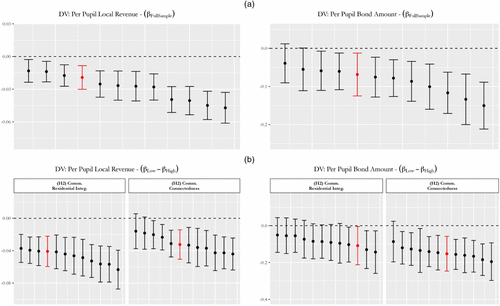
Notes. (a) Hypothesis 1. (b) Hypothesis 2.
Next, we test for the moderating effect of community inclusion predicted by Hypothesis 2 using our two measures of community residential integration and community connectedness. Given our use of fixed effects models, we use a split sample approach (Shaver 2019). In Table 2, Models 3a and 3b are OLS results predicting per pupil local spending split at the median value of community residential integration in the school district over the panel period.13 We see that the coefficient of racial diversity is negative and significant in districts with low community residential integration but statistically indistinguishable from zero in districts with high community residential integration. Further, z-tests comparing the coefficients across subsamples (reported below each pair of estimations) confirm that the coefficient of racial diversity in the low community residential integration subsample is statistically more negative than the corresponding coefficient in the high community residential integration subsample. In terms of economic magnitude, the point estimates in Model 3 imply that a one-standard-deviation increase in racial diversity decreases local school spending by about 4.6% or roughly about $335 per student in low residential integration school districts but has essentially no effect on spending in school districts with high residential integration. Models 7a and 7b in Table 2 show the split sample analysis predicting per-pupil bond amounts and show a similar pattern of results.
We repeat the analyses for Hypothesis 2 using our measure of community connectedness from Chetty et al. (2022a, b). Models 4a and 4b present the split-sample analysis predicting per-pupil local revenue, and Models 8a and 8b show the corresponding estimates for per-pupil bond amounts. In both cases, the diversity penalty appears only in districts with low community connectedness; the coefficients for districts with high community connectedness are statistically indistinguishable from zero. Z-tests comparing the coefficients across subsamples (reported below each pair of estimations) confirm that the coefficients of racial diversity in the low community connectedness subsamples are statistically more negative than the corresponding coefficients in the high community connectedness subsamples. In terms of economic magnitude, the point estimates in Model 4a imply that a one standard deviation increase in racial diversity decreases local school spending by about 3.7%, or roughly $270 per student, in less socially connected districts, but has no significant effect in more socially connected districts. We find similar patterns for the moderating effect of community connectedness using our per-pupil bond amount measure. These results provide strong support for Hypothesis 2, suggesting that the diversity penalty documented in prior literature, and as in our first hypothesis, is concentrated in communities that are diverse but not inclusive.
These results are further supported by Figure 2(b), which presents epistemic maps of our test for Hypothesis 2 across 48 different specifications. Specifically, it plots the estimates and confidence intervals for the difference between the coefficients of racial diversity in communities with high versus low inclusion, using our two measures of inclusion: community residential integration and community connectedness. Across all specifications, racial diversity has a more negative effect on support for local schools in districts with low levels of community residential integration or low levels of community connectedness than in those with high residential integration or high community connectedness, with the majority of these coefficients being statistically significant at conventional levels. Overall, these results provide strong support for the idea that community inclusion may offset the otherwise negative effect of increasing diversity on support for local public service organizations.
Although our results thus far show that both our measures of community inclusion—community residential integration and community connectedness—moderate the negative effect of diversity separately (and as noted, the two are only mildly correlated in our data), it is interesting to consider their combined effect. In particular, is it sufficient to have just one aspect of inclusion, either residential integration or connectedness, to offset the negative effects of diversity, or are both required? To explore that, we further split the sample by community residential integration × community connectedness, as shown in Figure 3. We find that the negative association between racial diversity and local support for public schools is strongest in districts where communities are relatively residentially segregated and less connected, whereas this effect is largely mitigated in districts that have either high residential integration or high community connectedness. Although preliminary and exploratory, these results suggest that these two aspects of inclusion may act as partial substitutes for each other in mitigating the negative effects of increasing diversity.
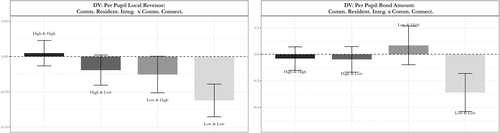
Note. The error bars represent 95% confidence intervals.
Moderating Role of Community’s Shared Values and Organizational Representativeness
Table 3 tests the moderating role of community shared values (Hypothesis 3) and organizational representativeness (Hypothesis 4). Models 9a and 9b present results predicting per-pupil local spending (Panel A) and per-pupil bond amounts (Panel B), with the sample split based on community shared values. We find that a one-standard-deviation increase in racial diversity in communities with low shared values is associated with approximately a 6% reduction in per-pupil spending and a 16% decrease in per-pupil bond amounts. In contrast, the association is indistinguishable from zero in communities with high shared values and is significantly larger in the high shared values subsample compared with low shared values communities for both outcomes. Models 11a–11d and 13a–13d in Panel A present results predicting per-pupil local spending, splitting the sample by community inclusion (measured as residential integration and community connectedness, respectively) and shared values. Models 11a–11d and 13a–11d in Panel B do the same with per pupil bond amount as our dependent variable. Consistent with our hypothesis, we find across all models that the coefficient of diversity is most negative for communities with low inclusion and low shared values and significantly less negative for all other communities. For instance, a one-standard-deviation increase in racial diversity is associated with an 8% reduction in per-pupil local spending in districts characterized by both low residential integration and low shared values (Model 11a, Panel A). In contrast, this relationship is not statistically distinguishable from zero in communities with high shared values (Models 11b and 11d, Panel A), regardless of their level of residential integration. In districts with high residential integration but low shared values (Model 11c, Panel A), the decrease is more modest at around 3%. A similar pattern holds when we measure inclusion as community connectedness (Models 13a–13d). These patterns are even more stark when using our per-pupil bond amount measure (Table 3, Panel B), where a one-standard-deviation increase in racial diversity is associated with a 24% lower per-pupil bond amount in communities with low connectedness and low shared values (Model 11a, Panel B) compared with an association indistinguishable from zero in other communities (Models 11b–11d, Panel B). These results consistently support Hypothesis 3.
|
Table 3. Role of Shared Values and Organizational Representativeness
| Shared values | Organizational representativeness | Community residential integration | Community connectedness | |||||||||||||||||
|---|---|---|---|---|---|---|---|---|---|---|---|---|---|---|---|---|---|---|---|---|
| Low | High | Low | High | Low | High | Low | High | |||||||||||||
| Shared values | Organizational representativeness | Shared values | Organizational representativeness | |||||||||||||||||
| Low | High | Low | High | Low | High | Low | High | Low | High | Low | High | Low | High | Low | High | Low | High | Low | High | |
| M9a | M9b | M10a | M10b | M11a | M11b | M11c | M11d | M12a | M12b | M12c | M12d | M13a | M13b | M13c | M13d | M14a | M14b | M14c | M14d | |
| Panel A: Per Pupil Local Revenue | ||||||||||||||||||||
| Racial Diversity | −0.06*** | 0.00 | −0.04*** | −0.01 | −0.08*** | −0.00 | −0.03* | 0.00 | −0.06*** | −0.01 | −0.00 | −0.01 | −0.07*** | −0.01 | −0.04*** | 0.01 | −0.06*** | −0.02+ | −0.02+ | 0.00 |
| (0.01) | (0.01) | (0.01) | (0.01) | (0.01) | (0.01) | (0.01) | (0.01) | (0.01) | (0.01) | (0.01) | (0.01) | (0.01) | (0.01) | (0.01) | (0.01) | (0.01) | (0.01) | (0.01) | (0.01) | |
| No. of observations | 60,013 | 61,566 | 60,539 | 61,077 | 36,153 | 24,241 | 23,860 | 37,321 | 39,409 | 21,010 | 21,128 | 40,065 | 34,731 | 25,645 | 24,907 | 35,190 | 31,444 | 28,955 | 28,839 | 31,272 |
| R2 | 0.969 | 0.961 | 0.969 | 0.960 | 0.968 | 0.962 | 0.969 | 0.960 | 0.969 | 0.960 | 0.969 | 0.961 | 0.961 | 0.960 | 0.974 | 0.953 | 0.965 | 0.957 | 0.969 | 0.956 |
| Z (difference diversity) | 5.09 (p = 0.00) | 2.79 (p = 0.00) | ||||||||||||||||||
| District fixed effects | Yes | Yes | Yes | Yes | Yes | Yes | Yes | Yes | Yes | Yes | Yes | Yes | Yes | Yes | Yes | Yes | Yes | Yes | Yes | Yes |
| School year fixed effects | Yes | Yes | Yes | Yes | Yes | Yes | Yes | Yes | Yes | Yes | Yes | Yes | Yes | Yes | Yes | Yes | Yes | Yes | Yes | Yes |
| Panel B: Per Pupil Bond Amount | ||||||||||||||||||||
| Racial Diversity | −0.16*** | −0.01 | −0.22*** | 0.01 | −0.24*** | −0.01 | −0.07 | −0.01 | −0.25** | 0.03 | −0.17* | 0.00 | −0.27*** | −0.05 | −0.01 | 0.01 | −0.35*** | −0.01 | −0.07 | 0.02 |
| (0.05) | (0.04) | (0.06) | (0.03) | (0.07) | (0.08) | (0.06) | (0.04) | (0.08) | (0.07) | (0.08) | (0.03) | (0.06) | (0.06) | (0.07) | (0.05) | (0.08) | (0.05) | (0.08) | (0.04) | |
| No. of observations | 60,013 | 61,566 | 60,539 | 61,077 | 36,153 | 24,241 | 23,860 | 37,321 | 39,409 | 21,010 | 21,128 | 40,065 | 34,731 | 25,645 | 24,907 | 35,190 | 31,444 | 28,955 | 28,839 | 31,272 |
| R2 | 0.138 | 0.157 | 0.145 | 0.151 | 0.146 | 0.160 | 0.129 | 0.157 | 0.149 | 0.155 | 0.137 | 0.150 | 0.141 | 0.168 | 0.138 | 0.149 | 0.152 | 0.157 | 0.140 | 0.147 |
| Z (difference diversity) | 2.53 (p = 0.01) | 3.56 (p = 0.00) | ||||||||||||||||||
| District fixed effects | Yes | Yes | Yes | Yes | Yes | Yes | Yes | Yes | Yes | Yes | Yes | Yes | Yes | Yes | Yes | Yes | Yes | Yes | Yes | Yes |
| School year fixed effects | Yes | Yes | Yes | Yes | Yes | Yes | Yes | Yes | Yes | Yes | Yes | Yes | Yes | Yes | Yes | Yes | Yes | Yes | Yes | Yes |
Notes. Robust standard errors clustered at the school district level are shown in parentheses. Coefficients are standardized and should be interpreted as the effect of a one-standard-deviation increase in the variable.
+p < 0.1; *p < 0.05; **p < 0.01; ***p < 0.001.
We next examine the moderating effect of organizational representativeness. Models 10a and 10b present results predicting per-pupil local spending and per-pupil bond amounts in Panels A and B, respectively, with the sample split at the median level of organizational representativeness. We find that the negative association between racial diversity and community support for public schools—using both measures—is concentrated in districts where public schools are relatively segregated. In these districts, a one-standard-deviation increase in racial diversity is associated with an approximately 4% decrease in per-pupil spending and about a 22% decrease in per-pupil bond amounts. In contrast, the association is indistinguishable from zero in districts where schools are relatively integrated. Next, we further split the sample simultaneously by community inclusion and organizational representativeness, as presented in Models 12a–12d and 14a–14d, using community residential integration and community connectedness as our inclusion measures, respectively. Across all models, we see strong support for Hypothesis 4. Specifically, Models 12a–12d show that the coefficient of racial diversity on local school spending is most negative in districts where both community residents and schools are relatively segregated (Model 12a, Panel A) and insignificantly different from zero in other communities. We observe a similar pattern in Models 14a–14d in Panel A. Once again, these findings are even starker when predicting per-pupil bond amounts. A one-standard-deviation increase in racial diversity is associated with a 25% decline in per-pupil bond amount in communities with low residential integration and organizational representativeness (Model 12a, Panel B) and a 35% decrease in communities with low connectedness and low organizational representativeness (Model 14a, Panel B). In contrast, racial diversity has no significant effect in other communities, except in Model 12c, Panel B, where there is still a negative association of about 17% between racial diversity and per-pupil bond amount—although this effect remains less negative than in communities with both low inclusion and low organizational representativeness.
Supplementary Analyses: IV Approach
A key concern with the associational results reported thus far is that local school spending may be influenced by various community-level factors (including the prior performance of local schools) that may also impact the level of racial diversity. We undertake IV analyses to deal with this concern, accounting for the endogeneity of racial diversity within a school district by using a Bartik-style instrumental variable adapted from the labor economics literature (Card 2001, Goldsmith-Pinkham et al. 2020). Specifically, we use the average Predicted inflow of immigrants into a region during the five-year period prior to a given year, which is calculated by combining the inflow of international immigrants into the United States in those years (push factor) with the historical settlement patterns of immigrants from different home countries as recorded in the 1980 Census (pull factor). Online Appendix I provides more details on how this instrument is calculated. The logic for this instrument is that new international immigrants tend to settle in locations where others from their home country have previously settled (Bartel 1989, Card 2001, Jaeger 2007, Goldsmith-Pinkham et al. 2020), so an increase in immigration from a given country will result in a predicted increase in immigration from that country to communities where others from that country have previously located, thus increasing that community’s racial diversity (relevance condition) but such immigration should not otherwise impact local school spending, except through its impact on racial diversity (exclusion condition),14 making it a valid instrument.
Although the instrument passes conventional diagnostics for instrument strength, with first-stage Cragg-Donald Wald F-statistic of 1,726 well above the Stock–Yogo (Stock and Yogo 2005) critical threshold of 16.38 for 10% distortion, we caution that this IV strategy captures only one specific channel of increasing diversity: Inflow of international immigrants. As such, our estimates reflect a local average treatment effect (LATE) that applies to districts whose racial diversity changes primarily due to immigrant inflows and such increases in diversity may differ systematically from others.15
Table 4 presents the results of our IV regressions. We find that our results remain robust to the use of an IV to account for the endogeneity of racial diversity; specifically, we continue to see a negative and significant effect of racial diversity on local support for public schools in less inclusive communities, especially if they have low shared values or low organizational representativeness. In fact, Table 4 even shows some evidence of a positive effect of diversity in communities with high inclusion and strong shared values. These findings increase our confidence that the associational results presented thus far are plausibly causal.
|
Table 4. Supplementary Analysis: Instrumental Variable Approach
| Community residential integration | Community connectedness | ||||||||||||||||||||||||
|---|---|---|---|---|---|---|---|---|---|---|---|---|---|---|---|---|---|---|---|---|---|---|---|---|---|
| Low | High | Low | High | Low | High | Low | High | ||||||||||||||||||
| Community residential integration | Community connectedness | Shared values | Organizational representativeness | Shared values | Organizational representativeness | Shared values | Organizational representativeness | ||||||||||||||||||
| Low | High | Low | High | Low | High | Low | High | Low | High | Low | High | Low | High | Low | High | Low | High | Low | High | Low | High | Low | High | ||
| M15 | M16a | M16b | M17a | M17b | M18a | M18b | M19a | M19b | M20a | M20b | M20c | M20d | M21a | M21b | M21c | M21d | M22a | M22b | M22c | M22d | M23a | M23b | M23c | M23d | |
| Racial Diversity | −0.23** | −0.01 | −0.27*** | 0.29* | −0.22** | 0.09 | −0.14* | −0.01 | −0.28** | −0.05 | −0.14 | 0.14 | −0.22** | −0.12 | −0.03 | 0.02 | −0.36*** | −0.04 | 0.37 | 0.27* | −0.31*** | −0.14 | 0.54+ | 0.24 | |
| (0.07) | (0.07) | (0.06) | (0.12) | (0.07) | (0.06) | (0.06) | (0.08) | (0.10) | (0.10) | (0.10) | (0.08) | (0.08) | (0.16) | (0.10) | (0.09) | (0.08) | (0.09) | (0.26) | (0.12) | (0.08) | (0.12) | (0.31) | (0.14) | ||
| Independent variable: Predicted Immigrants Inflow | 0.12*** | ||||||||||||||||||||||||
| (0.01) | |||||||||||||||||||||||||
| Z (difference diversity) | 2.26 (p = 0.01) | 4.04 (p = 0.00) | 3.31 (p = 0.00) | 1.22 (p = 0.11) | |||||||||||||||||||||
| No. of observations | 121,354 | 60,353 | 60,997 | 60,323 | 59,957 | 60,005 | 61,312 | 60,404 | 60,950 | 36,145 | 24,183 | 23,860 | 37,125 | 39,361 | 20,992 | 21,041 | 39,956 | 34,723 | 25,577 | 24,907 | 35,036 | 31,406 | 28,917 | 28,762 | 31,195 |
| R2 | 0.980 | 0.964 | 0.964 | 0.958 | 0.958 | 0.968 | 0.960 | 0.969 | 0.961 | 0.967 | 0.962 | 0.969 | 0.959 | 0.968 | 0.959 | 0.969 | 0.961 | 0.959 | 0.960 | 0.969 | 0.949 | 0.963 | 0.956 | 0.959 | 0.953 |
| District fixed effects | Yes | Yes | Yes | Yes | Yes | Yes | Yes | Yes | Yes | Yes | Yes | Yes | Yes | Yes | Yes | Yes | Yes | Yes | Yes | Yes | Yes | Yes | Yes | Yes | Yes |
| School year fixed effects | Yes | Yes | Yes | Yes | Yes | Yes | Yes | Yes | Yes | Yes | Yes | Yes | Yes | Yes | Yes | Yes | Yes | Yes | Yes | Yes | Yes | Yes | Yes | Yes | Yes |
| Cragg-Donald Wald F-statistic | 1,726.2 | 871.4 | 846.4 | 1,161.3 | 271 | 1,238.7 | 652.9 | 1,232.7 | 546.1 | 636.9 | 260.7 | 570.7 | 388.2 | 741.2 | 127.7 | 429.3 | 419.3 | 973.8 | 299.6 | 72.6 | 252.3 | 967.7 | 269.1 | 62.9 | 192.3 |
Notes. Robust standard errors clustered at the school district level are shown in parentheses. Coefficients are standardized and should be interpreted as the effect of a one-standard-deviation increase in the variable.
+p < 0.1; *p < 0.05; **p < 0.01; ***p < 0.001.
Supplementary Analyses: Educational Achievement
Because we are ultimately interested in the quality of education students in different communities receive rather than the amount spent on them, we run supplementary analyses to confirm that local spending on public schools does, in fact, correlate with the quality of student outcomes. These analyses also enable us to examine the direct effect of racial diversity on student outcomes. It could be that increasing racial diversity improves student outcomes by bringing them in contact with new ideas and perspectives, and that the reduction in local spending we document reflects the reduced need for such spending given the boost to student learning from racial diversity.
The analysis in Table 5 examines these possibilities. It reports the results of an OLS panel regression (with district × cohort × subject, grade, and school year fixed effects) regressing student outcomes in the same cohort of the same district on local and nonlocal spending, racial diversity, and the full set of control variables from our main analyses over time. Panel A uses student achievement in math as the outcome variable, whereas Panel B uses reading achievement. Across all models, we find a consistently positive and significant relationship between student achievement and both local and nonlocal spending, consistent with prior work (Jackson et al. 2016, Lafortune et al. 2018). Although these results are associational, they strongly suggest that reductions in public school spending are likely to worsen organizational performance in terms of student outcomes. Further, Table 5 shows no evidence of a positive association between racial diversity and student achievement; if anything, increasing diversity is negatively associated with reading outcomes (but only marginally with math outcomes).
|
Table 5. Supplementary Analysis: School Spending and Students’ Educational Achievement
| Panel A: Student achievements in math | Panel B: Student achievements in reading | |||||
|---|---|---|---|---|---|---|
| M24a | M24b | M24c | M25a | M25b | M25c | |
| Local Revenue Per Pupil (log) | 0.08*** | 0.08*** | 0.06*** | 0.06*** | ||
| (0.01) | (0.01) | (0.01) | (0.01) | |||
| Non-Local Revenue Per Pupil (log) | 0.09*** | 0.09*** | 0.09*** | 0.06*** | 0.06*** | 0.06*** |
| (0.01) | (0.01) | (0.01) | (0.01) | (0.01) | (0.01) | |
| Racial Diversity | −0.02* | −0.02+ | −0.09*** | −0.08*** | ||
| (0.01) | (0.01) | (0.01) | (0.01) | |||
| Comm. Res. Integration | −0.00 | −0.00 | −0.00 | −0.00 | −0.00 | −0.00 |
| (0.00) | (0.00) | (0.00) | (0.00) | (0.00) | (0.00) | |
| Comm. Org. Integration | −0.01*** | −0.01*** | −0.01*** | −0.02*** | −0.02*** | −0.02*** |
| (0.00) | (0.00) | (0.00) | (0.00) | (0.00) | (0.00) | |
| No. of observations | 505,631 | 505,631 | 505,631 | 532,446 | 532,446 | 532,446 |
| R2 | 0.856 | 0.856 | 0.856 | 0.880 | 0.880 | 0.880 |
| District × cohort × subject fixed effects | Yes | Yes | Yes | Yes | Yes | Yes |
| Grade fixed effects | Yes | Yes | Yes | Yes | Yes | Yes |
| School year fixed effects | Yes | Yes | Yes | Yes | Yes | Yes |
Notes. Robust standard errors clustered at the school district level are shown in parentheses. Coefficients are standardized and should be interpreted as the effect of a one-standard-deviation increase in the variable. We do not include our measures of community shared values and community connectedness due to their limited variance over time.
+p < 0.1; *p < 0.05; **p < 0.01; ***p < 0.001.
Other Supplementary Analyses
We run several additional analyses to confirm the robustness of our findings, that are reported in the online appendices for the sake of brevity. First, as mentioned, we undertake supplementary analyses to examine the effect of racial diversity on school district boundaries, recognizing that these boundaries are not static and may change over time. As described in Online Appendix B, this analysis shows that the probability of school district secession—that is, of a district splitting into two—increases with increasing racial diversity, and that the new school district created as a result tends to be more racially homogenous than the district from which it secedes. The power of this analysis is limited because we have only 32 instances of school district secession in our sample. Nevertheless, these findings are strongly consistent with the idea that increasing racial diversity causes local support for public schools to decrease, potentially to the point where members of one group prefer to separate and form their own, more exclusive district.
Second, one might argue that our focus on local school spending, whereas relevant to our theory, is too narrow. In particular, if increasing racial diversity in a community is associated with greater nonlocal support from state and federal sources, then such increases could offset declines in local spending, leaving students no worse off. To address this concern, we conduct a supplementary analysis predicting total per-pupil spending from nonlocal sources as well as from all sources (Online Appendix J). The results show that racial diversity within a community does not have a significant negative effect on nonlocal spending on local schools (if anything, we see some evidence of a positive effect of diversity on nonlocal funding in inclusive areas), consistent with the effect of diversity being local, and that the overall impact of racial diversity on total funding (local and nonlocal) is negative in less inclusive communities.
Finally, we conduct a set of additional analyses to rule out plausible alternative explanations, as shown in Online Appendix K. These analyses demonstrate that our results remain robust when we limit the sample to districts with a smaller geographical span (to rule out the possibility that residential segregation or limited cross-class interactions are simply artifacts of area size) and to districts with minimal spending gaps between schools (to confirm that our findings are not driven by overly broad school districts).
Discussion
Our study contributes to research on addressing societal grand challenges (Mahoney et al. 2009, George et al. 2016, Volmar and Eisenhardt 2025). Existing scholarship in this area suggests that many solutions to these challenges require action at the community level (Ostrom 1990, Luo and Kaul 2019, McGahan and Pongeluppe 2023, Jeong et al. 2025) and that community support for organizations seeking to advance the public interest may thus be critical to addressing local challenges and building community resilience (Yue 2015, Berrone et al. 2016, Rao and Greve 2018, Stein and Minniti 2025, Ruebottom et al. 2026). A key challenge with this is that it means that more racially diverse communities may find it harder to support such organizational solutions given their lower levels of civic engagement, causing them to be left behind.
Our study explores the boundary conditions of this problem, seeking to understand the conditions under which increasing racial diversity within a community will undermine its support for public service organizations. We argue and show that this negative effect of diversity is ameliorated in more inclusive communities where people from different groups live and interact together, especially when such community inclusion is complemented by shared community values and organizational representativeness. Our study thus sheds new light on the conditions under which community-based solutions to societal challenges are most viable (Ostrom 1990, Luo and Kaul 2019, Jeong et al. 2025), suggesting that such solutions may be most effective in inclusive communities whose members share common values, but may fail in diverse and polarized communities, where other noncommunity based solutions may be required. In doing so, we also extend scholarship on the effects of racial diversity on civic participation (Alesina et al. 1999, 2019; Trounstine 2016; Longhofer et al. 2019; McGhee 2021) by documenting the conditions under which racial diversity within a community is more or less likely to lead to lower investments in public goods and services.
Further, by highlighting the role of representativeness at the organizational level, our work speaks to research on organizational racial segregation (Ferguson 2015, Ferguson and Koning 2018, Zhang 2022, Dederichs and Wiertz 2025). Prior work has shown that representativeness at the organizational level can help overcome the negative effects of increasing community diversity on civic participation if such organizations serve as bridging organizations (Longhofer et al. 2019); our study extends this insight by showing that organizational representativeness and community inclusion act as complements. Not only do we show that organizational representativeness strengthens the moderating effect of community inclusion but that organizational representativeness is most effective at playing a bridging role in communities that are racially inclusive. More generally, our study contributes to research on the relationship between organizations and the communities in which they operate, offering a rich and nuanced account of the conditions that drive community support for public service organizations, and thus answering the call for more work at the intersection of civic participation and organization theory (Battilana et al. 2025).
Our work also contributes to research on racial diversity by highlighting the complementarity between diversity and inclusion, responding to recent calls to further examine the relationship between them (Shore et al. 2018, Hellerstedt et al. 2024, Nardi et al. 2024, Van Bommel et al. 2024). Although our theory and analyses are primarily at the community level, we would argue that our study has implications for managing diversity within organizations as well. After all, there is a long tradition of organizational scholarship leveraging concepts of social capital developed at the community level to offer insights on organizational outcomes (Nahapiet and Ghoshal 1998, Adler and Kwon 2002, Burt 2007, Sorenson and Rogan 2014), including work on the effect of organizational social capital on organizational performance (Leana and Pil 2006, Gargiulo et al. 2009, Pil and Leana 2009), growth (Galaskiewicz et al. 2006), innovation (Laursen et al. 2012), and internal cooperation (Burt et al. 2022). More specifically, work on diversity within organizations has often found equivocal results (Roberson et al. 2017, Nishii et al. 2018), which scholars have argued may be because, although increasing diversity helps to bring in new ideas and perspectives, it also reduces internal cohesion and coordination (Corritore et al. 2020, Lix et al. 2022, Reagans et al. 2023). If, as research in this tradition suggests, increasing diversity within an organization may exacerbate internal conflict (Pelled et al. 1999, Mannix and Neale 2007) and undermine performance (Tsui et al. 1992, Reagans et al. 2004, Dumas et al. 2024) unless appropriately managed (Nishii et al. 2018, Levine et al. 2021, Hoang et al. 2022, Waldman and Sparr 2023), then our study suggests that one way to mitigate this negative effect of diversity may be by creating a more inclusive culture (Roberson 2006, Nardi et al. 2024, Randel 2025) where people within the organization work in close proximity to each other, interact socially, and have shared values.
Theoretical insights aside, our work also offers new insight into the specific grand challenge of providing equitable access to quality education. By showing that racial diversity may undermine community support for local public schools, but that this negative effect may be ameliorated by community inclusion and by organizational representativeness, we offer new insight into a fundamental form of socio-economic inequity (Putnam 2007, Agarwal and Holmes 2019, Rivera and Tilcsik 2023). In particular, our work has implications for school funding policies, suggesting that the substantial reliance of U.S. public schools on local revenues may exacerbate inequities and put more diverse communities at a disadvantage. As such, our work supports policies to constrain the reliance of public schools on local property taxes implemented in many states—such as the 1971 Serrano v. Priest decision of the California State Supreme Court or Michigan’s Durant v. the State of Michigan (1997) decision—although our data suggest that reliance on local funding for public schools remains high in these states. Further, although scholars and policy makers have long championed greater school integration, the arguments for a more diverse student body have generally focused on the learning advantages of having students who bring different perspectives to the classroom. Our study suggests that racial representativeness of schools may also help foster stronger community support for local schools, especially in inclusive communities, improving educational outcomes by increasing the resources made available to schools by the local community. This insight is especially important because the question of whether educational institutions should take active steps to promote racial representativeness remains a topic of ongoing debate as reflected in the U.S. Supreme Court’s recent Parents Involved and Students for Fair Admission v. Harvard decisions.
As with any study, ours has several limitations, which provide opportunities for future work. First, our analysis is limited to a single country—the United States—and to a single community outcome—local support for public schools. Future work could test our predictions in other contexts, especially emerging markets (Glennerster et al. 2013), as well as expand our analyses to consider whether racial diversity has similar effects at the state or federal level as at the community level, given that our supplementary analyses show that nonlocal support has a similar relationship with educational attainment as local support. Future work could also explore other forms of community diversity, such as those based on social class, political or religious affiliation, or income, because these forms of diversity may impact support for organizations providing public services differently (Corcoran and Evans 2010, Boustan et al. 2013). Second, although we have made some effort to achieve causal identification through the use of an instrumental variable to account for the endogeneity of racial diversity within the community, it is hard to make a definitive causal claim, especially because community characteristics are almost always correlated, and we are not able to instrument for our moderators. In particular, although, we see no evidence of our instrument being weak, it is certainly plausible that our focus on diversity resulting from inflows of immigrants may not be representative of all increases in diversity. Future work could look more directly at the effect of immigration on community support for public service organizations. Third, although we have triangulated our results across several different proxies of community inclusion, each of these measures has its own limitations, and future work would do well to replicate our findings with stronger measures of community inclusion. Finally, although supplementary analyses (available from authors upon request) show that the negative effects of increasing diversity are not limited to increasing diversity in majority White communities, but hold equally for increasing diversity in majority non-White communities (Ananthakrishnan et al. 2024), future work could further explore differences between an increase in diversity as a result of the inflow of minority groups versus an increase in diversity as a result of the outflow of majority groups, as in studies of so-called “White flight” (Saiz and Wachter 2011).
To conclude, we show that racial diversity within a community is negatively associated with the community’s support for public service organizations, but that this negative relationship is ameliorated by community inclusion, especially if different racial groups in the community have shared values and the organizations providing public services serve demographically representative stakeholders. In doing so, we contribute to research on organizational solutions to grand challenges by examining the conditions under which such solutions may be able to rely on support from the local community while also extending research on the complementarity between diversity and inclusion to the community level.
The authors thank senior editor J. P. Ferguson and three anonymous reviewers for insightful and constructive guidance; Jiao Luo, Anita McGahan, Moshe Barach, Nicola Alexander, Russell Funk, David Tan, and Chris Rider for feedback on earlier versions of this paper; and participants at the National University of Singapore Seminar, Carlson School of Management Applied Economic Seminar, the 2022 Great Lakes Entrepreneurship Conference, the 2023 Stakeholder Strategy Conference, the Strategic Management Society DC Special Conference, the 2023 Stakeholder Strategy Symposium at the Academy of Management Annual Conference, the 2023 Non-Market Strategy Research Community Doctoral Conference, and the 2024 Society for Institutional & Organizational Economics Conference.
1 We use the term public interest quite broadly to include any and all activities that produce positive externalities or curtail negative externalities, consistent with prior work (Cabral et al. 2019, Luo and Kaul 2019). We focus our study on organizations whose core mission is to provide public services (which we term public service organizations) because that is what we study empirically, but we believe our theory generalizes to community support for the public interest activities of other organizational forms, including the philanthropic or CSR activities of for-profit firms, as well as the activities of hybrid forms that seek to balance social and financial objectives (Battilana and Lee 2014).
2 Some studies have also shown evidence for diversity having a positive effect on investments in public goods (Corcoran and Evans 2010, Boustan et al. 2013, Glennerster et al. 2013), though the first two focus on diversity in income rather than race. The negative effect of diversity on public good investments is thus far from axiomatic.
3 It is important to note that the advantages of reducing diversity may be conditional on selection (Cutler et al. 2008); in situations where diversity decreases because majority populations self-select out of a community, as in the case of “white flight” from urban centers (Saiz and Wachter 2011), the departure of rich long-term residents and the resulting loss of valuable community resources may negate any potential benefits from greater cohesiveness among those that remain.
4 Empirically, we focus on the first two aspects of community inclusion, measuring the extent of residential integration and connectedness in the community, as discussed further in our methods section.
5 Although we do not explicitly hypothesize this relationship for the sake of brevity, we test (and find support) for it in our empirical analyses.
6 Of course, spending alone does not determine school quality, yet as we show in supplementary analyses, it is positively correlated with student learning outcomes, and it seems hard to argue that a school that spends three times as much per student as another school is not providing its students with a superior education on average.
7 We exclude the state of Hawaii where public schools are managed at the state level, with no school districts.
8 This reflects the number of observations in our baseline model. We have missing data for some of our moderating variables in some district-years that cause some sample attrition in moderation analyses. We test the robustness of our results to this attrition by re-estimating all models using a fully balanced panel in Online Appendix A.
9 School districts in the United States are relatively stable during our sample period, so our main analyses treat school district boundaries as given. We examine changes to school district boundaries in analyses presented in Online Appendix B.
10 In addition to community residential integration and community connectedness, we also demonstrate the robustness of our results using two additional measures of community inclusion: (1) a cellphone diversity exposure measure, which captures the probability that two individuals of different races are in close proximity based on cellphone data within 15-minute temporal windows, relative to neighborhood diversity, and (2) a district’s racial climate, based on reports of racial harassment against minorities from the Civil Rights Data Collection (CRDC). Online Appendix C replicates the results of our main analyses (Tables 2 and 3) using these alternative measures.
11 As discussed in Online Appendix E, our results are also robust to the inclusion of several additional control variables, including percentages of Black, Hispanic, Asian, American Indian, and other racial groups, the number of operating schools in the district, median property values, the percentage of students in each grade, and payments received from or made to other school systems by a school district. We omit these variables from our main analysis because they are highly correlated with some of our other controls, raising multicollinearity concerns.
12 In Online Appendix G, we examine the mediating role of per-pupil bond amounts in the relationship between racial diversity and per-pupil local spending. We find a significant mediation effect, with per-pupil bond amounts linking racial diversity to local spending, and this effect is concentrated in the low-inclusion subsample, consistent with our theory. We also continue to see a direct effect of racial diversity on local support after accounting for mediation, implying that bonds are not the only channel through which diversity impacts local school support.
13 Online Appendix H shows coefficient plots from splitting the sample by quartiles.
14 We also followed the guidance of Goldsmith-Pinkham et al. (2020) by implementing a leave-one-out strategy—excluding the actual inflow of immigrants from a given region into the focal county and using only the inflow of immigrants from region r into the United States who could have settled in the focal county but did not—thus improving the plausibility of exclusion restriction.
15 In particular, increasing diversity as a result of immigrants joining existing enclaves may have a systematically different effect than other drivers of diversity, making our estimates more conservative if successful existing enclaves are associated with stronger embeddedness and less conservative if immigrants that move to such areas are less apt to assimilate. More generally, our instrumental variable strategy may specifically capture the impact of entry by international immigrants rather than all increases in racial diversity. We see this as less of a concern because increasing international immigration is a part of increasing diversity in the community, and as such, is less an alternative explanation than a nuanced version of our theory.
References
- (2015) Love thy neighbor? Ethnoracial diversity and trust reexamined. Amer. J. Sociol. 121(3):722–782.Crossref, Google Scholar
- (2002) Social capital: Prospects for a new concept. Acad. Management Rev. 27(1):17–40.Crossref, Google Scholar
- (2019) Let’s not focus on income inequality. Acad. Management Rev. 44(2):450–460.Crossref, Google Scholar
- (2000) Participation in heterogeneous communities. Quart. J. Econom. 115(3):847–904.Crossref, Google Scholar
- (2002) Who trusts others? J. Public Econom. 85(2):207–234.Crossref, Google Scholar
- (2011) Segregation and the quality of government in a cross section of countries. Amer. Econom. Rev. 101(5):1872–1911.Crossref, Google Scholar
- (1999) Public goods and ethnic divisions. Quart. J. Econom. 114(4):1243–1284.Crossref, Google Scholar
- (2004) Political jurisdictions in heterogeneous communities. J. Political Econom. 112(2):348–396.Crossref, Google Scholar
- (2019) Public goods and ethnic diversity: Evidence from deforestation in Indonesia. Economica 86(341):32–66.Crossref, Google Scholar
- (2024) Gentrification and racial distrust in communities: Evidence from 911 calls. Management Sci. 71(1):708–730. Google Scholar
- (2025) Data impacts of changes in U.S. Census Bureau procedures for race and ethnicity data. SSM Population Health 29:101742.Crossref, Google Scholar
- (1989) Where do the new US immigrants live? J. Labor Econom. 7(4):371–391.Crossref, Google Scholar
- (2014) Advancing research on hybrid organizing: Insights from the study of social enterprises. Ann. Management Rev. 8(1):397–441.Google Scholar
- (2025) On democratic organizing and organization theory. Admin. Sci. Quart. 70(2):297–327.Crossref, Google Scholar
- (2016) Understanding community dynamics in the study of grand challenges: How nonprofits, institutional actors, and the community fabric interact to influence income inequality. Ann. Management J. 59(6):1940–1964.Google Scholar
- (2017) Against Empathy: The Case for Rational Compassion (Ecco, New York).Google Scholar
- (1958) Race prejudice as a sense of group position. Pacific Sociol. Rev. 1(1):3–7.Crossref, Google Scholar
- (1996) Perceptions of racial group competition: Extending Blumer’s theory of group position to a multiracial social context. Amer. Sociol. Rev. 61(6):951.Google Scholar
- (2012) School desegregation and urban change: Evidence from city boundaries. Amer. Econom. J. Appl. Econom. 4(1):85–108.Crossref, Google Scholar
- (2013) The effect of rising income inequality on taxation and public expenditures: Evidence from US municipalities and school districts, 1970–2000. Rev. Econom. Statist. 95(4):1291–1302.Crossref, Google Scholar
- (2007) Secondhand brokerage: Evidence On the importance of local structure for managers, bankers, and analysts. Amer. Management J. 50(1):119–148.Google Scholar
- (2022) Cooperation beyond the network. Organ. Sci. 33(2):495–517.Link, Google Scholar
- (2019) Value creation and value appropriation in public and nonprofit organizations. Strategic Management J. 40(4):465–475.Crossref, Google Scholar
- (2001) Immigrant inflows, native outflows, and the local labor market impacts of higher immigration. J. Labor Econom. 19(1):11–64.Crossref, Google Scholar
- (2021) Categorical competition in the wake of crisis: Banks vs. credit unions. Organ. Sci. 32(3):568–586.Link, Google Scholar
- (2022a) Social capital I: Measurement and associations with economic mobility. Nature 608(7921):108–121.Crossref, Google Scholar
- (2022b) Social capital II: Determinants of economic connectedness. Nature 608(7921):122–134.Crossref, Google Scholar
- (2020) Social Capital in Singapore: The Power of Network Diversity (Routledge, London).Crossref, Google Scholar
- (2016) How firms shape income inequality: Stakeholder power, executive decision making, and the structuring of employment relationships. Acad. Management Rev. 41(2):324–348.Crossref, Google Scholar
- (1988) Social capital in the creation of human capital. Amer. J. Sociol. 94(1):95–120 94:26. Crossref, Google Scholar
- (2010) Income inequality, the median voter, and the support for public education. NBER Working Paper No. 16097, National Bureau of Economic Research, Cambridge, MA.Google Scholar
- (2020) Duality in diversity: How intrapersonal and interpersonal cultural heterogeneity relate to firm performance. Admin. Sci. Quart. 65(2):359–394.Crossref, Google Scholar
- (1999)
Social change and civic engagement: The case of the PTA . Skocpol T, Fiorina MP, eds. Civic Engagement in American Democracy (Brookings Institution Press, Washington, DC), 249–296.Google Scholar - (2008) Is the melting pot still hot? Explaining the resurgence of immigrant segregation. Rev. Econom. Statist. 90(3):478–497.Crossref, Google Scholar
- (2013) Ties that last: Tie formation and persistence in research collaborations over time. Admin. Sci. Quart. 58(1):69–110.Crossref, Google Scholar
- (2010) Corporations and economic inequality around the world: The paradox of hierarchy. Res. Organ. Behav. 30:35–53.Crossref, Google Scholar
- (2025) Brittle bridges: Ethnic segregation across and within civic organizations. Eur. Sociol. Rev. 41(4):538–552.Crossref, Google Scholar
- (2015) Ethnic diversity and social trust: Evidence from the micro-context. Amer. Sociol. Rev. 80(3):550–573.Crossref, Google Scholar
- (2017) Not all sparks light a fire: Stakeholder and shareholder reactions to critical events in contested markets. Admin. Sci. Quart. 62(3):561–597.Crossref, Google Scholar
- (2021) The diversity contract: Constructing racial harmony in a diverse American suburb. Amer. J. Sociol. 126(6):1347–1388.Crossref, Google Scholar
- (2024) Self-disclosure and respect: Understanding the engagement of value minorities. Organ. Sci. 35(3):1072–1094.Link, Google Scholar
- (2013) Getting closer at the company party: Integration experiences, racial dissimilarity, and workplace relationships. Organ. Sci. 24(5):1377–1401.Link, Google Scholar
- (2019) Seeing parochially and acting locally: Social exposure, problem identification and social entrepreneurship. J. Bus. Ventures 34(6):105942.Crossref, Google Scholar
- (2015) Entitativity and intergroup bias: How belonging to a cohesive group allows people to express their prejudices. J. Personality Soc. Psych. 108(2):234.Crossref, Google Scholar
- (2023) A method for studying differences in segregation across time and space. Sociol. Methods Res. 52(1):5–42. Google Scholar
- Identity, diversity, and team performance: Evidence from U.S. mutual funds. Management Sci. 71(4):3026–3051.Link, Google Scholar
- (2009) Residential segregation influences on the likelihood of ethnic self–employment. Entrepreneurship Theory Practice 33(2):373–395.Crossref, Google Scholar
- (2004) Politics and the new American welfare states. Amer. J Political Sci. 48(2):362–373.Crossref, Google Scholar
- (2015) The control of managerial discretion: Evidence from unionization’s impact on employment segregation. Amer. J. Sociol. 121(3):675–721.Crossref, Google Scholar
- (2016) Racial diversity and union organizing in the United States, 1999–2008. ILR Rev. 69(1):53–83.Crossref, Google Scholar
- (2018) Firm turnover and the return of racial establishment segregation. Amer. Sociol. Rev. 83(3):445–474.Crossref, Google Scholar
- (2018) Osmotic mobilization and union support during the long protest wave, 1960–1995. Admin. Sci. Quart. 63(2):441–477.Crossref, Google Scholar
- (2017) Neighborhood segregation and black entrepreneurship. Econom. Lett. 154:88–91.Crossref, Google Scholar
- (2008) Segregation, rent control, and riots: The economics of religious conflict in an Indian city. Amer. Econom. Rev. 98(2):505–510.Crossref, Google Scholar
- (2014) Warmth of the welcome: Attitudes toward immigrants and immigration policy in the United States. Ann. Rev. Sociol. 40(1):479–498.Crossref, Google Scholar
- (2013) Social Organization of an Urban Grants Economy: A Study of Business Philanthropy and Nonprofit Organizations (Academic Press Inc., London).Google Scholar
- (2021) Minority-White income inequality across metropolitan areas: The role of racial/ethnic residential segregation and transportation networks. J. Urban Affairs 43(1):16–39.Crossref, Google Scholar
- (2006) Networks and organizational growth: A study of community based nonprofits. Admin. Sci. Quart. 51(3):337–380.Crossref, Google Scholar
- (2009) The two faces of control: Network closure and individual performance among knowledge workers. Admin. Sci. Quart. 54(2):299–333.Crossref, Google Scholar
- (2003) Who affects whom in daily newspaper markets? J. Political Econom. 111(4):765–784.Crossref, Google Scholar
- (2016) Understanding and tackling societal grand challenges through management research. Acad. Management J. 59(6):1880–1895.Crossref, Google Scholar
- (2024) Partnering for grand challenges: A review of organizational design considerations in public–private collaborations. J. Management 50(1):10–40.Crossref, Google Scholar
- (2013) Collective action in diverse Sierra Leone communities. Econom. J. 123(568):285–316.Google Scholar
- (2017) Discrimination as a self-fulfilling prophecy: Evidence from French grocery stores. Quart. J. Econom. 132(3):1219–1260.Crossref, Google Scholar
- (2020) Bartik instruments: What, when, why, and how. Amer. Econom. Rev. 110(8):2586–2624.Crossref, Google Scholar
- (2014) Running for the exit: Community cohesion and bank panics. Organ. Sci. 25(1):204–221.Link, Google Scholar
- (2014) What underlies urban politics? Race, class, ideology, partisanship, and the urban vote. Urban Affairs Rev. 50(1):63–99.Crossref, Google Scholar
- (2020) Creating mutual gains to leverage a racially diverse workforce: The effects of firm-level racial diversity on financial and workforce outcomes under the use of broad-based stock options. Organ. Sci. 31(6):1515–1537.Link, Google Scholar
- (2024) Who captures the value from organizational ratings?: Evidence from public schools. Strategy Sci. 9(3):248–266.Link, Google Scholar
- (2024) Fooled by diversity? When diversity initiatives exacerbate rather than mitigate bias and inequality. Acad. Management Proc. 38(1):23–42.Google Scholar
- (2007) Racial Diversity and Social Capital: Equality and Community in America (Cambridge University Press, Cambridge).Crossref, Google Scholar
- (2014) Racial disparities in incarceration increase acceptance of punitive policies. Psych. Sci. 25(10):1949–1954.Crossref, Google Scholar
- (2005) Civic engagement and mass–elite policy agenda agreement in American communities. Amer. Political Sci. Rev. 99(2):215–224.Crossref, Google Scholar
- (2022) Beyond a numbers game? Impact of diversity and inclusion on the perception of organizational justice. Public Admin. Rev. 82(3):537–555.Crossref, Google Scholar
- (2025) Organizational civic culture: Workplaces as engines of democratic participation. Preprint, submitted July 25, https://doi.org/10.2139/ssrn.5357023.Google Scholar
- (2007) Do people mix at mixers? Structure, homophily, and the “life of the party.” Admin. Sci. Quart. 52(4):558–585.Crossref, Google Scholar
- (2016) The cultural contingency of structure: Evidence from entry to the slave trade in and around the abolition movement. Amer. J. Sociol. 122(3):755–797.Crossref, Google Scholar
- (2010) Trouble in store: Probes, protests, and store openings by Wal‐Mart, 1998–2007. Amer. J. Sociol. 116(1):53–92.Crossref, Google Scholar
- (2016) The effects of school spending on educational and economic outcomes: Evidence from school finance reforms. Quart. J. Econom. 131(1):157–218.Crossref, Google Scholar
- (2007) Green cards and the location choices of immigrants in the United States, 1971–2000. Chiswick BR, ed. Immigration (Emerald Group Publishing Limited).Google Scholar
- (2025) Comparative governance of for-profit provision of public services: Investor-owned firms versus cooperatives as internet providers. Strategic Management J. 46(5):1217–1250. Crossref, Google Scholar
- (2013) Segregation or “thinking Black”?: Community activism and the development of black-focused schools in Toronto and London, 1968–2008. Teaching College Rec. 115(11):1–25.Crossref, Google Scholar
- (2017) Community characteristics and changes in toxic chemical releases: Does information disclosure affect environmental injustice? J. Bus. Ethics 145(2):277–292.Crossref, Google Scholar
- (2004) Race, bureaucratic discretion, and the implementation of welfare reform. Amer. J Political Sci. 48(2):314–327.Crossref, Google Scholar
- (2021) Learning from testimony on quantitative research in management. Amer. Management Rev. 46(3):465–488.Google Scholar
- (2011) Why organizational and community diversity matter: Representativeness and the emergence of incivility and organizational performance. Acad. Management J. 54(6):1103–1118.Crossref, Google Scholar
- (2024) The geography of racially polarized voting: Calibrating surveys at the district level. Amer. Political Sci. Rev. 118(2):922–939.Crossref, Google Scholar
- (2014) Social capital: Maturation of a field of research. Acad. Management Rev. 39(4):412–422.Crossref, Google Scholar
- (2013) Community social capital and entrepreneurship. Amer. Sociol. Rev. 78(6):980–1008.Crossref, Google Scholar
- (2018) School finance reform and the distribution of student achievement. Amer. Econom. J. Appl. Econom. 10(2):1–26.Crossref, Google Scholar
- (2024) Community inclusion under systemic inequality: How for‐profit businesses pursue social purpose. J. Management Stud. 61(1):230–268.Crossref, Google Scholar
- (2012) Regions matter: How localized social capital affects innovation and external knowledge acquisition. Organ. Sci. 23(1):177–193.Link, Google Scholar
- (1954)
Friendship as social process: A substantive and methodological analysis . Berger M, Abel T, Page CH, eds. Freedom and Control in Modern Society, 18–66.Google Scholar - (2006) Social capital and organizational performance: Evidence from urban public schools. Organ. Sci. 17(3):353–366.Link, Google Scholar
- (2016) Contested boundaries: Explaining where ethnoracial diversity provokes neighborhood conflict. Amer. J. Sociol. 122(1):125–161.Crossref, Google Scholar
- (2019) Diversity initiative effectiveness: A typological theory of unintended consequences. Acad. Management Rev. 44(3):538–563.Crossref, Google Scholar
- (2013) Who gives? Multilevel effects of gender and ethnicity on workplace charitable giving. J. Appl. Psych. 98(1):49–62.Crossref, Google Scholar
- (2021) Racial attention deficit. Sci. Adv. 7(38):eabg9508.Crossref, Google Scholar
- (2003) Race and Regionalism in the Politics of Taxation in Brazil and South Africa (Cambridge University Press, Cambridge).Crossref, Google Scholar
- (2022) Aligning differences: Discursive diversity and team performance. Management Sci. 68(11):8430–8448.Link, Google Scholar
- (2002) Immigrant enclaves and ethnic communities in New York and Los Angeles. Amer. Sociol. Rev. 67(2):299–322.Crossref, Google Scholar
- (2019) The changing effectiveness of local civic action: The critical nexus of community and organization. Admin. Sci. Quart. 64(1):203–229.Crossref, Google Scholar
- (2022) A matter of life or death: How racial representation shapes compliance with city disaster preparedness orders. J. Urban Affairs 44(8):1168–1185.Crossref, Google Scholar
- (2019) Civic wealth creation: A new view of stakeholder engagement and societal impact. Acad. Management Proc. 33(4):383–404.Google Scholar
- (2019) Private action in public interest: The comparative governance of social issues. Strategic Management J. 40(4):476–502.Crossref, Google Scholar
- (2018) Winning us with trifles: Adverse selection in the use of philanthropy as insurance. Strategic Management J. 39(10):2591–2617.Crossref, Google Scholar
- (2009) Perspective—The interdependence of private and public interests. Organ. Sci. 20(6):1034–1052.Link, Google Scholar
- (2007) What differences make a difference? Psych. Sci. Public Interest 6(2):31–55.Crossref, Google Scholar
- (2020) IPUMS national historical geographic information system: Version 15.0 [dataset]. IPUMS, Minneapolis.Google Scholar
- (1977) Almost random careers: The Wisconsin School Superintendency, 1940-1972. Admin. Sci. Quart. 22(3):377–409.Crossref, Google Scholar
- (2009) Acting globally but thinking locally? The enduring influence of local communities on organizations. Res. Organ. Behav. 29:283–302.Crossref, Google Scholar
- (2013) Golfing alone? Corporations, elites, and nonprofit growth in 100 American communities. Organ. Sci. 24(1):39–57.Link, Google Scholar
- (2007) Community isomorphism and corporate social action. Acad. Management Rev. 32(3):925–945.Crossref, Google Scholar
- (2023) There is no planet B: Aligning stakeholder interests to preserve the Amazon Rainforest. Management Sci. 69(12):7860–7881. Link, Google Scholar
- (2021) The Sum of Us: What Racism Costs Everyone and How We Can Prosper Together (Random House Publishing Group, New York).Google Scholar
- (2001) Birds of a feather: Homophily in social networks. Ann. Rev. Sociol. 27(1):415–444.Crossref, Google Scholar
- (1977) Institutionalized organizations: Formal structure as myth and ceremony. Amer. J. Sociol. 83(2):340–363.Crossref, Google Scholar
- (2003) Racial homophily and its persistence in newcomers’ social networks. Organ. Sci. 14(2):123–136.Link, Google Scholar
- (2006) Residential segregation and interracial friendship in schools. Amer. J. Sociol. 112(2):394–441.Crossref, Google Scholar
- (1998) Social capital, intellectual capital, and the organizational advantage. Acad. Management Rev. 23(2):242–266.Crossref, Google Scholar
- (2008) What have we learned about generalized trust, if anything? Ann. Rev. Political Sci. 11(1):413–436.Crossref, Google Scholar
- (2024) Diversity and/or inclusion? Evidence from disability quota and inclusion laws in Brazil. Acad. Management Proc. 2024(1):17068.Crossref, Google Scholar
- (1998) Embeddedness and beyond: Institutions, exchange, and social structure. Brinton MC, Nee V, eds. The New Institutionalism in Sociology (Russell Sage Foundation, New York City), 19–45.Google Scholar
- (2018) A multi-level process model for understanding diversity practice effectiveness. Acad. Management Ann. 12(1):37–82.Crossref, Google Scholar
- (2021) Contracting beyond the market. Organ. Sci. 32(3):776–803.Link, Google Scholar
- (2021) Webs of influence: Secondary stakeholder actions and cross-national corporate social performance. Organ. Sci. 32(1):233–255.Link, Google Scholar
- (1991) Strategic responses to institutional processes. Acad. Management Rev. 16(1):145.Crossref, Google Scholar
- (1999) Black Social Capital: The Politics of School Reform in Baltimore, 1986-1998 (University Press of Kansas, Lawrence, KS).Google Scholar
- (1990) Governing the Commons: The Evolution of Institutions for Collective Action (Cambridge University Press, UK).Crossref, Google Scholar
- (2006) The value-added of laboratory experiments for the study of institutions and common-pool resources. J. Econom. Behav. Organ. 61(2):149–163.Crossref, Google Scholar
- (2006) Power to the principals: Decentralization in three large school districts. Organ. Sci. 17(2):298–307.Link, Google Scholar
- (2008) Making Schools Work: A Revolutionary Plan to Get Your Children the Education They Need (Simon and Schuster, New York).Google Scholar
- (1970) Participation and Democratic Theory (Cambridge University Press, Cambridge, UK).Crossref, Google Scholar
- (1999) Exploring the black box: An analysis of work group diversity, conflict and performance. Admin. Sci. Quart. 44(1):1–28.Crossref, Google Scholar
- (2008) We’re all in this together: Context, contacts, and social trust in Canada. Anal. Soc. Issues Public Policy 8(1):23–51.Crossref, Google Scholar
- (2003) Income inequality in France, 1901–1998. J. Political Econom. 111(5):1004–1042.Crossref, Google Scholar
- (2006) The evolution of top incomes: A historical and international perspective. Amer. Econom. Rev. 96(2):200–205.Crossref, Google Scholar
- (2009) Applying organizational research to public school reform: The effects of teacher human and social capital on student performance. Acad. Management J. 52(6):1101–1124.Crossref, Google Scholar
- (2025) Community inside and out: Moving community front and center in management research. Ann. Management Rev. 19(2):800–860.Google Scholar
- (1998) Social capital: Its origins and applications in modern sociology. Annual Rev. Sociol. 24(1):1–24. Google Scholar
- (2011) Diversity, social capital, and cohesion. Ann. Rev. Sociol. 37(1):461–479.Crossref, Google Scholar
- (2000)
Bowling alone: America’s declining social capital . Crothers L, Lockhart C, eds. Culture and Politics (St. Martin’s Press, New York), 223–234.Google Scholar - (2007) E Pluribus Unum: Diversity and community in the twenty-first century: The 2006 Johan Skytte Prize Lecture. Scandinavian Political Stud. 30(2):137–174.Crossref, Google Scholar
- (2016) Our Kids: The American Dream in Crisis, Reprint ed. (Simon & Schuster, New York).Google Scholar
- (2019) The private scope in public–private collaborations: An institutional and capability-based perspective. Organ. Sci. 30(4):831–846.Link, Google Scholar
- (1995) Prejudice as a response to perceived group threat: Population composition and anti-immigrant and racial prejudice in Europe. Amer. Sociol. Rev. 60(4):586–611.Google Scholar
- (1996) Group threat and regional change in attitudes toward African-Americans. Amer. J. Sociol. 102(3):816–860.Crossref, Google Scholar
- (2025) Inclusion in the workplace: A review and research agenda. Group Organ. Management 50(1):119–162.Crossref, Google Scholar
- (2012) Free spaces as organizational weapons of the weak: Religious festivals and regimental mutinies in the 1857 Bengal Native Army. Admin. Sci. Quart. 57(4):625–668.Crossref, Google Scholar
- (2018) Disasters and community resilience: Spanish flu and the formation of retail cooperatives in Norway. Acad. Management J. 61(1):5–25.Crossref, Google Scholar
- (2010)
Activists, categories, and markets: Racial diversity and protests against Walmart store openings in America . Negro G, Koçak Ö, eds. Research in the Sociology of Organizations (Emerald Group Publishing Limited, Leeds, England), 235–253.Google Scholar - (2022) Variation in the relationship between school spending and achievement: Progressive spending is efficient. Amer. J. Sociol. 128(1):189–223.Crossref, Google Scholar
- (2023) Shared language in the team network-performance association: Reconciling conflicting views of the network centralization effect on team performance. Collective Intelligence 2(3):26339137231199739.Crossref, Google Scholar
- (2004) How to make the team: Social Networks vs. demography as criteria for designing effective teams. Admin. Sci. Quart. 49(1):101–133.Crossref, Google Scholar
- (2020) Measuring segregation in a multiracial era: The impact of federal racial reporting changes on estimates of public school segregation. Teaching College Rec. 122(5):1–42.Google Scholar
- (2023) Not in my schoolyard: Disability discrimination in educational access. Amer. Sociol Rev. 88(2):284–321.Crossref, Google Scholar
- (2006) Disentangling the meanings of diversity and inclusion in organizations. Group Organ. Management 31(2):212–236.Crossref, Google Scholar
- (2019) Diversity in the workplace: A review, synthesis, and future research agenda. Ann. Rev. Organ. Psych. Organ. Behav. 6(1):69–88.Crossref, Google Scholar
- (2017) Transforming research on diversity and firm performance: A dynamic capabilities perspective. Ann. Management Rev. 11(1):189–216.Google Scholar
- (2026) Social-symbolic work of engaging heterogeneous communities: Participation work and entangled effects on organizations and communities. J. Management Stud. Forthcoming.Google Scholar
- (2011) The provision of local public goods in diverse communities: Analyzing municipal bond elections. J. Politics 73(4):1038–1050.Crossref, Google Scholar
- (2013) Interethnic friendship, trust, and tolerance: Findings from two North Iraqi. Amer. J. Sociol. 118(6):1650–1694.Crossref, Google Scholar
- (2025) Discrepancies in measures of racial and ethnic disparities: Implications for research, policy, and practice. Amer. J. Criminal Justice 50(6):1374–1400. Google Scholar
- (1995) Value priorities and readiness for out-group social contact. J. Personality Soc. Psych. 69(3):437.Crossref, Google Scholar
- (2011) Immigration and the neighborhood. Amer. Econom. J. Econom. Policy 3(2):169–188.Crossref, Google Scholar
- (2017) Community and capital in entrepreneurship and economic growth. Amer. Sociol. Rev. 82(4):770–795.Crossref, Google Scholar
- (2005) Civil society reconsidered: The durable nature and community structure of collective civic action. Amer. J. Sociol. 111(3):673–714.Crossref, Google Scholar
- (2002) Ethnic exclusionism in European countries. Public opposition to civil rights for legal migrants as a response to perceived ethnic threat. Eur. Sociol. Rev. 18(1):17–34.Crossref, Google Scholar
- (1987) The people make the place. Personality Psych. 40(3):437–453.Crossref, Google Scholar
- (1995) The ASA framework: An update. Personality Psych. 48(4):747–773.Crossref, Google Scholar
- (1997) Institutional arrangements and the creation of social capital: The effects of public school choice. Amer. Political Sci. Rev. 91(1):82–93.Crossref, Google Scholar
- (2019) Interpreting interactions in linear fixed-effect regression models: When fixed-effect estimates are no longer within-effects. Strategy Sci. 4(1):25–40.Link, Google Scholar
- (2018) Inclusive workplaces: A review and model. Human Resource Management Rev. 28(2):176–189.Crossref, Google Scholar
- (2011) Inclusion and diversity in work groups: A review and model for future research. J. Management 37(4):1262–1289.Crossref, Google Scholar
- (2023) When (non)differences make a difference: The roles of demographic diversity and ideological homogeneity in overcoming ideologically biased decision making. Organ. Sci. 34(5):1820–1838.Link, Google Scholar
- (2014) (When) do organizations have social capital? Ann. Rev. Sociol. 40(1):261–280.Crossref, Google Scholar
- (2008) The color of devolution: Race, federalism, and the politics of social control. Amer. J. Political Sci. 52(3):536–553.Crossref, Google Scholar
- (2025) Distributed knowledge and the creation of public value: Community-based organizing and wildfire management in Northern California. Acad. Management J. 68(5):1000–1030.Crossref, Google Scholar
- (2005)
Testing for weak instruments in linear IV regression . Identification and Inference for Econometric Models: Essays in Honor of Thomas Rothenberg (Cambridge University Press, Cambridge), 80–108.Crossref, Google Scholar - (1998) Are all associations alike?: Member diversity, associational type, and the creation of social capital. Amer. Behav. Sci. 42(1):47–65.Crossref, Google Scholar
- (2008) When does diversity erode trust? Neighborhood diversity, interpersonal trust and the mediating effect of social interactions. Political Stud. (Oxford) 56(1):57–75.Crossref, Google Scholar
- (2014) What makes a group worth dying for? Identity fusion fosters perception of familial ties, promoting self-sacrifice. J. Personality Soc. Psych. 106(6):912.Crossref, Google Scholar
- (2023) Can public organizations perform like private firms? The role of heterogeneous resources and practices. Organ. Sci. 34(4):1527–1553.Link, Google Scholar
- (2021) Statistical discrimination and the rationalization of stereotypes. Amer. Sociol. Rev. 86(1):93–122.Crossref, Google Scholar
- (2013) Punctuated generosity: How mega-events and natural disasters affect corporate philanthropy in U.S. communities. Admin. Sci. Quart. 58(1):111–148.Crossref, Google Scholar
- (2009) All politics is local: The reemergence of the study of city politics. Perspect. Politics 7(3):611–618.Crossref, Google Scholar
- (2015) The privatization of public services in American cities. Soc. Sci. History 39(3):371–385.Crossref, Google Scholar
- (2016) Segregation and inequality in public goods. Amer. J. Political Sci. 60(3):709–725.Crossref, Google Scholar
- (1992) Being different: Relational demography and organizational attachment. Admin. Sci. Quart. 37(4):549.Crossref, Google Scholar
U.S. Census Bureau (2024) Comparing ACS data. Retrieved November 2, https://www.census.gov/programs-surveys/acs/guidance/comparing-acs-data.html.Google Scholar- (2024) Prominent themes and blind spots in diversity and inclusion literature: A bibliometric analysis. J. Bus. Ethics 192(3):487–499.Crossref, Google Scholar
- (2014) Ethnic diversity and its effects on social cohesion. Ann. Rev. Sociol. 40(1):459–478.Crossref, Google Scholar
- (2025) Mavericks and diplomats: Bridging commercial and institutional entrepreneurship for society’s grand challenges. Organ. Sci. 36(2):572–600.Link, Google Scholar
- (2007) The Tyranny of the Market: Why You Can’t Always Get What You Want (Harvard University Press, Cambridge, MA).Crossref, Google Scholar
- (2023) Rethinking diversity strategies: An application of paradox and positive organization behavior theories. Acad. Management Proc. 37(2):174–192.Google Scholar
- (2015) Mobilizing a market: Ethnic segmentation and investor recruitment into the Nairobi securities exchange. Admin. Sci. Quart. 60(4):561–595.Crossref, Google Scholar
- (2018) Fraud and market participation: Social relations as a moderator of organizational misconduct. Admin. Sci. Quart. 63(1):43–84.Crossref, Google Scholar
- (2015) Community constraints on the efficacy of elite mobilization: The issuance of currency substitutes during the panic of 1907. Amer. J. Sociol. 120(6):1690–1735.Crossref, Google Scholar
- (2013) The failure of private regulation: Elite control and market crises in the Manhattan banking industry. Admin. Sci. Quart. 58(1):55.Crossref, Google Scholar
- (2017) A fair game? Racial bias and repeated interaction between NBA coaches and players. Admin. Sci. Quart. 62(4):603–625.Crossref, Google Scholar
- (2022) Regulatory spillover and workplace racial inequality. Admin. Sci. Quart. 67(3):595–629.Crossref, Google Scholar
Farzam Boroomand is an assistant professor of international business at the Darla Moore School of Business, University of South Carolina. He received his PhD in strategic management from Carlson School of Management. His research examines how organizational design and governance influence the effectiveness of efforts to address societal grand challenges.
Aseem Kaul is the Mosaic Company-Jim Prokopanko professor for corporate responsibility at the Carlson School of Management, University of Minnesota. He received his PhD in management from the Wharton School. His research interests are in studying organizational solutions to societal grand challenges, especially the social impact of private actions.

