


Legal Chameleons: Political Ideology, Institutional Histories, and Firms’ Management of Identity Cues
Abstract
This study examines how foreign firms strategically manage the salience of foreignness when facing unfavorable domestic evaluators. Foreign firms do so by altering the ethnic composition of the agents representing them before the evaluators. We examine this question in the context of Asian firms’ selection of legal counsel in U.S. federal courts. Prior research suggests that foreign firms may anticipate less favorable evaluations in courts that have historically favored domestic over foreign firms and in those with conservative judges. We argue that, in such evaluative settings, Asian firms adjust the ethnic composition of their external legal teams to manage the salience of foreignness, and that such adjustments are especially likely in courts that combine judge conservatism with pro-domestic ruling histories. We test these arguments using data on U.S. patent litigation from 2000 to 2016 and validated measures of courts’ political ideology and pro-domestic ruling histories. We find that Asian firms reduce the proportion of Asian-origin lawyers and increase the proportion of White lawyers when litigating in conservative courts, particularly when these courts also have pro-domestic ruling histories. By contrast, the ethnic composition of lawyers representing domestic firms remains stable across courts. Evidence of implicit bias against Asians among legal professionals provides additional support consistent with the theorized mechanism. Post hoc analyses reveal that adjusting the ethnic composition of external legal teams attenuates the likelihood of unfavorable outcomes in conservative courts. These findings contribute to research on liability of foreignness by identifying agent selection as a specific mitigation mechanism in evaluative arenas.
Funding: This research was supported by a research grant awarded to Y. H. Kim by Mays Business School.
Supplemental Material: The online appendix is available at https://doi.org/10.1287/orsc.2024.19400.
Introduction
How do foreign firms respond to anticipated disadvantages when competing abroad, particularly in domestic venues where outcomes depend on local evaluators? Foundational work on the liability of foreignness highlights how firms accumulate knowledge, political capital, and ties to mitigate resource gaps when competing abroad (Zaheer 1995, Zaheer and Mosakowski 1997, Eden and Miller 2004). Extending this perspective, subsequent research demonstrates how foreign firms can counteract such deficits by mobilizing diasporas and collaborating with domestic actors to compensate for disadvantages in local knowledge and political capital (Luo et al. 2002, Nachum 2003, Garg and Delios 2007, Hernandez 2014, Bucheli and Salvaj 2018, Kim 2019, Li et al. 2019, Shi et al. 2021).
And yet research suggests that the liability of foreignness encompasses not only gaps in foreign firms’ knowledge, material, and relational resources but also the possibility that evaluators will systematically penalize foreign parties. Indeed, a growing body of evidence shows that domestic courts and regulators often treat local and foreign entities differently, even under ostensibly neutral legal or policy frameworks (Bhattacharya et al. 2007, Smeets and Haxhi 2015, Choudhury et al. 2025). Thus, although resource accumulation and local collaborations may mitigate certain disadvantages, even well-resourced firms subject to evaluations can still face a handicap against domestic competitors.
The present study builds on this work to examine whether foreign firms anticipate and strategically respond to potential anti-foreignness bias in evaluative arenas (Yue et al. 2024, Yue and Takeda 2025).1 We argue that such anticipation is not uniform but varies with the specific domestic evaluators that a foreign firm faces, and it is based on two complementary signals of potential disadvantage. First, information about the evaluators’ past decision histories toward foreign firms provides a signal of how such firms have been evaluated (cf. Baum 1997, 2006), wherein foreign firms use histories of pro-domestic evaluation as signals of potential anti-foreignness bias. Second, evaluators’ conservative political ideology serves as a complementary signal of potential anti-foreignness bias for firms. Conservative orientations are associated with stronger preferences for order, hierarchy, and national in-group loyalty, which may translate into greater skepticism toward foreign entities (Jost et al. 2003). We therefore propose that foreign firms anticipate anti-foreignness bias when facing politically conservative evaluators and evaluators whose prior decisions have favored domestic companies. This anticipation should be especially strong in venues where these signals converge. Accordingly, foreign firms’ efforts to mitigate their exposure to anticipated disadvantage should be most pronounced in these venues.
Our main exploration thus concerns foreign firms’ strategic responses to an anticipated bias in evaluation. We propose that when encountering the signals described above, foreign firms engage in cue alignment, viewed as the strategic adjustment of visible attributes or cues to match evaluators’ preferences. Such cue alignment can shape evaluators’ impressions of a firm (Dutton and Dukerich 1991, Phillips and Kim 2009) and, in our setting, can also attenuate visible markers of foreignness. One of the central pathways through which cue alignment operates is in the selection of external agents—such as bankers, lawyers, or lobbyists—who represent the firm and act as its public face before domestic evaluators.
External agents’ observable characteristics can either amplify or diminish the salience of foreignness (Kim 2019, Kulchina and Oxley 2020, Kim and Siegel 2024). Although co-ethnic agents may facilitate communication and increase culture-based trust, their ethnicity may also heighten the salience of a firm’s foreignness. By contrast, selecting majority-group agents can temper the salience of foreignness, a sensible precaution when evaluators are believed to favor domestic parties. Accordingly, we expect cue alignment to intensify as foreign firms anticipate greater potential for unfavorable bias. This anticipation is informed by two complementary signals: the evaluators’ historical track records favoring domestic firms and their conservative ideological orientation. In such settings, we expect that foreign firms will aim to decrease the salience of foreignness by relying more heavily on majority-group agents and less on co-ethnic agents.
To test our theory, we analyze firms’ selection of legal counsel in 42,481 U.S. patent infringement cases filed between 2000 and 2016.2 We combine these data with measures of each court’s ruling history toward domestic versus foreign firms and indicators of courts’ judicial ideology across all 94 federal district courts. This setting suits our research question for at least three reasons. First, court outcomes can be shaped by judges’ discretion and subtle evaluative heuristics (Sunstein et al. 2006, Sag et al. 2009, McDonnell and King 2018, Unah and Peng 2024). Such court outcomes in patent infringement litigation can materially alter firms’ competitive positions, as intellectual property in the U.S. market is a cornerstone of many foreign firms’ competitive advantage. Second, both courts’ past ruling histories and judges’ political leanings are public and thus visible to foreign firms, enabling ex ante anticipation of potential anti-foreignness sentiment. Finally, in patent litigation, external counsel teams are indispensable and their composition is readily observable, allowing us to systematically capture cue alignment through agent selection.
Our empirical focus is on Asian firms litigating in U.S. courts. Asian firms account for a substantial share of innovative activity (Buntz 2025) and frequently appear in U.S. courts, both as plaintiffs and as defendants. Importantly, Asian entities are especially likely to be perceived as “foreign” in U.S. courts. Prior research shows that Asian origin is strongly associated with perceptions of foreignness (Cheryan and Monin 2005, Yogeeswaran and Dasgupta 2010) and that implicit biases against Asian Americans extend to legal professionals (Levinson et al. 2017). These factors render Asian firms a theoretically appropriate group for examining how foreign actors manage the salience of their identity when anticipating anti-foreignness bias. Although our theory development and analyses focus on Asian firms, in the Discussion section, we revisit the study’s implications for foreign firms more broadly.
Our analyses reveal that when litigating in more conservative courts, Asian firms reduce the share of Asian-origin lawyers and increase the share of White (majority-group) lawyers, whereas domestic (U.S.) firms exhibit no comparable adjustments in the composition of their legal team. The effect of courts’ past ruling histories is contingent on ideology: courts with pro-domestic ruling histories amplify the ideological effect of conservatism, indicating that historical information reinforces firms’ sensemaking about whether ideology signals potential anti-foreignness bias. Additional tests suggest that these adjustments are best explained as efforts to reduce the salience of foreignness rather than by alternative explanations, including differential access to specialized expertise across courts. Finally, supplemental analyses show that these representation adjustments are associated with a reduced likelihood of an unfavorable ruling.
Our paper aims to make three primary contributions. First, we theorize a specific mechanism by which firms can mitigate the liability of foreignness arising from unfavorable evaluations. Prior research shows that foreign firms face disadvantages arising not only from resource gaps but also from domestic evaluators’ predispositions (Zaheer 1995, Eden and Miller 2004, Choudhury et al. 2025). We focus on this evaluative dynamic and show that foreign firms can anticipate potential anti-foreignness bias when there is room for evaluators’ discretion. We accordingly specify how firms manage visible identity cues in such situations. Cue alignment refers to a targeted strategic response by firms: by adjusting outward-facing identity markers, they seek to shape how they are evaluated in domestic arenas. Our theory highlights that the evaluative disadvantage that foreign firms face is not uniform but varies with both the characteristics of the evaluative arena and the firms’ visible, salient identity cues.
Second, we aim to contribute to research on organizational impression management and evaluation by theorizing cue alignment as a mechanism through which firms manage symbolic identity cues before domestic evaluators (Dutton and Dukerich 1991, Phillips and Kim 2009, Westphal and Park 2020). Prior research has highlighted the importance of domestic agents in representing foreign firms (Kim 2019). We advance this line of work by showing that effective representation depends not only on employing domestic agents but also on aligning visible identity cues with the predispositions of specific evaluators. Rather than concealing firms’ foreign status, this mechanism shapes the salience of such cues. These dynamics can be expected to operate under specific conditions, including evaluative discretion and visible, salient identity cues associated with the subjects under evaluation. Notably, our study also uncovers important heterogeneity in cue alignment, indicating that anti-foreignness bias is not distributed evenly across foreign firms. In our context, Asian firms experience greater disadvantages than others because of factors related to history, national origin, ethnicity, and geopolitics. We return to these boundary conditions in the Discussion section.
Third, we seek to contribute to research on political ideology (Briscoe et al. 2014, Gupta et al. 2017, Gupta and Briscoe 2020, McDonnell and Cobb 2020) by conceptualizing ideology as a feature of domestic institutions that shapes foreign firms’ anticipation of potential anti-foreignness bias. We show that ideology informs agent selection, influencing how firms interpret institutional environments and adjust their representation. Together, these insights position political ideology as part of the evaluative landscape that foreign firms navigate.
More broadly, our study contributes to a burgeoning stream of research on how organizations actively navigate and respond to legal and regulatory institutions (Gurses and Ozcan 2015, Sytch and Kim 2021, Gao and McDonald 2022, Yue and Wang 2024, Sytch and Kallapur 2025). Much of this literature associates such actions with the pursuit of market power, competitive advantage, and undue influence over authorities (Sytch and Kallapur 2025). By contrast, we offer an alternative perspective: organizational engagement with the legal and regulatory environments may not invariably exacerbate market inequality. Rather, it may enable systematically disadvantaged actors—such as foreign firms litigating abroad—to level the playing field. In this respect, we highlight the deployment of external agents as one means through which firms strategically engage with their legal environments. We further demonstrate how such engagement can help foreign firms mitigate the anti-foreignness bias they face when litigating outside their home countries.
Theory and Hypotheses
Anticipation of an Anti-Foreignness Bias in U.S. Courts
An established line of research demonstrates that a principal source of foreign firms’ disadvantages vis-à-vis domestic competitors lies in deficits in critical resources, including knowledge, technological, financial, and relational assets. The liability-of-foreignness research attributes these deficits to the difficulty of transferring, adapting, or recombining resources across national contexts (Zaheer 1995, Lu et al. 2022). In particular, foreign firms often lack the institutional and cultural knowledge needed to navigate host-country regulations and norms (Mezias 2002, Wu and Salomon 2016) and encounter frictions when transferring knowledge across geographically dispersed operations (Zaheer and Mosakowski 1997, Miller and Parkhe 2002, Hernandez 2014). These challenges are frequently compounded by home- or host-country constraints on cross-border resource transfers—such as controls on capital or technology—that further limit firms’ ability to redeploy them abroad (Perkins 2014).
Although resource shortfalls can often be addressed through investment, partnerships, or organizational learning, foreign firms may still face disadvantages when outcomes depend on domestic evaluators. Such disadvantages arise not from resource deficiencies but from evaluators’ reliance on socially constructed categories and interpretive heuristics that shape how foreign actors are perceived (Phillips and Kim 2009, Kovács and Sharkey 2014, McDonnell and Nurmohamed 2021). Domestic evaluators—including customers, investors, regulators, and courts—play critical roles in conferring legitimacy and shaping outcomes. Because evaluations by host-country audiences determine the degree of legitimacy that foreign firms enjoy, they can amplify the liability of foreignness even when firms possess comparable resources (Edman 2016). When evaluation entails a degree of discretion rather than relying on purely mechanistic rules, even resource-rich foreign firms may face higher costs, weaker brand recognition, restricted access to capital, or greater uncertainty in legal and regulatory environments (Luo et al. 2002, Mezias 2002, Nachum 2003).
This study focuses specifically on how firms mitigate anticipated disadvantages in evaluative arenas—stemming from visible identity cues, discretion in evaluation, and institutionalized decision-making—rather than those arising from resource deficits. These conditions closely characterize U.S. patent litigation, where judges evaluate highly complex and uncertain claims under the law that generally underdetermines action, all of which are known to give rise to judicial discretion, as well as evaluative biases and heuristics (Guthrie et al. 2001, Rachlinski and Wistrich 2017). Our theory begins with the assumption that foreign firms scan their environment for observable signals of potential anti-foreignness bias—an out-group bias in which foreign entities are perceived as threats to national identity and interests (Yue et al. 2024, Yue and Takeda 2025)—in preparation for economically consequential encounters with domestic evaluators. We posit that firms rely on publicly available indicators that shape expectations about how foreign actors are likely to be received. In particular, foreign firms attend to two types of signals. First, they consider evaluators’ track records: when an evaluator has historically favored domestic over foreign firms, that record signals the potential for anti-foreignness bias in future evaluations involving foreign firms. Second, they consider evaluators’ broader ideological orientations, which function as observable signals of how foreign entities may be interpreted in that setting. For example, Yue and Wang’s (2024) study of the U.S. commercial drone industry shows how trade associations assessed which state venues might be receptive to lobbying efforts to relax restrictive drone regulations. They based these assessments on two signals: first, whether state venues had a history of vetoing or changing restrictive regulations in other nascent industries, and second, how ideologically distant those state venues were from restrictive local venues. Together, these signals—historical rulings and ideological orientation—enable foreign firms to form assessments of potential anti-foreignness bias.
Our theoretical arguments are mapped onto the context of foreign firms litigating in the U.S. court system. In this setting, evaluators’ track records correspond to courts’ historical rulings in disputes between foreign and domestic firms. Evaluative schemas are reflected in adjudicators’ political ideology, which shapes courts’ broader orientation toward domestic and foreign competitors. We next elaborate how these two signals operate in the study’s empirical context.
The potential for anti-foreignness bias in judicial contexts is widely acknowledged among legal practitioners (Clermont and Eisenberg 1996, Wu 2014). Empirical research also documents a general historic disadvantage for foreign firms litigating against domestic firms in U.S. courts, albeit with substantial heterogeneity across venues (Bhattacharya et al. 2007). Accordingly, a court’s ruling history provides an institutional record of how foreign firms have fared against domestic competitors in that venue. When a court has consistently favored domestic firms, it incites concern among foreign litigants. Because a court’s prior decisions are publicly observable, they are frequently interpreted as signals of how similar cases are likely to be resolved by the court.
Although prior rulings provide concrete information about how a court has resolved disputes involving foreign firms, their applicability to future cases may be limited by the case-specific and idiosyncratic nature of complex legal disputes, as well as by turnover among judges over time. We argue that, beyond prior rulings, foreign firms attend to broader signals of a court’s evaluative orientation. In particular, judges’ political ideology encompasses a constellation of values and beliefs about hierarchy, national identity, and openness to out-groups. Ideology-as-signal is especially relevant here insofar as it structures attitudes toward national in-groups and foreign actors (Jost et al. 2009). Political ideology systematically shapes how foreigners are perceived (Semyonov et al. 2006) and the extent to which foreign entities are viewed as out-group threats (Craig and Richeson 2014).
Courts are consequential institutional arenas in which judges render evaluations that shape critical organizational outcomes (McDonnell and King 2018, Sytch and Kim 2021). On the one hand, judges, and federal judges in particular, are highly trained professionals who are legally required and normatively expected to apply the law impartially. On the other, laws are notoriously incomplete, and legal decision-making necessarily involves interpretation and discretion. Thus, a substantial body of research demonstrates that judicial rulings systematically reflect ideological orientations and other cognitive influences (Rachlinski et al. 2009, Sag et al. 2009, Danziger et al. 2011, Cho et al. 2017, Mehmood et al. 2023). For example, in a comprehensive analysis of decisions in the U.S. Courts of Appeals, Sunstein et al. (2006) showed that judges’ political ideology mattered for rulings on a wide range of issues, including labor, environmental regulation, and affirmative action. Consistent with this pattern, recent work documents that judges who have more conservative ideologies are more likely to issue unfavorable rulings against foreign firms (Choudhury et al. 2025). Taken together, this evidence suggests that political ideology provides a meaningful, observable signal that foreign firms may use to anticipate potential outcomes in a given court.
Asian Firms’ Evaluative Disadvantage in U.S. Courts
Evidence indicates that, when litigating in U.S. courts, Asian firms are especially attuned to the abovementioned signals of anti-foreignness bias in evaluation. First, both the historical and ideological signals reflecting the bias are public and salient in U.S. courts. Our fieldwork indicates that firms closely monitor these signals, a practice reinforced by a cottage industry of legal analytics providers that offer granular assessments of court characteristics. Courtroom processes can mitigate or amplify the salience of nationality, with the ethnic composition of legal representatives as a particularly visible cue during the many hours that legal teams spend interacting with evaluators. In addition, practitioner accounts, historical narratives, and our own interviews with practitioners3 suggest that Asian firms are often perceived as facing anti-foreignness bias in U.S. courts. Prevailing narratives portray Asian firms as imitators rather than innovators in competitive and technological domains (Wu 2014). And Asian litigants believe these narratives can shape evaluators’ perceptions. At a panel on Chinese firms’ strategies in U.S. courts, one participant remarked: “There is definitely potential bias against Chinese companies in the U.S. judicial system … a common jury tactic in American vs. Chinese company patent cases … is for the American patentee to play up the notion that the Chinese company is simply copying American innovation” (Wu 2014, p. 153). In our interviews with industry professionals, a senior partner overseeing Asian clients at a global law firm explained: “A key factor [is] judges with a reputation for bias against foreign companies. We are concerned with both the judge and the jury.” Another attorney at an Asia-based firm was even more blunt: as a foreign litigant, she assumes the court is “in the pocket of a domestic competitor.”
More broadly, research shows that Asian origin is strongly associated with out-group categorization in the United States (Craig and Richeson 2014) and that legal professionals are not exempt from implicit negative stereotypes against Asian Americans (Levinson et al. 2017). It is therefore unsurprising that Clermont and Eisenberg (1996, p. 1134) report that many Asian litigants came to believe that they “cannot obtain justice in U.S. courts.” These findings reinforce the broader perception that Asian firms may be evaluated through out-group lenses in U.S. courts, heightening their sensitivity to signals of potential biased evaluation in such settings.
Cue Alignment as a Response to Anticipated Anti-Foreignness Bias
Our argument is that Asian firms anticipating anti-foreignness bias actively respond by strategically engaging the legal environments in which they are evaluated (Sytch and Kallapur 2025). We posit that they do so by managing the visible cues through which evaluators perceive them. We refer to this response as cue alignment, defined as the deliberate adjustment of outward-facing signals, or “cues,” to shape how the firm is interpreted in settings characterized by discretion in evaluation. In these settings, even sophisticated evaluators may rely on subtle legitimacy heuristics when forming judgments (Tost 2011, Hahl and Zuckerman 2014). These heuristics do not reflect the evaluators’ ignorance of a firm’s nationality or, viewed from the litigating firm’s perspective, its active concealment. Rather, they reflect the varying salience of the foreign-identity category in shaping evaluations of credibility, similarity, trustworthiness, and comfort (Hsu and Hannan 2005). When evaluations entail a degree of discretion, such category-based expectations can influence even highly experienced professionals (Kovács and Sharkey 2014).
This perspective builds on research on organizational impression management, showing that firms can shape how their actions are evaluated (Elsbach and Sutton 1992) by behaving in ways that conform to outsiders’ perceptions (Dutton and Dukerich 1991). Such efforts are inherently audience-specific, as organizations tailor their signals to the expectations of particular evaluative constituencies (Tracey and Phillips 2016). For example, Phillips and Kim (2009) show that early jazz record companies marketed African American artists’ performances under pseudonyms that obscured their race in order to appeal to elite audiences.
Our argument places the selection of external agents as an important lever for firms competing across international borders. These external representatives, such as lawyers, consultants, and lobbyists, perform multiple roles: they translate and tailor clients’ demands to local audiences and advocate for their clients, confer legitimacy before local audiences, and bridge cultural or institutional divides (Back et al. 2014, Hasija and Brown 2024, Li 2024). For example, Kim (2019) finds that domestic lobbyists in the United States helped alleviate policymakers’ suspicion toward foreign organizations and enabled their clients to be perceived as legitimate participants in domestic policy networks. These findings highlight a broader organizational dynamic: in many high-stakes arenas, firms’ outcomes depend in part on who speaks on their behalf.
Patent litigation is a strategically critical setting of the type just described. Firms’ legal arguments are advanced by external legal counsel—attorneys employed by outside law firms—who appear in court on behalf of client firms. The composition of a legal team constitutes a salient outward-facing cue tied to organizational image, namely, how firms believe they are viewed by others (Gioia et al. 2000). Because these agents serve as the face of the firm, they can shape how the firm is perceived and evaluated. Lawyers, in particular, act as the client’s face and voice in court and remain continuously visible to judges through hearings, filings, and courtroom interactions. Consequently, their observable attributes become a salient component of the firm’s outward-facing identity in the dispute. We next explore cue alignment and agent selection for Asian firms litigating in U.S. courts.
At baseline, Asian firms may be inclined to retain co-ethnic lawyers who share their language and cultural background. Such co-ethnic hiring reflects well-documented tendencies toward cultural homophily, trust, and information exchange within ethnic communities (Hernandez 2014, Pan 2015, Li et al. 2019). Instrumentally, shared background can facilitate rapport, clearer communication, and sensitivity to culturally inflected business practices; socio-affectively, it may reflect familiarity and attachment (Clough et al. 2019). Research on migration and labor markets similarly indicates that the likelihood of co-ethnic hiring is reinforced by dense co-ethnic enclaves and the associated referral networks (Portes and Sensenbrenner 1993, Kerr and Kerr 2021). These dynamics extend to legal representation. For instance, a survey of Chinese enterprises in the United States revealed that a major consideration in hiring external counsel was whether U.S. lawyers had a Chinese background, as executives preferred lawyers who could explain complex legal issues and nuanced connotations in their mother tongue (Li 2024).
However, these advantages may come at a cost in evaluative settings. Although co-ethnic lawyers confer the advantages of familiarity and trust, their presence may heighten perceptions of foreignness in venues where such perceptions may be consequential. A substantial body of psychological and sociological research shows that Asians and Asian Americans are persistently perceived as “foreign” in the United States (Cheryan and Monin 2005, Zou and Cheryan 2017). We therefore anticipate that Asian firms, when litigating against domestic competitors, may depart from the baseline tendency of retaining co-ethnic counsel in courts that have a history of favoring domestic firms.
To respond to anticipated anti-foreignness bias in these courts, Asian firms may reduce cues that accentuate their foreign origin. They would thus be less likely to rely on co-ethnic lawyers. Instead, anticipating that pro-domestic courts are more responsive to locally resonant signals, firms may strategically adjust outward-facing cues by retaining majority-group (White) counsel who align more closely with local evaluative preferences. Accordingly, we predict that Asian firms’ efforts at cue alignment depend on the strength of courts’ pro-domestic predisposition:
Asian firms are more likely than domestic firms to retain majority-group lawyers in litigation when appearing in courts characterized by stronger pro-domestic ruling histories.
Political Ideology as a Signal of Potential Anti-Foreignness Bias
Beyond attending to courts’ historical reputations, we expect Asian firms to assess the political ideology of a court’s judges as a signal of evaluative predispositions. A voluminous body of research shows that liberals and conservatives diverge in their attitudes toward foreign entities and out-groups. Conservatism is often associated with a preference for order and homogeneity, resistance to change, and skepticism of culturally dissimilar groups (Jost et al. 2003, Schwartz 2006). Compared with liberals, conservatives express greater concern over immigration, job security, and the preservation of national identity (Citrin and Wright 2009, Kunovich 2009, Yogeeswaran and Dasgupta 2010, Brockway and Doherty 2019, PRRI 2021).4 This orientation suggests that conservative audiences may be more likely than liberal audiences to interpret foreign firms as out-group actors. Accordingly, foreign firms, and Asian firms in particular, may anticipate comparatively more negative evaluations from more conservative evaluators.
In line with this reasoning, prior work shows that political ideology shapes firms’ expectations about the favorableness of different venues, subsequently influencing how firms approach them (Yue and Wang 2024). Studies of the legal sector show that conservative judges exhibit stronger national parochialism (Choudhury et al. 2025) and adopt harsher positions in immigration-related corporate cases (Gormley et al. 2026). The attitudinal theory, one of the dominant views in legal scholarship, holds that judicial decisions are widely understood to reflect the political preferences judges bring to their cases (Segal and Spaeth 2002, Posner 2008). In this view, liberal judges are predicted to favor outcomes supporting employees, consumers, labor unions, environmental interests, and civil rights plaintiffs, whereas conservative judges are predicted to rule in the opposite direction. In intellectual property specifically, judicial ideology affects case outcomes, including those decided by Supreme Court justices (Sag et al. 2009, Unah and Peng 2024). Taken together, these findings suggest that courts’ ideological orientations provide a meaningful, readily available signal of evaluative predispositions that foreign firms may anticipate in litigation.
It is worth noting here that in many organizational settings, an individual’s political ideology is private information and thus constitutes a weak signal of anti-foreignness bias. The U.S. federal judiciary is different in this regard. Because judges are nominated by sitting presidents, their ideological orientations are strongly correlated with the political leanings of the appointing administration and reflected in their judicial decisions (e.g., Sunstein et al. 2006, Epstein et al. 2013). Moreover, a mature ecosystem of legal consultants and legal analytics providers has been distilling and disseminating information about judicial tendencies for years. In doing so, these providers draw from data on judges’ contributions to political campaigns, judicial opinions, and docket histories, all to help litigants anticipate a court’s political leanings ex ante (Katz 2013, Borden and Baron 2014, Chen 2019). These features render judicial ideology observable and thus managerially actionable for litigants seeking to anticipate potential anti-foreignness bias.
Considering the arguments above, we posit that Asian firms, anticipating that more conservative courts may be more likely to interpret them as outsiders, will strategically adjust outward-facing cues to reduce the salience of foreignness. As argued earlier, although hiring co-ethnic lawyers offers linguistic and cultural familiarity, their presence may heighten the salience of foreignness in conservative venues. By contrast, majority-group (White) lawyers can reduce this perception and align more closely with local evaluative preferences. Thus, we predict that, through cue alignment, Asian firms will seek to mitigate their exposure to anticipated anti-foreignness bias in courts whose judges lean toward political conservatism:
Asian firms are more likely than domestic firms to retain majority-group lawyers when litigating in more politically conservative courts.
In our account, a court’s historical reputation reflects its track record of how its stance toward foreign firms has been enacted in practice (“How has this court treated foreign actors before?”), whereas political ideology provides a signal of how evaluators may view foreign litigants (“How will this court perceive a foreign firm?”). This logic accords with research showing that decision-makers attend to multiple signals based on their consistency and validity (Brunswik 1956, Hogarth 1991). These signals are likely to operate jointly: ideology provides a broad but potentially ambiguous signal of evaluative orientation, whereas historical reputation can calibrate those expectations by either reinforcing or qualifying them. In other words, historical rulings give firms a reference point for interpreting ideological signals and anticipating likely treatment. In our interviews, practitioners reported attending not only to “conservative” or “liberal” labels but also to venue-specific reputations grounded in prior rulings. One interviewee explained that their law firm routinely researches judges using resources such as the Almanac of the Federal Judiciary and the Robing Room, where attorneys who have appeared before a judge share anonymous reviews that help practitioners assess a court’s overall reputation, temperament, and decision patterns before deciding how to approach a case.
This validation of signals can matter for two reasons. First, ruling histories lend credibility and weight to ideological signals, allowing firms to calibrate how strongly those signals should influence their strategic choices. When a court’s past decisions align with its ideological orientation, ideology becomes a more reliable guide to expected outcomes. When they diverge, firms are more likely to discount ideology and treat the venue as less predictable. Second, conservatism itself contains cross-cutting signals. Conservatives are more likely to perceive Asians as cultural outsiders, yet they also tend to endorse market freedom and limited regulation, reflecting a strong pro-business orientation. Survey evidence shows that conservatives are more likely to view regulation as harmful to business, whereas liberals see it as necessary for protecting the public interest (Pew Research Center 2014). These pro-business tendencies may complicate or qualify domestic favoritism, especially in contexts where foreign firms contribute substantially to local employment or investment.5 Courts’ historical ruling patterns can therefore serve as a critical reference point for inferring the extent to which ideological predispositions translate into systematically pro-domestic outcomes.
In summary, we argue that the influence of political ideology on Asian firms’ baseline expectations of anti-foreignness bias interacts with the court’s historical record. When ideology and history convey congruent messages—for example, when a conservative court also has a record of favoring domestic parties—firms’ expectations of anti-foreignness bias are strengthened, heightening their engagement in cue alignment. By contrast, when the two signals diverge, as in conservative courts without a pro-domestic record, firms may view ideology as a less reliable indicator of potential anti-foreignness bias and place less weight on adjusting outward-facing cues. Accordingly, our final hypothesis states:
Asian firms’ reliance on majority-group lawyers in more politically conservative courts is stronger in courts characterized by more pronounced pro-domestic ruling histories.
Context: Patent Litigation in U.S. Courts
We test our theory in the context of patent infringement disputes in the United States, involving both foreign and domestic firms.6 This setting is well suited for testing our theory for several reasons. First, in the contemporary knowledge-based economy, intellectual property represents a core base of competitive advantage for many companies (Reitzig 2004, Pisano 2006), and litigation involving intellectual property constitutes a high-stakes instantiation of interfirm conflict, with verdicts often reaching tens of millions of dollars (American Intellectual Property Law Association 2019). Moreover, intellectual property—specifically patents—has gained significant prominence in the globalization strategies of multinational corporations, making the U.S. legal system a leading venue for patent litigation (Beukel and Zhao 2018).
Second, intellectual property litigation in the United States falls under the primary jurisdiction of federal district courts. These courts operate under a uniform body of federal patent law, which mitigates doctrinal variation while still leaving room for judges’ discretion in evaluation. At the same time, there is considerable diversity across the 94 district courts in judges’ political ideologies and their ruling histories. Federal judges are lifetime presidential appointees, and their ideological orientations often reflect those of the appointing president. Over time, courts also develop distinct reputations through accumulated patterns of rulings. Practitioners routinely consider venue-level characteristics such as judicial experience, local practices, and perceived predispositions when choosing where to file (Moore 2001).
Finally, in patent litigation, the bulk of the work is carried out by external legal counsel, who are primarily responsible for litigants’ interactions with the court (Uribe et al. 2020, Sytch 2025). As a result, it is rare for foreign clients to have in-house attorneys appear in U.S. courts—in our data, such instances occur in only 0.1% of cases. Our fieldwork further indicates that litigation within the United States is almost uniformly handled by U.S. law firms. Foreign companies must retain external counsel authorized to practice before U.S. federal courts, typically attorneys admitted in the district’s state or in good standing elsewhere. Consequently, even when firms rely on different legal representation in their home countries, their U.S. litigation is managed almost entirely through U.S. law firms.
Data and Methods
Sample
We collected detailed case-level information—including data on litigants and lawyers—for all patent infringement litigation cases filed in any of the 94 U.S. federal district courts from 2000 to 2016. This period predates the Supreme Court’s decision in TC Heartland LLC v. Kraft Foods Group Brands LLC (2017) and thus reflects the more permissive venue regime under which firms frequently litigated across multiple districts. To construct our sample, we combined the Patent Litigation Docket Reports Data offered by the Office of the Chief Economist (OCE) of the United States Patent and Trademark Office (USPTO) with the Lexis Nexis Lex Machina database.7 This resulted in a sample of 46,812 patent infringement cases with information on legal outcomes. After dropping cases with missing data on our control variables, our final sample comprised 42,481 unique lawsuits, involving 62,089 unique plaintiffs and defendants, who were represented by 52,334 unique lawyers.
Dependent Variables
Our primary dependent variable is constructed at the firm-case level as the Proportion of White lawyers on a firm’s legal team. This measure captures the extent to which firms adjust the visible ethnic composition of their legal teams toward the domestic majority group in the U.S. context. By definition, a higher proportion of White lawyers implies a lower presence of Asian lawyers, holding team size constant. We also reestimate our results using the Proportion of Asian lawyers as an alternative dependent variable.8 Together, these measures allow us to assess whether Asian firms (i) reduce their reliance on co-ethnic counsel and (ii) actively shift toward majority-group representation.
We code lawyers’ race and ethnicity using ethnicolr’s Wikipedia full-name model, a supervised machine-learning tool trained on labeled Wikipedia profiles (Ambekar et al. 2009). The model predicts each individual’s most likely racial/ethnic origin (e.g., Greater European, Asian). For consistency with prior research and our empirical setting (e.g., Christopher et al. 2003, Linos et al. 2025, Parasurama et al. 2025), we map these categories into four broad groups: Asian, Black, Hispanic, and White.9
Independent Variables
Asian Firm.
We identify whether litigating companies are U.S. or Asian entities based on the location of their headquarters (see Online Appendix A for details on coding procedures). Following prior literature (e.g., Dinc and Erel 2013, Choudhury et al. 2025), we code Asian Firm as an indicator variable that takes the value one if the headquarters or country of registration of the firm’s ultimate parent is located in Asia, and zero otherwise. To classify countries as Asian, we rely on two official United Nations lists: the General Assembly Regional Groups and the Statistics Division M49 Standard.
In our sample, Asian firms represent 6.89% of litigants, with the majority headquartered in Japan, Taiwan, South Korea, India, and China. U.S. firms account for more than 80% of litigants. Online Appendix B provides a frequency table of Asian firms in our sample by country/territory of origin, weighted by case count. The remaining litigants include non-Asian foreign firms (e.g., British or Canadian firms), individuals (e.g., university professors holding patents), and fictitious defendants (e.g., “John Doe”). We retain these parties in the sample and treat them as non-Asian; our results are robust to excluding them. At the case level, about 11.61% of disputes included at least one Asian firm.
Court’s Pro-Domestic Reputation.
This measure captures the district court’s reputation for favoring domestic litigants in the district court where the focal case is litigated. It is based on a court’s historical pattern of rulings in disputes between domestic and foreign firms and serves as a historically grounded indicator that foreign firms may use to assess potential anti-foreignness bias. To construct this measure, we used the Federal Judicial Center (FJC) Integrated Database and focused on contract disputes (Nature-of-Suit code 190: Other Contract10) in which the plaintiff was incorporated or had its principal place of business in the United States and the defendant was a citizen or subject of a foreign country. We focus on contract disputes to avoid potentially endogenous calibration with intellectual property litigation and to capture cases that primarily involve business interests rather than individuals or the state. Specifically, a Court’s Pro-Domestic Reputation is operationalized as the cumulative proportion of such cases in which the court ruled in favor of a domestic corporate plaintiff against a foreign defendant, calculated cumulatively from 1988 up to (but not including) the filing year of the focal case.11
Court’s Conservatism.
This measure captures the judges’ conservatism in the district court in which the focal case is litigated. We measure judges’ political ideology using the Database on Ideology, Money in Politics, and Elections (DIME) (Bonica 2014), which infers ideological positions from individuals’ campaign contributions to local, state, and federal elections (see Choudhury et al. 2025 for a similar approach). Specifically, we rely on Bonica and Sen’s (2017) DIME scores for federal judges, including imputed values for those without contribution records. The measure varies from +2 to −2. Positive scores denote conservatism, negative scores denote liberal ideology, and values near zero reflect centrism. Our measure of a Court’s Conservatism is constructed by averaging the DIME scores of judges in each district court who presided over at least one patent infringement case during the study period (see Online Appendix C for details on the scaling, imputation, and aggregation procedures). Higher values indicate more conservative courts, thus reflecting an ideological environment in which Asian firms are more likely to anticipate anti-foreignness bias.
Control Variables
Table 1 reports a range of case-, litigant-, and court-level controls we use that could influence case outcomes, venue choice, or lawyer selection. These controls capture (1) case characteristics, including the number and composition of litigants and lawyers; (2) whether the focal firm was a plaintiff or a defendant of the case; (3) court characteristics that may shape plaintiffs’ venue preferences; (4) variation in the availability and expertise of lawyers located near each court; (5) whether the case involved a high-volume plaintiff, such as a nonpracticing entity (NPE) or patent assertion entity (PAE); and (6) the court’s pro-business reputation, derived from the same Federal Judicial Center data used to construct our pro-domestic reputation measure. All court-level control variables were lagged by one year with respect to the dependent variable of interest.
|

Table 1. Description of Control Variables
| Variable | Operationalization |
|---|---|
| 1. Case characteristics about the size and composition of litigants and lawyers | |
| Total number of litigants | Number of unique litigants on the same side of the case |
| Total number of lawyers | Number of unique lawyers on the same side of the case |
| Number of non-Asian foreign litigants | Number of unique non-Asian non-U.S. litigants on the same side of the case |
| Opposing side’s number of litigants | Number of unique litigants on the opposing side of the case |
| Opposing side’s number of Asian litigants | Number of unique Asian litigants on the opposing side of the case |
| Opposing side’s number of non-Asian foreign litigants | Number of unique non-Asian non-U.S. litigants on the opposing side of the case |
| 2. Plaintiff/defendant status | |
| Plaintiff | Takes the value one if the litigant was a plaintiff in the focal case and zero otherwise |
| 3. Court characteristics affecting the plaintiffs’ baseline preference | |
| (log) Average case duration | Logged number of average days between case filing and case termination for all patent litigation cases adjudicated at the focal court in the past five years |
| Average case volume | Number of patent litigation cases that were filed in the focal court in the past five years |
| Percentage of cases favoring plaintiffs | Percentage of cases disposed of by entry of a final judgment in the past five years in which the court ruled fully or partially in favor of the plaintiff |
| Percentage of settled cases | Percentage of terminated cases that were settled out of court in the past five years |
| Total number of judges | Number of active and senior judges currently appointed at the focal court |
| Number of Asian judges | Number of Asian American judges currently appointed at the focal court |
| Has local rules | 1 = The court has court- or judge-specific local patent procedures or rules |
| 4. Differential availability and capabilities of lawyers around each court | |
| (log) Number of available lawyers | Logged number of patent lawyers having a primary office in the same state as the court where the focal case was filed. Our risk set of available lawyers includes all lawyers in the state listed on Martindale-Hubbell who had indicated “Intellectual Property” (IP) or “Patent” as their practice area (as of 2012) and remained active when the case was filed. |
| (log) Number of available elite law school lawyers | Logged number of IP lawyers within each court’s risk set of available lawyers who graduated from one of the top 14 law schools (also known as “T14” in the legal profession) |
| (log) Number of available Asian lawyers | Logged number of Asian lawyers within each court’s risk set of available lawyers |
| 5. Additional court and litigation context | |
| Case filed by a high-volume plaintiff | Plaintiff of a case is a party that files ≥10 patent cases (excluding Abbreviated New Drug Application [ANDA] cases) in a 365-day period. This variable primarily captures cases with NPEs or PAEs. |
| Court’s pro-business reputation | Court-level measure of historical support for business defendants. Calculated as the cumulative proportion (from 1988 up to, but not including, the focal case’s filing year) of cases in which the court did not rule in favor of the government when the U.S. government served as the plaintiff and a corporation was the defendant. To avoid overlap with IP litigation, we restricted the sample to three categories where the government typically sues companies: antitrust (NOS 410), securities (NOS 850), and environmental (NOS 893). |
Note. Data sources are the Federal Court Cases Integrated Database, Federal Judicial Center, Irwin IP, Lex Machina, Martindale-Hubbell, and USPTO.
Analysis
To test Hypothesis 1, we include an interaction term between Asian Firm and Court’s Pro-Domestic Reputation when predicting the ethnic composition of legal teams. As a complementary approach, we also conduct split-sample analyses by firms’ nationality and estimate the effect of Court’s Pro-Domestic Reputation separately for Asian and domestic firms. In testing Hypothesis 2, we use the same empirical specification but replace Court’s Pro-Domestic Reputation with Court’s Conservatism. We again conduct split-sample analyses by firms’ nationality to examine whether the effects differ across Asian and domestic firms. And finally, to test Hypothesis 3, we estimate models that include the interaction between Court’s Conservatism and Court’s Pro-Domestic Reputation. Following Shaver (2019), we conduct split-sample analyses by firms’ nationality to reduce concerns about spurious interaction effects. We also report models including the three-way interaction among Asian Firm, Court’s Conservatism, and Court’s Pro-Domestic Reputation.
We estimate ordinary least squares (OLS) regressions with the following fixed effects in all models: firm (i.e., litigating client), law firm, and filing year. Because firm fixed effects absorb the main effect of the Asian Firm indicator variable, only its interaction terms are estimable. Standard errors are clustered at the firm level to account for nonindependence of observations across cases involving the same litigant. This specification allows us to compare how the same Asian firm varies the ethnic composition of its legal team across cases filed in courts that differ in pro-domestic reputation or political ideology. By including law-firm fixed effects, we additionally account for stable differences between law firms.
Results
Table 2 reports descriptive statistics and zero-order correlations for all variables.12 In Models 1–4 of Table 3, we report the results testing Hypothesis 1, which predicted that Asian firms would be more likely than domestic firms to staff a higher share of majority-group lawyers when litigating in courts with a history of favoring domestic firms. Across models without controls (Models 1 and 3) and with controls (Models 2 and 4), the interaction term Asian Firm × Court’s Pro-Domestic Reputation is statistically indistinguishable from zero for both dependent variables (White lawyers: b = −0.023, p = 0.535 (Model 1); b = −0.018, p = 0.636 (Model 2); Asian lawyers: b = 0.009, p = 0.766 (Model 3); b = 0.012, p = 0.691 (Model 4)). In the split-sample analyses (reported in Online Appendix D), Court’s Pro-Domestic Reputation shows no significant effect for either Asian or domestic firms. These results indicate that courts’ pro-domestic ruling histories do not, on their own, shape Asian firms’ hiring patterns. Accordingly, Hypothesis 1 is not supported. We revisit this finding in the Discussion section in light of the interaction effects reported below.
|
Table 2. Summary Statistics and Correlation Matrix
| Mean | SD | 1. | 2. | 3. | 4. | 5. | 6. | 7. | 8. | 9. | 10. | 11. | 12. | 13. | 14. | 15. | 16. | 17. | 18. | 19. | 20. | 21. | 22. | 23. | ||
|---|---|---|---|---|---|---|---|---|---|---|---|---|---|---|---|---|---|---|---|---|---|---|---|---|---|---|
| 1. | Proportion of White lawyers | 0.90 | 0.18 | |||||||||||||||||||||||
| 2. | Proportion of Asian lawyers | 0.07 | 0.15 | −0.79 | ||||||||||||||||||||||
| 3. | Asian firm | 0.07 | 0.26 | −0.07 | 0.07 | |||||||||||||||||||||
| 4. | Court’s pro-domestic reputation | 0.13 | 0.09 | 0.00 | −0.01 | −0.01 | ||||||||||||||||||||
| 5. | Court’s conservatism | −0.02 | 0.39 | 0.05 | −0.05 | −0.03 | −0.14 | |||||||||||||||||||
| 6. | Total number of litigants | 60.90 | 331.55 | −0.01 | 0.00 | 0.00 | −0.05 | 0.02 | ||||||||||||||||||
| 7. | Number of non-Asian foreign litigants | 3.30 | 18.98 | −0.01 | 0.00 | 0.03 | −0.01 | 0.02 | 0.32 | |||||||||||||||||
| 8. | Total number of lawyers | 13.30 | 30.53 | −0.02 | 0.01 | 0.05 | −0.08 | 0.06 | 0.88 | 0.45 | ||||||||||||||||
| 9. | Opposing side’s number of litigants | 10.34 | 31.54 | −0.01 | 0.01 | 0.02 | −0.03 | 0.00 | 0.22 | 0.06 | 0.23 | |||||||||||||||
| 10. | Opposing side’s number of Asian litigants | 0.76 | 5.24 | −0.02 | 0.02 | 0.04 | 0.00 | −0.03 | −0.01 | 0.01 | 0.00 | 0.33 | ||||||||||||||
| 11. | Opposing side’s number of non-Asian foreign litigants | 0.91 | 4.21 | −0.02 | 0.02 | 0.06 | 0.00 | −0.03 | −0.01 | 0.02 | 0.01 | 0.31 | 0.17 | |||||||||||||
| 12. | Plaintiff | 0.41 | 0.49 | 0.02 | −0.02 | −0.11 | 0.05 | −0.05 | −0.13 | −0.08 | −0.22 | 0.02 | 0.08 | 0.00 | ||||||||||||
| 13. | (log) Average case duration | 6.01 | 0.20 | −0.02 | 0.03 | 0.04 | −0.10 | −0.03 | −0.03 | 0.03 | 0.03 | 0.04 | 0.04 | 0.05 | −0.02 | |||||||||||
| 14. | Average case volume | 1,119.78 | 1,267.17 | −0.05 | 0.04 | 0.02 | 0.08 | 0.08 | 0.01 | −0.02 | −0.01 | 0.00 | 0.00 | 0.00 | 0.02 | −0.15 | ||||||||||
| 15. | Percentage of cases favoring plaintiffs | 62.19 | 13.07 | −0.01 | 0.01 | −0.01 | −0.16 | 0.04 | 0.08 | −0.06 | 0.06 | 0.03 | −0.01 | 0.00 | −0.02 | 0.05 | 0.24 | |||||||||
| 16. | Percentage of settled cases | 53.69 | 10.25 | 0.00 | 0.01 | −0.02 | 0.07 | −0.40 | −0.05 | −0.01 | −0.11 | −0.04 | 0.00 | −0.01 | 0.07 | 0.02 | −0.47 | −0.21 | ||||||||
| 17. | Total number of judges | 16.75 | 11.34 | −0.02 | 0.00 | 0.00 | 0.14 | −0.31 | 0.08 | −0.01 | 0.00 | −0.01 | −0.01 | −0.01 | 0.03 | −0.21 | −0.22 | −0.08 | 0.24 | |||||||
| 18. | Number of Asian judges | 0.68 | 1.66 | −0.07 | 0.07 | 0.00 | −0.04 | −0.32 | 0.11 | −0.01 | 0.06 | 0.01 | −0.01 | −0.04 | 0.00 | −0.24 | 0.04 | 0.05 | 0.10 | 0.60 | ||||||
| 19. | Has local rules | 0.70 | 0.46 | 0.03 | −0.04 | −0.01 | 0.09 | 0.27 | −0.09 | −0.01 | −0.05 | −0.04 | −0.02 | −0.03 | −0.01 | −0.03 | −0.09 | −0.21 | −0.04 | −0.08 | −0.34 | |||||
| 20. | (log) Number of available lawyers | 6.59 | 1.25 | −0.03 | 0.03 | 0.02 | −0.11 | 0.03 | 0.11 | −0.01 | 0.15 | 0.03 | −0.01 | −0.04 | −0.08 | −0.02 | 0.09 | 0.05 | −0.18 | 0.45 | 0.45 | 0.14 | ||||
| 21. | (log) Number of available elite law school lawyers | 5.15 | 1.39 | −0.05 | 0.04 | 0.03 | −0.05 | −0.20 | 0.11 | −0.01 | 0.11 | 0.03 | 0.00 | −0.03 | −0.05 | 0.02 | 0.02 | 0.03 | 0.00 | 0.59 | 0.54 | 0.03 | 0.94 | |||
| 22. | (log) Number of available Asian lawyers | 3.39 | 1.58 | −0.06 | 0.06 | 0.03 | −0.07 | −0.07 | 0.12 | 0.00 | 0.13 | 0.03 | 0.00 | −0.03 | −0.06 | −0.02 | 0.14 | 0.01 | −0.12 | 0.52 | 0.55 | 0.11 | 0.95 | 0.94 | ||
| 23. | Case filed by a high-volume plaintiff | 0.21 | 0.41 | −0.01 | 0.02 | −0.07 | 0.03 | 0.01 | −0.08 | −0.03 | −0.11 | 0.07 | 0.11 | 0.03 | 0.63 | −0.01 | 0.21 | 0.04 | −0.08 | −0.07 | −0.04 | −0.03 | −0.06 | −0.06 | −0.03 | |
| 24. | Court’s pro-business reputation | 0.56 | 0.14 | 0.02 | −0.02 | −0.01 | −0.06 | 0.56 | −0.01 | −0.01 | 0.05 | 0.00 | −0.01 | −0.02 | −0.05 | −0.01 | 0.34 | 0.09 | −0.50 | −0.54 | −0.33 | 0.32 | −0.01 | −0.25 | −0.09 | 0.05 |
|
Table 3. OLS Regressions Predicting the Proportion of White (Asian) Lawyers
| (1) | (2) | (3) | (4) | (5) | (6) | (7) | (8) | |
|---|---|---|---|---|---|---|---|---|
| Testing Hypothesis 1 | Testing Hypothesis 2 | |||||||
| DV: Proportion of White lawyers | DV: Proportion of Asian lawyers | DV: Proportion of White lawyers | DV: Proportion of Asian lawyers | |||||
| Total number of litigants | 0.000 | −0.000** | 0.000 | −0.000* | ||||
| (0.707) | (0.010) | (0.819) | (0.018) | |||||
| Total number of lawyers | −0.000 | 0.000** | −0.000 | 0.000** | ||||
| (0.251) | (0.000) | (0.309) | (0.001) | |||||
| Number of non-Asian foreign litigants | −0.000 | −0.000+ | −0.000 | −0.000+ | ||||
| (0.345) | (0.069) | (0.302) | (0.089) | |||||
| Opposing side’s number of litigants | −0.000 | −0.000 | −0.000 | −0.000 | ||||
| (0.115) | (0.495) | (0.118) | (0.479) | |||||
| Opposing side’s number of Asian litigants | −0.000+ | 0.000 | −0.000+ | 0.000 | ||||
| (0.067) | (0.166) | (0.071) | (0.174) | |||||
| Opposing side’s number of non-Asian foreign litigants | 0.000 | 0.000 | 0.000 | 0.000 | ||||
| (0.776) | (0.338) | (0.783) | (0.340) | |||||
| Plaintiff | 0.000 | −0.001 | 0.000 | −0.001 | ||||
| (0.924) | (0.531) | (0.880) | (0.487) | |||||
| (log) Average case duration | −0.010+ | 0.013** | −0.010+ | 0.012** | ||||
| (0.051) | (0.001) | (0.062) | (0.002) | |||||
| Average case volume | 0.000 | −0.000 | 0.000 | −0.000 | ||||
| (0.535) | (0.647) | (0.481) | (0.555) | |||||
| Percentage of cases favoring plaintiffs | −0.000+ | 0.000 | −0.000+ | 0.000 | ||||
| (0.073) | (0.164) | (0.062) | (0.134) | |||||
| Percentage of settled cases | −0.000** | 0.000** | −0.000* | 0.000* | ||||
| (0.006) | (0.007) | (0.011) | (0.015) | |||||
| Total number of judges | −0.000+ | −0.000+ | −0.000+ | −0.000 | ||||
| (0.100) | (0.094) | (0.064) | (0.182) | |||||
| Number of Asian judges | 0.000 | 0.001 | 0.001 | 0.001 | ||||
| (0.592) | (0.176) | (0.443) | (0.336) | |||||
| Has local rules | 0.001 | −0.002 | 0.001 | −0.002 | ||||
| (0.820) | (0.356) | (0.776) | (0.300) | |||||
| (log) Number of available lawyers | 0.004 | −0.002 | 0.003 | −0.000 | ||||
| (0.224) | (0.498) | (0.370) | (0.870) | |||||
| (log) Number of available elite law school lawyers | 0.005+ | −0.001 | 0.006* | −0.003 | ||||
| (0.092) | (0.741) | (0.035) | (0.249) | |||||
| (log) Number of available Asian lawyers | −0.009** | 0.004+ | −0.009** | 0.004+ | ||||
| (0.001) | (0.089) | (0.001) | (0.054) | |||||
| Case filed by a high-volume plaintiff | 0.000 | 0.002 | 0.000 | 0.002 | ||||
| (0.982) | (0.210) | (0.952) | (0.224) | |||||
| Court’s pro-business reputation | 0.013 | −0.022** | 0.009 | −0.018* | ||||
| (0.162) | (0.002) | (0.327) | (0.013) | |||||
| Court’s pro-domestic reputation | −0.003 | −0.001 | −0.013+ | −0.007 | −0.002 | −0.007 | ||
| (0.779) | (0.907) | (0.096) | (0.424) | (0.857) | (0.396) | |||
| Asian firm × Court’s pro-domestic reputation | −0.023 | −0.018 | 0.009 | 0.012 | ||||
| (0.535) | (0.636) | (0.766) | (0.691) | |||||
| Court’s conservatism | 0.006** | 0.001 | −0.009** | −0.003 | ||||
| (0.008) | (0.623) | (0.000) | (0.205) | |||||
| Asian firm × Court’s conservatism | 0.021** | 0.020** | −0.018** | −0.016* | ||||
| (0.005) | (0.009) | (0.007) | (0.014) | |||||
| Constant | 0.896** | 0.951** | 0.068** | −0.007 | 0.895** | 0.951** | 0.066** | −0.006 |
| (0.000) | (0.000) | (0.000) | (0.803) | (0.000) | (0.000) | (0.000) | (0.824) | |
| Observations | 125,672 | 125,672 | 125,672 | 125,672 | 125,672 | 125,672 | 125,672 | 125,672 |
Notes. All models include firm (i.e., litigating client), law-firm, and filing-year fixed effects. p-values are presented in parentheses. DV, dependent variable.
+p < 0.10; *p < 0.05; **p < 0.01.
Hypothesis 2 predicted that Asian firms would be more likely than domestic firms to staff a higher share of majority-group lawyers when litigating in conservative venues. Across models without controls (Table 3, Models 5 and 7) and with controls (Table 3, Models 6 and 8), the interaction term Asian Firm × Court’s Conservatism is positive and significant for the proportion of White lawyers (Model 5: b = 0.021, p = 0.005; Model 6: b = 0.020, p = 0.009) and negative and significant for the proportion of Asian lawyers (Model 7: b = −0.018, p = 0.007; Model 8: b = −0.016, p = 0.014). These results consistently support Hypothesis 2. We also conducted split-sample analyses and report the results in Online Appendix D. Consistent with our main findings, Court’s Conservatism is positive and significant for Asian firms’ hiring of White lawyers (b = 0.041, p = 0.002) and negative and significant for the hiring of Asian lawyers (b = −0.037, p = 0.001), but statistically indistinguishable from zero for domestic U.S. firms’ hiring of White lawyers (b = 0.002, p = 0.471) or Asian lawyers (b = −0.003, p = 0.216). The test of the coefficients across the two models shows that the difference in the effect of court conservatism between Asian and domestic U.S. firms is statistically significant (White lawyers: p = 0.015; Asian lawyers: p = 0.017).
To aid interpretation, Figure 1, (a) and (b), plots the predicted values from Models 6 and 8 with standard error bars. The figures show that Asian firms reduce their reliance on Asian-origin lawyers (slope = −0.019, p = 0.004) and increase their reliance on White lawyers (slope = 0.021, p = 0.006) when litigating in conservative courts. By contrast, for non-Asian firms, the shares of White lawyers (slope = 0.001, p = 0.623) and Asian lawyers (slope = −0.003, p = 0.205) do not vary with court ideology. In terms of effect size, a one-standard-deviation (one-SD) increase in court conservatism is associated with Asian firms staffing about 0.8 percentage points more White lawyers and 0.7 percentage points fewer Asian lawyers on their external counsel teams, whereas the composition of non-Asian firms’ legal teams remains essentially unchanged. Although the effect seems small in magnitude at the level of an individual case, given the volume of litigation by Asian firms, it is substantive. Across all cases involving Asian firms in our final sample, a one-SD rise in court conservatism is associated with roughly 1,350 White lawyers added and 1,200 Asian lawyers displaced, indicating a substantively meaningful shift in the composition of external counsel.13
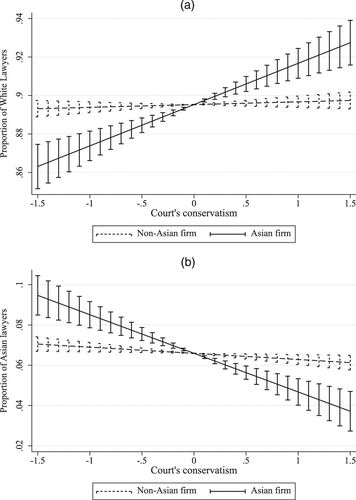
Notes. (a) Predicting proportion of White lawyers. (b) Predicting proportion of Asian lawyers.
In Table 4, we report the results testing Hypothesis 3, which predicted that Asian firms would be more likely than domestic firms to retain a higher proportion of majority-group lawyers when litigating in conservative venues with a history of favoring domestic firms. We first examine the interaction between Court’s Conservatism × Court’s Pro-Domestic Reputation within the Asian-firm subsample. The interaction is positive and significant when predicting the share of White lawyers (Model 1: b = 0.343, p = 0.016) and negative and significant when predicting the share of Asian lawyers (Model 4: b = −0.296, p = 0.012). These results indicate that Asian firms rely more on majority-group lawyers—and less on co-ethnic lawyers—when litigating in venues where ideological and historical signals jointly indicate heightened potential for anti-foreignness bias.
|
Table 4. OLS Regressions Predicting the Proportion of White (Asian) Lawyers
| (1) | (2) | (3) | (4) | (5) | (6) | |
|---|---|---|---|---|---|---|
| DV: Proportion of White lawyers | DV: Proportion of Asian lawyers | |||||
| Variables/litigants | Asian | U.S. | All | Asian | U.S. | All |
| Total number of litigants | −0.000 | 0.000 | 0.000 | 0.000* | −0.000** | −0.000* |
| (0.142) | (0.272) | (0.792) | (0.030) | (0.003) | (0.016) | |
| Total number of lawyers | 0.000 | −0.000+ | −0.000 | −0.000 | 0.000** | 0.000** |
| (0.299) | (0.081) | (0.285) | (0.242) | (0.000) | (0.001) | |
| Number of non-Asian foreign litigants | 0.000 | −0.000 | −0.000 | −0.000 | −0.000+ | −0.000+ |
| (0.214) | (0.441) | (0.299) | (0.406) | (0.085) | (0.092) | |
| Opposing side’s number of litigants | 0.000+ | −0.000 | −0.000 | −0.001** | 0.000 | −0.000 |
| (0.079) | (0.158) | (0.121) | (0.000) | (0.713) | (0.473) | |
| Opposing side’s number of Asian litigants | −0.002** | −0.000 | −0.000+ | 0.002** | −0.000 | 0.000 |
| (0.001) | (0.739) | (0.083) | (0.000) | (0.788) | (0.201) | |
| Opposing side’s number of non-Asian foreign litigants | −0.000 | −0.000 | 0.000 | 0.001* | 0.000 | 0.000 |
| (0.938) | (0.398) | (0.789) | (0.036) | (0.216) | (0.336) | |
| Plaintiff | 0.006 | 0.001 | 0.000 | −0.010 | −0.002 | −0.001 |
| (0.579) | (0.749) | (0.890) | (0.243) | (0.299) | (0.498) | |
| (log) Average case duration | 0.002 | −0.012* | −0.010* | 0.007 | 0.013** | 0.013** |
| (0.919) | (0.043) | (0.047) | (0.755) | (0.001) | (0.001) | |
| Average case volume | −0.000 | 0.000 | 0.000 | 0.000 | −0.000 | 0.000 |
| (0.327) | (0.967) | (0.920) | (0.236) | (0.922) | (0.915) | |
| Percentage of cases favoring plaintiffs | −0.000 | −0.000 | −0.000+ | 0.000 | 0.000 | 0.000 |
| (0.698) | (0.403) | (0.072) | (0.829) | (0.382) | (0.157) | |
| Percentage of settled cases | −0.001 | −0.000* | −0.000** | 0.000 | 0.000* | 0.000** |
| (0.152) | (0.041) | (0.006) | (0.411) | (0.025) | (0.008) | |
| Total number of judges | −0.000 | −0.000 | −0.000* | −0.000 | −0.000 | −0.000 |
| (0.939) | (0.112) | (0.048) | (0.263) | (0.166) | (0.241) | |
| Number of Asian judges | 0.003 | 0.000 | 0.001 | −0.002 | 0.001 | 0.001 |
| (0.410) | (0.675) | (0.393) | (0.398) | (0.133) | (0.389) | |
| Has local rules | 0.001 | 0.001 | 0.001 | −0.003 | −0.002 | −0.002 |
| (0.911) | (0.624) | (0.673) | (0.676) | (0.435) | (0.230) | |
| (log) Number of available lawyers | −0.013 | 0.005 | 0.005 | 0.011 | −0.002 | −0.002 |
| (0.451) | (0.225) | (0.207) | (0.470) | (0.624) | (0.538) | |
| (log) Number of available elite law school lawyers | 0.012 | 0.005 | 0.007* | −0.005 | −0.002 | −0.003 |
| (0.312) | (0.117) | (0.028) | (0.663) | (0.398) | (0.206) | |
| (log) Number of available Asian lawyers | −0.005 | −0.009** | −0.010** | −0.000 | 0.004+ | 0.005* |
| (0.755) | (0.003) | (0.000) | (0.989) | (0.069) | (0.016) | |
| Case filed by a high-volume plaintiff | −0.002 | −0.001 | 0.000 | 0.008 | 0.002 | 0.002 |
| (0.893) | (0.759) | (0.911) | (0.403) | (0.272) | (0.251) | |
| Court’s pro-business reputation | 0.003 | 0.015 | 0.011 | −0.041 | −0.021** | −0.020** |
| (0.941) | (0.143) | (0.218) | (0.183) | (0.009) | (0.005) | |
| Court’s pro-domestic reputation | 0.014 | −0.004 | −0.001 | −0.021 | −0.006 | −0.007 |
| (0.760) | (0.706) | (0.914) | (0.598) | (0.516) | (0.382) | |
| Court’s conservatism | −0.006 | −0.003 | −0.006 | 0.004 | 0.001 | 0.004 |
| (0.774) | (0.558) | (0.216) | (0.844) | (0.798) | (0.293) | |
| Court’s conservatism × Court’s pro-domestic reputation | 0.343* | 0.036 | 0.049* | −0.296* | −0.030 | −0.048* |
| (0.016) | (0.164) | (0.044) | (0.012) | (0.131) | (0.011) | |
| Asian firm × Court’s conservatism | −0.006 | 0.007 | ||||
| (0.687) | (0.571) | |||||
| Asian firm × Court’s pro-domestic reputation | −0.003 | −0.001 | ||||
| (0.943) | (0.986) | |||||
| Asian firm × Court’s conservatism × Court’s pro-domestic reputation | 0.209* | −0.191* | ||||
| (0.044) | (0.040) | |||||
| Constant | 0.934** | 0.950** | 0.949** | 0.016 | −0.008 | −0.004 |
| (0.000) | (0.000) | (0.000) | (0.929) | (0.796) | (0.875) | |
| Observations | 8,850 | 102,655 | 125,672 | 8,850 | 102,655 | 125,672 |
Notes. All fixed effects are included. p-values are presented in parentheses.
+p < 0.10; *p < 0.05; **p < 0.01.
In comparison, when restricting the sample to domestic U.S. firms (Models 2 and 5), the corresponding interaction is small and statistically insignificant (Model 2: b = 0.036, p = 0.164 for White lawyers; Model 5: b = −0.030, p = 0.131 for Asian lawyers). The coefficients for Court’s Conservatism × Court’s Pro-Domestic Reputation differ significantly between Asian and domestic U.S. firms (White lawyers: p = 0.036; Asian lawyers: p = 0.032). Finally, Models 3 and 6 in Table 4 draw on the full sample (including non-Asian foreign firms) and introduce the three-way interaction Asian Firm × Court’s Conservatism × Court’s Pro-Domestic Reputation. Consistent with our expectation, this interaction is positive and significant when predicting the share of White lawyers (b = 0.209, p = 0.044) and negative and significant when predicting the share of Asian lawyers (b = −0.191, p = 0.040).
Figure 2, (a) and (b), plots the predicted values from Models 1 and 2 with standard error bars. For Asian firms (Figure 2(a)), when courts have a high pro-domestic reputation (mean + 1 SD), the effect of political ideology on hiring White lawyers becomes more pronounced (slope = 0.062, p < 0.001). By contrast, when courts have a low pro-domestic reputation (mean − 1 SD), the effect of political ideology is statistically indistinguishable from zero (slope = 0.014, p = 0.370). For domestic U.S. firms (Figure 2(b)), the effect of political ideology is statistically insignificant regardless of courts’ pro-domestic reputation (low: slope = −0.001, p = 0.867; high: slope = 0.004, p = 0.201). Taken together, these findings support Hypothesis 3, showing that cue alignment by Asian firms is most pronounced when courts’ ideological and historical cues converge to signal heightened potential for anti-foreignness bias.
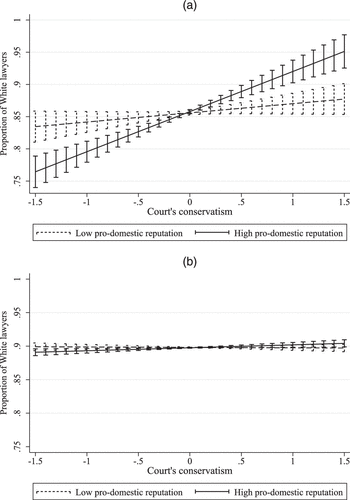
Notes. (a) Asian firm subsample. (b) Domestic (U.S.) firm subsample.
Supplemental Analyses
Implicit Bias Among Legal Professionals
To further assess whether political ideology plausibly captures variation in evaluative predispositions toward Asian firms, we examine evidence from the Asian-European American Implicit Association Test (IAT). Although judges are highly trained professionals expected to apply the law impartially, prior research shows that even sophisticated actors may exhibit perceptual biases under conditions of ambiguity and discretion (Guthrie et al. 2001, Englich et al. 2006). We therefore examine whether legal professionals’ political orientation is associated with implicit associations linking Asians to foreignness.
We draw on data from Project Implicit (Xu et al. 2025), focusing on respondents who self-identify as “Legal – Lawyers, Judges, and related workers.” This restriction yields 5,159 legal professionals who completed the Asian-European American IAT between 2006 and 2016, largely overlapping with our study period. The IAT measures the degree to which respondents automatically associate Asian Americans with “foreign” and European Americans with “American,” using the standard D-score metric (Greenwald et al. 2003). Positive values indicate a stronger implicit association of Asians with foreignness.
As shown in Table 5, legal professionals identifying as conservative display significantly stronger implicit associations between Asian Americans and “foreign” than those identifying as liberal. These results are robust to controls for age, gender, citizenship, residence, and period fixed effects. Although this analysis does not imply that judges act on such biases, it provides evidence that ideological orientation among legal professionals correlates with differential implicit associations consistent with the mechanism we theorize.14
|
Table 5. OLS Regressions Predicting Implicit Association Between Asians and Foreignness (IAT D Score)
| (1) | (2) | (3) | (4) | |
|---|---|---|---|---|
| DV: Implicit bias (IAT D score) | ||||
| Subsample of U.S. citizens residing in the United States | ||||
| Political conservatism | 0.025** | 0.025** | 0.024** | 0.025** |
| (0.000) | (0.000) | (0.000) | (0.000) | |
| Female | −0.065** | −0.061** | ||
| (0.000) | (0.000) | |||
| Age | 0.005** | 0.005** | ||
| (0.000) | (0.000) | |||
| Is a U.S. citizen | 0.064* | |||
| (0.024) | ||||
| Resides in the United States | −0.056+ | |||
| (0.064) | ||||
| Period FE | No | Yes | Yes | Yes |
| Constant | 0.184** | 0.211** | 0.039 | 0.068 |
| (0.000) | (0.001) | (0.593) | (0.367) | |
| Observations | 4,485 | 4,485 | 4,485 | 3,606 |
Notes. p-values are presented in parentheses. FE, fixed effect.
+p < 0.10; *p < 0.05; **p < 0.01.
Differentiating Co-Ethnic from Co-National Lawyers
We theorized cue alignment as a potential mechanism guiding Asian firms’ legal representation strategies. Under cue alignment, when litigating in conservative venues, Asian firms reduce their reliance on Asian legal representatives and increase their reliance on those from the majority (White) group. A possible counterargument, however, is that by doing so, firms may forfeit valuable benefits from hiring co-ethnic counsel, such as knowledge, networks, and cultural familiarity. Indeed, prior research and anecdotal evidence suggest that lawyers of Asian descent often specialize in serving Asian clients, who in turn may benefit from this familiarity when navigating the U.S. legal system (Pan 2015).
We examined this counterargument more closely by analyzing the specific ethnicities of Asian lawyers who were less likely to be selected. Building on prior work (Li et al. 2019, Li 2024), we anticipated that the greatest benefits of ethnic familiarity would arise when Asian lawyers share their clients’ country of origin. Specifically, Li et al. (2019) showed that Korean banks in China were more likely to invest in provinces with larger ethnic Korean (Chaoxian) communities, which helped them overcome barriers to doing business in China, whereas such communities had no effect on non-Korean banks’ location choices. Extending this logic, we expected that co-national Asian lawyers—those sharing a firm’s country of origin—would be less likely to be replaced than Asian lawyers whose ancestral origins differ from those of their client firms.
To test this intuition, we employed two complementary tools. First, we used the ethnicolr Wikipedia full-name model (Ambekar et al. 2009), which we previously used to classify lawyers into four broad U.S. racial/ethnic categories (Asian, Black, Hispanic, White). Second, we used the NamSor name-origin algorithm, which leverages onomastic and linguistic analysis to predict finer-grained national or ancestral origins (e.g., Chinese, Korean, Japanese, Indian) based on large multilingual data sets (Sebo 2023). Although NamSor often traces White American lawyers’ names to broader European ancestries (e.g., “Andrew Jay Miller” classified as Great Britain), it identifies specific country-of-origin ancestries for Asian lawyers with greater precision, making it particularly valuable in our context. Importantly, these are United States–based lawyers practicing in federal courts, whose names nonetheless signal ancestral origins in Asian countries. Using these two tools, we constructed two measures: (a) the proportion of Asian lawyers whose inferred ancestry matches that of the client firm (e.g., Korean-origin lawyers for a Korean firm), and (b) the proportion of Asian lawyers whose ancestry reflects a different Asian origin (e.g., Chinese- or Indian-origin lawyers for a Korean firm).
As shown in Table 6, the decrease in the proportion of Asian lawyers in conservative courts is driven primarily by those whose Asian ancestry differs from that of the client firm (Model 2: b = −0.036, p = 0.008). By contrast, the proportion of co-national lawyers (e.g., Korean-origin lawyers for Korean firms) does not vary with court ideology (Model 1: b = −0.001, p = 0.777). This pattern suggests that cue alignment does not entail completely forgoing the advantages of a shared background. Rather, foreign firms selectively manage their foreignness cues: they reduce their reliance on non-co-national Asian lawyers in conservative courts while maintaining some level of co-national hiring to provide cultural familiarity and ease communication. This finding aligns with our broader argument that Asian firms act as strategic chameleons in responding to potential bias in evaluation. They do not avoid Asian lawyers altogether but adjust their representation in a manner consistent with reducing the salience of foreignness without sacrificing the benefits of working with the co-national counsel.
|
Table 6. OLS Regressions Predicting the Proportion of Co-National and Non-Co-National Asian Lawyers
| (1) | (2) | |
|---|---|---|
| DV: Proportion of Co-National Asian lawyers | DV: Proportion of Non-Co-National Asian lawyers | |
| All control variables | Included | Included |
| All fixed effects | Included | Included |
| Court’s conservatism | −0.001 | −0.036** |
| (0.777) | (0.008) | |
| Constant | −0.026 | 0.013 |
| (0.795) | (0.946) | |
| Observations | 8,850 | 8,850 |
Notes. Sample restricted to Asian firms. Dependent variables are proportions of Asian lawyers representing the client. “Co-national Asian lawyers” refers to those whose inferred ancestry matches that of the client, whereas “Non-co-national Asian lawyers” refers to Asian lawyers from other national origins. p-values are presented in parentheses.
+p < 0.10; *p < 0.05; **p < 0.01.
Placebo Test Using Domestic-Looking Foreign Firms
One alternative explanation for our main result is that the higher share of White lawyers in conservative courts simply reflects differences in lawyers’ experience with conservative courts. If the lawyers most experienced with conservative courts are disproportionately White, then any foreign firm—Asian or otherwise—seeking high-quality representation would be expected to employ a higher proportion of White lawyers in those venues. To assess this possibility, we examine Canadian and British firms as a placebo group. Although these firms are foreign and thus face similar incentives to engage experienced counsel in conservative courts, they are culturally and ethnically closer to U.S. firms and lack the salient “foreignness” associated with Asian firms. Accordingly, they are not expected to engage in cue alignment (cf. Li 2024). If Canadian and British firms exhibit legal team composition patterns similar to those of Asian firms, such evidence would support the alternative explanation based on lawyers’ court experience.
The results in Table 7 show no systematic adjustment in the racial/ethnic composition of Canadian and British firms’ legal teams as court ideology varies (b = 0.019, p = 0.390; Model 1), and their patterns are statistically indistinguishable from those of domestic (U.S.) firms (b = −0.018, p = 0.375; Model 2). These findings help rule out the alternative explanation that White lawyers simply represent court-specific expertise in conservative courts. More generally, this placebo test points to a boundary condition of our theory: these alignments are likely to emerge only when foreignness is salient and visible. Such salience can arise from readily identifiable markers—such as national branding, executives’ ethnicity, or the composition of local representatives—that signal a firm’s foreign origin.
|
Table 7. OLS Regressions Predicting the Proportion of White Lawyers
| (1) | (2) | |
|---|---|---|
| DV: Proportion of White lawyers | ||
| Using only placebo group litigants | Using all non-Asian litigants | |
| All control variables | Included | Included |
| All fixed effects | Included | Included |
| Court’s conservatism | 0.019 | 0.001 |
| (0.390) | (0.804) | |
| Placebo (1 = is a British or Canadian firm) | (absorbed) | |
| Placebo × Court’s conservatism | −0.018 | |
| (0.375) | ||
| Constant | 0.847** | 0.952** |
| (0.006) | (0.000) | |
| Observations | 2,929 | 116,822 |
Note. p-values are presented in parentheses.
+p < 0.10; *p < 0.05; **p < 0.01.
Testing Key Theoretical Assumptions, Alternative Explanations, and Counterarguments
In Online Appendix E, we report additional contextual evidence consistent with our theoretical assumption that conservative environments are associated with less favorable portrayals of Asian firms. Using RavenPack news sentiment data, we show that news reports on the same cases featuring Asian firms are systematically more negative in local outlets located in judicial districts characterized by higher levels of political conservatism than in more liberal districts.
In Online Appendix F, we address two alternative explanations and one counterargument. First, we test whether the observed disadvantage pattern reflects a more specific anti-Chinese sentiment. Second, we examine whether Asian firms might be responding to courts’ pro-business reputation rather than their pro-domestic orientation. Third, we evaluate whether our findings could instead reflect the presence of Asian judges rather than courts’ ideological or reputational characteristics. The results indicate that neither the alternative explanations nor the counterargument materially accounts for the patterns reported in the main text (see Online Appendix F for full model specifications and detailed results).
Analysis of Case Outcomes
Our theory positions lawyer selection as Asian firms’ strategic response to anticipated anti-foreignness bias in U.S. courts. In additional analyses, we explored whether the disadvantages that Asian firms anticipate in conservative courts are actually realized, and whether cue alignment can mitigate these disadvantages. In analyzing whether cue alignment shapes firms’ likelihood of success, we use case resolution data from Lex Machina, which classifies outcomes through a combination of automated coding and expert review. We construct a binary variable Win equal to one when the focal side (plaintiff or defendant) obtained the better overall outcome—based on damages, remedies, and findings—and zero otherwise.15 In our sample, 13.1% of cases resulted in judgments (8.7% for plaintiffs and 4.4% for defendants), 70.9% were settled, and 15.8% were terminated on procedural grounds such as transfers or consolidations. Fewer than 0.2% of cases remained pending at the time of data analysis (more than 100 months after the end of the study period). Following prior work (e.g., Uribe et al. 2020), we use the case-side (plaintiff or defendant) as the unit of analysis, aggregating all parties and their representation on a given side. We do so because the case outcomes are specific to the plaintiff or defendant side, and litigants on the same side typically coordinate to present a unified narrative to the court. Each case, therefore, produces two observations: one for the plaintiff side and one for the defendant side. To account for the nonindependence of observations within cases, we cluster standard errors at the case level.
We report the results in Table 8. Models 1 and 2 establish the presence of disadvantages for Asian firms in litigation. Because these analyses are aggregated at the plaintiff/defendant side, we count the Number of Asian Litigants. Asian firms are significantly less likely to win in conservative courts, providing empirical evidence consistent with firms’ anticipation of anti-foreignness bias. Their likelihood of prevailing decreases in conservative venues both in the full sample (Model 1) and when excluding settled cases (Model 2). Non-Asian foreign firms (e.g., German or Mexican firms) exhibit a similar pattern (Model 3), consistent with prior research showing that court ideology systematically shapes legal outcomes for foreign litigants (Choudhury et al. 2025).
|
Table 8. Logistic Regressions Predicting Win
| (1) | (2) | (3) | (4) | (5) | |
|---|---|---|---|---|---|
| Win | Win | Win | Win | Win | |
| All control variables | Yes | Yes | Yes | Yes | Yes |
| Variables/cases | All | Nonsettled | All | No magistrate | No magistrate |
| Court’s conservatism | −0.159** | −0.189** | −0.141** | ||
| (0.002) | (0.000) | (0.007) | |||
| Presiding judge’s conservatism | −0.089 | −0.025 | |||
| (0.361) | (0.245) | ||||
| Number of Asian litigants | −0.012** | −0.009* | −0.008** | −0.024 | −0.007 |
| (0.001) | (0.046) | (0.010) | (0.463) | (0.216) | |
| Number of non-Asian foreign litigants | 0.017** | 0.012** | 0.012** | 0.017** | 0.017** |
| (0.000) | (0.006) | (0.002) | (0.000) | (0.000) | |
| Court’s conservatism × Number of Asian litigants | −0.027** | −0.024* | |||
| (0.001) | (0.048) | ||||
| Court’s conservatism × Number of non-Asian foreign litigants | −0.043** | ||||
| (0.000) | |||||
| Proportion of White lawyers | −0.216** | ||||
| (0.007) | |||||
| Proportion of Asian lawyers | 0.249** | ||||
| (0.009) | |||||
| Presiding judge’s conservatism × Number of Asian litigants | −0.096* | 0.014+ | |||
| (0.013) | (0.051) | ||||
| Presiding judge’s conservatism × Proportion of White lawyers | 0.068 | ||||
| (0.522) | |||||
| Number of Asian litigants × Proportion of White lawyers | 0.018 | ||||
| (0.646) | |||||
| Presiding judge’s conservatism × Number of Asian litigants × Proportion of White lawyers | 0.111* | ||||
| (0.017) | |||||
| Presiding judge’s conservatism × Proportion of Asian lawyers | −0.041 | ||||
| (0.746) | |||||
| Number of Asian litigants × Proportion of Asian lawyers | −0.017 | ||||
| (0.707) | |||||
| Presiding judge’s conservatism × Number of Asian litigants × Proportion of Asian lawyers | −0.144** | ||||
| (0.006) | |||||
| Constant | −1.972** | −2.929** | −1.992** | −1.847** | −2.040** |
| (0.000) | (0.000) | (0.000) | (0.001) | (0.000) | |
| Observations | 84,962 | 24,572 | 84,962 | 73,619 | 73,619 |
Notes. All models include the control variables from the main analysis and filing-year fixed effects. p-values are reported in parentheses. Models 1 and 3 use all cases; Model 2 uses only nonsettled cases. Models 4 and 5 exclude cases entirely presided over by a magistrate judge as well as cases with missing information on the proportions of White or Asian lawyers. Because each case produces two observations (plaintiff side and defendant side), the sample size is typically even; however, in Models 4 and 5, missing data on the proportion of White or Asian lawyers for one side of a case result in an odd number of observations. Zero-imputing the missing values for these variables yields qualitatively similar results.
+p < 0.10; *p < 0.05; **p < 0.01.
Next, Models 4 and 5 test whether the representation adjustments associated with cue alignment can attenuate this disadvantage. The three-way interaction between Presiding Judge’s Conservatism × Number of Asian Litigants × Proportion of White Lawyers is positive and significant (b = 0.111, p = 0.017), indicating that as the share of White lawyers increases, the negative effect of judicial conservatism on Asian firms’ likelihood of winning weakens. Conversely, the corresponding interaction with Proportion of Asian Lawyers is negative and significant (b = −0.144, p = 0.006), suggesting that reliance on co-ethnic lawyers amplifies the disadvantage in conservative courts.
To visualize these conditional effects, Figure 3 presents Johnson-Neyman plots showing the marginal effect of judicial conservatism on the likelihood of winning (Win) across the full range of lawyer composition, with shaded 95% confidence intervals indicating where the effect is statistically distinguishable from zero. As shown in Figure 3(a) (based on Model 4), conservatism significantly reduces Asian firms’ likelihood of winning when the share of White lawyers is low. As this share increases, however, the negative slope weakens and becomes indistinguishable from zero, suggesting that cue alignment can offset the disadvantage. By contrast, when Asian firms rely more heavily on co-ethnic lawyers, conservatism sharply reduces their likelihood of winning (Figure 3(b); Model 5). For cases without Asian firms, this effect remains statistically null across the full range of White- and Asian-lawyer representation (Figure 3, (c) and (d); Models 4–5).16
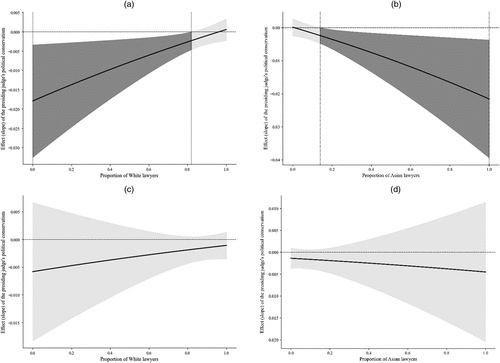
Notes. The Johnson-Neyman figures illustrate the regions of the moderating variable on the x-axis within which the relationship between the predictor (presiding judge’s political conservatism) and the dependent variable (Win) is statistically different from zero at the α = 0.05 level. Darker gray areas indicate values where the conditional effect of presiding judge conservatism is statistically significant, whereas lighter gray areas indicate values where the effect is not significant at the α = 0.05 level. (a) Proportion of White lawyers (cases involving Asian firms). (b) Proportion of Asian lawyers (cases involving Asian firms). (c) Proportion of White lawyers (no Asian firms). (d) Proportion of Asian lawyers (no Asian firms).
Taken together, these findings indicate that the changes in representation associated with cue alignment can materially mitigate the disadvantage of Asian litigants in conservative courts. By adjusting the ethnic composition of their legal teams in ways consistent with reducing the salience of foreignness, foreign firms can attenuate disadvantages associated with judicial conservatism. These results are consistent with cue alignment and show that the racial/ethnic composition of legal teams can influence litigation outcomes.
Discussion
This study was motivated by the question of whether and how foreign firms respond to anticipated anti-foreignness bias when competing in domestic arenas. We find that Asian firms attend to signals in the evaluative environment and adjust their strategies accordingly. In doing so, firms draw on two complementary signals of potential anti-foreignness bias: evaluators’ track record of prior decisions toward foreign firms and evaluators’ political ideology. When these signals converge, indicating both a pro-domestic track record and political conservatism, the composition of foreign firms’ legal representation changes in ways consistent with reducing the salience of foreignness.
Specifically, in the context of U.S. patent infringement litigation, we find that foreign firms pursue cue alignment by adjusting the ethnic composition of their litigation teams. Specifically, we show that Asian firms reduce the share of Asian-origin lawyers and increase the share of White lawyers in conservative courts, whereas domestic firms exhibit no comparable adjustments. This pattern is especially pronounced in conservative courts with a pro-domestic ruling history. In such venues, Asian firms retain legal teams with a higher proportion of White lawyers and a lower proportion of Asian-origin lawyers, attenuating the salience of foreignness.
Contrary to our initial expectation that courts’ pro-domestic ruling histories would independently predict cue alignment, we find that ruling history matters only in interaction with judicial ideology. Conversely, judicial conservatism, on its own, is associated with greater cue alignment by Asian firms. However, as courts exhibit weaker pro-domestic track records, the effect of judicial conservatism on the ethnic composition of Asian firms’ litigation teams weakens, suggesting that cue alignment becomes less pronounced when the two signals point in different directions. By contrast, when a court’s pro-domestic history converges with conservative judicial ideology, we observe stronger efforts at cue alignment.
This pattern indicates that ruling histories and ideology operate as complementary signals of anticipated anti-foreignness bias. Political ideology suggests that conservative courts may be less favorable toward foreign firms, prompting baseline adjustments in representation. Courts’ prior decisions, in turn, offer a relatively transparent record of how foreign firms have actually been treated. When these two signals align, they sharpen firms’ anticipation of anti-foreignness bias. In this sense, track records strengthen the inference that conservative ideology will translate into pro-domestic decision-making.
Interestingly, we found that Asian firms engage in cue alignment while preserving the advantages of national homophily. These advantages are known to include shared social capital, cultural fluency, and the tacit knowledge of the client (Li et al. 2019, Li 2024). Specifically, when reconstituting their legal teams toward majority (White) representation in conservative venues, Asian firms do not forgo lawyers from their own country of origin. Instead, they are less likely to recruit Asian lawyers from countries other than their own. Combined with additional analyses showing that such variation in counsel selection is unlikely to be driven by differences in legal expertise, cue alignment suggests that Asian firms behave as “legal chameleons.” They adapt the ethnic composition of their representatives to respond to potential anti-foreignness bias, while preserving the associated benefits of ethnic homophily between principals and agents.
Our analyses further reveal that the representation adjustments associated with cue alignment have tangible consequences: Asian firms that employ this strategy are better able to mitigate the evaluative disadvantage they face. Specifically, we find that cue alignment is associated with a higher likelihood of favorable judicial rulings in cases presided over by more conservative judges. These findings suggest that adjusting visible identity cues can shape outcomes by responding to evaluators’ anticipated predispositions. It is important to note in this respect that the responses can have far-reaching consequences. Because many multinational enterprises litigate intellectual property disputes in U.S. courts, the outcomes of these actions reverberate globally and shape competitive dynamics worldwide (Beukel and Zhao 2018).
With these findings, the present study makes several contributions. First, we advance research on the liability of foreignness by identifying a strategic mitigation mechanism that foreign firms can deploy when such liability arises from unfavorable evaluations. Evaluative disadvantage constitutes one of the central pathways—alongside deficits in financial and material resources, knowledge, and local social capital—through which firms incur the liability of foreignness (Edman 2016). The present study demonstrates how firms can manage symbolic identity cues in settings marked by ideological predispositions and discretion in evaluation. This mechanism complements prior research showing how foreign firms mitigate the liability of foreignness when it stems from resource and knowledge constraints (Zaheer 1995, Eden and Miller 2004).
Our study shows that firms respond to a perception-based channel of liability of foreignness in evaluative settings by adjusting the visible composition of their outward-facing agents. When litigating in the United States, Asian firms recalibrate the ethnic composition of their legal teams in anticipation of anti-foreignness bias signaled by courts’ ideological orientations and ruling histories. Our study also situates the disadvantages associated with foreignness as varying across both evaluative venues and Asian firms. In particular, our findings show that foreign firms, especially firms with a salient foreign identity, face more pronounced disadvantages in ideologically conservative evaluative settings. Building on prior work that highlights the legitimacy and certification benefits of employing local lobbyists when operating abroad (Kim 2019), our study suggests that the selection of local agents is more nuanced and varies with the ideological and reputational characteristics of the specific audience facing foreign firms.
Our findings also highlight heterogeneity in the liability of foreignness. The liability of foreignness is not distributed evenly across foreign firms; firms from some countries or regions experience greater disadvantages because of historical, racial, ethnic, religious, or geopolitical factors. Our study suggests that even highly trained legal professionals tend to associate Asian litigants with greater foreignness, and supplemental analyses further show that cases involving more Asian litigants are less likely to succeed in more conservative courts. These findings have implications beyond the immediate context of legal representation: the liability of foreignness may depend not simply on whether a firm is foreign but also on how strongly its country or region of origin is associated with foreignness in a particular domestic context. Collectively, they provide an empirical foundation for future research on the liability of foreignness, country-of-origin bias, ethnic bias, and nationalism in organizations (Edman 2016, Yue et al. 2024, Yue and Takeda 2025).
Second, we extend research on organizational identity, legitimacy, and impression management by theorizing firms’ selection of external agents based on visible, salient identity cues as a distinct form of impression management. Prior work shows that organizations shape external judgments by influencing how audiences interpret their actions (Dutton and Dukerich 1991, Elsbach and Sutton 1992, Gioia et al. 2000). Much of this research examines how firms manage perceptions through symbolic signaling, framing, and strategic disclosure (e.g., Brown et al. 2006, Tracey and Phillips 2016). Building on these insights, we demonstrate that firms strategically adjust the visible identity cues of the agents who represent them in evaluative arenas. We conceptualize these agent-selection dynamics as cue alignment, defined as the strategic adjustment of outward-facing identity signals to better match evaluators’ schemas and expectations. This mechanism is consistent with research on categorization and evaluation, which shows that even sophisticated professionals rely on category-based expectations and prototypicality judgments when assessing ambiguous cases (Hsu and Hannan 2005, Kovács and Sharkey 2014). Visible identity cues can activate these expectations, shaping how claims are interpreted through evaluators’ judgments of appropriateness, credibility, and authority (Tost 2011, Hahl and Zuckerman 2014).
Prior research showed that individuals and organizations sometimes disguise or downplay stigmatized identities to preempt a disadvantage in evaluation. In the 1920s, for instance, record companies used pseudonyms to mask African American artists’ identities, preserving legitimacy when marketing jazz to elite audiences (Phillips and Kim 2009). Similarly, racial-minority job seekers strategically “whiten” resumes—adopting White-sounding names and omitting minority-signaling details—to reduce the risk of discrimination (Kang et al. 2016). Extending this research, we show that organizations need not conceal identity outright. Cue alignment does not “fool” evaluators or conceal underlying foreign identity. Rather, it modulates the salience of foreignness, thereby influencing how the foreign actor is perceived, an effect that can carry meaningful consequences in settings where evaluators are pro-domestic or conservative and have discretion in evaluation. Beyond patent litigation, similar dynamics may arise in other evaluative settings where foreign identity cues are visible and salient and where evaluators have discretion. These could involve other forms of firms’ legal and regulatory action in the host country, efforts to secure host-country government contracts, or attempts to obtain venture funding (Hegde and Tumlinson 2014, Kim 2019, Wright et al. 2023).
Third, we extend research examining how political ideologies shape a range of organizational actions and outcomes, including progressive policy adoption, engagement with social movements, and advances in corporate social responsibility (e.g., Briscoe et al. 2014, Gupta et al. 2017, Gupta and Briscoe 2020, McDonnell and Cobb 2020). Building on prior work that focuses on how ideology shapes firms’ own actions, we shift attention to ideology as a feature of domestic institutions that evaluate firms. In our setting, courts’ ideological orientations, together with courts’ ruling histories, function as observable signals that foreign firms use to anticipate anti-foreignness bias and to adjust their representation accordingly. Yue and Wang (2024) show that when firms are exposed to unfavorable regulations from a given authority, they seek ideologically distant alternative authorities and those that implemented favorable regulations in the past, seeking to nullify unfavorable regulations. Our work shows that firms can attend to the very same signals of ideology and past actions, including concurrently, while selecting representatives to influence how they are evaluated within the same venue. Future research could examine when and how the different institutional signals, and the extent to which they converge, can shape firms’ responses in a given venue or a decision to seek an alternative venue altogether.
We extend these insights to emerging research on firms’ strategic engagement with legal and regulatory institutions. Prior research has shown that firms respond strategically to features of their legal and regulatory environments (Hiatt and Park 2013, Sytch and Kim 2021, Yue and Wang 2024, Sytch and Kallapur 2025). We show that such engagement can also involve the strategic deployment of external agents: foreign firms adjust who represents them in response to observable features of domestic evaluative institutions that signal potential anti-foreignness bias. In this way, strategic engagement with legal and regulatory institutions can help foreign firms mitigate disadvantages they face in consequential domestic evaluative arenas. At the same time, these strategies may generate unintended labor-market consequences, as efforts to manage visible markers of foreignness can limit opportunities for minority professionals, including lawyers, bankers, and consultants (cf. Kulchina and Oxley 2020, Uribe et al. 2020, Carnahan et al. 2022).
One limitation of our study is that our data do not allow us to directly observe whether or how judges perceive and respond to changes in the ethnic composition of claimants’ legal teams during legal proceedings. Although our supplementary evidence indicates that legal professionals are not immune to anti-foreignness bias, our analyses do not directly capture the perceptual mechanism underlying the observed effects. Examining this mechanism would require a different research design capable of capturing judges’ perceptions and decision-making in real time. Although such a design may be difficult to implement in legal settings, future research could investigate this mechanism in other contexts that permit researchers to directly observe how evaluators perceive and respond to changes in visible identity cues.
Our findings entail two key boundary conditions. First, cue alignment is not a universal remedy for the liability of foreignness. It operates only in settings where such liability arises from evaluators’ judgments based on the foreign identity of the actors being evaluated. Cue alignment is likely to be effective when it can influence salient markers of foreign identity. Our results show evidence of cue alignment for Asian firms litigating in the United States, but not for British and Canadian firms. We interpret this difference in terms of the salience of foreign identity markers, which may include visible ethnic characteristics and language. Beyond the liability of foreignness, we encourage future research to examine this boundary condition more closely by identifying which specific identity markers define the threshold of salience.
The second boundary condition concerns the presence of discretion in evaluation. Many settings are characterized by varying degrees of such discretion. Laws and regulations are often incomplete or conflicting (Sytch and Kallapur 2025), the evaluation of cultural products is inherently ambiguous (Kovács and Sharkey 2014), and even assessments of products and services in the knowledge-based economy can be shaped by uncertainty regarding their underlying quality (Podolny 1994, Sytch 2025). In each of these contexts, we expect cue alignment to operate. However, our arguments are less applicable in settings characterized by strong consensus regarding symbolic structures, evaluative criteria, and outcomes, such as mathematics, engineering, or the life sciences (e.g., Csikszentmihályi 1996), or in contexts involving purely mechanistic evaluations of unambiguous actions, such as counting sit-ups in a physical test or tallying the number of sales calls made. Such conditions attenuate or outright remove discretion in evaluation, which is central to the mechanism we theorize.
Taken together, our findings underscore that the liability of foreignness is not merely endured but can be strategically managed through the calibration of identity signals in evaluative settings. In doing so, they open new pathways for future explorations into how foreign identity, its salience, and discretion in evaluation jointly shape outcomes for foreign actors.
The authors thank Steve Boivie, Yonghoon Lee, Krishnan Nair, Chris Rider, and Haram Seo, as well as the seminar participants at Boston University, Columbia University, Indiana University, Texas A&M University, University of Arkansas, University of Michigan, and participants at the Academy of Management Annual Meeting and the Migration and Organizations Conference for helpful comments on this paper. The authors also thank Editor Mae McDonnell for her outstanding editorial guidance and two anonymous reviewers for their constructive comments, and the authors are grateful to Nick Batarilo, Jingyuan Li, and Yuwen Zhang for expert research assistance.
1 In line with the liability-of-foreignness research, we frame our arguments in terms of disadvantages faced by foreign firms, although in our context these dynamics could also be described as advantages held by domestic opponents. Similarly, we use the term anti-foreignness bias rather than pro-domestic bias to characterize the underlying evaluative predisposition, while recognizing that the two can be difficult to distinguish in our setting. We elaborate on this distinction in the Theory section.
2 Our empirical setting covers a period (2000–2016) prior to the Supreme Court’s decision in TC Heartland LLC v. Kraft Foods Group Brands LLC (2017), which substantially restricted venue shopping in patent litigation. Before this ruling, venue rules were highly permissive. Courts routinely accepted jurisdiction based on interactive commercial activity, and under 28 U.S.C. §1391(d), foreign defendants could be sued in any district. As a result, foreign firms frequently litigated across multiple courts rather than being tied to a single “home” court. Although firms possessed some discretion in court selection during this period, our theoretical interest lies in firms’ choice of legal counsel in a given court, rather than in the choice of the court.
3 In the process of our research, we conducted six semistructured interviews with corporate counsel and external legal counsel. Throughout the paper, we use the terms litigant and firm interchangeably to refer to the litigating company (i.e., the corporate party serving as plaintiff or defendant in a case). To avoid confusion, law firm is used exclusively to denote external legal counsel.
4 We note that political ideology can reflect different orientations: favoring domestic actors, disfavoring foreign ones, or both. Conceptually, evaluators may be high or low in both orientations. For example, the cosmopolitan stance advocates for a “sane patriotism” which is subsumed by a greater affinity for the entire human race (Sabet-Esfahani 2014). In our context, however, as in many competitive and zero-sum arenas, favoritism toward domestic firms comes at the expense of foreign firms. We therefore treat pro-domestic and anti-foreign orientations as functionally indistinguishable in our theorizing. An important area for future research is to identify contexts where pro-domestic and anti-foreign orientations may be conceptually separated.
5 We thank an anonymous reviewer for raising this point.
6 Patent infringement involves making, using, offering to sell, selling within the country, or importing into the country a patented invention without authority to do so during the term of the patent (35 U.S.C. §271(a)).
7 In 2017 and 2019, the OCE and the USPTO released the Patent Litigation Docket Reports Data for public use, covering 81,350 patent infringement cases filed from 1963 to 2016 (https://www.uspto.gov/learning-and-resources/electronic-data-products/patent-litigation-docket-reports-data). One significant limitation of the OCE database, however, is that it directly extracts party and attorney names from the Public Access to Court Electronic Records (PACER) system without standardizing or reconciling spelling variants, abbreviations, or name changes over time. By contrast, Lex Machina normalizes attorney, law-firm, and litigant names to correct misspellings and inconsistencies, providing consistent identifiers for cases filed since 2000. Another consideration is that our study requires access to underlying court filings to retrieve information such as party addresses from complaints. Although such documents are publicly available through PACER, access involves per-page fees, whereas Lex Machina provides complimentary research accounts for qualified academic users. We therefore limited our sample to patent infringement cases filed between 2000 and 2016.
8 Because the hiring of Asian lawyers can be affected by their local availability, all models include a control variable for the count of available Asian lawyers in the jurisdiction.
9 We estimated the ethnic origin of lawyers from their names, and thus were unable to correctly classify lawyers who identify as Asians but have non-Asian last names. Similarly, our method would incorrectly classify non-Asian lawyers with Asian last names as Asian. The resulting measurement error is unlikely to be systematically correlated with our key variables of interest, mitigating the risk of estimation bias.
10 This “Other Contract” category excludes insurance, tort, product liability, and franchise cases, where the defendant is often an individual person rather than a company. Although the FJC data do not disclose the full list of plaintiffs and defendants, our preliminary coding suggests that in the vast majority of these contract cases involving a U.S. firm and a foreign party, the foreign defendant was a company.
11 An alternative way to operationalize this variable would be to restrict the sample to historical cases featuring domestic corporate plaintiffs against Asian defendants, which would help isolate whether courts have been historically more hostile toward certain foreign countries than others. Unfortunately, the FJC Integrated Database codes only broad citizenship categories that distinguish between U.S. and foreign parties but not specific nationalities (e.g., Japanese, Korean, and Chinese). Nationality can sometimes be inferred from the case title, but only for the lead litigant. Obtaining reliable national-origin data for all parties would require manually accessing and coding the underlying PACER dockets, which becomes cost-prohibitive when applied at scale. We acknowledge this as a limitation of our measure and note that future research could refine it as more historical docket data become digitized, systematically linked to other identifiers, and made affordable to researchers.
12 We are sensitive to the high correlations among some control variables. To address this, we report models both with and without controls. We also reran the analyses after removing moderately to highly correlated controls (those with bivariate zero-order correlations above 0.30 with other variables; cf. Kalnins and Praitis Hill 2025) and found qualitatively similar results. In addition, we computed the robustness-of-inference-to-replacement (RIR) statistics (Busenbark et al. 2021). RIR quantifies how much omitted-variable bias would be required to invalidate the statistical inference. For Hypothesis 2, about 25% of the interaction effect would need to be replaced to overturn the inference; for Hypothesis 3, about 19% would need to be replaced. High RIR values in our analyses reduce concern that the results are artifacts of unobserved bias or omitted variables.
13 To calculate these numbers, we multiplied the estimated one-SD changes in lawyer composition by the number of Asian-firm cases and their average team size: 8,850 Asian firm-case pairings in the regression sample × 19.05 average unique lawyers per firm-case in the Asian-firm subsample × 0.008 (ΔWhite share) and 0.007 (ΔAsian share).
14 Prior research has administered IATs directly to judges. For example, Levinson et al. (2017) report that federal and state judges exhibit moderate to strong implicit stereotypes against Asian Americans. Rachlinski et al. (2009) similarly document implicit racial bias among judges, though their analysis focuses on pro-White and anti-Black preferences rather than Asian-specific associations. These studies do not examine whether such implicit associations vary systematically by political ideology, which is the focus of our analysis.
15 For details, please see https://law.lexmachina.com/help/documentation/district-court/resolutions. Other case resolutions include loss, settlement, and procedural resolutions.
16 We also examined whether non-Asian foreign firms benefit from cue alignment by strategically managing the ethnic composition of their external counsel. The results show that increasing the proportion of White lawyers (b = −0.060, p = 0.234) or Asian lawyers (b = 0.061, p = 0.322) does not materially alter outcomes for non-Asian foreign firms in conservative courts. These null results, combined with the aforementioned placebo test, suggest an important boundary condition: adjustments in representation are most pronounced when evaluators’ predispositions are explicitly tied to the salience of foreignness.
References
- (2009) Name-ethnicity classification from open sources. Elder JF IV, Fogelman-Soulié F, Flach PA, Zaki MJ, eds. Proc. 15th ACM SIGKDD Internat. Conf. Knowledge Discovery Data Mining (Association for Computing Machinery, New York), 49–58.Google Scholar
American Intellectual Property Law Association (2019) Report of the economic survey, 2019. Report, American Intellectual Property Law Association, Arlington, VA.Google Scholar- (2014) Innovation in emerging markets: The role of management consulting firms. J. Internat. Management 20(4):390–405.Crossref, Google Scholar
- (1997) The Puzzle of Judicial Behavior (University of Michigan Press, Ann Arbor).Crossref, Google Scholar
- (2006) Judges and Their Audiences: A Perspective on Judicial Behavior (Princeton University Press, Princeton, NJ).Google Scholar
- (2018) IP litigation is local, but those who litigate are global. J. Internat. Bus. Policy 1(1):53–70.Crossref, Google Scholar
- (2007) The home court advantage in international corporate litigation. J. Law Econom. 50(4):625–660.Crossref, Google Scholar
- (2014) Mapping the ideological marketplace. Amer. J. Political Sci. 58(2):367–386.Crossref, Google Scholar
- (2017) A common-space scaling of the American judiciary and legal profession. Political Anal. 25(1):114–121.Crossref, Google Scholar
- (2014) Finding the signal in the noise: Information governance, analytics, and the future of legal practice. Richmond J. Law Tech. 20(2):1–32.Google Scholar
- (2014) CEO ideology as an element of the corporate opportunity structure for social activists. Acad. Management J. 57(6):1786–1809.Crossref, Google Scholar
- (2019) Growing share of Republicans say U.S. risks losing its identity if it is too open to foreigners. Retrieved November 5, 2026, https://www.pewresearch.org/short-reads/2019/07/17/growing-share-of-republicans-say-u-s-risks-losing-its-identity-if-it-is-too-open-to-foreigners/.Google Scholar
- (2006) Identity, intended image, construed image, and reputation: An interdisciplinary framework and suggested terminology. J. Acad. Marketing Sci. 34(2):99–106.Crossref, Google Scholar
- (1956) Perception and the Representative Design of Psychological Experiments, 2nd ed. (University of California Press, Berkeley).Crossref, Google Scholar
- (2018) Political connections, the liability of foreignness, and legitimacy: A business historical analysis of multinationals’ strategies in Chile. Global Strategy J. 8(3):399–420.Crossref, Google Scholar
- (2025) Asian tech giants lead U.S. patent rankings. R&D World (January 16). Retrieved November 5, 2026, https://www.rdworldonline.com/asia-leads-in-u-s-patents-in-2024-while-u-s-grants-show-signs-of-recovery/.Google Scholar
- (2021)
Quantifying the robustness of empirical inferences in strategic management: The impact threshold of a confounding variable and robustness of inference to replacement . Hill AD, Lê JK, McKenny AF, O’Kane P, Paroutis S, Smith AD, eds. Research in Times of Crisis: Research Methods in the Time of Covid-19. Research Methodology in Strategy and Management, vol. 13 (Emerald Publishing, Bognor Regis, UK), 123–150.Crossref, Google Scholar - (2022) Do managers’ affiliation ties have a negative relationship with subordinates’ interfirm mobility? Evidence from large U.S. law firms. Organ. Sci. 33(1):353–372.Link, Google Scholar
- (2019) Judicial analytics and the great transformation of American law. Artificial Intelligence Law 27(1):15–42.Crossref, Google Scholar
- (2005) Where are you really from? Asian Americans and identity denial. J. Personality Soc. Psych. 89(5):717–730.Crossref, Google Scholar
- (2017) Sleepy punishers are harsh punishers: Daylight saving time and legal sentences. Psych. Sci. 28(2):242–247.Crossref, Google Scholar
- (2025) Economic nationalism and the home court advantage. Strategic Management J. 46(1):242–272.Crossref, Google Scholar
- (2003) When is more better? The effects of racial composition on voluntary turnover. Organ. Sci. 14(5):483–496.Link, Google Scholar
- (2009) Defining the circle of we: American identity and immigration policy. Forum 7(3):1–20.Google Scholar
- (1996) Xenophilia in American courts. Harvard Law Rev. 109(5):1120–1143.Crossref, Google Scholar
- (2019) Turning lead into gold: How do entrepreneurs mobilize resources to exploit opportunities? Acad. Management Ann. 13(1):240–271.Crossref, Google Scholar
- (2014) On the precipice of a “majority-minority” America: Perceived status threat from the racial demographic shift affects White Americans’ political ideology. Psych. Sci. 25(6):1189–1197.Crossref, Google Scholar
- (1996) Creativity: Flow and the Psychology of Discovery and Invention (HarperCollins, New York).Google Scholar
- (2011) Extraneous factors in judicial decisions. Proc. Natl. Acad. Sci. USA 108(17):6889–6892.Crossref, Google Scholar
- (2013) Economic nationalism in mergers and acquisitions. J. Finance 68(6):2471–2514.Crossref, Google Scholar
- (1991) Keeping an eye on the mirror: Image and identity in organizational adaptation. Acad. Management J. 34(3):517–554.Crossref, Google Scholar
- (2004)
Distance matters: Liability of foreignness, institutional distance and ownership strategy . Hitt MA, Cheng JLC, eds. Theories of the Multinational Enterprise: Diversity, Complexity and Relevance, Advances in International Management, vol. 16 (Emerald Publishing, Bognor Regis, UK), 187–221.Google Scholar - (2016) Reconciling the advantages and liabilities of foreignness: Toward an identity-based framework. J. Internat. Bus. Stud. 47(6):674–694.Crossref, Google Scholar
- (1992) Acquiring organizational legitimacy through illegitimate actions: A marriage of institutional and impression management theories. Acad. Management J. 35(4):699–738.Crossref, Google Scholar
- (2006) Playing dice with criminal sentences: The influence of irrelevant anchors on experts’ judicial decision making. Personality Soc. Psych. Bull. 32(2):188–200.Crossref, Google Scholar
- (2013) The Behavior of Federal Judges: A Theoretical and Empirical Study of Rational Choice (Harvard University Press, Cambridge, MA).Google Scholar
- (2022) Shaping nascent industries: Innovation strategy and regulatory uncertainty in personal genomics. Admin. Sci. Quart. 67(4):915–967.Crossref, Google Scholar
- (2007) Survival of the foreign subsidiaries of TMNCs: The influence of business group affiliation. J. Internat. Management 13(3):278–295.Crossref, Google Scholar
- (2000) Organizational identity, image, and adaptive instability. Acad. Management Rev. 25(1):63–81.Crossref, Google Scholar
- (2026) When do judges throw the book at companies? The influence of partisanship in corporate prosecutions. Rev. Financial Stud., advance article February 19, https://doi.org/10.1093/rfs/hhaf027.Google Scholar
- (2003) Understanding and using the implicit association test: I. An improved scoring algorithm. J. Personality Soc. Psych. 85(2):197–216.Crossref, Google Scholar
- (2020) Organizational political ideology and corporate openness to social activism. Admin. Sci. Quart. 65(2):524–563.Crossref, Google Scholar
- (2017) Red, blue, and purple firms: Organizational political ideology and corporate social responsibility. Strategic Management J. 38(5):1018–1040.Crossref, Google Scholar
- (2015) Entrepreneurship in regulated markets: Framing contests and collective action to introduce pay TV in the U.S. Acad. Management J. 58(6):1709–1739.Crossref, Google Scholar
- (2001) Inside the judicial mind. Cornell Law Rev. 86(4):777–830.Google Scholar
- (2014) The denigration of heroes? How the status attainment process shapes attributions of considerateness and authenticity. Amer. J. Sociol. 120(2):504–554.Crossref, Google Scholar
- (2024) Political lobbying by foreign firms: A new firm-level data set. J. Internat. Management 30(2):101098.Google Scholar
- (2014) Does social proximity enhance business partnerships? Theory and evidence from ethnicity’s role in U.S. venture capital. Management Sci. 60(9):2355–2380.Link, Google Scholar
- (2014) Finding a home away from home: Effects of immigrants on firms’ foreign location choice and performance. Admin. Sci. Quart. 59(1):73–108.Crossref, Google Scholar
- (2013) Lords of the harvest: Third-party influence and regulatory approval of genetically modified organisms. Acad. Management J. 56(4):923–944.Crossref, Google Scholar
- (1991) Judgment and Choice: The Psychology of Decision, 2nd ed. (John Wiley & Sons, New York).Google Scholar
- (2005) Identities, genres, and organizational forms. Organ. Sci. 16(5):474–490.Link, Google Scholar
- (2009) Political ideology: Its structure, functions, and elective affinities. Annual Rev. Psych. 60(1):307–337.Crossref, Google Scholar
- (2003) Political conservatism as motivated social cognition. Psych. Bull. 129(3):339–375.Crossref, Google Scholar
- (2025) The VIF score. What is it good for? Absolutely nothing. Organ. Res. Methods 28(1):58–75.Crossref, Google Scholar
- (2016) Whitened résumés: Race and self-presentation in the labor market. Admin. Sci. Quart. 61(3):469–502.Crossref, Google Scholar
- (2013) Quantitative legal prediction—Or how I learned to stop worrying and start preparing for the data-driven future of the legal services industry. Emory Law J. 62(4):909–966.Google Scholar
- (2021) Whose job is it anyway? Coethnic hiring in new U.S. ventures. J. Human Capital 15(1):86–127.Crossref, Google Scholar
- (2019) Is your playing field unleveled? U.S. defense contracts and foreign firm lobbying. Strategic Management J. 40(12):1911–1937.Crossref, Google Scholar
- (2024) Paying for legitimacy: Autocracy, nonmarket strategy, and the liability of foreignness. Admin. Sci. Quart. 69(1):131–171.Crossref, Google Scholar
- (2014) The paradox of publicity: How awards can negatively affect the evaluation of quality. Admin. Sci. Quart. 59(1):1–33.Crossref, Google Scholar
- (2020) Relational contracts and managerial delegation: Evidence from foreign entrepreneurs in Russia. Organ. Sci. 31(3):628–648.Link, Google Scholar
- (2009) The sources and consequences of national identification. Amer. Sociol. Rev. 74(4):573–593.Crossref, Google Scholar
- (2017) Judging implicit bias: A national empirical study of judicial stereotypes. Florida Law Rev. 69(1):63–113.Google Scholar
- (2024) Negotiating Legality: Chinese Companies in the U.S. Legal System (Cambridge University Press, Cambridge, UK).Crossref, Google Scholar
- (2019) When do ethnic communities affect foreign location choice? Dual entry strategies of Korean banks in China. Acad. Management J. 62(1):172–195.Crossref, Google Scholar
- (2025) Intersectional peer effects at work: The effect of White coworkers on Black women’s careers. Management Sci. 71(9):7600–7630.Link, Google Scholar
- (2022) Foreignness research in international business: Major streams and future directions. J. Internat. Bus. Stud. 53(3):449–480.Crossref, Google Scholar
- (2002) Mitigating liabilities of foreignness: Defensive versus offensive approaches. J. Internat. Management 8(3):283–300.Google Scholar
- (2020) Take a stand or keep your seat: Board turnover after social movement boycotts. Acad. Management J. 63(4):1028–1053.Crossref, Google Scholar
- (2018) Order in the court: How firm status and reputation shape the outcomes of employment discrimination suits. Amer. Sociol. Rev. 83(1):61–87.Crossref, Google Scholar
- (2021) When are organizations punished for organizational misconduct? A review and research agenda. Res. Organ. Behav. 41:100150.Crossref, Google Scholar
- (2023) Ramadan fasting increases leniency in judges from Pakistan and India. Nature Human Behav. 7(6):874–880.Crossref, Google Scholar
- (2002) Identifying liabilities of foreignness and strategies to minimize their effects: The case of labor lawsuit judgments in the United States. Strategic Management J. 23(3):229–244.Crossref, Google Scholar
- (2002) Is there a liability of foreignness in global banking? An empirical test of banks’ X-efficiency. Strategic Management J. 23(1):55–75.Crossref, Google Scholar
- (2001) Forum shopping in patent cases: Does geographic choice affect innovation? J. Patent Trademark Office Soc. 83(8):558–602.Google Scholar
- (2003) Liability of foreignness in global competition? Financial service affiliates in the City of London. Strategic Management J. 24(12):1187–1208.Crossref, Google Scholar
- (2015) Becoming a (pan)ethnic attorney: How Asian American and Latino law students manage dual identities. Sociol. Forum 30(1):148–169.Crossref, Google Scholar
- (2025) Applying while Black: The collateral effects of racial differences in work histories. Admin. Sci. Quart. 70(4):923–957.Crossref, Google Scholar
- (2014) When does prior experience pay? Institutional experience and the multinational corporation. Admin. Sci. Quart. 59(1):145–181.Crossref, Google Scholar
Pew Research Center (2014) Political polarization in the American public. Retrieved November 5, 2026, https://www.pewresearch.org/politics/2014/06/12/political-polarization-in-the-american-public/.Google Scholar- (2009) Why pseudonyms? Deception as identity preservation among jazz record companies, 1920–1929. Organ. Sci. 20(3):481–499.Link, Google Scholar
- (2006) Profiting from innovation and the intellectual property revolution. Res. Policy 35(8):1122–1130.Crossref, Google Scholar
- (1994) Market uncertainty and the social character of economic exchange. Admin. Sci. Quart. 39(3):458–483.Crossref, Google Scholar
- (1993) Embeddedness and immigration: Notes on the social determinants of economic action. Amer. J. Sociol. 98(6):1320–1350.Crossref, Google Scholar
- (2008) How Judges Think (Harvard University Press, Cambridge, MA).Google Scholar
PRRI (2021) Competing visions of America: An evolving identity or a culture under attack? Findings from the 2021 American Values Survey. Retrieved November 5, 2026, www.prri.org/research/competing-visions-of-america-an-evolving-identity-or-a-culture-under-attack/.Google Scholar- (2017) Judging the judiciary by the numbers: Empirical research on judges. Annual Rev. Law Soc. Sci. 13:203–229.Crossref, Google Scholar
- (2009) Does unconscious racial bias affect trial judges? Notre Dame Law Rev. 84(3):1195–1246.Google Scholar
- (2004) Strategic management of intellectual property. MIT Sloan Management Rev. 45(3):35–40.Google Scholar
- (2014) Prejudice and protectionism: Essays at the intersection of international political economy and psychology. Ph.D. dissertation, Harvard University, Cambridge, MA.Google Scholar
- (2009) Ideology and exceptionalism in intellectual property: An empirical study. California Law Rev. 97(3):801–856.Google Scholar
- (2006) A theory of cultural value orientations: Explication and applications. Comparative Sociol. 5(2–3):137–182.Crossref, Google Scholar
- (2023) How well does NamSor perform in predicting the country of origin and ethnicity of individuals based on their first and last names? PLoS One 18(11):e0294562.Crossref, Google Scholar
- (2002) The Supreme Court and the Attitudinal Model Revisited (Cambridge University Press, Cambridge, UK).Crossref, Google Scholar
- (2006) The rise of anti-foreigner sentiment in European societies, 1988–2000. Amer. Sociol. Rev. 71(3):426–449.Crossref, Google Scholar
- (2019) Interpreting interactions in linear fixed-effect regression models: When fixed-effect estimates are no longer within-effects. Strategy Sci. 4(1):25–40.Link, Google Scholar
- (2021) The liabilities of foreign institutional ownership: Managing political dependence through corporate political spending. Strategic Management J. 42(1):84–113.Crossref, Google Scholar
- (2015) Patent enforcement under strong IPR: The liability of foreignness in patent litigation. Acad. Management Proc. 2015(1):18259.Crossref, Google Scholar
- (2006) Are Judges Political? An Empirical Analysis of the Federal Judiciary (Brookings Institution Press, Washington, DC).Google Scholar
- (2025) The Influence Economy: Decoding Supplier-Induced Demand (Oxford University Press, New York).Crossref, Google Scholar
- (2025) Legal and regulatory entrepreneurship: A review of organizational tactics and their consequences for organizations and the law. Acad. Management Ann. 20(1):204–258.Crossref, Google Scholar
- (2021) Quo vadis? From the schoolyard to the courtroom. Admin. Sci. Quart. 66(1):177–219.Crossref, Google Scholar
- (2011) An integrative model of legitimacy judgments. Acad. Management Rev. 36(4):686–710.Crossref, Google Scholar
- (2016) Managing the consequences of organizational stigmatization: Identity work in a social enterprise. Acad. Management J. 59(3):740–765.Crossref, Google Scholar
- (2024)
U.S. Supreme Court decision making in intellectual property rights (1954–2022). Fix MP, Montgomery MD, eds. Research Handbook on Judicial Politics (Edward Elgar Publishing, Northampton, MA), 14–34.Crossref, Google Scholar - (2020) When friends become foes: Collaboration as a catalyst for conflict. Admin. Sci. Quart. 65(3):751–794.Crossref, Google Scholar
- (2020) Symbolic Management: Governance, Strategy, and Institutions (Oxford University Press, Oxford, UK).Crossref, Google Scholar
- (2023) Judging foreign startups. Strategic Management J. 44(9):2195–2225.Crossref, Google Scholar
- (2014) Caloba reporter—Patent litigation strategies for Chinese companies. Retrieved November 5, 2026, www.caloba.org/caloba-reporter-how-do-companies-in-the-greater-china-region-fare-in-the-u-s-patent-system.Google Scholar
- (2016) Does imitation reduce the liability of foreignness? Linking distance, isomorphism, and performance. Strategic Management J. 37(12):2441–2462.Crossref, Google Scholar
- (2025) Asian American IAT 2004-2024. Data file, Project Implicit. Retrieved November 5, 2026, https://osf.io/cpmfk/.Google Scholar
- (2010) Will the “real” American please stand up? The effect of implicit national prototypes on discriminatory behavior and judgments. Personality Soc. Psych. Bull. 36(10):1332–1345.Crossref, Google Scholar
- (2025) Organizational nationalism. Res. Organ. Behav. 45:100219.Crossref, Google Scholar
- (2024) Policy learning in nascent industries’ venue shifting: A study of the U.S. small unmanned aircraft systems (UAS) industry. Bus. Soc. 63(5):1203–1251.Crossref, Google Scholar
- (2024) Firms’ rhetorical nationalism: Theory, measurement, and evidence from a computational analysis of Chinese public firms. Management Organ. Rev. 20(2):161–203.Crossref, Google Scholar
- (1995) Overcoming the liability of foreignness. Acad. Management J. 38(2):341–363.Crossref, Google Scholar
- (1997) The dynamics of the liability of foreignness: A global study of survival in financial services. Strategic Management J. 18(6):439–463.Crossref, Google Scholar
- (2017) Two axes of subordination: A new model of racial position. J. Personality Soc. Psych. 112(5):696–717.Crossref, Google Scholar
Yong H. Kim is an assistant professor of management at Mays Business School, Texas A&M University. He received his PhD in business administration from the Stephen M. Ross School of Business at the University of Michigan. His research interests include organizational accountability, corporate social responsibility, international business, and nonmarket strategy.
Jose Uribe is an associate professor at the Kelley School of Business at Indiana University. He studies social networks, corporate governance, and the interplay of collaboration and competition.
Maxim Sytch is a professor of management and organizations at the Stephen M. Ross School of Business, University of Michigan. He received his PhD from the Kellogg School of Management at Northwestern University. His research examines how social and interorganizational networks shape resources, knowledge, and influence, focusing on network robustness and resilience and legal and regulatory entrepreneurship. His book, The Influence Economy, explores influence in professional services.

