


Newborn Gender and Technology Adoption Among Rural Entrepreneurs in Ethiopian Family Firms
Abstract
This paper investigates how the gender composition of potential heirs influences technology adoption decisions in family-owned agricultural microenterprises. Drawing on primary field data from three waves of panel surveys of 734 rural households in Ethiopia (2013–2019), we exploit the exogenous microshock of a newborn child’s gender to isolate its causal impact on farmers’ uptake of new technologies. We find that the arrival of a son—rather than a daughter—significantly increases the likelihood of adopting agricultural innovations. Additional analyses suggest that this heterogeneity is driven primarily by a combination of gendered social and succession norms that prioritize men over women in agricultural leadership together with parents’ rational expectations about sons’ future involvement in the family business. Our findings contribute to research on entrepreneurship and development by identifying family structure—specifically, heirs’ gender—as a novel determinant of technology adoption. More broadly, by situating the analysis within the family-firm paradigm, we argue that these dynamics extend beyond low-income settings; in many developing and advanced economies, gender biases in succession norms may systematically shape strategic investment decisions and long-term business sustainability.
Supplemental Material: The online appendix is available at https://doi.org/10.1287/orsc.2024.19985.
1. Introduction
Technology adoption in agriculture is widely recognized as a primary means of improving living standards, especially in developing countries (e.g., Suri 2011, Suri and Udry 2022). However, even when new technologies offer clear economic and agronomic benefits, their adoption by agricultural businesses is far from automatic (Conley and Udry 2010, Mobarak and Saldanha 2022), raising important questions about the factors that shape adoption decisions. Prior research has examined several aspects, including educational and credit constraints among rural entrepreneurs (e.g., Weir and Knight 2000, Huffman 2001, Croppenstedt et al. 2003, Liu 2013, Doering 2016).1 This paper focuses on an additional and still underexplored dimension potentially affecting the decision to adopt new technologies: the entrepreneur’s family structure, particularly the heirs’ gender composition.
Rural entrepreneurs in developing countries represent a significant portion of the economically active population (World Bank 2020, Global Entrepreneurship Monitor 2021). They tend to organize their activities within microenterprises with few or no employees, often operating without formal registration (Assenova and Sorenson 2017, Delecourt and Fitzpatrick 2021, Carlson 2023). These informal organizations are owned and managed by family members, exhibiting key characteristics of family firms, such as reliance on family labor, informal management structures, and intergenerational ownership (Block et al. 2015, Food and Agriculture Organization 2017). Because of these features, changes in the family structure may have important consequences for entrepreneurial decisions, including those related to technology adoption.
Building on this observation, we leverage the family firm as a framework to analyze the entrepreneurial decision-making process of rural entrepreneurs in a developing country setting. Whether farming activities are primarily aimed at household consumption or market sales, this organizational form functions not just as a structure but as a paradigm, or an individual domain, that shapes the entrepreneur’s mindset, values, and strategic approach (Fafchamps and Minten 2001, Anderson et al. 2005, Chrisman et al. 2005, Gagliardi and Novelli 2025). In family firms, entrepreneurial choices extend beyond simple profit maximization to include concerns about controlling family assets and ensuring business sustainability (Chrisman and Patel 2012, Leitterstorf and Rau 2014). Entrepreneurs may hesitate to make decisions that threaten the stability of their family legacy and are more likely to adopt new technologies when the long-term survival of the business is prioritized over potential short-term losses (Souder et al. 2017).
Perceptions of the stability of the family legacy and long‐term business sustainability are deeply shaped by societal norms around inheritance and gender roles. Social conventions often dictate heir identification within the family (Bennedsen et al. 2007, Minichilli et al. 2014), reinforcing a persistent gender gap (Bertrand and Schoar 2006, Amore et al. 2025). These patterns are well established in advanced economies—such as Europe and the United States—where family businesses represent a dominant organizational form (Bloom and Van Reenen 2007, Calabrò et al. 2018). They also emerge in rapidly growing markets, like China (Chen et al. 2021). However, their influence is even more marked in developing regions, where gendered expectations around leadership and succession are deeply entrenched (Sheridan et al. 2021). In these settings, sons are frequently regarded as the rightful heirs and as more suitable inheritors of their parents’ entrepreneurial legacy (Cavicchioli et al. 2018, Mishkin 2021). Moreover, in virilocal societies (common across many developing countries), cultural expectations that sons will remain near their families into adulthood, whereas daughters are expected to marry and relocate to their husband’s village, further reinforce gender biases in succession norms.
Expanding upon these insights, the primary objective of this study is to examine the impact of a newborn’s gender on the decision-making behavior of entrepreneurs regarding the adoption of new technologies. We situate our investigation within the context of rural entrepreneurs in Ethiopia (one of the largest and most populous countries in Africa), accounting for a significant share of the continent’s rural economy and farming population. The country is characterized by an agrarian structure dominated by smallholder family businesses and traditional family structures where decision-making authority is typically concentrated in the hands of the male head of household.
Although the decision to have children is a choice and therefore, potentially endogenous to the management of a rural business, where the family members—especially in developing countries—represent the actual workforce, the gender of the newborn is an exogenous event. The arrival of a son affects the entrepreneur’s decision-making behavior via farsightedness, and farsighted family firms are more likely to prioritize long-term gains over potential short-term losses (Block 2012). This response partly reflects gender-biased inheritance and succession norms that privilege male leadership in rural contexts (Cavicchioli et al. 2018, Sheridan et al. 2021). Thus, the birth of a boy can be perceived as both a strategic asset and a catalyst for safeguarding the farm’s future, prompting the entrepreneur to undertake forward-looking and sometimes riskier investments—such as adopting new technologies—to secure long-term growth. In addition, parental reactions may also stem from rational expectations about sons’ versus daughters’ future involvement in the family business shaped by migration trends and postmarital residence customs (Kedir and Oterová 2017).
We test this expectation on a unique data set derived from comprehensive field data collection conducted in Ethiopia between 2013 and 2019. Across three successive data collection phases in 2013, 2016, and 2019, we compiled data from 734 households across 20 different Ethiopian woredas, which represent districts or third-level administrative units below regions and zones. For each household, we documented the technology adoption choice made by family heads (our rural entrepreneurs) while also tracking their evolving family structure over time. Furthermore, we collected information on credit availability and household wealth to account for alternative explanatory factors.
Our analysis reveals a significant association between the arrival of a newborn son and the increased likelihood of technology adoption by entrepreneurs. Notably, this effect is observed only when the newborn is a boy rather than a girl. To explore the mechanisms shaping entrepreneurial decision making, we present evidence supporting the view that behavioral biases rooted in gendered social norms combined with rational expectations about the future son’s involvement into the family business are key drivers of entrepreneurs’ responses to changes in household composition.
Our study contributes to several strands of research. First, we add to the growing but still limited strategy literature that focuses on entrepreneurship in a developing country setting (George et al. 2016; Delecourt and Ng 2020, 2021; Foo et al. 2020; Delecourt and Fitzpatrick 2021; Carlson 2023; Agarwal et al. 2025). In this context, we examine how the gender composition of potential family successors influences entrepreneurs’ decision-making processes, building on prior research that links household structures and the presence of children to parental behavior and business management. Although previous studies have primarily focused on family structure as a constraint on firm profitability (Delecourt and Fitzpatrick 2021) and on the challenges that women entrepreneurs face at the family-work interface because of household obligations, such as unpaid caregiving (Barkema et al. 2024), we explore how the gender of children influences the adoption of technologies that may ultimately enhance entrepreneurial performance and businesses profitability.
Second, our study contributes to the literature on the individual-level determinants of technology adoption among smallholders (Suri and Udry 2022). Prior research has demonstrated that the uptake of productivity-enhancing technologies in agriculture is often constrained by a combination of hard factors—such as soil and land quality (Harou et al. 2020), climatic shocks (Boucher et al. 2008), and access credit and infrastructure (Banerjee and Duflo 2014, Atkin and Donaldson 2015)—as well as softer barriers, including risk exposure and social learning frictions (Conley and Udry 2010, Karlan et al. 2014). We extend this literature by identifying a novel channel, the birth of a son, that operates as a microshock that significantly influences technology adoption decisions.
Finally, we add to the literature on the implications of succession norms in family firms (Bertrand and Schoar 2006, Bennedsen et al. 2007, Feldman et al. 2016, Calabrò et al. 2018, Chen et al. 2021, Amore et al. 2025). Although our analysis is grounded in a developing country context, the mechanisms that we investigate have broader relevance. In particular, the tendency within family firms to prioritize male heirs over female heirs in succession decisions is not unique to low-income settings. Prior research has demonstrated that primogeniture norms and gender biases in succession planning persistently influence leadership dynamics, even in developed economies, such as Europe and the United States (Vera and Dean 2005, Bloom and Van Reenen 2007, Martinez Jimenez 2009, Overbeke et al. 2013). By examining how gendered expectations shape strategic decision making—such as the adoption of new technologies—our study contributes to a growing body of work that explores how deeply rooted social norms can affect long-term business choices across diverse institutional environments.
2. Conceptual Background: Household Structures, Gendered Social Norms, and Technology Adoption Decisions
The extensive literature on technology adoption encompasses studies conducted in both developed and developing countries. Traditionally, technology adoption decisions have been framed with reference to profit maximization considerations (e.g., Griliches 1957, Feldman et al. 2016). This also holds true in the context of developing countries, where farmers, who constitute a significant portion of entrepreneurs, are commonly portrayed as rational decision makers. Consequently, previous contributions have predominantly focused on analyzing technology adoption decisions through the lenses of objective constraints, such as educational or credit limitations (e.g., Weir and Knight 2000, Huffman 2001, Croppenstedt et al. 2003, Bruton et al. 2013, Liu 2013, Doering 2016).
However, more recent research has shown that entrepreneurial decisions, especially those characterized by high levels of uncertainty (such as technology adoption), are significantly influenced by individual domains defined as the set of knowledge, values, and practices that entrepreneurs develop as a result of their background and experience (Gagliardi and Novelli 2025). In developing countries, where entrepreneurs tend to organize farming activities through informal microenterprises managed as family firms, the family business organization is not only a structure but also, a learned framework that informs the entrepreneur’s mindset, values, and strategic approach (Fafchamps and Minten 2001, Anderson et al. 2005, Chrisman et al. 2005). In these contexts, an entrepreneur’s decision to adopt new technologies is shaped by a blend of socioemotional and temporal considerations alongside objective evaluations, which offer contrasting predictions about their behavior. On one hand, the entrepreneur is often motivated by a desire to preserve stability and the family legacy. These factors have been shown to impede engagement with risky and uncertain innovation projects (Gómez-Mejía et al. 2007, Kapoor and Adner 2012, Duran et al. 2016) and to reduce the perceived value of long-term planning in favor of strategies yielding more immediate and reliable returns (Carlson 2023). On the other hand, entrepreneurs in family businesses are often characterized by a stronger inclination toward long-term goals rather than short-term gains (Miller and Le Breton-Miller 2005). This long-term orientation (coupled with concerns about business sustainability) encourages a more extensive exploration of potential opportunities, even when these involve substantial risks (König et al. 2013).
Changes in family structure—particularly those linked to the arrival of children—play a critical role in this context, influencing the trade-off between short-term needs and long-term business sustainability in at least two directions. On the one hand, the birth of a child increases household consumption, potentially diverting resources away from investments with uncertain returns (Schultz 2006). On the other hand, it may shift the entrepreneur’s outlook toward a longer-term horizon, intensifying concerns about the sustainability of farming activities and fostering a preference for future gains over immediate returns (Chen et al. 2021, Bammens et al. 2022). This long-term orientation can encourage decisions that prioritize resilience over short-term profit maximization (e.g., Souder et al. 2017). We argue that which of these effects prevails depends on the gender of the newborn as not all children are likely successors in the family business.
Even today, in many societies, sons are predominantly regarded as the rightful heirs to the family business (Overbeke et al. 2013), whereas daughters’ contributions often remain undervalued as they are seldom granted formal roles, titles, or compensation (Sharma 2004, Martinez Jimenez 2009, Litz et al. 2011). In developed countries, daughters are more likely to be overlooked in succession decisions, even when they have a proven track record in education, training, and experience (Martin 2001). Additionally, they are more likely to be bypassed in favor of male insider substitutes or quasifamily members, such as sons-in-law (Royer et al. 2008). This gender bias further intensifies in developing countries, where traditional family values hold greater influence (Bertrand and Schoar 2006). Leadership roles within rural family firms predominantly exhibit a male-dominated pattern. Sons experience strong socialization from birth, shaping their identity as natural successors within family firms. This socialization process aligns them with the role of the farmer and fosters their development as future leaders (Fischer and Burton 2014, Sheridan et al. 2021).
These patterns often stem from deeply rooted gender stereotypes that ascribe distinct traits and capabilities to men and women (e.g., Ridgeway 2001, Alesina et al. 2013, Ding et al. 2013, Bordalo et al. 2016, Dimitriadis et al. 2017, Gagliardi et al. 2024) as well as from expectations that sons will be more likely to participate in managing the family business during adulthood given the customary practice for daughters to relocate after marriage. Such priors and beliefs not only shape individual self-perceptions and choices but also, frame parental views about the qualities needed for effective leadership (Overbeke et al. 2013, Hoisl et al. 2023). For example, in many developing contexts, farming is culturally coded as a masculine domain—valuing physical strength over other skills—which further sidelines women’s roles in agricultural leadership (Cavicchioli et al. 2018). At the same time, parents’ preference for sons often reflects rational considerations about future involvement in the family enterprise; by allocating inheritance with an eye toward children’s adult mobility, especially in virilocal societies where daughters customarily join their husband’s household, they strategically invest in sons to safeguard the business’s continuity (Kedir and Oterová 2017).
As a result of these mechanisms, farming is often perceived as unsuitable for women; men are more strongly associated with fieldwork, and women are more strongly associated with domestic responsibilities. Consequently, the availability of sons—often viewed as less risky heirs than daughters (Hong et al. 2018)—may significantly shape an entrepreneur’s outlook, fostering a longer-term perspective and reinforcing the commitment to preserve the family legacy over time. Building upon this understanding, we hypothesize that the arrival of a newborn son into a family setting heightens the entrepreneur’s inclination to adopt novel technologies. As sons are often seen as innate successors, the presence of a newborn male enhances the entrepreneur’s inclination to prioritize the long-term benefits of such investments over any potential short-term drawbacks.
3. Empirical Background: The Management of Rural Activities and Land Inheritance Norms in Ethiopia
Ethiopia provides a compelling context for examining the determinants of agricultural technology adoption. As one of the largest and most populous countries in Africa with over 120 million inhabitants as of 2023, it represents a significant share of the continent’s rural economy and farming population. Its agrarian structure, which is marked by smallholder-dominated agriculture, is broadly representative of rural livelihoods in sub-Saharan Africa. Historically, Ethiopia stands out as one of the few African nations that maintained its sovereignty through most of the colonial period, with only a brief occupation by Mussolini’s Italy from 1936 to 1941. This long-standing independence has contributed to the development of distinct institutions, governance structures, and sociocultural norms that have shaped rural life and intergenerational dynamics.
Farming has long been the predominant source of livelihood for households in Ethiopia as evidenced by studies such as Bezu and Holden (2014). According to the Central Statistical Agency (CSA), a mere 10% of economically active individuals in rural areas are engaged in nonagricultural occupations, with the majority of rural household heads being self-employed in agriculture (approximately 70%). These figures include a mix of subsistence farming, where activities are primarily devoted to internal consumption, and actual production that targets the market for sales. Most of these farming activities are organized in informal microenterprises that exhibit key characteristics of family businesses, such as reliance on family labor, informal management structures, and intergenerational ownership (Food and Agriculture Organization 2017, Medina and Schneider 2017). These firms account for over 40% of the total country’s output (Medina and Schneider 2017) and form the backbone of economic activities (Seelos and Mair 2007).
In rural households, it is customary for the household head to be male, often the father (Central Statistical Agency 2012). In female-headed households, where the mother often assumes the role traditionally held by the father, male heirs, particularly the eldest son, tend to be more actively involved in decision making related to rural business management (Ragasa et al. 2013). On average, a rural household in Ethiopia consists of about 5.1 individuals, with many families having between 4 and 6 children. The country’s under-five mortality rate remains relatively high by global standards at approximately 46 deaths per 1,000 live births.2 Youth migration is also a significant phenomenon, with sons being more likely to migrate for work, particularly to urban centers or abroad in search of better economic opportunities, and daughters often leaving their villages to relocate to their husband’s residence after marriage. The combination of child mortality rates and out mobility explains why the birth of any child—not just the firstborn as is more commonly emphasized in studies on developed countries (e.g., Calabrò et al. 2018)—may carry important implications for entrepreneurial decision making.
In Ethiopia, the operation of agricultural activities necessitates land ownership. The regulation of land ownership in the country dates back to the socialist Derg regime, which assumed power in 1975. During this time, all land, regardless of its rural or urban classification, was declared as State property, and rural residents were granted a constitutional right to access land for their livelihoods. Despite the subsequent changes in the market system and political leadership in 1991, land in Ethiopia continues to be owned by the State, subject to a system that imposes significant constraints on land markets (Bezu and Holden 2014).
Because land sales are prohibited and strict regulations govern land renting, inheritance serves as the primary means of accessing agricultural land. Within this context, norms surrounding inheritance and succession hold significant influence. Although the Ethiopian Constitution (Article 35) explicitly rejects gender discrimination in land use, transfer, administration, inheritance, and control, social norms still heavily shape the gendered dynamics of land inheritance (Fafchamps and Quisumbing 2005).
In Ethiopian agricultural societies, the inheritance of family assets, encompassing livestock, farmlands, and the house as well as social and political responsibilities from the father, primarily falls upon male children (Debsu 2009). The elder son, after taking the larger share of the livestock and the farmlands, distributes the remaining to his younger brothers. Women, instead, seldom inherit land from their parents. The study by Bezu and Holden (2014) examining the occupational choices of youth reveals that approximately three quarters of household heads surveyed stated that none of their daughters would be granted land. For women, access to land is predominantly dependent on marriage and linked to the traditional practice of relocating to their husband’s household (Bezu and Holden 2014).
The perpetuation of these enduring social norms related to gender roles can be attributed to several underlying factors. First, males are commonly perceived as more suitable for engaging in labor-intensive agricultural practices that require physical exertion compared with their female counterparts (Gebre et al. 2021). This perceived physical advantage reinforces the preference for male successors, particularly in the context of agricultural labor, as they are seen as better equipped to handle demanding tasks. Second, cultural taboos and traditional beliefs limit women’s participation in various farming activities, such as plowing, seeding, and threshing, thereby making male involvement in these tasks almost compulsory (Gebre et al. 2021). Finally, Ethiopian society is predominantly virilocal, meaning that it is customary for daughters to leave their parental home and relocate to their husband’s household after marriage (Kedir and Oterová 2017). This norm further reinforces the perception that male children are more suitable for agricultural responsibilities and more likely to remain actively involved in the family business into adulthood.
Growing up in such an environment, young boys readily identify themselves as farmers, and they develop a sense of responsibility toward continuing the family’s agricultural activities and providing long-term support for their parents in old age, whereas women are often confined to domestic chores and childcare (Dayanandan 2014).
4. Data, Operationalization of Key Variables, and Estimation Approach
4.1. Data
Our study is based on primary data obtained through fieldwork conducted in Ethiopia between 2013 and 2019. The sampling area encompasses the mountainous Ethiopian heartland while excluding lower-lying regions in the south and east because of distinct geographical features, farming practices, and security concerns. Our sample includes observations collected from 20 administrative Woredas, which are highlighted in blue and green in Figure 1. These 20 Woredas are located across five regions—Amhara; Oromia; the Southern Nations, Nationalities, and Peoples’ Region (SNNPR); Tigray; and Benishangul-Gumuz—each of which is a Regional State with its own capital and a high degree of administrative autonomy. Oromia and Amhara are the largest and most populous regions in Ethiopia, encompassing major urban centers, such as Addis Ababa—which is also the capital of the country since 1889—and Bahir Dar, respectively. Both regions are characterized by substantial ethnic homogeneity, with the Oromo and Amhara ethnic groups making up a large share of the population. However, although Amhara is predominantly an Ethiopian Orthodox Christian region, Oromia has a significant proportion of Muslims. The Southern Nations, Nationalities, and Peoples’ Region—the third-largest Regional State—is marked by high ethnic diversity, with over 50 recognized ethnic groups. Its capital is Hasaina. Tigray, with Mekelle as its capital, is more ethnically homogeneous, predominantly composed of the Tigrayan ethnic group, and the majority of its population adheres to the Ethiopian Orthodox Christian faith. Benishangul-Gumuz, whose capital is Asosa, is smaller and less densely populated. It is home to a range of indigenous groups and has one of the highest concentrations of Muslims in the country. The country’s religious geography reflects its long and diverse history. Christianity remains dominant in the northern and central highlands, particularly in the Amhara and Tigray regions, where the Ethiopian Orthodox Church has deep historical roots. Islam became established in the eastern lowlands and along ancient trade routes. These historical trajectories reinforced by ethnic settlement patterns and geography explain why some Ethiopian states are predominantly Christian, whereas others are predominantly Muslim.
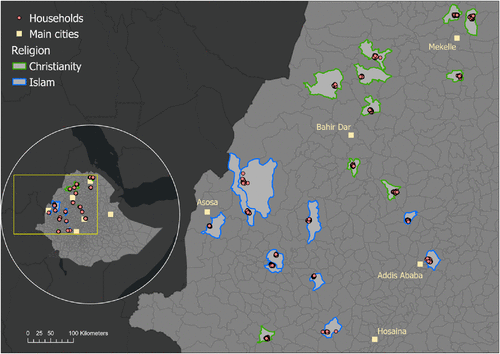
Notes. The areas highlighted correspond to administrative Woredas. Lighter Woredas have a majority Christian population, whereas darker Woredas are predominantly Muslim. Red dots indicate the location of surveyed households within each Woreda.
Within these selected areas, we identified and sampled 734 distinct households that participated in the data collection conducted in 2013, 2016, and 2019. These households primarily rely on rural family businesses as their main source of sustenance and income, and the head of each household can be considered the entrepreneur who makes strategic decisions regarding the management of the family firm. Further details regarding the sampling procedure implemented for the survey can be found in Online Appendix A.
For all households in our sample, we collected detailed information on the following aspects:
4.1.1. Family Structure.
We rely on the survey to reconstruct the household composition. The survey explicitly asks information about names, surnames, ages, and genders of the household members. To record this information accurately, we implemented a household roster as depicted in Figure B.1 in Online Appendix B. In the roster, the main respondent, typically the head of the household, is required to provide details about each family member, including their relationship to the head, gender, and additional demographic characteristics. This household roster serves as the primary source for reconstructing the family structure. To ensure precise mapping of the family structure and as an additional robustness check, we also relied on the common Ethiopian practice of children bearing their father’s first name. A more detailed description of the procedure employed to reconstruct the family structure based on the correspondence between the father’s name and the names of the children can be found in Online Appendix B. There were instances where the information obtained from the household roster and the correspondence between names and surnames within the household were imprecise, incomplete, or inconsistent across survey waves. Whenever feasible, we manually rectified these discrepancies as outlined in Online Appendix B.
4.1.2. Technology Adoption Decisions.
We leverage the survey to collect information about technology adoption decisions. The survey explicitly asks about crop production adjustments implemented by the respondents to increase the productivity of their agricultural business and to mitigate the impact of climate change in agriculture. Climate change is a primary concern for agricultural production in developing countries, and as such, it is a major threat to the sustainability of farming activities. In addition, focusing explicitly on technology adoption decisions aimed at improving climate adaptation practices allows us to examine choices that require a longer-term horizon and compel entrepreneurs to consider business sustainability in the face of disruptive future environmental changes. Among these adjustments, we qualified as technology adoption decisions those involving the introduction of new inputs, processes, or tools—such as those required when changing crop types, adopting new seed varieties, implementing soil and water conservation practices (e.g., contour plowing, mulching, and terracing), or constructing water-harvesting systems.3
Changing crop type and changing crop variety are relatively low-cost forms of technological adaptation compared with investments in physical infrastructure. These decisions are typically influenced by market dynamics, climatic variability, and access to improved seed varieties. Changing crop type constitutes a standard form of technology adoption as it involves the introduction of new inputs with enhanced productivity and resilience characteristics. On the other hand, the adoption of improved crop varieties is associated with higher yields, greater pest resistance, and improved drought tolerance. This practice can be regarded as a form of process innovation as it entails the reorganization of production practices to prevent soil deterioration, enhance soil sustainability, and promote long-term productivity (Smith et al. 2016, Franke et al. 2018). For both changes in crop type and variety, uptake is often constrained by limited access to information, credit, or input markets (Asfaw et al. 2011). Similar to the adoption of new crop varieties, soil and water conservation practices also entail the introduction of improved routines and the reorganization of agricultural processes. These practices tend to be labor intensive and moderately capital demanding. They improve soil structure, reduce erosion, and increase moisture retention, thereby generating long-term benefits and potential productivity gains. Adoption rates are often limited by labor constraints and by the longer time horizon required to realize benefits (Gebremedhin and Swinton 2003). Finally, water-harvesting systems include structures such as ponds, rooftop tanks, and check dams, which help store rainwater for use during dry periods. These systems are relatively expensive and labor intensive. They can lead to substantial yield increases, especially in arid zones, with some studies reporting yield gains of 30%–50%, although full benefits may take two to three years to materialize (Rockström and Barron 2007).
4.1.3. Additional Data.
We leverage several additional data sources to build control variables and provide evidence on the mechanisms behind the effect of family structures on technology adoption decisions. We utilized the survey to obtain information regarding credit availability and household wealth, which we measure by assessing the quantity of land owned by each household. To gain a comprehensive mapping of the dynamic evolution of family structures, we also derive information on the out-mobility behavior across Woredas.
We combined survey data and information from the World Cities Database to measure geographic distance (in kilometers (km)) between the Woreda where the household resides and the closest main city. In Online Appendix C, we provide further details on the procedure adopted to construct this distance indicator.
Finally, we leverage data from the Ethiopia Demographic and Health Survey 2016 compiled by CSA, including 41,392 individuals, to reconstruct the share of the population by religious faith across all regions where our Woredas are located. Online Appendix D provides further details on the religious composition of the population across different areas of the country.
4.2. Variables’ Construction and Estimation Approach
4.2.1. Independent Variable.
For each household, we constructed a variable to capture the occurrence of a new son/daughter within the time frame between two consecutive survey waves. To identify new family members, we relied on information extracted from the household roster. For example, if a new family member with an age of three or younger was recorded in the roster in 2019, we inferred that the child was born between 2016 and 2019. We constructed two indicator variables called Newborn (Male) and Newborn (Female), which take a value of one if the household welcomed a new son or a new daughter, respectively. For both variables, the value of zero indicates the absence of any newborn during the three-year interval between the two survey waves. About 42.8% of our households welcomed at least one newborn during the period under analysis, corresponding to 282 boys and 284 girls.
4.2.2. Dependent Variable.
We generated a variable to capture whether a household adopts any new technology during the time frame between the two survey waves. The primary dependent variable Technology Adoption is a binary variable that assumes a value of one if the household reported implementing any new technology concerning new crop varieties and types, changing planting dates, the construction of water-harvesting infrastructures, and implementations of soil and water conservation strategies, and it is zero otherwise. In 74.7% of the household-year observations, households reported adopting at least one of the aforementioned technologies. Figure 2 displays the various subcomponents of the composite indicator. The most common technologies include changes in crop variety and crop type followed by the adoption of soil and water conservation practices. The construction of water-harvesting infrastructures is less prevalent, involving only 7.1% of entrepreneurs in the sample.
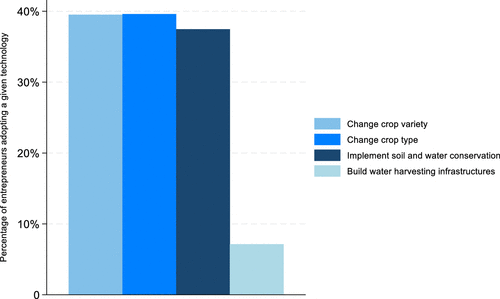
Notes. n = 2,202. Because individuals can adopt multiple technologies within the same period, the sum across all categories exceeds 100%.
4.2.3. Additional Variables.
From survey data, we construct a set of control variables to capture important determinants of technology adoption decisions. Credit access is a dummy that takes the value of one if the household had access to credit and zero otherwise. Land owned measures the land in hectares owned by the household. Number of Children measures the total number of children reported in the household roster in each survey year. This variable is an important control in our analysis as it accounts for the number of existing heirs and the potential impact of previous births on the decision to expand the family further.
We utilize the survey data to gather additional dimensions that are likely to influence parental behavioral responses based on the gender of the newborn. Specifically, we use the survey data to collect information on the out-mobility behavior of family members at the time of a child’s birth across Woredas. From this, we construct the variable Sh. Out-mobility, which captures the share of individuals who moved out, relative to the total population within each Woreda during the survey years (see Online Appendix E for additional details). These indicators allow us to examine whether rational expectations stemming from observed out-mobility patterns shape parental responses to the gender of newborns.
We employ data from the Ethiopia Demographic and Health Survey 2016 to retrieve information about regions that are majority Muslim versus regions that are not and map our Woredas into these regions. The Muslim-majority category includes regions such as Benishangul-Gumuz, where Muslims represent approximately 50% of the population compared with 45% Christians and 5% following other faiths, and Oromia, where Muslims make up 56% of the population versus 42% Christians and 2% following other religions. All other regions are predominantly Christian, including Amhara (82.6% Christian), Tigray (95.3% Christian), and the SNNPR (81% Christian). We construct a variable that takes the value of one if a Woreda belongs to a majority-Muslim region and zero otherwise.
Finally, we combine survey data with records from the World Cities Database to measure the distance in kilometers between the village of residence of each household and the closest main city. To this end, we mapped all Woredas and the 20 main cities reported in the World Cities Database by latitude and longitude. Anticipating that households near cities are likely to be more progressive and less influenced by cultural norms regarding gender roles compared with those in remote villages (Luca et al. 2023), we calculated the distance in kilometers between the Woreda where the household resides and the closest city.
Table 1 reports summary statistics on the main variables used in the analysis.
|

Table 1. Summary Statistics
| Variable | (1) | (2) | (3) | (4) | (5) |
|---|---|---|---|---|---|
| N | Mean | SD | Min | Max | |
| Technology adoption | 2,202 | 0.747 | 0.435 | 0 | 1 |
| N. Technology adoptions | 2,202 | 1.237 | 0.977 | 0 | 4 |
| Newborn (Male) | 2,202 | 0.120 | 0.325 | 0 | 1 |
| Newborn (Female) | 2,202 | 0.122 | 0.327 | 0 | 1 |
| N. Children | 2,202 | 3.942 | 2.178 | 0 | 14 |
| Land owned | 2,202 | 1.986 | 1.835 | 0 | 21 |
| Access to credit | 2,202 | 0.394 | 0.489 | 0 | 1 |
| Distance from city | 2,202 | 138.152 | 112.964 | 26.696 | 354.853 |
| Majority Muslims | 2,202 | 0.440 | 0.497 | 0 | 1 |
| Sh. Out-mobility | 2,202 | 0.138 | 0.035 | 0.080 | 0.242 |
| Soil and Water Conservation | 1,183 | 0.601 | 0.490 | 0 | 1 |
| Water Harvesting | 381 | 0.220 | 0.415 | 0 | 1 |
| Change Crop Type | 1,247 | 0.596 | 0.491 | 0 | 1 |
| Change Crop Variety | 1,253 | 0.596 | 0.491 | 0 | 1 |
Notes. Technology adoption is a dummy having a value of one if the household reported completing at least one of the following investments: change crop variety, change crop type, implement soil and water conservation, or build water-harvesting infrastructures; it has a value of zero elsewhere. N. of technology adoptions is the total count of distinct technological innovations adopted by the household. Newborn (Male) is a dummy variable having a value of one if the household heads had a new male child (i.e., if the household roster reports a new male in the household with an age equal to or younger than three years who is a child of the couple running the household). Newborn (Female) is a dummy variable having a value of one if the household heads had a new female child (i.e., if the household roster reports a new female in the household with an age equal to or younger than three years who is a child of the couple running the household). N. Children is the number of children listed in the family roster. Land Owned is the land in hectares owned by the household. Access to Credit is a dummy with a value of one if the household had access to credit and zero elsewhere. Distance from city measures the distance in kilometers from the closest city (we considered the 20 largest Ethiopian cities). Majority Muslims is a dummy with a value of one if the majority of inhabitants in the Woreda are Muslims and zero elsewhere. Sh. Out-mobility represents the share of individuals aged 15 years old or older listed in household rosters within a given Woreda who moved to other places because of either marriage or migration. Soil and Water Conservation is a dummy having a value of one if the household reported an investment to implement soil and water conservation and zero if no investments were completed. Observations for households that completed other types of investments are excluded. Water Harvesting is a dummy having a value of one if the household reported an investment in water harvesting and zero if no investments were completed. Observations for households that completed other types of investments are excluded. Change Crop Type is a dummy having a value of one if the household reported an investment to change crop types and zero if no investments were completed. Observations for households that completed other types of investments are excluded. Change Crop Variety is a dummy having a value of one if the household reported an investment to change crop variety and zero if no investments were completed. Observations for households that completed other types of investments are excluded. SD, standard deviation.
4.2.4. Estimation Approach.
The aim of this paper is to investigate whether technology adoption decisions by entrepreneurs are influenced by the gender of a newborn. In this setting, our primary source of identification relies on the randomness of the arrival of a son versus a daughter. In addition, to further strengthen our approach, we examine the effect of a newborn’s gender on technology adoption decisions by leveraging within-household variation rather than focusing solely on cross-sectional differences. Although it is reasonable to assume that the gender of a newborn is beyond the control of the household head, this assumption does not necessarily extend to the preconditions required for observing such gender differences—namely, the decision or likelihood of having children.
Family and personal circumstances play a significant role in shaping individual choices regarding parenthood and fertility more broadly. At the same time, cultural norms and community expectations may exert pressure on individuals and couples, influencing their decisions about starting or expanding a family. As a result, households that welcome a newborn may differ substantially from those that do not across several unobserved dimensions that are difficult to control for in a cross-sectional regression framework. Because we focus on the variables Newborn (Male) and Newborn (Female), which capture the effect of welcoming a newborn of a given gender relative to the opposite gender or no children at all, our estimates may turn biased and inconsistent.
Following the above intuition, we estimate the following equation:
Finally, we include wave and household dummies to account for potential variations across survey waves and to address households’ unobserved heterogeneity. Importantly, because household heads do not change during our time window, household dummies also control for unobserved characteristics of the household head, such as, for instance, literacy rate and risk preferences, that have been found to have substantial implications for an entrepreneur’s approach to technology adoption. In addition, these dummies account for unobserved heterogeneity in the technological advancement of family firms, which may stem from prior technology adoption decisions—whether influenced by childbirth.5
5. Technology Adoption Decisions and Newborn’s Gender
We start by providing a descriptive account of the relationship between technology adoption decisions and family structure in our sample. Table 2 reports figures across different Woredas. The percentage of technology adopters shows significant variation from 49% in Sirba Abay to 90.5% in Hidabu Abote (column (2) in Table 2). Columns (3) and (4) in Table 2 display the percentages of households that experienced the birth of a male or female child between 2013 and 2019, respectively. Columns (5) and (6) in Table 2 show the average numbers of male and female children within these households, respectively. The variation in the average number of male children ranges from 1.50 in Endamehoni to 2.7 in Debark.6
|
Table 2. Descriptive Statistics by Woreda
| Woreda | N. Households | % Technology adoption | % New Male | % New Female | Mean Male Children | Mean Female Children | Sh. Out-mobility |
|---|---|---|---|---|---|---|---|
| Libo Kemkem | 46 | 79.71 | 12.32 | 13.04 | 2.20 | 1.91 | 0.15 |
| Wogera | 44 | 69.70 | 12.88 | 12.12 | 2.14 | 1.76 | 0.13 |
| Endamehoni | 44 | 83.33 | 6.82 | 11.36 | 1.50 | 1.97 | 0.17 |
| Quarit | 43 | 72.09 | 17.83 | 8.53 | 2.26 | 1.82 | 0.14 |
| Kersa | 41 | 82.11 | 17.07 | 14.63 | 1.86 | 1.59 | 0.12 |
| Atsbi Wonberta | 40 | 86.67 | 9.17 | 8.33 | 1.73 | 1.51 | 0.18 |
| Chilga | 40 | 74.17 | 6.67 | 12.50 | 2.11 | 2.15 | 0.19 |
| Gesha Daka | 40 | 76.67 | 10.00 | 13.33 | 2.69 | 2.16 | 0.12 |
| Debark | 40 | 65.00 | 15.83 | 10.00 | 2.70 | 2.02 | 0.16 |
| Bichena | 39 | 63.25 | 4.27 | 10.26 | 1.76 | 1.60 | 0.14 |
| Nunu Kumba | 37 | 79.28 | 15.32 | 16.22 | 2.34 | 1.91 | 0.09 |
| Bambasi | 37 | 59.46 | 23.42 | 19.82 | 2.42 | 2.05 | 0.10 |
| Gida Ayana | 36 | 71.30 | 14.81 | 13.89 | 2.52 | 2.62 | 0.10 |
| Hawzein | 35 | 87.62 | 15.24 | 15.24 | 2.01 | 1.97 | 0.16 |
| Haru | 33 | 86.87 | 7.07 | 7.07 | 1.66 | 1.33 | 0.09 |
| Wonbera | 32 | 68.75 | 8.33 | 13.54 | 1.96 | 1.98 | 0.15 |
| Sirba Abay | 32 | 48.96 | 22.92 | 21.88 | 2.43 | 2.01 | 0.14 |
| Gimbi | 32 | 80.21 | 4.17 | 6.25 | 1.53 | 1.51 | 0.08 |
| Bereh Aleltu | 22 | 68.18 | 1.52 | 4.55 | 1.77 | 1.32 | 0.24 |
| Hidabu Abote | 21 | 90.48 | 9.52 | 6.35 | 1.67 | 1.68 | 0.16 |
Notes. Elaboration on survey data. Column (1) reports the number of households by Woreda. Columns (2), (3), and (4) show the percentages of households adopting innovation, welcoming a male child, and welcoming a female child during the period from 2013 to 2019, respectively. Columns (5) and (6) report the average numbers of male and female children by household during the same time period, respectively. Column (7) reports the share of individuals listed in household rosters within a given Woreda who left their household because of either marriage or migration to other places.
We further investigate this relationship in the context of a regression analysis. Table 3 presents the primary findings of our analysis. In column (1) in Table 3, we examine the effect of our key variables, Newborn (Male) and Newborn (Female). Consistent with our expectations, the arrival of the newborn son is associated with a significant increase in the likelihood of adopting new technologies. Specifically, households that welcome a new son exhibit an 8.2-percentage-point-higher probability of adopting new technologies (p = 0.025). This translates to an 11% increase in the probability of technology adoption relative to the baseline probability of adopting new technologies in our sample. Notably, the arrival of a new daughter does not have a significant impact on the household’s technology adoption decision. In columns (2)–(4) in Table 3, we introduce additional controls for the number of children within the family (column (2) in Table 3), the quantity of land owned (column (3) in Table 3), and access to credit (column (4) in Table 3). The amount of land owned, signaling household wealth, positively influences the decision to adopt new technologies. The specifications reported in Table 3 include wave and household fixed effects that control for heterogeneity in important characteristics of the family head, such as literacy rate or risk attitudes as well as unobserved differences in technologies across family businesses because of, for instance, past decisions about technological adoption (also for reasons other than the arrival of a child). In the most comprehensive specification in column (4) in Table 3, the arrival of a male newborn is still associated with a 8.8-percentage-point increase in the probability of technology adoption (equivalent to an 11.8% increase). Also, in this case, the arrival of a daughter does not appear to affect the technology adoption decision of the parent/entrepreneur.7 A test for equality of coefficients between the estimated parameters for Newborn (Male) and Newborn (Female) rejects the null hypothesis that the two coefficients are statistically similar (F(1, 733) = 5.10, p = 0.024). This further confirms the heterogeneous effect of a newborn’s gender on the technology adoption decision of the household head.8
|
Table 3. Newborn Gender and Technology Adoption Decisions
| Dependent variable: Technology adoption | (1) | (2) | (3) | (4) |
|---|---|---|---|---|
| Newborn (Male) | 0.082** | 0.088** | 0.089** | 0.088** |
| (0.037) | (0.037) | (0.037) | (0.037) | |
| Newborn (Female) | −0.027 | −0.017 | −0.013 | −0.014 |
| (0.038) | (0.039) | (0.039) | (0.038) | |
| N. Children | −0.018* | −0.020* | −0.020* | |
| (0.011) | (0.010) | (0.010) | ||
| Land Owned | 0.016* | 0.016* | ||
| (0.009) | (0.008) | |||
| Access to credit | 0.007 | |||
| (0.025) | ||||
| Constant | 0.740*** | 0.809*** | 0.782*** | 0.780*** |
| (0.007) | (0.041) | (0.043) | (0.043) | |
| Wave FE | Yes | Yes | Yes | Yes |
| Household FE | Yes | Yes | Yes | Yes |
| Observations | 2,202 | 2,202 | 2,202 | 2,202 |
| Wald test Newborn (Male) = Newborn (Female) p-value | 0.017 | 0.022 | 0.024 | 0.024 |
Notes. Robust standard errors are clustered at the household level. The dependent variable is a dummy having a value of one if the household reported completing at least one of the following investments: change crop variety, change crop type, implement soil and water conservation, or build water-harvesting infrastructures; it has a value of zero elsewhere. The main explanatory variables are (1) Newborn (Male), a dummy variable having a value of one if the household heads had a new male child, and (2) Newborn (Female), a dummy variable having a value of one if the household heads had a new female child. Additional controls include N. Children, the number of children listed in the family roster, and Land Owned, the land in hectares owned by the household. Access to Credit is a dummy with a value of one if the household had access to credit and zero elsewhere. Household and wave fixed effects (FEs) are included in all specifications. Waves dummies cover the intervals 2011–2013, 2014–2016, and 2017–2019.
*p < 0.10; **p < 0.05; ***p < 0.01.
In Table 4, we replicate our results looking at the probability of adopting each specific technology relative to the baseline of no adoption. Results show that the arrival of a newborn son is positively associated with technology adoption decisions in three of four cases (i.e., changing crop type, changing crop variety, and adopting soil and water conservation practices). We find no significant results for the construction of water-harvesting systems. In this case, however, the number of observations is substantially lower, thus reducing the probability of detecting any effect.9
|
Table 4. Decomposition of Technology Adoption Decisions by Type of Adopted Technology
| Dependent variable | Soil and water conservation | Water harvesting | Change crop type | Change crop variety |
|---|---|---|---|---|
| Newborn (Male) | 0.087 | −0.011 | 0.137** | 0.092* |
| (0.057) | (0.078) | (0.056) | (0.052) | |
| Newborn (Female) | −0.028 | 0.013 | −0.025 | −0.012 |
| (0.058) | (0.079) | (0.057) | (0.056) | |
| N. Children | −0.025 | −0.004 | −0.022* | −0.012 |
| (0.016) | (0.021) | (0.013) | (0.016) | |
| Land Owned | 0.006 | −0.026** | 0.008 | 0.010 |
| (0.012) | (0.012) | (0.009) | (0.012) | |
| Access to credit | 0.023 | 0.029 | −0.037 | −0.032 |
| (0.038) | (0.051) | (0.034) | (0.036) | |
| Constant | 0.667*** | 0.272*** | 0.664*** | 0.623*** |
| (0.064) | (0.081) | (0.053) | (0.068) | |
| Wave FE | Yes | Yes | Yes | Yes |
| Household FE | Yes | Yes | Yes | Yes |
| Observations | 1,183 | 381 | 1,247 | 1,253 |
| Wald test Newborn (Male) = Newborn (Female) p-value | 0.108 | 0.798 | 0.014 | 0.117 |
Notes. Robust standard errors are clustered at the household level. The dependent variable in column (1) is a dummy equal to one if the household reported an investment in soil and water conservation and zero if no investment was made. The dependent variable in column (2) is a dummy equal to one if the household reported an investment in water harvesting and zero if no investment was made. The dependent variable in column (3) is a dummy equal to one if the household reported an investment in changing crop types and zero if no investment was made. The dependent variable in column (4) is a dummy equal to one if the household reported an investment in changing crop varieties and zero if no investment was made. The main explanatory variables are Newborn (Male), a dummy equal to one if the household head had a new male child, and Newborn (Female), a dummy equal to one if the household head had a new female child. Additional controls include Number of Children (the number of children listed in the family roster), Land Owned (land in hectares owned by the household), and Access to Credit (a dummy equal to one if the household had access to credit). Household and wave fixed effects (FEs) are included in all specifications. Wave dummies cover the periods 2011–2013, 2014–2016, and 2017–2019.
*p < 0.10; **p < 0.05; ***p < 0.01.
Finally, Figure 3 provides additional evidence on how the arrival of a newborn son versus a daughter influences the likelihood of adopting new technologies, taking into account the existing gender composition of children in the household. The results suggest that the birth of a son increases the probability of technology adoption compared with the birth of a daughter, regardless of whether the household has relatively few or many sons. This effect is particularly pronounced in households with more daughters than the sample median, where the birth of a son raises the likelihood of adoption by 13.7 percentage points—a difference that is statistically significant relative to the effect of a daughter (p = 0.017). These findings are consistent with the notion that although the birth of a son generally induces a shift in the parent-entrepreneur’s adoption behavior—independent of the existing number of sons—this response is especially strong when sons are relatively scarce compared with daughters.10
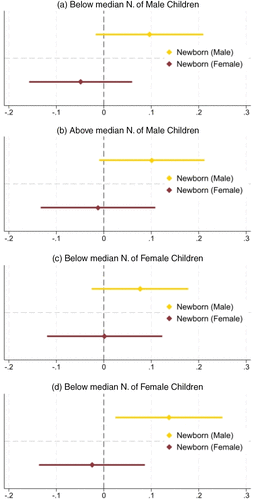
Notes. The figure plots the coefficients for Newborn (Male) and Newborn (Female) derived from regression (1) estimated on the following subsamples: (a) households with the number of male children below or equal to the sample median value, (b) households with the number of male children above the sample median value, (c) households with the number of female children below or equal to the sample median value, and (d) households with the number of female children above the sample median value. The control for the number of children has been removed to run these analyses. The Wald test results for equality of coefficients Newborn (Male) = Newborn (Female) are (a) F(1, 481) = 4.35 (p = 0.038), (b) F(1, 251) = 2.61 (p = 0.108), (c) F(1, 509) = 1.28 (p = 0.259), and (d) F(1, 223) = 4.28 (p = 0.040).
6. Mechanism Tests
We showed that the decision to adopt new technologies by family heads in rural family firms varies according to the gender of a newborn, with households welcoming a son being more likely to adopt compared with those welcoming a daughter. In this section, we delve deeper into the mechanisms driving this observed variation in technology adoption among microentrepreneurs following the birth of a newborn son, providing several checks that contribute incrementally to deepen the interpretation of our main findings.
We begin by documenting the heterogeneity in the main effect of newborn gender according to religious differences across Woredas. Although the Ethiopian Orthodox Church maintains traditional views on gender roles, Islam in the country tends to exhibit more conservative attitudes regarding women’s roles compared with Orthodox Christianity. To explore the heterogeneity stemming from religious identities, we divided the sample based on whether households reside in a Woreda within a primarily Muslim region or not. Column (1) in Table 5 focuses predominantly Muslim Woredas, whereas column (2) in Table 5 focuses on nonpredominantly Muslim Woredas. The effect of a newborn male on technology adoption decisions is more pronounced and significant in the Muslim-majority regions, with an increase in the magnitude of the effect of 15.6 percentage points relative to 8.8 percentage points in the main specification reported in column (4) in Table 3. This evidence is consistent with the notion that in contexts where gendered social norms are more strongly enforced, such as in the case of predominantly Muslim regions, family heads are more likely to respond differently to the gender of a newborn when making technology adoption decisions.
|
Table 5. Religion
| Dependent variable: Technology adoption | (1) | (2) |
|---|---|---|
| Sample | Majority Muslim | Nonmajority Muslim |
| Newborn (Male) | 0.156*** | 0.026 |
| (0.056) | (0.046) | |
| Newborn (Female) | −0.008 | −0.004 |
| (0.055) | (0.055) | |
| N. Children | −0.028** | −0.009 |
| (0.013) | (0.016) | |
| Land Owned | 0.021** | −0.023 |
| (0.009) | (0.026) | |
| Access to credit | 0.034 | 0.011 |
| (0.038) | (0.033) | |
| Constant | 0.754*** | 0.820*** |
| (0.055) | (0.072) | |
| Wave FE | Yes | Yes |
| Household FE | Yes | Yes |
| Observations | 969 | 1,233 |
| Wald test Newborn (Male) = Newborn (Female) p-value | 0.018 | 0.627 |
Notes. Robust standard errors clustered at the household level are in parentheses. Column (1) focuses on households where the majority of the inhabitants in the Woreda are Muslims. Column (2) focuses on households where the majority of the inhabitants in the Woreda are not Muslims. The main explanatory variables are (1) Newborn (Male), a dummy variable having a value of one if the household heads had a new male child, and (2) Newborn (Female), a dummy variable having a value of one if the household heads had a new female child. Additional controls include N. Children, the number of children listed in the family roster, and Land Owned, the land in hectares owned by the household. Access to Credit is a dummy with a value of one if the household had access to credit and zero elsewhere. Household and wave fixed effects (FEs) are included in all specifications. Waves dummies cover the intervals 2011–2013, 2014–2016, and 2017–2019.
**p < 0.05; ***p < 0.01.
We proceed by documenting heterogeneous effects in the likelihood of adopting new technologies based on the distance between a household’s Woreda and the nearest urban center. Prior research highlights a strong urban-rural divide in social values, with individuals living closer to major urban centers exhibiting more progressive attitudes toward gender roles and family dynamics (Luca et al. 2023). At the same time, distance from cities may also be correlated with migration patterns, potentially influencing parental responses to the arrival of a newborn through expectations about the likelihood that a child will remain nearby in adulthood and eventually take over the family business. In our data, approximately 13.8% of individuals migrate out of their original Woreda, with similar migration rates observed for men and women. Moreover, migration is negatively correlated with distance from cities, suggesting that it is more prevalent in urban cores than in remote areas.
To explore this heterogeneity, we conduct our analysis on subsamples defined by distance to the nearest city. The results of this analysis are presented in Table 6. Column (1) in Table 6 reports estimates for households located within 50 kilometers of the nearest urban area, a relatively short driving distance. Column (2) in Table 6 reports estimates for households located more than 50 kilometers from the nearest city. Columns (3) and (4) as well as columns (5) and (6) in Table 6 conduct similar analyses using different thresholds to identify households that differ in their distance from major cities (100 and 250 kilometers, respectively). We find no discernible differences in technology adoption decisions based on the gender of a newborn among households located near cities (columns (1), (3), and (5) in Table 6). However, gendered effects emerge as we focus on households farther from urban areas. Specifically, the coefficient for newborn males increases monotonically with distance from cities, whereas the coefficient for newborn daughters remains statistically insignificant throughout. In column (6) in Table 6, where we focus on more remote households, the effect of a newborn male increases the probability of adopting new technologies by 21.2 percentage points relative to the average effect of 8.8 percentage points reported in column (4) in Table 3.
|
Table 6. Distance from Cities
| Dependent variable: Technology adoption | (1) | (2) | (3) | (4) | (5) | (6) |
|---|---|---|---|---|---|---|
| Sample: Distance threshold | Close to city | Distant from city | Close to city | Distant from city | Close to city | Distant from city |
| ≤50 km | >50 km | ≤100 km | >100 km | ≤250 km | >250 km | |
| Newborn (Male) | 0.062 | 0.099** | 0.056 | 0.137** | 0.043 | 0.212*** |
| (0.061) | (0.046) | (0.044) | (0.064) | (0.041) | (0.076) | |
| Newborn (Female) | −0.047 | −0.004 | −0.005 | −0.026 | 0.003 | −0.068 |
| (0.057) | (0.049) | (0.043) | (0.068) | (0.045) | (0.070) | |
| N. Children | −0.021 | −0.020 | −0.012 | −0.027* | −0.013 | −0.040** |
| (0.019) | (0.013) | (0.014) | (0.016) | (0.012) | (0.020) | |
| Land Owned | −0.010 | 0.024*** | −0.011 | 0.027*** | −0.006 | 0.026*** |
| (0.019) | (0.009) | (0.016) | (0.009) | (0.016) | (0.009) | |
| Access to credit | −0.009 | 0.011 | 0.004 | 0.018 | −0.006 | 0.036 |
| (0.043) | (0.030) | (0.030) | (0.043) | (0.028) | (0.053) | |
| Constant | 0.872*** | 0.748*** | 0.830*** | 0.722*** | 0.815*** | 0.756*** |
| (0.077) | (0.051) | (0.059) | (0.066) | (0.054) | (0.080) | |
| Wave FE | Yes | Yes | Yes | Yes | Yes | Yes |
| Household FE | Yes | Yes | Yes | Yes | Yes | Yes |
| Observations | 687 | 1,515 | 1,356 | 846 | 1,680 | 522 |
| Wald test Newborn (Male) = Newborn (Female) p-value | 0.147 | 0.067 | 0.260 | 0.038 | 0.444 | 0.001 |
Notes. Robust standard errors clustered at the household level are in parentheses. Columns (1) and (2) focus on households that are in villages less than (more than) 50 km from a major Ethiopian city. Columns (3) and (4) focus on households that are in villages less than (more than) 100 km from a major Ethiopian city. Columns (5) and (6) focus on households that are in villages less than (more than) 250 km from a major Ethiopian city. The main explanatory variables are (1) Newborn (Male), a dummy variable having a value of one if the household heads had a new male child, and (2) Newborn (Female), a dummy variable having a value of one if the household heads had a new female child. Additional controls include N. Children, the number of children listed in the family roster, and Land Owned, the land in hectares owned by the household. Access to Credit is a dummy with a value of one if the household had access to credit and zero elsewhere. Household and wave fixed effects (FEs) are included in all specifications. Waves dummies cover the intervals 2011–2013, 2014–2016, and 2017–2019.
*p < 0.10; **p < 0.05; ***p < 0.01.
This evidence allows for a more nuanced interpretation of the underlying mechanisms. In particular, the finding that the effect of a newborn son is concentrated in more remote areas—likely characterized by more traditional gender norms and lower migration rates—suggests that parental responses reflect a combination of gendered social norms prioritizing men over women in agricultural societies and rational expectations regarding the future involvement of sons in the family business. Interestingly, however, the birth of a daughter has no significant effect on technology adoption decisions, regardless of whether the household is located in a Woreda that is close to or distant from major cities.
To delve deeper into this evidence, we examine out-mobility patterns across Woredas and assume that mobility behaviors observed within the same Woreda as the household at the time of the technology adoption decision may shape the family head’s expectations about whether a child will remain in the area in the future. To this scope, we re-estimate our preferred specification from column (4) in Table 3 on the subsample of households residing in low- versus high-out-mobility Woredas. Specifically, in Table 7, we split the sample based on whether a Woreda falls below the sample median (column (1)) or above the sample median (column (2)) in terms of the share of people who moved out of their own village.
|
Table 7. Out Mobility Across Woredas
| Dependent variable: Technology adoption | (1) | (2) |
|---|---|---|
| Sample | Low out mobility | High out mobility |
| Newborn (Male) | 0.147*** | 0.029 |
| (0.055) | (0.048) | |
| Newborn (Female) | −0.013 | −0.013 |
| (0.059) | (0.050) | |
| N. Children | −0.019 | −0.016 |
| (0.016) | (0.014) | |
| Land Owned | −0.006 | 0.024** |
| (0.014) | (0.011) | |
| Access to credit | 0.017 | 0.010 |
| (0.037) | (0.034) | |
| Constant | 0.804*** | 0.765*** |
| (0.068) | (0.056) | |
| Wave FE | Yes | Yes |
| Household FE | Yes | Yes |
| Observations | 1,017 | 1,185 |
| Wald test Newborn (Male) = Newborn (Female) p-value | 0.018 | 0.477 |
Notes. Robust standard errors clustered at the household level are in parentheses. Column (1) focuses on households where the propensity to leave the households because of marriage or migration to other locations is low (i.e., below the median). Column (2) focuses on households where the propensity to leave the households because of marriage or migration to other locations is high (i.e., above the median). The main explanatory variables are (1) Newborn (Male), a dummy variable having a value of one if the household heads had a new male child, and (2) Newborn (Female), a dummy variable having a value of one if the household heads had a new female child. Additional controls include N. Children, the number of children listed in the family roster, and Land Owned, the land in hectares owned by the household. Access to Credit is a dummy with a value of one if the household had access to credit and zero elsewhere. Household and wave fixed effects (FEs) are included in all specifications. Waves dummies cover the intervals 2011–2013, 2014–2016, and 2017–2019.
**p < 0.05; ***p < 0.01.
We find that the effect of having a newborn son on the probability of adopting new technologies remains statistically significant only in areas with low out mobility (+14.7 percentage points). In contrast, the effect of a newborn daughter remains statistically insignificant, regardless of whether the household resides in a Woreda with low or high out mobility. This evidence adds another layer to our understanding of the phenomenon; although rational expectations about the involvement of children in the family business during adulthood stemming from observable out-mobility patterns may influence investment decisions regarding sons, they do not appear to alter how daughters are perceived in terms of their leadership potential. Because daughters’ contributions to the family business are systematically discounted—regardless of whether they are more or less likely to remain in the household during adulthood—this suggests that gendered beliefs about women’s roles in agricultural societies dominate in shaping parental responses to the arrival of a newborn girl.
Finally, in Table 8, we show that our results remain broadly consistent when using the count of technologies adopted rather than the probability of adopting new technologies as the dependent variable. The effect of a newborn child remains stronger in Muslim-dominated areas as well as in more remote Woredas and those characterized by lower out-migration. Taken together, these additional checks are consistent with the idea that the arrival of a newborn son fosters technology adoption decisions through a combination of gendered social norms that prioritize men over women in agricultural leadership roles and rational expectations regarding their future involvement in the family business. In the case of daughters, by contrast, societal expectations tend to prevail, marginalizing them in business succession.
|
Table 8. Number of Technologies Adopted by the Household Head
| Dependent variable: N. Technology adoptions | (1) | (2) | (3) | (4) | (5) | (6) | (7) |
|---|---|---|---|---|---|---|---|
| Full | Majority Muslim | Nonmajority Muslim | Close to city (≤100 km) | Distant from city (>100 km) | Low propensity to migrate | High propensity to migrate | |
| Newborn (Male) | 0.101 | 0.243** | −0.004 | −0.020 | 0.333*** | 0.180* | 0.007 |
| (0.070) | (0.103) | (0.095) | (0.086) | (0.113) | (0.099) | (0.101) | |
| Newborn (Female) | −0.041 | 0.046 | −0.086 | −0.077 | 0.011 | −0.015 | −0.071 |
| (0.073) | (0.110) | (0.098) | (0.084) | (0.129) | (0.113) | (0.093) | |
| N. Children | −0.027 | −0.034 | −0.008 | −0.003 | −0.056** | −0.061** | −0.001 |
| (0.020) | (0.025) | (0.032) | (0.027) | (0.027) | (0.027) | (0.029) | |
| Land Owned | 0.030* | 0.051*** | −0.129** | −0.047 | 0.063*** | −0.014 | 0.053** |
| (0.016) | (0.018) | (0.054) | (0.036) | (0.019) | (0.027) | (0.023) | |
| Access to Credit | 0.027 | 0.010 | 0.077 | 0.051 | −0.008 | −0.037 | 0.100 |
| (0.048) | (0.071) | (0.063) | (0.060) | (0.077) | (0.071) | (0.065) | |
| Constant | 0.413*** | 0.274** | 0.618*** | 0.500*** | 0.311*** | 0.594*** | 0.303** |
| (0.084) | (0.114) | (0.141) | (0.120) | (0.120) | (0.123) | (0.118) | |
| Wave FE | Yes | Yes | Yes | Yes | Yes | Yes | Yes |
| Household FE | Yes | Yes | Yes | Yes | Yes | Yes | Yes |
| Observations | 2,160 | 942 | 1,218 | 1,347 | 813 | 984 | 1,176 |
| Wald test Newborn (Male) = Newborn (Female) p-value | 0.103 | 0.163 | 0.460 | 0.580 | 0.029 | 0.147 | 0.477 |
Notes. Robust standard errors clustered at the household level are in parentheses. The dependent variable is the count of technology adoptions. The table presents the results of Poisson regressions. Column (1) considers the full sample. Column (2) focuses on households where the majority of inhabitants in the Woreda are Muslims. Column (3) focuses on households where the majority of inhabitants in the Woreda are not Muslims. Columns (4) and (5) focus on households that reside in villages less than (more than) 100 km from a major Ethiopian city. Column (6) focuses on households where the propensity to leave the households because of marriage or migration to other locations is low (i.e., below the median). Column (7) focuses on households where the propensity to leave the households because of marriage or migration to other locations is high (i.e., above the median). The main explanatory variables are (1) Newborn (Male), a dummy variable having a value of one if the household heads had a new male child, and (2) Newborn (Female), a dummy variable having a value of one if the household heads had a new female child. Additional controls include N. Children, the number of children listed in the family roster, and Land Owned, the land in hectares owned by the household. Access to Credit is a dummy with a value of one if the household had access to credit and zero elsewhere. Household and wave fixed effects (FEs) are included in all specifications. Waves dummies cover the intervals 2011–2013, 2014–2016, and 2017–2019.
*p < 0.10; **p < 0.05; ***p < 0.01.
7. Discussion and Implications
In this study, we focus on the role of family structure on the entrepreneur’s decision-making process in a developing country setting. More specifically, we analyze how technology adoption decisions in rural family firms are influenced by the gender of newborn arrivals. We carry out our analysis in the Ethiopian context, where rural entrepreneurs constitute a significant share of the economically active population and often organize their activities in small-scale businesses showing the distinctive characteristics of family firms.
Our findings indicate that entrepreneurs exhibit a greater propensity to adopt novel technologies subsequent to the birth of a child. This effect is particularly pronounced when the newborn is a boy rather than a girl. We speculate that this outcome can be explained by the entrepreneur’s heightened forward-looking perspective and increased concerns regarding the sustainability of farming activities triggered by the arrival of a male child. We show that this phenomenon is associated with a combination of cultural norms related to gender roles in agricultural societies, whereby men are considered more suitable for fulfilling leadership roles in rural societies, and rational expectations regarding the involvement of sons in the family business during adulthood.
The findings of this study have important implications for the sustainability of agricultural production. The adoption of technologies—particularly those aimed at mitigating the risks associated with climate change—is crucial for soil preservation and long-term productivity. By showing that the decision to adopt these technologies responds to the gender of a newborn, we ultimately contribute to a deeper understanding of the role that this factor plays as a determinant of these outcomes. Supplementary analyses reported in Table F.5 in Online Appendix F provide evidence of a positive correlation between the number of male children in a household and agricultural productivity in subsequent years. In contrast, there is limited evidence of productivity effects associated with changes in the number of female children. Although this reduced-form approach cannot fully rule out the possibility that part of the effect of sons on agricultural productivity arises from other channels, such as additional labor supply, the main finding of this study that new sons trigger technology adoption suggests that at least part of the effect on agricultural productivity is driven by this mechanism.
By shedding light on the role of family structure—a factor that has been underexplored in the existing literature—in explaining variation among entrepreneurs in technology adoption decisions, our study contributes to the still underdeveloped body of strategy literature that examines the determinants of entrepreneurial decision making in developing country settings and the implications of these choices for business success (George et al. 2016; Delecourt and Ng 2020, 2021; Foo et al. 2020; Delecourt and Fitzpatrick 2021; Carlson 2023; Agarwal et al. 2025). By analyzing how rural entrepreneurs in Ethiopia—one of the largest and most economically advanced countries in Africa—respond to the birth of a child and how the child’s gender identity influences technology adoption decisions, we contribute to the understanding of how entrepreneurs make strategic choices in these contexts and how these decisions impact the productivity of their ventures.
We also contribute to the economic literature on individual-level determinants of technology adoption among microentrepreneurs by showing that variation in adoption is influenced by gendered social norms—factors that extend beyond the well-documented structural determinants, such as soil quality, land characteristics, climatic shocks, credit constraints, and infrastructure, as well as softer barriers, like risk exposure and social learning frictions explored in prior research (Suri and Udry 2022). This takeaway aligns with recent contributions that highlight the role of social norms in shaping household decision making under economic uncertainty. Observes that microentrepreneurs in developing countries often face both financial constraints and behavioral frictions, such as limited capacity for long-term planning and constrained aspirations. Similarly, Jayachandran (2021) documents how entrenched gender norms continue to limit women’s labor market participation, even when economic incentives or individual preferences might suggest otherwise. These patterns resonate with our core finding; the gender of a newborn child may influence long-term investment behavior not solely through shifts in household preferences but through socially embedded expectations related to inheritance, gender roles, and the continuity of the family enterprise.
Although our research is situated in a developing country context, the findings offer important and generalizable insights. The underlying dynamic that we highlight—the tendency within family firms to prioritize male heirs over female heirs in succession decisions—is also prevalent in developed economies. Prior research has documented how primogeniture and gender biases in succession norms influence leadership dynamics in family firms globally (Bloom and Van Reenen 2007, Calabrò et al. 2018). Recently, Amore et al. (2025) argue that the gender of a firm owner’s first-born child plays an important role in shaping succession decisions in family firms, increasing the likelihood that leadership is passed on to a family member rather than to a professional manager and correlating with higher innovation activity in the years following the appointment. In such settings, key strategic decisions—such as those related to innovation and human capital management—are shaped by gendered dynamics that influence how decision makers perceive and act on long-term priorities.
Our work carries important implications that stem directly from the mechanisms identified in this study. The finding that gendered social norms significantly influence technology adoption decisions —and ultimately, shape ventures’ productivity and sustainability—highlights the need for inclusive policies that address both material constraints and deep-rooted societal biases. Although we do observe some evidence of rational investment behavior following the birth of a male child, it is ultimately gendered social norms—particularly those limiting the perceived involvement of daughters—that appear to exert the strongest influence on gendered decision making.
At the organizational level, this may require implementing gender-sensitive succession planning or designing incentive systems that promote equal involvement of daughters and sons in strategic decision making. For example, family firms could institutionalize mentorship programs for female heirs or adopt governance structures that ensure balanced representation in leadership roles. In terms of public policy, governments and development agencies could support programs that combine access to credit or agricultural extension services with community-based campaigns aimed at shifting gender norms. Examples include conditional cash transfers that incentivize female participation in training or technology adoption or awareness initiatives that engage households in reflecting on gender roles in economic decision making.
Finally, addressing cultural stereotypes about gender roles—both in the labor market and in society more broadly—is essential not only for ensuring equal opportunities across sexes but also, for enabling organizations to make strategic decisions based on objective evaluations rather than long-standing social biases (Gagliardi et al. 2024). In the specific case of technology adoption, our findings suggest that a significant portion of the entrepreneurs in our sample may underinvest in technology adoption because of the belief that women are less suited than men to follow in their parents’ entrepreneurial footsteps. More broadly, such belief-driven decision making may spill over into other core organizational choices, including promotions to leadership positions, delegation of responsibilities, and talent development. To the extent that these decisions are based on perceptions rather than actual competencies, capabilities, or levels of involvement, the strategic direction of the firm becomes constrained by unnecessary and potentially inefficient criteria.
The authors thank participants at the Academy of Management 2025, the Strategic Management Society Conference 2024, and the 2024 Behavioral Perspectives on Family Firms Workshop at the École des hautes études commerciales de Paris (HEC) for their comments and suggestions on earlier versions of this paper.
1 A number of exhaustive reviews have been published on this subject; see, for instance, Foster and Rosenzweig (2010) or Magruder (2018) among others.
3 We retrieved information on technology adoption decisions from the following survey question: “If you have noticed changes in climate over your lifetime or are concerned that future changes in climate may affect your livelihood, what you have done to protect yourself, your family, or your community?” The question lists five possible crop production adjustments, including changing crop types, adopting new seed varieties, implementing soil and water conservation practices (e.g., contour plowing, mulching, and terracing), constructing water-harvesting systems, and changing planting dates. Unlike the first four items, changing planting dates involves modifying existing routines without introducing new technologies or inputs, and it is generally considered a management decision rather than a form of technology adoption. Its cost structure is fundamentally different from other types of interventions. This practice typically requires no financial outlay but depends on access to agroclimatic information and advisory services. Changing planting dates ranks among the lowest-cost strategies, with immediate potential yield effects and positive climate resilience outcomes—particularly in systems where rainfall onset is becoming less predictable. Its effectiveness depends on localized forecast access and usually complements other interventions, such as improved seed, water harvesting, or conservation agriculture. For these reasons, we excluded changes in planting dates from our dependent variable measuring technology adoption. However, the results from our main specification (Equation (1)) remain robust when this category is included.
4 To further explore whether the decision to expand the family correlates with the gender of the previous born in Table F.1 in Online Appendix F, we regress a dummy that takes the value of one if the household welcomes a newborn at time t with the (log) number of existing female and male children within the household at time t − 1. Then, we test for equality in coefficients between the number of female children and the number of male children within the family and fail to reject the null of the two coefficients being statistically different from each other (F(1, 733) = 0.42, p = 0.515). We also run a specification where the control for the number of children is substituted by variables for the numbers of male and female children separately. This approach, which is reported in column (1) in Table F.2 in Online Appendix F, accounts for the possibility that past technology adoption decisions are driven specifically by the number of male newborns in the household rather than by the overall number of children. Results also remain consistent in this additional specification.
5 It is still possible that within the time frame of our survey, the decision to adopt new technologies at a certain point in time depends on the existing level of technology within each family business at the time of the adoption decision. Put differently, households closer to the technological frontier may be less likely to adopt new technologies. However, because the existing level of technology should be independent of the gender of the newborn when controlling for the number of children, omitting this dimension should not systematically bias our results. To further support this claim, in Table F.2 in Online Appendix F, we estimate a discrete hazard model to predict the time to first technology adoption as a function of the arrival of a male newborn versus a female newborn, controlling for all variables in our preferred specification (column (2)). Results remain consistent with our baseline estimates in all specifications.
6 From Table 2, it is noteworthy that in most villages, the average number of male children exceeds that of female children, despite the percentage of newborn sons and daughters being only slightly in favor of girls (Figure 2). This observation aligns with previous research indicating that girls are less likely to be vaccinated and well fed compared with boys, particularly in illiterate households (Borooah 2004). It also corresponds with the tendency of family heads to not report daughters who have married and moved out as married women often join their husband’s family, contributing to and falling under the responsibility of the new family head. Additionally, Ethiopia has one of the highest maternal mortality rates in sub-Saharan Africa, which could affect the average number of daughters. Women in Ethiopia begin having children at a young age, so maternal mortality may significantly impact the young population (Ayele et al. 2021).
7 Our preferred specification employs a variable for the newborn that is constructed over the longest birth date interval included between two survey waves (i.e., three years). This approach allows us to capture the maximum number of newborn events between two consecutive waves of data collection. Table F.3 in Online Appendix F reports robustness checks using wider birth date intervals (four years in columns (1) and (2) and five years in columns (3) and (4)). Results remain consistent across all specifications.
8 We replicated this specification restricting the sample to households that experienced the arrival of at least one child during the time windows under analysis. Results reported in Table F.4 in Online Appendix F remain consistent with our main estimates.
9 The decision to focus on a composite indicator of technology adoption rather than disaggregating by specific technologies is motivated by both theoretical and empirical considerations. First, adoption decisions are not mutually exclusive but are typically made as part of a portfolio, with their effectiveness arising more from complementary use than from individual implementation (Di Falco and Veronesi 2013). An aggregate measure, therefore, more accurately reflects the entrepreneurial decision-making process, which is inherently portfolio based. Second, disaggregating by individual technologies raises concerns about statistical power. In our data, the adoption of some technologies is relatively rare, which limits our ability to precisely estimate gender-specific effects for individual practices (e.g., water-harvesting infrastructure). Finally, because unobserved shocks may be correlated across the four adoption outcomes, a seemingly unrelated regressions (SUR) framework would in principle be preferable. In practice, however, estimating a four-equation SUR requires a common sample in which all outcomes are jointly observed, which in our case, is small (N = 298), even though each equation is individually estimated on a much larger sample. When combined with household and year fixed effects, this restricted common sample provides insufficient residual variation for some equations, preventing estimation of the full SUR system. For these reasons, we retain equation-by-equation fixed-effects specifications with household-clustered standard errors. Importantly, because all equations include the same set of covariates and fixed effects, estimating them separately is an appropriate and standard approach, and SUR would not alter the substantive coefficient estimates in this setting.
10 To provide additional evidence on the effect associated with changes in family structure linked to the arrival of a new son, we employ a difference-in-differences estimation approach with staggered treatments. To account for potentially persistent treatment effects associated with changes in the composition of heirs, we construct our treatment variable as the cumulative number of newborn sons over the analysis time frame, controlling for all variables included in our preferred specification. In this setting, we leverage a discrete treatment variable that captures variations in the intensity of exposure based on the number of previous newborn sons. Accordingly, we employ the methodology proposed by de Chaisemartin and D’Haultfoeuille (2024). Figure F.1 in Online Appendix F reports the treatment effect coefficients. In the first period following the arrival of a newborn son, the likelihood of adopting new technologies increases by 10.9 percentage points. This effect diminishes in the second period (i.e., after two survey waves, equivalent to approximately eight years). The placebo test is insignificant. However, because of the limited time span of our data, we are only able to explore the behavior of treated and control groups up to one time period prior to the newborn event.
References
- (2025) Does a theory-of-value add value? Evidence from a randomized control trial with Tanzanian entrepreneurs. Organ. Sci. 36(2):601–625.Link, Google Scholar
- (2013) On the origins of gender roles: Women and the plough. Quart. J. Econom. 128(2):469–530.Crossref, Google Scholar
- (2025) CEO succession and patenting in family firms. Strategy Sci. 10(3):185–206.Link, Google Scholar
- (2005) The role of family members in entrepreneurial networks: Beyond the boundaries of the family firm. Family Bus. Rev. 18(2):135–154.Crossref, Google Scholar
- (2011) Agricultural technology adoption, seed access constraints and commercialization in Ethiopia. J. Development Agricultural Econom. 3(9):436–477.Google Scholar
- (2017) Legitimacy and the benefits of firm formalization. Organ. Sci. 28(5):804–818.Link, Google Scholar
- (2015) Who’s getting globalized? The size and implications of intra-national trade costs. Econometrica 83(3):763–831.Google Scholar
- (2021) Ethiopia’s commitment towards achieving sustainable development goal on reduction of maternal mortality: There is a long way to go. Women’s Health, ePub ahead of print December 16, https://doi.org/10.1177/17455065211067073.Crossref, Google Scholar
- (2022) Pursuing gains or avoiding losses: The contingent effect of transgenerational intentions on innovation investments. J. Management Stud. 59(6):1493–1530.Crossref, Google Scholar
- (2014) Do firms want to borrow more? Testing credit constraints using a directed lending program. Rev. Econom. Stud. 81(2):572–607.Crossref, Google Scholar
- (2024) How entrepreneurs achieve purpose beyond profit: The case of women entrepreneurs in Nigeria. Organ. Sci. 35(3):1042–1071.Link, Google Scholar
- (2007) Inside the family firm: The role of families in succession decisions and performance. Quart. J. Econom. 122(2):647–691.Crossref, Google Scholar
- (2006) The role of family in family firms. J. Econom. Perspect. 20(2):73–96.Crossref, Google Scholar
- (2014) Are rural youth in Ethiopia abandoning agriculture? World Development 64:259–272.Crossref, Google Scholar
- (2012) R&D investments in family and founder firms: An agency perspectives. J. Bus. Venturing 27(2):248–265.Crossref, Google Scholar
- (2015) Necessity entrepreneurship and competitive strategy. Small Bus. Econom. 44:37–54.Crossref, Google Scholar
- (2007) Measuring and explaining management practices across firms and countries. Quart. J. Econom. 122(4):1351–1408.Crossref, Google Scholar
- (2016) Stereotypes. Quart. J. Econom. 131(4):1753–1794.Crossref, Google Scholar
- (2004) Gender bias among children in India in their diet and immunisation against disease. Soc. Sci. Medicine 58(9):1719–1731.Crossref, Google Scholar
- (2008) Risk rationing and wealth effects in credit markets: Theory and implications for agricultural development. Amer. J. Agricultural Econom. 90(2):409–423.Crossref, Google Scholar
- (2013) Entrepreneurship as a solution to poverty. J. Bus. Venturing 28(6):683–689.Crossref, Google Scholar
- (2018) The courage to choose! Primogeniture and leadership succession in family firms. Strategic Management J. 39(7):2014–2035.Crossref, Google Scholar
- (2023) Differentiation in microenterprises. Strategic Management J. 44(5):1141–1167.Crossref, Google Scholar
- (2018) Farm succession at a crossroads: The interaction among farm characteristics, labour market conditions, and gender and birth order effects. J. Rural Stud. 61:73–83.Crossref, Google Scholar
Central Statistical Agency (2012) Household consumption and expenditure (HCE) survey 2010/2011. Statistical Bulletin No. 563, Central Statistical Agency, Addis Ababa, Ethiopia.Google Scholar- (2021) Carrying on the family’s legacy: Male heirs and firm innovation. J. Corporate Finance 69:101976.Crossref, Google Scholar
- (2012) Variations in R&D investments of family and nonfamily firms: Behavioral agency and myopic loss aversion perspectives. Acad. Management J. 55(4):976–997.Crossref, Google Scholar
- (2005) Trends and directions in the development of a strategic management theory of the family firm. Entrepreneurship Theory Practice 29(5):555–575.Crossref, Google Scholar
- (2010) Learning about a new technology: Pineapple in Ghana. Amer. Econom. Rev. 100(1):35–69.Crossref, Google Scholar
- (2003) Technology adoption in the presence of constraints: The case of fertilizer demand in Ethiopia. Rev. Development Econom. 7(1):58–70.Crossref, Google Scholar
- (2014) Gender issues in Ethiopia. World Affairs J. Internat. Issues 18(1):146–159.Google Scholar
- (2024) Difference-in-differences estimators of intertemporal treatment effects. Rev. Econom. Statist., ePub ahead of print February 9, https://doi.org/10.1162/rest_a_01414.Crossref, Google Scholar
- (2009) Gender and culture in southern Ethiopia: An ethnographic analysis of Guji–Oromo women’s customary rights. African Study Monographs 30(1):15–36.Google Scholar
- (2021) Childcare matters: Female business owners and the baby-profit gap. Management Sci. 67(7):4455–4474.Link, Google Scholar
- (2020) Do buyers discriminate against female-owned businesses? Two field experiments. Working paper, Stanford University, Stanford, CA.Google Scholar
- (2021) Equalizing business characteristics can close the gender gap in micro-business performance. Preprint, submitted April 21, https://doi.org/10.2139/ssrn.3830935.Google Scholar
- (2013) How can African agriculture adapt to climate change? A counterfactual analysis from Ethiopia. Land Econom. 89(4):743–766.Crossref, Google Scholar
- (2017) Blurring the boundaries: The interplay of gender and local communities in the commercialization of social ventures. Organ. Sci. 28(5):819–839.Link, Google Scholar
- (2013) From bench to board: Gender differences in university scientists’ participation in corporate scientific advisory boards. Acad. Management J. 56(5):1443–1464.Crossref, Google Scholar
- (2016) Necessity is the mother of isomorphism: Poverty and market creativity in Panama. Sociol. Development 2(3):235–264.Crossref, Google Scholar
- (2016) Doing more with less: Innovation input and output in family firms. Acad. Management J. 59(4):1224–1264.Crossref, Google Scholar
- (2001) Social capital and agricultural trade. Amer. J. Agricultural Econom. 83(3):680–685.Crossref, Google Scholar
- (2005) Assets at marriage in rural Ethiopia. J. Development Econom. 77(1):1–25.Crossref, Google Scholar
- (2016) Corporate divestitures and family control. Strategic Management J. 37(3):429–446.Crossref, Google Scholar
- (2014) Understanding farm succession as socially constructed endogenous cycles. Sociologia Ruralis 54(4):417–438.Crossref, Google Scholar
- (2020) Entrepreneurship in emerging economies. Strategic Entrepreneurship J. 14(3):289–301.Crossref, Google Scholar
Food and Agriculture Organization (2017) The State of Food and Agriculture 2017: Leveraging Food Systems for Inclusive Rural Transformation (Food and Agriculture Organization, Rome).Google Scholar- (2010) Microeconomics of technology adoption. Annual Rev. Econom. 2(1):395–424.Crossref, Google Scholar
- (2018) Sustainable intensification through rotations with grain legumes in sub-Saharan Africa: A review. Agriculture Ecosystems Environment 261:172–185.Crossref, Google Scholar
- (2025) Female entrepreneurs targeting women: Strategic redirection under scientific decision-making. Organ. Sci. 36(2):718–736.Link, Google Scholar
- (2024) Temporal availability and women career progression: Evidence from cross-time-zone acquisitions. Organ. Sci. 35(6):2178–2197.Link, Google Scholar
- (2021) Gender differences in agricultural productivity: Evidence from maize farm households in southern Ethiopia. GeoJournal 86(2):843–864. Crossref, Google Scholar
- (2003) Investment in soil conservation in northern Ethiopia: The role of land tenure security and public programs. Agricultural Econom. 29(1):69–84.Crossref, Google Scholar
- (2016) Social structure, reasonable gain, and entrepreneurship in Africa. Strategic Management J. 37(6):1118–1131.Crossref, Google Scholar
Global Entrepreneurship Monitor (2021) Global report 2021: Gender and entrepreneurship. Report, Global Entrepreneurship Research Association, London Business School, London.Google Scholar- (2007) Socioemotional wealth and business risks in family-controlled firms: Evidence from Spanish olive oil mills. Admin. Sci. Quart. 52(1):106–137.Crossref, Google Scholar
- (1957) Hybrid corn: An exploration in the economics of technological change. Econometrica 25(4):501–522.Crossref, Google Scholar
- (2020) Soil fertility and adoption of conservation agriculture. Amer. Econom. J. Appl. Econom. 12(3):299–318.Google Scholar
- (2023) Lost Marie Curies: Parental impact on the probability of becoming an inventor. Management Sci. 69(3):1714–1738.Link, Google Scholar
- (2018) Risk aversion and son preference: Experimental evidence from Chinese twin parents. Management Sci. 64(8):3896–3910.Link, Google Scholar
- (2001)
Human capital: Education and agriculture . Gardner BL, Rausser GC, eds. Handbook of Agricultural Economics, vol. 1 (Elsevier, Amsterdam), 333–381.Google Scholar - (2021) Social norms as a barrier to women’s employment in developing countries. IMF Econom. Rev. 69(3):576–595.Crossref, Google Scholar
- (2012) What firms make vs. what they know: How firms’ production and knowledge boundaries affect competitive advantage in the face of technological change. Organ. Sci. 23(5):1227–1248.Link, Google Scholar
- (2014) Agricultural decisions after relaxing credit and risk constraints. Quart. J. Econom. 129(2):597–652.Crossref, Google Scholar
- (2017) The complexity of marriage in rural Ethiopia: Parental transfers and post-marital residence choices. J. Development Stud. 53(1):68–81.Crossref, Google Scholar
- (2013) The family innovator’s dilemma: How family influence affects the adoption of discontinuous technologies by incumbent firms. Acad. Management Rev. 38(3):418–441.Crossref, Google Scholar
- (2014) Socioemotional wealth and IPO underpricing of family firms. Strategic Management J. 35(5):751–760.Crossref, Google Scholar
- (2011) Charting the future of family business research: Perspectives from the field. Family Bus. Rev. 25(1):16–32.Crossref, Google Scholar
- (2013) Time to change what to sow: Risk preferences and technology adoption decisions of cotton farmers in China. Rev. Econom. Statist. 95(4):1386–1403.Crossref, Google Scholar
- (2023) Progressive cities: Urban–rural polarisation of social values and economic development around the world. Urban Stud. 60(12):2329–2350.Crossref, Google Scholar
- Magruder JR (2018) An assessment of experimental evidence on agricultural technology adoption in developing countries. Annual Rev. Resource Econom. 10(1):299–316.Google Scholar
- (2001) More jobs for the boys? Succession planning in SMEs. Women Management Rev. 16(5):222–231.Crossref, Google Scholar
- (2009) Research on women in family firms: Current status and future directions. Family Bus. Rev. 22(1):53–64.Crossref, Google Scholar
- (2017) Shadow economies around the world: New results for 158 countries over 1991–2015. Preprint, submitted April 10, https://doi.org/10.2139/ssrn.2965972.Google Scholar
- (2005) Managing for the Long Run: Lessons in Competitive Advantage from Great Family Businesses (Harvard Business Press, Boston).Google Scholar
- (2014) CEO succession mechanisms, organizational context, and performance: A socio‐emotional wealth perspective on family‐controlled firms. J. Management Stud. 51(7):1153–1179.Crossref, Google Scholar
- (2021) Gender and sibling dynamics in the intergenerational transmission of entrepreneurship. Management Sci. 67(10):6116–6135.Link, Google Scholar
- (2022) Remove barriers to technology adoption for people in poverty. Nature Human Behav. 6(4):480–482.Crossref, Google Scholar
- (2013) The dearth of daughter successors in family businesses: Gendered norms, blindness to possibility, and invisibility. J. Family Bus. Strategy 4(3):201–212.Crossref, Google Scholar
- (2013) Gender differences in access to extension services and agricultural productivity. J. Agricultural Ed. Extension 19(5):437–468.Crossref, Google Scholar
- (2001) Gender, status, and leadership. J. Soc. Issues 57(4):637–655.Crossref, Google Scholar
- (2007) Water productivity in rainfed systems: Overview of challenges and analysis of opportunities in water scarcity prone savannahs. Irrigation Sci. 25:299–311.Crossref, Google Scholar
- (2008) Promoting family: A contingency model of family business succession. Family Bus. Rev. 21(1):15–30.Crossref, Google Scholar
- (2006)
Fertility and income . Banerjee AV, Benabou R, Mookherjee D, eds. Understanding Poverty (Oxford University Press, New York), 125–142.Crossref, Google Scholar - (2007) Profitable business models and market creation in the context of deep poverty: A strategic view. Acad. Management Perspect. 21(4):49–63.Crossref, Google Scholar
- (2004) An overview of the field of family business studies: Current status and directions for the future. Family Bus. Rev. 17(1):1–36.Crossref, Google Scholar
- (2021) Intergenerational farm succession: How does gender fit? Land Use Policy 109:105612.Crossref, Google Scholar
- (2016) Doubled-up legume rotations improve soil fertility and maintain productivity under variable conditions in maize-based cropping systems in Malawi. Agricultural Systems 145:139–149.Crossref, Google Scholar
- (2017) How family influence, socioemotional wealth, and competitive conditions shape new technology adoption. Strategic Management J. 38(9):1774–1790.Crossref, Google Scholar
- (2011) Selection and comparative advantage in technology adoption. Econometrica 79(1):159–209.Crossref, Google Scholar
- (2022) Agricultural technology in Africa. J. Econom. Perspect. 36(1):33–56.Crossref, Google Scholar
UNICEF (2019) Gender equality, women’s empowerment and child wellbeing in Ethiopia. Report, UNICEF Ethiopia, Addis Ababa, Ethiopia.Google Scholar- (2005) An examination of the challenges daughters face in family business succession. Family Bus. Rev. 18(4):321–345.Crossref, Google Scholar
- (2000) Adoption and diffusion of agricultural innovations in Ethiopia: The role of education. Centre for the Study of African Economies Working Paper No. WPS2000-5, University of Oxford, Oxford, UK.Google Scholar
World Bank (2020) World Development Report 2020: The Changing Nature of Work (World Bank, Washington, DC).Google Scholar
Salvatore di Falco is a full professor and Dean of the Geneva School of Economics and Management, University of Geneva. His research lies at the intersection of agricultural, environmental, and development economics, focusing on sustainability, resilience, and how people adapt to climate change.
Luisa Gagliardi is an assistant professor in the Department of Management and Technology at Bocconi University. She was a postdoctoral fellow in the Department of Geography and Environment at the London School of Economics and an assistant professor in the School of Social Sciences at the University of Geneva. Her research explores how location characteristics and personal background shape individual decision making and how these choices in turn influence organizations, communities, and society.
Valerio Pelucco is an assistant professor at Luiss Guido Carli. He earned his PhD in business administration and management from Bocconi University. His research focuses on strategy and decision making in family firms and venture capital contexts.

