Specialized Roles and Task Allocation in Organizations
Abstract
Organizations often struggle to deploy specialized expertise where it creates the most value. We argue that specialized roles help address this challenge by codifying expertise into formal positions that function as allocative infrastructure, channeling work to appropriate professionals. We test this argument in Brazilian maternity wards that introduced a new specialized nursing role. Using data on more than 15 million births and a difference-in-differences design, we show that the introduction of this role is associated with improved matching between expertise and client needs. These effects are stronger when client demand is higher, workflows are more predictable, and organizational experience is greater. A simulation analysis indicates that these improvements go beyond compositional changes, reflecting the system’s enhanced ability to route patients to appropriate providers. Improved matching is also linked to better maternal and newborn outcomes. Together, our findings extend research on task allocation by theorizing roles as allocative infrastructure and identifying organizational conditions under which specialization improves matching in professional work.
Supplemental Material: The online appendix is available at https://doi.org/10.1287/orsc.2025.20444.
Introduction
A core function of organizations is to structure the division of labor in ways that support efficiency and informed decision making (Smith 1776, Simon 1947, March and Simon 1958). Building on this foundation, Puranam et al. (2014) break down the division of labor into two distinct processes: task division, the decomposition of work, and task allocation, the assignment of tasks to specific individuals or groups. Although considerable research has examined coordination challenges that arise from task division, such as managing interdependencies among specialized workers (Becker and Murphy 1992, Raveendran et al. 2020, Ching et al. 2021), task allocation has received far less attention.
Yet, task allocation is consequential because it shapes whether expertise is applied where it is most valuable. When allocation falters, mismatches between expertise and task demands can erode service quality and performance (Ketkar and Workiewicz 2022, Raveendran et al. 2022, Cowgill et al. 2025). A key challenge of task allocation, therefore, is matching worker expertise to task demands, which in professional services often takes the form of ensuring professional–client matching: the alignment between a professional’s expertise and the specific needs of a client or case (Epstein et al. 2010).
Individual specialization makes professional–client matching both more valuable and more challenging. By narrowing the scope of work and deepening expertise, specialization increases the potential for higher-quality outcomes when clients are paired with the most relevant professionals (Huckman and Pisano 2006, Sahni et al. 2016). At the same time, it reduces flexibility and raises the informational demands of task allocation. Deeper specialization makes workers less interchangeable and heightens the risk of misallocation when task boundaries are ambiguous or information about others’ expertise is limited (e.g., Epstein et al. 2010, Reagans et al. 2016, Raveendran et al. 2022). Thus, although specialization enhances the potential benefits of effective allocation, it also amplifies the organizational challenges of achieving it.
We argue that specialized roles—formal positions oriented toward serving a defined set of client needs—offer a structural response to the allocation challenge posed by individual specialization. By codifying expertise into formal positions with defined scopes of practice, specialized roles make expertise more legible and create recognizable categories that simplify allocation decisions (Biddle and Thomas 1966). Rather than leaving allocation to ad hoc judgments or personal familiarity, roles provide the allocation system with distinct pathways for routing work, channeling cases toward appropriately specialized providers even when allocators lack detailed knowledge of individual workers’ expertise (Bechky 2006, Valentine and Edmondson 2015). In doing so, they increase the likelihood, though not the certainty, that specialized professionals will be matched to the right cases. This study examines whether specialized roles fulfill this allocative promise by improving matching between professionals and clients.
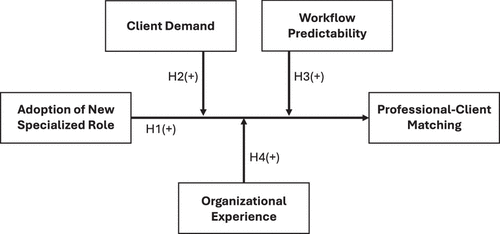
Whether specialized roles improve matching, however, depends on the organizational conditions under which allocation unfolds. In practice, allocation decisions occur amid fluctuating demand, uneven availability of professionals, and limited information about expertise—conditions that can blunt or even reverse the benefits of specialization. We therefore develop a contingency framework that specifies when specialized roles are most likely to improve professional–client matching. The framework highlights three organizational features that shape this relationship: client demand makes narrow scopes of practice viable, workflow predictability enables proactive task allocation planning, and organizational experience supports effective role deployment. Together, these conditions determine when specialized roles translate their structural promise into improved allocative outcomes.
We examine these ideas in the context of Brazil’s public healthcare system (Sistema Único de Saúde (SUS)), focusing on maternal care. Amid efforts to address high cesarean section (C-section) rates, some SUS hospitals adopted obstetric (OB) nurses—a specialized role akin to certified midwives—as part of maternity care reforms. This change altered the division of labor in maternity wards by introducing a distinct provider category authorized to attend vaginal deliveries, creating a new allocation pathway that did not previously exist.
The institutional features of this setting also allow us to isolate organizationally driven matching (where hospitals allocate patients to providers) from patient-initiated matching (where patients choose their providers). In SUS hospitals, expectant mothers are allocated to providers based on staffing schedules rather than personal choice, limiting patient-initiated matching. As a result, the adoption of OB nurses offers a valuable opportunity to study how introducing a narrowly scoped specialized role alters professional–client matching—specifically, whether patients are more likely to be paired with providers whose expertise aligns with their clinical risk.1
Our study leverages a data set covering over 15 million births between 2012 and 2022, with detailed information on mothers, providers, and hospitals. We use a difference-in-differences design to estimate the association between OB nurse adoption and professional–client matching, comparing changes within hospitals before and after adoption to changes in hospitals that never adopt. We find that OB nurse adoption is associated with improved professional–client matching—that is, patients are more likely to be paired with providers whose expertise aligns with their clinical risk. These improvements are strongest in hospitals with higher client demand, more predictable workflows, and greater organizational experience. We also show that improved matching is associated with better maternal and newborn outcomes, including lower complication rates and shorter hospital stays.
To clarify the mechanism behind the matching improvement, we benchmark observed allocation outcomes against a simulation in which patients are randomly assigned to available providers, accounting for the compositional mix of patients and providers. This comparison isolates allocation gains beyond what would arise mechanically from changes in the provider–patient pool. The simulation shows that prior to adoption, the allocation system barely outperformed random assignment, despite substantial expertise within the physician workforce across the risk spectrum. This suggests that the presence of expertise alone does not guarantee effective matching. After adoption, the system routes patients to appropriate providers substantially better than the simulated benchmark, indicating that the introduction of OB nurses makes expertise institutionally actionable.
This study makes two main contributions. First, we foreground task allocation as a core process within the division of labor. Whereas coordination concerns the ex post integration of interdependent tasks (Rico et al. 2008, Srikanth and Puranam 2011, Knudsen and Srikanth 2014), task allocation focuses on the ex ante allocation of work to individuals whose expertise fits the task demands. This distinction highlights the allocative challenge of deploying expertise where it creates the most value. We conceptualize professional–client matching as the allocative outcome of this process—the alignment between a professional’s expertise and a client’s specific needs. By shifting attention from the presence of expertise to its effective deployment, this perspective emphasizes that the benefits of individual specialization ultimately depend on how well expertise is matched to client needs.
Second, we show that specialized roles offer an organizational solution to this allocative challenge. By codifying expertise into formal positions, roles function as allocative infrastructure that improves professional–client matching. Our evidence indicates that roles enhance allocation not by enabling finer sorting among individual workers, but by providing recognizable categories that structure routing decisions. These benefits, however, are not automatic. Our contingency framework shows that the effectiveness of specialized roles depends on organizational conditions—client demand, workflow predictability, and organizational experience—that shape whether roles channel expertise into matches.
Theory and Hypothesis Development
Task Allocation as a Foundational Organizing Process
A key function, or raison d’être, of organizations is to create an internal division of labor that facilitates effective collective action (March and Simon 1958, Thompson 1967). A core element of this process is task allocation—the assignment of work to individuals whose expertise aligns with task demands (Cohen 2013, Puranam et al. 2014). Effective allocation allows organizations to deploy expertise where it is most valuable, improving efficiency, service quality, and client outcomes (Epstein et al. 2010, Hong et al. 2019). Conversely, misallocation, whether due to information gaps, ambiguities, or ad hoc allocation practices, can undermine performance (Chan and Anteby 2016, Adhvaryu et al. 2022, Feldberg 2022).
In professional and knowledge-intensive work, allocation outcomes often take the form of professional–client matching—the alignment between a professional’s expertise and the specific needs of a client or case.2 This alignment is critical for performance yet often difficult to achieve. Allocation decisions frequently unfold under conditions of fluctuating demands, constrained resources, and incomplete information, limiting organizations’ ability to direct expertise to the right cases (Boh et al. 2007, KC et al. 2020, Adhvaryu et al. 2022). Organizations respond to these challenges through a range of allocation mechanisms, each reflecting design choices about centralized control versus local flexibility (Puranam et al. 2014, Cowgill et al. 2025). Centralized approaches, such as managerial discretion, offer control over resource deployment and workload distribution but are limited by incomplete information (Boh et al. 2007, Dobrajska et al. 2015). Decentralized approaches such as self-selection leverage workers’ private knowledge but create coordination problems when interdependencies are high or organizational goals are opaque (Martela 2019, Ketkar and Workiewicz 2022, Raveendran et al. 2022). In practice, many organizations rely on hybrid approaches that provide structural guidance while leaving room for frontline discretion (Adhvaryu et al. 2022, Ketkar and Workiewicz 2022).
Yet, despite its critical role in translating human capital into performance outcomes, task allocation often remains an implicit or underspecified element of organizational design. This raises the question of how organizations can structure allocation in ways that consistently align expertise with task demands. Deepening our knowledge in this area is important because the performance benefits of expertise depend not only on who organizations employ, but on how effectively they allocate that expertise to specific tasks (Puranam et al. 2014). This motivates our focus on how individual specialization, and the structures used to manage it, shape allocation outcomes.
Individual Specialization and the Task Allocation Problem
When individuals become more specialized, the range of problems they face becomes narrower, enabling deeper expertise and greater efficiency (Smith 1776, Teodoridis et al. 2019).3 From a task allocation perspective, however, specialization creates a tension. On the one hand, when specialization is observable, narrower scopes of practice can facilitate allocation by making it easier to identify who is best positioned for a given task. In such cases, specialization reduces uncertainty about who holds relevant expertise and enables more systematic assignment (Gibbons and Waldman 2004, Huckman and Zinner 2008, Epstein et al. 2010).
On the other hand, finer-grained specialization can strain allocation mechanisms. Effective assignment requires detailed knowledge of how workers differ (Boh et al. 2007, Raveendran et al. 2022), and specialists’ deeper expertise does not always resolve ambiguities over who should do what, particularly when expertise is not easily apparent. Specialization can also reduce flexibility: if the designated specialist is unavailable or misassigned, others may lack the expertise to step in (Hong et al. 2019, Song et al. 2020).
In short, individual specialization makes matches both more valuable and more precarious. As Epstein et al. (2010, p. 812) note, “specialization and matching represent two sides of the same coin”: the benefits of specialization depend on whether organizations can align expertise with task demands.
Structuring Specialization Through Roles
Because individual specialization makes allocation more valuable but also more difficult, organizations can address this challenge by embedding specialization in formal roles with clearly defined responsibilities and expertise. Rather than leaving expertise differences implicit at the level of individuals, organizations can codify them into roles that carry clear expectations about domains of responsibility and types of work. This structuring matters. It translates individual specialization into organizationally legible categories, making expertise boundaries visible and actionable for allocation.
Roles formalize specialization by bundling a set of expected behaviors and responsibilities into a recognized position in the organizational structure (Biddle 1986, Nigam et al. 2016). In doing so, they make expertise legible to others, reduce ambiguity about who should handle particular tasks, and provide stable reference points for allocating work (Okhuysen and Bechky 2009, Valentine and Edmondson 2015). Importantly, such classification systems do more than passively map preexisting expertise—they actively shape how expertise is communicated and recognized, as the labels organizations use to categorize specialists become the frameworks through which expertise is made visible and actionable (Monteiro 2025). Roles thus improve allocation not only by providing better information about individuals, but by restructuring the allocation problem itself—when a role defines a distinct specialist category with a clear scope, the allocation system gains a basis for routing work toward the appropriate type of specialist, even when allocators lack detailed knowledge of individual workers’ expertise. Well-defined roles make task allocation more predictable and systematic, reducing the likelihood of mismatches (Bechky 2006, Bunderson and Boumgarden 2010). Ultimately, roles allow allocation processes to be “deindividualized” and less reliant on personal familiarity with others’ expertise, preferences, or strengths (Valentine and Edmondson 2015, p. 406). In this way, roles serve as allocative infrastructure—embedding structural pathways for directing who should do what and enabling organizations to channel expertise systematically rather than ad hoc.
Specialized roles can take multiple forms. They may formalize distinctions that already exist implicitly among workers—for instance, codifying who focuses on routine versus complex cases—or they may introduce entirely new professional categories into the organization. In both cases, their effect is to make expertise more visible and to channel allocation decisions toward better matches. Examples abound across industries: information technology companies add cybersecurity analysts to protect against digital threats; law firms use e-discovery specialists to manage digital evidence in cases; and hospital systems adopt specialized nursing roles to streamline care for certain conditions (Currie et al. 2010). In each case, roles help transform specialization from a latent property of individuals into a formal mechanism for directing expertise. Consistent with Bunderson and Boumgarden’s (2010) evidence that even self-managed teams benefit from bureaucratic features that clarify responsibilities, specialized roles provide a structural scaffold for more consistent and effective allocation. We therefore expect that organizations introducing specialized roles will see improvements in matching, not because specialization is inherently self-executing, but because roles embed specialization into structures that make allocation more systematic.
The adoption of specialized roles will be associated with improved professional–client matching.
A Contingency Framework for Specialized Roles and Professional–Client Matching
Although specialized roles embed expertise into organizational structures, their ability to improve professional–client matching is not automatic. The allocative function of roles is enacted through assignment systems that operate amid resource constraints, ambiguous task boundaries, and human discretion. Their effectiveness therefore hinges on whether organizations can recognize, allocate, and sustain expertise-based matches.
We theorize that three organizational factors moderate this relationship: client demand, workflow predictability, and organizational experience. These conditions provide the volume, structure, and adaptive capacity needed to turn the potential of specialized roles into reliable matching.
Client Demand: Sustaining Specialized Roles Through Volume.
High client demand amplifies the benefits of specialized roles by providing the volume needed to sustain finer-grained role differentiation—a dynamic recognized since Smith’s (1776) observation that the division of labor is limited by the extent of the market. Larger volumes of work allow organizations to sustain narrower scopes of practice without underutilizing professionals (Garicano and Hubbard 2007, Giustiziero 2021). When demand is high, professionals can focus on a smaller set of problems, building deep expertise through repetition and enabling more consistent alignment between what specialists do and what clients need (Huckman and Zinner 2008, Garicano and Hubbard 2009, Epstein et al. 2010). By contrast, when demand is low, the volume of cases in each domain is insufficient to maintain fine-grained specialization. Specialists may be required to cover a broader range of tasks outside their specific expertise, reducing the likelihood that clients are matched with providers best suited to their needs. We therefore hypothesize the following.
The benefits of adopting new specialized roles on professional–client matching will be magnified when organizations face higher client demand.
Workflow Predictability: Enhancing Allocation Planning and Precision.
The benefits of specialized roles depend not only on what work organizations undertake but also on how predictably that work arrives. Workflow predictability—the extent to which client needs and task demands can be anticipated in advance—enhances organizations’ ability to plan and assign work based on expertise rather than availability. When workflows are more predictable, managers and organizations can plan allocations ahead of time, ensuring that specialists are consistently matched with cases aligned to their expertise (Okhuysen and Bechky 2009, Valentine and Edmondson 2015). Much like Gittell’s (2002) findings that predictability supports smoother coordination during execution, predictability at the allocation stage enables managers to match expertise to work in advance. Predictability thus reinforces a deliberate division of labor, allowing specialists to focus on tasks where their skills add the most value.
These benefits are evident in settings where case inflow is foreseeable. For example, in law firms with predictable caseloads, such as corporate compliance or intellectual property filings, specialized attorneys can consistently work on matters that match their domain expertise rather than being diverted to general legal tasks. Similarly, in hospitals with scheduled surgical blocks, specialized cardiac surgeons can be consistently allocated to heart procedures rather than being pulled into tasks less related to their expertise. Such conditions reduce the need for improvised staffing, and preserve the boundaries of specialized roles. When workflows are unpredictable, by contrast, allocation tends to be reactive, driven by immediate availability rather than expertise, reducing the performance benefits of specialization (Staats and Gino 2012). Specialists may be diverted to tasks outside their domain, eroding both the consistency of role–task alignment and the advantages of specialization. We therefore hypothesize the following.
The benefits of adopting new specialized roles on professional–client matching will be magnified in organizations with higher workflow predictability.
Organizational Experience: Supporting Role Integration.
Organizational experience refers to the accumulated exposure professionals gain from repeatedly working within the same organization’s workflows, routines, and systems. Such experience embeds system-specific knowledge that complements technical expertise, allowing professionals to develop a nuanced understanding of how tasks, roles, and processes interconnect and how work typically flows through the organization (Huckman and Pisano 2006, Clark et al. 2013, Kim et al. 2023). This embedded knowledge helps organizational members interpret where a new specialized role fits within the broader workflow and anticipate how its introduction will interact with established routines (Huckman and Pisano 2006, Huckman et al. 2009). Such experience can also foster psychological safety and interpersonal trust (Edmondson 1999), enabling smoother incorporation of new roles into everyday practice. Over time, experience may also contribute to shared understandings of “who knows what,” clarifying responsibilities and supporting the channeling of work toward the new role when appropriate (Reagans et al. 2005).
Organizational experience also shapes how effectively organizations learn to deploy specialized roles. When professionals are attuned to their organization’s workflows, misallocations are more readily recognized and corrected, refining shared heuristics about how and when to deploy specialized roles (Bunderson and Sutcliffe 2002, Espinosa et al. 2007, Staats and Gino 2012). This collective capability reflects an organizational form of embedded knowledge—how well the workforce understands and enacts the organization’s division of labor—rather than simply individual tenure or interpersonal exposure. In less experienced organizations, weaker shared routines and slower feedback make it harder to detect and correct inefficient allocations once the new role is introduced.
In sum, organizational experience amplifies the allocative benefits of specialized roles by facilitating their incorporation into workflows and equipping organizations with the diagnostic capacity to learn where and when those roles add value. We therefore hypothesize the following.
The benefits of adopting new specialized roles on professional–client matching will be magnified in organizations with higher levels of organizational experience.
Figure 1 presents our contingency framework, which highlights how client demand, workflow predictability, and organizational experience moderate the relationship between the adoption of specialized roles and professional–client matching. The framework predicts a positive relationship between new specialized roles and professional–client matching, with this relationship strengthened by client demand, workflow predictability, and organizational experience.
Setting and Empirical Approach
Brazil’s Public Maternity Care System
We examine these hypotheses in Brazil’s public maternity care system, focusing on the introduction of a specialized role—obstetric nurses—and its impact on how hospitals match women in labor to care providers (physicians and OB nurses). Brazil’s public maternity care system offers an opportune setting for studying how new specialized roles shape professional–client matching. The country has one of the world’s highest C-section rates, averaging around 50% between 2007 and 2012—one of the highest among 139 countries, according to the United Nations Children’s Fund (UNICEF 2019). Recognizing this overrepresentation, the Brazilian Ministry of Health launched a series of reforms to expand access to evidence-based, patient-centered childbirth care, including the introduction of OB nurses into hospital maternity teams (Carr and Riesco 2007).
Brazil’s public healthcare system (Sistema Único de Saúde) provides universal coverage to roughly 75% of the population and accounts for about 70% of all births nationally (Carr and Riesco 2007).4 In Brazil’s public healthcare system, expectant mothers do not choose or develop relationships with the providers who ultimately deliver their babies. Prenatal care typically occurs in local health clinics near the patient’s residence, separate from the hospital setting (Barreto et al. 2020). When women arrive at a hospital in labor, they are assigned to available providers based on hospital staffing schedules, provider availability, and standardized triage protocols rather than patient choice (Ministério da Saúde 2014, Chown and Inoue 2025). These institutional features minimize patient-initiated matching (i.e., patients selecting their providers) and create an opportunity to observe organizational-based matching.
The OB Nurse Role: Scope, Training, Autonomy, and Adoption
OB nurses constitute a distinct professional category within Brazil’s nursing workforce. They are registered nurses who complete nationally standardized postgraduate training in obstetrics, encompassing coursework, supervised clinical rotations, and minimum delivery requirements (Lima et al. 2017). Certification establishes explicit competency thresholds and grants legal recognition from the Federal Nursing Council (Conselho Federal de Enfermagem) under Federal Nursing Law 7.498/86. Thus, OB nurses are not simply relabeled generalist nurses, but formally credentialed specialists prepared to manage labor independently while promoting the World Health Organization–recommended model of patient-centered childbirth care. Unlike generalist nurses, who may assist in deliveries but cannot legally manage labor independently, OB nurses are authorized to serve as primary providers for vaginal deliveries but cannot perform surgical procedures such as C-sections, which remain under physician authority. Because vaginal deliveries are more common among lower-risk pregnancies, OB nurses’ caseloads tend to concentrate at the lower end of the risk spectrum—but the legal boundary is defined by delivery mode, not patient risk classification.5
From an allocation perspective, the introduction of OB nurses represented a structural change in how responsibilities for patient care were organized. Before OB nurse adoption, all deliveries, both low- and high-risk, were attended by physicians. After adoption, women assessed as likely to deliver vaginally may be routed to OB nurses; physicians continue to manage all surgical cases as well as vaginal deliveries not assigned to OB nurses. Because this triage decision involves clinical judgment under uncertainty—a patient’s ultimate delivery mode is not known with certainty at the time of assignment—the routing is not deterministic. The role provides the triage system with a recognizable provider category to route toward, but the allocation decision itself requires assessment of the incoming patient’s likely care pathway.
The adoption and integration of OB nurses into maternity care in Brazil has unfolded gradually over the past two decades, shaped by a series of national policy reforms. Despite these reforms, adoption has been relatively slow. By 2020, only 2,049 OB nurses were practicing nationwide, with most concentrated in urban centers in the Southeast and South (Narchi et al. 2019, Oliveira et al. 2021).
Task Allocation in Maternity Care
Task allocation in SUS maternity hospitals is performed according to the standardized reception and risk classification (acolhimento e classificação de risco) protocol for obstetric triage (Ministério da Saúde 2014, Velho et al. 2024). We outline this process in Figure 2. On arrival, women are registered by administrative staff, undergo initial vitals screen by a nursing technician or auxiliary, and are then evaluated by a registered nurse for triage. This triage nurse is most often a general nurse trained in obstetric triage. Based on the Ministry of Health guidelines, this triage nurse assigns a color-coded priority ranging from red (immediate physician care) to blue (nonurgent; not requiring hospital care).6 This triage protocol is used in all hospitals and does not change with the adoption of OB nurses.
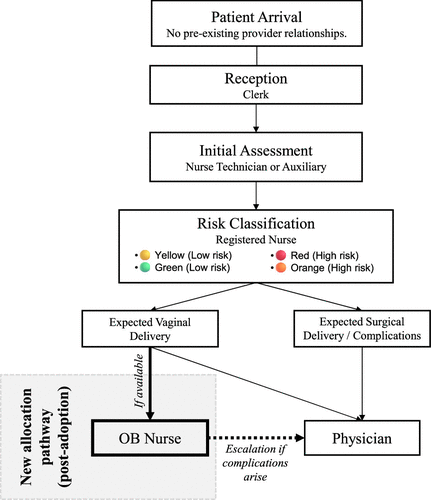
Notes. The thick arrow indicates the allocation pathway introduced with the adoption of the specialized obstetric nurse role. Thin arrows indicate preexisting allocation pathways.
Triage staff direct incoming patients based on their likely care pathway, routing cases expected to involve surgery or obstetric complications to physicians, and expected vaginal deliveries to either physicians or OB nurses. In hospitals with OB nurses, most intermediate cases (coded green and yellow) are managed by OB nurses (if available). For example, a woman arriving with mild contractions and no risk factors might be triaged as “green,” admitted and managed through labor by an OB nurse—a process that would have been handled entirely by a physician prior to OB nurse adoption. In hospitals without OB nurses, these cases are assigned to physicians. The OB nurse role simplifies allocation not by improving risk information but by creating a distinct provider category whose defined scope gives the triage system a structural basis for routing decisions that previously had no structural basis.
This institutional design yields a rare opportunity to observe organizational matching in a system where patient choice is minimal, allocation processes are standardized, and the introduction of a specialized role creates a clear, policy-backed shift that alters the division of labor in maternity wards.
Data and Sample Selection
We draw on three Ministry of Health databases: (1) Sistema de Informações sobre Nascidos Vivos (SINASC), which records all live births; (2) Sistema de Informacoes Hospitalares (SIH), which contains hospital and provider claims records; and (3) Cadastro Nacional de Estabelecimentos de Saúde (CNES), which details hospital characteristics.
The first data set, SINASC, gives information on the date, time, and healthcare unit of birth; several maternal characteristics, including the mother’s age, race, and municipality of residence; birth characteristics such as gestational length, type of pregnancy, fetal position, and delivery method (C-section or vaginal delivery); and the baby’s birthweight and Apgar score in the first minute, a measure of the newborn’s health status immediately after birth.
The second data set, SIH, contains provider claims records, which include information on patients (e.g., age, race, municipality of residence), hospital care (including date of admission, date of discharge, principal diagnosis, procedures performed), and a unique provider identifier assigned by the Brazilian Ministry of Health. We use the data on patients and hospital care (age, race, municipality of residence, date of birth, delivery method) to merge the SIH with the SINASC data set.
We then use the CNES data set to incorporate information on the healthcare units where the births take place. This final data set provides information about characteristics of healthcare units (e.g., teaching hospital, for-profit hospital) and other measures of an organization’s size, such as the number of beds in the hospital. We use a unique health unit code, assigned by the Brazilian Ministry of Health, to merge this data set with the SINASC and SIH data sets. This initial data set contains all births in the public health system in Brazil from 2012 to 2022, totaling approximately 15.6 million births across 960 hospitals.7
Identifying OB Nurse Adoption in the Sample.
To construct the analysis sample, we first identify hospitals that meet our definition of “adopting” OB nurses. We classify a hospital as adopting OB nurses if it meets two criteria. First, it must have at least six quarters without any OB nurse presence before the adoption quarter, followed by at least six quarters with OB nurses. Second, OB nurses must be present in at least 25% of all quarters following adoption. OB nurse presence is defined as at least one recorded birth attended by an OB nurse in that quarter.
We apply these criteria to ensure a clear preadoption period and sustained postadoption exposure. We exclude hospitals with OB nurses in all quarters (15 hospitals, accounting for about 490,000 births), as they lack a preadoption baseline for comparison. We also exclude hospitals with only sporadic OB nurse presence that does not meet our sustained adoption criteria—for example, those with a single quarter of OB nurse presence (158 hospitals associated with 3.4 million births). Applying these criteria, we identified 100 hospitals that adopted OB nurses between 2012 and 2020. Online Appendix B documents the geographic spread and timing of OB nurse adoption in our sample, showing that adoption was broadly distributed across Brazil and occurred gradually over the sample period.
Training–Testing Split and Client Complexity Estimation.
After defining the set of hospitals included in our study, we next determine which births we will use to estimate our core patient risk measure and which we will use for the analyses. To do this, we split the data into a training sample and a testing sample. The training sample consists of a random draw of 40% of births from hospitals that never adopted OB nurses and is used solely to estimate Client Complexity—a proxy for the risk level associated with each birth. This approach ensures that the complexity score for births in the analysis sample is based entirely on out-of-sample predictions, mitigating concerns about overfitting and mechanical correlation (though see the section Robustness Checks for alternative approaches).
Then, following Currie and MacLeod (2017), we estimate a logistic model using the training sample, predicting whether a birth results in a C-section based on maternal and pregnancy characteristics (e.g., maternal age, prior pregnancies, history of C-sections, multiple gestation, fetal position, and indicators of pregnancy complications).8 Table 1 presents the regression results,9 which align with our expectations: older mothers, those with prior C-sections, and those carrying multiple fetuses are more likely to undergo a C-section. Additionally, pregnancies complicated by fetal position or morbidity factors show a higher probability of C-section delivery. We then use the estimated coefficients from the training sample to the births in the testing sample to generate client complexity scores for each patient.10
|

Table 1. Logit Model Predicting C-Section (Training Data Set)
| (1) | (2) | |
|---|---|---|
| Coefficients | Odds ratio | |
| Mother’s age: Less than 18yr | −0.192** | 0.825** |
| (0.005) | (0.004) | |
| Mother’s age: 21–25yr | 0.241** | 1.272** |
| (0.004) | (0.005) | |
| Mother’s age: 26–30yr | 0.502** | 1.651** |
| (0.004) | (0.007) | |
| Mother’s age: 31–35yr | 0.732** | 2.079** |
| (0.005) | (0.010) | |
| Mother’s age: More than 35yr | 0.989** | 2.688** |
| (0.006) | (0.017) | |
| Mother’s prior C-section: One prior C-section | 2.184** | 8.884** |
| (0.004) | (0.034) | |
| Mother’s prior C-section: Two+ prior C-section | 4.638** | 103.337** |
| (0.011) | (1.130) | |
| Pregnancy type: Twins | 1.116** | 3.052** |
| (0.040) | (0.123) | |
| Pregnancy type: Three+ babies | 1.102** | 3.010** |
| (0.270) | (0.813) | |
| Fetal position: Pelvic | 2.412** | 11.160** |
| (0.010) | (0.116) | |
| Fetal position: Transverse | 3.658** | 38.801** |
| (0.072) | (2.796) | |
| Constant | −0.908** | 0.403** |
| (0.010) | (0.004) | |
| Observations | 3,698,535 | 3,698,535 |
| Pseudo R2 | 0.284 | 0.284 |
| Log pseudolikelihood | −2,549,776.7 | −2,549,776.7 |
Notes. Omitted categories are Mother’s age: 18–20 years, Mother’s prior C-section: No prior C-section, Pregnancy type: Single, Fetal position: Head down. The regression includes unreported indicators for number of prior pregnancies, gestational length, and for missing values for mother’s race, mother’s prior pregnancies, mother’s prior C-sections, pregnancy type, fetal position, and gestational length. Indicators for the following conditions are included but not reported to conserve space: preexisting hypertension complicating pregnancy, childbirth and the puerperium, preexisting hypertension with preeclampsia, gestational edema and proteinuria without hypertension, gestational hypertension without significant proteinuria, preeclampsia, eclampsia, unspecified maternal hypertension, diabetes mellitus in pregnancy, and maternal care for other conditions predominantly related to pregnancy. Robust standard errors are reported in parentheses.
**p < 0.01.
The predicted probabilities from this model serve as our proxy for client complexity and risk. For example, a healthy first-time mother with a singleton pregnancy at term in vertex position might have a predicted complexity score of 0.05, whereas a mother with preeclampsia, breech presentation, and a prior C-section might have a score above 0.90. After generating these predicted scores, we discard the initial 40% training sample, retaining only the remaining 60% of births for analysis (i.e., the testing sample).
Our final regression sample includes nearly 8 million births performed by over 26,000 providers across 787 hospitals. In this final sample, maternity wards have an average of 28 beds, 2.6 physicians in a day, and 4.96 patients delivering their baby each day. In the hospitals that adopt OB nurses, a maternity ward has on average 1.75 OB nurses working each day.
Dependent Variable: Professional–Client Matching
Our dependent variable, Professional–Client Matching, captures whether each patient is assigned to a provider whose past case mix indicates specialization in similar levels of case complexity as the focal patient.11 The measure is agnostic to provider type (i.e., OB nurse or physician) and focuses instead on whether a provider’s prior experience aligns with the patient’s clinical risk. We construct Professional–Client Matching in three steps, beginning with the classification of patients, then providers, and finally the definition of the match indicator.
Step 1: Classifying Client Complexity.
We quantify patient risk using Client Complexity, a clinically meaningful summary of maternal and pregnancy risks that captures the predicted probability of C-section delivery. Table 2 shows that Client Complexity scores range from 0.03 (indicating a high likelihood of vaginal delivery) to 1 (indicating a near-certain C-section). The distribution of Client Complexity exhibits considerable variation and is positively related with C-section occurrence (Figure 3, (a) and (b)). Notably, vaginal deliveries occur across the complexity spectrum (Figure 3(b)), reinforcing that delivery mode and patient risk, although correlated, are distinct—a point that matters because OB nurses’ scope of practice is defined by the former, not the latter. For classification, we divide the national distribution of client complexity into terciles, defining patients in the bottom tercile as low complexity, those in the middle tercile as moderate complexity, and those in the top tercile as high complexity.12
|
Table 2. Descriptive Statistics
| Mean | SD | Min | Max | |
|---|---|---|---|---|
| Client Complexity | 0.46 | 0.29 | 0.03 | 1.00 |
| Provider’s Risk Specialization | 0.46 | 0.11 | 0.03 | 1.00 |
| Professional–Client Matching | 0.32 | 0.47 | 0.00 | 1.00 |
| Hospital Ever Adopted OB Nurses (0/1) | 0.30 | 0.46 | 0.00 | 1.00 |
| Post–Adoption of OB Nurses (0/1) | 0.16 | 0.37 | 0.00 | 1.00 |
| High Client Demand (0/1) | 0.72 | 0.45 | 0.00 | 1.00 |
| High Workflow Predictability (0/1) | 0.47 | 0.50 | 0.00 | 1.00 |
| High Organizational Experience (0/1) | 0.62 | 0.49 | 0.00 | 1.00 |
| Mother’s age: Less than 18yr | 0.10 | 0.30 | 0.00 | 1.00 |
| Mother’s age: 18–20yr | 0.17 | 0.37 | 0.00 | 1.00 |
| Mother’s age: 21–25yr | 0.28 | 0.45 | 0.00 | 1.00 |
| Mother’s age: 26–30yr | 0.22 | 0.41 | 0.00 | 1.00 |
| Mother’s age: 31–35yr | 0.14 | 0.35 | 0.00 | 1.00 |
| Mother’s age: More than 35yr | 0.09 | 0.28 | 0.00 | 1.00 |
| Mother’s pregnancies: First pregnancy | 0.34 | 0.47 | 0.00 | 1.00 |
| Mother’s pregnancies: Second pregnancy | 0.28 | 0.45 | 0.00 | 1.00 |
| Mother’s pregnancies: Third pregnancy | 0.17 | 0.38 | 0.00 | 1.00 |
| Mother’s pregnancies: Fourth+ pregnancy | 0.17 | 0.37 | 0.00 | 1.00 |
| Mother’s C-section: No prior C-section | 0.69 | 0.46 | 0.00 | 1.00 |
| Mother’s C-section: One prior C-section | 0.17 | 0.38 | 0.00 | 1.00 |
| Mother’s C-section: Two+ prior C-section | 0.07 | 0.25 | 0.00 | 1.00 |
| Pregnancy type: Single | 1.00 | 0.05 | 0.00 | 1.00 |
| Pregnancy type: Twins | 0.00 | 0.04 | 0.00 | 1.00 |
| Pregnancy type: Three+ babies | 0.00 | 0.01 | 0.00 | 1.00 |
| Fetal position: Head down | 0.95 | 0.21 | 0.00 | 1.00 |
| Fetal position: Breech | 0.03 | 0.17 | 0.00 | 1.00 |
| Fetal position: Transverse | 0.00 | 0.04 | 0.00 | 1.00 |
| Pregnancy term: 28–31 weeks | 0.01 | 0.09 | 0.00 | 1.00 |
| Pregnancy term: 32–36 weeks | 0.09 | 0.28 | 0.00 | 1.00 |
| Pregnancy term: 37–41 weeks | 0.85 | 0.36 | 0.00 | 1.00 |
| Pregnancy term: 42+ weeks | 0.03 | 0.17 | 0.00 | 1.00 |
| Outcome: Baby Apgar 1-min (0–10) | 8.33 | 1.18 | 0.00 | 10.00 |
| Outcome: Baby low Apgar 1-min (0/1) | 0.06 | 0.23 | 0.00 | 1.00 |
| Outcome: Complications of labor and delivery (0/1) | 0.05 | 0.22 | 0.00 | 1.00 |
| Outcome: Length of stay (in days) | 2.40 | 1.67 | 0.00 | 337.00 |
| Outcome: Log cost | 6.50 | 0.25 | 6.09 | 11.19 |
| Outcome: C-section (0/1) | 0.44 | 0.50 | 0.00 | 1.00 |
| Observations | 7,981,843 |
Note. SD, Standard deviation.

Notes. Client Complexity is the predicted likelihood, based on the logistic regression reported in Table 1, that a birth will result in a C-section based on several maternal and pregnancy characteristics. Higher Client Complexity values indicate a greater likelihood of a C-section, whereas lower values suggest a higher likelihood of vaginal delivery.
Step 2: Classifying Provider’s Risk Specialization.
To capture a provider’s specialization in managing cases of varying risk, we construct Provider’s Risk Specialization, defined as the cumulative average Client Complexity of all patients previously attended by the provider. Higher values indicate a historical focus on more complex cases, whereas lower values indicate a specialization in less complex cases. In our sample, Provider’s Risk Specialization ranges from 0.03 to 1 (Table 2). Figure 4 presents the distribution of Provider’s Risk Specialization. Consistent with their scope of practice being limited to vaginal deliveries, OB nurses’ scores are concentrated (though not entirely) in the low-risk range (Figure 4(a)), whereas physicians’ scores vary more widely depending on their case mix (Figure 4(b)).13 We classify providers in each quarter by dividing the national distribution of Provider’s Risk Specialization into terciles, defining providers in the bottom tercile as low-risk specialists, those in the middle tercile as generalists, and those in the top tercile as high-risk specialists.

Notes. These figures show the distribution of Provider’s Risk Specialization, which reflects the risk profile of a provider’s patients. Higher values indicate specialization in complex cases, whereas lower values reflect a focus on less complex cases. Panel (a) shows the distribution for OB nurses, and panel (b) shows the distribution for physicians.
Step 3: Defining Professional–Client Matching.
We define Professional–Client Matching as a binary variable equal to one when a patient’s complexity category aligns with the provider’s specialization category and zero otherwise. Matches occur when low-complexity patients are treated by low-risk specialists or when high-complexity patients are treated by high-risk specialists. All other combinations, including cases involving generalists, are considered mismatches.14 We conduct several robustness checks using alternative operationalizations of professional–client matching, including quintile-based classifications, a continuous mismatch score, a cosine-similarity measure of patient–provider alignment, and treating middle-tercile patient–middle-tercile provider combinations as matches. Results are substantively consistent across these approaches and are discussed in more detail below.
Independent Variables
Post–Adoption of OB Nurses.
We construct a binary variable, Post–Adoption of OB Nurses,15 which equals one if the birth occurred in a hospital after OB nurses were introduced and zero otherwise.
Moderating Variables.
We examine how the relationship between OB nurse adoption and professional–client matching varies depending on client demand, workflow predictability, and organizational experience. To assess the heterogeneity of treatment effects in generalized difference-in-differences models that accommodate staggered adoption (Borusyak et al. 2024), we construct binary variables for high client demand, high workflow predictability, and high organizational experience. For adopting hospitals, moderators are measured in the quarter preceding adoption; for nonadopting hospitals, they are measured in the quarter preceding the first observed adoption in the sample, ensuring that these variables are not affected by postadoption changes in staffing, patient mix, or hospital operations.16
High Client Demand.
We measure client demand using hospital-level patient volume in the preadoption quarter and classify hospitals as having High Client Demand if their volume exceeds the sample median. Hospitals classified as having High Client Demand handled more than 282 births per quarter.
High Workflow Predictability.
We measure workflow predictability using the share of planned C-sections in the preadoption quarter. Planned C-sections are scheduled in advance, allowing hospitals to better anticipate and manage workflows (compared with when mothers just show up to the maternity ward in active labor). Hospitals with above-median planned C-section rates are classified as having High Workflow Predictability, reflecting greater scope for advance planning. Hospitals classified as having High Workflow Predictability scheduled C-sections for more than 16% of births.17
High Organizational Experience.
We proxy organizational experience using the average number of deliveries performed per provider in the preadoption quarter. The measure captures whether a hospital relies on a small number of providers who do many births (and therefore spend many hours in the hospital) or a larger number of providers who oversee fewer births in the hospital. Hospitals with above-median values are classified as having High Organizational Experience, indicating more sustained provider involvement within the same organizational setting. Hospitals classified as having High Organizational Experience are those in which providers average more than 30 deliveries per quarter.
Control Variables
We include several sets of fixed effects to account for factors that may influence professional–client matching. Hospital fixed effects account for persistent differences in matching across hospitals due to variations in resources and patient populations. Quarter fixed effects control for time-related shifts in matching that are common across all hospitals, including seasonal patterns and broader healthcare trends. We also include Day-of-week fixed effects, as hospital operations—and consequently professional–client matching—can vary significantly depending on the day, particularly between weekdays and weekends.18
Empirical Strategy
We estimate the effect of introducing OB nurses on professional–client matching using a difference-in-differences design that compares changes within hospitals before and after adoption to contemporaneous changes in nonadopting hospitals. We estimate the following model:19
Recent work shows that two-way fixed effects estimates in staggered treatment designs may be biased in the presence of heterogeneous treatment effects (de Chaisemartin and D’Haultfœuille 2020, Callaway and Sant’Anna 2021, Goodman-Bacon 2021, Sun and Abraham 2021, Borusyak et al. 2024). To address this concern, we use the imputation estimator proposed by Borusyak et al. (2024), which is robust to treatment effect heterogeneity across hospitals and over time. We compute robust standard errors clustered by hospital to account for heteroskedasticity and within-hospital correlation. In this model, the coefficient β captures the average effect of OB nurse adoption on professional–client matching.
Our theory also predicts that the relationship between adoption of OB nurses and professional–client matching will vary with client demand, workflow predictability, and organizational experience. To test these predictions, we estimate heterogeneous treatment effects by comparing hospitals classified as high (one) or low (zero) on each moderator. We implement these analyses using the imputation-based difference-in-differences approach, which accommodates staggered adoption and allows for subgroup-specific effects.20 We expect the coefficient to be larger for hospitals with high client demand (Hypothesis 2), high workflow predictability (Hypothesis 3), and high organizational experience (Hypothesis 4).
A potential concern in our empirical approach is whether nonadopting hospitals provide a valid counterfactual for adopting hospitals. We address this concern in several ways. First, we compare adopting and nonadopting hospitals across a broad set of patient and hospital characteristics. As shown in Table 3, the two groups are similar in professional–client matching and patient composition prior to adoption. Although hospital fixed effects account for permanent differences among hospitals, a remaining concern is that adopting hospitals might have followed different preadoption trends in professional–client matching. We address this possibility by investigating the dynamics in matching around the adoption and, as shown below, find no evidence of differential pretrends. To further mitigate concerns about endogenous adoption, we conduct two additional analyses. First, we match adopting and nonadopting hospitals on observable characteristics to improve comparability. Second, we restrict the sample to hospitals that eventually adopt OB nurses and exploit variation in the timing of adoption.
|
Table 3. Descriptive Statistics by Group
| Control | Treatment | |||||
|---|---|---|---|---|---|---|
| Before | After | |||||
| Mean | SD | Mean | SD | Mean | SD | |
| Professional–Client Matching | 0.31 | 0.46 | 0.29 | 0.46 | 0.37 | 0.48 |
| Hospital Ever Adopted OB Nurses (0/1) | 0.00 | 0.00 | 1.00 | 0.00 | 1.00 | 0.00 |
| Post–Adoption of OB Nurses (0/1) | 0.00 | 0.00 | 0.00 | 0.00 | 1.00 | 0.00 |
| High Client Demand (0/1) | 0.64 | 0.48 | 0.86 | 0.34 | 0.92 | 0.28 |
| High Workflow Predictability (0/1) | 0.45 | 0.50 | 0.52 | 0.50 | 0.52 | 0.50 |
| High Organizational Experience (0/1) | 0.56 | 0.50 | 0.70 | 0.46 | 0.79 | 0.40 |
| Mother’s age: Less than 18yr | 0.10 | 0.30 | 0.11 | 0.32 | 0.08 | 0.28 |
| Mother’s age: 18–20yr | 0.17 | 0.37 | 0.18 | 0.38 | 0.15 | 0.36 |
| Mother’s age: 21–25yr | 0.28 | 0.45 | 0.28 | 0.45 | 0.29 | 0.45 |
| Mother’s age: 26–30yr | 0.22 | 0.41 | 0.21 | 0.41 | 0.23 | 0.42 |
| Mother’s age: 31–35yr | 0.14 | 0.35 | 0.14 | 0.34 | 0.15 | 0.36 |
| Mother’s age: More than 35yr | 0.08 | 0.28 | 0.08 | 0.27 | 0.10 | 0.30 |
| Mother’s pregnancies: First pregnancy | 0.34 | 0.47 | 0.32 | 0.47 | 0.34 | 0.48 |
| Mother’s pregnancies: Second pregnancy | 0.28 | 0.45 | 0.28 | 0.45 | 0.29 | 0.45 |
| Mother’s pregnancies: Third pregnancy | 0.17 | 0.38 | 0.16 | 0.37 | 0.17 | 0.38 |
| Mother’s pregnancies: Fourth+ pregnancy | 0.17 | 0.37 | 0.16 | 0.37 | 0.17 | 0.38 |
| Mother’s C-section: No prior C-section | 0.70 | 0.46 | 0.66 | 0.47 | 0.72 | 0.45 |
| Mother’s C-section: One prior C-section | 0.17 | 0.38 | 0.15 | 0.36 | 0.17 | 0.37 |
| Mother’s C-section: Two+ prior C-section | 0.07 | 0.25 | 0.06 | 0.23 | 0.07 | 0.25 |
| Pregnancy type: Single | 1.00 | 0.05 | 1.00 | 0.06 | 1.00 | 0.05 |
| Pregnancy type: Twins | 0.00 | 0.04 | 0.00 | 0.04 | 0.00 | 0.04 |
| Pregnancy type: Three+ babies | 0.00 | 0.01 | 0.00 | 0.01 | 0.00 | 0.00 |
| Fetal position: Head down | 0.95 | 0.21 | 0.95 | 0.22 | 0.96 | 0.19 |
| Fetal position: Breech | 0.03 | 0.17 | 0.03 | 0.18 | 0.03 | 0.17 |
| Fetal position: Transverse | 0.00 | 0.04 | 0.00 | 0.05 | 0.00 | 0.04 |
| Pregnancy term: 28–31 weeks | 0.01 | 0.09 | 0.01 | 0.10 | 0.01 | 0.09 |
| Pregnancy term: 32–36 weeks | 0.09 | 0.28 | 0.10 | 0.30 | 0.09 | 0.28 |
| Pregnancy term: 37–41 weeks | 0.86 | 0.35 | 0.82 | 0.38 | 0.86 | 0.34 |
| Pregnancy term: 42+ weeks | 0.03 | 0.18 | 0.04 | 0.19 | 0.02 | 0.15 |
| Outcome: Baby Apgar 1-min (0–10) | 8.34 | 1.17 | 8.26 | 1.25 | 8.35 | 1.18 |
| Outcome: Baby low Apgar 1-min (0/1) | 0.06 | 0.23 | 0.07 | 0.25 | 0.06 | 0.24 |
| Outcome: Complications (0/1) | 0.05 | 0.21 | 0.05 | 0.22 | 0.08 | 0.27 |
| Outcome: Length of stay (in days) | 2.32 | 1.56 | 2.56 | 2.01 | 2.61 | 1.74 |
| Outcome: Log cost | 6.49 | 0.24 | 6.52 | 0.25 | 6.54 | 0.27 |
| Outcome: C-section (0/1) | 0.46 | 0.50 | 0.40 | 0.49 | 0.42 | 0.49 |
| Observations | 5,547,806 | 1,139,453 | 1,294,584 | |||
Note. SD, Standard deviation.
Results
Table 3 shows descriptive statistics of hospitals that adopted OB nurses before and after the adoption, providing preliminary evidence about Hypothesis 1. Consistent with Hypothesis 1, the average value of professional–client matching is higher after the adoption of OB nurses.
Table 4 shows estimates of the relationship between OB nurse adoption and professional–client matching. In Model (1), the coefficient on Postadoption is positive and statistically significant. A hospital’s adoption of OB nurses is associated with a 9.6 percentage point increase in professional–client matching, representing a 30% increase from a mean of 0.32.21 Consistent with Hypothesis 1, this finding indicates that introducing a specialized role improves alignment between patients’ needs and providers’ expertise.
|
Table 4. Obstetric Nurse Adoption and Professional–Client Matching
| Professional–Client Matching | ||||
|---|---|---|---|---|
| (1) | (2) | (3) | (4) | |
| Post-Adoption | 0.096** | |||
| (0.010) | ||||
| Post-Adoption (Low Client Demand) | −0.004 | |||
| (0.019) | ||||
| Post-Adoption (High Client Demand) | 0.105** | |||
| (0.010) | ||||
| Post-Adoption (Low Workflow Predictability) | 0.038** | |||
| (0.011) | ||||
| Post-Adoption (High Workflow Predictability) | 0.149** | |||
| (0.012) | ||||
| Post-Adoption (Low Organizational Experience) | 0.066** | |||
| (0.011) | ||||
| Post-Adoption (High Organizational Experience) | 0.104** | |||
| (0.011) | ||||
| Difference (High − Low) | 0.110** | 0.110** | 0.039** | |
| (0.021) | (0.015) | (0.013) | ||
| Hospital FEs | Yes | Yes | Yes | Yes |
| Quarter FEs | Yes | Yes | Yes | Yes |
| Day of week FEs | Yes | Yes | Yes | Yes |
| Observations | 7,981,843 | 7,981,843 | 7,981,843 | 7,981,843 |
Notes. This table shows estimates of the relationship between OB nurse adoption and professional–client matching, as well as how this relationship varies with client demand, workflow predictability, and organizational experience. Model (1) presents the average treatment effect, whereas Models (2) to (4) provide separate estimates for hospitals classified as low (zero) and high (one) on client demand, workflow predictability, and organizational experience. These models are estimated using the imputation-method difference-in-differences estimator developed by Borusyak et al. (2024). Differences in estimates across groups are computed using linear combinations of coefficients, applying the postestimation command xlincom to the output of did_imputation with the hetby option in Stata. Standard errors clustered at the hospital level are in parentheses. FEs, Fixed effects.
**p < 0.01.
An event study regression, which allows treatment effects to vary over time, reinforces this finding. Figure 5 presents event study estimates, obtained from generalized difference-in-differences models (Borusyak et al. 2024), in a graphical form. This figure shows a gradual increase in professional–client matching after the adoption of OB nurses. The event study plot also helps address the concern that adopting hospitals may have already been improving in matching prior to adoption. The event-study plot, however, shows no evidence of differential pretrends between the adopting and nonadopting hospitals, supporting the validity of our identifying assumption.
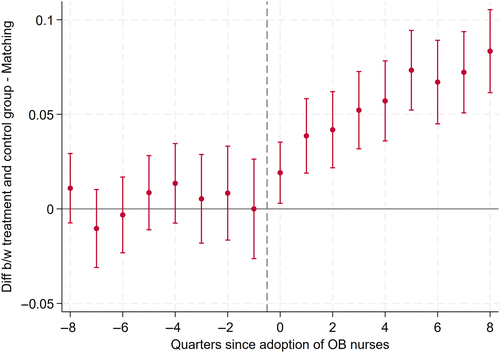
Notes. This figure shows regression coefficients with 95% confidence intervals based on robust standard errors clustered by hospital. The dependent variable is Professional–Client Matching. The model is estimated using the imputation method of Borusyak et al. (2024)—commands did_imputation and event_plot in Stata.
Models (2)–(4) estimate treatment effects separately for hospitals classified as low (zero) and high (one) on client demand, workflow predictability, and organizational experience, respectively. We compute the difference in treatment effects between these groups using linear combinations of coefficients.22
Model (2) shows that in hospitals with low client demand, the estimated coefficient is small and statistically insignificant (−0.004, p > 0.10), whereas in hospitals with high client demand the coefficient is 0.105 (p < 0.01). The difference between these estimates—about 11 percentage points—is consistent with Hypothesis 2 and indicates that the allocative benefits of specialized roles materialize primarily in higher-volume settings. Figure 6 shows that in high-demand hospitals these gains emerge soon after adoption and remain positive over time. In contrast, low-demand hospitals experience a short-term deterioration in matching, with no significant improvement relative to the control group even after eight quarters.
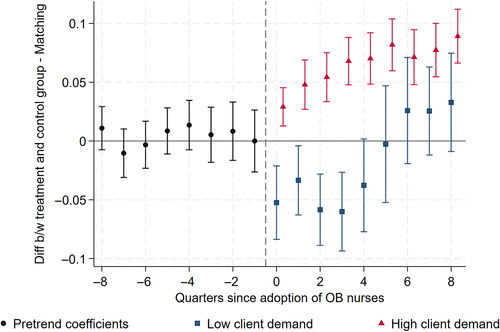
Notes. This figure shows regression coefficients with 95% confidence intervals based on robust standard errors clustered at the hospital level. The dependent variable is Professional–Client Matching. Estimates are obtained using the imputation-based difference-in-differences method of Borusyak et al. (2024), implemented with the did_imputation and event_plot commands in Stata. Hospitals are classified into low (zero) or high (one) client demand, and postadoption coefficients are estimated for each group. Preadoption coefficients are estimated jointly and do not vary by group, following the recommendation of Borusyak et al. (2024) to distinguish testing for pretrends from estimating treatment effects.
Model (3) shows a stronger association in hospitals where workflows are more predictable, consistent with Hypothesis 3. In hospitals with low workflow predictability, adoption is associated with a 0.038 (p < 0.01) increase in professional–client matching, whereas in hospitals with high workflow predictability, the estimated coefficient is 0.149 (p < 0.01). This difference of about 11 percentage points suggests that predictable workflows amplify the allocative benefits of specialized roles. Figure 7 shows that hospitals with high workflow predictability exhibit immediate and sustained improvements in matching, whereas hospitals with low workflow predictability show more gradual gains, leaving a persistent gap between the two groups after eight quarters.
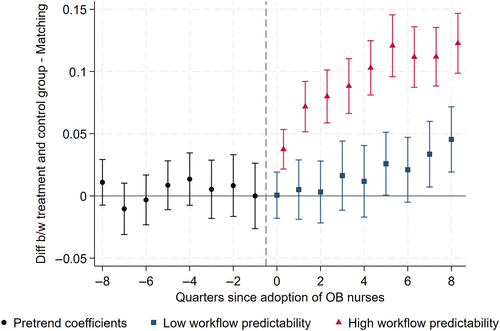
Notes. This figure reports regression coefficients with 95% confidence intervals based on robust standard errors clustered at the hospital level. The model is estimated using the imputation method of Borusyak et al. (2024). Hospitals are classified into low (zero) and high (one) workflow predictability, with postadoption coefficients estimated for each group. Preadoption coefficients are estimated jointly and do not vary by group.
Finally, Model (4) shows a coefficient of 0.066 (p < 0.01) for hospitals with low organizational experience and 0.104 (p < 0.01) for those with high organizational experience, a difference of about 3.9 percentage points. Consistent with Hypothesis 4, the association between OB nurse adoption and matching is stronger in hospitals with greater organizational experience. Figure 8 shows that hospitals with high organizational experience exhibit a faster improvement in matching, whereas hospitals with lower experience take longer to improve but eventually converge with their more experienced counterparts.
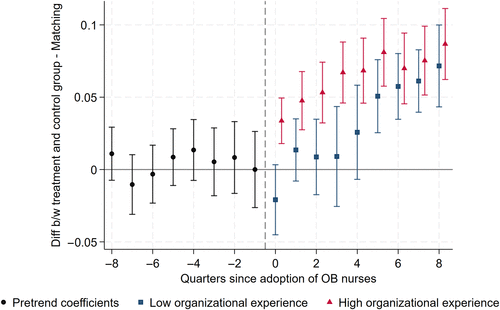
Notes. This figure reports regression coefficients with 95% confidence intervals based on robust standard errors clustered at the hospital level. The model is estimated using the imputation method of Borusyak et al. (2024). Hospitals are classified into low (zero) and high (one) organizational experience, with postadoption coefficients estimated for each group. Preadoption coefficients are estimated jointly and do not vary by group.
Taken together, the findings show OB nurse adoption is positively associated with improved professional–client matching and that this relationship is stronger in hospitals with higher client demand, more predictable workflows, and greater organizational experience.
Robustness Checks
We conduct a series of robustness checks to assess the credibility of our findings. Specifically, we examine the potential endogeneity of OB nurse adoption, evaluate possible cross-hospital spillovers (stable unit treatment value assumption (SUTVA) violations), test the sensitivity of our results to alternative measures of professional–client matching, and distinguish the allocative infrastructure mechanism from both mechanical diversion and capacity expansion. Additional robustness checks are reported in the Online Appendix.
Endogeneity of OB Nurse Adoption.
A potential concern with our empirical analysis is that hospitals adopting OB nurses differ systematically from nonadopting hospitals in ways correlated with professional–client matching. To address this, we implement a coarsened exact matching (CEM) procedure to improve comparability between adopting and nonadopting hospitals (Blackwell et al. 2009, Iacus et al. 2012). Hospitals are matched on organizational characteristics, capacity measures, and patient case mix, and in a stricter specification, also within state. Across specifications, covariate balance improves substantially, and regression estimates using CEM weights remain consistent with our main findings (Online Appendix D).
To further address concerns about selective adoption, we perform an analysis that restricts the sample to hospitals that adopted OB nurses, leveraging variation in adoption timing. This approach compares hospitals to themselves before and after adoption, holding constant persistent differences between adopters and nonadopters. Results are similar to our main estimates (Table A4), suggesting that the observed effects are unlikely to be driven solely by endogenous adoption.
SUTVA Violation.
Another concern is a violation of the SUTVA if the adoption of OB nurses in one hospital affects outcomes in other hospitals. Such interference could arise if providers work across treatment and control hospitals, creating cross-hospital spillovers. OB nurses rarely work across hospitals in our sample (9 of 1,343), and by definition, none work simultaneously in treatment and control hospitals. Although some physicians practice in multiple hospitals, we reestimate our models restricting the control group to the 410 hospitals that share no providers with treatment hospitals. The results remain consistent (Table A5), indicating that cross-hospital provider linkages are unlikely to bias our estimates.
Alternative Measures of Professional–Client Matching.
We assess whether our findings depend on how professional–client matching is operationalized. First, we redefine matching using quintiles of Client Complexity rather than terciles. Second, we construct a continuous mismatch measure defined as the absolute difference between patient complexity and provider specialization. Third, we use an alternative specification that treats middle-tercile patient–provider combinations as matches, relaxing our main measure’s exclusion of generalists. Results using all three approaches remain consistent with our main findings (Tables A6, A7 and A8; Figures A2 and A3).
Next, we implement an alternative approach to measuring professional–client matching, based on the cosine similarity method in Ching et al. (2021) and the experience-based matching in Epstein et al. (2010). For each provider, we construct a time-varying “experience vector” based on previously treated patient characteristics and compute cosine similarity with each focal patient’s characteristic vector. We also create a variant in which the provider’s experience vector is restricted to the preceding 90 days. Across both variants, results remain consistent for Hypotheses 1–3, with weaker evidence for Hypothesis 4 (Tables A9 and A10). Additional details and discussion of this approach are provided in Online Appendix E.
Finally, to address whether specialization may operate through condition-specific expertise rather than overall complexity, we define matching based on providers’ prior experience with specific clinical conditions. Restricting the sample to mothers presenting with common complications—membrane complications, eclampsia, and placental disorders—we code a match as assignment to a provider who has previously managed that condition. OB nurse adoption is associated with improved condition-specific matching for two of the three conditions examined, with positive but less precise estimates for the third, where the sample is smaller (Table A11). These results indicate that the allocative improvements we document extend beyond complexity-based measures to matching condition-specific expertise.
Distinguishing Allocative Infrastructure from Mechanical Diversion.
A central concern is whether improvements in professional–client matching reflect genuine changes in how expertise is deployed or are instead mechanical artifacts of introducing a new provider type. The concern takes two forms. First, OB nurses are concentrated in low-risk cases, so adding them to the provider pool may mechanically raise the share of well-matched births. Second, by diverting low-risk patients away from physicians, adoption alters the distribution of case complexity among physicians. If physicians consequently treat a more concentrated set of higher-risk cases, improvements in physician matching could reflect this compositional shift rather than more effective allocation.
To address these possibilities, we implement a random-assignment simulation that decomposes matching improvements into compositional effects and role-enabled allocative gains. For each hospital-day, we simulate matching under random assignment, holding constant the set of patients and providers that were present that day. We repeat this 1,000 times and compute the average simulated matching rate. The difference between actual and simulated matching—Excess Matching—captures the extent to which the allocation exceeds what would arise mechanically from changes in the provider–patient pool. We implement this simulation for both the full sample and a physician-only sample (excluding OB nurses). Full simulation design details are provided in Online Appendix F.
Table 5 reports mean matching rates from the simulation. Prior to adoption, the allocation system barely outperformed random assignment: excess matching was just 1.6 percentage points in adopting hospitals (0.8 percentage points in nonadopting hospitals). Despite substantial low-risk expertise in the physician workforce, the system lacked a mechanism to deploy it. After adoption, excess matching in the full sample rises to 5.5 percentage points, while remaining unchanged in the physician-only sample.
|
Table 5. Random-Assignment Simulation: Means for Adopting and Non-Adopting Hospitals
| All providers | Physician only | |||
|---|---|---|---|---|
| (1) | (2) | (3) | (4) | |
| Pre | Post | Pre | Post | |
| Panel A: Adopting hospitals | ||||
| Actual matching | 0.310 | 0.376 | 0.310 | 0.317 |
| Random benchmark | 0.294 | 0.321 | 0.294 | 0.301 |
| Excess matching | 0.016 | 0.055 | 0.016 | 0.017 |
| Panel B: Nonadopting hospitals | ||||
| Actual matching | 0.322 | — | 0.322 | — |
| Random benchmark | 0.314 | — | 0.314 | — |
| Excess matching | 0.008 | — | 0.008 | — |
Notes. This table reports mean matching rates from a random-assignment simulation. For each hospital-day, we observe the actual patients and providers and simulate matching under random assignment of patients to providers, holding each provider’s caseload fixed (1,000 permutations). Actual matching is the observed matching rate. Random benchmark is the mean matching rate across simulated permutations. Excess matching is the difference between actual and simulated matching, capturing the extent to which the allocation system sorts patients to providers beyond what the composition of the available pool would produce under random assignment. Columns (1) and (2) include all providers (physicians and OB nurses); columns (3) and (4) restrict the sample to physician-led births. For adopting hospitals, “Pre” and “Post” refer to periods before and after OB nurse adoption. For nonadopting hospitals, we report a single set of means pooled across the full sample period. Additional details about the simulation are provided in Online Appendix F.
Table 6 formalizes this decomposition using difference-in-differences estimates. In the full sample, OB nurse adoption increases actual matching by 9.6 percentage points. The analysis indicates that 5.8 percentage points of this gain reflect compositional changes in the provider–patient pool, captured by the simulated random benchmark. The remaining 3.9 percentage points—approximately 40% of the total effect—represent role-enabled allocative gains; that is, patients are sorted to providers better than random after adoption.
|
Table 6. Random-Assignment Simulation: Difference-in-Difference Estimates
| (1) | (2) | |
|---|---|---|
| All providers | Physician only | |
| Actual matching | 0.096** | 0.046** |
| (0.012) | (0.014) | |
| Random benchmark | 0.058** | 0.046** |
| (0.011) | (0.014) | |
| Excess matching | 0.039** | −0.001 |
| (0.004) | (0.001) |
Notes. This table reports difference-in-differences estimates decomposing the effect of OB nurse adoption on professional–client matching into compositional and active-sorting components. Each row reports the estimated treatment effect from a separate regression using the imputation estimator of Borusyak et al. (2024). Actual matching is the observed hospital-day matching rate. Random benchmark is the mean matching rate from 1,000 random permutations of patient–provider assignments within each hospital-day, holding provider caseloads fixed. Excess matching is the difference (actual minus simulated). Column (1) includes all providers; column (2) restricts the sample to physician-led births. All models include hospital and year-quarter fixed effects with standard errors clustered at the hospital level. Sample size is 2,264,877 in the “all provider” sample and 2,254,301 in the physician-only sample. Additional details about the simulation are provided in Online Appendix F. Standard errors clustered at the hospital level are in parentheses.
**p < 0.01.
In the physician-only sample, actual matching improves by 4.6 percentage points, but the random benchmark increases by the same amount, leaving excess matching unchanged. Thus, improvements among physicians appear to reflect compositional shifts in case mix rather than finer sorting within the physician group. Allocative gains operate primarily through routing patients across provider types.
Importantly, compositional shifts and allocative improvements are complementary features of the same structural change. Introducing OB nurses simultaneously reshapes who treats which cases and provides the triage system with a role-enabled signal for directing work. Compositional changes arise because expertise is formalized into a recognized role embedded in allocation routines. In this sense, matching gains reflect the operation of allocative infrastructure.
Additional analyses reinforce this interpretation. First, the distribution of physician specialization undermines the notion that physicians were concentrated in high-risk care. Before adoption, 33.9% of physician-led births in adopting hospitals were performed by physicians in the lowest tercile of risk specialization; this share declines only modestly to 25.8% after adoption (Table A12). Low-risk physician expertise was abundant but underleveraged. Second, excluding OB nurses and focusing solely on physicians does not eliminate improvements in physician-level matching (Table A13),23 but given the simulation analyses, these gains likely reflect compositional shifts in physicians’ case mix rather than improved sorting among physicians themselves. Third, if matching improvements operated purely through diversion of low-risk cases to OB nurses, gains would be confined to low-risk patients. Instead, adoption improves alignment for both low- and high-risk patients (Table A14), indicating that the role improves allocation more broadly through structural channeling, not simply by diverting low-risk cases.
Together, these findings show that matching gains reflect more than mechanical diversion. Before adoption, the allocation system failed to systematically leverage existing expertise. By codifying expertise into a formal role, OB nurse adoption created a structural pathway for directing patients to appropriate providers, improving matching beyond what compositional change alone would produce.
Distinguishing Allocative Infrastructure from Capacity Expansion.
Another concern is that OB nurse adoption improves matching by increasing staffing capacity rather than by restructuring allocation processes. Although our results are robust to controlling for day-level patient and provider counts (Table A15), we further examine whether improvements in professional–client matching reflect changes in allocative infrastructure rather than capacity expansion alone. First, we compare postadoption days when OB nurses are present to days when they are not. Although adoption is associated with improvements in matching on both types of days, the effect is substantially larger when OB nurses are on shift (Table A16; Figure A4), suggesting that improvements are linked to the active deployment of the specialized role. Second, we restrict the sample to days when hospitals operate with exactly two providers, holding staffing capacity constant. In this setting, adoption changes the composition of providers rather than total staffing levels. Improvements in matching are concentrated on days when staffing includes one physician and one OB nurse (Model (2); Figure A5), providing stronger evidence that the effect reflects changes in allocation structure rather than simple capacity expansion. Together, these analyses indicate that although OB nurse adoption may increase staffing, its influence on professional–client matching cannot be explained by capacity expansion alone.
Additional Robustness Checks.
Our results are also robust to additional specifications and alternative samples. Estimates remain consistent when including state × year fixed effects to absorb time-varying regional factors such as care guidelines or public health campaigns, excluding planned C-sections, restricting the sample to single-hospital municipalities, focusing on mothers with lower levels of formal education, using the full sample of births, and examining the intensive margin of OB nurse adoption. Detailed results for these analyses are reported in Online Appendix A (Tables A17–A23).
Professional–Client Matching and Clinical Performance
Beyond examining how specialized roles influence professional–client matching, we explore whether improved matching is associated with better maternal and newborn outcomes. This analysis provides evidence on the relevance of professional–client matching for clinical performance.
To examine this relationship, we estimate the following model:
Table A24 shows the estimates for the relationship between professional–client matching and maternal and newborn outcomes.25 Across all measures, professional–client matching is associated with more favorable indicators. In particular, better matching is linked to higher Apgar scores, fewer delivery complications, and shorter hospital stays, as well as lower hospitalization costs and C-section rates.26 The magnitudes of these associations are modest but comparable to those reported for other maternity care interventions (Melo and Menezes Filho 2023, Fischer et al. 2024, Sandall et al. 2024). Taken together, these patterns suggest that professional–client matching is meaningfully related to clinical performance. We elaborate on implications for policy and healthcare practice in Online Appendix G.
Discussion and Conclusion
This study examines task allocation as a core process in the division of labor, focusing on a fundamental yet understudied challenge: how organizations generate high-quality matches between professionals and the clients they serve. We distinguish task allocation from coordination to clarify its unique role in organizing work. Task allocation involves the ex ante assignment of work to specific individuals (Puranam et al. 2014), whereas coordination concerns the ex post integration of interdependent tasks (Rico et al. 2008, Srikanth and Puranam 2011, Knudsen and Srikanth 2014). Our analysis of OB nurse adoption in Brazilian hospitals shows that specialized roles improve professional–client matching by shaping how expertise becomes visible and is deployed. However, the allocative benefits of specialized roles depend on organizational conditions, including client demand, workflow predictability, and organizational experience. We elaborate on these contributions below.
Specialized Roles as Allocative Infrastructure
Specialized roles are typically understood as containers for expertise—formal positions that bundle skills and responsibilities. Our findings suggest they also function as allocative infrastructure, shaping how work is routed to appropriately specialized providers. This extends research on task allocation mechanisms such as managerial discretion, peer referral, and self-selection (Epstein et al. 2010, Raveendran et al. 2022, Cowgill et al. 2025) by highlighting roles as a mechanism that structures allocation.
Our simulation clarifies this mechanism. Before OB nurse adoption, patient allocation among physicians performed little better than random assignment, despite the presence of both low- and high-risk expertise within the physician workforce. The system possessed relevant expertise but lacked a structural basis for deploying it effectively—physician specialization was neither encoded in formal roles nor visible to triage nurses making assignment decisions. The OB nurse role resolves this not by improving sorting among physicians, but by introducing a formally defined provider category that makes expertise more legible and actionable. Before adoption, triage nurses chose among formally undifferentiated physicians. After adoption, the system gains a first-stage routing decision—OB nurse or physician—that simplifies the allocation problem and raises the likelihood of expertise-aligned matches.
This insight aligns with Monteiro’s (2025) argument that organizational classification systems shape how expertise is recognized and valued. We extend this logic by showing that such systems also shape how expertise is deployed. In our setting, the OB nurse role functions as a classification device that makes a clinically meaningful distinction operational at the point of triage. By formalizing this boundary, the role enables the allocation system to recognize and act on expertise that previously remained latent. Roles thus do not simply reflect expertise; they structure which expertise can be mobilized in practice.
Crucially, specialized roles function not as rigid allocation rules but as allocative scaffolds. They establish organizational channels (Galbraith 1973, Nadler and Tushman 1997, Puranam 2018) through which discretion flows, raising the likelihood that allocations align with expertise. Conceptualizing roles as allocative infrastructure shifts attention from how allocations are made (e.g., centralization or individual self-selection) to the organizational structures that shape allocation.
More broadly, our findings illuminate the relationship between individual specialization and task allocation. Classic accounts emphasize the productivity gains of specialization through focus, repetition, and learning (Smith 1776, Arrow 1962, Argote 1999). Yet these gains depend on matching specialists to the appropriate work. As expertise narrows, the stakes of allocation rise and the risk of misallocation grows. Specialized roles mitigate this tension by creating visible categories that simplify the allocation problem. Similar dynamics arise in professional service firms, where individuals hold identical titles despite having deep industry or problem-specific expertise. Without roles that encode those distinctions, organizations lack clear channels for directing expertise where it creates the most value. The challenge in such settings is not that expertise is absent but that it is invisible to the systems responsible for deploying it—precisely the condition our simulation documents in the preadoption period. When specialization becomes organizationally legible, the benefits of expertise are more likely to be realized.
Organizational Conditions Shaping Effective Task Allocation
A second contribution of our study is to show that the allocative benefits of specialized roles are contingent rather than automatic. Structurally similar OB nurse roles produced different matching outcomes across hospitals because their effectiveness depended on organizational conditions that supported or constrained their use. This echoes computational models showing that the performance of centralized allocation systems hinges on informational and temporal context (Raveendran et al. 2022).
Our setting features a predominantly centralized allocation system, in which triage nurses assign patients to providers. This arrangement resembles what Raveendran et al. (2022) describe as a replacement setting, where tasks (patients) arrive unpredictably and all available workers are eligible for assignment. Although centralized systems can outperform self-selection in such environments, our findings reveal substantial variation within this regime, suggesting that allocation effectiveness depends critically on organizational factors such as client demand, workflow predictability, and organizational experience.
First, we find that the allocative benefits of specialized roles are stronger in hospitals with high client demand. Volume sustains narrower scopes of practice and consistent deployment of specialized expertise, reinforcing classic arguments that the division of labor depends on the extent of the market (Garicano and Hubbard 2007, Smith 1776).27
Second, specialized roles generate larger gains in hospitals with more predictable workflows. In the framework of Raveendran et al. (2022), moving from a replacement setting (where tasks arrive unpredictably) to a simultaneous setting (where tasks and workers are known in advance) enhances the effectiveness of centralized allocation. Similarly, predictable workflows in our setting enable more deliberate assignment decisions, allowing managers to fully exploit information about providers’ expertise. By contrast, volatile environments expose the fragility of role-enabled allocation when immediacy overrides expertise fit (Song et al. 2020).
Finally, we find only partial support for the moderating role of organizational experience. Hospitals with greater organizational experience integrate OB nurses more effectively in the immediate aftermath of adoption, but this advantage diminishes over time. This pattern suggests that organizational experience primarily shapes integration capacity—accelerating early adaptation while offering limited long-run advantage once allocation practices stabilize (Edmondson et al. 2001, Zollo and Winter 2002).
Together, these findings extend theories of the division of labor and advance a contingency framework of task allocation. Effective allocation depends not only on introducing specialized roles, but on the organizational conditions that allow those roles to reliably channel expertise into matching.
Limitations and Future Research
Our study examines maternity care in Brazilian public hospitals, where OB nurses and physicians operate under clearly delineated scopes of practice. This clarity facilitates observation of allocation patterns but limits generalizability to settings with less sharply defined role boundaries. In our setting, OB nurses function within a professional hierarchy, are confined to vaginal deliveries, and face relatively low interdependence during task execution. In many professional contexts, however, specialized roles lack strict scope restrictions and involve greater interdependence, making allocation more tightly intertwined with coordination. Future research should examine whether role-enabled allocative infrastructure operates similarly in contexts with greater ambiguity, flatter hierarchies, or higher interdependence.
Although we observe large-scale changes in allocation patterns, we do not directly observe the decision-making processes that generate them. We therefore cannot disentangle the relative influence of centralized assignment, individual discretion, or informal social mechanisms. Qualitative or mixed-method studies could deepen understanding of how formal specialized roles interact with informal social mechanisms, such as affiliations or reputation networks, in shaping access to clients and opportunities (Gubler 2019, Gubler and Cooper 2019).
Although we implement several strategies to mitigate endogeneity concerns, unobserved organizational factors may still influence both adoption and matching. Future research leveraging policy shocks or alternative quasi-experimental designs could further strengthen causal inference.
Finally, future research should examine the potential trade-offs in allocative infrastructure. Although role-enabled matching may enhance the deployment of expertise, it may reduce flexibility, constrain cross-training, or limit adaptability (e.g., Stan and Vermeulen 2013, Teodoridis et al. 2019). Investigating how organizations balance the precision of role-enabled allocation with the need for flexibility would enrich our understanding of task allocation as a dynamic organizational process.
Conclusion
Through our analysis of specialized role adoption in Brazilian hospitals, we show that roles can function as allocative infrastructure, guiding allocation by embedding expertise expectations into organizational structures. However, their effect on task allocation is not inherent to role design, but emerges through interaction with organizational conditions, such as client demand, workflow predictability, and organizational experience. Our study highlights the central role of task allocation in the division of labor, underscoring the need for deliberate attention to how roles and organizational conditions shape the effective use of specialized expertise across diverse professional and knowledge-intensive settings.
The authors greatly appreciate the editorial guidance of Tim Gubler and the insightful comments from three anonymous reviewers. The authors thank Kylie Hwang, Maryam Kouchaki, Dylan Nelson, Yusaku Takeda, and Jorge Tamayo, as well as audience members at the Academy of Management Annual Meeting, Strategic Management Society Annual Conference, the Wharton People & Organizations Conference, and the Management in Emerging Markets Seminar, for their comments and suggestions on prior versions of this manuscript. The authors contributed equally to this manuscript and are listed in alphabetical order.
1 Throughout the paper, we use the term providers to refer to both physicians and OB nurses. Our main analyses examine how hospital adoption of OB nurses shapes professional–client matching across both types of providers.
2 We use the term allocation to refer to the process of assigning tasks to individuals and matching to describe the outcome of that process—that is, whether expertise is aligned with task requirements.
3 Specialization in the professional workforce can occur across the complexity spectrum—whether at the high end, involving concentrated expertise at the knowledge frontier, or at the low end, involving narrowly scoped responsibility for more routine work. Our focus in this study is on the latter.
4 Although we have data on all births in Brazil, provider claims data are unavailable for the private system, limiting our ability to analyze professional–client matching in that setting.
5 Because OB nurses’ scope is defined primarily by delivery mode rather than patient risk, they may attend patients with elevated risk factors who ultimately deliver vaginally.
6 Triage categories include the following: (1) red, immediate physician care; (2) orange, care within 15 minutes, typically by a physician or potentially an OB nurse; (3) yellow, care within 30 minutes, often by an OB nurse where present; (4) green, care within 120 minutes, usually suitable for an OB nurse where present; and (5) blue, nonurgent, redirected out of hospital to prenatal care provider.
7 We restrict the sample to general and specialized hospitals with at least five years of observations and an average of 365 births per year to mitigate small-sample variability and biases from irregular service provision. We further exclude mothers younger than 14 or older than 50, pregnancies under 28 gestational weeks, and deliveries involving traumatic accidents or multiple surgeries, as these cases often do not reflect the broader population.
8 This model includes indicators for the following characteristics of the mother and pregnancy: mother’s age group; mother’s number of prior pregnancies and the number of prior C-sections; whether it is a single baby, twins, or three or more babies; if the fetal position is head down, pelvic, or transverse; gestational length groups; indicators for conditions such as preexisting hypertension complicating pregnancy, preexisting hypertension with preeclampsia, gestational edema and proteinuria without hypertension, gestational hypertension without significant proteinuria, preeclampsia, eclampsia, unspecified maternal hypertension, diabetes mellitus in pregnancy; and maternal care for other conditions predominantly related to pregnancy.
9 The complete regression specification and full set of coefficients are reported in Table A1.
10 We experimented with several alternative models and found that the correlation between the ranking of client complexity produced by our model and the ranking produced by the alternatives is above 0.95. These alternatives included a model using a larger sample and a model using only the births in the hospitals considered the best in the country. The estimated coefficients were similar in all these models, suggesting that there is little controversy about the ranking of which mothers are the best candidates for C-section. We discuss the classification performance of these models in Online Appendix C.
11 We use “professional” to refer to credentialed workers in a professional service setting and “specialized” to refer to the degree of focus in a worker’s expertise or role. A professional can be a generalist or a specialist.
12 Our results are robust to alternative classifications (e.g., quintiles, continuous measures, and cosine similarity-based approaches). See the Robustness Checks section for details.
13 The distribution for all providers is provided in Online Appendix A, Figure A1.
14 Interpreting Professional–Client Matching for generalists (i.e., providers in the middle tercile of risk specialization) is challenging because they do not necessarily specialize in any particular risk level. Although one might assume that a patient with moderate Client Complexity is well matched to this kind of provider, these providers often treat both low- and high-complexity cases, meaning they do not necessarily have expertise in moderate-risk patients. To maintain consistency, we refrain from making inferences about matching involving this type of provider in this measure. Results are substantively unchanged when we use an alternative specification that treats middle-tercile patient–middle-tercile provider combinations as matches (Table A8).
15 In some tables, this variable is labeled Postadoption (instead of Post–Adoption of OB Nurses) for brevity.
16 All three moderators—High Client Demand, High Workflow Predictability, and High Organizational Experience—are binary variables constructed from measures calculated in the quarter prior to OB nurse adoption for treatment hospitals and in the quarter prior to the first adoption for control hospitals. This timing ensures that the moderators are not mechanically affected by OB nurse adoption. Online Appendix Tables A2 and A3 report two sets of correlations: one for the binary moderators used in the empirical analysis and another for the underlying continuous measures. The correlations among the binary moderators are generally low, with the highest being between High Client Demand and High Organizational Experience (r = 0.36). The correlation between High Workflow Predictability and Client Complexity is 0.08, and between its continuous counterpart (share of planned C-sections) and Client Complexity is 0.10, suggesting limited overlap between workflow predictability and Client Complexity in our setting.
17 Because this measure is based on planned C-section rates, it could in principle overlap with client complexity or the outcome variable. We address this concern by computing the measure in the quarter prior to adoption and by reestimating our models excluding all planned C-sections from the sample (Table A18).
18 In robustness checks, we show that our results are robust to the inclusion of additional control variables capturing the number of patients and providers in each day.
19 We further estimate event study regressions that allow treatment effects to vary over time. These models also allow the examination of differential pretrends. We report these estimates in graphical form.
20 We implement this analysis using the Borusyak et al. (2024) imputation-based difference-in-differences estimator, using the Stata command did_imputation with the hetby option to estimate heterogeneous treatment effects.
21 OB nurse responsibilities are defined by national regulation and standardized training, creating substantial consistency in their scope of practice across hospitals. However, implementation may vary modestly in autonomy, workflow integration, or the intensity of use (e.g., number of nurses hired or share of births attended). The estimates therefore reflect the average effect of OB nurse adoption across observed implementations. We examine heterogeneity along the intensive margin of adoption in a separate subsection below.
22 We compute differences in treatment effects across hospital groups using linear combinations of coefficients in Stata. Specifically, we apply the postestimation command xlincom to the output of did_imputation with the hetby option, allowing us to test whether the estimated treatment effects differ significantly between groups.
23 Results remain consistent for Hypotheses 1–3. For Hypothesis 4, the coefficient is larger in high-experience hospitals, but the difference between groups is not statistically significant at conventional levels.
24 To measure newborn outcomes, we use the baby’s one-minute Apgar score (0–10), a standardized test of infant health. We also construct an indicator for Low Apgar equal to one if the score is below seven. Maternal outcomes include Complications (one if medical records indicate delivery or postdelivery complications), Length of Stay (days from admission to discharge), Log Cost (log of total hospitalization cost in BRL), and C-Section (one if delivery was via C-section).
25 Tables A25 and A26 report the regressions using the quintile-based measure of professional–client matching and mismatching, respectively. The results are consistent with the findings reported in Table A24.
26 A one-standard deviation increase in professional–client matching is associated with a 1.2 percentage point increase in the one-minute Apgar score and a 0.2 percentage point reduction in the likelihood of low Apgar scores. Matching is also associated with a 0.6 percentage point decline in delivery-related complications, a 2.7 percent reduction in length of stay, a 0.3 percent reduction in hospitalization costs, and a 1.9 percentage point reduction in C-section rates.
27 At the same time, we find that adoption was not strictly concentrated in high-demand hospitals: some low-demand hospitals also introduced OB nurses, even though these settings were less likely to generate allocative gains.
References
- (2022) Management and shocks to worker productivity. J. Political Econom. 130(1):1–47.Crossref, Google Scholar
- (1999) Organizational Learning: Creating, Retaining and Transferring Knowledge (Kluwer Academic, Boston).Google Scholar
- (1962) The economic implications of learning by doing. Rev. Econom. Stud. 29(3):155–173.Crossref, Google Scholar
- (2020) Implementation of national childbirth guidelines in Brazil: Barriers and strategies. Revista Panamericana Salud Publica 44:e170. Crossref, Google Scholar
- (2006) Gaffers, gofers, and grips: Role-based coordination in temporary organizations. Organ. Sci. 17(1):3–21.Link, Google Scholar
- (1992) The division of labor, coordination costs and knowledge. Quart. J. Econom. 107(4):1137–1160.Crossref, Google Scholar
- (1986) Recent developments in role theory. Annual Rev Sociol. 12(12):67–92.Crossref, Google Scholar
- (1966) Role Theory: Concepts and Research (John Wiley & Sons, Inc., New York).Google Scholar
- (2009) CEM: Coarsened exact matching in Stata. Stata J. 9(4):524–546.Crossref, Google Scholar
- (2007) Expertise and collaboration in the geographically dispersed organization. Organ. Sci. 18(4):595–612.Link, Google Scholar
- (2024) Revisiting event study designs: Robust and efficient estimation. Rev. Econom. Stud. 91(6):3253–3285.Crossref, Google Scholar
- (2010) Structure and learning in self-managed teams: Why “bureaucratic” teams can be better learners. Organ. Sci. 21(3):609–624.Link, Google Scholar
- (2002) Comparing alternative conceptualizations of functional diversity in management teams: Process and performance effects. Acad. Management J. 45(5):875–893.Crossref, Google Scholar
- (2021) Difference-in-differences with multiple time periods. J. Econom. 225(2):200–230.Crossref, Google Scholar
- (2007) Rekindling of nurse-midwifery in Brazil: Public policy and childbirth trends. J. Midwifery Women’s Health 52(4):406–411.Crossref, Google Scholar
- (2016) Task segregation as a mechanism for within-job inequality: Women and men of the transportation security administration. Admin. Sci. Quart. 61(2):184–216.Crossref, Google Scholar
- (2021) Extemporaneous coordination in specialist teams: The familiarity complementarity. Organ. Sci. 32(1):1–17.Link, Google Scholar
- (2025) Peer influence in the workplace: The moderating role of task structures within organizations. Admin. Sci. Quart. 70(2):538–586.Crossref, Google Scholar
- (2013) Learning from customers: Individual and organizational effects in outsourced radiological services. Organ. Sci. 24(5):1539–1557.Link, Google Scholar
- (2013) Assembling jobs: A model of how tasks are bundled into and across jobs. Organ. Sci. 24(2):432–454.Link, Google Scholar
- (2025) Stable matching on the job? Theory and evidence on internal talent markets. Management Sci. 71(3):2508–2526.Link, Google Scholar
- (2017) Diagnosing expertise: Human capital, decision making, and performance among physicians. J. Labor Econom. 35(1):1–43.Crossref, Google Scholar
- (2010) Role transition and the interaction of relational and social identity: New nursing roles in the English NHS. Organ. Stud. 31(7):941–961.Crossref, Google Scholar
- (2020) Two-way fixed effects estimators with heterogeneous treatment effects. Amer. Econom. Rev. 110(9):2964–2996.Crossref, Google Scholar
- (2015) Delegation within hierarchies: How information processing and knowledge characteristics influence the allocation of formal and real decision authority. Organ. Sci. 26(3):687–704.Link, Google Scholar
- (1999) Psychological safety and learning behavior in work teams. Admin. Sci. Quart. 44(2):350–383.Crossref, Google Scholar
- (2001) Disrupted routines: Team learning and new technology implementation in hospitals. Admin. Sci. Quart. 46(4):685–716.Crossref, Google Scholar
- (2010) Specialization and matching in professional services firms. RAND J. Econom. 41(4):811–834.Crossref, Google Scholar
- (2007) Familiarity, complexity, and team performance in geographically distributed software development. Organ. Sci. 18(4):613–630.Link, Google Scholar
- (2022) The task bind: Explaining gender differences in managerial tasks and performance. Admin. Sci. Quart. 67(4):1049–1092.Crossref, Google Scholar
- (2024) Health care centralization: The health impacts of obstetric unit closures in the United States. Amer. Econom. J.: Appl. Econom. 16(3):113–141.Crossref, Google Scholar
- (1973) Designing Complex Organizations (Addison-Wesley, Reading, MA).Google Scholar
- (2007) Managerial leverage is limited by the extent of the market: Hierarchies, specialization, and the utilization of lawyers’ human capital. J. Law Econom. 50(1):1–43.Crossref, Google Scholar
- (2009) Specialization, firms, and markets: The division of labor within and between law firms. J. Law, Econom., Organ. 25(2):339–371. Crossref, Google Scholar
- (2004) Task-specific human capital. Amer. Econom. Rev. 94(2):203–207.Crossref, Google Scholar
- (2002) Coordinating mechanisms in care provider groups: Relational coordination as a mediator and input uncertainty as a moderator of performance effects. Management Sci. 48(11):1408–1426.Link, Google Scholar
- (2021) Is the division of labor limited by the extent of the market? Opportunity cost theory with evidence from the real estate brokerage industry. Strategic Management J. 42(7):1344–1378.Crossref, Google Scholar
- (2021) Difference-in-differences with variation in treatment timing. J. Econom. 225(2):254–277.Google Scholar
- (2019) Connected, but qualified? Social affiliations, human capital, and service professional performance. Organ. Sci. 30(5):912–936.Link, Google Scholar
- (2019) Socially advantaged? How social affiliations influence access to valuable service professional transactions. Strategic Management J. 40(13):2287–2314.Crossref, Google Scholar
- (2019) Complementarity of performance pay and task allocation. Management Sci. 65(11):5152–5170.Link, Google Scholar
- (2006) The firm specificity of individual performance: Evidence from cardiac surgery. Management Sci. 52(4):473–488.Link, Google Scholar
- (2008) Does focus improve operational performance? Lessons from the management of clinical trials. Strategic Management J. 29(2):173–193.Crossref, Google Scholar
- (2009) Team familiarity, role experience, and performance: Evidence from Indian software services. Management Sci. 55(1):85–100.Link, Google Scholar
- (2012) Causal inference without balance checking: Coarsened exact matching. Political Anal. 20(1):1–24.Crossref, Google Scholar
- (2020) Task selection and workload: A focus on completing easy tasks hurts performance. Management Sci. 66(10):4397–4416.Link, Google Scholar
- (2022) Power to the people: The benefits and limits of employee self-selection in organizations. Strategic Management J. 43(5):935–963.Crossref, Google Scholar
- (2023) Learning in temporary teams: The varying effects of partner exposure by team member role. Organ. Sci. 34(1):433–455.Link, Google Scholar
- (2014) Coordinated exploration: Organizing joint search by multiple specialists to overcome mutual confusion and joint myopia. Admin. Sci. Quart. 59(3):409–441.Crossref, Google Scholar
- (2017) Developing skills learning in obstetric nursing: Approaches between theory and practice. Revista Brasileira de Enfermagem 70(5):1054–1060.Google Scholar
- (1958) Organizations (Wiley, New York).Google Scholar
- (2019) What makes self-managing organizations novel? Comparing how Weberian bureaucracy, Mintzberg’s adhocracy, and self-organizing solve six fundamental problems of organizing. J. Organ. Design 8(1):23.Crossref, Google Scholar
- (2023) The effects of a national policy to reduce elective C-sections in Brazil. Health Econom. 32(2):501–517.Crossref, Google Scholar
Ministério da Saúde (2014) Manual de acolhimento e classificação de risco em obstetrícia. Ministério da Saúde, Brasilia, Brazil.Google Scholar- (2025) Generating, grading, and ghosting: How organizing experts shapes expertise. J. Management Stud. 62(1):381–407.Crossref, Google Scholar
- (1997) Competing by Design: The Power of Organizational Architecture (Oxford University Press, New York).Crossref, Google Scholar
- (2019)
Midwives in Brazil: Education, regulation of practice and professional association . Gray M, Kitson-Reynolds E, Cummings A, eds. Starting Life as a Midwife: An International Review of Transition from Student to Practitioner (Springer, Cham, Switzerland).Crossref, Google Scholar - (2016) Explaining the selection of routines for change during organizational search. Admin. Sci. Quart. 61(4):551–583.Crossref, Google Scholar
- (2009) Coordination in organizations: An integrative perspective. Acad. Management Ann. 3(1):463–502.Crossref, Google Scholar
- (2021) The current state of obstetric nursing in Brazil. Revista Latino-Americana Enfermagem 29:e3510.Google Scholar
- (2018) The Microstructure of Organizations (Oxford University Press, Oxford, UK).Crossref, Google Scholar
- (2014) What’s “new” about new forms of organizing? Acad. Management Rev. 39(2):162–180.Crossref, Google Scholar
- (2022) Division of labor through self-selection. Organ. Sci. 33(2):810–830.Link, Google Scholar
- (2020) The role of interdependence in the micro-foundations of organization design: Task, goal, and knowledge interdependence. Acad. Management Ann. 14(2):828–868.Crossref, Google Scholar
- (2005) Individual experience and experience working together: Predicting learning rates from knowing who knows what and knowing how to work together. Management Sci. 51(6):869–881.Link, Google Scholar
- (2016) Knowledge utilization, coordination, and team performance. Organ. Sci. 27(5):1108–1124.Link, Google Scholar
- (2008) Team implicit coordination processes: A team knowledge-based approach. Acad. Management Rev. 33(1):163–184.Crossref, Google Scholar
- (2016) Surgeon specialization and operative mortality in United States: Retrospective analysis. British Medical J. 354:i3571.Crossref, Google Scholar
- (2024) Midwife continuity of care models versus other models of care for childbearing women. Cochrane Database Systematic Rev. 4(4):CD004667.Google Scholar
- (1947) Administrative Behavior: A Study of Decision-Making Processes in Administrative Organization (Macmillan, Oxford, UK).Google Scholar
- (1776) An Inquiry into the Nature and Causes of the Wealth of Nations (University of Chicago Press, Chicago).Crossref, Google Scholar
- (2020) Capacity pooling in hospitals: The hidden consequences of off-service placement. Management Sci. 66(9):3825–3842.Link, Google Scholar
- (2011) Integrating distributed work: Comparing task design, communication, and tacit coordination mechanisms. Strategic Management J. 32(8):849–875.Crossref, Google Scholar
- (2012) Specialization and variety in repetitive tasks: Evidence from a Japanese bank. Management Sci. 58(6):1141–1159.Link, Google Scholar
- (2013) Selection at the gate: Difficult cases, spillovers, and organizational learning. Organ. Sci. 24(3):796–812.Link, Google Scholar
- (2021) Estimating dynamic treatment effects in event studies with heterogeneous treatment effects. J. Econom. 225(2):175–199.Crossref, Google Scholar
- (2019) Creativity at the knowledge frontier: The impact of specialization in fast- and slow-paced domains. Admin. Sci. Quart. 64(4):894–927.Crossref, Google Scholar
- (1967) Organizations in Action: Social Science Bases of Administrative Theory (McGraw-Hill, New York).Google Scholar
UNICEF (2019) The state of the world’s children 2019: Children, food and nutrition: Growing well in a changing world. Report, UNICEF, New York.Google Scholar- (2015) Team scaffolds: How mesolevel structures enable role-based coordination in temporary groups. Organ. Sci. 26(2):405–422.Link, Google Scholar
- (2024) Interobserver agreement in reception and risk stratification in Obstetrics implementation. Revista Brasileira Enfermagem 77(5):e20230361.Google Scholar
- (2002) Deliberate learning and the evolution of dynamic capabilities. Organ. Sci. 13(3):339–351.Link, Google Scholar
Jillian Chown is an associate professor of management and organizations at the Kellogg School of Management, Northwestern University. She studies the governance of expert work, with a focus on the indirect mechanisms—incentives, peer influence, task design, and spatial arrangements—through which organizations shape how professionals perform their work. She received her PhD in strategic management from the Rotman School of Management at the University of Toronto.
Carlos Inoue is assistant professor of business administration at the Gies College of Business, University of Illinois at Urbana–Champaign. His research examines how the design of organizations—how work is structured, workers are deployed, and rewards are distributed—affects worker outcomes and firm performance. He received his PhD in strategic management from the Rotman School of Management at the University of Toronto.