


How Does Status Affect Performance? Status as an Asset vs. Status as a Liability in the PGA and NASCAR
Abstract
Two competing predictions about the effect of status on performance appear in the organizational theory and sociological literatures. On one hand, various researchers have asserted that status improves performance. This line of work emphasizes tangible and intangible resources that accrue to occupants of high-status positions and therefore pictures status as an asset. On the other hand, a second stream of research argues that status instead diminishes performance. This alternative line of work emphasizes complacency and distraction as deleterious processes that plague occupants of high-status positions and thus portrays status as a liability. Which of these two perspectives best characterizes the actual performance of individuals in a competitive setting? And are they in any way reconcilable? In this paper, we summarize these two perspectives and test them in two empirical settings: the Professional Golf Association (PGA) and the National Association for Stock Car Auto Racing (NASCAR). Using panel data on the PGA Tour, we model golfers' strokes from par in each competition as a function of their status in the sport. Using similar data on NASCAR's Winston Cup Series, we model drivers' speed in the qualifying round as a function of their status in the sport. We find curvilinear effects of status in both contexts. Performance improves with status until a very high level of status is reached, after which performance wanes. This result not only concurs with the view that status brings tangible and intangible resources but also provides empirical support for the contention that status fosters dispositions and behaviors that ultimately erode performance.
Introduction
Two competing predictions about the effect of status on performance appear in the organizational theory and sociological literatures. On one hand, various researchers have asserted that status improves performance. This line of work dates back to Merton's (1968, 1988) discussion of the favorable impact of status on the evolution of scientists' careers. Merton drew attention to the process by which high-status individuals benefit from positive feedback between intangible and tangible resources and thus nearly monopolize available rewards. Some of the mechanisms underlying the effect of status on scientific output include access to superior equipment and facilities, as well as the confidence and charisma necessary to open new veins of inquiry. On the other hand, a second stream of research argues that status instead diminishes performance. This has precursors in Weber's (1978) discussion of status groups, which warned of nonproductive rent-seeking behavior among high-status individuals and which, more generally, supports the contention that occupants of high-status positions develop dispositions and behaviors that ultimately erode their capacity to perform. According to this second view, high-status individuals do worse than their lower-status counterparts because of the complacency and lack of focus that accrete around privileged positions in a social structure.
Which of these two perspectives best describes the actual performance of individuals in a competitive setting? And are they in any way reconcilable? In what follows, we summarize these two perspectives and then test them in two empirical settings: the Professional Golf Association (PGA) and the National Association for Stock Car Auto Racing (NASCAR). Using panel data on the PGA Tour, a nearly year-long series of events, we model golfers' strokes from par in each competition as a function of their status in the sport. Using similar data on NASCAR's Winston Cup Series, a season-long tournament in which professional athletes compete in weekend races, we model drivers' speeds in the qualifying round, again as a function of their status in the sport.
We see two compelling reasons for summarizing and empirically testing these alternative views. The first is related to the role of status as a signal; the second is related to status dynamics. Both motivations emerge from a consideration of how status has been typically (and in our view incompletely) conceived.
First, many scholars have come to view status as a signal of unobservable quality—a view that, although particularly insightful, needs refinement. Work on signaling starts with Spence (1974), who described a strong signal as an outcome that is easier for higher-quality actors (those who are more able, driven, or industrious) to obtain, so that those with the signal are, on average, thought to be of higher quality than those without it. For example, education, even if its content is unrelated to the idiosyncratic skill requirements of a particular job, is a strong signal of future productivity in the workplace because it is easier for higher-quality prospective employees to complete an advanced degree than for lower-quality candidates. In an influential contribution, Podolny (1993) developed a conception of status as a network-related signal of market actors' otherwise indecipherable quality. Much like other quality signals, status is less costly for higher-quality actors to attain. With greater individual-level or firm-level human capital, the costs of securing the deference or endorsements of other highly regarded actors fall considerably. Able actors more readily gain access to the physical and social spaces within which advantageous relationships are likely to form, and over time they can more easily display the traits necessary for these relationships to prosper. Consequently, observers can, with considerable confidence, take an actor's status as a valid indicator of his or her otherwise occluded quality.
Yet observers cannot do so with complete confidence if status eventually breeds laziness or diversion. To the extent that status does induce performance-eroding behaviors, our theoretical models will have to be reworked. Unlike existing frameworks that portray status as an intangible asset that invariably signals quality and lowers costs in a linear fashion (Podolny 1993, Bothner et al. 2010), future models will have to be adjusted to accommodate the possibility that high levels of status, at least in some contexts, portend lower quality and encourage unproductive behaviors. Consider, for instance, hiring committees' occasional reluctance to court elite candidates for fear that the latter will shirk on the basis of prestige accumulated over the course of their careers. Under such conditions, models of status will need to recognize negative status effects—as well as the imprecision surrounding status as an indicator inside the zone where it switches from communicating higher quality to conveying lower quality. Consequently, we believe that a research design that tests for positive as well as negative status effects may offer new insights, not only about what it is that status signals, but also about the clarity with which it does so.
Second, assessing whether status has positive or negative performance-related consequences may generate new insights about status dynamics, potentially alerting us to the possibility that shifts in vertical orderings occur endogenously—as a function of status itself. If it can be shown that high status attenuates, rather than improves, future performance, then new implications for future theoretical work follow. To the extent that existing work has considered growth and decline in status as an outcome (e.g., Podolny and Phillips 1996), researchers have viewed status as a factor that tends to strongly reproduce itself through time. Yet if negative performance effects exist, then future status potentially has a more nuanced dependence on lagged status. Standard state dependence would no longer characterize the process, especially if deleterious future behaviors are closely, rather than loosely, linked with prior status (cf. Stuart et al. 1999, Podolny 2005). For instance, it may be that processes resembling vacancy chains (White 1970, Lomi and Larsen 2001) operate in vertical orderings, such that high-status actors put forth less focused effort in direct response to their status, underperform, and thus end up cycling downward—in turn creating opportunity and motivation for lower-status actors to occupy the most coveted positions in the hierarchy (who themselves eventually underperform, create new vacancies, and so on). Thus, investigating whether status positively or negatively affects performance has the potential to redirect future studies of status growth and decline toward incorporating negative feedback into our models. We believe that the implications of such dynamics warrant further efforts to clarify how status influences performance.
We turn next to a review of two contrasting lines of argument concerning the performance-related consequences of status, after which we describe our empirical settings, as well as our measurement strategy and findings. Before concluding with a brief sketch of potential directions for future research, we enumerate five scope conditions that limit the generality of our findings and thus bring relief to the types of empirical settings in which our results are most likely to be observed.
Contrasting Theoretical Arguments
Positive Status Effects
Various studies offer strong support for the contention that status positively affects performance. Arguments in this vein generally fall into two categories: some emphasize the importance of tangible resources attached to status, whereas others focus on intangible concomitants of status. Investigations underscoring tangible resources have noted the relative ease with which higher-status actors garner three kinds of capital: physical, social, and financial. Commenting on constraints facing marginal scholars, Merton (1988) highlighted their limited access to physical and social capital. In particular, Merton (1988, p. 615) called attention to newly minted scholars who
Thus, whereas lower-status individuals find themselves without the requisite physical and social capital, their elite counterparts enter tracks built on technological and intellectual infrastructures that favor career advancement.are shunted off into the less stimulating milieus for scientific work, with their limited resources. Absent or in short supply are the resources of access to needed equipment, an abundance of able assistance, time institutionally set aside for research, and, above all else perhaps, a cognitive microenvironment composed of colleagues at the research front who are themselves evokers of excellence, bringing out the best in the people around them. Not least is the special resource of being located at strategic nodes in the networks of scientific communication that provide ready access to information at the frontiers of research. By hypothesis, some unknown fraction of the unprecocious workers in the vineyards of science are caught up in a process of cumulative disadvantage that removes them early on from the system of scientific work and scholarship.
Several other researchers have advanced similar arguments and findings regarding the status-based acquisition (or retention) of financial capital. Stuart et al. (1999), for instance, found that young biotech firms endorsed by high-status third parties get public funding faster than those without such endorsements. Using a sample of law firms, Phillips (2001) found that higher-status firms have more bargaining power—a finding consonant with Podolny's (2005) assertion that organizational status reduces labor costs. Correspondingly, Stuart and Ding (2006) found evidence indicating that academic scientists connected to elite, entrepreneurially minded colleagues convert to academic entrepreneurship with greater frequency because of their less restricted access to coveted resources. Shared by such studies is the theme that status makes it easier to secure financial capital, thus elevating performance.
Moving from tangible to intangible status-based resources, prior research coalesces around two main factors: self-efficacy and expectation states. Perhaps the simplest argument tying status to performance is that higher-status actors are more confident (Frank 1985). A number of investigations have shown that self-efficacy in turn positively affects a variety of performance-related outcomes, including motivation and effort (Podsakoff and Farh 1989, Nease et al. 1999), success in job interviews (Tay et al. 2006), and enhanced performance on standardized tests (Lovaglia et al. 1998). This line of work suggests that occupants of high-status positions enjoy positive feedback between confidence and performance—a virtuous cycle that Shea and Howell (2000) termed an “efficacy-performance spiral.”
Whereas the status–efficacy–performance link refers to the effect of status on actors' internal states, expectation states theory (Berger et al. 1977, Webster and Entwisle 1976) brings into focus the more favorable external norms that high-status individuals face. According to this view, status characteristics attributed to ego directly affect alters' expectations, and after “expectation states are formed and attached to actors, they are predicted to affect most important features of behavior: the higher expectations held for a given actor, the more likely he is to be given and to accept chances to perform” (Webster and Entwisle 1976, p. 493). This line of research suggests that individuals in a status hierarchy collectively reify the hierarchy they jointly constitute: low-status actors anticipate that high-status actors will perform better; high-status actors forecast that low-status actors will perform worse; and across the hierarchy, actors behave in ways consistent with the expectations they confront. Consequently, not unlike labeling theory (Becker 1963, Akers and Sellers 2008) and the thesis of self-fulfilling prophecies (Merton 1957), expectation states theory accords with the notion that lower-status actors have little choice but to reproduce their marginal positions by performing poorly.
Offering an example of this process, Whyte (1981) recorded how status distinctions in a street gang patterned its members' athletic performance: gang members' bowling scores closely matched (and further concretized) their locations in the status ordering because they collectively deemed it inappropriate for low-status members to bowl well, but when one of the least prestigious members bowled by himself (that is, beyond the strictures of status-based norms), he recurrently beat the leader's average score (Ridgeway and Walker 1995). In this sense, high-status positions confront their occupants (as well as their lower-ranked rivals) as “social facts” that cannot be “wished away” (Durkheim 1950, Berger and Luckmann 1966) but rather result in a set of tacit incentives, so that marginal actors and elites alike face the threat of punishment should they deviate from their role in the hierarchy.
Taken together, several lines of work thus strongly suggest that higher status results in better performance in a market setting. Whether this is because status confers access to capital (physical, social, and financial) or creates intangible benefits (such as greater self-efficacy and favorable expectations), it is plausible to expect elite actors to outperform their lower-status counterparts.
Negative Status Effects
Yet despite the preponderance of earlier research underscoring the favorable effects of status, a number of other investigations point in precisely the opposite direction. Central in this alternative perspective is the premise that status subtly ushers its possessors into nonproductive states and activities and thus brings down the levels of their future performance. Work from this second angle points to two related mechanisms: complacency and distraction.
Several early social theorists offered accounts broadly in keeping with the claim that status causes complacency. For instance, Veblen (1994) discussed self-satisfaction as an immediate byproduct of outstripping one's peers in material goods. Pareto (1991) underscored the frequency with which high-status individuals (because of their status) become “soft” and ultimately forfeit their valued positions. Likewise, Park and Burgess (1921, p. 711) warned that “the chief danger of status is that of suppressing personal development, and so of causing social enfeeblement, rigidity, and ultimate decay.”
Contemporary work on relative deprivation and advantage (Walker and Smith 2002, Burt 2010) similarly supports the contention that status induces complacency and thus erodes performance. According to this line of work, people adjust their attitudes and behaviors in response to their standing in a pecking order. To the degree that a focal individual ranks poorly (favorably) against peers, feelings of relative deprivation (advantage) ensue. Although much of this research stream has focused on deprivation as the trigger of various forms of conduct, such as political mobilization (cf. McAdam 1982), emigration (Stark and Taylor 1989), and technology adoption (Bothner 2003), the broader performance-related implications of ascending in status are clear: the positive sentiments of relative advantage equate to higher-status actors succumbing to indifference and exhibiting less agency. Underlying this process is a simple, though very important, dual feature of status that we believe merits close theoretical attention in future research—status is not only a beneficial resource (Merton 1968) and advantageous signal (Podolny 1993) and thus a means to desirable ends; status is also an end in itself (Weber 1978, Goode 1978) and can therefore engender detrimental feelings of self-satisfaction.
Moreover, a related set of observations suggests that status lowers performance because it breeds distraction. Status-based complacency and status-based distraction are of course very similar—both point to a tendency to drift into unproductive activities as status rises. They differ in that complacency is more egocentric, in the sense that it is internally generated (for example, the celebrated author who chooses to reside alone on Maui and live off her royalties), whereas distraction is more alter-centric, in the sense that it refers to the external pull of others endeavoring to soak up high-status individuals' time (for instance, the lionized author continually corralled by admirers into social events). Some other cases of status-based distraction include superstar athletes who are obliged to keep up with a stream of marketing opportunities, prestigious scientists frequently called on to write for the popular press or to give speeches (Zuckerman 1977), and celebrity CEOs who favor speaking tours over running their companies (Collins 2001). Along this line, Marx (1990) offered an insightful account of how status can dilute focus in the context of scientists' careers, as did Evans (2007) in the context of entrepreneurial labs, where the local status-based distractions of running larger labs keep scientists from producing novel work. Likewise, Malmendier and Tate (2009) found that high-status CEOs (winners of business awards) perform less well than their lower-status counterparts and are more prone to pursue distracting behaviors, such as writing books and serving on outside boards (cf. Wade et al. 2006).
Thus, several alternative lines of research indicate that higher status ultimately induces lower performance, bringing us to the question of which of the two views is more accurate. Two populations—the PGA and NASCAR—allow us to pit these views against each other empirically by assessing how performance is affected by individuals' positions in a pecking order.
Empirical Settings: PGA and NASCAR
Although several considerations drew us to our study populations, primary among them was the availability of well-defined metrics of performance (strokes from par in the PGA and speed in the “pole” in NASCAR) that allowed us to test for positive as well as negative status effects. Although there are a variety of outcome variables suitable for models that assess whether status is uniquely beneficial, testing for negative status effects (as we discuss further in our scope conditions section) calls for measures of performance that are sensitive to individuals' levels of engagement and focus. Furthermore, the PGA and NASCAR allowed us to situate individuals in a pecking-order-like status hierarchy (whose features we subsequently discuss in our measurement section), whose intertwined positions are the emergent residue of prior competitive interactions.
The PGA
Although 10 professional golfers and a single amateur converged in Newport, Rhode Island in 1895 to compete in the first U.S. Open, the PGA traces its modern history back only as far as 1968, when the “Tournament Players” division of the Professional Golfers' Association of America broke from the larger organization. Today, the PGA is composed of three tours—the PGA Tour (the primary professional golf tour), the Champions Tour (open to golfers who are 50 and older), and the Nationwide Tour (a “minor league” tour commonly seen as a feeder for the PGA)—and operates more than 100 yearly tournaments. Of these 100, 48 are deemed to constitute the PGA Tour season and combine to make up a total purse of more than $250 million in prize winnings.1 We collected data for our analysis from the PGA Tour only and confine our analysis to events in which four rounds of play, and only four rounds, were completed.2 Under these restrictions, the data set consists of information on 383 total events spanning a nine-year period from 1997 through 2005.
The PGA Tour season extends from January to November. With a few notable exceptions, each tournament spans four rounds of 18 holes each and is played over a four-day period, typically extending from an opening round on Thursday to a closing round on Sunday. Player participation hinges on a series of exemption or qualification classifications and is ultimately determined by the player himself. In an average year, a PGA Tour player is likely to play in approximately 25 of the 48 events, with some players opting to play more and some less. Unlike with NASCAR'S Winston Cup, in the years covered by our data set there was no supplemental monetary prize awarded to the player who “won” the PGA Tour season.3 Generally speaking, PGA events are self-contained tournaments with little or no contingent effect on one another. Although it is certainly true that nonmonetary awards and invitations to play in various future events are at stake, season-based distinctions (the overall money leader is typically viewed by fans and players alike as most important) are typically secured well before the end of the season and thus offer little incentive for players to participate in more than the average 25.
With little variation, scoring in golf is determined as the total strokes from par, par being a value that is usually between 70 and 72 and amounts to the total number of strokes that should be taken to finish a single 18-hole round. Final scores and finishing ranks are determined by adding the total strokes from par for each of the four rounds of play. Although tournaments vary significantly in the average total strokes from par achieved by the field, a winning score is typically less than the total par for four rounds of play.4
A field of approximately 150 golfers enters the typical PGA Tour event and completes the first two rounds of play over a two-day period. Following the close of the second round of play, the 70 players with the lowest (best) scores, including ties, advance to the final two rounds of play and are guaranteed a percentage share of the total prize money.5 Although the total amount of prize money awarded varies by tournament (largely as a function of the prestige of the tournament), allocation of the prize is determined by a standard PGA Tour formula and is marked by a convex payoff schedule.
NASCAR
Although it was formed some 35 years earlier, the NASCAR we know today is largely a product of an external, politically charged event that occurred in 1971. In that year, one in which the auto companies who had first sponsored NASCAR had few spare resources to support the sport, Congress enacted legislation that prohibited tobacco companies from advertising on television (Menzer 2001). Junior Johnson, a racing team owner and retired driver, saw an opportunity in the predicament of R. J. Reynolds, a leading tobacco company. Johnson approached an R. J. Reynolds executive, Ralph Seagraves, to request $500,000 to sponsor his team. Seagraves responded, “Look, we just got booted off television…. We were thinking more along the lines of eight hundred million or nine hundred million dollars” (Menzer 2001, p. 199). Johnson recalled thinking, “That's some ungodly figure you're willin’ to spend,” but collected himself and vowed to connect Seagraves with Bill France Sr., the head of NASCAR (Menzer 2001, p. 199). This new bond proved crucial to NASCAR's growth. Instead of sponsoring a single team, R. J. Reynolds eventually shored up its Winston cigarette brand by sponsoring the entire Winston Cup Series. The large infusion of cash from tobacco also had the added benefit of drawing more corporations unrelated to the auto industry into the sport (Huff 1997).
With the backing of its sponsors, NASCAR's size, growth, and influence came to rival or exceed those of other professional sports. In 2000, its revenue of $2 billion surpassed that of the National Hockey League ($1.7 billion) and came close to that of the National Basketball Association ($2.2 billion). Track attendance rose from 4 million in 1992, to more than 6 million in 1997, to 9.3 million in 1998 (Strauss 1998, Morris 1999). In addition, in 1999, NASCAR's televised races earned ratings second only to those of the National Football League (Dunnavant and Muller 1999, Spiegel 1999), and in 2001, TV viewership averaged more than 5 million per event, a 36% increase from the 2000 season (Elliott 2000).
NASCAR's Winston Cup Series is a season-long collection of 36 races, each typically with 43 drivers (Bothner et al. 2007). The overall series winner is the driver with the most points at the end of the season. Points are allocated as a function of finishing position in each race. In effect, the Winston Cup is a set of discrete tournaments (individual races) that jointly constitute a larger season-level tournament. Our panel extends from 1995 through 2003. We ended our panel in 2003 because NASCAR ended the Winston Cup in that year, turning to the Nextel Cup, a contest with different rules, in 2004.
Most important for our analysis, NASCAR drivers compete vigorously for pole positions—or starting positions—in each race, which are highly correlated with the race-day finishing positions, on the basis of which points get allocated. In other words, the pole refers to the order in which drivers start the race, which is determined by their performance in a qualifying round, which often occurs on the Friday before a Sunday race. The driver with the best qualifying speed starts the race at the front of the lineup, on the inside of the track. Adjacent to him, on the outside of the track, is the driver whose pole position equals 2. Thus, before the race begins, 43 drivers fill slots in 21 rows, with the last driver alone in back. Given the advantages of starting a race at the head of the pack, all drivers, regardless of status or skill-related considerations, face an incentive to post the fastest qualifying time on Friday to assume the top slot in the pole during the race.
With these contextual details in place, we can now briefly restate the two contrasting accounts of status effects in the terms of the settings in which we test them before turning to our measurement of status and findings. Consider first the argument that status brings tangible and intangible resources that yield superior performance. In golf, examples of tangible resources emanating from status include the best equipment; the most knowledgeable coaching, training, and caddying staff; and of course the most generous financial rewards. In an informal interview with golf writer and course designer Geoff Shackelford about the relationship between status and performance, he noted that “the more successful a golfer is, the more he is able to focus on golf. Tiger and Phil, for instance, particularly for the majors, have everything set up to a ‘T’ so that they don't have to worry about any of the logistical stuff before or during a big tournament” (Shackelford 2006). Likewise, in NASCAR, despite pointed efforts by the sport's organizers to level the playing field through strict rules that govern the engineering of each car, the best resources—coaches, sponsorship dollars, and pit crew technicians—nevertheless gravitate to the most highly regarded drivers.
Consider also the argument that status fosters complacency and/or distraction, which in turn impedes future performance. Local distractions abound for high-status athletes (increased fan attendance on the golf course or more intense monitoring by peers on the racetrack), but it appears that more global distractions, such as criticism, commercial opportunities, or simply new (often expensive) interests, affect highest-status athletes most. When the leading golfer Vijay Singh was surpassed by Tiger Woods in the PGA Tour money list, Singh admitted to having “become complacent with all the off-course distractions” (Associated Press 2005). Jeff Gordon (recently NASCAR's most prominent driver) acknowledged similar feelings of complacency in 2001 after having won 13 races in a single season. Although these may, of course, be strategically well-timed rationalizations of lowered performance on Singh's and Gordon's parts, they also run parallel to the notion that status works against individuals' inclinations to perform to the best of their abilities.
Conceptualizing and Measuring Status
Our conception of status is consistent with the (overtly) competitive features of our empirical settings. We view status among the athletes in our populations as the result of being favorably situated in a pecking order (Chase 1980, Whyte 1981), and using Bonacich's (1987) method, we capture a focal golfer's or racer's status as a function of the extent to which that focal individual has previously outranked well-positioned others. Consequently, although our approach draws direct inspiration from deference-centered models that have portrayed status as a “stock” built up from asymmetric “flows” among actors comprising a social system (e.g., Podolny and Phillips 1996), it also departs from these models in a central respect.
We differ from much recent work by adopting an approach that we consider particularly appropriate for strongly contested social systems in which status positions rest more on dominance than on deference. In this sense, not unlike Ridgeway and Walker's (1995) distinction between exchange-theoretic and conflict-dominance conceptions of status, we distinguish between what might be termed “soft” status (based on deference) and “hard” status (premised on dominance, the flip side of deference), viewing the latter as appropriate for the empirical settings we currently examine.6 Some familiar terrains in which individuals have been pictured as actively “taking” (rather than passively “receiving”) status include contentious face-to-face interactions (Mazur 1985), conflict-laden meetings among executives (Morrill 1995), and street gangs (Bourgois 2003). In such settings, the resultant hierarchy is most closely akin to a literal pecking order, so that status is a function of having dominated other ascendant rivals.7
Our approach thus follows much classical and contemporary sociological work that has pictured status as the residue of competition. For instance, Park (1952, p. 574) posited that “the status of the individual, or group of individuals in the social order…is determined by rivalry.” Likewise, Blau (1964, p. 127) argued that “differentiation of social status…emerges in the course of competition [as] each group member competes with all the other members for [their] respect.” In addition, Whyte (1981) discussed status distinctions among the previously mentioned gang members in his ethnography as a function of prior victories (or losses) in one-on-one street fighting.8Whyte's (1981) etiology of status is particularly relevant when linked up with the foregoing discussion of the effects of intragang status on bowling scores. Although pugilistic skill was a strong factor affecting members' location in a social order that later shaped bowling performance, autocorrelated athletic ability (carrying over from boxing to bowling) is absent from Whyte's (1981) account, which is instead fully premised on social construction (Bothner et al. 2010).
To compute status scores broadly in keeping with Whyte's (1981) imagery, we started by assembling for each event (whether a PGA tournament or a NASCAR race) an asymmetric matrix Dt. In this matrix, cell dijt tallies, over a one-year moving window, the number of ranks by which i outperformed j during those events in which i came in ahead of j. PGA golfers are ranked in each tournament based on strokes from par, and NASCAR drivers are ranked based on their finishing position in the race. Consequently, if during the one-year moving window there were three events in which i placed ahead of j, and if in those three events i did so by a total of 10 ranks (for example, by 5 ranks in the first event, 4 ranks the second, and 1 rank in the third), then the cell marked by row i and column j equals 10. Similarly, again over a one-year moving window, djit reports the total number of ranks by which j outstripped i, in those events in which j placed ahead of i, thus introducing asymmetry.
Using Bonacich's (1987) measure, we then computed levels of status as follows:
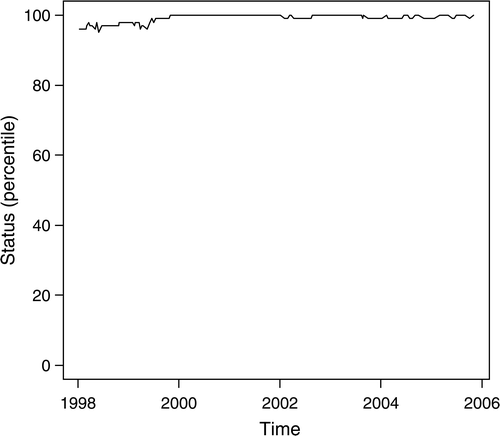
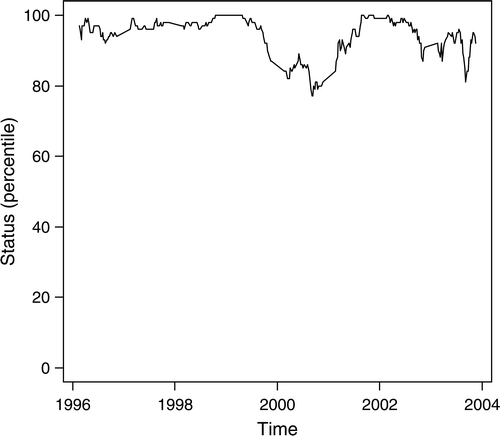
We depict the status trajectories of the well-known players Tiger Woods and Jeff Gordon over time in Figures 1 and 2, respectively. We have converted status scores to percentiles to ease visual comparison across empirical settings. Their high positions within their status distributions concur with commonly shared perceptions of their elite standing within the sports in which they compete.
Estimation and Controls
To test empirically the two contrasting views of status and performance we have reviewed, we estimate models of the form
We start by entering status and status squared, Sit and , respectively, to determine which of the two accounts of the performance-related effects of status is most accurate and to see whether the two accounts may be reconciled. For the golf panel, where increasingly negative strokes from par equates to better performance, if only Story 1 (that status positively affects performance) holds, then θ1 will be negative, and θ2 will be indiscernibly different from 0. Conversely, if Story 2 (that status negatively affects performance) best matches the empirical reality, then θ1 will be positive, and θ2 will again differ insignificantly from 0. And if Stories 1 and 2 jointly describe the effect of status on performance, then (again for golf, as the signs will be reversed for NASCAR), we expect θ1 < 0 and θ2 > 0.
We include four types of time-varying adjustments in Xit. First, we control for prior performance to rule out the possibility of mean reversion. This is especially important given the possibility that performance may drop for purely stochastic—rather than behavioral—reasons as an athlete reaches high levels of status. The simplest explanation for weaker execution as lagged status rises is that even the most highly regarded players regress to less impressive states. Consequently, in the PGA panel, we include the measure average strokes from par, which takes the average of the focal golfer's lagged strokes from par over the same one-year moving window over which we compute status. Similarly, for NASCAR drivers, we enter the measure average speed, which is the mean of the realization of the dependent variable lagged, again over a one-year moving window. Using a measure of prior recent performance in our models, we can disentangle the effect of status from that of having done particularly well (or poorly) in the recent past.
Second, we adjust for resources. These are gained resources in the PGA (because golfers do not compete for a draw from a season-specific purse) and anticipated resources in NASCAR (because drivers are in contention for a share of a season-specific purse). We adjust for accumulated earnings for the focal season in golf (designated by the covariate money, measured in millions of dollars) and for rank in the points distribution in professional auto racing. We expect athletes with greater actual or anticipated resources to perform better.
Third, both for golfers and racers, we enter age and age2 as well as experience and experience2. Entering age covariates allows us to separate the effects of status from a long-run process by which performance reaches a maximum near the middle of the age distribution, at which point athletes' reflexes start showing tangible signs of decay. Similarly, entering experience covariates (measured by the number of tournaments played divided by 100 for golfers, and the number of Winston Cup Series miles divided by 1,000 for drivers) permits us to distinguish the effects of status from that of an important component of athletes' time-varying quality, as well as a proxy for their commitment to continued participation in the sport.
Fourth, we enter the covariate risk taking in both sets of models. Adjusting for time-varying inclinations to take risks is important in light of the possibility that status may be related to individuals' overconfidence in their physical abilities and thus their propensity to pursue less disciplined strategies that end up diminishing their performance. We measured risk taking in the PGA panel in two steps: we computed the proportion of nonpar scores (eagles, birdies, bogies, and above by hole) to par scores for each golfer in each event and then took the mean of these scores over a one-year moving window for the focal golfer. Correspondingly, in NASCAR, our measure of risk taking is the average number of accidents per race over the same time frame for the focal driver.
Finally, we use a two-way fixed effects specification. We enter event dummies τt + 1 for all PGA tournaments and NASCAR races in our analysis, which absorb the effects of contest-to-contest changes in rules, technology, wind speed, temperature, and course or track conditions. They also adjust for the level of event-to-event churn in athletes' rankings, shifts in the mean and dispersion of the ability distribution, and all other forms of aggregate temporal heterogeneity that might affect levels of motivation and stress and therefore influence strokes from par in golf or speed in auto racing. Using a full set of event indicators thus enables us to separate the consequences of status from those of the PGA's and NASCAR's larger environments. We also added fixed effects to adjust for innate, athlete-specific tendencies to perform well, which are represented by σi. In our empirical settings, allowing the intercepts to vary by player is important in light of well-known variations in athletes' intrinsic ability levels. Together with the previously described continuous measures of a chosen individual's recent performance (or contemporaneous capacity to perform), which range from financial resources garnered to experience in the sport, the fixed effects σi importantly allow us to adjust for athletic ability or quality. Correlations and descriptive statistics for variables in our analyses are shown in Table 1.
|

Table 1 Correlations and Descriptive Statistics for Variables in the Analysis
| Variables | [1] | [2] | [3] | [4] | [5] | [6] | [7] | [8] | [9] |
|---|---|---|---|---|---|---|---|---|---|
| PGA | |||||||||
| [1] Strokes from par | 1 | ||||||||
| [2] Status | −0.0898 | 1 | |||||||
| [3] Average strokes from par | 0.1309 | −0.4053 | 1 | ||||||
| [4] Money | −0.0676 | 0.6611 | −0.2804 | 1 | |||||
| [5] Age | 0.031 | −0.028 | 0.0586 | −0.0364 | 1 | ||||
| [6] Experience | −0.0079 | 0.2219 | −0.0327 | 0.128 | 0.7501 | 1 | |||
| [7] Risk taking | 0.0001 | 0.0653 | 0.0305 | 0.104 | −0.1598 | −0.117 | 1 | ||
| [8] Change in status | −0.0238 | 0.0852 | −0.1045 | 0.0477 | −0.0466 | −0.0497 | 0.0109 | 1 | |
| [9] Retooling | −0.0102 | 0.1607 | −0.0534 | 0.0938 | −0.1003 | −0.0207 | 0.0575 | −0.0181 | 1 |
| Mean | −3.4848 | 0.9411 | −3.6239 | 0.4386 | 35.1242 | 1.3830 | 0.5617 | 0.0029 | 0.0041 |
| SD | 7.2608 | 1.0763 | 3.0423 | 0.6684 | 6.1276 | 1.2298 | 0.0614 | 0.2036 | 0.0638 |
| Min | −31 | 0 | −20 | 0 | 16 | 0 | 0.1803 | −3.0978 | 0 |
| Max | 30 | 9.3997 | 26 | 10.8302 | 64 | 5.95 | 1.1515 | 1.3464 | 1 |
| NASCAR | |||||||||
| [1] Speed in qualifying round | 1 | ||||||||
| [2] Status | 0.0039 | 1 | |||||||
| [3] Average speed | −0.0225 | 0.0008 | 1 | ||||||
| [4] Points rank | −0.0043 | −0.6403 | 0.0155 | 1 | |||||
| [5] Age | −0.0055 | −0.0835 | −0.0611 | 0.0903 | 1 | ||||
| [6] Experience | −0.0043 | 0.1689 | −0.0654 | −0.2494 | 0.6927 | 1 | |||
| [7] Risk taking | 0.0050 | −0.3057 | 0.1190 | 0.3322 | −0.0878 | −0.2058 | 1 | ||
| [8] Change in status | 0.0034 | 0.0639 | 0.0024 | −0.0621 | −0.0234 | −0.0238 | −0.0277 | 1 | |
| [9] Retooling | 0.0061 | −0.0620 | −0.0288 | 0.1728 | 0.0192 | −0.0582 | 0.0688 | 0.0011 | 1 |
| Mean | 155.926 | 0.5927 | 155.8722 | 21.7596 | 38.1412 | 88.9898 | 0.0773 | 0.0005 | 0.0229 |
| S | 30.4606 | 1.1113 | 6.3388 | 12.3540 | 7.1579 | 72.4077 | 0.0725 | 0.1437 | 0.1496 |
| Min | 23.998 | 0 | 89.937 | 1 | 19.7281 | 0 | 0 | −1.6505 | 0 |
| Max | 198.413 | 6.7384 | 191.2450 | 44 | 61.9250 | 283.4023 | 1 | 1.2705 | 1 |
Results
Estimates from four regression models predicting strokes from par in the PGA appear in Table 2, and estimates from four corresponding models predicting speed in NASCAR are shown in Table 3. We move between these two tables as we describe our findings.
|
Table 2 Estimates for Fixed Effects Models of Strokes from Par in the PGA
| Variables | Model 1A | Model 2A | Model 3A | Model 4A |
|---|---|---|---|---|
| Status | −2.2289** (0.0662) | −0.5428** (0.1002) | −0.4591** (0.1019) | −0.4618** (0.1027) |
| Status2 | 0.1487** (0.0124) | 0.0411* (0.0163) | 0.0322* (0.0164) | 0.0348* (0.0165) |
| Average strokes from par | −0.0497** (0.0153) | −0.0472** (0.0155) | −0.0512** (0.0155) | |
| Money | −0.5800** (0.0853) | −0.5451** (0.0873) | −0.5163** (0.0878) | |
| Age | −0.0578 (0.1853) | −0.0700 (0.1853) | ||
| Age2 | 0.0026 (0.0021) | 0.0027 (0.0021) | ||
| Experience | −1.3485** (0.4727) | −1.4196** (0.4730) | ||
| Experience2 | 0.1728* (0.0727) | 0.1770* (0.0727) | ||
| Risk taking | 1.0069 (0.6656) | 0.9974 (0.6655) | ||
| Change in status | −0.4399** (0.1539) | |||
| Retooling | 1.2743* (0.5759) | |||
| Player fixed effects | No | Yes | Yes | Yes |
| Event fixed effects | Yes | Yes | Yes | Yes |
| Constant | 1.6062 (0.8604) | −1.5911 (0.8436) | −5.2939 (4.3009) | −5.0845 (4.3001) |
| N | 22,481 | 21,626 | 21,543 | 21,543 |
| R2 | 0.6020 | 0.6200 | 0.6202 | 0.6205 |
*p < 0.05; **p < 0.01.
|
Table 3 Estimates for Fixed-Effects Models of Qualifying Speed in NASCAR
| Variables | Model 1B | Model 2B | Model 3B | Model 4B |
|---|---|---|---|---|
| Status | 0.9361** (0.0539) | 0.2308** (0.0869) | 0.2132* (0.0884) | 0.2155* (0.0886) |
| Status2 | −0.1449** (0.0125) | −0.0371* (0.0157) | −0.0342* (0.0159) | −0.0355* (0.0159) |
| Average speed | 0.0025 (0.0059) | 0.0032 (0.0060) | 0.0033 (0.0060) | |
| Points rank | −0.0135** (0.0032) | −0.0115** (0.0032) | −0.0114** (0.0033) | |
| Age | 0.3808** (0.1416) | 0.3836** (0.1416) | ||
| Age2 | −0.0048** (0.0013) | −0.0048** (0.0013) | ||
| Experience | 0.0014 (0.0052) | 0.0016 (0.0052) | ||
| Experience2 | 0.0000 (0.0000) | 0.0000 (0.0000) | ||
| Risk taking | −0.0907 (0.3843) | −0.0985 (0.3846) | ||
| Change in status | 0.2046 (0.1414) | |||
| Retooling | 0.1687 (0.1911) | |||
| Player fixed effects | No | Yes | Yes | Yes |
| Event fixed effects | Yes | Yes | Yes | Yes |
| Constant | 155.6011** (0.0260) | 155.7181** (2.1383) | 148.4171** (4.1594) | 148.3816** (4.1593) |
| N | 10,693 | 9,821 | 9,821 | 9,821 |
| R2 | 0.9950 | 0.9957 | 0.9957 | 0.9957 |
*p < 0.05; **p < 0.01.
First, to ensure that our effects are robust with respect to an array of specifications, we began in Models 1A and 1B with a very simple set of covariates and then proceeded to models that control more stringently for additional sources of variation. In these first two models, we entered only status, status squared, and fixed effects for events. In the PGA and in NASCAR, we see that under this initial specification, status has a curvilinear effect on performance. Across much of the status distributions of both sports, performance rises before peaking at a very high status level, after which golfers and drivers do worse in their respective domains. More precisely, performance declines after a status level of 7.49 in the PGA and after 3.23 in NASCAR. Although both turning points reside well within the range of the observed values, clearly they exceed the respective means appreciably and are therefore not indicative of middle-status phenomena (cf. Phillips and Zuckerman 2001). To the contrary, we see initial evidence of extreme status pushing down athletes' levels of performance. Thus, rather than just one of the two accounts of the performance-related effects of status receiving confirmation, we see preliminary support for both accounts.
Furthermore, the considerable extent to which these inflection points exceed the mean in each population is suggestive of differences in the relative weights on distinct social processes that move with status. Not unlike classical ecological research discussing how legitimacy as well as competition jointly vary (at different rates) with density (Hannan and Freeman 1989, Hannan and Carroll 1992; see Burt 1992, pp. 215–218), these results suggest that advantageous processes (the accrual of tangible and intangible resources) as well as disadvantageous processes (mounting complacency and distraction) move at different rates with status. More specifically, the estimates in Models 1A and 1B are in keeping with the notion that unfavorable concomitants of status rise very slowly over much of the status distribution and then turn sharply upward for those individuals who inhabit the most elite positions of the ordering. This interpretation is also consistent with the types of individuals occupying our empirical settings: professional athletes are, as a rule, more competitive than their counterparts in the general population and thus should be discernibly impeded by status only as they near the extreme of the status distribution. Although further work in other empirical settings is necessary to better understand the typical location of inflection points beyond which status exerts negative effects, these initial results offer an important starting point for considering the distributional locations of status-related downturns in performance.
Before adding further controls, we assessed the suitability of our functional form by fitting the effect of status as a spline in Tables 4 and 5. Using piecewise specifications, we fit strokes from par over a set of eight dummy variables capturing the PGA's status distribution in Table 4, and we then fit speed as a function of five indicators for NASCAR's status distribution in Table 5. In both empirical settings, we see further evidence of a curvilinear effect of status.
|
Table 4 Estimates for Piecewise Models of Strokes from Par in the PGA
| Variables | |
|---|---|
| P1 (0.5 < status ≤ 1) | −1.4516** (0.0802) |
| P2 (1 < status ≤ 2) | −2.6839** (0.0878) |
| P3 (2 < status ≤ 3) | −3.6972** (0.1276) |
| P4 (3 < status ≤ 4) | −4.8680** (0.1929) |
| P5 (4 < status ≤ 5) | −6.1310** (0.3023) |
| P6 (5 < status ≤ 6.5) | −7.4837** (0.3430) |
| P7 (6.5 < status ≤ 8.5) | −9.9221** (0.5333) |
| P8 (8.5 < status) | −7.9531** (1.3458) |
| Constant | −2.0579** (0.0474) |
| N | 22,481 |
| R2 | 0.5998 |
Notes. Baseline category: status ≤ 0.5. Event fixed effects are included.
**p < 0.01.
|
Table 5 Estimates for Piecewise Models of Qualifying Speed in NASCAR
| Variables | |
|---|---|
| P1 (0.5 < status ≤ 1.5) | 0.9043** (0.0684) |
| P2 (1.5 < status ≤ 2.5) | 0.9825** (0.0896) |
| P3 (2.5 < status ≤ 3.5) | 1.0942** (0.1170) |
| P4 (3.5 < status ≤ 4) | 1.3589** (0.1930) |
| P5 (4 < status) | 1.0771** (0.1228) |
| Constant | 155.6747** (0.0246) |
| N | 10,693 |
| R2 | 0.9949 |
Notes. Baseline category: status ≤ 0.5. Event fixed effects are included.
**p < 0.01.
Next, returning to the main regressions in Tables 2 and 3, additional models show that the curvilinear effects of status persist as additional controls enter. We added fixed effects for athletes as well as measures of past performance in Model 2, and then we entered further adjustments in subsequent models. Starting with Model 2, we see that the status-related minimum for golf and maximum for auto racing reside well within the range of the data (at 6.60 in the PGA and at 3.11 in NASCAR). Additionally, as expected, as an individual athlete acquires greater resources (measured by money won in golf and season rank in NASCAR), favorable outcomes follow. Using a within-athlete specification that also includes measures of past performance, we thus find that as a focal golfer accumulates greater prizes, and as a chosen driver ranks closer to the top, future performance improves.
This result is especially important for our understanding of the first (positive) component of the effect of status. With measures of athletes' prizes and ranks, we could isolate the unique advantages of status net of particularly visible measures of performance. Given that audience members can easily detect variations on the standard performance measures that we include as controls—average strokes from par and average speed around the track, as well as money won in golf and rank in the Winston Cup Series point distribution—our empirical settings offer a conservative test of the positive effect of status. In the presence of these controls for highly visible past performance, lagged status (over much of its range) still strongly elevates performance. Thus, if we imagine two athletes, A and B, who are endowed with the same intrinsic propensities captured by the fixed effects and who have recently also enjoyed identical levels of success on widely watched metrics, but A has greater status, then A (more than B) now enjoys the residue of having outstripped elite individuals in prior events. Put differently, A has greater “bragging rights” and related feelings of self-efficacy and can also, for instance, attract experienced crew chiefs or good caddies more readily than B.9
Turning to Model 3, although adjustments for risk taking fall short of significance, we see coefficients on experience and age terms consistent with our expectations—although it is experience that matters in golf and age that is consequential in auto racing. For instance, in Model 3A, coefficients on experience and experience squared indicate that, holding age fixed, performance wanes after a chosen golfer has participated in a very large number of events. This curvilinear pattern may reflect the time-dependent consequences of excessive familiarity with the sport. In addition, in Model 3B, track speed increases and then drops with age for NASCAR racers—a pattern mirroring the acute physical concentration necessary for posting high speeds. The physically demanding nature of auto racing (because of centripetal force) may explain why age matters more than experience on the racetrack, whereas among golfers aging is far less consequential for skill development and decline. More generally, given the persistently significant estimates on our covariates of interest, we find evidence in support of the premise that status yields meaningful deviations from individuals' typical age-and experience-based trends, underscoring the importance of social (net of physical) factors.
Robustness Checks
We took two additional steps to assess the robustness of our primary finding that status exerts a nonmonotonic effect on performance. First, we examined the possibility that diminishing performance is confounded with recently having achieved a sharp gain in the pecking order. For instance, it is possible that the complacency and/or distraction attached to high status results not from the level but from the upswing. Parvenus may be particularly susceptible to growing complacent or getting diverted by others' attention. We therefore entered the variable status change, which is the difference in status computed just before the focal event and the status of the athlete measured before the last contest in which he participated.
Second, we endeavored to assess the possibility that a high-status athlete undergoes a kind of “ratchet effect” (Gibbons 1987, Milgrom and Roberts 1992) and consequently throws off his execution in the short run. In the PGA and in NASCAR, closely scrutinized stars may experience ratchet effects as fans apply acute pressure and induce stress by insisting on even greater performance. If stars endeavor to match these heightened expectations, they will presumably retool in some way—as when a golfer changes his swing or a driver changes his car. Because such changes rarely yield immediate payoffs, but instead likely diminish execution initially, high status could result in lower performance because of the circumstances and costs surrounding retooling.
We therefore constructed for both data sets an indicator variable, retooling, set equal to 1 if, during the focal event, the player was amidst a recognizable retooling period, and 0 otherwise. We collected the data necessary for identifying such periods through various online media resources. For golfers, we used the term “retooling” in our searches because of the frequency with which golf writers and analysts deploy the term to code periods of strategic redevelopment. And in NASCAR, retooling appears similarly as a dummy variable, where a race-level observation equal to 1 indicates that the driver changed car makers (e.g., Ford to General Motors) between the last and the focal race. Whereas it was not possible to capture retooling for all golfers (because only the top get coverage in the popular press), data on retooling were available for all NASCAR drivers. When we enter these two additional adjustments in Models 4A and 4B, we find first that the effect of status change is insignificant in NASCAR while in fact favorable in golf. Moreover, in the PGA panel, retooling is negatively associated with performance, although this is not the case for NASCAR. Although this covariate might of course be endogenous to our dependent variable—part of a rationalization for poor performance—it is nonetheless apparent that the nonmonotonicity of the status effect retains its significance in the presence of these additional adjustments.
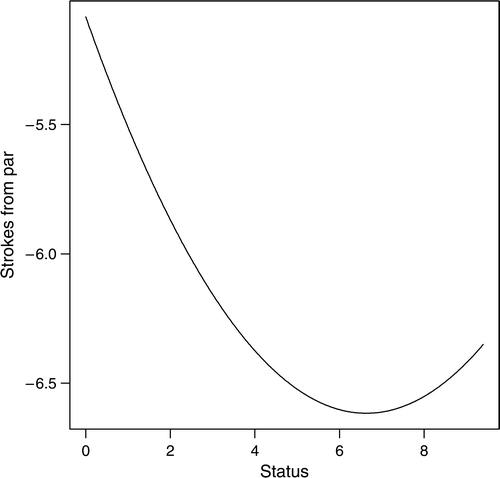
Finally, effects of interest from our full models appear visually in Figures 3 and 4. Figure 3 illustrates predicted strokes from par across status, as does Figure 4 for speed in miles per hour. Using the coefficients and intercepts from Models 4A and 4B, it is apparent that the effect magnitudes of status are substantively significant in both populations, although appreciably stronger for high-status athletes in NASCAR than for those in the PGA. In Figure 3, holding other factors constant, we see that an increase in status from 0 to the point just beyond six strokes from par yielding the minimum is worth more than a stroke and a half from par, and a move from there to the maximum level of status is associated with doing about a quarter stroke from par worse. It is in this elite zone of the distribution—occupied in our panel by Vijay Singh and Tiger Woods—that status exerts a moderate but discernible negative effect on performance.
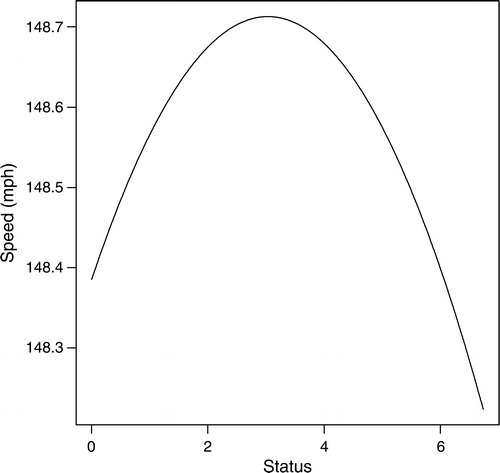
Moving to Figure 4, the net effects of status in NASCAR are also substantively meaningful, particularly when two contextual features of the sport are considered: One is that the average within-race standard deviation of speed in our panel was only 1.68 mph, so that drivers are separated by extremely short deltas. Another important feature (and motivation for entering race-specific fixed effects) is that the majority of the variation in speed is between races. For example, the average track speed at Daytona (an elongated track with gentle turns) was 185.66 mph, whereas the mean speed at Pocono (a more angular track with jarring turns) was 167.33. In this context, we see that a shift in status from 0 to 3 yields an increase in speed of roughly one-third of a mile per hour, and a shift from a status level of 3 out to the maximum value brings down predicted speed by just shy of half of a mile per hour. We note also that the inflection point for NASCAR occurs much sooner (and thus affects many more contestants) than in the PGA—a difference we consider further as we discuss scope conditions.10
Discussion
Our aim in this paper has been to cast further light on the relationship between status and performance. Our results have brought attention to countervailing status-related processes discussed in distinct lines of earlier research. Although we found that for the majority of PGA Tour golfers and NASCAR drivers status increases future performance (consistent with recurrent images of status as an asset), findings also show that as athletes move into particularly high positions in the status order, their performance then declines (in keeping with less frequent portrayals of status as a liability). One of our primary contributions is therefore to offer new material for rethinking the nature and consequences of status in competitive settings. Unlike prior research that has tended to treat status as an unequivocal indicator of quality, our findings indicate that, at least under certain conditions (conditions that we address explicitly below), status attenuates performance and thus signals declines in quality. We are therefore persuaded that it is important for future investigations to become attentive to the potentially nonmonotonic effect of status when modeling performance-related outcomes at various levels of analysis, such as individuals' rates of promotion and turnover, organizational survival chances and rates of future growth, and related outcomes (see Phillips and Zuckerman 2001 for the nonmonotonicity of the effect of status on conduct, rather than on performance).
Although our empirical investigations are, of course, limited by the idiosyncrasies of our chosen settings, we believe that our findings are informative for future examinations of the effects of status on performance in other contexts. We are especially prone to do so, given that we have uncovered similar patterns in two different data sets. We note also that whereas golf is primarily an individual sport, professional auto racing is, in at least some respects, also a team sport, and thus we believe our findings apply directly to future work using individual-level as well as organization-level samples.11 At the same time, no individual or organization operates in a market identical to the environments produced by the particular contextual features of the PGA and NASCAR. Consequently, before briefly suggesting empirical contexts in which it is plausible to anticipate replicating the pattern of effects we have observed, we enumerate five scope conditions that bracket the generality of our results.
Scope Conditions: Positional and Performance-Related
Because earlier empirical work has been relatively less attentive to the performance-eroding effects of status, our focus here is on the set of factors that we maintain are necessary for observing performance declines as status accumulates. An appreciation of these factors is important for directing future research toward those settings in which curvilinear effects of status on performance may be most plausibly anticipated (cf. Phillips and Zuckerman 2001, pp. 386–390). We begin by noting two conditions that pertain to the nature of actors' social positions, and we then identify three conditions that relate to kinds of performance.
First, although we have assumed that individuals' status levels equate to their locations in a local pecking order, it is easy to imagine empirical settings different from the PGA Tour and NASCAR's Winston Cup Series in which individuals explicitly understand their status positions to be inherently nested and therefore face status-related motivations different from those we have discussed. In other words, a focal individual may be favorably situated in a given status hierarchy but also recognize that the particular hierarchy in which he or she is implicated ranks unfavorably against other such hierarchies—a recognition that should work against the realization of negative status effects.12 Following Veblen's (1994) discussion of the behavioral ramifications of the nested nature of status, we expect negative effects of status on performance primarily in groups (hierarchies, tournaments, or markets) that reside at the top of a broader ordering comprising other such groups—or, less stringently, in groups not closely crowded by another, more highly esteemed group. Consistent with the idea that occupants of a lower-status group are inclined to “bend their energies to live up to” the ideals of the adjacent, higher-status group (Veblen 1994, p. 52), we anticipate more intense and focused effort (rather than complacency and distraction) as a focal individual's status rises—and thus nears a social boundary—in the context of a lower-status group.
Moving from the general to the specific, this alternative expectation is especially easy to appreciate in the context of the empirical settings we have examined. Mirroring a pattern common across professional sports—where one or more “minor” leagues operate as “feeders” to a single “major” league—in professional golf, the Nationwide Tour serves as a minor league, as does the Busch Series in professional auto racing. According to one NASCAR aficionado with whom we spoke, the Busch Series is the “proving ground for drivers who wish to step up to the organization's top level—the Nextel [formerly Winston] Cup.”
Although status hierarchies certainly exist within these lesser leagues, we predict that the curvilinear effect of status we have demonstrated in the PGA Tour and in the Winston Cup is far less likely to surface here for two interrelated reasons that link back to the foregoing review of the literature: One is that high-status athletes in the minor leagues naturally aspire to join the ranks of the next level and thus are less likely to develop the disadvantageous dispositions that otherwise tend to surface as status rises.13 Another reason is that, owing to the necessarily second-class nature of any system ranked beneath the very top, the chances of status-based distraction developing and affecting a chosen actor's performance are also appreciably lower. Correspondingly, the first scope condition on our primary finding is that the local status hierarchy is not nested in a broader hierarchy such that its elites have in clear view a distinct, more desirable context into which they can imminently transition.
A second scope condition related to actors' positions is also important for future empirical applications. In brief, the expectation that status will eventually diminish performance turns on the absence of contextual features that act as a “forcing function” (Burt 2005, pp. 77–78) to prevent visible declines. For example, although it is not the case that individuals are necessarily more susceptible than firms to negative status effects, it is conceivable that the sheer density of heterogeneous individuals within large firms (many individuals exposed to different market stimuli) reduces the hazard of a status-based decline in performance. Although particular persons inside the boundaries of such firms may of course grow self-satisfied or unfocused, diverse connections to the external environment can exert a countervailing influence on those who are otherwise likely to slide downward as organizational status increases. With minor modifications, the same process potentially applies at the individual level insofar as there are features of individuals' social positions that force their occupants to experience status in productive, rather than deleterious, ways.14 Consequently, the second condition narrowing the generality of our effects is that status (or its correlates) cannot create countervailing pressures or forms of social support. Accordingly, we think that future empirical work will profit from exploring interaction effects between status and forms of social capital, such as brokerage positions (Burt 2005), which channel and restrict the ways in which actors experience their status.
Third, shifting from characteristics of positions to types of performance, a depiction of status as a liability requires that performance is sufficiently objective that strong spillovers from status to socially constructed outcomes do not automatically occur. Unlike strokes from par and speed on the track, a number of performance metrics that are interesting outcomes to study from a status-based perspective are nonetheless virtually impervious to decline when status is high because of the way in which status typically shapes evaluators' perceptions. To stay with examples from athletics, prior work has demonstrated the existence of national bias (which may be interpreted as a by-product of local notions of status) in several settings, such as figure skating (Campbell and Galbraith 1996), gymnastics (Ansorge and Scheer 1988), diving (Hanley 2000), and boxing (Lee et al. 2002). When outcomes are subjectively scored by a pool of experts, the legitimacy of a given actor—enjoyed because of his or her citizenship, local appeal, status, or other social factors—can mask the impact of behavioral tendencies that would otherwise attenuate that actor's performance. Consequently, to replicate the results we have reported, it is (generally) necessary to examine dependent variables that do not incorporate strongly subjective components. Indeed, if status does in fact negatively affect highly subjective measures of performance, it will then be important to examine the possibility of whether the evaluators or judges in question are (perhaps unconsciously) redressing the “double injustice” of the Matthew effect—according to which low-ranked individuals are “unjustifiably victimized” while their elite counterparts are “unjustifiably benefited” (Merton 1968, p. 59; cf. Bothner et al. 2011). If status negatively affects the kinds of performance that are heavily influenced by social perceptions, the underlying mechanisms at work are almost certainly different from the complacency and distraction we have emphasized.
Fourth, a scope condition keyed to whether a focal actor controls the frequency of his or her performance arises from considering the different rules and incentive schemes that characterize our two empirical settings. On one hand, NASCAR virtually requires its drivers to participate in every race. Winning the Winston Cup results from having accumulated the greatest number of “points” based primarily on the finishing position in each race during the season, and the reward schedule tying points to finishing is sufficiently linear—as opposed to convex—such that the consistency of participation is mandatory for a driver to stay in contention for the season crown (von Allmen 2001). On the other hand, golfers in our panel do not compete in a similar season-long tournament but rather selectively face each other in a series of less tightly coupled contests. Golfers, unlike NASCAR drivers, face relatively weak participation constraints, enjoying considerable choice over when they compete and when they sit out. We suspect that this relative autonomy is, at least in part, responsible for the inflection point surfacing further to the right of the status distribution in the PGA than in NASCAR. When individuals can freely determine when they perform, they enjoy a “safety valve” (cf. Turner 2009) that serves to mitigate the (visible) effects of disengagement: rather than publicly performing less well, individual contestants can opt out altogether. In this connection, observing strongly negative status effects is probably much more likely in the absence of full discretion over when it is that performance occurs.
Fifth, the expectation that performance wanes with status requires that the performance outcome under examination is not decoupled from immediate effort. This restriction is important because of the prevalence of consequential performance outcomes available for empirical investigation that can certainly continue to rise long after a focal actor has pulled back from full engagement in his or her domain. As an example, consider coauthored research done largely with talented postdocs who, for status-related reasons, are willing to shoulder nearly all the work. Protectively eclipsed by a network of able “workhorses” (see Piskorski 2009 on networks as covers), a senior scientist can enjoy high status and grow complacent but still avoid showing visible declines in performance.
Thus, although we certainly do not expect to observe curvilinear effects of status on performance ubiquitously, we do believe that our findings may be replicated and extended in a number of empirical contexts. With the foregoing criteria in mind, we conclude by briefly describing two potential research settings, one at the level of the individual and another at the level of the firm: a population of life scientists and the investment banking industry, respectively.
Settings for Future Research
Life scientists provide an especially attractive empirical site for replicating our results because of the relative ease of measuring status and performance. Similar to our method for capturing status in the PGA and NASCAR, status levels among life scientists could be calculated from asymmetric relations recorded in time-varying matrices of citation counts (cf. Cole and Cole 1973). Here, a chosen author's status position may be approximated as a function of the extent to which that author receives citations from highly cited authors. In turn, performance might be determined by the time-varying count of lead-author publications in those journals that are regarded as having the greatest scholarly impact. Like our findings in the context of professional sports, among life scientists, future inquiry is likely to uncover a pattern whereby the average impact factor of the journals in which a chosen individual publishes as a lead author rises with that individual's status until some particularly high level, at which juncture the average impact factor of the outlets in which the individual publishes falls—net of age-based adjustments for senescence.
Second, given the popular business press's many anecdotal treatments of negative inertia and organizational complacency, we also believe that the implications of our analyses could be productively examined at the firm level. More specifically, we think that the success banks have in jockeying for positions in various league tables would make investment banking an intriguing research setting. League tables are quarterly published rankings of performance in each area of investment banking—for instance, initial public offering issuance, syndicated loans, and mergers and acquisitions. Like strokes from par in golf and speed in auto racing, a bank's ranking in a specific league table serves as an important metric of performance. Where performance is modeled as a function of prior status—measured from banks' relative locations in industry tombstones (Podolny 1993, 2005)—we expect to find evidence suggesting that as banks occupy more coveted positions in the status hierarchy, they are also at greater risk of downward shifts in the tables.
More generally, in viewing status not only as an asset but also as a liability, we can see how status can exert nuanced effects on performance and can even contribute to market turnover. In our view, prior work has too often focused solely on the auspicious and stabilizing effects of status. However, by viewing status as potentially deleterious, we believe that a more complete portrayal of its relevance as a social force in economic markets will emerge.
The first author is the corresponding author. The authors have benefited from the advice of Nat Bulkley, Ron Burt, Stanislav Dobrev, James Evans, Isabel Fernandez-Mateo, Ed Laumann, Joe Porac, Woody Powell, and Ray Reagans.
1 This amount is for the 2006 PGA Tour season; see http://www.pgatour.com.
2 There is one five-round tournament on the PGA Tour, which has been systematically dropped from the analysis. In addition, those events that were shortened because of weather conditions have been dropped.
3 This changed in the 2007 season with the introduction of the FedEx Cup—a season-long, points-based competition that awards $10 million, prize money beyond that accumulated in any prior tournament, to the winner of the PGA season.
4 For instance, when Tiger Woods won the 2000 U.S. Open Championship, he did so by posting an aggregate score of −12, or 12 strokes under par.
5 Players who have not yet declared their professional status at the start of a tournament (e.g., amateur players) are not included in the distribution of the purse, regardless of their finishing rank.
6 de Waal (1989, p. 187) drew a broadly similar distinction between kinds of status in an intriguing study of chimpanzees, noting that the “female hierarchy in our chimpanzee group [seemed] to be based on respect from below rather than intimidation and a show of strength from above [as among male chimps].”
7 Mazur (1985, p. 379) provided an intriguing example of competitively generated status exerting persistent social effects among primates quite separate from levels of ability or quality: “Status hierarchies, once established, persist over time because each individual soon recognizes and accepts its place. This is not simply a matter of the powerful imposing their will on the weak, for even in instances when power dissipates—as when an aging ‘alpha’ macaque loses his canines—it may be a long time before there is any serious challenge from obviously stronger subordinates.”
8 Whyte (1981, p. 4) recorded Doc, the leader of the Nortons, offering the following account—one that is important because it highlights the social consequences of asymmetric exchange in the context of the gang: “Nutsy was the head of our gang once. I was his lieutenant. He was bigger than me, and he had walloped me different times before I finally walloped him. When he walloped me, there weren't many people around, so I didn't mind, but the one time he broke his promise that he wouldn't hit me, there was a big crowd around…. I couldn't let him get away with that…. I went after him, and I was beating him up when the big fellows stopped us…. Next day I saw him leaning up against the wall. I went up to him and said, ‘I'll kill you,’ and I let him have one. He didn't fight back. He knew I was his master. And that got around…. After I walloped him, I told the boys what to do.”
9 Accordingly, if the measures of past performance that we enter as adjustments were lessvisible than they are in the PGA and in NASCAR, we would then expect the status effect to be appreciably stronger over the section of the distribution where status favorably affects performance.
10 Some examples of drivers with status levels beyond the inflection point include Dale Earnhardt, Dale Earnhardt Jr., Jeff Burton, Jeff Gordon, Jimmie Johnson, Rusty Wallace, and Sterling Marlin.
11 Although the individual NASCAR driver is certainly the primary actor, other key figures working with the driver in the background include the crew chief, who coordinates with the engine builder and additional specialists such as the tire man and the chassis man, and various crew members, who process data on lap times, the “telemetry” (engine heat and so on), and the heat of the tires once the car comes off the track.
12 This nesting of status positions was neatly brought forward by Park and Burgess (1921, p. 36; emphasis added), who posited that “the status and social position of any individual inside any social group is determined by his relation to all other members of that group and eventually of all other groups.” Their insight is important because it suggests that individuals look not only to their relative standing internally but also to the standing of their local group or hierarchy relative to other groups or hierarchies. In this sense, one can meaningfully speak of status hierarchies that themselves vary by status and whose (higher-order) status exerts influence after occupants have discerned their position locally.
13 In fact, it is not implausible to expect performance to increase—at least ephemerally—at an increasing rate across status in second-tier settings because of the focal actor's confirmed sense that he or she can, with an added investment of effort and focus, move into a qualitatively more desirable setting.
14 A familiar example of this type of social capital is the strong influence of Michael Jordan's father, James Jordan, before his untimely death.
References
- (2008) Criminological Theories: Introduction, Evaluation, and Application, 5th ed. (Oxford University Press, New York) .Google Scholar
- (1988) International bias detected in judging gymnastic competition at the 1984 Olympic Games. Res. Quart. Exercise Sport 59(2) 103–107.Crossref, Google Scholar
Associated Press (2005) Montgomerie won't worry about Tiger. Latin American Herald Tribune, . http://www.laht.com/article.asp?CategoryId=13002&ArticleId=203816.Google Scholar- (1963) Outsiders: Studies in the Sociology of Deviance. (Free Press, New York) .Google Scholar
- (1966) The Social Construction of Reality: A Treatise in the Sociology of Knowledge. (Doubleday, Garden City, NY) .Google Scholar
- (1977) Status Characteristics and Social Interaction: An Expectation-States Approach. (Greenwood, Westport, CT) .Google Scholar
- (1964) Exchange and Power in Social Life. (John Wiley & Sons, New York) .Google Scholar
- (1987) Power and centrality: A family of measures. Amer. J. Sociol. 92(5) 1170–1182.Crossref, Google Scholar
- (2003) Competition and social influence: The diffusion of the sixth-generation processor in the global computer industry. Amer. J. Sociol. 108(6) 1175–1210.Crossref, Google Scholar
- (2007) Competitive crowding and risk taking in a tournament: Evidence from NASCAR racing. Admin. Sci. Quart. 52(2) 208–247.Crossref, Google Scholar
- (2011) Organizing contests for status: The Matthew effect vs. the Mark effect. Management Sci. 57(3) 439–457.Link, Google Scholar
- (2010) A model of robust positions in social networks. Amer. J. Sociol. 116(3) 943–992.Crossref, Google Scholar
- (2010) When do Matthew effects occur? J. Math. Sociol. 34(2) 80–114.Crossref, Google Scholar
- (2003) In Search of Respect: Selling Crack in El Barrio. (Cambridge University Press, Cambridge, UK) .Google Scholar
- (1992) Structural Holes: The Social Structure of Competition. (Harvard University Press, Cambridge, MA) .Crossref, Google Scholar
- (2005) Brokerage and Closure: An Introduction to Social Capital. (Oxford University Press, Oxford, UK) .Crossref, Google Scholar
- (2010) Neighbor Networks: Competitive Advantage Local and Personal. (Oxford University Press, New York) .Google Scholar
- (1996) Nonparametric tests of the unbiasedness of Olympic figure-skating judgments. J. Roy. Statist. Soc. Ser. D 45(4) 521–526.Google Scholar
- (1980) Social process and hierarchy formation in small groups: A comparative perspective. Amer. Sociol. Rev. 45(6) 905–924.Crossref, Google Scholar
- (1973) Social Stratification in Science. (University of Chicago Press, Chicago) .Crossref, Google Scholar
- (2001) Good to Great: Why Some Companies Make the Leap … and Others Don't. (HarperBusiness, New York) .Google Scholar
- (1989) Chimpanzee Politics: Power and Sex Among Apes. (Johns Hopkins University Press, Baltimore) .Google Scholar
- (1999) NASCAR: Unsafe at this speed? BusinessWeek (November 1) 90–96.Google Scholar
- (1950) The Rules of Sociological Method, 8th ed. Edited by , Catlin G. E. G.. (Free Press, New York) . [Translated by
, Solovay S. A., Mueller J. H. .]Google Scholar - (2000) NASCAR's TV ratings buck trend. Florida Times-Union, City Ed. (December 14) D-13.Google Scholar
- (2007) Start-ups in science: Entrepreneurs, diverse backing, and novelty outside business. , Ruef M., Lounsbury M., eds. The Sociology of Entrepreneurship, Vol. 25. (Research in the Sociology of Organizations, Elsevier, Oxford, UK) , 261–305.Crossref, Google Scholar
- (1985) Choosing the Right Pond: Human Behavior and the Quest for Status. (Oxford University Press, Oxford, UK) .Google Scholar
- (1987) Piece-rate incentive schemes. J. Labor Econom. 5(4) 413–429.Crossref, Google Scholar
- (1978) The Celebration of Heroes: Prestige as a Control System. (University of California Press, Berkeley) .Crossref, Google Scholar
- (2000) A perennial dilemma: Artistic sports in the Olympic Games. J. Olympic Hist. 8(May) 39–46.Google Scholar
- (1992) Dynamics of Organizational Populations: Density, Legitimation, and Competition. (Oxford University Press, Oxford, UK) .Crossref, Google Scholar
- (1989) Organizational Ecology. (Harvard University Press, Cambridge, MA) .Crossref, Google Scholar
- (1997) The Insider's Guide to Stock Car Racing. (Bonus Books, Chicago) .Google Scholar
- (2002) Did Lennox Lewis beat Evander Holyfield?: Methods for analysing small sample interrater agreement problems. J. Roy. Statist. Soc. Ser. D 51(2) 129–146.Crossref, Google Scholar
- (2001) Failure as a structural concept: A computational perspective on age-dependence in organizational mortality rates. , Lomi A., Larsen E. R., eds. Dynamics of Organizations: Computational Modeling and Organization Theories. (American Association for Artificial Intelligence, Menlo Park, CA) , 269–306.Google Scholar
- (1998) Status processes and mental ability test scores. Amer. J. Sociol. 104(1) 195–228.Crossref, Google Scholar
- (2009) Superstar CEOs. Quart. J. Econom. 124(4) 1593–1638.Crossref, Google Scholar
- (1990) Reflections on academic success and failure: Making it, forsaking it, reshaping it. , Berger B. M., ed. Authors of Their Own Lives: Intellectual Autobiographies by Twenty American Sociologists. (University of California Press, Berkeley) , 260–284.Google Scholar
- (1985) A biosocial model of status in face-to-face primate groups. Soc. Forces 64(2) 377–402.Crossref, Google Scholar
- (1982) Political Process and the Development of Black Insurgency, 1930–1970. (University of Chicago Press, Chicago) .Google Scholar
- (2001) The Wildest Ride: A History of NASCAR. (Simon & Schuster, New York) .Google Scholar
- (1957) Social Theory and Social Structure. (Free Press, Glencoe, IL) .Google Scholar
- (1968) The Matthew effect in science. Science 159(3810) 56–63.Crossref, Google Scholar
- (1988) The Matthew effect in science, II: Cumulative advantage and the symbolism of intellectual property. ISIS 79(4) 606–623.Crossref, Google Scholar
- (1992) Economics, Organization and Management. (Prentice-Hall, Upper Saddle River, NJ) .Google Scholar
- (1995) The Executive Way: Conflict Management in Corporations. (University of Chicago Press, Chicago) .Google Scholar
- (1999) Action Performance Cos.: Hot-rodding his way to the top. BusinessWeek (May 31) 90–94.Google Scholar
- (1999) Relationships among feedback sign, self-efficacy, and acceptance of performance feedback. J. Appl. Psych. 84(5) 806–814.Crossref, Google Scholar
- (1991) The Rise and Fall of Elites: An Application of Theoretical Sociology. (Transaction Publishers, New Brunswick, NJ) .Google Scholar
- (1952) Human Communities: The City and Human Ecology. (Free Press, New York) .Google Scholar
- (1921) Introduction to the Science of Sociology. (University of Chicago Press, Chicago) .Google Scholar
- (2001) The promotion paradox: Organizational mortality and employee promotion chances in Silicon Valley law firms, 1946–1996. Amer. J. Sociol. 106(4) 1058–1098.Crossref, Google Scholar
- (2001) Middle-status conformity: Theoretical restatement and empirical demonstration in two markets. Amer. J. Sociol. 107(2) 379–429.Crossref, Google Scholar
- (2009) Networks as covers: Evidence from business and social on-line networks. . Working paper, Harvard Business School, Cambridge, MA.Google Scholar
- (1993) A status-based model of market competition. Amer. J. Sociol. 98(4) 829–872.Crossref, Google Scholar
- (2005) Status Signals: A Sociological Study of Market Competition. (Princeton University Press, Princeton, NJ) .Google Scholar
- (1996) The dynamics of organizational status. Indust. Corporate Change 5(2) 453–471.Crossref, Google Scholar
- (1989) Effects of feedback sign and credibility on goal setting and task performance. Organ. Behav. Human Decision Processes 44(1) 45–67.Crossref, Google Scholar
- (1995) Status structures. , Cook K. S., Fine G. A., House J. S., eds. Sociological Perspectives on Social Psychology. (Allyn & Bacon, New York) , 281–310.Google Scholar
- (2006) . Personal communication, September 14.Google Scholar
- (2000) Efficacy-performance spirals: An empirical test. J. Management 26(4) 791–812.Google Scholar
- (1974) Market Signaling: Informational Transfer in Hiring and Related Screening Processes. (Harvard University Press, Cambridge, MA) .Google Scholar
- (1999) Southern-fried dynasty. Forbes (October 11) 132–136.Google Scholar
- (1989) Relative deprivation and international migration. Demography 26(1) 1–14.Crossref, Google Scholar
- (1998) These stock-car stocks are zipping along. BusinessWeek (November 30) 164–164.Google Scholar
- (2006) When do scientists become entrepreneurs? The social structural antecedents of commercial activity in the academic life sciences. Amer. J. Sociol. 112(1) 97–144.Crossref, Google Scholar
- (1999) Interorganizational endorsements and the performance of entrepreneurial ventures. Admin. Sci. Quart. 44(2) 315–349.Crossref, Google Scholar
- (2006) Personality, biographical characteristics, and job interview success: A longitudinal study of the mediating effects of interviewing self-efficacy and the moderating effects of internal locus of causality. J. Appl. Psych. 91(2) 446–454.Crossref, Google Scholar
- (2009) The Significance of the Frontier in American History. (Penguin, London) .Google Scholar
- (1994) The Theory of the Leisure Class. (Dover Publications, New York) .Google Scholar
- (2001) Is the reward system in NASCAR efficient? J. Sports Econom. 2(1) 62–79.Crossref, Google Scholar
- (2006) The burden of celebrity: The impact of CEO certification contests on CEO pay and performance. Acad. Management J. 49(4) 643–660.Crossref, Google Scholar
- (2002) Relative Deprivation: Specification, Development and Integration. (Cambridge University Press, Cambridge, UK) .Google Scholar
- (1978) Economy and Society. Edited by , Roth G., Wittich C.. (University of California Press, Berkeley) .Google Scholar
- (1976) Expectation effects on performance evaluations. Soc. Forces 55(2) 493–502.Crossref, Google Scholar
- (1970) Chains of Opportunity: System Models of Mobility in Organizations. (Harvard University Press, Cambridge, MA) .Crossref, Google Scholar
- (1981) Street Corner Society: The Social Structure of an Italian Slum. (University of Chicago Press, Chicago) .Google Scholar
- (1977) Scientific Elite: Nobel Laureates in the United States. (Free Press, New York) .Google Scholar
Matthew S. Bothner is a full professor and Deutsche Telekom Chair in Leadership and HR Development at the European School of Management and Technology. His research examines the effects of individual and organizational status on various outcomes in markets, including rates of tuition growth among U.S. colleges and universities and the life chances of venture capital firms. He is also developing formal models to better understand the evolution and consequences of contests for status among individuals.
Young-Kyu Kim is an assistant professor of organizations and strategy at Korea University Business School and an affiliated faculty member at the Harvard Law School Program on the Legal Profession. He received his Ph.D. from the University of Chicago. His research interests include social networks, organizational status and identity, and the social mobility of individuals and firms. He is currently investigating the evolution of social relationships in virtual worlds.
Edward Bishop Smith is an assistant professor of strategy at the Ross School of Business, University of Michigan. He received his Ph.D. from the University of Chicago. His research focuses on the construction and consequences of organizational and individual identity, with particular empirical emphasis on financial markets. He is also developing work on the cognitive activation of social networks, or the process by which individuals mentally construct their social networks according to particular stimuli.

