How Emerging Organizations Take Form: The Role of Imprinting and Values in Organizational Bricolage
Abstract
We examine how emerging organizations acquire shape by drawing on multiple organizational forms, a process we call organizational bricolage. Studying Indymedia London, a grassroots media collective, we propose a grounded theory of organizational bricolage that identifies how various types of organizational forms are selected and how they are instantiated into the organization. Whereas extant research has emphasized imprinting as a primary mechanism shaping newly founded organizations, we point to the additional role of organizational values. Emerging organizations augment their imprinted forms by using ancillary forms aligned with their organizational values and reinforce their core features by differentiating themselves from antagonistic forms that conflict with their values. We contribute to the literature on organizational formation by developing a process model that details how imprinted forms are subsequently modified. Moreover, we extend theories of bricolage by specifying the limits to the relative arbitrariness of bricolage as an activity, and we contribute to the study of organizational values by suggesting that they act as a focusing device shaping organizational structure.
Introduction
When new organizations are created, the founders need to decide what form the organization should take (Tolbert et al. 2011). Previous work has suggested that this process is shaped by the environment in which the founding occurs. Organizations are imprinted with the characteristics of “groups, institutions, laws, population characteristics, and sets of social relationships that form the environment of the organization” prevalent at the time of founding (Stinchcombe 1965, p. 142). Most new organizations are “reproducer rather than innovative” organizations (Aldrich and Ruef 2006, p. 67) and copy organizational forms that already exist in the founding context (Aldrich and Fiol 1994, Dacin 1997). An organizational form is “an archetypal configuration of structures and practices given coherence by underlying values regarded as appropriate” (Greenwood and Suddaby 2006, p. 30). Examples of forms include the “commercial microfinance organization” (Battilana and Dorado 2010), the “biotechnology company” (Powell and Sandholtz 2012), the “charter school” (King et al. 2011), and other generally recognized blueprints that actors use in their organizing efforts. Each of these forms contains a specific configuration of organizational elements, including organizational structures and practices, choice of markets and audiences, and use of certain technologies (Hannan and Freeman 1984, Rao and Kenney 2008).
The task of shaping a new organization is complicated by the fact that organizations tend to be exposed not to one but multiple forms. As Meyer and Rowan (1977, p. 345) stated, “The building blocks for organizations come to be littered around the societal landscape; it takes only a little entrepreneurial energy to assemble them into a structure.” The “flotsam and jetsam” of alternative orders confront organizational actors with structural alternatives, offering multiple potential paths for organizational development (Schneiberg 2007, p. 48). Specifically at the time of founding, organizations face a “richly textured n-dimensional space” of forms present in the environment (Lounsbury and Ventresca 2002, p. 3). This may result in sets of intersecting imprints whereby organizations acquire multiple forms, or elements of forms, available to them in the sensitive period of founding (Marquis and Tilcsik 2013).
An emerging literature has started to explore how new organizations are shaped by multiple organizational forms. Suchman (1995) finds that Silicon Valley start-ups “compiled” various forms for managing their financial affairs and reward structures and that intermediaries, such as venture capitalists and law firms, played an important role in this process. Studying the creation of the Paris Opera, Johnson (2007) notes that the founder first drew on the form of the Royal Academy and later integrated elements of commercial theater following pressure from the political authorities. Chen and O’Mahony (2009) explore how production communities in the software and events sector differentiated their emerging organizations by combining forms from for-profit and not-for-profit sectors in novel ways. They present a contingency framework that charts emerging organizations’ degree of differentiation from a default organizational form as dependent on factors, including competition, resource dependence, and control over outputs. King et al. (2011) trace how charter schools in Arizona combined various elements available in their local context to realize differentiated “identities”—broadly equivalent to organizational forms—within the constraints of the proscribed charter school identity.
The focus of the above body of work is primarily on how environmental characteristics determine when and to what degree emerging organizations draw on multiple forms. For instance, Suchman (1995) suggests that over time, environmental forces converge to make start-up firms more alike in terms of the elements they chose. Similarly, King et al. (2011) propose that the more diverse an organization’s immediate environment is, the more likely it is to diversify its identity, and Johnson’s (2007) account implies that if resource environments are complex, then organizations will comply by combining multiple forms. However, there is ambiguity in the literature concerning the actual processes through which specific organizational forms, or elements thereof, are drawn upon and how they are recombined and assembled. Existing work hints at the possible roles of resource dependency and isomorphism, but we lack a theory of how emerging organizations select forms in contexts where multiple forms are available and how they are used to shape the organization.
In this study, we address this gap by studying the processes through which multiple organizational forms are drawn upon. Exploring the process by which multiple forms are combined during organizational creation sheds light on how entrepreneurs assemble idiosyncratic organizations from available templates even as they face pressures to conform to environmental forces (Aldrich and Fiol 1994), hence allowing us to trace a source of organizational distinctiveness (Glynn 2008). In some cases, these acts of recombination may lead to the emergence of entirely new organizational forms (Hannan and Freeman 1986), and so exploring this process in detail is valuable for understanding an important antecedent of broader innovation in organizational forms (Rao 1998, Powell and Sandholtz 2012).
In addressing the question of how new organizations select multiple organizational forms, and how they recombine them to shape the organization, we connect with previous work in entrepreneurship and other disciplines that has proposed the concept of bricolage. The term is derived from the French bricoler, (“to fiddle or tinker”) and has been used in various fields such as political science (Cleaver 2002, Carstensen 2011), sociology (Stark 1996), anthropology (Douglas 1986), and philosophy of science (Boxenbaum and Rouleau 2011). Within entrepreneurship, “bricolage” has proved useful for understanding how actors create entrepreneurial ventures and generate new technologies (Garud and Karnøe 2003, Baker and Nelson 2005, Baker 2007, Di Domenico et al. 2010, Duymedjian and Rüling 2010). A common theme arising from these studies is that bricoleurs “make do” with the resources they find and work them into new, valuable combinations (Di Domenico et al. 2010). Hence the concept of bricolage specifies a process that is central to what entrepreneurs do: assembling and combining resources of variable origin that are invested ex ante to engage in an endeavor with uncertain outcomes.
The above-mentioned studies stress the material aspects of bricolage by focusing on how actors combine physical and economic resources “at hand” in their proximate environment. However, bricolage may also involve the exploitation and manipulation of symbolic resources. In its original depiction, Lévi-Strauss (1967, p. 21) uses the concept in a semiotic sense, expressing how actors “build ideological castles out of the debris of what was once a social discourse.” Previous studies show how actors recombine “available and legitimate concepts, scripts, models, and other cultural artifacts that they find around them in their institutional environment” (Douglas 1986, pp. 66–67). For instance, cultural bricolage may lead to novel combinations of organizational culture where external skills and habits are combined with existing internal toolkits (Harrison and Corley 2011). Equally, organizational identities can be “cobbled together” from diverse cultural elements and symbols, rendering them distinctive but also similar because they draw on common elements (Glynn 2008, p. 420). Most relevant for our study, in starting up new organizations, actors weave myths together to produce surprising combinations (Mair and Marti 2009) and borrow elements from multiple social categories, leading to hybrid categories (Rao et al. 2005). The core lesson from these studies is that the symbolic constructs that actors encounter in their environment represent the very resources that enable organization building, rather than being mere constraints.
Inspired by this work, we propose the concept of organizational bricolage as a way to explore how organizational formation occurs in environments where multiple organizational forms are available. We define “organizational bricolage” as a process whereby a new organization is shaped by drawing on organizational forms that are to hand in a particular environment. In particular, we are interested in identifying the processes that govern what organizational forms are chosen and how they are integrated into the emerging organization. To answer this question, we undertook an inductive study of the formative years of Indymedia, a London-based online alternative media organization. Analyzing the organization’s online discussion forum over a period of six years, we examine how the Indymedia members engaged in organizational bricolage to construct a novel organization. We found this involved a process of selecting organizational forms from its environment as the raw material for organization building. Selection occurred on the basis of two criteria: (1) founders’ past experience with organizational forms and (2) alignment (or misalignment) of a form with organizational values, i.e., the belief system around the ultimate goals of the organization and how these should be achieved (Schwartz 1992). Selected forms were then used to shape the emergent organization through a process that we call instantiation. We found that this occurred in three ways: anchoring, whereby an anchor form is used to establish the taken-for-granted, value-infused core of the organization; augmenting, whereby members mobilize ancillary forms that are aligned with their shared organizational values to address pressing practical issues; and differentiating, whereby members invoke forms that clash with their shared organizational values so as to distance the organization from other similar organizations and reinforce its core features.
Our study contributes to several debates. We add to understanding of organizational formation in institutionally complex contexts (Aldrich and Fiol 1994, Lounsbury and Ventresca 2002, Marquis 2003, Johnson 2007, Chen and O’Mahony 2009, King et al. 2011) by expanding its previous focus on imprinting as we illustrate how imprinted forms are altered by reference to additional forms selected on the basis of their alignment with organizational values. We also contribute to the emerging literature on processes of bricolage in organizations (Ciborra 1996, Lanzara and Patriotta 2002, Garud and Karnøe 2003, Baker and Nelson 2005, Di Domenico et al. 2010, Duymedjian and Rüling 2010). We show that rather than representing freestyle, utilitarian improvisation, bricolage is informed and constrained by organizational values, and we outline the actual process by which bricolage proceeds. Finally, we contribute to work on organizational values (Selznick 1949, Bansal 2003, Kraatz et al. 2010, Bourne and Jenkins 2013) by elaborating the mechanisms by which values exert effects on emerging organizations’ structure. We propose that organizational values represent a filter that delimits the range of organizational forms that are potentially available for shaping an organization.
Methods and Data
Site Selection
We conducted an inductive study of the early period of the London-based “node” of the global Independent Media Centre (IMC) network. We refer to this organization as Indymedia. The organization’s goal was to provide a Web-based platform that could be used by anybody to author news items and upload them to the benefit of a global audience. Because this “open publishing” form was relatively novel, and participants were exposed to various other organizational forms during organization building, Indymedia represented an attractive research site for our study.
Our initial conversations with Indymedia members suggested that they looked to various contexts for inspiration. Apart from drawing on the organizational form of open publishing, they invoked additional organizational forms when addressing issues arising in organization building. For instance, they referred to forms such as the open source software project organization or the volunteer organization. These are organizational forms because they prescribe specific ways in which people act together (Clemens 1996), including how collective activities should be governed, what technologies should be used, how resources should be mobilized, what audiences should be addressed, and so on. The open source software project organization (hereafter abbreviated to “open source organization”) is an organizational form because it provides a structured way in which communities of open software programmers engage in goal-directed collective action and form long-term organizations such as the Linux distribution project (O’Mahony and Ferraro 2007, Chen and O’Mahony 2009), analogous to the role of social movement organizations within broader communities (Clemens 2005). In similar ways, the form of a volunteer organization prescribes how members are to mobilize resources via voluntary expense of labor and allocate authority (Harrison 1960, Tucker et al. 1990). Members referred also to organizational forms about which they were less enthusiastic, such as political parties and corporate news organizations.
Data Collection
We collected two bodies of data. First, we gathered historical material on the organizational construction of Indymedia. Most of these documents were authored by individuals involved in Indymedia, with the balance written by external observers. The material includes successive versions of the Indymedia website, mission statements, programmatic discussion documents, instructions for new members (“newbies”) narrative accounts and celebrations of Indymedia’s development, slide presentations, audio interviews, and contributions by Indymedia protagonists to third-party outlets. This documentation provided valuable information on both Indymedia’s prefounding context and early development. The archival material was also a rich source of information on organizational members’ thinking about Indymedia’s goals and values and the degree to which it drew on other domains such as open source software. Our task was facilitated by Indymedia’s professed ideal of openness as a result of which much of their organizational documentation was publicly available. In the appendix, we list a sample of archival sources.
Second, we tracked instances of communication associated with attempts to shape the organization by accessing Indymedia’s message board, which is an Internet-based application that allows users to post messages and reply to others’ postings. We downloaded all exchanges from two media message boards, representing the entirety of online communication within our focal organization between September 2000 and December 2006. The first board (“imc-uk”) was established in September 2000; the second (“imc-london”) was launched in October 2002 when Indymedia moved from a national to a regional structure. There was strong continuity between the two boards because, in the first period, the organization had been strongly London-centric.
The information on the boards was organized into “threads” or conversation topics, indicated by subject headlines, under which participants chose to post their comments. Participants were identified by unique user names—usually the same for both boards. The boards contained approximately 2.5 million words of text, of which large parts were not relevant for our study as they did not concern the organization itself but, for instance, talked about news items or events. From a random sample of month-long conversation blocks, we calculated that approximately 71% of the text was irrelevant and another 10% consisted of repeat messages, leaving approximately 19% of text that was meaningful for our study.
These messages were the central mode of communication within the organization and gave us direct access to detailed, verbatim conversations. Other research on Web communities used this type of data (O’Mahony and Ferraro 2007) because in these contexts, message boards represent a central organizing tool. Even though face-to-face discussions and impromptu discussions in Web-based chat rooms were also important, many of these were referred to and continued on the boards because the organizational policy was to make information relating to off-line meetings available online. The boards had the advantage of representing a body of longitudinal data consistently recorded throughout the organization’s history, and they benefited from being naturally occurring; hence there was an absence of research demand bias (Woodrum 1984).
Data Analysis
We analyzed the data in four steps. First, we familiarized ourselves with Indymedia by reading the archival materials and observing the online boards over a period of time. This “netnography” (Kozinets 1998) informed us about the nature of conversations, participants’ communication styles, and the reaction to postings by participants. It gave us insights into “hot topics,” allowed us to identify key events, and provided background knowledge about the organization and its development.
Second, we created a narrative account of how the organization developed (Langley 1999). Drawing on our evidence, we compiled a chronological list of more than 100 key events in the organization’s history between 2000 and 2006, and we subsequently wrote a detailed narrative of the context in which Indymedia emerged, the evolution of priorities and activities, the use of technology, and audience orientation. We also documented sample instances of participants proposing, considering, or rejecting certain actions to change or maintain organizational structures and practices.
Third, we traced instances of members referring to organizational forms during efforts to introduce, change, or maintain aspects of the organization. A research assistant, trained in qualitative data analysis and use of NVivo software, coded the entire message lists using open coding with a specific focus on themes that related to organization building and the organization’s relationship with its environment. He was instructed to disregard all “spam” as well as irrelevant and repeat communication. The resulting open codes included, for instance, “decision making,” “change,” and “structure.” As a test of intercoder reliability, one of the authors independently coded sample sections of text drawn from various time periods. No significant text passages had been missed, and the assistant’s coding was found to be internally consistent. The assistant’s work served to reduce the large amount of raw data to a more manageable evidence base. All the passages coded by the research assistant were subsequently recoded, separately by both authors, focusing on the emergent issue of organizational forms. Via a number of iterations, and establishing intercoder agreement through repeated meetings, we coded first for all the different ways in which members referenced any organizational forms that they perceived as being commonly known. By referencing, we mean instances of participants mentioning these forms in ways that supported their organizing efforts, primarily by providing templates that dealt with specific aspects of organizing, which we refer to as elements in line with previous research (Siggelkow 2002). At the same time, we coded for the actual forms referenced by participants. Although we were able to locate some references to specific organizations, such as the Guardian newspaper, most often, participants referenced open source communities or non-governmental organizations (NGOs) more generally, or they used the language of “models,” such as the “polymedia lab model.” An initial assessment revealed that codes fell into three classes (see Table 1). There was a large number of references to open publishing, which appeared to be Indymedia’s main organizing reference and which we labeled the “anchor form.” A variety of other organizational forms (“ancillary forms”), such as open source organizations, were referenced predominantly positively. The third category was a set of forms, such as commercial media, usually mentioned negatively; we labeled these “antagonistic forms.” We conducted another coding round aimed at inductively establishing how each class of form shaped the organization. We regrouped the first-order codes into more abstract second-order themes based on identifying common features using iterations of data examination and emerging theoretical insights (Corbin and Strauss 2008); subsequent iterations resulted in three third-order themes. For example, several participants referred to open publishing as “self-explanatory,” which we grouped under the second-order code “Open publishing seen as a natural way of organizing,” and which we subsequently generalized to “anchoring” after considering the other second-order codes. The third-order codes came to represent the three processes of bricolage that we call anchoring, augmenting, and differentiating. Our coding structure is depicted in Figure 1, and sample data are presented in Tables 1 and 2. We used the query command in NVivo to establish whether there were differences among individual members regarding their referencing of forms. We found that all the respective statements were contributed by core members, i.e., individuals in the top 20 message posters, and that there were no significant disagreements with respect to basic organizing questions. Disagreements were mostly between core and more peripheral members of the organization. This result supports the validity of our study since we expect the core members of an organization to be the primary decision makers and their views and decisions to determine overall organizational agency (O’Mahony and Ferraro 2007). We conducted the same kind of analysis to examine whether there were time-related differences regarding the organizational forms referenced and found no differences.
|

Table 1 Organizational Forms Referenced in Indymedia, with Illustrative Quotes from Primary Material
| Type of form | Form | Illustrative quotes |
|---|---|---|
| Anchor form | Open publishing | “Indymedia is dedicated to the open publishing ethos” |
| Ancillary forms | Open source software project organization | “We believe in open sharing and participation just like the free software community.…” |
| Voluntary organization | “Dear ‘nice volunteer person’! … We are widening the communication the communication structure, to enable a more self-organized process … as the network cannot be run by a collective alone.” | |
| Activist cell | “For us the production of autonomous media is a form of direct political engagement.” | |
| Antagonistic forms | Commercial news media | “Other than newspapers, Indymedia does not have an editorial section … this is in line with its participatory approach.” |
| Political party | “Our focus is not to be a player in mainstream politics.” | |
| Non-governmental organization | “Their [NGO] style of production, and their relationship with their audiences, is not unlike the mainstream [which we are against].” | |

|
Table 2 Data Illustrations for Instantiation Processes (from Primary Material)
| Third- and second-order codes | Illustrative quotation, fact, or episode—For selected first-order codes | Forms referenced |
|---|---|---|
| 1. Anchoring | ||
| Open publishing seen as a natural way of organizing | “I suppose that in the spirit of open-participation and open-publishing the comments sections are meant to be places for Discussion.” | Open publishing |
| “[Whichever way we choose to implement it] open publishing is central to the global indymedia network.” | ||
| Open publishing as value in itself | “Open exchange of and open access to information [is] a prerequisite to the building of a more free and just society.” | Open publishing |
| Decision to hold up the open publishing principle even though the absence of editorial control is perceived to have negative effects, such as allowing “right-wing” individuals to post messages. | ||
| Open publishing is a routine and common practice | “Just a quick outline of the way Indymedia works: Indymedia sites run under the principle of ‘Open Publishing,’ meaning that anyone with web access can post to an indymedia site. All uploads appear directly in the newswire on the frontpage on the right column. Posts that violate the Editorial Guidelines of the IMC an article is posted to are hidden from the newswire. The idea is to provide a forum for news that rarely makes the mainstream media, and to encourage grassroots campaigns to report without interference.” | Open publishing |
| 2. Augmenting | ||
| Enlist elements to achieve goals | “Also, IMC is not just a media project, it’s a political project, a tool for social change and establishing alternatives. (…) ‘We protest with cameras!’ ” | Activist cell |
| “Several people were more in favor of concentrating on more autonomous approach rather than spending energy on infrastructure for official esf. There are noises about the possibilities of doing something more akin to the polymedia lab model—where emphasis is also placed on discussion/networking and practical experimentation.” | ||
| Linux Penguin logo features on the cover of a slideshow about Indymedia. | Open source | |
| Increase impact and reach of organization | [Decide about editorial politics]: “Put specific political messages and information on front-page—(i.e., against passive editorial practice).…By being so strict with the guidelines, you are closing all the doors to people who could be future imc’ista.” | Activist cell |
| Resolve challenges encountered | “The thing is that Indymedia is a very volunteery thing so it’s not very clear what to do when you’re just floating in. … there’s very little structure (sorry) as all people involved just do their ‘chipping in.’ Yes it might look more ‘professional’ to you than it is—but the great thing about IMC is that it does indeed run on no money.” | Volunteer organization |
| [Somebody volunteers for quality control]: “It’s a bit of a challenge to make sense of it…it’s all a bit messy—but then we’re all volunteers…generally it’s down to check what’s needed and if you can chip in, you just do that.” | ||
| 3. Differentiating | ||
| Communicate organizational essence | “My main focus is not to become a player in the realm of the ‘mainstream politics,’ but on the contrary, to by-pass the mainstream by creating living alternatives to it.” | Political party |
| “No one is a ‘professional feature writer’ here.” | Commercial news media | |
| “Indymedia really means replacing press conferences with minicam witnesses.” | Commercial news media | |
| Motivate and inspire others | “I also think that Indymedia’s description of what is ‘political’ should be much broader than the usual ‘activist’ milieu. For me, if there’s anything significantly different and inspiring from UK political activism is that it has consistently feed from creativity, whilst combining direct action with art, performance, music, or whatever else.…Let’s build bridges and not go back to the ghetto.” | Political party |
| “Life is too short to be controlled” [by corporate organizations]. | Corporate news media | |
| Express organizational aspirations | “I was speaking to someone at yesterdays embassy protest who said that indymedia Uk is now his home page—it used to be the BBC!” | Corporate news media |
| In one instance, a member reminded others that providing solar panels for symbolic reasons [i.e., with a comprehensive carbon assessment] would be “as shallow” as the “green-washing” purported by corporate media. | ||
Note. We preserved stylistic idiosyncrasies of participants’ statements but corrected spelling mistakes.
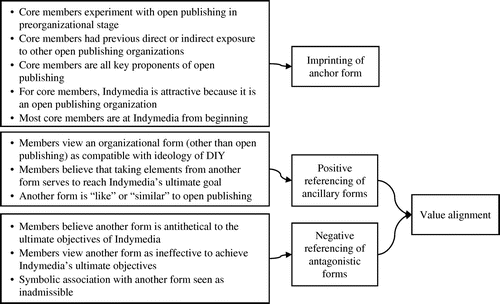
Our last step was to identify the sources of anchor, ancillary, and antagonistic forms. We returned to the first-order codes and studied all the passages that mentioned any of the referenced forms. In addition to the board exchanges, we included the archival material because it contained programmatic and reflective texts authored by participants, and hence they provided valuable information on motives and intentions. For the anchor form, we generated codes for why it was present in Indymedia and why it was chosen as such an important reference point. For the ancillary and antagonistic forms, we coded for information related to why Indymedia members thought there were commonalities between them and what was underpinning them. For example, members discussed the commonalities between Indymedia and Debian, a free software project, or between corporate news media and political parties. Figure 2 depicts the coding structure from this additional analytical step; sample data are presented in Table 3. The analysis led us to conclude that the source of the anchor form was “imprinting,” whereas for ancillary and antagonistic forms, it was “values,” meaning positively and negatively referenced forms were selected on the basis of their respective normative1 compatibility with the anchor form.
|
Table 3 Data Illustrations for Selection Processes (from Primary Material)
| Third- and second-order codes | Illustrative quotation, fact, or episode—For selected first-order codes |
|---|---|
| 1. Imprinting | Frequent references by founding members to Seattle precursor, for example, “With the convergence of many groups to Seattle in 1999, we knew that the sort of campaign might be an effective way to get the message of the anticorporate movement before the public. So we planned to do a similar sort of cross-media collaboration.” |
| Early members were in close contacts with other alternative media projects (e.g., the weekly news sheet Schnews, the magazine Squall, and the Undercurrents news network). | |
| “Soon after [the June 1999 protests] some of us started to meet up regularly to learn, exchange, debate, and build upon what had already been achieved.” | |
| 2. Value alignment | |
| Positive | “I think we should participate in these open-source projects because they are about communication, but also because they reflect the same diy autonomous and non-for-profit basis of indymedia” |
| “Open publishing and open-source software are both (r)evolutionary responses to the privatisation of information by multinational monopolies.” | |
| Negative | “This anti-journalism project fights to suppress the mediation of a professional or semi-professional instance, and tries to make people capable of producing their own ‘truth.”’ |
| “[Indymedia] is against corporate media control of globalization and for a more democratic and inclusive process of setting the world’s priorities and allocation of resources.” | |
Findings
Emergence and Development of Indymedia
The first IMC emerged during the November 1999 protests in Seattle against the World Trade Organization (WTO). The activists needed to distribute news via noncorporate networks and established a store in downtown Seattle where protestors and independent journalists could upload material. This outfit rapidly expanded to include a website that allowed all interested users to register and upload their news stories directly without editorial approval. Indymedia Seattle offered a way of producing and distributing news on the Internet, as well as a physical location for alternative media production targeted at a global audience of activists and leftist writers and readers.
The emergence of Indymedia Seattle and subsequent nodes occurred in the context of open publishing that had emerged as an organizational form in the 1990s as a result of the new possibilities afforded by the Internet. Open publishing allows the public to contribute news items to a media platform whereby contributions appear instantly on a website, and only minimal content filtering is applied. It represented an opportunity for social movement organizations to solicit, process, publish, and consume news much faster and more widely than ever before. The power of rapid global publishing was demonstrated during the 1994 Zapatista peasant rebellion in Mexico. Another example was OhmyNews, a Korean organization carrying the motto “Every citizen is a reporter,” established to counter the perceived bias of commercial and state-controlled media reporting (Kim and Hamilton 2006). In the United States, grassroots media organizations included Deep Dish TV and Paper Tiger, both propagating the idea of citizen journalism (Kidd 2003). Open publishing also encompasses outlets, such as Wikipedia, that enlist large audiences as both producers and publishers of content.
The open publishing formula proved an instant success during the Seattle WTO protests. Thousands of posts were uploaded onto the Indymedia Seattle site, which recorded millions of hits from around the world. Mainstream media began using Indymedia as a basis for reporting, and outlets such as the Financial Times provided Web links to it. This brought widespread attention to Indymedia as a novel way of producing and distributing news in a “bottom-up” fashion and chimed with the discourse of Internet liberation that dominated popular debate during the late 1990s. The Indymedia model was subsequently “exported” across the world, allowing activists to adapt this form to suit their particular contexts.
One locale where an Indymedia organization was established was London, led by an existing alternative media collective connected to various loosely organized radical social movement groups. Out of this core group grew a broader collective that included volunteers and individuals recruited through friendship networks. The Indymedia UK site went live during the 2000 May Day protests, but it was rudimentary and required manual updating. Similar to the Seattle model, the group provided a physical infrastructure for citizen journalists by introducing public access terminals via bicycle-powered laptops. In this paper, we refer to the London-based organization that constitutes the focus of our study as Indymedia. Apart from sharing the Indymedia label, the London organization was not connected to the Seattle entity.
Subsequent efforts were directed at building a more permanent organizational infrastructure. The participants held regular meetings, established an online message board, provided training sessions, and developed a mission statement. The result was a nascent organization with the following characteristics. First, it provided a technical infrastructure that allowed for decentralized uploading of messages. Second, it developed policies and rules. A central, often hotly debated issue was to what extent editorial control should be exerted. In the early days, some degree of editorial control was imposed, but this was later abandoned as participants felt it violated the principle of “horizontalism” and radical democracy. Third, in terms of targeted audiences, there was general agreement that Indymedia should encourage a blurring between the producers and consumers of news and distribute news that was disregarded by corporate news media.
Indymedia rapidly began diversifying its activities. It sought to incorporate film and other cultural events into its offerings, particularly those related to radical causes. It began to produce printed copies of online material via a publication entitled IMC Offline. An Indymedia radio show was broadcast on a local community radio station. It began providing information technology services and installed a local area network in a community center. During this period, Indymedia established links with external organizations. It had a tent at activist events such as the Cannabis Festival and the Anarchist Book Fair. Large-scale protests organized included “guerilla gardening” in London’s Parliament Square, demonstrations against globalization and the arms trade, and actions on the cross-channel ferries between the United Kingdom and France. In 2002, Indymedia even gained mainstream recognition in the form of a New Media Award. As the scope of Indymedia’s activities expanded, the issue of local and regional autonomy began to be debated, culminating in the creation of the “United Kollectives” in 2003 as a federal national structure that allowed regional Indymedia nodes to operate autonomously. In the course of these changes, the focal organization changed its name from Indymedia UK to Indymedia London but maintained continuity in terms of core members and range of activities.
Below, we examine how the Indymedia organization shaped itself by drawing on multiple organizational forms. We show that Indymedia combined and contrasted the open publishing model with various other organizational forms, and we explore how these modifications were generated. We present our findings under three headings, referring to, respectively, the class of forms referenced by organizational members, the way these forms were selected, and the process by which they were instantiated into the organization.
Anchoring
FormAlthough organizational members referenced a number of organizational forms during their attempts to build Indymedia, open publishing stands out as the most frequent reference. We call open publishing the “anchor form” because it provided the central point of reference for Indymedia’s organizing efforts. Open publishing appeared in the mission statement of the organization and in its “about” section, and a foundational document, not connected to Indymedia (Arnison 2001), was consulted when clarification of the model was required.
References to open publishing were frequent during Indymedia’s organizing efforts. As one member explained to a newcomer,
At its most basic level, open publishing erodes the dividing line between reporters and reported, between active producers and passive audience—people are enabled to speak for themselves. Simply put, you—not “indymedia”—are the reporters.2
The constitutive elements of the anchor form that were emphasized by the members included the mandate to provide free access to news publishing to everybody, the absence of editorial intervention and control, the equivalence of writers and readers, and the use of Internet technology for automating the process of uploading news.
SelectionWhen probing the circumstances under which open publishing became Indymedia’s anchor form, we found that the initial founding conditions were crucial in determining Indymedia’s organizing pathway. Many individuals involved in the early Indymedia had experience with off-line independent media and online tools for distributing independent media content at ad hoc events. This experience provided a blueprint for establishing the London organization. When discussing open publishing, members often referred to precedents dating back to a period before Indymedia was founded. For instance, early participant “Rock” explained that the J18 protests against the Cologne G8 summit on June 18, 1999 prompted the group to reflect on the need for autonomous media production by exploiting the enormous potential of new technologies. During this self-proclaimed “carnival against capitalism,” London media activist group “Reclaim the Streets” helped independent journalists distribute their coverage and provided an infrastructure for video Web streaming. The loosely organized group used the “Active” software developed by Sydney’s Catalyst Tech Collective, which later became the backbone of the Indymedia Web platform. Many London activists viewed these early experiments as the groundwork for the subsequent mobilization during the Seattle World Trade Organization protests in late 1999.
Such events were pivotal for bringing together the individuals who became the Indymedia founding team. One member recalled that participants at J18, which represented “one of the crucial days in the UK’s grass roots, activist scene,” were still active in Indymedia. The J18 group met up regularly to “learn, exchange, debate and build” on the previous experience. As Rock explained, the group shared the belief that rather than being the “journos of the movement,” it was more interested in creating the movements’ infrastructure. This group subsequently organized protests against a Prague IMF/World Bank conference and the Seattle WTO event in 1999 before establishing the more permanent operation that constituted Indymedia. This founding group’s ethos is illustrated by the following statement: “In written form there have always been pamphlet and printed distribution. The Internet makes it easier to reach people that would never think of reaching into the realms … of an alternative/radical bookshop” (Fuzz 2011). One member expressed the excitement that the Seattle protests triggered:
Being able to log onto a website and see events unfolding in real time, unfiltered, and first hand was mind blowing. What we had been dreaming about, suddenly was in front of our eyes, as by magic. We could not believe it, and the possibilities that [Indymedia] offered us were unlimited. (Milan 2010, p. 89)
In addition, many early participants had significant experience in other open or independent publishing organizations or projects. Some had been involved in making films for independent distribution, producing shows on community radio stations, or writing for and producing small independent newspapers. “Che” had been involved in “Open Magazine,” a collaborative network that published works of art for free, and “Plastic” was an independent film maker interested in using digital media to create awareness of social change. These individuals were core members of Indymedia; they were among the top 20 posters on the message board throughout our study period, with each contributing more than 100 messages, spread over the whole study period, whereas the median number of messages per signed-up member was 1. Of the 10 top posters, 8 individuals started contributing messages during the first year of the organization, suggesting that the majority of frequent contributors were also among the “old crew,” as the founding individuals were called in the community.
Our account illustrates that the open publishing form was imprinted onto Indymedia as a function of the experiences and visions of a founding group, similar to the way entrepreneurial start-ups are imprinted with organizing templates by founding individuals (Stinchcombe 1965, Kimberly 1975). This process represents “founder imprinting” (Nelson 2003). Indymedia did not have founders in a formal sense, such as in a firm, but given the idiosyncrasies of Indymedia, it is appropriate to refer to those individuals who had high involvement at inception and throughout our study period as founders. Early preferences for and experiences with a particular model of organizing for Indymedia exerted strong and continuing influence by providing the anchor form for members’ organizing efforts.
The founders were prepared to defend their vision of the organization against newcomers or peripheral members. For instance, they were critical of members who did not demonstrate continued adherence to the values of the organization. Even though this proposal was not eventually implemented, the old crew suggested that the 100 least active individuals (“lurkers”) be forcibly removed from the organization’s membership. They professed that nonparticipation was inacceptable: “Lurking is not only counterproductive but it also plays into the hands of the status quo. Change and social and environmental justice will only come about if people do something about it.” It was also suggested that nonparticipation was a direct result of being with Indymedia for the wrong motive: “If you are on this list watching silently from some corner ‘because it makes you feel better,’ then why don’t you just set up some direct debit with some big NGO.” This episode illustrates that the core members sanctioned those peripheral members failing to live Indymedia’s values by using penalties that ranged from moral persuasion (“show respect for the old crew”) to the threat of expulsion.
InstantiationIn referencing open publishing, Indymedia members sought to emulate what was considered the generally appropriate model of an independent news media organization. We characterize the process by which open publishing shaped the organization as “anchoring.” It consisted of the following three subprocesses as indicated by our second-level codes. First, open publishing was viewed as the natural way for Indymedia to be organized, and its elements were often implicitly practiced. For instance, when members unfamiliar with the organization asked how certain actions should be pursued, they were told that the open publishing model made them self-evident. When organizational members were prompted to explain “what we are about,” the open publishing model was at the center of their explanations. If outsiders failed to understand what Indymedia was about, members expressed exasperation: “We may think that it is self-explanatory, and after more than six years of Indymedia, that it should be widely known and understood by everyone, but the fact is that ‘out there’ there are still too many people that they go ‘whaaat?’ ”
Second, open publishing was presented not only as a means of achieving certain goals, but also as having value. Members spoke in glowing terms of the achievements of open publishing and its promising future. The organization prided itself in being a leading exponent of the open publishing “movement,” as illustrated by a statement from one of its key individuals: “It would be fair to say that Indymedia is basically the precursor of all blogs.”
Third, open publishing became routine within the organization. Members were told that in open publishing, activities were “usually” undertaken in specific ways, and hence it was expected that everybody would follow them, rather than providing explanations as to why an activity was effective. A question about editorial control—whether the organization was allowed to have a “hidden” folder to remove “inadequate” postings—was resolved by the decision to act in line with the implied open publishing model.
The above three subprocesses all emphasized the unquestioned, natural status of the anchor form. Referencing the anchor form meant reiterating elements of the organizational setup that were valued of themselves, beyond its instrumental purposes, and constituted the main frame of reference for the organizing attempts. The impact of the anchor form endured over time by providing a constant reference point for organizational decisions and actions. We found no time-related differences with respect to the frequencies with which members referenced the anchor form, suggesting that it played an ongoing role in members’ bricolage.
Augmenting
FormsIn addition to open publishing, organizational members referenced a series of other organizational forms, which we call “ancillary forms.” They include the forms of open source project organizations, voluntary organizations, and political activist cells.
First, drawing on the organizational form used in open source software projects (Chen and O’Mahony 2009), members were encouraged continuously to take initiative and contribute improvements to various aspects of the organization and its activities. The effort to become a “truly productive working list” included modifications to core technology (website), processes, and ongoing initiatives. The organization faced the paradox common to open source networks that contributions were self-motivated and self-initiated yet needed to be coordinated and integrated to form a coherent whole. The influence of the open source model is reflected in the fact that decisions were made using lists and emails rather than face-to-face meetings. Referencing the open source organization served to generate and constantly reinforce a self-motivational ethos within the organization. For instance, one member complained about the large numbers of lurkers, an expression used in online communities to refer to “people signed up as members but not contributing.” Another asked, “Why isn’t there more (h)ac(k)tivism?,” referring explicitly to alternative circles of computer software enthusiasts to encourage members to show more initiative.
Another form frequently referenced was the voluntary organization. Members were reminded that all those involved were unpaid volunteers expected to participate out of a sense of duty to the organization and the broader constituency. One member emphasized that Indymedia did not involve a “professional” approach but one that encouraged contribution and participation. By stressing the voluntary nature of Indymedia, members effectively supported the horizontal and egalitarian authority relations associated with the Indymedia form.
A final reference for Indymedia organization building was the form of an activist cell that encouraged decentralized, autonomous activity: “Indymedia is not just a media project, it’s a political project, a tool for social change and establishing alternatives.” Members emphasized Indymedia as an “open space” where “networks between autonomous groups” could be built, producing a form of “direct democracy.” Members were encouraged to stage “carnivalesque” manifestations of collective protest and celebration through colorful and circus-like performances. Indymedia was seen as a space that would encourage such celebrations, and hence, members sought to routinize these activities as part of Indymedia’s remit. Indymedia was expected to appeal to a particular core audience, that is, “autonomous” and grassroots activist groups.
By invoking references to additional organizational forms, Indymedia members sought to adapt and modify the anchor form by constructing a unique, local instance of an open publishing operator. We call these additional forms “ancillary” because they informed aspects of the emergent Indymedia structure, which, in the eyes of the members, were insufficiently or not adequately specified by the anchor form.
SelectionWe subsequently examined how ancillary forms were selected. We noticed that resonance with organizational values played a vital role among Indymedia members in this respect. Ancillary forms were selected on the basis of whether they broadly fitted with their views regarding the general purpose of Indymedia in society. As “Rock” stated, Indymedia was conceived by members as an “organization tool” through which they pursued higher goals such as social change and emancipation. To him, some organizational forms were deemed to be intrinsically in alignment with Indymedia’s dominant organizational values.
Values can be defined as a more or less coherent set of beliefs that transcend specific situations and guide the selection or evaluation of behaviors (Rokeach 1973). More specifically, organizational values comprise the definition of acceptable outcomes for an organization as well as the appropriate means to achieve them (Schwartz 1992), and thereby the impact on an organization’s structure and strategy (Kabanoff et al. 1995, Bansal 2003, Bourne and Jenkins 2013). For instance, organizational values may be based on the maximization of shareholder value, the improvement of organization’s market position, or the principle that all employees should be empowered (Bansal 2003, Bourne and Jenkins 2013). Organizational values may underpin organizational identity but are distinct from it because values may be shared among organizations, whereas their organizational identities differ and are unique for each organization (Albert and Whetten 1985, Bansal 2003).
In Indymedia’s case, its organizational values were dominated by “autonomism,” a belief system with roots in anarchism and Marxism (Böhm et al. 2010). The importance of this belief system in underpinning Indymedia’s organizational values is illustrated by a series of documents authored by core members that determine “equality, decentralization, and local autonomy” as key principles for the organization. One document states that Indymedia was “not derived from a centralized bureaucratic process, but from the self-organization of autonomous collectives.” This document goes on to emphasize Indymedia’s independence from dominant entities such as the state, corporations, large NGOs, and the market. These statements illustrate how Indymedia’s organizational values put particular emphasis on utopian ambitions as to how society should be structured and how this should be achieved.
This value system was articulated via a do-it-yourself (DIY) approach to media and communication implemented in two ways. First, participants were encouraged to focus on action rather than formal organizing or elaborate planning: “If you want something done, read the manual and go ahead.” Implicit in this plea was an aversion to hierarchy. Second, the media should be “created by those who used it,” as expressed in the dictum “Everybody is a journalist.” By erasing the distinction between producers and consumers, Indymedia members sought to mount a broader challenge to prevailing social structures, which in their view perpetuated a systemic inequity between dominant and subordinate groups.
These organizational values informed the range of organizational forms deemed acceptable as ancillary forms. The model of open source software was viewed as suitable for augmenting Indymedia’s open publishing setup because it emphasized a decentralized form of production and the use of online communication as an organizing tool. Illustrating the normative alignment between open publishing and open source programming, participants felt Indymedia should always use free, open source software that challenged the perceived corporate dominance of information technology. One member emphasized that “open publishing is nothing but the continuation of the free software mode of production” (Hamm 2005). Similarly, the volunteer organization form aligned with the desire to avoid commodified relations imposed by state or market and instead rely on the participants’ actual labor. Volunteerism also implied a rejection of professionalization, seen as promoted by accepting outside donations. For instance, Indymedia rallied strongly against a U.S. sister group’s intention to accept a grant from the Ford Foundation because this was seen as violating the principles of the grassroots volunteer organization. Similar normative alignment prevailed with respect to activist cells. One member explained that Indymedia was a political organization that specialized in “demonstrating with keyboards, cables and cameras.” Each of these forms was based on authority relations that emphasized nonremunerated, self-motivated expense of effort, and was based on loose networks that eschewed formal hierarchical structures. Additionally, all these forms emphasized the noncommercial production of goods and services, usually with an orientation to social change, and hence were judged compatible with the value system of autonomism.
InstantiationWe now turn to analyzing the way in which ancillary forms were used to shape the organization. It appeared that the open publishing form was insufficient to deal with a range of daily issues in Indymedia, providing the impetus for augmenting it by enlisting ancillary organizational forms. For instance, the open publishing model did not necessarily prescribe all management aspects of the organization. As a member explained,
Open publishing [OP] is central to the global indymedia network. Now, there are different ways of implementing OP. Postings to the site can be administered before or after appearing in the front page (the newswire). Which one London Indymedia would prefer is for people involved in the project to decide, as, in fact, it is a political decision.
The latitude in shaping open publishing manifested itself in three ways. First, members enlisted elements associated with other organizational forms to achieve certain goals. When the members decided that the technology infrastructure needed updating, one member described how they worked “a bit like open source software developing, very pragmatic. Some people do things, then it’s wait and see if others take them up….” Mirroring another element of open source organizations, they compiled manuals and organized formal training sessions even though these means were unusual in the anarcho-autonomist environment in which Indymedia operated. In their attempt to enlist resources, participants appealed also to the volunteer organization form, which relied on the labor input of members.
Second, ancillary forms were referenced to increase the organization’s impact by, for instance, recruiting additional audiences. A participant noted that Indymedia did not place sufficient emphasis on dealing with its technical challenges and should therefore do more to appeal to the “geeks.” This would help “put a focus on the tech-politix side of things.”
Third, members used ancillary forms to resolve organizational challenges and problems. On one occasion, the question arose as to whether the organization should adopt a completely neutral stance regarding the content that was uploaded to its site or whether content should be presented and prioritized in a way that favored political goals—for instance, with respect to publicizing protest marches. In this instance, the organization decided to be “like” an activist organization and position political content prominently.
We grouped the above processes under the header of “augmenting,” implying that references to other established organizational forms were used to address specific issues, increase organizational impact, and deal with challenges. At times, augmenting was used because the anchor form failed to provide clear guidelines, at others it meant that different forms were seen as improving on the features prescribed by the anchor. Drawing on these ancillary forms enabled certain aspects of the Indymedia organizations to be qualified, modified, or substantiated.
Differentiating
FormsAs well as positively referencing an anchor form (open publishing) and ancillary forms (open source organization, voluntary organization, activist cell), some forms were negatively invoked. Indymedia members identified three main forms as primary negative referents that indicated what they felt Indymedia should not be: a commercial news media organization, a political party, and an NGO.
By constantly affirming their organization’s difference from corporate news media, members sought to ensure that Indymedia would not be underpinned by their profit motives and preferential treatment of “mainstream” news stories. This differentiation facilitated members’ attempts to structure Indymedia as an open space where multiple opinions and approaches could appear and be debated. By distancing itself from corporate news media, Indymedia affirmed its goals as an organization that provided democratic access to news and served as a conduit for alternative stories that were ignored by the mainstream media. The differentiation signaled Indymedia’s aim to address a nonmainstream audience. The difference vis-à-vis for-profit news providers was reinforced by the refusal to adopt professional journalists’ practices, which were seen as biased by corporate interests. As one member remarked,
The strength of Indymedia is to accept non-professional features, to do things our own way rather than mimicking a hegemonic concept of journalism. The facts mentioned in our features rely on first hand reports.
There was also agreement that Indymedia should not be a political party. Participants distanced themselves from the personnel, organizational structure, and ideological positioning of political parties. They felt that Indymedia’s goals should not reflect those of established political parties or take specific positions on certain political or policy issues. Moreover, they refused the allegedly bureaucratic organizational structure of political parties.
In similar ways, members distanced their organization from the organizational form associated with large NGOs. They saw NGOs as overly bureaucratic and hopelessly compromised by the need to continuously raise funding. In their view, NGOs spent too much time and resources on unnecessary activities such as administration. Moreover, the members feared that Indymedia might become a conduit for statements and materials produced by large NGOs. This was underpinned by a concern that Indymedia was “not a place for spreading propaganda.” By distancing Indymedia from large NGOs, members sought to preserve the independence of their goals and ensure that authority relations within the organization did not become sclerotic, bureaucratic, or elitist.
SelectionHaving identified what the antagonistic forms were, we asked why these forms were negatively selected. We found that antagonistic forms were typically those that were dissonant with Indymedia’s organizational values. Corporate news media were seen as destroying autonomy and commercializing the production of news: “Inherent in the mainstream corporate media is a strong bias towards capitalism’s power structures, and it is an important tool in propagating these structures around the globe.” NGOs were seen as too hierarchical, discouraging action, and dependent on external donors. Their approaches were judged ineffective: “By lobbying there will be no radical change.” Professional journalism was viewed with suspicion because it threatened people’s ability to create media content for themselves, thereby biasing information flows in favor of large organizations. Each of these negatively referenced forms was seen as being antithetical to the broader goal of building an orientation toward autonomy. Indymedia members rejected them because they compromised direct action by prescribing formal planning and hierarchical authority relations. This rejection had a technical aspect—that is, Indymedia refused to be organized “like” a commercial news organization or an NGO—but it also had symbolical relevance. Negative referencing of normatively misaligned forms allowed members to reaffirm the organization’s key elements by clarifying what Indymedia was not.
InstantiationOur coding revealed three ways in which the reference of antagonistic forms impacted on the forming organization. First, pointing to antagonistic forms served to communicate the central purpose of the organization. For instance, the following statement was typical of organizational members’ efforts to dissociate their organization from corporate news organizations and thereby emphasize the virtues of Indymedia: “The press is the hired agent of a moneyed system, set up for no other reason than to tell lies whenever it serves their interests.” Pointing to antagonistic forms also allowed members to forcefully illustrate elements that were seen as essential. When a member used the Indymedia newswire to disseminate news about Indymedia, another member reprimanded her: “The news wire is for the general public to publish stories and not necessarily [to serve our interest]. If we do all this then we are as bad as the mainstream tabloids!”
Second, hinting at antagonistic forms helped to motivate and inspire both members and potentially interested outsiders. For example, one member called on the organization not to be “too professional” at publishing news as this would discourage members from writing and uploading news themselves:
People need to understand that Indy is primarily there to encourage people reporting themselves…some people still don’t understand the participatory ethos of Indymedia, viewing it as a professional service provider.
Third, members deployed references to antagonistic forms to express Indymedia’s aspirations. Members were keen to move into some of the “markets” currently occupied by other types of organizations, such as corporate news media. Similarly, the organization attempted not to replace existing “mainstream politics” organizations but “to by-pass the mainstream by creating living alternatives to it.” Negative referencing hence helped members to express the vision of what the organization could ideally represent.
We grouped the above three subprocesses under the category of “differentiating.” In all the instances described, elements from antagonistic forms were deployed to accentuate and strengthen elements of the organization that were associated with either the anchor or the ancillary forms. Rather than being discussed in their own right, antagonistic forms were primarily mentioned in conjunction with issues and tasks that were commonly seen as the essence of what Indymedia was about, suggesting that reference to antagonistic forms helped to reinforce those very aspects.
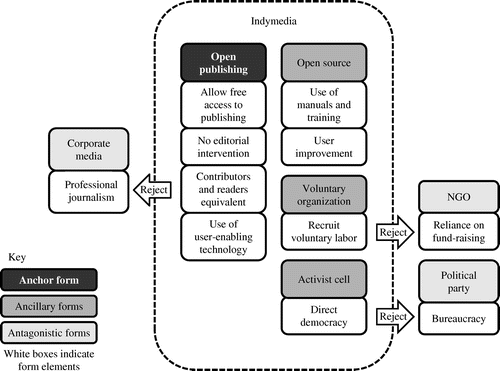
We graphically represent our findings in Figure 3, where we list sample elements pertaining to each class of forms, illustrating how the organization was pieced together from various forms and differentiated from others.
A Model of Organizational Bricolage
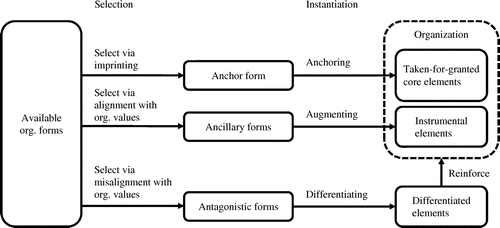
We now draw our findings together to create a grounded theory model of organizational bricolage. The model depicts the process through which certain organizational forms are selected from the organization’s environment and subsequently instantiated via anchoring, augmenting, and differentiating.
Selection
When encountering an opportunity for founding an organization, early members face the challenge of deciding how to organize (Tolbert et al. 2011). Particularly in the institutionally fluid circumstances, uncertainty may prevail regarding the appropriate organizational form. In the case of Indymedia, certainly during the protests preceding its foundation, action was very much cobbled together on an ad hoc basis. Such improvisation may work for initial action but will become difficult to sustain across a string of events and problematic to scale beyond a very small group of founders with deep personal knowledge of each other. Using organizational forms that already exist in the environment provides a solution to this basic organizing problem as the forms represent established templates available for designing and coordinating collective action. However, as there may be multiple organizational forms that are potentially available, the question then is which forms are selected.
We suggest that organizations select a primary organizational form—the anchor form—as a function of organizing models, which founders bring from their previous experiences. In the present case, we noticed that activists initially involved in Indymedia drew on the open publishing form because they were already familiar with this mode of organizing from ventures in which they had previously participated. This familiarity allowed actors to shortcut many of the design, experimentation, and learning processes that would be involved in developing a wholly new form.
In addition to the form imbued via founder imprinting, the Indymedia case suggests that an emerging organization selects a variety of additional forms to support the organizing process. These ancillary forms are selected on the basis of prevailing organizational values. At Indymedia, members selected forms such as the open source organization or the activist cell according to their alignment with Indymedia’s values—dominated by autonomism—that made them appear legitimate and acceptable to the members of the organization as well as its audience. This suggests that organizations enrich and differentiate their anchor form with other forms according to their normative alignment with the anchor form. Organizational forms are normatively aligned—meaning they reflect the same set of organizational values—if they are compatible with a specific vision of the kind of outcomes seen as acceptable for the organization and the appropriate means to achieving them (Schwartz 1992).
Organizational values as a selection mechanism also worked in the opposite way, as actors referenced organizational forms that clashed with Indymedia values. We call these forms antagonistic forms. Rather than simply ignoring them, normatively misaligned forms were actively invoked, but they were discussed in roundly negative terms and viewed as morally illegitimate by organizational members. These included forms such as the corporate media organization that were seen as antithetical to Indymedia’s value system of autonomism. Hence, if normative alignment is low, then an organizational form will be rejected as an ancillary form but can still be deployed by being referenced negatively. This differentiation helps the organization to mark its distinctive features vis-à-vis potential alternative organizational forms.
As a source of forms, organizational values work differently from imprinting as they encapsulate the overall worldview that organizational members hold and the associated goals that they wish the organization to pursue. In this way, the values provide a yardstick for judging the compatibility of alternative organizational forms with the emerging organization. By contrast, imprinting furnishes a specific form—open publishing—with which founders are familiar and that provides them with an immediate formula for organizing. The difference between organizational values as a source of forms and founder imprinting is that the latter provides a form as a concrete means of organizing, whereas values provide an overarching set of criteria for the assemblage of additional forms.
Instantiation
Having outlined the mechanisms used to select specific forms for bricolage, we now focus on the role the different classes of organizational forms play in organizational formation. Our coding revealed three processes through which the respective classes of forms were instantiated. By instantiation, we mean the way in which organizational forms were used to shape the emerging organization.
The first process is anchoring and encapsulates how the anchor form is instantiated. The anchor form is primarily invoked to engrain and emphasize the unquestionable features of the organization. The primacy of the anchor form reflects the powerful inertial force exerted by imprinting as the attachment to this form spreads from the founding members to other members, partly because of the authority exercised by the founder members and partly because they shape much of the initial organizational agency. In this way, attachment to the anchor form becomes a taken-for-granted component of organizational life, infused with intrinsic value (Berger and Luckmann 1966). At Indymedia, the commitment to open publishing rapidly became a sacrosanct aspect of the organization. The core elements of this model proved resilient even when they gave rise to significant problems. Even though the open newswire was occasionally used by neo-Nazi groups to publish anti-Semitic content, many Indymedia members remained resolutely committed to the principle of open publishing. This meant that instead of adding an editorial process, members chose to simply “hide” posts from the public version of the newswire. The organization’s orientation to the anchor form resulted from an implicit assumption that this was the legitimate and “proper” way of operating. The forces committing members to the anchor form are akin to the infusion of structures with value observed by Selznick (1949). For members, aspects of the structure of their organization, such as roles and authority relations, become “infected” with legitimacy in the sense that a penalty is associated with questioning these structures (Zucker 1988).
The second process is augmenting, whereby additional ancillary forms are deployed in forming the organization. These additional forms are used in a more instrumental and problem-driven way than the tacit acknowledgement of the anchor form as the “right thing to do,” and hence organizations have relatively greater discretion in using these forms than their imprinted anchor form. Organizational members may realize that the anchor forms underspecifies the means needed to address arising challenges or opportunities and seek to identify accepted ways in which such issues can be dealt with. Such problem-solving capacity may be offered by organizational forms other than the anchor form. At Indymedia, a range of ancillary forms was invoked to extend the anchor form in a way that enabled the organization to cope with pressing issues, such as organizing the decentralized, self-motivated maintenance and improvement of its website. The instrumental, witting fashion in which ancillary forms are deployed is reflected in the way in which they are integrated into the forming organization. Rather than “blending” them with the anchor form, integration occurs via the selection of specific single elements from ancillary forms and their subsequent addition to the anchor form (Siggelkow 2002). At Indymedia, such elements included, for instance, the use of manuals, which is a core element of open source organizations but is foreign to anarchist media organizations. As a result of their instrumental use, such elements are likely to be treated less as a permanent fixture of the organization and may not be valued by organizational members as a core or essential aspect of the organization.
The third process is differentiating, which involves rejecting certain organizational forms. From our coding, we inferred that these antagonistic forms are used differently from ancillary forms. Whereas ancillary forms provide a utilitarian source of elements used for augmenting, antagonistic forms are rejected to accentuate the desired elements of the organization. Analogous to augmenting, the differentiation process is element specific. This means that even though antagonistic forms are referenced in rather broad-brush, even emotional, terms, this tends to be done by emphasizing specific elements of antagonistic forms. For instance, at Indymedia, members rejected professional journalistic methods as an element of the corporate media organizations, which served to emphasize and reinforce Indymedia’s preference for the “everybody is a journalist” principle, which formed part of the open publishing anchor form. The outright rejection of antagonistic forms served to emphasize and strengthen members’ focus on and commitment to those elements of the organization that derived from either anchor and ancillary forms.
Though our single case study design does not allow us to be definite, one may postulate that the need to invoke antagonistic forms is greater when, during organizational formation, a multitude of ancillary forms are deployed compared with a more straightforward adoption of an anchor form. The threat of incoherence and identity loss may be exacerbated if the anchor form is edited with a multitude of elements from ancillary forms, and hence members may compensate for this by reinforcing the features of the organization by reference to antagonistic forms, complementing and assisting the elaboration of the organization as a composite of elements taken from anchor and ancillary forms. Gioia et al. (2010) report a similar observation in their study of identity formation in an emerging organization where contrasting experiences (negative identification) appeared particularly important in situations with high ambiguity.
At Indymedia, only a limited number of ancillary and antagonistic forms were invoked, compared with an almost indefinite number of forms that were in principle available. This can be explained by the observation that both augmenting and differentiating were issue driven, in the sense that additional forms were used when members felt that elements drawn from these forms could help solve a problem or alternatively help reiterate and express central features of the organization. Augmenting and differentiating therefore appear to occur particularly when the respective forms become salient as a result of issues or opportunities emerging in the organization (Rindova et al. 2011). Furthermore, this means that these processes occur in a piecemeal way, leading to incremental changes and adaptation of the organization over time.
To conclude, our model of organizational bricolage posits that, during formation, organizations invoke multiple organizational forms that are chosen using two selection mechanisms. An anchor form is selected through imprinting, referring to the adoption of the organizational form that is experientially salient for the founding individuals (Baron et al. 1999). In addition, ancillary and antagonistic forms are selected on the basis of their alignment and misalignment, respectively, with the organization’s prevailing values, which in Indymedia’s case, were based on the belief system of autonomism. The various forms are, in turn, instantiated into the organization via three processes. Through anchoring, the anchor form is implemented to constitute the taken-for-granted core elements of the organization. Through augmenting, ancillary forms are deployed to inform and justify the addition of instrumental elements, resulting in modifications and substantiations of the setup as determined by the anchor form. Finally, through differentiating, antagonistic forms are used to delineate what the organization would not be and create distance from other types of organizations. This process serves to accentuate and reinforce the combination of elements from anchor and ancillary forms that constitutes the instantiated organization. For a graphical representation of our model, see Figure 4.
Discussion
We studied the formation of Indymedia to understand how actors use organizational bricolage to build organizations from heterogeneous forms. In this section, we outline our contributions to three literatures: organizational formation and imprinting, bricolage, and organizational values.
Organizational Formation and Imprinting
The question of how new organizations take shape has long interested organization theorists (Stinchcombe 1965, Katz and Gartner 1988, Aldrich and Fiol 1994, Tolbert et al. 2011). In this study, we explored how new organizations use multiple organizational forms as templates during the formation process. Extant work on this aspect of organizational formation has primarily focused on how the features of young organizations’ environments affect the degree to which they draw from multiple forms (Suchman 1995, Lounsbury and Ventresca 2002, Johnson 2007, Chen and O’Mahony 2009, King et al. 2011). From previous research, it would seem then that we can predict the degree to which organizations will deploy multiple forms, but there is ambiguity in the literature through which mechanism(s) this happens. As a result, we have little detail about the process through which form combination occurs. By identifying organizational values as the engine that defines what are admissible and nonadmissible organizational forms to draw upon, we are able to characterize the process determining why certain forms are chosen, and why others are rejected.
Our novel insight is that while the process of imprinting is important in giving organizations initial shape, the latter is subsequently modified by recourse to additional organizational forms that are selected on the basis of value alignment. We explain this by proposing that parallel to being imprinted with a specific anchor form, an organization also acquires a system of organizational values, which then furnishes the criteria for admissible additional forms that may be used for augmenting the anchor form. Organizational values are the mechanism that provides an analytical link between the imprinting of an organization with a specific form and its subsequent modification via additional forms. Rather than the imprinted anchor form directly guiding the selection of additional forms, it is through the organizational values system that the latter is accomplished. In this way, the model of organizational bricolage provides insight into the nature of both the affordances and the constraints that an organization faces when manipulating its imprinted form. The affordances are based on the relative elasticity of organizational values with respect to form choice, in the sense that a number of forms will be seen as compatible with a given set of organizational values. The constraints are the exact mirror image, that is incompatibility of forms with the organizational values.
Our insights have implications for the literature on imprinting as a theory that explains how new organizations acquire structure and how this structure is reproduced over time (Stinchcombe 1965, Kimberly 1975, Boeker 1988, Johnson 2007, Marquis and Tilcsik 2013). Recent work has qualified the strong focus on the inertial force of imprinting by considering how its effects may fade over time (Boeker 1989, Marquis and Huang 2010, Ferriani et al. 2012, Marquis and Tilcsik 2013). Our framework of organizational bricolage helps explain how an organization may escape the inertial forces of initial imprinting by drawing on multiple organizational forms, yet simultaneously maintain a path-dependent trajectory that reproduces the initial commitment to the imprinted anchor form (King et al. 2011).
The extant literature tends to consider the modification of an original imprint as a result of adaptive learning (Boeker 1989, Ferriani et al. 2012, Marquis and Tilcsik 2013). Adaptation is a process through which forms or practices are modified to obtain a greater fit or improved performance for the organization (Siggelkow 2002, Ansari et al. 2010). For instance, during adaptation, actors may vary a form by way of organizational learning, implying adjustments as a consequence of performance feedback (Arrow 1962, Ferriani et al. 2012). Bricolage differs from adaptation in that it involves the explicit deployment of existing forms, available in the environment of the organization, for the process by which the organization is crafted. Moreover, in bricolage, an important criterion for judging which adjustments and modifications are suitable is whether there is alignment with the prevailing organizational values. However, bricolage may interact with adaptation by either enabling it via the provision of candidate forms or constraining it as certain forms are incompatible with the organization’s values. Our study has not focused specifically on how bricolage may interact with adaptation; this represents a question that future research should address.
Bricolage in Organizations
Previous work draws on the metaphorical power of the bricolage concept to characterize activities in which actors use resources to shape their local contexts, resolve problems, or exploit opportunities (Baker et al. 2003, Garud and Karnøe 2003, Baker and Nelson 2005, Desa 2012). At Indymedia, various existing organizational forms were drawn upon to structure the organization, suggesting that bricolage is an apt description of what we observed. We go beyond previous work in two ways. First, we suggest that during founding processes, it is not just material resources, including physical inputs, labor, and skills that are mobilized by actors in the construction of a new organization (Baker and Nelson 2005). Rather, we found that symbolic material was vital in cobbling together this particular organization. Although this kind of bricolage has been observed within existing organizations (Glynn 2008, Di Domenico et al. 2010, Harrison and Corley 2011, Christiansen and Lounsbury 2013), studies of emerging organizations have been lacking, even though the bricolage of forms is likely to play a major role in determining the future trajectories of these organizations. In our case, organizational forms “at hand” in the institutional environment of the emerging organization served as symbolic resources, informing how specific elements of the organization were to be constituted.
Second, we provide an account of the actual process of organizational bricolage. Existing studies emphasize the improvised, opportunistic, and experimental nature of bricolage (Douglas 1986, Clemens 1996). By contrast, we argue bricolage is a somewhat more structured activity, which comprises the three processes of anchoring, augmenting, and differentiating. Moreover, unlike existing work that emphasizes how bricolage is largely shaped by pragmatic, utilitarian considerations, such as the ease with which resources can be accessed and mobilized, we depict it as a process that is constrained not just by limited resource availability but by alignment of the symbolic elements that are being assembled with the prevailing organizational values. The key insight that our study proposes here is that the organizational bricoleurs face three different classes of symbolic elements, which, in our study, were organizational forms. The three classes of forms that were worked into the organization, i.e., anchor form, ancillary forms, and antagonistic forms, differed in how they could be used. Anchor forms are those elements over which organizational members have the least amount of discretion when selecting them but enable them to justify, strengthen, and reproduce the “natural” elements of the organization originating in imprinting events. Conversely, organizational members were able to select ancillary forms and antagonistic forms in a more discretionary manner, yet they were always subject to their alignment or misalignment with organizational values. Ancillary forms were available to be used pragmatically to achieve desired modifications of the organizational setup, whereas antagonistic forms were deployed to reinforce the desired features via cognitive and emotional contrasts. The role of “disidentification” in strengthening organizations’ distinctiveness has been emphasized in previous work (Elsbach and Kramer 1996, Anteby 2010), but our study considers these acts of differentiation as part of the wider process of bricolage.
Organizational Values
Selznick (1949) noted that organizations’ formal functions are infused with value, meaning that they are attached to broader systems of meaning. Selznick’s research and recent studies building on his contributions (Kraatz et al. 2010, Gehman et al. 2013) are concerned with how values are generated and reproduced, or perverted, within an organization. Implicit in this research is the assumption that organizational values are important because they shape how organizations act, change, or perform (Bourne and Jenkins 2013). This assumption has indeed been validated by a series of studies, demonstrating a link between organizational values and organizational outcomes, including innovation (Hage and Dewar 1973), resource acquisition (Voss et al. 2000), success in organizational change initiatives (Amis et al. 2002, Carlisle and Baden-Fuller 2004), and issue response (Bansal 2003).
Our study sheds light on an aspect that has found less attention in previous work by showing how organizational values act as a mechanism that shapes emerging organizations’ structure. Whereas previous studies have considered how structures and practices affect organizational values (Kraatz et al. 2010), the process by which organizational values influence the evolving structure of organizations has remained understudied, even though there is a close relationship if not correspondence between organizational values and organizational structure (Greenwood and Hinings 1988, Hinings et al. 1996). In this respect, our study explicates the actual mechanisms by which values may exert these structuring effects. The Indymedia case suggests that organizational values function as a focusing device for organization members when considering modifications to the organizational setup. Organizational values represented a filter that delimited the range of organizational forms that were potentially available to augment the realized structure of the organization. Organizational values provided organizational members with a device that indicated which forms, apart from the anchor form, were permissible and which were to be ruled out (Crawford and Ostrom 1995). Because values refer to the wider goals that an actor is dedicated to achieve, one may argue that Indymedia members chose ancillary organizational forms because they were perceived as supporting Indymedia’s vision. Consonance with respect to organizational values was used as a shortcut for selecting ancillary forms and rejecting antagonistic forms, obviating the need for detailed technical analysis of the appropriateness of specific forms. Such a selection process may, in practice, be technically suboptimal, but it likely results in social cohesion benefits both within the organization and among its key audiences. Because organizational values play an important role in generating organizational cohesion (Amis et al. 2002, Kraatz et al. 2010), choosing value-aligned ancillary forms may spare the organizational elites potential conflicts with organizational constituencies (Bourne and Jenkins 2013) that may occur if forms were merely chosen on technical merits.
Generalizability, Scope Conditions, and Future Research
To what extent are our findings generalizable? Reflecting its ambition for societal change, Indymedia’s organizational values may be more strongly ideological compared with other organizations. An ideology formulates specific core assumptions about the nature of humans and society, and it prescribes how society should be structured (Mannheim 1936, Knight 2006). Ideologies place particular emphasis on societal change (or preservation), and it could be argued that Indymedia was more strongly oriented toward social intervention than other organizations. However, ideologies are often implicit in the values of formal organizations as they seek to promote or defend general societal values as an intrinsic part of their activities (Selznick 1949, 1957). This applies even to private firms. For instance, the mission of Google Inc. to make the world’s information universally accessible implies a certain vision of society and how it should be changed. This means that the insights drawn from Indymedia potentially apply more broadly, implying that organizational values represent a guiding criterion for the selection of organizational forms in emerging organizations more generally. This consideration finds support from previous research that notes the close association between organizational forms and values. This work suggests that accepted forms are not merely instrumental recipes for achieving specific outcomes, but they also tend to be infused with norms, values, and beliefs (Rao 1998, Haveman and Rao 1997). Greenwood and Hinings (1988) argue that organizational design types (in other words, organizational forms) are underpinned by specific ideas, beliefs, and values that provide them with meaning. Haveman and Rao (1997) illustrate that different organizational forms are underpinned by different value systems (“theories of moral sentiment”), and therefore the transition from one form to another within an industry depends on the degree to which the values attached to the new form are accepted in the wider industry environment.
It follows that, in a scenario where an organization faces an environment featuring multiple forms, some forms will be more compatible with its organizational values whereas others will conflict with them. For instance, for an organization with a value commitment to poverty alleviation, a not-for-profit organizational form will appear more in line with its values than a corporate form with external shareholders (Foster and Bradach 2005). In other words, the selection of ancillary organizational forms during the process of bricolage will be shaped by the extent to which these forms are in line with the organization’s espoused values; those forms that clash with those values will be rejected.
Our findings are subject to a likely scope condition, related to the characteristics of the field context in which Indymedia operated. Our framework is likely to be particularly applicable to emerging organizational forms—for instance, within the context of an emerging industry (Aldrich and Fiol 1994). When an organizational form, such as the open publishing organization, is emerging, its features are not yet seen as solidly defined by relevant audiences, and new organizations in this context are likely to have more degrees of freedom in terms of creating idiosyncratic organizations that draw on a host of ancillary forms. In other words, if the pressure to conform to specific models is low, then an organization has more discretion for bricolage. Moreover, in the case of an emerging form, there will be cognitive uncertainty as to what effectively constitutes its core elements, and different organizations are likely to arrive at different instantiations of their form by seeking inspiration from other forms. King et al. (2011) argue that this process is shaped by the proximity of the focal organization to other similar organizations. By contrast, our study suggests that the values held by an organization will inform the process of form realization because its anchor form may not yet be well defined. When Indymedia was established, social media were still in the experimentation phase, and there were few examples of open publishing organizations. The open publishing form was hence only emerging, and its features not yet fully established or institutionalized. This provided those intending to launch open publishing organizations with a significant degree of freedom to experiment with alternative models. Future research could investigate whether actors engaged in organizational bricolage from the vantage point of well-established organizational forms meet more or different constraints when forming new organizations.
Moreover, because our study focuses on a single setting, actors’ bricolage activities are likely to be shaped by factors other than those considered here. It would be worth investigating the role of actors’ status and power within the organization in determining the degree of their discretion when invoking alternate institutional forms. Of particular interest is the degree of value consonance between the organizational elite and other constituencies with the organizations. As Bourne and Jenkins (2013) have pointed out, the organizational values espoused by elites do not necessarily correspond to the generally shared values throughout the organization. In the Indymedia case, we largely treated the values espoused by the founding members as being generally accepted in the organization because there was little evidence that other constituencies were at odds with these values. This may, however, not always be the case, and hence investigating the role of the relationship between organizational elites and other organizational members in informing the selection and integration of forms represents an interesting line of further investigation.
Conclusion
Our study of Indymedia illustrates how an emerging organization takes shape by drawing on multiple organizational forms that are available in its context. We developed a model of organizational bricolage that emphasizes the role of imprinting and organizational values in this process. It suggests emerging organizations are imprinted with an anchor form that is based on formative experiences of their founders. This anchor form is then modified via additional, ancillary forms that are selected in line with the prevailing organizational values. Moreover, the emerging core elements of the organization are reinforced through referencing antagonistic organizational forms, which are forms that the organization actively rejects as permissible blueprints. The concept of organizational bricolage hence adds to our understanding of organizational formation in contexts where multiple organizational forms are available to organizational founders.
A previous version of this article received the EGOS Best Paper Award 2013. Previous versions were presented at the Academy of Management Annual Meeting in Anaheim (2010), the European Group for Organizational Studies Colloquia in Lisbon (2010) and Montreal (2013), and an Organization Theory Research Group workshop at Bocconi University, Milan (2011). The authors are grateful for comments by the editor and three reviewers as well as N. Anand, Shahzad Ansari, Joel Bothello, Anna Canato, Lisa Cohen, Jeannette Colyvas, Elena Dalpiaz, Deborah Dougherty, Royston Greenwood, Santi Furnari, Candy Jones, Ilze Kivleniece, Bas Koene, Kamal Munir, Nelson Phillips, Woody Powell, Davide Ravasi, Paul Tracey, Henri Schildt, Marc Ventresca, and Bettina Wittneben. The authors appreciate the help by Marion Hamm and Zhongyuan Zhang in compiling and analyzing some of the data used in this paper. M. Perkmann acknowledges support from the UK Economic and Social Research Council (ESRC) via an Advanced Institute of Management Practices Fellowship [RES-331-27-0063]. A. Spicer acknowledges support from the ESRC’s “Non-Government Public Action” program [RES-155-25-0029].
Appendix. Sample List of Archival Sources
Annie and Sam (2004). From Indymedia UK to the United Kollectives. http://www.indymedia.org.uk/en/2004/12/302894.html.
Annie and Sam (2005). Indymedia and the politics of participation. Reporting the G8 in Scotland.
Anonymous. Edinburgh Media Centre Tech.
Anonymous. Interview with Jeff Perlstein: http://www.youtube.com/watch?v=9ab_VpVas7w.
IonNec. How I got stuck in the IMC and enjoyed it.
Hamm, Marion. Ar/ctivism in physical and virtual spaces: http://www.republicart.net/disc/realpublicspaces/hamm02_en.htm.
Hamm, Marion (2005). Indymedia UK: Urban Communica/action and the creation of a hybrid activist space in London. Presented at Re:activism, Budapest 14/15 Oct.
Various authors. Indymedia Essay Collection.
Various authors. Don’t hate the media, be the media: http://artactivism.gn.apc.org/allpdfs/228-Indymedia.pdf.
Various authors. (2005). The Independent Media Centre Network: What future? GarconDuMonde.
(Links live as of July 31, 2013.)
1 We use the term “normative” in the sense of “with respect to values.”
2 Unless otherwise attributed, the source for quoted material comes from two online message boards operated by Indymedia UK. See the Date Collection section for more details. The authors confirm the accuracy of all quotes herein.
References
- (1985) Organizational identity. Cummings LL, Staw BM, eds. Research in Organizational Behavior, Vol. 7 (JAI Press, Greenwich, CT), 263–295.Google Scholar
- (1994) Fools rush in? The institutional context of industry creation. Acad. Management Rev. 19:645–670.Crossref, Google Scholar
- (2006) Organizations Evolving, 2nd ed. (Sage, Thousand Oaks, CA).Crossref, Google Scholar
- (2002) Values and organizational change. J. Appl. Behavioral Sci. 38(4):436–465.Crossref, Google Scholar
- (2010) Made to fit: How practices vary as they diffuse. Acad. Management Rev. 35(1):67–92.Crossref, Google Scholar
- (2010) Markets, morals, and practices of trade: Jurisdictional disputes in the U.S. commerce in cadavers. Admin. Sci. Quart. 55(4):606–638.Crossref, Google Scholar
- (2001) Open publishing is the same as free software. Purplebark.net (blog), March, http://www.purplebark.net/maffew/cat/openpub.html.Google Scholar
- (1962) The economic implications of learning by doing. Rev. Econom. Stud. 29(3):155–173.Crossref, Google Scholar
- (2007) Resources in play: Bricolage in the Toy Store(y). J. Bus. Venturing 22(5):694–711.Crossref, Google Scholar
- (2005) Creating something from nothing: Resource construction through entrepreneurial bricolage. Admin. Sci. Quart. 50(3):329–366.Crossref, Google Scholar
- (2003) Improvising firms: Bricolage, account giving and improvisational competencies in the founding process. Res. Policy 32(2):255–276.Crossref, Google Scholar
- (2003) From issues to actions: The importance of individual concerns and organizational values in responding to natural environmental issues. Organ. Sci. 14(5):510–527.Link, Google Scholar
- (1999) Building the iron cage: Determinants of managerial intensity in the early years of organizations. Amer. Sociol. Rev. 64:527–547.Crossref, Google Scholar
- (2010) Building sustainable hybrid organizations: The case of commercial microfinance organizations. Acad. Management J. 53(6):1419–1440.Crossref, Google Scholar
- (1966) The Social Construction of Reality: A Treatise in the Sociology of Knowledge (Doubleday, Garden City, NY).Google Scholar
- (1988) Organizational origins: Entrepreneurial and environmental imprinting at the time of founding. Carroll G, ed. Ecological Models of Organizations (Ballinger, Cambridge, MA), 33–51.Google Scholar
- (1989) Strategic change: The effects of founding and history. Acad. Management J. 32(3):489–515.Crossref, Google Scholar
- (2010) (Im)possibilities of autonomy: Social movements in and beyond capital, the state and development. Soc. Movement Stud. 9(1):17–32.Crossref, Google Scholar
- (2013) Organizational values: A dynamic perspective. Organ. Stud. 34(4):495–514.Crossref, Google Scholar
- (2011) New knowledge products as bricolage: Metaphors and scripts in organizational theory. Acad. Management Rev. 36(2):272–296.Crossref, Google Scholar
- (2004) Re-applying beliefs: An analysis of change in the oil industry. Organ. Stud. 25(6):987–1019.Crossref, Google Scholar
- (2011) Paradigm man vs. the bricoleur: Bricolage as an alternative vision of agency in ideational change. Eur. Political Sci. Rev. 3(1):147–167.Crossref, Google Scholar
- (2009) Differentiating organizational boundaries. King BG, Felin T, Whetten DA, eds. Studying Differences Between Organizations: Comparative Approaches to Organizational Research,
Research in the Sociology of Organizations , Vol. 26 (Emerald Group Publishing, Bingley, UK), 183–220.Crossref, Google Scholar - (2013) Strange brew: Bridging logics via institutional bricolage and the reconstitution of organizational identity. Lounsbury M, Boxenbaum E, eds. Institutional Logics in Action, Part B,
Research in the Sociology of Organizations , Vol. 39 (Emerald Group Publishing, Bingley, UK), 199–232.Crossref, Google Scholar - (1996) The platform organization: Recombining strategies, structures, and surprises. Organ. Sci. 7(2):103–118.Link, Google Scholar
- (2002) Reinventing institutions: Bricolage and the social embeddedness of natural resource management. Eur. J. Development Res. 14(2):11–30.Crossref, Google Scholar
- (1996) Organizational form as frame: Collective identity and political strategy in the American Labor Movement, l880–l920. McAdam D, McCarthy JD, Zald MN, eds. Comparative Perspectives on Social Movements: Political Opportunities, Mobilizing Structures, and Cultural Framings (Cambridge University Press, Cambridge, UK), 205–226.Crossref, Google Scholar
- (2005) Two kinds of stuff: The current encounter of social movements and organizations. Davis GF, McAdam D, Scott WR, Zald MN, eds. Social Movements and Organization Theory (Cambridge University Press, Cambridge, UK), 351–365.Crossref, Google Scholar
- (2008) Basics of Qualitative Research: Techniques and Procedures for Developing Grounded Theory, 3rd ed. (Sage, Newbury Park, CA).Crossref, Google Scholar
- (1995) A grammar of institutions. Amer. Political Sci. Rev. 89(3):582–600.Crossref, Google Scholar
- (1997) Isomorphism in context: The power and prescription of institutional norms. Acad. Management J. 40(1):46–81.Crossref, Google Scholar
- (2012) Resource mobilization in international social entrepreneurship: Bricolage as a mechanism of institutional transformation. Entrepreneurship Theory Practice 36(4):727–751.Crossref, Google Scholar
- (2010) Social bricolage: Theorizing social value creation in social enterprises. Entrepreneurship Theory Practice 34(4):681–703.Crossref, Google Scholar
- (1986) How Institutions Think, 1st ed. (Syracuse University Press, Syracuse, NY).Google Scholar
- (2010) Towards a foundation of bricolage in organization and management theory. Organ. Stud. 31(2):133–151.Crossref, Google Scholar
- (1996) Member’s responses to organizational identity threats: Encountering and countering the Business Week rankings. Admin. Sci. Quart. 41(3):442–476.Crossref, Google Scholar
- (2012) Continuity and change in a spin-off venture: The process of reimprinting. Indust. Corporate Change 21(4):1011–1048.Crossref, Google Scholar
- (2005) Should nonprofits seek profits? Harvard Bus. Rev. 83(2):92–100.Google Scholar
- (2011) The rise of Indymedia. Undercurrents (blog), December 17, http://undercurrentsvideo.blogspot.co.uk/2011/12/rise-of-indymedia.html.Google Scholar
- (2003) Bricolage versus breakthrough: Distributed and embedded agency in technology entrepreneurship. Res. Policy 32(2):277–300.Crossref, Google Scholar
- (2013) Values work: A process study of the emergence and performance of organizational values practices. Acad. Management J. 56(1):84–112.Crossref, Google Scholar
- (2010) Forging an identity: An insider-outsider study of processes involved in the formation of organizational identity. Admin. Sci. Quart. 55(1):1–46.Crossref, Google Scholar
- (2008) Beyond constraint: How institutions enable identities. Greenwood R, Oliver C, Sahlin K, Suddaby R, eds. The SAGE Handbook of Organizational Institutionalism (Sage, Los Angeles), 413–430.Crossref, Google Scholar
- (1988) Organizational design types, tracks and the dynamics of strategic change. Organ. Stud. 9(3):293–316.Crossref, Google Scholar
- (2006) Institutional entrepreneurship in mature fields: The big five accounting firms. Acad. Management J. 49(1):27–48.Crossref, Google Scholar
- (1973) Elite values versus organizational structure in predicting innovation. Admin. Sci. Quart. 279–290.Crossref, Google Scholar
- (2005) Indymedia—Concatenations of physical and virtual spaces. eipcp Transversal (January) http://eipcp.net/transversal/0605/hamm/en.Google Scholar
- (1984) Structural inertia and organizational change. Amer. Sociol. Rev. 49(2):149–164.Crossref, Google Scholar
- (1986) Where do organizational forms come from? Sociol. Forum 1(1):50–72.Crossref, Google Scholar
- (1960) Weber’s categories of authority and voluntary associations. Amer. Sociol. Rev. 25(2):232–237.Crossref, Google Scholar
- (2011) Clean climbing, carabiners, and cultural cultivation: Developing an open-systems perspective of culture. Organ. Sci. 22(2):391–412.Link, Google Scholar
- (1997) Structuring a theory of moral sentiments: Institutional and organizational coevolution in the early thrift industry. Amer. J. Sociol. 102(6):1606–1651.Crossref, Google Scholar
- (1996) Values and organizational structure. Human Relations 49(7):885–916.Crossref, Google Scholar
- (2007) What is organizational imprinting? Cultural entrepreneurship in the founding of the Paris Opera. Amer. J. Sociol. 113(1):97–127.Crossref, Google Scholar
- (1995) Espoused values and organizational change themes. Acad. Management J. 38(4):1075–1104.Crossref, Google Scholar
- (1988) Properties of emerging organizations. Acad. Management Rev. 13(3):429–441.Crossref, Google Scholar
- (2003) Indymedia.org: A new communications common. McCaughey M, Ayers MD, eds. Cyberactivism. Online Activism in Theory and Practice (Routledge, London), 47–70.Google Scholar
- (2006) Capitulation to capital? OhmyNews as alternative media. Media Culture Soc. 28(4):541–560.Crossref, Google Scholar
- (1975) Environmental constraints and organizational structure: A comparative analysis of rehabilitation organizations. Admin. Sci. Quart. 20(1):1–9.Crossref, Google Scholar
- (2011) Identity realization and organizational forms: Differentiation and consolidation of identities among Arizona’s charter schools. Organ. Sci. 22(3):554–572.Link, Google Scholar
- (2006) Transformations of the concept of ideology in the twentieth century. Amer. Political Sci. Rev. 100(4):619–626.Crossref, Google Scholar
- (1998) On netnography: Initial reflections on consumer research investigations of cyberculture. Adv. Consumer Res. 25(1):366–372.Google Scholar
- (2010) Precarious values and mundane innovations: Enrollment management in American liberal arts colleges. Acad. Management J. 53(6):1521–1545.Crossref, Google Scholar
- (1999) Strategies for theorizing from process data. Acad. Management Rev. 24(4):691–710.Crossref, Google Scholar
- (2002) Technology and the courtroom: An inquiry into knowledge making in organizations. J. Management Stud. 38(7):943–971.Crossref, Google Scholar
- (1967) The Savage Mind (University of Chicago Press, Chicago).Google Scholar
- (2002) Social structure and organizations revisited. Res. Sociol. Organ. 19:3–36.Crossref, Google Scholar
- (2009) Entrepreneurship in and around institutional voids: A case study from Bangladesh. J. Bus. Venturing 24(5):419–435.Crossref, Google Scholar
- (1936) Ideology and Utopia: An Introduction to the Sociology of Knowledge (Harcourt, Brace and Co., New York).Google Scholar
- (2003) The pressure of the past: Network imprinting in intercorporate communities. Admin. Sci. Quart. 48(4):655–689.Crossref, Google Scholar
- (2010) Acquisitions as exaptation: The legacy of founding institutions in the U.S. commercial banking industry. Acad. Management J. 53(6):1441–1473.Crossref, Google Scholar
- (2013) Imprinting: Toward a multilevel theory. Acad. Management Ann. 7(1):193–243.Crossref, Google Scholar
- (1977) Institutionalized organizations: Formal structure as myth and ceremony. Amer. J. Sociol. 83(2):340–363.Crossref, Google Scholar
- (2010) The way is the goal interview with Maqui, Indymedia London/IMC-UK network activist. Internat. J. E-Politics 1(1):88–91.Crossref, Google Scholar
- (2003) The persistence of founder influence: Management, ownership, and performance effects at initial public offering. Strategic Management J. 24(8):707–724.Crossref, Google Scholar
- (2007) The emergence of governance in an open source community. Acad. Management J. 50(5):1079–1106.Crossref, Google Scholar
- (2012) Amphibious entrepreneurs and the emergence of organizational forms. Strategic Entrepreneurship J. 6(2):94–115.Crossref, Google Scholar
- (1998) Caveat emptor: The construction of nonprofit consumer watchdog organizations. Amer. J. Sociol. 103(4):912–961.Crossref, Google Scholar
- (2008) New forms as settlements. Greenwood R, Oliver C, Sahlin K, Suddaby R, eds. The SAGE Handbook of Organizational Institutionalism (Sage, Los Angeles),352–370.Crossref, Google Scholar
- (2005) Border crossing: Bricolage and the erosion of categorical boundaries in French gastronomy. Amer. Sociol. Rev. 70(6):968–991.Crossref, Google Scholar
- (2011) A cultural quest: A study of organizational use of new cultural resources in strategy formation. Organ. Sci. 22(2):413–431.Link, Google Scholar
- (1973) The Nature of Human Values (Free Press, New York).Google Scholar
- (2007) What’s on the path? Path dependence, organizational diversity and the problem of institutional change in the U.S. economy, 1900–1950. Socio-Econom. Rev. 5(1):47–80.Crossref, Google Scholar
- (1992) Universals in the content and structure of values: Theoretical advances and empirical tests in 20 countries. Zanna MP, ed. Advances in Experimental Social Psychology (Academic Press, Orlando), 1–65.Crossref, Google Scholar
- (1949) TVA and the Grass Roots: A Study in the Sociology of Formal Organization (University of California Press, Berkeley).Google Scholar
- (1957) Leadership in Administration: A Sociological Interpretation (University of California Press, Los Angeles).Google Scholar
- (2002) Evolution toward fit. Admin. Sci. Quart. 47(1):125–159.Crossref, Google Scholar
- (1996) Recombinant property in East European capitalism. Amer. J. Sociol. 101(4):993–1027.Crossref, Google Scholar
- (1965) Social structure and organizations. March JG, ed. Handbook of Organizations (Rand McNally, Chicago), 142–193.Google Scholar
- (1995) Localism and globalism in institutional analysis. The emergence of contractual norms in venture finance. Scott WR, Christensen S, eds. The Institutional Construction of Organisations (Sage, Thousand Oaks, CA), 39–63.Google Scholar
- (2011) Studying choice and change: The intersection of institutional theory and entrepreneurship research. Organ. Sci. 22(5):1332–1344.Link, Google Scholar
- (1990) Organizational form, population dynamics, and institutional change: The founding patterns of voluntary organizations. Acad. Management J. 33(1):151–178.Crossref, Google Scholar
- (2000) Linking organizational values to relationships with external constituents: A study of nonprofit professional theatres. Organ. Sci. 11(3):330–347.Link, Google Scholar
- (1984) Mainstreaming content analysis in social science: Methodological advantages, obstacles, and solutions. Soc. Sci. Res. 13(1):1–19.Crossref, Google Scholar
- (1988) Where do institutional patterns come from? Organizations as actors in social systems. Zucker LG, ed. Institutional Patterns and Organizations: Culture and Environment (Ballinger, Cambridge, MA), 23–49.Google Scholar
Markus Perkmann is an associate professor of technology and innovation management in the Business School at Imperial College London. He holds a Ph.D. in sociology from Lancaster University. His research interests include science entrepreneurship and science business, university–industry relations, and the management of hybrid organizations.
André Spicer is a professor of organizational behaviour at Cass Business School, City University London. He received his Ph.D. from the University of Melbourne in Australia. His research focuses on power and politics in and around organizations. He is currently studying stupidity in organizations.